
Wedding hanging floral installations turn a ceiling, a tent frame, or a tree limb into part of the design, but they also hang real weight over real people, so the first job is not the flowers: it is getting a written yes from whoever owns the structure, and a number for what that structure can safely carry.
Quick answer
Ask the venue, in writing, where you may hang something, how much each point may carry, and who is allowed to install it. Then add up the weight of everything that will hang (greenery, foam or other mechanics, frame, lights, hardware, water), add a cushion, and divide by the number of points. Published venue rules show why this matters: one Canadian university alumni center allows only items of about a pound from its ceiling, while a convention center asks for a certified rigger once ceiling-hung decor passes 25 pounds. If a venue has no approved points, choose a design that stands on the floor instead of hanging. We do not recommend any attachment method, because that decision belongs to the venue and a qualified rigger.
Why wedding hanging floral installations are a rigging question first
A hanging floral piece looks like decor in a photograph, and it is decor on the invoice. In the building, it is a suspended load, and suspended loads follow rules that florists do not write. The room, the ceiling, the fire code, and the insurance policy all have a say in wedding hanging floral installations, and most of the disappointment couples report comes from learning that late. This guide is built around that reversal: permission and weight first, then the design.
Hanging, rigging, and decor are three different jobs
People use the words loosely, and the looseness causes real misunderstandings between a florist, a planner, and a venue manager. Pulling them apart makes each conversation shorter, because you can name the job you mean.
A hang from an approved point
The simplest case is an item hung straight down from a point the venue has designated for the purpose. Convention-center rule sheets call this a dead hang, and one of them treats dead hangs up to 1,000 pounds as work that trained employees or subcontractors who know the house points and rules may do. Most wedding hanging floral installations weigh a small fraction of that, but the idea carries over: a hang is only simple when the point, the load, and the person doing the work are all known in advance.
Rigging with bridles, hoists, and trusses
Rigging is the more involved version. The same convention-center sheet reserves bridling, side loads, trusses, and anything over 1,000 pounds for qualified, trained riggers working to OSHA and ANSI standards and the manufacturer’s specifications. In plain terms, once weight is shared between several points, angled, or lifted by a motor, the arithmetic and the failure modes change, and the work stops being something a florist’s crew should improvise.
Decor is the part you can see
Decor is the greenery, blooms, ribbon, and candles. Everything above the visible layer, meaning the frame, the lines, the connectors, and the points they attach to, is structure. A good proposal from a florist separates the two, because the florist is accountable for the flowers and the venue and rigger are accountable for what holds them up.
Why the florist and the venue see the risk differently
A florist sells a look and is judged on how it photographs. A venue manager is responsible for the building, the guests in it, and every future event in the same room. Neither view is wrong, and the gap between them is where wedding hanging floral installations either get approved or quietly cancelled.
What the florist controls
For wedding hanging floral installations, the florist controls the design, the flowers, the mechanics that hold the stems, and usually the crew that builds the piece. One Australian wedding-advice article that collected florists’ answers lists the risks they name: liability for damage to floors or ceilings during installation, securing heavy pieces safely, pieces dropped during install, and working at height. The florist can reduce weight, test the build, and plan the sequence, but cannot create a rated ceiling point where none exists.
What only the venue and a rigger control
Only the venue can say what the ceiling or structure is, where it can be used for wedding hanging floral installations, and who is allowed to touch it. In the published rules we read, venues require their own approval of drawings or proposals, reserve the right to refuse a hang, and in some cases limit who may do the work. One live-event venue-services company states that its on-site rigging staff may refuse to hang any item at their discretion. Plan on that authority existing, and plan the design around it.
Where these installations hang
The location changes the structure you are asking about, and wedding hanging floral installations can sit in very different places, so it changes the questions. A ceremony piece over an altar and a cluster over a dance floor can involve completely different supports.
Ceremony: altar, aisle, and canopy
Florist and decor guides describe ceremony pieces hung above the altar alone or with an arch, over the aisle, and above the wedding party. For a ceremony outdoors, the same sources mention smaller pieces hung from an arch or from a shade tree. Each of those is a different structure with a different owner: a rented arch belongs to a rental company, a tree belongs to a landowner or a park, and none of them has a posted rating. If you are weighing an arch against a hanging piece, our guide to the floral wedding arch covers the standing alternative.
Reception: head table, over tables, and the dance floor
At receptions, the same decor sources list pieces above the head table, hanging centerpieces over guest tables, and clouds over the dance floor. One DIY guide suggests hanging a piece about eight feet above a dance floor or head table so tall guests will not knock it while it stays visible; that is a florist’s preference, not a code, so confirm clearance with the venue. A table full of hanging pieces multiplies the number of points you need approved, and each point is a separate question. Our wedding venue questions guide has the surrounding checklist.
Getting permission for wedding hanging floral installations
Permission for wedding hanging floral installations is not one yes. It is a chain: the venue allows hanging at all, someone confirms the point and its rating, a qualified person installs it, and the paperwork says so. The published venue rules we found describe that chain in slightly different words, and the details below come from them.
Ask the venue first, and ask in writing
Before you pay a florist for a design that hangs, find out whether it can hang. A deposit on a plan the venue then refuses is the most common avoidable loss with wedding hanging floral installations.
Find out what the ceiling is
Start with the structure. For wedding hanging floral installations, ask what the ceiling is made of, whether there are beams, trusses, or existing anchor points, and whether the venue has hosted hanging installations before. The Australian florist roundup recommends asking about ceiling height, existing beams, and previous installations, and asking to see photos of earlier work. If the venue cannot describe what is above the ceiling tiles, treat that as a no until someone who can describe it says otherwise.
Find out what the venue’s policy says
Some venues simply say no. One Canadian university alumni center’s decor FAQ states that it has no rigging points in its ceilings, that nothing, even string lights, may be hung from the ceiling without written approval, and that only lightweight items of a pound or less may hang there. It asks for a full proposal covering what will hang, the materials, and the load-in and load-out timing, and it recommends pipe and drape as the method for hanging decor. That is a single venue’s rule, but it shows what a careful policy looks like, and it is a good template for what to request elsewhere.
What large venues publish, and why it is useful to you
Convention centers and arena-style venues publish detailed rigging rules, which makes them a useful yardstick for wedding hanging floral installations, because they host trade shows and concerts every week. A wedding venue may be smaller and less formal, but the published rules show the categories of questions a competent venue should be able to answer.
Three examples of published thresholds
A Seattle convention center’s rigging overview requires ETCP-certified riggers for aerial and ground-supported rigging, and it lists ceiling-hung props or decorations over 25 pounds among the work that needs a certified rigger. It asks for rigging proposals at least 45 days before installation, and says drawings submitted within 7 days may get custom pricing and are not guaranteed approval. A San Francisco convention center asks that plans for items of 1,000 pounds or more reach its staff at least 30 days before move-in, and adds that plan review does not guarantee the rigged item is safe. A live-event venue-services company asks for rigging drawings at least 21 days before load-in, and lists the construction details and attachment illustrations it wants for decor.
What those numbers do and do not mean for a wedding
None of these thresholds applies to your venue. They are policies of specific buildings, and a hotel ballroom, barn, or restaurant will have its own. What they show is the shape of a normal answer: a weight at which a certified person is needed, a lead time, and a drawing. If your venue cannot give you any of the three, you have learned something about whether it has managed hanging loads before.

Who counts as a qualified rigger
The phrase “qualified rigger” appears in nearly every venue policy, and with wedding hanging floral installations it is worth knowing what it usually points to. We are not recommending a specific person or company here, only describing how venues use the term.
The ETCP credential
ETCP, the Entertainment Technician Certification Program, offers rigging credentials in two tracks: arena rigging, which covers chain hoists and truss systems that temporarily suspend objects from overhead structures in arenas, convention spaces, and theaters, and theatre rigging for permanently installed systems. A rigging-supply retailer’s help page says venues, production companies, and contractors often require it as a minimum qualification, and that it is a baseline credential, not a replacement for experience. The Seattle venue above asks its rigging supervisor to hold it.
What to ask a rigger beyond the credential
Ask who the rigger works for, whether the venue already has an approved list, and who carries insurance for damage or injury. We cannot tell you what coverage you need, and nothing here is legal or insurance advice; our wedding insurance guide explains the general landscape. Ask for the rigger’s name and contact in your contract, so the florist, planner, and venue are all talking to the same person.
Build a paper trail
Verbal approvals for wedding hanging floral installations disappear when staff change. The documents below turn a conversation into something every vendor can follow.
The rigging plan and the drawing
A plan names each hang point, its location, the weight on it, the hardware, and the person responsible. The venue-services company mentioned earlier asks for drawings with the event name, dates, ballroom location, rigging points, and trim heights, and notes that decor needs construction details and an illustration of how it attaches. A wedding version for hanging floral installations can be simpler, but it should still show points, weights, and heights. Ask the florist for a sketch and the weight list from the calculator later in this guide.
Approvals that belong in the contract
Put the venue’s approval, the permitted points, the approved installer, load-in and strike times, and who pays for the rigger in the vendor contracts or an addendum. If the design changes after approval, route the change through the same people. Our wedding contract change orders guide explains how to handle changes in writing, and the venue load-in restrictions guide covers the schedule side.
Load limits for wedding hanging floral installations, without the jargon
You do not need to become an engineer to ask good questions, but you do need a few words used the same way by everyone in the conversation. The terms below come from rigging-supply and venue documents, and they are explained here so you can follow the answers, not so you can approve a rig yourself.
Total weight, point load, and why they are different
A florist will quote you a weight for the whole piece of a hanging floral installation. A venue will quote you a limit for one point. Comparing the two directly is the most common arithmetic mistake in planning wedding hanging floral installations.
Total weight is everything that hangs
In wedding hanging floral installations, total weight includes the flowers and greenery, the water they hold, the frame or mechanics, any lights and cables, and the hardware between the piece and the ceiling. A Seattle convention center’s rigging rules say point loads must include all equipment weight, not only the headline item. Ask the florist to list each component, because a single number tends to leave out the parts that are easiest to forget, such as the frame, the string lights, and the connectors.
Point load is the share each point carries
Venues usually publish limits per point, such as the 1,000 pounds per point and 15-foot spacing the Seattle sheet lists for several of its areas, or the 500-pound limit another convention center gives for some ballroom points. A heavy piece hung from several points divides its weight, but only if the weight actually divides evenly. If one line is shorter, one knot slips, or one point is later removed from service, the others carry more. That is why the calculator below includes a “lose one point” check.
Working load limit, breaking strength, and the design factor
Hardware is labeled with ratings, and the ratings are easy to misread. Two different numbers appear on the same item, and only one of them is a limit you may load to.
What each term means
A rigging-supply retailer’s help article explains that a working load limit, or WLL, is the maximum load a component is rated to support in normal use, and that manufacturers mark it on the part. The design factor is the ratio of the part’s ultimate breaking strength to its WLL, so it is a built-in margin for wear, shock, and repeated use. The article’s example is a shackle with a breaking strength of 30,000 pounds and a WLL of 6,000 pounds, which is a 5-to-1 design factor. The same article says entertainment hardware typically needs at least a 5-to-1 design factor for overhead suspended loads, and a venue-services company states the same minimum for its overhead lifting and suspension hardware.
Why a package label is not a rigging plan
Decor guides sometimes give consumer-level numbers. One DIY installation guide says fishing line used for hanging should be rated for 50 or more pounds, and a florist guide lists fishing line, chains, cables, and hooks without ratings. Those are craft suggestions, not approved rigging. A convention center’s rules for one hall explicitly list string, fishing line, bailing wire, scissor clips, hook-and-loop tape, and tape among the things that may not be used to attach anything. The U.S. construction rigging standard similarly says rigging equipment may not be loaded beyond its marked safe working load and must not be used if its markings are missing. Our view: let the rigger choose and label every piece of hardware that carries a hung load.
Angles, side loads, and moving loads
Straight-down loads are the easy case. Real installations get nudged, pulled sideways, and sometimes lifted by a motor, and venue rules treat those situations more strictly.
Angled lines and side loads
When a line runs at an angle, the point is pulled sideways as well as down. A Seattle convention center limits non-vertical loads in some of its areas to 40 percent of the vertical load, at an angle of no more than 45 degrees, and another convention center forbids bridles and side loads in certain rooms altogether. For a hanging installation this means a design that fans out from one point at a steep angle needs a conversation, not only a weight.
Dynamic loads: sway, hoisting, and additions
The same Seattle document says loads are treated as static and must be reduced for dynamic loading, meaning moving or shock loads. A hoist lifting a piece, a draft setting it swinging, or someone bumping it all create forces bigger than the piece’s resting weight. A venue-services company adds that no extra loads may be applied to a truss or hoist once it is at trim without approval and a rigging representative present, which is the rule that stops someone from clipping one more garland on at the last minute.
Tents, trees, and other structures that are not a ceiling
Many weddings happen where there is no ceiling at all. The question then becomes what the structure is and who can state its limits.
Tent frames
An industry magazine article on hanging loads from tents says the tent type governs everything: engineered structures, track-style systems, tension-pole tents, and frame tents each carry loads differently, and the manufacturer’s engineering information states the allowed weight and attachment points. It gives example ranges for engineered structures of roughly 500 to 1,000 pounds at the ridge and 250 to 500 pounds at certain other points, and 50 to 100 pounds per location for track systems, and notes that actual limits vary by manufacturer. It says the tent installer is responsible for contacting the manufacturer. Ask the rental company for the written limit for your specific tent, and do not use the ranges as a permission slip.
Trees, arches, and gazebos
Decor sources mention wedding hanging floral installations on shade trees, arches, gazebos, and canopy ceilings. We did not find a published load standard for any of these, so we cannot give you a number. A rented arch or gazebo has an owner who should state its limit, and a tree has an owner who may not want anything attached to it. If the answer is unclear, a freestanding structure removes the question. See our outdoor wedding venues guide for site questions, and the wedding ceremony wind limits guide for what moving air does to anything off the ground.
A weight and fastening calculator for wedding hanging floral installations
The worksheet below is the novel part of this guide, and we want to be clear about what it is. It is a planning tool for wedding hanging floral installations and for a conversation with your florist, venue, and rigger. It does not certify that anything is safe to hang, it does not replace a rigger’s plan, and every figure we supply as a sample is either attributed to a published source or labeled as our own assumption.
Step one: add up everything that hangs
Start with a parts list, not a total. The list is what lets a rigger find the number that is wrong.
List the components
Write each part on its own line: garland or greenery, flowers, the mechanics that hold stems, the frame or hoop, lights and cables, connectors and hardware, and any water in the mechanics. Add a line for anything planned to be added later, such as extra stems for touch-ups, because a florist guide suggests keeping spares on hand for exactly that.
Where sample weights come from
We found few published weights for floral pieces, so use them as orders of magnitude. A retailer listing for a 6-foot artificial eucalyptus garland gives a product weight of 0.91 pounds, or about 0.15 pounds per foot. Another retailer’s listing for a 60-inch garland shows only a 2.05-pound shipping weight, which includes packaging and is a reminder not to use a shipping weight as a product weight. A floral-products company building a 6.5-foot overhead floral design on a truss estimated five to eight pounds per foam-and-flower tile and did not weigh them. Fresh greenery and a soaked foam cage will differ from artificial pieces, so ask your florist for the real figure.
Step two: add a cushion and divide by the points
The formulas below are our own planning heuristics, not engineering standards. We use them because they make an informal estimate more cautious, and because they give you a number to compare against what the venue says in writing.
The design load
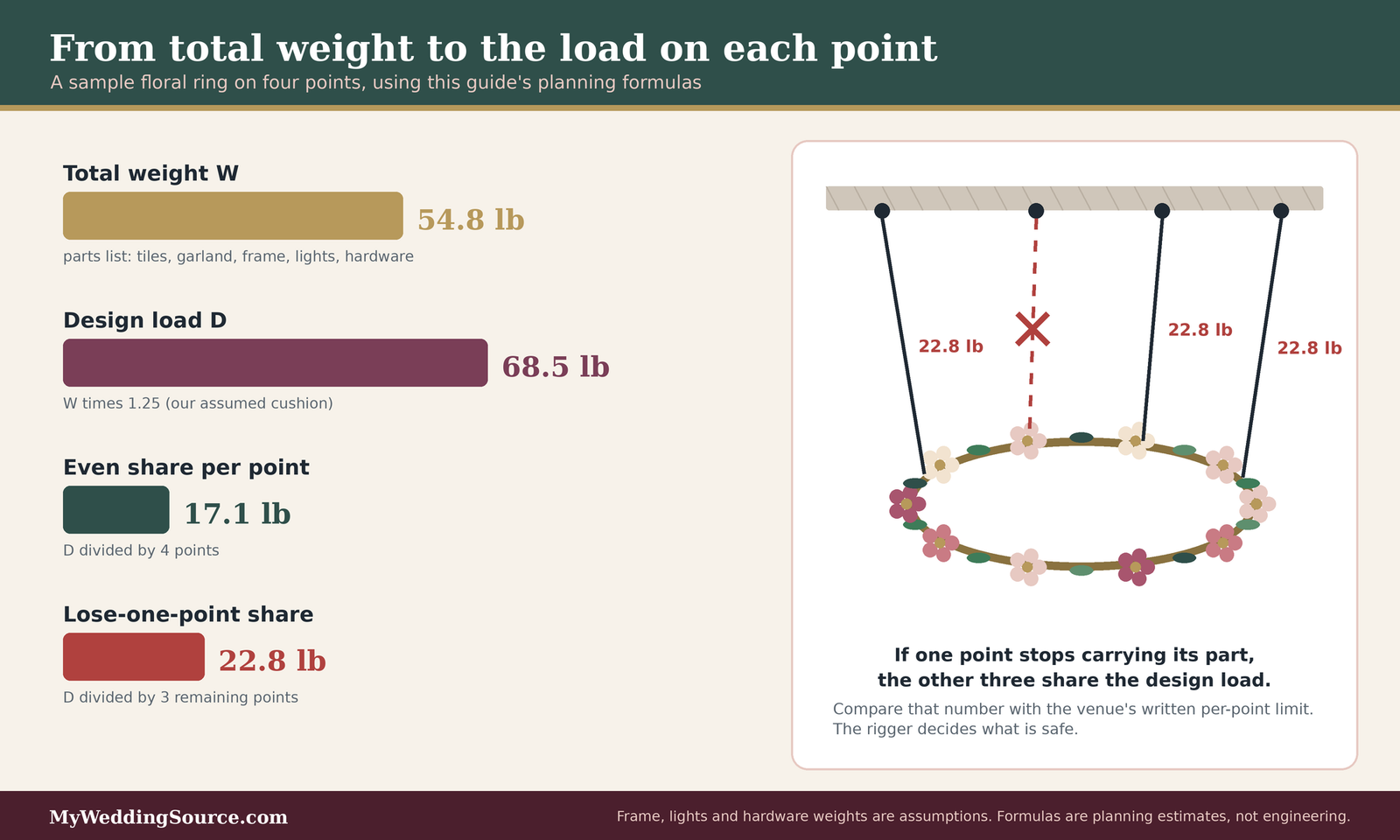
Add the component weights to get W. Multiply by 1.25 to get a design load D, which allows about a quarter for water, drift in the build, and last-minute additions. The 1.25 is our assumption, not a published figure. If your florist or rigger uses a larger allowance, use theirs.
Point load, and the lose-one-point check
Divide D by the number of points N to get the even share. Then divide D by N minus 1 to get the worst-case share if one point stops carrying its part. That second number is the one to compare to the venue’s per-point limit. If it is close to the limit, ask the rigger whether to add points or cut weight.
| Line | Formula | Sample input | Sample result |
|---|---|---|---|
| Garland or greenery | Length in feet times pounds per foot | 12 ft at 0.15 lb/ft (artificial garland listing) | About 1.8 lb |
| Foam-and-flower tiles | Tile count times pounds per tile | 6 tiles at 6.5 lb (midpoint of a florist’s 5 to 8 lb estimate) | 39 lb |
| Frame or hoop | Rigger or florist supplies | Assumed 10 lb | 10 lb |
| Lights, cable, hardware | Rigger or florist supplies | Assumed 4 lb | 4 lb |
| Total weight W | Sum of the lines | 1.8 plus 39 plus 10 plus 4 | About 54.8 lb |
| Design load D | W times 1.25 | 54.8 lb | About 68.5 lb |
| Even share per point | D divided by N | 4 points | About 17.1 lb |
| Lose-one-point share | D divided by N minus 1 | 4 points | About 22.8 lb |
Step three: three sample installations side by side
A calculator makes more sense when it runs on cases that differ. The three below are invented for illustration; they are not recommendations and they are not prices.
A garland over a head table
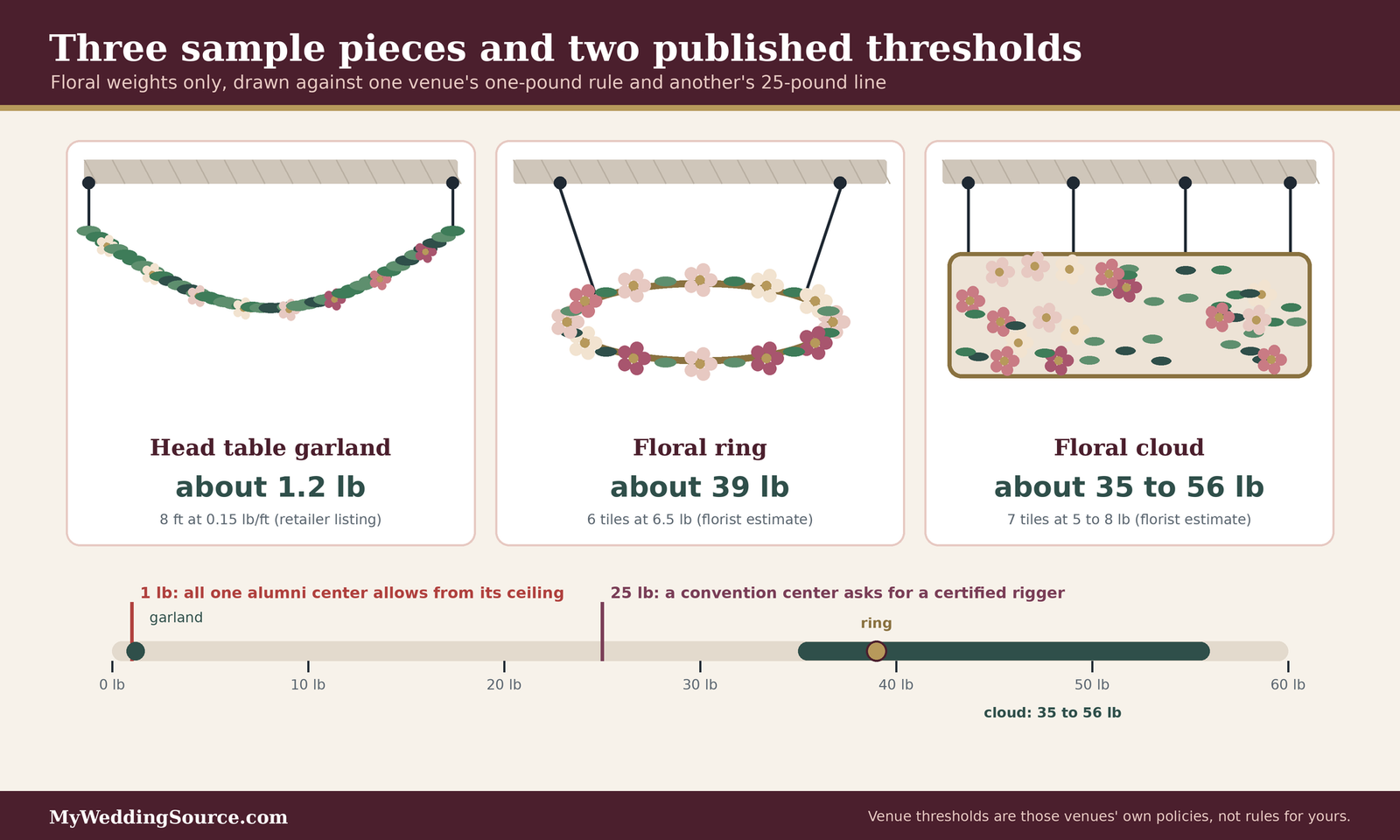
An 8-foot artificial garland at 0.15 pounds per foot weighs about 1.2 pounds, and with a small allowance for wire and fasteners it is still only a couple of pounds. That already exceeds the pound-or-less rule one alumni center publishes, which shows why even a “light” garland needs a question to the venue. It sits far below the 25-pound line that a Seattle convention center uses for certified riggers. Our wedding greenery garlands guide covers how to measure and order the length.
A ring-shaped floral chandelier
Our sample ring in the table above comes to roughly 55 pounds before the cushion, and about 69 pounds after it. That is well past the 25-pound line, so on that venue’s rules it would need a certified rigger and a drawing, and its lose-one-point share would be about 23 pounds on a four-point hang. The same piece would be far above the one-pound policy mentioned earlier. The weight is manageable for a building with rated points, which is the point: the arithmetic is rarely the obstacle, the permission is.
A floral cloud on a truss
The floral-products company’s 6.5-foot design used seven tiles, each cut in half into 14 panels. At the company’s five to eight pounds per tile, the florals alone come to about 35 to 56 pounds, and that excludes the aluminum truss, the chandelier the AV company installed in the center, and the motor that raised it. The company’s own advice is to consult the AV team about the structure’s weight early. For a piece this size, the florist and the venue’s technical staff are one conversation, not two.
Garland lengths for pieces that hang
Garlands are the building block of many wedding hanging floral installations, and their length behaves differently when they hang from above than when they lie on a table.
Measure the path, then allow for the drape
Measure the path the garland follows, including any drops and swags, and then use the multipliers in our wedding greenery garlands guide: supplier rules of thumb are about 1.5 times the span for a draped swag, or 20 to 30 percent extra for a gentle one, plus roughly 10 percent for breakage and seasonal variation. For vertical drops, measure from the point on the frame to the intended end, and add enough for the wrap around the frame. These are supplier habits, so ask your florist which one the quote assumes.
How much greenery sits on the frame
One DIY guide suggests about one to two greenery bundles per foot of structure, each made of two or three pieces crossed and secured, and about two to three bunches of baby’s breath per foot of area covered, advising buyers to purchase double their estimate. Treat those as one maker’s rules, not standards, and note that the baby’s-breath figure describes a cloud, not a garland. A higher density looks fuller and weighs more, so a change in density should trigger a change in the weight list.
Fastening and material choices, and who decides
Sources describe many ways to attach wedding hanging floral installations. This guide lists them so you can recognize the terms in a quote, not to endorse any of them. For anything that holds a load over people, the venue and the rigger choose the hardware.
| Material or method | What sources say about it | Question to ask the rigger or venue |
|---|---|---|
| Fishing line | A florist guide uses it for an invisible look; a DIY guide suggests line rated 50 lb or more; one convention center bans it for attachment in a hall | Is it permitted here at all, and who rates it? |
| Twine or jute | Used for rustic hangs and for candle accents in decor guides | May it carry a load, or only decor? |
| Zip ties and floral wire | Used to fasten elements to frames and tile panels to trusses | Are they allowed on the structure, and who inspects them? |
| Chains and cables | A florist guide lists sturdy chains and cables for heavier structures | Are they rated and marked, and what is the working load limit? |
| Hooks and eye screws | Industrial hooks are listed in florist guides; a DIY guide puts screw eyes in a wooden lattice | Where may they attach to the building, if anywhere? |
| Motorized truss or hoist | One floral design used a motorized truss so tiles could be attached at floor level | Who operates it, and who certifies the lift? |
| Pipe and drape frames | One alumni center recommends pipe and drape as the method for hanging decor | Does the venue or its rental company supply them? |
Frames and mechanics are part of the load
Wire hoops, wooden frames, chicken wire, and foam cages are all named in florist guides as the base for wedding hanging floral installations. They carry the flowers and they also carry their own weight. Choose the frame with the rigger, because the lightest frame that holds the design is usually the one that gets approved.
Test small before you test big
A florist guide recommends building a small-scale mockup and balancing flowers and greenery evenly to prevent sagging. A mockup on the floor, or hung from a stand the florist already owns, tells you about balance and stem placement. It tells you nothing about whether a ceiling point is acceptable, so do not treat a successful mockup as approval.
Fire, exits, and the building’s other rules
A ceiling is not an empty surface, and wedding hanging floral installations have to share it with everything else up there. It carries sprinklers, lights, ducts, and sometimes fire-protection systems that exist for the worst night of the building’s life, and the rules around them are the ones venues enforce most firmly.
Sprinklers, fixtures, and ducts are not hang points
Nearly every rule set we read says the same thing about the equipment in the ceiling, and it is one of the simplest rules to follow once you know it.
Do not hang from the fire system
A state fire marshal’s fact sheet on decorations says decorations must not hang from sprinkler pipes or sprinkler heads, because that can stop the system from working as designed in an emergency. A Seattle convention center lists sprinkler heads, light fixtures, conduit, and HVAC ducts among the elements nothing may be suspended from, and a San Francisco convention center adds false-ceiling hangers, expansion joints, and vents. If a florist’s plan quietly assumes one of these, ask the venue to say so in writing.
Do not block the air or the lights
The same Seattle rules prohibit blocking HVAC vents in one hall and restrict moving permanently installed lighting. Wedding hanging floral installations also change how stage and uplighting reach the room and can throw shadows where photographers need light. Our wedding lighting guide covers how decor interacts with the lighting plan, and it is worth involving whoever runs the lights in the hanging plan early.
Fresh material, flame, and flame retardancy
Fresh flowers and greenery in wedding hanging floral installations are combustible, and fire codes treat decorations as something to regulate, not just admire.
What the fire officials we read say
A state fire marshal’s guidance in Delaware says natural cut trees are banned in assembly occupancies unless the space has an approved automatic sprinkler system, and says combustible decorations must be flame-proofed or fire-retardant treated to a standard the fire marshal accepts. A Dallas fire-code information sheet for public assembly spaces says combustible decorations must be flame retardant and cites the NFPA 701 standard. Those are specific jurisdictions’ rules, and the Delaware rule is about cut trees, not garlands. They show the direction of the rules, and your local fire official decides what applies at your venue.
Candles and open flame in hanging pieces
Decor guides show candles attached to chandeliers and other wedding hanging floral installations. Venue rules are often stricter. The alumni-center FAQ requires every candle to be fully enclosed in a votive or cylinder and recommends LED candles, and the Dallas sheet says open flames and candles need fire marshal approval and a permit before an event. A flame above a hanging floral piece combines the two risks, so ask the venue about it before the design is final. LED candles are an easy way to keep the look without the question.
Exits and sightlines
Wedding hanging floral installations affect what people see and where they can go. Fire rules care about both.
Keep exits and signs visible
A state fire marshal’s fact sheet says decorations must not hide, block, or narrow exit doors or exit paths, and that they must not conceal exit signs or emergency lights. A hanging installation that dips low near an exit door, or that hides an illuminated sign from the dance floor, can fail that test even though it is nowhere near the floor.
Keep the walkways clear for the crew too
A Seattle convention center also bars free-standing items that obstruct exits, doorways, AEDs, fire equipment, or service access. Ladders, lifts, and cases used to install wedding hanging floral installations are free-standing items too, so plan where they are parked and when they leave. A good installation schedule puts the heavy equipment away before guests arrive.
Building and installing wedding hanging floral installations
The flowers in wedding hanging floral installations are alive, wet, and heavy, and the work happens above people’s heads, so the sequence of build, hydration, lift, and strike matters as much as the design.
Mechanics that change the weight
How the stems are held decides both the weight and the mess. The choice is a florist’s, but you can ask about it, because it moves the numbers in the calculator.
Floral foam and its trade-offs
Soaked floral foam is a common base for overhead panels. A floral-products company’s guide says to float-soak it, which takes about two minutes, not to exceed 20 minutes, and to use soaked foam within one to two weeks. Soaked foam holds water, and water adds weight to every panel, so the company’s chandelier example notes that its panels dripped periodically for about an hour after being installed. The same example had the tiles filled the Thursday before the event and held on a cart to drain. A state extension primer describes floral foam as non-compostable and warns that degradable plastics can leave microplastics behind, which matters if you care where the piece ends up.
Foam-free mechanics
An extension primer for florists lists alternatives: chicken wire that can be sanitized and reused, wadded curly willow or smilax stems, natural plant-fiber mechanics, and basalt-wool bricks. The Australian florist roundup notes that foam-free mechanics can hold bigger branches and fuller designs. Eco-friendlier mechanics may cost more, according to the extension primer. Ask the florist what the foam-free version weighs, because water-holding alternatives can be heavy too, and the answer should go into the weight list.
Installation day
Overhead work on wedding hanging floral installations has its own logistics: access, equipment, crew, and time. They are cost drivers, and they are a common reason a venue says no.
Sequence and timing
Florists quoted in the Australian roundup give set-up times of about two to six hours, plus about an hour to take the piece down the next day, depending on the florist and the design. One florist suggests installing early, before tables are placed, so ladders are easier to move. A DIY guide notes that venue access the day before may be needed, and that fresh flowers go on at the last stage, while faux pieces can be prepared weeks ahead. Our wedding vendor timeline and wedding flower logistics checklist show where to fit those windows.
Working at height
Ladders, scissor lifts, scaffolding, and rigs are all named in the florist roundup, and it advises asking the venue first whether it has its own. It reports that scissor lifts often need a special operator and that one florist prefers scaffolding because scissor lifts are heavy and can damage surfaces other than concrete, and should not go on lawns. A venue-services company says items over 75 pounds or 10 feet long may not be dead hung from a scissor lift. Ask who will operate the equipment, what the floor can take, and whether the venue’s own staff must do the lift.
Dripping, drafts, and heat
Anything alive and wet above a seating area needs a plan for what falls and what dries.
Water and mess
Foam-based pieces drip, so avoid placing them over the head table, a cake, or a dance floor without a plan. The floral company’s example lists weight, the water source, and keeping drips off guests as the main cautions. A foam-free build reduces the problem and changes the weight, so settle the mechanics before you settle the location.
Air, light, and time
A florist guide notes that lighting and airflow affect fresh flowers, and recommends misting and keeping stems in water until installation. Heat lamps, lights close to the piece, and air vents above it all shorten the life of a fresh arrangement. Our wedding flower refrigeration guide covers storage before the install, and fresh vs silk wedding flowers explains the trade-offs of faux pieces, which can be prepared weeks ahead.
Edge cases that change the plan for wedding hanging floral installations
The standard path is a venue with rated points and a cooperative rigger. Real weddings are messier, and the cases below cover the most common ways the plan shifts.
When the venue says no overhead
Many venues will refuse wedding hanging floral installations, and a refusal is a normal outcome. The design can usually survive it, because the visual idea is not the same as the method.
Pieces that stand instead of hang
A pipe-and-drape frame, a freestanding arch, or a floral cloud on posts can fill the space a hanging piece would have. Freestanding structures have rules too: a San Francisco convention center says freestanding structures 12 feet or taller without a certified engineer’s stamp must be tied off, and the Seattle sheet says ground-supported systems over 12 feet need a certified rigger’s inspection. Those are large-venue thresholds, but the lesson is that tall freestanding pieces still need a conversation. Our wedding backdrops and wedding aisle floral installation guides cover standing options.
Pieces that sit lower
Pieces at head height or below, such as a low floral cloud on stands or a flower-covered frame behind the head table, may avoid overhead permission, though the weight and fire rules still apply. Ask the venue whether it treats them as decor, and put the answer in writing.
When the plan changes late
Weather, headcount, and a florist’s availability change plans for wedding hanging floral installations after the paperwork is done. Each change can reopen a permission.
A new location or a bigger piece
If the ceremony moves under a tent, the structure changes, and the limits come from the tent manufacturer, not the building. If the florist upsizes, the weight list changes, and so does the point load. A venue-services company says additional loads may not be added to a truss at trim without approval, so treat any addition as a new request. Our wedding contract change orders guide covers how to record changes.
A substitution of flowers or mechanics
If a bloom becomes unavailable and the florist substitutes, weight and hydration needs may change, especially if a heavier stem or a wetter mechanic is used. Our guide to wedding flower substitution clauses. Whatever the contract says, ask the florist to commit to the maximum weight, not just the design.
Faux, reused, and rented pieces
Pieces that are not fresh flowers bring their own questions about weight, ownership, and damage.
Faux and mixed installations
A DIY guide says faux florals can be produced weeks in advance, and stresses fastening them so nothing falls on guests. Faux does not mean weightless. A florist who supplies faux greenery can usually give a weight from the supplier’s specifications, so ask for it. Mixed pieces with fresh stems on a faux frame need both lists.
Rented frames and damage
Rented frames, hoops, and trusses belong to someone else and carry damage terms. Convention-center rules say damage from rigging is billable, and one lists a per-point charge for damaged beam insulation. A wedding venue may have similar terms in its contract. Our wedding rental damage waivers guide explains how those waivers usually work, and the wedding rental planning checklist covers return logistics.
What wedding hanging floral installations cost, and who bills for what
We are not quoting dollar prices, because they vary by region, season, florist, and venue, and we did not find a reliable published figure. What we can describe is where the costs come from, which is useful when comparing quotes.
What drives the price
Wedding hanging floral installations cost more than a table piece for reasons that have nothing to do with the flowers.
The design itself
A florist’s blog lists the factors: who makes the piece and where you live, the number of floral chandeliers, the size of each, the frame construction, the type of flowers and greenery, live versus faux, and extra decor such as lights or fabric. The Australian roundup adds flower volume, since installations are often visible from all sides, plus extra staff for on-site construction and design complexity.
The rigging, equipment, and time
The same roundup lists rigging, equipment hire, and machinery, plus the height and the size and weight of the piece, as cost factors. Venue rules add their own: a Seattle convention center warns of rush charges for late rigging proposals, and a venue-services company says additional charges may apply if drawings arrive less than 21 days before load-in. A florist may not know what a rigger costs, so ask the venue who bills for it.
Where the cost really sits
With wedding hanging floral installations, the flowers are often not the biggest variable. Ask for separate lines for design and flowers, mechanics and frame, labor to build and install, equipment and rigging, strike, and any venue fee for review or supervision. Compare quotes on those lines, not on the total, and ask who pays if the venue refuses the hang after you have paid for the build. We have not quoted prices, and none of the figures in the sample calculator are costs.
Contract terms worth asking for
The contract is where a verbal approval becomes something both sides can rely on. We are not giving legal advice, and a lawyer can review any contract you are unsure about.
Approval before payment
Ask to tie the build deposit to the venue’s written approval, or to a refund or credit if the venue refuses. Ask the florist whether a fallback design is included, such as a freestanding version of the same look. Our wedding florist questions and wedding vendor subcontractors guides explain how to ask about who actually does the work.
Who is responsible for what
Ask who is responsible for the installation, who carries insurance, who removes everything at the end, and who pays for any damage to the ceiling, floor, or building. The Australian roundup lists liability for damage to floors or ceilings as a risk. We cannot tell you how the responsibility should be split, but it should be written down. See our wedding rental damage waivers guide for a related issue.
Questions to ask before you sign
Wedding hanging floral installations involve a conversation among at least three parties, and these questions give each a job. Ask them early, before a design is final.
Questions to ask before you sign
- May anything hang from the ceiling, tent, or structure at all, and where is that written down?
- What are the rated points, how much may each carry, and how far apart must they be?
- Who is allowed to install it, and does the venue require an approved or certified rigger?
- What drawings, weights, and attachment details does the venue need, and by what date?
- What is the total weight of the piece, listed by component, including the water in the mechanics?
- What happens if the venue refuses, the weather changes the plan, or the florist substitutes materials?
- Who removes everything at the end, and where do the greenery and mechanics go?
Questions for the venue
The venue controls the structure, so its answers set the boundaries of the design.
About the structure and the rules
Ask what the ceiling or frame is, whether there are approved points or none, what the per-point limit is, what attachments are prohibited, and whether decor may hang near sprinklers, vents, and lights. Ask whether the venue has hosted hanging installations before, and if you may see photos. Ask whether staff must do the hang or an outside rigger may.
About timing and paperwork
Ask what documents the venue wants, how many days before load-in it needs them, how long it takes to review, and whether rush or supervision fees apply. Ask when the florist may enter and how long the install may take, and whether any equipment, such as a lift, must be supplied by the venue. Our wedding venue load-in restrictions guide covers the schedule side.
Questions for the florist and the rigger
These questions tie the design to the numbers.
About weight and mechanics
Ask for the component weight list and what each assumption is, which mechanics are planned and what they weigh when wet, and how the piece is built and lifted. Ask whether a smaller mockup is part of the process, and how much weight the florist would remove if the venue’s limit were lower.
About the rigger and the plan
Ask who the rigger is, who they work for, what they will approve, what hardware they will use, and what their plan says about points and angles. Ask for it in writing, and make sure the venue has seen it. Ask whether a backup plan exists if a point is unavailable on the day.
After the reception: taking it down and sorting it out
Strike is the quietest part of the day for wedding hanging floral installations and the one most likely to be forgotten, so assign it before the wedding.
Take-down
The pull-down is usually easier than the install, according to one florist quoted in the Australian roundup, but the same florist notes that a same-day booking for the next wedding may mean an extra fee.
Who takes it down, and when
Confirm in the contract who takes the piece down, at what time, and who removes the hardware. A rigger who installed the points should remove the hardware that connects to the building. Do not ask a friend to climb a ladder to remove a piece that a professional installed. Our returning wedding rentals after a Sunday reception guide covers return timing for rented frames.
Check the ceiling afterward
Ask the venue to inspect the ceiling and points with the florist or rigger present, and have both sign off that nothing was damaged. A convention center in our sources says bent or damaged eyebolts must be reported immediately, which shows the kind of thing a careful venue checks.
Composting, donation, and waste
Wedding hanging floral installations are often large, and a lot of material comes down at once.
What can be composted
The EPA’s home-composting guidance says to keep herbicide-treated plants and diseased or pest-infested plants out of a home pile. Remove wire, tape, ties, and foam first, which is our own inference, since the primer we read says floral foam is not compostable. Ask the florist whether the material was treated, and whether the plan includes a compost pickup.
Donation and reuse
Some groups collect leftover event flowers. Our wedding flower donation after the reception guide explains how that works. Reusable frames, hoops, and mechanics often go back to the florist, so confirm who owns them and when they are collected.
FAQ: wedding hanging floral installations questions
Permission and venues
Can I hang flowers from any venue ceiling?
No. Many venues have no approved points, and some restrict even very light items. One university alumni center says it has no rigging points and allows only about a pound, with written approval. Ask for the policy in writing before you pay a florist to build a piece that hangs.
Who is allowed to install a hanging floral piece?
It depends on the venue. Published convention-center rules require certified or approved riggers for heavier or more complex work, and one venue-services company says its staff may refuse any hang. Ask the venue who may install, whether an outside rigger is allowed, and get the answer in your contract.
How far ahead should I ask about rigging?
As early as you can, before the design is final. Published lead times from large venues run from 21 to 45 days before load-in for rigging drawings, and late requests may cost more or be refused. A smaller venue may have no formal process, so ask what it needs and by when.
Weight and hardware
How much can a hanging installation weigh?
Only the venue or structure’s owner can say, point by point. Convention centers publish limits such as 500 or 1,000 pounds per point in some areas, while a small venue may have none. Ask for the per-point limit in writing, and ask your florist for a component weight list to compare.
Is fishing line strong enough to hang flowers?
Craft guides use it, and one suggests line rated for 50 pounds or more, but a convention center’s rules for one hall prohibit fishing line for attachment. Rigging hardware is typically chosen with a 5-to-1 design factor. Let the venue’s rigger choose and rate anything that holds a load overhead.
Does floral foam make the piece heavier?
Soaked foam holds water, which adds weight, and one floral company’s example panels dripped for about an hour after installation. That company estimated five to eight pounds per foam-and-flower tile but did not weigh them. Ask your florist for the wet weight of the design they propose, including mechanics.
Safety and aftermath
Can hanging flowers go near sprinklers, vents, or exits?
Not without the venue’s approval. Fire-marshal guidance says decorations must not hang from sprinkler pipes or heads, and must not hide or narrow exits or cover exit signs. Convention-center rules also bar suspending from fixtures and ducts. Ask the venue where decor may and may not go.
What happens to the flowers afterward?
Plan it before the wedding. The EPA says herbicide-treated and diseased plants should stay out of a home compost pile, and an extension primer says floral foam is not compostable. Remove wire and foam first, then ask your florist about donation, composting, or return of reusable frames.
Your next steps
Ask first, design second
Send the venue a short written question
Ask whether anything may hang, where, at what weight per point, and who may install it. Ask for the decor policy and any rigging documents. Our wedding venue questions guide has a longer list, and our wedding venue cost guide covers the budget side of the venue decision.
Hand your florist the answer and the calculator
Share the venue’s limits with the florist and ask for a component weight list using the worksheet in this guide. If the numbers do not fit, ask for a lighter or freestanding version of the same look. Our wedding florist questions guide and the overview of wedding flowers can help you frame the rest of the floral plan.
Put it in writing and on the calendar
Get approvals into the contracts
Make sure the venue’s approval, the approved installer, the points, and the load-in and strike times are written into the vendor agreements. Our wedding vendor timeline can help you place the dates.
Plan the end of the night
Name who takes the piece down, who removes hardware, and where the greenery goes. Use our wedding week checklist to place those reminders in the last days before the wedding.
Sources & methodology
How we built this guide
What we relied on
This guide combines published rigging rules from convention centers and a live-event venue-services company, a rigging-supply retailer’s explanation of working load limits, the ETCP certification program’s description of arena rigging, an industry magazine’s guidance on hanging loads from tents, state and city fire-marshal guidance on decorations, the U.S. construction rigging regulation, federal composting guidance, a state extension primer on floral mechanics, and florist and decor-supplier guides. Where a claim comes from a florist, retailer, or venue, we say so, because each describes its own practice. Venue figures are those buildings’ own policies and are not rules for your venue. The formulas, the 1.25 allowance, the lose-one-point check, and all sample totals are our own arithmetic and are estimates, and the frame, lighting, and hardware weights in the sample are assumptions, not measurements. We checked these pages on November 12, 2026 and did not verify that every organization named still operates or that each policy is current; confirm before you rely on one.
What we did not do
We did not inspect a venue, test or weigh any installation, or approve any rigging method, and we do not recommend one. This is not engineering, legal, insurance, or safety advice. Weight limits, fire rules, and building policies differ by place and change, so ask the venue, a qualified rigger, and your local fire official. We found no published load standard for hanging from trees, arches, or gazebos, and no published price list for hanging installations, so this guide offers neither.
Source list
Government, regulatory, and fire-safety sources
- U.S. Environmental Protection Agency, Composting at Home: https://www.epa.gov/recycle/composting-home
- Legal Information Institute (Cornell Law School), 29 CFR 1926.251, Rigging equipment for material handling: https://www.law.cornell.edu/cfr/text/29/1926.251
- Kansas Office of the State Fire Marshal, Fire Fact 087, Decorations: https://www.firemarshal.ks.gov/DocumentCenter/View/355/Fire-Fact-087—Decorations-PDF
- Delaware State Fire Marshal, General Fire Safety Requirements: https://statefiremarshal.delaware.gov/wp-content/uploads/sites/110/2024/04/General-Fire-Safety-Requirements-1.pdf
- Dallas Fire-Rescue, Fire Code Information Sheet, Public Assembly Occupancy: https://dallascityhall.com/departments/fire-rescue/Fire%20Code%20Information%20Sheets/Public%20Assembly%20Occupancy.pdf
- Mississippi State University Extension, A Primer for the Eco-Friendly Florist: https://extension.msstate.edu/publications/primer-for-the-eco-friendly-florist
Venue, rigging, and industry sources
- Seattle Convention Center, Event Services Rigging Overview (October 2023): https://seattleconventioncenter.com/sites/default/files/2023-11/Event%20Services%20-%20Rigging%20Overview%202023-10-20.pdf
- Moscone Center, Rigging Rules and Ratings: https://moscone.com/rigging-rules
- Pinnacle Live, Rigging Standards: https://www.pinnaclelive.com/rigging-standards
- University of British Columbia Alumni Centre, Decor and Venue FAQ: https://alumnicentre.ubc.ca/planning-toolkit/faq/decor-venue/
- ETCP (Entertainment Technician Certification Program), Rigger certification, Arena and Theatre: https://etcp.esta.org/certify/certify_rigger.html
- 4Wall, What is WLL and what is a design factor (retailer help article): https://www.4wall.com/help/what-is-wll-and-what-is-a-design-factor-safety-factor–n-214
- 4Wall, What is ETCP certification (retailer help article): https://www.4wall.com/help/what-is-etcp-certification–n-216
- InTents magazine, Safe installation for hanging loads: https://intentsmag.com/2010/12/01/safe-installation-for-hanging-loads/
Floral, retail, and decor sources
- Easy Weddings (Australia), What’s involved in having a floral ceiling installation: https://easyweddings.com.au/WeddingFlowers/advice/whats-involved-in-having-a-floral-ceiling-installation
- OASIS Floral Products, Create a spectacular flower chandelier using floral foam tiles: https://www.oasisfloralproducts.com/blogs/ideas/create-a-spectacular-flower-chandelier-using-floral-foam-tiles
- OASIS Floral Products, How and why to use floral foam: https://www.oasisfloralproducts.com/blogs/ideas/how-and-why-to-use-floral-foam
- Flower Moxie, DIY floral installation definitive guide: https://flowermoxie.com/blogs/moxie-blog/diy-floral-installation-definitive-guide
- Petal and Poem, Florist guide to hanging installations: https://www.petalandpoem.com/locations/florist-guide-to-hanging-installations
- Odeala Rose, Hanging floral installations for weddings: https://www.odealarose.com/blog/wedding-hanging-floral-installations/
- Eventbrite, Event rigging (event-production guide): https://www.eventbrite.com/resources/event-production/event-rigging/
- Target, Vickerman 6-foot green eucalyptus garland (retailer listing): https://www.target.com/p/vickerman-6-green-eucalyptus-garland/-/A-1006632347
- WebstaurantStore, Mills Floral Company 60-inch artificial mixed seeded eucalyptus garland (retailer listing): https://argo.webstaurantstore.com/mills-floral-company-60-artificial-mixed-seeded-eucalyptus-garland/1346001W4801.html