

Wedding rental return logistics is the part of a rental order that starts when the last song ends: who breaks everything down, who counts it, who hands it to the driver, and who is billed if a chair, a rack of glasses, or a bag of napkins does not come back. This guide gives you a plain pack-out plan, a chair reset count, and a pickup loss check so the answers are written down before the party.
Quick answer
In the rental terms we read, the person or business that signed the rental agreement stays responsible for the items from delivery until the company counts them back, and missing items are usually billed at replacement cost. That makes wedding rental return logistics a question of naming a packer for each item family, counting at every move, and keeping proof. Count the chairs three times (at delivery, after the ceremony-to-reception reset, and at staging), compare your staging count with the driver’s count, and photograph the staged items before the truck leaves. Search for any shortage right away, because several companies give a short window to return missing items before charging for them. Your signed contract controls, and this is general information, not legal advice.
What wedding rental return logistics covers
Most couples think about rentals twice: when they order and when the bill arrives. The work in between is a small logistics project, and it rarely gets an owner. Wedding rental return logistics is simply that project: breaking down, rinsing, stacking, bagging, counting, staging, handing over, and settling up. This section sets the boundaries so the rest of the guide stays practical.
Where wedding rental return logistics fits
The rental companies we read describe the same basic arrangement, and it helps to see the whole shape before looking at any single rule. The order is delivered, you or your team use it, you prepare it for pickup, and the company counts it back and bills for what is missing or damaged. Wedding rental return logistics lives in the third and fourth steps.
What this guide does and does not do
This guide is about the return side of a rental order, which is the heart of wedding rental return logistics: packing roles, counts, and loss. It does not repeat how to choose a damage waiver, how many extra chairs to order, or how a Sunday reception shifts the pickup calendar. Those topics have their own guides, and we point to them where they matter. Think of this one as the hand-off plan that sits between your rental order and your final invoice.
Who this is for
It is written for couples who ordered rentals themselves, for family members who were asked to “handle the rentals,” and for planners or venue coordinators who need a one-page standard to share. If a caterer or venue places the rental order for you, much of the packing may already belong to them, and the questions later in this guide help you confirm that.
Why wedding rental return logistics goes wrong
Returns tend to fail for ordinary reasons, not dramatic ones. People are tired, the venue wants to close, and nobody was told who owns the last hour. A planning article from Curated Events notes that couples often overlook the return pickup window, whether the venue requires trash removal before vendors leave, and how late the rental crew can stay. Those are logistics gaps, not honesty problems.
Too many hands, no single owner
During a wedding, rented items are handled by the couple’s helpers, caterers and bartenders, the venue crew, florists, photographers, and guests. Special Event Rentals, a company in Regina, makes this point on its post-event page: many people handle equipment during and after an event, so a loss can happen anywhere. That is a reason to name one coordinator rather than hope everyone assumes someone else has it.
The last hour is the weakest hour
The order was counted in daylight at delivery and is returned in the dark. Items are in motion, helpers are leaving, and people are eager to go home. Good wedding rental return logistics does not rely on counting at the start and again only when the truck arrives, because that leaves a long stretch where nothing is tracked. The method in this guide adds checkpoints in that stretch, which is where a missing chair is easiest to explain and easiest to find.
The vocabulary you will see
Rental paperwork uses a few words that matter more than they look. Knowing them makes your wedding rental return logistics plan much easier to write.
Delivery count and pickup count
The delivery count is the quantity the driver and you agree on when the order arrives. The pickup count is the quantity the company records when the items go back on the truck or into the warehouse. Several companies say they also count again at the warehouse. The difference between those numbers, after your own staged count is considered, is where a loss charge starts.
Replacement cost and recovery fee
Replacement cost is what the company charges when it considers an item lost, and the term is common across the policies we read. Special Event Rentals describes the charge as retail replacement cost. Party Rental Ltd. lists a separate product recovery fee when a return trip is needed to find items, and replacement costs if the items are not recovered within three business days of the scheduled pickup. These are examples from individual companies, not an industry standard.
Who packs in wedding rental return logistics
In wedding rental return logistics, the question “who packs” has no universal answer. It depends on your contract, your venue, and whether a caterer is involved. What you can do is split the work of wedding rental return logistics into roles, assign each role to a named person, and confirm in writing that the person knows what the rental company expects.
The five people who might pack
In practice, packing falls to one of five groups. The trick is to decide which group owns each item family before the wedding, because the default is that no one does.
The couple’s own helpers
For many weddings, the helpers are family and friends. Rental companies that give return instructions address the renter. PEAK Event Services, for example, says in its terms that equipment must be repackaged in its original condition and protected from weather, and that at multi-vendor sites the customer must clearly separate its items by vendor. If you assign friends, give them the company’s instructions, not just a request to “clean up.”
The caterer or bar team
Full-service caterers often handle rentals themselves. A Practical Wedding notes that many caterers do not own full sets of dishes, glassware, or linens and rent them for each event, and that you may be able to add your items to their existing order. When the caterer ordered the rentals, ask whether their team packs and returns them and whether the cost is already in your contract. Ask them to put that answer in writing, because a verbal promise is hard to prove later.
The venue or its coordinator
Some venues own their tables and chairs, and some require outside rentals to be gone by a set time. Whether venue staff will stack chairs or only point to the loading dock varies by venue. Treat it as a question, not an assumption, and see our guide to wedding venue load-in restrictions for the access side of the same conversation.
A planner or day-of coordinator
If you hired a coordinator, ask whether returns are part of their scope. Many coordinators plan the day and supervise teardown, but whether they physically pack and count is a contract question. Our guide to the wedding party coordination checklist can help you decide who else needs a defined job.
The rental company’s own crew
Some companies offer setup and breakdown for a fee. Party Reflections says in its FAQ that setup of chairs and tables can be added to a contract for a small fee, and PEAK’s terms list setup or breakdown as outside its standard order pricing. Where the company’s crew does the breakdown, the stacking question largely disappears, but the counting and the loss check do not.
Who the companies expect to pack in wedding rental return logistics
Across the policies we read, the expectation for wedding rental return logistics is consistent even when the details differ: the renter prepares the items for pickup and the company’s driver collects them. The preparation is where the work begins.
Instructions that appear again and again
Tables and chairs are commonly expected to be folded or stacked in one location. A Classic Party Rental says tables and chairs must be torn down and stacked in a single location, and Stuart Rental asks customers to stack them as they were delivered. China and glassware are commonly expected to be rinsed or scraped and returned in their racks or delivery containers, and linens are commonly expected to be shaken out. Each of these is a company policy, so use them as a checklist of things to confirm, not as a rule that applies to every vendor.
Where the instructions differ
Linens are the clearest example. A Classic Party Rental says customers need not wash rental items but asks that linens be shaken out and returned in its bags, with the bag left open if the linens are even slightly damp. Stuart Rental asks for linens to be returned dry to prevent mildew. Party Savvy’s FAQ warns against storing wet linens in plastic bags, and PEAK asks that linens not be put in trash bags at all, since staff may mistake them for garbage. The lesson is to read your own company’s linen instruction before the night, because the wrong bag can cause a charge.
A pack-out map for wedding rental return logistics at your venue
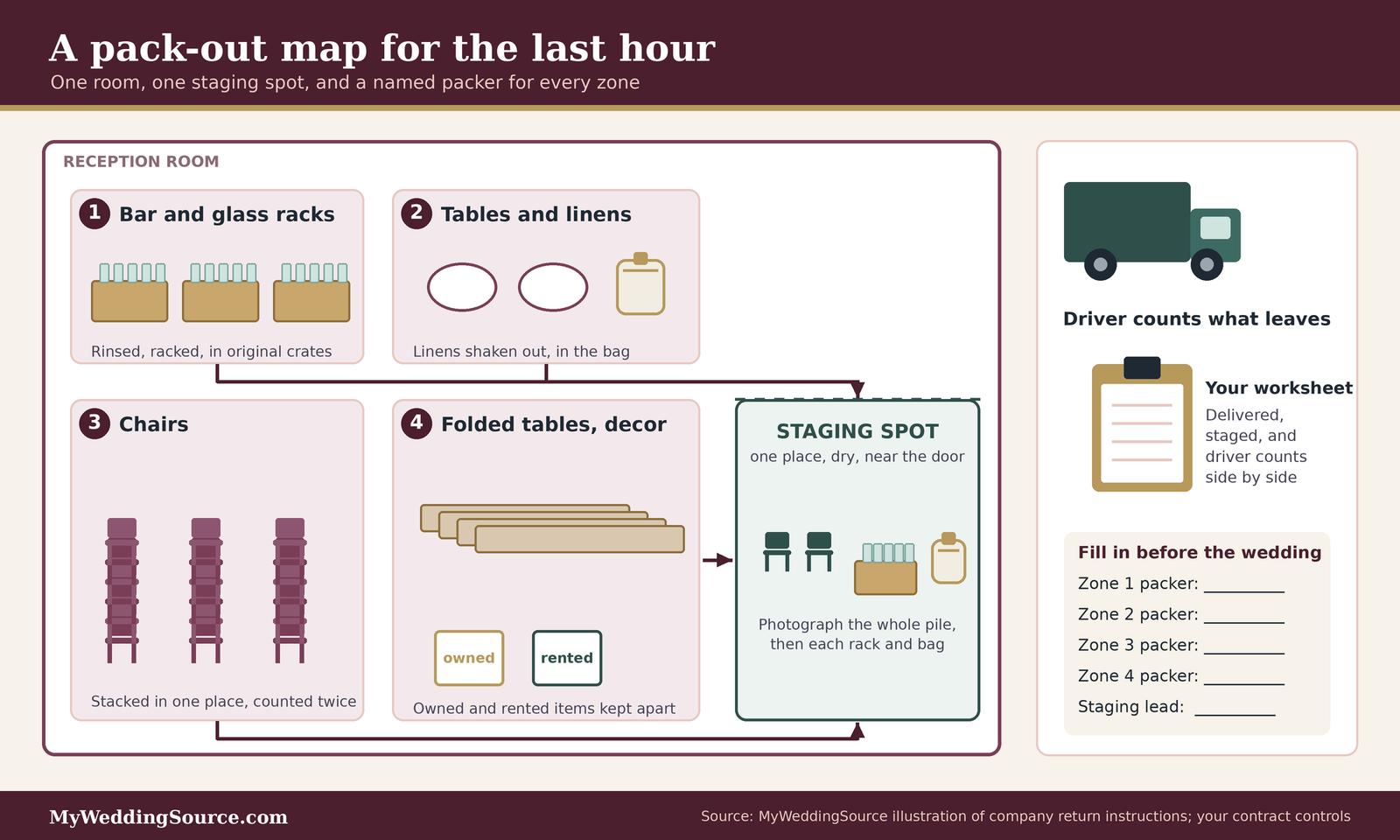
Before the wedding, draw or at least describe the path from the room to the truck. This part of wedding rental return logistics does not need to be fancy, and the first infographic below shows what the end result can look like.
Choose a single staging spot
Several companies ask that items be gathered in one location, a basic step in wedding rental return logistics. RSVP tells customers at a venue to gather all items in one spot and to make sure the venue contact knows when pickup will happen and where the items are held. Pick the staging spot with the venue ahead of time, and confirm it is near where the truck can park, is dry, and is not going to be cleaned by someone who might move or discard the items.
Mark the zones
Within the staging area, give each item family a zone: chairs, tables, racks of glassware and china, linen bags, and decor. Zones make counting faster and make gaps visible. If the glass racks are in a different corner from the chairs, a person walking the room can see at a glance whether anything is stranded.
Following every chair through the day
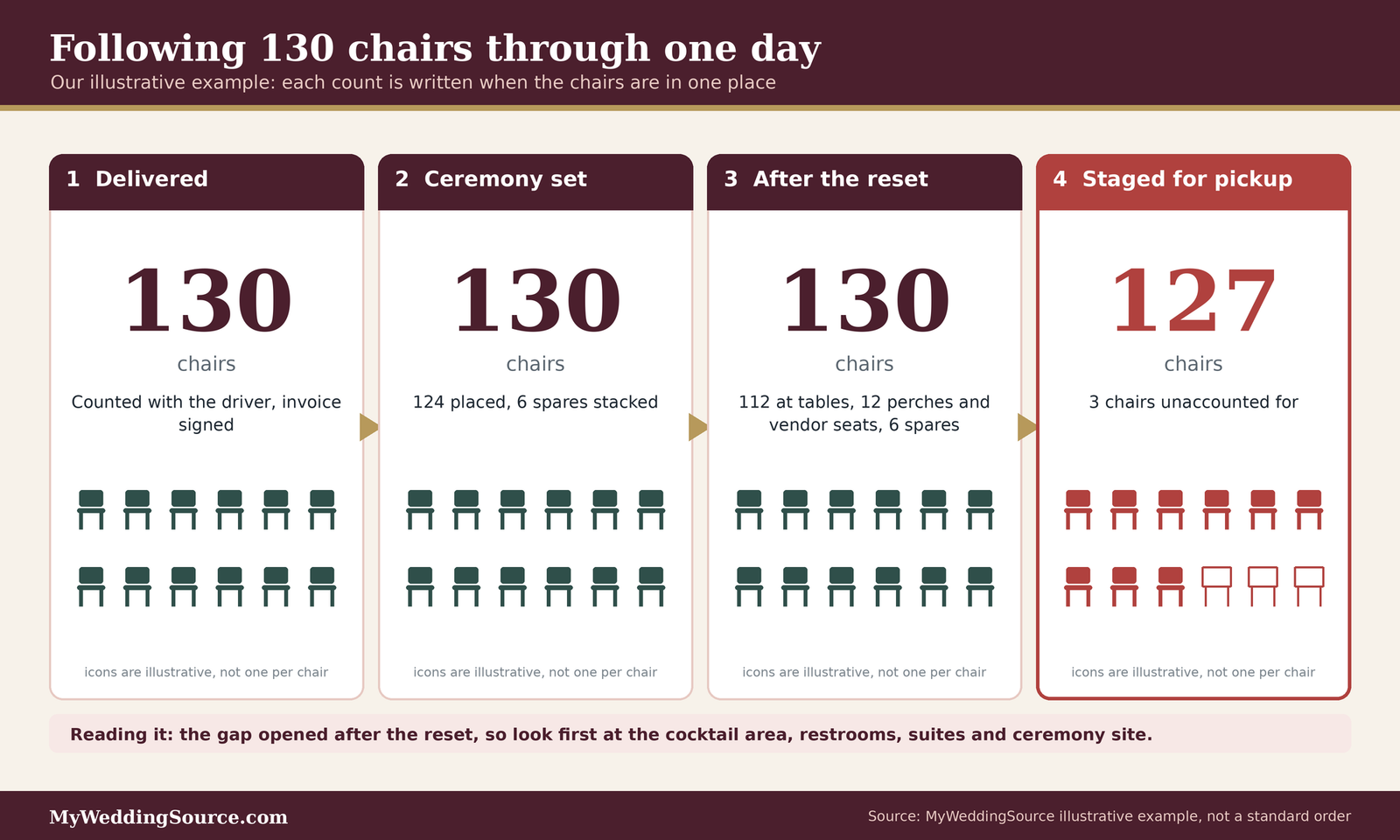
Chairs are the item most likely to cause a counting argument, because they move three times in one day: from the truck to the ceremony, from the ceremony to the reception, and from the reception to the staging spot. This is the chair reset count, the first of two tools in our approach to wedding rental return logistics. For how many chairs to order in the first place, see our guide on how to count extra rental chairs for ceremony and reception resets. Here we assume the order is placed and focus on tracking it.
The chair ledger
In wedding rental return logistics, a ledger is a short list of counts, written at moments when the chairs are all in one place. It takes five minutes per checkpoint and gives you an answer if the final number is short.
Four checkpoints
Write down the chair count at four moments. The first is delivery, when the driver counts the chairs with you and you sign the invoice. Special Event Rentals advises signing only after you are certain everything has arrived, since items found missing later can be charged as replacements. The second is after setup, when every chair is placed. The third is after the ceremony-to-reception reset. The fourth is at staging, before the driver arrives.
A worked example (our illustration)
Suppose the order is 130 chairs, which is an example and not a recommended number. At delivery the count is 130. After setup, 124 chairs are placed in rows and at the officiant and musician positions, and 6 spare chairs are stacked behind the ceremony area. After the reset, 112 chairs are at reception tables, 6 are at cocktail perches, 6 are near the band and vendor tables, and the same 6 spares are in a back corner. That adds to 130. At staging the count is 127. The ledger now tells you something useful: three chairs went missing between the reception and staging, not at delivery.
| Checkpoint | Count | Who counts | Running check |
|---|---|---|---|
| Delivered and signed | 130 | You and the driver | Matches the invoice |
| Ceremony set, plus spares | 130 | Helper or coordinator | 124 placed plus 6 spare |
| After the reset | 130 | Helper or coordinator | 112 plus 6 plus 6 plus 6 spare |
| Staged for pickup | 127 | Helper plus one more person | 3 short |
The reset is where chairs drift
If you flip ceremony chairs to the reception, the reset, the trickiest moment in wedding rental return logistics for chairs, is a short, crowded window in which chairs are carried across a room, a lawn, or a building. It is also the moment when a chair can end up in a hallway, behind a curtain, or in the bridal suite.
Assign a reset lead
Name one person who watches the reset and writes the count when it ends. The reset lead does not carry everything. They stand where they can see the doorway and confirm that the number at the reception matches the number from the ceremony. If your venue uses its own staff for the flip, ask the venue to give that lead a number rather than a thumbs-up.
What to do when the reset count is off
If the reset count does not match, stop and look before the reception starts, while the people who moved the chairs are still around. A short search of the ceremony site, the cocktail area, the restrooms, and the bridal suite will find most strays, and the search is easier at 5 p.m. than at midnight. If a chair is genuinely gone, write the number down and keep going; the loss check later will use it.
Chairs that are not at tables
Some chairs are used where no one is counting: lounge corners, the photo area, the cake table, the vendor tables, and the porch where guests drift for air.
Vendor and ceremony-team seating
Musicians, an officiant, a DJ, and a photographer may each take a chair. Our guide on wedding vendor meals covers feeding vendors, and the same planning that gives them a seat should record where that chair goes after the meal.
Accessible and reserved seating
Reserved or accessible seats are easy to forget at teardown because they may be set apart from the main rows. Include them on the ledger as their own line so the pickup count does not come up short for a reason that is easy to fix.
Packing standards for wedding rental return logistics, by item family
Once you know who packs, the next question in wedding rental return logistics is what “packed” means. The standards below come from the published instructions of the companies we read. They are examples to compare with your own contract, and where your company says something different, your company wins.
Dishes, glassware, and flatware
These items are the most fragile and the most likely to be billed for cleaning or breakage, so they deserve the most specific instructions.
Scrape, rinse, and rack
Several companies ask for food residue to be removed before return. PEAK’s general terms say china, glassware, flatware, and cooking equipment must be scraped clean, while A Classic Party Rental says dishware and flatware must be scraped and rinsed of all food and that extra cleaning fees apply if significant food residue remains. Special Event Rentals asks that plates and glassware be rinsed or wiped off. Party Reflections, by contrast, tells customers to find missing items before pickup and to leave tableware in the bags and crates it came in. The common thread is that you should not guess; ask what “clean enough” means for your order.
Racks and original containers
Return glassware to its racks and china to its crates when the company supplies them. A Classic Party Rental says china and glassware must be returned to their racks and lists unracked glassware among the things that can trigger additional charges. PEAK’s damage terms treat breakage of fewer than five china or glassware items per crate or rack as minor damage under its general terms, and a full crate or rack of broken pieces as a customer charge. That detail shows why the container matters: it is the unit in which the company thinks about loss. For glassware planning in particular, see our guide to wedding bar glassware rental.
Linens, napkins, and skirting
Linens are the easiest item to lose in a pile and the easiest to damage with the wrong storage. They are also the item where companies ask you to do the least, which makes the rules easy to miss.
Shake, bag, and keep dry
For wedding rental return logistics, the shared advice is to shake out food and debris, put linens in the company’s bag or on its hangers, and keep them dry. Special Event Rentals asks renters to shake linens free of debris or food, and Stuart Rental asks for linens dry and free of debris to prevent mildew and stains. Party Savvy advises avoiding wax, dye, burns, and mildew and says wax or mildew damage is not covered by its damage waiver. A single candle left on a runner can therefore turn into a replacement charge, so ask helpers to lift wax-prone decor before the linens are stripped.
Count the small pieces
Napkins, runners, and chair covers are small and numerous. One easy method is to count them into bundles of a fixed size as they are removed, then write the bundle count on the bag with a marker. A Practical Wedding suggests ordering about ten extra plates, forks, knives, and napkins to cover chips, drops, and vendors who were not in the headcount, which is a useful reminder that small items go astray at the same rate as everything else.
Tables, chairs, and large items
In wedding rental return logistics, large items are less likely to disappear, but they are the items that take the most effort to move, and the ones that cost the most to replace.
Fold, stack, and keep them together
The wording we found most often is some version of “folded and stacked in the same location as delivered,” which is how Party Savvy puts it. Stuart Rental asks customers to stack tables and chairs as they were delivered. If you used chairs in more than one place, bring them to one place or confirm in writing that the company will collect from each place. RSVP’s guidance for residences is to leave items where the crew set them, and for venues to gather everything in one spot.
Decor mixed with rentals
Owned decor and rented decor often share a table, a shelf, or an arch. Separate them before teardown starts. Our guide to wedding decor covers planning the look; the return plan only needs one rule, which is that anything the rental company did not deliver does not go on the pickup pile, and anything it did deliver does not go home in someone’s trunk.
Fees tied to how you pack
How you pack can change the bill even when nothing is lost, which is why wedding rental return logistics belongs in the budget conversation. The fees below appear in the policies we read.
Late, unready, or hard-to-find items
A Classic Party Rental says additional charges may apply if items are not ready on the contracted date, if food-related items are not cleaned, if china and glassware are not racked, or if tables and chairs are not stacked in one location. PEAK says it sends a secondary crew when it cannot find equipment on site and that pickup fees then apply. Party Rental Ltd. lists a re-pickup fee when items are not accessible on the scheduled date.
Delivery and pickup surcharges
PEAK lists time-based surcharges for delivery or pickup in the evening hours under its general terms, with charges that increase later at night. Special Event Rentals says late-night pickup fees can be avoided by leaving equipment unattended for a day or two after an event, but that doing so puts the theft and vandalism risk on the renter. Our guide to vendor overtime rates for weddings covers how late hours change other vendors’ bills.
What this actually costs
The companies we read put the cost of a careless return in three places: cleaning or unready-item fees, trip fees when items cannot be found or reached, and replacement charges for what is missing. We did not find a single price that applies to every company, so we are not quoting one. What we can say is that PEAK’s general terms list delivery or pickup surcharges of $200 to $500 for evening and overnight hours, and that the companies above that mention missing items bill them at replacement cost rather than rental price. Ask your company for its fee schedule and compare it with your contract before the wedding.
The pickup loss check for wedding rental return logistics
The second tool in our wedding rental return logistics method is a loss check you run in the thirty minutes before the truck is due. It is built to answer one question: if the company says something is missing, can you show that it was there, where it went, and what you did to find it?
Run the wedding rental return logistics check in four steps
The loss check is not complicated, and it is the part of wedding rental return logistics most couples skip. Its value is in doing the same four things each time, so that any gap is caught while the people and the venue are still available.
Step one: count the staged items yourself
Walk the staging area and count every item family. Write the counts on the worksheet below, not in your head. Use two people if you can, because a second counter catches the mistakes a tired first counter makes. Compare each number with the delivery invoice you signed, not with your memory of the order.
Step two: reconcile against the ledger
For chairs, compare the staged count with the last number on your chair ledger. For other items, compare against the invoice. Any difference becomes a line on the worksheet with the item, the number short, and the time. Do not try to explain the gap yet; just write it down.
Step three: search the usual places
Search before you call anyone. The places we would check, based on how a wedding actually moves, are the ceremony site, the cocktail area, restrooms, the bridal and groom suites, the parking area or shuttle stop, the caterer’s back-of-house area, trash and recycling bins, and vendor vehicles that were loading out. A florist may have packed a rented vase, and a guest may have carried a centerpiece to a hotel room. This list is our own suggestion, not a company rule.
Step four: photograph and hand over
Take a photo of each staged zone showing the whole pile, then close-ups of racks and bags with labels visible. RSVP recommends taking photos of items before leaving a venue, particularly at larger venues. Then be present for the driver’s count if you can. Special Event Rentals says it prefers that clients attend pickup so items can be counted together, and that it often counts alone otherwise.
The wedding rental return logistics worksheet
The wedding rental return logistics worksheet has seven columns. It fits on one page, and one copy goes to your helper and one stays with your paperwork.
What goes in each column
The first column is the item family. The second is the delivered count from the signed invoice. The third is your staged count. The fourth is the driver’s count, filled in on pickup day. The fifth is the variance, which is simply the staged or driver count subtracted from the delivered count. The sixth is where you searched. The seventh is whether you took a photo.
| Item family | Delivered | Staged | Driver | Variance | Searched | Photo |
|---|---|---|---|---|---|---|
| Chairs | 130 | 127 | 127 | 3 short | Ceremony site, suites | Yes |
| Glass racks | 18 | 18 | 18 | 0 | Not needed | Yes |
| Linen bags | 14 | 13 | 13 | 1 short | Caterer area, trash | Yes |
| Folding tables | 16 | 16 | 16 | 0 | Not needed | Yes |
Reading the variance
A variance of zero closes the line. A variance that matches between your staged count and the driver’s count means you and the company agree on what is missing, and the next step is to find it or accept the charge. A variance that differs between the two counts is a dispute you can discuss with evidence in hand. Both situations are far easier to handle with a photo and a ledger than with a recollection.
What “normal” loss looks like
Couples often ask whether some loss in wedding rental return logistics is simply expected. The only published figure we found was a rule of thumb attributed to caterers.
The three percent rule of thumb
Special Event Rentals says a caterer’s rule of thumb treats up to 3 percent missing as normal. That is one company describing one rule of thumb, from a Canadian rental company, and it is not a legal limit or a promise that you will not be charged. We mention it only because it explains why a very small shortage is common and why the first response should be to look, not to panic. For the 130 chairs in our example, 3 percent would be a little under four chairs, which is our arithmetic and not a company term.
When to treat a gap as serious
A shortage of a few small items deserves a quick search and a note. A missing rack, a missing crate, or a whole category of items deserves a call to the company right away, because a rack or crate is a bigger unit and more of your photos are relevant. PEAK’s terms say that if the customer cannot locate lost items, it may invoice the cost of the merchandise and related recovery costs, so a larger gap is worth raising early.
Who pays for losses in wedding rental return logistics
Everyone asks this question about wedding rental return logistics, and the honest answer is that the rental agreement decides it. What the policies we read have in common is a presumption that the renter pays unless the contract says otherwise. Your job is to know which clause governs, who the renter of record is, and who may owe you money in turn.
What the rental agreement usually says
The clauses below are examples from the companies we read. They show a pattern, not a rule, and your own agreement may be more or less generous.
Responsibility from delivery to return
Stuart Rental says responsibility for rented items remains with the customer from the time of delivery to return. Special Event Rentals says you remain responsible for missing or damaged items until you have counted equipment with the driver at pickup. A Classic Party Rental says missing equipment is charged at its cost unless it is returned within a reasonable time. The pattern is that the clock of responsibility starts at the door and ends at a count.
Waivers and what they leave out
A damage waiver is not the same as loss protection. Party Rental Ltd. says its 4 percent waiver covers minor damage from normal use but not theft or missing equipment, and that items lost or made unusable for an excluded reason are billed at replacement cost. A Classic Party Rental and Party Savvy make similar statements. Our guide to wedding rental damage waivers explains the difference in detail and lets you compare the fee to your own exposure.
When someone other than you may owe
In wedding rental return logistics, if a loss traces to another person, the rental company still bills the renter of record. Whether you can recover from someone else is a separate, private question.
Caterers, venues, and vendors
If the caterer placed the order, the caterer is the renter of record, and the company will bill the caterer. If you ordered, the company bills you, even if a venue worker or a vendor moved the items. Whether your caterer or venue contract makes them responsible for items they handled is a contract question, and a reason to ask for those terms in writing before the wedding. Our guide to wedding contract change orders explains how to document agreed changes so they do not rest on a conversation.
Guests and helpers
Guests and friends do not sign the rental agreement, so a company will not usually pursue them. Whether you ask a friend to contribute toward a loss is a personal decision that we cannot make for you. The more useful step is prevention: a named reset lead, a staging spot, and a count make it much less likely that the question arises.
Insurance and coverage questions
Insurance can sit around a rental loss in wedding rental return logistics, but it is not an automatic answer. We are not insurance advisers, and the notes here are prompts for a conversation with your agent.
Event and homeowners policies
Some event insurance policies and some homeowners or renters policies may address rented property, and some may exclude it. We did not review any policy for this guide. Our guide to wedding insurance lays out what to ask, and the main question to bring is whether rented property, theft, and unexplained disappearance are covered, and whether the policy requires a police report for theft.
Venue and vendor insurance requirements
Some venues require proof of insurance from vendors and may ask the renter to name the venue on a policy. Rental companies may also ask for insurance on larger items such as tents or lounge furniture. Check those requirements early, because they are far easier to satisfy before the wedding than after something goes missing.
The clocks that start when the truck leaves
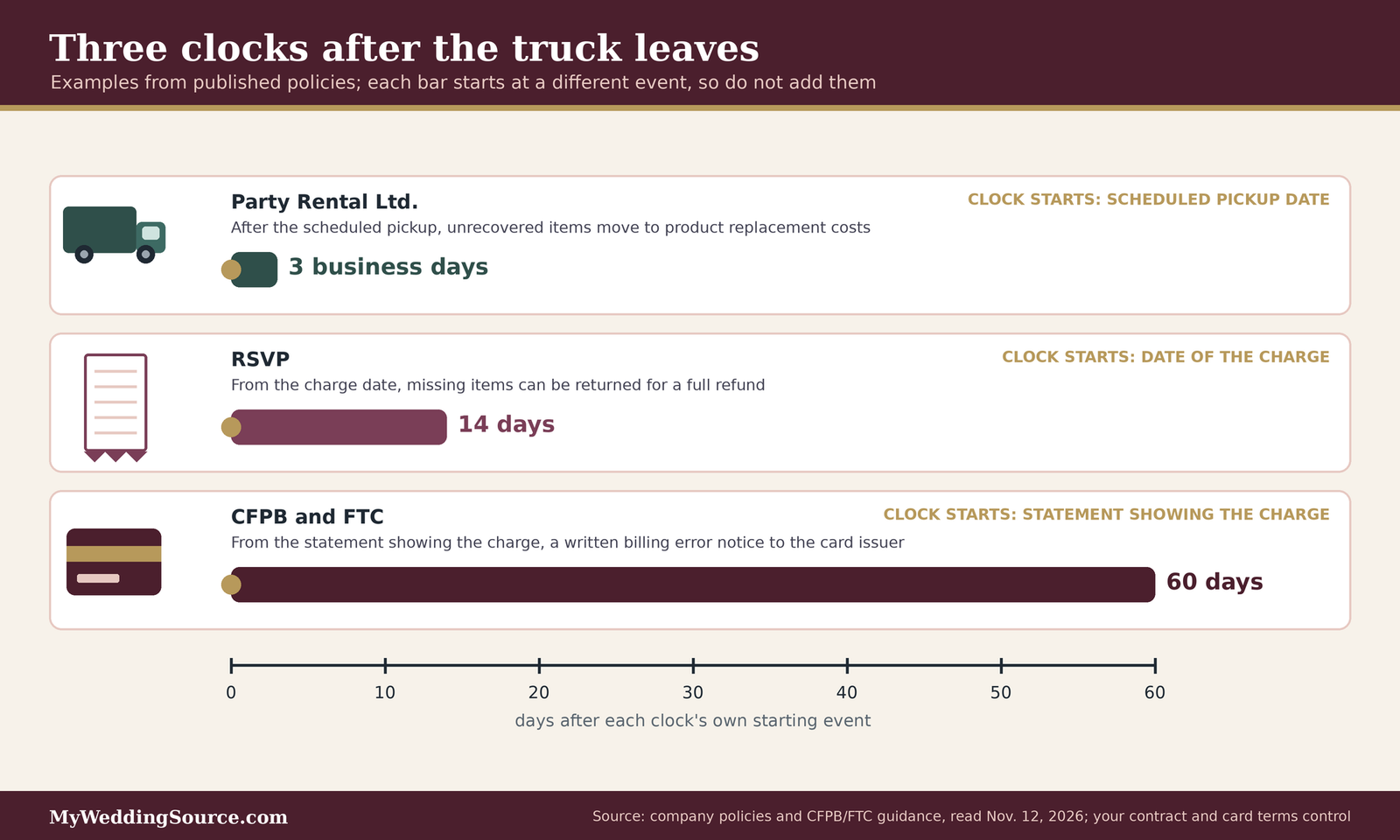
After the driver leaves, a set of short deadlines can begin, and they are an easily overlooked part of wedding rental return logistics. They differ by company and by card issuer, and the main danger is not knowing that they exist. The third infographic puts the examples we found on one timeline.
Company clocks in wedding rental return logistics
These are the windows we found in published policies. Treat them as examples, since your own agreement may use different numbers or none at all.
Recovery and replacement windows
Party Rental Ltd. says a product recovery fee applies if one or more items cannot be located at pickup and a return trip is needed, and that product replacement costs apply if the items cannot be recovered within three business days of the scheduled pickup. RSVP says missing items are billed when the contract closes and that you have 14 days from the charge date to return them for a full refund. Stuart Rental says that if you find and return missing items, your account is credited.
Notice, photos, and reporting
Timing also matters before the wedding. PEAK says missing or damaged items must be reported with photos before the event begins, and Special Event Rentals says the signature at delivery confirms the delivery is complete. If a count is wrong at delivery, say so at delivery. This is the single easiest way to avoid a dispute later.
The card dispute clock
If a charge on the final invoice looks wrong, the federal rules for credit card billing errors set a separate clock. We are describing public consumer guidance and not giving legal advice.
Sixty days from the statement
The Consumer Financial Protection Bureau says to send a written billing error notice within 60 calendar days after the charge appeared on your statement, and that a phone call alone does not protect your rights. The Federal Trade Commission describes the same 60-day window and says the issuer must acknowledge a dispute within 30 days and resolve it within 90 days. Both agencies describe keeping copies of everything you send.
What to try first
A dispute is a last step, not a first one. Start by asking the rental company for an itemized explanation, send your photos and ledger, and ask whether items found later can be credited. Our guide to wedding credit card reconciliation explains how to match each rental charge to your records, and the dispute process stays available if the conversation stalls.
Edge cases that change the plan
A tidy plan for wedding rental return logistics can still be bent by weather, by a second vendor, or by a helper who cannot come. These situations in wedding rental return logistics are common enough to prepare for and different enough that a generic checklist will not cover them.
Weather and site surprises
Rain, wind, and mud affect rentals more after the event than during it, because that is when the items are stacked and left.
Wet items and outdoor staging
For wedding rental return logistics in bad weather, companies that mention weather say items left outdoors unprotected are a customer responsibility. PEAK’s neglect examples include leaving items outdoors unprotected, and its care terms say equipment must be protected from weather and that it does not provide tarps. If the forecast is wet, ask the venue for an indoor or covered staging space and bring your own tarps for chairs and tables. Our guide to wedding photography rain backup covers the photo plan for a wet day, and the same weather call should include the return plan.
Overnight storage and security
If the company will not pick up until later, the items sit somewhere overnight. Special Event Rentals notes that leaving equipment unattended to avoid late-night fees shifts the theft and vandalism risk to the renter. Ask the venue whether the staging area is locked, whether staff will be on site, and whether anyone has keys. Photograph the staged items at the end of the night and again when you leave, and write down the time.
More than one rental order
Wedding rental return logistics gets harder when weddings have several orders: tables and chairs from one company, linens from another, and glassware through the caterer. Each has its own rules.
Two companies, one staging area
When two rental companies share a venue, the risk is that a driver takes the wrong stack or leaves another company’s items behind. PEAK says that at multi-vendor sites the customer must clearly separate its items by vendor. A Practical Wedding adds that two orders mean extra fees and more risk of returns going to the wrong company, and suggests one combined order where possible. If you cannot combine, tape a label on each zone naming the company and the invoice number.
The caterer’s rentals and yours
A caterer’s rented glassware and your rented chairs may sit side by side in the same service area. Ask the caterer which items are theirs and when their pickup is. Our guide to wedding catering service planning covers the service side, and the return plan needs only a clear line between the two inventories.
People problems
A wedding rental return logistics plan depends on the people in it, and the people in a wedding are tired, emotional, and often out of town by the next day.
The helper who cannot make pickup
If your helper cannot be present for the driver’s count, a rental company may count alone. RSVP says anyone can pick up a will-call order if they give the name on it, and Special Event Rentals asks that anyone returning items give the name the order was placed under. Give a substitute the same folder you would give the primary helper, including the worksheet, the photos, and the contract.
Couples who leave town
If you are leaving for a honeymoon, the person you leave in charge is acting for you. Put their name and phone number in the company’s file if the company allows it, and tell the caterer and venue who they are. Our wedding weekend event planning guide covers how to hand off responsibilities across a longer weekend, and the after-wedding checklist puts the return in context with your other post-wedding tasks.
Questions to ask before you sign
Most problems with wedding rental return logistics can be traced to a question that nobody asked before the wedding. The block below gathers the questions that matter for wedding rental return logistics in one place, followed by notes on what a good answer looks like.
Questions for the rental company
These wedding rental return logistics questions are best asked while you are comparing quotes, and again when you read the final agreement.
About packing and counts
Ask exactly how items must be prepared, who counts at delivery and at pickup, whether you may be present, and whether the pickup count is recorded on paper or by scan. One company tracks returns by barcode scanning and says any unscanned item is recorded as unreturned until it is scanned, which shows why it is worth asking how counts are logged.
About loss and fees
Ask how a missing item is priced, how long you have to return it before replacement costs apply, and whether a found item is credited. Ask what the fees are for late, unready, or hard-to-find items, and whether the damage waiver covers anything that is missing, which many do not.
Questions to ask about wedding rental return logistics
- Who packs each item family, and what does “packed” mean for dishes, glassware, linens, and chairs?
- Do you count at delivery and at pickup, and may I or my helper be there for both counts?
- If an item is missing at pickup, how is it priced, and how long do I have to return it for a credit?
- Does the damage waiver cover missing or stolen items, or only accidental damage?
- Are there fees if the items are not ready, not cleaned, not racked, or not stacked in one place?
- What is the pickup window, and what happens if the crew cannot find the items?
- If the caterer or venue handled any of the items, who is the renter of record?
- Can I add a second contact with authority to sign for pickup?
Questions for the venue and caterer
The rental company is only one party in wedding rental return logistics. The venue and the caterer decide whether your plan can actually happen.
About access and timing
Ask the venue when vendors must be out, where the truck may park, whether there is a staging space that stays locked, and who closes the building. Our guide to wedding venue questions covers the wider list, and the guide to wedding vendor communication deadlines can help you decide when to send each answer to each person.
About handling and responsibility
Ask the caterer whether their team will clear and rinse rented tableware, whether they use the same rack system the rental company expects, and whether they are responsible for what they handle. Ask for the answers in writing, and keep them with the rental agreement. If anything changes, our guide to the wedding vendor timeline shows where updates belong.
Packing and counts
Who is supposed to pack wedding rentals after the reception?
In wedding rental return logistics, the renter of record usually prepares items for pickup unless the contract says the company’s crew or the caterer does. The policies we read ask the renter to stack tables and chairs, rinse and rack dishes, and bag linens. Confirm in writing who owns each job, because the default is often no one.
Do I have to wash rented dishes and linens?
Often not, but the companies we read ask for some preparation. Several want food scraped or rinsed and linens shaken out and kept dry, and some charge extra when food residue remains. One says customers need not wash items but must scrape and rinse dishes. Check your own company’s page before the wedding.
Loss and charges
What happens if a rented chair goes missing?
The policies we read bill missing items at replacement cost unless they are returned within a stated window. Count chairs at each move so you can see where the gap opened, search the usual places, and tell the company promptly. A found chair is often credited, but the terms differ by company.
Does a damage waiver cover missing items?
In the terms we read, generally not. Party Rental Ltd., A Classic Party Rental, and Party Savvy each say the waiver does not cover missing or lost items, and PEAK says customers are responsible for missing items. A waiver usually addresses accidental damage, so read the exclusions before assuming it covers a shortage.
Counting and proof
Should I be there when the driver counts the pickup?
If you can, yes; it is the single most useful step in wedding rental return logistics. Special Event Rentals says it prefers that clients attend pickup so items can be counted together, and that it often counts alone otherwise. A second person with your worksheet and staging photos can stand in for you, so long as the company knows who they are.
What photos should I take before the truck leaves?
For wedding rental return logistics, take wide photos of each staged zone and close-ups of racks, bags, and labels, with the time visible if your phone records it. RSVP recommends photos before leaving a venue. Keep the photos with your worksheet and the signed delivery invoice, since together they show what you handed over.
Disputes and timing
How long do I have to dispute a wrong rental charge?
For a credit card charge, the CFPB and FTC describe sending a written billing error notice within 60 days. Company windows are separate and often shorter, such as the three business days and 14 days in the examples above. Contact the company first and keep every record, and check your own contract.
Is the couple always the one who pays for a loss?
Not always, but the company bills the renter of record. If a caterer or planner placed the order, they are the renter, and whether they or a vendor must reimburse you depends on contracts we have not seen. For legal questions about a specific dispute, speak with a qualified professional.
Your next steps
Before the wedding
Write the pack-out plan
Start your wedding rental return logistics plan by picking a staging spot with the venue, name a packer for each item family, and send the rental company’s own instructions to everyone who will help. Copy the loss check worksheet and fill in the delivered counts the day the order arrives. Our wedding rental planning checklist covers the ordering and delivery steps that come before this.
Confirm the clauses
Read the loss, waiver, and pickup clauses and mark anything unclear. Ask the company to explain missing-item pricing and the return window in writing. Our guide to returning wedding rentals after a Sunday reception adds the calendar questions if your wedding falls on a Sunday.
On the wedding day
Run the ledger and the check
On the day, wedding rental return logistics comes down to counting. Count at delivery, after the reset, and at staging, and keep the numbers on one page. Run the pickup loss check before the truck arrives, search for any gap, and photograph the staged zones. Check the seating plan in our reception floor plan guide if chairs will move to a different layout.
Hand over and keep the paper
Be present for the driver’s count or leave a named substitute. Ask for a receipt or written confirmation of the count, and keep it with the contract, the worksheet, and the photos. Keep everything for at least as long as the longest dispute window you found, and look at your card statement when the final charge posts.
Sources & methodology
How we built this guide
What we relied on
This guide draws on published return, pickup, damage, and missing-item policies from event rental companies, two event-planning articles, and federal consumer guidance on credit card billing errors. Company policies are cited as examples of how one business handles returns, because rental terms differ by company and region, and one of the companies is in Canada. The chair ledger, the loss check worksheet, the 130-chair example, and the percentage figure for that example are our own illustrations and arithmetic, not company terms. We read every page listed below on November 12, 2026, and policies, fees, and rules can change, so confirm current terms with your own rental company and card issuer.
What we did not do
We did not review your rental contract, your insurance policy, or your card agreement, and we did not test any company’s return process. Nothing here is legal, insurance, or financial advice. Contracts, state law, and card terms differ, and your signed documents control. Where a statement comes from a rental company, we attribute it, because its advice reflects its own business. Our list of places to search for missing items is our own suggestion, not a company rule.
Source list
Government and consumer-protection sources
- Consumer Financial Protection Bureau, How do I dispute a charge on my credit card bill: https://www.consumerfinance.gov/ask-cfpb/how-do-i-dispute-a-credit-card-charge-en-61/
- Federal Trade Commission, Using credit cards and disputing charges: https://consumer.ftc.gov/articles/using-credit-cards-and-disputing-charges
Rental company policies
- Party Rental Ltd., What happens if I break or misplace something: https://help.partyrentalltd.com/en_US/payment-and-policies/what-happens-if-i-break-or-misplace-something
- Party Rental Ltd., What is your policy on returning products upon pickup: https://partyrentalltd.helpjuice.com/payment-and-policies/what-is-your-policy-on-returning-products-upon-pickup
- PEAK Event Services, Rental terms and policies: https://WWW.PEAKEVENTSERVICES.COM/rental-terms-policies/
- A Classic Party Rental, Frequently asked questions: https://aclassicpartyrental.com/faqs
- Stuart Rental, Frequently asked questions: https://www.stuartrental.com/resources/faq/
- Party Reflections, Special event rentals FAQ: https://partyreflections.com/faq/
- Party Savvy, Frequently asked questions: https://partysavvy.com/canton/faqs
- Special Event Rentals (Regina), Post event: https://site1-regina-specialeventrentals.webguidecms.ca/rental-process/how-to-rent/post-event
- Special Event Rentals (Regina), Delivery day: https://site1-regina-specialeventrentals.webguidecms.ca/rental-process/how-to-rent/set-up-strike
- RSVP, Event rentals 101: https://rsvpparty.com/?p=38886
Planning articles
- Curated Events, Event rental logistics couples often overlook: https://curatedevents.com/blog/event-rental-logistics-couples-often-overlook/
- A Practical Wedding, Almost everything you need to know about party rentals: https://apracticalwedding.com/event-rentals/