

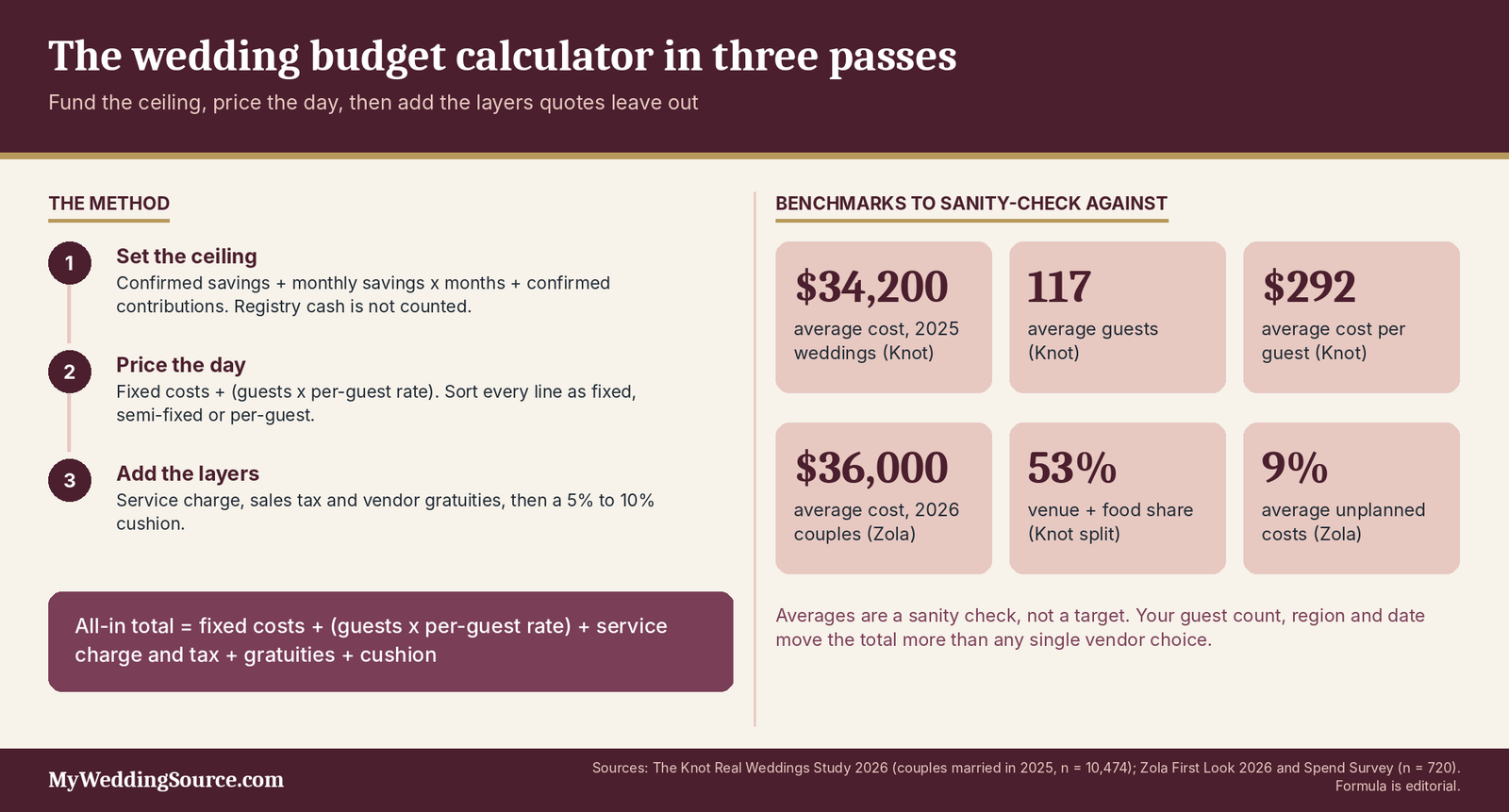
A wedding budget calculator works in three passes: set the ceiling you can actually fund, price the day as fixed costs plus a per-guest rate, then add the fee layers and cushion that quotes leave out.
You type 100 guests into a free wedding budget calculator and it hands back a tidy number, maybe $34,000, split into neat percentages. Then the venue sends a proposal with a food-and-beverage minimum, a 22% service charge and a line that says “plus applicable tax,” and the tidy number stops being useful. The calculator was not wrong so much as incomplete: it averaged what other couples paid, and it could not see your guest count, your date, your state’s tax rules or the way your particular vendors build a quote. A calculation you can see, line by line, survives those surprises because you know which input moved and by how much.
This guide teaches that calculation as a method you can copy into a spreadsheet or onto paper. You will set a funding ceiling, test it against 2025 and 2026 benchmark data, build a worked example for 100 guests, then see what changes at 50 and 150 guests. After that come the fee layers (service charges, gratuity, tax), the cushion that protects the plan, and a way to compare quotes without being fooled by different packaging. Our wedding budget guide covers vendor risks and contracts, and this page stays on the arithmetic.
No interactive tool is claimed here. Every figure below is either sourced to a named study or labeled as an illustrative example, and the illustrative numbers are there so you can replace them with your own quotes. If you finish the page with one spreadsheet and three questions for each vendor, it has done its job.
What a wedding budget calculator actually calculates
The calculation in one sentence
Funding ceiling minus the all-in cost of the day
Every wedding budget calculator, whether it is a website widget or a spreadsheet you built at midnight, does one subtraction. On one side sits what you can fund: savings, monthly contributions between now and the date, and money family has confirmed. On the other side sits what the day will cost once every required extra is counted. The difference is either a cushion or a gap, and the whole job of budgeting is deciding what to do about the gap early, while changing a guest count is still free.
Most online tools collapse the second side into a single guess. They multiply your guest count by an average, or they apply fixed percentages to a total you typed in, which means the result can only echo your assumptions back to you. A more useful calculator separates the spending side into costs that do not care about headcount (photography, officiant, attire), costs that scale with every chair (food, bar, rentals), and costs that appear as multipliers on top (service charge, tax, gratuity). That separation is what lets you answer a question like “what does 10 more guests really cost?” without guessing, and the later sections build it step by step.
Why the output is a range and not a single number
Even a carefully built total is a forecast, because several inputs will not be final until the contracts are signed and the final headcount is due. A venue proposal might carry a service charge anywhere from 18% to 25%, a caterer might price the bar by the hour or by the guest, and your state may or may not tax the planner’s fee. Treating the answer as a range, with a low case and a high case for the most uncertain inputs, keeps you from anchoring on a number that was only ever a midpoint.
A practical habit is to keep three versions of the total in your spreadsheet: a “quoted” column for what vendors have actually written down, an “expected” column for your best estimate of everything else, and a “stress” column that assumes the service charge is at the high end of the range you have seen and the headcount grows by 10%. If the stress column is still inside your ceiling, you can sign contracts calmly. If it is not, you have learned that on a Tuesday evening in your spreadsheet rather than on a Friday afternoon at the final-payment deadline.
How this page differs from our other budget guides
What the method adds to the budget report and the hidden-cost list
MyWeddingSource already publishes a general guide to the wedding budget that walks through vendor risk, payment schedules and scam warning signs, a list of wedding budget hidden costs that explains which add-ons tend to appear after a quote, and a 2027 wedding budget reality report that projects where prices are heading. Those pages answer “what should I watch for?” and “what is the market doing?” This page answers a different question: “given my guest count and my quotes, how do I calculate the total and see what moves it?”
If you read the three pages in order, the logic runs naturally. The report supplies context, the hidden-cost list supplies the line items you might forget, and this page supplies the arithmetic that puts those line items into a total you can compare to your ceiling. You do not need to read the others first, because every number used here is explained where it appears, but keeping the hidden-cost list open in another tab while you fill in the worked example is a sensible way to catch a missing row.
What this page does not do
This page does not tell you how much your wedding should cost, because that depends on your funding, your priorities and your region, and no national average can know any of them. It also does not offer personalized financial advice. When the discussion turns to borrowing or paying with credit cards, the guidance is general education drawn from federal consumer-protection sources, and your own situation may call for a conversation with a nonprofit credit counselor or a financial professional.
It also does not rank vendors or suggest that any particular style of wedding is better or worse. A courthouse ceremony with a restaurant dinner and a 200-guest hotel ballroom reception both run through the same formula; they just feed it very different inputs. If a number in the worked example looks higher or lower than your plan, that is a sign to swap in your own figure, not a sign that your plan needs to change.
What couples actually pay: the benchmarks worth calibrating against
National averages and what they leave out
The Knot’s 2025 numbers: average, median and guest count
The Knot’s 2026 Real Weddings Study surveyed 10,474 U.S. couples who married in 2025, and its data page is the most widely cited source for U.S. wedding costs. The Knot’s average wedding cost page reports an average ceremony-and-reception cost of about $34,200, an average guest count of 117, and an average cost per guest of $292. The study’s read-out also describes a median near $24,000, and that gap between the average and the median is the single most important thing to understand about these numbers.
An average is pulled upward by the minority of couples who spend a great deal, so the median, the point where half of couples spent less, gives a better picture of the typical experience. If your planned total is $24,000 you are not under-budgeting; you are sitting near the middle of the distribution. If it is $34,000 you are near the mean, and if it is $50,000 you are in the upper tail, which is entirely normal in a high-cost metro area or for a larger guest list. The average is a reference point and never a target.
Zola’s $36,000 and why two surveys disagree
Zola’s 2026 First Look Report draws on more than 11,500 couples planning 2026 weddings and reports an average cost of $36,000, unchanged from the prior year, with an average guest count of 145. Zola’s separate cost guide was last updated in March 2026 and combines its cost index with a post-wedding spend survey of 720 couples. The Knot and Zola figures are close, but they are not measuring the same thing.
The differences are easy to list. The Knot surveys couples after they married in 2025, while Zola’s headline figure comes from couples planning 2026 weddings, so one reports spending and the other reports plans. The two samples also differ in guest count (117 versus 145), which by itself would push Zola’s average up, and the platforms attract somewhat different couples. Treat the two numbers as a band of roughly $34,000 to $36,000 for a mid-sized U.S. wedding in this period, and avoid the temptation to average them into a falsely precise figure.
What sits outside the wedding number
Both studies draw a boundary around “the wedding,” and several large costs fall on the other side of it. The Knot lists the rehearsal dinner (about $2,800), the engagement ring (about $4,600) and the honeymoon (about $5,500) as costs outside the average wedding cost, and it reports wedding rings separately at about $3,000. Zola also tracks the honeymoon, rings and rehearsal dinner separately, with its own averages of $5,300, $1,500 and $2,700.
Those items matter for the calculator because they compete for the same pool of money. If your funding ceiling is $35,000 and you plan a $5,000 honeymoon and a $2,500 rehearsal dinner, the wedding itself has $27,500 to work with, not $35,000. Decide at the start whether your ceiling covers the whole celebration or only the ceremony and reception, and write that decision at the top of your spreadsheet. Our guide to honeymoon budget hidden fees covers that adjacent budget in detail.
How to read guest-count bands and category averages
The $17,100, $27,200 and $43,300 bands
The Knot’s cost page breaks the average by guest count: $17,100 for weddings of 1 to 50 guests, $27,200 for 51 to 100, and $43,300 for more than 100. These bands show that cost rises with headcount, but they should not be read as a price list. Each band holds couples with very different guest counts, regions and formats, and the 51-to-100 band includes both a 55-guest wedding and a 100-guest one.
The bands are most useful as a sanity check on a total you have already built. If you calculate $22,800 for a 50-guest wedding in a major metro, that is above the 1-to-50 average, which tells you to check whether a premium venue or a long list of vendors is responsible. If you calculate $12,000 for 80 guests, that is far below the 51-to-100 average, so look for a missing line such as the service charge or rentals. A gap between your total and the band is a prompt to investigate, not a verdict.
Why adding up category averages overshoots
It is tempting to build a budget by adding up published category averages: venue, catering, photography, flowers and so on. Zola’s cost guide lists fifteen category averages, and when you add them the total comes to about $46,900, which is well above Zola’s own $36,000 overall average. The most likely explanation is that each category average describes only the couples who bought that category, and no single couple buys every category at its average price.
That finding shapes how the worked example in this guide is built. Instead of summing every average, it picks a realistic set of services for a specific style of wedding, uses sourced figures where they exist, and leaves out categories that a couple at that budget might skip, such as a videographer or a band. When you build your own version, include only the categories you intend to hire and treat the category averages as quote sanity checks rather than line items to fill.
| Benchmark | Figure | Source and sample | How to use it |
|---|---|---|---|
| Average ceremony and reception cost | About $34,200 | The Knot, couples married in 2025 (n = 10,474) | Reference point, not a target |
| Median cost | About $24,000 | The Knot read-out, same sample | Closer to the typical couple |
| Average guest count | 117 | The Knot, same sample | Compare with your list |
| Average cost per guest | $292 | The Knot, same sample | Includes fixed costs, so it overstates the cost of one more guest |
| Zola average cost | $36,000 | Zola First Look, couples planning 2026 weddings (n over 11,500) | Planned, not reported spending |
| Cost by guest count | $17,100 / $27,200 / $43,300 | The Knot, 1-50 / 51-100 / over 100 guests | Sanity check for a finished total |
| Hidden costs | About $3,314, roughly 9% of spend | Zola Wedding Spend Survey (n = 720) | Reason to hold a cushion |
Step 1: Set the ceiling by counting what you can actually fund
Building the funding line
Savings today and savings by the wedding date
The ceiling begins with money you can verify: the balance in the account you have set aside for the wedding, plus what you will realistically add each month between now and the date. Be conservative with the monthly figure, because it competes with rent, travel, car repairs and every other thing life sends in a twelve-month window. A reliable way to set it is to look at your last three months of actual transfers rather than your intentions, and use the lower number.
Multiply the monthly amount by the months remaining until the final vendor payments are due, not until the wedding itself. Most final balances come due 14 to 30 days before the date, so a wedding 15 months away usually has about 14 months of useful saving. That small adjustment matters when a gap is tight, and it also means a bonus or tax refund that arrives in the last month cannot help with payments that are already past due. Write the date your last payment is due next to the savings figure so you remember which clock you are on.
Contributions: confirmed, likely and hoped-for
Family contributions are common enough to plan around but uncertain enough to label carefully. Zola’s 2026 report found that 88% of couples contribute financially to their own wedding (29% fully, 59% partially) and that 71% receive some family financial help, with 69% of those saying both families contribute. Those percentages describe a typical pattern; they say nothing about your family, and they should not be read as an expectation that anyone owes you money.
Sort every contribution into three buckets. “Confirmed” means the person has told you an amount and a date, ideally in writing or in the account. “Likely” means someone has said they want to help but has not given a number. “Hoped-for” is everything else. Only the confirmed bucket belongs in the ceiling, and the likely bucket belongs in a stress scenario you can revisit when the number firms up. The Knot’s guide to paying for a wedding adds a practical caution: parents who contribute may expect a say in decisions such as the guest list or venue, so it helps to talk about that expectation early and plainly.
Why registry cash is not part of the ceiling
Cash registry funds have grown quickly, with Zola reporting that 27% of 2026 couples are adding cash funds to their registry, up from 16% the year before. They are a welcome source of help, but the timing is a problem for budgeting. The Knot’s guide notes that guests’ cash gifts usually arrive near the wedding, often after vendor payments are due, so they cannot be counted on for the payments that decide whether you keep your date.
A workable rule is to treat registry cash as a recovery fund. If gifts arrive after the final payments, they can repay a credit card balance, replenish the savings you drew down or fund the honeymoon. Counting them in the ceiling creates a hole in the plan exactly when the largest balances come due, and it can push you toward borrowing to bridge a gap that gifts would only later cover.
Working backward from a date
The monthly-savings formula with real numbers
If you know the target total, you can solve for the monthly savings needed instead of guessing. The formula is: monthly savings needed = (target total – savings today – confirmed contributions) / months until the last payment. Suppose the target is $35,000, you have $8,000 saved, a family member has confirmed $5,000, and the last payment falls 15 months from now. The calculation is ($35,000 – $8,000 – $5,000) / 15, which equals $1,467 per month.
The Knot’s guide to paying for a wedding offers a similar illustration, noting that a $20,000 budget saved over 12 months works out to roughly $1,700 per month. That is illustrative arithmetic rather than a recommendation, and the point of working it out is to see whether the number is realistic for your household. If $1,467 per month would force you to skip other priorities such as emergency savings or retirement contributions, the arithmetic has just told you to change the target total, the date or the guest list, which is a far better time to learn it than month eleven.
What to do when the ceiling and the quotes do not meet
When your ceiling is below the all-in total you calculate, you have four levers, and they are not equal. Changing the guest count affects the largest block of variable cost and is free until invitations go out. Changing the date, to a Friday or Sunday or an off-peak month, can lower prices across venue, catering and vendors at once. Changing the format, for example a daytime reception with lighter food, reduces the per-guest rate. Raising the ceiling through more saving or borrowing is the fourth lever and the one with the longest tail of consequences.
Work through the levers in that order, and rerun the calculation after each one rather than making several changes at once, so you can see which one did the work. It also helps to decide your non-negotiables before you start trimming. If photography matters more to you than flowers, say so out loud now, because the temptation under pressure is to shave a little from everything and end up with a plan you love nowhere. The percentage-split step in the next section is built for exactly that conversation.
Step 2: Split the total with percentages, then test the split
Percent splits as a first draft
The Knot’s 2026 allocation and how to read it
A percentage split answers the question “roughly how much should each category get?” before any vendor has quoted anything. The Knot’s budget breakdown, built from its 2026 Real Weddings Study, puts venue and rentals at 29% of the budget, catering, cake and drinks at 24%, photography and videography at 10%, flowers and decor at 9%, music at 6%, attire and beauty at 6%, wedding rings at 5%, the planner at 4% to 5%, guest entertainment at 3%, transportation at 2%, and stationery and the officiant at 1% each. The article’s own figures add to 101%, which is rounding rather than a hidden error, and it describes the percentages as national averages meant as a starting point.
The table below applies those percentages to a $35,000 total so you can see the dollar value of each slice. Venue plus food and drink lands at about 53% of the total, which matches a pattern most planners will recognize: the space and the meal together take roughly half the budget, and everything else competes for the other half. If your venue is a family property or a courthouse, that 53% will be far lower and the remaining categories can rise accordingly.
| Category | Knot 2026 share | Dollars at $35,000 |
|---|---|---|
| Venue and rentals | 29% | $10,150 |
| Catering, cake and drinks | 24% | $8,400 |
| Photography and videography | 10% | $3,500 |
| Flowers and decor | 9% | $3,150 |
| Music | 6% | $2,100 |
| Attire and beauty | 6% | $2,100 |
| Wedding rings | 5% | $1,750 |
| Planner | 5% | $1,750 |
| Guest entertainment | 3% | $1,050 |
| Transportation | 2% | $700 |
| Stationery | 1% | $350 |
| Officiant | 1% | $350 |
Where percentages mislead
Percent splits break down in three predictable places. The first is at the edges of the budget: a $12,000 wedding cannot give the photographer 10% ($1,200) and still hire someone experienced, while a $90,000 wedding does not need to spend 29% of its budget on a venue to feel generous. The second is any plan where one vendor bundles several categories, such as an all-inclusive venue that covers the space, food, bar and rentals in one price, because the percentages assume those costs are separate lines. The third is a plan in which a category is skipped altogether, because the leftover percentage has to go somewhere, and it quietly inflates the other slices.
The practical lesson is to use percentages as a sanity check and not as a recipe. If your calculated photography line is 18% of the total, ask whether that reflects a deliberate priority or a quote that is higher than you realized. If your flowers line is 3%, ask whether that matches your plan or whether you have forgotten to price the ceremony and reception separately. Either way, the percentage did its job by pointing at the number worth a second look.
Reweighting for what you care about
Sorting lines into protect, flex and skip
The most useful move after a first-draft split is to sort every category into one of three groups. “Protect” means the line is central to why you are doing this and you would cut other things first. “Flex” means you care about it but could accept a smaller version, such as a shorter photography package or seasonal flowers. “Skip” means you would not miss it, such as a videographer, favors or a late-night snack. Most couples find that three or four categories land in “protect,” and the rest divide evenly between flex and skip.
Do this exercise separately with your partner before you compare notes, because it often reveals a priority one of you had not mentioned. One person may assume live music is non-negotiable while the other assumed the playlist was fine, and finding that out on a Sunday morning with a spreadsheet is much cheaper than finding it out after a deposit. Once the groups are agreed, shift percentage points from “skip” and “flex” into “protect” and write the new split next to the baseline so the trade is visible.
Three illustrative reweights at $35,000
The table below shows three editorial examples of how a split might change when a couple protects food, protects photos and music, or protects the space and its styling. These are illustrations of the method, not survey data, and each column sums to 100%. The categories are grouped more coarsely than the previous table so that the trade-offs are easy to see.
At $35,000, moving from the baseline to the food-and-drink-first split raises the food line from $8,400 to $11,200 and lowers flowers and decor from $3,150 to $2,100. That is a real change in the experience, and it shows why a one-size percentage split is only a starting point. Rerun your own version with your protect list and compare it to the baseline; the gaps between the columns are the conversation to have before you talk to vendors.
| Category group | Knot baseline | Food and drink first | Photos and music first | Space and styling first |
|---|---|---|---|---|
| Venue and rentals | 29% | 25% | 26% | 33% |
| Food, cake and drinks | 24% | 32% | 21% | 22% |
| Photo and video | 10% | 9% | 15% | 8% |
| Flowers and decor | 9% | 6% | 7% | 14% |
| Music and entertainment | 9% | 9% | 13% | 6% |
| Attire and beauty | 6% | 6% | 6% | 8% |
| Planner | 4% | 4% | 4% | 4% |
| Rings, transportation, stationery, officiant | 9% | 9% | 8% | 5% |
Step 3: Use per-guest math without fooling yourself
Which costs move with each guest
Variable, semi-fixed and fixed lines
Guest count drives the total more than any other single input, but it does not drive every line equally. Zola’s cost guide offers a useful framing: it suggests budgeting roughly $150 to $300 per guest for the guest-dependent costs, meaning food, beverages, rentals and similar items, and it treats photography, videography and music as costs that depend more on hours and service level than on headcount. That split into guest-driven and time-driven costs is the backbone of the calculation.
For the formula, sort each line into one of three groups. Variable lines scale almost one-for-one with chairs: food, bar, plates and glassware, linens, invitations, favors. Semi-fixed lines grow with headcount in steps or slowly: the venue site fee (larger rooms cost more), florals (more tables), photography (more hours or a second shooter), and the planner (more coordination). Fixed lines barely react to the number of guests: the officiant, attire, hair and makeup, and the DJ or band’s core fee. The table below lists the lines used in this guide’s worked example and how each behaves.
| Line | Behaves like | Why it moves, or does not |
|---|---|---|
| Food and bar | Variable | Priced per guest, then multiplied by service charge and tax |
| Rentals (chairs, linens, tableware) | Variable | One set per guest, plus delivery minimums |
| Invitations, favors, dessert | Variable | One per household or per guest |
| Venue site fee | Semi-fixed | Capacity tiers and larger rooms cost more |
| Photography | Semi-fixed | Longer coverage or a second shooter at larger sizes |
| Florals and decor | Semi-fixed | More tables and aisle rows to dress |
| Planner or coordinator | Semi-fixed | More vendors and logistics at larger sizes |
| Music, attire, hair, officiant | Fixed | Priced by service, not by headcount |
Step costs: the jumps that averages hide
A real quote does not rise smoothly with headcount; it jumps. A venue may include tables and chairs for up to 120 guests and charge for rental sets beyond that. A caterer may require an additional bartender or server at a particular headcount, and the ratio varies by company, so it is a question to ask rather than a number to assume. A photographer’s package may cover a set number of hours, and more guests can lengthen the cocktail hour, the group photos and the dinner.
The Knot’s cost pages show the same pattern in the data. Its photographer cost page reports averages of about $2,000 for weddings of 1 to 50 guests, $2,700 for 51 to 100, and $3,500 for 101 or more, and its planner cost page reports $1,700, $1,900 and $2,300 for the same bands. Neither band is a price list, but together they confirm that “fixed” costs creep up with scale, and that is why the worked example later in this guide raises several lines between the 50-, 100- and 150-guest scenarios.
Average cost per guest versus the cost of one more guest
Why $292 is not the price of a plus-one
The Knot’s headline cost per guest of $292 is an average: it is the total cost of the wedding divided by the number of guests. That total includes the venue site fee, photography, attire, the officiant and everything else that would exist even if the guest list were half as long. For that reason, the average cost per guest overstates what one additional guest costs, and it also understates what the first guests cost, because they carry the fixed costs.
A concrete way to see the difference is to imagine a wedding with $17,000 of fixed and semi-fixed costs and a true per-guest rate of $140. At 50 guests, the total is $24,000 and the average is $480 per guest. At 150 guests, the total is $38,000 and the average falls to about $253 per guest. The average dropped by nearly half, but each guest cost the same $140 throughout. Our guide to wedding cost per guest takes this distinction further, and this section gives you the working formula.
The marginal-cost formula
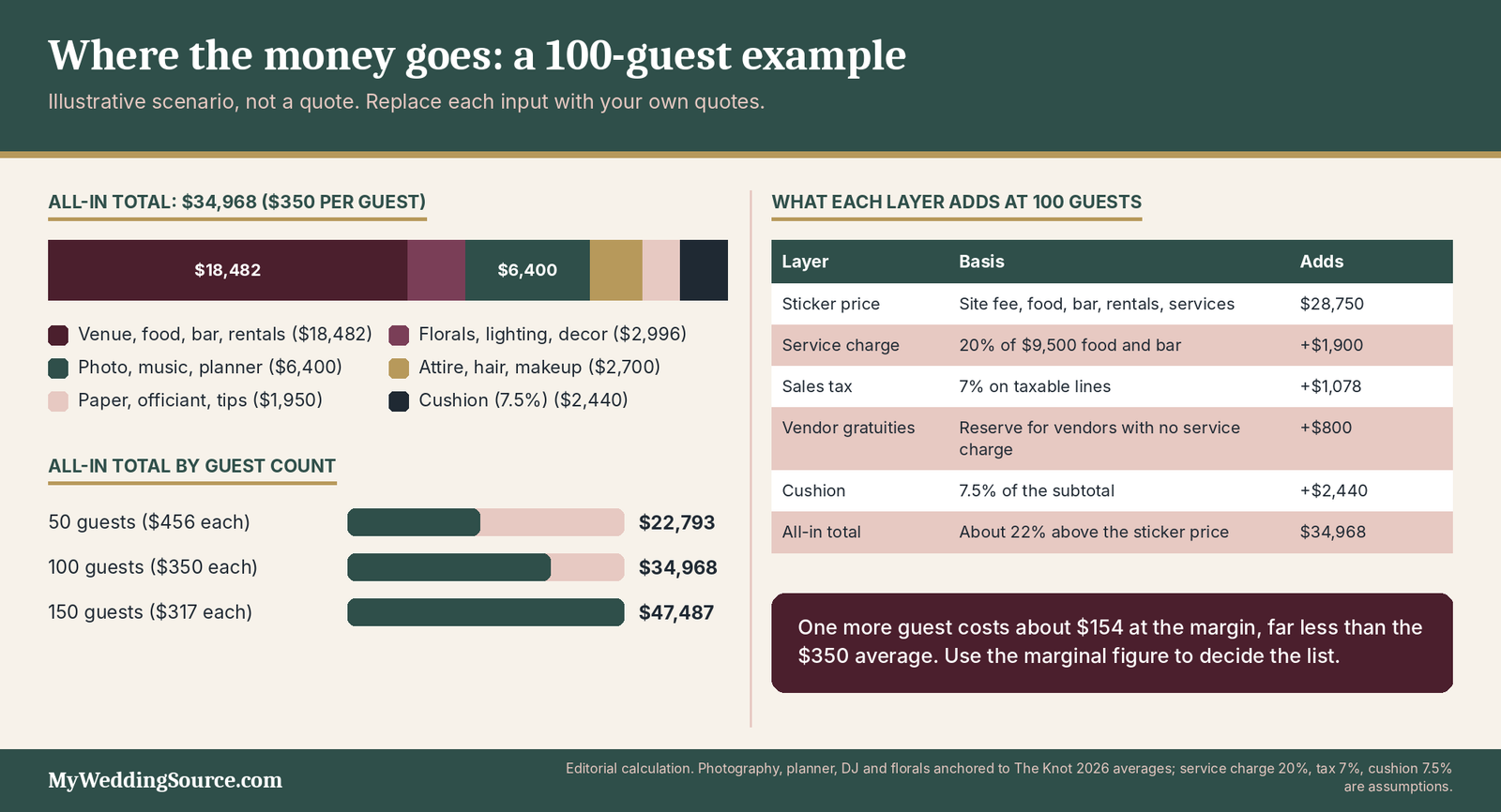
The cost of one more guest, called the marginal cost, is the sum of every variable line for that guest, with each layer of markup applied. Written out: marginal cost per guest = (food + bar) x (1 + service charge) x (1 + tax) + rentals x (1 + tax) + paper, dessert and favors. If you use the worked example’s inputs ($70 food, $25 bar, $12 rentals, $8 paper, a 20% service charge and 7% tax), the result is about $143 per guest before any cushion, or about $154 with a 7.5% cushion.
That is less than half of the average cost per guest in the same example ($350), and the gap between the two numbers is the part of the total that does not depend on guests. Use the marginal figure when you are deciding whether to add or cut people, and use the average figure only when comparing your total to a benchmark. Mixing them up is the most common arithmetic mistake in wedding budgeting: a couple who cuts 20 guests and expects to save 20 times $292, or $5,840, will find the actual savings closer to 20 times $154, or about $3,080.
A worked example you can copy: 100 guests, line by line
Inputs and assumptions
Fixed and semi-fixed lines
The example below is an illustrative scenario, not a quote and not a recommendation: a 100-guest reception with a hired coordinator, a DJ, photography, florals and a venue that charges a site fee while the caterer is hired separately. Where a sourced figure exists, the input is anchored to it. Photography is set at $2,700 and the planner or coordinator at $1,900, both matching The Knot’s averages for weddings of 51 to 100 guests. The DJ is $1,800, matching The Knot’s national DJ average, and florals are $1,900, matching the median on The Knot’s wedding flowers page.
The remaining inputs are editorial assumptions chosen to be plausible, and you should replace them first. The venue site fee is $5,000, lighting and decor extras are $900, attire for both partners including alterations is $2,400, hair and makeup is $300, and the officiant plus marriage license is $350 (the license fee varies by county, so check yours). These nine lines add up to $17,250, and none of them changes if a few guests are added or removed, which is why they are grouped together.
Per-guest lines
Four lines scale with the guest count. Food is $70 per guest, the bar is $25 per guest, rentals such as chairs, linens and tableware are $12 per guest, and paper goods, dessert and favors are $8 per guest. For context, The Knot’s average catering cost is about $80 per person, and Zola’s guide suggests $150 to $300 per guest for all guest-dependent costs combined, so the example’s pre-markup rate of $115 per guest sits modestly below the range once you consider that venues and caterers vary widely.
The per-guest rates are also where regional differences hit hardest. A caterer in a major metro area may charge double what a caterer in a smaller market does for similar food, and a venue that provides its own bar staff will price the bar very differently from one that requires an outside bartender. If you only have time to replace one input with a real quote, replace the food and bar rate, since it multiplies by every guest and every markup that follows.
Markups: service charge, tax, gratuity and cushion
Four markups sit on top of the line items. A 20% service charge applies to food and bar, which sits at the low end of the range The Knot describes (it says service fees are typically 20% to 25% of the food-and-drink fee) and inside the 18% to 22% that Zola reports as common for service charges and gratuities across vendors. A 7% sales tax applies to food, bar, the service charge, rentals, florals and decor; that is close to the 7.53% population-weighted average combined state and local rate in the Tax Foundation’s 2026 sales tax data, though what is actually taxable varies by state and item.
Gratuities of $800 cover vendors who do not add a service charge (the figure follows The Knot’s suggestion to reserve at least $800 for vendor tips). A 7.5% cushion sits between The Knot’s floor of 5% for unforeseen costs and the 10% that some couples prefer. Applying these four markups after the line items, in that order, produces the all-in number, and the next section shows each step.
The arithmetic, row by row
From line items to an all-in total
Work through the table from top to bottom and you can see where each dollar comes from. The nine fixed and semi-fixed lines are listed first, then the four per-guest lines with their calculations, then each tax and service layer on its own row so you can change one without disturbing the others. A line that depends on a rate shows the rate in the second column, which makes it easy to spot which inputs you should replace with your own.
| Line | How it is calculated | Amount |
|---|---|---|
| Venue site fee | Input | $5,000 |
| Photography | Knot average, 51-100 guests | $2,700 |
| Music (DJ) | Knot average | $1,800 |
| Florals | Knot median | $1,900 |
| Planner or coordinator | Knot average, 51-100 guests | $1,900 |
| Lighting, decor, extras | Input | $900 |
| Attire and alterations | Input | $2,400 |
| Hair and makeup | Input | $300 |
| Officiant and license | Input | $350 |
| Food | 100 guests x $70 | $7,000 |
| Bar | 100 guests x $25 | $2,500 |
| Service charge | 20% x $9,500 | $1,900 |
| Sales tax on food, bar and service charge | 7% x $11,400 | $798 |
| Rentals | 100 guests x $12 | $1,200 |
| Sales tax on rentals | 7% x $1,200 | $84 |
| Sales tax on florals and decor | 7% x $2,800 | $196 |
| Paper, dessert and favors | 100 guests x $8 | $800 |
| Subtotal | Sum of the lines above | $31,728 |
| Vendor gratuities | Reserve | $800 |
| Cushion | 7.5% x $32,528 | $2,440 |
| All-in total | Subtotal + gratuities + cushion | $34,968 |
| Average cost per guest | $34,968 / 100 | $350 |
Reading the result against the benchmarks
The all-in total of $34,968 is within about 2% of The Knot’s $34,200 average and just under Zola’s $36,000, which is not a coincidence of design so much as a sign that the inputs are realistic for a mid-sized wedding with a few professional services. The per-guest average of $350 is higher than The Knot’s $292, and the reasons are visible in the table: this example includes a planner, a cushion and gratuities that many couples in the survey did not pay for, and it has only 100 guests to spread the fixed costs over.
Group the lines by category and the shape matches the percentage split from earlier. Venue site fee, food, bar, service charge, tax and rentals together total $18,482, or about 53% of the all-in total, nearly identical to the 53% that The Knot’s venue-and-rentals plus catering-and-drinks categories represent. The definitions are not identical, so treat the match as reassurance and not as proof, but it does suggest that the bottom-up and top-down methods are describing the same wedding.
| Category group | Amount | Share of total |
|---|---|---|
| Venue, food, bar, rentals (with service charge and tax) | $18,482 | 52.9% |
| Photography | $2,700 | 7.7% |
| Florals, lighting and decor (with tax) | $2,996 | 8.6% |
| Attire, hair and makeup | $2,700 | 7.7% |
| Planner or coordinator | $1,900 | 5.4% |
| Music | $1,800 | 5.1% |
| Paper, dessert, favors | $800 | 2.3% |
| Officiant and license | $350 | 1.0% |
| Vendor gratuities | $800 | 2.3% |
| Cushion | $2,440 | 7.0% |
| Total | $34,968 | 100% |
Scenario tables: what changes at 50, 100 and 150 guests
The three scenarios side by side
The table
The same method applied to 50, 100 and 150 guests produces three very different totals and, more interestingly, three very different costs per guest. The semi-fixed lines are adjusted using the sourced bands where they exist: photography follows The Knot’s guest-count bands ($2,000, $2,700, $3,500), the planner line follows the planner bands ($1,700, $1,900, $2,300), and the venue, florals and decor lines step up with room size and table count. The per-guest rates, service charge, tax and cushion rate stay the same across all three so you can see the effect of headcount alone.
| Line | 50 guests | 100 guests | 150 guests |
|---|---|---|---|
| Fixed and semi-fixed lines (nine lines) | $13,350 | $17,250 | $21,450 |
| Food and bar ($95 per guest) | $4,750 | $9,500 | $14,250 |
| Service charge (20%) | $950 | $1,900 | $2,850 |
| Sales tax on food, bar and service charge (7%) | $399 | $798 | $1,197 |
| Rentals including tax ($12 per guest) | $642 | $1,284 | $1,926 |
| Sales tax on florals and decor | $112 | $196 | $301 |
| Paper, dessert and favors ($8 per guest) | $400 | $800 | $1,200 |
| Vendor gratuities | $600 | $800 | $1,000 |
| Cushion (7.5%) | $1,590 | $2,440 | $3,313 |
| All-in total | $22,793 | $34,968 | $47,487 |
| Average cost per guest | $456 | $350 | $317 |
What changed between columns and why
Going from 50 to 100 guests adds $12,175, or about $244 for each added guest, while going from 100 to 150 adds $12,519, or about $250 for each. Those increments are larger than the roughly $154 marginal cost from the previous section because the semi-fixed lines also step up: the venue, photographer, planner, florist and decor budget are all larger at each size. If you hold the semi-fixed lines flat and add only the per-guest rates, the increment falls back to about $154.
That distinction matters when you are deciding between 100 and 150 guests, and it is why you should always ask your venue and vendors what changes at your specific headcount, not what the average guest costs. The scenario totals also sit above The Knot’s band averages ($17,100, $27,200, $43,300), by roughly 33%, 29% and 10%. Part of that gap is what these scenarios include (a coordinator, a cushion, gratuities and full tax and service layers), and part is that averages blend couples with and without those services.
Where each size gets squeezed
At 50 guests, fixed costs dominate
At 50 guests, more than half of the all-in total ($13,462 of $22,793, about 59%) comes from lines that would exist at almost any size, and the average cost per guest of $456 is the highest of the three scenarios. The practical implication is that small weddings are not automatically inexpensive per person: the officiant, attire, photographer, coordinator and site fee do not halve when the list does. What a small wedding does offer is flexibility, because a 50-person reception fits in restaurants, private dining rooms and smaller venues that charge less for the space.
If you are planning a smaller wedding, look for savings in the fixed lines instead of expecting the guest list to carry the budget. A shorter photography package, a coordinator hired for the final month instead of the full engagement, and a venue that includes tables and chairs all reduce the fixed block. It is also the size where the per-guest rate can rise without wrecking the total, so a more generous menu is easier to afford here than at 150.
At 150 guests, step costs and logistics dominate
At 150 guests the average cost per guest falls to $317, but the total is $12,519 higher than at 100, and the lines most likely to surprise you are the ones that jump. Venue capacity may force a bigger room or a second space for cocktail hour, rentals may exceed the venue’s included inventory, and the caterer may add staff at certain headcounts. Photography and videography coverage hours stretch as group photos, cocktail hour and dinner service all take longer with more people.
Logistics also compound. A 150-person seated dinner needs more time to serve, which affects the timeline, the vendor meal count and the overtime exposure at the end of the night. If you are near 150 and unsure, ask the venue and caterer to quote at both 140 and 160 so you can see where the jumps fall, and check how your quotes handle the final guest count: some contracts set a guarantee that you pay for even if fewer guests attend, which means a drop in RSVPs near the deadline saves less than you expect.
How each line shifts the total: a sensitivity check
Per-guest levers
Ten more guests
The simplest sensitivity test is the one every couple eventually runs: what happens if the list grows by ten? In the 100-guest example, ten more guests add $1,535 if the semi-fixed lines stay where they are, which equals the marginal cost of about $154 per guest from earlier. If the extra ten push you into a bigger room or an additional server, the true increase is higher, and the scenario table suggests a range of roughly $1,500 to $2,500 for ten guests depending on where the steps fall.
Run this test in both directions before invitations go out. Cutting ten guests saves about the same $1,535 at the margin, which is real money but is often less than couples expect because the fixed block does not shrink. The more useful framing is that each name on the list has a price of roughly $154 in this example, so the list conversation becomes a question of whether a particular guest is worth that amount, not a question of whether a total is too high in the abstract. The same arithmetic helps when a relative asks to add a plus-one: you can name the price without making it personal.
The bar: hours, format and per-guest rate
Bar costs are the most elastic per-guest line, because they depend on service format (full open bar, beer and wine, signature drinks, cash bar), hours of service and who supplies the alcohol. In the example, raising the bar rate by $10 per guest, from $25 to $35, adds $1,380 to the all-in total once the service charge, tax and cushion are applied. A $10 change in a per-guest rate looks small on the proposal, but it is multiplied by 100 guests and then by the markups, so it moves the total by roughly $14 for every dollar of change.
The same multiplier works in your favor. Cutting the bar rate by $5 saves about $690, and a format change such as beer, wine and one signature cocktail often does that without guests noticing. Ask your caterer or venue to price at least two bar formats and to state whether the price covers bartenders, ice, mixers, glassware and cleanup, since some of those are bundled and others are billed separately. Our wedding food and catering hub collects the deeper guides on bar packages and catering formats.
Rate levers and the calendar
Service charge and tax: small percentages, real dollars
A percentage point on the service charge or tax looks trivial until you apply it to the right base. In the 100-guest example, the service charge applies to $9,500 of food and bar, so each point of service charge is worth about $95 before tax, and roughly $110 once tax and the cushion are applied. The tax rate applies to a larger base because it touches food, bar, service charge, rentals, florals and decor, so a swing from 0% to 10% moves the total by roughly $1,650.
The table below shows how each rate lever changes the all-in total from the $34,968 baseline. Only the lever in each row changes; everything else stays at the baseline. The service-charge and tax rows are the ones most likely to differ from your actual quotes, so replace them with the figures your vendors and your state use. The cushion rows show why choosing 5% versus 10% is itself a decision worth about $1,600.
| Change | New total | Difference from $34,968 |
|---|---|---|
| Ten more guests (semi-fixed lines unchanged) | $36,503 | +$1,535 |
| Bar rate up $10 per guest | $36,348 | +$1,380 |
| Service charge 18% instead of 20% | $34,749 | -$219 |
| Service charge 22% | $35,186 | +$218 |
| Service charge 25% | $35,514 | +$546 |
| Sales tax 0% | $33,809 | -$1,159 |
| Sales tax 5% | $34,636 | -$332 |
| Sales tax 10% | $35,464 | +$496 |
| Cushion 5% instead of 7.5% | $34,154 | -$814 |
| Cushion 10% | $35,781 | +$813 |
Date, day of week and season
Timing can move more dollars than any rate in the table, though the effect is uneven and depends on your market. Zola’s cost guide says off-peak timing, such as winter weekends or weekdays, can save 20% to 30% on most vendor costs, though it presents that as a general pattern and not a guarantee for any vendor. The Knot’s guide to the wedding off-season reports that only 24% of weddings take place from November through April, while October and June each account for 16% and May through October together account for 76%.
To see what the date lever could do in the example, suppose an off-peak date lowered the venue site fee and the food-and-bar rate by 10%. The all-in total would fall by about $1,850, to roughly $33,100. At a 20% reduction on those two lines, the total would fall by about $3,700. Those are hypothetical illustrations, not predictions, so use them to decide whether it is worth asking each vendor for a quote on a second date. If a winter date interests you, our guide to the December wedding budget covers the cost patterns and trade-offs of that season.
Service charges, gratuity and tax: the fee layers that change every quote
Service charge, tip and administrative fee: three different things
What a service charge is, and why it is not a tip
A service charge is a mandatory fee the business sets and adds to your bill, usually as a percentage of food and beverage. A tip, or gratuity in the traditional sense, is voluntary and set by the customer. The distinction has a federal tax meaning that is useful as a plain-language test. In Revenue Ruling 2012-18, the IRS applies four factors to decide whether a payment is a tip: it is made free from compulsion, the customer has an unrestricted right to set the amount, the amount is not dictated by employer policy, and the customer generally chooses who receives it. If any factor is missing, the payment may be a service charge, and an IRS guidance memo gives charges for catering, banquets and weddings as examples that employer policy typically dictates.
That ruling governs how businesses treat the money for payroll tax, not how your contract describes it, and it says nothing about where the money goes. A service charge may fund staff pay, venue overhead or both, which is why the plain question to ask is “does the service charge go to the servers and bartenders, and is any additional tip expected?” The label on the proposal does not answer it. Your contract should.
Gratuity: when extra tipping is and is not expected
Whether to tip on top of a service charge depends on what the contract says. The Knot’s vendor tipping guide says that if gratuity is already listed in the contract or invoice, additional tips are unnecessary, though exceptional service can still be rewarded, and that if no service charge is included a tip of 15% to 20% of the food and beverage fee is customary. It also notes that a service charge of about 2% is sometimes built into bar fees, and that couples should confirm who receives it.
For budgeting, the practical rule is to add gratuity as its own line only for vendors who have no built-in service charge, and to check each contract before you decide the amount. The Knot suggests reserving at least $800 for vendor gratuities, which is the figure used in the worked example, and its guide lists suggested amounts for photographers, DJs, hair and makeup professionals and others. The envelope for tips is worth preparing a week early so nobody is hunting for cash on the wedding day.
Administrative fees and the “plus plus” on a proposal
Some venues and caterers add an administrative fee on top of, or instead of, a service charge, and a proposal may show food and beverage prices followed by “plus plus,” meaning plus tax and plus service charge. There is no verified national range for administrative fees, so the honest answer to “how much is typical?” is that it varies, and the useful question is what the fee covers. A fee that funds day-of coordination, setup and breakdown is a different thing from one that is simply a percentage added to the total.
Zola’s data suggests the stakes are real: it found that 57% of couples faced a mandatory venue service fee and that those couples averaged double the unexpected fees of couples without one. That does not mean the fee is improper; it means the fee is a signal to ask for a complete total. Add each fee to the quote line it modifies, and compare the final, taxed, all-in number across vendors instead of the headline rate.
Tax: why the same quote costs different amounts in different places
The range of sales tax rates
The Tax Foundation reports that the population-weighted average combined state and local sales tax rate in the United States was 7.53% as of July 1, 2026, with Louisiana highest at 10.13% and five states (Alaska, Delaware, Montana, New Hampshire and Oregon) levying no statewide sales tax. Those are rates for retail sales in general, so they set the outer bounds for the tax layer in your calculator without telling you what is taxable. A 10% rate on a taxable bar bill is a different budget line from 0% on a venue fee in a state that does not tax event space.
For the calculator, use your state and local rate as the starting point, then confirm item by item which of your vendors charge it. Food and beverage, rentals and florals are commonly taxable, while professional services such as photography, officiating and planning are often treated differently, but the pattern varies by state and sometimes by county, so avoid generalizing from one wedding to yours. A quick email to each vendor asking “will sales tax be added to this quote, and on which lines?” gets you the answer in writing.
Are service charges taxable? Two states, two answers
Whether a mandatory service charge is itself taxed varies, and two published examples show how different the answers can be. In Virginia, a Tax Commissioner ruling issued in January 2015 (Public Document 15-10) states that mandatory gratuity or service charges in excess of 20% are taxable, which means charges up to 20% were excluded from the sales price in that case. In California, a 1995 appeals decision from the State Board of Equalization (the decision is posted by the CDTFA) concluded that mandatory gratuities agreed to in advance at banquets are part of taxable gross receipts.
These examples are decades or years old and come from specific facts, so do not treat either as current law for your wedding. They are here to show why the calculator keeps tax on the service charge as a separate, adjustable row: in one state the base is food and beverage, and in another it is food, beverage and service charge. This is general information and not legal or tax advice; ask the vendor how they apply tax, and if the amount is large, a state revenue department’s published guidance is the authoritative source.
The tax questions to ask
Four questions cover most of the uncertainty. First, which lines on the quote are taxable? Second, is the service charge taxed, and is the tax calculated on the subtotal before or after the charge? Third, is the venue’s site fee taxed, and does the rate differ for rentals, labor and delivery? Fourth, if you are marrying in a different city or state from where you live, which jurisdiction’s rate applies? Write the answers next to the quote, because they feed directly into the rate rows of your spreadsheet.
| Fee layer | What it usually is | Figures cited in this guide | Question to ask |
|---|---|---|---|
| Service charge | Mandatory percentage on food and beverage | 20% to 25% of the food-and-drink fee (The Knot); 18% to 22% across vendors (Zola) | Who receives it, and is it taxed? |
| Voluntary gratuity | Optional tip for vendors without a built-in charge | 15% to 20% of food and beverage if none is included (The Knot) | Is any gratuity already in the contract? |
| Administrative fee | Venue or caterer fee, sometimes a percentage | No verified national range | What does it cover? |
| Sales tax | State and local tax on taxable lines | 7.53% average combined rate, 0% to 10.13% range (Tax Foundation, July 2026) | Which lines are taxed, and in which jurisdiction? |
| Delivery and setup | Charge for transport and installation | $200 to $500 per vendor in some cases (Zola) | Is it itemized or bundled? |
Easy-to-miss costs: what the quotes never include
The small stuff that adds up
What Zola’s spend survey found
Zola’s 2026 Wedding Spend Survey (720 couples surveyed within 180 days after their weddings) found that couples spent an average of $3,314 on costs they had not planned for, roughly 9% of total spend. It also found that 98% of couples bought miscellaneous extras, averaging five categories, and that 75% encountered at least one unexpected fee. The most common extras were fashion accessories (81% of couples), the marriage license (79%), reception details (69%), ceremony details (59%) and wedding party gifts (58%).
Those figures describe a cushion’s job. A 9% unplanned-cost average is close to the 7.5% cushion in the worked example, and it explains why The Knot recommends earmarking at least 5% for unforeseen costs. The point of a cushion is not to predict a particular surprise; it is to make sure the next surprise does not become a credit card balance. If your quotes are firm, a 5% cushion may be enough, and if you are still waiting on several proposals or planning an outdoor wedding, a 10% cushion is easier to defend.
Postage, trials, alterations and accessories
The unexpected fees in Zola’s survey were mostly small, and they are easy to list ahead of time. Postage and alterations each caught 29% of couples by surprise, trial appointments caught 21%, and service charges caught 17%. Add a line for each of them in your spreadsheet with a rough estimate, even if the estimate is $200, and the surprise moves from the unplanned column to the planned one.
Accessories and finishing touches deserve the same treatment: veils, shoes, jewelry, ties, undergarments, steaming, a marriage license (fees vary by county, so check your clerk’s office), a thank-you card order, a guest book, a cake knife. None of these is large on its own, and together they can reach a few hundred dollars. The Knot’s wedding-day gratuity reserve belongs on this list too, since a tip envelope is easy to forget until the last day.
Costs that belong to a neighboring budget
Rehearsal dinner, rings, engagement ring and honeymoon
The Knot reports averages of about $2,800 for the rehearsal dinner, $3,000 for wedding rings, $4,600 for the engagement ring and $5,500 for the honeymoon, none of which is part of its average ceremony-and-reception cost. Whether they belong in your calculator is a decision about your ceiling, not about the arithmetic. If you pay for rings from savings and the honeymoon from registry cash, they are outside the wedding budget but inside your overall financial picture, and that should be stated plainly in your spreadsheet.
A practical way to handle them is to create two totals: “wedding day” and “wedding-related.” The first covers the ceremony and reception, and the second adds the rehearsal dinner, rings, honeymoon, wedding party gifts and any pre-wedding events. Comparing the second total to your overall funding picture keeps you from solving one budget by quietly spending from another, and it makes conversations with contributors clearer about what their gift is actually covering.
What your guests spend, and why it affects your list
Your guests carry costs too, and they are part of the picture even though they do not appear in your total. The Knot’s guest cost data, from its 2024 guest study, reports that attendees spent an average of $610 per wedding: about $270 for local weddings, $840 for guests who drive and $1,680 for guests who fly. Those figures include gifts, attire and travel, and they rise sharply when a wedding requires a flight and hotel room.
This matters for the calculator in two ways. First, it can shape your list: a guest who would have to fly across the country may appreciate an invitation they can decline without a fuss. Second, it affects your own costs if you pay for a hotel block, shuttle or welcome bag, because these are optional line items that scale with the number of out-of-town guests. If a destination or out-of-town celebration is in your plans, run the guest-side math before you set the headcount.

Protection costs
Event insurance, permits and deposits
The Knot suggests considering special event insurance, particularly for cancellations, postponements and home-hosted events, and a venue may require liability coverage. Prices vary with coverage type, event size, location and the policy’s terms, so there is no single figure to put in a calculator; get quotes and treat the premium as a fixed line. Be sure you understand the difference between cancellation coverage, event liability coverage and a vendor’s own insurance, since they protect against different problems.
Permits and deposits are the other protection costs. A park, beach or public space may require a permit with a fee, a damage deposit may be due at signing and refunded later, and a deposit is a cash-flow item even when it comes back to you. Add refundable deposits to your payment schedule, not your total, so they do not distort the all-in number but still show up in the month when money leaves your account.
The failure cost of an incomplete budget
Every missed layer has a price, and it is usually paid when you have the least flexibility. A $1,000 gap discovered six months out can be closed by trimming the guest list or adjusting the bar. The same gap discovered in the final week gets closed by a credit card, a request to family or a decision to skip something already paid for. This is the real argument for building the calculator early and revisiting it often: not that any single number is dramatic, but that the cost of discovering a gap grows as the date approaches.
That is also why the fee layers, the unplanned-cost cushion and the neighboring budgets are modeled as separate rows. A row that shows $0 is a prompt to ask a question, while a missing row is an invisible risk. If you cannot get an answer from a vendor, put your best estimate in the row and mark it as unconfirmed so it stays on your list of things to resolve before you sign.
Contingency: how much to hold back and when to spend it
How big the cushion should be
The 5% floor and the 10% ceiling
The Knot recommends earmarking at least 5% of the budget for unforeseen costs, and Zola’s spend survey found that couples averaged about $3,314 in costs they had not planned for, roughly 9% of total spend. Between those two data points sits the range used in this guide: a cushion of 5% to 10% of the subtotal, with 7.5% as the working default. That range is an editorial judgment built on the two sources, not a rule from any study, and your situation may justify a number outside it.
Calculate the cushion on the subtotal that includes gratuities, as the worked example does, so that it protects the whole plan and not only the vendor lines. In the 100-guest example, the cushion is $2,440, which is the difference between a plan that can absorb one late-breaking alteration bill, one extra table rental and a slightly larger final headcount, and a plan that has to borrow for any of them. If the figure feels large, remember that it is also the figure most likely to come back to you as savings if nothing goes wrong.
Matching the cushion to uncertainty
A flat percentage treats every wedding as equally uncertain, and they are not. A reasonable way to adjust it is to count how many large lines are still unsigned. If the venue, caterer and photographer have all signed contracts with all-in totals in writing, a 5% cushion covers the small stuff. If two or more large lines are still estimates, or the wedding is outdoors, in a new market or relies on a vendor with variable pricing such as a florist, 10% is easier to defend. Treat this as an editorial rule of thumb about how quotes tend to change, not as a statistical finding.
Zola’s finding that 69% of couples exceed their initial budget is another reason to lean toward the higher end when your numbers are preliminary. The cushion is cheapest when you set it early, because you can still change the plan to afford it. Setting it after you are already over budget turns it into a debt conversation. Decide the percentage when you set the ceiling, and write the dollar amount into the spreadsheet as its own locked row.
Rules for spending it
What counts as a cushion expense
A cushion exists for costs that are unplanned and unavoidable: an alteration that needs a second fitting, an overtime charge because the toasts ran long, a rental delivery fee that was not on the proposal, a marriage license fee that came in higher than expected, a permit that turned out to be required. It does not exist for upgrades. Deciding in advance which category a cost falls into saves you from spending the cushion on a new centerpiece idea in month five and having nothing left for the alteration in month eleven.
A useful test is to ask whether you would have said yes to the expense if it had been on the original quote. If the answer is “yes, but I forgot it,” it is a cushion item. If the answer is “I would have said no,” it is a choice, and it should go through the regular budget conversation with a corresponding trade elsewhere. Write the rule in the spreadsheet notes so that either partner can apply it without a debate.
What to do with the unspent cushion
Unspent cushion is the good outcome, and it deserves a plan. Common options include returning it to savings, paying down any card balance first, or putting it toward the honeymoon or a first-year household goal. Decide before the wedding so that the choice is not made in the glow of the honeymoon booking page. If a family member contributed toward the wedding, it can also be a courtesy to let them know how the money was used.
One caution applies to the other direction. If you find yourself spending the cushion on things that would have been choices, you have effectively raised the budget without admitting it, and the final payments will arrive without a buffer. Review the cushion balance at every checkpoint described in the tracking section, and if it is below half of its starting value with months still to go, treat that as a signal to revisit the plan.
How to compare quotes apples-to-apples
Normalize before you compare
The all-in line: one formula for every quote
Quotes are written to be read one at a time, not side by side, which is why a $5,000 site fee with a separate caterer can end up costing less or more than a $135-per-person package. The fix is to rebuild every quote into the same formula: all-in price = site or service fee + (per-guest rate x guests) + service charge + administrative fee + tax + delivery, setup and overtime + any minimum shortfall. Then compare the all-in price at the same guest count, which is the only comparison that tells you anything.
Use a single spreadsheet tab for this, with one column per vendor and one row per layer. Leave a cell blank when a layer is unknown and highlight it, because an unknown is a question to ask and not a zero. When the answers arrive, the blanks fill in and the lowest all-in price is usually not the lowest headline price. If you only have time to normalize one category, make it the venue and catering, which together make up roughly half the total.
Hours, staff and inclusions: what is in the price
Beyond the money layers, quotes differ in what they include, and those differences carry costs. A photographer quoting eight hours and one quoting six are not interchangeable, a caterer who includes bartenders and one who bills them separately are not interchangeable, and a venue that includes tables and chairs is different from one that does not. For each vendor, write down the hours of service, the number of staff, the set-up and breakdown responsibilities, and what is explicitly excluded.
The Knot’s pages on wedding photographers and flowers both recommend itemizing delivery, setup and breakdown fees, and the florist page notes that supply costs can rise after a contract is signed. That last point is a reason to ask whether prices are locked at signing. Compare like with like: if one quote is shorter on hours, either add the overtime rate to bring it to the same coverage, or note that you would need to buy extra time later.
A worked venue comparison
Three quotes for the same 100-guest dinner
Suppose three venues quote for the same 100-guest dinner. Venue A charges a $5,000 site fee and the caterer’s food and bar at $95 per guest, with a 20% service charge, 7% tax and rentals billed separately at $12 per guest. Venue B offers an all-inclusive package at $135 per guest that includes rentals, with a $1,500 site fee, a 24% service and administrative charge, 7% tax and a 90-guest minimum. Venue C charges a $3,000 site fee and requires a $12,000 food-and-beverage minimum, with a 20% service charge, 7% tax and separate rentals. These are illustrative quotes, not real vendors.
The table puts them on the same footing. The last row shows what each quote costs if the guest count falls to 80, which is the situation where the structure of a quote matters most. Notice that the cheapest headline is not obviously the cheapest all-in price, and that the quote with the lowest site fee is not the cheapest either. A package may look expensive per guest but include rentals, while a minimum may look reasonable until the headcount drops.
| Layer | Venue A: site fee plus caterer | Venue B: all-inclusive package | Venue C: site fee plus F&B minimum |
|---|---|---|---|
| Site fee | $5,000 | $1,500 | $3,000 |
| Food and bar billed | $9,500 | $13,500 | $12,000 (minimum) |
| Service or administrative charge | $1,900 (20%) | $3,240 (24%) | $2,400 (20%) |
| Sales tax (7%) | $798 | $1,172 | $1,008 |
| Rentals including tax | $1,284 | Included | $1,284 |
| All-in at 100 guests | $18,482 | $19,412 | $19,692 |
| All-in at 80 guests | $15,786 | $17,621 (90-guest minimum) | $19,435 (minimum still applies) |
What the comparison shows
At 100 guests, Venue A is cheapest by $930 over Venue B and $1,210 over Venue C, a gap of 5% to 7% that is smaller than the differences in the headline numbers suggest. The more important finding is what happens at 80 guests. Venue A falls by about $2,700 because everything scales with guests, Venue B falls by about $1,800 because of its 90-guest minimum, and Venue C falls by only about $260 because the $12,000 minimum applies regardless. If your RSVPs are uncertain, the structure of the quote matters more than its price at your planned count.
That is the case for asking every venue the same questions: what is the minimum, what is the guest guarantee, when is the final headcount due, and how does the price change if the count drops after that date. A venue that charges more at 100 but flexes down at 80 may be less risky than one that is cheaper at 100 and rigid below it. For more on reading venue paperwork, see our wedding venues hub, which links to our deeper guides on venue contracts and fees.
Paying for it: cash flow, borrowing and protecting your money
Cash flow: when the money leaves your account
An illustrative payment timeline for the 100-guest example
Knowing the total is only half of the job, because the money leaves your account in installments that rarely line up with your paychecks. Deposit sizes and due dates vary by vendor and are set in each contract, so the schedule below is an illustration of how the $34,968 example might flow, not a template your vendors will follow. The point is the shape: roughly a fifth of the money goes out at signing, about half in the final month, and the cushion stays untouched until needed.
| When | What comes due | Amount | Running total |
|---|---|---|---|
| Signing (about 12 months out) | Venue, caterer, photographer, DJ and planner deposits | $6,500 | $6,500 |
| 9 months out | First attire payment | $1,200 | $7,700 |
| 6 months out | Florals deposit | $1,000 | $8,700 |
| 3 months out | Caterer second payment, paper and favors | $4,800 | $13,500 |
| 2 months out | Rentals deposit, attire second payment | $1,600 | $15,100 |
| 30 days out | Venue balance, photographer, planner, officiant | $5,950 | $21,050 |
| 14 days out | Caterer final payment (after final headcount), rentals, DJ, florals, hair and makeup | $10,678 | $31,728 |
| Wedding day | Gratuity envelopes | $800 | $32,528 |
| Held in reserve | Cushion | $2,440 | $34,968 |
Final payments, tips and the two weeks before the wedding
The heaviest cash demand arrives at the moment you have the least capacity for surprises: in the 14 days before the wedding, the example shows $10,678 going out in a single stretch. Plan for this by moving the money into an account that is easy to reach, setting calendar reminders for each due date, and confirming the accepted payment method for each vendor. Some vendors accept cards and some do not, and some add a processing surcharge, so ask before you assume.
The final headcount also sets the final caterer bill, which is why the final count deadline is one of the most important dates on the calendar. Keep the tip envelopes labeled and assigned to a trusted person, such as a coordinator or a family member, so they reach the right vendor at the right moment. Write down which vendors have a service charge that already covers gratuity, so nobody tips twice by accident.
Borrowing, cards and protecting your money
What carrying a balance costs
Zola’s 2026 report found that 32% of couples are optimizing credit cards for points or new-card offers, 27% are adding cash funds to their registry and 4% have taken out a loan, among other ways couples are funding the day. Using a card can be sensible when the balance is paid in full before interest begins, and it can become expensive when a balance lingers. The Knot’s guide to paying for a wedding quotes a financial expert who describes cards as acceptable if you pay the balance before interest applies, and who warns against borrowing to cover wedding costs.
To see the scale, here is a hypothetical: $5,000 carried on a card with a 24% APR and repaid in equal payments over 12 months costs about $473 per month and $674 in interest; repaid over 24 months, it costs about $264 per month and $1,345 in interest. The APR is an assumption, so substitute your own card’s rate. The pattern, however, holds in general: a lower monthly payment stretches the repayment and raises the total cost, which is a trade-off the calculator makes visible and your card statement does not.
Introductory rates, balance transfers and credit counseling
Promotional rates can lower the cost of borrowing, but they have terms. The Consumer Financial Protection Bureau explains that an introductory credit card rate must last at least six months and that the issuer must tell you how long it lasts and what rate follows. Its guidance on consolidating card debt adds that balance transfers usually carry a fee and that promotional rates are temporary, so the comparison should include fees and the rate after the promotion ends.
If wedding debt becomes hard to manage, the CFPB says to contact the card company early and notes that nonprofit credit counseling organizations can help, and it advises asking about fees before enrolling. It also warns about for-profit debt settlement companies that guarantee results or tell you to stop paying your creditors. This is general education, not personalized financial advice, and a nonprofit credit counselor or financial professional can look at your specific numbers.
Disputing charges, and what the FTC fee rule does not cover
If a vendor fails to deliver what you paid for with a credit card, the Federal Trade Commission’s guide to using credit cards and disputing charges lists charges for goods or services not delivered as agreed as a billing error and says your written dispute must reach the issuer within 60 days after the first bill showing the error was sent. The issuer must acknowledge the dispute in writing within 30 days and resolve it within 90 days. Because that deadline runs from the statement date, keep records and check statements soon after each payment.
You may also have heard about the FTC’s rule on unfair or deceptive fees, which took effect May 12, 2025. The agency’s FAQ for that rule describes it as covering businesses that offer live-event tickets or short-term lodging, and it does not mention weddings or event services such as venue rental, catering or planning. So that rule does not impose an all-in price display requirement on wedding venue or catering quotes, which is why asking for the full total in writing remains your most reliable protection. State laws vary, and this is not legal advice.
Keeping the numbers honest: a recalculation routine
The routine that keeps the spreadsheet true
Three columns: budgeted, committed and paid
A budget that only lists planned amounts will drift away from reality within weeks, because the plan changes more slowly than the quotes do. Add two columns beside the budgeted amount: “committed,” meaning what a signed contract says you owe, and “paid,” meaning what has actually left your account. The gap between budgeted and committed shows where your estimate was wrong, and the gap between committed and paid shows what is still due. A line that is budgeted but not yet committed is an assumption, and the total of those lines is the part of the plan that can still surprise you.
The table below shows how three lines of the worked example might look partway through planning. Only the venue and photographer are committed, florals are still an estimate, and the status column says what happens next. Add a total row for each column and a “still uncommitted” row beneath it, so that the number you watch is not just how much you have spent but how much of the plan is still a guess.
| Line | Budgeted | Committed (signed) | Paid | Next step |
|---|---|---|---|---|
| Venue site fee | $5,000 | $5,000 | $2,500 | Balance due 30 days out |
| Photography | $2,700 | $2,850 | $900 | Confirm whether the overage is overtime or an album |
| Florals | $1,900 | Not signed | $0 | Collect two itemized proposals |
Triggers that mean you rerun the whole calculation
Rerun the full calculation, not just the line that changed, whenever one of a short list of events occurs. A guest list change of about 10% or more, because variable lines and several semi-fixed lines move. A change of date, day of week or venue, since almost every rate shifts. A new quote with a different structure, such as a package replacing an a la carte price. A change in a contribution or your savings pace. And the final headcount deadline, when the largest bill is set.
Between triggers, a monthly review of 15 to 20 minutes is enough to keep the tracker honest: update paid amounts, mark anything newly committed, look at the cushion balance, and check the next two payment dates. Setting the review as a recurring calendar event on a fixed day makes it a habit, not a chore, and it keeps the conversation about money from happening only when something has already gone wrong. If you plan with a coordinator, ask whether they maintain a budget tracker you can share.
Money conversations that keep the plan intact
Who decides when the numbers change
Every couple needs a rule for how much of a change one person can approve alone. A workable version is to agree on a dollar threshold, perhaps $250, above which both partners decide together, and a category list that is closed to change without a conversation, such as anything in the “protect” group. The specific number matters less than having one, since the common failure is not overspending on a big decision but drifting through many small ones.
Write the rule at the top of the spreadsheet along with the ceiling and the cushion rule. When a vendor sends a revised quote, run it through the calculator before replying, so that you respond with a decision rather than an impression. If you disagree, the calculator gives you something specific to disagree about: the cost of the change, the line it comes from and the trade you would make to pay for it. That is a calmer conversation than one that starts from “I don’t think we should spend that.”
Contributions with opinions attached
When family contributes, the money often arrives with expectations, spoken or not. The Knot’s guide to paying for a wedding warns that contributing parents may expect a say in decisions such as the guest list or venue, and it recommends raising that expectation early. A practical approach is to have the conversation before accepting any amount, ask what the contributor hopes the money will cover, and decide together whether a restricted contribution (for the venue, say, or the rehearsal dinner) fits the plan.
Put contributions in the spreadsheet as dated entries with the amount, the intended use and any conditions. This is not about mistrust; it is the same discipline you apply to a vendor contract, and it protects relationships when memory differs. If a contribution comes with conditions you cannot meet, it is kinder to say so early than to accept it and resent it later.
Cutting the total without cutting the point
The big levers, in order of effect
The guest list
The guest list is the largest lever because it multiplies the biggest variable block, and in the worked example every guest costs about $154 at the margin, with larger steps at certain thresholds. Trimming 20 guests would save roughly $3,000 in the simple model, and more if it brings you under a room or staffing threshold. The challenge is that this is also the most emotional lever, which is why it helps to have criteria the two of you agreed on before you start naming names.
If a cut is not possible, a tiered approach can soften it: invite everyone to the ceremony and a smaller group to dinner, or host a casual celebration for a wider circle after the wedding. These approaches change the format, and the format has its own costs, so run each one through the calculator before deciding it saves money. The point of the lever is to match the list to what you can fund without resentment, not to hit a particular number.
Date, day and hours
Moving the date, the day of the week or the time of day can reduce price across several vendors at once. Zola’s guide says off-peak timing, such as winter weekends or weekdays, can save 20% to 30% on most vendor costs, and the sensitivity section showed that even a 10% reduction on the venue and food lines saves about $1,850 in the example. Availability is the trade-off: the dates that are cheapest are often the ones with less demand for good reason, such as weather or travel patterns for your guests.
Hours matter too. A reception of four and a half hours costs less than one of six in bar service, venue time, DJ time and overtime exposure, and many couples find the last hour is the one guests use least. Ask each vendor what a shorter schedule would change, and compare it with what the extra time adds to the photos, the dancing and the sense of an unhurried evening. It is a choice, and it is one you can make deliberately.
Format and service style
How the meal is served changes both the price and the staffing, and the right choice depends on your venue and caterer. Some caterers price a buffet lower per person than plated service, but a buffet can add stations, longer lines and extra rentals, and the saving is not guaranteed. The only reliable way to know is to ask the caterer to price your guest count both ways, with staffing, rentals and the service charge included. Our guide to wedding food and catering explains the formats in more detail.
The same approach applies to the bar, the cake and the late-night food. Each can be scaled by format without changing what guests experience as hospitality: a smaller cake with sheet cakes in the kitchen, a bar with fewer signature drinks, a dessert table instead of a plated course. Run each option through the per-guest formula and keep the version that costs less and that you would still be glad to have chosen.
Trims with low regret
Trims that rarely hurt the day
Some reductions cost very little in experience. Fewer printed pieces, with details on a wedding website, saves on stationery and postage (which caught 29% of couples by surprise in Zola’s survey). Using ceremony flowers again at the reception, choosing seasonal blooms, and keeping the florals focused on the places guests look most all lower the florist line. A shorter photography package can be matched to the moments you care about most, such as getting-ready, ceremony, portraits and the first hours of the reception.
Each of these should be tested against your “protect” list. A trim that touches something you protect is not low-regret for you, whatever it is for the average couple. Make a short list of three or four trims, price each in the calculator, and pick the ones that together close the gap. Then stop; a plan that has been trimmed five times usually needs a different structure, not another small cut.
Trims that cost more than they save
A few cuts look attractive and then create costs elsewhere. Dropping a coordinator often shifts logistics to a friend or family member on the wedding day and raises the risk of a late setup or a missed vendor handoff. Skipping the cushion makes the plan look smaller but turns any surprise into debt. Choosing a vendor mainly on a lower headline price, without rebuilding the quote to the all-in figure, can end up costing more once the layers appear.
Be cautious about last-minute changes that need new deposits, because a deposit paid to a replacement vendor is money you cannot get back from the first one. Before you cancel anything, read the cancellation terms in the contract, which differ by vendor and state, and do the arithmetic on what you would still owe. For contract questions with real money at stake, a consumer attorney or your state’s consumer protection office is the right place for individualized advice.
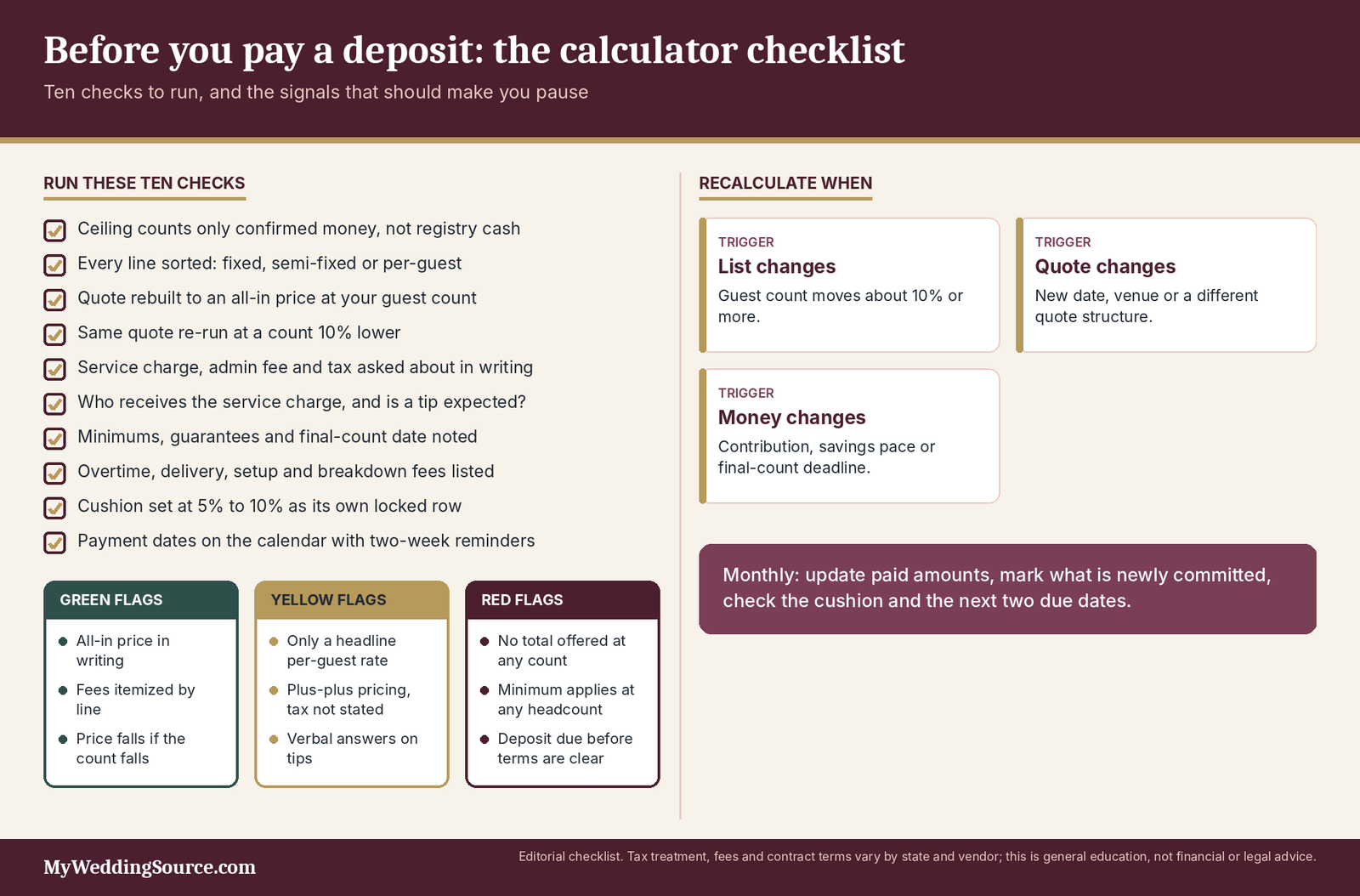
FAQ: wedding budget calculator questions
Using the calculator method
How much of the budget should go to the venue and catering?
The Knot’s 2026 allocation puts venue and rentals at 29% and catering, cake and drinks at 24%, so together they take about 53% of the budget. The worked example in this guide lands at the same 53% when the service charge, tax and rentals are included. Use that as a reference point, not a rule: a venue that is donated or low-cost shifts the share down, while a venue-and-meal package in a high-cost metro can push it well above 60%.
If your share is far from 53%, check the reason before changing the plan. A higher share may be a deliberate priority, as when the space and meal are the point of the day. A lower share might mean you have skipped a line, so confirm that rentals, service charge and tax are in the total.
What is a realistic cost per guest?
The Knot reports an average of $292 per guest for 2025 weddings, which includes fixed costs spread across about 117 guests. Zola suggests budgeting $150 to $300 per guest for the guest-dependent costs of food, beverages, rentals and similar items. In this guide’s worked example, the average cost per guest is $350 at 100 guests, while the marginal cost of one more guest is about $154.
Which number matters depends on your question. Use the average to compare your total to a benchmark and use the marginal cost to decide whether to add or remove guests. Neither number includes your region, so ask local vendors for their per-guest rates before you rely on either.
Should the cushion be a percentage or a fixed amount?
A percentage scales with the plan and is easier to maintain as the total changes, which is why this guide uses 7.5% of the subtotal. A fixed amount can feel more concrete, and some couples prefer to name a dollar figure such as $2,500 and defend it. Either approach works if you write the number down and define what it is for.
The Knot suggests at least 5%, and Zola’s survey found unplanned costs averaging about 9% of spend, so a range of 5% to 10% fits the data. Choose the higher end when several large lines are still unsigned and the lower end when contracts are complete and all-in totals are in writing.
Fees, quotes and borrowing
Do I tip on top of a service charge?
It depends on the contract. The Knot’s tipping guide says additional tips are unnecessary when gratuity is already listed in the contract or invoice, though exceptional service can still be rewarded, and suggests 15% to 20% of the food and beverage fee when no service charge is included. Ask who receives the service charge, since a charge can fund payroll, overhead or both.
Write the answer next to each vendor in your spreadsheet. If a contract is silent on gratuity, ask in writing and note the reply, so that you and your coordinator know on the wedding day which envelopes to hand out.
Is it okay to put wedding costs on a credit card?
Many couples do, and it can work well when you can pay the balance before interest begins, since cards can add protections and rewards. It becomes expensive when a balance lingers, as the $5,000 example showed: at a hypothetical 24% APR over 12 months, interest was about $674. The CFPB advises checking introductory rate terms, fees and the rate that applies after any promotion.
Paying a deposit by card also gives you dispute rights for services not delivered as agreed, with a written dispute due within 60 days of the statement showing the error. This is general information and not personalized financial advice; a nonprofit credit counselor can review your own numbers.
How often should I update the numbers?
Do a quick review monthly and a full recalculation whenever a trigger occurs: a guest list change of roughly 10%, a new date or venue, a quote with a different structure, a change in contributions or the final headcount deadline. A fixed monthly date on the calendar keeps it from slipping.
Before each payment is due, check the committed total against your ceiling and look at the cushion balance. If the cushion is below half of its starting value with months still to go, revisit the plan while changes are still inexpensive.
Your next steps
This week
Build the spreadsheet and set your ceiling
Open a blank spreadsheet and create four blocks: a funding line (savings, monthly savings, confirmed contributions), a fixed-lines block, a per-guest block and a markup block (service charge, tax, gratuity, cushion). Fill in the funding line first, using only confirmed money, and calculate your monthly savings need with the formula from Step 1. Decide whether your ceiling covers the wedding day only or the wider wedding-related total, and write that at the top.
Then copy the worked example’s rows into the other blocks and replace the inputs you know. Leave unknown cells highlighted, not zeroed. By the end of the evening you should have a first-draft total, a low and a high case, and a list of the five or six numbers that most need a real quote.
Send the same questions to every vendor
Email each vendor on your shortlist the same short list of questions: What is the all-in price at my guest count, including service charge, administrative fees and tax? What is the final headcount deadline and the guest guarantee? What are the overtime, delivery, setup and breakdown fees? Are there minimums? What is the payment schedule and the cancellation policy? Asking identical questions makes the answers comparable, and it signals that you read contracts closely.
Request answers in writing, and paste them into the comparison tab as they arrive. If a vendor cannot give an all-in number, note that as information about how they price, not as a reason to be suspicious; many vendors simply quote in layers. For the broader planning sequence around these steps, our wedding planning guide shows where budgeting fits in the timeline.
Before you pay a deposit
Rebuild each quote into the all-in formula and compare
Before any deposit leaves your account, rebuild each finalist’s quote with the all-in formula and compare them at your planned count and at a count 10% lower. Look at what happens in the lower case: a quote that barely changes is rigid, and one that falls with headcount is flexible. Choose with both numbers in front of you, and note the one you would regret if your RSVPs came in lower.
Then check that the cost sits inside your stress case. If it does not, change one lever at a time (guest count, date, format, then funding) and rerun the calculator so you know which change did the work.
Confirm the payment terms and keep proof
Confirm in the contract the deposit amount, the due dates, whether the deposit is refundable, what happens if you change the date or headcount, and which payment methods are accepted. Pay by a method that gives you a record, keep copies of every contract and email, and put each due date in your calendar with a reminder two weeks ahead. If a term is unclear, ask the vendor to clarify it in writing before signing.
Last, add the deposit to your tracker as “paid” and the balance as “committed,” and look at the new “still uncommitted” total. That is the number that tells you how much of your plan is still an estimate, and watching it shrink as contracts are signed is the clearest sign your calculator is working.
Sources & methodology
- The Knot Real Weddings Study 2026 (data page) — survey design: 10,474 U.S. couples married in 2025, recruited through The Knot and WeddingWire
- The Knot, average wedding cost — average cost, guest count, cost per guest, cost by guest-count band and category averages
- The Knot, ideal wedding budget breakdown — percentage allocations by category and the 5% unforeseen-cost guidance
- The Knot, how to pay for a wedding — funding options, registry cash timing and family contribution expectations
- The Knot, wedding vendor tipping — gratuity guidance and service charge handling
- The Knot, photographer, flowers and planner cost pages — planner averages by type and guest count; the photographer and flowers pages are linked in the text
- The Knot, wedding guest cost — attendee spending from the 2024 guest study
- The Knot, off-season guide — share of weddings by month and season
- Zola, First Look Report 2026 — average cost, guest count, who contributes, credit and registry cash behavior
- Zola, how much does a wedding cost — category averages, per-guest range, unplanned-cost and fee findings, off-peak savings
- Tax Foundation, 2026 sales tax rates — average, highest and zero sales tax rates as of July 1, 2026
- IRS, Revenue Ruling 2012-18 and IRS interim guidance memo — service charge versus tip factors
- Virginia Tax, Ruling 15-10 and California appeals decision — examples of differing state treatment of mandatory service charges
- CFPB, introductory credit card rates and consolidating card debt — promotional rates, fees, counseling and scam warnings
- CFPB, if you cannot pay your credit card bills — contacting issuers and nonprofit credit counseling
- FTC, using credit cards and disputing charges — 60-day dispute window and issuer response times
- FTC, rule on unfair or deceptive fees FAQ — scope of the rule (live-event tickets and short-term lodging)
Methodology: Benchmarks, category averages, percentages and survey findings are reported by the named sources for their own samples and years, and they were checked against each source’s page in October 2026. The worked example, scenario tables, sensitivity tests, venue comparison, payment timeline and financing illustration are editorial calculations built on those inputs and on stated assumptions, so they are illustrative examples and not quotes or predictions. Statements about what is taxable or how vendors price are general and vary by state, county and vendor, and nothing here is financial, legal or tax advice. Where one source states a number two ways, as with The Knot’s planner share (4% to 5%) and Zola’s internal percentages, the more conservative reading is used and noted.
Freshness note: Recheck The Knot and Zola figures when the next Real Weddings Study and First Look Report publish (typically early in the year), the Tax Foundation rate table each January and July, and any state tax guidance before signing a contract. Verify the CFPB and FTC pages if your plans involve new financing or a dispute, since agency guidance is updated periodically.