
A wedding aisle floral installation is every flower, vessel, stand, clip, and petal that lines or covers the path to the ceremony, and the two questions that cause the most trouble are the least glamorous ones: what holds each piece in place, and who removes it when the ceremony is over.
Quick answer
A sound wedding aisle floral installation answers five questions in writing before the florist builds anything: what each piece attaches to, what the venue allows it to touch, how wide the walkable path stays, which blooms suit the people who will sit beside it, and who clears everything afterward and where it goes. Venue policies we read ban tape, pins, and hooks outright, require florists to finish setup shortly before guests arrive, and make the florist responsible for removing containers. The federal accessibility standards describe a clear path of at least 36 inches, and they limit how far an object between 27 and 80 inches high may stick into a walkway. Anything hung overhead is a separate decision for the venue and a qualified rigger, not something to improvise with zip ties.
What a wedding aisle floral installation includes, and where this guide stops
Most advice about ceremony flowers is about how they look. This guide is about how a wedding aisle floral installation behaves on the day: how it stays upright, how it fits the path guests and the wedding party actually walk, how it affects the people sitting next to it, and what is left on the floor when everyone has gone to cocktail hour. Those details decide whether the flowers stay a pleasant backdrop or become the thing the planner, the venue manager, and the florist argue about at 5 p.m.
We are not florists, riggers, or safety engineers. What follows is a set of questions to put to the people who are, backed by published venue policies, accessibility standards, and allergy and environmental guidance. Where a statement comes from a venue, a florist, or a retailer, we say so, because those sources describe their own rules and products.
The formats a wedding aisle floral installation can take
The phrase covers very different objects. Each one has its own way of failing, so it helps to name the format of your wedding aisle floral installation before talking about anchoring or cleanup.
Seat-end and pew-end pieces
These are small arrangements, bundles of greenery, or ribbon-tied bouquets attached to the end of a chair or pew. The Knot’s roundup of aisle ideas lists pomanders on ribbons or loops at pew ends, small bouquets with reserved signs, and greenery swags tied to chairs. They are the easiest format to anchor because the chair does the work, but they are also the format most often restricted by venues, since the attachment method touches furniture.
Ground-level vessels along the aisle
Urns, troughs, buckets, terracotta pots, and lanterns set on the ground fall in this group. The same Knot article describes stone troughs, terracotta pots with wildflowers, and gold urns holding hydrangeas. Their weight is both their strength and their problem: a full vessel is stable in a breeze, but it is also heavy to carry and awkward to clear.
Petal lines and scattered petals
Rose petals scattered as a makeshift runner is one of the aisle ideas the Knot describes. Petals cost nothing to anchor, because they are not anchored, and that is exactly why so many venues restrict them. The venue policies we cite later show how common the restriction is.
Floral runners and ground installations
A floral runner is a built-up strip of flowers and greenery laid along or beside the path, sometimes on a base. It is the most labor-intensive format and the one with the most to clear afterward. Because this kind of wedding aisle floral installation sits on the walking surface or next to it, it also sits closest to the accessibility questions in the safety section below.
Hanging and overhead pieces
Garlands on shepherd’s hooks along an outdoor aisle are described in the Knot article, and hanging florals in small vessels are listed there too. Anything suspended above guests belongs in a different conversation, and we handle it in its own section below.
What this guide covers and what it leaves to others
A wedding aisle floral installation touches several other planning topics, and we link to those guides instead of repeating them.
Covered here
Anchoring methods and the questions that go with them, a safety and access check for the aisle, an allergy exposure screening and a bloom alternative table, cleanup and disposal, and the questions to put to your florist and venue.
Covered elsewhere
For delivery windows, cold storage, and the general florist conversation, see our wedding flower logistics checklist, wedding flower refrigeration guide, and wedding florist questions. For the arch at the end of the aisle, see our guide to the floral wedding arch. For what flowers cost overall, start with wedding flowers.
Anchoring a wedding aisle floral installation to the venue it is standing in
Anchoring is the question of what each piece rests on, attaches to, or is weighted by. It is also where a venue’s rules and a florist’s habits most often collide, because the florist’s usual tools (tape, wire, pins, ties, nails, hooks) are the ones many venues prohibit. The fix is to learn the venue’s rules first and design the wedding aisle floral installation around them, not the other way around.
Start with what the venue prohibits
The venue policies we read were written for churches and chapels, but the pattern is useful for any venue. We cite them as examples of what a policy can say, not as rules that apply to your venue.
Tape, pins, and hooks
One chapel’s policy says floral tape, 3M hooks, tacks, pins, nails, and screws are strictly prohibited indoors and outdoors, and it lists no approved anchoring method. A cathedral policy says pew-end decorations may not be pinned, glued, nailed, tacked, taped, or stapled, and it names what is allowed instead: elastic bands, plastic pew clips, or ribbons. The practical lesson is that the policy that tells you what is banned is only half the answer. Ask the venue to name what is permitted for a wedding aisle floral installation, in writing.
Where flowers may and may not go
A second chapel policy goes further than attachment: it says flowers or decorations cannot go in the aisles, on the pews, or on railings, and that aisle runners are not used. Another cathedral allows pew-end decorations at regular intervals along the full length of the aisle but bans aisle runners. Two policies from similar buildings gave opposite answers, so do not generalize from one venue to another.
Containers and leaks in a wedding aisle floral installation
The same chapel policy states that papier-mâché containers are not permitted and that containers must not present a risk of leaking. A container that sweats, seeps, or tips is a cleanup problem and, on a polished floor, a slipping problem. Ask your florist what is inside each vessel and how it is sealed.
Seat-end and pew-end pieces
Because the seat does the holding, this format of wedding aisle floral installation needs the fewest decisions, but each one matters.
Clips, bands, and ribbons
The cathedral policy above names elastic bands, plastic pew clips, and ribbons as the permitted attachments. Ask your florist whether the piece can be built to hang from one of those, and whether it was designed to hang from a chair back of the style your venue uses. A folding chair, a chiavari chair, a bench, and a pew all offer different places to attach.
Keep seats and sightlines clear
The same cathedral policy says pews may never be blocked by ribbons, cords, or strings. Even where a venue has no such rule, a bundle that hangs into the seat or tangles with a guest’s coat is a problem. Ask for a sample at the rehearsal, and sit in a chair beside it.
Weight and sway
A heavy arrangement on a light chair can tip it or drag it out of line, and a hanging one can swing into a passerby. These are our reasoning, not findings from a source, but they are easy to test with the actual chair and piece. Our wedding bouquet weight guide explains why flower weight is easy to underestimate, and the same logic applies to anything hung from a chair.
Ground-level vessels and stands
Ground pieces are the part of a wedding aisle floral installation where weight, surface, and wind matter most. The Knot article notes that garland on an outdoor aisle needs shepherd’s hooks to hang, which tells you that something has to hold the hook up, and that is the same question for any ground piece.
What the surface will take
Hard floors, carpet, grass, gravel, and sand each ask something different of a stand. On a lawn, a vessel might need a flat base or a board under it so it does not sink; on a hard floor, it might need a non-marking base. Ask the venue whether anything may be driven into the ground at all, because lawns often hide irrigation lines and cables. We found no source that sets a standard for ground anchoring, so this is a question to ask, not an answer we can give.
Wind and weight
Wind is the reason a good plan for outdoor flowers needs a plan for gusts. A floral foam manufacturer’s blog names wind as a challenge for outdoor flowers but, in the part we read, gives no specific wind-handling advice, so take the manufacturer’s silence as a reason to ask your florist rather than as reassurance. A freestanding piece with a tall, narrow shape and a small base is easier to tip than a wide, low one; again, that is our reasoning, to be confirmed with your florist’s experience.
Zip ties and existing structures
The same manufacturer’s blog suggests zip-tying floral cages to existing structures such as gazebos and arbor corners. That is an option only if the venue permits attaching things to its structures, and many do not. Treat it as a question to put to the venue, not as a default.
Floral runners and petals
Any part of a wedding aisle floral installation that sits on the walking surface carries a second set of questions, because people walk on it.
How a runner is built and held
We found no authoritative source on floral runner construction, so we cannot give a method. Ask your florist how the runner is built, what is under it, how it is kept from shifting, and how it is lifted afterward. If the answer is “tape,” check the venue’s tape rules first.
Why petals are so often restricted
The venue policies we reviewed ban petals more often than they allow them. One chapel’s policy prohibits throwing rice, confetti, birdseed, or flower petals inside or outside the building. The cathedral policy says flower petals may not be used, thrown, or released inside or outside, including on the front steps. Another chapel’s policy lists rice, birdseed, confetti, flower petals, sparklers, balloons, birds, and butterflies. These are the policies of specific religious venues, so a garden or hotel may differ, but the pattern is a good reason to ask before buying petals by the bag.
Petals and the walking surface
Loose material on a walkway is a question for the accessibility check below, since the federal standards ask for surfaces that are stable and firm. A scatter of petals is not loose gravel, and the standards do not mention petals, but a thick layer on a polished floor is something to test with a wheelchair or walker before the day.

Timing: when setup is allowed
Anchoring a wedding aisle floral installation is also a matter of time, because a venue may give a florist only a short window to install what took days to design.
Setup windows are tight for a wedding aisle floral installation
The chapel policy we cite says florists may deliver and arrange flowers no earlier than 30 minutes before the ceremony and must finish at least 15 minutes before it begins. The cathedral policy gives setup start times by service, for example 2:30 p.m. for a 5 p.m. wedding. A second chapel allows setup for 30 minutes before the ceremony and says flowers must be in place at least 25 minutes before the start. If your wedding aisle floral installation takes longer than that to build, you need to know now.
Tell your florist the actual window
Ask the venue for the earliest access time and the latest finish time, in writing, and pass both to the florist. If the design cannot be built inside that window, the options are a simpler design, a larger crew, or a different venue arrangement, and all three are easier to choose three months out than three hours out. Our wedding vendor timeline guide covers how to line up every vendor’s arrival.
Test the build at the rehearsal
If the venue allows it, ask the florist to bring one finished aisle piece to the rehearsal. Our wedding rehearsal guide covers what to rehearse; adding a flower check costs ten minutes and shows you the chair, the clip, and the walking path together.
Hanging and overhead pieces in a wedding aisle floral installation are a venue and rigger decision
The brief for a wedding aisle floral installation often includes a canopy of flowers or a row of hanging pieces over the guests. We treat this section differently from the rest of the guide: we do not give methods, and we do not suggest any overhead attachment that the venue has not approved.
Why a wedding aisle floral installation stops at the ceiling
Anything suspended above guests can fall on them, and the consequences of a failure are different from the consequences of a leaning urn.
An attachment point is the venue’s to approve
Only the venue knows what its ceiling, beams, trees, or tent frame can carry and where attachment is allowed. Several policies we read restrict fastening anything to pews, walls, or windows, and none of them was written with overhead loads in mind. Ask the venue in writing whether anything may be hung at all, from which points, and by whom.
Load and responsibility belong to a qualified person
We found no consumer guide we trusted for load limits, so we do not give any. If the venue permits suspended pieces, it will usually name the rigger or the approved vendors, and the florist and rigger should agree on the weight of each piece before the day. Our upcoming guide to wedding hanging floral installations covers this subject on its own.
Ask about insurance
Ask whether the venue requires proof of insurance from the florist and whether your own event policy has anything to say about decor. Our wedding insurance guide explains the basics, and neither it nor this guide is insurance advice.
Alternatives that stay near the ground
If the venue says no, you can often keep most of the visual effect without anything overhead.
Raise the visual line without hanging it
The Knot article describes garland on shepherd’s hooks along an outdoor aisle and hanging florals in small vessels. Both are suspended on low supports, not from a ceiling, and both still depend on the venue’s approval of ground hooks. Ask which of these the venue allows.
Move the drama to the end of the aisle
If a wedding aisle floral installation is restricted, the arch, altar, or backdrop can carry the flowers. Our wedding backdrops guide covers freestanding options, and our floral wedding arch guide covers the structure itself.
Keeping the aisle walkable: access and safety for a wedding aisle floral installation
A wedding aisle floral installation narrows a path in ways nobody measures until a guest with a walker arrives. The federal accessibility standards were written for public buildings and facilities, and a private wedding is not necessarily covered by them, so we use them here as a reference point for good practice, not as a legal requirement for your event. We do not give legal advice. If a venue is a place of public accommodation, its own accessibility obligations are the venue’s to explain.
Width and clearance along the path
The U.S. Access Board publishes plain-language guides to the ADA Standards. The numbers below come from those guides.
The clear width of the route
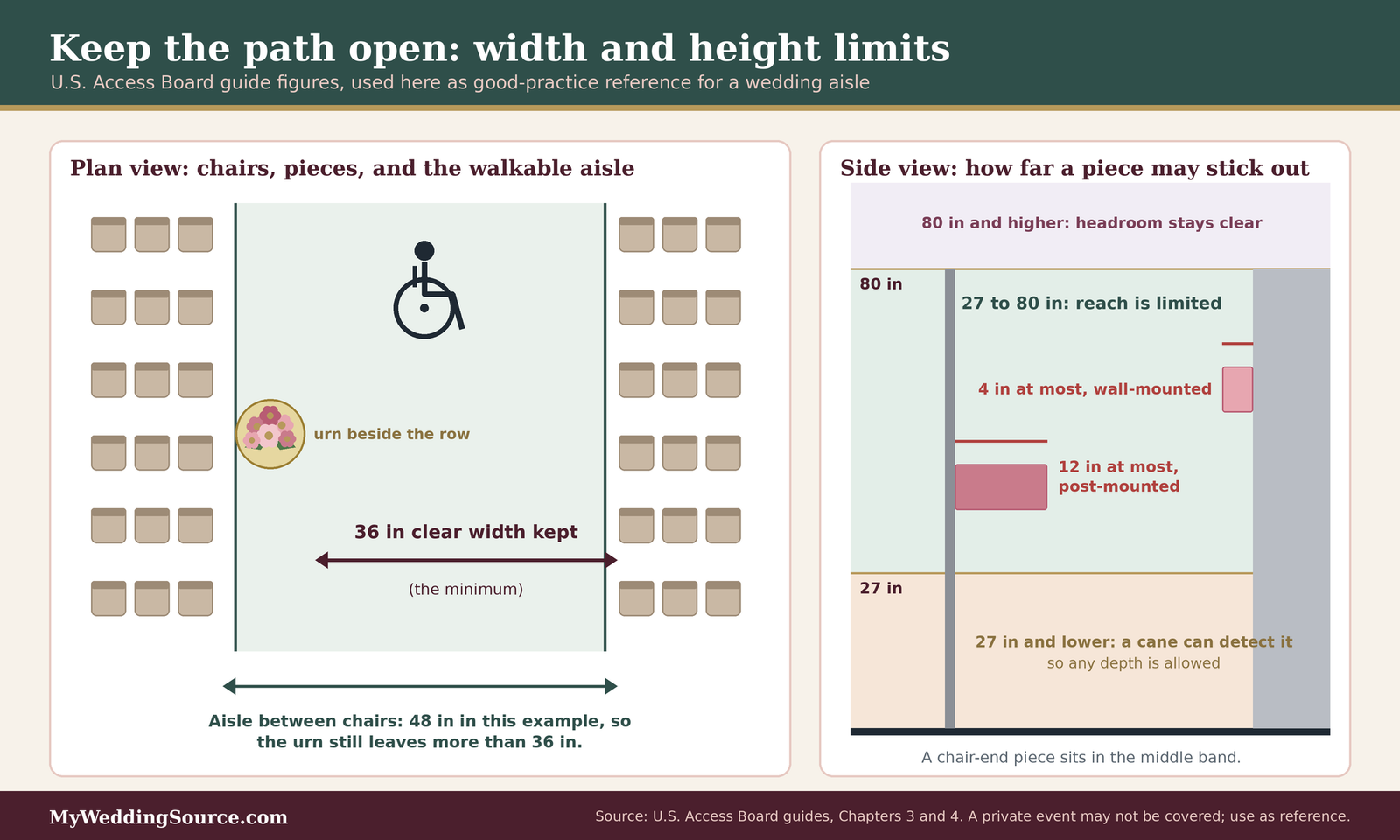
The Access Board’s guide to accessible routes says the clear width of an accessible route is at least 36 inches, continuous, and that it may narrow to 32 inches at points such as doorways, for a maximum length of 24 inches. Every vessel, chair-end piece, and petal edge in the wedding aisle floral installation that intrudes on that width takes away from the walkable path. If the aisle between chairs is exactly as wide as the chairs allow, a ground-level urn beside each row may take more than you expect.
Objects that stick out into the walkway
The Access Board’s guide to protruding objects describes the limits for objects whose leading edge falls between 27 and 80 inches above the floor. Wall-mounted objects in that range may project no more than 4 inches into the circulation path. Objects on posts or pylons may project no more than 12 inches. Objects at or below 27 inches, or at or above 80 inches, may protrude any amount under the standard, because a cane can detect the low ones and the high ones are above head height.
What that means for chair-end pieces
A pomander or bouquet hanging from a chair back sits well inside the 27-to-80-inch band. Whether a chair-end arrangement counts as a “protruding object” under the standard is a question for the venue, since the standard addresses fixed or mounted objects, but its numbers are a useful test: if a piece sticks out more than about 4 inches into the aisle, a person using a cane may not detect it until they hit it. That is our application of the figure, not a rule from the standard.
Headroom and anything overhead
The same guide says headroom must be at least 80 inches along circulation paths, with 78 inches permitted at doors and doorways. A hanging garland, canopy, or lantern needs to clear that height for the tallest guest, the wedding party, and anyone carrying something. Combine this with the rigging section above: the venue decides whether something may hang there, and the standard suggests the minimum height at which it should hang.
The surface under the flowers
The Access Board’s guide to floor and ground surfaces describes the surface rules for accessible routes.
Stable, firm, and slip resistant
The guide says surfaces must be stable (resisting movement) and firm (resisting deformation under force). It says concrete, asphalt, tile, and wood are generally acceptable, and that loose materials like gravel usually are not, unless treated and maintained. It adds that the standards set no minimum friction value and that standard practices for minimizing slipperiness are likely sufficient. A heavy scatter of petals is not covered in so many words, but the principle behind it applies: a surface that shifts underfoot is not firm.
Carpet, runners, and edges
The guide says carpet pile may be no higher than 1/2 inch, and that carpet must be securely attached so it does not shift or buckle, with exposed edges trimmed along their full length. Changes in level up to 1/4 inch are permitted without treatment, and a 1/2-inch change is permitted if beveled. A floral runner laid over carpet, or a runner with a raised edge, can create exactly the kind of lip those numbers describe. Measure the height of any runner or base at its edge.
Openings and gaps
Openings in a walking surface must prevent the passage of a sphere 1/2 inch in diameter, according to the guide. That matters if a runner base has gaps or mesh, or if a boardwalk, deck, or grate runs along part of the aisle. Ask your florist what the runner is built on.
Testing the path before the day
You do not need a measuring tape and a consultant to catch most problems. You need an hour at the venue and the actual pieces.
Walk it with the equipment guests will use
If anyone coming to the wedding uses a wheelchair, walker, cane, or stroller, ask them to try the path, with their permission and at their convenience. Our accessible wedding guest experience and wedding transportation for guests using wheelchairs guides cover the wider planning questions. If nobody can try it, a rolling suitcase and a person walking with a slow, careful step do surprisingly well as a rough substitute.
Check the lighting and the dress
An aisle that looks clear in daylight can hide a vase at dusk, and a long train or a long dress can catch on anything at ankle height. Our wedding dress train lengths guide explains how much fabric the aisle has to handle, and our wedding processional order guide covers who walks when.
Mark it for the crew
Give the florist and the venue the same plan: the width that must stay open, the height that must stay clear, and where anything may sit. A one-page sketch with those numbers on it, shared with the setup crew, is more reliable than a conversation the night before.
Candles, scent, and fire
Many a wedding aisle floral installation adds candles to flowers, and several of the venue policies we read restrict them.
What the policies say
The chapel policy we cite says open flames and candles are not allowed except for a unity candle, and that candles enclosed in votive or hurricane lanterns are allowed in other rooms. The cathedral policy says no candles may be placed in the aisles or on pews. The Knot article lists pillar candles in flame-lit or battery-powered versions, so the flameless option exists wherever a venue says no.
Scented candles and asthma
The American College of Allergy, Asthma and Immunology (ACAAI) says scented candles, especially many of them, can trigger asthma, and suggests LED candles at the reception. Use flameless candles near the aisle if you or a guest has asthma. Our wedding permits guide covers permits for outdoor sites more generally.
Ask the venue about greenery near flame
We found no source we could cite on how close candles can sit to cut greenery, so we do not give a distance. If the design mixes flame and greenery, ask the venue or the local fire authority what they require.
An allergy exposure screening and bloom alternative table for a wedding aisle floral installation
The aisle is the one part of the room that guests sit within arm’s reach of, so a wedding aisle floral installation puts flowers closer to noses and hands than almost any other decor. This section is a screening you can do in an evening and a table of alternatives to discuss with your florist. It is not medical advice, and it does not replace advice from an allergist.
How exposure happens along an aisle
Allergic reactions to a wedding aisle floral installation do not all work the same way, and the flower that bothers one person is not the one that bothers another.
Pollen that travels and pollen that stays put
The University of Florida’s IFAS Extension notes that wind-pollinated plants release large amounts of pollen and are the usual culprits for allergies, while insect-pollinated species need to produce far less. Which group a particular cut flower falls into is a question for your florist, because the source does not sort individual cut flowers. Our guide to planning flowers for a wedding with pollen allergies covers the pollen question in detail, and this guide focuses on the aisle.
Fragrance, not pollen
A florist’s guide we read warns that even non-allergenic flowers with strong scents can cause discomfort, citing gardenias and jasmine. ACAAI separately says guests may react to fragrance compounds in cologne and perfume. A person who sneezes near lilies may be reacting to scent, to pollen, or to both, and a good screening separates the two.
Touching, not breathing
Contact reactions are a third route. A case report in the journal literature describes a florist whose symptoms were caused by tulipalin A, a compound in tulips and alstroemeria, and says a sensitized person typically develops symptoms 12 to 24 hours after a later exposure. The authors recommend reducing contact and wearing nitrile gloves, and say vinyl gloves are not an effective barrier. This matters most for the people handling the flowers, which is a reason to tell your florist and your setup crew about any known sensitivities.
The five-question screening
Do this screening for your wedding aisle floral installation with your partner and, if you can, with your florist and a few close relatives. It takes less than an hour and is not a medical test.
Who sits closest
List everyone seated on the aisle in the first several rows, plus the officiant, the wedding party, and any child or older relative who will walk or be carried down it. Include anyone who will be handling the pieces afterward. These are the people to ask first.
What each person already knows
Ask about hay fever, asthma, skin reactions to plants, and sensitivity to scent. If someone has asthma or a known severe allergy, it is better that they speak to their allergist than to us. ACAAI suggests meeting an allergist a few months before the wedding if the couple has allergies or asthma, and starting medications before symptoms usually begin.
Which route is the risk
For each person who reports a reaction, note whether it comes from pollen, scent, or touch. That tells you whether to change the bloom, change the position, or change who handles it.
What is outdoors
At an outdoor wedding, the grass, trees, and weeds around the aisle add their own pollen to the flowers. ACAAI says tree and grass pollen peaks in the evening in spring and summer and ragweed pollen peaks in the morning in late summer and early fall. The ceremony time may matter as much as the bloom.
Whether animals are involved
ACAAI points out that if a pet is part of the wedding, nobody in the wedding party should be allergic to it. Ask also whether a dog or cat will be anywhere near the flowers, or whether the flowers will go home to a household with one. The ASPCA lists Lilium species as toxic to cats, and says kidney failure is the clinical sign; it gives a poison control number for suspected ingestion. That matters most if the aisle flowers go home with a guest or family member afterward.
The bloom alternative table
How the table is organized
The table below collects what the sources we read said about common aisle blooms and offers alternatives to discuss with a florist. The recommendations come from a florist’s own guide and from ACAAI, so they are one professional’s view and not a clinical finding. Individual reactions vary, so no flower is safe for everyone. Each row names a bloom, the concern a source raised, who it may matter to, alternatives worth discussing, and where the claim came from.
| Bloom | The concern raised | Who it may matter to | Alternatives to discuss | Source and caution |
|---|---|---|---|---|
| Lilies (Lilium) | A florist guide lists strong scent and loose pollen; the ASPCA lists the genus as toxic to cats | Scent-sensitive guests, households with cats | Calla lilies, which the same florist guide lists as having little to no pollen; roses; orchids | Florist’s own advice; ASPCA for cats. Ask about pollen-free varieties |
| Sunflowers | The florist guide lists high pollen, even in pollen-free varieties | Guests with pollen allergies seated nearby | Ranunculus, dahlias, or roses | Florist’s own advice |
| Daisies and baby’s breath | The florist guide lists daisies as part of the aster family and baby’s breath as able to release airborne pollen | Guests with pollen allergies | Carnations, hydrangeas, or greenery | Florist’s own advice |
| Goldenrod and wildflower mixes | The florist guide calls goldenrod a significant allergen and often confused with ragweed | Guests with ragweed or weed allergies | Roses, peonies, or orchids | Florist’s own advice; confirm what is in a wildflower mix |
| Gardenia and jasmine | The florist guide warns that strong scents can cause discomfort even where pollen is low | Scent-sensitive guests, asthma | Unscented or lightly scented flowers such as hydrangeas or ranunculus | Florist’s own advice; ACAAI on fragrance |
| Tulips and alstroemeria | A case report links tulipalin A to skin reactions in florists | Florists, setup crew, anyone handling stems | Roses or hydrangeas for handlers with known skin reactions | Case report; nitrile gloves recommended. The florist guide lists tulips as low in pollen, so the contact and inhalation risks differ |
| Roses | ACAAI recommends classic roses; the florist guide says hybrid and double-petal types keep pollen in their petals | Often a first choice for guests with pollen allergies | Peonies, ranunculus, or carnations if scent matters | ACAAI and florist’s own advice. Fragrant garden roses may still bother scent-sensitive guests |
| Hydrangeas, peonies, orchids | The florist guide lists them as low in pollen | Pollen-sensitive guests | Use as the main aisle flowers | Florist’s own advice; no flower is safe for every person |
What the table leaves out
It covers only the blooms the sources we read discussed, and it says nothing about dyes, sprays, or preservatives applied to stems, which a florist can describe. It also does not rank blooms by risk, because the sources did not.
Using the table without overreading it
A table of flowers can make allergies around a wedding aisle floral installation look more predictable than they are.
Treat it as a conversation starter
The table does not say which flowers are safe. It says which flowers a florist or an allergy organization flagged, and why. Your florist will know which varieties are in season and what the actual stems look like when they arrive. Our seasonal wedding flowers guide explains how season changes the choice, and our fresh vs silk wedding flowers guide covers the option of replacing a problem bloom with an artificial one.
Silk and greenery have their own caveats
Artificial flowers carry no pollen, but they can collect dust and, depending on the material, fragrance from storage. Greenery such as eucalyptus, ferns, and olive branches is suggested by the florist guide as a low-pollen way to fill an aisle, though a person who reacts to a particular plant should still test it.
Test before you commit
If someone in your circle has a known sensitivity, ask the florist for a sample stem or a small bundle a week ahead and let that person spend ten minutes beside it, in a room like the venue. This is an informal check, not a medical test, and a person with severe reactions should talk to an allergist before trying it.
Cleanup: who clears a wedding aisle floral installation, and where it goes
Cleanup is where a wedding aisle floral installation plan most often fails, because it happens when everyone is tired, the light is going, and the wedding party has already left. A good plan names a person, a time, and a destination for every piece, and it puts all three in the florist agreement.
What venues say about removal
The policies we read agree on one thing about any wedding aisle floral installation: the florist is responsible for removing what the florist brought.
Containers and refuse
The chapel policy we cite says delivery boxes and refuse must be removed once delivery and setup are complete, and that after the ceremony the florist must remove any flowers affixed to windows, pews, walls, or wall sconces. The cathedral policy says the florist, ushers, and family members must remove all flower containers from the vestibule before leaving, that this is not the staff’s job, and that trash must go in the proper receptacles. A third chapel’s policy says containers for corsages and arrangements must be removed from the vestibule before leaving.
Enforcement is real
One of the chapel policies says violations are addressed immediately and that continued violations lead to removal of the decorations and dismissal of the florist from the building. We cite it not to alarm you but to show that a venue may treat decor rules as operating rules. If you hire a florist who does not know the venue, send them the policy yourself.
Where nothing is stated
Several of the policies we read say nothing about cleanup in some spaces. For example, the chapel policy that spells out removal for its sanctuary does not address cleanup in its other rooms or event tent. Silence is not permission for a wedding aisle floral installation. Ask the venue for its after-event requirements in writing, including what happens to anything left behind.
The cleanup plan, piece by piece
Different pieces of a wedding aisle floral installation have different cleanup needs. Walk the aisle in your head, from the doorway to the end, and name the exit route for each item.
Chair-end and ground pieces
Name the person who unclips or unties each piece and the order in which they do it. If the ceremony chairs are being flipped for a reception, the pieces have to come off first. Ask the florist whether they will return for the pieces or whether a family member or a planner will carry them. If a family member, give them a label and a destination.
Petals and loose material
If petals are allowed at all, someone has to sweep them, and the tools matter: a broom, a dustpan, a bag, and a surface that will be swept. The venue may require that petals be removed from stairs and walkways, since people will walk on them in the dark. Ask the venue what its crew will and will not sweep, and whether it charges a fee for after-event cleaning.
Wax, water, and stains
Water from vessels, wax from candles, and pollen from open lilies can mark floors, linens, and clothing. We found no authoritative source on stain removal from flowers, so we do not give a method. Ask your florist to bring towels and a small kit, and ask the venue what it permits on its floors.
Foam, wire, and what is left behind
Some of the cleanup after a wedding aisle floral installation is about the material the flowers were built on.
Floral foam
A wedding blog’s article on florists dropping foam describes floral foam as a single-use microplastic of the phenol formaldehyde family, developed in the 1950s, and says water containing foam fragments should not go down the sink or into stormwater, because it is harmful to marine life. A flower retailer’s blog says the same basic thing in plainer terms: foam is made from a plastic, breaks down with repeated stem insertion, and is typically thrown away with the flowers after the event. A floral foam manufacturer’s blog, by contrast, recommends foam-based holders and cages for outdoor weddings. Those are three sources with three different interests. Ask your florist what they use, why, and how they dispose of it.
Chicken wire and reusable mechanics
The retailer’s blog describes chicken wire as a reusable alternative that creates a grid inside wide-mouthed containers, and lists its drawbacks: it takes more prep time, the stems sit directly in water so the container must hold water, and filled arrangements are heavier and more likely to spill in transport. The wedding blog describes florists using chicken wire, clamps, reusable cups and buckets, moss, and twine. Retailer and blog advice is useful, but neither is a safety or environmental standard. If your florist uses wire, ask how it is removed and who takes it.
Zip ties, tape, and ribbon
Small items such as zip tie ends, floral tape, and ribbon scraps end up in a lawn or a carpet. They are also the kind of material several venue policies ban or restrict. Ask the florist to bring a bag and to pick up before leaving.
Composting, donation, and sustainability claims
Many couples want the flowers from a wedding aisle floral installation to go somewhere useful, and it is worth knowing what the sources say before promising anything.
What the EPA says about composting
The EPA’s home composting page lists yard trimmings, plant stalks, and twigs among compostable materials, and says to avoid herbicide-treated plants, diseased or pest-infested plants, and treated or painted wood. It says compostable foodservice ware generally needs commercial facilities because home piles usually do not get hot enough. It does not mention floral foam, wire, or ribbon, so we cannot say they are acceptable, and the EPA’s list of materials to avoid suggests treating anything non-plant as trash unless a facility says otherwise.
Treated and imported flowers
The wedding blog we cite says imported or exotic flowers can be highly treated and may taint the composting process. That is one blog’s statement, not a regulatory finding, so ask your florist where the flowers came from and whether a composter will take them. Our wedding bouquet preservation guide covers keeping the bouquet, and our planned guide to wedding flower donation after the reception covers passing flowers on.
Be careful with green claims
The FTC’s Green Guides help marketers avoid environmental claims that mislead consumers, and the page we read says the guides cover how consumers interpret claims and how to substantiate them. If a florist’s proposal says “eco-friendly,” “biodegradable,” or “compostable,” ask what the claim means, which materials it applies to, and where those materials will go after the wedding. A vague claim is not proof of anything. Our own guide does not endorse any product as environmentally friendly.
Putting cleanup in the agreement
If it is not in writing, it is a hope. Our wedding vendor contract guide covers what a florist contract usually includes.
Name the person, the time, and the place
Write who clears each category of piece, when they will do it, and where it goes. If a family member is part of the plan, ask them before you promise them, and give them a time that does not collide with the first dance.
Ask about fees and deposits
Ask the florist whether collecting containers, striking the installation, or returning later is a line item, and ask the venue whether it holds a deposit against damage or leftover decor. If either answer is yes, ask what triggers a deduction and how long the venue has to return the deposit.
Keep a record of the starting condition
Take photographs of the space before setup, and after cleanup, with the date visible. If a dispute arises, the photographs are more useful than a memory.

Questions to ask your florist and venue about a wedding aisle floral installation
The questions below about a wedding aisle floral installation are the ones that would have saved most of the trouble in the sources we read. Send them in writing, and file the answers with the contract. Our wedding venue questions guide covers the rest of the venue conversation, and our wedding rental planning checklist covers anything you rent for the aisle.
Questions to ask about a wedding aisle floral installation
- What may each piece be attached to, and what attachment methods are not allowed at all?
- May anything be placed on the aisle, on the chairs or pews, or on the ground, and may petals be used?
- What is the earliest the florist may enter and the latest setup must finish?
- What width of the aisle must stay open, and what height must stay clear?
- What is each vessel made of, and could it leak or tip?
- Which blooms have a known pollen, scent, or contact concern for anyone seated or handling them?
- What is under, inside, and around each piece: foam, wire, tape, ties, or something else?
- Who removes each piece, by what time, and where does it go afterward?
- What does the venue charge for cleanup, and is there a deposit?
- What happens if rain, wind, or heat forces a change on the day?
Questions for the florist
These are the questions that decide whether the florist’s wedding aisle floral installation design fits the venue.
How will the wedding aisle floral installation be built and held?
Ask the florist to describe, piece by piece, how it will be attached, weighted, or placed, and what happens in a gust. Ask about previous work at this venue or in a similar setting. Our wedding florist questions guide has a longer list.
What will arrive, and in what order?
Ask for a delivery and setup timeline, including how many people will set up, whether they will return to strike the installation, and what they need from the venue. Our wedding flower logistics checklist shows how to build one.
What if a bloom is not available?
Ask whether substitutions are allowed and what you will be told. Our planned guide to wedding flower substitution clauses covers this. If you have an allergy concern, ask that any substitution be approved by you in writing.
Questions for the venue
The venue’s answers set the limits for the florist.
What are the written rules?
Ask for the decor policy as a document, not a summary, and forward it to the florist. Ask whether the policy changes for a rain location or a second room.
Who is on site and when?
Ask who the florist meets, who can approve a change on the day, and who locks up. If there is no one on site, ask what happens if the florist runs late or something is damaged.
What is the cleanup standard after a wedding aisle floral installation?
Ask what condition the space must be in at the end of the night and what the venue’s crew handles. Ask whether leftover decor is moved, stored, discarded, or charged for.
Questions for the planner or coordinator
If you have a planner or day-of coordinator, make them the owner of the plan.
Who owns the clock?
A planner can hold the setup window and tell the florist when to stop. Our wedding planner vs coordinator guide explains the difference.
Who owns the exceptions?
Decide who makes the call if the wind picks up, a guest needs a different route, or a vase breaks. A short written plan with a named person is better than a debate at the aisle.
What a wedding aisle floral installation can cost, and what drives the price
What this actually costs
We did not find reliable published prices for a wedding aisle floral installation, because the cost depends on region, season, format, and how much labor the venue’s rules require. The cost usually shows up as flowers and vessels, a setup and strike labor charge, a delivery or second-trip fee, rental fees for stands or urns, a venue access or after-hours fee, and a cleanup or damage deposit. Ask each vendor for line items in writing, and ask which of them are already included. If a number surprises you, ask what it covers before deciding it is too high. Our wedding budget guide can help you place the line in the larger plan.
Where the money tends to go
The structure of the cost of a wedding aisle floral installation is more useful than a number we cannot verify.
Labor for the build and the strike
A design that takes hours to install and hours to remove costs more in labor than the same flowers in a simple vase. If the venue’s setup window is short, the florist may need extra hands, and extra hands are a line item.
Vessels, stands, and rentals
Urns, troughs, lanterns, and stands may be owned by the florist, rented from a rental company, or bought by you. Ask who owns each one, who is responsible for damage, and who returns it. If you buy them, ask what happens to them afterward.
Fees that appear later
Ask the venue about access fees, extra-hour fees, and cleaning fees. Ask the florist about collection and strike. These are easier to negotiate before the contract than after.
Ways to reduce the load without shrinking the effect
The cheapest wedding aisle floral installation is not necessarily the smallest.
Reuse pieces of the wedding aisle floral installation
The Knot notes that lanterns can move to the reception afterward and that potted trees can be planted or returned. This saves flowers, but it also adds a move to somebody’s task list, so assign the move.
Let the chairs and the end of the aisle do more
Chair-end pieces on every other row can read as a full aisle at a lower cost than a continuous runner, and a strong arch or backdrop can carry the focus. This is a design opinion, not a sourced finding, so ask your florist whether it works in your space.
Choose in-season blooms
The foam manufacturer’s blog notes that in-season flowers are often less expensive. See our seasonal wedding flowers guide for how season shapes the choice.
Edge cases that change the plan for a wedding aisle floral installation
Most couples planning a wedding aisle floral installation do not need all of this. These are the situations where a plan that works in the average room breaks.
Weather and outdoor sites
An outdoor wedding aisle floral installation brings wind, heat, rain, and ground conditions.
Wind and rain
The foam manufacturer’s blog advises making a rain backup plan with the couple and serving food indoors to avoid last-minute chaos. For an aisle, that means deciding in advance whether the installation moves indoors, shrinks, or is skipped, and who decides by when. Our outdoor wedding infrastructure checklist and how to prevent feedback at an outdoor wedding ceremony guides cover other outdoor decisions.
Heat
The same blog says one team held delivery until about an hour before the ceremony because it was so hot. It is one anecdote, but the lesson is sound: heat shortens the time flowers look their best. Our summer wedding heat plan guide covers heat for guests, and our wedding flower refrigeration guide covers flowers.
Ground conditions
Lawns, sand, and gravel affect where a vessel can sit and whether a wheelchair can pass. The Access Board describes loose gravel as generally not acceptable on an accessible route unless treated and maintained. If the aisle crosses such a surface, ask the venue what is laid down for the day and whether it is firm.
Venues with strict rules
Some venues leave a wedding aisle floral installation little room.
Churches, chapels, and cathedrals
The policies we read show how strict a religious venue can be: setup in a 30-minute window, no tape, no petals, no candles in the aisle, and removal of everything by the florist. If you are marrying in one, ask for the policy before you design your wedding aisle floral installation. Our wedding ceremony guide covers the ceremony itself.
Venues that restrict florists to a list
Some venues require an approved vendor. A second chapel’s policy says arrangements must be done by a professional florist. If your florist is not on the list, ask what the venue requires before you commit.
Rented spaces with no on-site staff
If nobody from the venue is present, the florist or planner carries the responsibility for both entry and cleanup. Ask who has a key, who locks up, and who photographs the condition.
Guests with particular needs
A wedding aisle floral installation is built around the typical guest, and some guests are not typical.
Guests who use mobility devices
For a wedding aisle floral installation, apply the width and surface numbers above, and ask guests directly where they would like to sit. Our wedding seating for guests who cannot stand for long periods guide covers seating, which affects who is beside the aisle.
Guests with severe allergies or asthma
If a guest has a severe allergy, ask them what they need from the wedding aisle floral installation. They may prefer a seat farther from the aisle, a seat nearer an exit, or a conversation with the florist. Do not guess.
Children and animals
Children may touch, pull, or knock over what is within reach. Ask whether any piece is within a child’s reach and whether any piece is toxic if chewed or eaten. The ASPCA lists lilies as toxic to cats, and the principle applies to any animal at the ceremony.
FAQ: wedding aisle floral installation questions
Anchoring and setup
What can I use to attach flowers to chairs if the venue bans tape and pins?
Ask the venue what it permits. One cathedral policy we read names elastic bands, plastic pew clips, and ribbons as acceptable and bans pins, glue, nails, tacks, tape, and staples. Your venue may differ, so get its list in writing and ask your florist whether the design can hang from those attachments.
Can a wedding aisle floral installation hang from the ceiling or trees?
Only if the venue approves specific attachment points and, for any real load, a qualified rigger is involved. We found no consumer source we trusted for load limits and do not suggest any overhead attachment the venue has not approved. If the answer is no, garlands on low supports or a stronger arch can carry some of the effect.
How early can my florist set up?
It depends on the venue. One chapel we read allows delivery no earlier than 30 minutes before the ceremony, with setup finished at least 15 minutes before it starts, and a cathedral gives start times by service. Ask for the earliest and latest times in writing and make sure the design can be built inside that window.
Access and allergies
How wide should the aisle stay?
The U.S. Access Board’s guide to accessible routes gives a clear width of at least 36 inches, narrowing to 32 inches at points such as doorways. A private wedding may not be legally bound by that standard, but it is a sensible reference. Measure the open path with the vessels and chair-end pieces in place.
Which flowers are best for guests with allergies?
No flower is safe for everyone. ACAAI recommends classic roses, among others, and a florist’s guide lists peonies, hydrangeas, and orchids as low in pollen while flagging lilies, sunflowers, and strong scents. Use the table above to start a conversation with your florist, and ask guests with severe allergies what they need.
Are lilies a problem for pets or guests?
The ASPCA lists Lilium species as toxic to cats, and a florist’s guide flags lilies for strong scent and loose pollen. Whether lilies bother a given guest depends on the person. If cats live in a household that will take the flowers home, or a guest is scent-sensitive, discuss alternatives with your florist.
Cleanup
Who is responsible for cleaning up after the ceremony?
Usually the florist for what the florist brought, but check your contract and the venue’s policy. The cathedral and chapel policies we read make the florist responsible for removing containers and flowers that were affixed to pews, windows, or walls. Write down who clears each category of piece, by when, and where it goes.
Can the flowers be composted or donated afterward?
Sometimes. The EPA’s home composting guidance lists yard trimmings and plant stalks as compostable and says to avoid treated or diseased plant material, and one wedding blog says imported flowers can be highly treated. Floral foam, wire, and ribbon are not compostable at home. Ask your florist what is in the arrangement and where it can go.
Your next steps
Before you design anything
Collect the written rules for the wedding aisle floral installation
Ask the venue for its decor policy as a document, with the earliest access time, the latest finish time, the attachment methods it allows, and its cleanup standard. Forward the policy to your florist. Use our wedding venue questions guide for the broader conversation.
Run the screening for your wedding aisle floral installation
Spend one evening on the five-question allergy screening with your partner, and send the results to your florist. Our guide to planning flowers for a wedding with pollen allergies goes deeper on pollen.
Before the contract
Match the design to the window and the path
Ask your florist for a build plan that fits the access window, keeps the path at least as wide as you decided, and says how each piece is attached. Our wedding vendor contract guide covers what the agreement should say.
Write the cleanup plan into it
Name who clears each piece, when, and where it goes, and note any fees. If suspended pieces are part of the design, get the venue’s written approval and the rigger’s name before signing.
Before the day
Test one piece of the wedding aisle floral installation at the rehearsal
Bring one finished chair-end piece to the rehearsal, and walk the aisle with it and the planned width in mind. Use our wedding florist questions guide as a last check.
Give the crew a one-page plan
Hand the florist, the planner, and the venue the same page: the open width, the clear height, the setup window, the cleanup owner, and a phone number for each person.
Sources & methodology
How we built this guide
What we relied on
This guide combines the U.S. Access Board’s plain-language guides to the federal accessibility standards, EPA composting and organics guidance, the FTC’s Green Guides overview, allergy guidance from the American College of Allergy, Asthma and Immunology and the University of Florida, the ASPCA’s plant listing, a published case report on tulip-related skin reactions, published decor policies from three religious venues, and florist, retailer, and manufacturer blogs on floral foam, wire, and outdoor flowers. Where a statement comes from a venue, a florist, a retailer, or a manufacturer, we say so, because each describes its own rules and products. The anchoring and sway comments marked as our reasoning are not sourced findings. We checked the pages listed below on November 12, 2026, and we cannot vouch for later changes.
What we did not do
We did not test any anchoring method, rigging, or flower, and we did not inspect any venue. We give no legal, medical, engineering, or insurance advice. We found no authoritative consumer source for overhead load limits, ground anchoring in wind, floral runner construction, stain removal, or candle clearances near greenery, so we give no figures for them. The ADA Standards apply to specific facilities, and a private event may not be covered, so we use them as a reference.
Source list
Government, clinical, and professional sources
- U.S. Access Board, Guide to the ADA Standards, Chapter 3: Protruding Objects: https://www.access-board.gov/ada/guides/chapter-3-protruding-objects/
- U.S. Access Board, Guide to the ADA Standards, Chapter 3: Floor and Ground Surfaces: https://www.access-board.gov/ada/guides/chapter-3-floor-and-ground-surfaces/
- U.S. Access Board, Guide to the ADA Standards, Chapter 4: Accessible Routes: https://www.access-board.gov/ada/guides/chapter-4-accessible-routes/
- U.S. Environmental Protection Agency, Composting at Home: https://www.epa.gov/recycle/composting-home
- U.S. Environmental Protection Agency, Reducing the Impact of Wasted Food by Feeding the Soil and Composting: https://www.epa.gov/sustainable-management-food/reducing-impact-wasted-food-feeding-soil-and-composting
- Federal Trade Commission, Green Guides: https://www.ftc.gov/news-events/topics/truth-advertising/green-guides
- American College of Allergy, Asthma and Immunology, 10 Tips to Keep Achoos from Interrupting Your I Dos: https://acaai.org/resource/10-tips-to-keep-achoos-from-interrupting-your-i-dos/
- University of Florida IFAS Extension, publication FR268 on allergenic plants and pollen: https://edis.ifas.ufl.edu/publication/FR268
- ASPCA, Lily (toxic to cats): https://www.aspca.org/pet-care/animal-poison-control/toxic-and-non-toxic-plants/lily
- McCluskey, Bourgeois, and Harbison, Tulipalin A induced phytotoxicity, Int J Crit Illn Inj Sci (2014): https://pmc.ncbi.nlm.nih.gov/articles/PMC4093970
Venue policies, florists, retailers, and manufacturers
- Martha-Mary Chapel (Wayside), Wedding Decorating Policies and Procedures: https://www.wayside.org/weddings-decorating-policies—procedures
- Wichita Cathedral, 2022 Wedding Flowers and Decorations Policy: https://wichitacathedral.com/images/stories/documents/2022%20Wedding%20Flowers%20and%20Decorations%20Policy.pdf
- St. James Chapel (Archdiocese of Chicago), Decorators and Florists: https://stjameschapel.archchicago.org/for-vendors
- Polka Dot Wedding, Why your florist needs to ditch floral foam: https://polkadotwedding.com/2022/12/why-your-florist-needs-to-ditch-floral-foam/
- Flower Moxie (retailer), Showdown: foam vs chicken wire: https://flowermoxie.com/blogs/moxie-blog/showdown-foam-vs-chicken-wire
- Oasis Floral Products (manufacturer), Backyard and outdoor wedding flower planning tips: https://www.oasisfloralproducts.com/blogs/ideas/backyard-and-outdoor-wedding-flower-planning-tips-1
- The Knot, Pretty ways to decorate your ceremony aisle: https://www.theknot.com/content/pretty-ways-to-decorate-your-ceremony-aisle
- Bloom & Song, Florist’s guide to the best flowers for allergy-friendly weddings: https://bloomandsong.com/hk-flower-delivery-locations/florists-guide-to-the-best-flowers-for-allergy-friendly-weddings