

Wedding calligraphy is a craft purchase with a mail-delivery deadline attached, so the good decisions are the ones that protect two things at once: a handwritten look you love, and an address that a stranger in a postal facility can read without squinting.
Quick answer
Hand-lettered envelope addressing is typically quoted at about $2.50 to $6 per envelope according to The Knot (updated February 2024), and the total depends on households, not guests, plus add-ons such as inner envelopes, return addresses, metallic ink, and rush fees. Choose dark ink on light paper unless you have tested something else, ask for a sample on your actual envelope, give the calligrapher a final, spell-checked guest list in a spreadsheet, and weigh one fully assembled invitation at the post office before you buy stamps. Book as soon as you choose a stationer, because skilled calligraphers fill their calendars months ahead. Keep a printed fallback in mind in case an envelope is spoiled or the schedule slips.
Most guides to wedding calligraphy stop at style: copperplate or modern, black or gold. Style matters, but it is the easy part. The harder questions about wedding calligraphy are practical. How many envelopes will you really pay for? Which envelope stock lets the ink look crisp? What does the Postal Service expect from an address block, and where does a flourish become a delivery risk? What belongs in a quote, and what should you have in writing before you pay a deposit?
This guide works through those questions in the order you will meet them. It assumes you already know the basics of your invitation suite, which our wedding invitations guide covers, and it concentrates on the decisions that belong to wedding calligraphy specifically. Prices and rules are as we reviewed them in November 2026, and anything that is our own arithmetic or an illustration is labeled that way.
What wedding calligraphy covers, and what it does not
People use the phrase for several different services, and the confusion shows up in quotes. One studio may mean “we address your envelopes by hand.” Another may mean “we design a script and print it.” A third may mean “we write a few words once and give you a digital file.” Naming the product precisely is the first step toward comparing wedding calligraphy prices fairly.
The pieces a calligrapher actually writes
Calligraphers are hired for a short list of items, and wedding calligraphy orders usually combine several of them. Some are essential to the mailing, and others are reception details that can wait until the guest list is final. Treating them as separate jobs, with separate deadlines, keeps the early work focused on the part that has to be finished first.
Envelopes: outer, inner, and return address
Envelope addressing is the core of most wedding calligraphy orders. The Knot describes calligraphy as most often used on envelopes, on inserts such as reply cards, and on reception items. An order can include only the front of the outer envelope, or it can add the return address on the back flap and a second set of names on an inner envelope. Each added line or envelope is usually a separate charge, which is why two quotes that both say “per envelope” can differ by hundreds of dollars once the whole suite is counted.
Reception pieces and spot lettering
Beyond the mailing, wedding calligraphy appears on place cards, escort cards, menus, seating charts, and welcome signs. The Knot says place card calligraphy starts around $2 per card and that spot calligraphy, where only a few words such as the couple’s names are lettered, usually starts around $100 and comes with a digital file you can reuse on other stationery. Reception pieces depend on a final attendance list, so they are normally written later than the envelopes. Our guides to wedding table settings and wedding decor show where these pieces sit in the room.
Hand-lettered, printed, and font-based work are different products
The same word, calligraphy, covers three production methods that differ in cost, uniqueness, and risk. Knowing which one a vendor is quoting is more useful than comparing style names.
Handwritten with a pen
The Knot describes handwritten calligraphy as made to order, more expensive than the alternatives, and the most traditional choice. Every envelope is written one at a time, so small variations from piece to piece are part of the product, not a defect. Speed depends on the artist, and a spoiled envelope means starting that piece over. If you value the evidence of a human hand in your wedding calligraphy, this is the option that delivers it. If you value identical results on every envelope, it is not.
Printed calligraphy and digital fonts made from a calligrapher’s hand
The Knot also describes digital calligraphy fonts, created from a calligrapher’s handwriting, as generally cheaper, and printed calligraphy, made on a device such as an iPad with a stylus and then printed or embossed, as a middle route. Printed work is consistent and fast, and a spelling correction does not require rewriting an envelope. The trade-off is that printed script can look more uniform than handwriting, so it suits couples who want the look of wedding calligraphy more than the handmade quality. Ask exactly which method a quote covers before you compare it with a handwritten one.
Decide what must fit before you compare wedding calligraphy vendors
A calligrapher’s portfolio can make any style look appealing. The choice becomes easier when you set limits first: what you can spend, what the envelope has to survive, and what the people reading it need. The first step is to translate your wedding into criteria that a quote can be measured against.
Translate your wedding into selection criteria
Selection criteria are the facts about your event that shrink the field. A small formal dinner and a 200-guest outdoor wedding can both want wedding calligraphy and still need very different vendors, materials, and timelines.
Count households, not guests
Envelopes are addressed per mailing, and one envelope usually serves a couple or a family. A list of 120 invited guests might be about 85 mailings once couples and families are grouped. That number is our illustration, not a statistic, and your own count may be higher or lower. Count it from your actual list, separating mailings that need an inner envelope for children or a plus-one. The household count, not the guest count, drives the envelope bill, while place cards follow the number of guests who attend. Mixing the two is one of the most common budgeting errors when pricing wedding calligraphy.
Match formality, venue, season, and budget
Traditional scripts such as copperplate and Spencerian follow strict rules and suit formal events, according to The Knot, while modern calligraphy is looser and more personal to each artist and works across a wider range of occasions. A black-tie evening is a natural home for classic wedding calligraphy, and our black-tie wedding guide explains what that dress code signals to guests. A relaxed garden lunch may suit a lighter modern hand. Venue and season matter less for the envelope itself, but they affect budget priorities, so compare quotes against the share of your plan you are willing to give to paper. Our wedding budget calculator helps you set that share.
Separate must-haves from visual preference
A must-have is a requirement that would cause a real problem if it failed. A visual preference is something you would enjoy but can compromise on. For wedding calligraphy, must-haves usually include an address block the carrier can read, spelling that matches your list, a delivery date that precedes your mailing date, and a price that fits the plan. Preferences include ink color, flourish, slant, and liner. Writing the two lists separately before you open a portfolio keeps a beautiful sample from quietly overriding a practical limit.
Learn the terms you will see in quotes
Wedding calligraphy pricing uses its own vocabulary, and some terms change what you are paying for. A short glossary prevents misunderstandings later.
Styles, lines, and sets
Copperplate and Spencerian are traditional scripts with strict forms, and modern calligraphy is freer, according to The Knot. A line is one row of the address, and some studios charge by the line, so a fourth line for an apartment number can change the price. A set is an outer envelope plus an inner envelope. Spot calligraphy is a few words, such as names, written once, and it is the smallest wedding calligraphy order you can place. ThePricer’s July 2026 roundup of public price lists also mentions add-on charges for multiple family names, international formatting, and elaborate flourishes, which shows how quickly a simple per-envelope number can grow.
Marketing language that needs evidence
Several phrases appear in listings without a measurable meaning. “Fast turnaround” says nothing until you know the days and the quantity. “Post office friendly” is not a Postal Service standard, so ask what the studio means. “Archival” or “waterproof” ink are claims about materials, and only a test on your own envelope stock will show how that ink behaves. “Unlimited revisions” should be read against the contract’s definition of a revision. When a promise matters to you, convert it into a number, a date, or a sentence in your agreement. Our section on contract language below shows how.
Envelope options and how they change wedding calligraphy
The envelope is the canvas, and its structure, color, and finish decide how the ink looks and whether the piece travels well. Choosing the envelope before you commission the writing is sensible, because Zola advises choosing the envelope first and then the matching paper and design.
Choose the envelope structure
Modern invitations use one of several envelope arrangements. Each changes the amount of calligraphy, the cost, and the way you communicate who is invited.
Outer and inner envelopes
Emily Post advises using both an inner and an outer envelope, with the inner envelope naming the specific people invited so that anyone not listed is clearly not invited. The outer envelope carries titles and full names and the mailing address, and the inner envelope carries only the names of those invited. Zola notes that this double envelope is less common now because it is often unnecessary and adds cost, and it lists alternatives such as a paper band printed with guest names or names written directly on a single envelope. If you want the traditional structure, remember that each inner envelope is a second piece of calligraphy to quote.
When one envelope is enough
A single envelope is simpler and cheaper, and it can still be clear about who is invited, which also lowers the amount of wedding calligraphy you need to buy. The Knot’s guidance for a single envelope is to list everyone invited, including plus-ones and children, and it notes that “and Family” can save space. Emily Post suggests that with one envelope a short personal note can extend an invitation to a guest. A single envelope also leaves more room in the postage budget, because it is lighter. If your list includes children who are not invited or plus-ones with specific rules, say so on your wedding website as well, and see our wedding RSVP wording guide for ways to phrase it.
Match ink, color, and finish
Contrast between ink and paper is the single most important variable in the look of wedding calligraphy, and it is also the most important variable for delivery. Light envelopes and dark ink are the safest pairing.
Dark ink on a light envelope
The Postal Service’s standards for automation-readable mail call for dark ink on a light background, according to USPS Publication 28. A black, deep merlot, or dark teal ink on ivory or white paper meets that description comfortably for wedding calligraphy, and our contrast table later in this guide shows the arithmetic. If your priority is a smooth journey through the mail, this is the pairing to start with.
Light ink on a dark envelope
Dark envelopes with white or metallic ink are popular and photograph beautifully, so many couples ask about them when planning wedding calligraphy. An envelope retailer, LCI Paper, says the Postal Service allows dark envelopes with white ink as long as the address stays clear and legible and contrasts well with the envelope color, and it adds that automated sorters are generally calibrated for dark ink on light backgrounds. That is a retailer’s summary, not a postal rule, and the USPS standard cited above speaks of dark ink on a light background. Treat light-on-dark as a design decision with extra risk, test it with the post office, and ask for hand-canceling.
Gloss, wax, texture, and shape
A retailer cautions that high-gloss envelopes can cause postmarks to smear, which can make the piece hard to read. Zola’s postage guide lists wax-sealed envelopes, envelopes thicker than three-quarters of an inch, and square or custom-sized envelopes as items that machines cannot process or cancel, which means hand-processing and an added fee. In November 2026, the USPS price list shows a $0.82 stamped price for a one-ounce letter and a $0.49 nonmachinable surcharge, so a square or wax-sealed envelope that is nonmachinable starts at $1.31. Our wedding invitations guide covers postage in more detail.
Addressing standards for wedding calligraphy: etiquette and the Postal Service
Two sets of rules shape an addressed wedding envelope. Etiquette decides what the envelope should say and how it should treat guests. Postal standards decide where the information sits and how readable it must be. They overlap, but they do not always agree, and wedding calligraphy sits right where they meet.
Follow the etiquette conventions that affect the writing
The conventions below come from Emily Post and The Knot. They are customs, not laws, and modern couples bend them. What matters is that the person doing your wedding calligraphy gets one consistent set of choices before writing begins, because changing a convention halfway through an order means rewriting envelopes.
Names and titles
Emily Post advises writing titles with first, optional middle, and last names on the outer envelope, spelling out words such as Street and Boulevard, abbreviating only titles such as Mr., Mrs., Ms., and Dr., and avoiding middle initials. The Knot says the outer envelope should use full names with courtesy titles, but it notes that many couples now skip titles and use first and last names. For married couples both names go on the same line, and for unmarried couples who live together each name can have its own line or be joined with “and,” according to Emily Post and The Knot. Decide on a style, apply it to the whole list, and tell your calligrapher in writing.
Children, plus-ones, and the inner envelope
The Knot says a family with children under 18 is addressed on the outer envelope to the parents or guardians, with each child named on the inner envelope, and it warns that leaving a child’s name off implies the child is not invited. Emily Post advises against writing “and Guest” on the outer envelope and suggests addressing the outer envelope to the invitee alone and placing “and Guest” on the inner one. These are decisions about who is invited, so settle them before the list goes to the calligrapher. Our wedding etiquette guide covers the wider social questions.
Return address
Emily Post notes that guests will usually send replies and gifts to the return address on the outer envelope, so choose the address where you actually want them. The Knot describes the return address going on the upper-right corner or the back flap, and it advises including both first names if guests might not recognize one partner’s name. USPS consumer guidance places the return address in the top-left corner of the front and the stamp in the upper-right corner. If you want your wedding calligraphy on the front, the top-left corner avoids a collision with the stamp. The back flap is the common alternative that keeps the front clean.
Understand what the Postal Service reads
The Postal Service’s standards describe automation-readable mail, meaning pieces that machines can sort. They are written mainly for printed addresses, and the pages we reviewed do not describe handwritten calligraphy. We found no rule that bans a hand-lettered address, and we are not claiming one. They do show what a clean address block looks like, and that is a useful yardstick for judging a sample.
Three lines and a read area
USPS Publication 28 describes an address as three parts, from top to bottom: the recipient line, the delivery address line, and the last line with city, state, and ZIP Code. It says characters should not touch, spacing should be even, and all lines should share a uniform left margin and run parallel to the bottom edge of the envelope. The Domestic Mail Manual’s recommended placement for a letter puts the address in an area that starts one-half inch from the left and right edges and five-eighths of an inch from the bottom, and extends up to two and three-quarter inches from the bottom. The lower right corner, four and three-quarter inches in from the right edge and five-eighths of an inch up, is a barcode clear zone.

Where etiquette and postal guidance pull in different directions
USPS consumer guidance for letters tells senders to print neatly in capital letters, leave out commas and periods, include the ZIP+4 code when possible, and use a pen or permanent marker. The Domestic Mail Manual says sans-serif fonts and all capital letters are preferred for printed addresses. Etiquette asks for the opposite on several points: mixed case, spelled-out street names, titles, and a graceful script. Neither side is wrong, because they serve different readers. The people who open the envelope appreciate the script, and the sorting equipment benefits from the capital letters. Our suggestion, not a source’s, is to keep the spelled-out, mixed-case style if it matters to you, keep every line inside the read area, and test one envelope at the post office before you commit.
Prepare accurate address data
Wedding calligraphy is expensive to correct, so accuracy has to come first. A wrong apartment number on a hand-lettered envelope means paying for a new envelope and a new round of writing.
Verify addresses against USPS tools
Publication 28 says the delivery and last lines should be complete and checked against the USPS ZIP+4 and City State files. You do not need those files, but you can use the same idea: ask guests to confirm their addresses through your website or by text, and look up any uncertain street address with the USPS ZIP Code lookup tool, which finds a ZIP Code by street address. Do this before the list goes to your calligrapher, not after.
Build the spreadsheet your calligrapher expects
The Knot recommends a spreadsheet with a separate column for each detail, meaning title, first name, last name, street address, city, state, and ZIP code, and one row per guest or party. We would add columns for a second address line, for the exact inner-envelope names, and for a number that matches the back of each reply card, since Emily Post advises numbering reply cards to match the guest list. Proofread the spreadsheet, send it once, and confirm in writing that no later changes will be accepted without a fee. Our wedding planning checklist can help you place this task in the larger plan.
Readability: how to make wedding calligraphy easy to read
A beautiful envelope that cannot be read fails at its basic job, so wedding calligraphy has to be judged as lettering and as an address. Readability is partly a matter of contrast, partly a matter of letterforms, and partly a matter of who is reading, and each can be tested before you pay for 85 envelopes.
Check contrast before you commit
Contrast is the difference in lightness between the ink and the paper. The Postal Service calls the contrast between an address and its background extremely important in its guidance on mailpiece design, so it is worth measuring instead of guessing.
A repeatable contrast test
The World Wide Web Consortium’s accessibility guidance asks for a contrast ratio of at least 4.5 to 1 for normal text and at least 3 to 1 for large text, meaning about 18 point or larger, or about 14 point and bold. That standard is for screens, not for postal sorting, and it does not replace any postal rule. We use it only as an agreed, repeatable yardstick. The table below applies the W3C formula to some ink and paper pairs, using screen colors as stand-ins. Real inks, papers, and lighting will vary, so treat the numbers as a guide to relative risk.
| Ink on paper (sample colors) | Ratio | Meets 4.5 to 1? | What it suggests |
|---|---|---|---|
| Charcoal ink on ivory | 13.2 to 1 | Yes | Very safe |
| Merlot ink on ivory | 12.3 to 1 | Yes | Very safe |
| Dark teal ink on ivory | 8.1 to 1 | Yes | Safe |
| Plum ink on blush | 5.1 to 1 | Yes, narrowly | Test in dim light |
| Gold ink on merlot | 5.0 to 1 | Yes, narrowly | Test the sheen |
| White ink on merlot | 13.7 to 1 | Yes | Strong on screen; confirm with the post office |
| Gold ink on ivory | 2.4 to 1 | No | Risky for addresses |
| Gold ink on blush | 1.8 to 1 | No | Avoid for addresses |
Metallic and white ink
Metallic ink changes with the angle of the light, so a flat color on a screen cannot represent it. A gold that reads well in a studio may look pale in a dim mailroom. ThePricer’s July 2026 roundup lists metallic ink among the add-ons that raise a calligrapher’s price, which is another reason to test it first. Ask for a photograph of the actual ink on your actual envelope, look at it at arm’s length and in shade, and give the post office a test piece. If you love gold, a practical compromise is to keep the address in a dark ink and use metallic ink for the return address, liner, or a monogram.
Test the script itself
Contrast is only half of legibility in wedding calligraphy. The shape of the letters decides whether a carrier, or your great-aunt, can read a name quickly.
A three-reader test
Our suggested test is simple and free. Ask the calligrapher for a sample envelope with a realistic address, including a long name and an apartment number. Hand it, separately, to three people: someone who does not know the recipient, an older relative, and a friend who will read it without their glasses on. Ask each to read the address aloud at arm’s length and note anything they hesitate over. If two of three stumble on the same letter or line, ask the calligrapher to simplify the flourish or enlarge that line. The Knot warns that calligraphy across an entire invitation can be hard to read, and the same logic applies to a fancy address block.
Size, spacing, and older readers
An archived National Institute on Aging tip sheet on printed materials for older readers recommends roughly 12 to 14 point type, dark type on a light background, and non-glossy paper, and it notes that all capital letters are hard to read. It addresses printed health materials, not envelopes, and it does not discuss script typefaces, so we apply it only as a reminder that older guests benefit from larger, higher-contrast writing. It also differs from the Postal Service’s preference for capitals, which is a fair reminder that readers and machines want different things. In our judgment, mixed-case wedding calligraphy in a medium-weight hand with generous spacing between lines serves both audiences better than a very condensed script.
Wedding calligraphy pricing: what published numbers say and how to compare quotes
Prices for wedding calligraphy are published in many places and rarely mean the same thing. A survey average, a vendor’s starting price, and an aggregator’s range each answer a different question. The aim of this section is to turn them into a method, not to give you a number to quote back to a vendor.
Read the published numbers with their limits
We reviewed five public sources. None is a nationwide price survey of current quotes, so we present them as signals, with the date and type of each.
The published signals side by side
| Source and date | Type | Envelope figure | Other figures |
|---|---|---|---|
| The Knot, updated Feb. 2024 | Wedding-industry editorial | About $2.50 to $6 per envelope front, varying by region | Place cards from about $2; spot calligraphy from about $100 |
| ThePricer, July 2026 | Aggregator of public pricing; method described only in general terms | $2.50 to $7 per outer envelope; $3 to $10 per outer and inner set | Return address $2 to $4; place or escort cards $1.50 to $4; rush fees 20% to 50% |
| Studio Chavelli (vendor blog) | One calligraphy studio’s view | Envelopes start at about $4 each | Argues bulk discounts do not apply, since time per piece does not shrink |
| Love & Lavender (wedding blog that recommends a stationery vendor) | Blog | About $1 to $5 or more per envelope | Calls for about two weeks of work |
| Style Me Pretty survey, July 2016 (233 or more calligraphers) | Dated survey | Modern base envelope averaged $2.70; traditional averaged $4.30 | Traditional set-up fee averaged $40; rush fees 25% modern, 40% traditional |
Why the numbers disagree
The sources differ in date, region, style, and scope. A 2016 survey cannot describe 2026 prices, and a studio’s starting price is not an average. Some figures cover the front of an outer envelope only, and others include the inner envelope or return address. Calligraphers also price differently: per piece, per line, per word, or with a design fee and a set-up or project minimum, according to the studio blog we reviewed. When two sources disagree, ask what each one counts before deciding which is wrong. In practice, the range from about $2.50 to about $7 for an outer envelope is where several sources overlap, and it is a reasonable place to begin a budget, not to end one.
Normalize every quote into one number
The most useful thing you can do with several wedding calligraphy quotes is convert them into a single comparable figure: the all-in cost per mailing for your actual list. We call this quote normalization. It takes ten minutes and prevents most surprises.
The all-in method
Write down your household count, then for each quote list the base price per envelope, the cost of any second address line, the return address, inner envelopes, special ink, set-up or minimum fees, rush charges, shipping, and anything the contract says you must supply. Multiply each by the number of envelopes it applies to, add them, and divide by the household count. The result is the delivered cost per mailing. The table below shows the method on three quotes we invented for illustration. They are not real vendors, and the figures are not market prices.
| Line item | Quote A | Quote B | Quote C |
|---|---|---|---|
| Base price per outer envelope | $3.00 | $4.25 (return address and fourth line included) | $2.50 |
| Return address | $2.00 each | Included | $3.00 each |
| Fourth address line (20 of 85 mailings) | Included | Included | $1.00 each |
| Metallic ink | Not used | Not used | $0.75 each |
| Set-up fee | $40 | None | None |
| Total for 85 mailings | $465.00 | $361.25 | $551.25 |
| Delivered cost per mailing | $5.47 | $4.25 | $6.49 |
In this example the quote with the lowest headline number turned out to be the most expensive. That is the point of the exercise, and it is the reason to compare totals instead of base prices.

Add-ons and fees to expect
ThePricer lists add-ons that include a fourth address line, an apartment or unit line, international formatting, multiple family names, elaborate flourishes, and metallic ink, along with rush fees of 20 to 50 percent. It also reports that some studios charge a reservation fee, such as a $30 nonrefundable fee credited toward the order, or ask for 30 to 50 percent of the estimate up front, and that clients typically supply 10 to 20 percent extra envelopes. Treat these as examples of what to ask about, since your vendor’s terms may differ. Ask also about shipping, insurance for the envelopes in transit, and whether the quote includes a proof.
What it could cost for 85 mailings (our estimate)
Using the published ranges above and an assumed 85 mailings (our illustration), outer envelopes alone would run from about $212.50 to $510 at The Knot’s $2.50 to $6 range (85 times each end, our arithmetic). Adding a $2 to $4 return address from the ThePricer range raises the span to roughly $382.50 to $850, and a rush fee of 20 to 50 percent on the outer-only total would add about $42.50 to $255. Place cards are a separate line: 100 attending guests at $1.50 to $4 each would be $150 to $400. These are planning ranges, not quotes, and real prices depend on the calligrapher, region, style, and date. This is general planning information, not financial advice. Our wedding budget calculator can show how these amounts fit your overall plan.
Consider lower-cost routes and what each gives up
If the quotes for wedding calligraphy strain your budget, you have options. None is a lesser choice by default, but each trades something, and it helps to know what before you decide.
Spot calligraphy with printed addresses
The Knot says spot calligraphy, where only a few words are lettered, is an increasingly popular middle option and that the calligrapher provides a digital file you can reuse on other stationery. Pairing a lettered monogram or your names with printed guest addresses puts the wedding calligraphy where it is most visible. Zola notes that addresses can be printed on labels or directly on the envelope in a font that matches the invitation. The trade-off is a more uniform look on the front of the envelope, and printed labels can look less personal to some recipients.
Digital fonts and printed script
A digital font made from a calligrapher’s handwriting, or script drawn on a tablet and printed, can look very close to the real thing at a lower price, according to The Knot. A wedding blog that recommends a stationery vendor says printed addressing is consistent and readable but less personal, and it describes the stationer route as free for guest addressing with an extra fee for printing a return address and about 10 days for delivery. That is one blog’s description of one kind of service, so verify the terms with your own stationer.
Addressing the envelopes yourself
Zola suggests making a template and using a light table if you write the addresses yourself. A wedding blog describes faux calligraphy, where cursive downstrokes are traced over with a pen, as cheaper than hiring a calligrapher but slow, with mistakes wasting envelopes. As a rough estimate of our own, if each envelope takes three minutes, 85 mailings would take about four and a quarter hours of steady writing, before any spoiled pieces. Count those hours, and the cost of extra envelopes, before deciding that doing it yourself is free.
Compare wedding calligraphy options by use case, not popularity
Popularity tells you what other couples chose for their wedding calligraphy, not what suits your list, your date, or your envelopes. A better short list starts with the scenario you are actually in and works toward the option that fits it, with the trade-offs in view.
Build a short list around your scenario
The wedding calligraphy matrix below is our own synthesis of the published sources reviewed above. It is not a ranking, and no option is the best for everyone. Lead times come from the individual calligraphers and blogs we cite, and they describe one studio each, so use them as prompts for questions.
| Option | Best fit | Trade-offs | Specs to request | Lead time signal | Main failure risk |
|---|---|---|---|---|---|
| Handwritten, traditional script | Formal events, smaller lists | Highest price; strict forms; each piece written once | Style name, sample on your stock, line count | Booked months ahead; about five days of work for 100 envelopes at one studio (The Knot) | A misspelled or damaged envelope must be rewritten |
| Handwritten, modern script | Wide range of tastes and venues | Looser forms; each artist’s hand is distinct | Sample with long names and a unit line | About two to three weeks for roughly 100 outer envelopes at one studio (ThePricer) | Flourish that reduces legibility |
| Printed calligraphy or font from a calligrapher’s hand | Large lists; corrections expected | Consistent and quick; less handmade feel | File type, rights, print method, ink | Varies by printer | Print or alignment errors repeated on every envelope |
| Spot calligraphy plus printed addresses | Budget-conscious formal look | Handwork in one visible place; uniform address | Digital file, printing terms | Varies by studio and printer | Mismatch between lettered and printed styles |
| Stationer’s printed script | Fast, consistent mailing | Less traditional and less personal | Font match, proof, return-address fee | About 10 days for delivery at one stationer (a wedding blog) | Font hard to read at small size |
| Do it yourself | Small lists; patient writers | Time and spare envelopes; no professional polish | Template, spare stock, practice pen | Your own hours | Mistakes accumulate with fatigue |
Who each option suits
Imagine three situations, which we invented for illustration. A 60-guest formal dinner with about 40 mailings, a calm schedule, and a traditional invitation suite points toward handwritten traditional or modern script, because the volume is modest and the budget for each piece can be generous. A 180-guest wedding with a tight timeline and a firm budget points toward printed calligraphy or a stationer’s script, because consistency and speed matter more than the evidence of a hand. A modern outdoor wedding with dark envelopes and metallic accents points toward spot calligraphy for a name or monogram, with a readable dark or white address printed or tested at the post office.
Who should avoid each option
Handwritten wedding calligraphy is a poor fit if your guest list will not be final until close to the mailing date, since each correction is a rewritten envelope. Printed script is a poor fit if the main reason for calligraphy is the handmade character. Spot calligraphy plus printing is a poor fit if you dislike any visible difference between lettered and printed pieces. A stationer’s script is a poor fit if the font will be small and the recipients are older, and doing it yourself is a poor fit if your writing tires quickly or the list is long. If an option’s weakness matches one of your must-haves, drop it early.
Look at the trade-offs that listings minimize
Portfolios and product pages for wedding calligraphy show the best envelope in the batch. They rarely describe handling, the cost of a mistake, or what happens when the mail system meets paper and ink.
Handling, delivery, and what the mail can do to paper
Zola notes that standard machine processing can tear, bend, or mark thick invitations, and suggests asking the post office to hand-cancel them. USPS says a retail associate at a Post Office counter can hand-cancel a stamp at no charge. An envelope retailer says that asking for hand-sorting or hand-canceling can reduce damage but may add two to three weeks, which is a retailer’s claim we could not verify, so ask your local post office what to expect. Before you commit, ask how the ink on your sample holds up when it is handled and rubbed gently, since a mailing involves handling by several people.
The cost of fixing a wrong choice
Errors in wedding calligraphy are cheaper to catch early. Using The Knot’s $2.50 to $6 range, redoing 10 spoiled envelopes would cost about $25 to $60 in writing alone, our arithmetic, plus replacement envelopes and any rush fee, which ThePricer reports at 20 to 50 percent. A wrong address found after mailing costs more: a replacement envelope’s writing at the same range, a new stamp at the current $0.82 letter price, and a replacement suite. Those numbers are small compared with the stress of a missed invitation. That is why the proof, the final list check, and spare stock exist.
Plan wedding calligraphy backward from the mailing date
A calligrapher’s schedule and the mail’s schedule are both fixed for wedding calligraphy, so the only flexible element is when you decide. Working backward from the mailing date shows when each decision has to be made, and it makes the buffers visible.
Back-plan from the mailing date
The calendar below is a worked example, not a prediction. We chose Saturday, June 12, 2027 as a hypothetical wedding date. The Knot and Zola recommend mailing invitations about six to eight weeks ahead, so we used eight weeks, which gives a mailing date of Saturday, April 17, 2027. Writing time comes from the studios and blogs cited above, and the other dates are our own planning estimates.
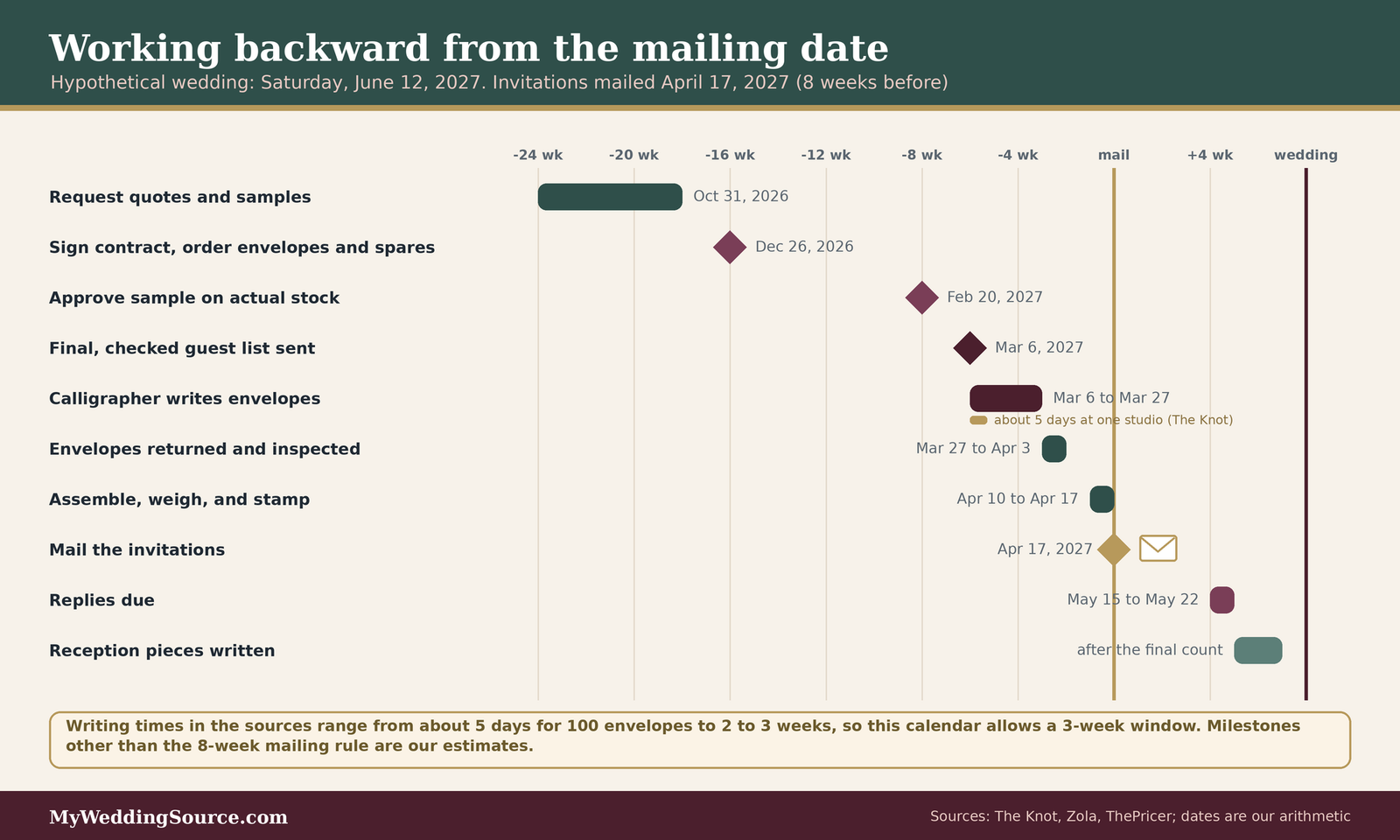
The worked calendar
| Milestone | Timing | Calendar date |
|---|---|---|
| Request quotes and samples | 24 weeks before mailing | October 31, 2026 |
| Sign contract; order envelopes with spares | 16 weeks before mailing | December 26, 2026 |
| Approve sample on actual stock | 8 weeks before mailing | February 20, 2027 |
| Send final, checked guest list | 6 weeks before mailing | March 6, 2027 |
| Calligrapher writes the envelopes | Three-week window | March 6 to March 27, 2027 |
| Envelopes returned and inspected | 3 to 2 weeks before mailing | March 27 to April 3, 2027 |
| Assemble, weigh, and stamp | 1 week before mailing | April 10, 2027 |
| Mail the invitations | 8 weeks before wedding | April 17, 2027 |
| Reply-by date | 4 to 3 weeks before wedding | May 15 to May 22, 2027 |
Build in buffer where the sources disagree
The sources give different writing times: about five days for 100 envelopes from one calligrapher quoted by The Knot, two to three weeks for roughly 100 outer envelopes from a studio cited by ThePricer, and about two weeks in a wedding blog. We planned a three-week window because the slowest published figure is the safest basis, and because a studio’s calendar may add days before work begins. If you want hand-canceling or hand-sorting, plan earlier, since a retailer says it can add two to three weeks. See our wedding timeline guide for the larger sequence.
Hand over the data and the envelopes
A clean handoff avoids most wedding calligraphy delays. It has two halves: the list, which the calligrapher needs final, and the envelopes, which you may supply.
Deliver the list and the stock
The Knot advises sending a final, signed-off design and guest list before the calligrapher starts writing, because day-of pieces and envelopes both depend on it. A studio blog says clients typically supply items such as envelopes, and ThePricer reports that clients typically supply 10 to 20 percent extra envelopes. Order spares from the same print run as the main stock so color and finish match. Ship with tracking, or deliver in person, and confirm in writing when the studio received them and how many.
Inspect and assemble in the right order
When the envelopes come back, check each against your spreadsheet before anything goes inside. Emily Post advises numbering reply cards to match the guest list, inserting enclosures in size order with the smallest on top and the printed side facing up, placing the inner envelope unsealed inside the outer one, and confirming that the names match before sealing. Then take one assembled suite to the post office and have it weighed. Our wedding invitations guide explains how the weight and shape change the postage.
Schedule the reception pieces separately
Envelopes and reception pieces share a calligrapher but not a deadline, so schedule your wedding calligraphy in two stages. Place cards, escort cards, menus, and signs depend on who actually attends, and that is unknown until replies arrive.
Wait for the final count
The Knot says that for day-of items such as place cards, you should ask when the final RSVP list is needed. The reply-by date in our calendar falls about three to four weeks before the wedding, which is also the window many caterers need. Our wedding RSVP wording guide explains how to set it. Ask the calligrapher in advance how many days they need after the final count, and set your reply-by date accordingly.
Leave a gap before the day
We suggest asking for reception pieces at least a week before the wedding, so that errors can be corrected without a rush fee. ThePricer reports rush fees of 20 to 50 percent. Place cards also have to reach the venue, and our wedding reception guide covers how the room is set up. A short written delivery date, agreed in the contract, protects you from a last-minute scramble.
Verify your wedding calligraphy choice before money becomes nonrefundable
Calligraphers usually ask for a deposit to hold a date for wedding calligraphy. That moment is the best point for a few careful checks, because after it, changing your mind costs money and time.
Ask for proof, samples, and a written scope
A portfolio shows what the artist can do. A sample on your own envelope shows what the artist will do for you. The difference is where most disappointments start.
Get a sample on your actual envelope
The Knot lists skipping proofs among the common mistakes and advises allowing time for proof review and revisions. For wedding calligraphy, ask for a sample with a realistic address, a long name, and a unit line, written on the same stock and in the same ink you plan to use. Photograph it in daylight and in dim light, run the three-reader test described above, and take it to the post office. If the studio will not provide a sample, ask whether the price of a paid sample is credited toward the order.
Turn vague promises into contract language
This is general education, not legal advice, and contract terms vary by state and by studio, so read your own agreement and ask a professional if you are unsure. Useful items to see in writing include the number of mailings and envelopes, the lines per address, whether inner envelopes and return addresses are included, the script style and ink, who supplies envelopes and spares, the delivery date, what counts as a revision, who is responsible for spelling errors that come from your list, and what happens if the studio makes a mistake. “Fast turnaround” becomes a date. “Post office friendly” becomes a test you both agree to.
Questions to ask before you sign
- Is the price per envelope, per line, or per piece, and what is the full total for my list?
- Which lines, inner envelopes, return addresses, and inks are included, and which are extra?
- Can I see a sample on my own envelope and ink before I pay the deposit?
- When must you receive the final list and the envelopes, and how many days will the writing take?
- Who pays for a spoiled envelope, a typo that came from my list, or damage in shipping?
- What is the deposit, is any of it refundable, and what happens if my date or guest count changes?
- What rush fee applies if my schedule slips, and do you decline short deadlines?
| Item | What to confirm | In writing? | Fallback if it fails |
|---|---|---|---|
| Sample or proof | Sample on actual stock and ink, with a long name | Photo and email approval | Choose a simpler hand or a printed script |
| Policy | Revisions, spelling errors, damage, and spoilage | Contract clause | Ask for a corrected clause or choose another studio |
| Contract term | Quantity, lines, inner envelopes, return address, ink | Itemized quote | Reduce the scope to what the budget covers |
| Timing | Writing days, delivery date, final-list deadline | Dated schedule | Move to a printed address for late additions |
| Fallback | Printed labels or script ready if an envelope fails | Agreed plan | Order spare stock early and keep the file |
Check cancellation, replacement, and rescheduling rules
Even a well-run wedding calligraphy order can change. A guest list shifts, a date moves, or an envelope arrives damaged. The cost of those changes is set by terms you can read before you pay.
Deposits and cancellation
ThePricer reports examples of a $30 nonrefundable reservation fee credited toward the order, and of studios that request 30 to 50 percent of the estimate up front or charge a project minimum. Your studio may differ. For wedding calligraphy, ask whether the deposit is refundable, transferable to a new date, or credited if you reduce the guest count, and note when each right expires. Keep a copy of every message. If the studio cancels, ask what happens to your deposit and whether they will help you find a replacement.
Errors and replacements
Ask who pays when an error occurs and where it came from. A typo copied from your spreadsheet is usually the client’s responsibility, but a misspelling that the studio introduced or a smudged envelope is a question to settle in advance. Ask whether replacement writing is charged at the full rate, and whether a spare envelope allowance is built in. The Knot’s advice to build in proof time matters here, because a mistake found at the proof stage costs a few minutes and one envelope.
Run a final fit test
The last test of your wedding calligraphy is not about style. It asks whether the finished envelope will do its job on your timeline and in the real world.
The post office test
Bring one fully written, stamped, and assembled suite to your post office. Emily Post advises weighing assembled invitations because inserts can increase postage, and Zola advises confirming the amount before buying stamps. Ask whether the piece is machinable, whether the address block is acceptable, and whether the clerk will hand-cancel it. Our estimate is that this 15-minute visit is the single most valuable check in the process, since it tests the paper, the ink, the weight, and the legibility together.
A fallback and a decision rule
Decide before you pay what you will do if your preferred wedding calligraphy option fails. Possible fallbacks include a printed script address, printed labels in a matching font, or a friend with neat handwriting for the last few envelopes. Our decision rule is this: if the approved sample fails the three-reader test or the post office test, or if the studio cannot meet your delivery date with a week of buffer, switch to the fallback before the final guest list goes out, and keep wedding calligraphy for spot lettering or reception pieces where the timing is looser.
Frequently asked questions about wedding calligraphy
Cost and booking
How much does wedding calligraphy cost per envelope?
The Knot reports about $2.50 to $6 per envelope front, varying by region, and ThePricer lists $2.50 to $7 for an outer envelope in July 2026. Inner envelopes, return addresses, metallic ink, and rush fees add to the total, so compare the all-in cost for your own list, not the headline price.
When should we book a calligrapher?
The Knot says calligraphers are often booked months in advance and suggests contacting one soon after you hire a stationer. Our sample calendar starts requesting quotes about 24 weeks before the mailing date. Book earlier if you want a particular artist, and leave time for a sample and proof before the final list is due.
How many envelopes should we order?
Count mailings, meaning households, not guests, and add spares. ThePricer reports that clients typically supply 10 to 20 percent extra envelopes. If your list has 85 mailings, our arithmetic gives 94 to 102 envelopes. Spares cover spelling mistakes and spoiled pieces, and unused ones can serve as samples or keepsakes.
Do we need inner envelopes?
Not necessarily. Emily Post advises using both inner and outer envelopes so that the inner one names the people invited, while Zola says the double envelope is less common because it is often unnecessary and adds cost. A single envelope can name everyone invited, and an inner envelope doubles the calligraphy to be quoted.
Addressing and readability
Can the Postal Service read wedding calligraphy?
We found no postal rule that bans a hand-lettered address. Postal standards for automation-readable mail call for dark ink on a light background, a clear address block, and a barcode clear zone, and USPS consumer guidance suggests capital letters. Test one finished envelope at your post office before ordering the full batch.
Is gold or white ink on a dark envelope safe for mail?
It carries more risk than dark ink on a light envelope. An envelope retailer says dark envelopes with white ink are allowed if the address stays legible and contrasts well, but the USPS standard we reviewed speaks of dark ink on light backgrounds. Test a sample, ask about hand-canceling, and keep the address contrast high.
Should the address be in capitals or mixed case?
Etiquette sources such as Emily Post show mixed case with spelled-out street names, while USPS consumer guidance asks for neat capital letters without commas or periods. Pick the style that matters more to you, keep every line inside the read area, and confirm with the post office. A printed address with lettered names is a common compromise.
What should we give the calligrapher?
Give a final, proofed spreadsheet with separate columns for title, first name, last name, street address, city, state, and ZIP, one row per party, as The Knot advises. Add inner-envelope names, a second address line, and reply-card numbers. Include your envelopes, spares, and a written delivery date, and send corrections only through the agreed process.
Your next steps
Decide and compare
Count mailings and choose a method
Group your list into households and decide whether you want inner envelopes. Then pick two methods from the option matrix, one handwritten and one printed, so you can compare real quotes. If you have not yet settled the basics of your suite, start with our wedding invitations guide, and see our save-the-date cards guide if you want the same lettering style to carry through.
Normalize at least three quotes
Ask each studio for an itemized wedding calligraphy total for your exact list, then run the all-in method. Compare delivered cost per mailing, lead time, and the written terms for errors and rush work. Check the result against our wedding budget calculator and our wedding planning guide.
Book and protect
Order a sample and run the tests
Pay for a wedding calligraphy sample on your envelope stock if needed, run the three-reader test, and visit the post office with a finished suite. If the sample fails, change the plan now, while changes are cheap.
Lock the schedule and the fallback
Put the delivery date, the list deadline, and the fallback in writing, then add the milestones to your calendar. For photos of the finished suite, mention it to your photographer, and use our wedding photographer shot list to plan what to request.
Sources & methodology
How we built this guide
What we relied on
This guide combines U.S. Postal Service standards and price documents (Publication 28, the Domestic Mail Manual, Publication 25, a consumer letter-mailing guide, and Notice 123), etiquette guidance from Emily Post and The Knot, a Zola envelope guide and a Zola postage guide, a National Institute on Aging tip sheet on print for older readers, the W3C’s accessibility guidance on text contrast, and pricing and practice notes from an aggregator, a calligraphy studio, a wedding blog, an envelope retailer, and a 2016 survey of calligraphers. Where a statement comes from a seller, we say so, because it reflects the seller’s interest. The household counts, contrast ratios, quote comparisons, cost ranges, and calendar dates are our own arithmetic or illustrations from stated assumptions, and they are estimates. Prices and rules are as we reviewed them in November 2026.
What we did not do
We did not survey calligraphers, test inks or envelopes at a post office, or verify any studio’s lead times or terms. The postal pages we reviewed do not address handwritten calligraphy, so we make no claim about how any specific hand-lettered envelope will be processed. We did not give legal or financial advice. Etiquette is convention and not law, prices and postage change, and contract terms vary. Confirm postage with your post office, ask for terms in writing, and have a professional read any contract you do not understand.
Source list
Government, standards, and public-interest sources
- U.S. Postal Service, Publication 28, Appendix A1, Readability: https://pe.usps.com/TEXT/pub28/28apa_002.htm
- U.S. Postal Service, Publication 28, Section 2.1.1, general address format: https://pe.usps.com/text/pub28/28c2_001.htm
- U.S. Postal Service, Domestic Mail Manual 202, Elements on the Face of a Mailpiece: https://pe.usps.com/text/dmm300/202.htm
- U.S. Postal Service, Publication 25, Reflectance: https://about.usps.com/publications/pub25/pub25_ch11_004.htm
- U.S. Postal Service, How to send a letter or postcard: https://www.usps.com/ship/letters.htm
- U.S. Postal Service, Notice 123, Price List: https://pe.usps.com/text/dmm300/Notice123.htm
- U.S. Postal Service, Prices: https://www.usps.com/business/prices.htm
- U.S. Postal Service, ZIP Code Lookup: https://tools.usps.com/zip-code-lookup.htm
- National Institute on Aging, Making Your Printed Health Materials Senior Friendly (archived copy): https://webarchive.library.unt.edu/web/20090113180926/http://www.nia.nih.gov/HealthInformation/Publications/srfriendly.htm
- W3C, Understanding Success Criterion 1.4.3, Contrast (Minimum): https://www.w3.org/WAI/WCAG21/Understanding/contrast-minimum.html
Etiquette and wedding-industry sources
- Emily Post Institute, Addressing and sending wedding invitations: https://emilypost.com/advice/addressing-sending-wedding-invitations/
- The Knot, Everything you need to know about wedding calligraphy: https://www.theknot.com/content/wedding-calligraphy-basics
- The Knot, Calligraphy wedding decor details: https://www.theknot.com/content/calligraphy-wedding-decor-details
- The Knot, How to address wedding invitations: https://theknot.com/content/addressing-wedding-invitations
- Zola, Wedding invitations: a guide to envelopes: https://zola.com/expert-advice/wedding-invitations-guide-to-envelopes
- Zola, Wedding invitation postage: https://www.zola.com/expert-advice/wedding-invitation-postage
Vendor, retailer, and aggregator sources (reflect sellers’ perspectives)
- ThePricer, Wedding calligraphy cost: https://www.thepricer.org/wedding-calligraphy-cost/
- Studio Chavelli, Commissioning calligraphy, part 3: understanding pricing: https://studiochavelli.squarespace.com/blog/commissioning-calligraphy-understanding-pricing
- Love & Lavender, Addressing wedding envelopes: handwritten, printed, or calligraphy: https://loveandlavender.com/addressing-wedding-envelopes-handwritten-printed-calligraphy
- LCI Paper, Can you send dark colored envelopes in the mail: https://lcipaper.com/kb/can-you-mail-dark-envelopes/
- Style Me Pretty, Wedding 101: calligraphy pricing decoded (2016 survey): https://stylemepretty.com/2016/10/21/smpwedding101-calligraphy-pricing-decoded/amp