

Wedding invitations do one job that no other wedding paper does: they turn a private plan into a clear request that dozens of people can act on, so the best ones are written backward from what a guest must know, decide, and do, and only then dressed up with paper, ink, and a stamp.
Quick answer
Mail wedding invitations about six to eight weeks before the date, and earlier (eight to twelve weeks) when guests must travel. Send save-the-dates about six to eight months ahead. Put the hosts, the couple, the date, the time, the full venue address, and one clear way to reply on the invitation; move maps, hotel blocks, and registry links to a details card or a wedding website. Before you buy stamps, take one fully assembled suite to the post office and have it weighed, because thickness, shape, and weight decide postage, not the number of pieces. Set the reply-by date three to four weeks before the wedding so you can give your caterer a firm count.
This guide to wedding invitations is written for couples in the United States who are about to commit to a design, a printer, and a mailing date. It covers the whole path in the order you will meet it: what the message must accomplish, when to send each piece, how to word it for your actual family situation, who is invited and how to say so, how printing choices change cost, what the post office charges, how to run RSVPs, and how to proofread before anything is printed. Where sources disagree, we say so instead of picking a winner. Where a number is our own arithmetic, we label it as an estimate.
Two limits are worth stating up front. First, etiquette is convention, not law, and the conventions have loosened; we describe what the major etiquette and wedding sources say and where modern practice differs, and you decide what fits your families. Second, postage and printing prices change, so treat every figure as a snapshot from November 2026 and confirm it before you pay.
What wedding invitations need to accomplish
Most wedding invitations fail in small, avoidable ways, and the failures are rarely about taste. A date is printed without a year, a reply card has no deadline, an envelope says “and guest” to someone whose partner of six years deserved a name, or the address of the venue is the address of the venue’s office, a mile away. None of those mistakes comes from bad taste. They come from starting with the design instead of the message.
A useful way to begin is to write down, in plain sentences with no decoration, what a guest should be able to do after reading your wedding invitations. A guest should be able to say who is getting married, who is hosting, when and where to arrive, who exactly is invited, how to reply and by when, and where to look for everything else. If your draft cannot support those six statements, no paper stock will rescue it.
List the facts a guest needs
The first decision is not what the invitation says but what it leaves out on purpose. Every fact you put on the card competes with the others for attention, and every fact you leave off must have somewhere else to live. Sorting facts into “on the invitation,” “on a details card,” and “on the website” is the single most useful planning step in this whole process.
Separate names, date, place, deadline, dress, and action
Start with the facts that belong on the main card because the invitation is meaningless without them: the people hosting, the couple’s names, the date and time, the venue name and city, and the request to attend. Then add the action, which is the part many drafts forget. The action is the reply: how to respond, by what date, and for how many people.
A simple test for each fact is whether the guest would be stuck without it on the day they decide whether to come. The date and city pass the test. The shuttle schedule does not. Dress code sits in between, so we cover it in its own section below. Emily Post’s guidance lists the event, date, time, and location as the core content, and it suggests including the city and state, though the state can be dropped when every guest is local. The Knot’s invitation guide adds the venue’s full street address, state, and ZIP code, plus the country for a wedding abroad. Those two views fit together: print the full address whenever any guest might navigate by it.
Write the deadline as a real date, not a phrase like “as soon as possible” or “in a few weeks.” Guests respond to dates, and a date gives you something to remind them about later.
Move travel and registry detail to the proper channel
Travel information changes. Hotel blocks fill, shuttles get rescheduled, and a ferry timetable can shift after your cards are printed. Anything that can change belongs on a wedding website, with a printed card that points to it, instead of on paper you cannot edit. Both The Knot and Emily Post suggest placing a website link on an insert instead of crowding the main card, and The Knot specifically recommends keeping registry information off the invitation itself and linking to a website on a separate card.
Emily Post goes further and advises against printing registry details or a “no gifts” request on the invitation, because either one puts attention on gifts. That is a convention, not a rule, and some couples ignore it on purpose. If you are one of them, a website line or a separate card is a gentler place for it than the invitation itself.
The practical result is a short list. On the invitation: hosts, names, date, time, place, reception line, reply instructions. On a details card or website: directions, parking, lodging, schedule for the weekend, and registry. If you use a QR code to point to the website, test it at the size you plan to print it; we cover that in the quality-check section.
Choose the relationship and the tone
Tone in wedding invitations is a decision about how you want to sound to people who will be reading this at their kitchen counter, not a decision about fonts. The paper, the typeface, and the wording all signal how formal the day will be, and Emily Post makes the same point: match the design to the event, because guests read it as a preview.
Formal, warm, concise, or direct
Formal wording uses the third person, spells out dates and times, and avoids contractions. It suits a ceremony in a house of worship, a black-tie reception, or a family that expects it. Warm wording speaks in the first person (“We would love for you to join us”) and suits a smaller wedding where the couple is hosting and most guests know them. Concise wording reduces everything to names, date, place, and reply. Direct wording adds one or two practical sentences, such as a child policy or the fact that the venue is outdoors.
None of these is the correct one. The mistake is mixing them inside one invitation, for example a formal host line followed by a casual request line followed by an informal “can’t wait to see you!” That mix makes guests guess how to dress and how to reply. Pick one register and keep it all the way down the card.
A quick way to choose is to imagine the most formal guest and the most casual guest reading the same card. If the wording would feel stiff to the casual one, loosen it. If it would feel careless to the formal one, tighten it. Usually there is a middle that works for both, and it tends to be warm and plain with the date and time written clearly.
Say it plainly when travel or attendance depends on it
Euphemism is charming on a menu and costly on wedding invitations. “Unplugged ceremony,” “adults celebrating,” and “dressy casual” can mean different things to different readers. When a guest’s travel plans, babysitting arrangements, or wardrobe depend on the answer, say it in direct language: “Adults only, please,” “The ceremony is outdoors on grass,” “Cocktail attire.”
Zola’s wording guide suggests placing “Adults only, please” at the bottom of the invitation for a child-free wedding. The same logic applies to anything that changes behavior: if a guest would book a different hotel or buy a different pair of shoes because of a detail, print the detail or link to it plainly.
The pieces of a suite and what each one does
A “suite” is the set of papers that arrives in one envelope. A suite can be one card or six, and more pieces are not better. Each piece should answer a question the main card cannot answer without becoming crowded, and each piece adds weight and cost. Emily Post lists the traditional enclosures as inner envelopes, tissue, and inserts such as maps, directions, or hotel information, plus a response card with its own envelope.
The matrix below shows what each piece is for, which facts belong on it, and what we suggest moving to a different channel. It is our own synthesis of the conventions above, not a rulebook.
| Piece | Its job | Facts it needs | Better placed elsewhere |
|---|---|---|---|
| Save-the-date | Hold the date and set expectations early | Names, date, city or region, website address | Exact venue, schedule, registry |
| Invitation card | Make the request and identify the hosts | Hosts, couple, date, time, venue and city, reception line | Directions, lodging, long notes |
| Reply card and envelope | Collect a decision | Reply-by date, who is invited, response choices, return address | Meal details if collected online |
| Details card | Hold practical information | Directions, lodging, parking, schedule, dress code | Anything that may still change |
| Wedding website | Hold changing information | Everything on the details card, updates, registry link | Anything a guest needs in order to reply |
| Outer envelope | Carry the suite and show who is invited | Guests’ names as invited, return address | Decoration that triggers postage surcharges |
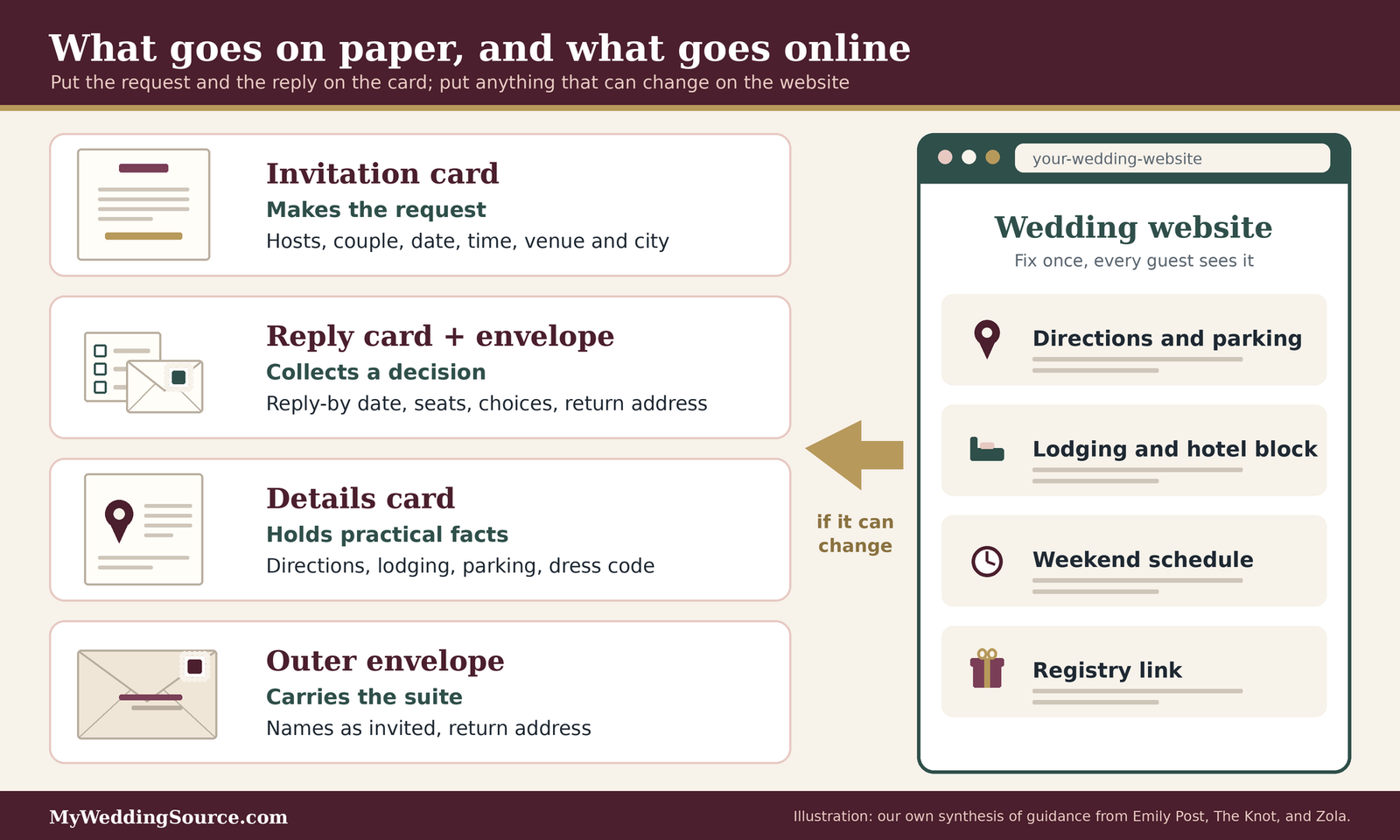
The core pieces
The core pieces are the invitation card, the reply card with its envelope, and the outer envelope. Everything else is optional. Wedding invitations for a wedding of any size can run on those three pieces plus a website. If you are sending to a small group and plan to collect replies by phone, text, or a website, you can drop the reply card entirely, which saves a piece, a stamp, and a few grams of postage.
Emily Post notes that response cards are meant for reception or combined wedding invitations, not for ceremony-only wedding invitations, and that a stamped reply envelope means you do not need to print “RSVP” on the card unless you want to offer another way to respond.
The optional pieces
Optional pieces include a details card, an accommodations card, a map, a reception card (when the reception is in a different place), tissue, an inner envelope, a belly band, and a wax seal. The first four pieces solve real problems. The rest are decorative, and some of them trigger postage surcharges, as we explain later in the postage section.
Ask of each optional piece whether a guest would miss it if it were absent. A map matters when the venue is hard to find. Tissue does not matter to anyone’s attendance. If a piece is purely decorative, treat it as a choice about the feel of the day and a cost you should price on purpose, not as an obligation.
When to send save-the-dates and wedding invitations
Timing is where well-meant plans for wedding invitations go wrong, because the dates are linked. The date you mail depends on the date replies are due, which depends on the date your caterer needs a count, which depends on the date of the wedding. Printing takes time before any of that begins. Working backward from the wedding date is the only reliable way to place each milestone.
The published guidance on when to mail wedding invitations is consistent enough to give you a starting range and varied enough that you should know where it differs. The ranges below come from The Knot, Zola, and Greenvelope, which is a digital-invitation company. We list them as ranges because that is how they are published.
Work backward from the wedding date
Instead of asking “when should we mail,” ask “when do we need to know the headcount, and what has to happen before then?” The mailing date follows from the answer.
Save-the-dates: roughly six to eight months, sooner for travel
The Knot recommends sending save-the-dates six to eight months before the wedding, no later than six months ahead, and not more than about a year ahead. It treats anything under four months as too late and suggests going straight to wedding invitations in that case. For a destination wedding or a holiday weekend it recommends the eight-month end of the range so guests can book travel.
Greenvelope’s timing guide is a little more specific about distance: about six months for a local wedding, six to nine months for a local wedding that requires some travel, and about twelve months for a true destination wedding. Its advice for a venue that is not yet chosen is to include at least the state and ZIP code.
A save-the-date needs only the date and the general location. It is not a request to attend, and it does not need an exact venue. It is, however, a statement that the recipient is on your list, so send it only to people you are sure you want to invite. The Knot is blunt about this: once the cards are in the mail you cannot take them back.
Invitations: six to eight weeks, longer when guests travel
For the wedding invitations themselves, The Knot recommends mailing six to eight weeks before the wedding, aiming for about eight weeks when guests will reply by mail and about six when replies are online. Sending more than about twelve weeks early risks guests’ plans changing, and sending later than six weeks is considered too late; in that case The Knot suggests using online replies and skipping traditional response cards.
Greenvelope’s ranges are slightly different: six to eight weeks for a local wedding, eight weeks for a local destination wedding, and eight to twelve weeks for a destination wedding. Zola also says six to eight weeks.
For guests overseas, The Knot recommends mailing nine to ten weeks ahead, and its mailing guide says eight to ten weeks. A stationery retailer’s postage guide (Minted) says to mail international wedding invitations one to two weeks earlier than domestic ones. The three statements are not identical, so use the longest as your planning figure if international guests are essential to you.
When sources disagree, plan to the stricter one
The disagreements here are modest, but they matter at the edges. Is eight weeks “early” or “on time”? The answer depends on who is traveling. Our suggestion is to choose the earlier figure for any guest who needs more than a day of travel, and the later figure for a local guest list. If a single invitation list mixes both groups, mail everything at once at the earlier date. The Knot’s advice for out-of-town guests is exactly that: mail all wedding invitations at the same time, about eight weeks out.
Holidays follow the same logic. The Knot suggests aiming for eight weeks for a holiday-adjacent wedding, or up to three months if guests will need a larger buffer.
Production lead times and the order date
The mailing date is not the date you place your order. Printing, assembly, and addressing all take time, and proofs need rounds of review.
Ready-made online orders
For pre-designed online wedding invitations, The Knot suggests ordering about twelve to fourteen weeks before the wedding and having them in hand, ready to mail, at least ten weeks before. That gives wedding invitations a buffer for shipping delays or a reprint. The Knot’s own invitation service states a print time of four business days; that is the seller’s claim about its own product, and your seller’s number may be different. Whatever the number, add a buffer for proofs.
Semi-custom and fully custom work
The Knot’s reporting quotes designers on custom timelines: about four weeks for semi-custom stationery, and eight to twelve weeks for a fully custom suite, including research, design, printing, and assembly. These are individual designers’ estimates, not industry standards, and the real timeline depends on how many rounds of revision you request and how many pieces the suite includes. Ask your designer for the schedule in writing, including the deadline by which you must approve the proof for the schedule to hold.
A worked backward schedule
The schedule below is an illustration, not a prediction. We chose Saturday, October 9, 2027, as a hypothetical wedding date and applied the published ranges. We counted weeks on a calendar.
| Milestone | Published range | Calendar dates |
|---|---|---|
| Save-the-dates mailed | 6 to 8 months before | February 11 to April 12, 2027 |
| Order invitations (ready-made) | 12 to 14 weeks before | July 3 to July 17, 2027 |
| Invitations in hand, ready to mail | At least 10 weeks before | By July 31, 2027 |
| Invitations mailed | 6 to 8 weeks before | August 14 to August 28, 2027 |
| Reply-by date | 3 to 4 weeks before | September 11 to September 18, 2027 |
| Final count to caterer | Your caterer’s deadline | Ask your caterer |
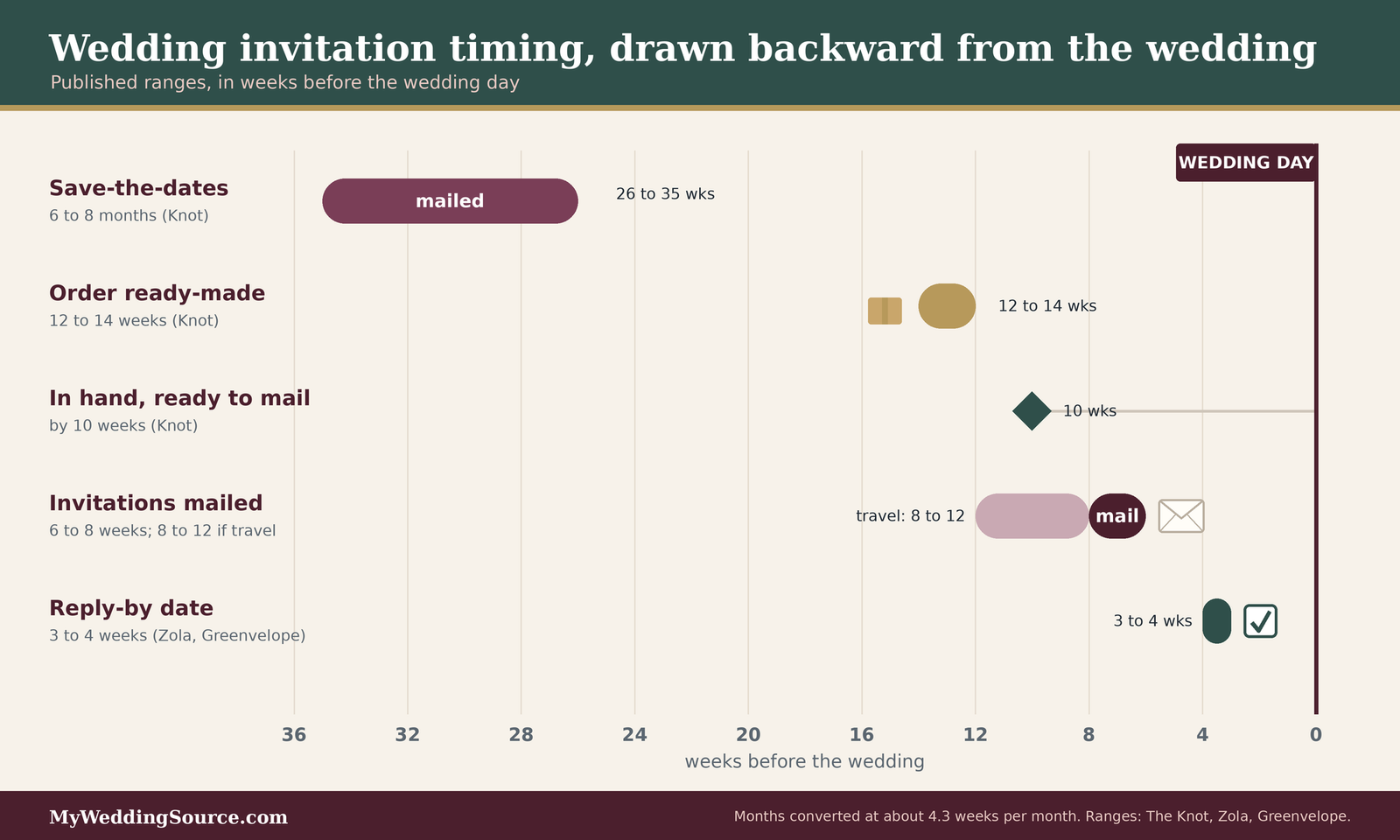
Two notes about this table. The reply-by range comes from Zola, which suggests a reply-by date at least three weeks before the wedding, and Greenvelope, which suggests four weeks. The final count deadline is not in the table because it belongs to your caterer or venue, not to a publication. Ask for it in writing and treat it as the fixed point everything else works back from.
Start with the guest list and the addresses
Every timeline above assumes you know who is on the list and where they live, and getting wedding invitations to the right addresses is usually the real bottleneck. That is usually the actual bottleneck.
Collect addresses early and in one place
Greenvelope suggests collecting guest addresses one to two months before sending save-the-dates. A shared spreadsheet or a form that asks guests directly is faster than asking family members to supply addresses for their friends. Ask for the name exactly as the guest would like it on an envelope, because titles, hyphenated surnames, and household names are easy to get wrong.
Add three columns that will save you later: the number of seats you are offering each household, how each household should be addressed on the envelope, and whether the household needs international postage. These columns become the source for the envelope addressing, the reply cards, and the postage budget.
Decide who is on the list before the first mailing
Because a save-the-date is a commitment, finish the first draft of your guest list before it goes out. The Knot advises sending save-the-dates to everyone who will receive an invitation, one per guest or one per household, and including people who have already confirmed verbally, such as family and the wedding party.
If your list depends on how many people decline, that is a separate matter we discuss in the RSVP section. For now, the useful rule is that anyone who receives a save-the-date should expect an invitation.
Short engagements, holidays, and peak season
Some timelines do not fit the standard ranges, and the guidance is flexible when you tell people honestly what is going on.
Fewer than four months
If the wedding is less than four months away, The Knot suggests skipping save-the-dates and sending wedding invitations directly, because the invitation then does both jobs. The Knot says to use digital replies when you are mailing late. Whatever you send, put the reply-by date on it and keep the reply method simple.
A shorter timeline also changes the order of decisions. Choose a ready-made design, order proofs promptly, and ask the printer for a firm ship date before you pay. Under the FTC’s rule for online orders, which we describe later, a seller must have a reasonable basis for any shipping time it states.
Holiday weekends, peak months, and overseas guests
Peak wedding months and holiday weekends compress the calendar for guests too. The Knot suggests mailing closer to the earlier end of the range in busy months. If your wedding falls on a holiday weekend, send wedding invitations toward the three-month end, send the save-the-date at the long end of its range, and put travel notes on the website early.
For overseas guests, mail early, offer a way to reply online, and consider a tracked mailing method for the wedding invitations that matter most. The Knot’s mailing guide mentions certified mail, Priority Mail, and private carriers, or numbering each reply card and keeping a matching list so you can tell who has not responded.
Build wedding invitations wording from components
Copy-paste scripts for wedding invitations break the moment your family does not match the script. A better approach is to treat the invitation as four short lines, each with one job, and to change only the line whose logic changes. Etiquette sources such as Emily Post and Zola describe the same structure, with small differences in order and vocabulary. We describe it here in plain terms and give invented examples so you can see the pattern.
The anatomy of the invitation sentence
Every wedding invitation, from the most formal to the most casual, answers four questions in order: who is asking, what are they asking, when and where, and what should the guest do. The vocabulary changes with the register. The order rarely does.
Host line, request line, event details, and action line
The host line names who is issuing the invitation. Traditionally it names the people paying for the wedding or the people whose home the event honors; today it often names whoever is hosting in the sense of welcoming guests, which may be the couple, both families, or both. Zola describes it as the line at the top that names the people paying for the wedding. The Knot notes it can be left off entirely when the couple hosts.
The request line is the verb: “request the honour of your presence,” “invite you to celebrate,” “ask you to join them.” Emily Post’s convention is that “the honour of your presence” suits a ceremony in a house of worship and “the pleasure of your company” suits other venues. Zola says formal request wording suits religious ceremonies and casual phrasing suits modern or non-religious events.
The event details give the names of the couple, the date, the time, and the venue. The action line tells the guest how to respond and when. Here is a plain-language example with invented names, which we offer only to show the structure:
Maya Lopez and Daniel Okafor invite you to celebrate their wedding. Saturday, October 9, 2027, at 4:30 in the afternoon. Willow Ridge Barn, 1200 County Road 14, Fairview, Ohio. Dinner and dancing to follow. Please reply by September 11 at the address on the enclosed card or at the website below.
In that example the host line and request line have merged because the couple is hosting. If a parent were hosting, the first line would change and the rest would stay as written. That is the whole idea: change a line only when the logic of that line changes.
Offer variants only where the logic changes
Variants are warranted in five places. When the hosts change, rewrite the host line. When the venue changes between the ceremony and the reception, add a reception line or a second card. When a religious element is part of the ceremony, adjust the request line; Emily Post, for example, describes a distinct line for a Nuptial Mass in a Roman Catholic wedding and the use of “and” between the couple’s names in Jewish wedding invitations. When guest policy matters, add a line. When the reply method is online, change the action line.
Beyond those five, variants add risk without adding clarity. Offering two nearly identical request lines for different tables of guests, for example, is a recipe for a printing mix-up. If you want different wording for different groups, print different versions and label them in the order file so that the right card goes into the right envelope.
Traditional conventions and where modern practice differs
Etiquette sources agree on most formal conventions. Where they differ, it is because the conventions are habits rather than rules, and habits have changed.
Honour or pleasure, spelled-out dates, and “half after”
Emily Post’s formal conventions include spelling out the date and year in words, writing times as “half after four” instead of “four-thirty” or “half past four,” dropping “in the afternoon” when the time makes it obvious, writing “Doctor” in full unless the line is too long, and capitalizing the day and month but not the year. It uses the British spelling “honour” in the formal phrase for a religious ceremony.
These rules produce a particular look, which is the point of them. They also make the invitation slower to read, which matters if guests are skimming for a date. If you choose full formal wording, check that the date and time are easy to find on the card even in a hurry.
Numerals, clarity, and a modern register
The Knot’s guide notes that traditional wedding invitations spell out the date and time, and that modern ones often use numerals in a clear font. Neither is wrong. If your invitation will be read by guests of different ages and languages, numerals are faster and less ambiguous. Zola’s guidance for formal wedding invitations writes the time as “in the afternoon” or “in the evening” while Emily Post prefers leaving those phrases out, a small example of how sources differ on the details.
Our suggestion: choose the register that fits your day, apply it consistently, and let clarity win any tie. A date that cannot be misread beats a date that is perfectly traditional.
Nontraditional families and hosting structures
Families do not arrive in the shape of a template, and the wording should not require a family to pretend otherwise. The goal is a card every host recognizes as accurate and every guest finds easy to read.
Use names instead of labels when labels create confusion
Labels such as “Mr. and Mrs.” assume a particular marriage and a particular surname. If a host uses a different surname, is not married, or prefers a different title, use names. A host line that reads “Alicia Ramirez and Peter Hale” tells guests exactly who is hosting. Zola’s guidance covers the common variants: when parents have different last names, join the names with “and,” avoid initials, and use middle names only for very formal wedding invitations. For same-sex parents it suggests “Mr.,” “Mrs.,” or “Mx.” with names ordered alphabetically, and for the couple hosting it says the host line can be skipped.
If a title matters to a host, such as Dr. or Captain, include it, since titles are part of how that person is addressed. If a host prefers no title, leave it off. Asking each host how they want to be named takes one text message and avoids a reprint.
Make blended, divorced, deceased, and multiple-host arrangements readable
Etiquette sources approach these cases differently, so here is where they agree and where they diverge.
For divorced parents, Zola says to list the mother first and the father on a separate line without “and” between them, with a stepparent listed after the parent they are married to. Emily Post’s sample wording for divorced and remarried parents lists each parent with their spouse as separate pairs. The two approaches look different, but both avoid joining two people who are no longer a couple on one line with “and.”
For a deceased parent, Zola’s guidance is to add “the late” before the parent’s name, either in the host line or after the child’s name. Emily Post’s samples do not include a specific example for this case, only a format for a single living parent. Some families prefer not to print the name in the host line at all and instead honor a late parent in the program or on the website. That choice belongs to the family, and a quick conversation beforehand avoids hurt feelings.
For multiple hosts, such as both sets of parents and the couple, The Knot describes the pattern “together with their families,” placing the couple’s names first and following with a line that names the contributing parents or families. Emily Post uses the same pattern. It is a good option when the people paying are not a clean “bride’s family” and “groom’s family.”
The table below summarizes how the wording logic changes by situation. The sample lines are invented for illustration. They show structure, not a required script.
| Situation | Host line approach | Illustrative host line | Notes on when it applies |
|---|---|---|---|
| Couple hosts | Skip the host line or open with the couple’s names | Maya Lopez and Daniel Okafor invite you to celebrate their wedding | Best when the couple is paying and welcoming guests |
| One set of parents hosts | Name the hosting parents first | Alicia Ramirez and Peter Hale request the pleasure of your company at the marriage of their daughter Maya Lopez to Daniel Okafor | Use only if those hosts are comfortable being named alone |
| Both families host | Name both sets, or use “together with their families” | Together with their families, Maya Lopez and Daniel Okafor invite you to celebrate their wedding | Good when contributions are shared or mixed |
| Divorced parents | List each parent on a separate line, with new spouses after their partner | Alicia Ramirez / Peter Hale, with Anna Hale, request the pleasure of your company | Check each parent’s preferred name and order before printing |
| A parent has died | “The late” before the name, or mention elsewhere | Maya Lopez, daughter of Alicia Ramirez and the late Carlos Lopez | Ask the family which they prefer |
| Hosts with different surnames or titles | Use full names, not “Mr. and Mrs.” | Alicia Ramirez and Dr. Peter Hale | Avoids guessing about marital status or surname |
Wedding invitations wording by hosting situation
The templates in the table are a starting point. In practice most couples need to adapt one or two of them. The next few paragraphs show how.
When the couple hosts
This is the simplest case and increasingly common. Open with the couple’s names and a request line, then the details. The Knot notes that the host line can be left off when the couple hosts, and Zola adds that an invitation can instead open with a welcoming introduction. If you want to acknowledge parents who are contributing, use “together with their families” and avoid naming amounts or roles.
When several people share the hosting
If more than two parties host, the clearest approach is to name the couple first and a family line second, then keep every other line unchanged. Do not try to rank contributions on the card. Rank on the card is rank in the room, and families remember it. If a particular host needs to be named for personal reasons, name them in the host line and let the rest be “and their families.”
Wedding invitations and the guest list: who exactly is invited
A wedding invitation answers a question the couple has already decided, which is who is invited. The hardest wording problems are not about hosts. They are about the guest line: plus-ones, children, and households. An invitation that does not make the answer clear creates a reply with the wrong number of people, and the fix is usually an awkward conversation that could have been avoided on paper.
Say exactly who is invited
The principle is simple: on wedding invitations, the names on the envelope are the names invited. Everything else is a courtesy to the guest that reinforces the same message.
The envelope is the invitation list
When wedding invitations name the guests, Zola’s guidance is direct: if you are not allowing plus-ones, address the envelope to the invited guest only. If you welcome children, address it to the guest and their family. If the wedding is child-free, add “Adults only, please” at the bottom of the invitation. Emily Post agrees that children are not automatically invited and that parents who assume otherwise are mistaken, and that the safest course is clear communication in advance.
On a reply card, a printed line that says “We have reserved ___ seats in your honor,” with the number filled in by hand, or a line printed with the invited names, makes the answer unambiguous. It also lets you personalize the card, and it does not require guests to interpret a policy.
Plus-ones, partners, and “and guest”
Emily Post suggests using a companion’s name whenever possible instead of “and guest,” which feels less warm. If you do not know the name, ask the invited guest, which is a friendlier request than it sounds. Many couples invite partners in committed relationships by name and ask other single guests whether they would like to bring someone.
Whatever policy you choose for your wedding invitations, state it once in the same way everywhere. A plus-one policy that exists on the website but not on the envelope is a policy that will be misread.
Children and adults-only weddings
Child policy is where wedding invitations cause the most surprise, because the guest’s decision depends on it: childcare, travel, and whether to come at all.
Where to say it, and in what words
Wedding invitations are the most reliable place for the policy, since every guest reads them. Zola’s wording is “Adults only, please.” Another way is to address the envelope to the adults and add a line on the website explaining the policy and any childcare resources. Use plain words and avoid long explanations. A guest who reads “Adults only, please” understands. A guest who reads a paragraph defending the policy feels judged.
If some children are invited and others are not, such as the couple’s nieces and nephews but not the cousins’ children, the envelope becomes the policy statement. Address the envelope to the people invited, and expect that a few guests will call to ask. A short, kind script helps: “We have room for the adults in your family and for our nieces and nephews. We hope you can celebrate with us.”
Replies that include people you did not invite
Emily Post’s invitation guide addresses what to do when a reply lists children who were not invited. Our suggestion is to contact the guest promptly and explain the situation kindly, before the number becomes a surprise at the venue. The call is easier if the reply card made the number clear. If you printed the number of seats reserved, point to it: “We were only able to reserve two seats for your household, and I wanted to tell you before the day.”
Dress code, lodging, and the day’s logistics
Some details are not part of the request but still affect whether a guest can say yes. Decide where each goes before you print.
Where dress code belongs
The Knot calls dress code optional and suggests placing it in a lower corner or at the bottom center of the invitation, on a details card, or on your wedding website. Zola places it with the logistics, next to the date, time, and location. If you name a code, use a term guests can look up. Our guide to cocktail attire explains one of the most common terms and where its edges are.
If the dress code is likely to matter for travel, such as an outdoor ceremony on grass that makes heels difficult, say so in words. A single practical line is more useful than a named code.
Out-of-town details
For out-of-town guests, a details card or website should include lodging suggestions, travel distance from the nearest airport, and any shuttle or transport. Emily Post lists maps, directions, and hotel information as typical inserts. If you are using a hotel block, check the cut-off date in writing and print the date. Do not print a hotel’s phone number if you are not certain it is correct.
Names, titles, and addresses
Names are where small errors on wedding invitations sting most. A misspelled name is a signal to the guest that they were not looked up carefully.
Handwritten or printed addresses
Emily Post advises addressing envelopes by hand and never using labels. That is the traditional rule, and it reflects a preference for personal touch. It is also not practical for everyone: a couple with a large list and little time may choose printed envelope addresses, and many stationers offer printing directly on the envelope, which looks cleaner than a label. Hiring a calligrapher is an option, and The Knot mentions it, but it is an added cost and an added production step with its own lead time.
A practical middle path is to hand-address the envelopes for the closest family and friends, and use printed addresses for the rest. Whatever you choose, test one envelope with the post office before committing to a whole batch, because ink color, paper texture, and design elements can affect legibility. We return to this in the postage section.
Titles, spelling, and household names
Emily Post advises using correct titles and spellings and asking when you are unsure. Use the name each household uses for itself. Ask about hyphenated surnames, families with different surnames in one household, and guests who use a title such as Dr. or Judge. Write the name on the spreadsheet exactly as it should appear on the envelope, and use that column as the single source for envelope printing, the inner envelope, and the reply card. A name that appears three different ways in three documents will appear three different ways on paper.
Printing, paper, and cost for wedding invitations
Printing is the part of making wedding invitations that most resembles shopping, and it is where it helps most to separate three questions that sellers often blur together: how the ink goes on the paper, how much customization you are buying, and who is responsible for each step from proof to delivery. A quote that mixes the three is hard to compare with another quote. A quote that separates them is easy.
Print methods and what they do to cost
The Knot’s reporting on stationery pricing describes a clear order, though it gives no dollar figures per method. Flat digital printing is the least expensive. Letterpress and foil stamping cost more. Sculpted embossing is the most expensive. Combining several methods in one design raises the price further.
How the main methods differ
Flat digital printing transfers ink to the surface without texture and is the usual choice for ready-made online orders. Foil stamping presses a thin metallic layer onto the paper, which gives a reflective line or shape. Letterpress presses an inked plate into soft paper, which leaves an impression you can feel. Embossing raises a shape out of the paper. Thermography (a raised-ink process) and engraving also exist, and a stationer can tell you whether they are offered.
We describe these in general terms because process names vary between shops, and your own sample is the most reliable guide. Ask to see and handle a printed sample on the paper you plan to buy, and ask which methods your design uses on which pieces. A design can use foil on the invitation and flat print on the reply card, which saves cost on the piece that will be thrown away or saved in a drawer.
Paper stock and weight
The Knot lists cotton or tree-pulp cardstock and 110-pound eggshell cardstock as the most budget-friendly options, double-ply cotton and handmade paper as mid-range, and acrylic and other non-paper materials as more costly. Paper also affects postage. Thicker stock adds weight, and a stiff or uneven piece can be treated as nonmachinable by the post office. We explain the mechanics in the postage section.
Ask for the paper weight, the finish, and the exact thickness of the assembled suite. These numbers decide whether your invitation fits in a standard envelope and whether it fits in a standard stamp.
Ready-made, semi-custom, and custom
The three tiers mean different things at different shops, so ask each seller what it means by the term.
Who each tier suits
Ready-made designs suit couples who want a clean result on a short timeline and are comfortable choosing from a catalog. Semi-custom work, in which a designer adapts a template with your colors, wording, and some layout changes, suits couples who want something more personal without paying for a blank-page design. Fully custom suites suit couples who want a specific illustration or concept and have the time and budget for design rounds. The Knot’s reporting quotes designers who estimate semi-custom wedding invitations and enclosures at under $2,000 or about $2,500 for a full semi-custom paper suite, and custom suites in the thousands; these are individual designers’ estimates and not survey data.
No tier is better. The question is which one reduces risk for you. A short timeline favors ready-made. A strong visual idea favors custom. A modest budget with a personal touch favors semi-custom.
How to read a quote
This is where a simple method pays off. Ask every stationer to quote the same package, and then normalize the quotes onto a shared basis. We suggest the following worksheet, which is our own method and not an industry standard.
- Count the households, not the guests. Wedding invitations go to households. A list of 117 guests might be about 70 to 80 households.
- Add spares. The Knot suggests ordering at least five extra save-the-dates, and the same logic applies to wedding invitations: extras cover mistakes, late additions, and keepsakes.
- Price each piece separately. Invitation, reply card, reply envelope, details card, outer envelope, inner envelope, liner.
- Add the services that turn printed pieces into mailable wedding invitations. Envelope addressing, assembly, stamping, and proofs. Some sellers include them and some charge for each.
- Divide by households, not guests. This gives a per-household cost you can compare across quotes.
- Add postage on a separate line. The Knot’s cost reporting does not say whether postage is included in its stationery figures, so keep postage separate until you know.
A quote that lists one price for a “suite” without listing the pieces is not wrong, but it is hard to compare. Ask for the breakdown in writing.
Digital invitations and hybrids
Digital wedding invitations are a real option, not a lesser one, and a hybrid of paper and online replies is common. They remove printing and postage from the budget, and they make tracking replies simple. They also carry trade-offs, mostly about who you are inviting.
When a digital invitation works well
Greenvelope, a digital-invitation company, notes that the headcount updates in real time as guests respond, that meal choices and custom questions can be collected with the reply, and that a save-the-date can collect mailing addresses. The same company says digital wedding invitations do not need to go out as early as printed ones, but The Knot keeps the same six-to-eight-week timeline for digital wedding invitations because guests still need time to reply and plan.
These are statements from a company that sells the product, so weigh them accordingly. The honest summary is that digital works well when your guests are comfortable with email and when you have reliable email addresses, and that it asks more of guests who prefer paper or who do not check email often.
Paper with an online reply
A hybrid often fits best: printed wedding invitations that point to an online reply through a short web address or QR code. The Knot says digital replies are workable at about six weeks when wedding invitations are printed, and Greenvelope notes that a QR code on a printed card can link to an online reply so no return envelope is needed. Offer a second way to reply, such as a phone number or an email, for guests who do not use QR codes. We discuss QR code safety in the quality-check section.
What couples report spending, and what to expect
Money is the part of planning wedding invitations where published numbers are easiest to misuse. A survey average is a description of other couples, not a target for you.
What this actually costs
Survey average (The Knot, 2026 Real Weddings Study, couples married in 2025): about $510 for the full stationery suite, including about $220 for wedding invitations with reply cards, $150 for save-the-dates, and $150 for day-of paper such as signage and menus. These figures describe personalized print wedding invitations from online retailers, not fully custom work. Our estimate for postage (below) is separate and uses current USPS prices with stated assumptions. Your quote is the only number that matters when you buy. This is general information, not financial advice; our wedding budget calculator can help you set a ceiling.
The averages, and how to read them
The Knot’s 2026 Real Weddings Study surveyed 10,474 U.S. couples who married between January 1 and December 31, 2025. Respondents were recruited by email through The Knot and WeddingWire memberships, so the sample describes couples who use those platforms and not all couples. In that study the average wedding cost was about $34,200 and the average guest count was 117.
The Knot’s article on the cost of wedding invitations reports the $510 stationery average noted above, and it also lists averages by guest count of $130 for 1 to 50 guests, $180 for 51 to 100, and $260 for 101 or more. The article does not make clear whether those three figures describe the full suite or the wedding invitations alone, so treat them as a rough indication that spending rises with guest count and not as a precise price list.
Using The Knot’s own figures, the full suite average of $510 across the average guest count of 117 works out to roughly $4.36 per guest. That is our arithmetic, labeled as an estimate, and it mixes a survey average with another survey average. It is useful only for a sense of scale.
A worked cost example with assumptions
Here is a worked example using assumptions we state openly. Suppose 117 guests, which is The Knot’s reported average. Suppose about 1.6 guests per household, which is our assumption, giving about 73 households to mail. Add a handful of spares when you order.
At the Knot’s average of $220, wedding invitations with reply cards would work out to about $1.88 per guest, or about $3.01 per household mailed, again as an estimate that depends on the assumptions. If a designer’s semi-custom suite were instead priced near the $2,500 figure the Knot quotes, the same 73 households would cost about $34 each. The gap between $3 and $34 per household is not a measure of quality. It is a measure of how much custom work, how many pieces, and how many revision rounds you are buying.
Add postage on top. In the postage section below we estimate roughly $155 to $235 for the same 73 households across save-the-dates, wedding invitations, and reply envelopes, depending on shape, weight, and whether you use postcards.
Hidden costs that belong on the budget line
Several costs rarely appear in a headline price. Envelope addressing or calligraphy, assembly, extra proofs, rush fees, and reprints for errors all appear as separate lines at some shops. Postage appears nowhere in the stationer’s quote. A venue’s map printing, a second details card, and a hotel-block insert each add a piece. If an extra piece pushes the suite into the next ounce, it adds to every household.
Keep a short running list during design, and total it before you approve the final proof.
Postage and mailing wedding invitations
Postage is where wedding invitations meet the physical world. Two suites that look similar can cost different amounts to mail, and the cause is often a detail the designer chose for beauty, such as a square envelope or a wax seal. The mechanics are not complicated, but they follow rules that are not obvious from a product photo.
All postage figures in this section come from USPS pricing and mailpiece standards as we reviewed them in November 2026, and we describe them as of that date. Prices change, so confirm with your post office before you buy.
What the post office charges
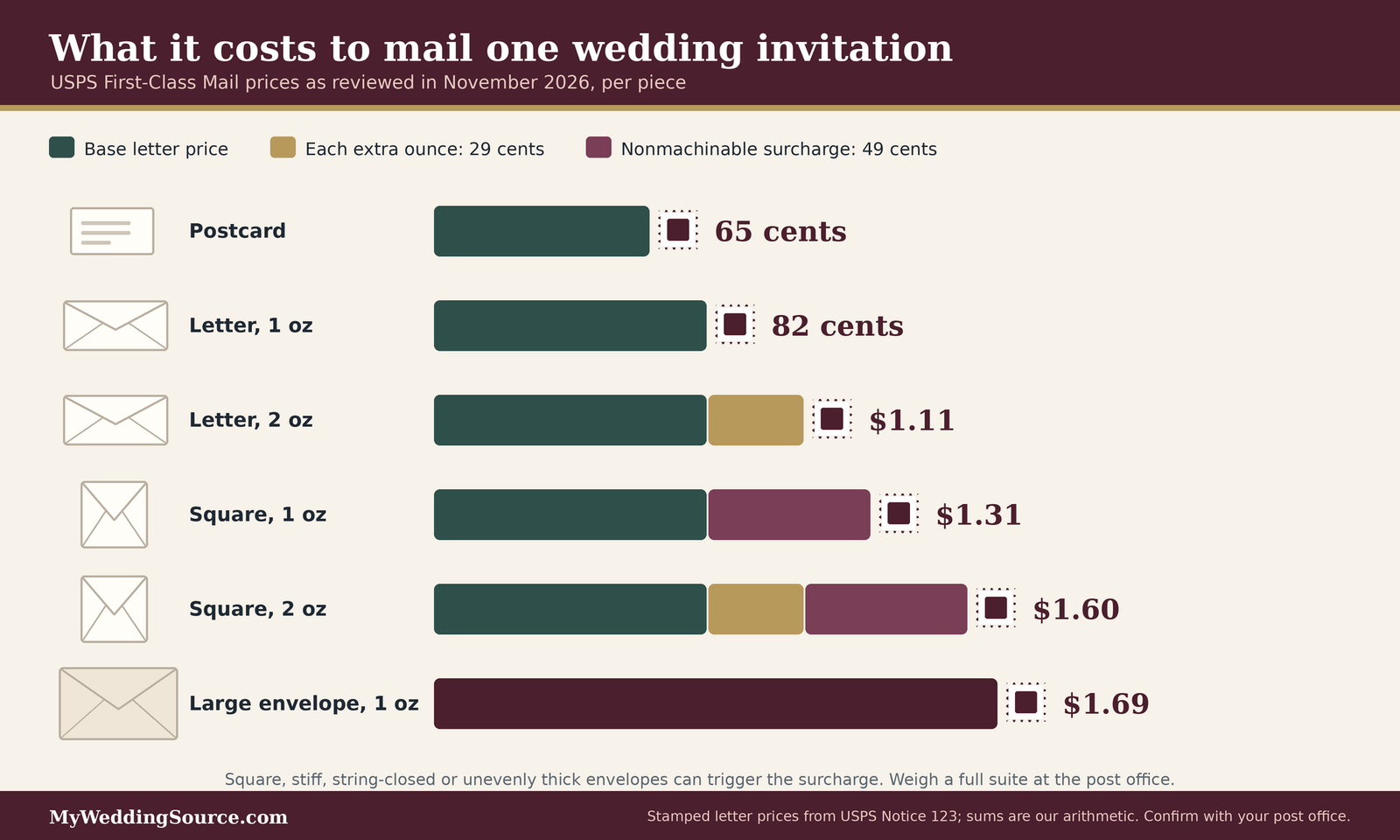
The base price of a First-Class Mail letter stamp is 82 cents, up from 78 cents. USPS announced the increase in April 2026, and the USPS price list we reviewed shows the 82-cent stamped price, a 78-cent metered price, and 29 cents for each additional ounce. A domestic postcard costs 65 cents. A large envelope, also called a flat, starts at $1.69 for the first ounce and rises to $1.98 at two ounces and $2.27 at three ounces.
Base rate and additional ounces
A standard letter that weighs one ounce or less takes one stamp. Each additional ounce adds 29 cents. A two-ounce suite therefore costs 82 plus 29 cents, which is $1.11. The USPS maximum weight for a letter-size piece is 3.5 ounces. Heavier pieces are charged at the large-envelope rate. Stationery retailers, including Minted, advise rounding up to the next ounce when a suite weighs slightly more than a whole number, since a suite at 1.1 ounces is priced as two ounces.
A suite with an invitation card, reply card and envelope, details card, tissue, and liner can pass one ounce quickly. The number of pieces matters less than the paper weight and size, which is why the only reliable method is to weigh a complete sample.
The nonmachinable surcharge, and what triggers it
USPS adds a surcharge of 49 cents to a letter that has nonmachinable characteristics. The standards that define those characteristics list several that matter for wedding invitations:
- Shape. A letter whose length divided by its height is below 1.3 or above 2.5 is nonmachinable. A square envelope has a ratio of 1.0, so it is nonmachinable by definition. A 5-by-7-inch envelope sits at 1.4 and clears the minimum; a 6-by-6 square does not.
- Rigidity. A piece that does not bend easily around the sorting belt is nonmachinable. Thick, stiff wedding invitations or a rigid insert can fail this test.
- Closures and attachments. Clasps, strings, buttons, or similar devices make a piece nonmachinable. A paper envelope window and allowable attachments do not.
- Uneven thickness. A piece with pens, pencils, keys, or coins that cause uneven thickness can be nonmachinable, so a stiff or lumpy embellishment is a risk worth testing.
- Thin for its size. A piece thinner than 0.009 inch that is longer than 6 inches or taller than 4.25 inches is nonmachinable.
- Address orientation. If the address runs parallel to the shorter dimension, the piece is nonmachinable.
The standards also set size limits for letter-size mail. A letter can be at most 11.5 inches long, 6.125 inches high, and one quarter inch thick. A piece that exceeds those dimensions is charged as a large envelope.
Square 1-ounce wedding invitations therefore cost 82 plus 49 cents, or $1.31. A square 2-ounce suite costs $1.60. Minted notes that placing a square invitation inside a rectangular outer envelope can avoid the square surcharge, which is worth asking your designer about. The outer envelope is what the post office measures.
Weigh the full suite before you buy stamps
You cannot predict postage from the stationer’s description of the pieces. You can only measure it.
The test-mailing routine
The Knot advises taking one fully assembled invitation to the post office, having a clerk weigh it, and confirming the postage, since the others will cost the same to mail. Minted adds that the clerk will also test flexibility, or you can use a kitchen scale that reads to 0.1 ounce, and that you should reweigh after any change in paper, liners, or seals.
Assemble the sample exactly as you will send it, including every insert, the reply card with its envelope, tissue, and any seal. Do not forget the stamp on the reply envelope, which adds a little weight. Then ask three questions: What is the exact postage? Is this machinable? Is there anything you would change to lower the cost? Clerks have seen thousands of wedding suites, and a short conversation can save a re-order.
The Knot also suggests buying stamps before the visit, because arriving to stamp and mail on the same day may leave you without the denominations you need. Wedding-themed stamps exist, and a retailer’s 2026 guide lists a Love stamp and two wedding designs, but the combination of stamps matters more than the artwork. Two stamps that total $1.11 are as good as one.
Reply envelopes and return postage
Reply envelopes need postage because guests will not buy it for you. Minted advises pre-stamping reply envelopes at the right rate and weighing a complete reply with the card inside. A reply card in an envelope usually fits the standard letter rate. A postcard-style reply is cheaper at 65 cents if the card meets postcard requirements. USPS sets size and shape rules for postcard pricing, and Minted points out that sizes around 4 by 6 inches or smaller are typical, so verify with USPS before printing.
The savings from postcards are real but modest. For about 73 households, the difference between a postcard reply at 65 cents and an enveloped reply at 82 cents is about $12. Weigh that against guests who like to include a note and the cost of printing envelopes.
A worked postage budget
This is our estimate for the same example: 73 households, three mailings (save-the-date, invitation, and the guests’ reply). We assume each guest replies by mail with a pre-stamped reply envelope, and we count only households mailed, not spares. We use USPS prices from November 2026.
| Mailing | Lower case | Cost | Higher case | Cost |
|---|---|---|---|---|
| Save-the-date | Postcard, 65 cents | $47.45 | Rectangular envelope, 82 cents | $59.86 |
| Invitation | Rectangular, 1 oz, 82 cents | $59.86 | Square, 2 oz, $1.60 | $116.80 |
| Reply | Postcard, 65 cents | $47.45 | Enveloped, 82 cents | $59.86 |
| Total | $154.76 | $236.52 |
An in-between case, with a postcard save-the-date, a rectangular 2-ounce invitation at $1.11, and an enveloped reply at 82 cents, comes to about $188. These figures leave out international guests, extra mailings such as a rehearsal dinner invitation, and any resends for address errors. They show that postage is a real line on the budget, though smaller than stationery.
Hand-canceling, tracking, and overseas guests
Delicate wedding invitations raise a reasonable worry about machine handling. The options are modest, and none is a guarantee.
What hand-canceling is, and what it is not
Hand-canceling means a postal clerk marks the stamps by hand instead of letting a machine do it. The Knot’s guide explains that it can reduce machine handling, that USPS does not guarantee it, and that clerks may or may not agree. One Knot article says hand-canceling by itself does not add a charge, while another Knot mailing guide says to expect a small per-envelope surcharge and a longer wait, so ask your post office what it does. A piece that cannot go through a machine is nonmachinable and costs more. Hand-canceled mail may be slower, and The Knot suggests allowing an extra week. It does not prevent all machine contact, because mail still passes through sorting and transport.
If your post office declines, The Knot notes that a second outer envelope can offer some protection. That adds weight, so reweigh the suite. Our own suggestion is to ask early, to go at a quiet time of day, and to bring a complete sample.
Overseas and tracked mailings
For wedding invitations that go abroad, check postage for each country with your post office. One stationery retailer’s 2026 guide lists a Global Forever stamp at $1.75 per one-ounce letter and large envelopes starting at $3.30, and estimates seven to twenty-one business days; this is a retailer’s summary and not a USPS figure, so verify it. The Knot recommends allowing eight to ten weeks, and Minted recommends mailing one to two weeks earlier than domestic wedding invitations.
If delivery is critical for a few guests, such as the ones who need a visa letter or have to arrange long travel, consider a tracked method for those suites only. Tracking costs more per piece, so use it where it matters. A phone call or an email, in addition to the paper, is a reasonable backup.
Address legibility and the address block
Beautiful wedding invitations in an envelope that a machine cannot read are delayed wedding invitations. The USPS standards for letter mail are written for automated mailings, so not every rule applies to a handwritten invitation, but they are a useful guide to legibility.
Where the address should sit
The standards describe an area on the front of the letter in which the address should fall: at least half an inch from the left and right edges, at least five-eighths of an inch from the bottom, and no higher than about 2.75 inches from the bottom edge. They also reserve a clear zone in the lower-right corner for postal barcodes, which should be free of printing. A return address in the upper-left corner is standard, and the standards call for it when certain endorsements or services are used.
For a calligrapher or a designer, the practical meaning is: do not run the address block into the bottom edge, do not place ornament in the lower-right corner, and do not set the address in a way that rotates it relative to the long edge of the envelope.
Type size and contrast
For addresses printed by machine, USPS standards recommend at least 8-point type, preferring sans-serif and all-capital letters, and they discourage reverse printing, which is light text on a dark background. These are standards for automation mail, not a rule for your envelope, but they point in a useful direction. Metallic ink on a dark envelope or pale script on a colored envelope is the combination most likely to defeat a scanner.
Test the envelope you plan to use. Ask the post office to run a sample, or mail one to yourself and see how it arrives. If the address is hard for you to read at arm’s length in poor light, a sorting machine and a carrier will find it harder still.
RSVP for wedding invitations: deadline, method, and follow-up
A reply card is a small piece of paper with a large job, and it is the part of wedding invitations that guests actually act on. It converts guests’ good intentions into a headcount, a meal count, and a seating chart. Most RSVP problems with wedding invitations are not caused by rude guests. They come from a missing date, an unclear number of seats, or a reply method that took more effort than the guest expected.
Set the reply-by date
The deadline is not arbitrary. It is the date you need replies in order to meet your caterer’s or venue’s deadline, with enough room to chase late replies.
Three to four weeks before the wedding
Sources differ slightly. Zola suggests a reply-by date at least three weeks before the wedding, so you have time to finalize the headcount with the caterer and complete the seating chart. Greenvelope suggests four weeks, and notes that this leaves time to invite someone from a second list if first-choice guests decline. The Knot’s timing guide does not give a specific number of weeks for the deadline.
Our suggestion is to start from your caterer’s or venue’s final-count date and subtract a week for chasing replies. If the final count is due two weeks before the wedding, a reply-by date four weeks before the wedding leaves two weeks of buffer. Ask for the final-count date in writing before you print the reply cards, because it determines the number on the card.
Why a firm date works better than a soft one
A printed date turns “we will get back to you” into a specific task. Guests who see “please reply by September 11” will usually respond near that date, while guests who see “please reply at your earliest convenience” will not. That is the practical reason to print an exact date rather than a range.
A firm date should sit a few days before the date you actually need, since some replies will arrive late no matter what. The cushion is yours to use, and guests do not need to know about it.
Choose paper, online, or both
The reply method should match how your guests actually communicate. A mixed list of guests may need more than one option.
Paper reply cards
Emily Post’s guidance is that a response card is printed in the same style and paper as the invitation but smaller, and comes with its own envelope. A stamped return envelope means the card does not need “RSVP” printed on it. The traditional response wording is “Accepts with pleasure” and “Regretfully declines,” according to Zola, though casual events can use more relaxed phrasing.
Our suggestions for the card itself: print the reply-by date, print the number of seats reserved or leave a line for the guest to write the names attending, and include a line for each choice you need, such as a meal or a dietary note. The Knot suggests numbering each reply card and keeping a matching list, so that a card returned without a name can still be matched to a household. That small mark on the back saves an awkward search through the guest list.
Online replies and QR codes
Online replies make tracking easier and take less time for guests who are comfortable with phones. Zola’s guidance is to include a URL or QR code for online replies, and a stamped envelope for mailed ones.
A QR code is just a link, and the Federal Trade Commission warns that scammers sometimes place their own QR codes over real ones or send them in messages designed to rush people, and that scanned codes can lead to fake websites or malware. That does not mean your own printed code is unsafe. It means guests are right to be cautious, so print the web address in words next to the code, so a guest can type it instead of scanning, and test the code on more than one phone before printing.
Follow up on replies
Even with a clear card, some replies will be missing. Follow-up is part of the plan, not a failure of it.
A reminder schedule
Greenvelope’s advice, for its digital product, is to send two reminders: one a week before the deadline and one a day or two after it, both only to guests who have not replied. The logic carries over to paper wedding invitations. A short text or email a week before the date reminds people who set the card aside. A second, more direct message after the date should ask for an answer by a specific day.
Keep a simple tracker for replies to your wedding invitations. One row per household, with the date the invitation was mailed, the date a reply arrived, the number attending, the meal choices, and any notes. If you numbered the cards, add the number.
Words for the follow-up
Here are two short messages, written by us for illustration. Adapt them to your voice.
Hi Sam, we’re finalizing numbers for our wedding and haven’t received your reply yet. Could you let us know by Friday whether you’ll be able to join us? Thank you, and no worries if you’re still working it out.
Hi Sam, we need to give our caterer a final count tomorrow. Would you be able to confirm today whether you and Jordan can come? If we don’t hear back, we’ll plan for a regret. We’d love to see you either way.
The second message is firm because it names a consequence and a date. It also leaves a door open. Most guests respond to specific, polite requests.
Declines, second lists, and the final count
A guest list is not a promise that everyone will come, and planning for that is practical, not cynical.
What to expect from declines
Emily Post’s guide notes that 10 to 20 percent of invited guests typically decline. That is a general figure from an etiquette publication, not a survey of your guests, and your own rate will depend on how many travel, how far, and how close your guests are to you. Destination weddings and weddings with many out-of-town guests tend to see more declines, though we do not have a source for how many more.
If your venue or budget has a fixed capacity, the declines let you plan a little closer to it, but they should not be used to justify inviting more people than you can seat. Overbooking is a risk, not a strategy.
Inviting everyone at once, or using a second list
Sources disagree here. Emily Post advises inviting the full guest list at once, instead of holding a standby list. Greenvelope, by contrast, notes that early replies let a couple invite people from a second list if first-choice guests decline.
Both views come with trade-offs. Inviting everyone at once avoids the awkwardness of a late invitation and the possibility that a guest realizes they were a second choice. A second list lets you fill a venue closer to capacity but requires an earlier first mailing, a firm early deadline, and a willingness to send wedding invitations closer to the date. If you use a second list, leave enough time that a late invitation still gives guests a fair chance to plan, and consider using online replies for those guests. Whichever choice you make, decide it before the first mailing, because the timeline depends on it.
Quality-check wedding invitations before printing
A proof is the last moment at which an error in wedding invitations costs nothing. After approval, a mistake is your cost, a reprint, or an apology. Treat the proof as a test with a pass or fail, not a quick glance.
Run a guest comprehension test
The best proofreaders of wedding invitations are people who do not already know the answers. Ask two or three people, such as a friend, a relative who is not hosting, and someone unfamiliar with the wedding, to read the proof cold, with no explanation.
Can a guest tell exactly who is invited and what to do?
Hand each reader the whole set of wedding invitations, in the order guests will see it, and ask five questions. Who is getting married? When and where is it? Who is invited on this envelope? How do I reply, and by when? Where do I find more information? If any reader hesitates or answers differently from the others, that line needs rewriting.
Pay particular attention to the guest line. A reader should be able to say how many people are invited without guessing. If the envelope says “The Garcia Family,” ask whether that means two adults, or two adults and three children. The envelope should answer that question, or the website should explain the policy clearly.
Check date, time, address, and deadline for consistency
Every date, time, and address appears more than once. The invitation, the details card, the website, and the reply card should agree. Make a short table of the key facts: the date, the ceremony time, the reception time, the venue name, the street address, the reply-by date, and the website address. Compare each document against the table, line by line, aloud.
Check the day of the week against the date on a calendar. It sounds too basic to matter, and it is one of the most common errors in printed stationery. Also check time conventions: “4:30” without “afternoon” is clear in context, but a reception that starts at “12:00” is not.
Run a production and privacy check
The final check is about details a reader will not catch but a printer or a guest will.
Confirm spelling against legal and preferred names
Names should match how each person wants to be named, which is not always their legal name. Ask each host and each member of the couple to read their own name on the proof and confirm in writing. Check surnames, accents, middle names, and titles. A guest’s name on the envelope list should match the way they spell it, which is easy to confirm in a quick message.
If a name includes characters that your printer’s font cannot render, such as an accented letter, ask the printer to check the font on the proof. A missing accent can look like a mistake even when it is a limit of the template.
Check QR links, website visibility, and version control
Scan every QR code on at least two phones, in good and poor light, and confirm that the page loads quickly and shows what a guest expects. The FTC’s consumer guidance suggests that unexpected QR codes and links deserve a look before anyone opens them, which is a reason to print the plain web address next to your code.
Confirm who can see your wedding website. Decide whether it should be public or visible only to people with a password, and test the page in a private browser window, without your account logged in. Ask yourself whether the page shows anything you would not want a stranger to see, such as an exact home address, a phone number, or the dates you will be away from home. Our suggestion is to keep private details off public pages, and to let guests ask for them.
Finally, control versions. Keep one master document with the approved text. Name each proof by date. When the printer sends a revised proof, compare it to the master, not to the previous proof, since errors can creep back in when a design is revised. Get the final approval in writing, and keep the file.
Check type size and contrast for guests who read differently
Guests of different ages and vision read wedding invitations differently. A few simple checks improve readability for everyone.
Contrast and size
The Web Content Accessibility Guidelines, a technical standard for web pages, require a contrast ratio of at least 4.5 to 1 for normal text and 3 to 1 for large text, and they define large text as at least 18 points, or 14 points and bold. Those figures are for screens, and printed pieces are viewed in different light, so we use them only as a rough benchmark. Pale gray or metallic ink on a light background, or light text on a dark background, is the combination most likely to fail. Ask your designer to check contrast on the details card and the reply card in particular, since those are the pieces guests must read carefully.
Print the proof at actual size and read it in dim light. If you cannot read the date comfortably, many guests will not be able to either.
Offering another way to get the information
Not every guest who receives wedding invitations will use a website, a QR code, or a mailed card. Offer a phone number or an email address on the details card for guests who prefer to ask. If you expect guests who use screen readers, make sure the website works with text alternatives for images, and that key details are written as text on the page and not only inside an image of the invitation. Putting the whole invitation on the website as a picture is a common mistake that makes the details unavailable to screen readers and hard to copy into a calendar.
Ordering from a stationer: delivery, proofs, and your protections
Whether you buy wedding invitations from a local studio or an online retailer, you are entering a contract for a custom product with a deadline. A few questions asked before you pay can prevent most disputes. This is general information and not legal advice, and you should read the actual terms of any seller you use.
Delivery dates and delay notices
The date a seller gives you is a promise, and in some cases the law backs it up.
What the FTC rule says about shipping times
The Federal Trade Commission enforces a rule covering goods ordered by mail, phone, fax, or the internet. According to the FTC’s business guide, a seller must have a reasonable basis for any shipping time it states. If it states none, it must reasonably expect to ship within 30 days of receiving a properly completed order. When a seller cannot ship on time, it must promptly offer the customer a choice, without being asked, to accept a delay or cancel for a full refund, and a refund must follow within a set period when an order is canceled.
The FTC guidance does not specifically address made-to-order goods, and the rule has exemptions, so we cannot say how it applies to every custom invitation order. What it does show is the general standard: a stated ship date matters, and a seller that misses it owes the customer a clear choice. Keep the order confirmation, the ship date, and any later messages about delays.
Build a buffer, not a deadline on the edge
Do not choose a delivery date for wedding invitations that leaves no room for error. The Knot’s advice is to have ready-made wedding invitations in hand about ten weeks before the wedding, which allows time for a reprint or a delay. Our suggestion is to ask the seller for the ship date in writing when you order, to ask what happens if a proof is approved late, and to ask whether rush options exist and what they cost.
Proofs, reprints, and returns
Custom stationery is generally made for you and cannot be resold, so return policies are often narrow. The details matter.
Who pays for errors
If the printed piece does not match the approved proof, most sellers will correct it. If the proof contained an error that you approved, most sellers will not. That is the reason to treat the proof carefully. Ask the seller to state in writing how it handles printing errors versus customer errors, what the reprint turnaround is, and whether a reprint changes your delivery date.
Keep every approval
Save the proof approval, the quote, the invoice, and the shipping confirmation in a single folder. If you change any element after approval, such as adding a line, ask for a new proof, because an unsigned change is the kind of dispute that is hard to settle later.
Questions to ask a stationer before you pay
- What exactly is in the suite, piece by piece, and what does each piece cost?
- How many extra pieces are included, and what do additional sets cost?
- What is the ship date, and will you confirm it in writing?
- How many proof rounds are included, and what does an extra round cost?
- If the printed piece does not match the approved proof, what is your remedy and turnaround?
- Are envelope addressing, assembly, and stamping included, or priced separately?
- What is the assembled thickness and weight, so I can test postage before I order?
- What is your refund or cancellation policy once design work has started?
A worked example, start to finish
To show how the pieces of wedding invitations fit together, here is one hypothetical couple. The details are invented for illustration, and the assumptions are ours.
The scenario
Maya and Daniel are planning a Saturday wedding in October 2027 for about 117 guests, which is The Knot’s reported average guest count. About a third of the guests will travel from out of town, and four households live abroad. They are hosting jointly with both sets of parents, one of whom is divorced and remarried. They want printed wedding invitations with an online reply.
The decisions they make
They choose “together with their families” as the host line, so no one’s name is ranked. They list the divorced parent and spouse as a separate line only in the program, after talking with that family. They print the full address of the venue and a website address next to a QR code, and test the code on three phones. They mail save-the-dates in February at the eight-month end of the range, because many guests travel, and wedding invitations in mid-August at about eight weeks.
They number each reply card, and they print the reply-by date three to four weeks before the wedding, after confirming the caterer’s final-count date. They send the four overseas households a note at the long end of the range and use a tracked method for those suites only.
What it costs, in rough terms
Using the assumptions in the cost and postage sections, they would budget about 73 households’ worth of stationery plus spares, and roughly $155 to $235 in postage for the three mailings, plus extra for the four overseas suites. The stationery price depends on the quote they choose, and they set a ceiling before they start, using a budget tool such as our wedding budget calculator.
A risk register for the whole process
A risk register for wedding invitations is a short list of the things that could go wrong, with an early sign and a fix. It takes ten minutes to make and often saves a reprint.
| Risk | How it shows up | Early signal | Check or fix |
|---|---|---|---|
| Wrong date, time, or address | Guests arrive at the wrong place or time | Details differ between card, website, and reply card | Compare every document to one master fact sheet, aloud |
| Postage underpaid | Suites returned or delayed | Square shape, stiff stock, wax seal, extra insert | Weigh and test one full suite at the post office |
| Reply deadline too close | Final count missed, guesses at the caterer | Replies still arriving after the deadline | Set the date three to four weeks out and send two reminders |
| Unclear guest line | Replies include uninvited people | Reply counts exceed seats reserved | Print invited names or seats reserved, and state any child policy |
| QR code fails | Guests cannot reply online | Code unreadable at print size or on older phones | Test on several phones and print the web address in words |
| Late or missing delivery | Invitations not in hand for mailing | Seller silent past the promised ship date | Get the ship date in writing and keep a buffer |
| Addresses wrong or stale | Returned mail, missing replies | Several guests say they never received it | Confirm addresses before printing and send a text or email heads-up |
| Overseas mail delayed | International guests have little time to plan | No tracking, mailed on the domestic schedule | Mail earlier, offer online reply, track the critical suites |
Using the register
Review the register for your wedding invitations at three points: before you approve the proof, before you mail, and the week the reply-by date arrives. At each point, add anything new and cross off what is handled. The point is not to predict every problem. It is to make the common ones boring.
When something goes wrong anyway
If an error in wedding invitations reaches the mailbox, act quickly and plainly. A short correction by text, email, or a small printed card is often better than a full reprint, and guests generally respond kindly to a clear, calm note. Update the website first, because it is the one source you can fix at once.
FAQ: wedding invitations questions
Timing and wording
When should we mail wedding invitations?
Most sources recommend six to eight weeks before the wedding. The Knot suggests about eight weeks when guests reply by mail and about six when replies are online. Allow eight to twelve weeks for destination weddings and nine to ten weeks for overseas guests, and plan your reply-by date and printing time before choosing a mailing date.
Do we need save-the-dates before wedding invitations?
Not always. The Knot recommends them six to eight months ahead and treats under four months as too late, in which case it suggests skipping them and sending wedding invitations. Save-the-dates matter most when guests must travel or book time off. They are a statement that the recipient is on your list, so send them only to people you intend to invite.
What should the invitation include, and what should be left off?
Wedding invitations should include hosts, the couple’s names, date, time, venue and city, and how to reply by when. Put maps, lodging, schedules, and registry details on a details card or website. Emily Post advises against printing registry information on the invitation, and The Knot suggests a website link on a separate card instead.
How do we word an invitation when parents are divorced or a parent has died?
Use names, not labels. Zola suggests listing divorced parents on separate lines, with stepparents after their spouse, and adding “the late” before a deceased parent’s name. Emily Post shows divorced and remarried parents as separate pairs. Ask each host how they prefer to be named, and confirm the wording with them before printing.
Postage, replies, and guests
How much postage do wedding invitations need?
It depends on weight, shape, and stiffness. In November 2026 a USPS letter stamp was 82 cents, each additional ounce 29 cents, and the nonmachinable surcharge 49 cents, so a square two-ounce suite costs $1.60. Take one fully assembled suite to the post office, have it weighed, and confirm the price before buying stamps.
When should the RSVP be due?
Zola suggests at least three weeks before the wedding and Greenvelope suggests four weeks. The right date depends on your caterer’s or venue’s final-count deadline, so ask for it in writing and leave room to chase late replies. Print an exact date on the card, and send reminders to households that have not answered.
How do we say that children or plus-ones are not invited?
Address the envelope only to the people invited, and say so plainly where guests will see it. Zola suggests adding “Adults only, please” to the bottom of the invitation for a child-free wedding and addressing the envelope to the invited guest alone when plus-ones are not allowed. Print the policy on the website too.
Can we send digital invitations instead of paper?
Yes. Digital wedding invitations remove printing and postage and make replies easy to track, but they work best when you have reliable email addresses and guests are comfortable online. The Knot keeps the same six-to-eight-week timeline for digital wedding invitations. Many couples combine printed wedding invitations with an online reply, and offer a phone number for guests who prefer to call.
Your next steps
Decide the message and the dates
Write the six statements
Before choosing a design, write one plain sentence each for who is marrying, who is hosting, when and where, who is invited, how to reply by when, and where to find more. Then compare your draft to our wedding planning checklist so nothing is left undecided.
Work backward from the wedding date
Use your date, your caterer’s final-count deadline, and the ranges in this guide to build a calendar. Our wedding timeline guide shows where wedding invitations sit among the other milestones, and our guide to planning a wedding covers the order of the larger decisions.
Test before you commit
Get a sample and weigh it
Ask your stationer for a printed sample on your paper, assemble it as you will send it, and take it to the post office. Confirm the postage, the machinability, and the hand-cancel policy before you place the full order.
Plan for the paper in photos
Invitation suites are often photographed on the wedding day. If you want that, ask your stationer for two extra complete suites and add them to your photographer’s list. Our wedding photographer shot list explains how to request detail shots, and our broader wedding planning guide places stationery among the rest of the plan.
Sources & methodology
How we built this guide
What we relied on
This guide combines etiquette guidance from Emily Post, wedding-industry timing and cost reporting from The Knot and Zola, a digital-invitation company’s timing guide (Greenvelope), U.S. Postal Service price lists and mailpiece standards, a Federal Trade Commission business guide on shipping rules for online orders, FTC consumer advice on QR codes, and the W3C’s accessibility guidance on text contrast. Where a statement comes from a retailer or a company that sells the product, we say so, because it reflects the seller’s interest. The household counts, per-household costs, and postage totals are our own arithmetic from stated assumptions, and they are estimates. Dates and prices are as we reviewed them in November 2026.
What we did not do
We did not test envelopes at a post office, survey couples, or verify any seller’s lead times. We did not give legal or financial advice. Etiquette is convention and not law, postage and prices change, and the FTC rule has exemptions and may not apply to every custom order. Confirm postage with your post office, ask your stationer for terms in writing, and read any contract before you sign.
Source list
Government, regulatory, and standards sources
- U.S. Postal Service, Notice 123, Price List: https://pe.usps.com/text/dmm300/Notice123.htm
- U.S. Postal Service, Domestic Mail Manual 101, Commercial Letters, Cards, Flats, and Parcels (letter-size standards and nonmachinable criteria): https://pe.usps.com/text/dmm300/101.htm
- U.S. Postal Service, Domestic Mail Manual 202, Elements on the Face of a Mailpiece (address placement and legibility): https://pe.usps.com/text/dmm300/202.htm
- U.S. Postal Service, newsroom release on proposed July 2026 prices: https://about.usps.com/newsroom/national-releases/2026/0409-usps-recommends-new-prices-for-july.pdf
- Federal Trade Commission, Business Guide to the Mail, Internet, or Telephone Order Merchandise Rule: https://ftc.gov/business-guidance/resources/business-guide-ftcs-mail-internet-or-telephone-order-merchandise-rule
- Federal Trade Commission, Consumer Alert on QR codes: https://consumer.ftc.gov/consumer-alerts/2023/12/scammers-hide-harmful-links-qr-codes-steal-your-information
- W3C, Understanding Success Criterion 1.4.3 Contrast (Minimum), WCAG 2.2: https://www.w3.org/WAI/WCAG22/Understanding/contrast-minimum.html
Etiquette and wedding-industry sources
- Emily Post, Wedding Invitations 101: https://emilypost.com/advice/wedding-invitations
- Emily Post, Formal Wedding Invitation Wording: https://emilypost.com/advice/formal-wedding-invitation-wording
- Emily Post, Samples of Formal Wedding Invitation Wording: https://emilypost.com/advice/samples-of-formal-wedding-invitation-wording
- The Knot, The National Average Cost of Wedding Invitations and Stationery: https://www.theknot.com/content/average-cost-of-wedding-invitations
- The Knot, The Average Wedding Cost (2026 Real Weddings Study): https://www.theknot.com/content/average-wedding-cost
- The Knot, When to Send Wedding Invitations: https://www.theknot.com/content/when-to-send-wedding-invitations
- The Knot, When to Send Save-the-Dates: https://www.theknot.com/content/when-to-send-save-the-dates
- The Knot, Save-the-Date Etiquette: https://theknot.com/content/save-the-dates-etiquette
- The Knot, How to Mail Wedding Invitations: https://www.theknot.com/content/how-to-mail-wedding-invitations
- The Knot, Hand Cancel Wedding Invitations: https://www.theknot.com/content/hand-cancel-wedding-invitations
- The Knot, Invitation Wording: https://www.theknot.com/paper/invitation-wording
- Zola, Wedding Invitation Wording: A Complete How-To Guide: https://www.zola.com/expert-advice/how-to-word-wedding-invitations
Stationery and digital-invitation companies
- Greenvelope, When to Send Wedding Invitations: https://www.greenvelope.com/blog/when-to-send-wedding-invitations
- Greenvelope, Timing Guide for Invitations and Save the Dates: https://www.greenvelope.com/resources/when-to-send-wedding-invitations-and-save-the-dates
- Minted, Postage for Wedding Invitations: https://www.minted.com/wedding-ideas/wedding-invitation-postage-rates
- Paperlust, USPS Wedding Stamps and Postage Guide, 2026 Rates: https://paperlust.co/blog/?p=12505