

Wedding planning stress rarely comes from the wedding itself. It comes from a handful of decisions made out of order, a budget nobody fully owns, and promises made to other people before the couple has agreed with each other, so the most useful thing you can do is find the bottleneck instead of trying to work harder.
Quick answer
Most wedding planning stress traces back to four bottlenecks: a guest list that is not settled, a budget with no single owner and no cushion, a planning workload that sits on one person, and contracts or deposits signed before the details were clear. Fix them in that order. Settle the guest range before you tour venues, hold back a reserve for fees you cannot see yet, split tasks by name and date, and read every contract before you pay. If wedding planning stress stops feeling like a to-do problem and starts interfering with sleep, work, or daily life, talk to a qualified professional. This guide is general planning information, not medical, legal, or financial advice.
What wedding planning stress is made of
Everyone describes wedding planning stress as a feeling, but a planner would describe it as a queue. Decisions stack up behind one another, each one waiting for an earlier decision that has not been made, and the feeling of being overwhelmed is mostly what a long queue feels like from the inside. That is the practical way to think about wedding planning stress. This section names the inputs that matter and separates the ones you can control from the ones you only think you must obey. If you want the full planning framework first, our wedding planning guide covers it, and this article stays on the narrower question of where things jam.
The inputs that change the answer
You can describe nearly every wedding with five numbers and facts: how many guests, which venue, how much money, whose opinions count, and how much time you have. Wedding planning stress is highest when two of those five are fixed and collide. A venue that holds 80 people and a list of 130 is not a feeling, it is arithmetic, and the arithmetic will not move because someone is upset about it.
Guest count, venue, budget, relationships, and timing
Guest count is the input that moves everything else. Catering and bar costs usually follow headcount, rentals and invitations follow it, and so does the size of the venue you can consider. The Knot Worldwide’s 2026 Real Weddings Study, which covers couples who married in 2025, reports an average of 117 guests and an average cost of about $34,000, or about $292 per guest. Zola’s 2026 First Look Report, a survey of couples marrying in 2026, reports a higher average of 145 guests and a $36,000 average cost. The two numbers differ because the studies recruit different people and define cost differently, which is why it is safer to treat both as rough neighborhoods than as targets.
Venue comes next because it fixes a date, a capacity, and often a vendor list. The Knot’s study reports that 89 percent of couples booked a venue, so for most people it is the first large contract. Budget sits beside it. Timing is the quietest input and often the most expensive: Zola reports an average engagement of about 18 months, but your own window may be shorter, and a short window shrinks the number of vendors who are still open.
Relationships are the input that does not appear in any spreadsheet. Parents who are contributing money, a close friend who expects a role, a partner who wants a smaller day than you do: each one acts like a constraint even though none of them is a number. Write them down next to the numbers so they get discussed on purpose.
Hard constraints versus social pressure
A hard constraint is something that fails if you ignore it. A venue’s legal capacity, a date a key person cannot attend, a deposit due date written in a contract, and the money in the bank account are all hard. Social pressure is a preference that feels like a constraint because someone will be disappointed: the expectation that a certain cousin be invited, that there be a seated dinner, that every friend get a bridesmaid or groomsman role.
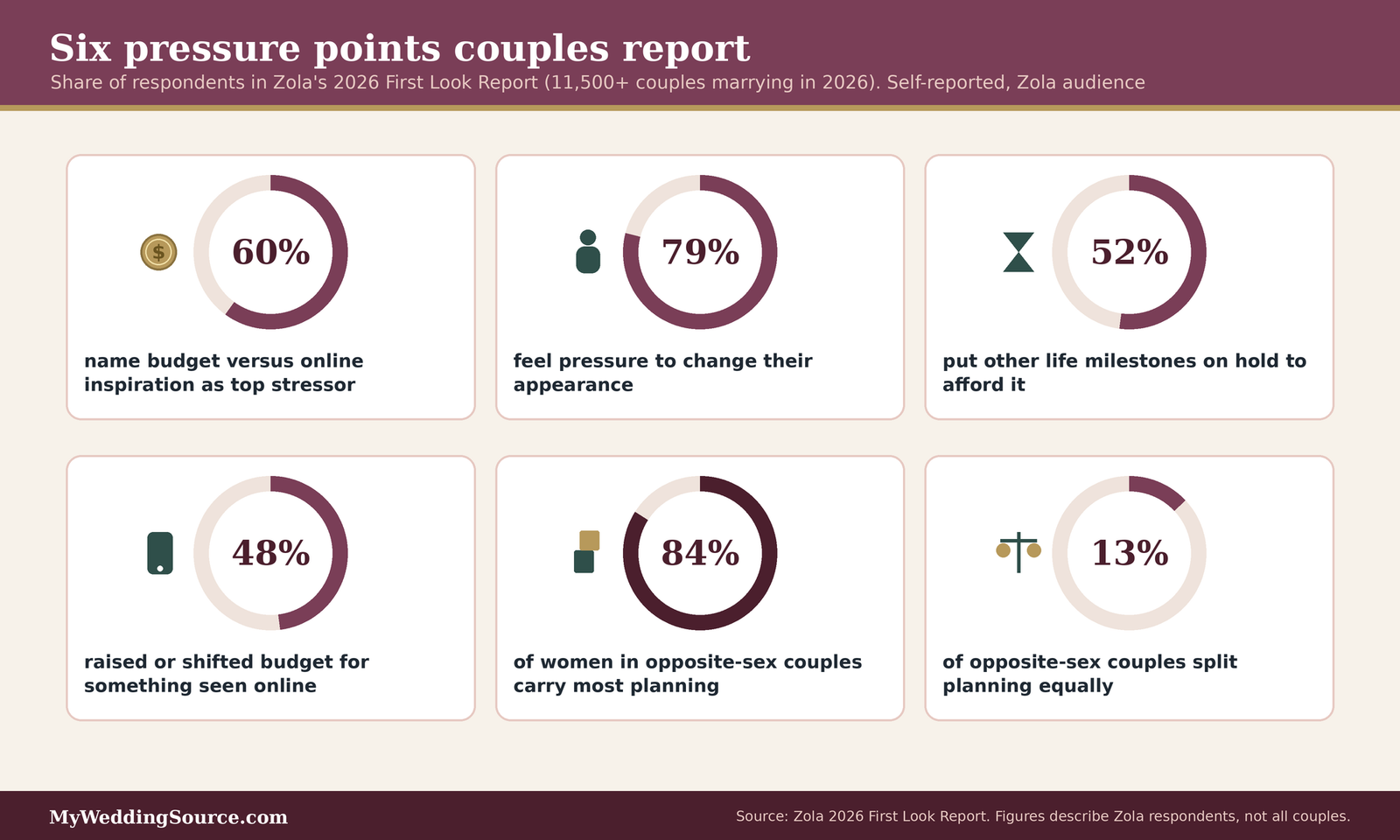
A short test helps. Ask whether the thing would fail on its own if nobody ever complained about it. If yes, it is a hard constraint and belongs in the plan first. If no, it is a pressure, and it deserves a decision about how much it is worth, not an automatic yes. Zola’s 2026 report says 60 percent of surveyed couples call managing their budget against online inspiration their top planning stressor, which is a good example of how wedding planning stress feeds on pressure that looks like a requirement. Nothing fails if the arch of flowers you saw online is smaller, and recognizing that is one of the quickest ways to lower wedding planning stress.
The second-order effects nobody warns you about
The common pattern behind wedding planning stress is not one big bad decision. It is a small decision that quietly changes four others. A planner would call these second-order effects, and they are the reason a choice that looked cheap and easy in March feels expensive and miserable in August.
What a decision changes downstream
Take a simple example, labeled as our illustration. A couple chooses a Saturday in peak season because it is the date family prefers. That choice narrows the venues that are free, which narrows the caterers those venues allow, which raises the cost of the first three vendors and shortens the time to compare quotes. Later the couple feels rushed and pays a rush fee for invitations. None of those later costs was part of the original decision, and none was visible when it was made.
You can make downstream effects visible by finishing one sentence for every large decision: “If we choose this, then we also have to decide , , and ___.” Writing three blanks takes about two minutes and prevents the surprise that makes people feel the process is out of control. Our wedding planning timeline shows the typical order of those follow-on decisions.
Fairness, workload, and the guest experience
Second-order effects are not only financial. Zola’s 2026 report says that among opposite-sex couples only 13 percent split planning evenly, and 84 percent of the women in that group say they carry most of the load. Among same-sex couples in the same report, 29 percent describe a 50/50 split. These are survey self-reports from Zola’s own audience, not a measure of every couple, but they match something many couples recognize: the person who enjoys planning or is quicker with details becomes the default project manager, and their wedding planning stress rises while the other partner’s does not.
Guests carry effects too. A reception schedule with a long gap between ceremony and dinner, a seating plan made in a hurry, or an unclear dress code is wedding planning stress that moves from the couple to the guests. Decisions about guest experience are easiest to make early, and our wedding etiquette guide and wedding reception guide cover the choices that guests notice most.
What the survey data does and does not say
Most numbers in this article come from two industry surveys. It is worth knowing exactly what they are, because the way a survey is built changes how far you can lean on it.
How to read an industry survey
The Knot Worldwide says its 2026 Real Weddings Study draws on 10,474 U.S. couples who married between January 1 and December 31, 2025, recruited by email through The Knot and WeddingWire memberships. Zola says its 2026 First Look Report surveyed more than 11,500 couples marrying in 2026, and its separate Wedding Spend Survey, with 720 respondents, polls couples within 180 days after their wedding. In all three cases, the people who answered are people who already use a wedding website, so they may plan differently from couples who do not. The figures describe those respondents, not every wedding in America.
That does not make the data useless for understanding wedding planning stress. It makes it a map of one region. When both companies report a similar guest range or a similar share of couples going over budget, the overlap is more believable than either number alone.
What we could not find
We did not find a rigorous, independent measure of how many engaged couples experience a clinical level of stress, and we are not going to invent one. Where we describe wedding planning stress below, we are quoting what surveyed couples say about their own planning, or giving planning advice. We also did not find a source that tells you exactly how much a given decision will cost in your city. For that you need quotes. Where a number in this guide is our arithmetic, we label it as an estimate. ## Find the bottleneck: where wedding planning stress piles up
Once you can see the queue, you can find the item at the front of it, which is the quickest way to ease wedding planning stress. The four bottlenecks below are the ones that, in our editorial judgment, cause the most rework, which is why they are covered in the order you would meet them. They are not a ranking from research. They are a working model, built from the survey figures cited in this guide and from consumer-protection advice, and you should adjust it to your own situation.
The decision chain: guest list, budget, venue, date
Planning has a natural order, and most rework happens when couples skip a link in it. The chain runs roughly from a draft guest range, to a total budget and who owns it, to a venue and date, to the vendors that depend on the venue, to the paper and details that depend on the vendors. Each link is cheap to change before the next one starts and expensive to change afterward.

Settle a guest range before touring venues
You do not need a final list to start. You need a range, such as “between 80 and 110,” and a short list of people who are certain. A range lets you screen venues by capacity, ask caterers for realistic quotes, and avoid falling in love with a space you cannot use. Ranges also make the conversation with parents easier, because you can say what the number is for instead of arguing about names.
A practical method is to sort invitees into three tiers: certain, probable, and maybe. Price the day for the first two tiers and treat the third as a reserve that opens only if money and space allow. This is an editorial method, not an industry rule, but it turns a painful all-or-nothing debate into a series of smaller ones. Our wedding planning checklist places the guest-list step early for the same reason.
Give the budget one owner and one cushion
Budgets fail in two ways: nobody is watching the total, or everybody is, and they disagree. Pick one person to hold the master spreadsheet and report the running total at a fixed weekly time. That person is a bookkeeper, not a boss. Any spend above an agreed threshold, say $250, is discussed before it is committed.
The cushion matters as much as the owner. Zola’s Wedding Spend Survey (720 respondents) reports that hidden costs, meaning unexpected fees and miscellaneous items, averaged $3,314, about 9 percent of total spend. Zola’s report also says 69 percent of couples exceed their initial budget. Together those figures suggest that a reserve of roughly 10 percent is a reasonable starting assumption. The 10 percent is our arithmetic, not Zola’s recommendation, and your own quotes may justify a larger or smaller one. If you want a structure for the totals, our wedding budget calculator is a good place to begin.
The money bottleneck: hidden costs and guest math
Money-related wedding planning stress is partly about how much and partly about not knowing. A budget that looks fine in a spreadsheet can still feel frightening if the spreadsheet leaves out service charges, tax, gratuity, travel, alterations, and the many small items that appear late. Reducing the uncertainty reduces the stress even before the total changes, and that is why this part of wedding planning stress is the easiest to act on.
Where the unplanned money tends to come from
Benzinga, summarizing Zola’s report, lists the usual sources of overspending: hidden fees such as service charges, gratuities, overtime, and delivery or setup; last-minute upgrades such as more guests, better food or drinks, extra flowers, or more photography hours; and location, because weddings in large cities can cost about twice as much as similar weddings elsewhere. That list is a journalist’s summary rather than a Zola finding, so treat it as a checklist of questions, not a measurement.
Zola’s 2026 First Look Report adds a category many couples forget: beauty, physical health, and mental wellbeing spending that averages about $1,100 and typically sits outside initial budgets. The same report says 48 percent of couples increased their budget or moved money to get something they saw online. These are good prompts to ask yourself before the money is gone, not after.
Zola’s spending survey also reports how people pay: 47 percent use long-term savings and monthly income, 31 percent use credit cards, and 25 percent receive cash added to their registry. We are not giving financial advice, but we will note that how you pay changes how long the wedding planning stress lasts. A cost paid from savings ends when the wedding does, while a cost put on a card follows you into the marriage. Our wedding registry guide explains cash-fund options.
The guest arithmetic, with honest caveats
A per-guest average is a blunt tool, but it makes the stakes visible. Using The Knot’s reported $292 per guest, ten additional guests would be about $2,920. Using the wider $150 to $300 per-guest guideline that Zola publishes, ten guests would be about $1,500 to $3,000. These are our estimates from averages, not quotes.
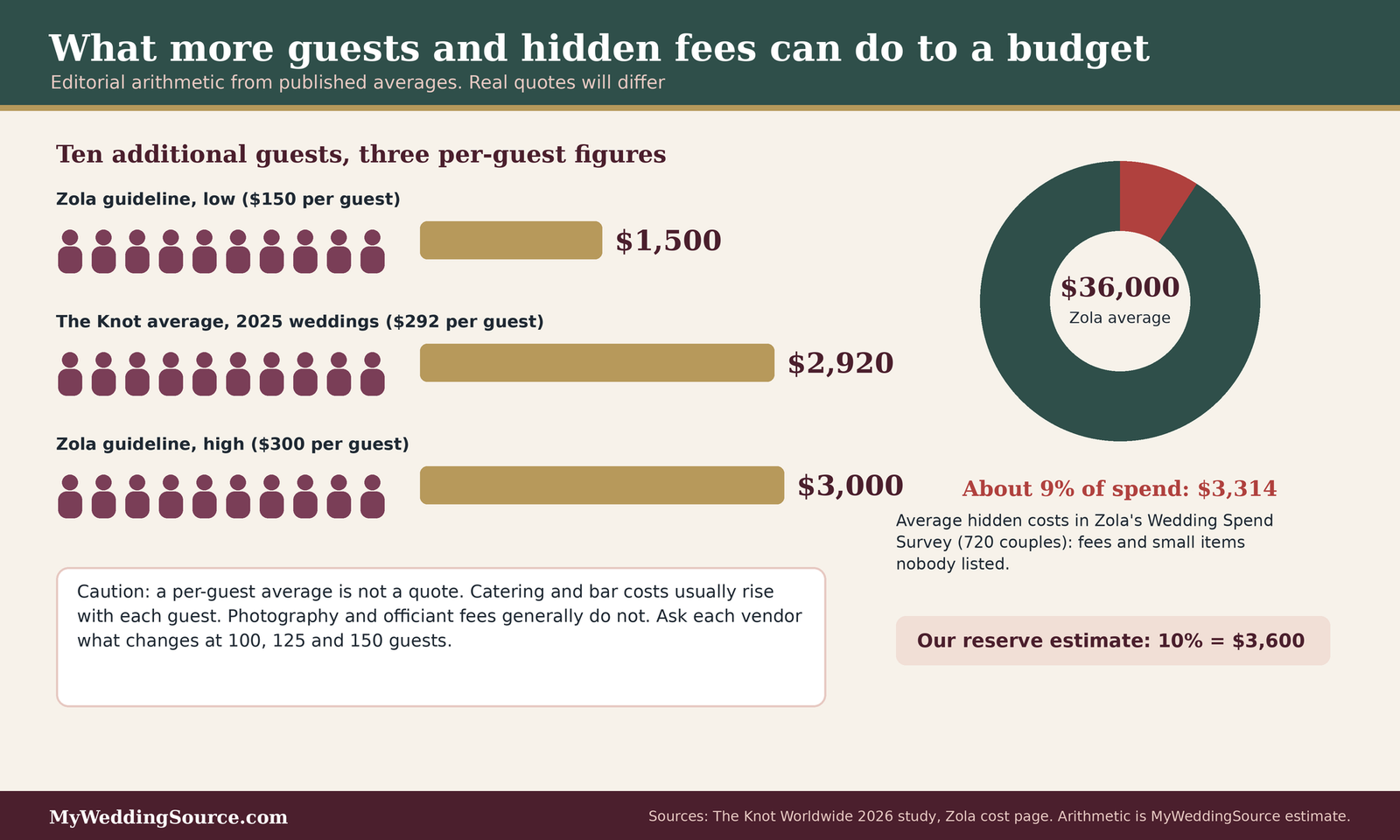
The real marginal cost differs by line item. Catering and bar costs tend to rise with every guest, while a photographer’s fee or an officiant’s fee generally does not. That means the cost of adding the last ten guests is often lower than the average suggests, but the cost of the first extra table can be higher if it pushes you into a larger room or a higher catering tier. Ask each vendor what changes at specific headcounts, such as 100, 125, and 150, and write down the answers. Our wedding catering guide and open bar wedding guide explain the pricing structures that are most sensitive to headcount.
The people bottleneck: workload and outside opinions
The third pile-up is human, and it is where wedding planning stress often becomes personal. A wedding is a project with two principals and many stakeholders, and projects fail when the work is invisible or the opinions are unlimited.
Make the workload visible
Zola reports that among opposite-sex couples, 84 percent of women say they carry most of the planning, and primary planners say they take the job because they are more detail-oriented (93 percent), enjoy planning more (83 percent), or because “it’s just the way it is” (60 percent). The first two reasons are real, but the third is a habit. Habits can be changed by making the work visible.
Put every open task on a shared list with an owner and a date. Count the tasks per person once a month. If one person holds most of them, the question is not who is better at planning but which tasks can be handed off completely, with a written description of “done.” Hand off whole jobs such as the rehearsal dinner, the music brief, or the honeymoon booking, not fragments that still require supervision. Our honeymoon planning guide is a good example of a project that can be fully owned by one person.
Limit the number of voices
Online inspiration and family opinions arrive without being asked. Zola’s report says 41 percent of Gen Z respondents and 28 percent of Millennials say social media added wedding planning stress. We cannot say what that wedding planning stress costs you, but we can suggest a structure: decide in advance who has a vote, who has a voice, and who has neither. Parents who pay for part of the day may have a voice on that part. Friends and extended family usually have neither, even if they offer opinions kindly.
A phrase that works is “we are still deciding, and we will tell you when we have.” It is polite, it is true, and it does not invite debate. Our wedding etiquette guide covers common situations where a courteous refusal is appropriate.
The contract bottleneck: signing before you understand
The fourth pile-up is the one that costs money directly, and it adds wedding planning stress later if it is ignored. Vendors ask for deposits early, and the pressure to secure a date can push couples to sign before they have read what they are signing.
Read before you pay
The Wisconsin Department of Agriculture, Trade and Consumer Protection advises couples to get everything in writing, to ask for a sample contract in advance, and never to sign a blank one. Its guidance says a contract should state all costs and delivery dates and say who is responsible for mistakes. For photographers it recommends naming the specific photographer and the delivery date in the contract, and for caterers it recommends covering pricing, beverages, service charges or gratuities, cancellation and refund terms, and a bad-weather plan.
The Better Business Bureau’s wedding planning guide, dated November 6, 2026 on the page we read, gives a similar list: dates, times, products, quantities, prices, key staff names, arrival times, cancellation and refund terms, and overtime charges. We are not lawyers, and contract law varies by state, so use these as questions to ask, and consider having an attorney review large or unusual contracts. Our wedding photography guide lists the contract details specific to photographers.
Deposits, payment method, and what insurance will not do
Both sources suggest paying as little as you can at signing. Wisconsin’s guidance notes that bridal shops often require a non-refundable deposit, commonly 50 percent, that photographers may be paid in installments, and that paying by credit card can provide a path to help if something goes wrong. The BBB suggests paying only a deposit after both sides sign, using a credit card for deposits, and avoiding cash, wire transfers, gift cards, and payment apps.
Both sources also mention insurance. Wisconsin notes that wedding insurance typically will not cover cancellation because of a change of heart or a problem you knew about when you bought the policy, and the BBB recommends reading any policy closely for exclusions. Neither source tells you which policy to buy, and neither do we. Treat insurance as a document to read, not a safety net to assume. The same logic applies to custom or altered items such as gowns, which Wisconsin says are often non-refundable, so ask about refund and credit policies before ordering. ## Compare your options for easing wedding planning stress
Once you know where the queue is jammed, you have a handful of ways to clear it and lower wedding planning stress. None of them is the right answer for everyone, which is why this section compares them against the same criteria instead of recommending one. The goal is to help you see what each option costs, what it saves, and what it risks.
Score the options on the same criteria
A fair comparison asks the same questions of every option. We use four: what it does to the budget, what it does to your time, what it does to conflict between people, and how easily you can undo it. Each is scored in plain words (lower, similar, higher) so we do not pretend to precision we do not have.
Use ranges and plain words, not fake precision
Nobody can honestly say that hiring a planner “reduces wedding planning stress by 40 percent.” What you can say is that it moves work from you to someone else, costs money, and is hard to reverse once the deposit is paid. Zola’s cost index lists wedding planning at an average of $4,047 among couples who pay for it, with a typical range of $3,200 to $4,900, but your local prices will differ and the services vary widely, from full planning to a day-of coordinator. Treat the table below as a way to think, not a prescription.
| Option | Effect on budget | Effect on your time | Effect on conflict | How reversible |
|---|---|---|---|---|
| Keep planning yourselves with a shared task list | Lowest cost | Highest time, but spread across two people | Lower if the split is explicit | Fully reversible |
| Hire a full planner | Higher cost | Large reduction | Can lower or raise conflict, depending on who the planner answers to | Hard once a deposit is paid |
| Hire a day-of coordinator only | Moderate cost | Reduces only the final weeks | Little effect on earlier disputes | Moderate |
| Reduce the guest count | Usually lowers cost | Reduces many small tasks | Can raise conflict with family | Hard to undo after invitations go out |
| Move the date later | Can lower or raise cost | Adds time to every task | Usually lower | Hard after contracts are signed |
| Simplify scope (fewer vendors, fewer events) | Lower | Large reduction | Low, unless expectations are high | Reversible early, hard later |
| Delegate whole jobs to trusted people | Low | Moderate reduction | Depends on whether the job is truly handed off | Reversible |
The pattern in the table is simple, and it holds for most kinds of wedding planning stress. The cheapest options cost time, the options that save the most time cost money, and the options that reduce conflict usually require an uncomfortable conversation first.
Where two options tie
Some options are close to equal. Hiring a day-of coordinator and delegating whole jobs to a trusted friend both reduce the wedding planning stress of the final weeks, and which is better depends on whether you would be comfortable being the person who gives instructions to a friend on your wedding day. If you would not, pay a professional. If you would, and the friend is reliable and willing, the savings are real.
A second tie sits between shrinking the guest list and simplifying the scope. Both reduce cost and tasks. Shrinking the list tends to create conflict with people. Simplifying scope tends to create conflict with your own expectations. If you are more worried about people than about the details, simplify scope first. If you are more worried about the details than about people, review the list.
Test the options on two very different weddings
A framework is only useful if it survives contact with a specific case. The two scenarios below are our illustrations, built on stated assumptions, and they are not data about real couples. Their numbers are chosen to be round and easy to follow.
A small, simple case and a large, complex case
Scenario A: a small, simple wedding. A couple plans a weekday afternoon ceremony and lunch for about 40 guests at a single venue, with a 9-month timeline. They have a shared task list and no family funding. Their wedding planning stress is mostly about decisions, because there are few vendors to manage. The best use of their effort is a clear budget owner, a reserve for fees, and a short contract checklist. A full planner would be hard to justify. They might benefit from asking a trusted friend to handle music and a day-of timeline.
Scenario B: a large, complex wedding. A couple plans a Saturday wedding with about 150 guests, a rehearsal dinner, a welcome event, family members traveling from other states, and a 12-month timeline. Family is contributing, and two sets of parents have opinions. Here the bottlenecks are people and money together. They would likely benefit from a written agreement about who decides what, a weekly planning meeting, delegated jobs with owners, and possibly a planner or day-of coordinator. Zola’s report says 37 percent of couples host at least one extra event and 18 percent hold a two-to-three day wedding weekend, so Scenario B is not unusual.
| Scenario A: small and simple | Scenario B: large and complex | |
|---|---|---|
| Assumptions | About 40 guests, one venue, 9 months, self-funded | About 150 guests, multiple events, 12 months, family contributing |
| Main bottleneck | Decisions and deposits | People and money |
| Recommended first move | One budget owner, 10 percent reserve, contract checklist | Written decision rights, weekly meeting, delegated jobs |
| Hire a planner? | Probably not | Worth pricing seriously |
| Threshold that flips it | If both partners work long or irregular hours, price a day-of coordinator | If the budget cannot absorb a planner, delegate whole jobs and shrink scope |
Why the preferred option changes
The preferred option changes because the constraint changes. In Scenario A, the scarce resource is attention, but the task count is low, so a simple system is enough. In Scenario B, the scarce resource is coordination, and coordination is what a planner or a written decision structure provides.
The thresholds in the last row are the useful part for anyone managing wedding planning stress. They tell you what would change the answer. If you can name the condition that would flip your own decision, such as a budget limit, a date, or a headcount, you are far less likely to be pushed into a choice by whoever speaks last or loudest.
A decision matrix for your own wedding
You can copy the structure of the first table for your own decision. List the options you are considering down the left side, write your own criteria across the top, and score each cell in words. Then look for the option that does not have a “hard to reverse” and a “high cost” in the same row, because that combination is where most regret lives.
Pick criteria that reflect your real constraints
The four criteria above are a starting set. If your family is the bigger problem, add “effect on relatives.” If your calendar is, add “effect on work.” Choose three to five. More than five makes the matrix feel like a second job, which defeats its purpose.
Decide, record, and move on
When you have chosen, write one sentence that explains the decision, with the date and the reason. This is your decision log. It prevents the same debate from returning every few weeks, and it gives you something to point to when a relative asks why. Our plan a wedding guide offers a broader structure for tracking decisions across the whole project. ## Turn the analysis into rules you can apply
Analysis is only useful if it becomes a habit, and habits are what keep wedding planning stress from returning. This section reduces everything above to a few rules with a default, an exception, and a short list of people and information you need before the next decision. Use what fits and ignore what does not.
The threshold that should drive each choice
Most choices that drive wedding planning stress turn on a single threshold, and the threshold is usually a number you already have or can get quickly. The trouble is that couples argue about preferences while the threshold sits unexamined. Name it first.
A default when you are unsure
When uncertainty remains, our default is to choose the option you can reverse. Between a venue with a flexible cancellation policy and one with a lower price but a strict one, the flexible venue is the better default until the guest range and budget are settled. Between a full-payment discount and a deposit, take the deposit. Between booking everything in one month and booking in order of dependency, book in order. These are editorial rules of thumb, not guarantees, and they are meant to reduce regret, not to minimize cost in every case.
The same default applies to money. Keep the reserve until the last vendor payment is made, and spend it only on things that were genuinely unforeseeable. If you reach the final month with part of the reserve unspent, you have an easy decision about what to do with it, which is a better problem than the opposite one.
Cost reality check
Here is the arithmetic, labeled as our estimate. Zola reports an average cost of $36,000 and average hidden costs of $3,314, about 9 percent. A 10 percent reserve on $36,000 is $3,600. On a $20,000 budget it would be $2,000, and on a $60,000 budget it would be $6,000. These are not quotes or recommendations to spend. They show why a reserve is easier to set aside at the start than to find in the last month, and why a per-guest figure of $150 to $300 can make ten extra guests a $1,500 to $3,000 decision. Survey averages are not your quotes, and city and vendor differences can be large. We are not financial advisers; consider talking to one before using credit or loans.
The exception that overrides the default
The default is to preserve flexibility, but there are cases where it should be overridden. If a date or venue has a hard external deadline, such as a family member who cannot travel at other times, a religious calendar, or a venue that is truly unique, committing earlier may be correct. If a vendor is genuinely scarce, such as a photographer or musician you consider essential, booking sooner may outweigh the cost of reduced flexibility.
The test is whether the thing is a hard constraint or a social pressure, as described earlier. Hard constraints can justify losing flexibility. Pressure rarely does. When in doubt, ask for the cancellation, postponement, and substitution terms in writing, and decide with those terms in front of you. Our marriage license guide is a reminder that some deadlines, such as when a license can be issued or how long it stays valid, may be set by your state and not by a vendor, so check with the office that issues yours.
The next conversation and the data you need
Many stalled decisions, and much of the wedding planning stress around them, are waiting for a conversation that nobody has scheduled. Identify it, schedule it, and bring the right information.
Who has to agree
For each large decision, name the people whose agreement you need. For most, the answer is the two of you, plus anyone contributing money to that item. Write the name next to the decision. A short roster prevents two problems: deciding without someone who later objects, and waiting for someone who was never required to decide.
If parents or others are contributing, agree on what the contribution covers before it is spent. Zola reports that 71 percent of couples receive some family financial help, and among them 69 percent say both families contribute. That is a lot of voices, and the money conversation is easier at the beginning than in the middle. Zola’s survey of engaged adults, conducted by The Harris Poll in 2023 and reproduced by Zola, reports that 54 percent of engaged respondents do not agree with their partner on financial goals. That subgroup was small, 133 people, so treat the figure as a prompt for a conversation, not a statistic about everyone.
The quotes, measurements, and guest information to gather
Before the next big decision, collect four things: itemized quotes from at least two vendors with the same scope, the headcount thresholds at which prices change, the cancellation and payment terms in writing, and the current guest range with the three tiers described earlier. If a vendor will not provide a written quote or a sample contract, that is information too.
Normalize quotes so you can compare them. Write each quote on one page with the same lines: base price, service charge or gratuity, tax, overtime rate, travel or delivery, setup and breakdown, and what is explicitly excluded. This is our method for quote comparison, not an industry standard, but it makes a hidden fee visible and a cheap quote honest.
Questions to ask before you pay a deposit
- What exactly is included, and what is explicitly excluded?
- What is the full price including service charge, gratuity, tax, and overtime?
- What changes at higher or lower guest counts, and by how much?
- What happens to my deposit if I cancel, postpone, or you cannot deliver?
- Can the deposit be moved to a new date, and how much notice is needed?
- Who specifically will work my event, and is that named in the contract?
- When are payments due, and what is the last date I can change the details?
- Can I have a sample contract to read before I decide?
When stress is more than a planning problem
Planning advice has limits. Some of what people call wedding planning stress is ordinary strain that eases when the work is organized. Some is something else, and it deserves help from someone qualified. This section is general information and not medical or mental-health advice, and we are not clinicians.
Telling wedding planning stress from a health concern
A planning problem has a shape: a task, a deadline, a person, a decision. It tends to ease when the task is done. A health concern is different, and it is not something an article can diagnose.
What a public health source says about stress
The National Institute of Mental Health describes stress as a response to an external cause, such as a conflict or a big test, that usually fades once the situation is resolved. It describes anxiety as a reaction that can continue even without a clear threat. It says that if stress or anxiety interferes with everyday life, leads you to avoid activities, or never seems to go away, it is time to consider professional help, and that talk therapy and medication are the main treatments, often used together. We are paraphrasing, and we are not offering a diagnosis or treatment suggestion.
In practical terms, that means you should not wait for the wedding to be over if the feeling is large and persistent. A primary care clinician, a licensed therapist, or a counselor can help you decide what is going on and what to do.
Where to turn if you need help right now
If you or someone you know is in immediate distress or having thoughts of self-harm, the 988 Suicide and Crisis Lifeline offers free, confidential support at any hour, every day. You can call or text 988, or use the chat on the 988 Lifeline site. It is for anyone, including people who are worried about a friend or family member. If there is an emergency, call your local emergency number.
Protecting the relationship while you plan
The wedding is a few hours and the marriage is the rest of your lives, so wedding planning stress is worth handling with that proportion in mind, and it helps to keep that proportion in mind when planning conversations become tense. Practical agreements can protect the relationship without requiring anyone to be a perfect communicator.
Make money conversations routine
The 2023 Harris Poll figures reproduced by Zola found that 21 percent of engaged respondents disagree on how much to spend on the wedding overall, and 26 percent say they argue about money regularly. The sample is small and dated, so we use it only to say that money tension is common, not to say how common. A weekly 20-minute money check, at a calm time and not during a vendor call, can take much of the heat out of the topic. Start with the number, then the decision, then any feelings. Our wedding budget calculator can give you a shared set of figures to start from.
Agree on a few ground rules
Three short agreements often help. First, no big decisions after a certain hour or when either person is exhausted. Second, any decision above your threshold needs both people. Third, each person may call a “no wedding talk” evening without needing to justify it. Zola reports that 52 percent of couples have put other life milestones on hold to afford the wedding, so a deliberate rest is not indulgence. It is part of the plan.
Keeping the plan calm week to week
A system you can sustain beats a perfect system you abandon, especially when wedding planning stress is already high. The goal is a rhythm that keeps small things from turning into emergencies.
A weekly 45-minute planning meeting
Pick one time each week. Use a simple agenda: review the decision log, review the budget total against the reserve, assign or reassign tasks, and name the single most important decision for the next week. Keep it to 45 minutes and end on time. Any item that cannot be decided in that time goes to the next meeting with a named person who will bring the data.
The point of a fixed meeting is containment. When planning can happen at any time, it happens all the time. When it has a time, the rest of the week can be about something else, which is a modest but real relief.
Pace the work with milestones and buffers
Use milestones to pace the work, and put buffers around the ones that depend on other people. Our save the date cards guide, wedding invitations guide, and wedding RSVP wording guide show the paper timeline in detail, and our wedding planning timeline gives the broader sequence. Give a week of slack to anything that depends on a vendor, a guest response, or a shipment, because those are the dates that move.
When you have to choose what to drop, drop the details that guests will not notice and keep the ones that matter to the two of you. Decor, favors, and extras are common places to trim. Our wedding decor guide and wedding ceremony guide help you decide which details are central and which are optional, and our wedding vows guide is a reminder that the part of the day most people remember is often the simplest.
FAQ: wedding planning stress questions
Causes and warning signs
What causes wedding planning stress most often?
Surveys point to money, workload, and pressure from outside opinions as the main sources of wedding planning stress. Zola’s 2026 report says 60 percent of surveyed couples name balancing budget against online inspiration as their top stressor, and 84 percent of women in opposite-sex couples say they carry most planning. These are survey self-reports from one company’s audience, not a measure of all couples.
Is wedding planning stress normal?
Many couples describe some wedding planning stress, and the surveys cited here show that money and workload are common sources. Normal does not mean you should ignore it. If stress is constant, interferes with sleep, work, or daily life, or leads you to avoid activities, a qualified professional is the right person to talk to.
Money and contracts
How much should we set aside for surprise costs?
There is no official figure. Zola’s Wedding Spend Survey reports hidden costs averaging $3,314, about 9 percent of total spend, and 69 percent of couples exceeding their initial budget. A reserve of roughly 10 percent is our own estimate. Your quotes, city, and risk tolerance may justify a different amount, so test it against real numbers.
What should be in a vendor contract?
Consumer-protection guidance from Wisconsin and the Better Business Bureau says to get everything in writing, including prices, dates, times, key staff, cancellation and refund terms, and overtime charges. Never sign a blank contract. Contract law varies by state, so this is general information, and a large contract may deserve an attorney’s review.
Sharing the work
How do we split planning fairly?
List every open task with an owner and a date, then count the tasks per person each month. Hand off whole jobs instead of fragments, and describe what done looks like. Zola reports that only 13 percent of opposite-sex couples split planning equally, so an explicit list helps make the work visible before resentment builds.
How do we handle relatives who keep offering opinions?
Decide who has a vote, who has a voice, and who has neither, and tell contributors what their money covers before it is spent. A polite, repeatable line such as “we are still deciding and will let you know” avoids debate. Our etiquette guide covers more situations, and some conflicts may be easier with a neutral third party.
Getting help
Should we hire a planner to reduce stress?
It depends on what is driving your wedding planning stress. A planner moves work from you to someone else, at a cost. Zola’s index lists planning at an average of $4,047 among couples who pay for it, though services and local prices vary. If people are the bottleneck, a planner can help. If decisions are, a shared system may be enough.
When should we talk to a professional about stress?
Consider it if stress or anxiety interferes with everyday life, makes you avoid activities, or never seems to ease, which is how the National Institute of Mental Health describes warning signs. A primary care clinician or licensed therapist can help. For immediate distress or thoughts of self-harm, call or text 988 at any hour.
Your next steps
This week
Name the front of the queue
Look at the four bottlenecks: guest list, budget, workload, and contracts. Pick the one that is blocking the most decisions and write one sentence about what it needs. That is your project for the week, and the rest can wait. Our wedding planning checklist and wedding planning guide can show you what comes next.
Set the meeting and the owner
Schedule the weekly meeting, name the budget owner, and agree on a spending threshold above which both of you decide. These three steps cost nothing and remove much of the daily friction that builds wedding planning stress over months.
This month
Build the reserve and the quote sheet
Set aside a reserve, use the same one-page layout for every vendor quote, and ask each vendor for a sample contract. If you want help with the budget, try our wedding budget calculator.
Ask for help early
If a task is not getting done, hand it off with a written description of done, or price a professional. If stress feels larger than a task list, contact a clinician or counselor, and use 988 if you are in distress. You do not have to wait until the wedding is over. For photo details later, see our wedding photographer shot list.
Sources & methodology
How we built this guide
What we relied on
This guide combines two industry surveys of U.S. couples, published consumer-protection guidance on wedding vendors, and public health information on stress. Where a number comes from The Knot Worldwide or Zola, we say so, because both companies recruit respondents from their own member lists and sell wedding products and services, so their figures describe their own audiences. Dollar totals, reserve percentages, per-guest arithmetic, the scenarios, the decision matrix, and the bottleneck model are our own editorial work and are estimates or illustrations, not findings. A Benzinga article was used only for its summary of commonly cited overspending causes.
What we did not do
We did not survey couples, interview vendors, or test any planning tool, and we did not find an independent measure of how many couples experience clinical stress. We did not give medical, mental-health, legal, or financial advice. Prices, contract law, and vendor practices vary by city and state, so verify details with your own quotes, your contracts, a qualified professional, and, where relevant, an attorney or the agency that handles consumer complaints in your state.
Source list
Government and public health sources
- Wisconsin Department of Agriculture, Trade and Consumer Protection, Avoiding Wedding Catastrophes: https://datcp.wi.gov/Pages/Publications/Wedding219.aspx
- National Institute of Mental Health, I’m So Stressed Out! fact sheet: https://www.nimh.nih.gov/health/publications/so-stressed-out-fact-sheet
- 988 Suicide and Crisis Lifeline: https://988lifeline.org/
Industry surveys and reports
- The Knot Worldwide, 2026 Real Weddings Study press release (February 18, 2026): https://www.theknotww.com/press-releases/the-knot-worldwide-unveils-2026-real-weddings-study
- Zola, 2026 Wedding Trends: Zola’s First Look Report: https://www.zola.com/expert-advice/the-first-look-report-2026
- Zola, Average Cost of Weddings in 2026: https://www.zola.com/expert-advice/how-much-does-a-wedding-cost
- Zola (republished from NerdWallet and The Harris Poll, 2023), 54 percent of engaged Americans disagree with partner on financial goals: https://www.zola.com/expert-advice/54-of-engaged-americans-disagree-with-partner-on-financial-goals
Consumer guidance and press
- Better Business Bureau, wedding planning key dates and vendor guidance: https://www.bbb.org/article/news-releases/19283-weddings-key-dates
- Benzinga, Nearly 70% of couples blow past their wedding budget (December 2025): https://www.benzinga.com/personal-finance/management/25/12/49215665/nearly-70-of-couples-blow-past-their-wedding-budget-heres-what-you-can-realistically-