

Knowing how to plan a wedding when you have never done it starts with a short, ordered job: spend your first 90 days settling who is doing what, what the money can cover, how many people you are inviting and which venue and vendors to contact first, and sign nothing until those four answers are written down.
The engagement is a week old, the group chat is loud, and someone has already asked whether you have a date. Venue tours, planner consultations and Instagram saves all arrive faster than the answers they depend on, so many couples start by doing whatever feels most fun: browsing dresses, building a color palette, bookmarking florists. None of that is wrong, but it leaves the unglamorous decisions waiting, and those decisions (the budget ceiling, the guest range, the planning roles) quietly set the terms for everything that follows. This page is the beginner path through that opening stretch, built for couples with no planning experience, no assumptions about who is paying, and no requirement that the wedding be large, formal or expensive.
It is deliberately narrower than our other planning pages. The complete wedding planning guide explains the whole process and the reasoning behind each decision, and the month-by-month wedding timeline maps the schedule from engagement to the wedding day. Here you get the first three months only, organized as three phases with a clear output at the end of each, plus the vendor outreach order and the first-time mistakes that cost couples the most. If you want the full tick-box list afterward, our wedding planning checklist is the place to go next.
Numbers on this page come from named studies and are labeled as survey findings: The Knot’s 2026 Real Weddings Study (10,474 couples married in 2025) and Zola’s 2026 First Look Report (11,500+ couples). Examples marked illustrative are editorial arithmetic you can replace with your own quotes, and nothing here is personalized financial or legal advice. Terms, fees and laws vary by vendor and by state, so treat the figures as a sanity check and not as a quote for your city.
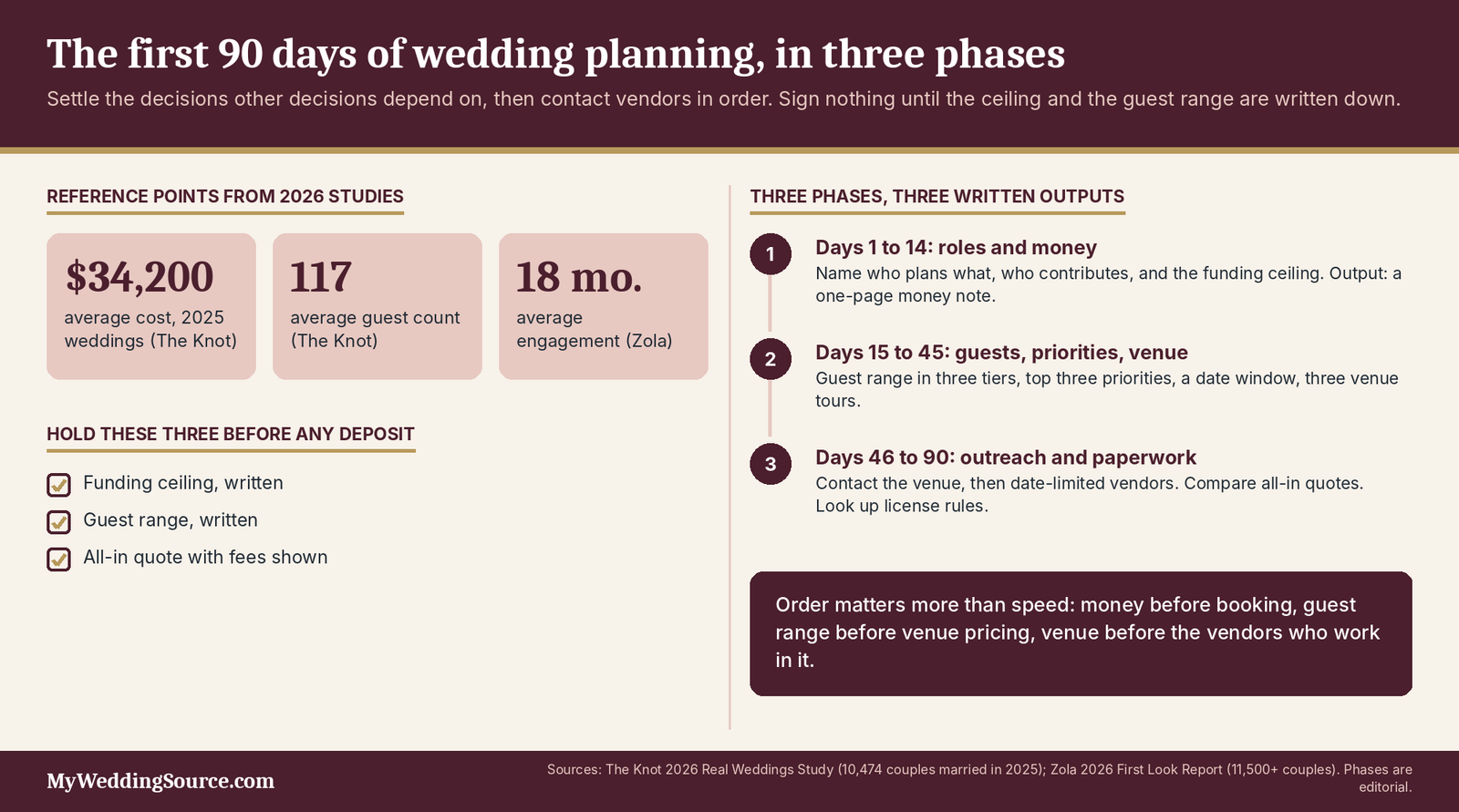
What should you actually get done in the first 90 days?
What has to be decided early, and what can wait
The four decisions that everything else leans on
Almost every later choice depends on four early answers: who is doing the planning, how much money is available, roughly how many guests are coming, and which general season and place you are aiming for. A venue cannot be priced without a guest range, a caterer cannot quote without a venue, and a photographer cannot hold a date you have not chosen. That chain is why wedding planners and editors keep repeating the same advice to start with the budget and the guest list. Zola’s planning checklist, for example, places the budget conversation, the contributor question and a rough guest list in the first stretch of tasks, before venue booking appears at about 11 months out.
The practical consequence is that these four answers are a gate and not a preference. If one of them is missing, you can still look at venues or vendors, but anything you sign is a bet on an answer you have not made yet. Treat the first 90 days as the time to make the four decisions in writing, even if the written version is a range and not a single number. A guest range of 80 to 110 and a funding ceiling you are willing to defend are enough to start.
What can wait until month four or later
A surprising amount of the work does not need to happen yet. Wedding party selection, attire appointments, the registry, stationery design, the playlist, favors and decor details all depend on decisions you will make in the first 90 days, so doing them early mostly creates rework. The Zola checklist places the registry around 10 to 8 months out, attire appointments around 10 months, and the florist around 9 months, which is consistent with letting the foundational decisions settle first.
Waiting is not procrastination when it is a choice. Couples who write a short “not yet” list in week one (for example, “dress, registry, favors, honeymoon”) find it easier to say no to the well-meaning relative who asks about bridesmaid colors in week two. The list also gives you a place to park good ideas without losing them. Inspiration is useful, and it belongs in a board, not in a contract.
How much time do you actually have?
Why 18 months is an average and not a deadline
Zola’s 2026 report puts the average engagement at about 18 months, unchanged from the prior year, and the same report found that roughly 1 in 5 couples take real planning steps before they are even engaged. Those figures describe a typical couple, not a required runway. Plenty of couples marry within a year, and others wait three or four years for reasons that have nothing to do with planning, such as saving, finishing school, family health or a venue that books far in advance.
The more useful way to use the average is as a reminder that a longer runway means more decisions can be made in sequence and more deposits can be spread over time. If your date is more than a year away, the first 90 days can be slower and more exploratory. If it is closer, the same three phases apply, but you will compress them and lean harder on written confirmations.
What changes if the wedding is six to nine months away
Zola’s checklist offers specific advice for couples with 6 to 9 months: lock in the venue, photographer and officiant first because they are hardest to book on short notice, consider digital invitations to skip printing lead time, keep the guest list smaller, and skip traditions that do not fit. That advice fits the three-phase plan. The only change is that phases overlap, so you might tour venues in week two and request photographer availability in week three.
A shorter runway also changes how you read vendor availability. Ask every vendor for open dates in a two- or three-month window, and treat each answer as a real constraint on your date choice. A date that is open at three of your five top vendors is usually a better choice than the date you picked first.
The 90-day map at a glance
Three phases, three outputs
The table below is the whole plan on one screen. Each phase has a short list of decisions and one tangible output you can point to, such as a one-page money note or a venue shortlist. If you finish the output, you are on track, whatever the calendar says.
| Phase | Days | Decisions to make | Output you can show |
|---|---|---|---|
| 1. Roles and money | 1 to 14 | Who plans what; who contributes; funding ceiling | One-page money note with the ceiling and contributors |
| 2. Guests, priorities, venue | 15 to 45 | Guest range; top three priorities; date window; venue shortlist | Guest tiers, priorities note, three toured venues |
| 3. Outreach and paperwork | 46 to 90 | Vendor contact order; all-in quotes; license rules | Comparison sheet, license office and rules noted |
Dates are approximate, and phases overlap in practice. What matters is the order, not the day count: money before booking, guest range before venue pricing, venue before the vendors who work in it.
How to know you are behind, and what to do about it
Being behind rarely looks like missing a day on a calendar. It looks like a venue deposit paid before the guest range was written down, a dress ordered before the date was set, or two vendors quoting for different headcounts. Those are the signals that a gate was skipped, and the fix is usually to go back and write down the missing answer before spending more.
If you are already past one of these points, do not panic or restart. Pick the missing decision, hold the conversation this week, and ask any vendor you have already contacted to requote against the new numbers. Vendors respond to changed numbers all the time, and a corrected quote is far cheaper than a corrected contract.

Who plans what, and how do you have the money conversation?
Setting roles before the work arrives
Name a default planner out loud
Zola’s 2026 report found that 84% of women in heterosexual relationships say they carry more of the planning load, and only 29% of same-sex couples say they split the work equally. It also found that 93% of primary planners say they take on more because they are more detail-oriented, not because they have more free time. In other words, the default planner often emerges without anyone choosing, and the other partner may not realize how much is happening in the background. That is not a character flaw in anyone; it is what happens when a large project has no owner.
The fix is a ten-minute conversation in week one: who is the point person for money and contracts, who is the point person for guests and communication, and which decisions require both of you. You do not need an exact split, and you can revisit it at each phase. What matters is that the arrangement is a choice and that the person doing more has a say in how the rest is divided.
Where parents, friends and paid help fit
Family and friends often volunteer in the first week with energy and no assignment. Give them whole, bounded categories with a report-back date, such as the rehearsal dinner, the hotel block or the guest-address spreadsheet, and tell them who has final say. The Knot’s guidance on paying for a wedding notes that parents do not have to contribute but often do, and that contributing parents may expect a say on items such as the guest list or venue, so it helps to sort out who decides what before any money moves.
A paid planner or coordinator is a role decision as well as a budget decision. The Knot’s planner pricing page (updated May 2026) reports an overall average of $2,100, with full-service planners averaging $3,800, month-of coordinators $2,400 and day-of coordinators $1,600. Ask yourself in the first 90 days which of three jobs you want help with: finding and comparing vendors, managing contracts and timelines, or running the day itself. The answer decides whether you want a planner now, a coordinator later, or neither.
Having the money conversation
Funding ceiling, contributors and conditions
Start with a number you can defend, not a number you hope for. Write down who is contributing (you, your partner, family, anyone else), the amount each has actually confirmed out loud, and any expectations attached to it. Add what the two of you can save between now and the date. The total is your funding ceiling, and every vendor quote from here on is a drawdown against it.
The Knot’s advice on paying for a wedding warns that cash registry gifts usually arrive close to the wedding, which makes them unreliable for paying vendor deposits, and it calls loans risky and 401(k) withdrawals a last resort because of penalties and taxes. If you are weighing credit cards or loans, a nonprofit credit counselor is a better conversation than a planning article, because this page offers general education only. A ceiling built on money you have, or reliably will have by each payment date, is easier to stick to than one that depends on a hoped-for gift.
When family money is part of the plan
If a parent or relative plans to give a large sum, two practical questions come up. The first is conditions: does the gift come with a say in the guest list, venue or traditions, and are you comfortable with that? The second is tax paperwork. The IRS lists a 2026 annual gift tax exclusion of $19,000 per recipient ($38,000 when spouses give jointly), and notes that the general rule is that any gift is a taxable gift unless an exception applies. Its FAQ page does not address wedding expenses specifically, so a donor with a large gift should ask a tax professional how the rules apply to them. For most contributions this is a short conversation, and it is better to have it before the money moves.
What the national averages are good for
Averages are useful as a sanity check and misleading as a target. The Knot reports $34,200 for weddings held in 2025 and Zola reports about $36,000 for its 2026 couples, but the two studies use different samples and methods, and neither is a quote for your city. The table below gathers reference points that matter most at this stage, with a note on how to use each.
| Reference point | Figure | How to use it |
|---|---|---|
| Average cost, 2025 weddings (The Knot) | $34,200 | Sanity check only |
| Average guests / cost per guest (The Knot) | 117 / $292 | Shows how headcount drives total |
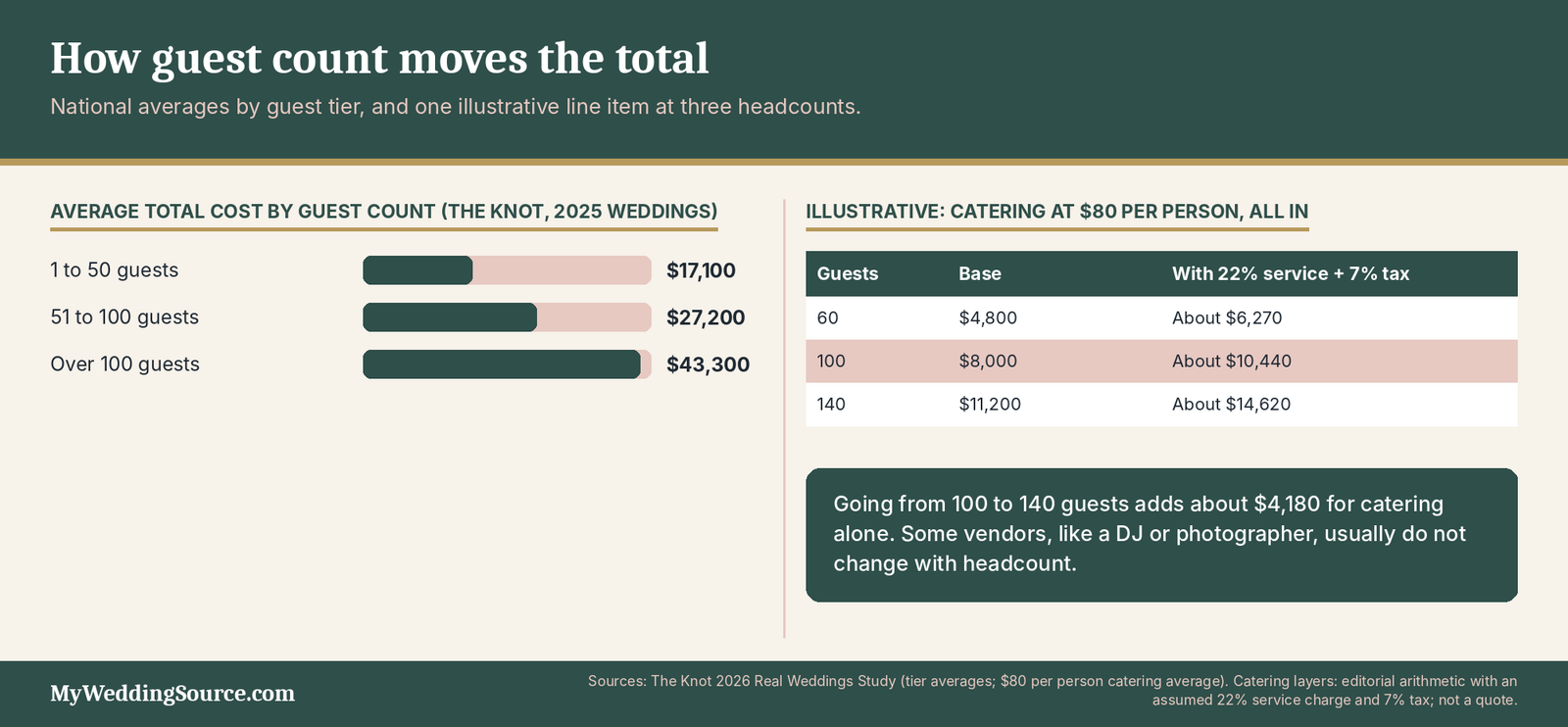
| Cost by guest count (The Knot) | $17,100 (1 to 50); $27,200 (51 to 100); $43,300 (over 100) | Compare your range to the matching tier |
| Cost by region (The Knot) | $29,000 Midwest to $48,400 Mid-Atlantic | Local prices vary more than national ones |
| Average cost, 2026 couples (Zola) | About $36,000 | A second source with a different sample |
| Vendors hired (The Knot) | 13 on average | Plan for many contracts, not one |
The guest-count rows are the most telling. A wedding over 100 guests averages about $43,300 in The Knot’s data, while one with 51 to 100 guests averages about $27,200, which is a difference of roughly $16,000 that travels with the larger guest count. That gap is why the guest count gets its own section next, and why you should compare your plan to the tier that matches your range and not to the headline average.
How many guests should you plan for, and why does it set the budget?
Building a list you can price
Three tiers instead of one number
Before you tour a single venue, sort everyone you might invite into three tiers: people you cannot imagine the day without, people you very much hope will come, and people you would invite if space and budget allow. Zola’s checklist recommends the same must-invite, hope-to-invite and if-space-allows structure in its first stretch of tasks. The tiers turn a painful yes-or-no debate into a range, and a range is what a venue coordinator or caterer actually needs to give you a useful quote.
Do the first pass separately if your families are large, then merge the lists in one sitting. Disagreements are easier to settle when each person has already ranked their own names, because the conversation becomes about tiers and not about individuals. If a parent is contributing, ask early whether they expect to invite their own guests, and whether that number counts against the total or sits on top of it. A handful of unresolved “of course we’ll invite them” names can add up to twenty extra seats by the time invitations go out.
Ranges, declines and the plus-one question
Plan for a range, not a point. A range such as 80 to 110 lets a venue show you pricing and floor plans at both ends, and it protects you from the two common failures: a room that feels half empty and a room that exceeds capacity. The Knot’s guidance suggests starting from about a 20% decline rate for a typical wedding and adjusting upward when many guests face expensive travel, and it describes that figure as a rule of thumb, not a measured statistic. It also cites its 2023 Knot Guest Study, which put the average cost of attending a wedding at about $580, a figure that helps explain why distance and travel costs raise decline rates.
Illustrative example, not a forecast: if you invite 125 people and assume 20% decline, you would plan for about 100 attendees, then ask the venue what its capacity and minimums look like at 90 and at 125. Decide your plus-one and children policies in this phase too, since they change the invite count more than almost anything else. A policy that is written down once, such as “partners of anyone in a committed relationship, no children under 12,” is much easier to apply fairly than a dozen case-by-case decisions.
How headcount flows into cost
Fixed costs and variable costs
The Knot’s cost page makes a point that is easy to miss: some vendors, such as DJs and photographers, typically charge the same regardless of guest count, while catering, rentals and other per-person items scale with headcount. That means adding or cutting guests does not change every line equally. Cutting twenty guests may save thousands on food and bar, a little on rentals and nothing on the photographer, so the guest list is the strongest lever on the variable half of the budget.
The same point cuts the other way for small weddings. A 40-person wedding still needs a venue, a photographer, an officiant and a florist, so the cost per guest can rise as the guest count falls. Smaller does not automatically mean cheaper per head, though The Knot’s guest-tier averages ($17,100 for 1 to 50 guests, $27,200 for 51 to 100, $43,300 for over 100) show that total cost still climbs with headcount. Use the tier that matches your range as your reality check.
An illustrative catering example at three guest counts
The table below uses The Knot’s reported average catering cost of $80 per person to show how a single line item moves with headcount. The service charge (22%) and sales tax (7%) are assumptions chosen for the example, since both vary widely by caterer, venue and state, and the arithmetic is editorial, not a quote.
| Guests | Base catering at $80 | Plus 22% service charge | Plus 7% tax on both |
|---|---|---|---|
| 60 | $4,800 | $5,856 | About $6,270 |
| 100 | $8,000 | $9,760 | About $10,440 |
| 140 | $11,200 | $13,664 | About $14,620 |
Going from 100 to 140 guests adds about $4,180 in this example, for catering alone, before the bar, rentals, linens, favors or stationery are counted. That is the practical meaning of “guest count sets the budget”: every added name carries a cost that reaches several line items at once. When a family member asks whether you can add four more people, you now have a number to discuss, and the answer is a conversation about trade-offs and not a refusal.
Venues, headcount and the first real quote
Why the venue question comes after the range
Asking a venue “how much for 100 guests?” before you have a range produces a quote you cannot compare with anything else. Asking “what does a Saturday in September cost at 80, 100 and 125 guests, including food and beverage minimums and service charge?” gives you three data points and shows where the pricing breaks. Venues often have minimums that rise with the day of the week and the season, so a range reveals those breakpoints.
Our venues hub collects the deeper pages on costs, questions and red flags, and our food and catering hub covers the catering decisions that follow once a venue is chosen. For now, the guest range is a filter: it narrows which venues are even worth touring.
When the headcount is not yet certain
Sometimes the number genuinely cannot be settled, because a family has not decided who is coming or a contributor has not committed. In that case, plan for two numbers: a floor (the people who are definitely coming) and a ceiling (the number you would accept if everything goes your way). Ask venues and caterers about pricing at both, and make sure any contract has a clear final-headcount date, usually well before the wedding, after which the number is locked. Until then, the guest count is a range with a deadline, and the deadline is what actually forces the decision.
What are your priorities, your date window and your venue shortlist?
Priorities that make the trade-offs easy
Three priorities and a skip list
Zola’s 2026 report found that couples save on favors (48%) and stationery (36%) so they can spend more on the venue (47%) and photography (45%), and that 52% have put other milestones, such as buying a home or paying down student debt, on hold. Those percentages are not a recommendation, but they show how common it is to trade one category against another. Pick your own top three priorities (for example, food, music and photographs) and a skip list of categories you will keep minimal.
Write both down and date the note. Priorities that live only in conversation tend to dissolve under vendor pressure, because a florist’s upgrade or a venue’s package can make every option sound essential. A skip list is not a verdict that those things do not matter to you; it is a rule that says “we spend nothing extra here unless something changes.” When an add-on appears, you check it against the list instead of reopening the whole conversation.
Protecting your priorities from the feed
The same Zola report found that 48% of couples updated their budget to get something they saw online and that 87% made planning decisions based on social media. Inspiration is a legitimate way to discover what you like, and it is also a reliable way to inflate a budget one saved post at a time. The practical guard is to separate the inspiration board from the commitments sheet. The board collects possibilities, while the sheet only lists things you have priced, approved and, eventually, signed for.
A useful habit is a 48-hour rule for anything that adds more than a small amount to the plan. Save it, wait two days, and then check it against your three priorities. If it still matters and fits the ceiling, add it deliberately, and if it does not, you have lost nothing.
Choosing a date window
Season, day of week and flexibility
Choose a window of a few months before you choose a single date. The Knot’s seasonal averages for 2025 weddings were $33,200 for January to March, $34,300 for April to June, $35,400 for July to September and $33,200 for October to December, which suggests a modest difference in average totals but says nothing about what a particular venue charges for a particular weekend. Those are averages across many different weddings, not price lists, so treat them as direction and not as a discount schedule.
What flexibility actually buys you is options. A Friday or Sunday, an off-peak month or a morning ceremony often gives a popular venue or photographer more room to say yes, and some venues price those slots differently. Ask each venue which of your candidate dates they have open and how the price changes, and let the answers narrow the window.
Weather and daylight shape the plan
If your window includes late fall or winter, the clock and the forecast become planning inputs. Sunsets arrive earlier, ceremonies need to be timed around light, and outdoor plans need a backup. Our guide to a November wedding timeline built around earlier sunsets covers timeline planning around earlier sunsets, and the cold-weather wedding backup plan covers what to do if the forecast turns.
For any outdoor or partly outdoor venue, ask about the rain plan in the first tour and not the last one. Our outdoor wedding rain plan guide covers rain-plan decisions for outdoor weddings. A venue that can show you the indoor layout, the decision deadline and the extra cost in writing is a venue you can compare with others.
Touring venues without getting swept up
Five answers to collect at every tour
Take the same short list to every venue so the notes are comparable: capacity at your ceremony and reception setups, the hours you are paying for (including load-in and load-out), whether outside vendors are allowed, the rain or heat plan, and the insurance the venue requires of its vendors and of you. Ask for a full price sheet or a sample invoice from a comparable event, not just the rental fee, because food-and-beverage minimums, service charges and taxes often change the total more than the rental line does. The Knot’s reported average for a reception venue is $12,900, but the same fee can mean very different things at different venues.
Hold, sign and the three-venue rule
A date hold is a courtesy and a contract is a commitment. Many venues will hold a date for a short period, often a few days, so you can review the paperwork, but the policy varies, so ask. Tour at least three venues before signing, if only to learn what a reasonable price sheet looks like, and write down the answer to each of the five questions. Resist the pressure of a “this date is going fast” email until you have done the comparison, since a good venue can survive a few days of your homework.
The sign-or-wait decision is easiest when you have three things in hand: the funding ceiling, the guest range and a written all-in quote. If any of the three is missing, you are signing on faith. If all three are in hand and the numbers fit, you can sign with confidence and move to the next vendors in line.

In what order should you contact vendors, and what should you ask?
The outreach order for the first 90 days
Venue first, then the vendors who can only work one event
The venue goes first because it fixes your date, capacity and often your caterer, bar and rentals, and every other vendor’s availability depends on it. After the venue, contact the vendors who can work only one event on a given day or who run short on popular dates: usually the photographer, the caterer (if the venue does not provide one), the officiant and live music. Zola’s checklist places venue booking at about 11 months out and the photographer at about 10, with the florist at about 9, which is a reasonable guide to when each category should be settled. Peak-season Saturdays in popular regions can sell out earlier, so ask each vendor how far ahead they usually book.
In the first 90 days, the goal is to contact and compare, not to book everyone. You are collecting availability and all-in pricing so that when the venue is signed you can move quickly with a short list. The Knot’s 2026 study found that 89% of couples booked a venue, 88% a photographer and 85% a caterer, which tells you where most budgets and most booking pressure sit.
The outreach order in one table
The table below shows a sensible order of contact, the typical timing signal from Zola’s checklist, and the one thing to ask first. Treat the timing as guidance and not as a rule, since vendors and regions differ.
| Order | Vendor or role | Zola timing signal | First thing to ask |
|---|---|---|---|
| 1 | Venue | Book at about 11 months | All-in price at your range; rules on outside vendors |
| 2 | Photographer | About 10 months | Date availability; delivery timeline; what is included |
| 3 | Caterer (if not in venue) | Research at 11 months; tastings at 9 | Per-person price with service charge and tax |
| 4 | Officiant | Choose at about 11 months | Authorization in your wedding state |
| 5 | Planner or coordinator | Decide at 12+ months | Scope: planning, month-of or day-of |
| 6 | Florist | About 9 months | Delivery, setup access, minimums |
Music, bakers and beauty vendors come after this list. Several of them can wait until the venue and date are settled, and many can be found through the first vendors you hire, since photographers and venue coordinators know who works well in the space.
Running outreach so the answers are comparable
What a first email should say
A good first message takes two minutes to write and saves weeks of back-and-forth. Include your date window (not one date), your guest range, the venue or city, and the services you want, then ask for availability, a sample price list and what a typical contract and payment schedule look like. The Knot’s study found that 52% of couples cited responsiveness as key to building trust with vendors, so pay attention to how quickly and clearly each one replies, because that is a preview of how they will communicate during the months before the wedding.
Keep a single tracking sheet with one row per vendor and columns for date contacted, reply date, availability, quoted price, what is included and your gut note. The same Knot study found that 37% of couples contacted more vendors than they had planned in order to find options within budget, which is a good reason to expect some back-and-forth and keep the sheet current. A tidy sheet turns a stressful decision into a comparison.
Reading a quote as an apples-to-apples number
Pricing is complicated, and most vendors are not trying to hide anything, but a headline price and a final price are different numbers. Ask each vendor for an all-in estimate that shows required extras, service charges, taxes and travel fees, and compare only quotes that cover the same scope. A photographer quoting eight hours and one shooter is not comparable to one quoting six hours and two shooters, even if the totals look similar.
Deposits, payment method and the paper trail
Pay deposits with a method that leaves a record, and save the contract, invoice and receipt together the day you sign. The FTC explains that a written credit card billing-error dispute must reach the issuer within 60 days after the first bill showing the error was sent, and that the issuer must resolve it within 90 days of receiving your complaint. For disputes about the quality of a service, the FTC notes additional conditions, including that you first try to resolve the problem with the seller, so a card is a safety net and not a guarantee. Some vendors add a card fee, which you should weigh against that protection.
Event insurance is a separate question that comes after you have paid deposits. The National Association of Insurance Commissioners explains that event liability coverage pays for harm your event causes to others, while cancellation coverage helps recover costs if an event is delayed or canceled for covered reasons, and that voluntary cancellation is typically not reimbursed. The NAIC suggests considering coverage once you have signed contracts or paid deposits, and noting that a policy can take several days to take effect.
Planner, coordinator or neither
Which job do you want help with?
Use the three-job test from earlier. If you want help finding and comparing vendors, a full-service or partial planner is the fit. If you want someone to manage the timeline in the final months, a month-of coordinator is. If the vendors and design are handled and you want help running the day, a day-of coordinator is. The Knot’s planner data list day-of coordination (37%) and full-service planning (33%) as the most common types, with average costs ranging from $1,600 for day-of to $3,800 for full-service.
Hiring a planner in the first 90 days can change the order of this whole page, because a planner may handle vendor outreach for you. Ask any planner you interview what is included, whether they take referral fees or commissions from vendors, who contacts vendors and what happens if they are unavailable on your date. Their answers tell you more about how they work than the price does.
If you plan without one
Plenty of couples plan without a planner and do well, especially with a smaller guest count or a venue that includes a coordinator. The trade is your time and attention in exchange for the planner’s fee, and the first 90 days are when you find out whether that trade is working for you. If the sheet is current and the vendor replies are manageable, you are probably fine. If you are already behind in week six, consider a day-of or month-of coordinator for the later months, and book them early, since good ones also have limited dates.
What paperwork and tools should you set up before day 90?
The legal side, handled once and early
Where the marriage license rules live
A marriage license is the legal permission to marry, and a marriage certificate is the record that you did. USA.gov explains that licenses typically expire within 30 days to a year depending on the state, and that you should contact the vital records office in the state where you plan to marry for the rules. The CDC’s handbook on marriage registration adds that each state’s statutes set the requirements and that a county clerk or other local official usually issues the license.
In the first 90 days, your task is only to find the issuing office for the place where you will marry and write down its rules, fees, waiting period, expiration date and ID requirements. Do not apply yet, because a license that expires before the wedding has to be replaced. Rules differ by state and sometimes by county, so never rely on a friend’s experience in another place. That is also why the license belongs in a “look up now, apply later” bucket.
Officiants, witnesses and who can sign
Who may legally officiate and whether witnesses are required are also set at the state level, and the CDC handbook notes that officiants should know state and local rules, including any registration requirements. The handbook was published in 1988, so use it for the general principle and the current state or county site for specifics. Zola’s checklist similarly advises choosing an officiant who is certified in your wedding state.
If a friend or relative will officiate, check that person’s authorization with the issuing office before you announce it. Many states offer routes for a friend to be authorized, but the steps and lead times vary, and finding that out in month ten is a stressful way to learn it. A quick call in the first 90 days settles it.
Tools and routines that keep the next year calm
One email, one folder, one sheet
Set up a shared email address and a cloud folder in week one, as Zola’s checklist suggests, and keep three documents inside: the money note, the guest tiers and the vendor sheet. Everything that goes to a vendor should come from the shared address, so that a missed message does not depend on one person’s inbox. Add a trusted backup person who can access the folder if one of you is traveling or unavailable.
Keep a “decisions log” as well, a simple page that records each decision, the date, who made it and why. It sounds fussy, and it prevents the familiar argument about who said what in March. When a contributor asks why you chose a particular venue, the log has the answer.
Using AI for admin without outsourcing judgment
Both major studies report rising use of AI in planning. Zola found that 54% of couples use it in some capacity, most often for etiquette questions (54%), timelines and to-do lists (44%) and drafting vendor or guest emails (40%), and The Knot found adoption among engaged couples at 36%, with couples then checking details on trusted wedding platforms. Zola also reports that 99% of couples agree human vendors remain essential.
That pattern is a sensible model: use a tool to draft an email, organize a task list or suggest questions, then verify prices, policies and legal requirements with the people and offices responsible. A tool cannot know your venue’s contract terms or your county’s license rules, and it can produce confident answers that are wrong. Treat it as a fast assistant for drafts and structure, and keep every final decision, contract and payment in human hands.
Announcements and the wedding website
You do not need save-the-dates or a full website in the first 90 days, but you should decide how and when guests will hear about the date. If the date is set and many guests will travel, an early heads-up through a simple website or message helps them plan, and it is the natural place to collect addresses. Hold off on printing anything until the venue is signed, since a venue change after printing is an expensive correction. If you got engaged around the winter holidays, our Christmas proposal planning page is the companion piece on how that moment is put together, and the first 90 days here start from the day after it.
Which first-time mistakes cost couples the most?
Money mistakes that show up in the first 90 days
Signing before the ceiling and the range exist
The costliest mistake is the earliest one: a deposit paid on the first venue that feels right, before the funding ceiling or guest range is written down. It happens because tours are exciting, a coordinator is persuasive and the date really might be gone tomorrow. The consequence is a contract sized for an assumption, and it can be hard to undo, because deposits are often partly or fully non-refundable. The fix is the sign-or-wait test from earlier: ceiling, range and a written all-in quote, or no signature.
Treating an average as a target
An average cost of $34,200 or $36,000 is an arithmetic result, not an instruction. Plenty of couples spend well below it and plenty spend well above it, and The Knot’s own data show a range from roughly $29,000 in the Midwest to $48,400 in the Mid-Atlantic and far higher in some cities. A couple who sets a ceiling by looking at the headline average may overspend if their region is cheaper or feel they are failing if it is not. Use the average to check whether your plan is in the right neighborhood, and then build the budget from quotes.
Forgetting service charges, taxes and tips
Quotes often exclude things that arrive later, which is the classic way a $10,000 line becomes a $13,000 one. Ask each vendor whether the price includes service charge, tax and gratuity. The Knot’s tipping guide says that tips for caterers and waitstaff are unnecessary when gratuity is already listed on the contract, and it suggests, as one example, 15% to 20% of the food and beverage fee otherwise, so reading the contract before you budget for tips avoids double-paying. Add a line for tips and a buffer of about 5%, which The Knot recommends as a just-in-case fund, to your sheet from the start.
Letting the feed rewrite the budget
As noted in the priorities section, Zola found that 48% of couples updated their budget to get something they saw online. The risk is not the inspiration itself but the unplanned addition, which is added at a moment when no one is comparing it to the ceiling. Use the 48-hour rule and check each addition against your top three priorities.
People and process mistakes
Leaving decision rights unclear
When two people, three parents and a friend all feel entitled to a veto, small decisions take weeks. Write down who decides which categories, and what dollar amount one person can approve alone. A line such as “decides alone up to $500, checks with both beyond that” prevents most of the friction before it starts.
Letting the guest list drift
A guest list that grows by two names a week is a budget increase in disguise. Freeze the tiers at the end of phase two, and require any addition to replace a name or to be approved against the ceiling. If a contributor insists on additions, the cost table earlier turns the conversation into numbers. Four more guests at the illustrative $80 per person with service charge and tax adds about $418 for catering alone.
Confusing a date hold with a booking
A hold is a courtesy and a contract is a commitment. If a vendor says “I’ll pencil you in,” ask in writing how long the hold lasts and what ends it. The reverse also happens: a couple pays a deposit believing the date is secured when the contract has not yet been countersigned. Confirm that you hold a countersigned copy before treating the date as safe.
Skipping the paper trail
Verbal promises about extras, upgrades or discounts rarely survive a staff change. Anything a vendor says out loud that matters to you, such as the free hour of coverage or the included rain-plan tent, should appear in the contract or a confirming email. Save everything in the shared folder the day you receive it.
| Mistake | Early warning sign | Fix |
|---|---|---|
| Signing before ceiling and range | Deposit due before you have a written budget | Pause; write ceiling, range and all-in quote first |
| Treating an average as a target | Budget copied from a headline number | Rebuild from quotes in your region |
| Missing service charge, tax, tips | Quote lacks an all-in line | Ask for all-in estimate; add tip and 5% buffer rows |
| Letting the feed rewrite the budget | Frequent unplanned add-ons | 48-hour rule; check against top three priorities |
| Unclear decision rights | Decisions stall or get redone | Write who decides what and the dollar limit |
| Guest list drift | Count rises weekly | Freeze tiers; additions replace or get approved |
| Hold mistaken for booking | No countersigned copy | Get written hold terms; countersigned contract |
What does day 90 look like, and what comes next?
A day-90 checkpoint you can score yourself
Seven things that should be true
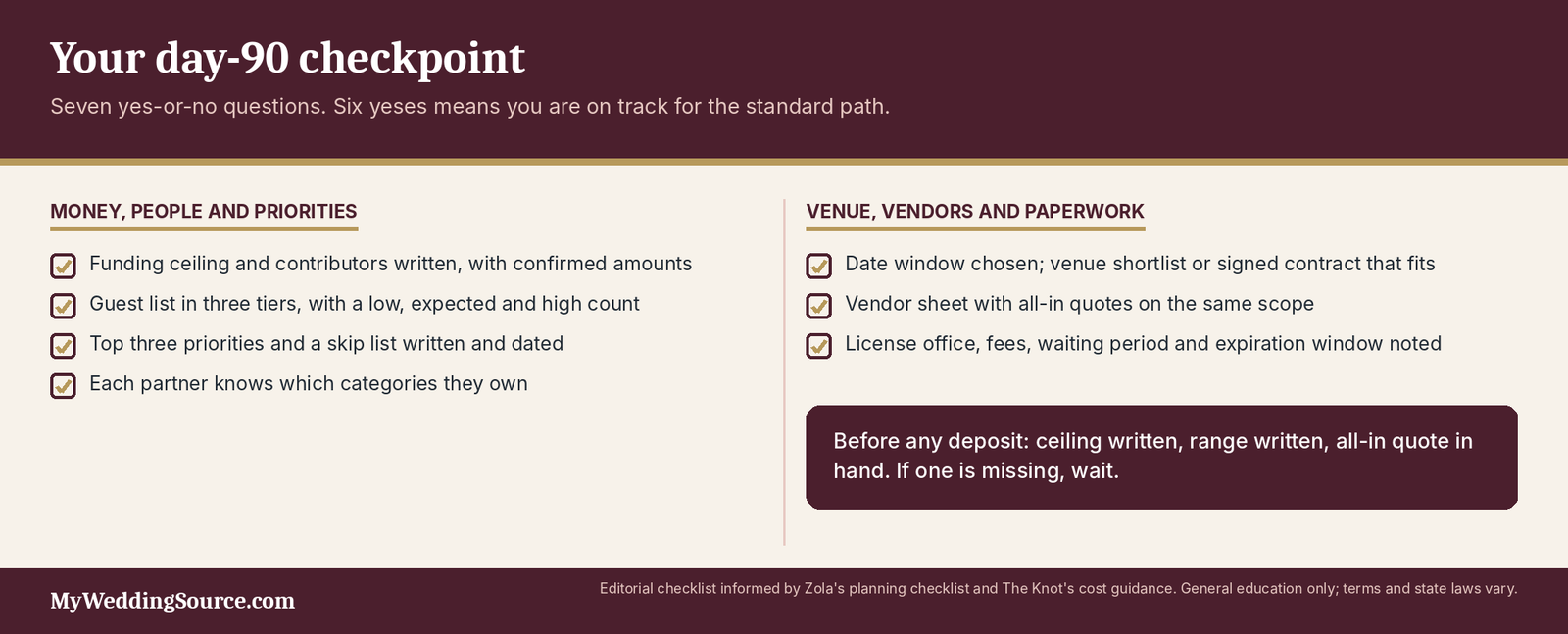
By day 90 you do not need a booked vendor team, but you should be able to answer seven questions with a yes. Do you have a funding ceiling and a list of contributors with confirmed amounts? Do you have a guest range and tiered list? Are your top three priorities and skip list written down? Do you have a date window and a venue shortlist, or a signed venue contract that fits the ceiling? Do you have a vendor sheet with all-in quotes you can compare? Have you looked up your marriage license office, its rules and expiration window? And does each of you know who owns which category of tasks?
If you can say yes to at least six, you are on track for the standard path, whatever the calendar says. If fewer, pick the missing items and schedule the conversation this week, because each one gates later decisions.
What to do if you are not there yet
Falling short at day 90 is common, especially when families are involved, and it does not mean the plan is failing. The usual causes are an unresolved contributor conversation or a guest list that will not settle. Both are conversation problems, so schedule the conversation, bring the numbers from the tables above, and decide only what the group can decide that day.
If the date is within a year, treat the missing items as urgent and focus on the venue, photographer and officiant first, as Zola advises for shorter engagements. If you have more runway, take a week to settle the missing items before booking anything else. The cost of a one-week pause is small next to the cost of building on an unsettled foundation.
Where to go after day 90
Months four to nine in outline
After the first 90 days, the work shifts from deciding to booking and building. You sign the venue and the date-limited vendors, tier your communication, begin attire and ceremony planning, and start on the paper trail for guests. The sequence and timing for those months live in our month-by-month wedding timeline, which picks up where this page stops. The complete wedding planning guide explains the reasoning behind each decision if you want more than a schedule, and our wedding planning hub collects everything in one place.
Expect the pace to feel different after day 90. The early decisions are about alignment and the later ones are about logistics, so the work becomes more concrete, with more vendor emails, more payments and more dates to track, and fewer open-ended debates. That is a good sign, because logistics respond to a checklist in a way that disagreements do not.
What to do before the first big deposit
Before any major deposit leaves your account, read the contract against your notes and confirm five lines: the deposit and what part is refundable, the cancellation and postponement schedule, the final-payment date, what happens if the vendor cannot perform, and every fee not included in the headline price. Terms and state laws vary, so this is general education and not legal advice, and if a contract affects a large sum a local attorney can review it. For the full tick-box list of what to confirm and when, the wedding planning checklist picks up from this point.
FAQ: how to plan a wedding questions
Starting out
Where do I start if I have never planned anything like this?
Start with a conversation, not a booking. Decide who is leading which category, who is contributing money and how much, and roughly how many people you want in the room. Write those three answers on one page, then tour venues with the page in hand. This order matters because the venue, the caterer and nearly every other vendor will ask for the same three answers, and having them ready makes every quote more comparable.
How long does it take to plan a wedding?
The Zola 2026 report puts the average engagement at about 18 months, but averages hide a wide range, and many couples plan in 12 months or fewer. If you have 6 to 9 months, Zola advises booking the venue, photographer and officiant first, using digital invitations and keeping the guest list smaller. The first 90 days still follow the same three phases, with more overlap.
Do I need a wedding planner?
Not necessarily, and the answer depends on which job you want help with: comparing vendors, managing the timeline or running the day. The Knot reports a $2,100 national average for planners, with day-of coordinators averaging $1,600 and full-service planners $3,800 in its study. Many couples with a smaller guest list or a venue that includes a coordinator plan without one, and add a day-of coordinator later if the details start to pile up.
Money and paperwork
How much should I budget to start?
Start from your funding ceiling, not from an average, and then compare it with the matching guest tier. The Knot’s 2025 data show about $17,100 for 1 to 50 guests, $27,200 for 51 to 100 and $43,300 for over 100, and the national average is about $34,200. These are reference points across very different weddings, not quotes, and your region matters: the same data show state averages from about $17,000 to $57,000. If debt is part of the plan, a nonprofit credit counselor can help you decide what is realistic.
When should I get the marriage license?
Look up the rules now and apply later. USA.gov notes that licenses typically expire between 30 days and a year, depending on the state, so applying too early can mean applying twice. Contact the office that issues licenses where you will marry, write down the fees, waiting period, ID requirements and expiration window, and put the application date on your calendar.
Your next steps
This week
Hold the money-and-roles conversation
Set aside an hour with your partner and anyone contributing, and leave with a one-page note that lists the funding ceiling, contributors, who owns which category and the dollar limit each person can approve alone. If a parent or relative is giving a large gift, ask early about conditions and mention that a tax professional can explain how gift rules apply to the donor. Date the note and put it in your shared folder.
Build the three tiers and a range
Do a first pass at the guest list by yourselves, sort it into the three tiers, and write down a low, expected and high count. Then calculate the 20% decline example for your high number so you have a planning range. Send the range, not a single number, to the first venue you contact.
Before you pay a deposit
Run the sign-or-wait test
Confirm three things: the funding ceiling is written, the guest range is written and you hold an all-in quote that shows service charge, tax and fees. If any is missing, wait. If all three are in hand and the price fits, ask whether the vendor can hold the date for a few days while you read the contract.
Read five lines and file the paper trail
Check the deposit and refund terms, cancellation schedule, final-payment date, what happens if the vendor cannot perform and the fees not in the headline price. Pay with a method that leaves a record and save the contract, invoice and receipt in your shared folder the same day. Then add the vendor to your sheet with the due dates, so no payment arrives as a surprise.
Sources & methodology
- The Knot Worldwide: 2026 Real Weddings Study press release — 10,474 U.S. couples married in 2025; $34,000 average, 117 guests, $292 per guest, 13 vendors, booking rates, responsiveness and AI adoption findings.
- The Knot: average wedding cost — $34,200 average, guest-count tiers, regional and seasonal averages, venue and catering averages, fixed versus variable costs and the 5% buffer.
- The Knot: how much wedding planners charge — planner averages by service type, updated May 2026.
- The Knot: how to pay for a wedding — contributor conversations, funding options and cautions on loans and retirement withdrawals.
- The Knot: how many guests RSVP no — 20% decline rule of thumb and the 2023 guest-cost study.
- The Knot: wedding vendor tipping guide — suggested tip ranges and checking contracts for included gratuity.
- Zola: 2026 First Look Report — 11,500+ couples; $36,000 average, 18-month engagement, planning-load, budget-priority, social media and AI findings.
- Zola: wedding planning checklist — task timing from 12 months out, three-tier guest list, and shorter-engagement advice.
- IRS: frequently asked questions on gift taxes — 2026 annual exclusion of $19,000 per recipient and the general gift rule.
- FTC: disputing credit card charges — 60-day and 90-day billing-error timelines and conditions for service disputes.
- NAIC: event insurance consumer insight — liability versus cancellation coverage, exclusions and when to buy.
- USA.gov: marriage certificates and licenses — license versus certificate, validity range and where to apply.
- CDC/NCHS: Handbook on Marriage Registration — state law governs license requirements, local officials issue licenses, officiant rules vary (published 1988).
Methodology. Verified facts come from official or primary sources: the IRS, FTC, NAIC, USA.gov and the CDC. Survey findings and averages come from The Knot’s and Zola’s studies, which use different samples and methods, so their figures differ and should be read as ranges and not as quotes; sample sizes are stated where the source gives them. The 20% decline rate and the 5% buffer are published rules of thumb, and dollar examples labeled illustrative, as well as the 90-day phases, vendor outreach order and day-90 checkpoint, are editorial arithmetic and judgment informed by those sources. This is general education only; laws, license rules and contract terms vary by jurisdiction and agreement.
Freshness note. Cost averages reflect 2025 weddings reported in 2026; recheck The Knot and Zola figures each spring when new editions publish. Recheck the IRS gift exclusion each January, and confirm license rules, fees and waiting periods with your issuing office before you apply. Planner pricing was last updated by The Knot in May 2026. Last researched October 12, 2026.