
Bridal makeup works best when you decide the result first, test it under the conditions it will actually face, and then build the schedule, the skin routine, and the touch-up kit backward from the moment your photographer needs you ready.
Quick answer
Treat bridal makeup as a small project with four checkpoints. First, write down the result you want in plain words (finish, coverage, color story) and the conditions it must survive (heat, tears, flash, hugs, a long day). Second, book a trial that lasts long enough to wear the look for several hours and photograph it in more than one kind of light. Third, back-time the wedding morning from your photo deadline, with a buffer before you get dressed. Fourth, stop experimenting with new products and treatments in the final weeks, and decide who carries the touch-up kit. Reported day-of prices for the bride’s hair and makeup together were about $300 on average in The Knot’s 2025 study, and trials and tips are usually extra.
This guide is about the decisions around bridal makeup, not about trends or product reviews. It does not tell you which brand to buy or which artist to hire. It gives you a way to compare options, questions to put in writing, and a schedule you can adapt. Where we cite prices or timing, we name the source, and where we do our own arithmetic, we label it as an estimate.
What bridal makeup has to survive, and the result you want from it
Most people begin bridal makeup planning with a photograph from the internet and ask an artist to reproduce it. That is a reasonable starting point for a conversation, but it is a poor specification. A single image does not tell the artist what your skin does at hour six, what your venue’s light looks like, or what your dress neckline will do to the color near your face. The more useful starting point is a short brief: the result you want, and the list of conditions that result has to survive. The rest of the planning follows from that brief.
Define the finish, coverage, and texture you want in bridal makeup
Words like “natural,” “glam,” and “soft” mean different things to different people, which is why bridal makeup conversations go wrong so often. Your job at this stage is not to learn professional vocabulary. It is to narrow your preferences into a few choices an artist can act on, and to notice which of your preferences are fixed and which are flexible.
Match your choices to weather, photography, dress, and skin needs
Start with the four things that are already decided or nearly decided. The first is the weather and setting: an outdoor ceremony in summer, a ballroom in winter, and a barn with no air conditioning present different demands, and you will know most of this when you book your venue. The second is the photography plan: ask your photographer whether they use flash, whether you will have a first look, and how much time they expect to spend on portraits. Our wedding photographer shot list can help you decide which photographs matter most, because a plan with many close portraits asks more of your bridal makeup than a plan built around wide candid shots.
The third is your dress and accessories. A strapless neckline, a high lace collar, a veil, and a headpiece all change what the artist sees and what the camera sees. The fourth is your own skin and your own habits. If you rarely wear foundation, a full-coverage look may feel uncomfortable by mid-afternoon, no matter how it looks in the mirror. If you have sensitive skin or known allergies, that belongs in the brief from the first message. Write one sentence for each of the four items and send them to every artist you consider. The replies will tell you a great deal about who listens.
Avoid choosing from filtered inspiration alone
Photographs you find online are often edited, lit by professionals, and shot from a flattering angle, and the person in the picture may not share your skin tone, skin texture, or face shape. This does not mean inspiration images are useless. It means they should be used as a vocabulary and not as a promise. Pick three or four images and, for each one, write down what you like in it: the lip color, the brow shape, the way the skin looks, the amount of eye definition. Then add one image you do not like, with a note about why. In our view, the “not this” example can tell an artist as much as the “this” examples.
Also bring a few ordinary photos of yourself, ideally in natural light and without filters. They show your real coloring and the features you are happy to emphasize. A good artist will use them to talk through what is realistic. An artist who promises that your skin will look exactly like a retouched photograph is making a promise that no application technique can keep, and that is worth noticing before you pay a deposit.
Schedule a bridal makeup trial that behaves like the real day
A trial is the only chance to test your bridal makeup brief before it matters. Many people treat it as a preview appointment: sit in the chair, approve the look, and leave. A better approach is to treat it as a small experiment with a hypothesis (this is the look I want), a set of conditions (hours, light, movement), and a way to record what happens. The result is that you arrive on the wedding morning with a plan that has already met reality once.
Cost and timing for trials vary. The Knot’s analysis of 2025 weddings reports that a combined hair and makeup trial typically adds roughly $225 to $350 on top of the day-of price, while Zola’s guide puts a bridal makeup trial at roughly $150 to $300 and a hair trial at roughly $100 to $250, with trials held about two to three months out. A vendor guide from the beauty-services company Glamsquad suggests four to eight weeks before the wedding, so that hair length, hair color, and skin are close to their wedding-day state. Those sources do not agree exactly, and none of them is a rule. The principle is to hold the trial late enough that your skin, hair, and any planned treatments are close to final, and early enough that you could still change course.
Test your bridal makeup for several hours
The most common trial mistake is judging the look in the chair. Bridal makeup looks different when it is fresh than it does after a few hours of talking, eating, laughing, and moving. If your schedule allows, ask for a trial slot in the morning or early afternoon, and plan to be out in the world afterward: lunch with a friend, a walk, an errand. The point is not to be fussy. It is to give the look the same kind of day it will have at the wedding.
During those hours, check the look at set intervals and make short notes on your phone. At one hour, does anything feel heavy on your skin? At three hours, where has the product moved or faded: around the nose, at the corners of the eyes, on the chin where you may touch your face? At five or six hours, does the color still look right, or has it shifted? The Knot’s skin and beauty timeline advises setting aside a few hours for a trial and expecting that getting the look right may take several tries, which fits this approach. If you cannot stay out for hours, even a two-hour test beats none, and you can ask the artist whether a second, shorter session is available at a reduced rate, since some artists offer that option.
Bring the things you will really wear: the earrings if they are decided, a similar-neckline top, and your usual glasses or contact lenses if you wear them. Tell the artist if you plan to cry, because that is a legitimate design constraint and not an embarrassing confession. They will tell you which products they would use and how those products have behaved for other clients.
Photograph it in daylight, flash, and indoor light
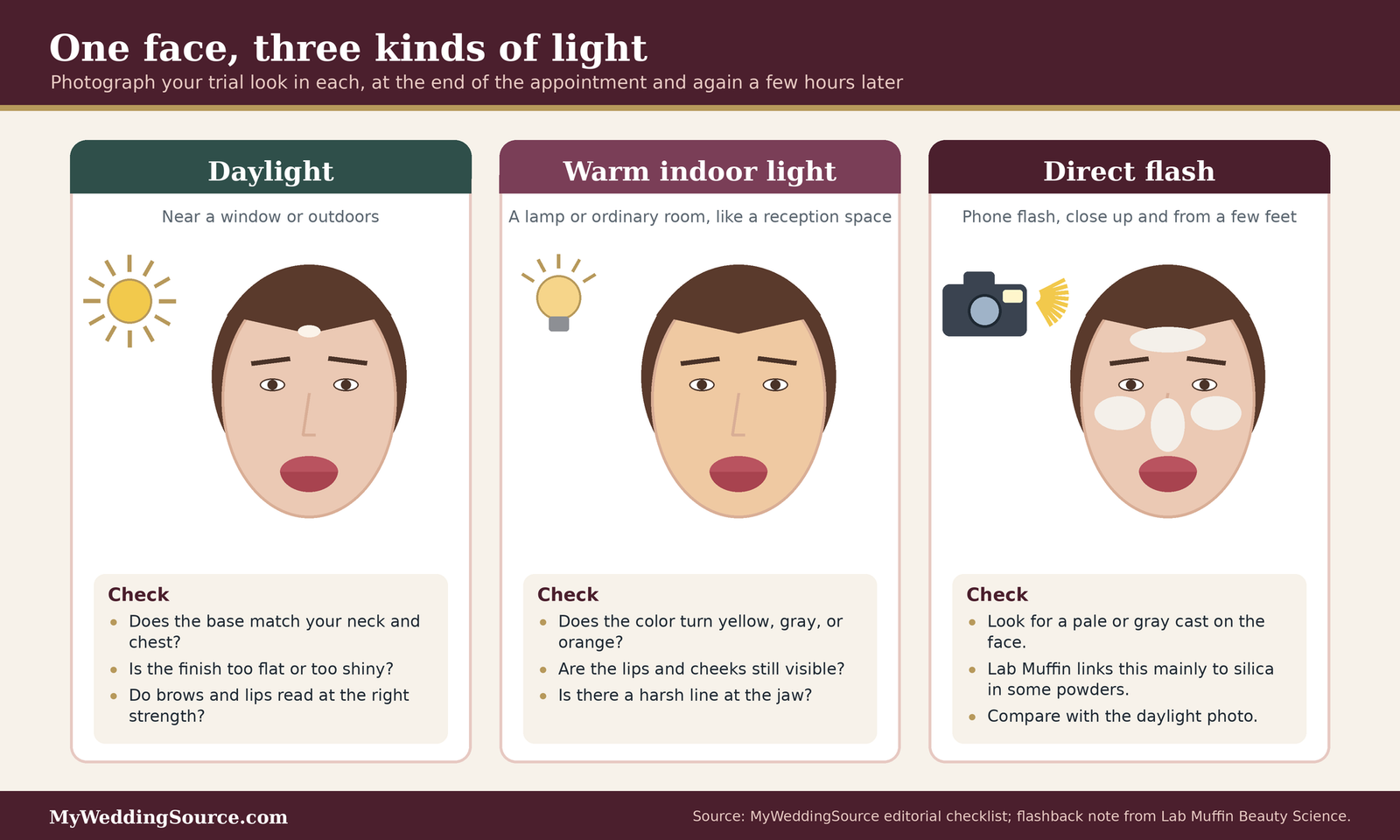
The camera does not see what the mirror sees. A look that seems balanced in a bright salon may look flat in a dim reception room, or glow unevenly under direct flash. The simplest fix for bridal makeup is to take your own photographs at the end of the trial, and again a few hours later, in three kinds of light: daylight near a window or outside, the warm indoor light of an ordinary room, and direct flash from a phone or a camera if your photographer will use flash.
The flash test deserves special attention because it is the one most people skip. Flashback, the white or gray cast that sometimes appears on faces in flash photographs, is mainly associated with silica, an ingredient common in translucent setting powders, according to the beauty-science writer Lab Muffin. Other reflective ingredients, such as titanium dioxide, zinc oxide, mica, and shimmer, can contribute but usually less. The same source notes that spraying water or setting spray over the powder only hides the effect temporarily, and that you do not need to give up sunscreen to avoid it. Its most reliable advice is to test the look with a flash photo before the event. Take the photo from a few feet away, then another from close up, and compare them with a daylight photo taken at the same time. If the flash version looks pale, tell your artist what you saw and ask what they would change.
| Result you want | Condition to test | Photography check | Wear-time check | Correction to request |
|---|---|---|---|---|
| Skin that looks like skin, not a mask | Natural light by a window, then close-up phone photos | Compare cheek and forehead texture in daylight and flash | Look at the nose, chin, and forehead at hours three and six | Lighter coverage in the center, more precision where you need it |
| Eyes that stay defined | A trial meal, a laugh, and a moment of watery eyes | Check for smudging in flash photos taken after the meal | Check the lower lid and outer corners for transfer | Different eye product or a smaller amount; confirm what is waterproof |
| Lip color that survives drinks and kisses | Drink from a glass and eat something small | Photograph with a smile and with the lips relaxed | Note where color has moved at hour two and hour four | A different formula, a lip liner, or a smaller touch-up item for your bag |
| Brows that match your face in photos | Flash and daylight photos from the front and from a three-quarter angle | Check that brows are not too dark or too faint in each | Check for fading or smudging at hour four | Adjust the shade or the amount of product |
| A complexion that matches your neck and chest | Photograph the neckline you will wear, in daylight | Look for a visible line at the jaw and neckline | Check for transfer on a similar-colored top | Adjust the shade or blend further down the neck |
| No white cast in flash | Direct phone flash, up close and from several feet | Compare against a daylight photo from the same hour | Check again after you have powdered or touched up | Ask the artist to reduce or move reflective powder; retest |
Use the matrix as a recording sheet, not as a quiz. Print it or copy it into a note, fill in the last column during the day, and send the corrections to the artist the same evening while the details are fresh. That small step turns a trial into a revised brief.
Prepare your skin without surprising it
Skin preparation for bridal makeup is where an eager planner can do the most good or the most harm. The helpful version is simple: a consistent, gentle routine, sun protection, and no unfamiliar treatments close to the wedding. The harmful version is a rush of new products and procedures in the last month, each of which carries some chance of redness, breakouts, or a reaction on the days that matter most. This section is general education and is not medical advice. If you have a skin condition, a history of reactions, or a question about a treatment, ask a board-certified dermatologist or another clinician.
Build a skin timeline that protects your bridal makeup
The best timeline ends with weeks in which nothing new happens. That is a design choice: you do the experimenting early, learn how your skin responds, and then spend the final stretch repeating what works.
Work backward from the date, with early experiments and late routines
The Knot’s timeline suggests that a dermatologist can help you set a routine for your skin type, and that an earlier visit leaves time to adjust it. It also advises that if you want a first-time or stronger facial, such as microdermabrasion, you book it two to three weeks before the wedding, because the treatment can leave skin red for a few days and a first treatment shows how your skin reacts. A soothing facial you have had before, by contrast, is described as fine closer to the date. We would add a recommendation of our own, which is a recommendation and not a finding: keep a short log of what you use each day, so that if something goes wrong you can tell your clinician exactly what changed.
One workable sequence follows. Several months out, settle your everyday routine and see a dermatologist if you have a concern. Two to three months out, hold your bridal makeup trial if your artist recommends it (see the previous section for how sources differ). About a month out, stop adding new products. Two to three weeks out, schedule any stronger first-time facial. In the final week, keep to what you know. Our plan wedding timeline can help you place these steps among the other deadlines, and the wedding planning checklist is a good place to store the dates.
Protect your skin from the sun, including on the day
Sun exposure in the months before a wedding is a skin-prep issue as well as a health issue, and it can also change how your bridal makeup shade matches your skin. The American Academy of Dermatology advises using a broad-spectrum, water-resistant sunscreen of SPF 30 or higher, applying it about 15 minutes before going outdoors, using at least about a teaspoon for the face, and reapplying every two hours and after swimming or sweating. Those are general guidelines for sun safety, and they apply to an outdoor ceremony as much as to any other day.
On the wedding morning, ask your artist how sunscreen fits into their application order. Coppertone, a sunscreen manufacturer, advises applying sunscreen as the last step of skin care and before makeup, and letting it dry for a few minutes first. That same source notes that a foundation with SPF may help, but that people rarely reapply a full face of makeup often enough to maintain protection, so it does not treat makeup SPF as a replacement for sunscreen. Because this is a manufacturer’s guidance, treat it as one input and ask your dermatologist or artist how they handle it. If your ceremony is outdoors, plan a place and a moment to reapply, and put it on the schedule.
Choose products with the same care you use for people
New products carry risk, and risk is worth managing deliberately. Both the Food and Drug Administration and dermatologists give plain advice here, and it is less exciting than most beauty content, which is exactly why it is useful.
Read the label and do not assume “hypoallergenic” protects you
The FDA’s consumer guidance advises reading the whole label, including ingredients, warnings, and directions. It points out that the term “hypoallergenic” is not defined by the FDA, so a product carrying that word is no assurance of safety for sensitive skin. The agency also notes that false eyelashes, lash extensions, and their adhesives are regulated as cosmetics, and it advises checking an adhesive’s ingredients before use, because the eyelid area is delicate and reactions there can be especially troublesome. For lashes, that is the practical question to ask: what adhesive will you use, and what is in it?
If you have a known allergy, give your artist the exact ingredient or product class that has caused trouble and ask them to confirm what is in each product they plan to use on you. A professional who takes the request seriously will read labels with you. If an artist treats it as an inconvenience, consider that a signal about how they handle safety in general.
Patch-test anything new, and stop at the first sign of trouble
The American Academy of Dermatology’s guidance on testing skin care products suggests applying a quarter-sized amount in a spot where it will not be rubbed or washed away, such as the underside of your arm or the inside of your elbow, twice a day for seven to ten days, using the amount you would normally use. If you see no redness, itching, or swelling in that time, you can begin using the product. If a reaction occurs, wash the product off gently as soon as possible and stop using it, and see a dermatologist if a severe reaction does not improve. The same guidance notes that ingredients such as retinol and glycolic acid can cause temporary irritation, especially on sensitive skin.
Seven to ten days is a long test, which is the reason to start early. If your artist plans to use a product on your face that you have never worn, ask them for the product’s name in advance so you can patch-test it, or ask whether they will do a small test during the trial. The FDA adds a simple rule for everything you use: if a rash, redness, burn, or other unexpected reaction occurs, stop using the product and contact a health care provider, and report the problem to the FDA through its complaint process.
What bridal makeup costs and what a quote should include
Price is where bridal makeup planning most often loses its footing, because the same word covers very different packages. One artist’s quote may include a trial, travel, and a touch-up visit; another’s may include only the application and leave everything else as an add-on. Before you compare numbers, decide what you are comparing. This section separates reported survey figures from vendor quotes and from our own arithmetic, so that you can build a realistic line in your budget.
What this actually costs
The Knot’s study of 2025 weddings reports that the bride’s hair and makeup together averaged about $300 for the day-of services, split roughly evenly between hair and makeup, and that figure excludes trials and gratuity. A trial typically adds more, and The Knot suggests budgeting 15 to 25 percent of the final beauty total as a tip. Zola reports higher ranges in its own guide. Treat any number as a starting point for your market, then replace it with real quotes. Our wedding budget calculator can hold the line item while you collect them.
Read the reported numbers for what they measure
Two large wedding platforms publish beauty costs, and a reader who sees both can easily conclude that one of them is wrong. A more useful conclusion is that they define and sample the category differently. Both are worth reading, as long as you note the year, the sample, and what is included.
The Knot and Zola do not measure the same thing
The Knot’s Real Weddings Study reports on 10,474 U.S. couples who married between January 1 and December 31, 2025. For the bride, it reports an average of $300 for hair and makeup combined, $150 for hair alone, and $150 for makeup alone, and it states that this covers day-of services but excludes trials and gratuity. The middle half of spenders fell between $210 and $390, with a median of $280. It also reports that 72 percent of couples hired a wedding beauty professional, and that wedding party beauty services averaged about $210 in total, or roughly $110 per member for hair and $100 for makeup.
Zola’s guide to wedding hair and makeup costs describes a national average of $982 from its Wedding Cost Index, and typical totals of $800 to $1,200, which is far above The Knot’s figure. We could not confirm from the page what exactly that category includes, so we do not average the two, and we recommend you do not either. The gap is a reminder that “average wedding hair and makeup” can refer to different baskets of services, different samples, and different years. Zola’s guide also reports that a bridal makeup application typically runs about $200 to $500, with most couples spending around $300 to $400, which is a more directly comparable number for bridal makeup alone. Its tipping figure comes from Zola’s 2026 Wedding Spend Survey of more than 700 recently married couples. Whichever source you use, you are learning the shape of the market, not the price you will pay.

What moves a quote up or down
The Knot’s regional breakdown for the bride’s combined hair and makeup shows a spread: about $360 in the Northeast and New England, $360 in the Mid-Atlantic, $260 in the Midwest, $290 in the South and Southeast, $280 in the Southwest, and $320 in the West. If you live in or marry in a high-cost region, expect to land above the national figure, and if you marry in a lower-cost region, below it.
Beyond geography, several choices change the number. Zola’s guide reports that traditional makeup application runs about $200 to $400 while airbrush application runs about $300 to $500, so the technique you request can move the price. The Knot notes that travel fees can apply for destination weddings and for artists working outside their usual service area, even within one state, and Zola’s guide gives examples of $50 to $200 as a flat fee or $25 to $75 per hour of travel time, with fees often waived within about 30 minutes. Group size matters too. Add the bridal party, mothers, and flower girls, and the total changes more than any single service price. These are reported ranges and examples from two publishers, not quotes, and your artist’s policies can differ.
Normalize bridal makeup quotes so you compare like with like
When three artists send three differently structured bridal makeup quotes, the easiest mistake is to compare the largest number on each page. A short normalization method fixes that and takes about ten minutes.
A five-line method for comparing quotes
For each artist, write five lines on a single sheet. Line one: the day-of price for the bride’s bridal makeup application, with the number of minutes the artist allots. Line two: the trial price, or “included.” Line three: travel and any parking, early-start, or after-hours fees. Line four: the price per person for anyone else in your group, along with how many people the artist can handle in the available time. Line five: the estimated tip, calculated as a percentage of the day-of price using the range you consider appropriate. Add lines one through three and five for a bride-only total, then add line four for the rest of your group.
Here is a worked example with invented numbers, which are illustrative and not market data. Artist A quotes $300 for the day, $175 for a trial, and waives travel. Artist B quotes $240 for the day, $150 for a trial, and charges $90 for travel. Add a 20 percent tip on the day-of price (a mid-range choice inside the 15 to 25 percent range The Knot suggests), and the totals are $535 for A and $528 for B. Artist B looked $60 cheaper on the headline quote, and ends up about $7 cheaper once everything is counted. The quote that looked far cheaper was nearly the same, and that is the point of the method: it turns a visual impression into arithmetic. It also shows you whether a “cheaper” artist would still be worth choosing for other reasons, such as availability for your date or a look you prefer.
Count the costs that sit outside the quote
Several costs live outside the package and should be asked about directly. A deposit is usual: the Glamsquad guide, a vendor source, mentions deposits of 25 to 50 percent of the total to hold a date, with the balance due on or near the wedding day, though this varies by artist and you should treat it as one company’s description. Ask about cancellation and rescheduling terms, because a postponed date can mean a lost deposit. Ask what happens if you add a person on the wedding morning, and what the hourly rate is if the schedule runs long.
Ask about trial scope too. The Knot’s article advises that if a quote does not explicitly mention a trial, you should expect to pay extra for one, which is a simple question to confirm in writing. And ask whether a touch-up is included: some packages have the artist stay for portraits or leave a small kit, and others end when the last person leaves the chair. Add these answers to your sheet. Our wedding budget calculator and wedding planning guide can help you fit the total in alongside the rest of the plan, and the plan wedding overview shows how beauty fits into the larger sequence of decisions.
Choosing a bridal makeup artist and putting the terms in writing
A portfolio shows you what an artist can do on a good day. It does not show whether they are licensed where you live, how they manage hygiene, whether they answer messages, or what the contract says. This section is about those unglamorous questions for anyone hiring for bridal makeup. They are also the questions that protect you.
Verify who may do the work, and how they keep it clean
Two things are worth checking before you sign: whether the person is authorized to perform paid bridal makeup services in your state, and what their hygiene routine is. We present one state as an example and a method for checking yours. We did not survey all fifty states, and rules differ.
Licensing differs by state, so check yours
In California, the Board of Barbering and Cosmetology’s publication on esthetics lists makeup and eyelash application among the services within esthetics, and says those services may be legally performed only by state-licensed estheticians in state-licensed salons and barbershops. It names one exception: makeup or skin care demonstrators who receive no payment from the client for applying the product. That is one state’s board describing its own law, and other states handle makeup artists differently, so do not assume the California answer applies to you.
The practical method is to look up your state’s cosmetology or barbering board, find what it says about makeup application for pay, including bridal makeup, and then ask the artist directly which license they hold and where it can be verified. Check whether your board offers an online license lookup. If an artist works as a mobile professional, ask how they comply with your state’s rules for services performed outside a salon. A good artist will answer without defensiveness. This is general information and not legal advice; your state board is the authority, and if you are unsure, ask the board.
Hygiene questions that are fair to ask
The FDA’s guidance for consumers gives a clear baseline: do not share makeup, wash your hands before use, keep containers clean and tightly closed, never add saliva or water to mascara, and throw away products that change color or smell. It specifically tells consumers to avoid sampling shared testers that many people have used, and says that if you must sample, you should use single-use applicators such as clean cotton swabs. A professional kit is a different setting from a store tester, but the principle carries over: a product that touches many faces can carry germs from one person to another.
You can ask, politely and in your first exchange: How do you handle mascara and lip products between clients? Do you use disposable applicators, and how are brushes cleaned? Do you wash your hands or use sanitizer before starting each person? Is the kit set up so that the products used on my eyes are not the same open containers used on other people without a hygienic method? Whether an artist meets a particular standard is for your state’s rules and your own comfort to judge, and we cannot score their answers for you. But an artist who has a clear, calm routine and describes it easily is demonstrating professionalism. The FDA also advises replacing mascara roughly every two to four months and notes that heat or moisture can spoil products, so it is reasonable to ask how the kit’s contents are dated and replaced.
Book your bridal makeup artist on a realistic timeline
Good bridal makeup artists have limited dates, especially on popular weekends, and a verbal agreement leaves too much room for misunderstanding. Both of these are simple to fix early.
When to book, and why sources differ
Zola’s guide on timing suggests booking hair and makeup professionals six to twelve months before the wedding, scheduling trials with each professional three to six months out (usually held about a month before the wedding), locking in your look one to three months out, and sharing the party’s itinerary two to four weeks ahead. The Glamsquad blog, which is a vendor source and therefore marketing as well as advice, suggests booking nine to twelve months ahead for peak-season Saturdays in major metro areas, six to eight months ahead for off-peak dates or weekdays, and holding the trial four to eight weeks before the wedding. We did not independently verify its claims about how quickly top artists fill their calendars, so treat those as one company’s view.
The sources disagree on trial timing, which is a useful lesson: no one can tell you a universal number. A reasonable approach is to book the artist as soon as you have your date and venue, and then fix the trial date as soon as the artist’s calendar allows a slot in the window you prefer. If your wedding falls on a popular weekend in your area, ask artists how far ahead they are typically booked, and decide based on that answer.
What belongs in the written agreement
Before you pay a deposit, ask for a written agreement or at least a confirming email. It should state the date, the start time, and the location; the services included for each person; the number of people and the minutes allotted; whether a trial is included and what it costs if not; any travel, parking, early-start, or after-hours fees; the deposit amount and due date; the balance and when it is due; the cancellation, rescheduling, and substitution terms; and what happens if the artist is ill or unavailable. It should also say whether the artist stays for touch-ups, and for how long, and whether the tip is already built into a service fee, which The Knot advises you to check in the contract.
Keep the questions in one place and send them in a single message so that the answers are easy to compare. The callout below can be copied into an email.
Questions to ask a bridal makeup artist before you book
- Which license do you hold, and where can I verify it?
- How do you handle hygiene between clients, including mascara, lip products, and brushes?
- What does the trial include, what does it cost, and is it credited toward the day-of price?
- How many minutes will you allot to my application, and how many people can you finish before my photo deadline?
- Which products do you plan to use around my eyes and on my lashes, and can you share the ingredient lists?
- How do you adjust for heat, humidity, tears, and flash photography?
- What are your travel, parking, early-start, and overtime fees?
- What are your deposit, cancellation, rescheduling, and substitution terms?
- Will you stay for touch-ups, or leave a kit, and what does that cost?
- If you are ill or unavailable, who steps in, and how will I be told?
Build the wedding-morning bridal makeup schedule backward from the photo deadline
Bridal makeup schedules on the wedding morning fail for a predictable reason: they start at the ceremony and subtract a guess. A better method begins at the first moment you need to be fully ready, which is usually the first photograph, and subtracts each real block of time in turn: dressing, buffer, each person’s service, and the artist’s own setup and travel. The result is a start time that you can defend. It is also a document you can send to your artist, your photographer, and your wedding party.
Calculate bridal makeup service time by person
You can only back-time a morning if you know how long each person’s service takes. Artists will tell you their own numbers, and those numbers matter more than any average, but published ranges give you a sanity check on what you hear.
Include setup, transitions, touch-ups, and travel
Zola’s guide to how long wedding hair and makeup takes gives traditional-style ranges that are useful for a first draft: 60 to 90 minutes for the bride’s bridal makeup, about 45 minutes for a bridesmaid, 30 to 45 minutes for a mother of the bride or groom, and 30 to 45 minutes for flower girls and other attendees, noting that more elaborate looks take longer. Its sample schedules also include “spillover” time, such as 90 minutes before a 4:00 p.m. ceremony in one example and 45 minutes before a 3:00 p.m. ceremony in another.
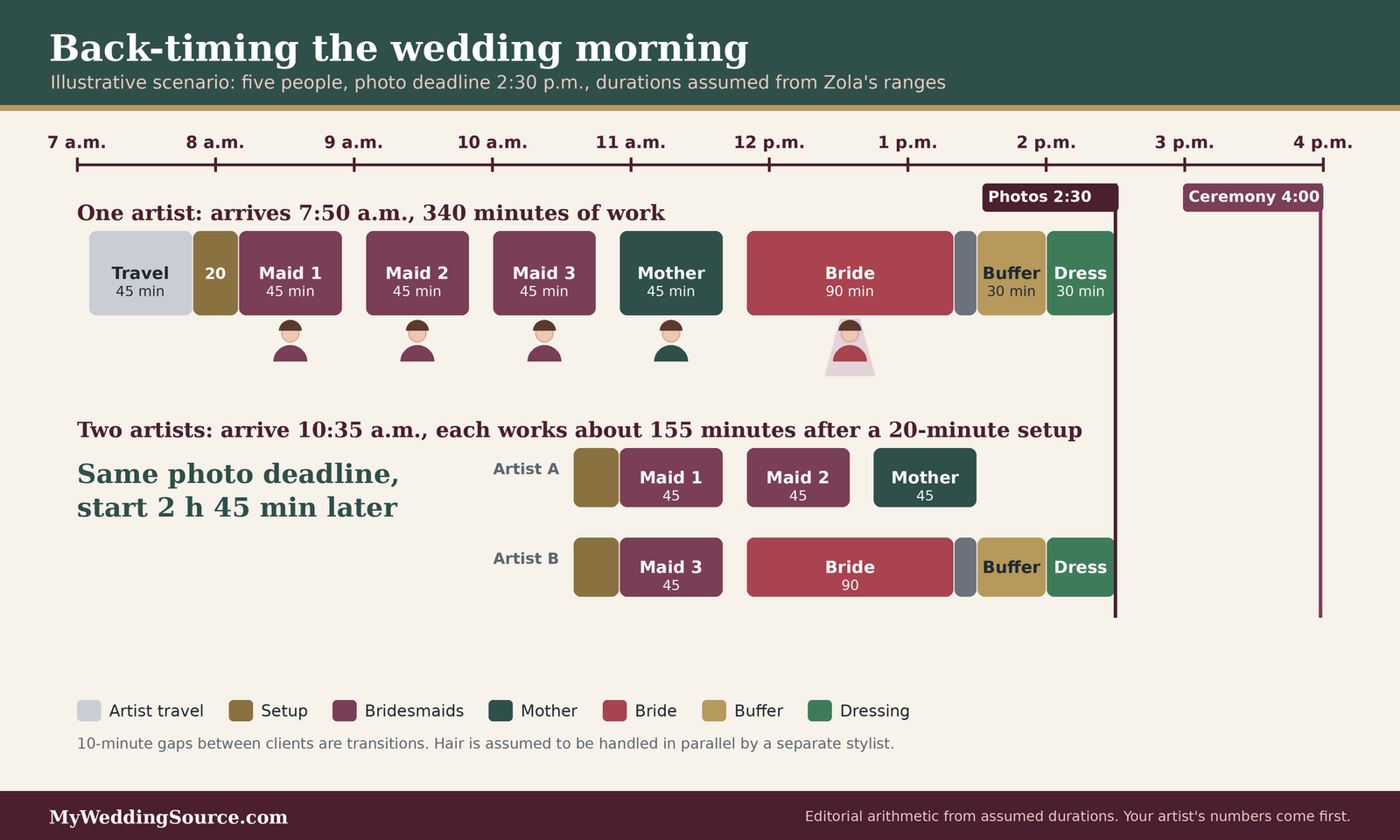
To turn ranges into a schedule, add the pieces people forget. Setup takes time because the artist unpacks, arranges a workspace, and checks the light. Transitions take time because people arrive late, take bathroom breaks, or want a second opinion. A final touch-up pass takes time because the bride’s bridal makeup needs a last look once she is fully dressed, after the dress, jewelry, and veil are in place. And the artist has to travel, which matters for your schedule only if the artist needs to arrive earlier than you expect. The table below applies the method to a worked scenario. The scenario is ours and its numbers are assumptions: one artist, five people (the bride, three bridesmaids, and one mother), a photo deadline of 2:30 p.m., and a 4:00 p.m. ceremony. It uses the upper end of Zola’s bride range and a 10-minute transition between people. It assumes that hair is handled by a separate stylist working in parallel, which is a different calendar and not modeled here.
| Block | Minutes | Clock time | What to notice |
|---|---|---|---|
| Artist travels to the venue | 45 | 7:05 to 7:50 a.m. | Ask whether travel is billed; confirm the address and parking in writing |
| Artist setup | 20 | 7:50 to 8:10 a.m. | Needs a window with good light and a table |
| Bridesmaid 1 | 45 | 8:10 to 8:55 a.m. | Start with the person least likely to run late |
| Transition | 10 | 8:55 to 9:05 a.m. | Cleaning applicators and changing the cape |
| Bridesmaid 2 | 45 | 9:05 to 9:50 a.m. | Hold the order steady so no one waits unannounced |
| Transition | 10 | 9:50 to 10:00 a.m. | Lunch order or snacks can be handled here |
| Bridesmaid 3 | 45 | 10:00 to 10:45 a.m. | Final of the three in the party |
| Transition | 10 | 10:45 to 10:55 a.m. | Pause for any change to the plan |
| Mother | 45 | 10:55 to 11:40 a.m. | Zola’s range for mothers is 30 to 45 minutes; the upper end is used here |
| Transition | 10 | 11:40 to 11:50 a.m. | Reset the station for the bride |
| Bride | 90 | 11:50 a.m. to 1:20 p.m. | Upper end of Zola’s 60 to 90 minute range |
| Final check and touch-up | 10 | 1:20 to 1:30 p.m. | Check lips, eyes, and shine before the buffer |
| Buffer | 30 | 1:30 to 2:00 p.m. | Absorbs lateness; protects the dressing window |
| Dressing | 30 | 2:00 to 2:30 p.m. | Buttons, veil, shoes, and a last look in a mirror |
| Photo deadline | 2:30 p.m. | First look and portraits begin |
Add up the artist’s blocks from setup through the final check and you get 340 minutes, or five hours and forty minutes, which is why the artist arrives at 7:50. That is our own arithmetic from assumed durations and not a prediction for your day, and it is the reason to ask each artist to confirm their durations before you build your own schedule. If you bring in a second artist and split the five people so that each works a chain of about 155 minutes plus a 20-minute setup, the same photo deadline would allow the artists to begin around 10:35 a.m. instead of 7:50 a.m., roughly two hours and forty-five minutes later. That is another estimate. Whether it is worth the extra cost depends on how much the early start costs you in sleep, stress, and snack runs, which is a personal weighing and not a formula.
Add a buffer before you get dressed, after the makeup is done
A buffer is not padding. It is the part of the plan that absorbs ordinary delay without spilling into the time reserved for dressing and photographs. In the scenario above, the buffer is 30 minutes and sits between the end of the bridal makeup session and the start of dressing. Zola’s sample schedules use larger and smaller buffers, 90 and 45 minutes in two examples measured against the ceremony, and we use a smaller figure because we measure it against the photo deadline and not the ceremony. Choose the size that matches how much you trust your own punctuality, your party’s, and your venue’s.
A few specific delays are worth planning for by name. A person arrives late, which is solved by putting the least likely latecomer first and the most likely latecomer last among the non-brides. A style takes longer than expected, which is solved by asking your artist where in the order they would absorb the extra time. The bride’s own look takes longer because the trial look was changed, which is the best reason to finalize the look at the trial. Put the buffer on the schedule as its own line with a name, such as “buffer: do not use,” so that nobody quietly spends it on a second round of coffee. Our plan wedding timeline shows how to place the morning’s blocks alongside the rest of the day.
Coordinate accessories and clothing with the beauty plan
Bridal makeup does not live alone on your face. It sits near a neckline, under a veil, beside earrings, and in front of a camera. Small mismatches here are the usual source of last-minute adjustments, and most of them can be found in advance with an inexpensive rehearsal.
Test veils, necklines, earrings, and getting-ready clothing
If you can, bring the veil or headpiece to the trial, or at least photographs of it, and ask the artist to watch how it sits against the hairline and the face. A veil that is lifted or removed during the day can brush against fresh bridal makeup, and the trial is the right moment to see how your look responds. Ask your hair stylist and your makeup artist whether they want to see the veil, and in which order they plan to place the headpiece relative to the finishing steps.
The neckline matters because makeup shade and neck or chest color must look consistent in photographs. Wear a top with a similar neckline to the trial, or take a photograph with the dress’s shape in mind. For earrings and necklaces, the issue is both look and comfort: bring the pieces, wear them for the hours of the trial, and note whether they pull or catch. Metal tone can matter to how a look reads, and our wedding ring metals guide can help you think about how your ring and jewelry metals sit together in photographs. The getting-ready clothing deserves a mention as well: a button-front or wide-neck top that you can step into and out of without pulling over your head will protect finished bridal makeup, and a robe is fine if it is not scratchy near the face. This is practical advice and not a rule.
If a close-up photograph of your hands and rings is on your list, consider your nails and skin too. The engagement ring guide can help you think through the ring itself, and our shot list article is useful for deciding how much time your photographer should spend on hands.
Avoid last-minute product or color changes
The final week is not the time to change the bridal makeup shade, the lash, or the lip color. A late change replaces a tested decision with an untested one, and it removes your ability to see how it behaves in photographs and over time. If something truly needs to change, make it small, and make it with the artist and not alone.
Timing for add-on services deserves its own guard. Zola’s guide suggests booking some services close to the wedding and others farther away: lash extensions at least 48 hours before the wedding, with application taking up to two hours; a lash lift two to five days before; brows about three days before; and a spray tan about two days before. Those are one publisher’s suggestions and not universal rules, and individual skin and technique vary. The principle is to decide the order and timing of add-ons with your artist, so that the lashes, brows, tan, and nails are done early enough to settle and late enough to look fresh, and so that none of them is a first-time experience in the last week. If a lash adhesive or any new item will be used on you, apply the patch-test guidance from the skin preparation section first, and ask for the product name.
Control risk in the final weeks before the wedding
By the last month, your bridal makeup options narrow, and that is a good thing. The aim is to keep the odds in your favor: fewer unknowns, fewer new variables, and a small kit that solves the problems you can predict. This section covers both the things to stop doing and the things to prepare.
Stop experimenting with unfamiliar treatments or products
The pattern that causes the most regret with bridal makeup is a new product or treatment introduced late, in the hope that it will make everything look better. The odds are poor and the cost of a bad outcome is high, because there is no time to recover.
Use professional medical or skin advice for reactions and procedures
If you are considering a cosmetic procedure, a prescription skin product, or any treatment that can cause redness, peeling, or swelling, talk with a licensed health professional well before the date, and tell them your wedding date. We are a planning site and cannot advise on which treatments are suitable for you. What we can say, from the sources above, is that The Knot’s timeline places a first-time or stronger facial two to three weeks before the wedding because skin may be red for a few days afterward, and that dermatologists describe retinol and glycolic acid as ingredients that can cause temporary irritation, especially on sensitive skin.
If a reaction occurs, the FDA’s advice is to stop using the product, contact a health care provider, and report the problem through its complaint process. The same advice applies close to the wedding. Do not try to cover a reaction with more product, and let your clinician decide what is safe to put on the area. Tell your artist about any skin issue as early as you can so they can plan around it, and ask whether they have seen similar situations before. A good artist will want to know, and can adjust products or technique, though what is safe for you is a question for your clinician.
Patch-test where appropriate
Patch testing was covered in the skin preparation section, and the short version is that the dermatologists’ guidance asks for seven to ten days of twice-daily use on a small spot before a new product goes on your face. Close to the wedding, you will rarely have that much time, which is the reason to decide early which products are going to touch your skin on the day. Ask your artist for the list of products they plan to use on your face and lashes, then decide with them which of those you have worn before.
Where a product is new to you and there is not enough time for a full test, the choice is between asking the artist for an alternative you have already worn and accepting some uncertainty. That choice belongs to you, and it can reasonably go either way depending on your history. If you have a known allergy, you should lean toward the tested alternative. If your skin has never reacted to anything, the risk is likely lower, but we cannot judge that for you. Whatever you decide, keep a note of the products used on the day, because if a reaction does appear, the list will help your clinician work out the cause.
Prepare bridal makeup touch-up and contingency supplies
A bridal makeup touch-up kit is a small insurance policy. It does not need to be elaborate, and it does not need to contain everything the artist used. It needs to contain the few items that solve the problems you are likely to face, and it needs a person assigned to carry it.
Decide who carries the kit
Ask your artist what they recommend for your look, and ask them to name the items in writing or to pack a small kit for you. A short list usually works better than a large one, because a person trying to help in a hurry should be able to find the right item without a lesson. Then decide who holds it. The best carrier is someone who will stay close to you, will not be pulled away for other tasks, and is comfortable doing small repairs. Ask this person to look at the trial photographs and the artist’s notes beforehand so that they know what the lip color, brow shade, and skin finish are supposed to look like.
Because the FDA advises against sharing makeup, the kit should hold items for you alone and should not be passed around the party. Keep it in a bag that travels with the person and not in the car or at the venue’s front desk. The agency also advises that eye makeup should not be applied or removed in a moving vehicle, because a bump or a sudden stop can cause an applicator to scratch the eye. If a limousine or shuttle is part of your day, do any touch-ups before you leave or after you arrive, not on the road.
Plan for humidity, tears, wind, heat, and veil removal
Think of conditions as a list of predictable events and decide what each one needs. For heat and humidity, ask your artist what they would change about the plan and whether the products they use are suited to the setting, and test the look in similar conditions if you can. For tears, decide whether you want tissue within reach and agree on how to use it, for example by pressing lightly and not rubbing, which is a practical suggestion and not a researched finding. For wind, choose an arrangement for the veil and hair that you have tried outdoors, and ask your hair stylist about securing it. For the sun, plan a time and a place to reapply sunscreen, following the American Academy of Dermatology’s general guidance of reapplying every two hours when outdoors.
Veil removal deserves a sentence of its own. A veil that is taken off after the ceremony can brush against the face and hair, and removing it is a small choreography worth rehearsing, preferably by the person who will do it, and ideally at the trial. Decide in advance whether the veil comes off after the ceremony, after photographs, or at the reception, and who is responsible. Mark the moment on your schedule, and put a short check in the plan for a touch-up before the reception entrance, with the kit carrier and the photographer both aware of it. These small agreements do more for your appearance than any single product.
FAQ: bridal makeup questions
Planning and booking
How far ahead should I book a bridal makeup artist?
Sources differ. Zola suggests six to twelve months before the wedding. A vendor guide from Glamsquad suggests nine to twelve months for peak-season Saturdays in major metro areas and six to eight months for off-peak dates. Ask artists in your area how far ahead they are booked, and reserve your date once you have it.
How long should a bridal makeup trial last?
Plan on a few hours, so you can see how the look holds up and photograph it in daylight, indoor light, and flash. The Knot advises setting aside a few hours and expecting more than one try. Ask the artist how long the appointment runs and whether a short follow-up session is available.
Cost and quotes
What does bridal makeup usually cost?
The Knot reports an average of about $150 for the bride’s bridal makeup and $300 for hair and makeup combined, based on couples married in 2025, excluding trials and tips. Zola reports higher ranges in its own guide. Costs vary by region, technique, and travel, so collect written quotes and normalize them with the same five lines.
Is the tip included in the quote?
Not always. The Knot suggests budgeting 15 to 25 percent of the final beauty total, and Zola’s survey reports 16 to 20 percent, with about 71 percent of couples tipping. Check your contract for any service fee that already covers gratuity, and ask the artist how they prefer to receive a tip.
Skin and safety
When should I stop trying new skin care products?
There is no universal date. Dermatologists suggest patch-testing a new product for seven to ten days before using it, and The Knot places stronger first-time facials two to three weeks before the wedding. A practical rule is to stop adding new products about a month out and to ask your dermatologist about your own skin.
Do I need to worry about flashback in photographs?
It is worth a quick test. Lab Muffin reports that flashback is mainly linked to silica in some translucent powders, and that other reflective ingredients can contribute less. Take a flash photo at the end of your trial, compare it with a daylight photo, and tell your artist what you see so they can adjust.
Wedding day
What should be in a bridal makeup touch-up kit?
Ask your artist, because the right items depend on your look, and keep the list short so that a helper can find things quickly. The FDA advises against sharing makeup, so keep the bridal makeup kit personal, and assign one person to carry it and to know your look.
What if I cry or the weather turns?
Tell your artist before the wedding, since both are reasonable design constraints. Test the look in similar conditions where you can, keep tissues within reach, and plan a place to reapply sunscreen if you are outdoors. Dermatologists advise reapplying every two hours in the sun, which is worth building into your schedule.
Your next steps
Write the brief and book the trial
Draft your one-page bridal makeup brief
Write the bridal makeup result you want, the four conditions it must survive, three inspiration images with notes on what you like in each, and one you do not like. Add your skin notes and any allergies. Send the brief to each artist you are considering, and compare how they respond. Use our wedding planning guide to place beauty among your other early decisions.
Book the trial and set up the test
Choose a bridal makeup trial date inside the window your artist prefers. Plan to wear the look for several hours, photograph it in daylight, indoor light, and flash, and fill out the trial matrix the same day. Send the corrections to the artist that evening so the final look is a revised version of what you tested.
Lock in the schedule and the safeguards
Back-time the morning and share it
Build your bridal makeup schedule from the photo deadline using the artist’s own durations, and add a named buffer. Share it with your artist, your photographer, and your party at least a couple of weeks ahead. Our wedding planning checklist is a handy place to store the dates and confirmations.
Make the last rule simple
In the final month, add nothing new to your face. Keep the routine you have tested, confirm the products with your artist, and give one person the kit and a copy of the trial photographs. If a reaction or a skin concern appears, contact a clinician first, and tell your artist as early as you can.
Sources & methodology
How we built this guide
What we relied on
This guide combines two large U.S. wedding-industry cost and timing sources (The Knot’s Real Weddings Study for 2025 weddings and Zola’s published guides), consumer-safety guidance from the Food and Drug Administration, dermatologist guidance on testing products and sun protection from the American Academy of Dermatology, a California state licensing publication, and a handful of vendor and beauty-science sources. Where a statement comes from a vendor, we say so, because a vendor’s advice reflects its own services. The quote comparison, the schedule, and the second-artist estimate are our own arithmetic from assumed or published inputs, and they are estimates and illustrations, not market data.
What we did not do
We did not test products, interview artists, survey state licensing rules beyond the one California example, or give medical or legal advice. Prices, timing, and rules vary by region, artist, and year, and some of the sources above do not describe their methods in detail. Confirm every quote, license, and contract term yourself, and see a licensed clinician about skin concerns or reactions.
Source list
Government, clinical, and professional sources
- U.S. Food and Drug Administration, Eye cosmetic safety: https://www.fda.gov/cosmetics/cosmetic-products/eye-cosmetic-safety
- U.S. Food and Drug Administration, Using cosmetics safely: https://www.fda.gov/cosmetics/resources-consumers-cosmetics/using-cosmetics-safely
- American Academy of Dermatology Association, How to test skin care products: https://www.aad.org/public/everyday-care/skin-care-secrets/prevent-skin-problems/test-skin-care-products
- American Academy of Dermatology Association, How to apply sunscreen: https://www.aad.org/public/diseases/skin-cancer/prevent/sunscreen-apply
- California Board of Barbering and Cosmetology, Esthetics consumer publication: https://www.barbercosmo.ca.gov/forms_pubs/publications/esthetics.pdf
Wedding-industry, vendor, and consumer sources
- The Knot, Average cost of wedding hair and makeup (Real Weddings Study, 2025 weddings): https://theknot.com/content/average-cost-wedding-hair-makeup
- The Knot, Skin care tips and pre-wedding beauty timeline: https://www.theknot.com/content/skin-care-tips
- Zola, A guide to wedding hair and makeup costs: https://www.zola.com/expert-advice/a-guide-to-wedding-hair-and-makeup-costs
- Zola, How long does wedding hair and makeup usually take: https://www.zola.com/expert-advice/how-long-does-wedding-hair-and-makeup-usually-take
- Glamsquad, How far in advance should you book wedding hair and makeup services (vendor source): https://glamsquad.com/blog/how-far-in-advance-should-you-book-wedding-hair-and-makeup-services
- Lab Muffin Beauty Science, Why make-up flashback happens and how to avoid it: https://labmuffin.com/why-make-up-flashback-happens-and-how-to-avoid-it/
- Coppertone, Sunscreen before or after makeup (manufacturer source): https://www.coppertone.com/sun-facts/before-or-after-makeup