
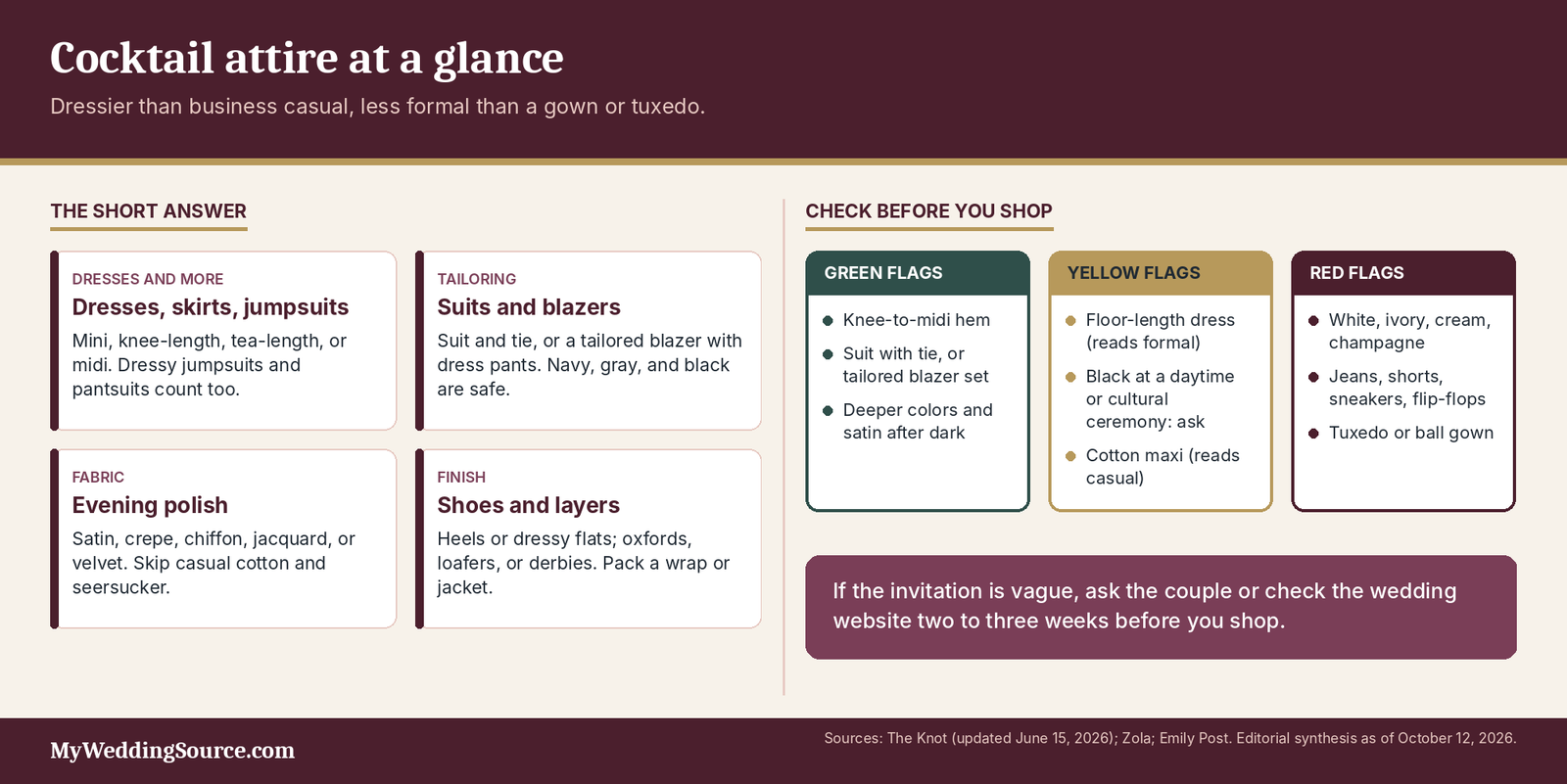
Cocktail attire means dressy but not black tie: a knee-length or midi dress, a jumpsuit or dressy separates, or a suit and tie, in an evening-leaning fabric and adjusted for the venue, the season, and your budget.
The invitation says “cocktail attire,” your calendar says the wedding is eleven weeks away, and you are standing in front of a closet that holds one navy dress, one gray suit, and a lot of jeans. The phrase sounds like it should be simple, yet guides disagree on where it sits: some place it between semi-formal and formal, others treat cocktail and semi-formal as the same thing. That gap is why a guest can read three articles and come away with three different shopping lists. This guide settles the definition, shows you where the sources agree and where they do not, and then turns the definition into outfits you can actually buy, rent, borrow, or pull from your own closet.
Everything here is organized around garments and situations rather than around gender, because the people who receive a cocktail-attire invitation include women in suits, men in dresses, nonbinary guests in skirts and blazers, and everyone in between. Most published guides still split advice into “men” and “women,” so where we quote a source we tell you how that source framed it, and then we translate it into pieces anyone can wear. You will also find notes for guests who are pregnant, plus-size, petite, tall, or dressing around a mobility device, a sensory need, or a religious requirement.
The sources behind the definitions are named inline, with the date each page was last updated as of October 12, 2026. Etiquette is not law, and no authority issues an official ruling on what “cocktail” means, so the aim is to give you the most widely shared reading and the reasons to adjust it.
What cocktail attire actually means
The working definition
The one-sentence version
The Knot, updating its guest guide on June 15, 2026, describes cocktail attire as a dress code whose formality “falls between semi-formal attire and formal attire,” which makes it dressier than a typical office look and less dressy than a gown or tuxedo. In practice that means a polished outfit you could wear to a nice dinner, a gallery opening, or an evening wedding reception without anyone wondering whether you misread the invitation. The reasoning is simple: cocktail attire borrows its idea of dressiness from evening socializing, so the outfit should look at home with a drink in your hand and a few hours of standing, mingling, and dancing ahead. A good test is to picture the room at the cocktail hour, and ask whether your outfit would look intentional there. Wikipedia’s entry on the cocktail dress traces the style to the 1920s, when cocktail parties took hold in the United States, and says Christian Dior named it in 1948, with hemlines falling just below the knee while evening gowns stayed ankle-length.
What the garments usually look like
According to The Knot’s guide, cocktail dresses are typically mini, knee-length, or midi, and jumpsuits and pantsuits with the same level of polish also qualify. For suits, the guide recommends a suit and tie or a well-tailored blazer with dress pants, with navy, gray, and black as the safe colors. Its stylist source, Gabrielle Hurwitz, notes that ties have become more flexible, for example under a sports coat with a turtleneck or in summer, but says that “traditionally, cocktail attire means a tie.” For our purposes, that translates into a simple rule: wear the tie unless you have a clear reason not to, and if the weather or the venue gives you one, make the rest of the outfit look deliberately sharp.
Where the sources disagree
Cocktail versus semi-formal: two codes or one?
The Knot treats cocktail as its own rung, above semi-formal and below formal. Zola’s guest guide, last updated February 5, 2024, lists the two together as “Semi-formal (cocktail attire),” describing the look as polished and put together without going over the top, with suits, cocktail dresses, midi dresses, or dressy jumpsuits as examples. Emily Post’s guest-attire page uses a three-level system of formal, semiformal, and informal, and never gives cocktail its own heading. The practical reading is that cocktail and semi-formal overlap heavily: if you dress to the cocktail standard in this guide, you will be appropriately dressed for either label, and you will rarely be wrong by being slightly more polished than the invitation says.
Disagreements about length, black, and tuxedo-adjacent looks
The Knot’s cocktail page lists floor-length dresses among things to avoid, while Emily Post’s black-tie page says a “dressy cocktail dress” is acceptable at black tie for women, and The Knot’s separate list of items to skip says midi dresses can be too little for black tie. Those statements can all be true at once if you think of cocktail dresses as the upper edge of cocktail attire and the lower edge of black tie, which is exactly why the line blurs. Color gets the same treatment: The Knot’s cocktail page includes black among safe suit colors and lists black, navy, and burgundy for a more formal take, while its etiquette roundup says black can feel too somber at less formal events.
How cocktail attire compares with every other dress code
The lower rungs: casual, dressy casual, and semi-formal
Casual and dressy casual
Zola’s guide says to avoid tank tops, t-shirts, shorts, and jeans unless the celebration is clearly relaxed, and calls dressy or business casual the safest choice. Emily Post’s informal category describes an afternoon dress, or a dressy skirt or pants with a blouse, and a sport jacket or blazer with slacks, with a tie optional. Dressy casual, as most guides use it, sits one step higher: think a sundress or a button-down with chinos and loafers, polished enough for a garden lunch without needing a jacket. The difference between dressy casual and cocktail is the fabric and the finish, since cocktail attire expects a more tailored garment, a jacket or a more refined dress, and shoes that look intentional rather than relaxed.
Semi-formal and festive
Semi-formal is the code that overlaps most with cocktail attire, and the overlap is why so many guests use the terms interchangeably. Emily Post’s semiformal category lists a cocktail dress or dressy pantsuit for evening, and a dark suit, while daytime semiformal calls for a dressy afternoon dress, suit, or pantsuit, or a dark suit or blazer with gray flannels and a tie. Festive attire, as The Knot’s festive guide (last updated November 15, 2023) describes it, is “essentially a stylish mix of cocktail and semi-formal, with an added dash of fun,” with rich embellishments, sequins, velvet, saturated colors, and playful details such as a holiday tie.
The upper rungs: black-tie optional, formal, and black tie
Black-tie optional and formal
Black-tie optional is the first step above cocktail. Emily Post’s black-tie page lists, for black-tie optional, a floor-length evening gown, a shorter cocktail dress, a little black dress, or dressy separates, with a tuxedo requested but a dark suit acceptable, worn with a white dress shirt, a conservative tie, and leather dress shoes. The Knot says that for black-tie optional, a tuxedo is not required and a formally styled suit is acceptable. Formal attire, according to The Knot’s page updated June 24, 2026, “sits between cocktail and black tie,” and typically means a floor-length or ankle-length dress, or dressy separates or a jumpsuit, with a tuxedo optional and a dark, fitted suit with crisp white shirt and tie also appropriate.
Black tie and white tie
Black tie is the top of what most American weddings request. Emily Post describes it for men as a black tuxedo jacket and matching trousers, a formal white shirt, a black bow tie, and a black cummerbund or vest with black patent shoes, and for women as a floor-length evening gown, a dressy cocktail dress, or the dressiest little black dress. The Knot’s tuxedo-versus-suit guide is stricter on suits: for black tie, a tuxedo is required and a black suit is not an acceptable substitute, and it adds that tuxedos should not be worn at cocktail-level events or anything more casual. The takeaway for cocktail guests is the reverse rule: leave the tuxedo and the ball gown at home.
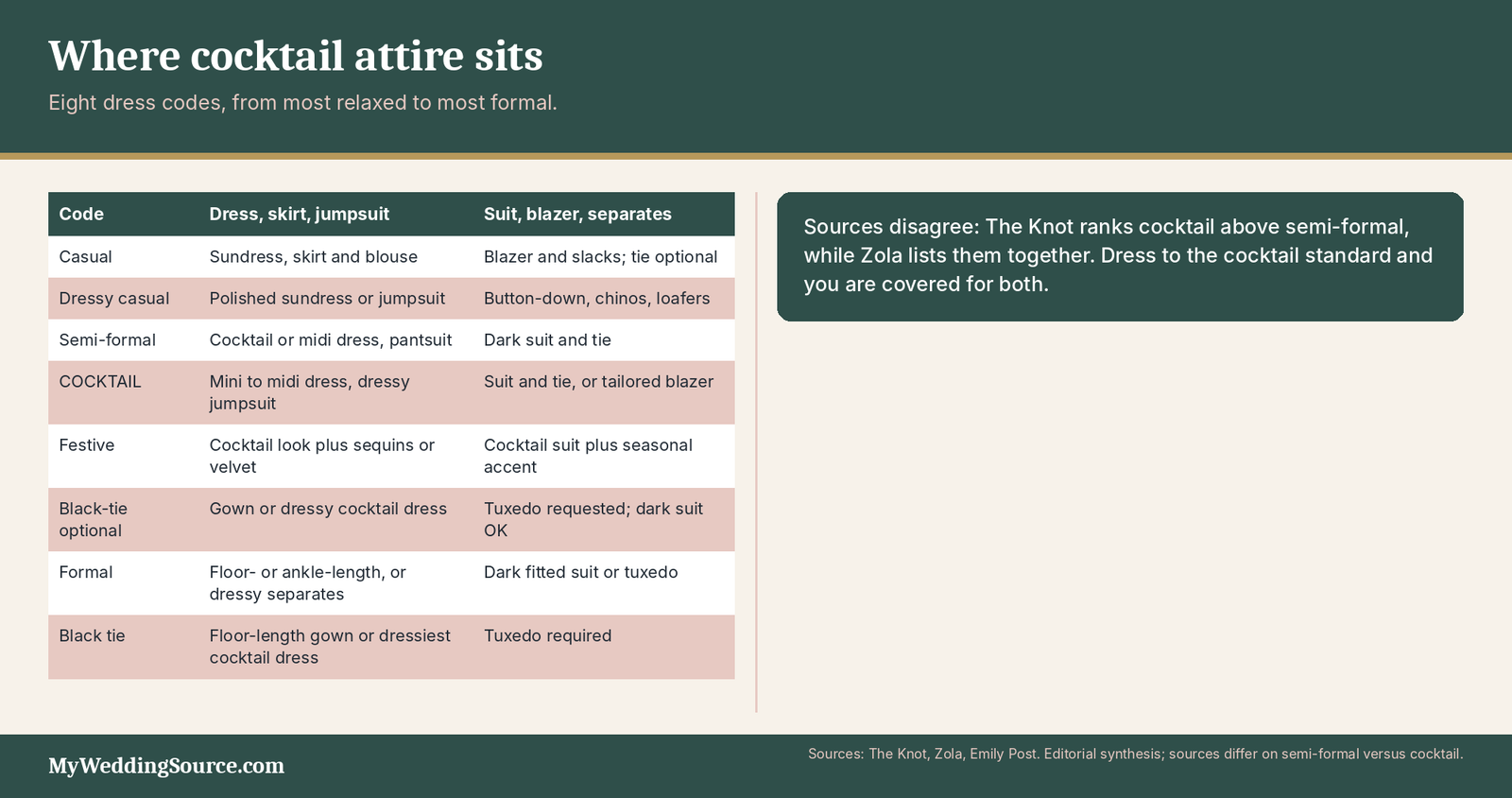
The table below puts all eight codes side by side. It is an editorial synthesis of The Knot, Zola, and Emily Post as of October 12, 2026, and it simplifies in places, so treat it as a starting point rather than a verdict. The garment columns are organized by piece instead of by gender, because every row works for any guest who wants to wear the pieces listed. Where the rungs overlap, such as cocktail and semi-formal, the notes column says so rather than pretending the sources agree.
| Code | Dresses, skirts, jumpsuits | Suits, blazers, separates | Notes on sources |
|---|---|---|---|
| Casual | Sundress, skirt and blouse, dressy pants | Blazer and slacks or chinos; tie optional | Zola: avoid tanks, tees, shorts, jeans unless clearly relaxed |
| Dressy casual | Polished sundress, jumpsuit, or skirt set | Button-down and chinos; loafers; jacket optional | Editorial reading; guides vary |
| Semi-formal | Cocktail or midi dress, dressy pantsuit | Dark suit; tie | Zola merges with cocktail; Emily Post uses it instead of cocktail |
| Cocktail | Mini to midi dress, dressy jumpsuit or pantsuit | Suit and tie, or tailored blazer with dress pants | The Knot: above semi-formal, below formal |
| Festive | Cocktail outfit plus sequins, velvet, bold color | Cocktail suit plus a seasonal tie or accent | The Knot: “mix of cocktail and semi-formal” with fun |
| Black-tie optional | Floor-length gown or dressy cocktail dress | Tuxedo requested; dark suit acceptable | Emily Post and The Knot agree a suit is acceptable |
| Formal | Floor- or ankle-length dress, dressy separates | Dark fitted suit or tuxedo | The Knot: between cocktail and black tie |
| Black tie | Floor-length gown or dressiest cocktail dress | Tuxedo required; black suit is not a substitute (The Knot) | Sources differ on whether a cocktail dress qualifies |
What to wear: outfit formulas for every body and gender expression
Dresses, skirts, and jumpsuits
Dresses and skirt sets
A cocktail dress is the most familiar answer, and the sources agree on its shape: The Knot lists mini, knee-length, and midi, and says floor-length belongs to formal and black-tie events. The most dependable cuts are a fit-and-flare, a wrap, a sheath, or a slip-style dress with a structured jacket or wrap over it, because each one holds up through sitting, hugging, and dancing. A matching skirt-and-top set in satin, crepe, or jacquard is a strong alternative when you want two pieces that can be worn separately later, which improves the cost per wear. If you prefer a longer line, a tea-length or mid-calf hem sits comfortably inside the code, whereas a true floor-length gown is the first thing to leave at home. For a shopping-focused look at dresses across every dress code, our guide to wedding guest dresses compares cuts, fabrics, and fit. Whatever you choose, sit down in it before you buy it, because a dress that looks right standing and rides up or gapes when you sit will fail at a seated dinner.
Jumpsuits, pantsuits, and dressy separates
Jumpsuits and pantsuits count as full cocktail attire when the fabric and tailoring are dressy; The Knot specifically names them alongside dresses. Look for a wide-leg or straight-leg cut in crepe, satin, or a drapey woven fabric, a defined waist, and a hem that clears the top of your shoe so the line stays clean. Dressy separates, such as a silk shell with tailored trousers or a satin midi skirt with a fitted knit top, work if each piece looks evening-ready on its own. The most common failure with separates is mixing a formal piece with a clearly casual one, for example a satin skirt with a cotton tee, so the outfit reads as two different dress codes.
Suits, blazers, and tuxedo-adjacent looks
Suits and tailored blazer combinations
The Knot’s guidance for a suit at cocktail attire is a suit and tie, or a well-tailored blazer with dress pants, in navy, gray, or black. This works for anyone who prefers tailoring, including women, nonbinary guests, and men, and the same rules of fit apply: shoulders that sit at the seam, a jacket long enough to cover the seat, and trousers with a clean break at the shoe. A mid-tone suit in charcoal, deep green, or burgundy reads more evening than a light-colored one, and a white or pale blue dress shirt keeps it conventional. For a deeper look at lapels, colors, and fabrics, our guide to groom’s wedding attire, suit styles, and accessories covers suit construction in detail.
Tuxedo-adjacent looks and when they overreach
A velvet dinner jacket, a satin-lapel blazer, or a tailored three-piece suit can all feel at home at cocktail attire when the rest of the look stays simple. The risk is crossing into full formal wear, and The Knot is direct on this point: tuxedos are typically reserved for black-tie evening events, and it advises that they should not be worn at cocktail-level events or more casual ones. A good way to stay inside the line is to choose one dressy signal and keep everything else conventional, such as a velvet blazer with plain trousers and a regular tie rather than a velvet jacket with a bow tie and patent shoes. If you own a tuxedo and want to use it, break it up: wear the jacket with different trousers or the trousers with a different jacket, so no one reads the look as black tie.
Dressing for your body, not against it
Fit, comfort, and tailoring priorities
A cocktail outfit succeeds or fails on fit more than on price, and a simple priority list helps you decide where to spend. Fix the shoulders and the rise first, since those are the hardest and costliest alterations, then handle the hem and sleeve length, which are the easiest. If a garment pinches when you raise your arms, hug someone, or sit for two hours, it will feel worse by the end of an eight-hour wedding day, so test movement in the fitting room rather than judging a standing pose. Undergarments matter as much as the outer layer, and many guests find that seamless or strapless-compatible options remove the need for adjustments on the day.
Pregnancy, mobility, sensory needs, and sizes
Cocktail attire is flexible enough to accommodate nearly every body when you choose by comfort and structure rather than by a fixed pattern. Guests who are pregnant can look to empire-waist, wrap, or stretch-crepe dresses and jumpsuits, and may want to plan for swelling by leaving extra room in their shoes. Guests who use a mobility aid or have trouble with stairs and grass should prioritize closed, stable footwear, a hem that will not catch in wheels or on a cane, and fabrics that do not snag, while guests with sensory sensitivities can choose soft linings, tagless garments, and fabrics that do not itch. Plus-size, petite, and tall guests often find the strongest cocktail options in stretch or fluid fabrics with adjustable closures such as wrap ties or hidden zippers, and many retailers now publish extended size ranges, but fit still varies by brand.
The table below turns the garment advice into seven outfit formulas you can adapt, with the situations where each one works and the most common way each one goes wrong.
| Formula | Pieces | Works best for | Watch for |
|---|---|---|---|
| The classic dress | Knee or midi dress, block heel or dressy flat, small clutch | Evening ceremonies, city venues | Fabric that creases when seated |
| The jumpsuit | Wide-leg crepe jumpsuit, metallic sandal, statement earrings | Mixed indoor and outdoor | Hem dragging on grass or stairs |
| The suit and tie | Navy or charcoal suit, dress shirt, tie, leather shoes | Almost every cocktail setting | Wrinkles and a loose collar |
| The tailored blazer set | Dark blazer, dress trousers, silk or knit top | Tie-optional or summer weddings | Pairing with casual shoes |
| The skirt set | Satin midi skirt, fitted top, light jacket | Garden or early-evening events | Static and cling in dry air |
| Tuxedo-adjacent | Velvet blazer, plain trousers, regular tie | Winter or festive evenings | Adding a bow tie plus patent shoes |
| Culturally specific formal | Garments from your own tradition at formal-day or evening level | Weddings with family traditions | Colors with symbolic meaning |
Cultural formalwear, religious ceremonies, and cocktail attire
Culturally specific formalwear at a cocktail-attire wedding
How to translate cocktail attire into your own tradition
If your family or community has a formal garment that you wear to weddings, it can be an entirely good answer to cocktail attire, and often a better one than anything from a shop. The principle is to match the level of formality rather than the specific cut: choose the garment that you would wear to a dressy evening event in your tradition, in a fabric and finish that feels evening-appropriate. Wikipedia’s dress code entry reminds readers that dress codes differ by culture and that formal dress is usually described in terms of Western norms, so the Western label may not map neatly onto your garment. If the couple’s invitation uses a Western code and you are unsure how your garment fits, a short message saying “I plan to wear a sherwani, is that in line with your dress code?” is welcome rather than awkward.
Garments that map to cocktail and formal levels
Wikipedia describes the barong tagalog, the national dress of the Philippines, as an embroidered long-sleeved formal shirt worn untucked over an undershirt with belted trousers and dress shoes, which is common formal or semi-formal wear and a typical groom’s garment at Filipino weddings since the 1990s. The sherwani, a fitted, knee-length men’s coat from the Indian subcontinent, is famous as a wedding outfit and may be worn at formal events in India, Pakistan, and Bangladesh. The sari is considered formal attire across the region, with brocade silk saris worn for festive and formal occasions and more than 80 documented drapes. These examples are not a complete list, and guests who wear other traditional garments, such as those from East Asia, Africa, the Middle East, or Latin America, can follow the same approach of matching formality and asking the hosts if unsure.
Religious ceremonies and colors that carry meaning
Modesty, head coverings, and houses of worship
Some ceremonies take place in a church, temple, mosque, gurdwara, or synagogue, and the house of worship may set its own expectations that override the reception dress code. The Knot advises guests to consider cultural and religious norms and notes that some places of worship require modest clothing, and Emily Post’s guest-attire page adds that head-covering or modesty requirements and whether the service is secular or religious should shape your choice. In practice that can mean covered shoulders and knees, a shawl or jacket you can put on for the ceremony and remove for the party, or a scarf or head covering that you bring in your bag. If the couple has not mentioned requirements, ask them directly, because it is much easier to pack a wrap than to explain a missing one at the door.
Colors and symbols that vary by culture
Color meanings vary widely between traditions, and a shade that is a safe default in one community can carry a different meaning in another. The Knot warns that red is considered inappropriate at some Indian, Pakistani, and Chinese weddings, and Zola’s guide advises avoiding black, white, and red at Chinese weddings. Wikipedia notes that red is the most favored color for wedding saris and the traditional bridal garment in Hindu weddings, which is a good reminder that colors worn by the couple’s family may be reserved for them. These are general patterns and not rules for every family, so the reliable approach is to ask the hosts or a friend from the couple’s community which colors to avoid, and to treat a quiet question as a courtesy rather than a hassle.
Fabrics, lengths, colors, and what to avoid
Fabrics and lengths that read as cocktail
Fabrics that signal evening polish
The Knot’s cocktail guide lists silk satin, silk chiffon, silk georgette, jacquard, and beaded or embellished materials as evening-appropriate, with satin and velvet particularly suited to evening events. Fabric matters because it carries more of the formality than the cut does: a satin slip dress and a cotton slip dress can share a pattern and still sit three dress codes apart. For suits, a wool or wool-blend in a smooth finish reads dressier than a rough linen or a heavy tweed, and a subtle sheen or a fine twill helps it look evening-ready. If silk is outside your budget, polyester satin, crepe, and viscose blends can provide a similar drape, though they trap heat and show wrinkles differently.
Lengths for dresses, skirts, and trousers
For dresses and skirts, the cocktail range runs from mini through knee-length to midi, according to The Knot, with floor-length reserved for more formal events. The practical sweet spot for most settings is a hem between just above the knee and mid-calf, which suits sitting, dancing, and venues with stairs or lawn. Shorter hems are acceptable, but a mini at a church ceremony or a conservative family event may call for tights or a longer jacket to balance the look. Trousers and jumpsuits should clear the ground in your intended shoes, and a tailor can hem them to the exact heel height, which is worth doing if you plan to wear flats at the ceremony and heels at the reception.
Color, pattern, and the white rule
Choosing color by time of day and season
The Knot says no color is off limits at cocktail attire, with lighter hues and patterns suiting daytime and deeper solid shades suiting evening or more formal venues. Seasonal logic supports that: its general wedding guide suggests jewel tones and fabrics like velvet and silk for fall, while summer favors lighter colors and shorter styles. Deep green, burgundy, midnight blue, plum, and rich teal photograph well and work in most seasons, and metallic accents add evening polish without requiring a full sequin outfit. Patterns are welcome as long as the scale and fabric match the occasion, so a floral on satin reads cocktail while a cotton gingham sundress reads picnic.
White, ivory, cream, and the colors to check first
The Knot’s guide to what to avoid says guests should not wear any shade of white unless the couple says otherwise, and Zola’s guide specifically names white, cream, and ivory. The Knot clarifies that a white dress shirt under a suit is fine, as is a dress with a small amount of white, but its formal-attire page adds champagne and light-colored suits to the list of shades to skip. Zola also advises avoiding the same colors as the bridesmaids if you can check beforehand, and The Knot says red can draw attention away from the couple. Treat these as strong norms and not laws, and if the invitation or website explicitly invites white or a color theme, follow the couple’s instructions over the general rule.
What to avoid at cocktail attire
Casual pieces that undercut the code
The Knot’s cocktail guide names jeans, shorts, sneakers, flip-flops, and casual sandals as items to avoid, and it flags casual fabrics such as cotton, cotton blends, and seersucker, unless the event is outdoors or daytime. Its stylist source says a cotton-blend maxi dress would likely be too casual unless it is a beach event, which shows that the same garment can be right in one setting and wrong in another. The Knot’s wider list of things to skip adds baseball caps, which are never appropriate, and notes that hats should come off before entering an indoor venue. Denim is generally off-limits unless the wedding is Western-themed, and The Knot says men should wear sneakers only at dressy casual weddings, and then only a clean, unworn pair.
Too revealing, too tight, or too much
Zola advises avoiding clothing that is too short, tight, flashy, or revealing at a wedding. The underlying idea is not about modesty for its own sake but about attention: an outfit that needs constant adjusting pulls focus from the couple and from your own enjoyment. A comfortable test is the three-movement check, in which you sit, lift your arms, and bend to hug someone while looking in a mirror, and then decide whether any of those movements needs a safety pin. If you want a bold or sheer element, balance it with structure elsewhere, for example a sheer sleeve with a modest neckline, or a high slit with a fuller skirt.
Adjusting for time of day, season, climate, and venue
Time of day, season, and climate
Daytime versus evening
Emily Post’s guest-attire page draws a consistent line between daytime and evening at every level of formality: a dressy afternoon dress, suit, or pantsuit for semiformal daytime, and a cocktail dress or dressy pantsuit with a dark suit for semiformal evening. For a ceremony at 2 p.m., lighter colors, softer fabrics, and a lighter-weight suit are appropriate, while for a 6 p.m. start, deeper colors, satin, velvet, and darker suits signal evening. The Knot echoes this when it says lighter hues and patterns suit daytime while deeper, solid shades suit evening. If the day spans both, such as an afternoon ceremony followed by an evening reception, pick a mid-tone outfit and use accessories and a jacket or wrap to shift it toward evening.
Fall, winter, and cold-weather planning
The Knot suggests jewel tones and fabrics like velvet and silk for fall, and Zola advises bringing a coat to winter weddings in case you spend time outdoors. Our fall wedding weather and seasonal cost guide notes that early-fall days can swing 25 degrees or more within the same day and recommends that couples publish the expected temperature range on their wedding website, which is useful information to look for before you pack. The National Weather Service explains that wind chill, which describes how cold exposed skin feels, is only defined for air temperatures at or below 50 degrees Fahrenheit and wind speeds above 3 mph, and that bright sunshine may raise the wind chill by 10 to 18 degrees. In plain terms, a breezy 50-degree evening on a patio will feel colder than the thermometer says, so choose long sleeves, tights, or a wrap you can add.
Summer heat and humid weather
Hot weather is where cocktail attire most often collides with comfort. The Knot notes that lightweight fabrics like linen can work for seaside or summer weddings, and that light, bright colors suit summer, so choose breathable weaves and lighter linings while staying away from fabrics that look casual in photographs. The CDC’s heat guidance identifies adults over 65, pregnant people, children, people with disabilities or chronic conditions, and those taking certain medications as being at higher risk in the heat, and it stresses hydration and cooling, so those guests should plan for shade, water, and an easy exit to air conditioning. A suit jacket can come off at the reception if the room is warm, which is why a well-fitting shirt or shell underneath matters.
How venue type changes the outfit
Barns, farms, and gardens
A barn or garden wedding often invites softer, more movement-friendly cocktail looks, but the ground and the weather set limits. The Knot recommends chunky heels for outdoor weddings and warns that stilettos and kitten heels can sink into grass or sand, so block heels, wedges, or dressy flats are safer. Barns can be hot in summer and drafty in fall, so a light jacket or wrap belongs in your bag, and long skirts can pick up dust or damp, which makes a midi or tea-length hem easier to manage than a floor-length one. Rain plans differ by venue, so check whether our guide to an outdoor wedding rain plan is relevant to your invitation, because a move indoors changes shoe and layering choices at the last minute.
Beaches and waterfronts
Beach weddings pair cocktail attire with sand, wind, and sun, and the sensible approach is to dress for the code and the conditions. The Knot’s attire guide says to avoid formal dresses at a casual beach wedding and notes that stilettos can sink into sand, while its cocktail guide says linen and other lightweight fabrics can work for seaside events. Practical choices include a midi dress with a weighted hem that resists wind, a lightweight suit in a pale or mid-tone shade, or a jumpsuit that does not blow around, with flat sandals or wedge heels that can handle sand. If the ceremony is on the beach and the reception is in a hotel ballroom, bring a second pair of shoes.
Ballrooms, hotels, and houses of worship
Indoor venues set the dressiest tone and sit closest to the formal end of cocktail attire, even when the invitation says only “cocktail.” A ballroom or hotel reception supports satin, velvet, deeper colors, and polished shoes, and you can expect air conditioning that feels cold, so a jacket or wrap is useful. Houses of worship add the modesty and covering considerations discussed earlier, and many couples hold a ceremony in one and a reception in another. In those cases, dress for the stricter of the two and carry layers or accessories that make the outfit evening-ready for the second venue.
| Venue | Dress, skirt, or jumpsuit | Suit or blazer set | Shoes and layers |
|---|---|---|---|
| Barn or farm | Midi in crepe or satin; avoid floor-length | Mid-tone suit; jacket for drafts | Block heel or dressy flat; wrap |
| Garden or lawn | Tea-length or midi; light fabric | Lighter suit in cooler tones | Wedge or block heel; thin layer |
| Beach or waterfront | Wind-resistant midi or jumpsuit | Lightweight suit; consider no tie | Flat sandal or wedge; sun cover |
| Ballroom or hotel | Satin, velvet, deeper color | Dark suit and tie | Dress shoe or heel; light jacket |
| House of worship | Sleeves or a wrap; knee or longer | Dark suit and tie | Closed shoe; shawl or head cover |
| City rooftop or loft | Midi or jumpsuit; mind the wind | Tailored suit or blazer set | Comfortable heel; evening layer |
Shoes, accessories, and outerwear
Shoes that handle the whole day
Heels, flats, and terrain
The Knot says cocktail shoes can be heels or dressy flats, such as satin or patent ballet flats, and its wider guide says outdoor venues call for chunky heels while indoor venues suit pump heels. The deciding factor is the ground: grass, gravel, cobblestone, boardwalk planks, and sand each ask for something different, so ask the couple what surface you will be standing on for the ceremony. If you plan to dance, look for cushioned insoles, a heel of two inches or lower, and an ankle strap or closed back that keeps the shoe on your foot. Break shoes in for at least a week before the event, since a pair that feels fine in the store can blister after four hours.
Dress shoes for suits and tailored looks
For suits, The Knot recommends oxfords, loafers, or derbies, which means closed, polished leather or a close equivalent in a vegan material. Black shoes suit darker suits and evening events, while brown and burgundy pair well with navy, gray, and mid-tone suits in daytime. Match your belt to your shoes, and let your socks hide the gap between trouser and shoe when you sit. If you are on your feet for hours, a sturdier sole and a cushioned insole make a bigger difference than a more expensive shoe, and a leather conditioner a few days before the wedding keeps the shoe from creasing too visibly.
Accessories and layers that finish the look
Jewelry, bags, ties, and pocket squares
The Knot’s guest-attire guide recommends accessories that complete the look, such as earrings, a matching bag, and, for men, a pocket square, printed tie, or belt. The easiest rule is to choose one accent: a statement earring or a statement necklace, a pocket square or a tie with a subtle pattern, a metallic clutch or a patterned scarf. Small bags are the practical choice because you will be holding a drink, shaking hands, and dancing, so choose a clutch, a crossbody with a thin strap, or a pocket-sized wallet that fits your phone, keys, lip balm, and a card. A watch counts as an accessory, and a classic metal or leather watch fits cocktail attire better than a sports watch.
Coats, wraps, blazers, and umbrellas
Outerwear is where cocktail guests most often disrupt their own look, so plan it as part of the outfit. A wrap or shawl in a fabric like pashmina or silk works over a dress or jumpsuit, a tailored topcoat or a wool overcoat fits over a suit, and a structured blazer can be added to a dress for the ceremony and removed for dancing. The National Weather Service’s wind-chill guidance suggests that cold with wind feels much colder than the temperature alone, so a layer you can put on after sunset is worth more than a fancier accessory. In rain, a compact black or neutral umbrella is the most dependable choice, and a trench or a dressy raincoat is more elegant than a hoodie.
Budget, rental, thrift, and the shopping timeline
What cocktail attire costs and how to spend less
Repeat-wearing and borrowing
The least expensive cocktail outfit is one you already own, and that is a respectable answer at a wedding as long as the pieces fit the code. Check your closet for a dark suit, a dressy dress or jumpsuit, or a pair of tailored trousers and a blazer, and then plan around the weakest piece, usually shoes or the shirt. If you wear the same outfit to several weddings, vary it with different accessories, a different layer, and different shoes, because guests rarely notice the repetition. Borrowing from a friend or a family member is a second route, as long as you agree in advance on cleaning and what happens if something is damaged.
Renting a suit, tuxedo, dress, or subscription
Menswear rental is the most transparent market, and published starting prices give a baseline. As of October 12, 2026, Generation Tux’s homepage listed tuxedos from $139 and featured suits and tuxedos at $159, while The Black Tux listed suits from $169 to $179 and tuxedos at $189 on its homepage. Generation Tux states that orders arrive 14 days before the event, that you should try the items within 48 hours, and that the package is returned within 3 days after the event. For dresses, one-off rental prices vary by garment and retailer and were not published on the pages we checked, so compare the rental fee, shipping, insurance, and cleaning policy before you decide. Clothing subscriptions can be efficient if you want several outfits: Nuuly’s homepage lists $98 per month for six items and states there are no late, damage, or shipping fees, and Rent the Runway’s homepage listed $99 for the first month and $164 per month after, though plan terms change, so read the current page.
Thrift, resale, and buying new
Resale is a growing route for formalwear. ThredUp’s 14th annual Resale Report, published in 2026, projects the global secondhand apparel market will reach $393 billion by 2030, growing about twice as fast as the overall apparel market, which suggests that quality selection should keep expanding. When shopping resale, check for final-sale policies, inspect seams and linings, and budget for dry cleaning and alterations, since the sticker price is lower but the extras are the same. Buying new is the most predictable route for fit and return policies, and The Knot’s tuxedo-versus-suit guide (linked above) puts a new entry-level suit at around $200 and a tuxedo at around $300, with rentals sometimes under $200. Guests traveling for the wedding should also account for the broader trip costs described in our guide to destination wedding guest costs, because attire is only one line in the total.
| Option | Typical outlay | What to verify |
|---|---|---|
| Re-wear from your closet | $0 to about $60 for cleaning or a hem (editorial estimate) | Fit, condition, and shoes |
| Borrow from a friend | $0 plus cleaning | Who pays for damage or cleaning |
| Rent a suit or tuxedo | From $139 to $189 listed starting prices (Oct. 12, 2026) | Delivery date, return deadline, replacement policy |
| Clothing subscription | $98 to $164 per month listed (Oct. 12, 2026) | Cancellation terms, item limits |
| Resale or thrift | About $20 to $150 (editorial estimate) | Return policy, condition, alterations |
| Buy new | About $60 to $300 for a dress or jumpsuit (editorial estimate); about $200 for an entry-level suit (The Knot) | Return window, alteration cost |
Shopping and tailoring timeline
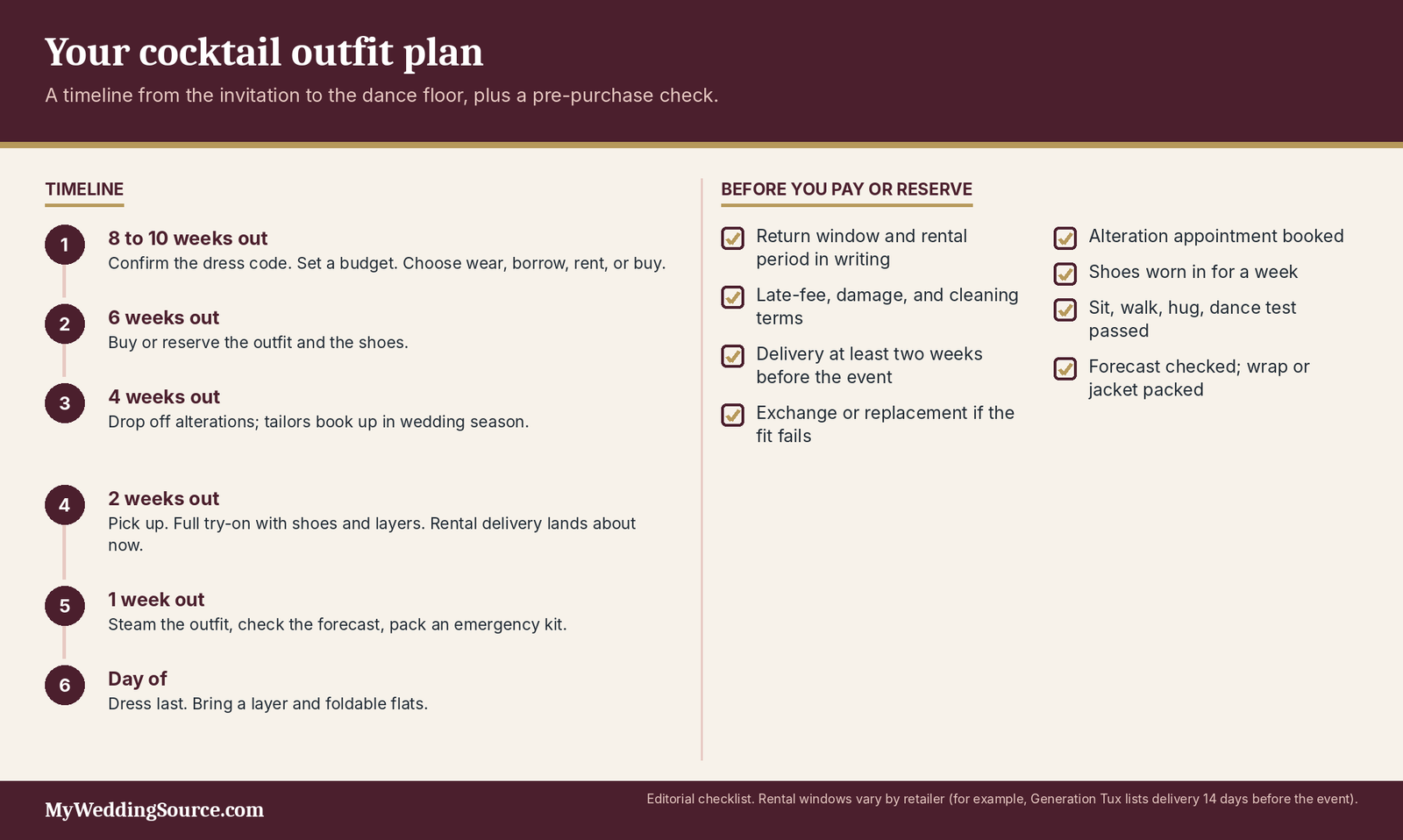
Eight to four weeks before
Start by confirming the dress code and the venue, then decide whether to wear, rent, borrow, or buy, and set a number you are comfortable with. At six weeks, buy or reserve the outfit and the shoes, since popular sizes and dates sell out for rentals and online retailers often ship slowly in wedding season. At four weeks, drop off any alterations, because tailors fill up before busy months and a fitting or two often adds a week or more. A simple hem or strap adjustment usually costs much less than a structural change, though prices vary by shop and region, so ask for a quote before you leave the garment.
The final two weeks
Two weeks out, pick up your alterations, do a complete try-on with the shoes, undergarments, and accessories you will wear, and check how you sit, walk, and dance. For rentals, plan around delivery windows, such as Generation Tux’s 14 days before the event, so you have time to swap an item. One week out, steam or press the outfit, check the forecast, and pack an emergency kit with safety pins, fashion tape, blister plasters, a stain pen, and a phone charger. The night before, lay everything out, including your layers, and keep the outfit in a garment bag so it travels without creasing.
| When | Task | Why it matters |
|---|---|---|
| 8 to 10 weeks out | Confirm dress code; set budget; choose wear, rent, borrow, or buy | Prevents panic shopping |
| 6 weeks out | Buy or reserve outfit and shoes | Sizes and rental dates sell out |
| 4 weeks out | Drop off alterations | Tailors book up in wedding season |
| 2 weeks out | Pick up; full try-on; plan layers | Time to fix problems |
| 1 week out | Steam; check forecast; pack emergency kit | Fewer day-of surprises |
| Day of | Dress last; bring layers and flats | Comfort across eight hours |
When the invitation is vague, and the mistakes to avoid
How to find out what the hosts mean
Where to look before you ask
Start with the pieces of the invitation suite you already have, because dress-code clues are often scattered across them. The save-the-date, the invitation, the wedding website, and the details card may each add a line, such as “cocktail attire, garden ceremony,” or a note about shoes on grass, and the website often has a FAQ page that answers the question directly. The Knot’s guidance is to check the invitation or the wedding website first and to ask the couple if no dress code is listed, and Emily Post adds that the invitation and the time of the wedding are the strongest clues to formality. A 7 p.m. start in a hotel ballroom points toward the dressier end of cocktail, while a 2 p.m. start at a winery points toward the lighter end.
A short script for asking
The least awkward people to ask are members of the wedding party or the couple’s parents, because they often have the details and are used to guest questions, but a direct message to the couple is also welcome. A good message is short, specific, and low-pressure: “We are so excited for the wedding! The invitation says cocktail attire. Are you picturing suits and knee-length dresses, or something dressier? We are happy to follow whatever you have in mind.” It shows that you care about getting it right, and it gives the host an easy way to answer in one line. Send it two to three weeks before you shop, so a delayed reply does not squeeze your timeline.
If you cannot get an answer
Sometimes the couple is traveling, the wedding party is unreachable, and the wedding is near. In that case, dress to the middle of the likely range: a dark suit and tie, or a midi dress or jumpsuit in a dressy fabric, with a jacket or wrap you can add or remove and shoes that work on mixed surfaces. That outfit sits inside cocktail attire and semi-formal, and it is close enough to dressy casual on the low side and black-tie optional on the high side that it rarely looks out of place. Avoid white, ivory, and cream, bring a layer, and carry flats if you will be on your feet.
If you are the couple: wording the dress code
Choose words that match your reality
Guests rely on your wording, so choose the code that matches what you are actually planning, not the one that sounds the most elegant. If your ceremony is an afternoon garden event with a relaxed reception, “dressy casual” or “garden party attire” may serve guests better than “cocktail attire,” while an evening ballroom reception with a seated dinner fits “cocktail attire” or “black-tie optional.” Remember that the guests who dress up the most usually spend the most, and a code that is a step more formal than needed can add real cost for guests who are already paying for travel and gifts. If a significant number of guests are traveling, a lower code or a flexible phrase may be a kinder choice.
Add one sentence of specifics
Examples include “Cocktail attire; the ceremony is on grass and the reception is indoors,” “Cocktail attire; evenings are cool, so bring a layer,” or “Cocktail attire; suits, dresses, and jumpsuits are all welcome.” Put the line on the invitation or the details card, and repeat it on your wedding website with the forecast range and the surfaces guests will walk on. Our guide to wedding invitation timing and wording covers where dress-code lines fit in the suite, and our overview of wedding planning shows where invitations sit in the larger timeline.
Mistakes that cost guests money, comfort, or confidence
Misreading the code
The most common error is dressing a full code too high or too low. A floor-length gown or a tuxedo turns cocktail attire into black tie, and a sundress or a polo with chinos turns it into dressy casual, so check whether your outfit would match the top or bottom of the table earlier in this guide. Another error is treating cocktail and semi-formal as separate worlds, when the overlap is large and the safest outfit sits in both. If you catch yourself debating between two rungs, choose the more polished one, and make sure it is comfortable enough to enjoy.
Practical mistakes that show up on the day
Many problems are logistical rather than stylistic. Shoes that have not been worn in, a dress that does not allow sitting, a jacket that cannot come off, and a missing layer are the problems that ruin the evening, and each one can be avoided with a test run at home. Last-minute shopping leaves no time for alterations, and ordering a single size online with no return window can leave you without an outfit. A sensible habit is to put the whole outfit on one week out, sit, walk, hug, and dance in it for ten minutes, and fix whatever fails.
Frequently asked questions about cocktail attire
Questions about the dress code itself
Is cocktail attire the same as semi-formal?
Not always, but the two overlap heavily. The Knot places cocktail above semi-formal and below formal, while Zola’s guide lists the two together as “Semi-formal (cocktail attire),” and Emily Post uses a formal, semiformal, and informal system without a separate cocktail heading. Because of that overlap, an outfit that meets the cocktail standard in this guide will be appropriate for either label. If the invitation uses either term, you do not need two separate outfits, and a quick message to the couple can settle any remaining doubt.
Can I wear black to a cocktail attire wedding?
Usually yes, with one caveat. The Knot lists black among the safe suit colors for cocktail attire and includes black, navy, and burgundy for a more formal look, while another Knot guide says black can feel too somber for less formal weddings. The cultural note also applies, since Zola advises avoiding black at Chinese weddings. If you wear black, add color or texture through a scarf, jewelry, a tie, or a pocket square, and check the couple’s wedding website for any color guidance.
Can I wear a long or maxi dress to cocktail attire?
It depends on the dress. The Knot lists floor-length dresses among the things to avoid at cocktail attire and says a cotton-blend maxi dress would likely be too casual unless the event is a beach wedding. A tea-length or mid-calf dress in a dressy fabric sits comfortably inside the code, while a satin or crepe floor-length dress edges toward formal. If a long dress is your most comfortable option, religious reasons, or personal style, choose an evening fabric and ask the couple whether it fits the event.
Questions about specific outfits
Do I need to wear a tie to cocktail attire?
Traditionally yes, though modern practice is more flexible. The Knot’s stylist source says “traditionally, cocktail attire means a tie,” and notes that ties are more flexible today, for instance under a sports coat with a turtleneck or in summer. A good guide is to wear a tie to an evening or indoor event and to consider skipping it for a hot summer or outdoor event, as long as the shirt and jacket look sharp. If you skip the tie, keep the collar crisp and consider a pocket square for finish.
Can I wear pants or a jumpsuit instead of a dress?
Yes. The Knot lists jumpsuits and pantsuits with the same formality as part of cocktail attire, and Emily Post’s semiformal evening category includes a dressy pantsuit. Choose a fabric and cut that reads as evening wear, such as crepe or satin in a wide-leg or straight-leg shape, and pair it with dressy shoes and jewelry. A hem that clears the floor in your chosen heel height will keep the line clean.
What should I wear to a daytime cocktail attire wedding?
Dress for the time of day and the venue. Emily Post’s daytime semiformal calls for a dressy afternoon dress, suit, or pantsuit, and The Knot says lighter hues and patterns suit daytime. A midi dress in a lighter color, a lightweight suit, or a tailored jumpsuit works, and you can still wear a jacket or wrap if the venue is cool. Keep the fabric polished, skip casual cotton, and carry a layer for the evening.
Your next steps
This week
Collect the clues
Open the invitation, the save-the-date, and the wedding website, and write down the dress code, the ceremony time, the venue type, and whether the event is indoors or outdoors. Check the forecast range for the date, and note whether the ceremony and reception are in different places. If anything is unclear, send the short message from the earlier section today, because answers can take a week or more.
Decide to wear, borrow, rent, or buy
Look through your closet first and pull two or three candidates that fit the code, then compare them with a rental or a purchase using the cost table above. If you are renting, check the delivery and return dates against the wedding date. If you are buying, check the return window before you order, so you can still change course.
Before you pay or reserve anything
Read the rental and return terms
Before you click buy or reserve, read the return policy, the rental period, the late-return fees, the damage terms, and the cleaning rules, and keep screenshots of the page you saw. Ask whether free replacements or exchanges are available if the item does not fit, and whether delivery has a guaranteed date. If a seller will not state the policy in writing, choose another seller.
Test the whole outfit once
When the outfit arrives, try it on with the exact shoes, undergarments, jewelry, and layer you plan to wear, and spend ten minutes sitting, walking, and dancing. Photograph yourself from the front and back in natural light and look for gaps, wrinkles, and anything that needs a fix. Book any alteration right away, and put the pickup date on your calendar.
Sources & methodology
- The Knot: A Guest’s Guide to Cocktail Wedding Attire (updated June 15, 2026) — definition, garments, fabrics, lengths, shoes, and items to avoid at cocktail attire.
- The Knot: Formal Wedding Attire (updated June 24, 2026) — formal as the rung between cocktail and black tie; white, ivory, cream, and champagne guidance.
- The Knot: Festive Attire (updated November 15, 2023) — festive as a mix of cocktail and semi-formal with a dash of fun.
- The Knot: What to Wear to a Wedding (updated March 5, 2026) — checking the invitation, asking the couple, cultural color cautions, outdoor shoes.
- The Knot: What Not to Wear to a Wedding (March 28, 2024) — white, black, red, denim, caps, sneakers, and wrong-formality cautions.
- The Knot: Tuxedo vs. Suit (updated March 3, 2026) — which dress codes call for tuxedos or suits, plus entry-level purchase and rental price points.
- Zola: What to Wear to a Wedding (updated February 5, 2024) — “Semi-formal (cocktail attire)” grouping, casual guidance, and white/cream/ivory advice.
- Emily Post: Wedding Guest Attire — formal, semiformal, and informal categories by daytime and evening.
- Emily Post: Black Tie Dress Code — black tie and black-tie optional definitions and tuxedo alternatives.
- Wikipedia: Cocktail dress — 1920s origin, 1948 naming, and hemline history (background only).
- Wikipedia: Dress code — notes that semi-formal is loosely defined and that dress codes vary by culture.
- Wikipedia: Barong Tagalog, Sherwani, and Sari — background on culturally specific formalwear examples.
- National Weather Service: Wind Chill — wind chill definition, the 50 degrees Fahrenheit and 3 mph limits, and the sunshine adjustment.
- CDC: Heat and Health — groups at higher risk in hot weather and hydration and cooling guidance.
- Generation Tux and The Black Tux — listed menswear rental starting prices and delivery and return windows (homepages, October 12, 2026).
- Nuuly and Rent the Runway — listed clothing subscription pricing (homepages, October 12, 2026).
- ThredUp Resale Report — 2026 projection for global secondhand apparel growth.
Methodology. Dress-code definitions are editorial syntheses of The Knot, Zola, and Emily Post pages that were readable on October 12, 2026; no official body defines these terms, so differences between sources are noted rather than resolved. Prices labeled “listed” were read from retailer homepages on that date and are starting prices, not quotes, while amounts labeled “editorial estimate” are illustrative ranges that vary by brand, region, and season. Cultural examples are brief background drawn from reference entries and cannot represent every community, so confirm expectations with the hosts. Weather and health statements come from the National Weather Service and CDC pages above and are general information, not medical advice.
Freshness note. Recheck retailer prices and rental or subscription terms before you buy, and look again at The Knot, Zola, and Emily Post pages each spring and fall when wedding seasons begin, since guidance is updated often. Last researched October 12, 2026.