
Learning how to prevent feedback at an outdoor wedding ceremony means seeing that the squeal is a loop between a microphone and a speaker, not bad luck, and that a few decisions made before the day, about where things stand, which microphones are used, and who mutes what, decide whether it ever starts.
Quick answer
To keep a ceremony from squealing, keep every open microphone farther from the speakers than the audience is, use directional microphones where a person will stay put, keep the number of live microphones as low as the ceremony allows, and have the sound operator ring the system out at the real positions before guests arrive. Turn off any microphone that is not about to be used. Pair that with a spare microphone, a wind plan, and a named person who decides what happens if weather moves in. This guide shows how to prevent feedback at an outdoor wedding ceremony step by step, includes a handheld, lavalier, and podium selection grid, and lists the questions to put to your sound vendor. It is general planning information, not electrical, engineering, or legal advice.
How to prevent feedback at an outdoor wedding ceremony: why it happens and what changes
Anyone who has stood near a speaker with a microphone has heard it: a rising howl or whistle that seems to come from nowhere. It feels unpredictable, but the cause is simple and the fixes are mostly about geometry. This section explains the loop in plain language and then looks at what an open-air ceremony changes, so the rest of the guide makes sense. Knowing how to prevent feedback at an outdoor wedding ceremony starts with understanding that the system is simply listening to itself.
The loop in plain words
Feedback is a circle. A microphone picks up a voice, the sound system makes it louder, a speaker plays it, and some of that sound drifts back into the microphone. If the returning sound is loud enough, the system amplifies it again, and the loop feeds itself until it howls. Shure, a microphone manufacturer, describes it the same way: sound from a loudspeaker re-enters a microphone and is amplified over and over, and any combination of microphone, amplifier, and speaker can do it.
The three ingredients
Every case of feedback needs a microphone that can hear a speaker, enough amplification to make the returning sound count, and a path for the sound to travel. Remove or weaken any of the three and the loop does not close. That is useful, because a wedding crew can change each one: where the microphone points, how much gain is applied, and how far the speaker is from the microphone.
Why it starts at one pitch
Real rooms and fields do not return every pitch equally. The microphone, the speaker, and the space between them favor a few frequencies, so the howl starts at one pitch and climbs. Shure’s guidance links the sound to the pitch: low hoots or howls tend to sit roughly between 250 and 500 hertz, singing tones near 1,000 hertz, and screeches above about 2,000 hertz. You do not need to memorize those numbers. They explain why an engineer cuts one narrow band of sound instead of turning the whole system down.
What an open-air ceremony changes
Outdoors, the picture is different from a ballroom, and the differences cut both ways. Some risks go down, some go up, and a few are simply new. We are reasoning here from general principles and from the sources listed at the end, so treat the comparisons as planning guidance and let your sound professional judge your actual site.
Fewer walls, but not fewer problems
Shure suggests treating hard, reflective surfaces such as glass, marble, and wood to reduce feedback indoors, which points to an advantage outdoors: a lawn or garden has no ceiling and often few walls bouncing sound back toward the microphone. That does not make feedback go away. A tent wall, a barn, a stone building, or a gazebo behind the officiant can still reflect sound, and the speakers and the microphone are still in the same loop. Ask your sound operator to look at what is behind and beside the ceremony spot, not only at the grass in front.
Guests, distance, and quiet voices
Outdoor ceremonies often have a quiet voice problem: an officiant who speaks softly, vows meant to be intimate, and a crowd seated on folding chairs with nothing to hold the sound in. The temptation is to raise the volume, and raising the volume is exactly what pushes a system toward feedback. The better answer is to put the sound closer to the people who need it, to use a microphone placed close to the speaker’s mouth, and to accept that the vows may need to be a little more projected than a whisper. Later sections show how.
Weather and wind arrive as extras
Wind makes noise in microphones that sounds nothing like feedback but ruins the recording and the live mix just as thoroughly, and storms bring real safety decisions that sit above any audio question. Neither belongs in a pure feedback explanation, but both belong in a plan, which is why the weather section later in this guide covers them. If you only remember one thing from the outdoor differences, remember that a ceremony field has fewer repeatable conditions than a room: the wind changes, the sun moves, and the crowd’s size and seating change what the system hears.
Five levers for how to prevent feedback at an outdoor wedding ceremony
Sound professionals describe feedback control as a handful of levers, and the same five show up in the manufacturer guidance we reviewed: distance, direction, gain, the number of open microphones, and equalization. Pulling the first four correctly makes the fifth a small adjustment instead of a rescue. If you only have time to understand one part of how to prevent feedback at an outdoor wedding ceremony, make it this section.
Lever one: distance between microphone and speaker
Distance is the cheapest fix, because it costs nothing but planning. For anyone planning how to prevent feedback at an outdoor wedding ceremony, this is the first lever to pull. The farther a microphone is from a speaker, the less of the speaker’s sound reaches it, and the more the system can be turned up before the loop closes.
The six-decibel rule of thumb
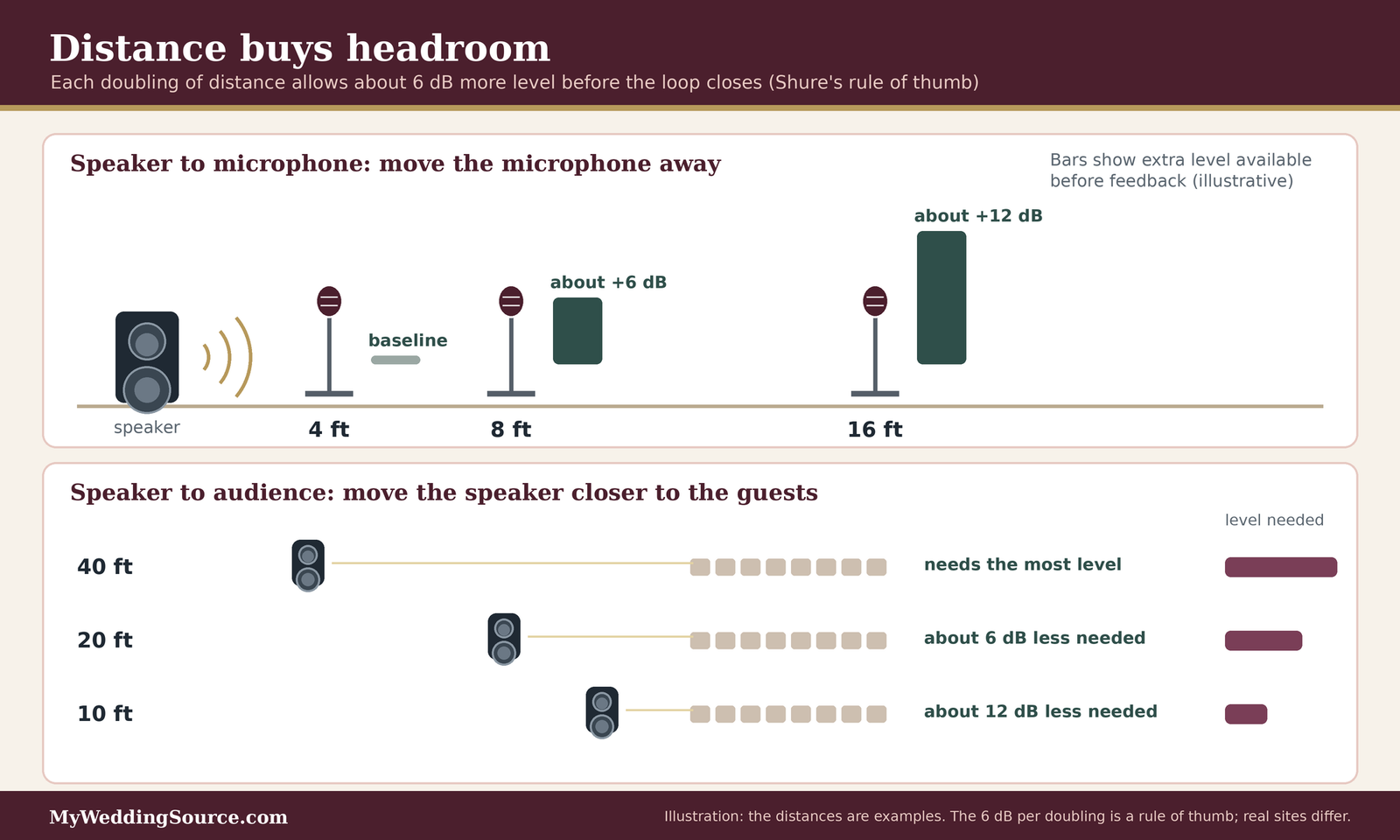
Shure’s guidance says that doubling the distance between a speaker and a microphone allows roughly six decibels more system output before feedback, and that halving the distance from a speaker to the audience allows about six decibels more as well. Six decibels is a meaningful amount of extra headroom, which is why engineers reach for distance first. Our own arithmetic, shown in the first figure, is simply that the rule stacks: eight feet instead of four buys about six decibels, and sixteen feet instead of four buys about twelve. Real sites differ, so treat the figure as an illustration of the idea.
Put the speakers in front of the microphone
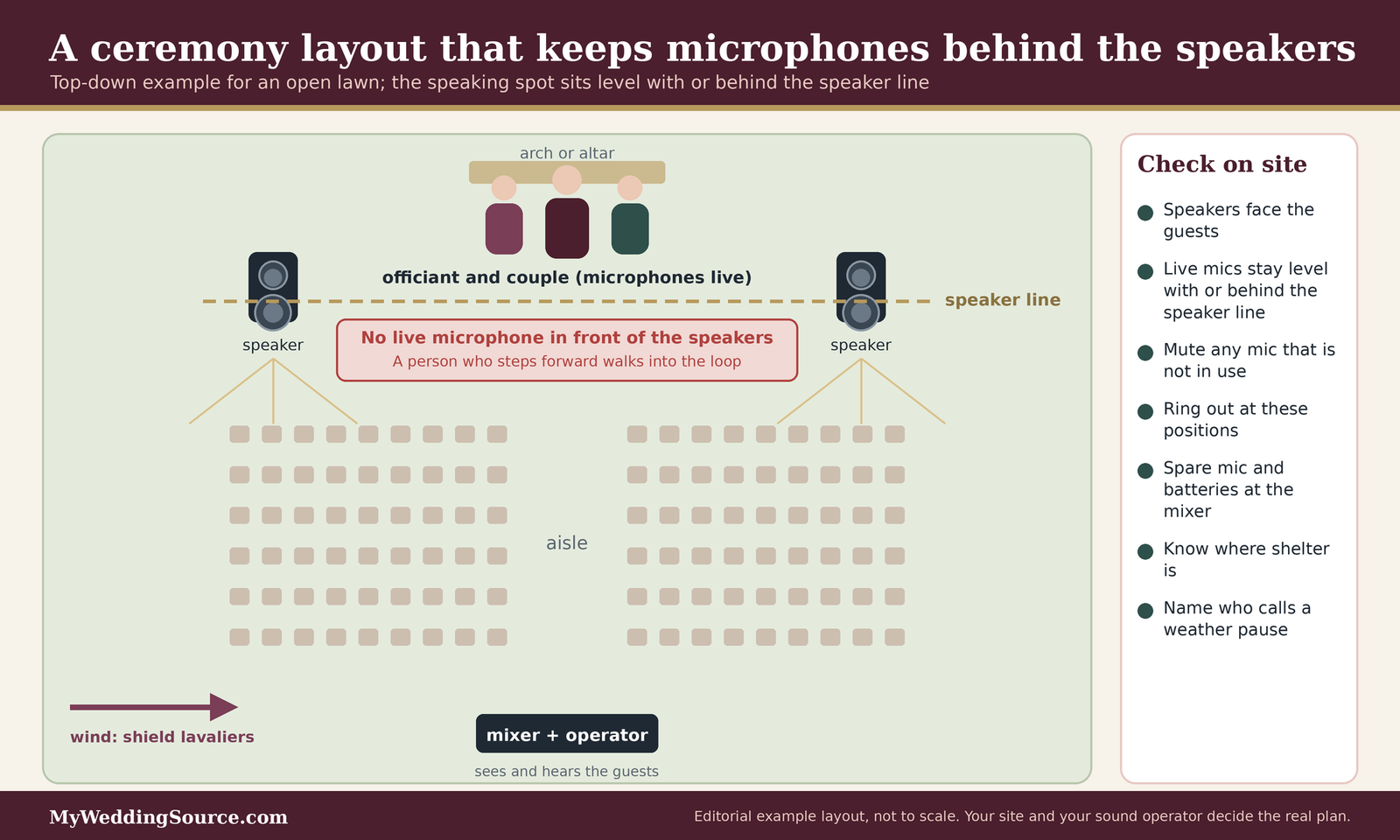
Audio-Technica, another microphone maker, advises positioning the microphone behind the main speakers, so that the speakers face away from it and the audience sits in front of them. Their blunt version is that a microphone in front of the speakers almost always feeds back, which is what happens when a presenter walks out ahead of the loudspeakers. At a ceremony, this has a very practical meaning: the officiant and the couple stand behind or level with the front of the speaker line, never in front of it, and the speakers face the guests.
Lever two: direction and pickup pattern
A microphone does not hear equally in all directions. Its pickup pattern describes where it listens and where it ignores, and choosing the pattern is the second lever.
Cardioid and its quiet zone
A cardioid microphone, as Audio-Technica explains, rejects sound most strongly from the rear, so the speakers should sit in that rejection area. Shure notes that vocal microphones often use a directional pattern for exactly this reason: to favor the voice in front and reject sound from the speakers. An omnidirectional microphone, by contrast, picks up sound from all directions equally, which makes feedback much harder to control, according to Audio-Technica. That is the main reason a person walking and talking with a directional handheld microphone is usually easier to keep quiet than one wearing an omnidirectional capsule on a lapel.
Do not cup the microphone
Shure also points out that cupping a hand around the grille of a handheld microphone changes how it picks up sound, makes it behave more like an omnidirectional microphone, and increases the odds of feedback. Guests who borrow a microphone for a toast or a reading often do this naturally. It is worth one sentence in the rehearsal: hold it below the chin, pointed at the mouth, with fingers off the top.
Lever three: gain and distance to the mouth
In practice, how to prevent feedback at an outdoor wedding ceremony depends heavily on gain. Gain is how much a microphone’s signal is amplified, and volume is how loud the speakers play. Together they decide how much of the loop’s energy returns.
Close to the mouth beats loud in the system
Audio-Technica notes that halving the distance between a voice and the microphone roughly doubles the sound level reaching the microphone, because of the inverse-square law. That lets an operator lower the volume while keeping the voice clear, which raises the gain available before feedback begins. For a ceremony this is the reason a lapel microphone placed a few inches below the chin outperforms a microphone clipped to a lectern two feet away from a soft-spoken speaker.
Why louder is the wrong reflex
When people cannot hear, the reflex is to ask for more volume. A good operator does the opposite first: move the speaker closer to the audience, bring the microphone closer to the mouth, and reduce the number of open microphones. Shure’s guidance treats lowering the output as the primary fix and the other tools as help. If your vendor reaches for a graphic equalizer as the first answer to a squeal, that is worth a polite question about the physical layout.
Lever four: how many microphones are open
On the question of how to prevent feedback at an outdoor wedding ceremony, count the open microphones: each microphone that is switched on is another route for speaker sound to return.
Every open microphone adds a path
Shure lists multiple open microphones among the common causes of feedback, since each live one is another path back into the system, and it advises turning off microphones that are not in use. A ceremony often has several candidates (our own planning estimate, not a sourced figure): the officiant, the couple, a reader, a musician, and perhaps a guest. They rarely speak at once, so only the ones needed at that moment need to be live.
Mute discipline in practice
A named person at the mixer, or a wireless transmitter with a mute switch that the operator controls, can open each microphone just before it is needed and close it afterward. The couple should not be asked to remember to mute their own transmitters during a ceremony, and the officiant should not be asked to juggle a switch while reading. Agree on the cues at the rehearsal and write them on the run sheet.
Lever five: equalization and ring-out
Equalization is the last lever, not the first, in how to prevent feedback at an outdoor wedding ceremony. Used lightly, it removes the one or two pitches where a particular setup is touchy.
What ringing out means
Shure describes a ring-out in steps: raise the system level slowly until feedback begins, identify the pitch, cut that frequency by about three decibels on an equalizer, raise the level again, and repeat for the next pitch that rings, stopping at the level you need and avoiding over-equalizing. The result is a system tuned to that microphone, in that spot, at that volume. Move the microphone and the answer can change, which is why the ring-out belongs at the real positions on the day.
The limits of equalizers and automatic reducers
Equalization cannot rescue a bad layout. Shure notes that it will not provide enough gain when microphones and speakers sit too close together, and it warns against large boosts, since each boost adds gain at a specific pitch. Automatic feedback reducers can react faster than a person, particularly with wireless microphones, but they supplement good placement and do not replace it. Audio-Technica adds that automatic eliminators may cut too deeply and leave the sound hollow, so ask your vendor how theirs is set.
A selection grid for handheld, lavalier, and podium microphones
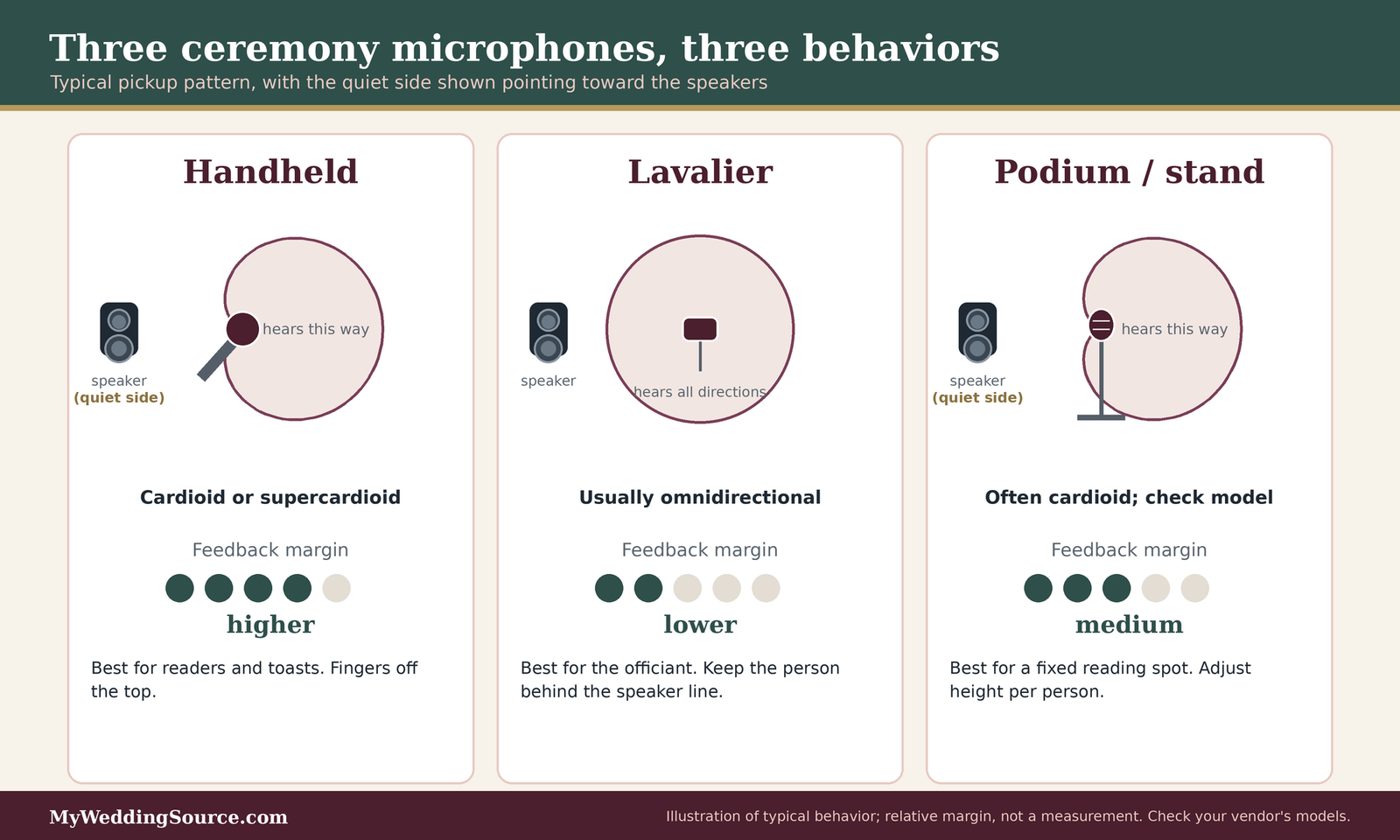
Most ceremonies use some mix of three microphone styles, and the choice shapes how to prevent feedback at an outdoor wedding ceremony: a handheld, a lavalier (the small clip-on kind), and a podium or stand microphone. None is best everywhere. The right choice depends on who is speaking, whether they will move, and how close the speakers will be. The grid below is the practical center of this guide on how to prevent feedback at an outdoor wedding ceremony, and it is meant to be used with your sound vendor, not instead of one.
Reading the grid
The grid, a tool for how to prevent feedback at an outdoor wedding ceremony, describes typical behavior. Microphone models vary, and a vendor’s specific model may differ from the general pattern, so use the grid to prepare questions, not to overrule your operator.
What the columns mean
Pickup is where the microphone listens. Feedback margin is a plain-language summary of how much volume you can usually add before the loop closes, based on the pickup pattern and the distance from the mouth. Wind and handling describe the other common outdoor problems. The last two columns say where each style fits a ceremony and what to watch for. The pickup details for lavalier and handheld microphones come from an equipment-rental guide, MediaGear, and the feedback guidance from Shure and Audio-Technica.
What the grid does not do
It does not rank brands, give prices, or promise results. It also cannot tell you how your site behaves. A lawn with a stone wall behind the officiant is different from an open field. The grid gets the conversation started, and the sound check settles it.
| Style | Typical pickup | Feedback margin | Wind and handling | Best ceremony job | Watch for |
|---|---|---|---|---|---|
| Handheld | Cardioid or supercardioid, favors what is in front | Higher, if held close and not cupped | Handling noise from hands; wind on the capsule without a windscreen | Reader, guest toast, musician announcements | Cupping, wandering toward a speaker, bass buildup when held very close |
| Lavalier (clip-on) | Usually omnidirectional, hears all directions | Lower, so the speaker line matters more | Cable and wind noise are low per the rental guide, but clothing rustle is a risk | Officiant, and the couple if they speak softly | Placement set before the ceremony, head turns, rustle, two lavs close together |
| Podium or stand | Often cardioid, but depends on the model | Medium to higher, if the speaker stays in position | Wind on an exposed stand; stand can be bumped | Readings from a fixed spot, officiants who do not move | A speaker who leans away, a stand placed in front of the speaker line |
Handheld microphones
A handheld is the most familiar microphone and, for feedback control, the most forgiving when it is used well.
Why a handheld helps prevent feedback at an outdoor wedding ceremony
MediaGear’s guide says handheld microphones are typically cardioid or supercardioid, so they focus on the source in front and reject more background, and that this directional focus allows higher gain before feedback, which suits loud live settings. That matches the manufacturer guidance on directional patterns. For a ceremony, a handheld is a good choice for a reader, a guest who gives a toast, or a musician who announces a song.
How a handheld goes wrong
The same guide lists handling noise from hands moving on the body and proximity effect, where the bass rises as the speaker gets closer. Untrained users, it says, may get heavy, distorted low end. Add Shure’s warning about cupping the grille and the picture is clear: hold it below the chin, pointed at the mouth, at the distance your operator recommends, and keep fingers off the top. A short demonstration at the rehearsal beats any instruction on the day.
Lavalier microphones
A lavalier is the small clip-on microphone that most officiants wear. It frees both hands and sits close to the mouth, which are real advantages.
Why a lavalier is more delicate for feedback
The MediaGear guide describes lavalier microphones as omnidirectional, so they hear in all directions and pick up more of the room. Audio-Technica warns that omnidirectional microphones make feedback much harder to control. Some lavalier models are directional, so if your vendor uses one, ask about the model. In general, a lapel microphone on a person who stands near a speaker is the setup most likely to squeal, which is why the speaker line matters more with lavaliers than with handhelds.
Placement and rustle
MediaGear says a lavalier is typically clipped about five to eight inches below the mouth, and that its position should be set carefully at the start. The same guide lists clothing rustle and changes in volume and tone when the head turns away from the capsule as common failure points. Lavaliers are also less affected by wind and cable noise than handhelds, according to that guide, but placement under a collar or a veil changes the story, so ask the operator to test it with the real clothing at the rehearsal.
Podium and stand microphones
A podium or stand microphone is the oldest solution, and it is still useful when someone will read from one spot.
Where a fixed microphone shines
A fixed microphone keeps the voice in one place, which makes feedback control more predictable. If the officiant or a reader stands behind a lectern or a stand, the operator can tune the system to that spot and keep it there. Because the microphone does not travel, there is also less risk of the speaker drifting toward a loudspeaker, which Shure notes is a particular problem with wireless setups.
Where it fails
Fixed microphones fail when people move. A reader who leans away, a bride who steps to the side, or a child who is too short for the stand turns a well-tuned microphone into a distant one, and the operator may raise the gain to compensate. That is the moment the loop starts. If you use a stand, have it adjusted for each person who will use it and rehearse the move to the stand, not only the reading. Wind can also push a lightweight stand over, which is another reason to place it away from the loudspeaker line and to secure it.
Where speakers and people stand
Layout is the heart of how to prevent feedback at an outdoor wedding ceremony. A good layout makes the sound check easy, and a bad layout makes it a fight. This section turns the levers into a plan you can sketch on paper before the day. The best way to learn how to prevent feedback at an outdoor wedding ceremony is to draw it.
The speaker line and the stage line
To apply how to prevent feedback at an outdoor wedding ceremony on a real lawn, think of two imaginary lines across the ceremony area. One runs along the front of the loudspeakers. The other runs along the front of the spot where the officiant and couple stand.
Keep the people behind the speakers
Audio-Technica’s rule is that the microphone belongs behind the main speakers. At the ceremony, that means the speaker line sits in front of or level with the people, facing the guests, and the stage line sits behind it. If speakers stand beside a trellis or an arch, they should be set a little forward of it. If your venue has a fixed sound system, ask where the speakers are and where a speaker would need to stand to be behind them. The third figure shows an example layout from above.
Aim the quiet side at the speakers
For a cardioid microphone, the rear is the quiet side. Shure notes that if a performer must stand near a monitor, the rear of the microphone should face it. Ceremonies rarely have monitors, but the same idea applies to the main speakers: the person speaks toward the guests, and the speakers sit in the area the microphone ignores. For lavaliers, which are omnidirectional, there is no quiet side, so distance does all the work.
Coverage for a larger crowd
Distance helps in two directions. It is good between speaker and microphone, and it is good between speaker and audience, where closer speakers mean less volume is needed.
Bring sound closer to the guests
Shure’s guidance says halving the distance from speaker to audience allows about six decibels more output before feedback. If a ceremony has a long, narrow seating area, a single pair of speakers at the front forces the sound to travel past the front rows to reach the back, which tempts someone to turn it up. Ask your vendor whether additional speakers placed along the sides would let the system run quieter. We have not verified a standard rule for crowd sizes, so let your operator judge by looking at your layout.
Check what sits behind and beside
The reflecting surfaces we mentioned earlier matter again here. A tent wall, a building, or a hedge close behind the guests can bounce sound back toward the front. We could not find a source that gives a safe distance, so this is a general reasoning point: ask your operator to walk the site, clap in a few places, and listen for echoes that return to the stage area. If something sounds slapped back, mention it in the sound check.
The sound check and ring-out that keep a ceremony quiet
Most feedback problems at ceremonies are not discovered during the ceremony. They are discovered, or avoided, in the time before guests arrive. A short, repeatable sound check is the best insurance when you are working out how to prevent feedback at an outdoor wedding ceremony. If you want a simple definition of how to prevent feedback at an outdoor wedding ceremony, it is this: test it where it will be used, with the people who will use it.
Before the day
The preparation is mostly conversation. A quick call with your vendor changes what happens on site.
Share the plan and the people
A quick conversation about how to prevent feedback at an outdoor wedding ceremony helps most when it is specific. Tell the vendor who will speak, where they will stand, and whether anyone will move. Share the officiant’s name and, if possible, ask whether the officiant has a preferred microphone. Our wedding officiant guide covers what to ask an officiant, and the wedding rehearsal guide shows how to run a walk-through. Ask the vendor for a written note of the microphones, the backups, and the setup time.
Agree on setup time and access
Ask when the vendor will arrive, how long setup takes, and when the site will be ready. Our wedding vendor timeline explains how to schedule arrivals so the sound check is not squeezed between the florist and the photographer. A check that happens while chairs are still being placed does not test the real conditions.
The ring-out on site
The ring-out is the core of the sound check, and it should take only a few minutes if the layout is good.
How the operator does it
Following Shure’s steps, the operator raises the system level slowly with a microphone in the speaking position until feedback begins, identifies the pitch, cuts it modestly, and repeats, stopping at the level the ceremony needs. The operator then lowers the level slightly so there is a margin. We recommend asking the vendor to explain the margin they leave. A system that is ringing at the edge during the sound check will squeal the moment someone turns their head.
Check every microphone in every position
A ring-out for one microphone is not a ring-out for all, and this is where how to prevent feedback at an outdoor wedding ceremony gets specific. Each microphone and each speaking position changes the result. Test the officiant’s lavalier in the officiant’s spot, the couple’s microphones where they stand, the reader’s handheld at the stand, and any musician’s microphone. Then have each person speak at normal ceremony volume, and walk the seating area to check that the sound is even. Run the test once more with the chairs filled, if possible, since a crowd changes the space.
The final check before guests arrive
A last walk-through catches what the sound check missed.
Confirm batteries, mutes, and the spare
Fresh batteries, labeled transmitters, a clear mute plan, and a spare microphone within reach are the practical protection against embarrassment. Ask who changes the batteries and when. Our wedding audio and lighting checklist has a broader production checklist, and the wedding emergency kit guide is a good place to add spare batteries to the day-of bag.
Rehearse the cues, not only the words
A quiet system depends on cues: the operator opens the officiant’s microphone when the music fades, opens the couple’s microphones for vows, and closes them afterward. Walk through the order once, with the person who will actually do it. Our wedding processional order guide is useful for fixing the sequence, and our wedding vows guide covers how to speak them so a microphone can follow.
Wind, wireless interference, and weather at an outdoor ceremony
Three outdoor problems get mistaken for feedback or get in its way: wind noise, radio interference, and weather. They are different problems with different fixes, and it helps to name them correctly so the right person solves them. Planning for them is part of how to prevent feedback at an outdoor wedding ceremony, because a crew that is fighting wind will often raise the gain and create the loop it was trying to avoid.
Wind is noise, not feedback
Wind hitting a microphone produces a low rumble or crackle. It does not howl, but it can drown a quiet voice, and the instinct to turn up the microphone makes the loop more likely.
Windscreens, positioning, and low-cut filters
Rode, a microphone maker, describes foam windshields as the usual first line of defense and furry windshields as better for strong wind, noting that fur can dull high frequencies. It also suggests positioning the speaker out of the wind, for example by having the person turn so their body blocks gusts, and notes that wind noise sits mostly at low frequencies, roughly 20 to 250 hertz, where a low-cut or high-pass filter helps. The Broadcast Bridge adds that gusts on a lavalier’s sound ports can cause damage to the recording that cannot be fixed afterward, and that the thin stock foam supplied with many lavaliers gives little protection outdoors. It recommends fur-style windscreens designed for the purpose.
What this means for a ceremony
Wind protection is part of how to prevent feedback at an outdoor wedding ceremony, since it keeps the crew from chasing gain. Ask your vendor which windscreens they bring for each microphone, and whether the lavalier can be concealed where wind is less likely to reach it, such as inside a collar or placket instead of an exposed tie. The sources suggest testing placements beforehand to balance wind protection with clear sound. If the weather forecast shows strong wind, ask about moving the speaking position behind a wall, a hedge, or an arch.
Wireless interference and what it sounds like
Most ceremony microphones are wireless, and they use radio frequencies that follow national rules.
Dropouts are not feedback
MediaGear notes that crowded radio environments, such as trade shows and large venues, can cause signal dropouts, and recommends scanning for clear frequencies, checking that frequencies are legal in your region, and using dual-channel systems that can switch if interference appears. A dropout sounds like cutting out, static, or silence, while feedback sounds like a rising howl. If the vendor tells you that interference occurred, ask which frequency they scanned and what the spare plan was.
Frequency rules your vendor should know
The Federal Communications Commission explains that most current wireless microphones use the TV bands, with licensed and unlicensed options, and that since a 2017 auction the 617 to 652 and 663 to 698 megahertz ranges were repurposed for broadband, with microphones required to stop operating there by July 13, 2020. The FCC also says the manufacture, sale, and lease of microphones for those repurposed ranges is prohibited. You do not need to manage this yourself. It is a reasonable question to ask a professional vendor whether their equipment is compliant for your region. We are not giving legal advice, and a vendor who rents consumer equipment may be less certain than a production company.
Weather decisions sit above audio
Storms change the priorities. Sound equipment is replaceable, but people are not.
Lightning and shelter
The National Weather Service says that if you hear thunder you are close enough to be struck, that people should go indoors immediately, and that they should wait until 30 minutes have passed since the last lightning or thunder. It lists large, solidly built buildings and vehicles with a closed solid roof as safe, and lists covered outdoor areas, small sheds, and open vehicles as not safe. The CDC adds that gazebos, tents, and picnic pavilions offer no protection, and that people should put down metal items such as umbrellas. OSHA and NOAA’s fact sheet for outdoor workers says lightning tends to strike the tallest objects, so people should stay clear of tall equipment and metal. Our inference is that this matters for tall speaker stands, so ask your vendor how they secure equipment and what they do if lightning is forecast.
Name who makes the call
The National Weather Service’s Event Ready Guide advises planners to decide in advance how weather hazards will trigger the plan, how people will be alerted, and how long moving to shelter will take, and suggests adding a 25 percent safety factor to that time. It also recommends assigning weather awareness to a role so someone is always responsible, and starting to monitor at least three days before the event. For a wedding, that role might be the planner, the venue manager, or another named person. Our summer wedding heat plan and outdoor wedding infrastructure checklist cover related planning, and our wedding insurance guide covers wedding insurance in general. Electrical and rigging work should be left to qualified staff, and we are not giving safety-engineering advice.
Edge cases that cause squeals
The standard setup works until a real wedding does something unscripted. Most of the cases below come down to the same levers, but they are worth planning because they are the moments when the loop starts.
People who move
Movement is the most common cause of trouble for any plan on how to prevent feedback at an outdoor wedding ceremony. Shure notes that performers wandering toward a speaker invite feedback, especially with wireless microphones.
The officiant who walks
Some officiants step forward, move among the guests, or walk with the couple. A lavalier suits this, but the system must be tuned for the position the officiant will actually use, and the officiant should be told where the speaker line sits. Ask the officiant to stay behind the speaker line when the microphone is open, and plan a mute if they move forward.
The couple who turn to face each other
Vows are often spoken facing each other, with heads turned away from the audience. MediaGear lists changes in volume and tone when the head turns away from the capsule as a lavalier problem, and a quiet voice invites more gain. Ask the vendor how they will keep vows audible without a big increase, for example by using lavaliers on both people with a short mute before and after, or a nearby stand microphone. Our wedding vows guide covers how to prepare and rehearse them.
Guests and borrowed microphones
Anyone who has not used a microphone before is unpredictable. That is not a flaw in the guest, it is a planning fact.
Readers and toasts
A reader at a stand or with a handheld may lean in, lean out, or cup the microphone. A short demonstration at the rehearsal, and a short hand signal from the operator, is a better strategy than explaining during the ceremony. Our wedding readings guide covers choosing readings, and knowing the order helps the sound operator plan.
Children and soft voices
A child reader may stand too far from the microphone, or the stand may be too tall. Adjust the stand before the child arrives, and let the operator know so the gain is not raised blindly. If a child is nervous, a short practice with the real microphone, even once, usually helps more than any instruction.
Music and the ceremony site
Live music at a ceremony adds another source and another microphone.
Musicians near the speakers
A guitarist, a violinist, or a singer who is amplified becomes another open microphone in the same field. Place them out of the speaker line or ask whether they need amplification at all. Our wedding songs guide covers ceremony music, and our wedding DJ questions guide shows what to ask a DJ who also runs the ceremony sound.
Recorded music and open microphones
When recorded music plays through the same speakers, any open microphone near the stage hears it. The processional is a common moment: the officiant’s lavalier is live, the speakers are loud, and the officiant is standing close. Close that microphone until the music ends, then open it, as an operator does with a cue sheet.
Guest phones and cameras
Not every squeal comes from the system. We did not find a reliable source on whether guest phones affect a sound system, so we leave that as a question for the vendor. If you plan an unplugged ceremony, our unplugged wedding ceremony guide covers the etiquette.
Video and photo audio
A photographer or videographer may want a clean feed or place their own recorder near the officiant. Share the plan with the sound vendor and the photographer so no one adds a microphone without telling the operator.
Plug-in feeds and splitters
Some videographers ask to plug into the sound system. Ask your vendor whether they offer a feed and who connects it, since an unplanned connection can introduce unexpected noise. A feed from the mixer is a better answer than a new microphone near the speakers.
Questions to ask your sound vendor and venue about feedback
A good vendor will answer these quickly, and the answers show how seriously they take how to prevent feedback at an outdoor wedding ceremony. A vague answer is useful information too. Use the list below as a script for how to prevent feedback at an outdoor wedding ceremony, and ask for the answers in writing, since memory fails on a busy day.
Questions for the sound vendor
Ask about the equipment, the people, and the plan for when something fails.
Equipment and microphones
Questions to ask your sound vendor
- Which microphone models will each person use, and are they directional?
- Where will the speakers stand, and how far will they be from the officiant and the couple?
- Will you ring the system out at the real positions before guests arrive, and how long does that take?
- Who will operate the mixer during the ceremony, and can that person mute and unmute each microphone?
- What windscreens do you bring for each microphone, and what is the plan if wind is strong?
- What is the spare microphone, where is it kept, and how long does a swap take?
- Do you scan for clear wireless frequencies at the site, and what is your plan for interference?
- Is your equipment licensed or compliant for the frequencies used in our area?
- How do you secure speakers and stands in wind, and what is your plan if lightning is forecast?
- What does your quote include for setup, the operator, and backup equipment?
Vendor credentials and plan
Ask whether the vendor has worked at similar outdoor sites and whether they will visit or review photos of yours. Our wedding vendor due diligence checklist helps you verify insurance and contracts, and our wedding DJ questions guide is relevant when a DJ provides the ceremony sound.
Questions for the venue
The venue controls power, access, and rules, and it may have its own sound system.
Power, access, and house systems
Ask whether the venue provides a house sound system and whether outside vendors are allowed to use it, where power is available, and whether there are restrictions on cables or generators. Our wedding venue questions guide and outdoor wedding venues guide cover broader venue questions.
Sound limits and permits
Some venues and localities limit amplified sound or require permits. We did not review any local ordinance and cannot tell you what applies to you. Ask the venue for its written sound policy, and check with the local authority if the site is a park or public space. Our wedding permits guide covers permits in general, and a sibling guide on wedding reception noise limits covers the reception side.
What this can add to your budget
We did not find reliable published prices for ceremony sound, so we are not quoting any. The line items that tend to appear on a quote are the operator’s time, extra microphones or a spare, windscreens, additional speakers for a larger crowd, and setup time for a site without power. Ask for an itemized quote, ask what is included in the base price, and compare it against what your venue already provides. A short sound check and a spare microphone are usually small items compared with the cost of a ceremony no one can hear, but ask your vendor, because pricing varies widely.
What to do if it squeals anyway
Even a well-planned system can squeal if a person turns, a microphone is dropped, or a battery changes the level. A good crew has a short, calm response, and the couple should know it exists. The aim of knowing how to prevent feedback at an outdoor wedding ceremony is fewer surprises, not a perfect record.
The operator’s first moves
The fix in the moment is almost always a single, quick action.
Mute, then lower, then find the cause
The fastest fix is to mute the microphone that is most likely the cause, which stops the loop at once. The operator can then lower the level slightly, check where the speaker and microphone are, and reopen the microphone. If the cause was a person who stepped forward, a quiet word or a hand signal helps. If the loop returns at the same pitch, a small cut at that frequency, as in the ring-out, usually resolves it.
When an automatic reducer helps
Shure notes that automatic feedback reducers are useful with wireless microphones because they can react faster than a person, though they supplement good placement. Ask whether the vendor’s system has one and whether it is on for the ceremony. If the reducer cuts too deeply, as Audio-Technica warns, the voice may sound hollow, which is a better problem than a howl.
The couple’s and guests’ part
The couple and the officiant do not need technical skill. They need a script.
Keep going, calmly
If a squeal happens, the officiant can pause, smile, and wait a moment while the operator fixes it. Guests tend to take their cue from the people at the front. A planned pause is less stressful than a rushed fix, and a short pause costs little.
Share the plan with the wedding party
Tell your coordinator, officiant, and a trusted friend who is sitting in the audience how the cue works. If the sound drops out, one person walks to the operator quietly and does not shout. Our wedding ceremony guide and wedding party coordination checklist help assign these roles.
Basics
Why does a microphone squeal at an outdoor wedding ceremony?
Sound from a speaker travels back into an open microphone, gets amplified, and repeats until it howls, as Shure explains. It usually starts when a microphone sits too close to a speaker, the gain is high, or several microphones are open. Moving people behind the speakers and muting unused microphones removes most of the risk.
Is feedback more likely outdoors or indoors?
It can happen in both. Indoors, hard walls can reflect sound back, while outdoors there are often fewer reflections, but the same loop applies, and tent walls or buildings nearby can bounce sound. Wind and quiet voices also tempt crews to raise the level. Ask your operator to assess your specific site.
Does the officiant need a microphone at a small ceremony?
Often yes, because sound disperses outdoors and a soft voice can be lost. Whether you need one depends on the guest count, the site, and the officiant’s voice. Ask your vendor to test at the real positions, and ask about a spare. A properly placed lavalier or handheld is usually enough for small groups.
Equipment and setup
Which is safer for feedback, a lavalier or a handheld?
Typically a handheld, because handhelds are usually cardioid or supercardioid and allow more gain before feedback, according to MediaGear, while lavaliers are usually omnidirectional. A lavalier is still common for officiants because it frees the hands. With a lavalier, keep the person behind the speaker line and mute it when idle.
What is a ring-out and who does it?
A ring-out is a short test in which the sound operator raises the level until a pitch starts to howl, then makes a small cut at that pitch and repeats, as Shure describes. The operator does it at the real positions before guests arrive. Ask the vendor how long it takes and what margin they leave.
How many microphones should be open during the ceremony?
As few as the moment needs. Each open microphone is another path for feedback, and Shure advises turning off those not in use. A common plan is for the operator to open the officiant’s microphone, then the couple’s for vows, and close each afterward. Agree on the cues at the rehearsal and write them down.
Weather and rules
What if the wind is strong on the wedding day?
Wind noise is not feedback, but it can hide voices and tempt a higher gain. Rode suggests foam windshields first, furry ones for strong wind, and positioning the speaker out of the gusts. Ask your vendor which windscreens they bring, and whether the speaking spot can move behind a barrier.
What should we do if a storm threatens the ceremony?
Follow your written weather plan. The National Weather Service advises going indoors when thunder is heard and waiting 30 minutes after the last thunder or lightning. Tents and gazebos are not safe shelter, according to the CDC. Name a decision-maker in advance, and leave equipment decisions to qualified staff. Safety comes before the sound system.
Your next steps
Plan the setup
Sketch the speaker line and the stage line
Draw the ceremony area from above, mark the speakers, the officiant, the couple, and any reader. Check that every open microphone sits behind or level with the speakers. Share the sketch with your sound vendor and ask for their changes, then keep the final version in your planning folder.
Choose the microphone for each speaker
Use the selection grid in this guide to decide who gets a lavalier, a handheld, or a stand, and ask the vendor for the specific models. Our wedding audio and lighting checklist shows where microphones fit into the wider production plan.
Lock in the details
Get the answers in writing
Send the vendor questions on how to prevent feedback at an outdoor wedding ceremony by email and save the replies with the contract. Our wedding vendor due diligence checklist and wedding lighting guide help you keep the rest of the production organized.
Book the sound check and the rehearsal cues
Ask for time before guests arrive for the ring-out, and add the mute cues to the rehearsal. Our wedding rehearsal guide shows how to run it, and a sibling guide on wireless wedding ceremony audio and one on a wedding AV backup plan go deeper on radio and backups.
Sources & methodology
How we built this guide
What we relied on
This guide combines National Weather Service, CDC, and OSHA lightning and event-safety guidance, Federal Communications Commission pages on wireless microphones, and published feedback and microphone guidance from manufacturers and an equipment-rental company. Where a statement comes from a company, we say so, because manufacturer advice reflects the maker’s products and habits. The distance examples in the first figure are our own arithmetic from the six-decibel rule of thumb and are estimates. The selection grid and the layout figure are editorial illustrations based on the sources, not measurements. We checked the sources listed below in November 2026; guidance and rules can change, so confirm anything time-sensitive with your vendor and the issuing agency.
What we did not do
We did not test microphones, measure any site, or review local noise ordinances, permits, or venue policies. We did not find reliable published prices for ceremony sound, so we quote none. This is general planning information, not electrical, engineering, safety, or legal advice. Electrical and rigging work should be done by qualified professionals.
Source list
Government and public-safety sources
- National Weather Service, Weather safety: https://www.weather.gov/safety
- National Weather Service, Lightning safety overview: https://www.weather.gov/safety/lightning-safety-overview
- National Weather Service, Event Ready Guide: https://www.weather.gov/media/crh/eventready/Event_Ready_Guide.pdf
- Centers for Disease Control and Prevention, Lightning safety tips: https://www.cdc.gov/disasters/lightning/safetytips.html
- OSHA and NOAA, Lightning safety when working outdoors (OSHA 3863): https://www.osha.gov/Publications/OSHA3863.pdf
- Federal Communications Commission, Wireless microphones: https://www.fcc.gov/topic/wireless-microphone
- Federal Register, FCC proposed rule on wireless multi-channel audio systems (July 1, 2021): https://www.govinfo.gov/content/pkg/FR-2021-07-01/pdf/2021-10716.pdf
Manufacturer and equipment sources
- Shure, How to control feedback in a sound system: https://www.shure.com/en-us/insights/how-to-control-feedback-in-a-sound-system/
- Audio-Technica, How do I prevent microphone feedback: https://blog.audio-technica.com/audio-solutions-question-week-prevent-microphone-feedback/
- MediaGear, Lavalier vs. handheld mics: https://mediagear.ee/lavalier-vs-handheld-microphone/
- Rode, Ways to reduce wind noise when recording outside: https://rode.com/en/blog/all/ways-to-reduce-wind-noise-when-recording-outside
- The Broadcast Bridge, Avoiding outdoor wind noise when recording with lavalier mics: https://www.thebroadcastbridge.com/content/entry/9026/avoiding-outdoor-wind-noise-when-recording-with-lavalier-mics