

Wedding readings are short texts that someone other than the couple speaks during the ceremony, and the ones that land are rarely the most famous: they are the ones that suit your officiant’s rules, your readers’ voices, your guests’ ears, and the minutes you actually have.
Quick answer
Ask your officiant what is allowed before you browse a single poem, because a religious ceremony may set the texts and a secular one usually leaves them open. Then plan one or two wedding readings of about one to three minutes each, which is the range one major wedding site recommends, and pick them by who will read them and how they sound aloud, not by how often they appear online. Check whether the text is still under copyright before you print it in a program. If you are unsure which text to use, a short passage from a source that already means something to both of you is a safer default than a famous poem that does not.
Most advice about wedding readings is a list of titles. A list can help you start, but it cannot tell you which title is right for your ceremony, because the answer depends on rules and constraints that a list does not show. This guide is built around those constraints. It helps you decide how many wedding readings you need, what kind, who should deliver them, how long they can run, and what you need to check before the words go into a printed program. It does not repeat the full ceremony plan, which lives in our wedding ceremony guide, and it does not cover personal promises, which are a different task covered in our guide to wedding vows.
A note on method. We read current guidance from two large wedding planning sites, from one Catholic archdiocese, from a university public speaking text, and from the U.S. Copyright Office and the Cornell copyright guide. We found no national survey of how many couples include wedding readings or which texts they choose, so this guide makes no claim about what is popular. Where we do arithmetic, such as converting minutes into words, we label it as our own estimate.
Define the decision before you choose wedding readings
A reading is a small decision with several moving parts. Couples often begin with the text and discover later that the officiant has objections, that the reader dreads speaking, or that the passage runs four minutes. Starting with the constraints reverses that order and saves rework. Treat wedding readings as a planning decision first and a literary one second.
List the inputs that change your wedding readings
Five inputs matter more than any individual poem. They are the ceremony’s religious or secular structure, the time available, the people who could read, the guests in the room, and the permissions the text requires. Each one removes some options from the table. Settle these five, and your wedding readings shortlist usually shrinks to a handful of workable texts.
The ceremony’s structure and the officiant’s role
A ceremony inside a faith tradition may specify its readings, while a secular or civil ceremony may leave the whole choice to you. That is the biggest single input. In the Catholic guidance we reviewed, from the Archdiocese of New York, two or three readings may be proclaimed at a wedding with or without Mass, and at least one of them must explicitly address marriage. Other traditions have their own rules, and an officiant who is not tied to a tradition may simply ask what you want. Ask first, in writing if you can, because the answer changes which texts are even eligible. Few other facts affect wedding readings as much. Our wedding officiant guide covers how to find and question the person leading your ceremony.
Guest count, venue, and sound
Readings are heard, not read, so the room matters. A backyard ceremony for forty people where everyone sits within a few rows is a different setting from a church with stone walls and a hundred and eighty guests, or an outdoor ceremony with wind and traffic. The more distance and ambient noise, the shorter and simpler the language should be, and the more you should plan for a microphone. A university public speaking text recommends speaking louder than most speakers expect, which is useful to hand to a reader who tends to speak quietly. If you cannot test the space before the day, plan on a rehearsal reading with someone standing at the back. Sound is one of the quiet reasons wedding readings succeed or fail.
Timing and the rest of the program
A ceremony has a fixed amount of attention to spend. One planning site suggests keeping the whole segment of wedding readings to no more than five minutes, with each reading running one to three minutes, and another suggests a rule of thumb of two minutes or less for each. Those are editors’ recommendations rather than rules, but they agree on the direction: short. If your ceremony also includes personal vows, a unity ritual, a musical interlude, and a long officiant address, every minute you give to wedding readings comes from somewhere else. A short, well-chosen text often does more than a long one. Our wedding planning timeline helps place the ceremony inside the larger day, and the ceremony guide covers how long the pieces usually take.
People who could read, and who cannot
Make a list of every person you might ask, then mark each one honestly: comfortable speaking to a crowd, willing but nervous, or likely to say yes out of obligation. The marking changes the text. Good wedding readings start with honest notes about people. A nervous reader should get a short, plain passage with clear sentences. A confident reader can carry a longer, more rhythmic piece. One planning site recommends giving a shorter reading to someone who is nervous before crowds, and that is a practical rule you can apply without any further research.
Separate hard constraints from social pressure
Not every limit is equal. Some are real, such as an officiant who will not allow non-scriptural texts, and some are only expectations, such as a relative who assumes a particular poem will be read. Sorting them early keeps you from solving the wrong problem.
What counts as a hard constraint
Treat as hard anything set by someone with authority over the ceremony or by a law or contract. That includes an officiant’s or faith community’s rules about texts, a venue’s rules about amplified sound, and the copyright status of a text you want to print. A constraint is hard when ignoring it would change the ceremony, cause a conflict on the day, or create legal exposure. Everything else is negotiable, and the practical test is whether someone can actually stop you. Most wedding readings problems turn out to be pressure, not constraint.
What counts as social pressure
Pressure usually arrives as a suggestion: your aunt reads at every family wedding, a friend wants to share a favorite, or a parent wants a particular passage included. These are worth hearing because they often reveal relationships you want to honor. They are not obligations. Wedding readings are optional, as one major wedding site points out, so you can honor a relative in another way, such as an usher role, a seat of honor, or a toast at the reception. Declining a request about wedding readings does not mean declining the person. If a request cannot be accommodated, a kind and specific answer works better than a vague one, and our wedding etiquette guide has more on handling family expectations without a standoff.
Identify the second-order effects of each choice
Every reading choice changes things beyond the minutes it takes. Looking at those effects before you commit prevents the small surprises that show up in rehearsal or on the day.
What the choice changes downstream
A reading changes the printed program, the rehearsal, the photographer’s and videographer’s plan, and sometimes the officiant’s script. A passage in another language needs a translation printed beside it. A long passage in the program takes space that a shorter one frees. A text under copyright may need written permission before it is printed or livestreamed. Our guide to wedding programs covers what else belongs on that page, and the rest of this guide covers how to check each downstream effect. Wedding readings touch more of the day than their length suggests.
Fairness, workload, and the guest experience
Asking someone to read is a gift and a burden at once. It is a visible honor, and it asks the reader to prepare, to travel with a printed copy, and to stand in front of everyone. Think about whether the honor spreads sensibly across your families and friends. Think also about the guests: a text in a language half the room does not speak, an in-joke that most guests will not get, or a passage that runs long on a hot afternoon changes how everyone experiences the ceremony. The best wedding readings let most of the room feel included, even if only a few people know the references. That test is worth applying to every one of your wedding readings.
Learn what your officiant and tradition allow for wedding readings
Rules about readings vary more than most couples expect, and the sources we reviewed do not cover every tradition. This section describes the situation in broad terms and shows one example in detail, then explains how to ask for the specifics from your own officiant.
Religious ceremonies often set the texts
In many faith traditions the readings are part of the liturgy, and the couple chooses within a set of options rather than from anywhere. That does not make the choice small, but it changes the work: you are selecting from a list, and your reader is proclaiming a text that belongs to a community. Wedding readings in a liturgy are a shared inheritance as well as a personal choice.
One example: Catholic wedding readings
The Archdiocese of New York’s liturgical question-and-answer page says the options come from the Order of Celebrating Matrimony, that at least one reading must explicitly address marriage, and that the first reading is normally from the Old Testament, except in Easter Time, when it comes from the Book of Revelation. It also says poems, song lyrics, and other non-biblical texts may not replace the Scripture readings or the Responsorial Psalm. Those texts can still appear elsewhere, such as before the entrance procession, within the homily, or as a comment at the dismissal, according to the same page. That is the single most useful detail for couples who love a particular poem and are marrying in a Catholic church: ask the priest or deacon where it can go instead of whether it can replace Scripture. The same approach applies to other rules about wedding readings.
Other traditions and interfaith couples
We did not find a reliable primary source in this research for the rules of other traditions, so we will not summarize them. The practical step is the same: ask the person who will lead the ceremony which texts are expected, which are permitted, and which are not. For interfaith couples, one planning site suggests including a reading from each tradition, such as a Bible passage and a Quran passage. That is one editorial suggestion, not a universal rule, and the officiant or community leaders for each side may have views you should hear before settling on it. Wedding readings in an interfaith ceremony deserve extra conversation.
Secular and civil ceremonies leave more open
If your officiant is a judge, a celebrant, a friend ordained for the day, or a clerk, the wedding readings are usually yours to choose. That freedom is a gift and also the source of most generic choices, because the same three or four poems appear in an enormous number of ceremonies. Many wedding readings sound alike for that reason alone.
What to confirm with a non-religious officiant
Ask whether the officiant has any preference about length, whether they want to read the text in advance, and where they would place wedding readings in the script. Some civil officiants, such as courthouse staff, have a fixed format and little time, and they may not allow additions. In that case the reading could move to a moment outside the formal ceremony, such as a short toast or a note in the program. Our marriage license guide explains the legal side, which is separate from wedding readings: the legal steps are the same whether or not anyone reads a poem.
Where readings usually sit in the script
One planning site says readings usually come early in the ceremony, after the officiant’s introduction and before the vows, though the officiant may suggest another point. That position makes sense for a practical reason: guests are settled and attentive, and the reading sets a tone before the personal moments. If you have two wedding readings, some couples space them, with one early and one after a ritual or musical piece, so that the ceremony has some variety and nobody sits through two in a row. That is a planning idea, not a rule, and your officiant may have a better arrangement for the room. Placement matters as much as selection for wedding readings.
Compare the kinds of text against the same criteria
Instead of ranking individual poems, compare the kinds of text. Each kind carries a predictable set of strengths and risks, and once you know the kind that suits your ceremony, finding the specific passage becomes much easier.
The kinds of wedding readings, in plain terms
The categories below are our own grouping, built from the types that the planning sites we reviewed list: religious texts, prayers and blessings, poems, song lyrics, movie quotes, and book excerpts. We added a few that couples use in practice, such as personal letters and group readings.
Sacred texts, prayers, and blessings
These include passages from scripture, traditional blessings, and liturgical prayers. They suit couples whose faith or family tradition is part of the day, and they carry the weight of long use. The risks are mismatch (a passage that one of you does not believe or that guests from other backgrounds find alienating) and translation, since translations differ in copyright status and in which versions an officiant uses. Ask which translation your officiant uses and whether you can print it.
Classic poems from before the copyright cutoff
Poems published long ago, such as the 1609 sonnets of Shakespeare, are in the public domain, which makes printing them straightforward. That is one reason older texts remain common wedding readings. The Poets.org page for Sonnet 116 lists a 1609 date and a 14-line form. Classics tend to have elevated language that can sound stiff when read cold, and they appear in so many ceremonies that guests may recognize them. That recognition can be a comfort or a signal that the choice was automatic. A classic works best when you have a specific reason for it that you can say in one sentence.
Contemporary poems and song lyrics
Modern poems can sound more like the couple, with plain language and current images. They are almost always under copyright, which affects printing and sometimes reading aloud, as the next section explains. Song lyrics have the same issue and add a performance problem, because lyrics read as speech often lose the rhythm that made them work in music. If a song matters to you, playing it as part of the ceremony may serve you better than having someone read the words.
Prose excerpts, letters, and children’s books
A paragraph from a novel, a letter between the two of you, or a children’s book can feel distinctive precisely because it is not on the usual lists. One planning site notes that a child might read a children’s book and a friend who loves Shakespeare might read Shakespeare, which shows the point: the text and the reader can belong together. Prose is easier to trim to a length than poetry, because you can cut at a paragraph break without breaking a rhyme. Copyright status varies by book, and the same date rules apply.
Original writing and group readings
You can write the reading yourselves, or ask a friend to write one, or have several people each read a line or two of a shared text. One site suggests that everyone present can read a passage together from the program, which turns the guests from audience into participants. Original writing sidesteps copyright and is the least likely to sound generic, though the quality varies with the writer. Group wedding readings reduce the pressure on any one reader and work best with short, simple lines that people can follow without rehearsal.
Score the options with ranges, not fake precision
No survey measures how well each kind works, so any numeric score would be invented. The table below uses three plain levels, low, medium, and high, and every cell is our editorial judgment from the sources above and from how each kind behaves when read aloud. Treat the table as a thinking tool, not a result. Use it to narrow wedding readings, then decide with your ears.
The decision matrix
| Kind of text | Fits a religious ceremony | Easy for a nervous reader | Easy to trim to length | Permission effort to print | Risk of sounding generic |
|---|---|---|---|---|---|
| Sacred text or blessing | High, if the officiant approves the passage | Medium | Low to medium | Low for older translations, higher for modern ones | Medium |
| Classic public-domain poem | Low to medium | Low to medium | Low | Low | High |
| Contemporary poem | Low | Medium | Low | High | Medium |
| Song lyrics | Low | Medium | Low | High | Medium |
| Prose excerpt or children’s book | Low | High | High | Varies by date | Low |
| Letter or original writing | Low to medium | Medium | High | None | Low |
| Group reading from the program | Medium | High | Medium | Depends on the text | Low |
Read across a row to see the trade-off, and read down a column to see which kinds lead. For example, a prose excerpt scores well for nervous readers and length control but depends on the book’s copyright date, while a classic poem is easy to print but sits at the top of the generic-risk column. No row wins every column, which is why the inputs from the first section matter.
Where two options tie
Some choices tie, and it is useful to say so. A classic poem and a prose excerpt can both suit a secular ceremony with a confident reader, and in that case the tie-breaker should be the people, not the text: choose the one your reader reacts to when they read it aloud. Likewise a letter and an original reading tie on permission and generic risk, and the tie-breaker is time, because writing something good takes longer than most couples expect. If two options still tie, pick the shorter. Shorter wedding readings rarely disappoint a room.
Make wedding readings feel like yours without rewriting them
The generic problem is less about the text and more about the connection. A familiar poem can feel specific if the reader says one sentence about why you chose it. A rare text can still feel generic if nobody says why it matters.
Add a sentence of context
Ask your officiant or the reader to introduce the passage with a single sentence, such as where you first heard it or why it came up in your relationship. That one line does more to prevent a generic feel than switching to a less common poem. It also helps guests who do not know the text, because they have a reason to listen. Context turns wedding readings from decoration into part of the story.
Choose by the line you can explain
When you read a candidate passage, find the one line you could explain to a friend in a sentence. If you cannot find such a line, the text may be pretty but unconnected to you. If two or three lines stand out, consider trimming the passage down to those lines, as long as the original is public domain or you have permission to excerpt, since cutting a copyrighted work is still a use of it.
Check copyright before wedding readings go in print
Copyright is the part of readings that most couples never think about until a program is at the printer. This section gives general information, not legal advice, and a lawyer or the rights holder is the right source for a specific situation.
What is safe, and what needs a closer look
The core rule is about age. The Cornell copyright guide’s chart says works published in the United States before 1931 are in the public domain as of January 1, 2026, because their copyright has expired. For works from 1931 through 1977, the status depends on whether a copyright notice was included, whether the copyright was renewed, and the publication year. The chart says works published with a notice from 1964 through 1977 are protected for 95 years from publication.
Older texts are the simplest choice
If a poem or book was published before 1931 in the United States, you can generally read it and print it. Examples from the sources we reviewed include Shakespeare’s sonnets, which date to 1609; Kahlil Gibran’s 1923 book The Prophet, which Project Gutenberg hosts as a digital edition; and A. A. Milne’s 1926 Winnie-the-Pooh, which Duke’s Center for the Study of the Public Domain lists among the works entering the U.S. public domain on January 1, 2022. Two cautions apply. A new translation or a modern edition with added material can have its own copyright, so check the edition you are copying from. And rules outside the United States differ, which matters if your guests or livestream reach other countries.
Newer texts need permission or a different plan
For a text published in 1931 or later, treat it as protected until you confirm otherwise. The Copyright Office’s page on fair use says there is no formula, no safe percentage, and no safe word count, so quoting a few lines in a printed program does not become safe because it is short. It also says the Office cannot advise individuals on specific fair use questions. If you want a protected poem, the usual path is to ask the publisher or the author’s representative for permission, and to ask early, because replies can take time and fees may apply. We found no standard fee schedule, so we will not quote one.

Reading aloud, printing, and livestreaming are different acts
Three acts involve a text in your ceremony, and the rules do not treat them identically. It helps to separate them so that you ask the right question.
Speaking the text in the room
The statute has exemptions for certain live performances. One covers nondramatic literary or musical works performed during religious services at a place of worship or other religious assembly. Another covers certain live performances without commercial purpose and without payment to performers or organizers, though the notes to that provision describe it as not covering transmissions to the public. Whether a particular wedding fits any exemption is a legal question that depends on the facts. For most couples the practical point is simply that a short reading by a guest in a private ceremony is an ordinary event, and the larger risk is in the other two acts.
Printing the text in a program or on signage
Reproducing a protected text in a program or sign is a copy, and the performance exemptions above do not clearly extend to it. Two simple options exist. Print only a title and author with a line saying who will read it, or print the full text only if it is in the public domain or you have permission. A cleaner program also reads better, as our wedding programs guide explains, and a one-line credit costs nothing.
Livestreaming and recording
A livestream sends the ceremony to people outside the room, and the statute’s notes treat transmissions to the public differently from live performances. If a protected poem is part of a stream or a posted video, ask the rights holder about it, or choose a public-domain text for the streamed ceremony, or read the protected text before the stream begins. If your plan involves a videographer, our wedding photography guide covers how to coordinate with the person recording. None of this is legal advice, and a short consultation with an attorney is reasonable if a text is important to you and the status is unclear.
What wedding readings cost
Readings are mostly free, and the costs that do appear are specific. Permission fees for a protected text, if the rights holder charges one, are set by that holder and vary, so we do not quote a figure. Printing adds a little if you include full texts in the program or on signage, and it adds nothing if you print only a title and a credit. Time is the largest cost: choosing, trimming, rehearsing, and coordinating readers takes hours, and a weak reading can cost the ceremony a few minutes of attention. If you hire a celebrant or a calligrapher, ask whether texts are included in the quote, and get any permission fee in writing before you commit. This is general information, not financial or legal advice.
Test the options against two very different weddings
A framework is only useful if it gives different answers for different weddings. The two scenarios below are illustrative, not real couples, and their assumptions are stated so you can swap in your own.
A small, simple ceremony and a large, complex one
Both scenarios use the same decision inputs: the structure, the time, the readers, the room, and the permissions. The recommendations differ because the inputs differ.
The small and simple case
Assume a backyard ceremony for about forty guests, a friend serving as a non-denominational officiant, a ceremony that runs about fifteen minutes, and two friends who are comfortable speaking. No rule limits the texts, nothing is livestreamed, and the program is a single card. The couple’s constraint is time: fifteen minutes leaves little room for wedding readings beyond a few minutes. Our recommendation is one reading of about two minutes, chosen from a prose excerpt or original writing, with a single line of context from the officiant, and the second friend given a different job, such as a short welcome. This avoids the permission questions entirely if the text is original or old enough to be public domain.
The large and complex case
Assume a church ceremony for about a hundred and eighty guests, a priest officiating, a family that includes both Catholic and non-Catholic relatives, a livestream for relatives abroad, and a printed program. Several constraints are hard: the officiant’s rules about Scripture, the acoustics of a large room, the livestream, and the printed page. Our recommendation is to let the priest guide the Scripture selections within the allowed options, to ask where a favorite poem could go instead, such as a place the archdiocese guidance says non-biblical texts may appear, and to choose public-domain or original text for anything that will be printed or streamed. Add a microphone check in rehearsal, and consider assigning a reader from each side of the family.
Why the preferred option changes
The recommendation changed because different inputs were binding. In the small case, time was the limit and permission was easy. In the large case, authority and distribution were the limits, and time was a secondary concern. That is the central idea of this guide: the right reading is the one that satisfies your binding constraint, and the binding constraint is not the same for every couple. Wedding readings succeed when they respect the limit that actually binds.
The threshold that flips the choice
| Scenario | Assumptions | Recommended approach | What flips it |
|---|---|---|---|
| Backyard, about 40 guests, friend officiates | About 15 minutes total, two confident friends, no stream | One prose or original reading of about 2 minutes | If the ceremony runs past 25 minutes, a second short reading fits |
| Church, about 180 guests, priest officiates | Scripture rules apply, stream, printed program | Scripture within the allowed options, other texts placed where the priest allows | If the priest approves a non-biblical text for a specific moment, add it there |
| Courthouse with a short fixed format | Few minutes, no additions allowed | Move the text to a toast or the program | If the clerk permits a brief reading, use one under a minute |
| Interfaith ceremony, two traditions | Two officiants or leaders, mixed guests | One text from each tradition, trimmed short | If either leader objects, ask for a shared or neutral passage |
| Destination ceremony, few guests | Under 20 guests, no program | One short reading by a guest, or exchange letters privately | If a livestream is added, switch to public-domain or original text |
Use the table as a starting point, not a verdict. The assumptions are ours, and a different officiant or venue could change any row. Your own wedding readings may fit none of these rows exactly, and that is fine.
A worked time budget
Here is a small piece of editorial arithmetic. A university speaking text says most people speak about 125 to 150 words per minute, and it suggests dividing a word count by 150 to estimate speaking time. Using that range, a one-minute reading is about 125 to 150 words, a two-minute reading is about 250 to 300 words, and a three-minute reading is about 375 to 450 words. A five-minute segment of wedding readings, the cap one planning site suggests, is therefore roughly 625 to 750 words in total. These are estimates for ordinary speech, and a slow, nervous, or emotional reader may be slower, which is why the next section recommends timing a real recording. Timing is the quiet discipline behind good wedding readings.
Choose readers and rehearse your wedding readings
A good text read badly sounds worse than an ordinary text read well. Delivery decides whether wedding readings are remembered kindly. This section covers the people and the delivery, because those decide how a reading lands.
Match the reader to the passage
Pairing matters more than most couples expect. With wedding readings, the reader is half the text. The right reader can make a plain passage feel personal, and the wrong one can make a beautiful passage painful to sit through.
Choose by comfort, not by rank
It is tempting to give readings to the most important relatives. The planning sites we reviewed point the other way: choose readers who are comfortable speaking to a crowd and who are close to you. If an important person is nervous, a shorter passage may let them participate without dread, and a smaller role, such as a welcome or a blessing before the meal, can be a better fit than a ceremony reading.
Give the reader the text early, in a usable format
Send the text at least a few weeks before the wedding, as a printed page in a large readable size with generous spacing. Tell the reader how it will be introduced, where it falls, and who will signal them. If the reader speaks another language or has a vision or reading difficulty, ask what format helps them, and offer to record the passage for practice. Our wedding planning checklist is a good place to add a line for each reader’s materials and rehearsal time.
Plan the sound, the pace, and the pause
Delivery is easier to fix than most people think, and most of the fix is pace and volume. Rehearsal is the cheapest improvement available for wedding readings. A few simple habits change the result.
Pace, pauses, and nerves
The speaking text we reviewed warns that nerves make speakers rush, and it suggests writing a reminder such as “slow down” on the notes. It also describes pauses as useful, because they let the audience process what they have heard, and it notes that slowing near the end signals that a piece is concluding. For a reading, that translates into a few practical instructions: breathe before the first line, pause at the end of each sentence or stanza, and slow down for the last line. Time the reading aloud at the pace you expect on the day, since a reader who rehearses silently will usually be faster than they sound in the room.

Microphones, accessibility, and the back row
The same text recommends speaking louder than most speakers expect, noting that it helps listeners with hearing difficulties. If the room has no microphone, ask the reader to practice projecting to a person at the back during rehearsal. If there is a microphone, test it with each reader, because a microphone that works for one voice may cut out for another. Consider a printed program or large-print copies for guests who need them, and choose a text with clear, direct sentences if the room is large or noisy. Good seating and sight lines matter too, and our wedding ceremony guide covers aisle width and seating for guests who need space.
Rehearse once, in the real room
A single rehearsal in the real space catches most problems. If you cannot rehearse in the venue, at least rehearse standing, with the printed page, with someone listening from across a room.
What to check in the rehearsal
Check where the reader stands, where the page rests, how they get to the spot and back, whether the light is enough to read by, and whether the officiant’s cue is clear. Time the reading once more and adjust if it runs over the plan. If a reader is anxious, a second run helps more than reassurance does, and a short pause to breathe before the first line is often the single most useful tip.
Plan for the unexpected
Bring a printed spare of every reading, because phones die and pages blow away. Name a backup reader for each passage, especially for a reader who is traveling, and tell the officiant the plan. If a reader becomes too emotional to continue, the officiant can step in and finish, which is a calm option that is easy to arrange if it is agreed in advance. Our guide to wedding planning stress has more on preparing for the day without over-scripting it.
Turn the analysis into a rule you can use
You now have enough to decide. You can now narrow your wedding readings with confidence. This section compresses the guide into a default, an exception, and a short list of conversations and data to collect, so that you can finish the choice in one sitting.
The rule, the default, and the exception
A decision rule should be short enough to remember and flexible enough to survive a surprise. This one has three parts.
The default when you are unsure
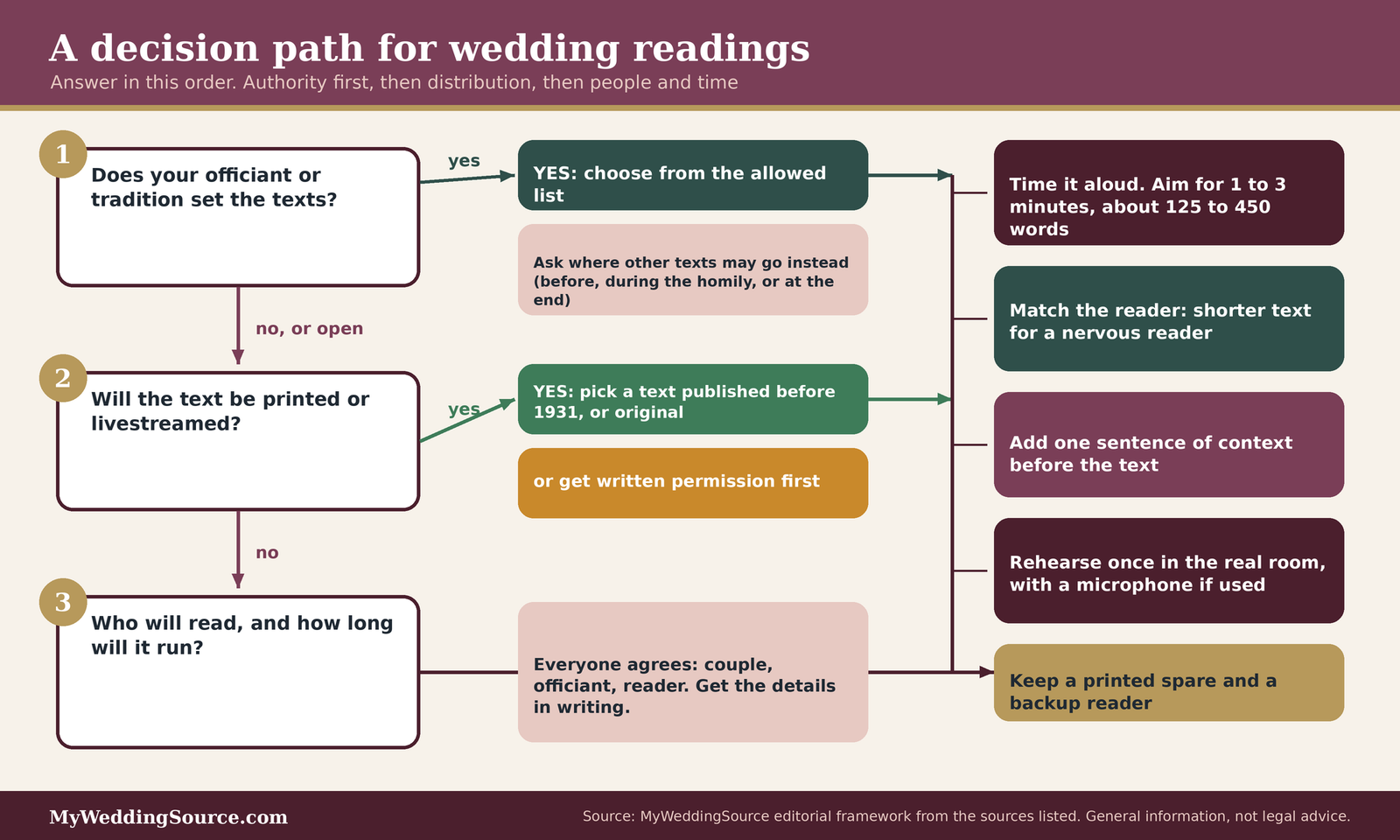
When you are unsure, choose one reading of about two minutes, from a source that already means something to both of you, in language your guests will understand, that is old enough to be in the public domain or written by you. Introduce it with a sentence of context, and give it to the most comfortable reader you know. This default is not the only good answer, but it satisfies the most common constraints at once: it fits a short ceremony, avoids permission problems, reduces generic risk, and keeps the reader at ease.
The exception that overrides the default
The default yields whenever someone with authority over the ceremony specifies otherwise. A priest, rabbi, imam, or other officiant who sets the texts overrides your taste, and a copyright holder who refuses permission overrides your wish to print a particular poem. If neither applies and your ceremony is long, it can carry a second reading, up to the five-minute total one planning site suggests. The exception is not a loophole, it is a reminder that the rule exists to serve the ceremony and not the other way around.
What to settle, and who has to agree
The last conversations are short, but skipping them is how problems reach the day. Settle them at the same time, so that nothing is left in a text thread.
Who must agree
At minimum, the two of you must agree on the text, because you are the ones it speaks for. The officiant must agree to the text and its position in the script. The reader must agree to the passage, and a gentle check that they are comfortable with it is better than assuming. If a parent or relative has strong feelings, ask them early. For a livestreamed or printed ceremony, whoever manages the program or the recording should know which texts are included.
What to collect before you finalize
Collect the officiant’s rules in writing, the exact text and edition you will use, the copyright status or permission in writing for anything protected, the timed length of each reading, each reader’s confirmation, the printed format for the program, and the rehearsal time. If you want a single document, a one-page sheet with those items, one row per reading, works well and takes ten minutes to build. Keeping wedding readings on one page makes later changes easy.
Questions to ask before you finalize
Good questions keep a small decision from turning into a day-of problem. Ask the officiant and the readers in writing where you can, and keep the answers with your ceremony notes.
Questions worth asking about wedding readings
- Which texts does this ceremony require, allow, or exclude, and where could an excluded text appear instead?
- How many readings fit, and how long should each run?
- Where in the script do the readings go, and who gives the cue?
- Which translation or edition will we use, and is it in the public domain?
- Do we need permission to print or stream this text, and who do we ask?
- Who will read, and have we confirmed they are comfortable with the passage?
- Is there a microphone, and have we tested it with each reader?
- Who is the backup if a reader cannot attend or cannot continue?
For the officiant
These questions confirm the rules and the script, and the answers decide which texts are eligible at all.
Rules and approvals
Ask whether the officiant needs to approve the text in advance, whether there are texts they cannot allow, and whether they prefer to introduce each reading. If you are marrying in a faith tradition, ask where texts that are not part of the liturgy can appear instead of asking whether they can replace the liturgy.
Timing and the script
Ask how long the officiant expects the whole ceremony to run, how much time they suggest for wedding readings, and where they place them. Ask also how they handle a reader who loses their place or becomes emotional. A calm plan agreed in advance is easier to follow than one invented on the spot. Officiants who lead many ceremonies usually have views on wedding readings worth hearing. Our wedding officiant guide has more questions to bring to that conversation.
For the readers and the printer
These questions cover the people and the page, and the answers belong on the checklist you share with everyone involved.
Readers
Ask each reader whether they are comfortable with the passage, whether they want to change a word, whether they need a different format, and whether they can attend the rehearsal. Offer a way out that is easy to take, because a reader who says yes under pressure is a risk to the reading. Graceful exits make wedding readings safer for everyone.
Printer and program
Ask the printer or designer whether they will include full texts or titles only, who proofs the final copy, and how long changes take. If the text is protected, ask whether the printer wants to see proof of permission before printing it. Our wedding invitations guide covers the paper side of the day, if you want matching stationery.
FAQ: wedding readings questions
Choosing and timing
How many wedding readings should a ceremony have?
One or two suit most ceremonies. One major wedding site recommends limiting wedding readings to one or two so the ceremony does not drag, and a Catholic archdiocese says two or three may be proclaimed in a Catholic wedding. Your officiant’s rules and your ceremony length should decide, and readings are optional.
How long should a wedding reading be?
Between one and three minutes is a common recommendation, and one site suggests two minutes or less. At the 125 to 150 words per minute that a university speaking text describes, that is roughly 125 to 450 words. Time the passage aloud and trim anything that runs over.
Can we use a poem or song lyrics in a Catholic ceremony?
Not in place of Scripture. The Archdiocese of New York says poems and song lyrics may not replace the Scripture readings or the Responsorial Psalm, but they may appear elsewhere, such as before the entrance procession, in the homily, or as a comment at the dismissal. Ask your priest or deacon where yours could fit.
Do we have to have readings at all?
No. One major wedding site notes that readings are optional. Many couples skip them in a short ceremony or use the time for vows, music, or a ritual. If you want to honor someone who would have read, a toast, a seat of honor, or a note in the program can do the same job.
Readers, rights, and logistics
Who should do the readings?
Choose people who are close to you and comfortable speaking to a crowd. Planning sites suggest giving a shorter passage to someone who is nervous and matching the reader to the text, such as a child with a children’s book. Ask each person privately, and make it easy for them to decline.
Do we need permission to print a poem in our program?
If the poem was published in the United States before 1931, it is in the public domain as of January 1, 2026, according to the Cornell copyright chart. For newer works, assume it is protected, and ask the rights holder. This is general information, not legal advice, and the Copyright Office says there is no safe word count.
Can we livestream a ceremony that includes a protected poem?
It is a question for the rights holder or an attorney. The statute’s exemptions for certain live performances are described in its notes as not covering transmissions to the public. The simplest options are a public-domain or original text for the streamed ceremony, or reading the protected text before the stream begins.
What if a reader is too nervous or too emotional to finish?
Plan for it before the day. Name a backup reader, bring a printed spare, and ask the officiant to step in and finish if needed. Rehearsing once in the real room, slowly, with a pause before the first line, helps most nervous readers, and a shorter passage lowers the stakes.
Your next steps
Settle the rules
Ask the officiant first
Send your officiant three questions this week: which texts are required or excluded, how many wedding readings fit, and where they go in the script. Their answers decide which texts you can consider, so wait for them before you shortlist. Our wedding ceremony guide shows how wedding readings sit among the other parts of the ceremony.
Pick a text by its constraints
Choose two candidates, one of a kind that matches your officiant’s rules and one backup. Read each aloud with a timer, find the line you could explain in a sentence, and check its publication date. Our wedding vows guide helps if you are also deciding how personal your promises will be.
Lock in the people and the page
Invite and prepare the readers
Ask each reader privately, send the text early in a large, readable format, tell them where it falls and how it will be introduced, and book them for the rehearsal. Add each reader to your wedding planning checklist so that nothing depends on memory.
Finish the program and the reception plan
Print titles and credits for protected texts and full text only where it is public domain or permitted. If someone you wanted to honor is not reading, give them a role at the reception, and our wedding reception guide covers where toasts and tributes fit in the evening.
A useful companion piece: Unity Ceremony Ideas: Meaning, Setup, Safety, Cleanup, and When to Skip One.
Sources & methodology
How we built this guide
What we relied on
This guide draws on liturgical guidance from the Archdiocese of New York, the Cornell University Library’s copyright guide, the Copyright Office’s fair use page, the text of the U.S. copyright statute as published by Cornell’s Legal Information Institute, a university public speaking text, and advice on choosing wedding readings from two large wedding planning sites. Facts about the publication dates of specific works come from the Poets.org page for Sonnet 116, Project Gutenberg, and Duke’s Center for the Study of the Public Domain. The conversions from minutes to words, the time budget, the decision matrix, and the two scenarios are our own editorial work, and they are estimates and illustrations, not survey results.
What we did not do
We did not find a national survey of how many couples use wedding readings or which texts they choose, so we make no claim about popularity. We did not review the rules of every faith tradition, and we describe only one in detail. We did not give legal advice: copyright status depends on the edition, the country, and the use, and the right source for a specific question is the rights holder or an attorney. Wedding planning sites reflect their editors’ views and not rules, and we say so where we use them.
Source list
Government, legal, and library sources
- U.S. Copyright Office, Fair Use Index: https://www.copyright.gov/fair-use/
- Legal Information Institute, Cornell Law School, 17 U.S. Code Section 110, limitations on exclusive rights, exemption of certain performances and displays: https://www.law.cornell.edu/uscode/text/17/110
- Cornell University Library, What is the Public Domain? (copyright term chart): https://guides.library.cornell.edu/copyright/publicdomain
- Duke University School of Law, Center for the Study of the Public Domain, Public Domain Day 2022: https://cspd.law.duke.edu/publicdomainday/2022
- Project Gutenberg, The Prophet by Kahlil Gibran: https://gutenberg.org/ebooks/58585
Religious, academic, and wedding-industry sources
- Archdiocese of New York, Liturgical Q and A: Readings at wedding celebrations: https://www.archny.org/posts/liturgical-q-and-a-readings-at-wedding-celebrations
- University of Minnesota Libraries, Communication in the Real World, Vocal delivery: https://open.lib.umn.edu/commpractice/chapter/vocal-delivery/
- Poets.org, Let me not to the marriage of true minds (Sonnet 116): https://poets.org/poem/let-me-not-marriage-true-minds-sonnet-116/print
- Zola, Wedding ceremony readings: https://www.zola.com/expert-advice/wedding-ceremony-readings
- WeddingWire, How to choose wedding ceremony readings: https://www.weddingwire.com/wedding-ideas/how-to-choose-wedding-ceremony-readings