

Choosing wedding guest hotels sounds like a booking chore, but it is closer to a small logistics project: you are matching a handful of buildings to a crowd of people who differ in budget, stamina, mobility and travel plans. This guide shows how to build a hotel shortlist that you score on route, cost, accessibility and booking conditions, so that the grandmother with a walker, the student on a tight budget and the family with a toddler can all find a room that works.
Start with your guests, not the hotels. Sort them into groups by budget and physical needs, decide how far from the venue they can reasonably stay, and shortlist two to four properties. Score each one on route, true total cost, verified accessibility and booking terms. Treat accessibility as pass or fail, not as a point on a scale. Then read every block contract for the cutoff date and attrition terms before you sign, and give guests one clear page that says where to book and by when.
Here is how wedding guest hotels usually go wrong. A couple finds a pretty hotel near the venue, asks for a block of rooms, and posts the booking link. Three months later, a guest in a wheelchair discovers that the “accessible” room has a tub, a cousin on a student budget has found a motel eleven minutes away that costs half as much, and two family friends have booked a third hotel because the first one was full. Nobody did anything unreasonable. The couple simply planned the hotel as one decision when it is actually several.
The good news about wedding guest hotels is that you can avoid nearly all of it with a few hours of work done in the right order. The order matters. If you choose among wedding guest hotels first, you inherit their limits. If you start from the people, you can see which limits you cannot accept.
This guide to wedding guest hotels is written for couples who are handling the lodging themselves, for family members who have been handed the job, and for planners who want a tidy method. It does not assume a big budget, a big guest list or a big city. It does assume that you will check facts yourself instead of trusting a brochure, because room types, fees and cancellation terms change, and no article can promise what a particular hotel will do on a particular night.
What wedding guest hotels planning is trying to achieve
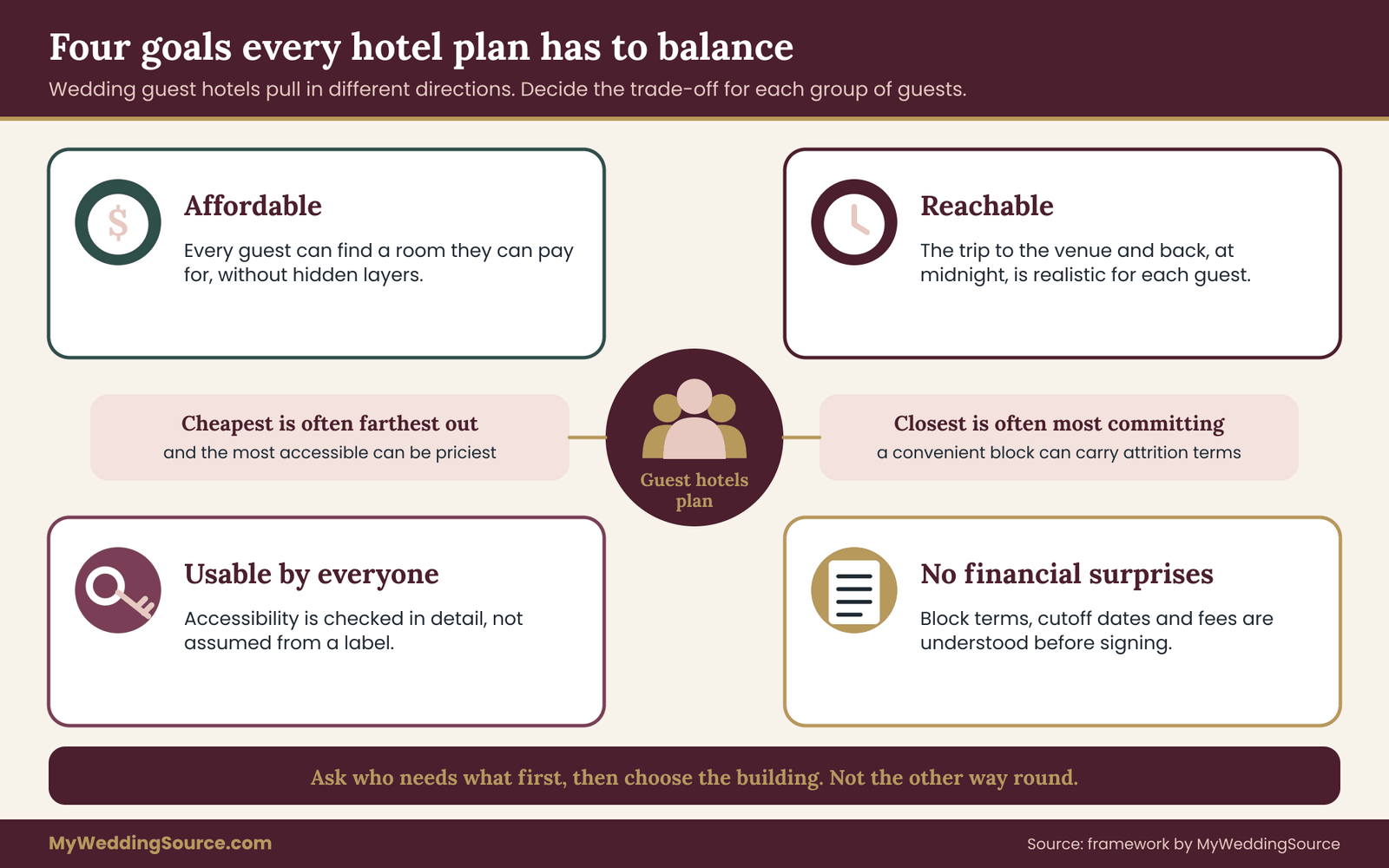
It helps to name the goals before you start comparing wedding guest hotels. There are four, and they pull in slightly different directions.
Everyone has a place to sleep that they can afford. The cheapest workable option and the most comfortable option are rarely the same building. A good plan gives guests a real choice instead of one rate for everybody.
Nobody is stranded. A hotel that looks close on a map can be twenty-five minutes away at midnight, on a road with no sidewalk, with no rideshare coverage. Getting back after the party matters as much as getting there.
Every guest can actually use the room. That means accessibility checked in detail, not a checkbox on a website. It also means thinking about guests with needs that are not visible: limited stamina, hearing loss, sensory sensitivity, a medical device that needs a refrigerator.
You are not financially exposed. A block of rooms can carry obligations. Understanding them before you sign is the difference between a convenience and a bill.
Those four goals conflict in predictable ways when you choose wedding guest hotels. The cheapest hotel is often farthest out. The most accessible hotel may be the priciest. The convenient block may carry a financial commitment you would rather avoid. Most of the work is deciding, with eyes open, which trade-off you accept for each group of guests.
Who is this planning for
Be honest about the size of the problem. If your wedding is local and most guests will go home that night, you may need nothing more than a suggested hotel or two. If a third of your guests are traveling, you need a proper plan. If you are marrying at a remote venue, a destination or a place where rooms are scarce, lodging may drive the whole date and guest list. In those cases the sections on routes and blocks matter most, and you may also want to read our guide to choosing a wedding date around guest availability, vendor capacity and travel disruptions, because lodging supply is one of the things that decides when you can marry.
Step one: map your guests before you look at wedding guest hotels
You cannot choose wedding guest hotels well until you know who you are choosing for. This step takes an hour and a copy of your guest list. If you do not have a firm list yet, our wedding guest list guide explains how to get there, and a rough list is enough to start.
Go through the list and mark every household that is traveling and will need a room. You do not need exact numbers. You need to know roughly how many rooms you are talking about, because a block for ten rooms and a block for sixty are different contracts and different hotels.
Then sort travelers into groups. These are the ones that tend to matter.
- Wedding party and immediate family. They arrive early, stay longer and often need to be close to the venue. Some couples cover or share their costs. Many do not, and everyone should know in advance which applies.
- Budget-conscious guests. Students, early-career friends, guests traveling with several children, and anyone on a fixed income. They will compare prices and will often prefer a modest hotel with free breakfast and parking.
- Mid-range travelers. Most adult guests. They want a clean, comfortable, reasonably priced room and are happy with one good option.
- Guests who want comfort or convenience. Older relatives who do not want to drive after dark, friends who treat the weekend as a mini-vacation, guests who simply want the nicest option nearby.
- Guests with mobility needs. People who use wheelchairs, scooters, walkers or canes, and those who cannot manage stairs or long distances. They need verified features, a short route from the car or shuttle to the room and the venue, and reliable transport.
- Guests with other access needs. Deaf and hard-of-hearing guests who need visual alert equipment, blind and low-vision guests who need clear wayfinding, guests with sensory sensitivities who need a quiet floor, guests who rely on service animals, and guests with medical needs such as a refrigerated medication.
- Families with small children. They need space, a quiet corner for naps, perhaps a kitchenette, and often a location where they can return to the room early.
- Guests who will drive in and leave the same night. They may need nothing but parking and a place to rest if the drive is long.
You will notice that one guest can belong to several groups. A grandfather on a fixed income who uses a walker is a budget guest and a mobility guest. That is the point of listing needs separately: the hotel has to pass the access test and the price test, not one or the other.
Ask in a way that gets useful answers
Do not guess about needs, and do not ask guests to disclose medical information. Instead, invite them to tell you what would help, in general terms, in the same message that carries the hotel details. Something like this works:
“We are putting together hotel options for the wedding weekend and want everyone to have something that works. If you need a particular kind of room, such as a ground-floor room, a roll-in shower, a quiet room or anything else, tell us and we will check with the wedding guest hotels. You do not need to explain, and it stays between us.”
The final sentence matters. People will say what they need if they feel it will not become public gossip. Keep the answers in a private note, and share only what the hotel needs to know.
Count rooms for your wedding guest hotels with some honesty
When you estimate how many rooms you need, count households, not people. A couple shares one room. A family of four may need one or two. A group of friends might share. Then apply a realistic uptake: not everyone on your list will come, and not everyone who comes will stay at the hotel you recommend. Many couples find that only a portion of the traveling guests book through the block, because some stay with family, some find a better rate elsewhere and some choose a vacation rental.
Rather than trust a rule of thumb you read somewhere, ask the hotel’s group sales office what pickup rates they usually see for weddings of your size and season. They have the data. Their answer will vary by city and weekend, and you should treat it as an estimate. A modest block is almost always safer than an ambitious one, because you can usually add rooms later if they are available, while shrinking a block after the contract is signed is harder.
Step two: set the radius for wedding guest hotels and test the routes
Once you know who is coming, decide how far from the venue your wedding guest hotels can reasonably be. This is the filter that removes most hotels before you ever look at a rate.
Distance on a map is a poor guide. What counts is the time and the effort of the real trip, at the real hour, for the real person. A hotel six miles away on a straight road is closer in practice than one two miles away behind a highway interchange.
Build a route test for each of the wedding guest hotels
Pick the hotels that look plausible and test the routes yourself, ideally at the same time of day as the events. A good test has four parts.
- The arrival trip. From the hotel to the venue at the time guests will leave for the ceremony. Note the drive time, parking at the venue, and where a shuttle would drop people. If you cannot test in person, use a mapping service’s typical-traffic estimate for the right day and hour, then add a margin.
- The return trip. From the venue to the hotel at the end of the night. This is the one couples forget. Ask whether rideshare drivers will pick up at your venue, how long the wait usually is, and whether the road is dark and narrow. In rural areas, rideshare coverage after midnight may be thin or absent.
- The walking route, if any. If the hotel is near the venue, walk the path. Is there a sidewalk? Is there a curb cut at every crossing? Is the surface even? A route that looks pleasant to you can be impassable to a wheelchair user or tiring for a guest in heels or with a cane.
- The airport trip, if guests fly. Distance from the airport, the transit options, and the cost of a taxi or rideshare. A hotel with a free airport shuttle may be worth more than a cheaper one without it. Confirm the shuttle’s hours, because many stop running in the evening, and confirm that it can carry wheelchairs, which not every shuttle can.
Write the results on a sheet or in a note for each of the wedding guest hotels. You are collecting facts you will compare later, and your memory will not be reliable after the third phone call.
Decide between walking, shuttle and driving
Your venue and your wedding guest hotels together set the guests’ transport. A few arrangements come up again and again.
The hotel is the venue, or is next door. Guests can walk and nobody needs to drive. This is the simplest case, and it is why hotel venues are popular with couples who have many out-of-town guests. The trade-off is less choice on price, since the hotel knows it is the only convenient option.
A hotel within a short walk of the venue, other options farther away. Good for a mix of budgets. Guests who prefer to be close pay for convenience, and others take a shuttle or a car.
All hotels a drive away. This is typical for rural, estate and vineyard venues. You will need a transport plan: a shuttle between the main hotel and the venue, clear instructions for rideshare, and a plan for the end of the night. Our guide to wedding guest transportation planning covers shuttles, schedules and accessibility in detail. The point for hotel planning is that a hotel without a reliable ride home should usually not be on the shortlist for guests who cannot drive.
Do not assume that guests staying at wedding guest hotels will “figure it out.” People who are tired, who have been drinking, or who do not know the area will not. The couples who have the fewest problems are the ones who supply a plan.
Plan the morning after
A last test that people skip: what does the morning look like? If you are hosting a brunch or a send-off, can guests reach it from their hotel? If checkout is at eleven and the flight is at noon, can they make it? If a guest has left a car at the venue, how do they get back to it? These are small questions with large consequences for the people affected, and the answers can change which hotel looks best.
Step three: build a shortlist of wedding guest hotels you can compare
With radius and routes settled, you should have a handful of wedding guest hotels that pass the first filter. Now narrow them to a working shortlist of two to four.
Fewer than two leaves you with no fallback if one sells out or turns out to have poor terms. More than four makes the guest experience confusing and the block management messy. A common shape is one main hotel, one lower-cost option and, if needed, one with strong accessibility features or a different location. Sometimes one hotel serves two of these roles, and that is fine.
Think in tiers
A way to avoid a confused list of wedding guest hotels is to give each hotel a role.
- The anchor. The hotel most guests will use, usually mid-priced and close to the venue. This is where you place your main block, where the wedding party stays and where out-of-town events can be centered.
- The budget option. A cleaner, plainer property with a lower rate, which may be farther away or lack amenities. It exists so that cost never forces someone to decline.
- The comfort or access option. A property that offers something specific the anchor does not, such as a larger accessible room selection, quieter floors, ground-floor rooms, suites for families, or a more convenient location for the older guests.
You do not need all three. A small wedding may need one anchor and one budget option. A large one may need all three. The roles keep the list purposeful, and they give you a plain way to explain the choices to guests.
Score each hotel on four dimensions
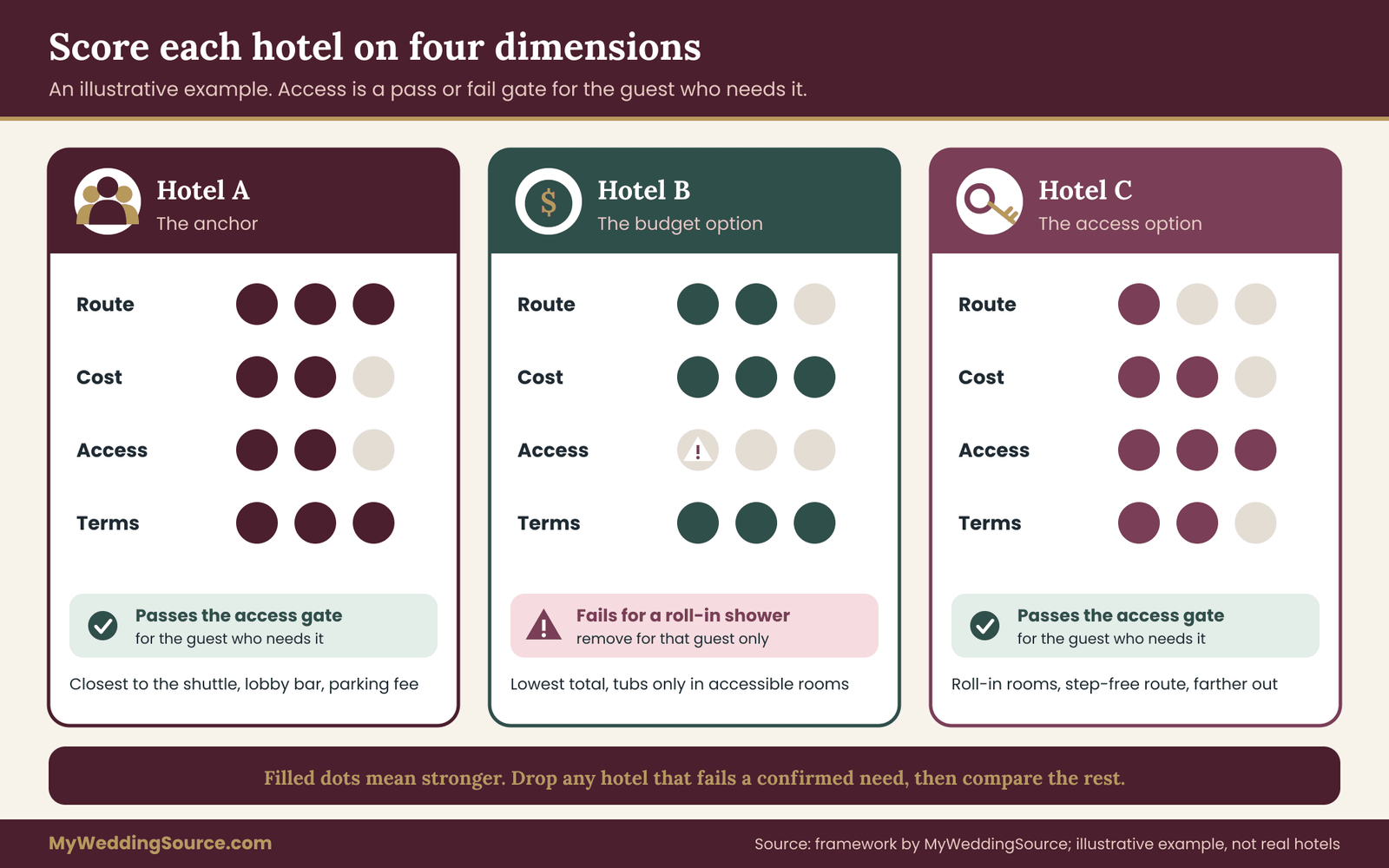
For each shortlisted hotel, record what you learn about these wedding guest hotels under four headings. These match the real decision, and writing them down stops the nicest lobby from winning by default.
Route. How long and how easy is the trip to and from the venue, and from the airport? Is there a shuttle, a safe walking path, or reliable rideshare? Is the return trip at night manageable?
Cost. What is the true nightly total, including taxes, mandatory fees and parking? What is the cost per guest if people share? Does breakfast, Wi-Fi or an airport shuttle come with the rate?
Accessibility. What features are confirmed, in writing, for the specific rooms and routes your guests need? What is the hotel’s process for reserving and holding an accessible room?
Booking conditions. Is it a courtesy block or a contracted block? What are the cutoff date, deposit, cancellation terms and attrition clause? Who carries the risk if rooms go unsold?
Give each dimension a simple rating, such as strong, acceptable or weak. If you prefer numbers, a scale of zero to three works. Do not agonize over the scale. The purpose is to make the comparison visible, not to produce a mathematical result.
Accessibility is a gate, not a score, when choosing wedding guest hotels
One rule changes how you use the ratings. Treat accessibility as a pass or fail for the guests who need it, not as one more point on a scale.
If you have a guest who needs a roll-in shower and a hotel cannot confirm one, that hotel does not work for that guest, however good its price and location. Averaging a high price score with a low access score gives a reassuring number that hides a real failure. So do it in two passes. First remove any hotel that cannot meet a confirmed need. Then compare the survivors on route, cost and booking terms.
It also means you might keep a hotel on the list for most guests while using a different one for the guests with specific needs. That is a perfectly good outcome, as long as the second hotel is not isolated from the rest of the weekend.
Weigh the dimensions for your wedding
The dimensions do not count equally for every couple choosing wedding guest hotels. A wedding where most guests are young and driving may weigh cost and parking more. A wedding where many guests are older may weigh route and accessibility more. A destination wedding may weigh booking terms heavily, because blocks are the main way to secure rooms in a place where supply is tight.
Decide the weights before you look at the ratings, not after. If you decide afterward, you will unconsciously weigh what favors the hotel you already like.
Where to find wedding guest hotels worth shortlisting
Start with places you can verify when you search for wedding guest hotels. The venue itself will usually have a list of nearby hotels it recommends, and some have relationships that give guests a better rate. Local tourism boards publish lodging lists. Your own map search will show what else is near the venue. Guests who live in the area can tell you which hotels they would avoid, and local knowledge is often the best filter you have.
Treat reviews carefully. A handful of recent, detailed reviews that mention noise, cleanliness, elevators or parking tell you more than a star average. Look for mentions of the things you care about, such as the accessible rooms, breakfast hours or the neighborhood at night. And remember that no review replaces a phone call to the hotel.
Step four: read the true cost of a room at your wedding guest hotels
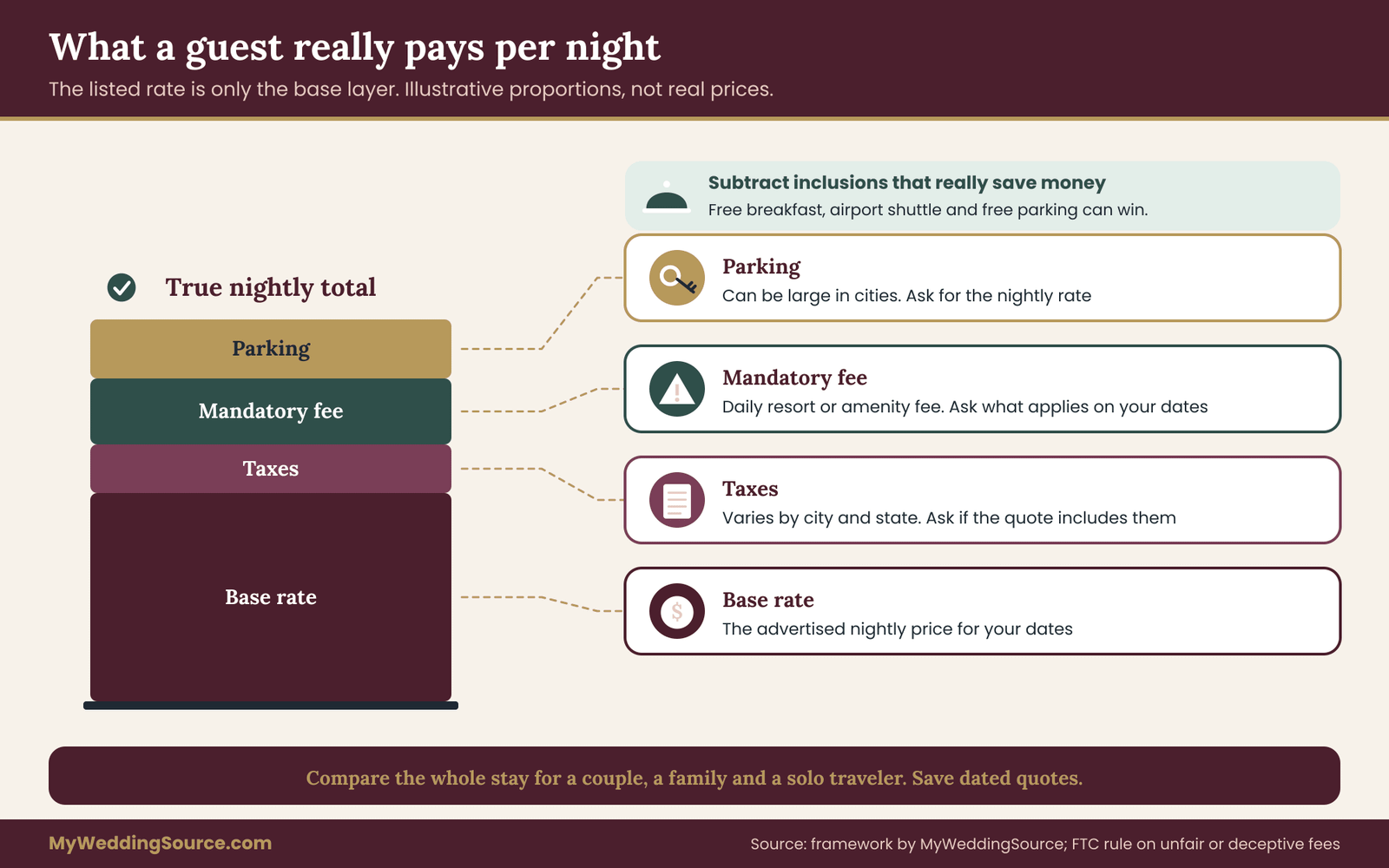
Price is the dimension most guests look at first when they compare wedding guest hotels, and it is also the one where a listed rate can mislead you. The number on the booking page is a starting point. What a guest pays is a stack of layers.
The layers behind a nightly rate
Walk through these for every shortlisted hotel, and write down the answers.
The base rate. The price per night for the room type, for the dates you need. Rates change by day, so check each night of the stay. A Friday and a Sunday can differ sharply.
Taxes. Lodging taxes vary by city and state. Ask whether the quoted rate includes them. If the hotel gives you a block rate, confirm whether it is before or after tax.
Mandatory fees. Some hotels add a daily fee for amenities, whether or not a guest uses them. These are often called resort fees, destination fees or amenity fees. In the United States, a Federal Trade Commission rule on unfair or deceptive fees that applies to short-term lodging requires businesses to show the total price, including most mandatory charges, prominently when they advertise a price, with some exceptions. That is a useful protection, but it does not remove the fee. It only makes it visible, and the rule has limits, so ask the hotel directly what mandatory charges will apply to a guest staying on your dates.
Parking. In cities, overnight parking can be a large line item. A hotel that looks cheap can cost more once parking is added. Ask for the nightly rate and whether there are in and out privileges.
Breakfast and other inclusions. A free breakfast is real money for a family. A free airport shuttle saves a taxi fare. These inclusions can make a slightly higher rate cheaper overall.
Occupancy charges. Some hotels charge extra for a third or fourth person in a room, or limit the number of guests per room. Families should know this before they book.
Pet and service animal rules. Pet fees are common. Service animals are treated differently under federal law, and a hotel should not charge a pet fee for a service animal, though you should confirm the hotel’s policy and how it applies in your situation.
Cancellation terms. A lower rate with a strict prepayment can be a worse deal than a slightly higher rate that can be canceled without a penalty up to a few days before arrival. This matters for guests who may need to change plans.
Compare wedding guest hotels on cost per guest, not cost per room
A room’s price makes more sense when divided by the number of people sharing it. A suite that costs more per night may be cheaper per person for a group of four than two separate rooms. A budget guest traveling alone may prefer a smaller hotel even if the rate is similar. When you compare hotels, work out the total for a typical stay of two or three nights for a couple, for a family of four and for a solo traveler. Do the sums in the open with the real numbers from each hotel.
Avoid quoting averages from articles as if they applied to your city. Nightly rates vary hugely by market and season, and what matters is what your three hotels charge on your dates. Collect quotes in writing, or save screenshots with dates, so that you can show guests what they should expect to pay and notice if a rate changes.
Should you subsidize rooms
Some couples choose to pay for part of the lodging for certain guests. This is a budget decision and it varies widely. A few common patterns exist.
- Paying for the wedding party’s rooms, or for some nights of them.
- Paying for immediate family who travel far.
- Paying for no one, but negotiating a good rate and a quiet hotel.
- Setting aside a small fund for guests who would otherwise not be able to come, offered privately.
None of these is correct for everyone. If you decide to cover rooms, decide how it will work before you invite people to book, and put it in writing so there are no surprises. If you do not, there is nothing wrong with that either. A well-chosen budget option is a form of kindness in itself. Our wedding budget guide helps you decide how much lodging support fits your overall plan.
Step five: verify accessibility at wedding guest hotels in detail
With wedding guest hotels, accessibility is where the most damage is done by assumptions. A website that says “accessible rooms available” tells you very little. To a guest who uses a wheelchair, the difference between a roll-in shower and a tub with a transfer bench is enormous. To a guest with a hearing loss, a room without a visual fire alarm is a risk. Both can appear under the same label.
What the law gives you to work with
In the United States, lodging operators covered by the Americans with Disabilities Act have specific duties about reservations. The Department of Justice’s rule says, in summary, that a hotel must let people reserve accessible rooms in the same way and at the same hours as other rooms, provide enough information about the hotel and its rooms for a guest to judge whether the accessible features meet their needs, hold accessible rooms for people who need them until all other rooms of that type are taken, and reserve and guarantee the specific accessible room a guest books.
This is not a guarantee that every room does everything. Hotels built or altered at different times may meet different standards, and what counts as accessible can vary. Treat the rule as leverage, not as a promise. It supports your right to ask for details and to expect a hotel to hold the accessible room you reserve. It does not substitute for confirming the specifics.
Know what to ask
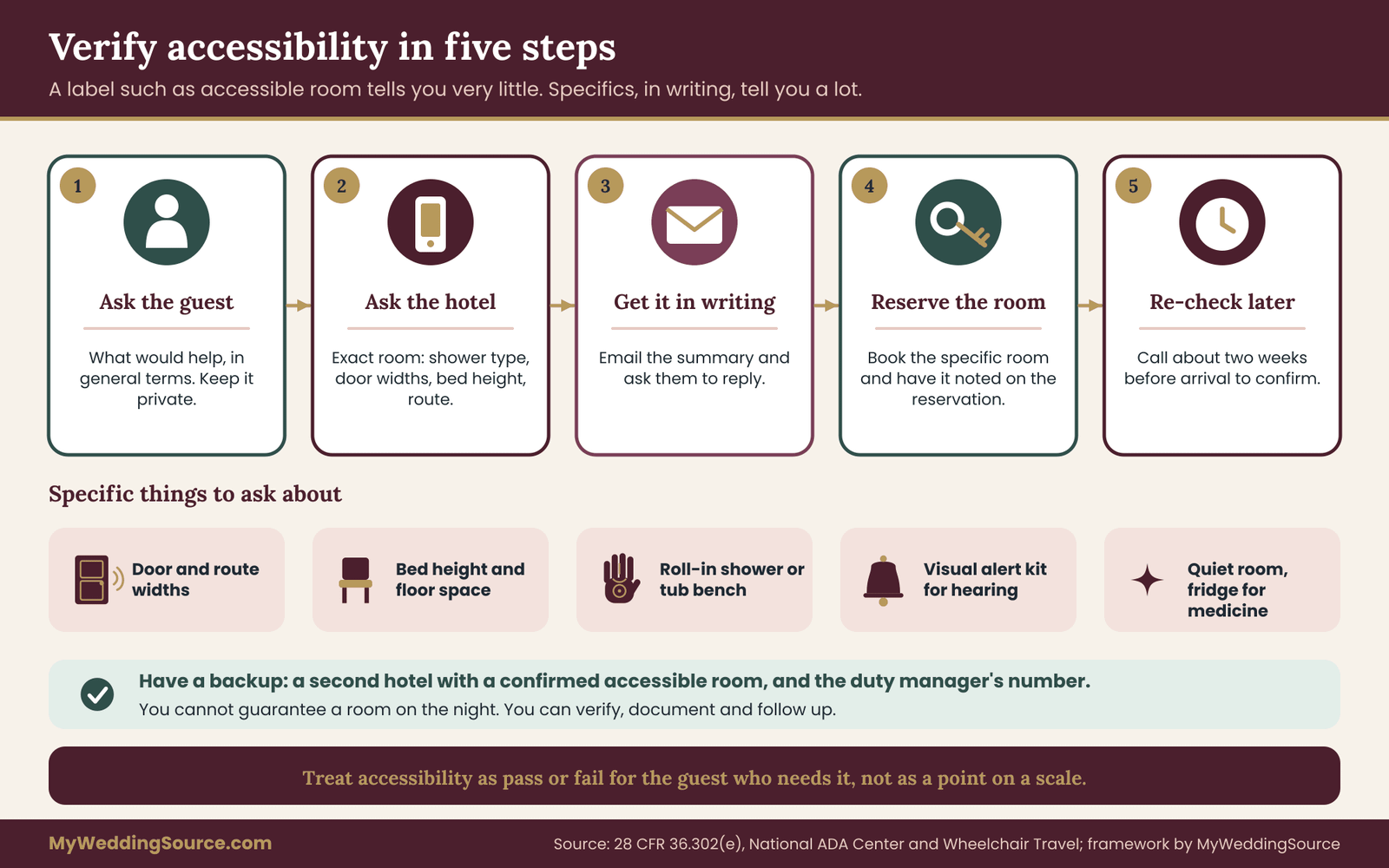
“Is it accessible?” gets a vague answer. Specific questions get facts. Ask for each of the items that matter to your guest, and ask the hotel to describe the exact room, not a typical one.
Getting in and around.
- Is there a step-free route from the parking area or drop-off to the front desk, and from the desk to the elevator?
- How wide are the doors to the room and the bathroom?
- Is the elevator large enough for a power wheelchair or scooter, and is there a backup if it breaks?
- Are there any rooms on the ground floor? Is the room near the elevator or at the end of a long corridor?
Inside the room.
- How high is the bed, and is there clear floor space on both sides?
- Is there room to turn a wheelchair or scooter?
- Are the closet rod, thermostat, light switches and peephole reachable from a seated position?
The bathroom.
- Is there a roll-in shower with a fold-down seat, a tub with a transfer bench, or a standard tub? Which one is in the room being reserved?
- Are there grab bars, and where?
- Is the toilet height and clearance suited to the guest’s transfer method?
- Is there a handheld shower head?
For guests who are deaf, hard of hearing, blind or have low vision.
- Can the hotel supply a kit with a visual door alert, a bed shaker or a visual fire alarm?
- Does the front desk offer written communication or video relay options?
- Is signage tactile and high contrast, and is the route to the room straightforward?
Other needs.
- Is there a refrigerator available for medication?
- Can the hotel provide a quiet room away from elevators and ice machines?
- Does the hotel allow service animals without extra charges, and is there a relief area?
- Are there fragrance-free or low-fragrance room options for guests with sensitivities?
- Is the pool or fitness room accessible, if a guest wants it?
You do not need to ask every question for every guest. Ask what applies, and ask the guest first what matters most.
Put it in writing
Phone calls are useful, but they leave you with memory instead of evidence. After you speak to the hotel, send an email that summarizes what they told you: the room type, the features confirmed, the dates and the confirmation number. Ask them to reply. If the hotel will not confirm in writing, treat that as a warning.
When the guest books, the hotel should note the accessible requirement on the reservation. Ask whether the reservation is for a specific room or a room type, and ask the hotel to confirm that the room will be held. Then check again a couple of weeks before arrival. A quick call to confirm the reservation and the features is cheap insurance.
Block an accessible room, not just a promise
When you set up a group block, ask how accessible rooms are handled inside it. Some hotels have a small number of accessible rooms and hold them back from group blocks so that they can be released to individual travelers. Others will include them. Neither is wrong, but you need to know which applies, because it affects whether your guest can book at the block rate.
A sensible approach is to ask for one or two accessible rooms to be included in the block at the group rate, and to ask the hotel to hold them for guests who identify a need until the cutoff date. If the hotel cannot do this, ask how a guest with a need should book and whether the group rate can still apply.
Where accessibility planning has limits
Be honest with guests about what you can and cannot control. You cannot guarantee the condition of a hotel on the night. Equipment breaks, rooms are moved, staff change. What you can do is verify, document, follow up and have a backup plan, such as a second hotel with an accessible room or a note of the hotel’s duty manager contact. Our guide on wedding weekend event planning explains how to pace events so that guests with limited stamina are not asked to move around more than necessary.
The U.S. Department of Transportation also publishes guidance on air travel for people with disabilities, covering assistance, wheelchairs and complaints. If a guest is flying to your wedding, it is worth sharing that information with them, since the flight is often the hardest part of the trip.
Step six: understand the room block before you sign anything
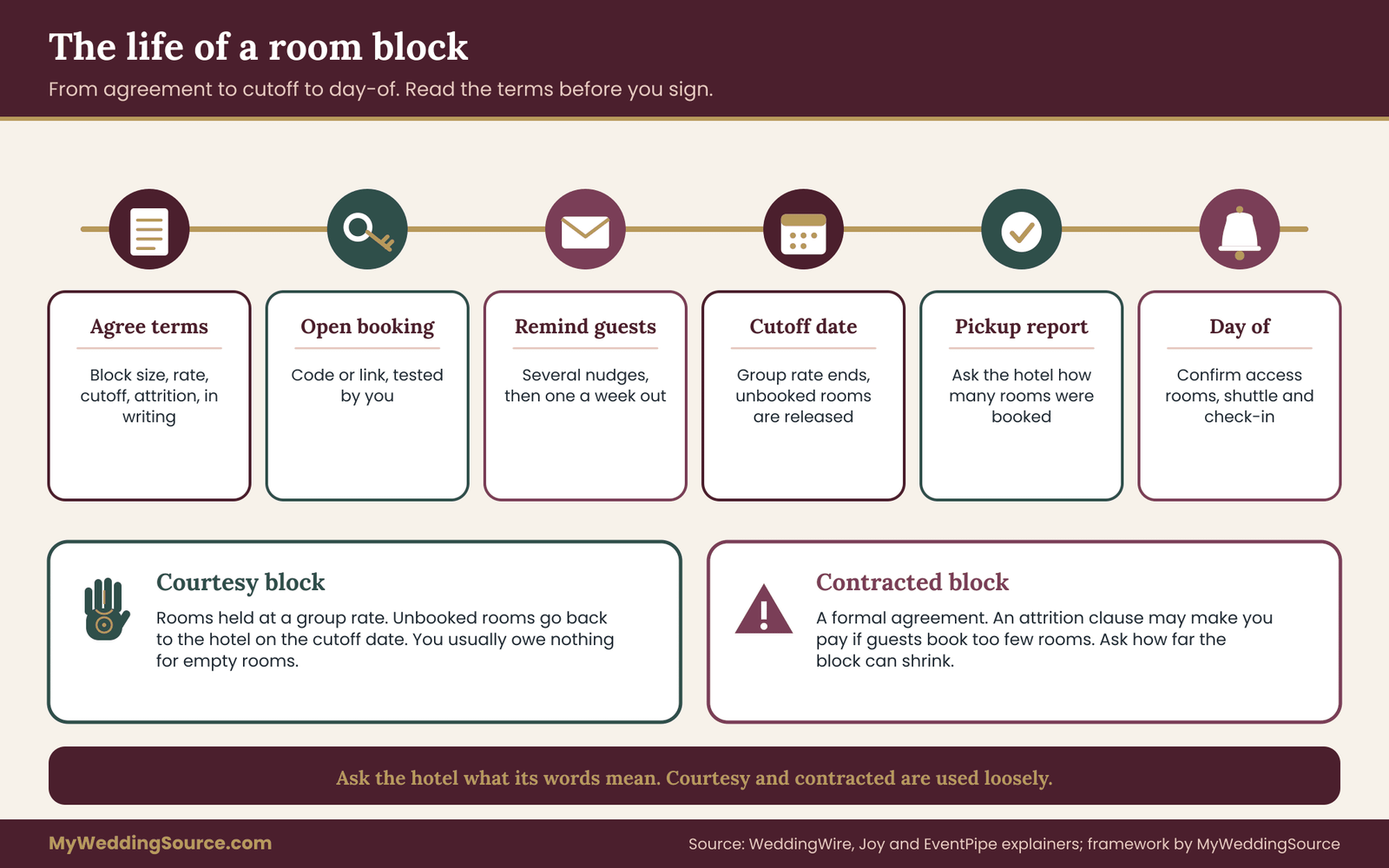
A room block is a group of rooms a hotel sets aside at a negotiated rate for your guests. It can make life much easier, and it can also tie you to terms you did not expect. The difference lies in the type of block and the fine print.
Courtesy block and contracted block
The two terms are used loosely, so ask the hotel what they mean by theirs.
A courtesy block, sometimes called a hold or a soft block, reserves rooms for your guests at a set rate without requiring you to guarantee that they will be filled. Guests book individually, usually with a code or a link, and the hotel releases unbooked rooms back to general sale on a set date. You are generally not responsible for unsold rooms. The trade-off is that the hotel has fewer obligations too, and a courtesy block usually offers less protection if the hotel becomes busy.
A contracted block, sometimes called a group or attrition block, is a formal agreement. The hotel holds the rooms, and you commit to a certain level of pickup. If guests do not fill enough rooms, you may owe the hotel money. The commitment is described in what the industry calls an attrition clause.
Many couples are better off with a courtesy block, especially for smaller weddings where the risk is not worth the benefit. A contracted block makes more sense when rooms are scarce, such as at a popular destination, a holiday weekend or a small town with a big event, because it is the only way to secure space. Our guide to holiday wedding travel and hotel blocks covers how those weekends change the calculation.
The terms that matter
Whichever type you choose, ask for the following in writing, and read them as terms of a contract, not as a sales pitch.
- The block size and the room types. How many rooms, of what type, on which nights. Ask whether you can add rooms later and whether the rate holds if you do.
- The rate. The nightly rate, whether it includes taxes and fees, and for how many nights it applies. Ask whether it is available a few days before and after the event, since early and late arrivals are common.
- The cutoff date. The date by which guests must book at the group rate. After that date, the hotel releases the unbooked rooms. Guests who book after the cutoff may pay a higher rate, or find the hotel full.
- The attrition clause. Whether you are responsible for rooms that are not booked, and by how much. Ask what happens if pickup falls short, whether there is a grace percentage, and whether you can reduce the block before a certain date without penalty.
- Deposits and payment. Whether a deposit is required, when it is due, whether it is refundable and who pays. In many cases, guests pay their own bills, and the couple pays nothing unless the block includes something extra such as a welcome reception.
- Cancellation terms for guests. How far ahead a guest can cancel without a penalty, and whether the group rate has a stricter policy than the regular one.
- How guests book. A phone number, a booking code, a dedicated link or all three. Ask whether the link is reliable, whether it shows the group rate and whether guests who call are told about the block.
- The rooming list. Whether you are expected to send a list of guests’ names, and by when. Some hotels require it for contracted blocks. Ask how guest privacy is handled.
- Concessions. Some hotels offer perks for blocks that meet certain pickup, such as a complimentary room or a discount for the couple. Ask what they are and what has to happen to earn them. Do not count on them, and do not make plans that assume they will arrive.
- Accessible rooms and special requests. How they are handled, as discussed above.
The Joy and EventPipe explainers listed in our sources are helpful starting points, and they use plain language to describe how attrition and cutoff dates work. Remember that every hotel writes its own contract, and the explainers describe patterns, not your hotel.
What a contract review looks like
Before you sign, read the full document. Do not rely on a summary. Look for the following red flags.
- A large attrition obligation relative to your expected pickup.
- A cutoff date that is too early for guests to know their plans. Cutoffs that are several weeks before the wedding are common, but check whether the date suits your guest list.
- A requirement that you pay a deposit that is not refundable.
- Language that makes you responsible for guests’ damage or incidental charges.
- Vague descriptions of the room types.
- Terms that conflict with what the sales manager said.
If anything is unclear, ask for it to be changed or clarified in writing. Hotels often negotiate, and a block is a negotiation, not a form. For a large or complicated contract, consider asking a lawyer to review it. Contract terms and consumer protections vary by state and by hotel, and nothing here is legal advice. Our wedding vendor due diligence checklist can help you vet the hotel as a business before you commit.
Questions to ask when you call the group sales office
Group sales staff handle weddings routinely and are usually glad to explain. A short list of questions gets you most of the information you need.
- What dates are available for our block, and what rate would you offer?
- Is this a courtesy block or a contracted block, and what is the difference in your hotel?
- What is the cutoff date, and what happens to unbooked rooms?
- Is there an attrition clause, and how much can we reduce the block without a penalty?
- What taxes and mandatory fees apply per night, and are they in the rate?
- How are accessible rooms handled within the block?
- What is the cancellation policy for guests?
- What is the typical pickup for weddings of this size on this weekend?
- Can you send the full terms in writing before we decide?
The answer to the last question tells you a lot. A hotel that is happy to provide terms in writing is easier to work with than one that wants you to commit first.
Step seven: place guests across wedding guest hotels without confusing them
You now have a shortlist, scored on route, cost, accessibility and booking conditions, and you know what each block requires. The last design step is to decide which guests go where and to present the options clearly.
Keep the number of wedding guest hotels small
Every extra hotel adds work. It means another block to manage, another cutoff date, another set of instructions, and a thinner pickup at each property. For most weddings, two or three wedding guest hotels is plenty. A fourth hotel is justified only if it fills a real gap, such as a unique accessibility feature or a location for a group of guests coming from the other direction.
Present options, not assignments
Guests prefer being given a choice, and it avoids the awkwardness of telling someone where to stay. A good lodging page presents each of the wedding guest hotels with a short description of what it is for, rather than ranking them.
For example, it might say that one hotel is the closest to the venue and the most convenient for the weekend events, that a second is a simpler option at a lower price with a short drive, and that a third has several accessible rooms and a lobby on the ground floor with a step-free route to the dining room. Guests can then pick the one that suits them. Notice that this approach does not label anyone. A guest who needs an accessible room reads the third description and sees it applies. A guest on a tight budget reads the second and sees it was chosen with them in mind.
Keep the wedding party and family together, lightly
The wedding party and close family are usually the people who need to be together. Placing them at the anchor hotel makes it easier to run the morning of the wedding, to share getting-ready rooms and to keep to the schedule. It also gives them the easiest route to the venue. If you are covering their rooms, the anchor hotel is where you make the arrangement.
Think about the social side
Wedding guest hotels become the place where guests meet before and after the events. If the anchor hotel has a lobby bar or a breakfast room, many guests will spend time there, and that can be part of the weekend. If you have a welcome event, a nearby hotel makes it easier for everyone to attend. If some guests are at a distant hotel, plan a way to include them, such as a shuttle to the welcome event, or an early invitation to the group.
This is also where fairness matters. If the anchor hotel is where everything happens, make sure guests at other hotels are not left out. A simple way is to have the same schedule and transport for everyone, so that where you sleep does not determine what you can attend.
A worked example: three wedding guest hotels, one wedding
The following example is illustrative. The couple, the wedding guest hotels and the numbers are invented to show how the method works, and your own figures will differ. Do not read the prices as a guide to what rooms cost anywhere.
The situation. Priya and Marcus are marrying on a Saturday in early October at a restored barn about twenty minutes outside a mid-sized college town. They expect about one hundred and twenty guests. Roughly sixty will travel. Of those, nine households are the wedding party and immediate family, about fifteen are friends in their twenties and thirties who will watch their budgets, about fifteen are middle-aged relatives and family friends, and six are older relatives, including Marcus’s grandfather, who uses a wheelchair, and Priya’s aunt, who has limited stamina and uses a cane. One friend is hard of hearing. A young family is traveling with two small children.
Step one: the guest map. The couple sorted the travelers into groups as described earlier. They sent a private message asking whether anyone needed a particular kind of room. The grandfather’s daughter replied that he needs a roll-in shower and a ground-floor or elevator-accessible room close to the lobby. The friend who is hard of hearing asked whether the hotel offered a visual alert kit. Three households asked about breakfast and parking, since they were driving.
Step two: the routes. The barn is a twenty-minute drive from town. There is no walkable hotel. Rideshare is available in town but unreliable on the country road after ten at night. So the couple decided that any hotel would need a shuttle between town and the barn, and they began to plan one. They tested the drive from each of the wedding guest hotels to the barn on a weekend evening and noted the time and the condition of the road.
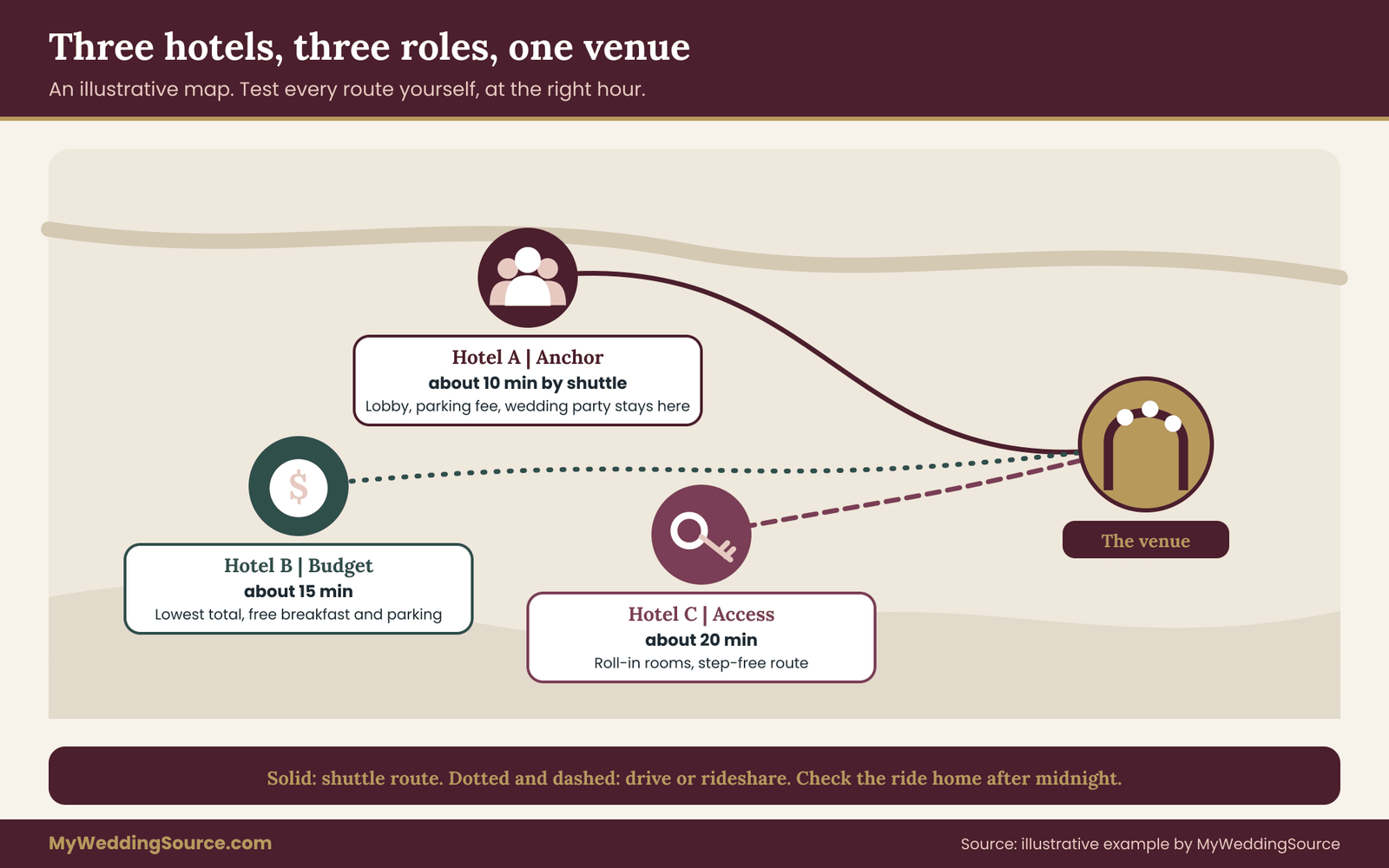
Step three: the shortlist. They found three candidates in town.
- Hotel A, a mid-priced downtown hotel, ten minutes from the barn by the shuttle route, with a free breakfast and a parking garage. It had a restaurant and a lobby bar.
- Hotel B, a simple roadside hotel at the edge of town, fifteen minutes from the barn, with free parking, a free breakfast and the lowest rate.
- Hotel C, a newer hotel near the highway, twenty minutes from the barn, with a larger set of accessible rooms and a step-free route from the parking lot to the elevator.
Step four: the true cost. The couple asked each hotel for the total nightly price for two nights, including taxes, fees and parking. Hotel A’s headline rate was higher, and it charged a daily parking fee in the garage. Hotel B’s rate was the lowest with no extra fees. Hotel C’s rate was between the two, with free parking. For a family of four, they compared a standard room with two beds. For a solo traveler, they compared the smallest room. The couple saved the quotes with dates.
Step five: accessibility. The couple called each hotel and asked specific questions about the roll-in shower, door widths, the route to the elevator and the visual alert kit. Hotel A had one roll-in shower room, already often requested. Hotel B had accessible rooms with tubs only. Hotel C had several roll-in shower rooms and confirmed it could supply visual alert kits. They asked each of the wedding guest hotels to confirm in writing. Hotel B could not meet the grandfather’s needs and so failed the access test for him, though it still passed for guests with no such needs.
The decision. The couple kept all three, with roles.
- Hotel A became the anchor for the wedding party and most guests, because of its location, its lobby and its shuttle route.
- Hotel B became the budget option for the younger friends and the driving families.
- Hotel C became the accessible option, and the couple asked it to include two roll-in shower rooms in its block at the group rate and to hold them until the cutoff for guests with identified needs.
The blocks. The couple chose courtesy blocks at all three hotels. They judged that the town had enough rooms that a contracted block was not worth the attrition risk, and that the weekend was not a major event weekend. They asked each of the wedding guest hotels for the cutoff date, the cancellation terms and the booking link, and wrote them down in one place.
The result. On the wedding website, the couple described each of the wedding guest hotels by its purpose, listed the address, the nightly total with fees, the shuttle details and the cutoff date, and added a short note to contact them if anyone needed help finding a suitable room.
The grandfather’s family booked a roll-in shower room at Hotel C. The friend who is hard of hearing booked a room at Hotel A and requested the visual kit through the reservation. Some of the younger friends booked at Hotel B, and a few chose a vacation rental that the couple had not considered. That was fine. The couple’s goal was never to fill every room, but to make sure everyone had a workable option.
What the example shows
Three things are worth noticing. First, the guest map came before the hotel search, and it determined which questions the couple asked. Second, accessibility removed a hotel for one guest without removing it for all, which is why the couple kept it on the list as a budget option. Third, the blocks were small and simple. The couple took on no financial risk, and they got what they needed: a place to send people.
The example also shows limits. The couple could not guarantee that the roll-in shower rooms would be available on the night. They reduced the risk by asking for a hold, getting confirmations in writing and following up before the event. If a room had fallen through, they had a fallback: a call to Hotel A for its accessible room, and a duty manager contact at each hotel.
Tell guests clearly about wedding guest hotels: the lodging page
All the planning for wedding guest hotels is wasted if guests cannot find the information. A single lodging page on your wedding website, linked from the invitation or the save-the-date, solves most of the problems.
What the page should say
For each hotel, include the following.
- The name and the address.
- A one-sentence description of who it suits, such as “closest to the venue” or “lowest rate” or “most accessible rooms.”
- The nightly total, with a note on what is included and what is not. Be careful to describe rates as the hotel quoted them, and say that rates and fees can change.
- How to book: the code, the link or the phone number.
- The cutoff date for the group rate, written clearly.
- The route to the venue and the shuttle details, if any.
- A note on accessibility features you have confirmed, with the hotel’s phone number so that guests can ask for details.
- Any key terms, such as cancellation rules.
Keep the language plain and the tone warm. Avoid pressure language, such as telling guests they “must” book at a certain hotel. It is better to say what you have arranged and why, and to let guests decide.
Sample wording
“We have arranged room blocks at three hotels in town. Each has a different focus, so pick whichever suits you. Hotel A is closest to the shuttle pickup and has a lobby bar where many of us will meet up. Hotel B is a simpler stay at a lower price and includes breakfast and free parking. Hotel C has the largest number of accessible rooms, including roll-in showers, and a step-free route from the parking lot. The group rates are available until the cutoff date on each hotel’s line below. If you need a specific kind of room and are not sure how to book it, send us a note and we will help.”
A few notes on this sample. It names the purpose of each hotel without ranking them. It tells guests what to do if they need help. And it avoids promising anything about the hotels’ services that you cannot guarantee.
Timing the message
Information about wedding guest hotels is most useful when guests are deciding whether to travel. Many couples publish the lodging page when the save-the-date goes out, and they send a reminder before the cutoff date. Our guide to save-the-date timing explains when to send notices for weddings with different amounts of travel. As a rule, open the block as soon as the date is firm, because rooms in popular weekends sell quickly.

Track the pickup
After the block opens, check in with each hotel. Ask how many rooms have been booked, and compare this with your estimate. If pickup is slow, send a gentle reminder to guests. If it is fast, ask the hotel whether it can add rooms. Do this every few weeks, and more often as the cutoff approaches.
Keep a simple list of who has said they are staying where, based on what guests tell you. This helps you plan the shuttle, the welcome event and the morning-after brunch. It is also useful if a hotel has an issue, since you can contact the affected guests at once.
Be careful with privacy. Do not share guests’ room numbers or reservation details beyond what is needed, and avoid posting lists of who is staying where.
When wedding guest hotels plans go wrong
Even with a careful plan, problems with wedding guest hotels come up. Most are manageable when you know what to do and who to call. The following are the ones that happen most often.
The block sells out early
This is a good problem and a stressful one. Guests who book late find no rooms at the group rate.
Ask the hotel whether it can add rooms to the block, and at what rate. If it cannot, ask whether another hotel nearby can offer a second block. Tell guests plainly that the first hotel is full and where else they can look, and update the lodging page. If you had a courtesy block, remember that the hotel may have released the rooms to general sale, and that rooms at a regular rate may still be available. It is worth checking with the hotel directly instead of relying on the booking page.
A guest finds a cheaper rate elsewhere
Hotels sometimes offer promotional rates that beat a group rate. This is normal, and it is not an insult to the couple. If the hotel has a courtesy block, there is no harm, and guests should book the rate that suits them. If it is a contracted block with attrition, ask guests to book through the block if possible, because rooms booked outside the block may not count toward your pickup. Let guests know this in a friendly way, without pressure. It is also worth asking the hotel whether it will match a lower rate for block guests.
The accessible room is given away or is not as described
If a guest arrives and the accessible room has been assigned to someone else, or the features are not what was confirmed, act quickly. Ask the front desk to find the reserved room or an equivalent room. Under the federal rule, a hotel should hold an accessible room for the guest who reserved it, and the guest is entitled to point that out politely. Keep your written confirmation handy. If the hotel cannot resolve it, ask for the duty manager. Have a backup hotel in mind, and ask guests to tell you promptly if there is a problem, so that you can help.
If the problem is serious or unresolved, the guest can contact the hotel’s corporate office. Complaints about discrimination can also be filed with the Department of Justice. You should not need to go there for a wedding, but it helps to know the avenue exists.
The hotel overbooks or changes terms
If the hotel overbooks, ask it to arrange comparable accommodation nearby at its own cost, and to provide transport. Most reputable hotels have a process for this. If the hotel changes the terms of the block after signing, such as a rate increase or a change to cancellation rules, refer to the written agreement and ask the group sales office to honor it.
Pickup is far below the estimate
If you have a contracted block, a low pickup can lead to a shortfall. Ask the hotel early, well before the cutoff date, whether the block can be reduced without a penalty. Many hotels will reduce a block if asked in time, since they would rather resell the rooms. Promote the block to guests, and ask the hotel whether it can help by sending a reminder. If you have a courtesy block, there is little to worry about, since the rooms go back to the hotel.
Weather or travel disruption hits
When a storm or a canceled flight affects arrivals, guests will need to change their bookings. Ask the hotel about its policy for late arrivals and cancellations due to weather, and share that with guests. If you have wedding insurance, check what it covers, and note that coverage for guests’ own travel is typically not included.
Illness or an emergency before arrival
A guest who becomes ill may need to cancel. Group rates sometimes carry stricter cancellation terms than the regular rate, so it is worth telling guests the deadline for a penalty-free cancellation. A kind note on the lodging page that says “if your plans change, please check the hotel’s cancellation terms” helps.
Special situations
The method above works for most weddings, but a few situations need extra thought when you arrange wedding guest hotels.
Wedding guest hotels for destination and remote weddings
When guests fly in, hotel supply may be the main constraint on your date and size. Book early, and consider a contracted block if the market is tight. Ask the hotel how it handles group airport transfers. Consider that guests may stay longer, so ask whether the block rate extends before and after the event.
Rural and venue-adjacent lodging
If the venue offers on-site lodging, such as cabins or an inn, you have a convenient option, but the rooms may be limited and vary widely. Ask the same accessibility questions, and ask how rooms are assigned. If the venue is the only place to stay within an hour, make sure there is an accessible option, because guests have no alternative.
Wedding guest hotels on holiday weekends and busy event dates
Rooms are scarce and costly on holiday weekends and when a big local event is in town. Rates may be higher, minimum stays may apply, and cancellation terms may be stricter. The earlier you book, the better. Our guide to holiday wedding travel and hotel blocks covers these weekends in depth.
Hotel venues
When the wedding is at a hotel, the hotel often offers a group rate as part of the event contract. This can be convenient, but it can also carry a minimum number of room nights. Read the venue contract carefully, and ask whether the lodging commitment is separate from the food and beverage minimum. Our wedding venues guide explains how to read venue contracts.
Vacation rentals
Some guests will choose a rental house or an apartment. This can suit large families and groups, and it can be cheaper. The trade-off is that accessibility is rarely verified, check-in times vary and cancellation terms differ. If you want to mention rentals on your page, say so briefly, and note that the accessibility and cancellation terms are the guest’s responsibility to check.
Guests with service animals
Service animals are allowed in hotels under federal law, and a hotel should not charge a pet fee for them. Policies on other animals, such as emotional support animals, vary, and the rules differ from those for service animals. Encourage guests to ask the hotel in advance if they have questions, and tell them that the hotel can explain its policy.
Families with small children
Look for rooms with two beds or a suite, a refrigerator, a quiet floor and a location that lets families leave the party early. Ask about cribs and whether they are free. If you are hosting a rehearsal dinner or a welcome event, consider the kids’ bedtimes when planning transport.
Guests who need personal care assistance
A guest who travels with a caregiver may need two beds or an adjoining room. Ask the hotel whether it can accommodate that and how the rate applies. Some guests may prefer not to explain, so offer a general invitation to share needs and keep the information private.
Early arrivals and late departures
Wedding party members often arrive early and leave late. Ask the hotel whether the block rate covers extra nights, and whether it offers early check-in or late checkout. A getting-ready room needs to be available early, and some hotels can provide it for a fee.
Etiquette and tone when recommending wedding guest hotels
There is no mystery here, but a few points are worth stating.
You are not required to pay for your guests’ wedding guest hotels, and guests do not expect it. What guests do appreciate is help finding a place, a reasonable range of prices and a clear page. Do not pressure anyone to stay at a particular hotel. Some will have reasons you do not know, such as a loyalty program, a family connection or a preference for a rental.
Be considerate about asking for information. Invite guests to share needs, but do not ask for medical details. Keep what they tell you private. Use the information to help them, and not to talk about them.
Be generous in tone. A short note that says you want everyone to have a comfortable place to stay will be remembered. A long list of rules will not.
Common mistakes with wedding guest hotels
The mistakes with wedding guest hotels below come up often enough to be worth naming. Each is easy to avoid if you know about it.
- Choosing the hotel before the guests. A hotel selected for its looks may fail the people it needs to serve.
- Trusting “accessible” on a website. Always ask for specifics and get confirmation in writing.
- Averaging accessibility into a score. A hotel that cannot meet a need should be removed for that guest, not rated down slightly.
- Ignoring the ride home. The trip back at midnight is as important as the trip there.
- Signing a contracted block without reading the attrition clause. This can lead to unexpected bills.
- Booking too many hotels. More options mean more confusion and thinner pickup.
- Forgetting the true cost. Fees, parking and taxes can change which hotel is cheapest.
- Setting the cutoff date too early or too late. Too early and guests miss it. Too late and the hotel may release rooms you wanted.
- Not tracking the block. A block you do not check can sell out or lie unused.
- Sharing too much guest information. Keep rooming details and needs private.
- Making promises you cannot keep. Do not tell guests a hotel will have a particular room type, a perk or a refund policy unless the hotel has confirmed it in writing.
A working timeline for wedding guest hotels
Tasks for wedding guest hotels are spread over many months, and the order matters. Here is a timeline you can adapt. The month numbers are a starting point for a wedding with a fair amount of travel. Shorten them for a smaller or more local event, and lengthen them for a destination or a popular weekend.
As soon as the date and venue are set. Decide whether lodging is a real issue for your guest list. Look at what is near the venue, and ask the venue for its recommendations. Check how many rooms are available on your weekend. If supply looks tight, begin the process now.
Nine to twelve months before. Build the guest map. Draft a private question about needs. Test the routes for your shortlisted hotels. Call the group sales offices, ask your questions and collect written terms. Score the wedding guest hotels on route, cost, accessibility and booking conditions.
Eight to ten months before. Choose your hotels and their roles. Negotiate the block terms. Sign the agreements for any contracted blocks, after reading them in full. Set up the booking links and codes, and test them yourself.
Six to eight months before. Publish the lodging page and send it with the save-the-date, or as close to it as you can. Confirm accessible room arrangements with the wedding guest hotels, in writing. Share the information with guests who asked about needs.
Three to five months before. Check pickup at each hotel. Send a first reminder to guests. If pickup is slow, ask the hotel for advice. If it is high, ask about adding rooms.
Two to three months before. Send a reminder that includes the cutoff date. Confirm the shuttle plan and the policies of the wedding guest hotels for late arrivals. Review the pickup again.
Four to six weeks before. Cutoff dates often fall in this period. Send a last reminder a week ahead. After the cutoff, ask each of the wedding guest hotels for a report on how many rooms were booked, and ask what happens to unbooked rooms.
Two weeks before. Call each hotel to confirm the accessible reservations and the features guests asked for. Confirm shuttle times. Send guests a short arrival note with addresses, check-in times, transport and a contact number.
The week of the wedding. Give the wedding party and a trusted helper the hotel phone numbers and the name of the duty manager, if the hotel will provide one. Confirm that any welcome items for guests have been delivered if you are arranging them.
The day after. Confirm checkout times and the plan for guests with early flights. Check that nothing has been left in the rooms. If the block has any outstanding charges, settle them promptly.
This looks like a lot, and it is, but each step is small. The point is to keep the whole thing visible so that nothing is left to the last week.
A simple email to a hotel’s group sales office
If you prefer to start in writing, a short, specific email works well and gives you a paper trail. You can adapt this one.
“Hello. We are planning a wedding on [date] at [venue], about [distance] from your hotel, and we are looking at options for our out-of-town guests. We expect around [number] rooms over [nights]. Could you tell us whether you have availability, what group rate you can offer, and whether this would be a courtesy block or a contracted block? We would also like to know the cutoff date, any attrition terms, the taxes and mandatory fees per night, and how accessible rooms are handled within a block.
Several of our guests have mobility needs, so we would like to understand which rooms have roll-in showers and what the route from parking to the room looks like. Could you send the terms in writing? Thank you.”
Notice that it states the date, the size and the questions plainly, and it asks for terms in writing. It does not commit you to anything.
A short message to a guest who asked for an accessible room
“Thank you for letting us know what would help. We have asked [hotel] about a room with a roll-in shower near the elevator, and they have confirmed one is available at the group rate. Here is the booking link and the hotel’s phone number. When you book, please tell the hotel you need that room type so they can note it on your reservation. If anything is not as described when you arrive, call us and we will help sort it out.”
This message tells the guest what has been confirmed, how to book and what to do if there is a problem. It avoids promising more than you know.
A checklist for wedding guest hotels you can use
Use this as a working list. Tick off items as you go, and keep the answers in a single note.
Guests
- Listed households that will travel and estimated the number of rooms.
- Sorted guests into groups by budget and need.
- Asked guests, privately, what would help, and recorded the answers.
- Decided how the wedding party and family will be placed.
Routes
- Tested the trip to and from the venue at the right hours.
- Checked the walking route for surfaces, curbs and lighting.
- Confirmed rideshare coverage or a shuttle for the return trip.
- Checked the airport route, if relevant.
- Planned the morning after.
Shortlist and costs
- Chosen two to four hotels with clear roles.
- Collected the total nightly price including taxes, fees and parking.
- Compared the cost per guest for different group sizes.
- Noted inclusions such as breakfast and shuttles.
- Saved the quotes with dates.
Accessibility
- Asked specific questions for each guest need.
- Confirmed features in writing.
- Asked how accessible rooms are handled in the block.
- Arranged a follow-up call before the wedding.
- Identified a backup plan.
Blocks and contracts
- Chosen a courtesy or contracted block for each hotel.
- Read the cutoff date, attrition clause, deposit and cancellation terms.
- Asked for terms in writing and read the full document.
- Tested the booking link and code.
Communication
- Built a lodging page with the hotels, roles, totals, booking details and cutoff dates.
- Sent it with the save-the-date, and set reminders.
- Tracked pickup and kept guest details private.
FAQ
How many wedding guest hotels should I recommend?
Two or three is enough for most weddings. A common pattern is an anchor hotel near the venue, a lower-cost option and, if needed, a hotel with stronger accessibility features. A fourth property is worth adding only if it fills a clear gap, because each extra hotel means another block, another cutoff date and thinner pickup.
Do I have to book a room block at wedding guest hotels?
No. A block is a convenience, not a requirement. For a local wedding or a town with plenty of rooms, a short list of suggested hotels may be enough. A block is more useful when rooms are scarce, when the weekend is busy or when you want a negotiated rate for a larger group. Read the terms before you decide.
What is the difference between a courtesy block and a contracted block?
A courtesy block holds rooms at a group rate without requiring you to guarantee that they will be filled, and unbooked rooms return to the hotel on a set date. A contracted block is a formal agreement that can make you responsible for rooms that are not booked, under an attrition clause. Hotels use the terms differently, so ask yours what each one means.
What does an attrition clause mean?
An attrition clause describes how much of a contracted block you must fill and what happens if guests book fewer rooms than agreed. In some contracts the hotel can charge the difference. Ask what the allowed shortfall is, whether you can reduce the block before a certain date, and get the answer in writing.
How can I be sure a room at one of the wedding guest hotels is really accessible?
Ask for specifics, not a label. Request the exact features of the room you are booking, such as a roll-in shower, door widths, bed height and the route from parking. Ask the hotel to confirm in writing, and call again a couple of weeks before arrival. In the United States, lodging operators covered by the Americans with Disabilities Act have duties about how accessible rooms are described, held and confirmed, but the details of each room still need checking.
Should the couple pay for rooms at wedding guest hotels?
It is a personal choice and a budget choice, and there is no expectation either way. Many couples pay for the wedding party or immediate family, or for nothing at all. If you decide to help, decide how it will work before guests book, and put it in writing. A good range of prices and a clear lodging page are also forms of help.
What should I do if the block at a wedding guest hotel sells out?
Ask the hotel whether it can add rooms and at what rate. If not, look for a second hotel nearby and consider a new block there. Update your lodging page and tell guests where else to look. Remember that rooms may still be available at the hotel’s regular rate even when the group block is full.
When should guests book rooms at the wedding guest hotels?
As soon as they know their travel plans, and always before the cutoff date. Group rates usually end on that date, and rooms may be released to the public after it. Give guests the cutoff date clearly on the lodging page and send a reminder about a week before it.
Your next steps for wedding guest hotels
Begin with the guest map for your wedding guest hotels. This week, list the households that are traveling, and send a short, private message asking whether anyone needs a particular kind of room. Next, test the route from two or three candidate hotels to your venue at the hour of the events. Then call each group sales office with the questions in this guide and ask for terms in writing.
Once you have the answers, score each of the wedding guest hotels on route, cost, accessibility and booking conditions, remove any that fail a confirmed need, and choose two or three with clear roles. Publish a lodging page with the details and the cutoff dates, and check in on the pickup every few weeks. If you want to see where lodging fits in the bigger picture, our wedding planning checklist shows the order of the other tasks.
Sources
- Rule on reservations by places of lodging, 28 CFR 36.302, Cornell Legal Information Institute
- Accessible lodging fact sheet, National ADA Center
- Hospitality questions and answers, ADA National Network knowledge base
- Rule on unfair or deceptive fees, Federal Trade Commission
- Aviation consumer protection, U.S. Department of Transportation
- Rules for ADA hotel room reservations, Wheelchair Travel
- ADA design requirements for hotels, Wheelchair Travel
- How to reserve hotel room blocks for your wedding, WeddingWire
- What is a courtesy room block, Joy
- What is an attrition clause in a hotel block, Joy
- What is hotel room block attrition, EventPipe
- Hotel room block contracts: contracted and courtesy blocks, EventPipe
- Cancellation and attrition terms, University of Virginia Finance
Travel is only part of looking after guests. Our guide to wedding guest care covers babies, children and older relatives on the day itself.
No hotel will sign a contract? Compare your options with this method for guest lodging without a room block.