
A wedding vendor purchase order is a one-page wedding vendor purchase order that you write, the vendor reads and signs, and both of you check against when the work is delivered. It lists exactly what is being bought, how many, by when, for what price, how you will accept it and how changes get recorded. This guide gives you the template, the five acceptance gates that sit between “ordered” and “done,” and a change log that keeps everyone honest.
Attach a one-page order sheet to every vendor contract. Fill it with scope lines that can be checked, a delivery window, a price and a payment schedule tied to acceptance gates. Keep a dated change log for every adjustment. At each gate, check what arrived against the wedding vendor purchase order, write down the result and only then release the next payment.
Most couples do not need more paperwork. They need less ambiguity. A contract says a florist will provide “ceremony and reception florals.” The couple pictures twelve centerpieces, an arch and two bouquets. The florist, who has forty events that month, pictures what the quote said. Nobody is lying. Nobody wrote it down at the level where it can be checked.
A wedding vendor purchase order closes that gap. It borrows a habit from professional buying, where a buyer issues an order that names each item, quantity, price and delivery condition, and where a delivery is inspected before it is accepted. Wedding vendors do not usually expect couples to do this, which is exactly why it works: it feels like a friendly checklist, but it turns a loose promise into a list you can tick off.
This article covers the wedding vendor purchase order itself. It does not repeat the general contract advice on our wedding vendor contract guide, which explains cancellation clauses, liability and the legal terms to read before you sign. Think of that guide as the legal frame and this one as the working document that hangs inside it.
What a wedding vendor purchase order is, and what it is not
In business, a purchase order is a document issued by a buyer to a seller that states what the buyer wants to buy, in what quantity, at what price and on what delivery terms. Once the seller accepts it, it is typically treated as part of the agreement between them. A wedding vendor purchase order does the same job on a smaller scale, for one vendor and one event.
It is useful to separate the documents that tend to get blurred together:
- A quote or proposal is the vendor’s offer. It describes a package and a price. It can be vague on purpose, because a vague package is easy to sell.
- A contract is the signed agreement. It carries the legal terms: cancellation, liability, force majeure, who owns the photographs, what happens if someone cannot perform.
- A wedding vendor purchase order is the buyer’s detailed order sheet. It turns the package into specific lines and defines how each line will be accepted.
- An invoice is the vendor’s request for payment. It should match the order sheet and the payment schedule, line by line.
- A delivery receipt or acceptance record is the proof that a gate was passed: the flowers arrived, the gallery was delivered, the rentals were counted.
A wedding vendor purchase order is not a replacement for a contract. It does not carry legal protections that the contract lacks, and it will not rescue a bad contract. What it does is make the contract’s promises specific enough to enforce, compare and remember.
Why a signed wedding vendor purchase order beats a long email thread
Many couples already keep a record of what a vendor promised: a long email chain, a text thread, a proposal PDF with a few edits. The trouble is that the real agreement ends up spread across five places. When something goes wrong, you are searching for a sentence that may not exist.
A single sheet with a version number and a change log makes the current agreement obvious. Anyone, including the vendor’s assistant, your planner or a family member who is handling a delivery, can open it and see what was ordered and what has changed. That is more useful than any individual email, however polite.
Why couples benefit from a wedding vendor purchase order
Consider the kinds of problems that appear again and again in wedding planning, and notice how many of them come down to unclear scope rather than bad intent.
- A caterer’s package “includes a bar,” and the couple assumes this means all alcohol, while the caterer means non-alcoholic drinks and ice.
- A photographer’s package “includes an album,” and the album turns out to be a small proof book, not the large heirloom the couple saw at the consultation.
- A rental company delivers sixty chairs when the order was for eighty, and nobody can say whether eighty was ever written down.
- A florist substitutes a flower for seasonal reasons, which may be perfectly reasonable, but the couple finds out the day before.
- A DJ arrives with a speaker setup that does not cover the cocktail-hour space, because only the reception room was mentioned.
In each case, a specific line on an order sheet would have turned a disagreement into a quick check. “Eighty chairs, delivered by 11:00 a.m.” can be counted. “Plenty of seating” cannot.
A wedding vendor purchase order also helps in quieter ways. It makes quotes comparable, because you ask each vendor to price the same scope. It gives you a calm script for changes: “Let’s add that to the wedding vendor purchase order and note the price.” And it keeps the couple and the planner, or the couple and their families, working from the same facts.
What a wedding vendor purchase order will not do
Be honest about the limits. The sheet will not make a vendor perform if they have decided to walk away. It will not substitute for insurance, which is covered in our wedding insurance guide. It will not override a signed contract that says something different, unless both parties agree in writing that it does. And it will not turn a poor vendor into a good one, which is why the earlier step of vetting matters, as described in our vendor due diligence checklist.
What it does is reduce the number of situations where “we thought you meant” becomes the whole dispute.
Who owns the wedding vendor purchase order
The simplest rule: the couple owns it, or whoever is managing the vendor relationship on the couple’s behalf. If you have a planner or a day-of coordinator, they may draft the sheets and keep the change log. If you are managing alone, one partner should be the keeper so there is only one current version.
The vendor’s job is to read it, flag anything that is wrong or impossible, and sign or confirm it. A good vendor will often fix it with you. A vendor who refuses to look at a one-page scope sheet is giving you information about how the rest of the relationship may go.
Who needs a copy of the wedding vendor purchase order
- Both partners, so either can answer a question from the vendor.
- The planner or coordinator, if you have one.
- The vendor’s main contact and, for day-of delivery, the person who will actually be on site.
- The venue contact, for any vendor who must be let in, parked, powered or given a loading route.
- One trusted person who will be on site on the wedding day and has authority to accept deliveries.
Keep the number of editors to one or two. The more people who can change the sheet, the less it means.
How the pieces fit together
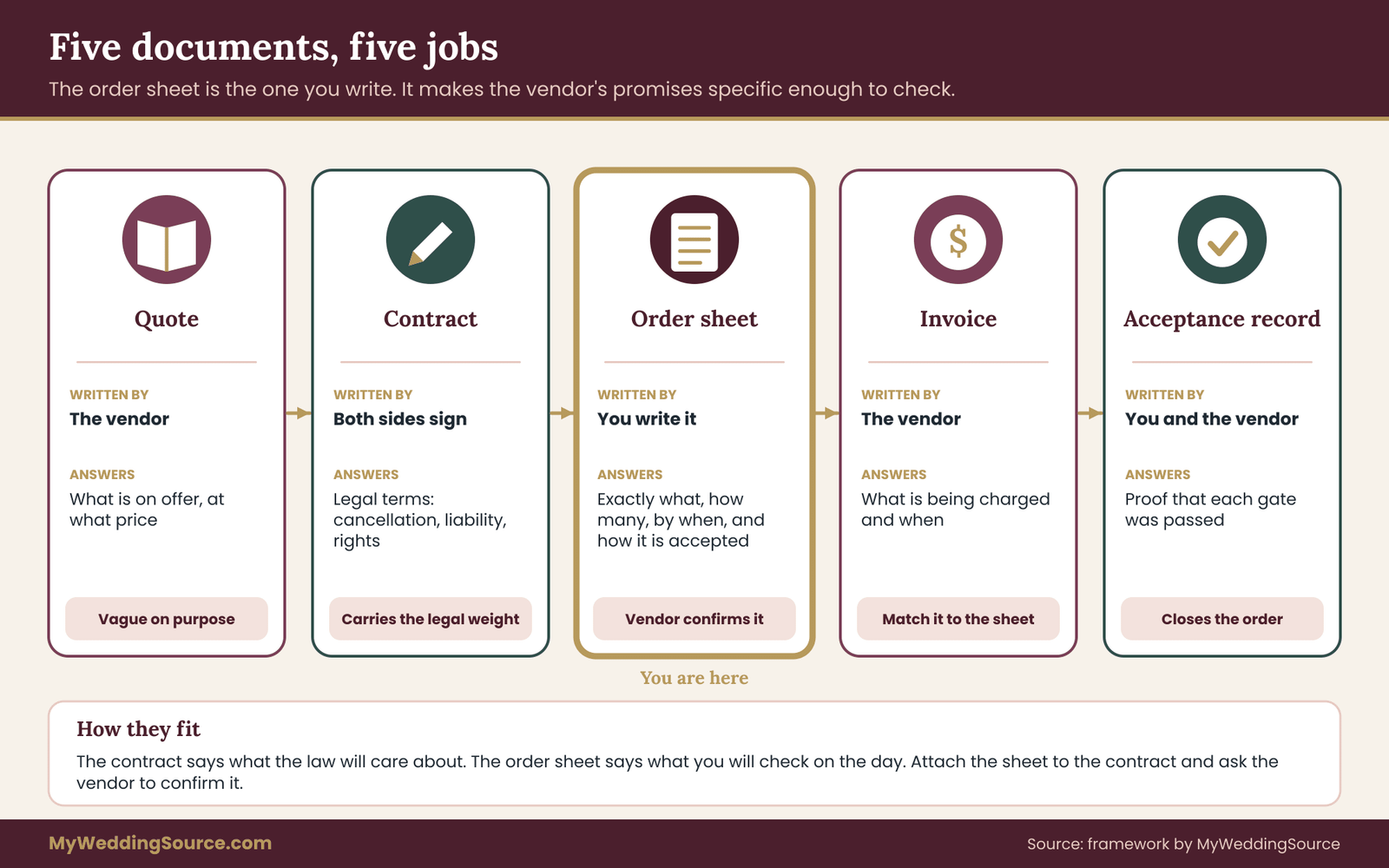
The picture above shows how the five documents relate. The quote starts the conversation, the contract fixes the legal terms, the wedding vendor purchase order specifies and tests the delivery, the invoice requests payment and the acceptance record closes the loop. When one of them disagrees with another, you want to find out in the planning stage, not at the venue loading dock.
A practical way to read the sequence: the contract says what the law will care about, and the order sheet says what you will care about on the day. You need both.
Which document controls if they disagree
This is a legal question, and the answer depends on the wording of your contract and the law where you live. As a general matter, a signed contract with a clause saying it is the entire agreement may override a separate sheet unless the sheet is attached to it or the contract says that attachments form part of it. The safest approach is practical rather than legal: ask the vendor to sign the wedding vendor purchase order as an attached schedule to the contract, and make sure the contract refers to it. If you are unsure how your documents interact, a short consultation with a licensed attorney in your state is worth more than any template.
The six parts of a wedding vendor purchase order
Keep the sheet to one page for small vendors and two or three for caterers, rental companies and anyone with many lines. Every wedding vendor purchase order can use the same six parts, in the same order, so that vendors learn the format quickly.
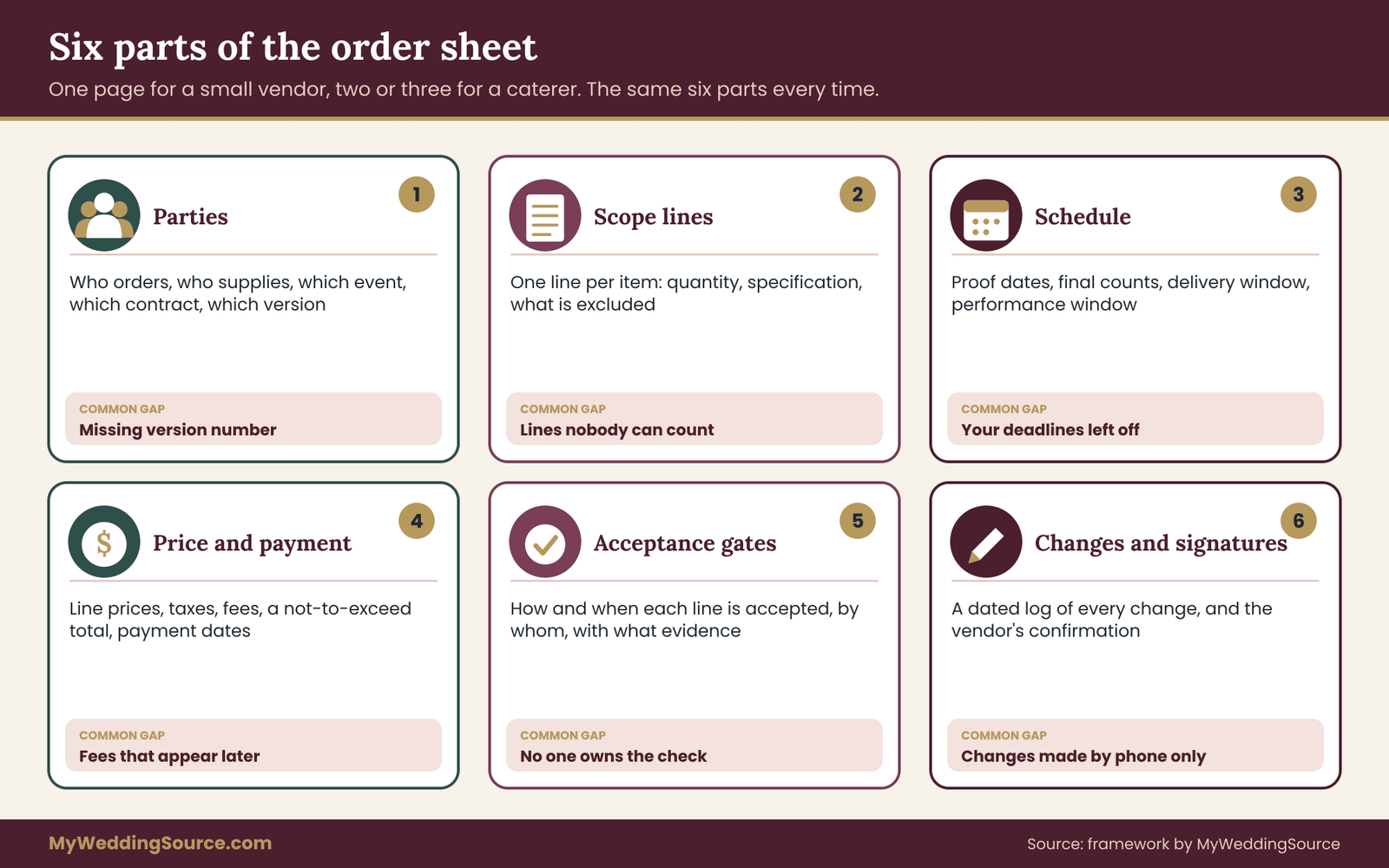
Part one: parties and identification
Start with the facts that stop confusion later. Who is ordering, who is supplying, what is the event, and which contract does this sheet belong to?
- Names of both partners, or the legal name of whoever signed the contract.
- The vendor’s business name and the name of the person responsible for this order.
- The event date, the venue name and the address, including any loading or delivery entrance.
- The contract date and, if there is one, its reference number.
- A version number and the date of the last update, such as “Version 3, updated on the date of the last change.”
This is dull, but it matters. A sheet with no version number is a sheet that someone will argue about.
Part two: scope lines
Each thing you are buying gets its own line. A line has an item, a quantity, a specification and a note on what is excluded. The next section shows how to write lines that can be checked.
Part three: schedule
Dates and times for everything that has to happen: site visit, tasting or proof deadline, final quantity date, delivery or arrival window, setup time, event performance window, pickup or teardown. Use clock times and time zones where the vendor and venue may be in different places.
Part four: price and payment
The agreed price per line or per package, taxes, service charges, delivery fees, gratuities if applicable, and the payment schedule. The payment schedule in a wedding vendor purchase order should refer to the acceptance gates described later, so that each installment is tied to a point you can observe. Keep the dates from this part in the same payment calendar you use for the rest of your wedding budget.
Part five: acceptance gates
How you will decide that each line has been delivered as ordered, and who will decide it. This is the heart of the process and has its own section below.
Part six: change log and signatures
A running list of every change after the first version, with the date, who asked, what changed, the effect on price and time, and who agreed. Then signature lines or a clear statement that the vendor confirms the wedding vendor purchase order by reply email.
Writing scope lines for a wedding vendor purchase order that you can actually check
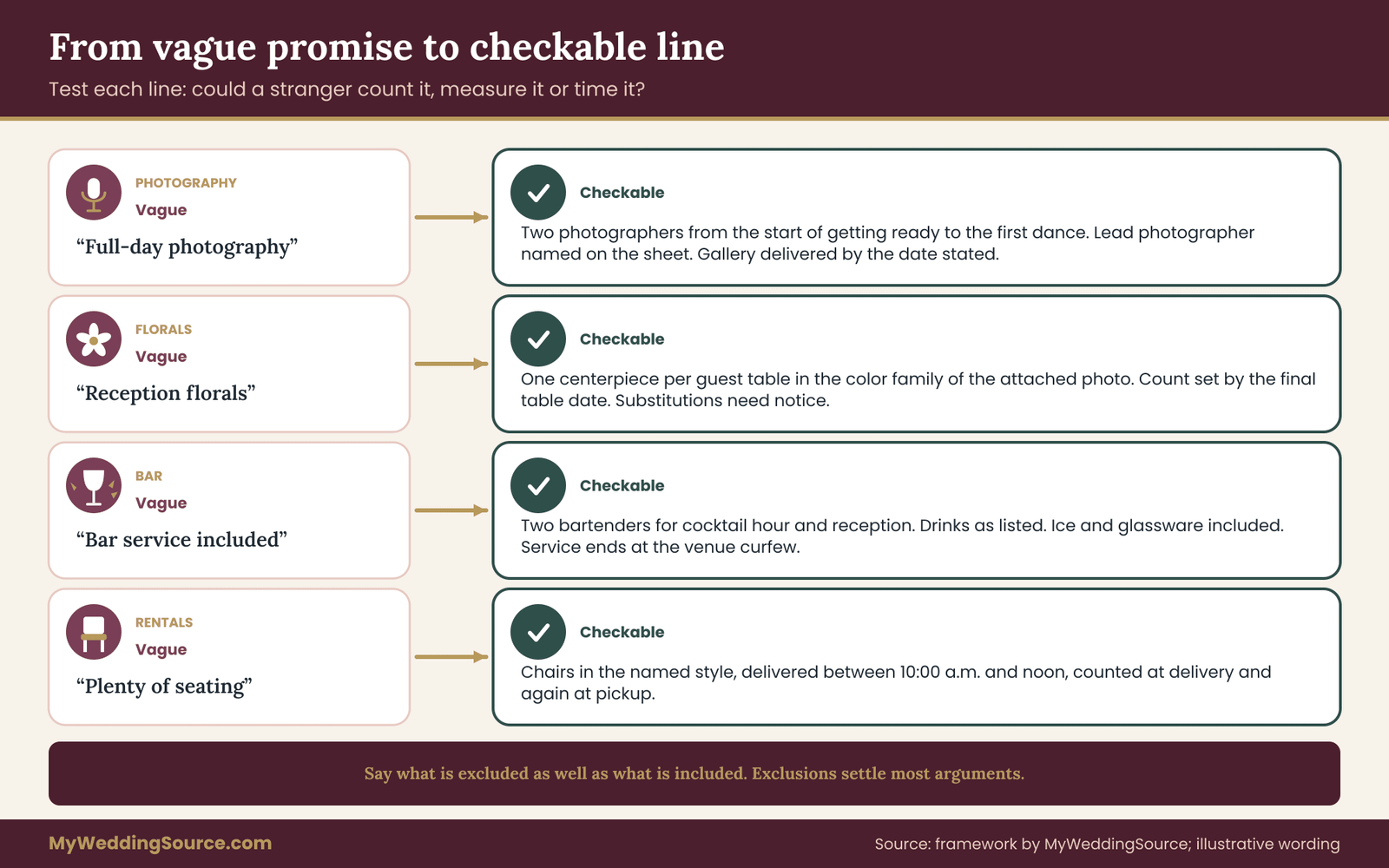
A scope line is good when two strangers could read it and agree about whether it was delivered. The easiest test is to ask: “Could someone who has never met us count, measure, photograph or time it?” If not, rewrite it.
The formula
Use four elements in each line:
- The item, in plain language.
- The quantity or duration, as a number.
- The specification, including size, style, color family, brand tier or standard.
- The edge, which is what is excluded or what happens if the item is not available.
Here is how it looks in practice.
- Vague: “Photography coverage.” Checkable: “Two photographers, continuous coverage from the start of getting ready to the end of the first dance, with a lead photographer named in this sheet. Overtime is charged at the rate in the contract and approved in writing.”
- Vague: “Reception florals.” Checkable: “Centerpieces for the guest tables and sweetheart table, in the color family and style described in the attached photos. Quantity is set by the final table count. Seasonal substitutions are allowed only within the same color family and with notice before the delivery date.”
- Vague: “Bar service.” Checkable: “Two bartenders for the cocktail hour and reception, with the beer, wine and signature drink list on the attached menu, ice and glassware included, and service ending at the time stated in the venue agreement.”
Words that signal a vague line
Be wary of these when you see them in a quote or in your own drafting:
- “Approximately” with no range. Ask for a range.
- “Up to” with no minimum. Ask what the minimum is.
- “Standard” or “typical.” Ask what the standard is, in numbers.
- “As needed” or “as appropriate.” Ask who decides.
- “Including” with no end of the list. Ask whether the list is complete.
- “Similar.” Ask what counts as similar and who approves it.
None of these words is wrong. They are normal in vendors’ templates. But each one marks a place where the line cannot yet be checked, so each one deserves a follow-up question.
Include what is excluded
Exclusions are as valuable as inclusions. If delivery is included but setup is not, say so. If the DJ’s price covers the ceremony speaker but not the microphone for the officiant, say so. Many disputes arise because each side assumed the other thing was obvious. A short “Not included” line under each item costs nothing and often reveals a gap while there is still time to fix it.
Match the wedding vendor purchase order to the contract’s words
Where the contract already uses a term, use the same term. If the contract says “Deluxe Reception Package,” your wedding vendor purchase order should name that package and then list what is in it. This avoids creating two vocabularies and makes it harder for a later reader to claim the sheet describes something different.
Quantities, specifications and substitutions in a wedding vendor purchase order
The line items that cause the most friction are physical goods: flowers, linens, chairs, stationery, cakes, signage and rentals. They are also the ones you can count when they arrive, which makes them ideal for a wedding vendor purchase order.
Quantities that move
Some quantities are fixed at signing, such as the number of photographers. Others move with the guest count: tables, centerpieces, plates, programs. For those, write the rule rather than the number.
- “One centerpiece per guest table. Final table count confirmed by the date in the schedule.”
- “Chairs equal to the final headcount plus ten percent for ceremony overflow, confirmed by the same date.”
Then add the date after which the vendor will no longer accept a lower number. This is the point where your flexibility ends, and it should appear in your calendar as well as on the sheet.
Specifications that matter
For goods, write the specification at the level that would let a stranger tell a correct item from an incorrect one.
- Dimensions for linens, backdrops, signs and arches.
- Color family and, where possible, a reference photo or swatch attached to the sheet. Colors vary between screens, so ask for a physical sample for anything important.
- Material where it affects the look or the care, such as real versus faux, glass versus acrylic.
- Condition for rentals, such as “clean, undamaged and free of stains” and any tolerance for normal wear.
- Brand or tier where it matters, with an equivalent allowed only by agreement.
Our rental planning checklist goes into detail on what to confirm for tables, chairs, linens and equipment, and it pairs well with the item lines you write here.
A short, fair substitution clause
Substitutions are normal. A flower may be unavailable, a chair model may be discontinued, a printer may change paper stock. The question is not whether substitutions happen but who decides.
A fair clause has four parts:
- The vendor may substitute only an item of equal or greater value and similar appearance.
- The vendor tells you before the delivery date, not at the door.
- You may approve or decline the substitute.
- If you decline and no suitable option exists, the line is credited at its price.
Vendors often accept this when it is framed as protecting them from complaints. If a vendor refuses to describe how substitutions are decided, treat that as a decision to make with open eyes.
Quotes you can compare with a wedding vendor purchase order
One of the most useful side effects of a wedding vendor purchase order is that it makes quotes comparable. If three caterers each propose a different package structure, you cannot tell which is cheaper or better. If you send each of them the same scope lines and ask them to price against those lines, you can.
How to ask for comparable quotes
- Draft the lines you care about: services, quantities, timings and exclusions.
- Send the same sheet, with prices left blank, to each vendor you are considering.
- Ask each vendor to fill in prices, mark anything they cannot do, and propose alternatives separately.
- Compare the completed sheets line by line.
You will often learn more from the blanks than from the prices. A vendor who writes “not included” next to your outdoor power requirement has just told you about a cost you would have met later. A vendor who adds a helpful alternative has told you something about how they work.
Comparing like with like
When quotes differ in structure, convert them to a common basis before choosing: the total after taxes, fees and gratuity; the cost per guest for food and drink; the cost per hour for time-based services; and the cost of anything you would need to add. The goal is not to choose the cheapest. It is to know what each option actually includes.
For the broader budget picture, see our wedding budget guide, which puts vendor costs in context.
When a vendor’s own forms differ from yours
Many vendors prefer their own proposals and contracts. That is fine. You are not trying to replace their documents. You are adding a short sheet that sits beside them. If a vendor’s form already lists everything clearly, you can mark that the wedding vendor purchase order is “satisfied by” their document and add only the parts that are missing, such as acceptance gates and the change log.
Schedules, windows and who is where: the timing part of a wedding vendor purchase order
A vendor who is “on time” has a different idea of on time from a couple who has a ceremony at a fixed hour. Timing language on a wedding vendor purchase order should be specific enough to settle the question without discussion.
Delivery and arrival windows
For goods, state a window, not a single time, and a contact. For example: “Delivery between 10:00 a.m. and noon to the loading entrance. Driver calls the on-site contact thirty minutes before arrival. Items are placed in the room named on the sheet.”
For services, state the arrival time, the setup time and the start of the event window. Include what the vendor needs from the venue, such as power access, a load-in route or a room to change in. The more a vendor depends on the venue, the more your timeline should be checked with the venue itself. Our wedding vendor timeline guide shows how to stack these arrivals so that vendors do not block each other, and the wedding venues guide covers what venues typically require from outside suppliers.
The performance window
A service has a window in which it should be delivered: the photographer’s coverage hours, the band’s sets, the officiant’s arrival, the shuttle’s runs. Write the start and end times and what happens if the event runs long. Overtime rates and approval rules belong here, not in a conversation on the day.
Deadlines on your side
An order sheet is two-way. Vendors need things from you, and the sheet should say so. Common examples:
- Final headcount and dietary counts, by a stated date.
- Approval of a design proof, by a stated date.
- Payment of an installment, by a stated date.
- Details such as shot lists, song lists, seating charts or ceremony timings.
If you miss one of these dates, the vendor may reasonably pass the consequences on to you. Putting your deadlines on the same sheet makes the obligations mutual and prevents surprise.
Time zones and travel
If anyone is traveling, or the vendor is based elsewhere, say which time zone applies and who is responsible for travel, lodging and equipment shipping. A destination wedding adds layers, from customs for shipped items to local licensing, and each should be named on the sheet rather than discovered at the airport.
Price, taxes and payments: the money part of a wedding vendor purchase order
Money lines should be as exact as scope lines. A price that is correct but incomplete is the most common source of unpleasant final bills.
What to write
- The price of each line, or the package price and what it covers.
- Taxes, if any, and whether they are included in the figures.
- Service charges, delivery fees, setup fees, travel fees and cleanup fees, listed separately even if they are zero.
- Gratuities, whether they are included, optional or expected, and who receives them.
- Overtime and extra-hour rates, in writing.
- A “not-to-exceed” total for the order unless changes are approved through the change log.
This last item deserves attention. A not-to-exceed total means the vendor cannot add charges that were not on the wedding vendor purchase order without a documented change. It does not stop real changes from raising the price, but it forces them to go through the process.
Linking payments to gates
Most vendors ask for a deposit to hold the date, then installments, then a final balance. Those dates come from the contract and are usually non-negotiable in structure, though sometimes negotiable in timing. What you can often add is clarity about what each payment is for.
A tidy payment schedule on a wedding vendor purchase order looks like this: the deposit secures the date and is paid at signing; the second installment is paid after you have approved the proof or confirmed the final scope; the final balance is due before the event as the contract says, with a note that acceptance is recorded at the delivery gate, not at the payment date.
Be realistic. A caterer will not wait until after the wedding to be paid, and a photographer will not hold your date for free. The goal is not to withhold money to gain leverage. It is to make sure each payment corresponds to something you can point to, so that if a problem arises you know which payments have been made for which promises.
Paying in a way that leaves a record
Pay by a method that creates a clear paper trail and, where possible, some ability to dispute a charge. Credit cards come with federal dispute rights under the Fair Credit Billing Act for billing errors, including charges for goods or services you did not accept or that were not delivered as agreed, provided you follow the notice rules. Debit cards, bank transfers, checks and payment apps have different rules, and some have little recourse. The Federal Trade Commission and the Consumer Financial Protection Bureau both publish plain-language guidance, and the sources at the end of this article list them. Whatever method you choose, label every payment with the invoice number and the line items it covers.
Matching invoices to the wedding vendor purchase order
When an invoice arrives, compare it with the order sheet line by line before paying. Check the quantities, prices, fees and totals. If the invoice has a charge that is not on the sheet, ask for an explanation or a change entry. This check takes ten minutes and prevents most billing disagreements.
The five acceptance gates of a wedding vendor purchase order
Acceptance is the moment when you say, “Yes, this matches what we ordered.” In everyday life we accept things informally: we sign for a package without opening it, or we nod at a vendor on the day. A wedding vendor purchase order makes acceptance a deliberate act at defined points, so that problems are caught while they can still be fixed.
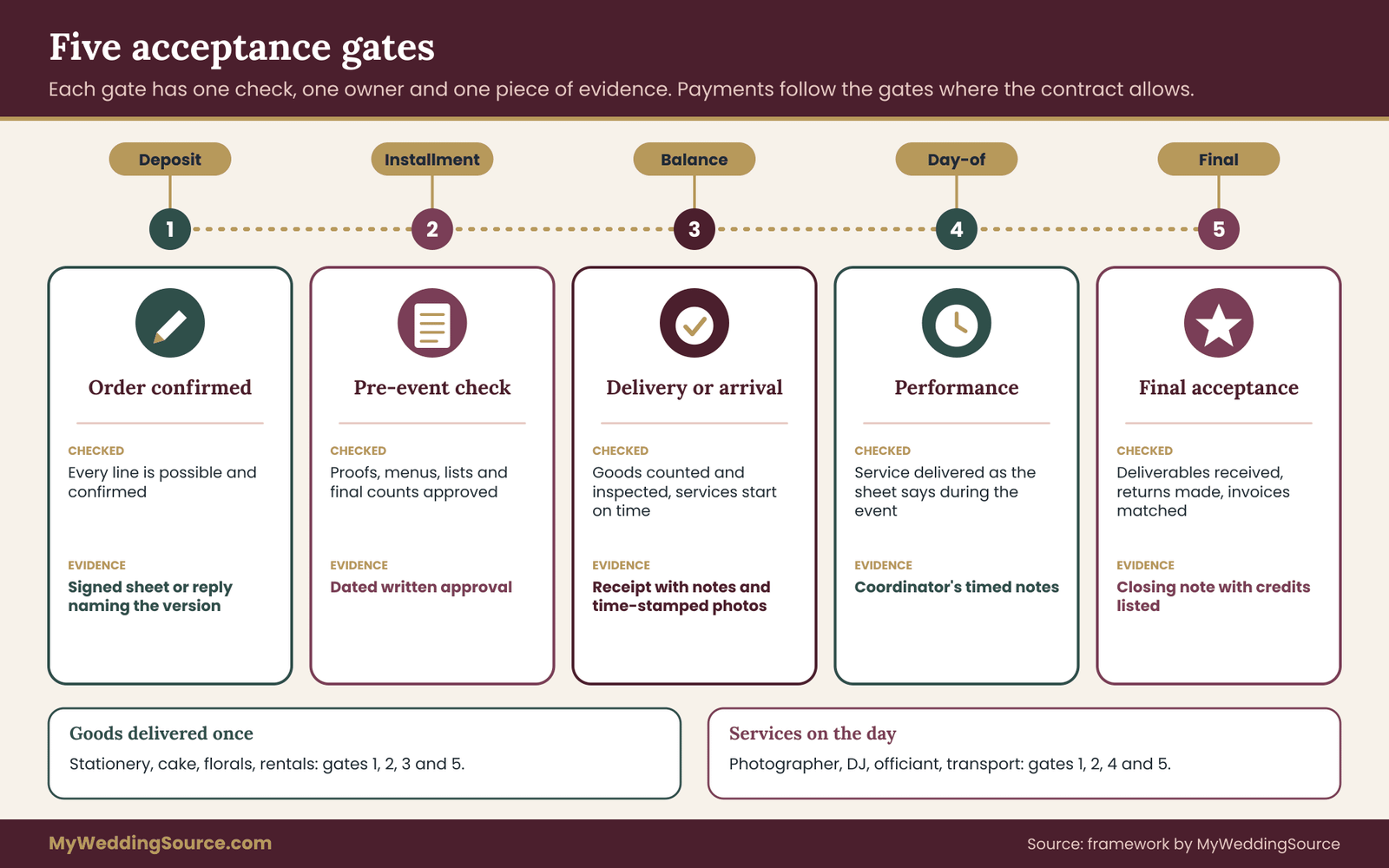
The five gates are placed along the life of an order. Not every vendor needs all five, but every vendor should have at least two.
Gate one: the wedding vendor purchase order is confirmed
What is checked: The vendor has read the sheet, confirmed that every line is possible and signed or replied to confirm it.
Evidence: A signed sheet or a written confirmation naming the version number.
Why it matters: This is where impossible lines are discovered. A vendor who has never confirmed the sheet cannot later say they agreed to it, and you cannot say they did.
Typical payment link: The deposit, if it has not already been paid with the contract.
Gate two: pre-event check
What is checked: Proofs, samples, menus, music lists, floor plans and designs have been reviewed and approved. Final quantities are confirmed.
Evidence: Your written approval of the proof or the final list, dated, with the version attached.
Why it matters: Approval after a proof is often a contractual turning point: once you approve a printed proof, errors in it are usually yours. Check carefully before approving.
Typical payment link: A mid-stage installment.
Gate three: delivery or arrival check
What is checked: Goods are counted and inspected when they arrive. Services begin as scheduled with the people named on the wedding vendor purchase order.
Evidence: A delivery receipt with the count, notes on any shortages or damage, photographs with the time stamp, and the name of the person who accepted.
Why it matters: This is the best time to raise a problem, because the vendor is still on site and a replacement may be possible. Sale-of-goods law in many states expects a buyer to inspect goods within a reasonable time and tell the seller promptly if they do not match. The exact rules vary, so treat the delivery check as time-sensitive.
Typical payment link: The final balance, if the contract allows payment on delivery, or the point at which you confirm the balance is correct.
Gate four: performance check
What is checked: For services, whether the performance matched the sheet during the event: coverage hours, set lists, service ratios, setup completed.
Evidence: A short note by the coordinator or a trusted person during the event, with times. For example, “Photographer arrived at the time stated. Band ended the last set at the time stated.”
Why it matters: Services cannot be returned. The only evidence of what happened is what was noted at the time.
Typical payment link: Any balance that the contract makes due on the day, and gratuity.
Gate five: final acceptance
What is checked: The deliverables after the event: the photo gallery, the video, the album, returned deposits, final invoices, equipment returned and inspected.
Evidence: A final acceptance note that lists what was received, what is outstanding and any agreed credits, followed by the final payment or the release of a deposit.
Why it matters: This closes the order and starts the clock on any follow-up. Without it, issues may drift for months.
Typical payment link: Any post-event balance and the return of a security deposit.
Making the gates of a wedding vendor purchase order fit your vendors
Match the gates to the type of vendor.
- Goods delivered once (stationery, cake, florals, rentals): gates one, two (proof or sample), three and five.
- Services performed on the day (photographer, DJ, officiant, transportation): gates one, two (confirmed details), four and five.
- Mixed vendors (caterers, florists with installation, rental companies with setup): all five, adapted.
Keep the gates short on the page. A single line for each gate is enough: what you check, who checks it, and when.
Inspecting goods against a wedding vendor purchase order: a short guide for the loading dock
Goods can be inspected, and that is where a wedding vendor purchase order is at its most practical. Whether you or a trusted helper is at the venue when a delivery arrives, a simple routine will protect you.
Before the delivery
- Give the person receiving the delivery a printed copy of the sheet, not a link.
- Mark the lines to be counted and the condition to be checked.
- Make sure they have permission to accept on your behalf and know who to call for a decision.
- Arrange a place to put the items, with room to count them.
At the delivery
- Greet the driver and ask for the delivery receipt.
- Count the items against the sheet before signing, not after.
- Open boxes and check the most important or fragile items.
- Photograph anything wrong, with a time stamp, and write the problem on the delivery receipt before signing.
- Call the vendor from the dock if something is missing or damaged. Ask what they will do and when, and write it down.
- Sign for what was actually received, with notes, not for the order as a whole.
Why notes on the receipt matter
A signature without notes can be read as acceptance of everything. A signature with a note such as “forty chairs received of fifty ordered; remaining ten to follow by 2:00 p.m.” records what happened. It is also fair to the driver, who can only report what they delivered.
After the delivery
Send a short message to the vendor the same day confirming what was received, what was missing and what was agreed. Update the sheet’s acceptance record. If a replacement or credit was promised, add it to the change log.
For the rental items in particular, repeat the count at pickup so that you are not billed for missing items that were never delivered. Many rental companies charge for loss or damage based on their own count and their own inspection after pickup, and your records are what you will rely on if you disagree.
The change log: how a wedding vendor purchase order stays true
Weddings change. Guest counts move, a vendor offers an upgrade, the weather forecast turns, a family member adds a request. A wedding vendor purchase order that was perfect in January can be wrong by June unless changes are recorded as they happen. The change log is how you keep it true.
What goes in a change entry
Each entry takes one or two lines and holds seven facts:
- Date of the change.
- Who asked for it, you or the vendor.
- What changed, referring to the line number on the wedding vendor purchase order.
- Why, in a few words.
- Effect on price, up or down, or “none.”
- Effect on time, such as a new delivery window or deadline.
- Who approved, with the date and how (reply email, signature, message).
A small entry might read: “Line 4. Centerpieces reduced from fourteen to twelve because the final table count changed. Price down by the agreed per-piece amount. Approved by the florist by email on the date of this entry.”
The change loop
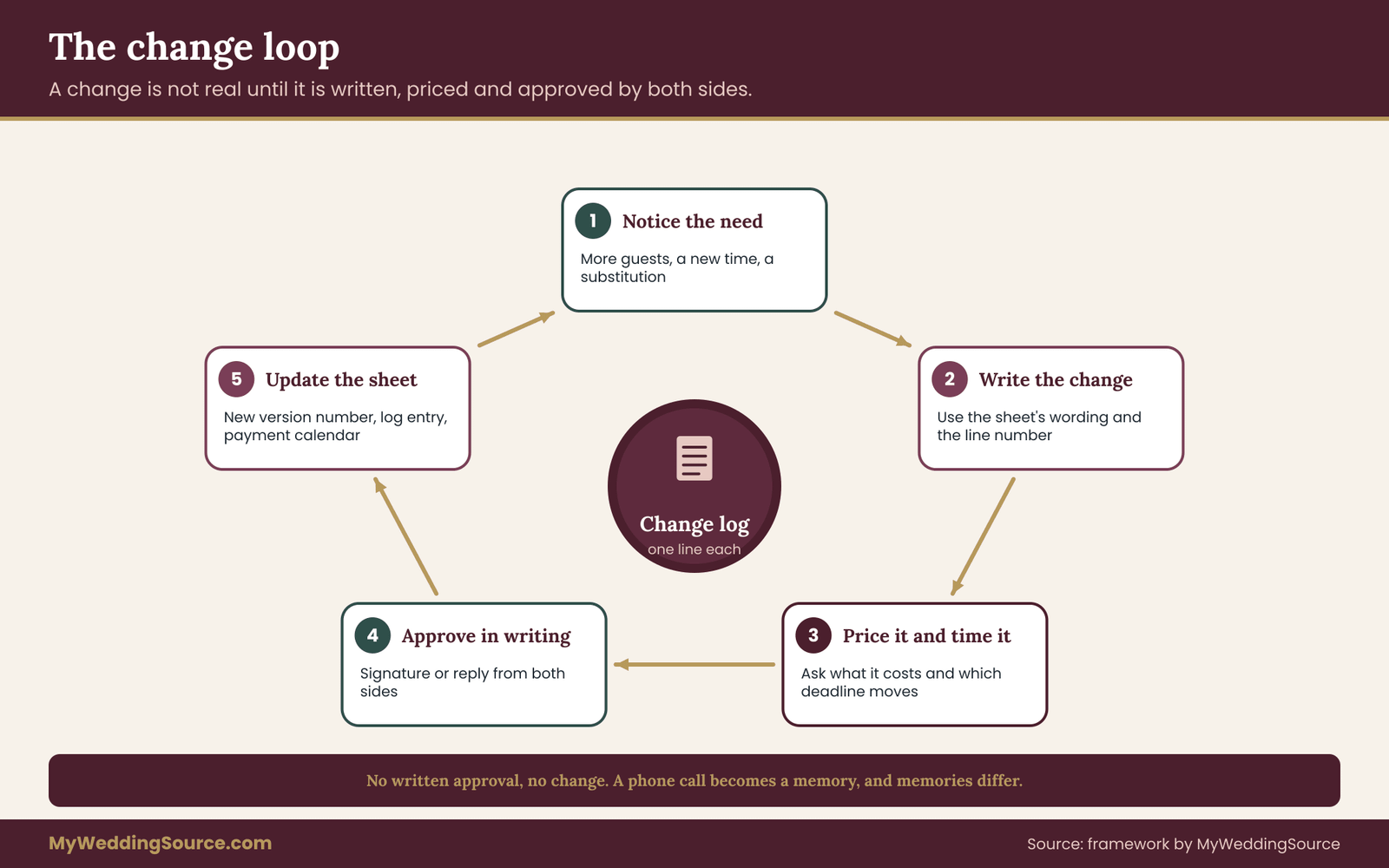
The loop has five steps, and the discipline is in not skipping any.
- Notice the need. Someone sees a change coming: more guests, a new time, a substitution.
- Write the change. Describe it in the language of the sheet, with the line number.
- Price it and time it. Ask the vendor what it costs and whether it affects any deadline.
- Approve it in writing. Both sides confirm, by signature or reply.
- Update the sheet and your payment calendar. Increase the version number, add the entry to the log and adjust your payments.
The most common failure is step four. A change that is agreed in a phone call but never written down becomes a memory, and memories differ. A short follow-up message, such as “To confirm our call, we are changing line 4 as follows and the price changes by this amount,” is enough.
Who may approve changes
Decide at the start. A sensible rule for a couple with a planner is that the planner may approve changes that do not affect price or that fall within an agreed amount, and anything above that needs one of the partners. On the vendor side, ask who is authorized to approve changes. The person who answers your emails and the person who can alter the price are not always the same.
Vendor-initiated changes
Vendors sometimes propose changes: a substitute item, a different arrival time, a replacement for the named photographer. Treat them exactly the same way. Do not accept a verbal change at the door. Ask for it to be written, ask what changes in price and quality, and decide whether you agree. If you do not, say so promptly. Waiting can be read as acceptance.
Small changes and big changes
Not every change needs a ceremony. Give yourself a threshold. A swap that does not change price, time or appearance may need only a log line. A change that affects price, time, appearance or the people providing the service should be approved in writing before it happens. When in doubt, write it down.
Signatures, versions and storage for a wedding vendor purchase order
A sheet that exists in three versions on three devices is worse than no sheet.
Version control in plain language
- One master file, stored in a shared folder that the keeper controls.
- A version number on every copy, such as “Version 2.”
- Old versions saved but marked “superseded,” never deleted.
- When you send a new version, say so in the message and ask for confirmation of the new version number.
Signing
Electronic signatures are widely accepted for ordinary commercial agreements, and many vendors use them already. If a vendor prefers to confirm by email, ask them to reply with a statement such as “We confirm Version 2 of the wedding vendor purchase order dated this date.” Keep the message with the sheet.
Where to keep records
Create one folder per vendor, with the contract, the order sheet and its versions, invoices, receipts, delivery notes, photos from the gate checks and key messages. Keep a duplicate offline or in a second account. You will thank yourself if a dispute arises months later or if you need records for a claim.
What if a vendor will not sign the wedding vendor purchase order
Some vendors will not sign a separate sheet. Reasons vary: a rigid template, a corporate policy, a busy owner. You still have options.
- Ask them to accept it by email. A reply that says “confirmed” may be enough.
- Put the lines into their document. Ask whether the scope details can be added to the contract as an attached schedule or an addendum.
- Send it as your understanding. A short message that says “This is our understanding of what you will provide. Please tell us if any line is incorrect by this date” at least creates a record that you described the order and the vendor had a chance to correct it. It is weaker than a signature but better than silence.
- Weigh what the refusal tells you. A vendor who will not engage with specifics may still be excellent, but the risk is higher, and you should make that decision knowingly.
If a vendor is the sole provider you need on your date, such as an in-house venue caterer, you may have little leverage over the form. Even so, an order sheet you keep for your own use is valuable. It will tell you, on the day, exactly what you expected.
A worked example, with invented numbers
The example below is illustrative. The vendor, the couple and the figures are made up to show the method. Your own terms will differ.
Imagine a couple, Priya and Sam, who have a florist and a rental company for an outdoor reception. They write one order sheet for each.
The florist’s wedding vendor purchase order
The florist’s sheet has six lines: bridal bouquet, two attendant bouquets, ceremony arch pieces, twelve centerpieces and a sweetheart table arrangement. Each line has a color family, a photo reference and a substitution rule. The delivery window is 11:00 a.m. to noon at the venue’s side entrance. The final centerpiece count is due on a stated date, six weeks before the event.
The rental company’s wedding vendor purchase order
The rental sheet lists ninety chairs, eleven round tables, linens in a named color and size, and two cocktail tables. Delivery is on the day before the event between two and four in the afternoon. Pickup is the morning after. The sheet notes the surface the tables will sit on and asks the company to confirm they can handle grass.
What happened at each gate
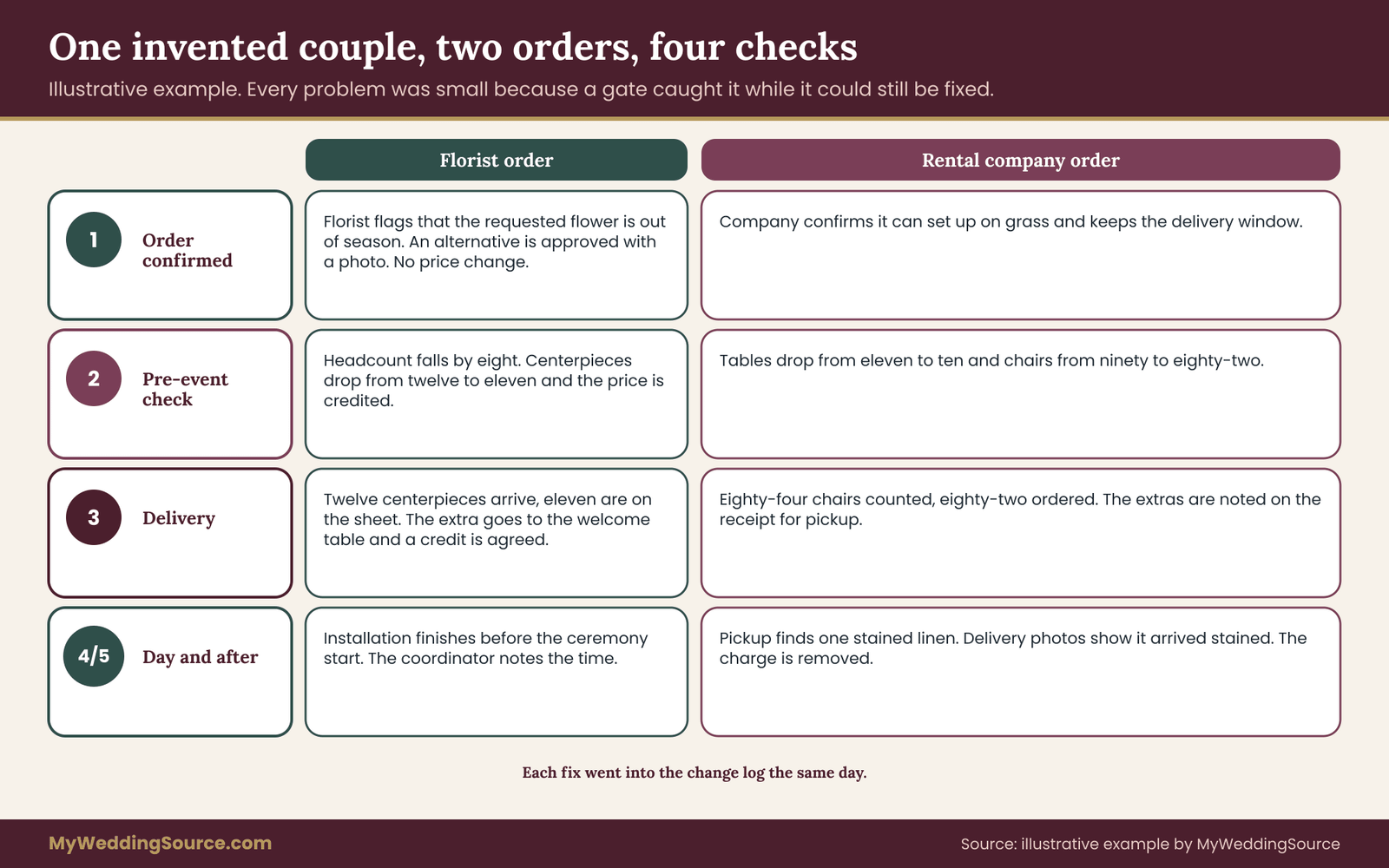
- Gate one. The florist confirms the wedding vendor purchase order but flags that the requested flower is out of season at that time of year and proposes two alternatives. Priya and Sam approve one with a photo. This goes in the change log as an approved substitution, with no change in price.
- Gate two. The final headcount drops by eight guests. The couple reduces the table count from eleven to ten, which brings the centerpiece count from twelve to eleven and the chair count from ninety to eighty-two. Both sheets are updated and both vendors confirm, with the price effect shown in the log.
- Gate three. The rental delivery arrives with eighty-four chairs, not eighty-two as updated. Sam counts them, notes the extra chairs on the receipt and asks the company to collect them at pickup so that the couple is not billed for them. The florist’s delivery has twelve centerpieces, not eleven. Sam checks the sheet, sees that it was updated to eleven, and asks for a quick credit and for the extra piece to be used at the welcome table. The florist agrees. Both agreements go into the log.
- Gate four. The coordinator notes the florist’s installation finished before the ceremony start and records the time.
- Gate five. After the event, the rental company’s inspection finds one stained linen. The couple’s delivery photos show it was stained on arrival. The charge is removed.
The sheets did not stop every problem. They made each one small. Each was spotted at a gate, written down and fixed by someone with the facts in hand.
When something goes wrong: using the wedding vendor purchase order as a record
If a vendor does not deliver what the sheet describes, the wedding vendor purchase order and gate records are the foundation of your response. A calm sequence helps.
- Stay factual. Gather the sheet, the change log, the invoice, the delivery notes and the photographs.
- Contact the vendor promptly. State what the wedding vendor purchase order said, what was delivered and what you would like: a replacement, a partial refund, a credit or a fix.
- Put it in writing. Email the same points so you have a record. Keep the tone professional.
- Check the contract. Look for the clause on complaints, notice periods and remedies. The vendor contract guide explains how to read these.
- Escalate if needed. If the vendor does not respond fairly, consider a complaint to the Better Business Bureau or your state attorney general’s consumer protection office, and, if you paid by card, a dispute with your card issuer following its stated process and deadlines.
Payments and disputes
Card disputes have time limits, and the notice to your issuer typically must be in writing within a set window after the statement showing the charge. The FTC and the CFPB explain how this works for credit cards, and their pages are listed in the sources. A record of acceptance gates shows exactly what you accepted and what you did not, which can make a dispute clearer. Remember that a card issuer, a vendor or a court will each look at your contract and your evidence, and outcomes depend on the facts and the law where you live.
Small claims and professional help
For larger sums, or when a vendor refuses to respond, small claims court is designed for people without lawyers, and your records matter there. Limits and procedures differ by state. For anything complex, such as a substantial loss or a contract with unusual terms, a short consultation with a licensed attorney in your state is sensible. This article offers general information and is not legal advice.
Insurance
Event insurance may cover certain vendor failures or cancellations, depending on the policy. Coverage, exclusions and claim steps vary, so read the policy’s terms, and see our wedding insurance guide for the general picture. The wedding vendor purchase order and acceptance record help with a claim because they document what was promised and what happened.
Scams and the wedding vendor purchase order as a safety anchor
The same record that helps with honest disputes also helps you spot dishonest requests. Wedding payments are a target for fraud, including fake invoices, requests to change payment details and vendors who vanish after a deposit.
The wedding vendor purchase order gives you reference points:
- The vendor’s confirmed contact details. If an email arrives asking you to send payment to a new account, check it against the contact details on the signed sheet and phone the number you already have. Do not use contact information in the message itself.
- The expected invoice. If an invoice contains lines that are not on the sheet or a total above the not-to-exceed amount, pause.
- The payment schedule. If a request for payment arrives outside the schedule, ask why, in writing.
- The named people. If a stranger turns up claiming to represent the vendor, check the names on the sheet.
If something seems wrong, the FTC runs a consumer scams page and a reporting site, both listed in the sources. Reporting helps others and creates a record.
Lines to put on a wedding vendor purchase order, by vendor type
Every vendor sells something different, so the useful lines differ. These lists are starting points. Delete what does not apply and add what does.
Photographer and videographer
- Named lead photographer and the number of additional shooters.
- Coverage start and end events, in clock times, and how overtime is requested and priced.
- Locations covered, including any second venue.
- Deliverables: number or range of edited images, delivery format, gallery hosting period and the delivery deadline after the event.
- Rights: print release, usage permissions and the vendor’s right to publish images.
- Backup plan: what happens if the photographer is ill, and how the replacement is chosen.
- Shot list or essential moments agreed in advance, attached to the sheet.
- Gate five: gallery received, checked for completeness and downloaded.
Caterer and bar service
- Menu items, serving style and portion rules.
- Final guest count date, the dietary counts and the rule for late changes.
- Staffing ratios and names of the lead captain or manager.
- Equipment, glassware, linens and serviceware, and who supplies each.
- Alcohol service rules, licensing and who is responsible for them.
- Service start and end times, cake-cutting service and cleanup.
- Tasting date and approval, with notes on any recipe changes agreed.
- Gate three and four: food arrives and is served as scheduled, and a coordinator notes any gaps.
Florist and décor
- Each arrangement, with quantity, size, color family and a reference photo.
- Substitution rule, with notice date.
- Delivery, installation and breakdown times.
- Containers and stands: owned, rented or included, and when they are returned.
- Gate three: count and condition at delivery, with photographs.
- Gate five: return of containers and any final credits.
Rentals
- Each item, with quantity, size, style and condition standard.
- Delivery window, setup service and the surface or location.
- Pickup window and the rule for counting at pickup.
- Damage and loss fees, and how they are assessed.
- Weather or site conditions that affect delivery, such as access for a truck.
Our rental planning checklist can help you think through the items themselves. Use it to draft the lines, then paste them into the wedding vendor purchase order.
Music, DJ and band
- Performance windows for ceremony, cocktail hour and reception.
- Equipment supplied, including microphones for speeches and the ceremony, and what power they need.
- Set list guidance, do-not-play list and who has final say on the day.
- Announcements and the role of the emcee.
- Sound limits or curfews from the venue.
- Backup equipment and replacement provision.
Transportation
- Vehicles, capacity and the number of runs.
- Pickup and drop-off points, times and the route.
- Waiting time rules and charges.
- Names or contact details of drivers.
- What happens if a vehicle breaks down.
Cake and desserts
- Size, tiers, flavors, fillings and design, with a sketch or reference.
- Delivery time, location and who sets it up, including support or display stand.
- Serving: cutting service, plates and boxes.
- Storage and temperature requirements until serving.
- Return of stands, cake toppers or other items.
Officiant
- Name, arrival time and the rehearsal attendance.
- Ceremony script, who approves the final version and when.
- Legal responsibilities, such as signing the license and returning it, as described by the local authority.
- Fee, travel and any extra charges.
Hair, makeup and beauty
- Number of people served and the services each person receives.
- Start time, finish time and the schedule for each person.
- Trial date and what is agreed after it.
- Travel, early-morning fees and touch-up service.
- Products or allergies to avoid.
Stationery and signage
- Quantities, sizes, paper stock, printing method and envelope details.
- Proof dates and approval, with the version you approved.
- Delivery date and how errors are handled.
- Whether the quantity includes spares.
Planner or coordinator
- Services included at each stage, in lines.
- Hours on the day and the number of assistants.
- Meetings, rehearsal attendance and communication rules.
- What the planner can approve on your behalf, and the limits.
These are only starting points, but even a short list in each category produces a sheet that is easier to check than a package name.
Special situations for a wedding vendor purchase order
The method is the same everywhere, but the details shift with the type of vendor and the type of wedding.
In-house venue vendors
Venues that supply their own catering, bar, rentals or coordination usually have fixed forms and little room to change them. You may not get a signature on your wedding vendor purchase order, but you can still use it as your own checklist and send it as your understanding. Ask for the banquet event order or equivalent document, which is the venue’s version of the same idea, and compare it with your wedding vendor purchase order line by line. Where they disagree, ask which controls and have the answer put in writing.
Friends and family as vendors
When a cousin photographs the wedding or a friend plays music, a formal contract can feel awkward. A one-page wedding vendor purchase order is a gentle alternative. It is not about suspicion. It lists what you hope for, what they have agreed to, the timings and what happens if something changes. It protects the friendship by making expectations visible, and it is a kindness to the friend, who may not know what you are picturing.
A wedding vendor purchase order for online orders and custom goods
Invitations, signage, favors, attire and décor are often ordered from online sellers or small makers with standard terms. You may not be able to negotiate, but you can still do the following:
- Save the product page, the order confirmation and any custom-design approvals.
- Record the promised ship date and the date you need the item by, with a margin.
- Check the return and refund terms before ordering custom items, because many are final sale.
- Approve proofs in writing and keep the version you approved.
- Inspect on arrival and photograph problems immediately.
Stationery is one of the most proof-dependent orders, so give the approved proof a version number and keep the file.
Destination weddings
Distance multiplies risk. Add lines for who is responsible for shipping, customs, local permits and replacement if an item is lost. Confirm who the local contact is and how to reach them in the local time zone. Where a vendor is overseas, check how payments and disputes would work across borders before you pay, since card protections and bank transfer rules differ.
Multiple vendors that depend on each other
Some deliveries cannot be checked in isolation. The tent company’s setup affects the caterer’s kitchen, the florist’s installation depends on the tables being in place, and the sound system relies on power from the venue. Add a “depends on” note to each line where this applies, and let each vendor see the lines they rely on. Your coordinator’s overview, such as the one in our wedding party coordination checklist, should show the sequence in one place.
A very small wedding vendor purchase order
For a small order, such as a single cake or a pair of bouquets, a half-page sheet is enough. Keep the same six parts, but compress them. It is better to have a short sheet that is used than a long one that is not.
A large, complex wedding vendor purchase order
For a caterer with a large menu, a rental company with dozens of items or a production company with lighting, sound and staging, the sheet may run to several pages. Group the lines by category and give each category a gate owner. A spreadsheet for the line items, attached to a one-page summary, often works better than a long document.
The last fourteen days of a wedding vendor purchase order
The final two weeks are when the sheet earns its keep. A wedding vendor purchase order is useful in January, but most of its value is realized in the days before the event, when the list of things that can still change gets short.
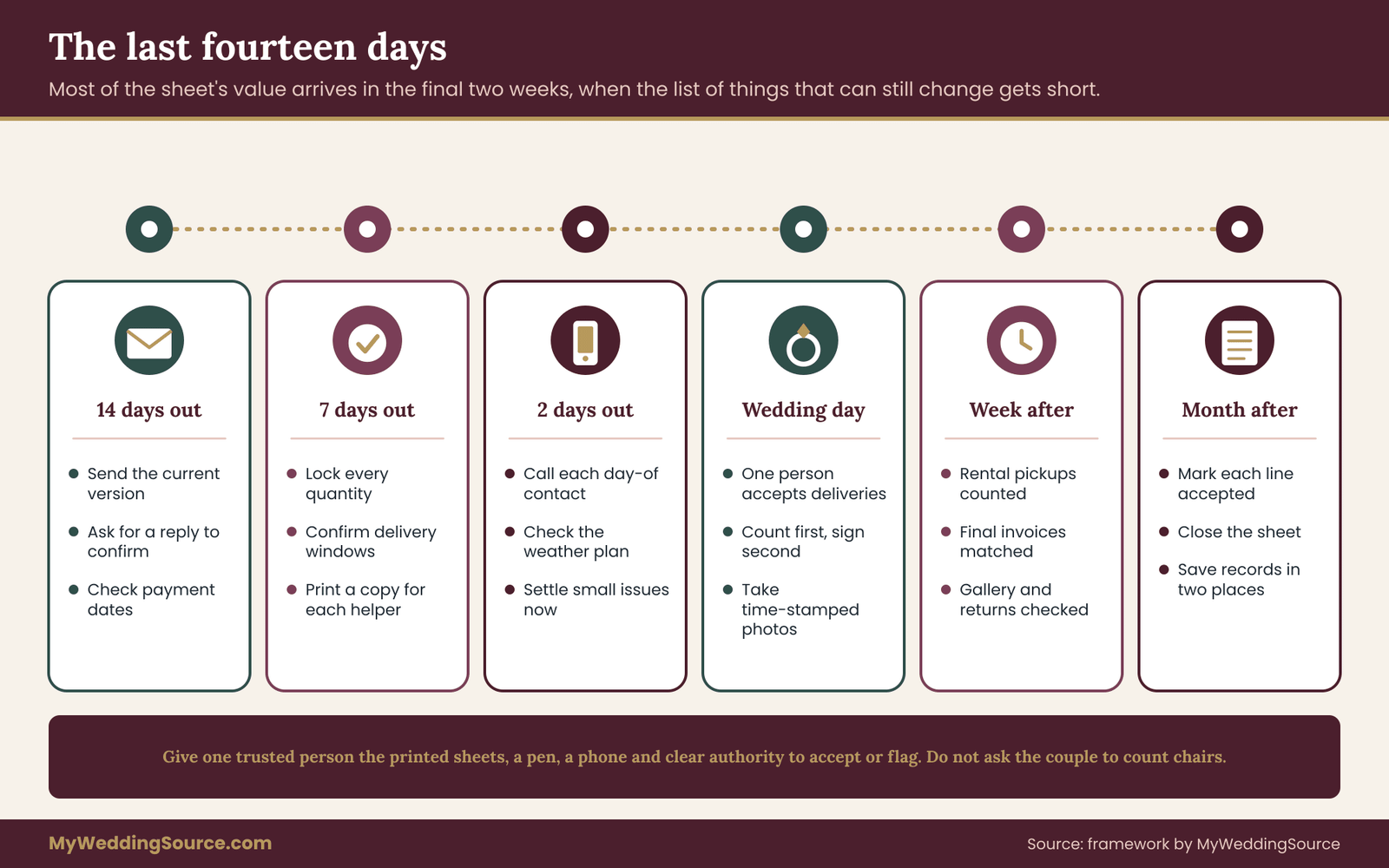
Fourteen days out: reconfirm
Send each vendor the current version of the sheet and ask them to confirm it by reply. Check the list of changes against the latest version and make sure nothing is missing. Confirm payment dates and amounts.
Seven days out: lock quantities
By now, the final headcount should be in. Confirm every quantity-dependent line, including tables, chairs, meals, centerpieces and programs. Confirm the delivery windows, the contact for each arrival and the route to the loading area. Print the sheets for each person who will receive a delivery.
Two days out: the contact round
Call or message each vendor’s day-of contact, confirm arrival times and ask whether anything has changed on their side. Check the weather plan and see whether any line needs a change. Resolve small issues now rather than on the day.
The day itself: who signs off
Give one person the authority to accept deliveries and to record gate results. Provide them with a folder that holds the printed sheets, a pen, a phone with the vendors’ numbers and a way to take time-stamped photos. Decide in advance what they can approve on the spot and what must wait for you.
If you have no coordinator, ask a reliable friend or relative and brief them in advance. It is unfair to ask someone to do this at the last minute, and the couple should not be the ones counting chairs.
Day after, week after, month after
Rental pickups, returns, final invoices, galleries and deposits all land after the wedding. Set reminders for each and, as each arrives, record final acceptance on the wedding vendor purchase order.
After the wedding: final acceptance and closing the wedding vendor purchase order
An order is closed when every line has been delivered, every payment is made, and any deposit that should be returned has been returned. Closing is not a formality. It sets the record for any later question.
The closing checklist
- Every line is marked accepted, accepted with a credit or disputed, with notes.
- Every invoice is matched and paid, with receipts saved.
- Any deposit that should be returned is returned, or a date is set.
- Deliverables are received and checked: photos, video, albums, signage, rentals returned.
- The change log is complete and the final version is saved.
- A short note is sent to the vendor stating that the order is closed, with thanks where deserved.
Reviews and feedback
After closing, you are in a good position to write an honest review. Rely on your acceptance records. Be specific and fair, mentioning what was delivered as ordered as well as what was not. Reviews that are accurate and measured help other couples more than angry or glowing ones.
What to keep, and for how long
Keep the contract, the final sheet, the invoices, proof of payment and photographs of any problems for at least as long as the longest period in which a dispute, a refund or a claim might arise. Time limits differ by state and by type of claim, so ask a professional if you are unsure. Digital copies in two places are enough for most couples.
Mistakes to avoid with a wedding vendor purchase order
- Writing it after the problem appears. The sheet is most useful when written before signing and updated as changes occur.
- Making it too long. If the sheet is longer than the vendor will read, shorten it. Focus on the lines that matter.
- Using vague lines. If you cannot count, measure or time a line, rewrite it.
- Forgetting exclusions. Say what is not included.
- Skipping the change log. Verbal changes vanish.
- Letting several people edit. One keeper, one master version.
- Ignoring your own deadlines. The sheet binds both sides.
- Paying ahead of the gates when you can choose not to. Follow the contract’s schedule, and where you have flexibility, tie payment to something observable.
- Accepting at the door without checking. Count first, sign second.
- Treating the sheet as a replacement for the contract or insurance. It supports them.
A wedding vendor purchase order template you can copy
Use this outline and adapt the words. Fill in only what applies.
Header
- Event, date and venue, with loading entrance.
- Ordered by, vendor name and contact.
- Related contract date or number.
- Version number and date.
Lines (one per item)
- Line number.
- Item.
- Quantity or duration.
- Specification, with reference photo or sample.
- Not included.
- Substitution rule.
- Price.
Schedule
- Proof or approval deadline.
- Final quantity date.
- Delivery or arrival window and contact.
- Event performance window.
- Pickup or teardown.
Payments
- Deposit, installments and final balance, each with date, amount and what it covers.
- Taxes, fees and gratuity.
- Not-to-exceed total.
Acceptance gates
- Gate, what is checked, who checks it, when and what evidence is saved.
Change log
- Date, who asked, line, what changed, effect on price and time, who approved.
Confirmation
- Vendor’s signature or reply statement, with date.
- Buyer’s signature, with date.
If you prefer to start from a ready-made structure, the same fields can live in a simple spreadsheet, with one tab per vendor and one for the change log.
How to introduce the wedding vendor purchase order to a vendor without friction
The sheet works best when the vendor sees it as help. Timing and tone matter more than format.
When to send it
Send it with your questions after you have a quote and before you sign, so that vendor and couple can fix gaps in the contract itself. If you have already signed, send it as soon as you decide to use one, and present it as a way of confirming details. Do not wait until the week before the wedding. A vendor who receives a long sheet at the last moment has little room to respond.
What to say
A short message does the job. Here is an example you can adapt in your own words:
“We are excited to work with you. To make sure we have everything right, we have put the details of our order on a one-page sheet: what we expect, the quantities, the timings and how we will check the delivery together. Could you look it over, correct anything that is wrong or not possible, and reply to confirm it? If something in your own paperwork already covers a line, just tell us and we will mark it as covered.”
This gives the vendor three easy options: confirm, correct or point to their own document. It also signals that you expect to work together rather than to catch them out.
Handling pushback
Some vendors will say they have never done this before. That is fine. Offer to go through the sheet in a short call. Others will say their contract already covers everything. Ask them to show you where, line by line, and use the wedding vendor purchase order as a way of finding the gaps. A few will object to the acceptance gates. Explain that gates protect them as well, because a recorded acceptance prevents later disagreement about what was delivered.
If a vendor gives you a reason that makes sense, such as a legitimate constraint on substitutions or a delivery they cannot time precisely, adjust the line and record the reason. The sheet should describe reality, not an ideal that neither side can meet.
Keeping the relationship warm
You are building a record, not a case. Keep every message friendly and factual. Thank the vendor when a gate passes smoothly, and ask questions rather than making accusations when it does not. Most vendors want your wedding to go well and will respond to that tone. A good working relationship is also the best protection you have, because a vendor who likes working with you will go further when something unexpected happens.
A short routine to keep it alive
- Monthly: Open each sheet, check the deadlines on your side and ask whether anything has changed.
- After every change: Update the log and the version number the same day.
- Before each gate: Read the gate lines again and decide who will be present.
- After each gate: Write the result and send a one-line confirmation to the vendor.
Ten minutes a month is enough for most couples, and the habit pays off in the final weeks, when things move quickly.
Working with a planner or day-of coordinator on a wedding vendor purchase order
If you have a planner, the wedding vendor purchase order process can be shared. Many planners already keep something similar, so ask before building a parallel system.
- Ask what they use. A planner’s vendor sheets, banquet orders and timelines may already contain most of the lines. Add the acceptance gates and the change log if they are missing.
- Agree who is the keeper. There should be one master version, kept by the planner or by you.
- Agree the limits of authority. Spell out what the planner can approve without asking you.
- Share the final versions. Both of you should have the latest sheets and the change log before the wedding week.
A planner or coordinator who accepts deliveries on the day is also your best witness. Their notes at the gates become part of your record, and their experience helps you spot when a vendor’s substitution is reasonable and when it is not. For the broader picture of who does what, our wedding planning checklist gives a general frame, and the wedding timeline guide shows how the day itself is sequenced.
Common questions about the wedding vendor purchase order
Here are the questions couples most often ask once they have the idea.
Is a purchase order really necessary for a small wedding? It is not required. For a small wedding with few vendors, a half-page sheet for each major vendor may be all you need. The value scales with how much money and how many moving parts are involved, and with how much you care about avoiding surprises.
Will vendors think we are being difficult? Usually not, if you present it as a checklist that helps both sides. Frame it as “We like to write down exactly what we are ordering so that nothing is missed.” Vendors who work with planners are used to this level of detail.
Does it replace the contract? No. It supports the contract and should be attached to it, if possible.
What if the vendor’s quote already lists everything? Then mark that the quote satisfies the scope section and add only the missing parts, usually the acceptance gates, the change log and any exclusions.
FAQ
What is a wedding vendor purchase order?
It is a one-page order sheet that a couple writes and a vendor confirms. It lists each item or service, the quantity, the specification, the schedule, the price and payment schedule, and how each line will be accepted. It sits beside the vendor’s contract and makes the promises in it specific enough to check.
Is a wedding vendor purchase order a legally binding contract?
It depends on how it is written, how it is signed and the law where you live. A sheet that is signed by both sides and attached to the contract is more likely to be treated as part of the agreement than a sheet that is not. A sheet that conflicts with a signed contract that says it is the entire agreement may not override it. For a definite answer about your documents, ask a licensed attorney in your state. This guide gives general information, not legal advice.
How is a wedding vendor purchase order different from a vendor contract?
A contract sets the legal terms: cancellation, liability, payment obligations, ownership of work and the like. A wedding vendor purchase order is the working document that says exactly what is being delivered, when, and how you will accept it. You want both. Our vendor contract guide covers the legal terms, and this one covers the order details.
What are acceptance gates?
They are defined points at which you check what the vendor has delivered and record the result: order confirmed, pre-event check, delivery or arrival check, performance check and final acceptance. Each gate has a short description of what is checked, who checks it and what evidence is saved. Tying payments to gates, where the contract allows, makes each payment correspond to something observable.
Can I withhold payment if a gate is not met?
Do not assume you can. Your contract’s payment terms control, and withholding payment in breach of those terms can create problems for you. If a gate fails, notify the vendor in writing at once, state the problem and the remedy you want, and check the contract and your payment method’s dispute process. For anything significant, consider a short consultation with a licensed attorney in your state.
What should I do if a vendor refuses to sign the sheet?
Ask for confirmation by email, ask whether the lines can be added to their own document as a schedule, or send the sheet as your understanding and ask them to correct anything that is wrong by a stated date. Weigh how comfortable you are proceeding without a confirmed scope. You may also keep the sheet for your own use, because it still helps you check the delivery.
How much detail is enough?
Enough that a stranger could count, measure or time each line. Start with the lines where the most money or the most emotion is involved, such as the photographer’s coverage, the caterer’s menu and the florist’s main pieces, and add detail where you have had questions.
Who should be at the delivery to accept it?
Someone you trust who has the printed sheet, the vendor’s number and the authority to accept or reject items. A planner or coordinator is ideal. If you have none, ask a reliable friend, and brief them ahead of time on what to count and what to do if something is wrong. Avoid asking the couple to do it on the wedding day.
Your next steps
Pick your biggest vendor and write a one-page wedding vendor purchase order for that order this week. Use the six parts, make every line something that can be counted or timed, and add a short list of acceptance gates and an empty change log. Send it to the vendor with a friendly note and ask them to confirm it.
Then repeat for the next two largest vendors. Add the dates to your calendar, set reminders for your own deadlines and name the person who will accept deliveries on the day. Use the wedding planning checklist to check that nothing else is missing from your list of vendors.
Sources
- Using credit cards and disputing charges, Federal Trade Commission
- Sample letter disputing credit and debit card charges, Federal Trade Commission
- Scams, Federal Trade Commission
- ReportFraud, Federal Trade Commission
- What is a chargeback, Consumer Financial Protection Bureau
- How do I dispute a charge on my credit card bill, Consumer Financial Protection Bureau
- Submit a complaint, Consumer Financial Protection Bureau
- UCC 2-201, Formal requirements; statute of frauds, Cornell Legal Information Institute
- When is a written contract required under the UCC, Nolo
- Purchase orders vs contracts, Ramp
- Purchase order vs purchase agreement, LegalZoom
- Wedding planning consumer guide, Wisconsin Department of Agriculture, Trade and Consumer Protection
- Wedding scams to avoid, The Knot
- When to pay wedding vendors, The Knot
- Should you buy wedding insurance, Consumer Reports
Payment method belongs in the written order. See how a credit card surcharge should be disclosed before you pay a deposit.