

Wedding waste reduction planning is the work of finding out what your wedding will throw away, cutting the biggest piles before they exist, and sorting the rest so more of it ends up somewhere useful. This guide walks through a realistic audit, from the first inventory of catering, rentals, flowers and paper to the cleanup sequence after the last dance, and it shows how to describe your results without overselling them.
Start wedding waste reduction planning with a list of everything that will enter the event: food, drinks, rentals, flowers, paper, packaging and favors. Next to each item write who brings it, who removes it and where it goes afterward. Cut the biggest, most avoidable piles first, which for most couples means uneaten food, single-use serveware and printed paper. Set up labeled sorting stations, assign one person to run them, weigh the bags at the end, and report only what you actually measured.
Most advice about sustainable weddings starts with a mood: low-impact, natural, zero waste. That is fine as a direction, but it does not tell you what to do on a Tuesday in March when the caterer wants a headcount and the florist wants to know about the foam. Wedding waste reduction planning is the practical version. It treats waste the way you already treat money: a list of line items, an owner for each, a due date, and a number at the end that tells you how it went.
You do not need a flawless wedding to do wedding waste reduction planning well. You need a short list of decisions made early, a few conversations with the people who will be hauling things away, and one calm volunteer on the day. Couples who skip the early decisions usually end up with an honest intention and a dumpster full of mixed trash. Couples who make them usually end up with something they can be proud of, even if the final bin count is not dramatic.
If you are still at the very beginning of planning, keep the wedding planning checklist open next to this guide. Waste decisions attach to almost every line on it.
What wedding waste reduction planning is, and what it is not
Wedding waste reduction planning has three jobs, and it helps to keep them separate because they use different tools.
The first job is reduction: buying, ordering and printing less of what you will not use. This is the cheapest kind of waste work because the item never exists, so nobody has to carry it, store it or find a bin for it.
The second job is diversion: sending what is left to a better place than the landfill, whether that is a food donation, a compost stream, a recycling bin, a return to the rental company or a resale listing. This takes logistics, not just good intentions.
The third job is honest reporting: measuring what happened and describing it accurately, on your website, to your guests and to yourselves. This is the part most couples skip, and it is the part that keeps the whole effort from turning into a vague claim.
What wedding waste reduction planning is not is a promise to eliminate waste. Weddings concentrate a lot of eating, drinking, decorating and traveling into a few hours, and some waste will remain no matter how careful you are. A realistic aim for wedding waste reduction planning is a clear improvement over the default for your venue and region, plus a record of how you got there.
Statistics that do not belong in wedding waste reduction planning
You have probably come across a figure for how many pounds of trash the average wedding produces, or how much carbon one wedding emits. Those numbers circulate widely, but they are rarely traced to a transparent method, and they depend on what is counted: guests’ flights, the honeymoon, the dress, the food. This guide does not rely on any of them. Your wedding is its own case, and the useful number is the one you measure for yourselves.
Why an audit beats a pledge in wedding waste reduction planning
A pledge sounds like “we are having a zero waste wedding.” An audit sounds like “we expect most of our waste to come from food, plastic bottles and shipping boxes, so we will deal with those first, and we will weigh what we throw away.” The second version is less photogenic, and it is the one that changes outcomes.
There are three reasons. An audit forces you to see which categories are large, so you spend effort where it matters. It gives your vendors something concrete to respond to, since a caterer can answer “can you pack up the leftovers in reusable containers” much more easily than “can you help us be sustainable.” And it protects you from overclaiming, which matters if you plan to tell anyone about the result. A later section on green marketing claims covers how that works.
Who controls what in wedding waste reduction planning
Almost every waste decision at a wedding is shared, and knowing who controls which piece saves arguments.
- You control purchasing: headcount, menu style, paper, favors, décor, flowers, attire and what you ask vendors to bring.
- Your caterer controls food production, serveware and kitchen waste, including how much extra is cooked and what happens to it.
- Your venue controls hauling, bins and rules. Many venues limit which haulers may enter, forbid outside composting or require that all trash go through their dumpsters.
- Rental companies control returns, including how items must be cleaned or sorted before pickup.
- Your planner or day-of coordinator controls the schedule that makes sorting and removal possible.
- Guests control their own behavior, which you can influence mostly by making the right bin the easy one.
You will notice that the venue and the caterer appear in half this list. That is why the earliest conversations in your planning matter more than anything you do in the last week.
Start wedding waste reduction planning with a materials inventory
The inventory is a plain list, and it is the most useful hour you will spend on wedding waste reduction planning. The goal is to see every material that will cross the threshold of your event, in what quantity, who is responsible for it and where it is likely to end up.
Open a spreadsheet or a notebook and create these columns for each line:
- Item: what it is, in plain words, such as “ceremony programs” or “bar cups.”
- Quantity: your best estimate, or the supplier’s quote.
- Who brings it: you, a vendor, the venue or a rental company.
- Who removes it: the same question, because it is often a different person.
- End of life: returned, reused, donated, recycled, composted, landfilled or unknown.
- Notes: rules, deadlines or questions you still need to ask.
The “unknown” entries are the valuable ones. Each is a decision you have not made yet, and each one is where waste tends to appear by default.
The six streams of wedding waste reduction planning
Nearly everything on a wedding inventory falls into one of six streams. Sorting your list into them makes the work more manageable, because each stream has its own decision-makers and its own best moves.
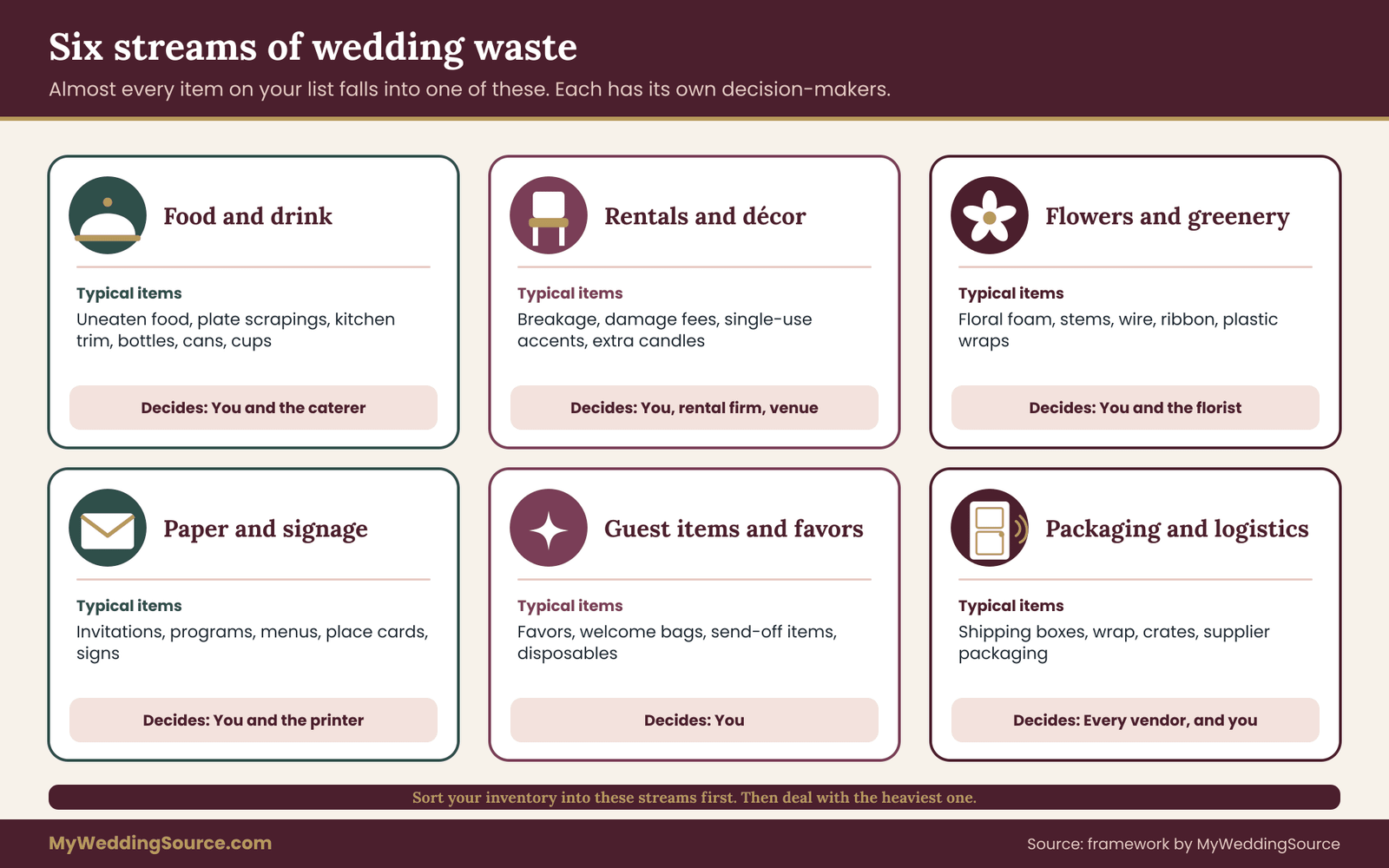
Food and drink is usually the heaviest stream and the most expensive one. It includes uneaten food, plate scrapings, kitchen trim, bottles, cans, cups, straws and the packaging the ingredients came in.
Rentals and décor covers tables, chairs, linens, glassware, lounge furniture, arches, candles and anything else that comes back to a rental company or goes home with a vendor. The waste here is mostly about breakage, damage fees and single-use accessories.
Flowers and greenery includes arrangements, loose petals, stems, floral foam, wire, ribbon and the buckets that arrive with them.
Paper and signage is everything printed: save-the-dates, invitations, programs, menus, place cards, welcome signs and thank-you cards. Quantities decide most of it.
Guest items and favors covers favors, welcome bags, send-off items such as confetti, bubbles or sparklers, and the small disposable things that appear around a reception, from drink stirrers to disposable cameras.
Packaging and logistics is the invisible stream: shipping boxes, bubble wrap, garment bags, delivery crates and the packaging on every supply you order in the weeks before the wedding. It is often the first waste your wedding makes, long before any guest arrives.
Count what arrives in your wedding waste reduction planning
Most couples think about waste as the pile at the end of the night. A better habit is to count what arrives. When you order two hundred printed programs, two hundred bottles of water, a case of candles and a box of lanterns, you are already deciding what will leave. A quick pass through your order confirmations in the months before the wedding will show you things you had forgotten, like a second round of signage or the cardboard from each vendor’s delivery.
Pre-wedding packaging is easy to deal with if you notice it. Keep boxes flat and dry. Ask whether a supplier will take back crates or tote bins. Set aside a spot for the packing material you will need to return a rented item or ship a gift. Many couples find that a surprising share of the “trash” they handle in the final week is cardboard, and cardboard is usually the easiest material to divert.
Keep your first wedding waste reduction planning inventory rough
Do not wait for final numbers. Your first inventory will contain guesses, and that is normal. A guest count of “about 120” is enough to start. The aim in the first pass is to identify the large categories and the open questions, not to produce a clean report. You will update the list as contracts are signed, and the final version, which you complete after the wedding, will show what actually happened.
If your wedding is across several days, start with the main event and add the rehearsal dinner and any brunch as separate rows. Each of those events has its own food, paper and rental decisions.
The waste hierarchy for wedding waste reduction planning
Waste specialists rank the ways of handling materials from best to worst, and the ranking is useful for weddings because it tells you where your effort pays off most. The U.S. Environmental Protection Agency publishes a version for non-hazardous materials: prevent or reuse first, then recycle or compost, then recover energy, and dispose last. Its separate ranking for food puts prevention at the top, then feeding people, then feeding animals, then industrial uses and composting, with landfill at the bottom.
You do not have to memorize the tiers. You need one habit: when you notice an item on your inventory, ask the questions in order.
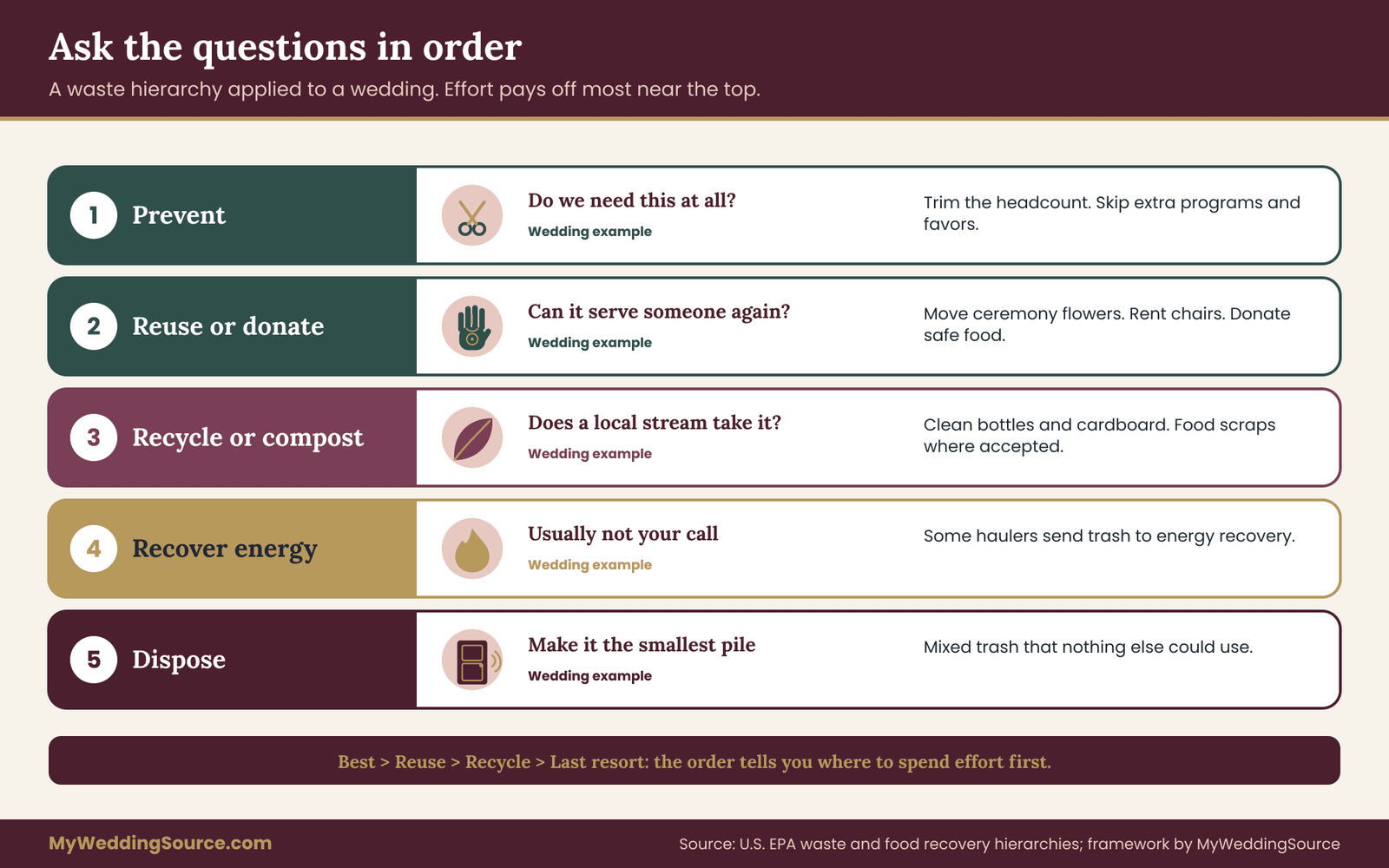
Prevent. Do we need this at all, or can we buy fewer? A lot of wedding waste comes from items that exist for a photo or a single moment, and a few of them could be dropped without anyone noticing.
Reuse or donate. If we do need it, can it be used again, by us or by someone else? A ceremony arrangement can move to the reception. Rented chairs go back to be rented again. Leftover food that meets safety rules can feed people.
Recycle or compost. If it cannot be reused, can the material go into a stream that actually accepts it where we are? This is the tier where most couples feel they are “being green,” and it is also the tier where local rules matter most.
Recover or dispose. Whatever remains goes to the trash, and it should be the smallest and least interesting pile.
How the order changes wedding waste reduction planning decisions
The order matters because the tiers do not have equal weight. A couple that spends hours setting up three sorting bins but orders plenty of extra food and a large pile of single-use items has put its effort in the middle of the ladder. A couple that trims the headcount to what the RSVPs say, chooses a service style that wastes less food, and rents instead of buying has done more with less work.
None of this makes recycling and composting unimportant in wedding waste reduction planning. It means they work best as the second line of defense, once you have cut what you can.
When the hierarchy surprises wedding waste reduction planning
Some choices that sound virtuous are not. Buying a set of reusable items for a one-time event, then storing them forever, is not reuse in any meaningful sense. It is a purchase. Renting the same items for the day is usually closer to the spirit of reuse, because the same plates serve many weddings. On the other hand, renting items that travel a long distance, need heavy washing or arrive wrapped in a lot of packaging can take away some of the benefit. How these tradeoffs balance depends on distance, washing methods and what your local rental companies do, and it is worth asking them rather than assuming.
The same logic applies to “compostable” serveware. It sits in the recycle-or-compost tier, which is below prevention and reuse, and it only delivers a benefit if a facility that accepts it is available to you. Real china and washable glassware, if your venue or caterer can handle them, sit higher on the ladder. The section on reading green claims shows how to check.
The four-step audit behind wedding waste reduction planning
The method behind wedding waste reduction planning is simple enough to write on one page. It has four steps, and you will revisit the first two several times as plans change.
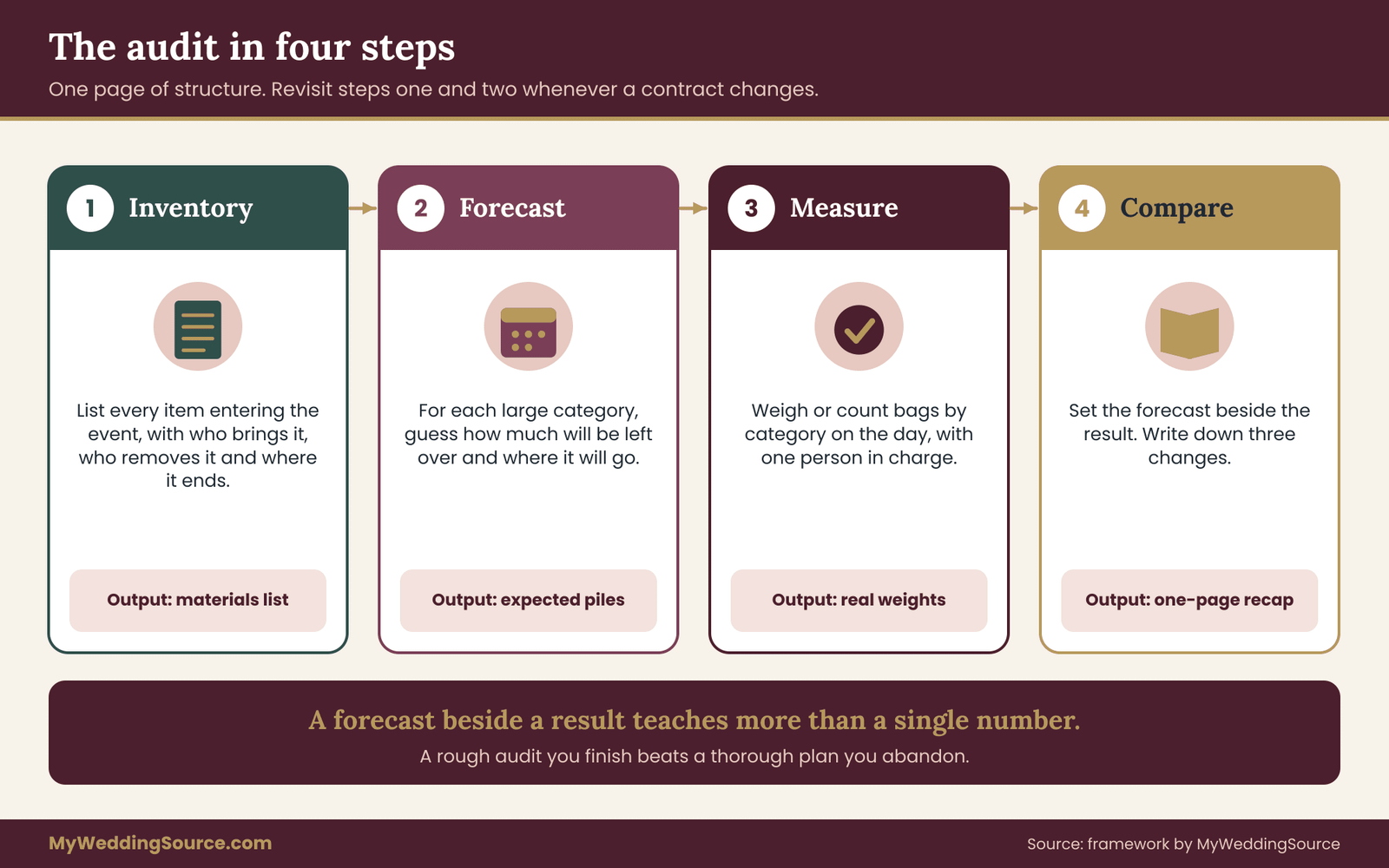
Step one: inventory. The materials list from the earlier section. This is where you find the large categories.
Step two: forecast. For each large category, guess how much will be left over and where it will go. A forecast is not a measurement. It is a way to notice that you have no plan for something big, such as forty pounds of food scraps and nowhere to put them.
Step three: measure. On the day, collect the waste in a way that lets you weigh or count it by category, with a trusted person in charge.
Step four: compare and write it down. Compare what you forecast to what happened, note what you would change, and share it with your vendors if they wish to learn from it. The comparison is the point. A single figure with no context teaches little. A forecast beside a result teaches a lot.
You will not do wedding waste reduction planning flawlessly. A small amount of structure is much better than none, and a rough audit that you actually complete beats a thorough plan you abandon.
Food and drink: the heaviest part of wedding waste reduction planning
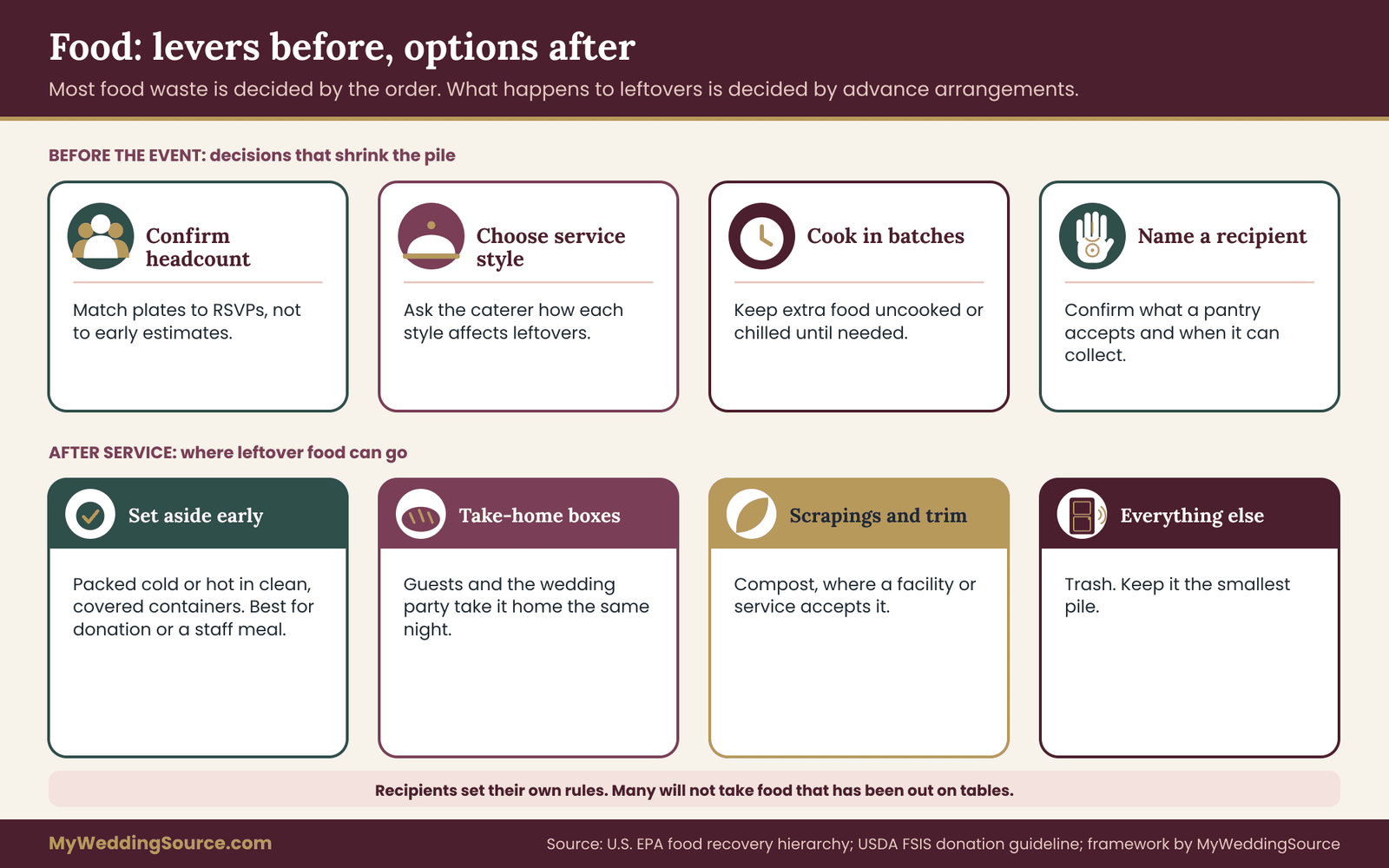
For most weddings, food is the biggest waste stream by weight and by cost, so wedding waste reduction planning usually begins there. Uneaten food is also the stream with the most ways to improve, because every pound you do not order or cook is a pound nobody has to deal with. It is a good place to put your first and strongest effort.
Headcount: the first step of wedding waste reduction planning for food
The number of plates a caterer produces comes from your guest count, and that number tends to drift. Couples often give the caterer a high estimate early, then forget to revise it as declines come in. The most effective step in food waste reduction is to bring the final headcount down to the number of people who are actually coming.
Make this a process. Collect RSVPs by a firm date, follow up on missing replies, and share your count with the caterer as soon as the contract allows. Ask when the final number is due and whether it can go down after that date. If your contract pays for a minimum, ask whether a lower headcount changes per-person pricing, because the answer affects how much you can safely trim. Our wedding guest list guide covers how to build and trim the list in the first place, and that is where the largest savings begin.
A few couples order food for guests who confirmed and then did not show up. Others plan for a percentage of no-shows that the caterer recommended years ago. Ask your caterer how they handle this and what they have seen with similar events. Their answer will help you pick a count that avoids both shortages and a large surplus.
How service style changes what is left over
Service style affects how much food is prepared and how much comes back uneaten, though the effect varies by caterer and by crowd, and we would be guessing if we attached numbers to it. What you can do is ask your caterer about the specifics.
- Plated service gives the kitchen control over portions, which can make leftovers more predictable. Guests who do not like an item may leave it untouched, which creates plate waste.
- Buffets let guests choose their own portions, which can reduce plate waste for picky eaters and increase it for anyone whose eyes are bigger than their appetite. Buffets also often involve full pans that must be replenished until the line closes.
- Stations spread the food out and may reduce the pressure on any single pan, but they can create more serving dishes and more heat sources to manage.
- Family-style service puts shared platters on the table, so guests take what they want, and leftovers are often on serving dishes that can be packed up cleanly. It also needs a lot of tableware.
No style wins in every case. The more useful question for your caterer is what they do with food that has been prepared but not served, and how they set up the line to avoid making more than needed.
Caterer questions for wedding waste reduction planning
Put the following questions to your caterer early, ideally before you sign. Good caterers hear them often, and your tone should be curious, not accusing.
- How do you decide how much food to prepare for a given headcount, and do you cook in batches so extra food can stay uncooked?
- What happens to food that was prepared but never served? Do you donate, send it home with staff, or throw it away?
- If we want leftovers donated, which organizations do you work with, and what is your process?
- Do you use reusable serving pans, plates, flatware and glassware, or disposable ones? Can we choose?
- What do you do with kitchen scraps and trim? Is composting available, either through you or through the venue?
- How do you handle packaging from the ingredients, such as cardboard, plastic wrap and cans? Is there a recycling stream on site?
- Can we get a take-home box for guests or the wedding party, and what would it cost?
- Do your staff have time and instructions to sort waste during the event?
- Can you give us a post-event summary of what was served, what was left and where it went?
- Are there fees for anything we ask, such as extra labor, special hauling or box supplies? Please put them in the contract.
Write down the answers. Put anything you agree to in the contract or in an email you can point to later. Our vendor due diligence checklist covers how to check the things a vendor tells you, and the same discipline applies here.
Wedding waste reduction planning for donated food, done safely
Donation is the part of wedding food waste reduction planning that couples most want to do and most often drop at the last minute. It is possible, but it needs arrangements made in advance and a clear picture of what a recipient can accept.
Federal law offers some reassurance. The Bill Emerson Good Samaritan Food Donation Act protects people and businesses who donate food in good faith to nonprofit organizations that distribute it to people in need, with an exception for gross negligence or intentional misconduct. The protection does not remove the duty to handle food safely, and state laws add their own details. Ask your caterer whether they have donated before, and ask the recipient what their rules are.
Recipients set their own conditions, and they vary. Many food banks, shelters and meal programs do not accept food that has been served to guests or left out on tables. Some take only commercially packaged items, some take prepared food only if it was held at safe temperatures and some will not accept anything on short notice. A few will send a driver to the venue if you call ahead. Others cannot. The federal food-safety guideline on donation from the USDA’s Food Safety and Inspection Service and the food-safety guidance from university extension offices give a good overview of temperature control and handling, and your local health department can tell you what applies in your area.
Practical steps that tend to work:
- Choose a recipient early and ask what they accept, when they can pick up and how food should be packed.
- Ask your caterer to set aside donation portions before service starts, in clean, covered containers, kept hot or cold until packed. Food that stays in the kitchen and never reaches the buffet or tables is easier to donate than food that has been out.
- Assign a person to hand off the food and to take a photo of the receipt or a note from the recipient.
- Plan for the case where the recipient cannot make it. Have a backup, such as take-home boxes for the wedding party and staff meals.
If nobody can accept the food, the next best options are guest take-home boxes and a staff meal, which feed people and do not require a recipient to be available at midnight.
Wedding waste reduction planning at the bar
The bar creates a particular mix of waste: glass bottles, cans, plastic cups, straws, garnish scraps, melted ice and a surprising number of half-finished drinks. Wedding waste reduction planning for the bar comes down to three decisions: what the drinks come in, what they are served in and where the empties go.
Bulk options, such as kegs, bag-in-box wine and batch cocktails served from dispensers, reduce the number of single bottles and cans. They also change service speed and presentation, so ask your bar team what they recommend for your crowd. Our guide to wedding bar service planning covers how bar size, staffing and drink choices fit together.
Glassware is another choice. Real glasses mean fewer disposable cups, but they need washing, rental or breakage allowances and staff to collect them. Many venues and rental companies can supply glass racks that come back to the same truck. If you choose compostable or paper cups, see the claims section for what that choice does and does not promise.
For water, a few large dispensers or pitchers can replace many individual bottles, particularly outdoors, if you plan for hot weather and make sure the water is safe and easy to reach. For ice, ask whether your bar supplier handles bags and returns, since ice is heavy and melts into a mess if left.
Finally, plan where the empties go in your wedding waste reduction planning. Glass, aluminum and some plastics are accepted by many curbside programs, though the rules differ from place to place. The EPA’s consumer guidance on common recyclables explains why local rules matter and why dirty or mixed items can cause whole loads to be rejected. If your venue does not have recycling, ask whether your bar team or caterer will take bottles and cans with them. Bar staff often handle the empties anyway, and they can bag them separately if asked early.
Wedding waste reduction planning for cocktail hour, late-night food and cake
These three moments make a lot of food in small units, which is where waste often hides.
During cocktail hour, passed appetizers are made in batches and often come back to the kitchen. Ask the caterer to pace the trays to guest flow, so the last tray of hors d’oeuvres is not an unused mountain. Late-night snacks are a favorite photo moment and also a common source of leftover boxes and wrappers, and the right amount depends on how much dinner was served. Ask whether the late snack can be made to order or limited to a number of portions, then offer it later, not earlier.
Cake raises two questions. The first is size: a cake that serves everyone plus a modest extra is generally enough, and a sheet cake in the kitchen can handle the rest if you want to cut a smaller display cake. The second is what happens to the extra. Ask your baker or caterer about packing leftovers for guests to take home, and decide who will box them. A stack of take-home boxes and a note on the cake table works well. If you plan to freeze the top tier, check the baker’s guidance on how long it keeps and how to wrap it.
Rentals, décor and venue materials in wedding waste reduction planning
Rentals deserve a section of their own because renting is a form of reuse, and because rented items bring costs and rules that shape your wedding waste reduction planning. The idea is simple: every plate, chair, table and linen that goes back to the rental company serves another event, and every item that is bought for a single wedding and discarded does not.
Rent what you can, and count what you rent for wedding waste reduction planning
Start your rentals list with the large items: tables, chairs, linens, china, flatware, glassware, lounge furniture, tents and dance floors. Ask your vendors whether the items are cleaned on site or before pickup, what you must do before returning them and what counts as damage. Our wedding rental planning checklist walks through counts, delivery and pickup windows, which are the details that cause charges at the end.
Two waste-related points come up often. First, breakage and missing items. A careful count at delivery and again at pickup keeps you from paying for items that were never lost and helps you see where the waste is, since broken glassware ends up in the trash and charges end up on your bill. Second, sorting. Some rental companies require that food residue be scraped, that linens be bagged separately and that items be stacked in specific crates. If those steps are not done on the day, you may pay a cleaning fee or the venue staff may do it in a hurry. Assign someone to know the rules.
Décor that works twice in wedding waste reduction planning
The best décor waste reduction is moving things. A ceremony arrangement that moves to the head table at the reception, an arch that becomes a photo backdrop, signage that works for the welcome table and the bar all cut the number of items you buy or rent. Moving things takes planning: who carries what, when the ceremony space is free and whether the venue allows it.
For items you buy, think about who will use them next. Some couples resell décor, others donate it to a school, theater group, church or community center, and many give it to friends getting married soon. A short list of possible recipients, made before the wedding, makes it easier to say yes to an item you do not need to store.
Candles deserve a quick note. Many venues restrict open flames, and the leftover wax and glass holders produce waste that varies with the product. Ask what the venue allows before you buy a large quantity, and consider whether the holders can be returned to a rental company.
Confetti, glitter, balloons and other send-off items
Send-off items are small, but they leave a visible mark and often break venue rules. Several venues forbid confetti, glitter, rice, sparklers or balloon releases, because they create cleanup work or risk to wildlife and property. Some states and localities restrict balloon releases as well, so check local rules before you plan one.
If you want something for the exit, ask the venue what it allows, then choose something that gets collected: ribbon wands that are handed back, bubbles that leave no residue, or a lantern-light moment that can be done with a candle or LED. If you use petals or leaves, ask whether the venue permits them on its grounds and who will sweep them. A product labeled biodegradable is not a license to scatter it anywhere. The claims section explains why the label alone says very little.
What your venue will and will not do for wedding waste reduction planning
The venue’s rules shape what your wedding waste reduction planning can achieve. Ask about:
- Trash and recycling service: what they provide, what is separated and who carries bags to the dumpster.
- Composting: whether any is available on site, or whether you can bring your own hauler.
- Vendor removal: whether vendors must take their own trash and packaging, or whether the venue handles it, and at what cost.
- Dumpster access and hours: when, where and whether there is a fee for extra pickups.
- Rules on donations and leftover items: whether guests or vendors may take things away, and where staff keep stored items overnight.
- Cleanup deadlines: how soon the space must be clear, which affects what you can sort on the day.
Your venue guide explains how to compare venues on the points that matter, and waste services belong on that list. A venue with built-in recycling and a clear vendor removal policy saves you a lot of effort. A venue with no recycling and strict hauling rules is not a deal-breaker, but you will need to plan more carefully and perhaps pay for a separate service.
Flowers and greenery in wedding waste reduction planning: a smaller pile with sharp edges
Flowers are a small share of the weight at most weddings, but they are visible, and they involve a few materials worth knowing about. Our flower logistics checklist covers timing and delivery, and this section covers the parts that affect waste.
Floral foam and mechanics
Many arrangements are built in floral foam, a green block that holds stems in place. Foam is a single-use product, and it generally does not break down in a compost pile, so the leftover blocks go to the trash and tiny fragments can end up in water. Many florists now work without it, using chicken wire, pin holders, glass marbles, branch structures or water-filled vases. Ask your florist how they build arrangements, and whether they offer a foam-free option. If they say yes, ask whether it changes the price or the look, then decide.
Other mechanics matter too. Ribbon, wire, plastic wrap and plastic sleeves around bouquets are small, but they add up. Ask your florist to use paper or reusable wraps where possible and to take back buckets, vases and stands when the event is over.
Move flowers, then give them away: wedding waste reduction planning for blooms
The most direct cut in flower waste is using the same arrangements twice. Ceremony flowers can move to reception tables, the head table or the cocktail area. Bridesmaid bouquets can go on the guest book table. An arch can be taken apart so the florals decorate the cake table. Agree this with your florist, since moving flowers means someone must carry them and re-set them with fresh water.
After the event, some flowers can be given to guests, the wedding party or family. Others may go to hospitals, senior living communities or community groups, but each organization has its own rules about what it accepts, and many will not take arrangements with wire, foam or certain flowers. Ask before you promise. Assign a person to pack the flowers, since nobody on the couple’s side will want to do it at midnight.
Flowers that cannot be used again can often go to a compost stream. Stems, leaves and petals are good material for a home or municipal pile, if the flowers are not heavily treated and are separate from wire, plastic and foam. Check what your local program accepts. Dried or preserved flowers are another route for a bouquet that matters to you, though preservation services have their own costs and their own materials.
Potted plants and rentals
Some florists rent plants, greenery and large arrangements, which then return to the shop. Potted plants can be given away as favors or planted afterward, as long as they suit the climate and guests have a way to take them home. A few couples have a school, community garden or park group that welcomes plants. Make sure any invasive species are left out, and ask the supplier what is in the pots.
Paper, signage and favors in wedding waste reduction planning
Paper is the easiest stream to count and one of the easiest to cut in wedding waste reduction planning. The quantities are set by you, and the decisions come early in the process.
Print for households, not for each guest: wedding waste reduction planning for paper
Invitations are usually addressed to households, so one invitation per household is the norm. Programs, menus and place cards are a different story, and the quantities depend on the format. A program for every guest is a lot, particularly if the ceremony is short. A single large program on an easel, one per two guests or a QR code that links to the program online are all ways to cut. Ask yourself who will keep each item and who will leave it on a chair.
Digital options are worth considering for save-the-dates and some invitations, but they are not right for every guest. Older relatives may prefer paper, and some guests miss emails. A mixed approach works well: digital for people who use it, paper for those who will not. The same logic applies to paper counts: decide who needs a printed piece before you order.
A practical rule for printing: order what your guest list requires, plus a small allowance for errors and keepsakes, and not much more. Printers often charge less per piece for larger runs, which makes a big order tempting, but the leftover cards are waste you paid for. If a printer offers a lower per-unit price at a much higher quantity, run the numbers on what you will actually use before saying yes.
Signs that work twice
Signage tends to get made once and thrown out. A welcome sign, a seating chart, a bar menu and a set of directional signs can often be designed to be used again, in your home, at the rehearsal dinner or by friends. Chalkboards, framed prints and wooden signs last better than foam board. If a sign has a date and your names on it, it is harder to pass on, so consider which signs can be generic. A good starting point is to choose a few durable signs and skip the rest.
Favors and welcome bags
Favors are the clearest case of something that is made for a purpose and often ignored. If guests are likely to leave them on the table, a favor is waste with a bow on it. The best favors are consumed or used: food guests will eat, plants they will take, a donation made in their name or something genuinely useful for the weekend.
Edible favors need care about allergies and labeling, and they work only if guests actually eat them. A donation card on each table, with a short note about the cause, produces no leftover items and often means more. For welcome bags at a destination wedding, include only what people will use in the next two days, such as water, a snack and a schedule, and skip the trinkets. Ask your hotel whether it will deliver the bags and whether it recycles the packaging.
Guest books, thank-you cards and the weeks after
The guest book, the photo booth strips, the card box and the thank-you notes all create paper after the wedding. Pick one guest book format and one way to collect notes, and keep any thank-you cards to the number you will really send. Our wedding budget guide has a section on post-wedding costs, and the paper you skip saves money as well as waste.
Attire, beauty and the weekend in wedding waste reduction planning
Attire is not a large share of event waste in wedding waste reduction planning, but the items are valuable, and the decisions are long-lived.
The wedding dress and suits. A dress that is altered carefully, kept in good condition and resold or donated has a long second life. Consignment shops, online resale platforms and charity programs are all possible, and each has different rules about condition and timing. Ask what is accepted before cleaning or preserving the dress, because a preservation box adds cost and does not suit every plan.
Wedding party attire. Choose dresses and accessories that guests can wear again, and let people choose their own shoes and jewelry. Dresses that suit different body types and budgets are easier for people to wear again.
Beauty and getting ready. The morning of the wedding produces small, mixed waste: makeup wipes, disposable cups, snack wrappers and hair product packaging. A few reusable supplies and a bin for each stream cover most of it. Ask your hair and makeup team what they bring and what they take away.
Travel and the weekend. Destination weddings and multi-day events add shipping, packaging, welcome gifts and hotel waste. A short email to guests with the water refill locations and the sorting setup at the hotel can reduce the amount of single-use items. Ask the hotel what recycling it provides.
Reading green claims in wedding waste reduction planning: compostable, recyclable, eco-friendly
Wedding waste reduction planning means reading labels, because many items sold to couples carry an environmental claim: eco-friendly cups, biodegradable confetti, compostable plates, recycled paper, carbon-neutral shipping. These labels can be accurate or vague, and a poor choice can turn an effort into a mistake. A little checking helps.
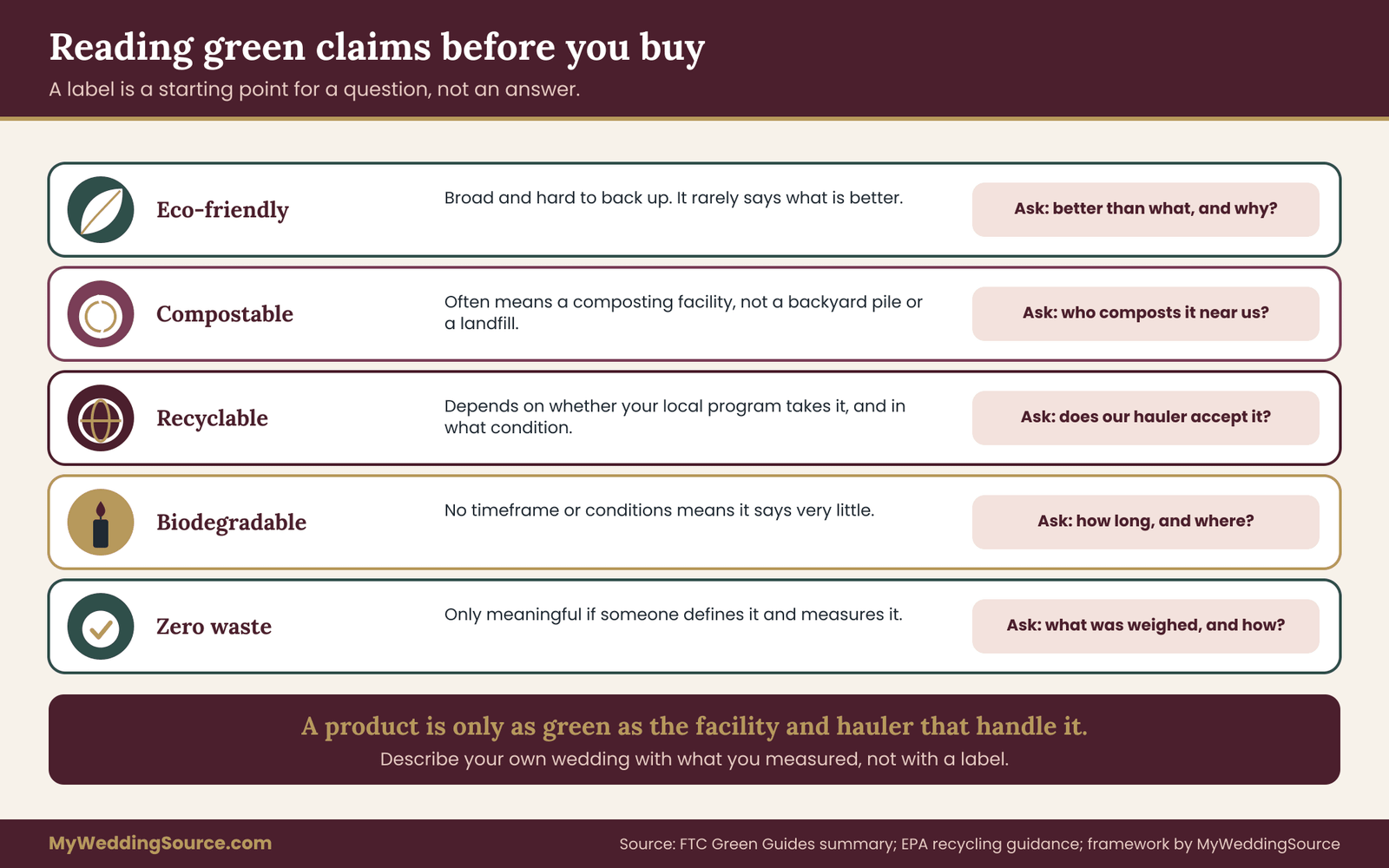
The Federal Trade Commission publishes the Green Guides, which explain how businesses should make environmental claims in advertising. The guides are written for marketers, not for couples, but they are a handy way to see what a careful claim looks like. In general, the FTC says that broad claims such as “eco-friendly” are hard to back up, that businesses should qualify claims and make clear what part of the product or package the claim covers, and that terms like “compostable” and “recyclable” depend on whether the right facilities are available to the people using the product. Their summary of the guides is a short and readable starting point.
Compostable does not mean it will compost where you are
A plate that is “compostable” may break down in an industrial composting facility and not in a backyard pile or a landfill. If your venue, caterer and city do not send food waste and compostables to such a facility, the plate may end up in the trash anyway. Certification programs, such as the Biodegradable Products Institute’s, test products against standards for composting and can help you pick a product that matches the claim, though they do not make a facility appear. A few states and localities have labeling rules for compostable products, and the Minnesota Pollution Control Agency’s page on compostable product labeling is one example of how these rules work.
Before you buy compostable serveware, ask three things. Does a facility near us accept it? Will our venue or caterer collect it separately from the trash? Will the product be sorted correctly on the day, so it does not contaminate the recycling or food scrap stream? If the answer to any of these is no, durable or reusable serveware is probably the better choice.
Recyclable means “if your local program takes it”
A recycling symbol or the word “recyclable” does not tell you whether your area’s curbside program accepts the item. The EPA’s guidance for consumers stresses that programs differ and points people to their local rules. Heavily soiled paper, mixed materials and small items such as caps and straws are common problems. Some items, such as glass or aluminum, are widely accepted, and others are not.
Biodegradable, degradable and “natural”
“Biodegradable” without a timeframe or conditions says little, since almost any material will break down eventually. A claim of “degradable” has the same problem. “Natural” and “plant-based” describe the origin of a material, not what happens to it afterward. If a seller uses these words, ask what standard the product meets, under what conditions it breaks down and how long it takes.
Be careful with your own claims
The same caution applies to what you say about your wedding. A line on your website that says “our zero waste wedding” can be tested by a skeptical guest or vendor, and it is easy to overstate. A better choice is to describe what you did and what you measured: “We weighed our trash and recycling, and we sent leftover food to a local pantry.” That is true, specific and modest. The audit later in this guide gives you the numbers you need to write it.
You can also ask vendors to be careful. If a vendor advertises an eco-friendly service, ask for the details behind it. A short question about how a claim is supported is within bounds for any purchase.
Sorting and collection on the day of your wedding waste reduction planning
A sorting system is where the best wedding waste reduction planning can fail, because it depends on guests, staff and volunteers behaving consistently during a party. The good news is that the design principles are well known: make the right choice easy, label clearly and put a person in charge.
Choose streams that match local rules in your wedding waste reduction planning
Your stream list should match what your hauler and venue will actually accept. The most common set for a wedding is food scraps (if compost is available), recyclables (bottles, cans and clean cardboard), reusable items such as rentals and glassware, and trash. Some venues add a fifth stream for donation food and a sixth for flowers. More streams mean more labels and more chances for mistakes, so start with the smallest set that covers your major piles.
Ask your venue and caterer how their staff will handle each stream. If the venue only has trash bins, you may need to bring your own bins and arrange removal. If the caterer composts kitchen scraps, you may be able to add guest-side compost bins to the same arrangement. If nothing is available, focus on reduction and reuse, and do not feel pressured to invent a stream you cannot complete.
Put stations where waste happens
Waste appears at predictable places, and a station should sit near each one.
- The bar: bottles, cans, cups and garnish. One recycling bin and one trash bin work better than a large unlabeled bin.
- The buffet or dessert table: plates, napkins and serving trash. If you use compostable items with a composting service, place the food scrap bin here.
- The cocktail hour area: small plates, picks and napkins, where guests put things down quickly.
- Near the dance floor and exit: cups and favors, and sometimes the largest volume of litter at the end of the night.
- Behind the scenes: the caterer’s kitchen, the bar storage area and the vendor load-out area, where most of the heavy material appears.
Stations in public view need clear signs. Use pictures of the items next to the words, because guests do not read at a party. Put a sample item on the bin lid, with the same cup or plate guests will have. Keep the number of choices at each station to two or three, and set trash and recycling bins side by side so people do not walk to a second location.
Label for the guest, not for yourself
A sign that says “compost” is clear to an environmental scientist and confusing to a guest holding a paper plate, a plastic fork and a napkin. Name what goes in, with pictures: “food scraps and paper napkins,” “bottles and cans,” “everything else.” If your plates are compostable and your forks are not, say so on the bin or switch the forks.
Guests cannot be expected to sort a mixed pile. Staff and volunteers can, and a quick second pass at the end of the event, before bags are tied and carried out, will catch the most common mistakes.
Name a waste captain for wedding waste reduction planning
The single best thing you can do for the sorting system is to put one person in charge. This could be your day-of coordinator, a friend or relative who enjoys logistics, or a staff member at the venue who agrees to take it on. Give the captain a one-page brief with the following:
- the list of streams and what goes in each one;
- station locations and who stocks them with liners and signs;
- where full bags go, and which door or loading area to use;
- the name and phone number of the caterer’s lead and the venue contact;
- the plan for donations, flowers and rentals at the end of the night;
- a simple scale and a notebook, or a phone app, for the measurement step.
Do not make the captain a member of the wedding party or someone who needs to be on the dance floor. Their job starts when the party is in full swing, and it ends well after the music stops. Thank them properly, with a note and a gift or a fee if they are a professional.
Brief the vendors on your wedding waste reduction planning
Vendors who know the plan are more likely to follow it. A short email, sent a week before the wedding, can give each vendor the relevant details: where to put empties, how the venue wants cardboard flattened, which items are to be returned, what happens to flowers and food and who the captain is. Our wedding vendor timeline lists when each vendor arrives and leaves, which is the information you need to decide who is on site at breakdown, and who will be gone before the final sweep.
How to run the audit: measuring wedding waste reduction planning results
You do not need a lab to measure wedding waste reduction planning results. You need a scale, a notebook, a few categories and a person who will write down what they see.
What to measure
Choose categories that match your streams and your decisions. A useful short list is:
- Donated food, weighed at handoff, or estimated from the caterer’s count of containers.
- Food scraps for composting, weighed in bags or bins.
- Recyclables, weighed separately for bottles and cans and for cardboard, if you can.
- Landfill trash, the bags that will go to the dumpster.
- Reused or returned items, counted, not weighed, such as rentals returned and flowers sent to a new home.
If weighing is not possible, count full bags and note the bag size. A count of “eleven 30-gallon bags of trash, four of recycling, and two of food scraps” is rough, but it is a real record, and it can be compared to your forecast. You can also ask the haulers or the venue whether they track weight or volume and whether they will share it.
Equipment and method
A basic hanging scale or a bathroom scale works for bags and bins, and a luggage scale is handy for small ones. Weigh a bin and then subtract the empty bin’s weight. Do the weighing near the dumpster or loading area, where the bags will be collected anyway, and write each result in the notebook with the category. If a bag is too heavy to lift safely, split it up or estimate. Safety first: do not ask anyone to lift more than they can handle, and wear gloves around mixed trash.
If you want to know what is in the trash, open one or two bags, with gloves, and write down what you see. This takes a few minutes and tells you more than the weight. A bag with food waste in it points to a sorting problem or a missing compost stream. A bag full of plastic wrap and foam points to vendor packaging. A bag of broken glass points to a handling problem. The EPA’s Food: Too Good to Waste guide and state resources such as the New Jersey Department of Environmental Protection’s page on how to measure food waste explain simple ways to track and weigh material.
The diversion rate in wedding waste reduction planning, and what it does not tell you
The number most people want is the diversion rate: the share of waste that was kept out of the landfill. To calculate it, divide the weight of materials that were composted, recycled or otherwise diverted by the total weight of waste. Decide in advance whether donated food counts as diverted material and say which way you counted it, because the answer changes the figure.
The number has limits. It measures what went into the bins, not what happened downstream. Materials placed in recycling bins can be rejected at the sorting facility if they are contaminated, and compost bins can be refused if they contain the wrong materials. Weight can also mislead: a heavy bottle or a wet food scrap counts for more than a light pile of paper or foam. Treat the rate as a rough indicator and use the category weights to guide your decisions, not the percentage on its own.
A worked wedding waste reduction planning example with invented numbers
The following figures are invented to show how the method works. They do not describe a real wedding, and your own results will differ.
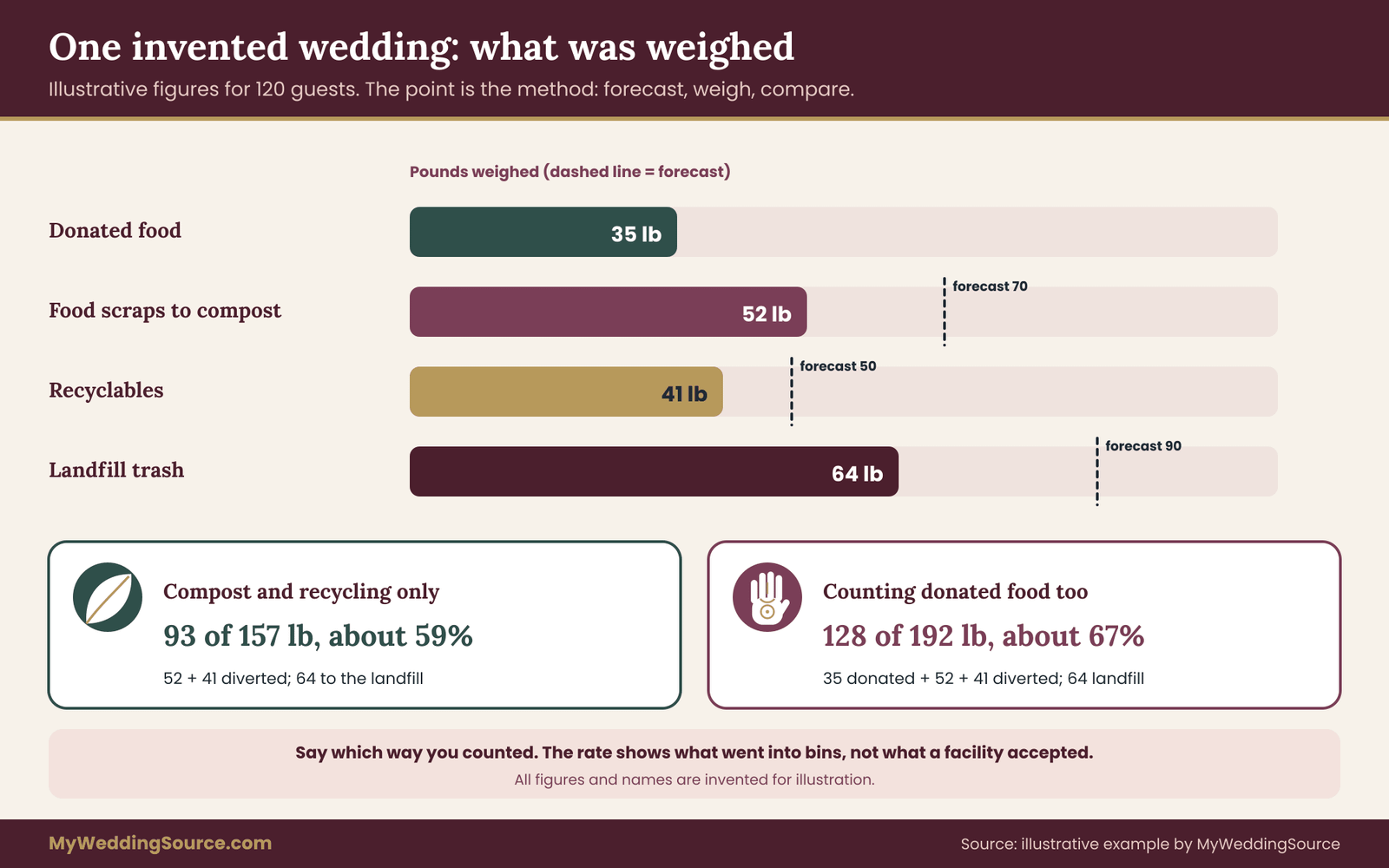
A couple hosts 120 guests at a venue with a catered buffet. Before the wedding, they forecast their waste at about 70 pounds of food scraps, 50 pounds of recyclables and 90 pounds of trash. The caterer agrees to set aside donation portions and take kitchen scraps to a composting service. A volunteer weighs the bags after the party.
The results:
- Donated food packed before service: 35 pounds.
- Food scraps for composting: 52 pounds.
- Recyclables (28 pounds of bottles and cans and 13 pounds of cardboard): 41 pounds.
- Landfill trash: 64 pounds.
Of the waste that was not donated, the couple handled 52 + 41 + 64 = 157 pounds. The diverted share, counting compost and recycling only, is 93 of 157 pounds, or about 59 percent. If they count the donated food as diverted material too, the total leaving the event is 192 pounds and the diverted share is 128 of 192 pounds, or about 67 percent. They choose to report both figures and say how each was calculated.
The comparison with the forecast is more interesting than the percentage. Trash came in well below the forecast, and the couple credits a smaller headcount and the decision to skip printed programs. Food scraps were lower than expected because the caterer pulled donation portions before service. The trash was still the largest single category, so the volunteer opened two bags. Both held soiled paper napkins and plastic film from vendor deliveries, with a few blocks of floral foam. For a future event, or for friends planning their own, three changes stand out: cloth napkins or a napkin stream that goes with the food scraps, a florist who works without foam and a request that vendors take their packaging with them.
That list is a good outcome for an audit of wedding waste reduction planning. It is modest, specific and based on weights, and nobody needs to pretend the wedding produced no waste.
After the audit: write one page
Within a week of the wedding, while memories are fresh, write one page that records:
- the numbers by category and how you measured them;
- what went to plan and what did not;
- the three changes you would make;
- what you will say publicly, if anything, in plain words.
Share the page with your caterer, venue and planner if they are open to it. Vendors who see their own results are more likely to adopt changes, and a short note of thanks goes a long way.
The cleanup sequence after the last dance in wedding waste reduction planning
The end of the night is when wedding waste reduction planning either holds together or falls apart. People are tired, vendors want to leave and the venue has a deadline. A short, written sequence, agreed in advance, keeps the work from landing on whoever is still standing.
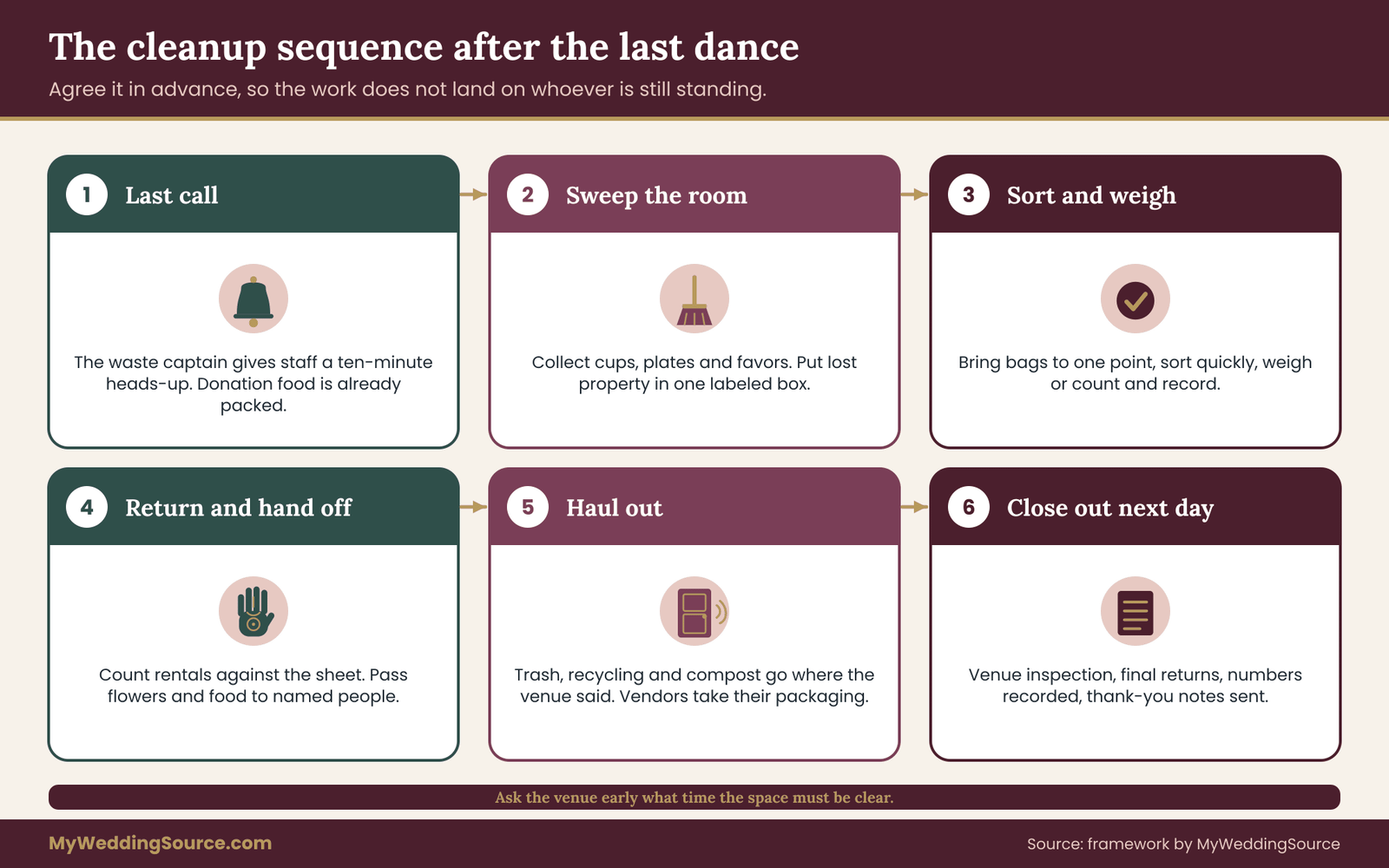
Last call and final service. When the bar closes and the last food is served, the waste captain gives staff a ten-minute heads-up so they can start collecting from stations. Leftover food that is eligible for donation should already be packed. Anything out on tables is not.
Sweep the room. A first pass through the space collects cups, plates, favors and personal items. Put lost property in one labeled box with the venue contact’s name, and take a photo of it.
Sort and weigh. Bags are brought to a single point, opened if needed for a quick sort, weighed or counted and recorded. This is the audit step, and it takes about as long as one song.
Return and hand off. Rentals go back to their crates, with counts checked against the delivery sheet. Flowers, food and décor that are headed to a new home are packed and handed to the person responsible. Vendors take their own packaging and equipment.
Haul out. Trash, recycling and compost go to the dumpster or hauler area the venue named. If you have a separate compost or donation drop-off the next morning, someone needs to hold those items safely overnight, which should be agreed with the venue ahead of time.
Close out the next day. Check the venue’s closing inspection, return any leftover rentals, record the final numbers and send the thank-you notes to vendors and volunteers. The final line of your inventory, the end-of-life column, can be filled in at this point.
If a venue has strict rules about overnight storage or leaves little time for sorting, ask them early what is realistic. A good venue will tell you honestly, and you can adjust your plan to match.
What wedding waste reduction planning costs, and what it saves
Couples often ask whether wedding waste reduction planning costs more. The honest answer is that some choices save money, some cost money and many are about even. Here is how the main decisions tend to play out. These are patterns, not promises, and your quotes will tell you the real numbers.
Choices that often save money: trimming the headcount to the confirmed number, reducing printed paper, using fewer disposable items, skipping extra favors, moving flowers from one space to another and buying fewer décor items. In these cases the item is not bought, so there is no cost to offset.
Choices that often cost more: compost or special hauling services, additional bar or kitchen labor for sorting, real glassware and china compared to disposables in some markets and a florist’s foam-free build, which can take more time. Some of these costs are modest and some are not, so ask for a price.
Choices that vary: rentals compared to buying, caterer packaging and take-home boxes and reusable serveware. The price depends on the vendor and the market.
Track everything in your budget so you can see the net effect. A budget that ties each line to a category makes this easy, and a “waste” tag on any line that responds to an audit decision lets you add them up at the end. Do not promise yourself savings you have not priced. Instead, ask each vendor for a quote with and without the change, and decide with both numbers in front of you.
Another thought that helps: uneaten food is a purchase you made and did not use. A plate of food that goes in the bin was paid for, along with the labor and fuel that made it. Thinking about waste as money you did not mean to spend can be a useful way to spot it.
Writing wedding waste reduction planning into vendor conversations and contracts
Wedding waste reduction planning works best when its terms appear in writing. Verbal promises tend to be forgotten by the day of the wedding, and staff on site may not know about them. A few lines in a contract or email thread cover most of what you need.
Things to ask a vendor to confirm in writing:
- Caterer: donation process and who handles it, kitchen scrap handling, serviceware choices, take-home boxes and any fees.
- Venue: trash and recycling arrangements, vendor removal rules, dumpster access, composting options, storage overnight and cleanup deadlines.
- Florist: foam-free build if you want it, takeback of buckets and vessels, whether arrangements can be moved and who handles the move.
- Rental company: pre-return sorting and cleaning rules, count procedure, damage definitions and pickup window.
- Planner or day-of coordinator: who runs the sorting system, who briefs staff and who completes the audit page.
- Printer: quantity, paper type and how overruns are handled.
When a vendor says “yes, we can do that,” ask them to put it in an email. When a vendor says no, ask whether there is a partial option. Many vendors have more flexibility than their standard package suggests, particularly if you ask early and politely. Checking what vendors say, and comparing their replies, is the same discipline you would use for any other contract.
If a vendor is unwilling to engage, that is information too. You may choose a different vendor, or you may decide that this is not the issue to push on and move your attention to something you control.
A timeline for wedding waste reduction planning
The right time to do each task depends on your engagement length, and the points below are a general guide. Compress them for a short timeline.
At the start of planning. Set your intentions in a short conversation: what matters most, what you will not compromise on and who will own this work. Ask venues about waste services as part of your site visits.
When you sign with vendors. Ask the caterer, florist and rental company the questions in this guide before you sign, and put agreed items in the contract. Create your first inventory.
Six to four months out. Order paper in the quantities you need, choose décor you can reuse and confirm your donation recipient. Reach out to a compost service or hauler if the venue does not have one.
Three to two months out. Update the inventory with confirmed quantities, check rules on send-off items and arrange your waste captain.
The final month. Confirm your headcount with the caterer as RSVPs close, tell vendors about the sorting plan and prepare bins, signs and the one-page brief. Check that the scale and notebook are on the list.
The week of. Send the vendor briefing email, confirm donation pickup times and make sure the captain knows the schedule.
The day after and the week after. Complete the return list, record the numbers and write the one-page summary.
If you are thinking about the broader schedule, use your planning checklist alongside this list, since each waste task attaches to a regular planning task.
Wedding waste reduction planning in special situations
A small or micro wedding. Fewer guests means fewer pounds, but the same wedding waste reduction planning decisions apply. Right-size the food, choose a menu that your caterer can pack for leftovers and keep paper to a minimum. The advantage is control: a small group can follow a simple sorting plan without much effort.
A backyard or home wedding. You may be the venue, which means you control the bins and the hauling. Check your municipal collection rules, rent or borrow extra bins and plan for a trash pickup day soon after the event. Ask your neighbors if a big event will block the street on collection day.
An outdoor or park wedding. Parks often require that you carry out everything you carry in, and some forbid decorations. Check with the park authority about rules and plan for portable bins with lids, since wildlife is drawn to food scraps. Our outdoor wedding rain plan covers weather backups, which also affect what you carry in and out.
A destination wedding. Local recycling and composting vary widely, and some places have little or none. Focus on reduction: ship fewer items, choose local vendors and bring reusable items instead of buying disposable ones. Ask the venue what they recycle and what happens to waste there.
A multi-day or cultural celebration. Large guest lists and several meals mean more of everything. Start with the headcount for each event, and make sure each caterer or family cook knows the donation and leftover plan. Traditions that involve shared meals, gifts and decorations often have good reuse customs of their own, such as passing items among relatives, which fit well with an audit.
A wedding with a tight budget. The cheapest wedding waste reduction planning is the kind that avoids buying. Trim paper, borrow décor and focus on the food headcount. Skip the paid services and do the audit with a notebook and a scale.
Common mistakes in wedding waste reduction planning
- Starting too late. The venue, caterer and florist decide most of your options when you sign. If you raise waste a week before the wedding, you are asking them to change a plan that is already set.
- Buying “eco-friendly” items without a disposal plan. A compostable cup is trash if no one composts it. Ask where it goes before you buy.
- Sorting without a person in charge. Labeled bins and a hopeful crowd do not make a system. One accountable person does.
- Forgetting the invisible stream. Boxes, wrap and packaging from vendor deliveries arrive before the wedding and are rarely counted.
- Overclaiming. Saying you hosted a zero waste wedding invites scrutiny. Describe what you did and measured.
- Skipping the donation arrangement. Food donation takes calls, containers and a pickup plan, and it rarely happens by accident.
- Ignoring local rules. Recycling and composting vary from place to place. What works in one city may not in another.
- Measuring nothing. Without numbers, you cannot say what worked, and the next couple you advise starts from zero.
- Taking on too much. A few well-chosen changes beat a long list that nobody can follow. Pick three to five and do them well.
Limits and honest caveats
A few points are worth stating plainly.
The environmental benefit of any choice depends on the material, the distance it travels and the facilities that handle it. A reusable item is not always better than a single-use one, and a compostable item is not always better than a recyclable one. Where this guide gives a general direction, check it against your local options.
Facilities, hauler rules and food donation policies change, and they differ by state and city. This guide does not replace advice from your local waste authority, health department or a qualified professional. For food donation and safety questions in particular, check with the recipient and your local health department.
The worked example uses invented numbers to show a method. It is not a benchmark, and you should not treat 59 or 67 percent as a target. A first audit that records what happened, whatever the figures, is worth more than a good-looking percentage that nobody can reproduce.
Finally, the best decision for your wedding may not be the lowest-waste one. Guest comfort, safety, budget and the people you love all count. Wedding waste reduction planning is a way to make better choices with your eyes open, and it does not require you to give up the parts of your day that matter most to you.
Start your wedding waste reduction planning in one evening
You do not need a long project to begin. In one evening you can do the following:
- Open a blank sheet and list everything that will enter your wedding, using the six streams as headings.
- Mark the three largest piles. For most couples, these are food, drinks and paper.
- For each large pile, write the one question you will ask a vendor this week.
- Put your venue’s waste services on your tour questions list.
- Choose your recipient for leftover food, and make a call to confirm what they accept.
- Pick a waste captain, or put the role on your planner’s task list.
- Set a reminder for the final headcount date, since that one decision saves more food than any other.
That is a real start, and it takes about an hour. The rest of the work follows the same method, one conversation at a time.
Wedding waste reduction planning questions couples ask
A few short answers to questions that come up in almost every conversation about this topic. The full answers are in the sections above.
Do we have to give up things we love? No, and wedding waste reduction planning does not ask you to. The aim is to cut what nobody will miss and to handle the rest better. A cake, flowers, a printed invitation and a favor can all stay if they matter to you.
Is a bigger percentage always better? Not necessarily. A high diversion rate on a small pile of waste can matter less than a modest cut to a large pile. Look at weights by category.
What if the venue offers no help? Focus on reduction and reuse, ask vendors to take their own materials and bring your own bins if the venue allows it.
FAQ
How early should we start wedding waste reduction planning?
Ideally when you tour venues and compare caterers, since those choices set your options. Ask each venue about trash, recycling, composting and vendor removal, and ask each caterer how they handle leftovers and serviceware. If you are already booked, start with your inventory and ask your vendors what is possible. Even a few weeks is enough to cut paper quantities, confirm your headcount, set up a donation contact and plan a simple sorting system. The earlier you begin, the more your vendors can adjust without extra charges.
What is the single most effective step we can take?
For most couples doing wedding waste reduction planning, it is bringing the food headcount down to the number of people who are actually attending and sharing it with the caterer as soon as the contract allows. Food is typically the heaviest and most expensive stream, and every plate you do not order is a plate no one has to carry, donate or throw away. A close second is arranging a donation or take-home plan for food that is prepared and not served, since that decision has to be made before the event.
Is it safe to donate wedding food?
It can be, when it is arranged in advance and handled properly. Federal law protects good-faith donations to nonprofits, but it does not remove food-safety duties, and recipients set their own conditions. Many will not accept food that has been served or left on tables. The safest route is food that was set aside in clean, covered containers before service and held at safe temperatures until handoff. Ask your caterer and the recipient what they require, and check with your local health department if you are unsure.
Are compostable plates and cups a good idea?
They can be, if a composting facility near you accepts them and if your venue or caterer will collect them separately from the trash. Without those two conditions, a compostable plate is likely to go to a landfill anyway. Certification marks help you pick products that meet testing standards, but they do not promise that a facility will take the item. If you cannot confirm a way to compost, real plates, rented glassware or recyclable options are usually the simpler choice.
Does a zero waste wedding exist?
Almost certainly not in the strict sense, and the phrase is risky to use, since it invites people to check. Good wedding waste reduction planning describes what you measured instead. Weddings involve food, travel, vendors and packaging, and some waste remains whatever you do. A more accurate approach is to measure what you produce, reduce what you can and describe your results in plain terms, for example, “we weighed our trash and sent leftover food to a local pantry.”
How do we weigh waste at a wedding?
For wedding waste reduction planning, a hanging or bathroom scale and a notebook are enough. Have a volunteer weigh each bag or bin by category after the party and subtract the container’s weight if needed. If weighing is not practical, count full bags and note their size. Open one or two trash bags to see what is in them, using gloves, since the contents often tell you more than the weight does. Record the numbers the same night or the next morning, and compare them to your forecast.
What should we ask our venue about waste?
For your wedding waste reduction planning, ask what trash and recycling service they provide, whether composting is available on site, how vendor trash is handled, where the dumpsters are and when they are collected, whether they permit outside haulers and what rules apply to send-off items such as confetti or balloons. Also ask about cleanup deadlines and overnight storage for items that will be picked up the next day, since these shape what you can sort and donate on the night.
Will wedding waste reduction planning cost more?
Some choices save money, some add cost and many are close to even. Trimming the headcount, printing less paper, skipping extra favors and reusing décor tend to save. Composting services, extra sorting labor and some foam-free floral builds can add cost. The way to find out is to ask each vendor for a quote with and without the change, and track the numbers in your budget. Do not assume savings you have not priced.
Your next steps
Take one evening this week. List everything that will enter your wedding, group it into the six streams and mark the three largest piles. Write one question for each of those piles and send it to the right vendor. Put venue waste services on your list of tour questions, and choose a recipient for leftover food.
Then set two dates in your calendar: the day your final headcount is due, and the week before the wedding, when you will brief vendors and your waste captain. After the event, spend an hour on the one-page summary. You will have a clear record of what you did, a short list of what to change and numbers you can stand behind. That is what good wedding waste reduction planning looks like in practice.
Sources
- Sustainable Materials Management: Non-Hazardous Materials and Waste Management Hierarchy, U.S. Environmental Protection Agency
- Food Recovery Hierarchy, U.S. Environmental Protection Agency
- Composting at Home, U.S. Environmental Protection Agency
- How Do I Recycle? Common Recyclables, U.S. Environmental Protection Agency
- Food: Too Good to Waste Implementation Guide and Toolkit, U.S. Environmental Protection Agency
- From Farm to Kitchen: The Environmental Impacts of U.S. Food Waste (2018 wasted food report), U.S. Environmental Protection Agency
- Environmental Claims: Summary of the Green Guides, Federal Trade Commission
- Guides for the Use of Environmental Marketing Claims, Federal Register
- Bill Emerson Good Samaritan Food Donation Act, 42 U.S. Code section 1791, GovInfo
- Food Donation Guideline, USDA Food Safety and Inspection Service
- Tips for Donating Food, University of Maryland Extension
- How to Measure Food Waste, New Jersey Department of Environmental Protection
- Certified Compostable Products: Science, Standards and the Facts That Matter, Biodegradable Products Institute
- Compostable Product Labeling, Minnesota Pollution Control Agency