

Save the date cards do one narrow job, which is to tell people early that a date is taken, and the paper, digital, design, and postage choices around them matter only as far as they help that job get done without wasting money or mailing the wrong people.
Quick answer
Send save the date cards only to guests you are certain you will invite, one per household, about 4 to 8 months before a local wedding and 8 to 12 months before a destination or holiday-weekend wedding, with the venue contract signed first. Digital is the cheaper and faster route, paper is the more tangible one, and a hybrid often fits best: paper for the few households that will treasure it, digital for everyone else. If you mail paper, check the envelope’s shape and thickness against postal rules before you order, because a square or lumpy envelope costs more to send. Prices and rules below were checked in November 2026 and can change.
What save the date cards are for, and what they are not
Most of the confusion around save the date cards comes from treating them as a small invitation. They are not. A save the date card is an advance notice with a deliberately short list of facts, and a small set of consequences follow from that. Before comparing formats, it helps to be clear about the job, because the job decides who receives one, how early, and how much any of it should cost. For the full planning sequence around this one task, our wedding planning guide sets out the larger picture, and this article stays with the decisions that belong to save the date cards themselves.
The job of a save the date card
A card like this exists so guests can protect a date, request time off, and start thinking about travel. That is all. It does not ask for a reply, it does not carry the registry, and it does not need the full schedule. When you hold that narrow definition in mind, many design and wording questions answer themselves.
It is a notice, not a request
Zola’s etiquette advice says save the date cards need only the date and the location, not the full details. Paperless Post makes the same point from the other side: save the date cards do not require an RSVP. A card that asks guests to respond, pick a meal, or confirm a plus-one is behaving like an invitation, and it will draw invitation-style questions months before you can answer them.
The simplest test is to ask whether a guest could act on your save the date cards today. If the honest answer is “they can mark their calendar and start looking at flights,” your save the date cards are doing their work. If the honest answer is “they need to do something by a deadline,” the card has drifted.
What save the date cards quietly promise
Because a save the date card goes only to people you plan to invite, receiving one carries an expectation. Vistaprint states the consequence directly: recipients will expect an invitation. Paperless Post suggests wording that tells guests a formal invitation will follow, which is the traditional phrase and a useful guardrail. That implied promise is the reason the guest list matters more than the paper stock, and it is the subject of the next section.
Treat the promise as real. A guest who rearranges a vacation around your date and then never receives an invitation has been treated unkindly, even if no one meant harm. That outcome is almost entirely avoidable by sending save the date cards late enough to know your list and early enough to be useful.
Who belongs on the list
The most expensive mistake with save the date cards is not a printing error. It is mailing a card to someone you later cannot invite. Everything about the guest list should be settled before a stamp is applied.
Send to the definite list only
Zola’s timeline guidance divides guests into two groups. Group A is the people you have definitely invited, and Group B is the people who may or may not be invited, depending on space or budget. Save the date cards go to Group A only. WeddingWire says the same thing in different words, suggesting that couples wait if the guest count is uncertain.
If your final count is still moving, a practical approach is to hold the Group B names back and send them an invitation later without a card. Nobody is slighted by skipping an advance notice they never knew about, while a card that is followed by silence is a clear signal. Our wedding budget calculator can help you see how many guests your budget can support before you commit to a list.
One card per household, plus your own circle
Both Zola and WeddingWire suggest one card per household rather than one per person, which cuts the order quantity and the postage. WeddingWire adds that your wedding party and immediate family should receive one too, even though they already know the date, because save the date cards work as a keepsake and a reference. Address each card to the exact people you intend to invite, since Vistaprint points out that the names on the envelope tell guests who is included.
Two edge cases are worth deciding in advance. Paperless Post advises against sending a card to someone who has already said they cannot attend, because it can read as a request for a gift, though it says a digital copy as a keepsake is fine if they want one. And if a guest’s household includes adult children who live elsewhere, decide whether they get their own card now, not after the envelopes are sealed.
Define the decision before choosing a format
Choosing between paper and digital too early turns into a taste contest. A calmer approach is to name what you are optimizing for, rank those things, and then compare options on the same footing. The point of this section is to give you a short method you can reuse, so the answer comes from your situation and not from whichever product page you saw last.
List the criteria that actually change the choice
Most save the date decisions turn on a handful of factors. Plenty of other considerations feel important but do not change which format you should buy, and sorting the two kinds apart is the first step.
Separate deal-breakers from preferences
A deal-breaker is a fact that rules an option out. If a large share of your guest list does not use email or text, a purely digital plan will fail no matter how elegant it looks, because the save the date cards will not reach them. If your wedding is within roughly six months, printing and mailing may not leave you the lead time that paper save the date cards need, a point Vistaprint raises when it suggests that couples with a short engagement send a digital save the date first and printed cards afterward if they still want them.
A preference is something you would like but could live without: a particular foil color, a magnet for the refrigerator, an engagement photo with a certain mood. Write two short lists before you open any shopping tab. Deal-breakers decide the format, and preferences decide the design within it. Mixing the lists is how couples end up paying for a finish that does nothing for the outcome they actually need.
Weight cost, logistics, experience, and flexibility
Four criteria cover most of the ground. Cost is the cash you spend, including postage. Logistics is the effort of collecting addresses and getting the save the date cards out. Experience is how save the date cards feel to receive and what it says about the day. Flexibility is how easily you can correct a mistake or change the date.
Give each a weight from one to three, where three means it could decide the choice by itself. A couple with a tight budget and a casual wedding might weight cost at three, flexibility at two, and experience at one. A couple hosting a formal weekend with older relatives might reverse that. The numbers are not scientific. Their purpose is to force you to admit what you care about before a design pulls you in.
Compare like with like
Quotes and product pages describe different things. One shows the price per card, another shows a bundle, a third shows a free design that costs nothing until you reach the shipping step. You cannot compare them until you convert them to a common unit.
Normalize to cost per delivered household
The unit that matters is the cost for one household to receive a usable notice. For paper, add the card price, any envelope or addressing fee, and postage, then divide by the number of households you actually reach. For digital, add any platform fee and divide the same way. This is our own method and our own arithmetic, so treat the results as estimates, but the approach keeps the comparison honest.
Here is the method with illustrative numbers. Minted’s product page for a foil-pressed card listed $188 for a quantity of 100, with envelopes and recipient addressing shown as included, which works out to $1.88 per card. A USPS price page we checked listed a stamp at $0.82 for a standard letter. One card sent to one household in a standard envelope therefore costs about $2.70 in cash before tax and shipping, which the page did not state. A free digital design for save the date cards costs nothing in cash. That gap is real, but it leaves out time, which the next sections address.

Expose features that sound equivalent but are not
Several phrases in vendor listings sound alike and are not. “Envelopes included” may mean plain white envelopes, or it may mean colored envelopes with a liner. “Addressing included” may mean printed recipient addresses, which Minted’s page lists as free on that product, or it may mean you receive a template and print them yourself. “Free” on a digital design may mean a free design but paid delivery features, so read what each tier unlocks.
Quantity matters too. A listed price for 100 cards tells you nothing about the price for 30 unless the page shows it, and Minted’s page did not show tiers or a minimum. If a hybrid plan depends on printing a small batch, ask the seller for the minimum and the per-card price at your actual quantity before you build a budget around the 100-card figure.
What save the date cards cost
Money questions need a clear separation between three kinds of numbers: survey averages, vendor prices, and our own arithmetic. They answer different questions, and mixing them is how a budget goes wrong. This section keeps them apart.
What this actually costs
The Knot’s 2026 Real Weddings Study put the average save the date cards line at $150 for online, ready-made stationery, while professional designers quoted $1,000 to $3,000. Free digital designs cost no cash, and a printed card plus a stamp ran about $2.70 per household in our worked estimate. Your price depends on quantity, paper, envelope shape, and how much of the work you do yourself.
What the survey averages tell you
Survey data is useful as a reality check, not as a target. It tells you what couples reported spending in aggregate, and it hides the variation that matters for your own quote.
What the $150 average does and does not mean
The Knot’s average cost page reports figures from its Real Weddings Study. The 2026 edition surveyed 10,474 U.S. couples who married between January 1 and December 31, 2025, and the page was updated on April 30, 2026. Among online or ready-made stationery, the average full stationery suite was $510, invitations including RSVP cards averaged $220, save the date cards averaged $150, and day-of paper such as signage and menus averaged $150.
Two cautions apply. First, the page does not say what the $150 save the date figure includes, so we cannot tell whether postage, envelopes, or design fees are inside it, and the piece parts do not add up to the $510 suite because averages are calculated from different groups of respondents. Second, the study surveys members of The Knot and WeddingWire who agreed to respond, and the figures are self-reported. Use the number to sanity-check a quote for save the date cards, and do not treat it as a promise of what your order will cost. The average wedding in that study cost about $34,000 with 117 guests on average, according to The Knot’s announcement of the 2026 study, so $150 is a small slice of a large total.
What professional designers charge
The same Knot page reports a much higher range for professional designers, who are described as a different category from online retailers. Save the date cards from professional designers were quoted at $1,000 to $3,000 on that page, alongside semi-custom invitations under $2,000 and full custom suites running far higher. Those figures come from the designers quoted, not from the survey average.
Custom work buys things a template cannot, such as an illustration of your venue, a bespoke layout, or specialty printing. It also adds revision rounds and proofing time. If you are tempted, divide the quote by your household count. At 80 households, a $1,000 quote is $12.50 per card and a $3,000 quote is $37.50, which is our arithmetic and a useful way to decide whether save the date cards should carry that much of your stationery budget.
A worked estimate with stated assumptions
Because no single survey average fits a particular wedding, here is a transparent estimate. Every assumption is listed so you can swap in your own numbers.
The assumptions behind the numbers
Assume 80 households receive a card, of which 75 are in the United States and 5 are abroad. Assume you order 100 foil-pressed cards at the $188 figure from Minted’s page, which leaves 20 spare, in line with WeddingWire’s suggestion to order roughly 15 to 20 extra. Assume a stamp at $0.82 for domestic standard letters, as listed on a USPS price page, and $1.75 for a one-ounce international letter, the figure in USPS’s April 2026 announcement of July price changes. Assume no sales tax or shipping, since the product page did not state them.
Then the arithmetic runs as follows. Cards are $188. Domestic postage is 75 times $0.82, or $61.50. International postage is 5 times $1.75, or $8.75. The total is $258.25, or about $3.23 per household once the spare cards are counted. Compared with the Knot’s $150 online average, the gap comes mostly from foil pressing and postage, which may or may not be inside the survey figure.
What digital costs, including your time
Zola lists its digital save the date designs as free and describes sending a link by text or sharing it individually. Paperless Post sells digital invitations with credits it calls Coins, with RSVP tracking and guest messaging listed as free and premium add-ons raising the Coin cost, and its page offers 10 free Coins to new users. One digital vendor, Eventifai, which sells such services and so has an interest in the comparison, puts premium templates and features at $10 to $30, though it cites no data behind that range.
Cash is only part of the cost. Collecting a working email or phone number for every household takes effort, and so does chasing the households that do not reply. If you assume five minutes per household, a figure we chose for illustration, 80 households is about 6.7 hours. Printing needs mailing addresses, which require the same chasing, so this labor mostly applies to both formats.
Where one option stops being cheaper
Cheaper depends on the quantity, and in one small corner the answer reverses.
The cash break-even for a small mailing list
If a paid digital platform charges a flat fee, there is a household count below which paper is cheaper in cash. Take the top of the vendor range above, $30. Dividing $30 by our $2.70 print-and-stamp estimate gives about 11 households. Below that, printing and mailing would cost less than the platform, ignoring printing minimums, which would likely push that threshold lower.
The result is narrow and conditional. With a free design such as Zola’s, there is no break-even, and digital wins on cash at any list size. The point of the exercise is to show that “digital is always cheaper” depends on which digital product you buy.
Hybrid costs for a handful of paper recipients
A hybrid plan prints for a few households and sends a link to the rest. If you print for 20 households at the same $1.88 per card and mail them at $0.82, the cash cost is $54, or about $0.68 per household across all 80. That assumes a seller will print 20 cards at the 100-card per-card price, which you must confirm. A seller with a minimum of 50 or 100 changes the math, and the unused cards are a sunk cost.
Hybrid plans also add coordination. You need two lists, two sets of addresses, and a way to avoid sending the same household both versions by accident. That is easy to manage on a single spreadsheet column labeled “paper” or “digital,” and our wedding planning checklist is a handy place to keep the task and its deadline.
Paper save the date cards: formats, design, and printing
Paper is the traditional route, and it has real strengths: a card can sit on a refrigerator, be pinned to a calendar, and be found again in a drawer. It also has more moving parts than a link. This section covers what you are actually choosing when you pick a printed design, and what to put on it.
Choosing a paper format
Paper save the date cards come in several shapes. The shape matters for appearance and, as the mailing section explains, for postage.
Flat cards and petite cards
The Knot’s page lists standard, postcard, petite, magnet, and digital formats for save the date cards. A standard flat card is the familiar rectangle that travels in an envelope. A petite card is smaller, and Zola’s upload specifications for its custom digital designs give a classic card as 5.25 by 7.25 inches and a petite, postcard, or folded card as 4.5 by 5.75 inches. Those dimensions come from Zola’s specifications for uploading your own design, so check the real size of any product you order.
A flat card with an envelope gives you room for a photo and a short line of text, and it is the easiest format to get right. Petite cards save a little paper and can feel modern, but a smaller envelope may fall near postal shape limits, which the mailing section covers. When you compare two cards of similar price, ask for the finished card size and the envelope size in inches.
Postcards, magnets, and other formats
A postcard needs no envelope, which can reduce cost and cut an addressing step. USPS’s price page lists postcards starting at $0.65, compared with $0.82 for a standard letter, so a card that qualifies saves about $0.17 per household at those prices. The tradeoff is privacy, because a postcard travels with its message visible, and it has to meet postal size and thickness limits.
Magnets are popular because they stay on the refrigerator. WeddingWire’s save the date guide mentions alternatives to cards, such as magnets, a printed chocolate bar, or a vintage mixtape, as long as the item feels meaningful to you as a couple. Any object that is thick, stiff, or an odd shape can change postage or need a different envelope, so show the finished item to a post office before you order a full batch.
What goes on save the date cards, and what waits
A short card is a good card. The hardest design decision is often what to leave off.
The facts every card needs
Zola’s advice on what to include is brief: both names, the city or town, and the date. Paperless Post adds that if your wedding spans several days, you should say which day is the ceremony day, and it suggests a general location such as the city, state, or country. Vistaprint recommends names, date, and city as the minimum, and adds the venue name if you have it, with the city enough if you do not.
Most sources recommend a line saying a formal invitation will follow. Zola calls “formal invitation to follow” the traditional phrase and says casual couples can change the wording as long as guests do not mistake the card for the invitation. Many couples also add a wedding website address, which Zola treats as optional and Paperless Post and Vistaprint recommend.
What to leave for the wedding website
Zola’s guidance is to leave hotel and travel recommendations off the card and put them on your wedding website, along with venue details and updates. It also says to leave off the registry, an unsettled venue, and any RSVP request. Putting these details online keeps save the date cards clean and lets you correct information after the cards are in the mail, which printed text cannot do.
One caution: WeddingWire says hotel room block details can be included if you have reserved one. The advice differs by source. A reasonable middle path is to include a block only if you have it confirmed and wish guests to book early, and otherwise keep the card to the three facts above. Details like dress code can wait too; our guide to cocktail attire is the kind of reference you can link from your website instead of explaining on a card.
Design choices that help rather than decorate
Design should serve legibility and tone. A few practical choices matter more than the choice of typeface.
Photos, tone, and legibility
Zola suggests choosing an engagement photo that reflects the feeling you want guests to expect, and matching the image to the text, so a witty line pairs with a playful photo. If you are planning a session, our wedding photographer shot list is useful for the wedding day itself, and the same photographer can often tell you how to pose for a card that will be printed small.
Legibility is the part most often missed. The date should be readable at arm’s length in ordinary room light. Script fonts, pale ink on a photo, and foil that catches glare can make a date hard to read. Ask for a printed proof, or at least a digital proof at actual size, before approving the order.
Proofing, spares, and the cost of changing your mind
WeddingWire suggests ordering 15 to 20 extra cards beyond your guest count, and notes that ordering extras up front is cheaper and easier than reordering later. Spares of your save the date cards cover address errors, a late addition to the list, and keepsakes for the wedding party. They also protect against the situation where a name or date is misspelled on one card and you want to fix it without a second print run.
Proofing is where mistakes get caught. Read the date aloud, check the day of the week against a calendar, and check the spelling of every name. A wrong date on a save the date is the one error that undermines the card’s entire purpose, so treat that check as the most important step in the order.
Digital save the date cards: where they fit and where they fail
Digital save the date cards deserve the same scrutiny as paper. They are quick and inexpensive, and they are often the right answer, but they carry risks that vendors tend to play down.
How digital save the date cards work
Understanding delivery is the first step, because it determines both cost and reliability.
Links, text messages, and email
Zola says it creates a link for easy online access, which you can text to everyone at once or send individually, and its page also lists email and direct message as options. Paperless Post describes instant delivery, tracking, and the ability to ask guests to reply with their mailing addresses. Instant delivery is the headline feature: you can send a digital card the day you sign the venue contract.
The mechanics of digital save the date cards are simple, but they change what you need to collect. You need an email address or phone number for each household, which is a different list from the mailing addresses needed for paper. Greenvelope, a digital invitation vendor, suggests collecting guest contact details one to two months before sending save the date cards, which leaves time to correct errors.
Collecting contact details in one pass
A single request can gather both kinds of information. Send a short message to your list asking for the best email, phone number, and mailing address for each household. Even a couple who plans to go fully digital gains from having mailing addresses on file, since thank-you notes and the eventual invitation may be on paper. Zola mentions that its Wedding Guest List Manager can track guest addresses, which helps when thank-you notes are due.
Keep the collected information in one spreadsheet with a column for format, so you always know who gets what. That sheet becomes the control document for the rest of your stationery.
Where digital falls short
Digital’s weak points are about reach, not design. They are worth knowing before you commit.
Spam folders and missed messages
Vistaprint notes that digital save the date cards can land in spam or be overlooked, so it advises following up with key guests. Eventifai says the same about email and recommends reminders. These are vendor sources, but the underlying point is simple and widely understood: you cannot see inside someone’s inbox, and a message that looks like marketing can be filtered.
A practical safeguard is to send from your own address or by text where you can, include a plain-text line with the date in the message body as well as the image, and set a date by which you will follow up with households who have not acknowledged it. For people who matter most to the plan, such as the wedding party and close family, a quick phone call removes the doubt.
Formality, older guests, and the keepsake question
Vistaprint says digital save the date cards may feel less formal for black-tie events. Eventifai says older family members and guests less comfortable with technology often prefer tangible invitations, though it cites no survey for the claim, and it recommends a hybrid. These are generalizations, and your family may be the exception. If you know a grandparent keeps every card in a shoebox, send paper to that household and do not wait for a study to confirm it.
Keepsake value is the one thing digital cannot fully replace. If you want guests to display a card, paper wins. If you want a message to arrive in a day with no postage and be easy to share across a distance, digital wins. Either answer is legitimate, and the criteria section above is the place to decide which matters more.
Mailing strategy: postage, shape, and addresses
For paper save the date cards, the mail is where small surprises raise the cost. Most of them are avoidable with a few measurements taken before you order.
Postage mechanics
Postage is simple until the envelope is not ordinary.
Stamps, postcards, and rate changes
On a USPS price page we checked in November 2026, a standard letter started at $0.82 and a postcard at $0.65. USPS announced in April 2026 that prices would rise on July 12, with the one-ounce letter moving from 78 cents to 82 cents, the postcard from 61 cents to 65 cents, and the additional ounce staying at 29 cents. That announcement described the changes as proposed and subject to review, so the live page is the figure to trust. Stamp prices change, and a stamp bought at an old price still works if it is a Forever stamp.
A heavier card or one with an insert can cross the one-ounce line. The additional-ounce rate in that announcement was 29 cents, so a modest extra weight does not break a budget, but it adds up across 100 envelopes. Weigh a fully assembled sample, with the envelope and any insert, on a kitchen or postal scale before you buy stamps in bulk.
Square, oversized, and unusual envelopes
The same USPS page lists letters in a square, oversized, or unusual envelope as starting at $1.31, against $0.82 for a standard letter. The difference is $0.49 per piece, so 80 square envelopes would cost about $39 more in postage than standard ones, which is our arithmetic using those two figures. That extra can exceed the saving from choosing a smaller or cheaper card.
International mail costs more again. USPS’s April 2026 announcement listed the one-ounce international letter moving from $1.70 to $1.75. Because that announcement was a proposal, confirm the current figure at the post office or on the USPS site before you buy stamps for guests abroad.
Envelope and card shape
Postal standards describe machinable letters in specific dimensions, and decorative envelopes can fall outside them.
The shape rule in plain terms
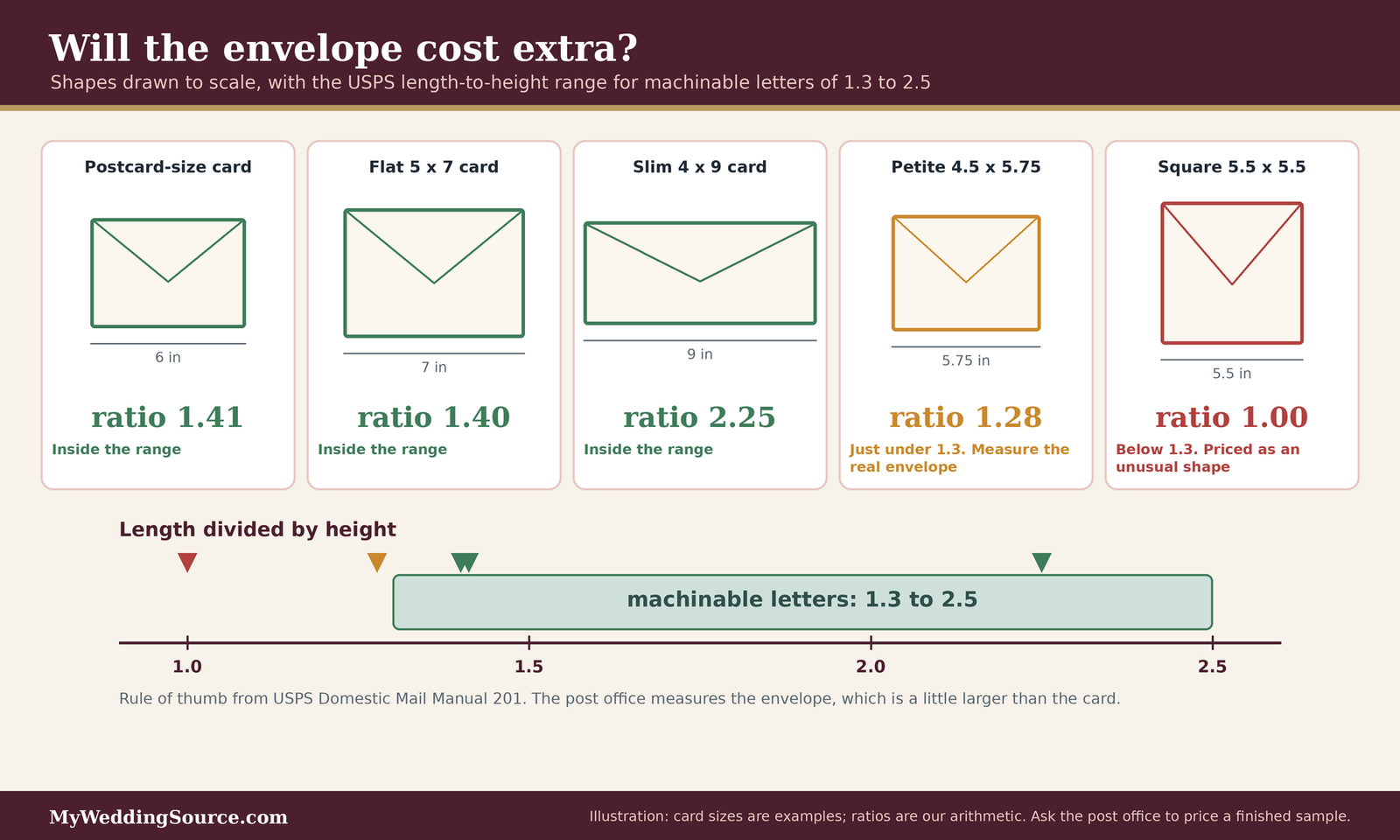
USPS’s Domestic Mail Manual, section 201, defines a machinable letter by size. The minimum is 5 inches long and 3.5 inches high, with a maximum of 11.5 inches long and 6.125 inches high. The length divided by the height must be between 1.3 and 2.5, inclusive. A letter-size piece that falls outside the standards can be treated as nonmachinable, which fits with USPS listing square and unusual envelopes at a higher starting price.
A square envelope has a ratio of 1.0, which is below the minimum. A typical 5 by 7 card is about 1.4, which passes. A petite card at 4.5 by 5.75 has a ratio of about 1.28, which is slightly under 1.3, and that is our arithmetic on the card, not a statement about any specific envelope. The envelope is what the post office measures, and it is slightly larger than the card, so measure the envelope before you order.
Thickness, closures, and add-ons
The same manual limits the thickness of a letter to one-quarter inch, and it says rigid items such as pens or keys are prohibited inside mailpieces, while flexible items like credit cards are permitted. It also says an automation-compatible mailpiece may not have clasps, strings, buttons, or similar closure devices, or protrusions that could impede or damage mail processing equipment. Polywrapped or shrinkwrapped pieces are not automation-compatible either.
What does that mean for a save the date? A ribbon tied around a card, a wax seal, a button closure, a thick magnet, or a bulky insert may push a piece into a different price. The manual does not address wax seals or magnets by name, so we cannot say exactly how a given one will be treated. Take a finished sample to the post office and ask them to price it, then keep their answer with your order records.
When to send: a timeline you can work backward from
Timing advice for save the date cards varies by source, and the variation is useful because it shows the range of reasonable practice. Our synthesis below is an editorial reading, not a rule.
Where the sources agree and differ
Everyone agrees on the principle: far enough ahead for guests to plan, late enough that your list is settled. The numbers differ at the edges.
Local weddings
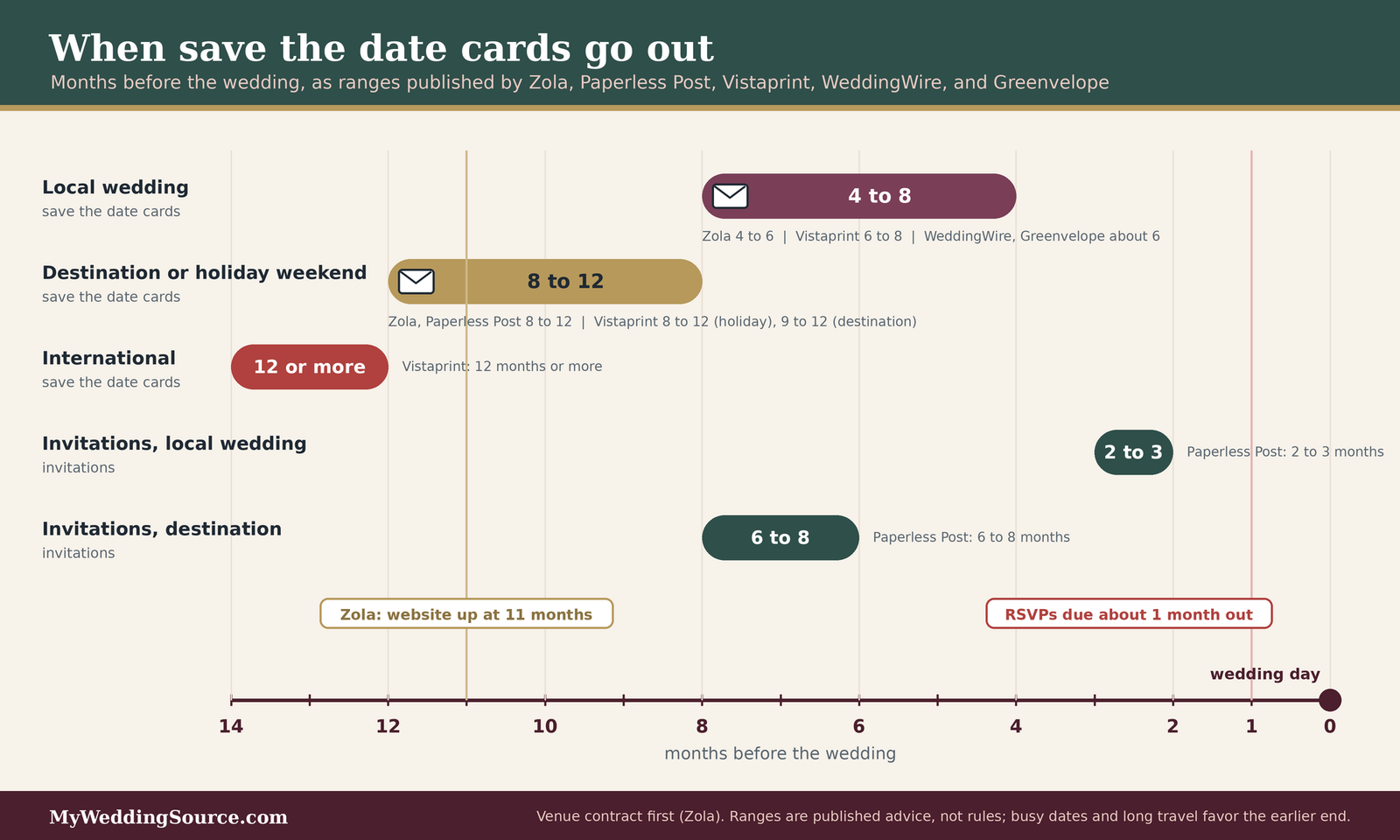
For a local wedding, Zola recommends four to six months, and gives an overall range of no earlier than eight months and no later than four. Paperless Post gives four to six months for local weddings, with invitations two to three months before the date. Vistaprint says six to eight months, leaning toward eight in peak season or where lodging is limited. WeddingWire says about six months, and Greenvelope says about six.
A fair reading is that six months is a safe midpoint for a local wedding, with earlier sending for popular dates and later sending if your list is small and nearby. Sending more than a year out is not helpful for most couples, and Vistaprint cautions that it can backfire, except for international or holiday-weekend weddings.
Destination, holiday, and international weddings
Zola and Paperless Post both say eight to twelve months for a destination wedding. Vistaprint says nine to twelve months for destination weddings, with twelve or more for international ones, and eight to twelve for holiday weekends or peak season. Greenvelope says six to nine months for a local destination wedding and twelve months for a destination wedding, and WeddingWire says eight months to a year for destination or holiday-weekend weddings.
The reasoning is practical. Guests who must book flights, request vacation, or find childcare need the extra months. If you are asking people to travel, also consider whether they can afford it, and think about telling them the date early enough that a long engagement is not the only way to give them time.
Working backward from the date
A timeline is easier to trust when you build it from the end. Start from the day and subtract.
Sign the venue first, then set the clock
Zola advises securing the venue before ordering or sending cards, ideally by signing the venue contract, so you do not end up sending change-the-date cards. That one rule prevents the most expensive kind of mistake. A save the date for a date you do not yet hold is a promise you may have to withdraw.
Once the contract is signed, subtract your chosen lead time. For a six-month local plan, the card must be in the mail six months before the wedding, printing and addressing must finish before that, and the design must be approved before printing. For help placing these dates on a full calendar, see our wedding planning timeline.
Add buffer for proofs, addresses, and production
Paper save the date cards have delays that digital ones do not. Vistaprint lists turnaround options for 100 cards from three days for a rush order to just over two weeks for economy, so a deadline-driven order needs a margin. WeddingWire says calligraphy addressing takes about a week for 100 envelopes, while addressing them yourself may take two to three weeks.
Add time for your own review. A realistic schedule leaves room for a design draft, a proof, a correction, a production run, addressing, and a trip to the post office. If any of those slips, the card goes out later, which is fine if you built buffer, and a problem if you did not. Zola suggests setting up a wedding website around the 11-month mark, so build the website and the cards together.
Matching the format to different weddings
The right answer changes with the wedding. Three illustrative couples show how the same criteria produce different results. They are composites we built for this guide, with stated assumptions, and they are not real clients or survey respondents.
Three couples, three answers
Each example uses the cost figures from earlier in this article, so you can see how the arithmetic shifts with the situation.
A casual local wedding with a ten-month engagement
Imagine a couple planning a backyard celebration for about 60 guests, roughly 40 households, nearly all local, with a ten-month engagement. They have signed the venue agreement and want a relaxed tone. For save the date cards, a link by text reaches almost everyone in a day at no cash cost, and Zola’s free digital designs make that practical.
Suppose four households are older relatives who prefer paper. The couple prints a small batch for them and sends a link to the other 36. At the $2.70 figure, four printed cards with stamps would cost about $11, if a seller prints so few, which they should confirm. Send time is flexible, so five or six months before the date is comfortable, in line with the local ranges above.
A destination wedding with guests abroad
Now imagine a couple marrying abroad with 60 households, of which 20 live outside the United States. Sources agree they should send early, around eight to twelve months, and Vistaprint suggests twelve or more for international weddings. Paper would cost, by our arithmetic, 40 domestic stamps at $0.82 plus 20 international stamps at $1.75, which is $32.80 plus $35.00, or $67.80 in postage, and cards for 70 households at $1.88 would add $131.60. The total is $199.40, or about $3.32 per household.
Digital reaches the 20 households abroad immediately and avoids the foreign mail question. Eventifai, a digital vendor, says mail to international guests can be delayed or complicated, though that is a vendor’s view. The sensible choice here is usually digital first, because the long lead time makes speed less important than reach, with paper for anyone who would value it. A couple also needs to ask whether guests can afford to travel, which is a reason to send as early as sources permit.
A holiday-weekend wedding with a formal tone
Finally, imagine a formal wedding on a holiday weekend, with 110 households and many older relatives. WeddingWire says to send earlier for holiday weekends, and Vistaprint gives eight to twelve months for holiday or peak-season dates. Printed save the date cards fit the tone. Using our assumptions, 120 foil-pressed cards at $1.88 cost $225.60, and 110 stamps at $0.82 cost $90.20, so the total is $315.80, or about $2.87 per household.
The example shows the cost of an envelope choice. If the couple picked a square envelope, postage would be 110 times $1.31, or $144.10, instead of $90.20, which is $53.90 more. That is our arithmetic from two USPS figures, and it is the kind of detail a shape check catches before the order is placed. Vistaprint also notes that digital may feel less formal for black-tie events, so printed save the date cards match the occasion.
Why the recommendation changes
The three answers are not random. They depend on a few thresholds, and you can test your own wedding against them.
The thresholds that flip the answer
First, reach. If a meaningful part of your list will not see a text or email, add paper for those households. Second, lead time. If your wedding is under about six months away and you have not ordered, Vistaprint’s advice is to send a digital version first. Third, geography. If many guests live abroad, the postage figures above favor digital, and the lead time is usually long enough for either route. Fourth, tone. If you want a keepsake or a formal feel, paper earns its cost.
When two thresholds point in different directions, the hybrid plan is the tiebreaker. It lets you spend on paper where it matters and save elsewhere, and it costs only the extra coordination of a second list.
When neither option is ideal
Some situations make both formats a poor fit. If your venue is not yet signed, no card is ideal, because a save the date for an uncertain date risks a change-the-date card later, as Zola warns. If your guest list is still in flux, the better move is to wait, as WeddingWire advises. And if the wedding is very close, a phone call or personal message to key guests may do more than any card.
In these cases, the useful action is not to pick a better card. It is to fix the underlying problem first, then return to the format decision with a stable date and list. Save the date cards are the last step of a short chain, and it cannot repair the earlier links.
| Scenario | Leading choice | Why | Threshold that flips it |
|---|---|---|---|
| Casual local wedding, about 40 households, ten-month engagement | Digital link, paper for a few households | Reach is high, cash cost is near zero | Many guests without email or text |
| Destination wedding, 20 of 60 households abroad | Digital first, paper by request | Postage of $1.75 per international letter and long lead time | Guests who want a keepsake or have no online access |
| Formal holiday-weekend wedding, about 110 households | Paper | Tone and keepsake value, early sending expected | A tight budget or a square envelope that raises postage |
| Short engagement, under six months | Digital first | Production and mailing time are short | Enough time remains to print and mail |
| Guest list or venue not settled | Wait | A card is a promise you may have to withdraw | List and venue are confirmed |
A decision rule you can reuse
A rule is useful if it reduces to a few questions you can answer from your own records. The matrix and thresholds below are our editorial synthesis of the sources above, built to be checked against your numbers.
Choose X when, choose Y when
Use the matrix as a checklist, not a verdict. The point is to see which criteria decide your case.
| Criterion | Favors paper when | Favors digital when | What to check |
|---|---|---|---|
| Guest reach | Several households lack email or text | Nearly everyone is online | Count households by how you can reach them |
| Cash budget | Paper cost per household fits your plan | Any cash saving matters | Cost per delivered household |
| Time to the wedding | More than about six months remain | Fewer than about six months remain | Printing and mailing buffer |
| Tone and keepsake | Formal tone, keepsake wanted | Casual tone, share-and-save fine | Your event style |
| Distance | Local, easy mailing | Many guests abroad | International postage and delays |
| Flexibility | Date and list are certain | Details may still change | Venue contract signed |
| Effort | You can gather mailing addresses | You can gather emails and numbers | Which list you can build faster |
State the threshold that changes the answer
Pick three numbers and write them down. First, the share of households that cannot easily receive digital messages. If it is more than a handful, plan a hybrid. Second, the months remaining. If the date is under about six months away and nothing is ordered, start with digital. Third, your cash ceiling per household. If it is below the paper estimate for your design and postage, choose digital or a postcard-rate card that qualifies.
These thresholds are guidance, not law, and they come from our reading of vendor and etiquette sources. Different couples will set them differently, and that is fine. What matters is that the thresholds come from your list, not from a mood.
Name the cases where neither is ideal
Skip save the date cards if the list is not final, the venue is not signed, or the wedding is so close that a direct message is faster. In all three cases, spend the effort on the underlying fact. A clean guest list and a signed contract make any format work, and without them no format helps.
If you are weighing the whole planning sequence instead of one card, our guide to how to plan a wedding places this decision among the others.
Verify before you order
Before you pay a printer or a platform for save the date cards, collect the evidence that settles the open questions, and keep it with your records.
List the evidence to request
Ask the seller for these items in writing: the total price for your quantity including envelopes, the finished card and envelope dimensions in inches, the production and shipping time, the proof process, what happens if there is a printing error, and whether addressing is included. For a digital product, ask what the free tier includes, what the paid tier adds, and whether guests need an account to view the save the date cards.
Ask the post office, too. Bring a finished sample or a ruler-measured mockup and ask for the price per piece. That single answer prevents a surprise across the whole batch. Our wedding planning checklist can hold these items as tasks.
Name the line that should settle the question
Every order has one line that decides whether it is worth it. For paper, it is the per-household cost after postage, with the actual envelope. For digital, it is the plan’s price and what it includes. For a hybrid, it is the minimum print quantity. Find that line before the design, because a design you love is hard to give up.
If a quote does not show it, ask the seller to add it. A reputable seller will give a clear total, and a vague one is a reason to keep comparing.
Questions worth asking before you order
- What is the total for my quantity, including envelopes, addressing, tax, and shipping?
- What are the finished card and envelope sizes in inches?
- What is the minimum order, and does the price change if I order fewer?
- When will I see a proof, and how many corrections are included?
- What is the production time, and what is the latest I can order for my mail date?
- For digital, what is free, what is paid, and do guests need an account?
- Has the post office priced a finished sample of this card in its envelope?
Risks to plan for
Most problems with save the date cards are small and predictable. A short risk register turns them into tasks.
The risks that come up
A few failures account for most of the regret. Each has an early signal and a simple response.
Errors that cannot be undone
A wrong date, a misspelled name, or a wrong address is the clearest risk, because a printed card cannot be edited. The early signal is a rushed proof. The response is a slow proof read by two people, with the date checked against a calendar. If you find an error after printing, tell the affected guests plainly and send a corrected notice, since a guest who keeps a wrong date is worse off than one who has two cards.
Change-the-date notices exist for exactly this reason, and Zola’s guidance is to avoid needing them by signing the venue first. We were unable to find a detailed etiquette source for them in this research, so confirm current practice with your stationer if you need one.
Messages that never arrive
Mail can be returned and email can be filtered. The early signal is silence from a household you expected to hear from. The response is a follow-up call or text a few weeks after sending, which is also the simplest way to confirm addresses. Keep the guest sheet current, including a note of who confirmed receipt.
| Risk | Early signal | Response |
|---|---|---|
| Wrong date or name printed | Proof reviewed by only one person | Two readers, calendar check, and a written sign-off |
| Postage higher than planned | Square, thick, or embellished envelope | Post office prices a sample before ordering |
| Digital message filtered | No acknowledgment after a few weeks | Follow-up text or call, plain-text date in the message |
| Card sent to someone later not invited | List still changing | Send only to the definite list |
| Venue or date changes | Contract not yet signed | Wait for the signed contract |
| Spare cards run out | No extras ordered | Order extras with the first print run |
After save the date cards go out
Save the date cards start a conversation, and guests will ask questions. A little preparation makes those easier.
Questions guests will ask
Zola lists the common questions that follow save the date cards: dress code, theme, indoor or outdoor setting, arrival time, plus-one and children policies, accessibility, and travel logistics such as the nearest airport, hotel options, transportation, and parking. A wedding website can answer many of them, and Zola suggests posting date, time, place, and venue first.
Decide in advance which of these you can answer now and which you cannot. It is fine to say that details will come with the invitation. You do not owe a full program months early, and a short, kind answer protects your plans.
Hotels, travel, and the website
Zola says you can book a hotel block before RSVPs arrive, since hotels are usually willing to work with an estimated headcount, and suggests researching nearby alternatives and transportation between the airport, hotel, and venue. If rates are still being negotiated, tell guests when to expect an update. Save the date cards should not carry this detail, so point to the website.
Keep the website current once your save the date cards are out, because it is the one channel you can correct after the cards are out. Link to it from the card, and put dress and travel notes there instead of printing them.
Questions to ask before you commit
The checklist above covers the order. These broader questions test the decision itself.
About the decision
These questions confirm that the format matches your situation.
Does this format reach every household?
Walk down your list and mark how you would reach each household. If the number you cannot reach digitally is more than a few, plan paper or a phone call for them. The goal is that every household learns the date, not that every household gets the same object.
Do the dates and the list hold?
Check that the venue contract is signed and the list is final. If either answer is uncertain, wait. A short delay costs nothing, and a withdrawn promise costs trust.
About the money
These questions test the budget.
What is the cost per delivered household?
Add the card, envelope, addressing, postage, and any platform fee, then divide by households reached. Compare that number across options, not the sticker prices. Our wedding budget calculator shows how this line fits the larger plan.
What is the cost of the envelope?
Ask whether the envelope is standard, how it measures, and what the post office will charge. A shape that adds $0.49 per piece adds real money across a full list.
FAQ: save the date cards questions
Timing and who receives them
How early should save the date cards go out?
Most sources suggest four to eight months for a local wedding and eight to twelve months for a destination or holiday-weekend wedding. Zola gives four to six months locally, Vistaprint six to eight. Pick the earlier end for save the date cards on popular dates or long travel, and make sure the venue contract is signed first.
Does everyone on the guest list need one?
No. Send them only to guests you are certain to invite, because recipients expect an invitation. Zola calls this the definite group and suggests skipping guests who may be cut for space or budget. Send one card per household, and include your wedding party and close family as a keepsake.
Is a digital save the date acceptable?
Yes. Zola, Paperless Post, and Vistaprint all treat digital and paper as acceptable. Digital save the date cards are fast and inexpensive, though a message can land in spam and may feel less formal for a black-tie event. Follow up with key guests, and send paper to households that would prefer it.
Cost and mailing
How much do save the date cards cost?
The Knot’s 2026 study reported an average of $150 for online, ready-made stationery and $1,000 to $3,000 from professional designers. Digital designs can be free. In our worked estimate, a printed card plus a stamp was about $2.70 per household, before tax and shipping. Your quote will vary.
Do square envelopes cost more to mail?
Often yes. USPS lists letters in square, oversized, or unusual envelopes as starting at $1.31, against $0.82 for a standard letter. Its mail manual sets an aspect-ratio range for machinable letters, which a square envelope falls outside. Have the post office price a finished sample before you order.
Content and wording
What should a save the date card say?
Keep it short: both names, the date, and the city or town. Many couples add a wedding website and a line saying a formal invitation will follow. Leave off registry details, RSVP requests, and hotel information, which can live on your website where you can correct them later.
Should I include the venue or a hotel block?
Include the venue only if it is settled, and otherwise the city is enough. Zola advises leaving hotel and travel details off the card, while WeddingWire says a reserved block can be included. If you include one, confirm it first, and point guests to the website for updates.
What if I have to change the date?
Send a clear change-the-date notice to everyone who received the first card, and update your website. Zola’s advice is to avoid this by signing the venue contract before sending cards. We did not find a detailed etiquette source for wording, so ask your stationer about current practice.
Your next steps
Settle the facts
Confirm the venue and the list
Sign the venue contract and finalize the definite guest list before any save the date cards are ordered. Our wedding planning guide and wedding planning timeline show where this fits in the larger sequence.
Gather the contact details
Before ordering save the date cards, send one short message asking each household for an email, a phone number, and a mailing address. Keep the answers on one sheet with a paper or digital column.
Choose and order
Compute your cost per household
Use the method above with your own quantity and postage. Ask the post office to price a finished sample, and use the wedding budget calculator to see how it sits in the full budget.
Proof, send, and follow up
Have two people proof the date on your save the date cards and every name. Send on your chosen date, then follow up with households that have not acknowledged the card, and keep your website current.
Sources & methodology
How we built this guide
What we relied on
This guide combines The Knot’s 2026 Real Weddings Study figures, U.S. Postal Service price pages and mail design standards, and published etiquette and timing advice from wedding and stationery companies. Where a statement comes from a retailer or platform, we say so, because sellers describe their own products favorably. The cost-per-household figures, break-even counts, and scenario totals are our own arithmetic from the cited prices, with stated assumptions, and they are estimates. We checked prices in November 2026.
What we did not do
We did not order or test any card, send any mailing, or verify any vendor’s claims independently. We did not find independent data on how many couples send paper versus digital save the dates, so we make no claim about popularity. Postage and product prices change, and etiquette varies by community, so confirm the current price with the seller and the post office. Nothing here is legal or financial advice.
Source list
Government and postal sources
- U.S. Postal Service, Domestic Mail Manual 201, Commercial Letters, Cards, Flats, and Parcels: https://pe.usps.com/Text/DMM300/201.htm
- U.S. Postal Service, Prices for business mailers (letter, postcard, and unusual-envelope prices): https://www.usps.com/business/prices.htm
- U.S. Postal Service, newsroom release of April 9, 2026, recommending new prices for July: https://about.usps.com/newsroom/national-releases/2026/0409-usps-recommends-new-prices-for-july.htm
- Stamps.com, Current postage rates (cross-check of letter and postcard prices): https://www.stamps.com/usps/current-postage-rates.md
Survey and industry sources
- The Knot, National average cost of wedding invitations and stationery: https://www.theknot.com/content/average-cost-of-wedding-invitations
- The Knot, 2026 Real Weddings Study overview: https://www.theknot.com/content/wedding-data-insights/real-weddings-study
- Business Wire, The Knot Worldwide 2026 Real Weddings Study announcement: https://www.businesswire.com/news/home/20260218045442/en
Etiquette, retailer, and platform sources
- Zola, When to send save the dates: https://www.zola.com/expert-advice/when-to-send-save-the-dates
- Zola, What should be included on save the date cards: https://zola.com/expert-advice/what-should-be-included-on-save-the-date-cards
- Zola, What to do after sending save the dates: https://zola.com/expert-advice/invites-paper/save-the-dates/what-to-expect-after-sending-save-the-dates
- Zola, Digital save the dates: https://www.zola.com/wedding-planning/digital/save-the-date/shop
- Paperless Post, Save the date etiquette: https://www.paperlesspost.com/blog/save-the-date-etiquette/
- Paperless Post, How much do wedding invitations cost: https://www.paperlesspost.com/blog/how-much-do-wedding-invitations-cost/
- Vistaprint, When to send save the dates: https://www.vistaprint.com/hub/when-to-send-save-the-dates
- WeddingWire, The guide to save-the-date etiquette: https://www.weddingwire.com/wedding-ideas/the-ultimate-guide-to-save-the-dates
- Greenvelope, When to send wedding invitations: https://www.greenvelope.com/blog/when-to-send-wedding-invitations
- Eventifai, Digital vs. paper save the dates: https://www.eventifai.com/planning-guides/digital-vs-paper-save-the-dates-which-is-right-for-your-2026-wedding
- Minted, Foil-pressed save the date cards product page: https://www.minted.com/product/foil-pressed-save-the-date-cards/MIN-FOI-SFS/always