

Good proposal ideas start with who your partner is, how much attention they want, and what the place will actually allow, and only then with props, music, and a photographer, because the details that make a moment feel personal are usually the cheapest ones.
Quick answer
Pick one feeling you want the moment to leave behind, such as calm, joy, or “everyone who matters is here.” Choose a setting that fits that feeling, check what the place and the weather allow, and keep one focal point and one backup. Most proposal ideas that go wrong fail on logistics (a closed trail, a crowd, a missing permit, a storm), not on romance. The Knot’s 2024 survey of couples found that most proposers prepared ahead, and a small share hired a photographer to capture the moment unnoticed. When you compare proposal ideas, a simple plan you have walked through once usually beats an elaborate one you have not.
If you are reading about proposal ideas, you are probably some mix of excited and nervous, and you may be worried that yours is not original enough. It does not need to be. What a proposal needs is to be recognizably about the two of you, which is a different goal from being unusual. This guide treats proposal ideas as a small planning project with three parts: personality (what your partner would love), privacy (who is there, and who sees it later), and logistics (permits, weather, travel, photography). We keep the romance and the spreadsheet in the same room, because the second one protects the first, and good proposal ideas need both.
We do not know your partner, so we will not tell you what they want. What we can do is show how real proposals are put together, what official sources say about the public places people often choose, what a hired photographer typically costs according to one vendor’s own listing, and how to build a plan that still works if something goes wrong. Where a figure is our own arithmetic, we say so.
Start with the feeling, not the venue, when choosing proposal ideas
Most people begin their search for proposal ideas with a location, because a location is easy to picture. A more reliable starting point is the feeling you want your partner to have in the first ten seconds. That feeling quietly decides almost everything else: whether you invite anyone, whether you want photos, how much you can plan without spoiling the surprise, and how much risk you are willing to take.
Define the audience and the emotional purpose
An audience can be one person, ten people, or a hundred strangers at a ballgame. Your partner may love being the center of attention or may find it mortifying. This is the single most important fact about your partner when you weigh proposal ideas, and you probably already know it.
Private, family-centered, high-energy, sentimental, or playful
It helps to name the mood before you pick the scene. Here is how five common moods tend to translate into proposal ideas. These are planning heuristics, not rules.
A private mood means the two of you, no audience, and usually no visible camera. It suits people who dislike being watched, who might cry, or who want their first reaction to belong to nobody else. The risk is that you will have no record of it unless you arrange one carefully, which we cover in the photography section.
A family-centered mood means parents, siblings, or children are present or close by, perhaps for a dinner or a holiday gathering. It suits couples whose families are central to their lives. The risk is that a crowd raises the pressure to say yes on the spot and gives you more people who might spoil the surprise, so choose relatives who can keep a plan quiet.
A high-energy mood means a trip, an activity, a game, or a lively public place. It suits partners who like adventure and being among people. The risk is that outdoor, active, and public settings are the ones that depend most on weather, access rules, and timing.
A sentimental mood draws on shared history: the first-date spot, the place you got a dog, a song, a letter. It suits people who keep ticket stubs. The risk is quiet: sentimental plans often depend on one specific location that may have changed, closed, or become crowded since you last visited.
A playful mood uses humor, a scavenger hunt, or an inside joke. It suits partners who laugh easily. The risk is that a game with many steps has many places to fail, so it needs the simplest possible backup.
Many people combine two moods, such as private and sentimental, and that is usually the safest pairing, because a small audience and a meaningful place need very little equipment.
Avoid copying a viral idea without the same context
Videos of elaborate proposals travel widely because they are dramatic, and because we rarely see the preparation or the versions that did not make the clip. A flash mob, a hot-air balloon, or a rented billboard works for the people who did it because it matched them, their partner, their city, and their budget. Moved to a different context it may not.
Before you adapt an idea you saw online, ask three questions. What did it need that I do not have (a cooperating crowd, a venue that said yes, a professional crew)? What would my partner feel at each step, not just at the end? And what is the smallest version that keeps the core of the idea? A viral idea is a prompt, not a template, and the same is true of any list of proposal ideas, including this one.
What the survey data suggests about how people actually propose
For proposal ideas, one of the few published sources is The Knot’s 2024 Jewelry and Engagement Study, published in December 2024, which reports data from what the publication describes as more than 7,800 U.S. couples. The publication’s summary does not describe how respondents were recruited, how the results were weighted, or the base for each percentage, so treat the figures as a useful picture of one survey’s respondents and not as a measure of all engagements. Our infographic below shows the reported settings.
The Knot’s later Real Weddings release, covering couples who married in 2025 (10,474 U.S. couples recruited by email from The Knot and WeddingWire membership), says nearly 9 in 10 proposers had a ring in hand, which is consistent with the 2024 figure of 89%. We could not access the proposal section of that later study, so the 2024 figures are the most detailed we have. Several of the reported figures are useful for planning. By the survey’s account, 83% of proposers prepared ahead of time and 13% called their proposal spontaneous. Among the proposers who prepared, just under half spent one to three months planning. Most proposals were private (53%) and fewer were public (39%). Beyond that, 83% of the people who were proposed to described it as a surprise, yet over half of those people knew a proposal was coming soon without knowing when. The takeaway for anyone choosing proposal ideas is a comfortable one: surprise is usually about timing and details, not about whether a proposal is coming at all.

Check that your partner is ready, and that you are on the same page
Everything above assumes that a proposal is welcome. This section is short, but it is the most important in the article.
Talk about the future before you plan the moment
The Knot’s 2024 survey reports that 57% of couples began discussing their engagement more than a year before the proposal. Proposals that land well tend to follow open conversations about marriage, timing, and expectations, even if the exact day stays unknown. If you have never talked about marriage with your partner, have that conversation first, in an ordinary moment, before you book anything.
You do not have to reveal the plan to have that conversation. Asking “what do you picture for us in a couple of years?” is a conversation, not a clue. If the answer is “I am not sure yet,” that is useful information, and it is better to learn it over dinner than on one knee.
Decide what “no” or “not yet” would mean for the plan
It is uncomfortable to plan for a partner who is not ready, but a plan with an audience, a prepaid vendor, or a long trip deserves a quiet exit. Private settings give the most room for a gentle “not yet” because nobody else is watching. If you plan something public or with guests, decide in advance how you will end the moment gracefully and who will help. We are not suggesting this is likely. We are suggesting that a plan with no exit puts pressure on both of you.
List the practical constraints
Once you know the feeling, make a short list of what the place and the day will allow. This is where promising proposal ideas get edited into workable ones.
Space, sound, weather, accessibility, timing, and vendor rules
Walk through six constraints in order. Space: how many people can stand comfortably without blocking a path or a doorway? Sound: will music or an announcement carry, or be drowned out by wind, traffic, or a nearby event? Weather: what is the realistic range for that date and time of day, and is there shelter within a few minutes’ walk? Accessibility: can everyone you want present, including older relatives and anyone who uses a wheelchair or walker, reach the spot and get back? The National Park Service notes that individual park websites list accessible features, programs, and services, so check the specific park before assuming a trail or overlook works for everyone. Timing: when is the light good, when is the site crowded, and does anything close early? Vendor and venue rules: does the property allow outside décor, music, or a photographer, and what is the policy on open flame?
Each of these questions about your proposal ideas can be answered by a phone call or a website, usually in a few minutes. The permit and rule research for public land gets its own section below, because the rules vary a good deal from place to place.
Set a budget or complexity ceiling
Two ceilings are worth setting before you commit to any of your proposal ideas: a money ceiling and a complexity ceiling. For money, decide the total you are comfortable spending on the moment itself, separate from the ring. If you are still deciding on the ring, our engagement ring guide covers the buying side, and our wedding budget calculator helps you see how an engagement fits into the larger picture.
For complexity, a useful rule is to count the independent things that must go right: a person arrives on time, a permit is granted, the weather holds, a vendor shows up, a surprise stays quiet. Each is a place where a plan can slip. Three is manageable. Six is a project that needs a run-of-show and a backup, and ten is usually a sign that the plan has outgrown the moment. If your count keeps climbing, remove steps instead of adding insurance.
What this actually costs
The ring is rarely the only cost. Think of a proposal budget as ring, plus the setting, plus the people, plus the record of it. The Knot’s 2024 study reported an average engagement ring spend of about $5,200 for that year’s respondents, which is a survey average and not a price anyone should aim at. The rest of the budget can be close to zero (a walk at a place you love) or can add up quickly (travel, a hired photographer, flowers, a dinner afterward). Set the ceiling first, then choose the idea that fits under it. Our worked example in the photography section shows how to compare quotes fairly.
Match the idea to the feeling with a simple matrix
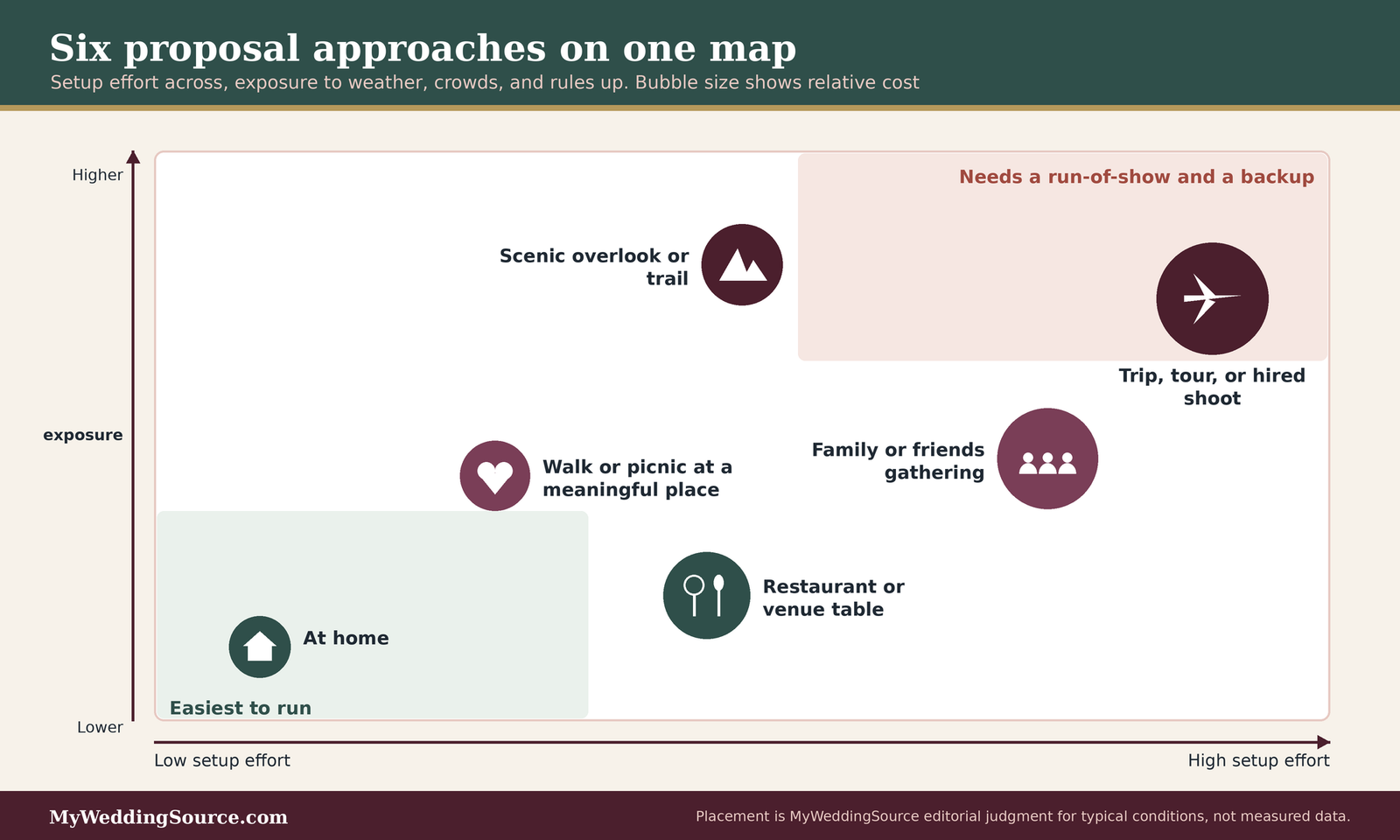
A matrix helps when you are choosing between two or three proposal ideas that all sound good. The table below compares six common approaches on the factors that tend to decide how a proposal feels and how likely it is to go smoothly. The ratings are our editorial judgment about typical conditions, not measured data, and your own city, season, and partner will move them.
How to read the matrix
Read across a row for one idea, or down a column to compare. “Setup” is the amount of preparation and coordination the idea usually needs. “Cost” is a rough relative level, not a quote. “Failure risk” describes how often outside factors (weather, crowds, rules, timing) can disrupt the idea, not how romantic it is.
Six approaches compared
| Idea | Best emotional goal | Guest fit | Setup | Relative cost | Failure risk | Main thing that can go wrong |
|---|---|---|---|---|---|---|
| At home, in a familiar room | Intimate, unhurried | Just the two of you, or family arriving after | Low | Low | Low | The surprise is spoiled by an unexpected visitor or delivery |
| A walk or picnic at a place that matters to you | Sentimental, private | Two people, optional photographer | Low to medium | Low | Medium | Weather, crowds, or a changed location |
| A scenic overlook or trail | Awe, a sense of adventure | Two people, a few close friends nearby | Medium | Low to medium | Medium to high | Access rules, weather, tiredness, or other visitors on the spot |
| A restaurant or a table at a venue | Celebratory, easy to share | Small group, staff involved | Medium | Medium | Low to medium | The venue’s rules, noise, or a table in a bad location |
| A family or friends gathering | Joy, shared belonging | Larger group, more relatives | Medium to high | Medium | Medium | Someone spoils the surprise, or the attention is too much |
| A trip, a tour, or a hired shoot | Memorable, travel-based | Two people, plus a vendor | High | Medium to high | Medium | Cancellation terms, delays, and a ring that has to travel safely |
Choosing between two close options
If two proposal ideas in the matrix seem equal, break the tie with the failure risk column and your partner’s tolerance for surprises that do not go to plan. A person who laughs off a change of weather suits a high-risk idea. A person who is anxious about being watched suits a low-risk, private one.
The map below places the same six approaches on two axes, setup effort and exposure to outside factors, so you can see the trade-off at a glance. Its placement is editorial judgment.
Proposal ideas by personality: starting points, not scripts
The proposal ideas below are grouped by the mood they usually serve. Each one is a starting point. They are intentionally unspecific about places, because the best version uses a place that is yours. For each, we note what to check and what a smaller backup might look like.
Quiet and private
These proposal ideas keep the audience to the two of you and put your attention on the moment itself.
A familiar place at an unfamiliar time
Think of a favorite park bench, a rooftop, a kitchen, or a porch, at an hour you do not usually visit. Sunrise and the last hour before dark both tend to be quieter than midday. The idea works because the place is already meaningful, which is why quiet proposal ideas like this one cost so little and the timing is the only surprise. Check sunrise and sunset times, make sure the spot is open at that hour, and bring a layer in case it is cooler than expected.
A letter, a playlist, or a ritual you already share
If you cook together, take the same walk every Sunday, or have a song, build the moment from that. The cost is usually very low, which makes this one of the most budget-friendly proposal ideas. The backup is simple: if the setting falls through, do the same thing at home. The idea only fails if you try to add too much to something that was already enough.
Home with a photographer outside the door
A private moment at home can still be recorded if someone you trust, or a hired photographer, is positioned at a distance, in a car, or in a neighboring space. We cover the cue and consent questions below, because capturing a private moment without spoiling it takes planning.
Shared with people who matter
These proposal ideas include a small circle, and they work best when you trust everyone to keep the plan quiet.
A meal with family or close friends
A dinner, a brunch, or a gathering already on the calendar is a natural stage. It adds very little cost and gives a ready-made celebration afterward. Choose a spot where you can talk without a crowd of strangers nearby, and tell the restaurant in advance. Assign one person to keep the cue, one to take photos, and one to handle the toast or the drinks, so you can stay in the moment.
Letting the family arrive afterward
For some couples, the best version is a private proposal followed by a surprise celebration. The two of you have the quiet moment first, then relatives or friends appear, or you call them together. It splits the experience into two parts and avoids the pressure of an audience when the question is asked.
Including children or a pet
The Knot’s 2024 study reports that 5% of proposals included a pet. Children and pets add warmth to family proposal ideas, and they also add unpredictability, because they do not follow cues. If you want them present, give them a simple role, such as holding a sign or wearing a ribbon, and have a second adult responsible for them so you are not managing them while proposing.
Active, outdoors, and adventurous
These proposal ideas lean on the setting, and they are the ones where rules and weather matter most.
A trail, a viewpoint, or a beach
Outdoor proposal ideas rely on the place being open and calm. The Knot’s 2024 study reports that scenic spots (34%), outdoor activities (14%), and beaches (14%) were all common settings among its respondents. These are also the places where access rules, weather, and tides matter. Visit in advance if you can, confirm the route and the length, and have a plan for a closure. Our guidance on public land, drones, and weather below applies here.
A day-long activity with the moment built in
A kayak outing, a bike ride, or a hike can end at a prepared spot, with the proposal as the finish. Tiredness is a real factor on active days, and a late-afternoon plan can slide when people are slow. Build in extra time, and place the proposal early enough that nobody is cold, hungry, or racing the light.
A hired photographer posing as a tourist
Some photography services describe proposal tactics such as a photographer who asks to take your photo as a “friendly tourist,” or who shoots a regular couple session as cover. The vendor we cite later also describes a hidden option as the riskiest, because passersby can interrupt. If you consider any of these, ask the photographer how they handle interruptions, and how they signal you.
Travel and destinations
These proposal ideas combine the proposal with a trip and add the rules of another place.
A trip you were taking anyway
A proposal built around travel you already planned adds little cost. It helps to choose a moment early in the trip, so a delay or a cancelled plan does not leave you carrying a ring for a week. Check your airline’s and your insurer’s rules, and keep the ring with you; the Transportation Security Administration advises travelers to keep valuables with them and not in checked baggage.
A landmark or a famous view
The Knot’s 2024 study reports that 7% of proposals took place at a famous landmark, and 8% on a vacation abroad. Famous places draw crowds and sometimes have rules about photography, decoration, and amplified sound. Plan for crowds at midday, and consider an early morning or a quiet side of the place. Famous settings are common proposal ideas for a reason, and the same crowds that make them special make them harder to control.
Remote or international plans
If the proposal will take place abroad, check entry requirements, local rules for public spaces, and any vendor’s cancellation terms well in advance. We have not researched rules for specific countries, so use the official site of the destination. ## Develop the idea around guest and vendor reality
Proposal ideas on paper have no weather, no strangers, and no closing time. Once it meets a real place, a few unglamorous questions decide whether it holds. This section is about editing the idea down to what it needs, testing the part most likely to break, and checking the rules of the places and people you rely on.
Choose the minimum elements needed to make it work
A useful test for any of your proposal ideas: if you removed this element, would the moment be worse? If the answer is “no” or “a little,” remove it.
Remove props or steps that do not improve the moment
Props that do not carry meaning tend to add work and risk without adding feeling. Rose petals scatter and need cleanup. Banners need hanging and wind blows them over. A multi-step scavenger hunt has several places to fail. Keep the elements that tell the story of you two, because the strongest proposal ideas are specific, and cut the ones that would be there in any proposal.
A practical way to edit is to list every element (location, music, flowers, sign, guests, photographer, dinner after) and give each a score from 1 to 3 for how much it adds to the feeling you named earlier. Keep the 3s, look hard at the 2s, and drop most of the 1s. This is our own method, not a standard, and the scores are for you alone.
Assign setup and cleanup
Someone has to arrive early, place the pieces, and clear them away, and it cannot be you if you want to stay unhurried and present. Name a person for each job and tell them the time, not the reason, if you want to keep the details quiet. Cleanup matters more than people expect: many public places expect visitors to leave no trace, and candles, confetti, and petals can create real problems for the people who maintain a site. Ask the place what it allows. At Yosemite, for example, the park’s wedding page says balloons, arches, and other decorations are not authorized and that event or directional signs are not allowed. That page covers weddings and commitment ceremonies and does not mention proposals, so treat it as a hint about the park’s general attitude and call the park for your case.
Rehearse or prototype the risky part
Every one of your proposal ideas has one element most likely to fail. Find it, and test it before the day.
Test timing, music, movement, or signage
Visit the spot at the same time of day you plan to propose. Check the light, the noise, the crowd, and how long it takes to walk from the entrance to the place. If you plan music, play it on the device you will use and listen from where your partner will stand, because wind and traffic change how sound carries. If you plan to move (a walk, a bike ride, a boat), time it, then add a buffer of 25 to 50%, which is our rule of thumb for people who are not rushing.
If there will be a sign, check that it can be read from the angle your partner will see it, and that it will stay up in a breeze. For public parks, remember that signs and decorations may need permission, as the Yosemite example shows.
Create a simpler backup version
A backup for your proposal ideas is not a lesser plan. It is the same feeling in a smaller form. If your main plan is a hilltop at sunset, the backup might be the same hilltop at an earlier hour, a covered spot nearby, or the same words at home with the same music. Decide the trigger in advance, such as a forecast, a closure, or a delay, so you are not improvising under stress. Tell your helpers the backup too, so they can follow it without asking you.
A short rule helps: if the weather forecast within a day of the event gives you a reason to hesitate, switch. The backup is not a defeat. It is the plan working.
Check the rules of public places, drones, travel, and open flame
This is the most practical section in the article, and the one where many proposal ideas run into surprises. We relied on official sources, and where an official page did not address proposals specifically, we say so, because the right answer is often a phone call to the managing office.
Parks and public land
Rules differ by park, city, and site, and many official pages describe weddings and ceremonies and not proposals. That is a real gap, not a reason to skip the check.
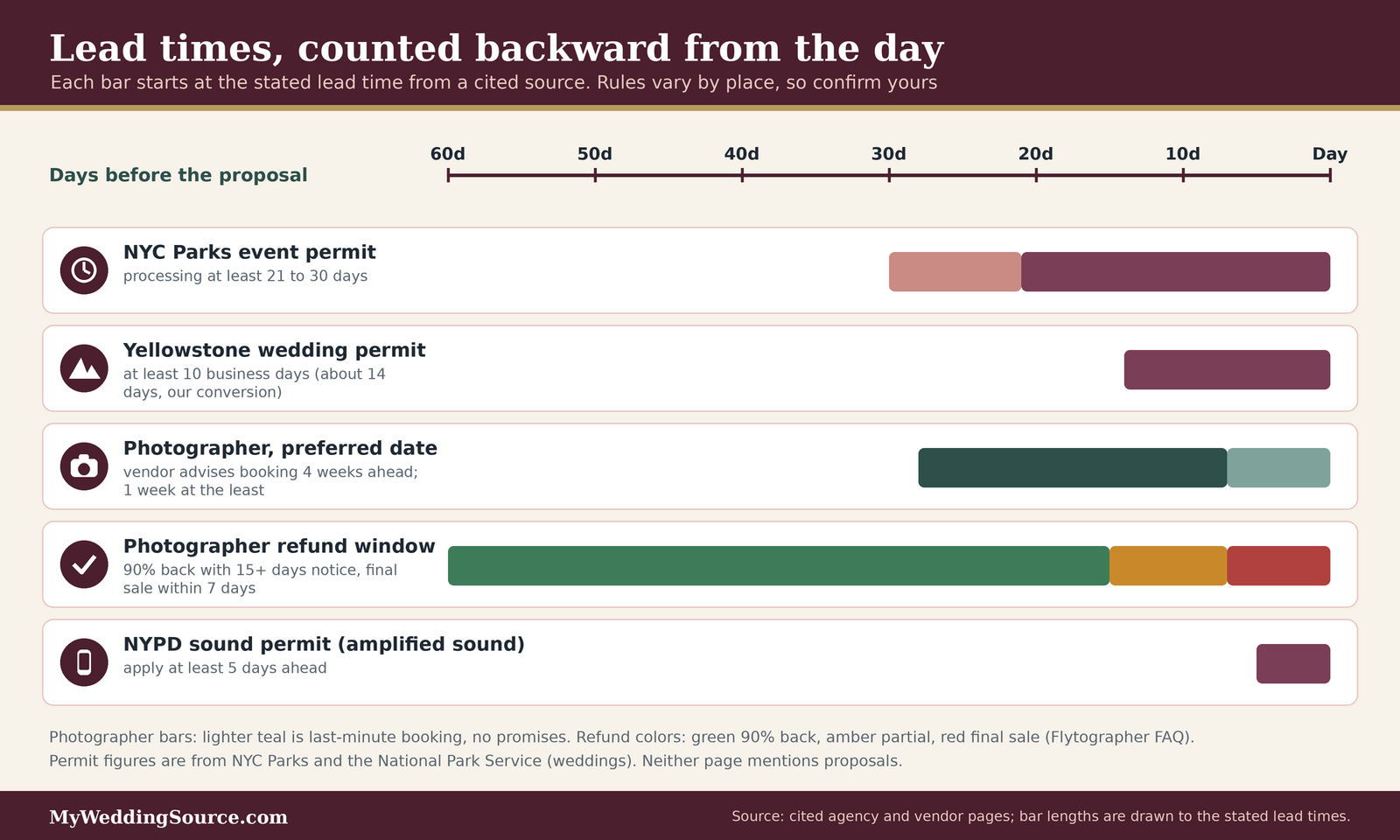
The National Park Service publishes separate pages for individual parks. Yosemite’s page says a special use permit is required for any wedding or commitment ceremony, and that the permit costs $150, with an extra $50 per hour if event monitoring is required. It also says permits will not be issued on holidays or holiday weekends, and that entrance fees are not waived. Yellowstone’s page says a special use permit is required and must be requested at least 10 business days in advance, and lists group size limits that vary by location, from 5 people in one area to larger numbers in others. Neither page mentions proposals, so we cannot tell you whether a quiet proposal for two people needs a permit in those parks. What the pages do show is the sort of rule that could affect a larger or decorated event: group size, decorations, signs, and timing. Call the park’s permit office and describe what you plan.
In New York City, the Parks Department’s special event page says a permit is generally not needed for groups of fewer than 20 people, although some smaller groups apply anyway to reserve a spot, for example for wedding photography. It also says a permit does not guarantee exclusive use of an area, and that processing takes at least 21 to 30 days. Anyone who wants amplified sound must apply for a special events permit regardless of group size, and the NYPD issues a separate sound permit, which the page lists at $45 with a request at least five days in advance. For film or photography requirements, the city’s 311 page says that requirements depend on where the shoot takes place, that NYC Parks requires clearance from the park’s administrative authority, and it points to the Mayor’s Office of Film, Theatre and Broadcasting for specifics.
The pattern is the same everywhere: the smaller and quieter the plan, the fewer the rules, and the more it grows with guests, sound, decorations, and professional photography, the more likely something needs approval. Our figures here are for illustration. These rules change, so check the current page for your site.
Drones
Drones can capture dramatic footage, and they are the item most likely to cause a legal problem. The Federal Aviation Administration says recreational flyers must pass the free Recreational UAS Safety Test and carry proof, must register drones that weigh 250 grams (0.55 pounds) or more, and have been required to broadcast Remote ID since September 16, 2023, unless flying in a designated identification area. The FAA also says to keep the drone within visual line of sight, to fly at or below 400 feet in uncontrolled airspace, to obtain prior authorization to fly in controlled airspace, and to give way to other aircraft. The FAA page we read does not discuss flying over crowds, so that is something to ask the FAA or a qualified pilot about.
National parks are stricter. The Park Service’s aviation manual says launching, landing, or operating an uncrewed aircraft in a park is prohibited unless the superintendent approves it in writing, and that recreational use is generally not approved. Yosemite’s page puts it plainly: operating a drone is prohibited. If a drone shot is important to you, consider a location where it is allowed, and if you hire a photographer who flies one, ask them what credentials and permissions the flight requires and ask to see them. When in doubt, skip the drone. A ground-level photographer will usually catch the faces and the reaction, which is what you will want to see later.
Flying with the ring
If you are traveling to propose, the Transportation Security Administration’s page says jewelry is allowed in both carry-on and checked bags, but it advises keeping valuables with you and not in checked baggage. It also says you can ask to be screened in private, and that the officer makes the final decision at the checkpoint. We would add two practical points of our own: keep the ring where you can reach it without drawing attention, and check how your insurance treats a ring in transit. Our guide to engagement ring insurance explains what to look for, and it is worth reading before you travel with an expensive piece.
Candles, sparklers, and fireworks
Open flame is easy to underestimate. The National Fire Protection Association notes that candles are a cause of home fires and home fire deaths, which is a good reason to consider flameless candles indoors and to ask any venue about its policy before lighting anything. The U.S. Consumer Product Safety Commission tells consumers to make sure fireworks are legal in their area, reports an estimated 13,000 fireworks injuries in the year it describes, and says sparklers burn at about 2,000 degrees Fahrenheit, hot enough to melt some metals. Many public parks and venues prohibit fire altogether, and fire danger can be high in dry seasons. Our advice is to skip fire unless the venue explicitly approves it, and to choose a lighting plan that does not need flame.
Weather, lightning, heat, and water
Weather is the most common reason a plan changes. The National Weather Service says lightning strikes the United States about 25 million times a year and kills about 20 people annually, and that if you hear thunder, even a distant rumble, you are already in danger; thunder can usually be heard from about 10 miles away. That is a reason to treat a storm forecast as a reason to move, not a risk to run. On heat, the NWS notes that high heat can lead to illness and is especially hard on young children, older adults, people with chronic conditions, and pregnant women. If older relatives or small children will be present, shade, water, and a short walk matter.
For beaches, the NWS says rip currents often form on calm, sunny days, advises swimming only at beaches with lifeguards, and recommends checking local beach forecasts. A beach proposal does not need anyone in the water. If you do plan a swim, wade, or boat ride, the ring is much safer in a pocket you have tested than on a finger at risk of slipping off in cold water.
Hire help and compare quotes fairly
Not every set of proposal ideas needs hired help, but if you are considering a photographer or a planner, a clear method for comparing is worth having.
What a hired proposal photographer may cost
One vendor, Flytographer, lists proposal photography packages for New York City on its website, which we treat as that vendor’s own claim and not as an industry average. At the time we read the page, it listed a 30-minute package at $425 with 20 digital photos, a 60-minute package at $525 with 35 photos, a 90-minute package at $690 with 50 photos, and a two-hour package at $815 with 65 photos. The page says the gallery arrives within five days. The company’s FAQ says extra time costs $165 per 30-minute increment when the photographer is free, that it recommends booking at least one week ahead and ideally four weeks ahead for your preferred time, and that cancellations within seven days are final.
Prices, packages, and cities differ, and independent photographers price in other ways. These numbers show how one vendor frames the cost. They are not a forecast for your area.
Normalizing quotes: price per minute and per delivered photo
Photographers quote in different units, which makes it hard to compare. A simple method is to turn each quote into the same two numbers: price per minute of coverage, and price per delivered photo. This is our own arithmetic from the vendor’s listed figures, and it is a way to compare, not a verdict on which is better.
| Package | Price | Coverage | Photos | Price per minute | Price per photo |
|---|---|---|---|---|---|
| 30 minutes | $425 | 30 min | 20 | about $14.17 | about $21.25 |
| 60 minutes | $525 | 60 min | 35 | about $8.75 | about $15.00 |
| 90 minutes | $690 | 90 min | 50 | about $7.67 | about $13.80 |
| 2 hours | $815 | 120 min | 65 | about $6.79 | about $12.54 |
The method shows two things. Longer packages cost less per minute and per photo, but they cost more in total. And the proposal itself may last only a minute or two, so the total price is what you pay for the window around it (arriving, positioning, the moment, the reaction, and a few portraits). Choose the shortest window that leaves a buffer for lateness and a few portraits afterward.
A worked example, with our assumptions
Suppose you plan a scenic-spot proposal with a hired photographer and a dinner afterward. Using the vendor’s 60-minute listing of $525, and assuming (our assumption, not a quote) $50 for flowers and $120 for a dinner for two, the total for the moment is about $695, before travel and before the ring. If you replace the photographer with a friend and keep the rest, the total is about $170. If you keep the photographer but drop dinner, it is about $575. These totals are arithmetic on assumed figures. They show where the money moves, and they will not match your prices.
Questions that separate a quote from a plan
A good quote answers more than price. Ask how the photographer will blend in, what happens if a stranger interrupts, what the rules are for the location, how they signal you, what happens if the weather forces a change, and what their cancellation terms are. Flytographer’s own page describes its “fly on the wall” option as the riskiest because passersby could interrupt, which is a candid thing for a vendor to say and a good question to ask any photographer.
A timeline built from the lead times above
Lead times are the part people most often underestimate. The ones we found are for different kinds of events, so the timeline below is a conservative frame, not a promise. It works backward from the most demanding lead time we found (a New York City permit that can take 30 days) and adds a buffer.
Protect spontaneity by planning the mechanics
The paradox behind most proposal ideas is that it takes the most planning to look unplanned. The answer is to put the planning where your partner cannot see it: in cue sheets, roles, and timing, so that what they experience feels easy.
Keep operational instructions out of the guest-facing experience
In practice, proposal ideas that feel effortless depend on this split. Your partner should see a moment. Your helpers should see a schedule.
Give vendors and helpers a cue sheet
A cue sheet is a one-page list of who does what at what time, written so that someone who has never met you could follow it. For each person it states the arrival time, the exact position, the signal they wait for, and what to do if the plan changes. Keep it short, because long documents are not read on the day. Send it to your photographer, your restaurant contact, and your helpers a few days ahead, and bring a printed copy.
A practical addition is a single group message thread that includes only the people who need to coordinate, and does not include anyone who might mention it to your partner. Do not rely on memory for names and times that matter. If a vendor needs to see your partner’s name or schedule, share only what they need.
Name who starts and ends the moment
Decide who gives the first cue and who calls it done. You will be focused on your partner, so you cannot also be the stage manager. Choose one trusted helper to watch the clock, to wave in the photographer, to start the music, and to quietly announce that you are done so that guests can come forward. Without that person, moments tend to either drag on or end abruptly.
A run-of-show for a small outdoor proposal
The table below is an illustrative example, with invented times, for a simple sunset proposal with a photographer and a few friends nearby. Adjust the steps and times to your own case, and notice how few things are in it.
| Time | Cue | Owner | Setup | Backup | Cleanup |
|---|---|---|---|---|---|
| 3:00 pm | Walk through the spot, check access and light | You | Confirm route, bring a layer and water | Switch to the indoor option if the forecast changes | None |
| 4:30 pm | Helper arrives, places flowers and a blanket | Helper | One blanket, one small bouquet | Skip the blanket if the ground is wet | Helper removes everything |
| 5:15 pm | Photographer takes position at a distance | Photographer | Agreed spot and sightline | Move to the second agreed spot if a crowd arrives | None |
| 5:30 pm | You and your partner arrive at the spot | You | Ring in a pocket you have checked twice | Pause if a stranger is nearby | None |
| 5:40 pm | The question | You | Words practiced, no props | Repeat in a quieter spot if interrupted | None |
| 5:50 pm | Photographer joins for portraits | Photographer | Short portrait window | Skip portraits if your partner wants privacy | None |
| 6:15 pm | Friends appear or a call is made | Helper | Cold drinks, a small toast | Move to a restaurant if the weather turns | Helper takes trash and props |
| 7:30 pm | Dinner | You | Reservation confirmed that morning | Walk-in option within five minutes | Settle the check |
Know when to stop adding
Editing proposal ideas is a design habit more than a logistics habit. When a plan feels thin, it is tempting to add something. Usually the better move is to improve what you have.
Use one memorable focal point
Choose one thing the moment will be remembered for, which is the hardest edit in any set of proposal ideas, whether that is the place, a song, a spoken sentence, or the presence of one person, and let everything else support it. If the focal point is the view, do not compete with it using music and decorations. If it is a song, choose a quiet spot. A single focal point also makes the story easy to tell later.
Avoid stacking competing surprises
A proposal is already a big surprise. Adding a surprise party, a trip, and a reveal of another announcement on the same day divides attention and raises the chance that something goes wrong. If you want a second surprise, schedule it for another time: the next day’s brunch is often enough. Your partner can hold one big feeling at a time.
Check your plan against a short stop list
Before locking in, run through this list. Does any element exist only because you saw it elsewhere? Does a step depend on a stranger’s cooperation? Is there an element you would be embarrassed to explain to a park ranger or a restaurant manager? Is there anything your partner would dislike if it were done to them in public? Each yes is a reason to simplify.
Capture it without spoiling it
On the photography side of proposal ideas, The Knot’s 2024 study reports that 20% of proposers hired a photographer to capture the moment without their partner knowing, and 5% hired other vendors such as musicians, a videographer, or a planner. Whether you do either, the questions are the same: who is watching, who is recording, and who will see it afterward.
Choose how visible the camera should be
There are roughly three approaches, and each fits a different mood. A hidden photographer keeps the moment feeling private and works best in places with space to stand at a distance. A known photographer (your partner knows someone will be there, though not when) allows more posed portraits and is easier in crowded places. A friend with a phone is the simplest and costs nothing, and it works best when you have named the friend and shown them where to stand. For help with the broader photography plan, our wedding photography guide covers the wider photography plan, and the wedding photographer shot list is useful for the next stage.
Decide who sees it, and when
Social media can spoil proposal ideas quickly. Ask yourself who should hear first, and agree with helpers that nothing is posted or sent until you say so. Many people prefer to tell their closest family in person or by phone before anything appears online. If the proposal happens in a public place, other people may photograph it. You cannot control that, but you can choose a time and a spot with fewer bystanders. Etiquette around announcements has its own conventions, and our wedding etiquette guide covers wedding manners more broadly.
Keep the ring safe through all of it
A ring in a pocket on a trail, a beach, or a boat is a ring at risk. Test the pocket. Practice a calm hand motion. Choose the simplest way to carry it, and keep it out of sight until the moment. Ask your jeweler about the ring box, a spare for practice if available, and insurance that covers loss in transit. If you have not bought the ring yet, read our guide to wedding rings and engagement ring insurance first.
When plans change: a short risk register
Most proposals go well. A few things go slightly wrong, whatever proposal ideas you choose, and a short register helps you think through them calmly. This is our own planning tool, built from the risks discussed above.
The common failure points and what to do
Each risk has a likelihood that depends on your plan. The point is to decide in advance, not to worry.
Weather and access
Trigger: a forecast of storms, heat, or a closure. Response: switch to the backup you chose, and tell your helpers. The National Weather Service’s guidance on thunder and lightning is clear enough to build a rule on: if you can hear thunder, move indoors.
A stranger or a crowd
Trigger: someone walks into the spot or a group arrives. Response: pause, walk to the second agreed spot, or wait a few minutes. A photographer’s signal or a friend’s wave can make this feel natural. Do not hurry the question.
A missed cue or a late guest
Trigger: someone is late or misses a signal. Response: stall by taking a photo, enjoying the view, or having a drink. Nobody except you needs to know it is late. Build ten minutes of slack into any plan with guests.
A ring problem
Trigger: the wrong size, a lost box, or a loose stone. Response: remember that a ring can be resized and a stone can be reset, and that the moment is the question, not the ring. If the size is wrong, say so with a smile and explain that you will exchange it. Our ring engraving guide explains how resizing interacts with engraving, and your jeweler’s policy will say what is possible.
What if the answer is not an immediate yes
A surprise proposal gives your partner very little time to respond, and a moment of silence is not necessarily a refusal.
Give space without pressure
If your partner needs a moment, give it. Say something kind, make it easy to step away, and do not let the audience fill the silence. A private setting makes this easier, which is another reason to keep the audience small when you are unsure.
Afterward
If the answer is “not yet,” that is information about timing and not a verdict on the relationship. Talk later, in private. If the answer is yes, the next practical steps are small: call the people closest to you, take a few photos, and enjoy the evening before you think about planning. Most couples, according to The Knot’s 2024 study, begin planning within a couple of months, and 57% began planning in less than one month after the proposal, so there is no hurry to begin the same night.
Questions to ask before you book or finalize
Use these questions to test your proposal ideas with any vendor, venue, or managing office. The answers are more useful in writing.
Questions to ask
- Is a permit or permission needed for a small proposal, with or without a photographer?
- Are decorations, music, signs, or candles allowed here, and are drones prohibited?
- What are the opening and closing hours, and when is the site busiest?
- Is the route accessible for everyone I want to be there?
- What happens if the weather changes, and what are the cancellation and refund terms?
- How will the photographer or vendor blend in, and what happens if someone interrupts?
- What is included in the price (minutes, photos, travel, delivery date), and what costs extra?
- Is there a person on the day I can call if something changes?
For venues, parks, and permit offices
These questions apply to any place that manages access or events.
Rules and approvals
Ask for the answers by email, because the person at a counter may not know a proposal policy, and a written reply helps if a staff member questions you on the day. Mention the number of people, any amplified sound, and any photography, since these are the items that most often trigger a rule.
Timing and fees
Ask how far ahead approval is needed, whether holidays and weekends are treated differently, and whether fees are refundable. The sources above show processing times from about 10 business days to 30 days, so ask early.
For photographers and other vendors
These questions apply to anyone you pay.
Scope and signals
Ask what the coverage window is, how many images you will receive, how they will find you and signal you, and what happens if they cannot find you. If they plan to fly a drone, ask what permissions are required for the location and ask to see them.
Cancellation and substitution
Ask about weather, illness, and last-minute changes, and what happens if the photographer is unavailable. Vendors differ widely. One vendor we cite makes sales final within seven days of the shoot, which is a reminder to read the terms before you pay.
FAQ: proposal ideas
Planning basics
How far ahead should I start planning proposal ideas?
It depends on how elaborate it is. The Knot’s 2024 survey reported that most proposers prepared ahead and that just under half of early planners spent one to three months. If you need a permit or a vendor, allow more, since lead times we found run from about 10 business days to 30 days.
Do I need a permit to propose in a public park?
Not necessarily, but it depends on the place, the group size, and what you bring. The pages we read cover weddings and events, not proposals. New York City Parks generally requires none for groups under 20, but amplified sound needs approval. Call the managing office and describe your plan.
Are private or public proposal ideas better?
Neither is better; it depends on your partner. The Knot’s 2024 survey reported 53% private and 39% public among its respondents. If you are unsure, choose private, because it leaves room to talk afterward and lets your partner react without an audience.
Photography and privacy
Should I hire a photographer for a proposal?
Only if you want a record and cannot arrange one another way. The Knot reported that 20% of proposers hired a photographer to capture it without their partner knowing. A friend with a phone costs nothing, and a hired photographer adds cost, but also expertise in blending in and positioning.
Can I use a drone for a proposal?
Often not. The FAA requires recreational flyers to pass a safety test, register drones of 250 grams or more, and follow altitude and line-of-sight rules. National parks generally prohibit launching or operating drones unless the superintendent approves in writing. Check your site before planning one.
Logistics and safety
How do I keep the ring safe when I travel?
The TSA says jewelry is allowed in carry-on and checked bags but advises keeping valuables with you, not in checked baggage. You can ask for private screening. Keep the ring where you can reach it, and check how your insurance covers a ring in transit.
What if the weather turns?
Decide your trigger and backup in advance. The National Weather Service says that if you hear thunder, even faintly, you are already in danger from lightning. Build a covered or indoor version of the same moment, and tell your helpers so they can follow it.
What if my partner needs time to answer?
Give them space and keep the moment quiet. A private setting makes this easier. A pause is not necessarily a no, and a calm response helps both of you. Talk afterward, in private, once the feeling has settled and nobody is watching.
Your next steps
Decide and simplify
Write down the feeling and the ceiling
To choose among proposal ideas, write in two sentences the feeling you want your partner to have and the most you will spend on the moment. Keep the note where you can find it. If a later idea does not serve the feeling or fit the ceiling, drop it.
Cut to one focal point and one backup
Pick one memorable element and one backup version for your favorite of the proposal ideas. Tell your helpers both. If you are still choosing a ring, our guide to wedding bands and engagement ring insurance help with the steps that come next.
Check and book
Call the place and the vendor
Ask the questions above, in writing, and confirm permits, rules, and cancellation terms. Add your lead times to a calendar, working backward from the day.
Plan for after the yes
Keep the first evening simple. When you are ready, our wedding planning guide, planning checklist, and timeline for planning a wedding will help you set the next steps, and the plan a wedding overview gives the wider picture.
Sources & methodology
How we built this guide
What we relied on
This guide to proposal ideas combines a published U.S. couples survey (The Knot’s 2024 Jewelry and Engagement Study and its 2026 Real Weddings Study release), official pages from the National Park Service, the Federal Aviation Administration, the Transportation Security Administration, the National Weather Service, the Consumer Product Safety Commission, and New York City agencies, and one vendor’s published pricing and policies. Where a statement comes from a vendor, we say so, because a vendor’s listing reflects its own products and may differ from other providers or other cities. The normalization table, the worked cost example, the run-of-show, and the risk register are our own planning tools and arithmetic, built on the figures stated, and they are illustrations, not quotes.
What we did not do
We did not test venues, hire vendors, or review a representative range of photographers. The Knot’s summary does not describe sampling or weighting, and its figures are from the study for 2024, so they may have changed since. Most official pages we read cover weddings and ceremonies and do not mention proposals, so we could not confirm whether a particular proposal needs a permit. Rules change, so confirm with the managing office, and we do not give legal, insurance, or medical advice.
Source list
Surveys and industry data
- The Knot, Wedding proposal myths (2024 Jewelry and Engagement Study data): https://www.theknot.com/content/wedding-proposal-myths
- The Knot Worldwide, 2026 Real Weddings Study press release: https://www.theknotww.com/press-releases/the-knot-worldwide-unveils-2026-real-weddings-study
- The Knot, 2025 Real Weddings Study: https://www.theknot.com/content/wedding-data-insights/real-weddings-study
Government and public agency sources
- National Park Service, Yosemite weddings and commitment ceremonies: https://www.nps.gov/yose/planyourvisit/weddings.htm
- National Park Service, Yellowstone wedding information: https://www.nps.gov/yell/planyourvisit/weddinginfo.htm
- National Park Service, Reference Manual 60, Chapter 12, Uncrewed Aircraft Systems: https://www.nps.gov/subjects/aviation/upload/RM60_Chapter-12_Uncrewed-Aircraft-Systems-508-signed.pdf
- National Park Service, Accessibility: https://www.nps.gov/subjects/accessibility/index.htm
- Federal Aviation Administration, Recreational flyers: https://www.faa.gov/uas/recreational_flyers
- Transportation Security Administration, Jewelry: https://tsa.gov/travel/security-screening/whatcanibring/items/jewelry
- National Weather Service, Lightning safety: https://www.weather.gov/safety/lightning
- National Weather Service, Rip current safety: https://www.weather.gov/safety/ripcurrent
- National Weather Service, Heat safety: https://www.weather.gov/safety/heat
- U.S. Consumer Product Safety Commission, Fireworks safety: https://www.cpsc.gov/Safety-Education/Safety-Education-Centers/Fireworks
- NYC Parks, Frequently asked special events permit questions: https://www.nycgovparks.org/permits/special-events/faq
- NYC311, Film, video, or photography permit: https://portal.311.nyc.gov/article/?kanumber=KA-02073
Vendor and safety organization sources
- Flytographer, New York City proposal photographer packages: https://www.flytographer.com/destinations/new-york-city/proposal
- Flytographer, Frequently asked questions: https://www.flytographer.com/faq
- National Fire Protection Association, Safety with candles: https://www.nfpa.org/education-and-research/home-fire-safety/candles