
Wedding reception noise limits come from three places at once, a local ordinance, your venue’s house rules, and your vendor contracts, and the couples who stay out of trouble are the ones who learn each limit as a number, a clock time, and a measuring spot before the band loads in.
Quick answer
Ask three questions in writing: what is the loudest level allowed, at what hour does amplified music have to stop or drop, and where is the sound measured (at the speaker, at the property line, or inside a neighbor’s home). Then turn each answer into something your DJ or band can follow, such as a target level on a meter, a clock time on the run-of-show, and a named person who checks both. Wedding reception noise limits vary by city, county, and venue, and this guide is planning help, not legal advice.
What wedding reception noise limits actually are
People talk about wedding reception noise limits as if there were one rule. In practice there are layers, and each layer has its own wording, its own enforcer, and its own penalty. A venue may tell you the music must end at ten, while the city may care about something else entirely, such as how far the sound carries or how loud it is at a neighbor’s fence. Learning to separate the layers is the first step, because it tells you whom to ask and what to get in writing.
The three layers that govern a reception
Think of a stack. At the bottom is public law, in the middle is the venue’s own policy, and on top is whatever you sign with your vendors. A problem at any layer can end your music early, and the layers do not always agree with one another.
Public rules: ordinances and local enforcement
The federal government is not the main player here. The U.S. Environmental Protection Agency says that when its Office of Noise Abatement and Control closed in 1981, primary responsibility for noise issues shifted to state and local governments, and that local governments now handle matters such as complaints about neighbors and loud stereos. For a reception, that means the rule that applies is usually a city, county, or township ordinance, enforced by local police or a code office. These ordinances differ a great deal. Some set a number, some set a distance, and some simply bar “unreasonable” noise after a certain hour.
Venue rules: house policies and contract clauses
A venue can be stricter than the law, and many are. Some set a decibel ceiling, some set a clock time, and some do both. The venue’s rules usually appear in the rental agreement, an event guidelines page, or a sound policy sheet. Because the venue holds the relationship with the neighbors and the permits, it can end your music for reasons you did not expect, so its rules are the ones you will most often feel.
Vendor terms: what your DJ and band agree to
Your DJ, band, and rental company have their own terms, such as overtime fees, a maximum set length, and what happens if someone asks them to turn down. Our guide to DJ questions and the checklist for vendor contracts show where those terms tend to hide. The point for noise is simple: if the venue or the city sets one of your wedding reception noise limits and your vendor contract says nothing about honoring it, you are the one holding the gap.
Why wedding reception noise limits appear as numbers, clocks, and distances
When you read different wedding reception noise limits side by side, they tend to use one of three tools. Knowing which tool a rule uses tells you how to comply with it.
Numbers: decibel ceilings
A decibel ceiling caps how loud the sound may be, usually in A-weighted decibels (dBA). It is the most precise kind of limit, and the only one you can check with a meter. It is also the kind that most needs a clear measuring spot, because a number without a location means very little.
Clocks: curfews and quiet hours
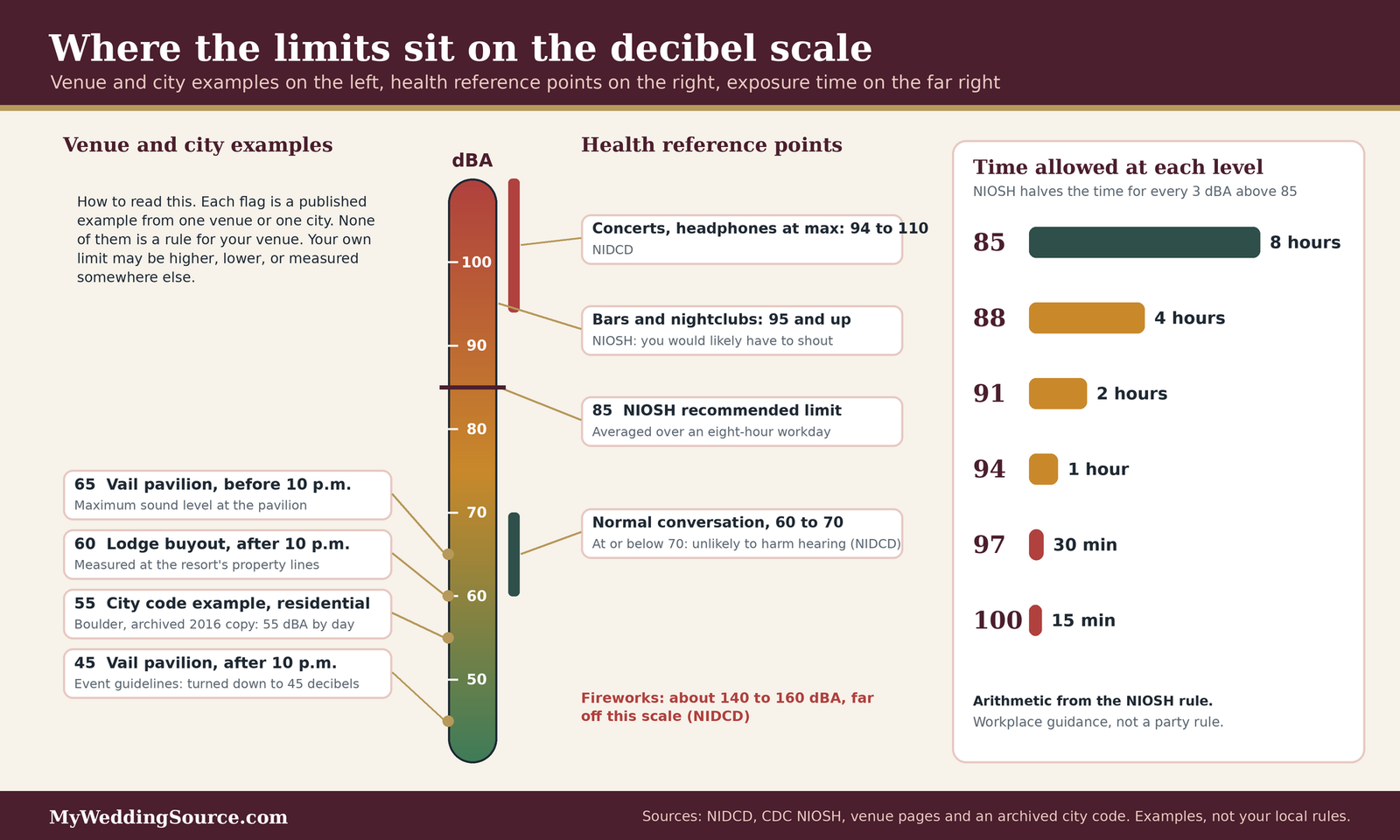
A clock rule says amplified music has to stop, or drop, at a stated hour. Venues often combine this with a lower ceiling after a certain time. For example, the Town of Vail’s event guidelines for its Donovan Pavilion say music must be turned down to 45 decibels by 10 p.m., with a 65-decibel maximum before then. The guidelines do not say how or where the level is measured, which is exactly the kind of gap you should ask about.
Distances: how far the sound may carry
A distance rule says amplified sound must not be audible beyond a stated number of feet from the property line. A City of Boulder code copy archived in June 2016, for example, barred amplified sound audible 100 feet or more beyond the property line between 11 p.m. and 7 a.m. where loudspeakers are in a residential district. Treat that as an example of a style of rule, not as current law, because the archived copy may be out of date and the current code may differ. Distance rules need no meter at all, which makes them easy to break by accident.
Reading wedding reception noise limits: decibels, weighting, and distance
A decibel limit is easy to misread, and wedding reception noise limits are no exception. Before you can decide whether your event will meet one, you need three ideas: what the number means, what “A-weighted” signals, and how distance changes the reading. None of this needs an engineering degree, and a few minutes with it makes every conversation with a venue manager or sound technician clearer.
What a decibel number means
A decibel (dB) is a unit on a logarithmic scale, so small changes in the number are bigger than they look. CDC’s NIOSH explains that a sound 10 dB louder is ten times more intense, and it recommends cutting the exposure time in half for every 3 dBA increase above 85 dBA. Small differences on the meter therefore matter.
The dBA scale and why it matters for music
Most noise rules and most meters use dBA. According to the reference article on A-weighting, it adjusts a reading to reflect the ear’s reduced sensitivity to low frequencies, and it is the standard for environmental noise measurement. C-weighting passes considerably more low-frequency energy. That difference matters at a dance floor, where bass is a large part of the music: a reading in dBA can understate what a neighbor feels as thumping. Our reading of that difference is a planning caution, not a measured result. The NIOSH Sound Level Meter app offers A, C, and Z weighting. If a rule names a weighting, use that one. If it does not, ask.
Ordinary sounds as reference points
The National Institute on Deafness and Other Communication Disorders (NIDCD) lists normal conversation at about 60 to 70 dBA, headphones at maximum volume and concerts at about 94 to 110 dBA, and notes that sounds at or below 70 dBA are unlikely to cause hearing loss even after long exposure. NIOSH describes bars and nightclubs as around 95 dBA or more, the level at which you would likely have to shout to be heard at three feet. Those reference points explain why a reception can feel normal inside and still break a neighbor’s limit outside.
How distance changes what is measured
A reading is always a reading somewhere. The same speaker can register one level at the dance floor and a much lower level at a fence, and a limit that applies at the fence is a very different target than one that applies at the speaker.
The six-decibel rule of thumb
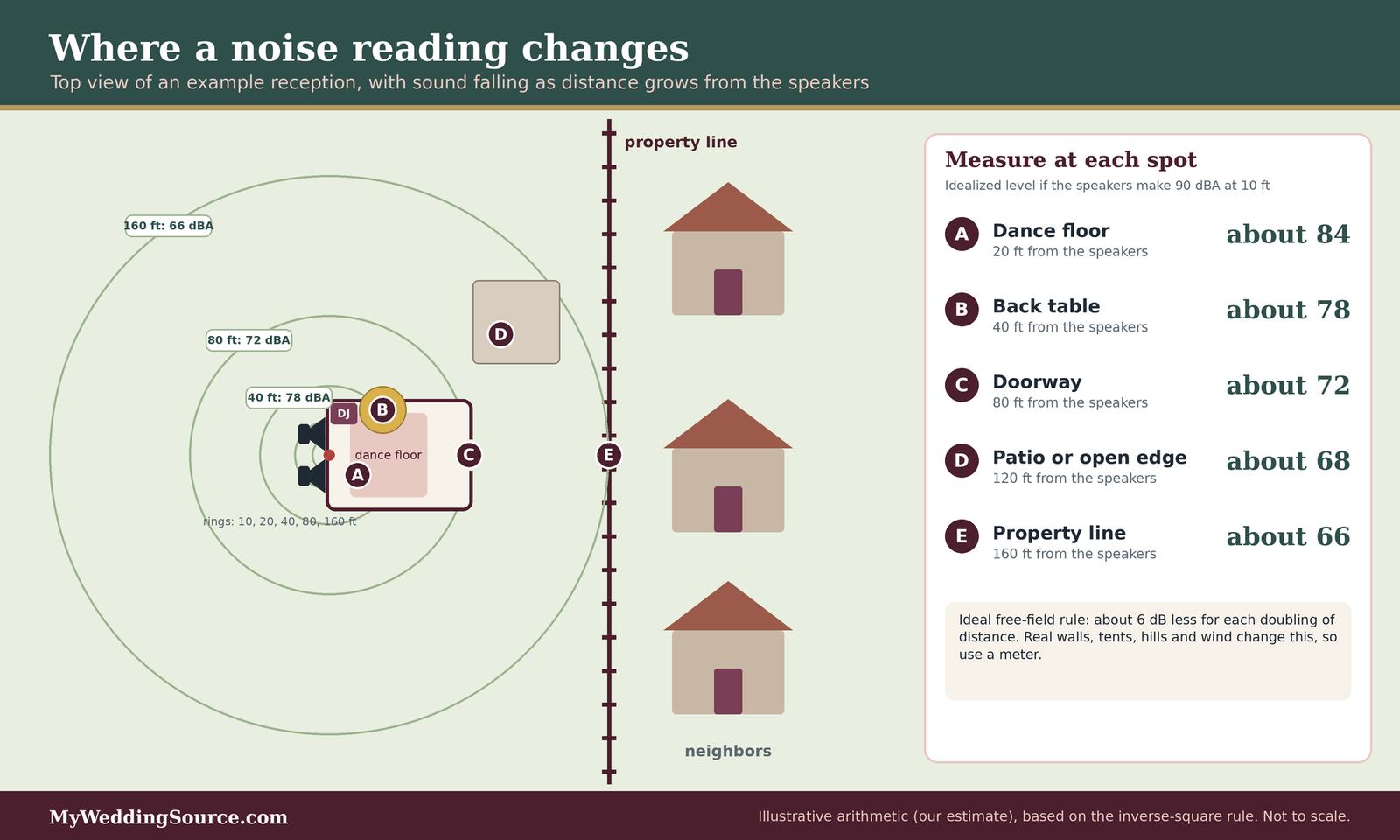
Under ideal conditions, sound from a point source falls about 6 dB for each doubling of distance, according to the Simon Fraser University Sonic Studio Handbook. That page also says the rule applies only in a free field, with no reflecting surfaces, no background sound, and no interference. Our illustration uses that rule for arithmetic. Real venues have walls, tents, hills, trees, and wind, so treat the numbers as a teaching aid and not a forecast.
Why the property line becomes the problem
Suppose a speaker produces 90 dBA at ten feet, an assumption for illustration. Under the ideal rule, that level would fall to about 84 dBA at twenty feet, 78 dBA at forty feet, 72 dBA at eighty feet, and 66 dBA at 160 feet, all estimates from our own arithmetic. If a limit of 60 dBA applied at a property line 160 feet away, the speaker would need to produce meaningfully less than that assumed level, or the sound would need to be aimed, shielded, or kept inside. This is why a limit measured at the property line changes the setup, not only the volume knob.
Finding your wedding reception noise limits before you sign
You cannot comply with wedding reception noise limits you have not found. The best time to look for wedding reception noise limits is before you sign a venue contract, because after that your options narrow quickly. The goal is to leave with the actual numbers, hours, and measuring spots in writing, not a reassuring phrase such as “we are pretty relaxed.”
Where to look and whom to ask
Start with documents, then confirm by asking a person. Documents are slower but more reliable, and a conversation helps you read between the lines.
The venue’s documents
Read the rental agreement, the event guidelines, and any sound policy attachment. Look for a decibel number, a music cutoff time, a limit on amplification, a rule about doors and windows, and the penalty for a violation. Some venues say plainly that staff can shut music off and refuse refunds. One botanic garden’s 2019 private event sound policy, for example, says garden staff can shut down private event music if the rules are not followed and that no refund is given. That policy’s published limits are about hours and amplification time, not decibels, which shows how differently venues define “limit.”
The city or county rules
Search for your city or county’s noise ordinance on its official code site and note the hours, any numeric limits, and the measuring location. If the venue is in an unincorporated area, check the county. If you cannot find it, call the clerk or the non-emergency police line and ask which ordinance covers amplified music at an outdoor or tented event. Write down the date and the name of the person you spoke with. This guide cannot tell you what your local code says, and an ordinance can change, so confirm it for your date.
Permits and variances
Some places allow a special event permit or a variance, and some do not. Boulder’s archived code copy described a variance that its city manager could grant for temporary sound that could not meet the limits, with conditions, so the possibility exists in some codes. Whether yours does is a question for your local government. Our guide to wedding permits covers the wider permit conversation.
Deciding which limit wins
When the venue and the city disagree, the stricter rule is the one you plan around. A wedding music newsletter by Matthew Campbell, published on Substack in December 2023, makes the same practical point: if city and county or residential and commercial rules differ, follow the stricter standard. The newsletter is a reader-supported publication and says it is not legal advice, so we use it as a practitioner’s reminder and not as an authority on any specific code.
Build a one-page sheet of wedding reception noise limits
Put every one of your wedding reception noise limits on one page: the decibel ceiling, the weighting if known, the measuring spot, the clock times, the penalty, and who enforces. Add the source and the date you confirmed each line. This sheet becomes the single reference that your DJ, band, planner, and day-of coordinator all read.
Keep the evidence
Save the email or the page. A phone call fades, and a verbal “that should be fine” does not help you if a neighbor calls the police. Our article on contract change orders explains how to document a changed term so it travels with your agreement.
Questions to ask
- Is there a decibel limit, and is it A-weighted or C-weighted?
- Where is it measured: at the speaker, on the dance floor, at the property line, or inside a nearby home?
- What time must amplified music end, and what time must the event end, including load-out?
- Is there a lower limit after a certain hour?
- Must doors, windows, or tent sides stay closed after a certain hour?
- Who monitors the level, and with what device?
- What happens at a first warning, and at a shutdown? Is any refund or deposit affected?
- Who pays if a citation is issued to the event?
- Does the venue require its own sound system, or may our DJ or band bring one?
- Are there special rules for outdoor ceremony music, cocktail hour, or an after-party?
Questions for your DJ, band, and planner
Once you have your wedding reception noise limits, hand them to the people who control the volume. A good vendor will welcome the clarity, because it protects them as well as you.
What to ask a DJ or band
Ask whether they have worked at venues with strict limits, whether they own a meter or use a venue-supplied one, and how they will keep levels steady when a crowd arrives. Ask if they can set a limiter and who holds the key to it. Ask how they handle a request to turn down in the middle of a song. For live acts, ask about stage volume, drum placement, and whether they can play at a lower level without losing energy. Our live band stage plot guide explains how stage layout shapes what the room, and the street, hears.
What to ask a planner or day-of coordinator
A coordinator can own the clock and the conversation with the venue manager. Ask who will take readings, who has the authority to say “turn it down,” and how that instruction travels to the DJ without a scene. Our vendor communication deadlines article and the day-of coordination checklist show how to set those handoffs up early.
Measuring volume at your reception
Wedding reception noise limits are only useful if someone can tell, in the moment, whether the room is under them. Measuring does not need to be elaborate. It needs a decent meter, a consistent method, a few agreed spots, and a person whose only job at certain moments is to look at the number. The method below is our suggested routine for couples and coordinators, not an official procedure, and a venue or city may require its own.
Choosing a meter for wedding reception noise limits
Meters range from a venue’s built-in display to a handheld device to a phone app. The right choice depends on how formal your limit is and who might question your reading.
What the venue or DJ may already own
Ask first. Many venues that publish a decibel limit own a meter, and some use real-time monitors that show levels on a screen. If the venue’s meter is the one that counts, you want to see it, learn where it sits, and ask for its readings in the pre-event walkthrough. A DJ or band that works in strict venues may also own a meter and know how to read it.
Phone apps and handheld meters
CDC’s NIOSH offers a free Sound Level Meter app for iOS. NIOSH says the app is accurate within plus or minus 2 dBA based on testing in a reverberant chamber at its acoustics laboratory, that it meets Type 2 requirements of the IEC 61672 standard when used with a calibrated external microphone, and that it cannot currently verify an Android app because Android hardware varies widely. The NIOSH page describes the app as a tool for measuring workplace noise, so use it as a check and a tool for your own planning, not as proof for a ticket or a dispute. A handheld meter that meets a stated standard is a better choice if a limit is strict. The Boulder code copy we reviewed required meters meeting ANSI S1.4-1974 Type I or II, which shows that some codes name an equipment standard, so ask your local authority if it does.
Where, when, and how to measure
Because a reading changes with position, you want a small set of repeatable spots. Mark them on your floor plan and use them every time.
The five spots that tell the story
A practical set is the dance floor, a back table, the entrance or doorway, the outside patio or open edge, and the property line or the nearest neighbor if you are allowed to stand there. The Wedding MusicLetter piece mentioned earlier makes the same point: measuring only at the speakers is not enough, and the dance floor, back tables, outside area, and property line all matter. Our reception floor plan guide shows how placement of the DJ, bar, and dining changes what each spot hears.
A repeatable method
Hold the meter at ear height, away from your body and from walls, with the microphone pointed toward the source. Use the same weighting and response setting each time, and write them down. Take a reading during a typical loud song, not a quiet one, and watch it for about a minute so you catch the peaks. Note the time, the song, the spot, and the number. If you have a limit measured at the property line, plan time for a person to stand there during the sound check, since the property line is the spot that most often decides the outcome.
Averaging versus peaks
Rules differ. Some describe a steady level, some describe a short-term maximum, and some are built on an average over time. NIOSH defines a time-weighted average as sound level averaged over an eight-hour period, which suits a workday and not a reception, so do not copy that logic onto your event. Ask the venue whether its limit is a never-exceed number or an average, and set your target below it by a margin you and the technician agree on.
The sound check and the log
A sound check is the cheapest tool you have for meeting wedding reception noise limits. It shows you the real numbers in the real room before guests absorb sound and before a crowd makes everyone talk louder.
Run a check with the same equipment
Do the check with the equipment, the room setup, and the speaker placement you will use. Empty rooms are more reflective than full ones, so the reading will usually change once guests arrive. Our guide to the audio and lighting checklist and the wireless ceremony audio guide describe what a technician usually verifies, and our article on preventing feedback at an outdoor ceremony covers the outdoor side.
Keep a simple log
A log protects you. A short table with the time, spot, reading, and initials of the person measuring is enough. If a complaint arrives and a police officer asks what the level has been, a log shows you were paying attention. It also lets the technician see a drift upward as the evening goes on, which is common when a room warms up and a crowd gets energetic.
| Time | Spot | Song or moment | Reading (dBA) | Limit | Action |
|---|---|---|---|---|---|
| 7:45 p.m. | Dance floor | Sound check, loud track | |||
| 7:50 p.m. | Property line | Sound check, loud track | |||
| 8:30 p.m. | Back table | First open dance set | |||
| 9:15 p.m. | Doorway | Peak crowd | |||
| 9:45 p.m. | Property line | Last dance |
Curfew compliance: back-timing the evening
Even a perfectly measured event can break wedding reception noise limits if the clock runs away. Curfews are about time, and time is the thing weddings lose track of most easily. The cure is to work backward from the cutoff and give every moment a slot, including the ones people forget, such as the walk to the last dance.
The kinds of curfew
A single “ten o’clock” can mean several different things. Pinning down which one applies changes your timeline by an hour or more.
Music-off, event-over, and load-out
Venues describe three different clock points. One is the hour amplified music must end or drop. Another is when the event must end and guests leave. A third is when vendors must finish load-out. One venue’s help page, for example, says all events must end by 10 p.m., with music finished and guests moving to load-out, and load-out running until 11 p.m. The page sets no decibel limit and points to Midvale City’s noise ordinance as the outside standard. Another venue’s policy says live bands must end their sets by 10 p.m., and that after 10 p.m. a 60 dBA limit applies, measured at the property lines. Those two venues show how the same hour can mean very different things.
Quiet hours and lower limits after a set time
Some rules reduce the allowed level at a stated hour instead of stopping the music. Vail’s pavilion guidelines require music to be turned down to 45 decibels by 10 p.m., after a 65-decibel maximum before then. If you have a rule like this, the last hour is a different event: it is a conversation-level party, with the volume plan, the program, and even the song list adjusted for it. The Boulder code copy we reviewed shows another pattern, where a residential limit dropped from 55 dBA to 50 dBA at 11 p.m.
A countdown you can actually run
Back-timing means picking the cutoff, writing it at the end of a timeline, and filling backward. Write the real clock times on the run-of-show and give the same page to the DJ, band, photographer, and coordinator.
An example countdown for a ten o’clock cutoff
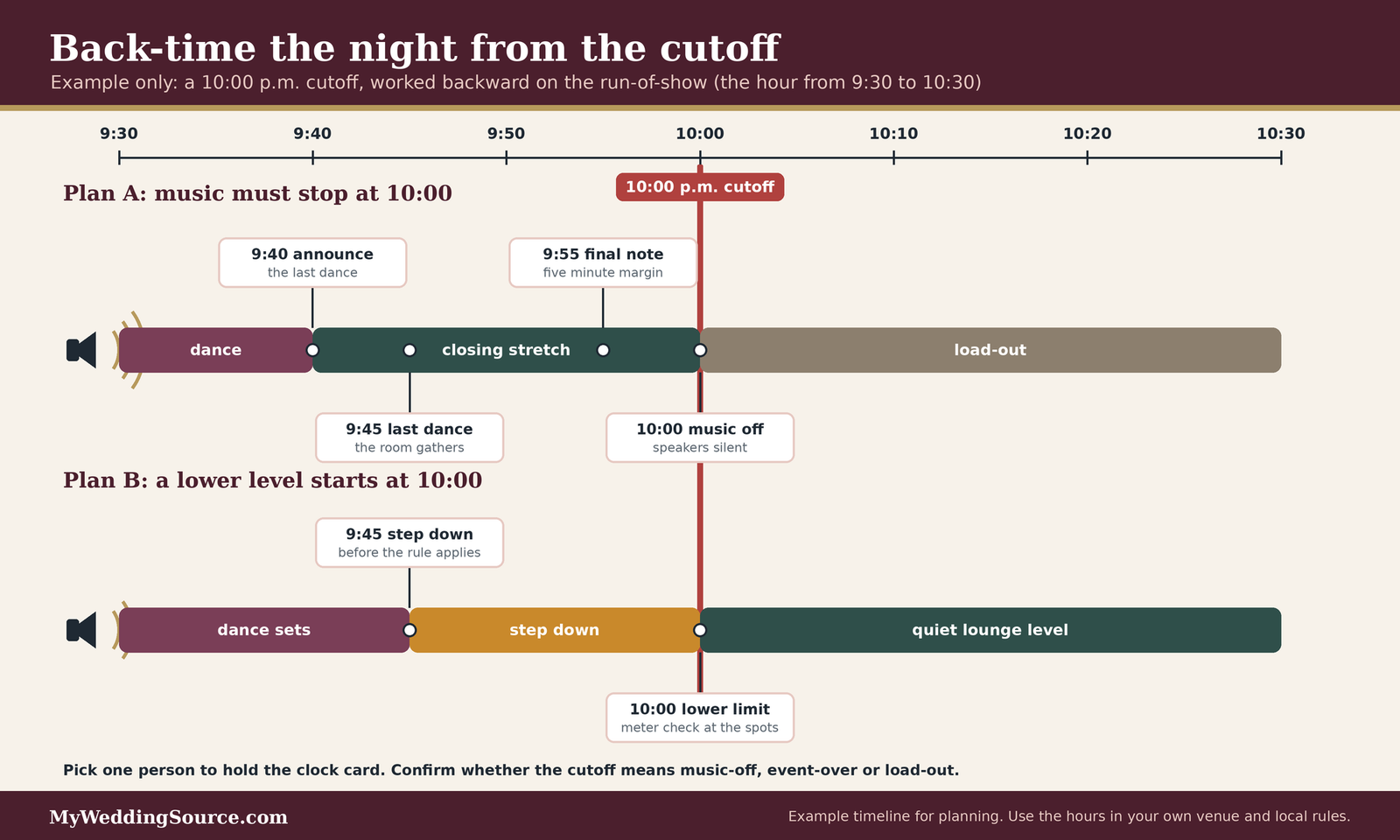
The sequence below is an example, not a recommendation for your schedule. Start with a music-off time of 10:00 p.m. Put the final song so it ends at 9:55 p.m. to leave a margin. Announce the last dance at about 9:40 p.m. so the room has time to gather. If a lower level applies after a set time, do the step-down about fifteen minutes before it takes effect, so the room adjusts gradually and not in the middle of a song. Plan the send-off, or any exit, before music has to end, not after. Then give load-out its own block of time, and check with the venue on its end time. Our article on the wedding last dance covers how to make a final song feel intentional, and the end-of-night ride plan covers how guests leave.
Give someone the clock
Choose one person, usually the day-of coordinator, to watch the clock and signal the DJ or band. If no coordinator is hired, give the job to a reliable friend who is not in the wedding party. Put the cutoff and the step-down time on a card the person carries. The goal is that nobody has to guess, and nobody has to argue with a guest who wants one more song.
Shaping the program around wedding reception noise limits
The easiest way to stay inside wedding reception noise limits is to design the evening around them. A program built for a ten o’clock cutoff looks different from one built for midnight, and nothing says the earlier plan has to feel smaller.
Move the loudest moments earlier
If the venue lowers its limit at a set time, schedule the dance sets, the grand entrance, and any high-energy moments before it. Put dinner, toasts, cake, and slower songs near the end, when a lower level suits the mood. Our guides to toasts and speeches and the reception overview can help you see how the evening fits together.
Plan the dance floor in two phases
You can treat the last hour as a second phase with its own feel: a smaller, closer gathering, songs with strong singalong appeal, and a cozy lounge corner for people who want to talk. This keeps energy up without volume, and it can be a pleasant contrast for guests who tire of loud music. Our wedding entertainment ideas article has other ways to keep a late evening lively.
Hearing health and what wedding reception noise limits mean for guests
One of the main jobs of wedding reception noise limits is protecting neighbors, but it sits next to a quieter concern, which is guests’ hearing. The two are related, and keeping the room at a sensible level helps both.
What the health agencies say
The health agencies are consistent about the basics. They are general public health statements, not a diagnosis, and they do not tell you what level is right for your guests.
The eighty-five decibel line
NIOSH recommends a limit of 85 dBA averaged over an eight-hour workday and says that for each 3 dBA increase, the exposure time should be cut in half. NIDCD says long or repeated exposure to sounds at or above 85 dBA can cause hearing loss and that the louder the sound, the less time it takes. By our arithmetic from the NIOSH rule, that works out to about four hours at 88 dBA, two at 91, one at 94, half an hour at 97, and fifteen minutes at 100 dBA. These workplace recommendations do not translate directly to a party, but they show why level and time together matter. OSHA uses a different approach, with a 90 dBA permissible limit and a 5 dBA exchange rate for workers, which is a reminder that standards differ and that all of them were written for jobs.
Tinnitus and recovery
NIDCD notes that loud noise can cause tinnitus, a ringing, buzzing, or roaring in the ears or head. It may fade over time but can sometimes persist throughout a person’s life. Guests who feel ringing after a loud night should know that it is worth taking seriously. This site does not give medical advice, and anyone with symptoms should see a clinician.
Making the room kinder to ears within your wedding reception noise limits
You do not need to turn a wedding into a library. A few choices lower the level people experience without removing the party.
Placement and distance
Because sound falls with distance, placing speakers so that guests are not close to them is the simplest step. Put the bar, the dessert table, and the seating for older relatives away from speakers, and give people a quiet spot to talk. Our guide to seating for guests who cannot stand for long periods and the accessible guest experience article describe how to place seating thoughtfully.
Earplugs and quiet corners
Offer a small basket of earplugs near the dance floor. NIDCD lists earplugs and earmuffs among its prevention tips and says to move away from noise you cannot reduce. A quiet room or patio with a door gives guests a place to rest their ears and gives anyone sensitive to sound a way to take part without leaving. It also gives you something to point to when a limit means turning the volume down.
Silent disco as a way to meet a limit: the headphone channel and charging inventory
A silent disco moves the music from the air into headphones, which is why it comes up in talk about wedding reception noise limits, so the dance floor can stay lively while the room outside stays quiet. Vendors market it as a way to avoid noise complaints. HUSH says its headphones let a party run late without violating noise ordinances, and Silence Activations calls the format a noise-controlled party experience. Those are the vendors’ own claims, and neither page gives a specific ordinance or limit. Treat a silent disco as a tool that may help, and confirm with your venue and your local authority before you rely on it. For the full planning guide, see our article on the wedding silent disco.
What a silent disco does and does not solve
Headphones change who hears what, but they do not change everything a rule might care about. A clear view of the gap helps you decide if the format fits your situation.
What it can quiet
The dance floor music goes through the headphones, so the speaker output that reaches neighbors can drop to near zero. Guests who want to talk can take a headphone off and have a conversation. The vendors also say that a single room can carry several channels, which means a DJ, a playlist, and a live set could play at once without competing through speakers. Silence Activations says most professional systems support up to three channels, with one transmitter per channel, and HUSH describes up to three selectable channels.
What it can leave behind
Guests still talk, laugh, and sing, and a crowd of people dancing in headphones can be surprisingly loud with their own voices. Wedding reception noise limits can still apply to more than the dance music. A silent disco does not remove toasts, a band’s acoustic instruments, a ceremony, or the sound of people leaving. A rule based on whether sound is audible, or a rule about a curfew for the event itself, may still apply even if the music is silent. Ask your venue or local authority directly whether a silent format changes anything, and get the answer in writing.
The inventory worksheet
The sheet below turns the headphone question into a short list you can hand to a vendor. It follows the advice from vendors that you should count active participants, add a spare buffer, and match each channel to a transmitter. The example uses 120 evening guests and our own arithmetic, so replace the numbers with yours.
Counting headphones
Silence Activations suggests planning one headphone per expected guest or active participant, plus a 5 to 10 percent buffer for walk-ins and swaps. For a guest list of 120 in the evening, if you expect about 80 percent to join, that is 96 headphones. Adding a 10 percent buffer gives about 106. Both the 80 percent assumption and the result are our estimate, and your crowd may differ.
| Line item | How to decide | Worked example (estimate) |
|---|---|---|
| Evening guests | Guests present after dinner | 120 |
| Expected participants | Evening guests multiplied by your guess of participation | 96 (at 80%) |
| Spare buffer | Add 5% to 10% for swaps and failures | 106 headphones (at 10%) |
| Channels | One per distinct audio source you want to run | 3 |
| Transmitters | One per channel, plus a spare if the vendor offers it | 3, plus 1 spare |
| Headphone battery | Vendor figure, confirmed in writing | About 8 to 10 hours (HUSH) |
| Charging time | Vendor figure for the model you get | About 2 hours (HUSH) |
| Charging stations | Ask how many headphones each tree or hub holds | Ask the vendor |
| Outlets needed | Count one per charging device and transmitter | Confirm with the venue |
| Handoff and return | Who collects, counts, and packs headphones | Named person, checked against count |
Channels and transmitters
Give each channel a plain purpose, such as “DJ,” “throwback playlist,” and “slow songs,” and color-code if the vendor offers LED options. Quiet Events says two transmitters on the same channel in the same location cause static, and its published pricing bills transmitters separately at forty dollars each. Ask whether the headphone count and the transmitter count appear separately on your quote so you can compare vendors accurately.
Charging, storage, and the end of the night
Batteries are the quiet constraint of the format. A silent disco that runs out of power before the curfew defeats the point.
Match the battery to the event length
HUSH lists about 8 to 10 hours of battery life and about 2 hours to recharge. Quiet Events does not state headphone battery life on its pricing page, so ask for the figure for the model you would receive. Compare it to your full timeline, including sound check, any early use, and a margin if the party runs long. If headphones arrive fully charged, a short event is usually within a single charge, but you should confirm the starting state and what happens if a unit dies.
Where the headphones live
Ask where headphones are stored before and after, who hands them out, and how you will keep count. A table with a sign-in and a count on each return saves charges for lost units. Quiet Events says its rentals include charging trees or individual chargers, and that its price list includes optional features such as custom colors and an anti-theft system. Our guide to outdoor wedding infrastructure and the article on generator rental can help if charging or transmitters need power where there is no outlet.
What it can cost
Meeting wedding reception noise limits does not have one price, because the costs hide in several lines. One published example: Quiet Events’ pricing page, dated April 29, 2026, lists a standard one-day rate of $7 per headphone and $40 per transmitter, billed separately, and says an on-site audio technician is quote-based and varies by city. On those rates, our estimate for the worked example above (106 headphones, 3 transmitters) is about $862 before shipping, any technician, and options, and the vendor says prices can change. Other costs to expect: a sound technician or a meter rental, overtime if the event runs past an agreed time, and possible fines. Our vendor overtime rates guide explains how overtime is usually billed, and the venue cost article covers fees the venue may add.
Edge cases and awkward situations
Most guides to wedding reception noise limits assume a standard ballroom with a ten o’clock cutoff. Real events are messier. These are the situations that most often catch couples off guard.
Outdoor, tent, and rural settings
Open air removes the walls that normally hold sound in, so what was a comfortable level inside can become a neighborhood issue outside.
Tents and open sides
A tent holds sound in only a little. Open sides, walls, and trees all change how sound travels, and the sound-versus-distance arithmetic earlier in this guide works only in idealized conditions. If a venue says doors must stay closed after a certain hour, as Vail’s pavilion guidelines do during summer, ask what the equivalent is for a tent: lowered sides, a smaller speaker footprint, or a reduced level. Our outdoor wedding venues and barn wedding venues guides cover the layout of these spaces.
Rural and backyard events
Wedding reception noise limits still matter at a rural venue. It may feel remote, but sound can still carry to neighbors, and a rural area may have only a county rule or a general nuisance standard. A private backyard is not automatically exempt. The Wedding MusicLetter article lists examples where city and county limits differ, and a rule might apply to a private home the same way it applies to a venue. This is a question for your city or county, and a good one to ask before you send invitations. Our garden wedding venues article and the guide to portable restrooms for outdoor weddings cover related logistics for open-air sites.
Shared buildings and special moments
Some sources of noise are not the dance floor, and some limits apply to people who are not at your wedding.
Hotels and shared buildings
A hotel may have guests in nearby rooms, a quiet-time policy for the building, and its own rules. A resort lodge’s help page, for example, says that when a wedding group buys out the property, a 60 dBA limit applies from 10 p.m., measured at the property lines, but that quiet time for common areas begins at 9 p.m. when the public is on site. The lesson is that a buyout and a regular night can have different rules, and you should ask which applies.
Ceremony music, cocktail hour, and after-parties
Limits can apply to an outdoor ceremony, to a cocktail hour on a patio, and to an after-party in a lobby or lounge. Ask whether the rules are the same at each. Our wedding ceremony audio guide discusses how a ceremony is amplified, and the vendor timeline article shows how to keep the schedule clean.
Fireworks, sparklers, and other loud effects
NIDCD lists a fireworks show at about 140 to 160 dBA. A rule about music may not cover fireworks, cannons, or other effects, and those often fall under permits and fire rules instead. Ask the venue and the local fire authority before planning anything with a bang, and keep any approval with your contract. Our article on wedding permits outlines where to start.
When wedding reception noise limits are tested
Even a careful plan for wedding reception noise limits can meet an unhappy neighbor or an unexpected visit. Planning the response ahead of time keeps the evening calmer.
If a neighbor complains
The Wedding MusicLetter article says officers often issue a warning first and seek voluntary abatement, and a 2022 news report from Allegheny County, Pennsylvania, tells a related story: neighbors called police about noise from a wedding at a county park mansion around 9:30 p.m., and the county changed its rules for later events. Those rules required events to end at 10 p.m. and said weddings must use the venue’s sound system. The report did not state a decibel limit. If someone arrives, the best response is calm, quick, and cooperative: the coordinator steps out, listens, checks the meter, and lowers the level if needed.
If the venue shuts the music off
Read the contract before this happens. A venue may be allowed to end the music, and in some policies that comes without a refund. Our vendor contract guide and the wedding insurance article explain what a contract and a policy may or may not cover, and an insurer or attorney is the right person for a specific answer. This guide cannot give legal advice.
Who does what: a simple responsibility map
A good plan for meeting wedding reception noise limits gives each task to one named person. The map below is a starting point you can adapt, and it pairs well with our vendor due diligence checklist.
Before the wedding
The work on wedding reception noise limits before the event is mostly asking and writing things down, and it is the part that does the most good.
Couple and planner
You and your planner collect the limits sheet, confirm hours and measuring spots with the venue, and write them into the vendor agreements. Ask for the venue’s sound policy in your first round of questions, using our venue questions list. If you hire a day-of coordinator, hand them the limits sheet at least a week ahead.
DJ, band, and technician
Your sound vendor confirms equipment, brings or arranges a meter, and sets a target level that sits a margin below the limit. They should also tell you early if a request, such as a larger sound system, will not fit the limit. The vendor subcontractors article explains what to do if a technician comes from a third party.
During the wedding
The evening depends on a small set of people knowing who decides what.
The clock keeper and the meter keeper
One person watches the clock. Another, who may be the same person for a small event, takes readings at the agreed times and records them. If the venue has its own monitor, ask who watches it. The rule of thumb is that the person who sees the number needs permission to ask the DJ to adjust.
The decision rule
Agree in advance on what happens when the level reaches the target: the keeper signals, the DJ lowers by a stated amount, and the keeper rechecks within a few minutes. When the reading is over the limit, lower first and discuss later. This keeps the night from turning into an argument.
Wedding reception noise limits: frequently asked questions
Finding the rules
Who sets wedding reception noise limits?
Usually three parties do: your city, county, or township through an ordinance; your venue through its policy or rental agreement; and your vendors through their contracts. The EPA says primary responsibility for noise issues moved to state and local governments in 1981. When rules differ, plan around the stricter of your wedding reception noise limits and keep it in writing.
How do I find the noise ordinance for my venue?
Search your city or county’s official code site for noise or amplified sound, and note the hours, any decibel number, and the measuring location. If the venue is outside city limits, check the county. When the wording is unclear, call the clerk or the non-emergency police line and write down the date and the answer.
Measuring and meeting a limit
Can I use a phone app to check the volume?
You can use one as a planning check. CDC’s NIOSH app for iOS is stated to be accurate within about 2 dBA in laboratory testing, and it meets a Type 2 standard only with a calibrated external microphone. It is not proof for a dispute. If a limit is strict, ask whether the venue or your technician has a proper meter.
Where should the volume be measured?
Ask the venue or the authority, because it differs. Some limits apply at the property line, some inside a neighbor’s home, and some at the speakers. One venue we reviewed measures at its property lines. Measure at several spots, including the dance floor, the doorway, and the nearest edge, and keep a short log.
Curfews and timing
What time does music usually have to stop under wedding reception noise limits?
There is no single answer. The venues we reviewed named ten o’clock for music or the event to end, while codes elsewhere use later hours such as eleven. Some lower the allowed level at a set time instead of stopping. Ask whether your cutoff is music-off, event-over, or load-out, and build the timeline backward from it.
What happens if we go over wedding reception noise limits?
It depends on the venue and the place. The consequences we found ranged from a warning to the venue shutting off the music, in some cases without a refund, to a police visit and fines. Ask your venue what happens at a first warning, who pays a citation, and whether any deposit is at risk if wedding reception noise limits are broken.
Silent disco and special cases
Does a silent disco let us avoid noise rules?
Not automatically. Vendors say headphones help events avoid noise complaints, but those are marketing claims, and a rule about curfews, crowd noise, or audibility may still apply. Ask your venue and your local authority whether a silent format changes anything, and get the answer in writing before you rely on it.
Are fireworks or sparklers covered by the same rules?
Often not. Fireworks can reach about 140 to 160 dBA, according to NIDCD, and effects like these are frequently governed by separate permit and fire rules. Ask the venue and the local fire authority before you plan one, and keep any approval with your contract.
Your next steps
Collect the facts
Build your limits sheet for wedding reception noise limits
Write down your wedding reception noise limits: the decibel ceiling, the weighting, the measuring spot, the cutoff times, the penalty, and the source and date for each. Put it on one page and share it with every vendor. Our wedding venue questions and venue capacity guides help with the wider conversation.
Add the limits to your contracts
Ask your DJ, band, and planner to confirm in writing that they will work within your wedding reception noise limits. Our vendor contract and contract change orders articles show how to add a clause or a change.
Rehearse the plan
Schedule a sound check with a meter
Pick your measuring spots, take readings at each with the equipment you will use, and write the target level on the run-of-show. If the venue allows it, do the property-line check too. Our audio and lighting checklist covers what else to verify.
Back-time the evening
Write the cutoff at the end of the timeline and fill backward, with the last dance, any step-down, and load-out. Share it with the clock keeper. If audio fails or the limit forces a change, see our guide to a wedding AV backup plan, and use the wedding planning checklist to place the sound tasks in the larger plan.
Sources & methodology
How we built this guide
What we relied on
This guide combines public health and workplace guidance on noise exposure, EPA information on who regulates noise, published venue and city rules, the reporting of one local news story, and vendor pages for silent disco rentals. We checked these sources on November 12, 2026, and noise rules, prices, and policies change, so confirm the details for your date. Where a statement comes from a venue or vendor, we say so, because it reflects that seller’s equipment and habits. The sound-versus-distance figures, the exposure times, and the worked headphone example are our own arithmetic or assumptions, and they are estimates.
What we did not do
We did not measure any venue, test any meter, or review your local code. Ordinances differ and change, and the archived city code copy we cite is from 2016 and is used only as an example of a style of rule. This guide is planning help and not legal, medical, or engineering advice. For a specific rule, ask your venue and your local government.
Source list
Government, health, and standards sources
- U.S. Environmental Protection Agency, Clean Air Act Title IV, Noise Pollution: https://www.epa.gov/clean-air-act-overview/clean-air-act-title-iv-noise-pollution
- CDC NIOSH, Noise and Hearing Loss Prevention: https://www.cdc.gov/niosh/noise/about/index.html
- CDC NIOSH, About noise and hearing loss: https://www.cdc.gov/niosh/noise/about/noise.html
- CDC NIOSH, Sound Level Meter app: https://www.cdc.gov/niosh/noise/about/app.html
- CDC NIOSH, Understanding noise exposure: https://www.cdc.gov/niosh/noise/prevent/understand.html
- CDC, About hearing loss: https://www.cdc.gov/hearing-loss/about/index.html
- National Institute on Deafness and Other Communication Disorders, Noise-Induced Hearing Loss: https://www.nidcd.nih.gov/health/noise-induced-hearing-loss
- OSHA, Occupational noise exposure: https://www.osha.gov/noise
- World Health Organization and ITU, Safe listening devices and systems: https://who.int/publications/i/item/9789241515276
- World Health Organization, Deafness and hearing loss: https://www.who.int/news-room/fact-sheets/detail/deafness-and-hearing-loss
- New York City Department of Environmental Protection, Noise Code: https://www.nyc.gov/site/dep/environment/noise-code.page
Venue, city, and news sources
- Town of Vail, Donovan Pavilion event guidelines: https://vail.gov/government/donovan-pavilion/rates-policies/event-guidelines
- Chalet View Lodge, Curfew and noise abatement: https://intercom.help/chalet-view-lodge-462509f2a432/en/articles/5298044-curfew-and-noise-abatement
- Formation Events, Are there any volume restrictions: https://formation-events.helpscoutdocs.com/article/60-are-there-any-volume-restrictions
- Botanic garden private event sound policy, 2019: https://origin-www.botanicgardens.org/sites/default/files/file/2020-05/2019soundpolicy.pdf
- City of Boulder noise code, archived copy dated June 10, 2016: https://nonoise.org/lawlib/cities/ordinances/Boulder,%20Colorado.pdf
- CBS Pittsburgh, Hartwood Acres changing wedding rules after neighbors call police: https://www.cbsnews.com/amp/pittsburgh/news/hartwood-acres-changing-wedding-rules-neighbors-call-police-noise-complaints
- Wedding MusicLetter, Decibel requirements for weddings (December 20, 2023): https://weddingmusicletter.com/p/decibel-requirements-for-weddings
Acoustics reference and vendor sources
- Simon Fraser University Sonic Studio Handbook, Inverse-Square Law: https://www.sfu.ca/sonic-studio-webdav/handbook/Inverse-Square_Law.html
- Wikipedia, A-weighting: https://en.wikipedia.org/wiki/A-weighting
- HUSH, Silent disco rentals for weddings and parties: https://hushconcerts.com/silent-disco-rentals/weddings-and-parties/
- Silence Activations, How many channels can a silent disco have: https://silenceactivations.com/support/products-equipment/how-many-channels-can-silent-disco-have/
- Silence Activations, How many headphones for a silent disco: https://silenceactivations.com/support/getting-started/how-many-headphones-for-silent-disco/
- Quiet Events, Silent disco rental pricing guide (page dated April 29, 2026): https://www.quietevents.com/blogs/quiet-events-blog/silent-disco-rental-pricing-guide-2026