
A honeymoon with mobility needs goes well when “accessible” stops being a label on a booking page and becomes a set of measured, written, dated facts about one specific room, which you can collect in a few short calls and emails before you pay a deposit.
Quick answer
Treat every “accessible” label as a claim, not a fact. For a honeymoon with mobility needs, ask the hotel for the specific room number or room type, the shower type, the bed height, the door and bathroom clearances, and photos taken with a tape measure in frame. Get the answers by email, hold the reservation under a cancellation window that outlasts your checks, and reconfirm a few days before you travel. The checklist and evidence ladder below turn that into a routine you can finish in an evening.
You are planning one of the few trips where the schedule is fixed by a wedding date, the budget has already taken several hits, and the people who most want it to go smoothly are exhausted. A honeymoon with mobility needs adds one more job to that pile: finding out, before you arrive, whether the room you booked will work with your body and your equipment. This guide is the verification routine for that job, built for a honeymoon with mobility needs in any destination. It is not a list of recommended hotels for a honeymoon with mobility needs, because a hotel’s description tells you what the hotel believes, and what you need is what a tape measure would say.
Most of the guide is practical and a little repetitive on purpose, because a honeymoon with mobility needs rewards routine. The same few questions, asked in the same order, catch most problems. We explain which U.S. rules set the floor for hotel rooms, what those rules do not promise, how to read a listing, what to say on the phone and in writing, how to grade the answers you get, how flights and airports fit around the hotel, and what to do if the room on arrival is not the room you verified. We are not lawyers, doctors, or travel advisors, so none of this is legal, medical, or insurance advice. Where something depends on your body, your equipment, or your policy, we say so and point you to the person who can answer it.
Why a honeymoon with mobility needs deserves its own verification routine
Nothing about a honeymoon with mobility needs changes your rights or your needs. What changes is the cost of being wrong. A mismatch on a business trip is an annoyance you can fix by changing hotels on Tuesday. A mismatch on a honeymoon with mobility needs can mean a bathroom you cannot use on the first night, in a place you flew a long way to reach, with the wedding bills still arriving. That is the reason to spend a few hours on verification before you spend thousands on rooms.
The stakes are different on this trip
The usual advice for accessible travel is sound for a honeymoon with mobility needs too, but it was written for general trips. Three features of a honeymoon with mobility needs make a written routine more valuable than a casual phone call.
The dates are hard to move
Most couples choose honeymoon dates around a wedding, time off work, and flight availability. If your room fails verification late, you may have fewer alternatives than a flexible traveler would. That is an argument for checking early, before you pay a non-refundable deposit, and for treating a cancellation window as part of the room itself. Our honeymoon booking checklist covers the wider order of operations, and this guide goes deep on the one step that goes wrong most quietly.
You will be tired when you arrive
A wedding week is long. By the time you land, check in, and reach the room, your energy for troubleshooting is lower than it was when you planned the trip. A verified room means arrival is a confirmation, not an investigation. Plan the first night as a low-effort night, as our honeymoon jet lag plan suggests for any short trip, and keep the problem-solving for the weeks before departure.
Romantic features are often the least accessible ones
Products sold for a honeymoon with mobility needs, like all honeymoon products, are sold on features that tend to involve steps, lips, and narrow passages: lofts, sunken tubs, canopy beds, private plunge pools, hillside villas, and rooms at the end of long paths. None of these is a problem in itself. They are the places where a general “accessible” label is least likely to have been checked against the specific room. Ask about them directly instead of assuming the accessible category covers them.
What this guide does and does not cover
Verification has limits, and it is better to know them before you start. This guide is about hotels and resorts, with enough of the surrounding journey to keep the hotel plan from falling apart.
Covered: the room, the property, and the paper trail
We cover how to read a listing, how to call and write to a property, what a bathroom and bedroom should measure to count as accessible in the United States, how to rate the evidence you receive, and how to document the reservation so you can enforce it on arrival. We also cover the airline and airport rules that most often affect a hotel plan, such as advance notice for equipment and where to find the complaint route.
Not covered: medical needs, equipment choices, and destination guidance
We do not tell you which wheelchair, scooter, or walking aid to use, how much assistance you need, or how to manage a health condition on the road. Those are decisions for you and your clinicians. We also do not recommend specific hotels or destinations, because we have not inspected any. For destination ideas, start with our honeymoon destinations guide, then run each shortlist property through the routine here.
What “accessible” does and does not promise
The word appears on almost every hotel website, and it carries very different weight depending on where the hotel is and how the listing was written. Before you can verify anything, you need a working sense of what the word can legally mean in the United States, what it often means in practice, and what it may mean nothing at all elsewhere.
The U.S. rules set a floor for hotels, not a guarantee for your body
Hotels in the United States are covered by the Americans with Disabilities Act, and the Department of Justice has written specific rules for lodging. Those rules matter to a couple planning a honeymoon with mobility needs because they give you a vocabulary and a set of measurements to hold a hotel to. They also have limits that surprise people.
What hotels must do when you book
The Department of Justice reservation rule, codified at 28 CFR 36.302(e), requires lodging operators to let guests with disabilities book accessible rooms in the same ways and during the same hours as other guests. Hotels must describe their accessible features in enough detail for a guest to judge whether a room meets their needs. They must hold accessible rooms back and sell them to others only when every other room of that type is gone, and when you reserve a specific accessible room it must be blocked and removed from all reservation systems and guaranteed for you. A summary from the ADA National Network adds that hotels must make some accessible rooms available to third-party booking services and share accessibility details with them.
These are the five duties we use as a script in this guide: same access to booking, a useful description, a hold on inventory, a block when you ask, and a guarantee of the room you reserved. When a hotel’s answer conflicts with any of them, you have found something worth writing down.
What the design standards set as a floor
The 2010 ADA Standards for Accessible Design set the minimum features of rooms with mobility features. A few numbers are worth knowing as yardsticks, because they are measurable. A clear opening for a door is at least 32 inches. Beds in an accessible room need clear floor space for a wheelchair, which the Standards define as at least 30 by 48 inches. A bathroom must have a turning space, a 60-inch circle or a T-shaped equivalent. The toilet seat is 17 to 19 inches from the floor. We give the full list in the checklist section, with the shower dimensions, and we label each item as a minimum from the Standards or as practical advice from other sources.
What the rules do not promise
The Standards are minimums, not a promise that a room will suit you. One writer in an AFAR magazine feature calls the ADA a “floor, not a ceiling,” and travelers quoted there describe high beds in rooms designated as accessible, doors too heavy to open alone, and roll-in showers with a small lip that makes entry nearly impossible. The Standards also set no bed height at all, according to WheelchairTravel.org, even though a mattress top is often 30 inches or more from the floor. The ADA National Network’s lodging guide recommends 20 to 23 inches from the floor to the top of the mattress, which is guidance, not a rule. Use the ADA numbers as the minimum you will not go below and your own measurements as the real standard for your honeymoon with mobility needs.
Why the label can mislead even in the United States
If the rules exist, why would a room labeled accessible fail you? Because the rules have exceptions, phased requirements, and enforcement gaps that a listing will never mention.
Size, age, and renovation change what is required
The room-count table in the 2010 Standards scales with the size of the property. A hotel with 1 to 25 rooms needs one room with mobility features, and it needs none with a roll-in shower. Roll-in showers are required in mobility rooms only once a property has more than 50 rooms. That means a small inn can be fully compliant and still offer only a transfer-type shower or a bathtub with a seat. Properties built before the current rules may also rely on a safe harbor for elements built to the older 1991 standards, and altered or added rooms are counted by the alteration, not the whole building. In an older building, “meets the standard” and “meets your needs” can be far apart.
Listings and inventory have failed in documented ways
In June 2024 the U.S. Attorney’s Office for the District of Colorado announced a settlement with Marriott International over allegations that many of its branded hotels listed no accessible rooms, or fewer than the minimum, in the central reservation system, that accessible-room information was hard to find on its website, and that before October 2022 guests could not guarantee accessible rooms through third-party sites. Marriott denied the allegations and the agreement is not an admission of liability. We cite it only to show why a person with mobility needs should not assume a booking engine reflects the real room inventory. The lesson is about process: confirm with the hotel itself, in writing, which room you hold.
Outside the United States the word means whatever the local context makes it mean
The ADA does not follow you abroad. The State Department states that every destination has its own laws on disability discrimination and accessibility, and that some places have few or no legal requirements. The CDC’s guidance for travelers likewise notes that accessibility standards differ by country and that many countries do not legally require accommodations.
Treat foreign listings as unverified until proven otherwise
A hotel abroad may use “accessible” to mean a ground-floor room, a wide doorway, or a bathroom with a handrail. Each of these may be genuinely helpful, but none implies a roll-in shower, a turning space, or a bed height. The checklist in this guide works for a honeymoon with mobility needs anywhere because it asks for measurements and photos rather than for a label. Use the U.S. numbers as a yardstick, not as a claim about what the hotel must provide.
Use official country guidance to set your expectations
Before you shortlist a country, read the State Department’s pages on local laws and special circumstances for your destination, and the CDC’s note that its Country Reports on Human Rights Practices describe each country’s framework for people with disabilities. These sources will not tell you whether a given hotel’s shower works for your honeymoon with mobility needs, but they will tell you how much to rely on the local system and how much to bring with you, such as spare parts and equipment. For couples comparing a distant trip with a nearer one, our mini-moon versus honeymoon guide may help you decide whether to start closer to home and take the longer trip later.
Write your own needs sheet before you contact a hotel
Hotels answer the questions they are asked, and a honeymoon with mobility needs raises questions many front desks never hear. If your first message says “I need an accessible room,” you will get an answer about the hotel’s accessible room, which may or may not be your room. A short needs sheet for a honeymoon with mobility needs turns your body and equipment into specifics a front-desk employee can check. It also makes the later checklist faster, because you already know which answers matter most for a honeymoon with mobility needs.
Measure and describe your equipment
You do not need a clinical assessment for this. You need a handful of numbers and plain descriptions that a person with a tape measure can compare against a room.
Equipment dimensions to write down
For a wheelchair or scooter, record the overall width, the overall length including footrests, the turning radius if the manufacturer lists it, the seat height, and the weight if a lift or vehicle is involved. For a walker or cane, note whether you need a handrail beside the toilet and shower, and how far you can walk without sitting. The State Department’s guidance for travelers recommends carrying your wheelchair’s make, model, and battery type, and keeping your gate-check receipt, so assemble those details once and reuse them in every email.
Spare parts, batteries, and charging
The same guidance suggests bringing spare parts and supplies because repair items can be hard to find abroad, and checking voltage, plug types, and the reliability of local electricity. For a power chair or scooter, your needs sheet should state the battery type, the charger’s input requirements, and how many hours of charging you normally need. Then ask the hotel for a standard outlet near the bed, away from the pathway, which is a better request than “somewhere to charge.”
Describe how you transfer and move
On a honeymoon with mobility needs, the same chair can work in two different bathrooms and fail in a third because of how you move. Describing your movements is more useful to a hotel than naming a diagnosis, and you are not obliged to share a diagnosis to ask for a measurement.
Transfers: the movements that decide the bathroom
Write down whether you transfer from your chair to a bed, toilet, and shower seat, and from which side. Note whether you need a bench in the shower, a roll-in shower you can enter seated, a tub with a seat, or a transfer shower. Note which side of the toilet you approach from, since a wall or a vanity on the wrong side can end the discussion. If you need help from your partner, say so, because your partner also needs room to stand and move.
Distance, stamina, and surfaces
If you walk with a cane, crutches, or a walker, or you use a chair only part of the time, write down the distance you can cover comfortably, whether stairs are possible, and how you manage uneven surfaces. This matters for the long walk from a lobby to a villa, a hillside resort, a beach path, or a dining room reached by a staircase. Fatigue is a real factor on a honeymoon with mobility needs, and a distance in feet from the room to the dining room is a more honest number than “close to everything.”
Decide your non-negotiables and your flexible items
You will not find a property that matches every preference, so rank them before the calls begin. Hotels will offer substitutions, and it is easier to compare them when you have decided in advance what you can and cannot accept.
Must-haves for your body
These are items that, if absent, make the room unusable: a shower type you can enter or transfer into, a toilet you can reach from your side, a bed you can get into, a doorway your chair clears, and a path from the front door to the room with no steps. Keep this list short, and keep each item in measurable form, such as “bed top no higher than the seat of my chair,” so that an answer can be checked.
Nice-to-haves for the trip
These are the items that shape the experience but not the safety of the room: a balcony you can use, a room near the elevator, a view, a bathtub for soaking if you can use one, a quiet corridor. Decide what you would trade. A couple that values a pool-side villa may accept a longer path if a golf cart or shuttle is promised in writing. Knowing your trades keeps the conversation calm when you are comparing hotels for a honeymoon with mobility needs when the first offer is not perfect.
How to read an accessible listing before you call
You can learn a lot about a honeymoon with mobility needs from a hotel’s website before you pick up the phone, and you can tell whether the property takes accessibility seriously by how it describes its rooms. The goal is to sort properties for your honeymoon with mobility needs into “worth a call” and “skip,” not to verify anything yet.
Decode the wording on the listing
Hotels use different phrases for similar rooms and the same phrase for different rooms. Because the DOJ reservation rule requires a description detailed enough for guests to judge for themselves, a listing that says only “accessible” with no further detail is a weak sign.
Words that tell you something
Look for the shower type by name (roll-in, transfer, tub with seat), a stated bed configuration, a door width, a mention of a turning space, and a mention of visual alerts or other communication features if relevant. The more a listing says in plain measurable terms, the more likely the staff have looked at the room. Listings that name a feature in plain terms are easier to verify and easier to hold to the promise.
Words that tell you very little
A phrase like “accessible-friendly,” “mobility-friendly,” “barrier-free design,” or “ADA compliant” without any feature detail is a signal to ask, not a signal to book. AFAR quotes a travel-company founder asking, of an “accessible” listing, accessible for whom? That question is the right test for every listing in this category.
Find the property’s accessibility page, photos, and floor plans
Properties that have thought about accessibility usually have a dedicated page, and larger chains often publish a feature list per room type. Use that page as a source of questions, not of answers.
Look at the photos with a purpose
Photos can answer a few questions without a call: whether the bathroom has a visible lip at the shower entry, whether a folding seat is on the wall, whether a handheld shower is visible, whether there is clear floor space on both sides of the bed, and whether furniture is crowded. Photos also hide a lot, because they are chosen to sell, not to measure. Photo evidence matters most when it is taken by the hotel for you, with a measuring tape in frame, as described below.
Check the layout of the whole property
A usable room at the end of an unusable path is not a usable room, and that holds for any honeymoon with mobility needs. Check the property map for stairs, hills, long distances, the location of the accessible rooms relative to elevators, and the route to the pool, restaurant, spa, and beach. ADA National Network guidance says guests can ask staff about accessible routes to and through the building and about accessibility of common spaces such as restaurants, pools, and fitness centers, so those questions belong on your list.
Use a quick screen to build your shortlist
Before you invest calls in a property, run a five-point screen drawn from the listing. This is a filter, not verification.
The five-point screen
Does the listing name a shower type? Does it name a bed arrangement? Does it say where accessible rooms are located? Does the property have a way to reach a person by phone or email? Does the website say anything about common areas? A property that clears three or more earns a call. A property that clears none is not necessarily inaccessible, but it has not made your job easier, and you have other places to spend your evenings.
When to skip a property early
If the only accessible room type is on a floor with no elevator, if the listing says the accessible room is a standard room with a rail added, or if the property refuses to say anything about shower type, move on. You can always return later. On a honeymoon with mobility needs, you want the shortlist to hold the properties that talk to you openly.
The verification call and the written follow-up
The call is where verification for a honeymoon with mobility needs succeeds or fails, and a call without a written follow-up is only half a verification. Staff turn over, memories fade, and a front desk employee who promised a roll-in shower in March may not be on shift in June. The follow-up email turns the promise into a record.
Reach the right person
A website phone number often leads to a central reservations line that cannot see the property’s rooms. The checklist for this step is short but important.
Call the property, not the chain
WheelchairTravel.org recommends finding the hotel’s own front desk number, choosing the front desk option on any phone menu, and confirming that you are speaking with someone at the property. Chain reservation lines can describe room categories, but they usually cannot walk into the room. Ask for the person who handles accessible-room requests, or the general manager or a duty manager, and write down the name and the date of every conversation.
Choose a time when the front desk can help
Ask when a manager is available and call then, and avoid the busiest check-in hours if you can. If you struggle with phone calls, send the email first and ask the hotel to call at a time you name, or use a relay service or a travel advisor who can make the calls on your behalf.
Ask in an order that gets honest answers
An order that moves from the general to the specific works better than a rapid list of measurements. It lets the person on the phone volunteer what they know, and it lets you hear whether they know the room.
The opening questions
Start with whether the property has an accessible room for a wheelchair or mobility device, what makes that room accessible, and whether there is more than one type. Then ask whether the room you want has the bed type, view, or suite features you want, since accessible rooms are supposed to be dispersed among room types. If a hotel says the only accessible room is a standard king when you wanted a suite, ask whether the suite has a similar bathroom and what the difference is.
The room-specific questions
Next ask for the shower type and whether it has a fold-down seat, whether there is a handheld shower, how high the bed is, how wide the bathroom door is, and whether the staff can send photos. WheelchairTravel.org suggests asking staff to photograph the room and bathroom from several angles, with extra attention to the shower and any seat, and to note your chair’s size and your need for extra room to maneuver. If the hotel resists, explain that you have specific needs and need the photos to judge safety, and ask for a supervisor.
Questions to ask on the first call
- Which room number or room type am I being offered, and is it the same room that will be held for me?
- What type of shower does it have: roll-in, transfer, or tub with a seat? Is there a fold-down seat and a handheld shower?
- How wide is the entry door and the bathroom door, and how much clear floor space is there beside the bed and toilet?
- How high is the top of the mattress from the floor, and can staff lower it or remove furniture if needed?
- Is the route from the entrance to the room step-free, and how far is it?
- Can staff email me photos, with a tape measure in frame, of the entry, bed, bathroom, and shower?
- What is the cancellation window, and does it apply if the room does not match what you have told me?
Follow up in writing the same day
A written message does three jobs. It records what you were told, it gives the hotel a chance to correct an error, and it gives you a document to show at check-in. Keep the tone friendly and exact.
What to put in the email
Thank the staff member by name, repeat the room or room type you discussed, list the specific features they described, and ask them to confirm by reply. Ask for the photos and measurements you requested, state your needs sheet in a few lines, and ask them to note the request on the reservation. WheelchairTravel.org also suggests asking whether you may bring your own shower seat or have one shipped to the hotel if theirs does not suit you. Ask the hotel to confirm that the accessible room has been blocked for you, which tracks the DOJ requirement that a requested accessible room be removed from the reservation system.
Track every contact
WheelchairTravel.org suggests keeping a spreadsheet of calls with staff names, email addresses, and what you were told, and following up within about 24 hours if you have not heard back. MIUSA’s air travel tips make the same point for airlines: record the name and position of each employee you speak with. A simple table with date, person, channel, claim, and status is enough.
The evidence ladder: how much to trust each answer
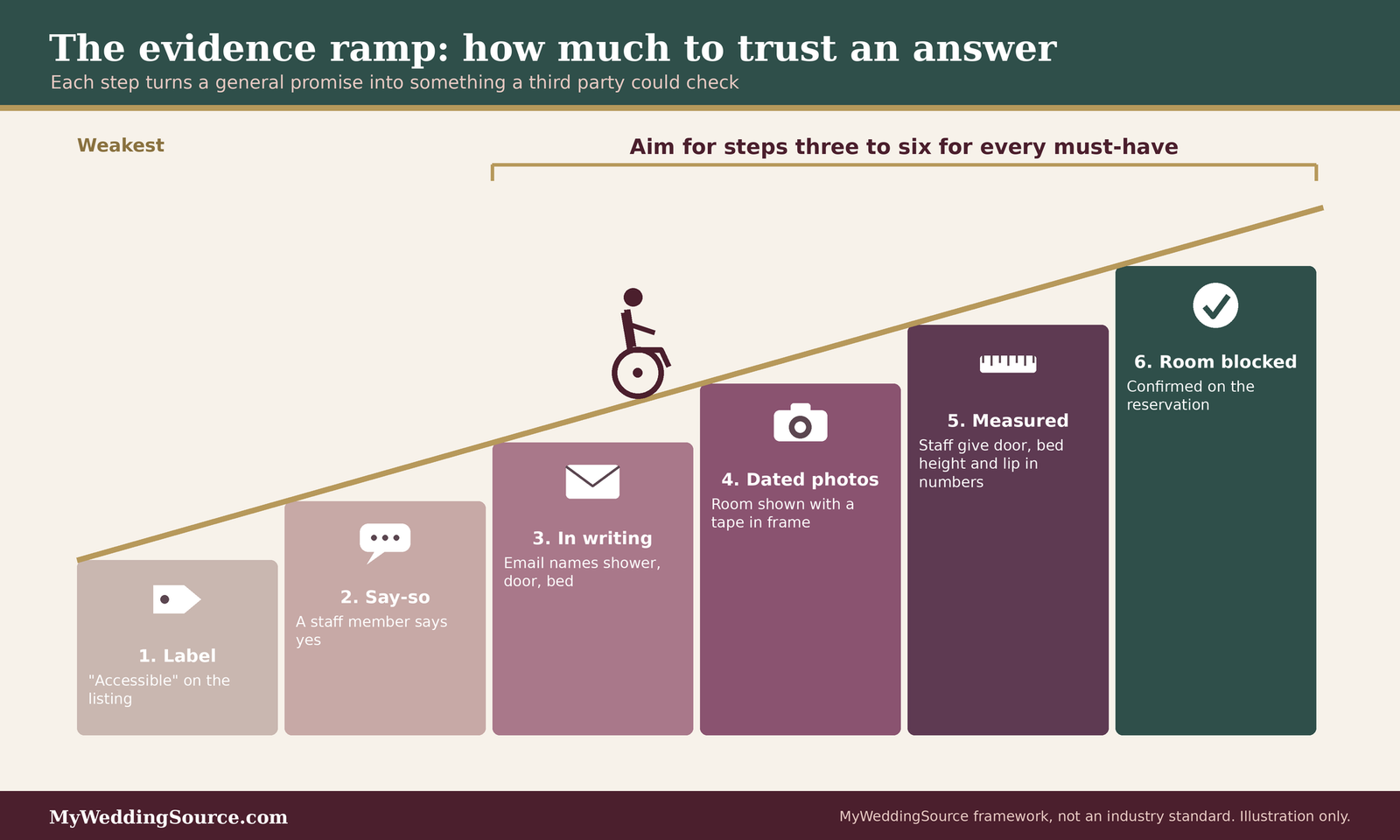
Not all answers weigh the same when you plan a honeymoon with mobility needs. A cheerful “yes, it is fully accessible” from a reservations agent is information, but it is the weakest kind. The ladder below is our own working framework, not an industry standard, and it exists to help you decide when to stop asking and when to keep going. For a honeymoon with mobility needs, the rule of thumb is to go up at least to the written-specifics rung for anything on your must-have list.
The rungs, from weakest to strongest
Each rung adds something the one below lacks. Think of the climb as converting a general promise into something a third party could check.
The lower rungs: label and say-so
The lowest rung is the label on a booking page or listing. The next is a verbal statement from staff. Both are worth having, since they tell you whether to continue, but neither is a record. A verbal statement can be sincere and wrong, because the person on the phone may be describing a room category they have never entered.
The middle rungs: writing and photos
The third rung is written specifics from the property, such as an email that names the shower type, door width, and bed arrangement. The fourth is dated photos or a short video of the actual room, with a tape measure or another known object in frame. Written specifics make the hotel accountable for what it said. Photos let you see what words leave out, such as a lip at the shower entry or furniture blocking a turning space.
The top rungs: measured and confirmed on the reservation
The fifth rung is measurements taken by staff, such as the clear width of the door and the height of the mattress, stated in numbers. The sixth is a reservation record showing that the specific room or room type is blocked for you, with your requirements noted, and a confirmation you can show at check-in. Not every trip needs the top rung for every item, but for must-haves, aim there.
Match the rung to the risk
Spending effort evenly across every item wastes time. Put your energy where a mistake would end the room’s usefulness.
High-risk items need the highest rungs
Shower type and entry lip, toilet side and clear floor space, bed height and side clearance, door widths and thresholds, and the route from the entrance. If any of these is on your must-have list, do not settle for a verbal statement. Ask for written specifics and photos.
Low-risk items can stay on the lower rungs
Whether the room has a balcony chair, a coffee machine within reach, or a view of the pool can usually be handled with a verbal answer. Record it, but do not hold up a booking over it. Keeping the ladder in mind stops you from interrogating a hotel about trivia while a bathroom door width remains unconfirmed.
The hotel accessibility verification checklist
This is the working core of the guide. For a honeymoon with mobility needs, use it as a script for the call, a template for the email, and a form to fill in on arrival. Each table gives the item, the question to ask, what a good answer sounds like, and a sign that you should stop and clarify. We use the 2010 ADA Standards as the yardstick for United States hotels and mark each number as a minimum. Outside the United States, use the same numbers as a reference and expect to adapt.
Arrival, route, and the room door
A room is only as accessible as the path to it. On a honeymoon with mobility needs, start at the curb and move inward.
From the curb to the lobby
Ask whether the main entrance is step-free, whether a ramp or automatic door is available, and where drop-off and parking are. For a car, ask whether there is a van-accessible parking space and how far it is from the entrance, and for a driver or shuttle, ask whether the vehicle has a ramp or lift. Our guide to wedding transportation for guests using wheelchairs explains the questions to ask about lifts, ramps, and securement, and they apply equally to an airport transfer on a honeymoon with mobility needs.
| Item | Ask | A good answer includes | Stop and clarify if |
|---|---|---|---|
| Entrance | Is the main door step-free? | Yes, with automatic or easy-open door and no steps | “There is a small step” or the accessible entrance is at the back or through a service area |
| Route to the room | Is there a step-free route from lobby to room? | Elevator or ground floor, with distances | Elevator is out of service often, or you must pass a staircase |
| Distance | How far is the room from the elevator and the lobby? | A distance in feet or a description you can compare with your stamina | “Close to everything” with no number |
| Door width | What is the clear opening of the room door? | At least 32 inches clear, stated as a number | “Standard door” or no number |
| Door weight | Can the door be opened alone? | Easy to open, or an automatic opener | Heavy fire door with no opener |
Doors, thresholds, and hardware
The 2010 Standards set a 32-inch minimum clear opening for doors, a maximum threshold height of one-half inch (up to three-quarters of an inch if beveled, in existing or altered work), and a maximum opening force of five pounds for interior hinged doors. Door hardware must sit between 34 and 48 inches above the floor, and door closers must take at least five seconds to close from a wide-open position. You do not need to quote these. Ask whether the hotel has measured the clear width of the entry door and the bathroom door and whether there is a raised threshold. AFAR reports travelers complaining about doors so heavy they cannot open them alone, so ask that too.
The bedroom: beds, floor space, and furniture
The bedroom is where people rest and where furniture can quietly erase the space a chair needs.
Bed height and side clearance
The Standards require clear floor space of at least 30 by 48 inches beside beds in an accessible room, set up for a parallel approach, either on both sides of one bed or in a single shared space between two beds. WheelchairTravel.org reports that the Standards set no bed height. A mattress top 30 inches or higher is common, while the ADA National Network recommends 20 to 23 inches. If your transfer depends on matching the seat height of your chair, ask for the top of the mattress measured from the floor, and ask whether the bed frame, box spring, or topper can be removed. WheelchairTravel.org notes that hotels must honor reasonable requests that do not impose an undue burden or cost, such as lowering a bed or removing furniture, and that it considers a request for a patient lift unlikely to be met.
Turning space and furniture
The Standards require a turning space in the guest room, a 60-inch circle or a T-shaped space. Ask for photos that show the open floor between the bed, desk, and luggage rack, and ask whether furniture can be moved before you arrive. A room that technically has a turning space can lose it when a rollaway bed, extra chair, or honeymoon decoration is added. Say in your email that you do not want extra furniture or decorations placed in the room’s floor space.
| Item | Ask | Minimum or reference | Stop and clarify if |
|---|---|---|---|
| Space beside the bed | How much clear floor beside the bed? | At least 30 by 48 inches on a parallel approach (2010 Standards) | Only one side, or less than your chair needs |
| Mattress top height | Measured from floor to top of mattress? | Not set by the Standards; 20 to 23 inches is recommended by the ADA National Network | “Standard height” with no number |
| Turning space | Is there open floor in the room? | A 60-inch circle or T-shaped space | Photos show crowded furniture |
| Outlets near the bed | Is there an outlet by the bed for charging? | A usable outlet within reach | Outlet behind heavy furniture |
| Light and controls | Can I reach switches and controls? | Operable parts 34 to 48 inches high for doors; check others | Controls behind the bed or above reach |
The bathroom and shower, the highest-risk zone
If you verify only one thing, verify the bathroom. It is the part of the room where an error costs the most and where small differences matter most.
Three shower types and what they mean
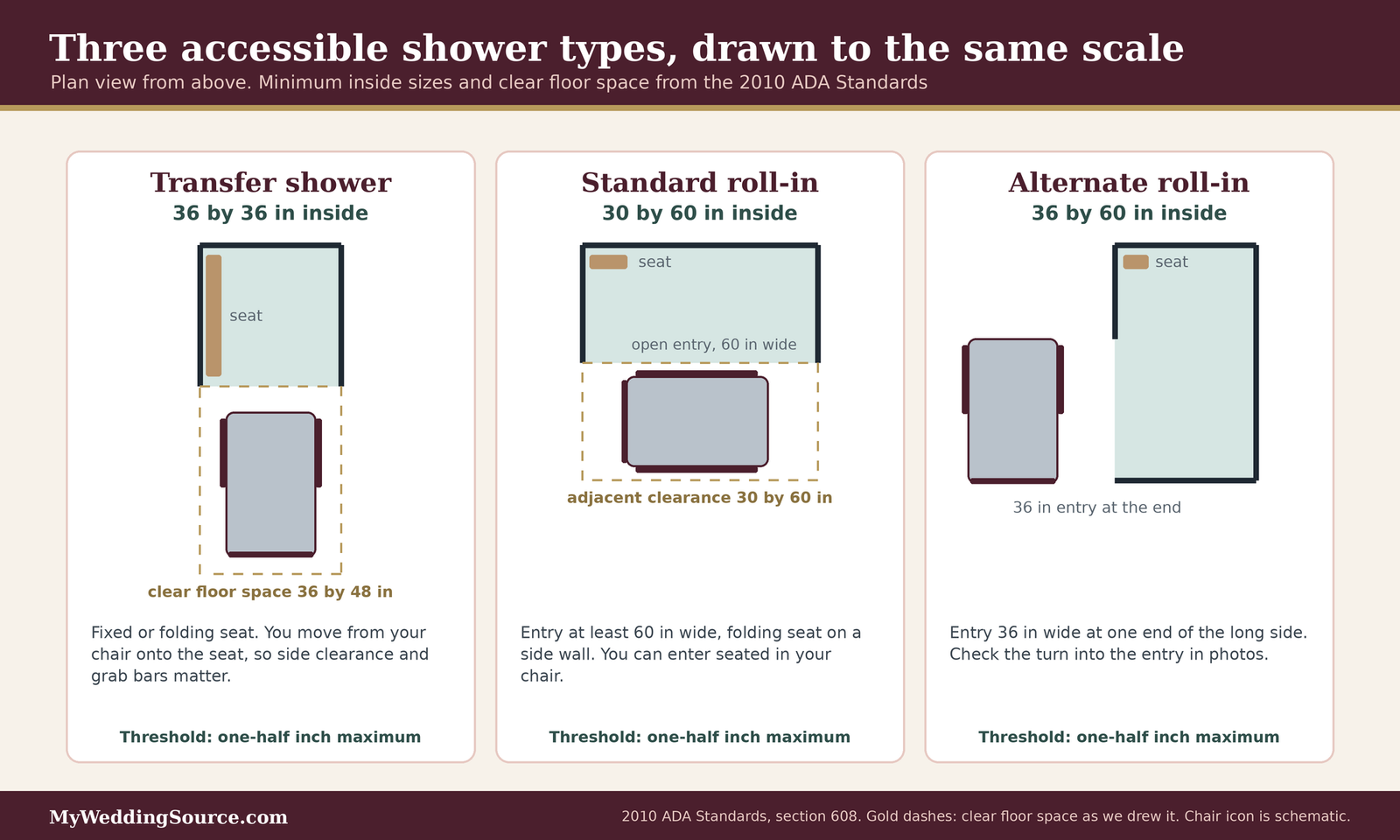
The 2010 Standards describe three kinds of accessible shower. A transfer shower is 36 by 36 inches inside, with at least 36 by 48 inches of clear floor space in front, and a seat. A standard roll-in shower is at least 30 by 60 inches inside, with an entry at least 60 inches wide. We draw it with the 60-inch side open to the room, a reading we flag as our own. An alternate roll-in shower is at least 36 by 60 inches with a 36-inch entry at one end of the long side. Roll-in types may have a threshold no higher than one-half inch. In a mobility room, a roll-in shower must have a folding seat, and the shower must have a handheld spray unit with a hose at least 59 inches long that works as a fixed head too, with water no hotter than 120 degrees Fahrenheit. Roll-in showers are required in mobility rooms only when a property has more than 50 rooms.
The lip, the seat, and the controls
The most common failure reported by travelers is not a missing roll-in shower but a shower with a small lip at the entrance, according to the AFAR feature, where one traveler notes that even a half-inch lip can make entry nearly impossible. The Standards cap roll-in thresholds at one-half inch, so ask for a photo of the entry and the exact height of any lip. Ask whether the seat folds from the wall, how high it is, and whether a portable bench is available. The Standards place roll-in shower controls no higher than 48 inches above the shower floor. WheelchairTravel.org also reports that bathtub seats are typically set 17 to 19 inches above the floor, so ask the same about any tub-with-seat room.
| Item | Ask | Minimum or reference | Stop and clarify if |
|---|---|---|---|
| Shower type | Roll-in, transfer, or tub with seat? | Transfer 36 by 36 in; standard roll-in 30 by 60 in; alternate roll-in 36 by 60 in | “Walk-in” or “accessible shower” with no type |
| Entry lip | What is the height of the shower entry? | One-half inch or less | A visible lip or a curb |
| Seat | Folding seat? Can I use my own bench? | Folding seat required in roll-in showers in mobility rooms | No seat and no option to bring one |
| Handheld spray | Hose length and fixed head? | Hose at least 59 in, works as both | Fixed head only |
| Toilet | Which side is the wall and grab bar? Seat height? | Seat 17 to 19 in; grab bars side and rear | Vanity or wall on your transfer side |
| Turning space | Is there a turning circle? | 60-inch circle or T | Bathroom too tight in photos |
| Sink | Knee clearance and reach? | Sink must not overlap toilet floor space | Cabinet under the sink, high mirror |
Toilet, sink, and room to turn
Ask which side of the toilet has the wall and the grab bar and which side has open floor, because WheelchairTravel.org’s summary of the Standards places toilet grab bars on the side wall nearest the toilet and the wall behind it, with the seat between 17 and 19 inches above the floor. The sink cannot overlap the clear floor space next to the toilet under the 2010 Standards. If you need knee clearance under a sink, ask for it by name. The 60-inch turning space can be a circle or a T-shaped space, and a photo from the bathroom door with a tape measure across the floor shows more than a description.
Beyond the room: dining, pool, spa, and beach
A honeymoon with mobility needs still happens mostly outside the room, so the common areas need their own pass through the checklist.
Dining and shared spaces
Ask whether the restaurants, bars, and lounges are step-free, whether tables and seating accommodate a chair, and whether the path from the room to dining is step-free. The ADA National Network lists restaurants, lounges, meeting rooms, pools, and fitness centers among spaces where guests can ask about accessibility. If breakfast is included in your rate, ask where it is served and whether the route is the same as the route to the room. If you have dietary needs as well, our honeymoon with food allergies guide covers parallel verification for kitchens.
Pools, spas, beaches, and couples treatments
Pools and spas are covered by their own ADA accessibility requirements in the United States, which the ADA National Network points to separately, and abroad they vary. Ask whether the pool has a lift or ramp and whether staff are trained to use it, how a beach or boardwalk can be crossed, and whether spa treatment rooms, tables, and changing areas can be used with your equipment. A “couples treatment” is a common honeymoon booking, so ask about table height, transfers, and whether the room is step-free before you book it. Treat these as part of the same verification for a honeymoon with mobility needs, not a surprise at check-in.
Booking the room so the verification holds
Verification only matters if the room you verified is the room you receive, which is the whole point of booking a honeymoon with mobility needs carefully. The booking channel, the confirmation wording, and the cancellation terms decide whether your paperwork protects you.
Choose the channel with the clearest record
The ADA reservation rule says accessible rooms must be bookable in the same ways as other rooms, including through third parties, so you are not forced to book by phone. But you may prefer a channel that leaves a better record.
Booking direct versus through a third party
WheelchairTravel.org advises booking directly with the hotel because travelers have reported poor experiences guaranteeing accessible rooms on third-party sites, and notes that even when a site lists accessible inventory, the hotel itself must confirm or guarantee the reservation. That is one site’s advice, not a legal rule, and the Marriott settlement allegations above suggest why a direct confirmation is useful. If you book through a site anyway, contact the hotel afterward, give them the confirmation number, and ask them to block the specific room and note your needs.
Points, packages, and upgrades
If you are paying with loyalty points, read our honeymoon using points guide for how redemption rooms are allocated, and ask whether the accessible room is available at the award level. Packages and honeymoon bundles often assign rooms by category, and upgrade requests can quietly replace a verified room with a different one. Our guide to honeymoon resort room category upgrades explains how upgrades work; the rule for a honeymoon with mobility needs is to decline any change of room until you have verified the new room by the same checklist.
Get the confirmation in the right words
For a honeymoon with mobility needs, a confirmation that says “accessible room requested” is weaker than one that names what you were promised.
What the confirmation should say
Ask for a written confirmation that names the room type or number, the shower type, the bed arrangement, and the dates, and that states the room has been blocked for you. If the system cannot show the room number in advance, ask that the notes on your reservation list your required features, and ask the property to reply to your email confirming it. Keep the original listing as a screenshot with the date, in case the description changes later.
Cancellation window and deposits
Cancellation terms are part of verifying a honeymoon with mobility needs. If the property sends photos that reveal a problem after a non-refundable deposit, you are stuck. Ask for a free-cancellation window that extends beyond the date you expect to finish your checks, and ask what happens if the room is changed by the hotel. Our honeymoon travel insurance guide explains how policies treat cancellations, and a policy’s terms about pre-existing conditions and equipment are worth reading closely. We cannot interpret your policy, so confirm the details with your insurer or an advisor.
What this actually costs
Verifying a honeymoon with mobility needs costs mostly time: a few calls, a few emails, and a spreadsheet. The money risk is in non-refundable deposits paid before the room is verified, in equipment rental or shipping you may need at the destination, and in ground transport that can handle your chair. Under the ADA, accessible rooms are supposed to be offered across room types with comparable choices, so ask for the rate of the accessible version of the room you want, in writing, and compare it with the standard version. We do not quote prices because they vary by property and date. For the wider budget, see our honeymoon budget guide.
The journey around the hotel: flights, airports, and transfers
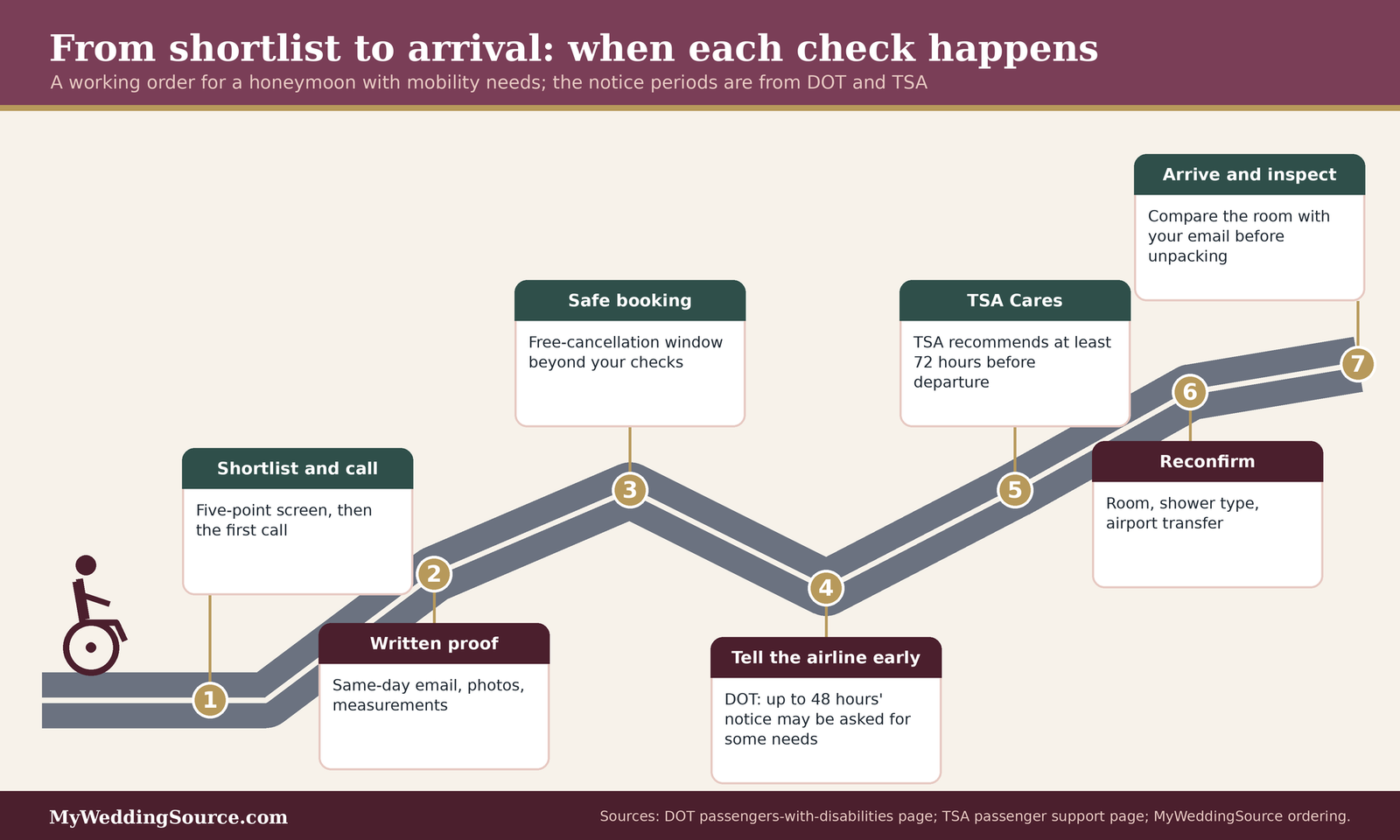
A verified room is not useful on a honeymoon with mobility needs if the equipment does not arrive with you. A few rules on flights and airports affect hotel planning for a honeymoon with mobility needs, and most of them are time-sensitive, so the timeline matters as much as the checklist.
Airline rules that affect your equipment and your arrival
The Department of Transportation enforces the Air Carrier Access Act, and its consumer pages and a recent rule on wheelchairs set out what airlines must do. Always check the current text, because rules change and we read a pre-publication version of the final rule.
Notice, batteries, and assistance
According to DOT, airlines may not require advance notice that you are traveling with a disability, but they may ask for up to 48 hours’ notice for some accommodations that need preparation, such as carrying an electric wheelchair on a smaller aircraft. Airlines must accept battery-powered wheelchairs with their batteries, must not charge for required accommodations like hazardous-materials packaging, and must give assistive devices priority for baggage compartment storage. The CDC adds that airlines may require one hour of advance check-in for some services, and recommends mentioning an aisle chair need when booking and again at check-in because smaller planes may lack jetways. The CDC also says airlines are not required to help with feeding, lavatory use, or medication, so a traveler who needs that help should bring a companion or attendant.
Mishandled wheelchairs and the 2024 rule
A DOT final rule signed on December 12, 2024 and effective January 16, 2025 sets requirements for safe and dignified assistance, treats a checked device that is not returned in the condition received as presumptively a violation, and gives deadlines for delayed chairs and scooters, such as delivery to the final destination within 24 hours for domestic flights and international flights of 12 hours or less. It also sets compliance dates for particular provisions that fall in 2025 and 2026, and the text we read is a pre-publication version, so confirm what applies to your itinerary on DOT’s site. Airlines must also provide a complaints resolution official. For a honeymoon with mobility needs, the practical takeaway is to document your chair’s condition before you hand it over and to carry a loaner plan, such as a hotel contact who can help locate temporary equipment.
Airports, screening, and the transfer to the hotel
Airports and the ride to the hotel are where a verified room can come undone.
Security and airport support
TSA Cares is a TSA service at (855) 787-2227 that can arrange a Passenger Support Specialist, and TSA recommends contacting it at least 72 hours before departure. TSA notes that a support specialist does not exempt you from screening and that TSA does not provide airport wheelchair service, so contact your airline for that. The State Department notes that the Hidden Disabilities Sunflower program is available at more than 230 airports and that travelers should check what help services exist at departure and destination airports. If you plan a connection, check the airport layout in advance, as MIUSA suggests, and have a backup plan.
From the airport to the room
Ask the hotel how guests on a honeymoon with mobility needs usually travel from the airport, whether it runs a lift-equipped shuttle, and whether a roll-in-accessible taxi or van can be booked. If you rent a car, our honeymoon rental car insurance guide covers the coverage questions, and you should also ask the rental company about accessibility equipment such as hand controls. We have not verified that any specific company offers them. Put the transfer in the same email chain as the room confirmation so the whole arrival is documented in one place.
Edge cases that change the checklist
The checklist above assumes a wheelchair user needing a roll-in or transfer shower. Real needs are more varied, and some of the most common situations on a honeymoon with mobility needs call for a different emphasis.
Needs that do not fit the standard picture
Mobility is not a single category, and a honeymoon with mobility needs can mean many different things, and the questions you prioritize should follow your needs.
Cane, walker, or part-time chair use
If you walk but cannot manage stairs, long distances, or a high tub edge, the questions that matter most are distances, handrails, seat heights, bathtub entry, and the location of the room. For a honeymoon with mobility needs, a mobility room built for a wheelchair may suit you well, or a standard room on a ground floor with a seated shower and grab bars may. Ask for the same measurements and photos, and be specific about what you cannot do.
Power chairs, scooters, and attendants
A power chair or scooter usually needs more clear space, reliable charging, and a larger door and elevator than a manual chair. State the chair’s width, length, and charger needs. If your partner or an attendant assists you, ask for a room with two beds or a layout that gives them space to move, and ask about a connecting room if an attendant travels with you. The CDC notes that airlines are not required to help with feeding, lavatory use, or medication, so assistance planning has to cover the hotel too.
Destination-specific complications
The destination can make a verified room hard to use in ways the room itself does not show.
Terrain, weather, and hurricane season
Cobblestones, steep hills, sand, and heavy rain can make a step-free room hard to reach. Ask about the terrain between the room and the places you plan to go, and about what the hotel does during storms, including whether the elevator works on backup power. If you are traveling in storm season, our honeymoon travel during hurricane season guide covers the broader planning.
Cruises, tours, and group transport
The CDC notes that cruise programs and tours departing from U.S. ports have obligations under Title III of the ADA, even on foreign-registered ships, and recommends confirming that needed items are available before booking. Cabin dimensions, tender boats, and shore excursions need the same photos-and-measurements treatment as a hotel. If you are mixing a hotel with a tour, ask the tour operator how its vehicles and sites accommodate your equipment.
When the room is not the room you verified
Even a well-documented reservation for a honeymoon with mobility needs can fail on arrival. A prepared response lets you stay calm and act quickly.
On arrival: a short inspection routine
On a honeymoon with mobility needs, check the room before you unpack, because it is easier to move before you have settled in.
The first five minutes
Open the door and test it, move through the room and bathroom in your chair or with your aid, check the shower entry and seat, and compare what you see with the photos and measurements in your email. Take photos of any difference. If you are tired after the journey, hand the checklist to your partner and let them do it.
Compare against the confirmation
Keep the email chain and the original listing on your phone. If something is different, show the specific line to the front desk and ask for the room you reserved. A calm, specific request, such as “my reservation notes a roll-in shower and this room has a tub,” is easier for staff to act on than a general complaint.
If the hotel cannot provide the verified room
Sometimes the hotel truly cannot deliver on a honeymoon with mobility needs, because of an error, a maintenance issue, or an operational problem. You still have steps.
Ask for the manager and write it down
Ask for the manager, state what you reserved and what you were given, and ask for an alternative in writing. WheelchairTravel.org advises that the hotel should move you, at its own cost, to a nearby property that meets your needs and that you should not accept less than what you reserved. That is the author’s advice, not legal advice, and what applies to you depends on the facts and the hotel’s location. The ADA National Network lists 1-800-949-4232 as its number for ADA questions.
Keep a record and use the complaint routes
Note the date, names, and what was offered. If a dispute continues, a lawyer or a disability rights organization can advise on your options. For airline issues, DOT accepts complaints, and airlines must respond to written complaints and make a complaints resolution official available. Share specific feedback with the property afterward, because it helps the next traveler, as WheelchairTravel.org suggests with public reviews.
FAQ: honeymoon with mobility needs
Planning and verifying
How far ahead should I verify a hotel for a honeymoon with mobility needs?
Start as soon as you have a shortlist, before paying a non-refundable deposit. Allow time for photos, measurements, and follow-up emails, since staff may need days to reply. There is no official lead time, so build in extra weeks if you can, and reconfirm the room again shortly before you travel.
Is a room labeled accessible guaranteed to suit my needs?
No. In the United States, the 2010 ADA Standards set minimum features, and they do not set a bed height or promise a roll-in shower in small properties. Elsewhere the term varies. Ask for the shower type, door and bathroom measurements, and photos, and treat the label as a starting point.
Rooms and bathrooms
What is the difference between a roll-in shower and a transfer shower?
A roll-in shower can be entered seated in a wheelchair, with a threshold of one-half inch or less, and the Standards set minimum interiors of 30 by 60 or 36 by 60 inches. A transfer shower is 36 by 36 inches with a seat and requires you to move from your chair. Which suits you depends on your transfers.
What should I do if the hotel will not send photos?
Explain that you need photos to judge whether the room is safe for you, and ask for a supervisor or a manager. WheelchairTravel.org suggests asking staff to take photos with a phone. If a property still refuses, you can treat that as information and move to a hotel that will answer questions in writing.
Travel and equipment
What notice do airlines need for my wheelchair?
DOT says airlines may not require advance notice that you are traveling with a disability, but may ask for up to 48 hours’ notice for some accommodations, such as carrying an electric wheelchair on a smaller aircraft. Airlines must accept battery-powered wheelchairs. Check your airline’s policy and notify it early, since details vary by aircraft.
Do the ADA rules apply to hotels abroad?
No. The ADA applies in the United States, and the State Department notes that every destination has its own laws on disability discrimination and accessibility, with some having few or no legal requirements. Use the U.S. measurements as a reference and ask each hotel to confirm specifics in writing, with photos.
Booking and arrival problems
Should I book directly or through a booking site?
The ADA reservation rule says accessible rooms must be bookable through third parties as well, but WheelchairTravel.org advises booking directly because some travelers have had poor experiences guaranteeing rooms on third-party sites. Either way, contact the hotel, give the confirmation number, and ask them to block the specific room in writing.
What if the room is different on arrival?
Show the front desk your written confirmation and ask for the room you reserved, or a manager if needed. WheelchairTravel.org advises not accepting less than you reserved and asking the hotel to relocate you at its own cost. That is practical advice, not legal advice, so keep records and seek qualified help if needed.
Your next steps
Prepare your own information
Write the needs sheet
List your equipment dimensions, your transfers, your must-haves, and your trade-offs on one page. Keep it with your notes for the honeymoon with mobility needs so that every hotel email starts from the same facts. Our honeymoon planning guide can help you place this step in the wider timeline.
Pick a shortlist of three properties
Use the five-point screen to narrow to three hotels, so you can compare answers side by side. Starting with a short list keeps the calls manageable, and it gives you a fallback if the first choice fails verification.
Verify, record, and reconfirm
Run the call and the follow-up
Use the call questions and the checklist tables for your honeymoon with mobility needs, send the same-day email, and log every contact. Stop at the rung of the evidence ladder your must-haves require, since a honeymoon with mobility needs rarely needs the top rung for every item, and keep the photos and measurements in one folder.
Reconfirm before you travel
A few days before departure, email the hotel to reconfirm the room, the shower type, and the arrival transfer. Check with TSA Cares and your airline in the timeframes described above, and carry printed or saved copies of your confirmation. For other guests at your wedding, the same approach appears in our accessible wedding guest experience guide.
Sources and methodology
How we built this guide
What we relied on
This guide draws on the Department of Justice hotel reservation rule as published in the regulations, the 2010 ADA Standards for Accessible Design, the ADA National Network’s lodging guidance, Department of Transportation consumer pages and its wheelchair final rule, State Department and CDC travel guidance for people with disabilities, TSA’s passenger support page, a U.S. Attorney’s Office announcement, and practical advice from accessibility-focused travel writers and organizations. We checked these pages on November 12, 2026. Where a statement comes from an advocate, a writer, or a retailer-style source, we attribute it, because it reflects that author’s view. The evidence ladder is our own framework, and the checklists are our own organization of the cited minimums and advice.
What we did not do
We did not inspect any hotel, test any equipment, or interview travelers ourselves. We are not lawyers, medical professionals, or insurance advisors, and this guide is not legal, medical, or financial advice. Rules, standards, and policies change, and the DOT rule we read was a pre-publication version, so verify current text before relying on it.
Source list
Government and regulatory sources
- U.S. Department of Justice, 28 CFR 36.302(e), reservations by places of lodging (summary text): https://www.corada.com/documents/ada-title-iii-regulations/36-302-e-1
- 2010 ADA Standards, Section 224, transient lodging guest rooms: https://www.corada.com/documents/2010ADAStandards/224
- 2010 ADA Standards, Section 608, shower compartments: https://www.corada.com/documents/2010ADAStandards/608
- 2010 ADA Standards, Section 404, doors, doorways, and gates: https://www.corada.com/documents/2010ADAStandards/404
- 2010 ADA Standards, Section 305, clear floor or ground space: https://www.corada.com/documents/2010ADAStandards/305
- 2010 ADA Standards, Section 304, turning space: https://www.corada.com/documents/2010ADAStandards/304
- U.S. Department of Transportation, Air travelers with disabilities: https://www.transportation.gov/airconsumer/passengers-disabilities
- U.S. Department of Transportation, Final rule on safe accommodations for air travelers with disabilities using wheelchairs (December 2024, pre-publication version): https://www.transportation.gov/sites/dot.gov/files/2024-12/Final%20Rule%20Ensuring%20Safe%20Accommodations%20for%20Air%20Travelers%20with%20Disabilities%20Using%20Wheelchairs.pdf
- U.S. Department of State, Accessibility guidance for travelers with disabilities: https://travel.state.gov/en/international-travel/planning/personal-needs/accessibility.html
- Centers for Disease Control and Prevention, Travelers with disabilities (Yellow Book): https://www.cdc.gov/yellow-book/hcp/travelers-with-additional-considerations/travelers-with-disabilities.html
- Transportation Security Administration, TSA Cares passenger support: https://www.tsa.gov/travel/passenger-support
- U.S. Attorney’s Office, District of Colorado, Marriott International agrees to address barriers to reserving accessible rooms (June 4, 2024): https://www.justice.gov/usao-co/pr/marriott-international-agrees-address-barriers-making-reservations-accessible-rooms
Advocacy, education, and travel sources
- ADA National Network, Accessible lodging: https://adata.org/sites/adata.org/files/files/Accessible_Lodging_2014.pdf
- ADA National Network, Hospitality FAQ: https://adata.org/faq-page/120
- WheelchairTravel.org, ADA design requirements for hotels: https://wheelchairtravel.org/hotels-ada-design-requirements/
- WheelchairTravel.org, Rules for ADA hotel room reservations: https://wheelchairtravel.org/hotels-ada-room-reservations/
- WheelchairTravel.org, Step-by-step guide to verifying hotel accessibility in advance: https://wheelchairtravel.org/step-by-step-guide-verifying-hotel-accessibility-in-advance/
- AFAR, What hotels get wrong (and right) about accessible design, from disabled travelers: https://www.afar.com/magazine/accessible-hotels-wins-fails-and-what-needs-to-change
- Mobility International USA, Air travel tips: https://miusa.org/resource/tip-sheets/airtraveltips/