
Wedding vendor subcontractors are the people and businesses your vendor brings in to do part of the work you hired them for, and the calmest way to deal with them is to learn who they are before you sign, not when a stranger walks into your reception.
Quick answer
Using wedding vendor subcontractors is ordinary business, not a warning sign. What matters is whether you know about it. Before you sign, ask each vendor three things in writing: who will do each part of the work on your day, which parts are handled by someone who is not on the vendor’s own team, and what happens, to the price and to the plan, if a named person cannot come. The worksheet in this guide turns those questions into a form you can send, and it also asks whether anyone is paid for referring the people involved. This is general education, not legal advice.
What wedding vendor subcontractors are, and why couples rarely hear about them
Most couples picture a vendor as one person or one company: a photographer, a caterer, a florist, a DJ. In practice many wedding businesses are small networks. The person you met at the consultation may be the owner, the lead on your day, a salesperson, or a name on the website. Other people may carry out parts of the job, and some of those people are not employees. This guide uses the term wedding vendor subcontractors for anyone outside a vendor’s own payroll who performs part of what you bought, along with the related case of a business that hands an entire booking to someone else.
Nothing here assumes bad faith. A lead vendor who brings in a trusted partner can give you better coverage than one person working alone. The risk is a mismatch between what you believed you were buying and what shows up, and the cure for a mismatch is information shared early.
Plain definitions for the people in the chain
Industry words vary, and two vendors can use the same word for different arrangements. Start with plain definitions, then ask each vendor to describe their own setup in everyday language.
Employee, contractor, and partner business
An employee works for the vendor on the vendor’s payroll. An independent contractor is a separate worker or business that the vendor pays for a specific job. A partner business is a separate company that the vendor coordinates with, such as a rental company that delivers chairs for a caterer. The Internal Revenue Service describes the line between employee and contractor as a weighing of behavioral control, financial control, and the type of relationship, with no single factor deciding it. As a couple, you do not need to classify anyone. You only need to know which people are the vendor’s own team and which are not.
Lead, associate, second, and assistant
In photography, a lead photographer is the person who owns the booking. A second shooter is a photographer hired to work beside the lead. The site Photography Life, a photographer-education publication, separates second shooters from assistants, who may not be photographers at all and mostly handle gear and lighting. An associate photographer is described by a photography-law site, The Legal Paige, as a professional who works under the business owner’s brand and can cover an event in the owner’s place. Other trades have their own versions: a lead florist and a freelance designer, a head chef and a banquet captain, a band leader and a sub musician. The labels differ, but the question stays the same. Who is responsible for your event, and who is standing there?
Why the topic stays under the surface
Subcontracting is rarely hidden on purpose. It stays quiet because of how weddings are sold and how contracts are written.
Websites sell a person, contracts name a business
A portfolio is the work of a particular person, or of several people whose work was blended into one style. A contract is usually signed with a business entity. That gap can be harmless, but it means the face on the website does not appear in the legal document unless you ask for it. If you are booking a specific photographer’s eye, a specific chef’s menu, or a specific musician’s sound, put that person’s name where the contract can hold the vendor to it. That gap is where wedding vendor subcontractors most often go unmentioned.
Couples assume the person they met is the person who shows up
Most of us assume the consultation partner and the day-of worker are the same person, and nobody thinks to say otherwise. Some vendors describe their team on a web page and others mention it only if asked. A short written question at the start of the relationship removes the guesswork for both sides and costs the vendor almost nothing to answer. Asking about wedding vendor subcontractors at the first meeting keeps the conversation friendly.
When subcontracting helps you, and when it causes problems
Vendors have good reasons to bring in other people. Understanding them makes the conversation friendlier and your questions sharper.
Reasons it can improve your day
A vendor with a larger team can cover more than one location at once, replace someone who falls ill, and bring specialists for parts of the job that they do not do themselves. The Legal Paige, which writes contract guidance for photographers, recommends a “lead associate” clause that tells the client an associate may attend and that the business remains responsible for delivering the promised services. A backup network matters too. In a WeddingWire interview, wedding photographer Julia Wade says a seasoned professional typically has a network of other photographers who can cover a wedding in an emergency, and that the process should be spelled out in the contract.
Reasons it can cause problems
Trouble starts when the arrangement is unknown, vague, or different from what was sold. Common examples are a style that does not match the portfolio, a person who never saw your contract or your timeline, an unexpected extra charge from a third party, or an insurance certificate that covers the vendor but not the helper. None of these is inevitable. They are the reasons to ask early. Each of these problems traces back to wedding vendor subcontractors who were not discussed in advance.
Who might be delivering your service: five common setups
You can sort most vendor arrangements into five patterns. These are our own framework for the conversation, not an industry standard, and a single vendor can use more than one depending on the season or the size of your event. The goal is not to grade the patterns. It is to help you recognize which one you are in, so you can ask better questions about it.

The owner-operator and the small team
At one end of the range is a vendor who does the work personally, perhaps with a spouse or a part-time assistant. At the other end is a company with salaried staff. The questions are different for each.
The owner does everything
If the owner does the service and nobody else handles any part of it, wedding vendor subcontractors are not an issue for that vendor, and you can say so in the contract in one line: the owner will personally perform the services. Even then, ask how the vendor would cover an illness or accident, since a one-person business has no built-in backup. Our guide to a wedding vendor replacement policy covers that gap in more depth. Some vendors will say plainly that they work without wedding vendor subcontractors, and that answer is worth writing down.
Employees on the vendor’s payroll
A vendor with employees can send an employee in place of the owner and still be the one responsible for the work. You are usually not dealing with separate companies. The practical questions are who will lead your event, what experience that person has, and whether you can see their work. Ask for the lead’s name and role and for the number of staff that will attend. Staff of that kind are not wedding vendor subcontractors, but the same questions about names and roles still apply.
The associate or contractor who works under the vendor’s name
This is the setup most often discussed in photography, but it appears in other trades too. A business owner books the event, then assigns it to an independent professional who works under the business brand.
What the arrangement looks like
The lead owner sells and manages the booking, and a contractor delivers some or all of the service. The contractor may be an experienced professional with their own clients, which is why The Legal Paige advises hiring associates who are established. For you, this can be a good arrangement if you meet the person, see their work, and have it described in the contract. It becomes a problem when you thought you were hiring the owner. This is one of the clearest examples of wedding vendor subcontractors working under a business name.
What to put in writing
Ask that the contract name the person who will perform the service, or at least describe their role and experience. Ask whether you may approve a replacement, and what the vendor will do if the named person is unavailable. Also ask whether the work product, such as photos, belongs to the vendor or to the contractor, because The Legal Paige notes that for an independent contractor, copyright belongs to the creator unless a written agreement transfers it. For a client, the useful point is simple: your vendor should be able to state in writing that they hold the rights needed to deliver what you bought. Our guide to photography deliverables shows what to look for in the delivery terms.
The specialist hired for one part of the job
Some vendors do most of the work and hire a specialist for a piece of it. A caterer may bring in a bartender service, a florist may hire an installation crew, a planner may hire day-of assistants.
How a partial subcontract works
The lead vendor stays your contract partner, and a separate business or person handles one component. You may never meet the specialist before the day. This can improve quality if the specialist is better at that piece than the lead vendor, and it adds a link to the chain that you should be able to see. Partial arrangements like this are common forms of wedding vendor subcontractors.
What to ask about the specialist
Ask what the specialist does, who they are, whether they carry their own insurance, and whether their work is covered by the lead vendor’s contract with you. Ask also whether the specialist’s cost is already inside your price or could be billed separately. A vendor who knows the answers will give them without fuss.
The rental or logistics partner
Many vendors rely on outside businesses for items rather than skills: tables, linens, glassware, lighting, transport, portable equipment.
Where partners sit in the chain
Rental and delivery partners usually do not show up in a vendor’s team description, and they do not need to. They matter when something is damaged, late, or missing, because the question becomes whose responsibility it is. For a deeper checklist, see our wedding rental planning checklist. Think of them as wedding vendor subcontractors for objects instead of skills.
Questions about delivery and damage
Ask who delivers and collects, when, and who is responsible if an item is damaged or does not arrive. Ask whether the vendor will be on site when the partner arrives, or whether you or the venue must sign for the delivery. Those answers belong in the contract.
The business that sells the booking and hands it off
The final pattern is a broker or an agency that takes your booking and assigns the work to someone else, sometimes at the last minute from a pool of providers.
Brokers, agencies, and platforms
A booking business may be transparent about this, listing the pool of providers on its website, or it may describe itself as the provider while handing the job to another company. Neither is automatically wrong. What you need to know is whether you are buying a named person’s work or a service level that anyone in the pool might deliver. In this model, wedding vendor subcontractors may be the whole delivery team.
How to tell which one you have
Ask: “Will the person who delivers my service be chosen by me, chosen by you, or chosen later from a pool?” Ask when you will learn the name, and whether you can reject a person after seeing their work. If the answer is “later,” you are buying a service level, and the contract should define that service level in detail.
Where subcontracting tends to appear, vendor by vendor
We could not find reliable national statistics on how often each type of wedding vendor uses outside help, so this section does not claim any. It describes where outside help can enter each kind of job, which is the information you need to ask a precise question. Treat each H3 below as a prompt, not as a description of what any particular vendor does.
Photography and video
Visual work is the area where the lead-versus-associate distinction is best documented, mostly in guidance written for photographers.
Who holds the camera
Photography Life describes second shooters as photographers hired to work alongside the main photographer, and says clients should communicate only with the main photographer. The Legal Paige describes associates as able to work independently and cover an event in the owner’s place. For you, the practical question is which of these roles applies. Ask who will be the primary photographer for the ceremony and for portraits, and whether anyone else will carry a camera at the same time. Our wedding photography guide explains how coverage is usually planned. Photography is the field where wedding vendor subcontractors are most openly discussed.
Who edits and delivers
Editing and delivery can also be outsourced, for example to an editing service or a studio assistant. That is not necessarily a problem, but the contract’s delivery terms rest on it. Ask who edits, whether the lead reviews the final gallery, and who holds your files if the vendor’s business closes. Our photography deliverables guide explains what to expect from delivery terms. Behind-the-scenes work is another place wedding vendor subcontractors may appear.
Catering, bar, and rentals
Food and drink involve the largest number of hands on the day, so more roles can come from outside the core team.
Kitchen, service, and bartending
A caterer may use a core team plus event-day staff, and bar service may be run by the same company or by a separate licensed provider. Ask who is licensed to serve alcohol where your wedding is held, who carries liquor liability coverage, and whether the bar staff are part of the caterer’s team or a separate business. Our guide to wedding catering service planning covers the service side in more detail. Food service is a place where wedding vendor subcontractors can multiply quickly.
Rentals, delivery, and cleanup
Rented items arrive and leave through a third party, as noted earlier. Ask who owns the rental contract, who signs the delivery receipt, and who is responsible for items between delivery and pickup. If the venue requires certain vendors for rentals or cleanup, ask for the policy in writing. Ask whether these partners count as wedding vendor subcontractors in the vendor’s contract.
Flowers and decor
Floral work often involves building at the venue, which brings in extra hands and sometimes additional specialists.
Design versus installation
The designer who built your proposal may not be the person who installs it, particularly for large arches or ceiling work. Ask who designs, who builds, who installs, and who removes. Our florist question guide lists other topics to raise with a florist. Installation crews are a typical example of wedding vendor subcontractors in floral work.
Sourcing and substitutions
Flowers and supplies can also come from outside sources, and substitutions are a normal part of the trade. That is a different issue from subcontracting people, but it deserves a clause of its own: what can be swapped, who decides, and whether the price changes.
Music and entertainment
Musicians and DJs may be solo acts, companies with several performers, or agents who book performers.
Who plays your set
A band leader may book musicians for a given event, and a DJ company may rotate its staff. If you chose a performer for their voice or style, ask that the performer be named in the contract and that a replacement require your approval. Our DJ questions guide lists what to ask in an interview. Sub musicians and technicians are wedding vendor subcontractors in a music setting.
Equipment, sound, and lighting
Sound and lighting may come from the performer or a separate technician. Ask who sets up, who runs sound during the ceremony and reception, and who is responsible for equipment failures. Our audio and lighting checklist helps with the technical side.
Hair, makeup, and personal services
Beauty teams often work in groups on a schedule with a tight margin.
Lead artist and team members
A lead stylist may personally style the person getting married and assign the rest of the party to team members. If you booked someone specifically for your own look, ask that the lead artist perform that part and that the team members be named or described. Our hair and makeup schedule guide shows how timing depends on team size. Team members who are not employees count as wedding vendor subcontractors here too.
Trials and the day-of artist
If you have a trial, ask whether the trial artist will be the day-of artist. If not, ask what the vendor does to pass along what you decided together, such as photos and notes.
What your contract should say about delegation and substitution
A contract is where the answers become binding. The notes below are general education drawn from published legal explainers and are not legal advice. A licensed attorney in your state can tell you how your own contract would be read.
How contract law treats handing off the work
Two ideas matter here: delegation, which means passing a duty to someone else, and the delegator’s continuing responsibility.
What delegation means
A business-law textbook published on Saylor Academy’s open textbook site explains that delegation is the transfer of the duty to perform to a third party. It says duties can generally be delegated unless public policy or the contract itself bars it, and that a duty usually must be expressly delegated under most common-law rules. It gives the example of a general contractor who hires plumbers and electricians as long as the work meets the contract’s specifications. Delegation is the legal idea behind most wedding vendor subcontractors.
Personal services are treated differently
The same text says that when the other party expects the obligor to perform personally, the duty cannot be delegated, and its example is a famous singer who sends an understudy. In that example the singer remains liable for breach. A vendor selling the owner’s own artistry may fall closer to this category, but that depends on the contract and the facts, so do not assume it. If you rely on a particular person, say so in the contract.
The delegator stays responsible, with exceptions
According to the same text, a party that delegates a duty remains liable unless the original contract provides for substitution, or the other party agrees to release them in a new arrangement. For you, that supports a simple ask: have the vendor confirm in the contract that they remain responsible for the work of anyone they engage. It also explains why some vendor contracts include a substitution clause, since that clause can limit what you can claim when a replacement arrives.
Naming people versus naming roles
A contract can identify who performs the work with different levels of precision.
Naming the person
The strongest protection is a clause that names the person who will perform the service, for example the lead photographer, the head chef, or the band leader. The Legal Paige recommends a client-facing “lead associate” clause that tells the client an associate may attend and that the business remains responsible for the promised services, plus a substitution clause covering what happens if an associate cannot attend because of illness, injury, or emergency. The second clause can protect both sides, so read it closely if you see it. Naming the person is the strongest protection when wedding vendor subcontractors may be involved.
Naming a role and a standard
If the vendor cannot name a person, ask for a role and a standard: for example, a lead with a stated minimum of experience, a portfolio you have reviewed, and a promise that the person will receive your timeline and contract before the day. It is weaker than a name, but it is far better than silence. A standard can be written for wedding vendor subcontractors even when names are not known.
Wording to look for, and wording to question
Sample wording below is for conversation with your vendor and your attorney, not for copying.
Clauses that help you
Look for a statement of who will perform the services, a statement that the vendor remains responsible for the work of anyone they engage, a notice requirement if the plan changes, a right to approve or decline a replacement within a stated time, and a statement of what happens to the price if a lower-tier replacement is used. Our guide to wedding vendor contracts covers the larger contract and our guide to wedding contract change orders covers what happens when terms change. Each of these clauses speaks directly to wedding vendor subcontractors.
Clauses to question
Be cautious about broad language such as “the Company may use any personnel or third parties it chooses,” a clause that releases the vendor from all liability for a subcontractor’s acts, or a clause that makes you pay a third party directly with no description of what they do. A clause is not automatically improper, because contracts differ, but you should understand it before agreeing. If something is unclear, ask for it in plain language or take it to an attorney. Clauses of this kind can leave you with little recourse if wedding vendor subcontractors fall short.
Employee, contractor, or partner business: why the label matters to you
Couples do not need to settle employment law questions. They do need to know how the label shapes the practical risks that fall on the day.
How the IRS frames the difference
The IRS explains that it applies common-law rules and looks at the evidence of control and independence in three groups.
Behavioral, financial, and relationship
The agency lists behavioral control, which asks whether the business controls what the worker does and how; financial control, which asks about pay, expense reimbursement, and who supplies tools; and the type of relationship, which asks about written contracts, benefits, and whether the work is central to the business. It says no single factor decides the question and that there is no set number of factors. It also notes that businesses can ask for an official determination using Form SS-8, which may take months. None of this is your job as a client, but it shows why two vendors can call the same worker by different names. Knowing the terms helps when a vendor explains how their wedding vendor subcontractors are engaged.
What it does not tell you
The test is about taxes and worker status, not quality or reliability. A contractor can be excellent and an employee can be inexperienced. Use it to understand the vocabulary, not to judge the vendor. None of this makes wedding vendor subcontractors better or worse by label alone.
What the label changes in practice
The label affects who controls the work, who carries which insurance, and who is accountable if something goes wrong.
Control and standards
The Legal Paige notes that a contractor must be free to decline work and to control their own schedule, which is part of what makes them independent. For a client, that means a vendor’s ability to direct a contractor on the day may be limited by how the arrangement is set up. Ask how the vendor makes sure the contractor follows your timeline, shot list, menu, or music rules. Standards are a practical concern whenever wedding vendor subcontractors work from your timeline.
Injury and damage coverage
The Legal Paige also says a business generally does not provide workers’ compensation or unemployment insurance for a contractor. If a helper is hurt at your venue, or damages something, the practical question is whose insurance responds. We cannot answer that for you, and it depends on state law and the policies in place. You can ask each vendor to describe in writing what coverage applies to non-employee helpers and ask your venue what it requires. Insurance questions about wedding vendor subcontractors are among the most useful to ask.
Who speaks for the vendor on your day
Even in a good arrangement, someone needs to be in charge.
One point of contact
Photography Life advises that clients communicate with the main photographer and that a second shooter should direct questions back to them. The same principle works for any vendor: name one person on the day who can make decisions, and share their phone number with your planner or coordinator. Our guide on planner versus coordinator roles explains who handles what. A single contact simplifies things even when wedding vendor subcontractors are involved.
Brand standards and briefing
A vendor’s helper represents the vendor for the day, so the helper needs your timeline, your preferences, and your rules. Ask how the vendor briefs outside helpers, and whether you can send a one-page summary of your own. Our wedding vendor timeline guide helps you build the single schedule that every vendor, and every helper, can follow. Briefing matters for every one of the wedding vendor subcontractors on your list.
Insurance when someone other than your vendor does the work
Insurance paperwork is where a subcontracting arrangement either becomes visible or stays vague. A certificate of insurance is easy to request and easy to misread, so this section explains what it shows and what it does not. It is general education, and a licensed insurance agent or attorney can answer questions about a specific policy.
What a certificate of insurance shows
A certificate of insurance, often shortened to COI, is a one-page summary that an insurer issues to prove a policy exists.
The fields on the page
Insureon, an online small-business insurance seller, describes a COI as a document from a vendor’s insurer confirming coverage, and says it typically lists the insurance provider and the insured, the type of coverage, the policy number, the policy term with effective and expiration dates, and the coverage limits. Because Insureon sells insurance, treat its advice as the view of a seller. Our guide to reading a COI field by field goes through one in detail in the planner context.
What a certificate does not prove
A certificate is a summary of the policy, not the policy itself, and Insureon says exclusions and other policy terms are not listed on the certificate. An insurance trade writer, Bill Wilson, argued in Insurance Journal in March 2026 that under the December 2025 version of the standard ACORD 25 form, a certificate may show only the limit a contract requires rather than the full limit of the policy. He writes that the certificate certifies the policy, not compliance with a contract, and that many states may have rules on what certificates must show. That is one commentator’s reading, and we mention it so you know to ask for the actual limits and the policy dates and to confirm them with the insurer or agent.
Additional insured status and its limits
Venues and couples often ask a vendor to name them as an additional insured. It is useful, and it is narrower than many people assume.
What additional insured means
Insureon explains that an additional insured endorsement adds another party, such as a venue, to the policyholder’s coverage, and says the coverage typically applies only to claims caused by the policyholder’s actions. Wilson notes that hundreds of non-standard endorsement forms exist, and that some cover only vicarious liability or provide excess rather than primary coverage. The upshot for you is that “we will add you” and “you are protected” are different statements. Ask to see the endorsement if the protection matters to you or to your venue.
Why helpers need their own look
A policy covers the named insured. Whether it covers a helper who is not an employee depends on the policy language, so the helper may carry their own coverage, or the lead vendor’s coverage may extend to them, or neither may be true. Do not guess. Ask each vendor whether outside helpers are covered under the vendor’s policy, whether the helper has a separate certificate, and whether either one names the venue as required. Our overview of wedding insurance explains how event coverage differs from vendor coverage. Coverage for wedding vendor subcontractors is the question most often left unasked.
Who is responsible for requirements the contract does not mention
Venues usually have written insurance requirements for vendors, and your own contracts may say little.
Check the venue’s requirements first
Ask your venue for its insurance and vendor rules in writing, and compare them with what your vendors carry. Our venue questions guide lists what to ask a venue about outside vendors.
Do not assume the contract covers it
Rocket Lawyer, a legal-services company, notes in its wedding contract overview that event organizers can be responsible for securing insurance and permits even when a contract does not mention them. That is a reason to ask early who handles each requirement rather than assuming the vendor does.
Money: who pays whom, and what it does to your price
Subcontracting usually does not change what you owe. It can change how the money moves, who can bill you separately, and whether anyone who recommended the vendor is paid for it.
How lead vendors pay the people they bring in
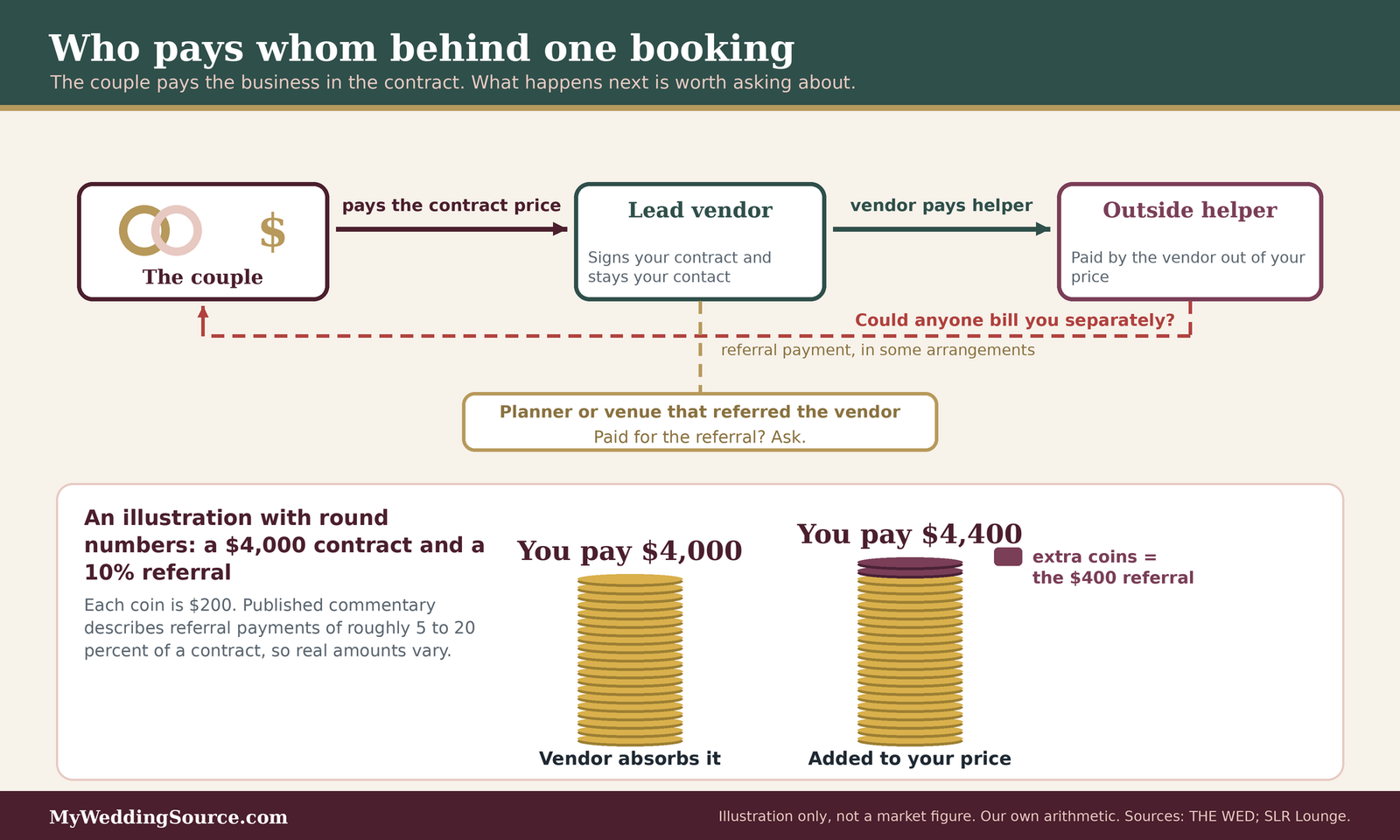
In the ordinary case you pay your vendor and your vendor pays the helper.
One price or a separate bill
Ask whether the quoted price includes every person and every third-party cost, and whether any helper or partner can bill you separately. If a third party will bill you, ask what the service is, what it costs, and when it is due. A line in the contract that says “all labor and third-party services are included in the price” removes the ambiguity. This is the first money question to raise about wedding vendor subcontractors.
Who you pay and when
Pay the business named in the contract, using a method that leaves a record, and be wary of paying a helper directly in cash unless the contract says to. If you pay an outside party directly for any reason, ask for a receipt and a written description of the service. Our wedding budget guide helps you track what is in each quote. Payment trails are easier to follow when wedding vendor subcontractors are listed in the contract.
What it can cost
The following is an illustration, not a quote or a statistic. Suppose a florist’s contract is $4,000 and the planner who referred the florist is promised a 10 percent referral. If the florist absorbs that payment, you pay $4,000. If the florist adds it to your price, you pay $4,400 for the same flowers. Published commentary describes referral payments of roughly 5 to 20 percent of a contract (THE WED, July 2026, and SLR Lounge), so the difference could be larger or smaller in your case. Where a vendor hires a subcontractor, ask whether the subcontractor’s cost is inside your quote, and ask for a credit in writing if a lower-tier replacement is used. Our own arithmetic here is an estimate.
Referral payments and recommendations
Subcontracting and referrals are different things, but they often sit side by side, so the worksheet in this guide asks about both.
What published sources say
THE WED, a wedding publication, reports that a planner or venue may receive roughly 5 to 20 percent of a vendor’s contract for sending business over, that “recommended” can mean either a real track record or a paid placement, and that couples are rarely told which. It presents this as a common practice and says the answer is disclosure, not alarm. SLR Lounge, a photographer-focused site, takes a harder line, calling planner kickbacks of 5 to 20 percent a conflict of interest and advising readers to walk away from planners or venues that collect them. Those are different opinions from different sides of the industry, and you can ask the same questions whichever view you hold. Our wedding planner commission disclosure guide goes deeper on the planner side. These sources show that referral money and wedding vendor subcontractors often arise in the same conversation.
What the FTC guides say, and what they do not
The Federal Trade Commission’s Endorsement Guides, 16 CFR Part 255, say that when an endorser has a connection to a seller that audiences would not expect and that could affect how much weight they give the endorsement, the connection should be disclosed clearly and conspicuously. The rule lists payments and free or discounted products among such connections, and says an advertiser can be liable for failing to disclose unexpected connections with its endorsers. The FTC’s question-and-answer guidance adds that affiliate commissions should be disclosed near the link. These rules are about endorsements in advertising. Whether a particular planner’s private referral arrangement falls within them is a legal question we cannot answer. We cite them because the principle is useful to borrow: if a payment could change how much you trust a recommendation, you should know about it.
Venue fees, preferred lists, and exclusive arrangements
Some venues set rules about which vendors may work on their grounds, and the rules can interact with subcontracting.
Preferred lists and facility fees
SLR Lounge describes pay-to-play preferred lists and venue “facility fees” charged when a client hires a vendor who is not on the venue’s list, with an example of a 5 percent fee. Ask your venue in writing whether outside vendors are allowed, whether any fee applies, and who pays it. If a vendor says a fee will be passed to you, that should be in your contract. Fees like these can touch wedding vendor subcontractors as well as the primary vendor.
Exclusive vendor requirements
The same source describes exclusive arrangements in which every event at a venue must hire from a single list. If your venue works that way, you may find that your vendor’s helper is also chosen by the venue. Ask who selects the helper, who they answer to, and what happens if they miss the event. Ask the venue to confirm in writing which vendors it requires and why. Exclusive lists can decide which wedding vendor subcontractors you end up with.
The worksheet: who is actually delivering the service?
This is the working part of the guide. It is a six-part form you can copy into a document or spreadsheet and send to each vendor. Each part has a short table with the question, a space for the vendor’s answer, and a space for where that answer appears in writing. The aim is not to catch anyone out. It is to reach a point where you can say, for each vendor, who does what, who is paid by whom, and what happens if the plan changes.
How to use the worksheet
A short explanation of timing and tone helps the worksheet land well.
When to send it
Send the worksheet after you have shortlisted a vendor and before you sign, or before you pay a deposit if the contract is already in your hands. If you have already signed, send it anyway, and ask the vendor to confirm the answers by email. If the answers differ from the contract, ask for an addendum. Our vendor due diligence checklist fits alongside this form as the broader check on a vendor. This form is built around wedding vendor subcontractors, so it works for every vendor type.
What a good answer looks like
A good answer names people or roles, says what each does, says whether each is an employee or outside, and points to the contract clause or email that records it. It does not need to be long. A vendor who answers briefly and specifically is giving you what you asked for. A vendor who answers vaguely, or declines to answer, is giving you information of a different kind. A clear answer about wedding vendor subcontractors is brief and points to a clause.
The six-part worksheet
Copy each table as is, and add rows for your own vendor type. Leave the “Their answer” and “Where in writing” columns blank for the vendor to fill in.
Part A: Who we are booking
Use this part to pin down the legal business and the person you believe you are hiring.
| Question | Their answer | Where in writing |
|---|---|---|
| What is the exact legal name of the business that signs the contract? | ||
| Who is the owner, and will the owner personally attend our event? | ||
| Which named person will lead our event, and what is their role? | ||
| Is the person we met the person who will deliver the service? | ||
| Did we choose this vendor for one person’s style, and is that person named in the contract? |
Part B: Who will be on site
Use this part to list every person or business who will take part, with their relationship to the vendor.
| Role | Name or business | Employee, contractor, or partner business | Arrival and departure time |
|---|---|---|---|
| Lead | |||
| Second or associate | |||
| Assistant or day-of helper | |||
| Outside specialist (bar, install, sound) | |||
| Delivery or rental partner |
Part C: What is subcontracted
Use this part for the pieces of the work that someone outside the vendor’s own team will do.
| Question | Their answer | Where in writing |
|---|---|---|
| Which parts of our order will be done by someone outside your own team? | ||
| Who is the person or business, and have we seen their work? | ||
| Do you remain responsible to us for that work? | ||
| Is the cost included in our price, or could that party bill us separately? | ||
| Can we approve or decline a replacement for that party? |
Part D: Referral and compensation
Use this part to ask whether anyone is paid for recommending the people involved. Our guide to planner commission disclosure explains the planner side in more detail.
| Question | Their answer | Where in writing |
|---|---|---|
| Did a planner, venue, or other vendor refer you to us, or us to you? | ||
| Does anyone receive a commission, referral fee, discount, or gift for that referral? | ||
| Is any such payment included in our price or added to it? | ||
| Do you pay any fee to be on a venue’s or planner’s preferred list? | ||
| Will you confirm the answers above in our contract or by email? |
Part E: Insurance and licensing
Use this part to ask who is covered, and keep your questions about the venue’s rules separate.
| Question | Their answer | Where in writing |
|---|---|---|
| Can you send a certificate of insurance showing coverage dates that include our event? | ||
| Are outside helpers covered under your policy, or do they carry their own? | ||
| Can the venue be named as an additional insured, and can we see the endorsement? | ||
| Does anyone on site need a license or permit for their part of the work, and who holds it? | ||
| What does the venue require from you, and have you met it? |
Part F: If the plan changes
Use this part to settle what happens before it needs settling.
| Question | Their answer | Where in writing |
|---|---|---|
| If the named person cannot attend, who replaces them? | ||
| How soon will you tell us, and can we decline the replacement? | ||
| Will the replacement have comparable experience, and how will you show us? | ||
| What happens to the price if a lower-tier replacement is used? | ||
| What happens if no replacement is available? |
A short message to send with the worksheet
A friendly note makes the worksheet feel like routine planning.
A message you can adapt
“Hello, we are excited about working with you. As we finish our planning file, we are asking every vendor to complete a short form about who will be involved on the day, including any outside helpers or partners, and how substitutions work. It is a routine step for us, and it helps us build a single schedule for everyone. Could you fill it in by [date], and tell us which parts you would prefer to discuss by phone? Thank you.”
If the vendor declines or is vague
Some vendors will say the form is unnecessary or that answers are proprietary. You can offer to narrow it to Parts B, C, and F, which concern who is present and what happens if they are not. If the vendor still will not say who is performing the work or whether outside parties are involved, you have learned something relevant to your decision. Our wedding vendor contract guide discusses how to weigh vagueness against the rest of the picture.
Edge cases that change the answer
Real arrangements rarely fit a tidy chart. These cases come up often enough in vendor conversations to be worth thinking through, and the reasoning applies even where we have no published statistics to cite.
The vendor is a platform, an agency, or a broker
When you book through a company that coordinates many providers, the contract partner and the performer are almost always different.
Read the booking terms for the word “provider”
Look for wording such as “independent providers,” “pool,” or “assigned.” That language tells you the company sells a service level and assigns people later. It can be a reasonable model, particularly for standard services, and it is the one where a defined service level in the contract matters most. Platforms are a special case of wedding vendor subcontractors, because the whole team may be assigned later.
Ask when the name arrives and what choice you have
Ask when you will learn the provider’s name, whether you can see their work in advance, and whether you may decline an assignment. Put the answers in an email so there is a record. If you are booking for a specific person’s style, this model may not suit you.
The vendor is a planner who engages other vendors
A planner may hire day-of helpers, bring in a coordinator for the day, or manage a set of vendors on your behalf.
Who contracts with whom
Ask whether you will sign directly with each vendor or whether the planner will hold the vendor contracts. If the planner holds them, ask whether you can see each contract and whether the planner is paid by the vendors. Our guide to planner versus coordinator roles explains how the roles divide, and our wedding planner commission disclosure guide covers pay models. A planner who engages others adds another layer of wedding vendor subcontractors to understand.
Whose staff run the day
Ask who runs the timeline on the day, whether they work for the planner or for a separate company, and who they answer to. Share the timeline with them in advance, and with each vendor.
The venue requires or controls certain vendors
A venue may require its own caterer, a house bar, or a list of approved vendors.
What the venue’s rules mean for your contracts
When a venue requires a vendor, the venue relationship sits alongside your contract with the vendor. Ask the venue to state in writing which vendors are required, what each charges, and who is responsible if one of them fails to deliver.
Compare the venue’s rules with your vendor’s
If your photographer, caterer, or DJ is also subject to the venue’s rules, ask them whether they have worked there and whether they are on a preferred list. Ask if any fee applies. Our venue questions guide is a good companion.
Your wedding is far from where the vendor is based
Destination weddings and rural venues change the logistics.
Local helpers on the day
A vendor who travels may hire local helpers near your venue, such as assistants, drivers, or installers. That can be sensible. Ask who they are, how the vendor chooses them, and whether they will be briefed before the day. Local help is a quiet source of wedding vendor subcontractors for destination events.
Licensing and local rules
Licensing, permits, and insurance rules can differ by location. Ask the vendor which rules apply and who is responsible. Our guide to wedding permits explains what couples commonly need to check, and a local attorney or the venue can confirm what applies to you.
The vendor is part of a family or friend arrangement
Some vendors are friends, relatives, or acquaintances who offer services at a discount or as a favor.
Informal does not mean unneeded
A friend who photographs or plays music may not have a contract, insurance, or backup plan. That is understandable, but the questions in this guide still apply in a lighter form: who will do the work, what happens if they cannot attend, and who is responsible for the equipment or the space. Even a friend’s help raises the same wedding vendor subcontractors questions in a lighter form.
Keep a short written note
Even a friendly arrangement benefits from a half-page note covering the date, the time, what is included, and what happens if plans change. It protects the friendship as much as the wedding.
When the named person cannot come: a plan before you need it
Illness, travel trouble, and emergencies happen to everyone. The substitution plan is what separates a stressful morning from a manageable one, and it is easier to agree on early.
Agree on the replacement before the day
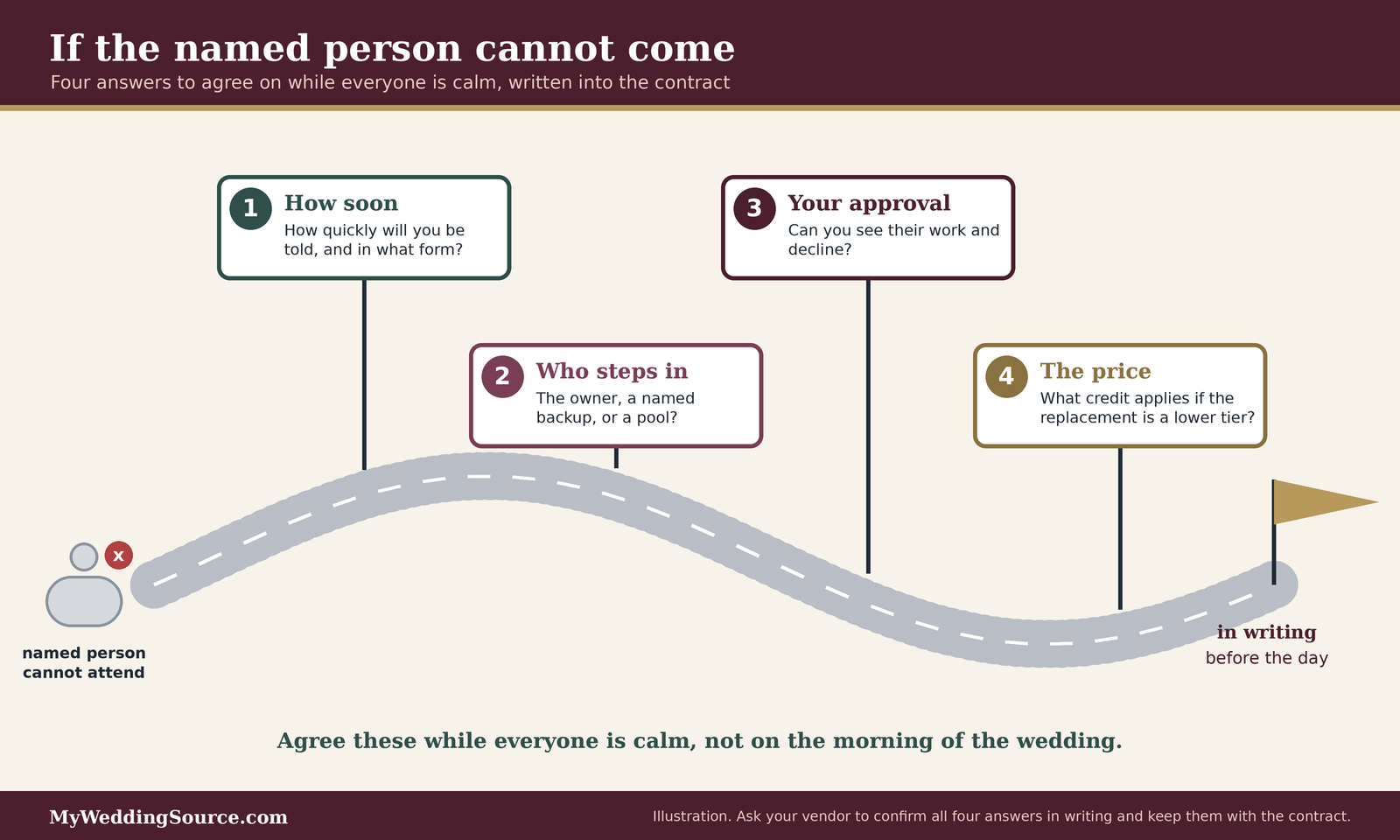
The best time to discuss a replacement is when everyone is calm and no one is in a hurry.
Ask for the process in writing
Ask each vendor to describe what they would do if the named person were unavailable: who would be asked first, how soon you would be told, how you could review the replacement’s work, and what you could decline. Julia Wade, quoted by WeddingWire, says a seasoned photographer has a network of colleagues who can cover a wedding and that the process should be in the contract. Our guide to a wedding vendor replacement policy covers this in more depth. A written process is the best answer to the problem of wedding vendor subcontractors who cannot attend.
Decide what you would accept
Think about what you would be comfortable with. Would you accept an associate of similar experience? A different person you can see in advance? A partial credit? Write your answers down before you need them so that a rushed phone call does not decide for you. Decide this for each of your wedding vendor subcontractors before the date.
Handling the day itself and what comes after
Plans can still change at short notice, and you should know who to call.
The call chain on the day
Give your planner, coordinator, or a trusted friend a list of vendor phone numbers and the names of each vendor’s backup contact. Our week-of checklist includes a reminder to confirm contacts a few days ahead, and our vendor timeline guide shows where each vendor fits into the schedule. Include contacts for wedding vendor subcontractors, not only for the lead vendor.
Afterward: record it and ask for the adjustment
If a replacement attended, write down what happened soon afterward, while the details are fresh. If the contract promised a particular person, ask for the adjustment the contract describes, and keep the exchange polite and factual. If the problem is serious, talk to an attorney or your state’s consumer protection office about your options. Our guide to wedding contract change orders explains how to document changes in writing.
A timeline for asking, from shortlist to the week before
The questions in this guide are easiest to ask at the right moment. This timeline keeps them from piling up.
Before you sign
Most of the leverage and most of the goodwill are available now.
At the first consultation
Ask who will deliver your service, whether the person you are talking to will attend, and whether anyone outside the team handles any part of it. Take notes, and ask to see the contract. These questions are normal and cost nothing. Mention wedding vendor subcontractors in the first ten minutes, and the rest of the process gets easier.
With the contract in hand
Read for names, roles, delegation language, substitution language, insurance, and fees. Send the worksheet. Ask for edits in writing. If a clause is unclear, take it to an attorney before you sign. Our guide to wedding vendor contracts walks through the other terms to read. Contract language about wedding vendor subcontractors is easiest to fix before signing.
After you sign
Keep the thread alive, so there are no surprises near the date.
Two to three months before
Ask each vendor to confirm the roster and arrival times in writing, and send your timeline. If anything changed from the worksheet, ask for an addendum. Check that insurance certificates cover the date and the venue. Roster changes at this stage are a common source of wedding vendor subcontractors you did not expect.
The final weeks
Reconfirm contact numbers, load-in details, and the backup contact. Check that each vendor has your timeline and the venue’s rules. Our vendor meals guide reminds you that helpers need to eat, and that number needs to be on the final headcount.
Questions to ask before you pay
Use these as a short version of the worksheet in a first call, or as a final check before a deposit.
Questions worth asking each vendor
- Who will personally perform each part of our service, and is that written in the contract?
- Which parts, if any, are done by someone who is not on your own team?
- Do you remain responsible to us for the work of anyone you bring in?
- Is every person and third-party cost included in our price, or could anyone bill us separately?
- Does anyone receive a commission, fee, discount, or gift for referring you to us?
- Do outside helpers carry their own insurance, or are they covered by yours, and can we see the certificate?
- If the named person cannot attend, who replaces them, how soon will we know, and can we decline?
- What happens to the price if a lower-tier replacement is used?
Questions for your vendors
These questions go to the person who signs the contract.
About people and work
Ask for the lead’s name and role, the roster for the day, and which pieces are handled by outside parties. Ask how the vendor briefs helpers on your timeline, and who will be the single decision-maker on the day. Answers about wedding vendor subcontractors should be specific, not general.
About paper and money
Ask for the contract clause that records each answer. Ask whether any third party can bill you, whether any referral payment is included in the quote, and what credit applies if a replacement is of lower tier.
Questions for your planner or venue
These questions go to the people who recommended or require vendors.
About recommendations
Ask how the planner or venue chose each recommended vendor, whether any fee or commission is paid for the referral, and whether it affects your price. THE WED suggests these questions and says a professional acting in good faith should welcome them.
About requirements
Ask whether outside vendors are allowed, whether any fees apply, what insurance the venue requires, and whether any vendor is mandatory. Ask for the answers in writing and keep them with your contracts.
FAQ: wedding vendor subcontractors questions
Is it normal, and do I have the right to know?
Is it normal for wedding vendors to use subcontractors?
It is a recognized business practice, and published guidance for photographers openly describes associates and second shooters. We could not find national statistics on how common it is across all vendor types. Treat it as neither a red flag nor a secret: ask who does what, and ask to see the answer in the contract.
Am I entitled to know who is doing the work?
You are entitled to ask, and a vendor who values your business should answer. Whether a particular state or contract requires disclosure is a legal question that depends on the facts, so we cannot say yes or no. A written answer before you sign is reasonable to request, and it protects both sides.
What the contract and insurance should say
Can my vendor send someone else in their place?
It depends on the contract. A business-law textbook on Saylor Academy’s site says duties can often be delegated unless the contract or the nature of the service forbids it, and personal services may be treated differently. If you rely on one person, name them in the contract and require your approval for a replacement.
If the vendor hires a helper, who is responsible for mistakes?
The same textbook says a party that delegates a duty generally remains liable unless the contract provides for substitution or the other side releases them. Ask the vendor to confirm in writing that they remain responsible for anyone they engage, and take the contract to an attorney if the wording is unclear.
Does the vendor’s insurance cover their subcontractor?
Not necessarily. A policy covers the named insured, and whether it extends to non-employee helpers depends on the policy. Ask for a certificate showing dates that include your event, ask whether helpers are covered or carry their own, and confirm details with the insurer or an insurance agent.
Pay, referrals, and problems
Should I pay a subcontractor directly?
Usually you pay the business named in your contract and let the vendor pay their helpers, unless the contract says otherwise. If a third party asks for payment, ask what the service is, who they are, and whether it is already in your price. Keep receipts and written descriptions of anything you pay directly.
Does a planner’s referral fee have anything to do with subcontractors?
They are separate, but they often overlap. A planner may recommend a vendor, who then brings in a helper. THE WED reports that referral payments of roughly 5 to 20 percent are described in the industry. Ask both questions: who is doing the work, and does anyone receive payment for the referral?
What if the vendor refuses to say who will be involved?
Offer to narrow your questions to who will be on site and what happens if they cannot attend. If the vendor still declines, that is relevant information for your decision. If you have already signed, ask for an addendum, and consider asking an attorney about your options, since the answer depends on your contract and state.
Your next steps
Start the paper trail
The sooner the worksheet is out, the easier it is to adjust your plans if the answers surprise you.
Send the worksheet to your shortlist
Copy the six-part worksheet into a document and send it to each vendor on your shortlist with the short message above. Compare the answers side by side, and note which are in writing. Our wedding vendor due diligence checklist fits with it as a broader check on each vendor. The worksheet makes wedding vendor subcontractors easy to compare across vendors.
Add the answers to your contracts
If an answer matters, ask the vendor to put it in the contract or an addendum. Names, roles, substitution terms, and price credits are the pieces most worth recording. Our guide to wedding vendor contracts covers the rest. Written terms are the only reliable record of how wedding vendor subcontractors are handled.
Keep the plan current
A good plan needs checking as the date approaches.
Reconfirm the roster before the date
Two to three months out, ask each vendor to confirm the roster, arrival times, and insurance in writing. Use the wedding planning checklist to track what is done and what is waiting.
Share one schedule with everyone
Build a single timeline and send it to every vendor, helper, and your planner or coordinator, so that outside helpers receive the same information as the owner. Our wedding vendor timeline guide shows how to build it.
Sources & methodology
How we built this guide
What we relied on
This guide draws on federal guidance for endorsements and material connections, the IRS description of how it distinguishes employees from independent contractors, a business-law textbook on delegation of contract duties, wedding-industry commentary on referral payments and preferred vendor lists, contract guidance written for photographers, and insurance trade and seller explanations of certificates and additional insured status. We read the pages listed below on November 12, 2026. Where a statement comes from a seller, a vendor-focused publication, or a single author’s opinion, we say so in the text. The $4,000 and 10 percent example is our own illustrative arithmetic and an estimate, not a market figure. The five setups and the six-part worksheet are our own framework, not an industry standard.
What we did not do
We did not test any vendor’s practices, review any contract, or find national statistics on how often wedding vendors subcontract. This guide is general education and not legal, insurance, tax, or financial advice. Contract, consumer, licensing, and insurance rules differ by state, and a licensed attorney or insurance professional can advise on your situation.
Source list
Government and regulatory sources
- Federal Trade Commission, Guides Concerning the Use of Endorsements and Testimonials in Advertising, 16 CFR Part 255 (eCFR): https://www.ecfr.gov/current/title-16/chapter-I/subchapter-B/part-255
- Federal Trade Commission, The FTC’s Endorsement Guides: What People Are Asking: https://www.ftc.gov/business-guidance/resources/ftcs-endorsement-guides-what-people-are-asking
- Federal Trade Commission, Disclosures 101 for Social Media Influencers: https://www.ftc.gov/business-guidance/resources/disclosures-101-social-media-influencers
- Internal Revenue Service, Independent contractor (self-employed) or employee: https://www.irs.gov/businesses/small-businesses-self-employed/independent-contractor-self-employed-or-employee
Legal, insurance, and professional sources
- Saylor Academy, Business Law and the Legal Environment, 14.2 Delegation of Duties: https://saylordotorg.github.io/text_business-law-and-the-legal-environment-v1.0/s17-02-delegation-of-duties.html
- Insurance Journal, The Additional Insured Illusion (March 23, 2026): https://amp.insurancejournal.com/magazines/mag-features/2026/03/23/862422.htm
- Insureon, Certificate of liability insurance for vendors: https://www.insureon.com/small-business-insurance/certificate-of-liability-insurance/vendor
- Rocket Lawyer, Wedding contract legal terms and clause definitions: https://www.rocketlawyer.com/blog/wedding-contract-legal-terms-and-clause-definitions-925843
Wedding-industry and photographer-focused sources
- THE WED, Why Do Some Wedding Vendor Recommendations Come With a Price Tag? (July 2026): https://thewed.com/magazine/why-some-wedding-vendor-recommendations-come-with-a-price-tag
- SLR Lounge, 5 Things Every Bride and Groom Needs to Know About Preferred Vendors and Vendor Lists: https://www.slrlounge.com/5-things-every-bride-groom-needs-know-preferred-vendors-vendor-lists/
- The Legal Paige, Things to be aware of legally when hiring an associate photographer: https://thelegalpaige.com/blogs/blog/things-to-be-aware-of-legally-when-hiring-an-associate-photographer
- Photography Life, Hiring a second shooter for wedding photography: https://photographylife.com/hiring-a-second-shooter-for-wedding-photography
- WeddingWire, Everything You Need to Know About a Wedding Photography Contract: https://www.weddingwire.com/wedding-ideas/wedding-photography-contract