

Planning a wedding with an immunocompromised guest comes down to three things done early and calmly: asking the person what they need, lowering the everyday infection risks that a wedding creates (shared air, shared food, shared surfaces, sick guests), and writing the plan down so that vendors and family members can carry it out without you.
Quick answer
When you are planning a wedding with an immunocompromised guest, ask the guest privately what would help, and let their answers, and their medical team’s advice, set the plan. Then work through the layers in this order: a sick-guest policy, cleaner air, safer food service, handwashing stations, a seat and an exit route that suit them, and optional masks and testing. The Centers for Disease Control and Prevention (CDC) lists vaccination, hygiene, cleaner air, and staying home when sick as the core strategies for everyone, with masks, distancing, and testing as added layers for higher-risk situations. This guide does not give medical advice. The guest decides what they can safely attend, and a wedding can still go ahead with kindness, small changes, and clear communication.
Who counts as immunocompromised, and why a wedding is different
Most guest-planning advice assumes that the main question is comfort. For a guest with a weakened immune system, the main question can be health, which changes what “welcoming” looks like. Before you design anything, it helps to understand what the term covers and what a wedding adds to the picture, because planning a wedding with an immunocompromised guest is not the same as planning around a preference.
What “immunocompromised” can mean
The phrase is a broad label, not a single diagnosis. Two guests who both use it may need completely different things from you, and neither owes you a medical explanation for what they ask.
Conditions and treatments
The CDC’s clinical guidance on underlying conditions lists several immune-related categories in its higher-risk group, including primary immunodeficiencies, solid organ or blood stem cell transplant, HIV, blood cancers, and treatment with corticosteroids or other immunosuppressive medicines. The U.S. Food and Drug Administration (FDA) adds that cancer, diabetes, HIV/AIDS, autoimmune diseases, and organ transplants can all weaken immunity, either through the disease itself or its treatment. A guest may be immunocompromised because of a condition they have had for years, a treatment that ends in a few months, or a medication they take every day and rarely mention.
Risk is a range, not a label
The CDC describes some people as “moderately or severely immunocompromised” and does not define the levels on its clinical conditions page. Your guest knows where they fall, and their care team can say what is safe. The CDC page also stresses that its list should not be used to exclude people with these conditions from prevention or treatment, which is a useful reminder for hosts: the goal is to include the guest, not to decide for them. If you are unsure how cautious to be, ask. Guessing in either direction tends to go badly.
What a wedding adds
A wedding stacks several infection-related risk factors into one day. None of them is a reason to cancel a celebration, but each is a place where a small decision can help.
Time, proximity, and shared air
Weddings bring many people together for hours, often indoors, often with hugging, singing, and loud conversation that happens at close range. Guests may have traveled from several regions, and some arrive tired or with a scratchy throat they have decided to ignore. The CDC’s prevention page for respiratory viruses points to cleaner air as a core strategy and treats distancing and masks as added layers, which matches the way a wedding actually works: you can improve air and sick-guest rules for everyone, and offer the rest as options.
Food, hands, and travel
Food is the other major pathway. Buffets, shared serving utensils, raw items on a grazing table, and long gaps between setup and service all matter more when immunity is lower. Travel adds hotel rooms, rental cars, airport crowds, and shared rides. The sections below treat each of these separately so that you can decide what is worth changing for your guest and your event.
Planning a wedding with an immunocompromised guest starts with the person, not a policy
The most common mistake is to build a set of precautions first and then present it to the guest. A better order is to ask what they need, and then build around that. This protects their autonomy and often saves you effort, because guests regularly say that two or three small changes are all they require.
Ask before you assume
A short private conversation does more than a long document when you are planning a wedding with an immunocompromised guest. It also avoids the awkwardness of discovering at the reception that the seat you chose is beside the buffet line.
Who should ask
Ask the way you would ask about any need, with one person you both trust, and one time. For a close friend or relative, one of you can call. For a more distant guest, a short, warm note works better than a surprise conversation at a party. If the guest has shared their situation with someone in your family, ask that person to introduce the topic only if the guest is comfortable with it. Avoid asking a third party for the guest’s medical details.
What to ask
Open questions leave room for the guest to answer as much or as little as they like. For example: “We would love you there. Is there anything that would make the day easier for you?” Follow with practical prompts, not diagnostic ones: whether a particular part of the day matters most to them, whether they would prefer to arrive after the ceremony or leave before the dance floor opens, whether they would like a seat near an exit or an outdoor option, and whether they would like to bring their own food or a companion. If they say they are not sure yet, offer to check in again closer to the date.
Respect privacy
Health information is personal, and nothing about hosting a wedding gives you a right to it. This guide does not give legal advice, and privacy rules differ by situation, so treat the following as a courtesy standard rather than a legal one.
Keep a small circle of people who know
When planning a wedding with an immunocompromised guest, share the guest’s needs with the few people who must act on them, such as your planner or day-of coordinator, the catering manager, and one trusted family member. Share the need (“a seat near the door, plated food, a quiet place to rest”), not the reason. Your coordinator does not need to know a diagnosis to hold a table.
Do not announce, explain, or single the person out
Avoid describing the guest’s health to other attendees, to your wedding party, or in a toast. If another guest asks why there is a handwashing station by the entrance, the answer is simply that you wanted everyone to feel comfortable. Seating cards, signs, and the program should not mention a medical reason for any individual.
When the guest cannot come, or chooses not to
Sometimes the answer will be no, and the most helpful thing you can do is make that answer easy to give. A guest should never feel they are letting you down by looking after their health.
Make declining easy
Say plainly that you will understand any decision, and mean it. A guest who feels pressure may attend against their doctor’s advice, or may stay away and feel guilty. A line such as “Whatever works for your health is the right answer, and we will not be offended” removes the pressure without drama.
Include them in other ways
You can share the ceremony through a livestream, arrange a small visit before or after the wedding, send a photo album, or save a dish from the menu to share later. Our guide to wedding photography explains how to request a short ceremony clip or a set of portraits, and our accessible wedding guest experience guide covers the wider needs-first approach to guest comfort.
Planning a wedding with an immunocompromised guest in layers
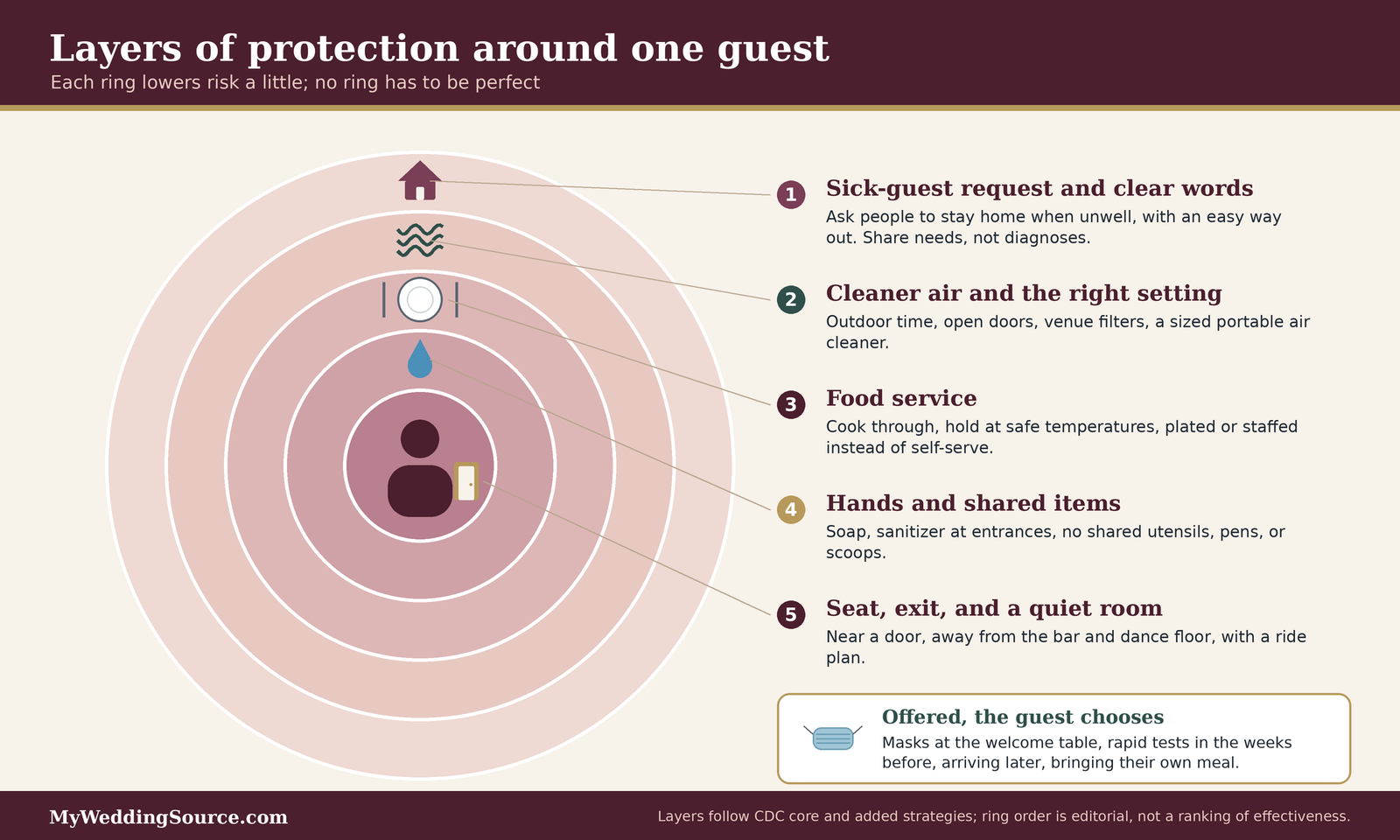
No single measure removes risk, and no single measure is required. The most useful way to think about planning a wedding with an immunocompromised guest is as a set of layers, each of which lowers risk a little, so that missing one does not undo the rest. Public-health guidance is built the same way.
Why layers work better than rules
Planning a wedding with an immunocompromised guest rarely needs strict rules. A layered plan is easier to carry out than a long list of rules, and it gives you somewhere to retreat if a layer turns out to be impractical.
No single measure does everything
The CDC’s page on preventing respiratory viruses describes the core strategies as keeping up with vaccinations, washing hands and cleaning frequently touched surfaces, improving air quality, and staying home when sick. It lists masks, physical distancing, and testing as additional strategies that add protection and matter most in certain settings or when illness is rising in your community. For people at higher risk, it says that prevention is especially important and that, if you are unsure about others’ risk, the additional strategies are the most protective option.
Layers you control and layers you offer
Some layers are entirely in your hands: the venue, the food service, the schedule, the seating, the sick-guest policy. Others are things you offer and the guest chooses, such as masks, a pre-event rapid test, an earlier arrival, or their own food. Keeping those two groups separate prevents you from imposing measures on the whole guest list that only one person needs.
Build the plan in order of effort
Start with the changes that cost nothing and affect everyone, and add effort only where the guest asks for it. This also keeps the plan proportionate, which matters for tone as much as for budget.
No-cost changes
These are decisions you make with a phone call or a line of text: a clear request that anyone who is sick stay home, a seat near an exit, a handwashing reminder on the program, an agreement with the caterer about serving utensils, and a quiet place to rest. For most weddings these cover a large share of what a guest will ask for.
Small-cost changes
These involve modest spending: individual servings or a plated course in place of a self-serve line, a portable air cleaner in a key room, wall-mounted sanitizer stations, supplied masks and rapid tests in a basket, and a private car for the guest and a companion. Our wedding catering service planning guide explains how service style affects staffing and price.
Structural changes
These change the shape of the event: moving the ceremony outdoors, choosing a venue with better air handling, shortening the guest list or the evening, or splitting the celebration into a small ceremony and a larger party. They are worth considering early, because they are hard to change once contracts are signed. If a smaller event appeals to you for other reasons, our micro wedding planning and small wedding planning guides cover how to scale down well.
A planner for the layers
Use the table below as a working sheet. It lists the layers in this guide, who normally owns each one, and whether it needs the guest’s agreement. The cost column is a rough guide to effort, not a quote, and prices vary widely by region and vendor.
| Layer | What it addresses | Who usually owns it | Needs the guest’s say? | Rough effort |
|---|---|---|---|---|
| Sick-guest request | Contagious guests, wedding party, vendors | Couple and coordinator | No | Free |
| Cleaner air | Shared indoor air | Venue and couple | Sometimes | Free to moderate |
| Outdoor option | Ceremony, cocktail hour | Couple and venue | Yes | Free to high |
| Food service | Raw and risky foods, holding temperatures | Caterer | Yes | Low to moderate |
| Hand hygiene | Hands and shared surfaces | Venue and couple | No | Low |
| Seat and exit | Distance from crowds, easy departure | Couple and coordinator | Yes | Free |
| Masks and tests | Added personal layers | Guest, with supplies from couple | Yes | Low |
| Ride plan | Shared transport | Couple and guest | Yes | Free to moderate |
How to use the planner
Print it, and write the guest’s name at the top. Go through each row with them and mark it yes, no, or later. A row marked “no” is a real answer and should not be argued. If the guest asks for something that is not in the table, add a row.
What to do when a layer is not available
A venue may not be able to change its air handling, or a caterer may only offer a buffet. In that case, strengthen another layer. A guest who cannot avoid a buffet can have a plated plate prepared in the kitchen. A guest who cannot get cleaner indoor air can spend more of the day outdoors and arrive after the ceremony. The goal is a sensible total, not a perfect score on every row.
Choosing the setting and schedule when planning a wedding with an immunocompromised guest
Where and when the event happens affects every other layer. The right choices at this stage can make later decisions simple, and the wrong choices are expensive to reverse.
Outdoors, indoors, or both
Open-air spaces are not risk free, and in planning a wedding with an immunocompromised guest they deserve a close look, but the sources that address gatherings point to them as a gentler option than crowded rooms.
Why outdoor spaces help
Families Fighting Flu, a nonprofit advocacy group, suggests open-air gatherings such as backyard events or park picnics, because fresh air may reduce the spread of respiratory illness compared with crowded indoor spaces. That is a general suggestion, not a guarantee, and it does not replace advice from the guest’s care team. For a wedding, it supports a practical split: hold the ceremony and cocktail hour outside when the venue allows, and move indoors only for dinner and dancing. Our outdoor wedding venues guide covers what to look for in an outdoor site.
Why indoor spaces need a plan
An indoor reception can work well with proper air handling, a sensible capacity, and seating that keeps the guest away from the busiest areas. The sections that follow explain what to ask about. If your only option is a small, crowded indoor space, consider whether the guest might choose to attend only the ceremony.
What tents and hybrid layouts change
A tent with open sides behaves very differently from one that is fully closed. If the plan includes a tent, ask the rental company how many sides can stay open and whether it can add fans to move air through the space. Our outdoor wedding infrastructure checklist covers the equipment side of this.
Season, timing, and length
Schedule decisions are the least visible protection and sometimes the most effective.
When illness is rising in your community
The CDC says that masks, distancing, and testing matter most when illness is rising in your community. You cannot predict that months ahead, but you can build flexibility: ask the guest which signals they watch, share your plan to check in a week or two before the wedding, and keep masks and tests on hand. Local health departments publish current information. Your guest’s care team may have its own thresholds, and those take priority over general advice.
Shorter exposure windows
A guest who cannot manage a six-hour event may be fine for a ninety-minute window. Consider printing the program so that the guest can see when the ceremony ends and the toasts begin, and tell the coordinator which part matters most to them. For hot-weather events, our summer wedding heat plan explains how to build shaded and cooled spaces, which also give guests a place to step away.
Guest count and density
Crowding affects both air and the number of people who might arrive unwell.
Smaller guest lists
A smaller event has fewer contacts, fewer unknown illnesses, and fewer people to remind about hand hygiene. That is not a reason to shrink your list, but it is a reason to mention the option if your guest is a central person. Some couples hold the ceremony with a small group and the party a few months later.
Room layout and table spacing
You can often lower density without lowering the guest count by using the whole room: spreading tables, placing the bar and the dessert station away from the main walkway, and making the entrance wide enough that people do not queue. A reception floor plan shows how to test the room before you commit, and our wedding venue capacity guide explains how a stated capacity compares to a comfortable one.
Air and ventilation: what to ask the venue about
Air is the least visible layer in planning a wedding with an immunocompromised guest, and the one hosts most often leave to chance. You do not need to become an engineer. You need a handful of good questions and the willingness to accept a straightforward answer.
Ask about the room’s air
Venue staff are often asked about capacity and catering, and rarely about air, so expect some blank looks. A friendly, specific request works better than a technical one.
Filters and outdoor air
The National Institute for Occupational Safety and Health (NIOSH), part of the CDC, says that code-minimum ventilation may not be enough in crowded spaces or when illness is spreading widely. It recommends filters rated MERV 13 or higher where the heating and cooling system can handle them, and notes that MERV 8 filters capture far fewer of the small particles linked to respiratory viruses. Ask the venue what filter rating its system uses, whether it brings in outdoor air, and whether it can set the system to run before and during your event. Some venues will not know the answer, and a manager who offers to find out is a good sign.
What carbon dioxide monitors can and cannot tell you
NIOSH notes that carbon dioxide (CO2) monitors can show whether a space is getting enough fresh air, but they do not measure infection risk. It suggests portable meters over fixed wall sensors, comparing readings against a baseline, and treats 800 parts per million as one possible target, not a universal one. A coordinator can bring a small meter to your final walkthrough and note the reading with a full room, but treat the number as one clue, not a verdict.
Portable air cleaners
A portable air cleaner is the most common add-on for a room you cannot change. The sources are clear on both its value and its limits.
Sizing a unit
The Environmental Protection Agency (EPA) says that many portable cleaners reach high particle-removal rates with HEPA filters, and that the Clean Air Delivery Rate (CADR) shows how many particles a unit removes and how large an area it serves. Its example is roughly 65 cubic feet per minute for 100 square feet and 390 for 600 square feet, assuming 8-foot ceilings, with higher ceilings needing more. NIOSH suggests that if only airflow is listed, you look for at least two-thirds of the room’s floor area in cubic feet per minute, and that several smaller units placed in higher-risk areas may work better than one large one. Floor area is length times width, so a 40-by-60-foot room is 2,400 square feet, and two-thirds of that, about 1,600 cubic feet per minute, is a rough planning figure of our own, which you should check against the unit’s rating.
Placement, noise, and ozone
The EPA advises leaving airflow unobstructed and away from curtains, and notes that noise depends in part on fan speed. It also cautions against devices that intentionally produce ozone, a lung irritant, and notes that some ionizers and other technologies may emit it. NIOSH points to UL 2998 zero-ozone certification and asks for independent performance data on newer technologies. A unit placed beside the guest’s table will not help much if it is also blasting the cake table, so decide where the guest will spend the most time and place the cleaner there.
Windows, doors, and fans
Simple airflow steps cost almost nothing and can be done in any room that has an opening.
Moving air without drafts
NIOSH says fans cannot replace outdoor air, but they can improve room mixing and make open windows more effective, and it recommends low speeds and avoiding airflow that blows directly from one person onto another. For a wedding, that usually means opening doors during cocktail hour, keeping a side door cracked during dinner if the weather allows, and aiming fans along the room, not across tables.
Rental and venue conversations
Ask the venue whether doors and windows can be opened, whether fans are allowed, and whether it permits a guest-supplied air cleaner. Put the answers in an email so that the day-of staff can find them. Our wedding venue questions guide has a wider list for the first tour.
What this can cost
Most of the layers involved in planning a wedding with an immunocompromised guest are free or cheap, and the main variable is the air-cleaning equipment. Prices for portable air cleaners vary by size, brand, and filter type, so we do not quote a figure: check the manufacturer’s CADR rating against the EPA sizing example above and compare at least two options. Many couples rent or borrow equipment, or ask the venue what it already owns. If a guest has asked for a measure that costs money, such as a private car or an extra plated course, say plainly who is paying, and do not leave the guest to cover an expense that you asked them to incur. Prices and availability change, so confirm current figures with each vendor before you commit.
Food, drink, and the catering line for an immunocompromised guest
In planning a wedding with an immunocompromised guest, foodborne illness is a separate risk from respiratory illness, and it is one where a caterer’s habits matter more than a guest’s. The good news is that most of what helps is ordinary good practice that a professional kitchen already knows.
What federal guidance says about higher-risk foods
The FDA’s page on people at risk of foodborne illness names people with weakened immune systems among the groups for whom infections can be more serious, and lists foods that these groups are advised to avoid or handle with extra care. This is general consumer guidance, not an individual diagnosis, so your guest’s care team may give them a more specific list.
Foods the FDA lists for caution
According to the FDA, people in higher-risk groups should avoid raw or undercooked meat, poultry, and eggs; raw or partly cooked seafood and refrigerated smoked seafood; raw shellfish; unpasteurized milk and raw-milk cheese; queso fresco-type cheeses; unwashed fresh vegetables; unpasteurized juices; raw sprouts; and refrigerated pâtés. It says hot dogs, deli meats, cold cuts, and smoked fish should be eaten only if reheated until steaming hot, and it lists deli-prepared salads such as ham, chicken, or seafood salad. At a wedding, that translates into specific menu items: oysters on ice, a charcuterie board, sprout garnishes, soft cheeses, a raw bar, a smoked salmon canape, and house-made sauces made with raw egg.
Temperatures and the two-hour rule
The CDC’s food safety page gives minimum internal cooking temperatures of 145 degrees Fahrenheit for whole cuts of beef, pork, lamb, and fish, 160 degrees for ground beef or pork, and 165 degrees for all poultry and for leftovers and casseroles. It says perishable food should not sit out for more than two hours, or one hour when the air temperature is above 90 degrees, and that bacteria multiply quickly between 40 and 140 degrees. A summer outdoor reception is exactly the sort of setting where that one-hour limit matters, and our wedding grazing tables guide explains how to handle foods that sit out.

Service style
How food reaches the table matters as much as what is on it, because every shared spoon is a shared surface.
Buffets and self-serve stations
The American Cancer Society advises people with cancer to skip buffets and self-serve food stations as part of infection prevention. That is advice for one group, but the reasoning applies more widely: long holding times, shared utensils, and many hands on the same spoons. If you love the buffet format, there are middle paths, such as staffed stations where a server plates the food, or a plated course for the guest prepared in the kitchen. Our wedding catering guide explains the main styles.
Plated, family style, and individual servings
Plated meals keep food covered until it reaches the guest and avoid shared utensils. Family-style service passes platters from hand to hand, which can be harder for a guest who is trying to limit contact. Individually wrapped or portioned items, such as small desserts in cups or boxed late-night snacks, remove the issue. For other situations where service style matters, see our family-style service for long tables guide and the dessert bar versus wedding cake comparison.
Talking to your caterer
Caterers hear dietary requests every day, and a clear, specific request is easy for them to meet. A vague request, such as “keep it safe,” is not.
What to ask
Ask which menu items use raw or undercooked ingredients, how the kitchen measures temperatures for hot and cold holding, how long food will sit out between setup and service, whether the cake, sauces, and dressings use pasteurized eggs, and whether a dish can be prepared separately for one guest. Ask also who will handle the guest’s plate, and whether servers wash their hands or change gloves between tasks. For the wider conversation, our wedding dietary restrictions guide describes how to put requests in writing.
How to keep the guest comfortable
Do not announce the plate at the table. Ask the guest whether they would like to see the menu in advance, and whether they prefer a separate plate or a quiet word from a server. If they would rather bring their own meal, let them, and make sure the venue’s policy allows it. Food-safety needs vary by person, so the guest’s own list leads.
Drinks and ice
Bars add shared surfaces: ice scoops, garnish trays, communal pitchers, and condiments. Ask the bar team to use closed containers, tongs or scoops with handles, and individually poured drinks. Our wedding bar service planning guide covers the equipment side. Bottled water and single-serve beverages are a quiet safeguard for any guest who wants them.
This section covers the cheapest and most overlooked layers of planning a wedding with an immunocompromised guest. It also carries the most social friction, so wording and tone matter.
Handwashing and sanitizer
Clean hands are one of the simplest parts of planning a wedding with an immunocompromised guest, and the CDC treats hygiene as a core strategy.
What the CDC says about washing
The CDC says soap and running water are the best choice in most situations, and recommends scrubbing for at least 20 seconds. If soap and water are not readily available, it advises an alcohol-based hand sanitizer with at least 60 percent alcohol, which you can confirm on the label. Its list of times to wash includes before and after eating, after using the toilet, and after coughing or sneezing. A wedding gives guests several of those moments within an hour.
Where to put stations
Place sanitizer at the entrance, outside the restrooms, near the food, and beside the guest book and the gift table. Check that restrooms have soap, hot water, and paper towels before guests arrive. For outdoor sites, our portable restrooms for outdoor weddings guide explains how to provide a working wash station. If you use scented sanitizer, consider the effect on guests who are sensitive to fragrance, which is covered in our guide to hosting a wedding for guests with severe fragrance sensitivities.
A sick-guest policy
The simplest layer with the highest payoff is a clear, kind request that people stay home if they are unwell. It protects the immunocompromised guest and every other guest.
Wording that people will follow
The CDC advises staying home and away from others when you are sick. People are more likely to follow a request that comes with an easy way out. Say that you would rather miss someone than have them feel unwell at the party, and that they can send a gift, call, or watch a recording. Offer a flexible RSVP change, and do not penalize anyone for a late cancellation because of illness. Our wedding RSVP wording guide covers how to word the response card.
Wedding party, family, and vendors
The request matters most for the people who will be closest to the guest: the wedding party, the parents, and the vendors who handle food. Tell your caterer, photographer, and coordinator that they should send a substitute if they are sick, and ask whether their contract allows one. Our wedding vendor replacement policy explains what to look for.
Shared items and touch points
A wedding is full of objects that many hands touch, and a few small changes remove most of them.
Utensils, cups, and favors
The American Cancer Society advises against sharing toothbrushes, utensils, cups, and straws. At a wedding, that means avoiding communal serving spoons, sampling dishes, shared toast glasses, and passed bowls. Pre-wrapped favors in place of a scoop-your-own candy bar are a simple change.
Guest book, photo booth, and props
Guest books and props may pass through many hands. Offer individual pens, a digital option, or an attendant who wipes surfaces between uses. Our wedding photo booth guide describes how to run one without constant handling.
Masks, testing, and vaccination when planning a wedding with an immunocompromised guest
These are the layers that people feel most strongly about, and also the ones where a host’s tone matters most. This guide does not give legal or medical advice, and you should check local rules and your guest’s care team’s advice before deciding.
Offer options before you set requirements
When planning a wedding with an immunocompromised guest, making masks and tests available is usually more practical than requiring them, and it avoids a conflict over something that your guest may not even ask for.
Masks as a supplied option
The CDC lists masks as an additional layer, and notes that they can lower the risk of spreading COVID-19 when used along with distance from others. Families Fighting Flu suggests keeping masks in a health kit as an option for those who want them. A basket of masks at the entrance, with no sign calling attention to why, lets a guest take one without explaining.
Testing before the event
The CDC says a COVID-19 test can help you decide next steps, including whether to seek treatment and how to limit spreading the virus to others. You can offer rapid tests in the weeks before the wedding to the wedding party and the guest’s immediate circle, as an option. A single test is a snapshot of one moment, and the CDC lists testing as an additional layer, not a stand-alone solution, so treat it that way.
Vaccination conversations
Vaccination is a personal medical decision, and you should think carefully before making it a condition of attendance.
What the CDC says
The CDC’s respiratory virus guidance advises vaccinating before viruses spread widely in your community because vaccines take time to work, and says people should ask their doctor which immunizations apply to them. For some people who are moderately or severely immunocompromised, the CDC’s clinical guidance notes that vaccine response may be limited, and it describes an antibody treatment for some of them, which is a decision for the person and their doctor. That is one reason that the people around such a guest matter.
How hosts can handle it
If you want to ask inner-circle guests to be up to date on vaccines, do it as a personal request from one person to another and do not ask for proof. Our guidance is practical, not legal: a request made kindly is more likely to be met than a requirement posted on a website. If you decide on a firm policy, talk to your venue and consider getting legal advice, since rules about health information and requirements differ by place.
Who needs to hear what
Not everyone needs the same message. Tailor it to the role.
The inner circle
The couple, the parents, and the wedding party are the people most likely to spend long periods close to the guest. A brief conversation, led by one of you, can cover the sick-guest rule, handwashing before the ceremony, and a quiet word if anyone feels unwell on the day.
Everyone else
For the full guest list, keep the message general: a line on your website about hand hygiene stations, an invitation to stay home when ill, and a note that masks are available. Our wedding website accessibility audit guide explains how to present such information clearly.
Seating, rooms, and the guest’s path through the day
This is the working core of planning a wedding with an immunocompromised guest: a simple plan for one guest’s route through the event, from the drive-up to the last goodbye. Drawing the path on a floor plan turns vague good intentions into specific decisions that your coordinator can carry out.
Seating that fits the guest
In planning a wedding with an immunocompromised guest, seat choices are one of the few precautions that cost nothing and are invisible to everyone else.
Near an exit, away from the busiest zones
A seat near a door or an open window gives the guest more fresh air and an easy way to leave without crossing the room. Keep it away from the buffet line, the bar queue, the speakers, and the dance floor, where people gather and talk loudly. Our wedding seating chart guide explains how to place guests who need particular spots without making the plan obvious.
Table companions
Seat the guest with people who are close to them and who understand the plan, ideally people who will mention if they feel unwell and who will keep a respectful distance from a plate or a glass. If the guest has a partner or caregiver, seat them together. Consider the number of people at the table as well as the table’s location; a quieter table of six is often easier than a lively table of ten. If the guest also has mobility needs, our seating for guests who cannot stand for long periods guide covers that part.
Arrival, departure, and rides
A guest’s day often starts and ends outside the venue, and that is where small changes help most.
A short walk from the car
Ask the venue where guests can be dropped off close to the entrance, and whether the guest can use a side door so that they avoid the main crush. Our wedding guest transportation planning guide covers shuttles and drop-off, and its relatives on wheelchair users and walking aids cover mobility needs that sometimes accompany a weakened immune system.
A way to leave early without a scene
Agree on a quiet signal, and on a person who will arrange the car. The guest should not have to explain to anyone why they are leaving, and nobody should feel offended. If the guest is relying on a ride service or a family member, confirm the pickup time in advance and put it in the coordinator’s notes. Our wedding end-of-night ride plan explains how to arrange rides.
A quiet place to step away
A calm room helps a guest who needs a break, whether for rest, medicine, or a private phone call.
What the space needs
A room with a door, a chair or couch, a window that opens if possible, a nearby restroom, and a supply of water works well. If you have a portable air cleaner, this is a good place for it. Make sure that the guest and one companion know where it is, and tell your coordinator, not the whole guest list. Our low-stimulation wedding dining areas guide describes similar spaces for guests who need quiet.
Medicine, supplies, and an emergency plan
Ask whether the guest would like a place to store medicines or a cooler. Our wedding emergency kit guide covers general supplies. For anything that is a medical emergency, call local emergency services first, and keep the venue’s address handy for the coordinator.

Someone who owns the plan on the day
A plan that lives only in your head will not survive the day. Name a person, ideally a coordinator or a trusted friend, who knows the guest’s needs and has your authority to act on them.
A one-page brief
Give that person a single page with the guest’s name, their seat, the planned arrival and exit, the quiet room, the food arrangement, and the contact for the guest’s companion. It should say what the guest has chosen, not why. If the day-of coordinator is a vendor, see our wedding vendor communication deadlines guide for when to send it.
Decisions the coordinator can make alone
Spell out what the person may do without checking with you: move a table, open a door, ask a server to replace a dish, arrange a ride, or ask a guest who is coughing to take a seat farther away. The more they can do without interrupting you, the more you can enjoy the day.
Words you can use when planning a wedding with an immunocompromised guest
The right words reduce awkwardness for everyone involved in planning a wedding with an immunocompromised guest. The scripts below are starting points, written to be short, warm, and easy to adapt. They do not need to be copied exactly.
Reaching out to the guest
Send the first message privately, in the way the guest usually prefers to communicate.
The first message when planning a wedding with an immunocompromised guest
We are so glad you are coming, and we want you to be comfortable. Is there anything that would make the day easier, such as where you sit, what you eat, or when you arrive and leave? Please tell us as much or as little as you like, and we will follow your lead. If you would rather not attend, we completely understand.
The follow-up with specifics
Thank you for telling us. Here is what we have planned: a seat near the side door, a plated meal prepared separately, and a quiet room if you want a break. Please tell us if you would like to change anything, and we will check in again two weeks before the wedding.
Messages for guests and vendors
Group messages should be general, and vendor messages should be specific.
Wording for the website and invitations
If you are feeling unwell close to the wedding, please stay home. We would rather miss you than have you feel poorly, and we will share photos. Hand sanitizer will be available throughout the venue, and masks will be at the welcome table for anyone who would like one.
Wording for the venue and caterer
We have a guest with a weakened immune system. Could you tell us the filter rating on your system, whether doors can be opened, and whether we may bring a portable air cleaner? For catering, we would like the guest’s plate prepared separately without raw or undercooked items, and we would like to confirm how holding temperatures are monitored.
Note that the message names the need, not the person. It is enough for the vendor to act without learning anything private.
Questions to ask before you finalize
Good questions turn a general intention into a confirmed arrangement. Ask for the answers in writing, and keep them with your contracts.
Questions worth asking
- To the guest: Is there anything that would make the day easier, and is there a part of the day that matters most to you?
- To the venue: What filter rating does your air system use, and can it run before and during the event?
- To the venue: Can doors and windows be opened, and may we bring a portable air cleaner?
- To the caterer: Which dishes include raw or undercooked ingredients, and how are holding temperatures checked?
- To the caterer: Can one plate be prepared separately, and who will serve it?
- To the coordinator: Who owns the one-page brief, and what may they change without checking with us?
Questions for the venue and coordinator
The venue controls the air, the layout, and the entrances, and the coordinator controls how the plan runs. A candid answer such as “we cannot change the filters, but we can open the patio doors” is useful, and you can build around it.
Questions for the caterer
Ask for a written note of any substitutions, and ask who prepares the guest’s plate. If the caterer offers a tasting, ask whether the separate plate can be included.
When someone pushes back
Someone will occasionally call the precautions excessive, or ask why you are doing this. You can respond without defensiveness.
Short answers that end the conversation
“We are making a few small changes so that everyone is comfortable” is true, kind, and complete. If someone presses, a smile and a change of subject usually work. You do not owe anyone an explanation of another person’s health.
When a family member objects
If a parent or sibling disagrees, remember that they may be worried about the cost or the mood of the day. Listen, restate the plan, and point out that most of the changes are small. If the conflict continues, focus on the one or two measures that matter most to your guest and let go of the rest. Our wedding etiquette guide covers broader family dynamics.
What the law says about planning a wedding with an immunocompromised guest
This section is general information, not legal advice. Laws, contracts, and local rules differ, and you should ask a qualified professional about your situation.
How the ADA applies
The Americans with Disabilities Act (ADA) is the best-known federal law on disability access, and it applies to some parts of your wedding and not others.
Businesses that serve the public
The U.S. Department of Justice explains that Title III of the ADA covers businesses that serve the public, such as restaurants, hotels, and shops, and that covered businesses must make reasonable modifications to their policies and practices when needed for a person with a disability, unless doing so would fundamentally change the nature of what they offer. A venue, caterer, or hotel may therefore fall under it. The ADA’s own examples involve allowing a service dog or a scooter, so each situation depends on the facts.
Disability definitions and your own role
The ADA’s guide defines disability as a physical or mental impairment that substantially limits one or more major life activities, and says it does not name every covered condition. It does not list immune system conditions specifically, so whether a particular guest’s situation qualifies is a question for the guest and a legal professional. A private couple hosting their own wedding is not a business, and we do not assert that the ADA places duties on you personally. Our approach is to treat the guest’s request as a reasonable one regardless of legal status.
Put agreements in writing
Whatever the law requires, written agreements keep everyone on the same page.
Contracts and emails
If a venue agrees to open doors, run its air system a certain way, or let you bring equipment, ask for the promise in the contract or in an email you can find later. Our wedding venue questions guide explains what to put in writing.
Insurance and changes
If a guest’s health or a public-health situation could force a change of plans, read your cancellation and postponement terms before you sign, and ask an insurance professional what a policy covers. Our wedding insurance guide explains the basics, and policies vary a great deal in what they cover.
Edge cases and awkward situations
Real weddings rarely fit a tidy script, and planning a wedding with an immunocompromised guest is no exception. These are the situations that come up most often, with a calm way to think about each.
When the guest is someone central
The same layers apply, but the stakes feel higher because the person is not a bystander.
The couple, or one of you
If one of you is immunocompromised, you are both the hosts and the guests of honor. Build the plan around your own needs first, tell your coordinator, and give yourselves permission to leave the party early. Talk to your care team about timing, travel, and the honeymoon, and see our honeymoon planning guide for scheduling.
A parent or someone in the processional
If a parent or grandparent is in a role that requires standing near many people, such as the receiving line, think about whether the role can be adjusted: a seated greeting, a short receiving line outdoors, or an alternative to hugging. Ask them what they would prefer. Our wedding processional order guide explains how to change roles gracefully.
Children and family groups
Family events include children, babies, and sometimes pets, and they raise their own questions.
When the guest is a child
If a child guest has a weakened immune system, parents will usually already have strong views and a clear routine. Follow their lead. Families Fighting Flu suggests that families pack sanitizer, wipes, tissues, extra medications, water, and a thermometer for gatherings, and that anyone with fever, cough, or breathing trouble after an event contact the child’s healthcare provider. A host can make space for that kit and a quiet corner.
Children among the other guests
Young children often come with colds. Seat families with children away from the guest and ask parents to keep sick children home. If you are weighing a no-children policy for other reasons, our child-free wedding etiquette guide covers it.
Travel and weekend events
Destination weddings and multi-day events create extra contacts and extra decisions.
Getting there
Airports and planes bring crowds. Ask the guest whether they prefer to drive, travel a day early, or arrive for only part of the weekend. Do not pressure them to attend every event, and do not read a missed welcome party as a message. Our destination wedding etiquette guide covers what hosts owe traveling guests.
Lodging and group events
Offer a lodging option that suits them, such as a room with a kitchenette or a separate entrance, if they have asked for it. Review the weekend schedule for crowded events that are optional. Our wedding weekend event planning guide explains how to keep a schedule flexible.
When plans change at the last minute
Even a good plan will meet an unexpected obstacle, and a short, rehearsed response keeps it small.
A guest or vendor becomes sick
Tell your coordinator that the rule is to swap, not to soldier on. If the sick person is a vendor, ask for a substitute. If it is a guest, ask them kindly to stay home or to leave. If it is someone close, assign someone else to the task and keep the person away from the guest.
The guest cannot attend after all
Tell them they are loved and thanked, and mean it. Offer a recording, a visit, or a small box from the menu. Check your contracts for any changes you need to make, such as seat counts and meals, and update your coordinator. Their absence is not a failure of your plan.
A timeline for planning a wedding with an immunocompromised guest
A schedule keeps the work small. The suggestions below are our own planning sequence, not a standard, and you should adjust it for your date and your guest.
Months before the wedding
The earlier steps involve conversations and contracts, which are slower and harder to change later.
The first conversation and the venue
Speak with the guest as soon as the guest list is firm, because planning a wedding with an immunocompromised guest goes best when it starts early. Add air, doors, and food questions to your first venue tour, and note the answers. If the venue cannot meet your guest’s needs, you will learn that while you still have choices.
Catering and the written plan
At your tasting, raise the foods and service style, and confirm any separate plate. Put the plan in writing, share the one-page brief with your coordinator, and add the sick-guest line to your website and invitations.
The final weeks
The last stretch of planning a wedding with an immunocompromised guest is mostly confirmation.
Check in and confirm
Contact the guest two weeks before the date, and confirm seats, rides, and food. Ask your inner circle to be careful about exposure in the days before the wedding. Confirm the venue’s air settings and the placement of any air cleaner.
Prepare the supplies
Buy masks, rapid tests, sanitizer, and individual pens. Pack a small basket for the welcome table and a separate kit for the quiet room. Our wedding party coordination checklist explains how to delegate.
On the day and after
The first hour
Walk the room with the coordinator before guests arrive: soap in the restrooms, air cleaner running, doors open, the quiet room ready, and the guest’s seat marked. Introduce the guest’s companion to the coordinator.
After the party
Send a thank-you note, and check in with the guest a few days later. If anyone reports illness after the event, share the information kindly and promptly, so that others can decide what to do. The CDC advises people at higher risk to seek medical care promptly if they become sick, since treatment may lower the risk of severe illness.
FAQ: planning a wedding with an immunocompromised guest
The basics
Do I have to change my whole wedding for one guest?
No. Planning a wedding with an immunocompromised guest rarely means a different wedding. Most changes are small and help everyone: a sick-guest request, clean hands, a good seat, and careful food handling. Start by asking the guest what they need, and add only what they request. Larger changes, such as moving outdoors, are choices that you make for your own reasons as well.
How do I ask without making it awkward?
Ask privately, in warm and open terms, and make it easy to decline. A message such as “Is there anything that would make the day easier?” invites an answer without requiring a diagnosis. Follow the guest’s lead on how much to share, and keep what they tell you to the few people who need to know.
What if the guest decides not to come?
Accept it gracefully and do not ask for reasons. Offer another way to be included, such as a livestream, a visit before or after the wedding, or a photo album. Reassure the guest that you understand and that your relationship does not depend on attendance. Their health decision is theirs to make.
Air, food, and hygiene
Is an outdoor ceremony safer?
It may be gentler. Families Fighting Flu suggests open-air gatherings because fresh air may reduce the spread of respiratory illness compared with crowded indoor spaces. It is not a guarantee, and some people have other concerns outdoors. Ask the guest and their care team, and consider outdoor time for the ceremony and cocktail hour.
Should I skip the buffet?
Consider it. The American Cancer Society advises people with cancer to avoid buffets and self-serve stations, and many higher-risk guests may prefer not to use them. A plated meal, staffed stations, or a separate plate prepared in the kitchen are options. Ask the guest, then talk with your caterer about what is practical.
Do air cleaners really help?
They can help in a room you cannot otherwise change, but they are one layer. The EPA says filtration does not replace controlling pollutants and ventilating, and that no air cleaner removes all pollutants. Choose a unit sized for the room, avoid ozone-producing devices, and place it near where the guest will spend time.
Rules and requests
Can I require masks, tests, or vaccines?
You can set conditions for your own event, but think about whether the benefit is worth the friction, and consider offering options first. The CDC treats masks and testing as additional layers. Rules about health information vary by place, so for a firm policy, check with your venue and a legal professional.
Does the ADA require my venue to do any of this?
It may require some things, but it depends on the facts. The Department of Justice says Title III covers businesses that serve the public and requires reasonable modifications unless they would fundamentally alter the service. It does not list immune conditions specifically, so ask a legal professional, and get commitments in writing.
Your next steps
Start the conversation
Message the guest
Once you are planning a wedding with an immunocompromised guest, send a short, warm note asking what would help, and offer a phone call if they prefer one. Mention that you will follow their lead and that any answer is welcome. Our accessible wedding guest experience guide offers a wider approach to guest needs.
Choose one person to own the plan
Pick a coordinator or a trusted friend, and share the one-page brief once the guest has agreed to it. Our wedding party coordination checklist explains how to hand off tasks.
Lock in the details
Get the answers in writing
Send the venue and caterer your questions, and keep their replies with your contracts. Our wedding vendor communication deadlines guide explains when to send what.
Prepare the supplies and the sick-guest line
Add the sick-guest request to your website, stock sanitizer, masks, and tests, and check in with the guest two weeks before the date. Our wedding emergency kit guide lists other items worth packing.
Sources & methodology
How we built this guide
What we relied on
This guide draws on U.S. federal public-health and food-safety guidance (the CDC, the FDA, the EPA, and NIOSH), the Department of Justice’s ADA materials, and advocacy and patient-support organizations. Where a statement comes from an advocacy group, we say so. The arithmetic example for a portable air cleaner and the sequence of the planning timeline are our own estimates and suggestions. We checked the sources listed below on November 12, 2026, and guidance can change, so please confirm current recommendations with the guest’s care team and your local health department.
What we did not do
We did not give medical or legal advice, test any equipment, or interview the guests or clinicians mentioned. Every immune condition and every guest is different. Ask the guest and their care team what is right for them, and ask a qualified professional about contracts and legal duties.
Source list
Government and regulatory sources
- U.S. Department of Justice, Title III, businesses that serve the public: https://www.ada.gov/topics/title-iii/
- U.S. Department of Justice, A Guide to Disability Rights Laws: https://www.ada.gov/resources/disability-rights-guide/
- CDC, Preventing respiratory viruses: https://www.cdc.gov/respiratory-viruses/prevention/index.html
- CDC, COVID-19 prevention: https://www.cdc.gov/covid/prevention/index.html
- CDC, Underlying medical conditions associated with higher risk for severe COVID-19: https://www.cdc.gov/covid/hcp/clinical-care/underlying-conditions.html
- CDC, About handwashing: https://www.cdc.gov/clean-hands/about/index.html
- CDC, Preventing food poisoning: https://www.cdc.gov/food-safety/prevention/index.html
- CDC NIOSH, Ventilation frequently asked questions: https://www.cdc.gov/niosh/ventilation/faq/
- U.S. Food and Drug Administration, People at risk of foodborne illness: https://www.fda.gov/food/consumers/people-risk-foodborne-illness
- U.S. Environmental Protection Agency, Guide to air cleaners in the home: https://www.epa.gov/indoor-air-quality-iaq/guide-air-cleaners-home
Patient and advocacy organizations
- American Cancer Society, Preventing infections in people with cancer: https://www.cancer.org/cancer/managing-cancer/side-effects/infections/preventing-infections-in-people-with-cancer.html
- Families Fighting Flu, Protecting immunocompromised people during summer gatherings: https://familiesfightingflu.org/protecting-immunocompromised-people-during-summer-gatherings/