

A wedding vendor replacement policy is the part of your agreement that says what happens when the person you hired cannot be there, and the time to read it is before you pay a deposit, because after a vendor’s calendar, health, or business changes it is too late to negotiate.
Quick answer
A useful wedding vendor replacement policy answers five questions in writing: who decides when a replacement is needed, how fast you are told, who qualifies as a substitute, whether you can say no, and what you get back if no acceptable substitute exists. Published sample clauses for photographers and DJs follow a common ladder: reschedule if the event is affected, offer a comparable replacement if only the person is affected, and refund if neither works. If your contract says nothing, you are relying on general contract law and on the vendor’s goodwill, so ask for the missing language before you sign.
What a wedding vendor replacement policy is, and why staff changes matter
Most couples book a vendor because of a specific person: the photographer whose portfolio they loved, the florist who sketched the arch on a napkin, the DJ who read the room at a friend’s reception. The contract, however, is usually signed with a business, and a business has more than one way to deliver a service. A wedding vendor replacement policy is the clause, or cluster of clauses, that connects those two facts. It tells you what the business must do when the person you met is not the person available on your date.
This guide is about that connection. It is not a general guide to vendor contracts, and it does not repeat our advice on who is actually delivering the service or on reading a full vendor contract. It focuses on a narrower and more stressful question: what happens when staff change, whether that change is a sudden illness the morning of your wedding or a lead designer who leaves the company six months earlier. Throughout, a wedding vendor replacement policy means the written terms about substitution, notice, approval, and refund.
Staff changes come in more than one shape
People tend to imagine a single dramatic scenario, such as a photographer who does not show up. In practice, staff changes arrive on different timelines, and the right protection for each is different. A wedding vendor replacement policy that covers only the day-of emergency may say nothing about a departure three months out.
The sudden gap
A sudden gap is an illness, injury, family emergency, or travel failure that removes one person from your event on short notice. The vendor usually still exists and still wants to serve you, but the named person is out. Sample contract language published for photographers and DJs, which we describe later, concentrates on this situation, and it is the one most vendors have thought about.
The slow reassignment
A slow reassignment happens when the person you booked moves to a different role, leaves the business, goes on leave, or shifts to a different market while your date is still months away. Nothing is broken on your wedding day, so no emergency clause is triggered, yet the service you thought you bought has changed. A good wedding vendor replacement policy covers this by requiring notice and giving you a chance to react while you still have options.
The business-level change
A business-level change is a sale, merger, closure, or bankruptcy of the vendor itself. Here the question is no longer who replaces a person but whether anyone is obligated to perform at all. This is the hardest case to protect against with wording alone, and we treat it separately in the money and edge-case sections.
Why this clause gets skipped
A wedding vendor replacement policy is easy to overlook for ordinary reasons, and knowing them helps you spot the gap in your own paperwork.
It reads like boilerplate
Many contracts tuck substitution into a paragraph about force majeure, cancellation, or the vendor’s “right to assign.” It rarely has its own heading. Because it sits among terms that feel hypothetical, couples skim it, and nobody asks about it in a sales meeting where the mood is excited and optimistic.
Nobody wants to plan for the bad day
Asking “what if you get sick?” can feel like inviting bad luck or insulting the person across the table. It is a routine business question, and a vendor with a plan can answer it calmly. The Better Business Bureau advises couples to ask each vendor how it plans to deliver on time and whether it offers any guarantees, and to find out what those guarantees cover. That is the same question in plainer words.
It is hard to compare
Unlike price, a wedding vendor replacement policy does not fit in a single number. One vendor promises a “qualified replacement,” another promises “a comparable professional,” and a third promises nothing but a refund. We built a side-by-side comparison method later in this guide so you can weigh them against each other.
Five situations that can trigger a replacement
Before comparing clauses, it helps to name the events a wedding vendor replacement policy has to handle. The list below is our own framework, not an industry standard. Use it as a checklist when you read a contract: if you cannot find language for a situation that matters to you, ask about it.
Situations involving one person
These are the cases most people picture first, and they are the ones where a replacement can plausibly step in.
Illness or injury on or near the wedding day
The ShootProof help center publishes free contract language, prepared by an attorney according to the page, that lists the photographer’s own illness or injury among events outside the photographer’s control. The same template says the photographer should notify the client as soon as reasonably possible once they expect they may be unable to perform. The key for you is the notice: the sooner you know, the more options you keep. Ask what “as soon as reasonably possible” means in practice, and whether the vendor will commit to a specific window.
Emergency or travel failure
A flat tire, a canceled flight, a family crisis, or a vehicle accident can strip an event of a vendor within hours. A DJ-focused contract guide from Check Cherry describes a backup performer clause that covers illness, an emergency, a car accident, or a family crisis. Notice that these are events the vendor does not control and that nobody planned for. The question to ask is not whether they can happen but whether the vendor has a pre-arranged answer.
A planned absence the vendor did not mention
Sometimes a vendor knows they will be unavailable, for example because of a scheduled surgery, a leave of absence, or a second booking that overlaps your date, and the news reaches you late. A wedding vendor replacement policy that requires the vendor to tell you as soon as they know turns this into a manageable change instead of a surprise.
Situations involving the team
When a vendor is a team, the picture shifts from replacing a person to protecting the quality of a team.
A lead leaves the company
A vendor with several employees or associates may lose the person who sold you the job. If your contract names the lead, ask whether naming them is a promise or a description. Our article on subcontractors explains why the label on the relationship, employee, associate, or partner business, shapes who answers to you. For a staff departure, the practical fix is a clause saying the vendor will tell you promptly and let you decide whether to continue.
The salesperson is not the deliverer
At larger businesses, the person who walks you through packages may never appear on your wedding day. That is common and not a problem in itself. It becomes a problem if the contract implies you are buying the salesperson’s style. Ask who will do the work, and ask whether you can meet them or see their own recent work before you sign.
A seasonal rush overwhelms the roster
Peak dates strain every roster. If a vendor books more events on a Saturday than their core team can cover, they may fill gaps with temporary help. Ask how many events the business takes on your date, and who is assigned to yours. Reasonable vendors answer without defensiveness.
Situations involving the business
These are the cases where replacement language alone cannot rescue you, but good habits can reduce the damage.
Closure, sale, or bankruptcy
The BBB notes that businesses that close with little notice are a known problem for couples and suggests checking how long a business has operated and how many customers still use it. Those are signals, not guarantees. Closure removes the counterparty entirely, which is why payment method and insurance, covered later, matter more here than any clause.
Venue staff and in-house vendors
When your venue supplies a coordinator, bartenders, or an in-house caterer, a staff change at the venue changes your replacement picture too. The person who knows your floor plan may leave. Ask the venue whether your coordinator is assigned by name or by role, and who writes down the plan so another person can pick it up. Our wedding venue questions guide covers other points worth raising at a tour.
A vendor that changes ownership mid-contract
If a studio, band agency, or florist is sold, contracts typically transfer with the business, but the service culture may not. Ask whether the contract can be assigned to a new owner and whether you would be told. A notice clause is a modest request that costs the vendor nothing if the answer is yes.
How replacement works vendor by vendor
A wedding vendor replacement policy cannot be one-size-fits-all. A substitute photographer, a substitute cake, and a substitute officiant are different problems with different risks. This section walks through the main roles, using only what published sources say and marking where we are reasoning from general principles. We have not audited any vendor category, and practices vary by business, so treat each paragraph as a prompt for your own questions.
Roles where the person is the product
These vendors sell a personal style or presence, so a substitute changes what you receive.
Photographers and videographers
Photography is the category with the most published guidance on associates. The Legal Paige, a legal resource for photographers, advises photographers who hire associates to include a lead associate clause in the client contract, telling clients in advance that an associate may work their event and confirming that the photographer remains responsible for the services promised. It also suggests a substitution clause explaining what happens if the associate cannot attend because of illness, injury, or emergency, with the photographer either stepping in or arranging a replacement. That is advice written for photographers, not a rule, but it tells you what a careful photographer’s contract may already contain. Ask to see their wedding vendor replacement policy. Our wedding photography guide and the photography deliverables guide cover the other terms that sit next to it, such as delivery timing and usage.
DJs, bands, and musicians
A DJ’s contract can often name a backup because the equipment and playlist are portable. Easy Weddings, an Australian wedding directory, collected supplier answers on what happens if a DJ is sick, and they described several approaches: an agency with a pool of performers, a personal network of trusted DJs who are briefed on the event, a two-person team in which an assistant can take over, a refund, or a bare-bones option in which the entertainer supplies a speaker and microphone so you can play your own playlist. Because that is an Australian source and a set of supplier opinions, it shows the range of possible practices, not what a U.S. vendor will say. A band is harder to replace because each member contributes a sound, so ask whether a missing member can be covered by a pre-approved substitute and what happens if the leader is out. Our wedding DJ questions guide has more on what to ask.
Officiants and celebrants
An officiant is a personal-service role with a legal dimension: in many places only certain people can solemnize a marriage, and rules differ by state. We did not research each state for this guide, so check local requirements. In practice, ask who the officiant’s backup is, whether that person can legally officiate where you are marrying, and whether they will receive your script. Our wedding officiant guide explains the planning side.
Roles where the work is more transferable
These vendors sell a product or a process that a team can carry out, so substitution is more common and often more acceptable.
Caterers and bartenders
A catering company typically has a kitchen team, a menu, and a service staff. Your relationship is usually with the business and its event manager, not one chef. Ask what happens if the event manager is out, who holds your final plan, and how the company handles menu substitutions when an ingredient is unavailable. The BBB’s wedding tips also suggest asking how last-minute substitutions and related charges are handled for flowers, and the same question works for food. Our wedding catering guide covers menu and service planning.
Florists
Flowers are the category where substitution is built into the trade, since stems vary by season and supply. The BBB suggests specifying a minimum bouquet size or number of stems and asking how last-minute substitutions are priced. For a staff change, the question becomes whether the lead designer’s sketches and recipe cards are written down so another designer can build the same piece. Our florist question guide lists other points to raise.
Hair and makeup teams
Beauty services sit between the two groups. Many artists work as a team that can cover a missing artist, but the trial you booked was with one person. Ask whether the replacement will have seen your trial notes and photos, and whether the schedule can still hold. Our hair and makeup schedule guide shows why a lost hour can ripple through a morning, and the hair trial guide explains what to document.
Roles that coordinate other roles
The people who hold the plan matter most when staff change, because they are the ones who bring in replacements.
Planners and day-of coordinators
The Wed, a wedding publication, advises couples whose vendor cancels to involve a planner right away because planners often have backup vendors. That makes a planner or coordinator a natural source of replacements, and it makes their own backup policy important. Ask who covers if your coordinator is ill and whether an assistant has read your timeline. Our guide to planner versus coordinator roles explains how those jobs differ, and our wedding planner commission disclosure article covers an important caution: a planner’s replacement suggestion may involve a referral arrangement, so ask.
Venue coordinators and day-of staff
Venues often assign a coordinator, but not always the same person for every event. Ask whether your coordinator is named, how handoffs are documented, and what the venue does when a key person is out on your date.
Rentals, transportation, and other logistics providers
Delivery drivers, rental crews, and shuttle operators are replaceable at the individual level, but the business’s capacity is the real variable. A rental company that loses a driver can usually send another, whereas a single-vehicle limousine operator cannot. Ask about the fleet or crew size behind your booking. Our wedding rental planning checklist covers delivery and pickup details.
What the law generally says about substitutes
Contract law is the backdrop to every wedding vendor replacement policy. This section is general education, not legal advice, and state law differs. We read a business-law textbook, a legal reference on damages, and a consumer-law explainer, and we have not reviewed your contract. If a dispute is serious, a licensed attorney in your state can tell you what applies.
Delegating a duty versus replacing a person
The first idea to know is delegation. A business-law textbook published on Saylor Academy’s site explains that a delegation transfers the job of performing a contract to a third party, and that the person handing it off remains responsible for performance. The textbook says only a novation, a new agreement in which the other party accepts the substitute, ends the delegator’s liability. In wedding terms, that means a vendor who sends a substitute is generally still answerable to you, unless you agree otherwise.
When a duty can be handed off
The same textbook says that unless public policy or the contract itself prohibits it, a delegation is enforceable, and it gives the example of a contractor who can delegate work on a house to qualified specialists. Many wedding services, such as setting tables or arranging flowers from a design, are the kind of work that can be done by another qualified person. That is why vendors commonly use associates and teams.
When a duty depends on one person
The textbook also says that duties depending on a specific person’s performance cannot be delegated, using the example of a famous singer who cannot send an understudy and avoid liability. This is the legal reason to write a name into your contract if the person matters to you. If the contract is silent, a court might treat a wedding photographer’s role as more transferable than you assumed, and that is a risk you can reduce by being specific.
What your contract can change
Because contract terms generally control, the contract is where your wedding vendor replacement policy lives, so it is where you protect yourself.
Prohibiting or approving substitution
The textbook notes that courts enforce clauses that forbid delegation. A contract can therefore say that the named person must perform, or that any substitute needs your written approval. Whether a vendor will accept that is a business decision; many will agree to approval rights in exchange for a reasonable standard, such as a substitute of comparable experience.
Fixing the consequence in advance
Some vendors include a fixed payment or refund formula for the case in which they cannot perform. Cornell’s Legal Information Institute describes liquidated damages as a predetermined payment, either a set amount or a formula, that a party must pay if it breaks the contract, and says courts will not enforce such a clause if it is punitive or unconscionable. Nolo, a legal publisher, adds that these clauses are generally enforceable when the harm was hard to predict and the amount is a reasonable forecast, and that courts scrutinize standard-form consumer contracts more closely. Whether a particular refund formula would hold up in your state is a question for a lawyer.
What this does not tell you
General principles leave real gaps.
Rules differ by state and by service
The textbook describes common law and the Uniform Commercial Code in broad terms, and the UCC governs sales of goods, not services. A wedding contract is often a mix of goods and services, so which rules apply can depend on the facts. We did not research individual states.
A clause is only as good as the vendor behind it
Even a perfect wedding vendor replacement policy needs a solvent, reachable vendor to honor it. If a business closes, a contract right can be hard to collect on. That is why the payment and insurance steps later in this guide matter alongside the wording.
Reading the language: phrases that carry the weight
A wedding vendor replacement policy is often short, and a few words do most of the work. Before you compare vendors, learn to spot the phrases that decide what you actually get. The examples below are our own illustrations of common wording patterns, not quotations from any contract.
Phrases that give you rights
In a wedding vendor replacement policy, look for wording that creates a duty on the vendor or a choice for you.
“Will” versus “may”
A clause that says the vendor will provide a replacement creates a commitment. A clause that says the vendor may provide one creates an option the vendor can decline. The ShootProof sample language says the photographer should make reasonable efforts to suggest a replacement, which sits between the two: it commits the photographer to try but not to succeed. If you want more, ask for a firm commitment backed by a refund.
“Comparable” and “qualified”
Check Cherry’s backup performer clause describes a qualified substitute with comparable experience. Those two adjectives set a standard you can measure. Ask to define them: for a photographer, perhaps a stated number of years or weddings shot, and for a DJ, similar experience in your genre and venue type. A clause that says only “a replacement” sets no standard.
“Written approval” and “your consent”
Approval rights belong to you only if the clause says so. In the ShootProof template, a client who rejects the suggested replacement is entitled to the refund amount, which gives the client a practical veto. Ask whether your contract has a similar right to decline, and what happens to your money if you do.
Phrases that take rights away
Other wording quietly narrows what you can expect.
“Sole discretion”
If the vendor may decide in its sole discretion whether a replacement is suitable, you have no standard to point to. Ask to replace it with a reasonable standard or to add your approval.
“No guarantee of a specific person”
Check Cherry’s guidance notes that unless a contract names a particular performer and a fee for that person, the DJ does not promise a specific individual. That is not unfair, but it tells you something: if you chose a vendor for one person, the name needs to be in the contract, and the contract needs to say what happens if that person is not available.
“Refund of amounts paid” versus “refund minus costs”
A full refund is different from a refund net of expenses. The ShootProof template says that if a new date or replacement does not work, the photographer may refund fees minus expenses and work already completed, such as pre-event communications, timelines, and gear preparation. That is a reasonable structure for a vendor, but you should know the formula in advance and ask for it to be itemized.
Phrases that are missing
The most important feature of a wedding vendor replacement policy is that it exists.
No notice period
If the contract does not require the vendor to tell you promptly about a change, you may learn late. Ask for a specific window, such as within a set number of days of learning about the change.
No definition of the event
A clause about “unforeseen circumstances” may or may not include illness. The ShootProof sample explicitly lists the photographer’s own illness or injury. If your contract’s list is silent, ask for illness, injury, and emergency to be named.
The clause comparison: three sample policies side by side
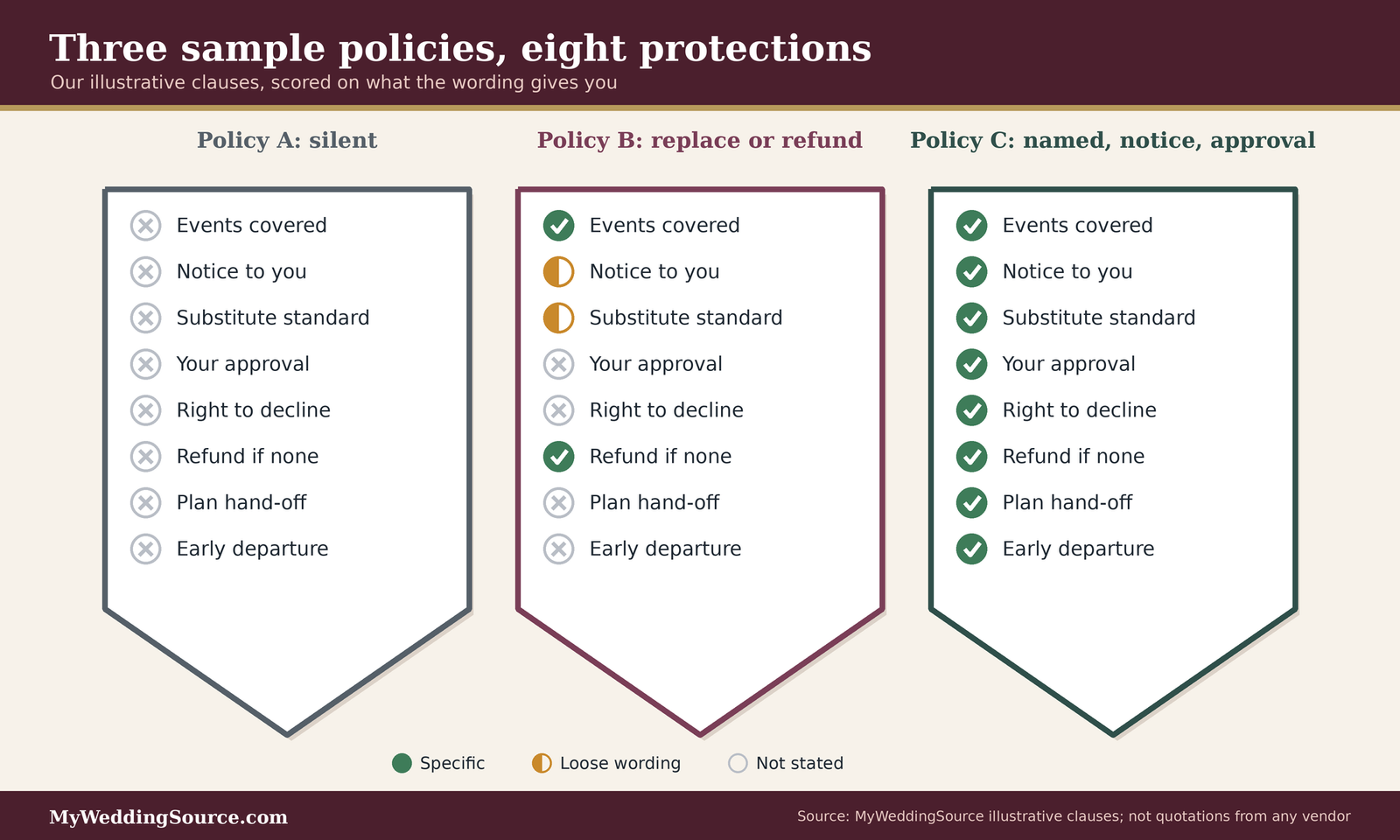
Couples compare vendors on price and portfolio because those are easy to line up. A wedding vendor replacement policy is harder, so this section gives you a way to put them next to each other. We wrote three illustrative policies based on the patterns in published sample language. They are teaching examples in our own words, not quotations from any vendor and not recommended wording for your contract. Treat them as a ruler, and have an attorney review any real clause.
The ladder most published clauses follow
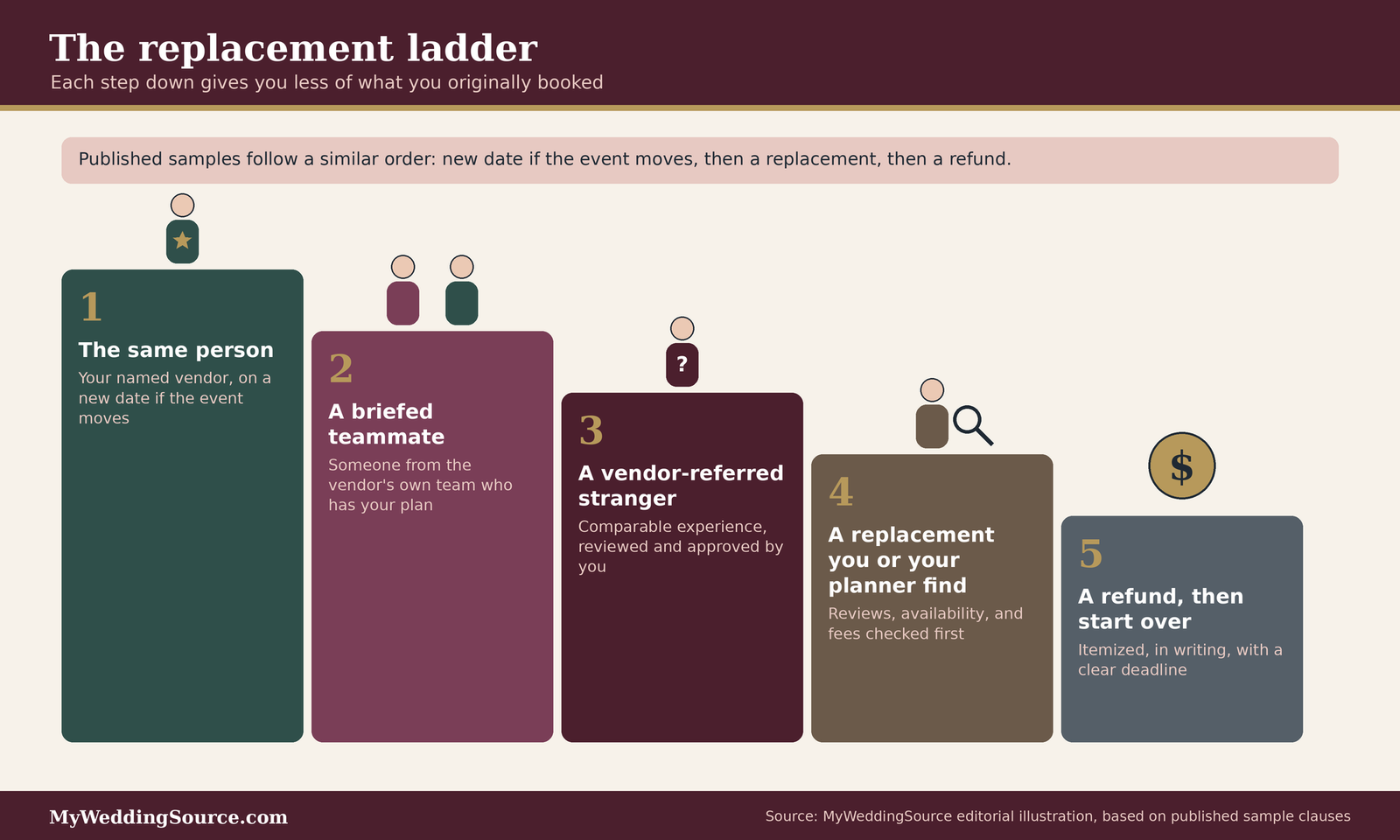
The sources we read describe a similar order of remedies in a wedding vendor replacement policy, even though they come from different corners of the industry. Seeing the order helps you notice when a contract skips a rung.
Rung by rung
The ShootProof template, prepared by an attorney according to the page, puts a new date first when the event itself is affected, then a replacement when only the photographer is affected, and a refund when neither works. Check Cherry’s DJ clause runs a similar path: reasonable efforts to find a qualified substitute with comparable experience, then a refund of what the client paid for the canceled service. The Wed’s advice for couples who face a cancellation adds the human steps: get the cancellation in writing, ask the vendor for referrals, involve a planner, and secure the most essential booking first. The illustration below combines those into one ladder.
Why the order matters to you
Each rung gives you less of what you originally bought. The same person is the best outcome, a briefed teammate is next, a vendor-referred stranger is further down, and a refund means you start over. A strong wedding vendor replacement policy keeps you high on the ladder as long as possible and gives you a say before you step down. A weak one lets the vendor jump straight to the bottom. That is the practical test of any wedding vendor replacement policy: how far down the ladder it lets you fall.
Three illustrative policies
Below are three short examples of a wedding vendor replacement policy, written for this guide, that represent common strengths. We describe them in prose to avoid implying that any vendor uses this exact wording.
Policy A: the silent contract
Policy A has no wedding vendor replacement policy at all, only a general cancellation section. If the named person is out, the contract does not say who steps in, how you are told, or what you get back. You are relying on general contract law, which, per the business-law textbook we read, generally leaves the vendor responsible for performance even when a substitute is used, and on the vendor’s goodwill. Many vendors will do the right thing, but the contract does not make them.
Policy B: replacement or refund
Policy B says that if the vendor cannot perform because of illness, injury, or emergency, the vendor will notify you promptly and make reasonable efforts to provide a qualified replacement with comparable experience, and that if no replacement is available the vendor will refund the amounts paid for the affected service. It borrows its structure from the published ShootProof and Check Cherry examples. It is a solid baseline for a wedding vendor replacement policy. Its weaknesses are the words “reasonable efforts” and “qualified,” which are not defined, and the lack of a right to decline a replacement you consider unsuitable.
Policy C: named person, notice, and approval
Policy C names the person you booked, requires the vendor to tell you within a stated number of days of learning that the person may be unavailable, requires any substitute to be approved by you in writing, defines comparable experience, lets you decline and receive an itemized refund, and says what happens to your deposit. It protects you most but is the hardest to obtain, because it takes flexibility away from the vendor. Some vendors will agree to part of it. The goal is not to win every term but to know which ones you are giving up.
Comparing them apples to apples
The table below scores the same eight features across the three policies. It is our own comparison of illustrative clauses, so the ratings describe the sample wording, not any real company.
| Feature | Policy A (silent) | Policy B (replace or refund) | Policy C (named, notice, approval) |
|---|---|---|---|
| Events covered (illness, injury, emergency) | Not stated | Named | Named, plus planned absences |
| Notice to you | Not stated | “Promptly” | A stated number of days |
| Who qualifies as a substitute | Not stated | “Qualified,” comparable experience | Defined standard |
| Your right to approve | None | None | Written approval required |
| Your right to decline | None | None | Yes, with refund |
| Refund if no substitute | Not stated | Amounts paid for the service | Itemized, deposit addressed |
| Hand-off of your plan to the substitute | Not stated | Not stated | Required |
| Effect of staff departure before the date | Not stated | Not stated | Notice and option to cancel |
What the table shows
Policy B closes the biggest gap, since it commits the vendor to try a replacement and to refund otherwise. Policy C closes the smaller gaps that matter when you care about the person, not only the service. Policy A leaves every cell blank, which is a finding in itself. Read across a column and you see where a wedding vendor replacement policy is strongest.
What the table does not show
No table can tell you whether a vendor will honor its terms. It cannot rate a vendor’s backup network, solvency, or the quality of a replacement. For those, use the due diligence habits in our vendor due diligence checklist, such as confirming how long the business has operated and what past clients say.
Turning a comparison into a request
Once you know how your wedding vendor replacement policy compares, you can ask for specific edits instead of a vague “more protection.”
Ask for one or two additions, not a rewrite
Vendors work from templates and may resist wholesale changes. A short request lands better: add illness and emergency to the list of covered events, add a notice window, and add your right to decline a substitute with a refund. Put the request in an email so the answer is written, and keep the thread with your contract so your wedding vendor replacement policy is easy to find later.
Keep the exchange friendly and in writing
Written answers matter for the same reason the BBB recommends getting all sales promises in writing: a verbal assurance is hard to prove later. Our guide to wedding contract change orders explains how to document an amendment so both sides sign it.
Money: deposits, refunds, and what protects you if a vendor disappears
A wedding vendor replacement policy has a financial side, and it is where couples feel the most stress. This section covers how money normally interacts with replacement, with figures taken only from the sources we read.
What this can cost, and what can protect you
- Refund formula. One published photographer template refunds fees minus expenses and work already completed, such as pre-event communications and preparation. Ask for that amount to be itemized in advance.
- Payment method. The BBB advises against paying the full amount up front and notes that credit cards can offer protection in a dispute that other payment methods may not.
- Dispute deadline. The FTC says a written credit card billing dispute must reach the issuer within 60 days after the first bill with the error was sent, so keep your statements and act quickly.
- Insurance. Zola reports that cancellation and postponement policies typically cost $150 to $600 with limits from $7,500 to $175,000, and that vendor problems account for about a third of claims. Policies differ, and known issues are generally excluded.
Deposits and refunds
Most disputes over a wedding vendor replacement policy turn into money disputes, so know your starting position.
Ask what is refundable before you pay
Many contracts call the deposit nonrefundable. That label may be reasonable for a vendor who turns away other business, but it should not apply when the vendor is the one who cannot perform. Ask for a sentence saying that if the vendor cancels or cannot provide an acceptable replacement, the deposit and payments are refunded, subject to any itemized deduction you have agreed to.
Who pays if the replacement costs more
A replacement from a premium team might cost more than your original vendor, and a replacement found at the last minute might too. A clause that says the vendor bears any difference when it supplies the substitute keeps you whole. If you hire a replacement yourself, the price is your own problem unless the contract says otherwise. Ask where your contract lands.
Partial performance
If a vendor delivers part of a service, such as a photographer who arrives late or a DJ who can stay only half the night, a refund formula that is all or nothing does not fit. Ask whether the policy allows a partial refund proportionate to what was missed. This is a negotiation point, not an entitlement. If extra hours are part of the problem, our guide to vendor overtime rates explains how to read those charges.
Using your payment method as protection
How you pay can matter as much as what the contract says.
What the FTC says about card disputes
The FTC’s consumer page explains that services you did not accept or that were not delivered as agreed can be disputed as billing errors on a credit card. You send a written notice to the issuer’s billing-inquiry address so it arrives within 60 days of the first bill with the error. The issuer must acknowledge the complaint in writing within 30 days and resolve it within 90 days, and during the dispute you may withhold the disputed amount while paying the rest. The page also lists limits: it covers credit cards and revolving credit, not every form of payment, and missing the window may cost you these protections. Rules for debit cards and other methods differ, and we did not research them here.
Practical habits
Pay deposits and balances by a method that leaves a record, keep invoices and emails together, and note payment dates so you can calculate your deadlines. Do not rely on a verbal promise of a refund. Treat the FTC page as a starting point and ask your card issuer how it handles disputes for services that were not provided, since the process in practice may differ.
Insurance and what it does and does not cover
Insurance is a backstop, not a substitute for a wedding vendor replacement policy.
What Zola’s explainer says about vendors
Zola’s insurance explainer says vendor issues make up about a third of wedding insurance claims, and that photographers, florists, officiants, and caterers may cancel at the last minute, fail to show, or go out of business. It says that if a vendor fails to show, the wedding may still go ahead but some reimbursement may be available. The explainer does not describe how bankruptcy claims are handled, so ask an insurer directly. Our wedding insurance guide explains how to read a policy.
What insurers generally exclude
Zola lists exclusions that matter here: known issues, last-minute changes of heart, and pre-existing medical conditions that could interfere with the ceremony. Read that as a reason to buy before a problem appears and to read the vendor-failure wording line by line. We are not insurance professionals and do not recommend any product.
The worksheet: score any wedding vendor replacement policy
The comparison above uses sample clauses. This worksheet applies the same idea to the wedding vendor replacement policy in the real contract in front of you. It is our own framework, not an industry standard, and a score is a conversation starter, not a verdict on a vendor. A vendor with a low score may be excellent and simply have a short contract.
How the scoring works
Give each of eight items a score from zero to two, then add them. The total ranges from zero to sixteen.
The scale
Zero means the contract is silent or the language gives you nothing you can rely on. One means the item is covered but loosely, with undefined words such as “reasonable” or “promptly.” Two means the item is covered specifically, with a standard, a number, or your own right. Score what the paper says, not what the salesperson promised, because only the paper survives a staff change.
The eight items
Score each of these separately: events covered, notice to you, who qualifies as a substitute, your approval or right to decline, refund if no substitute, handling of deposits and price differences, hand-off of your plan to the replacement, and what happens if staff leave before the date. These are the same rows as the comparison table, plus one on money.
Reading the total
A total is only useful if you know what to do with it.
Scores near zero to five
A low score usually means the contract has little or no wedding vendor replacement policy. That is not an accusation. Ask the vendor to add a short replacement paragraph, and weigh how they respond. A vendor who writes it promptly has shown you something good. A vendor who refuses to discuss it has shown you something worth knowing.
Scores near six to ten
A middle score means a baseline exists, similar to our Policy B. Pick the two weakest items and ask for specific improvements, especially a notice window and your right to decline. These are the cheapest changes for a vendor to agree to.
Scores near eleven to sixteen
A high score means the contract already addresses most of what we raise. With a strong wedding vendor replacement policy on paper, spend your energy on the human side: meet the backup if possible, confirm the vendor’s capacity on your date, and make sure your plan is documented so a replacement can pick it up.
Using the worksheet fairly
Scores for a wedding vendor replacement policy can mislead if you ignore context.
Weigh the role
A strict wedding vendor replacement policy matters more for roles where the person is the product, such as a photographer you chose for a particular eye, and less for roles where a team follows a written plan. Weight the items accordingly. A florist with a documented recipe system and a flexible replacement standard may serve you better than one with a rigid named-person clause.
Do not score generosity
A vendor who promises to “make it right” with no paper scores zero on every item, however sincere. Sincerity is valuable and worth noting, but it does not enforce itself when the person who made the promise has left the company. The BBB’s advice is to get sales promises in writing, and this is the reason.
Edge cases that change the answer
Most contracts treat the wedding vendor replacement policy as a common-case clause, so unusual facts need more attention. These edge cases come from the situations couples describe and from the gaps in the sources, not from statistics. We could not find national data on how often any of them occur.
When the person is the whole business
A solo vendor has no team, so replacement means another business entirely.
What a solo vendor can realistically promise
A solo photographer, celebrant, or DJ may rely on a network of peers. Easy Weddings’ supplier responses describe personal networks of trusted DJs who are briefed on events, which is the kind of arrangement a solo operator can offer. Ask who is in the network, whether they have worked together before, and whether the substitute will be briefed. If the vendor cannot name anyone, ask what the refund and notice terms are, since a refund is the main protection.
When a solo vendor has no backup at all
Some solo vendors honestly have no one. Respect the honesty, and then ask for a prompt notice commitment and a refund. For the wedding itself, decide whether you are comfortable with a single point of failure, or whether you want a second, smaller layer of coverage, such as a friend who can capture phone photos or a playlist ready for a speaker.
When a replacement is offered, but you do not like it
A vendor may offer a substitute you do not trust.
Rights to decline
The ShootProof template gives the client the practical right to reject a suggested replacement and receive a refund of the refund amount. Not every contract does. If yours is silent, ask. If you need to decline and the contract does not allow it, put your concerns in writing, ask for a meeting or portfolio review, and consider whether a refund negotiation is realistic. This is a place to involve an attorney if the sum is large.
Time pressure
The closer to the date, the less room you have to compare. The Wed’s advice is to avoid rushing a rebooking, to check availability, contracts, and reputations of new options first, and to treat the first 48 hours after a cancellation as critical. Both pieces of advice matter: move quickly, but not so quickly that you replace one problem with another.
When staff leave months before the date
A departure far from the wedding is the case with the most room for a good outcome.
Ask for notice and choice
A clause requiring notice within a stated number of days lets you meet the new person, review their work, and decide whether to stay. If you decide to leave, the contract should say whether you get a refund and how much. Without a clause, a departure may still be a breach, depending on how the contract is written, but that is a legal question for an attorney.
Copyright and work product
If the vendor is a photographer, ask who owns the images shot by an associate. The Legal Paige explains that photos taken by an employee generally belong to the business under the work made for hire rule, while photos taken by a contractor belong to the photographer unless a written agreement transfers the rights. This is why you should ask that your contract grants you the delivery and usage rights you expect regardless of who presses the shutter. Our photography deliverables guide covers usage terms.
When the vendor is a venue or a package
Some services come bundled.
Venue-provided vendors
If the venue supplies the caterer, the bar staff, or the coordinator, the replacement terms live in the venue’s contract. Read that agreement for who the venue promises and whether it can change them. Ask whether you may approve a replacement and whether the venue will refund the difference if the replacement is a downgrade.
Package deals with several vendors
A bundled package, such as photo and video from one company, means one business is responsible for several roles. A staff change affects more than one deliverable. Ask whether each role has a named lead and a backup, and whether you can end one part of the package without losing the whole.
When the replacement is the vendor’s cousin, friend, or competitor
Referrals can be generous or complicated.
Asking about referral money
When a vendor or planner suggests a substitute, it is fair to ask whether they receive a fee. The Wed reports that planners and venues may receive referral payments for sending business to vendors, and says the answer is disclosure. That is a commercial relationship that can affect which replacement you are shown. Our commission disclosure guide covers how to ask.
Sizing up an unfamiliar replacement
A replacement who is a stranger to you needs a quick check: a recent portfolio, two references, and confirmation that they have the insurance and any licenses your venue requires. The same due diligence you would use on a first-choice vendor still applies, only faster.
A timeline for asking, and a plan for the day it happens
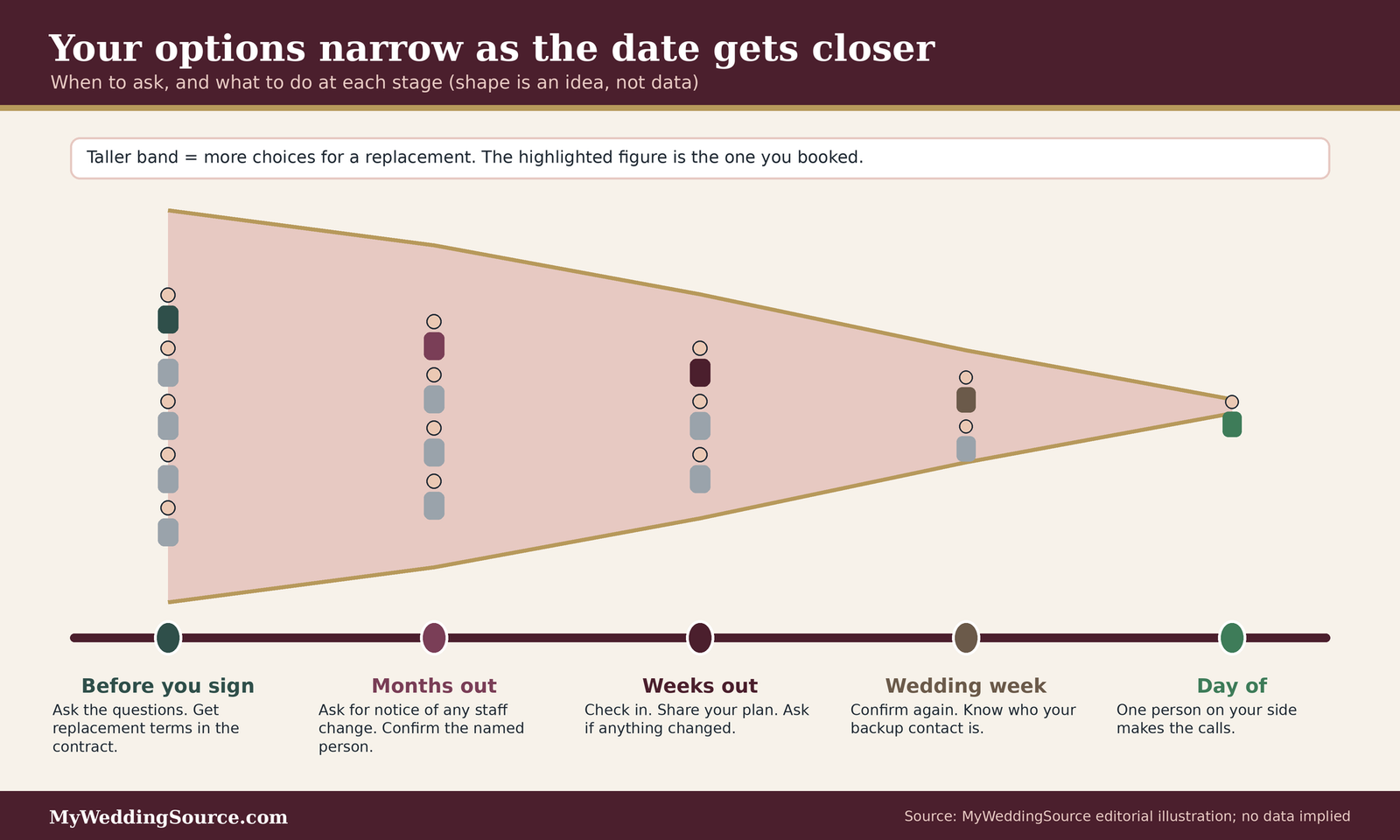
The right question at the right moment costs nothing, and this is when to raise your wedding vendor replacement policy questions. This timeline pairs the order of operations with the point at which options narrow. It is our own framework, and the labels are qualitative: we do not have data on how many replacements are available at each stage.
Before you sign
This is the moment of most leverage, so ask for the wedding vendor replacement policy in writing now.
At the consultation
Ask the vendor how they handle illness, emergencies, and staff changes. Listen for specifics, such as a network, a team, or a standing agreement with another business. Note the answer and ask for it in writing as part of the contract. If the vendor is evasive, that is information.
At contract review
Use the worksheet and the comparison table. Send your requested additions by email and wait for a written reply. Our vendor timeline guide explains where this step fits in the planning calendar.
Between signing and the wedding
Options exist, but they narrow as the date approaches.
Check-ins during planning
Ask for a short written confirmation of the named person and backup at set points, such as when you finalize your timeline. Our vendor communication deadlines article covers when to confirm details. The BBB suggests confirming all services one or two weeks before the event and verifying the agreed details, which is also a natural time to ask whether anything has changed on the vendor’s side.
If you learn of a change
Respond in writing, ask who the replacement is and when they can meet you, and review your contract for notice, approval, and refund terms. Keep your tone calm, because vendors who feel respected are more likely to help.
On the day, or in the days just before
When the change happens late, speed matters.
The first 48 hours
The Wed advises couples to treat the 48 hours after a cancellation as the critical window, get the cancellation confirmed in writing, ask the vendor whether they can recommend replacements, and involve a planner if you have one. It also advises securing a backup venue first, then replacing essential vendors such as the caterer, photographer, and entertainment, and researching reviews, availability, and fees for each. We would add one practical step: pick one person on your side to handle calls, so information does not scatter.
Keeping the day on track
If a replacement arrives, give them a one-page summary of your timeline, key people, and must-have moments. Our wedding week checklist and emergency kit guide help you prepare for the week itself. After the event, keep every message and receipt in case you need to pursue a refund, and if you do, check your deadlines for card disputes.
When to involve a professional
Some situations are beyond a friendly email.
Signs it may be time
The Wed suggests considering legal support if a vendor disappears with your deposit, refuses a refund you are entitled to, or breaks the agreement without explanation. We would add that a large deposit or a contract with unusual terms is worth a lawyer’s review before signing, since it is cheaper to ask early.
What a professional can and cannot do
A licensed attorney in your state can explain how your contract and local law interact. A planner can help you find replacements. Neither can promise a result, and we are not either one. Keep the 60-day card dispute window in mind and review the FTC steps early.
Questions to ask before you pay
Questions to ask about a wedding vendor replacement policy
- If the person I am booking cannot attend, who steps in, and how do I learn who it is?
- How soon will you tell me if a change is possible, and is that a number of days in the contract?
- What makes a replacement comparable, and can I see their recent work before approving them?
- Can I decline a replacement and receive a refund, and is the refund itemized?
- What happens to my deposit and payments if no acceptable replacement exists?
- Who pays if the replacement costs more than my original vendor?
- What happens if staff leave or the team changes months before my date?
- Is there a written plan, timeline, or recipe so a replacement can pick up where my vendor left off?
- Does the business have a backup network, an agency, or a standing agreement with other vendors?
- What would you do if your business closed or were sold before my wedding?
Using the list well
The list of questions about a wedding vendor replacement policy is long, so prioritize.
Pick the five that matter most
For a photographer you chose for a style, ask about named person, approval, and refund first. For a caterer with a team, ask about the plan hand-off and capacity. Not every question applies to every role, and a long list can feel like an interrogation.
Write the answers down
Record answers in an email to yourself or to the vendor, and ask for the key ones in the contract. The BBB’s advice to make sure every oral agreement appears in the written contract applies here.
When the answers are not what you hoped
Sometimes a vendor’s reply reveals a gap.
A vague answer
If the answer is “we will take care of it,” ask what that means in practice: who, by when, and what happens to your payments. A vague answer is not a bad sign by itself, but it should lead to a written commitment before you pay more.
A flat refusal to put it in writing
A vendor may decline to add language. That is their right, and you can decide whether the service is worth the uncertainty. Many couples then choose a more flexible payment schedule, a backup plan of their own, or a different vendor.
FAQ: wedding vendor replacement policy questions
The basics
What is a wedding vendor replacement policy?
It is the written terms describing what happens if the person or team you hired cannot perform, covering who steps in, how you are told, whether you can approve or decline the substitute, and what you get back if none is acceptable. Some vendors put this in a dedicated clause; others spread it across cancellation and force majeure sections.
Do all wedding vendors have a replacement policy?
No. Some contracts address substitution clearly, and others say nothing. We did not find national data on how common each is. If yours is silent, ask the vendor to add a short paragraph, and treat the response as useful information about how they handle problems.
Is a vendor required to send a replacement?
It depends on the contract and state law, so we cannot say yes or no. Published sample clauses commit the vendor to reasonable efforts, not a guarantee. If a replacement matters to you, ask for a firm commitment backed by a refund, and have an attorney review the wording for anything high stakes.
When something goes wrong
What should I do first if my vendor cancels?
Get the cancellation confirmed in writing, then read your contract for notice, refund, and replacement terms. The Wed advises acting within the first 48 hours, asking the vendor for referrals, involving a planner if you have one, and securing a backup venue before replacing other vendors. Stay polite, since goodwill helps.
Can I refuse the replacement my vendor suggests?
Only if your contract allows it or the vendor agrees. One published photographer template lets the client reject the suggested replacement and receive a refund of a defined amount, but not every contract does. Check yours, and if it is silent, raise your concerns in writing quickly.
Will I get my deposit back?
It depends on the contract and on why the service failed. Many contracts call deposits nonrefundable, but a vendor who cancels or cannot provide an acceptable replacement is a different situation. Ask for refund terms in writing before paying, and consult an attorney if the vendor refuses a refund you believe you are owed.
Protecting yourself
Does paying by credit card help?
Possibly. The BBB notes cards can offer protection in a dispute that other methods may not, and the FTC says services not delivered as agreed can be disputed as billing errors if your written notice reaches the issuer within 60 days of the first bill. Rules vary by card and payment type, so ask your issuer.
Does wedding insurance cover a vendor who cannot perform?
Some policies may. Zola reports that vendor problems account for about a third of claims and that reimbursement may be available if a vendor fails to show, but known issues are generally excluded. Read the vendor-failure wording of any policy carefully and ask the insurer about your situation before relying on it.
Your next steps
Review what you have
Find the wedding vendor replacement policy in each contract
Open every signed vendor agreement and search for substitution, replacement, illness, emergency, force majeure, and cancellation. Mark where each is silent. Score the roles that matter most with the worksheet, starting with the vendors you chose for a specific person.
List your gaps in order of importance
Pick the three vendors where a staff change would hurt most, and write the single most important missing term for each. Keep the list short enough that you will actually send it.
Ask for the changes
Send one friendly email per vendor
Request the specific additions you identified, such as a notice window, a comparable-experience standard, and your right to decline with a refund, and ask for a signed amendment. Our guide to wedding contract change orders explains how to document changes cleanly, and our wedding vendor contract guide covers the rest of the agreement.
Prepare for the worst case
Decide who on your side will make calls if a vendor cancels, save your planner’s number if you have one, and pick a payment method with dispute rights for future balances. For the wider plan, use our wedding planning checklist and wedding budget guide.
Stay current as the date approaches
Confirm the named person and backup
Add a check-in to your calendar at the point you finalize your timeline and again one to two weeks before the wedding. Ask whether anyone has changed and whether the backup plan still stands.
Hand over your plan
Give each vendor a one-page summary of your priorities and keep copies. A written plan helps any replacement start well and makes your wedding vendor replacement policy easier to use, and our vendor due diligence checklist can help you vet a stranger quickly.
Sources & methodology
How we built this guide
What we relied on
This guide draws on a federal consumer page about disputing credit card charges, a business-law textbook on delegation of contract duties, Cornell’s Legal Information Institute and Nolo on liquidated damages, free contract language published by a photography software company, a DJ contract guide, legal guidance written for photographers who hire associates, Better Business Bureau wedding tips, a wedding publication’s advice for vendor cancellations, an Australian wedding directory’s collection of DJ answers, and an insurance explainer from a wedding company. We read the pages listed below on November 12, 2026. Where a statement comes from a seller, a vendor-focused publication, or a single author’s opinion, we say so in the text. The three sample policies, the eight-item scoring worksheet, and the five situations are our own illustrations and frameworks, not industry standards or quotations from any contract.
What we did not do
We did not review any vendor’s contract, test any vendor’s backup plan, or find national statistics on how often vendors are replaced. This guide is general education and not legal, insurance, or financial advice. Contract, consumer, licensing, and insurance rules differ by state, and a licensed attorney or insurance professional can advise on your situation.
Source list
Government and legal reference sources
- Federal Trade Commission, Consumer Advice: Using Credit Cards and Disputing Charges: https://consumer.ftc.gov/articles/using-credit-cards-and-disputing-charges
- Cornell Law School Legal Information Institute, Wex: Liquidated damages: https://www.law.cornell.edu/wex/Liquidated_damages
- Saylor Academy, Business Law and the Legal Environment (v1.0), Delegation of Duties: https://saylordotorg.github.io/text_business-law-and-the-legal-environment-v1.0/s17-02-delegation-of-duties.html
- Nolo, When Are Liquidated Damage Provisions Enforceable: https://www.nolo.com/legal-encyclopedia/when-are-liquidated-damage-provisions-enforceable.html
Consumer, industry, and professional sources
- Better Business Bureau, BBB wedding tips: https://www.bbb.org/article/money/16783-bbb-wedding-tips
- The Wed, Wedding venue or vendor canceled: here is exactly what to do next: https://thewed.com/magazine/wedding-venue-or-vendor-canceled-heres-exactly-what-to-do-next
- ShootProof Help Center, Free contract language: force majeure clause and date change amendment: https://help.shootproof.com/hc/en-us/articles/360048153453-Free-Contract-Language-Force-Majeure-Clause-and-Date-Change-Amendment
- The Legal Paige, Things to be aware of legally when hiring an associate photographer: https://thelegalpaige.com/blogs/blog/things-to-be-aware-of-legally-when-hiring-an-associate-photographer
- Check Cherry, 12 things your DJ contract is probably missing: https://www.checkcherry.com/articles/231-12-things-your-dj-contract-is-probably-missing
- Easy Weddings (Australia), What happens if our wedding DJ is sick on the day: https://www.easyweddings.com.au/WeddingMusic/advice/what-happens-if-our-wedding-dj-is-sick-on-the-day
- Zola, What does wedding insurance cover: https://www.zola.com/expert-advice/what-does-wedding-insurance-cover