

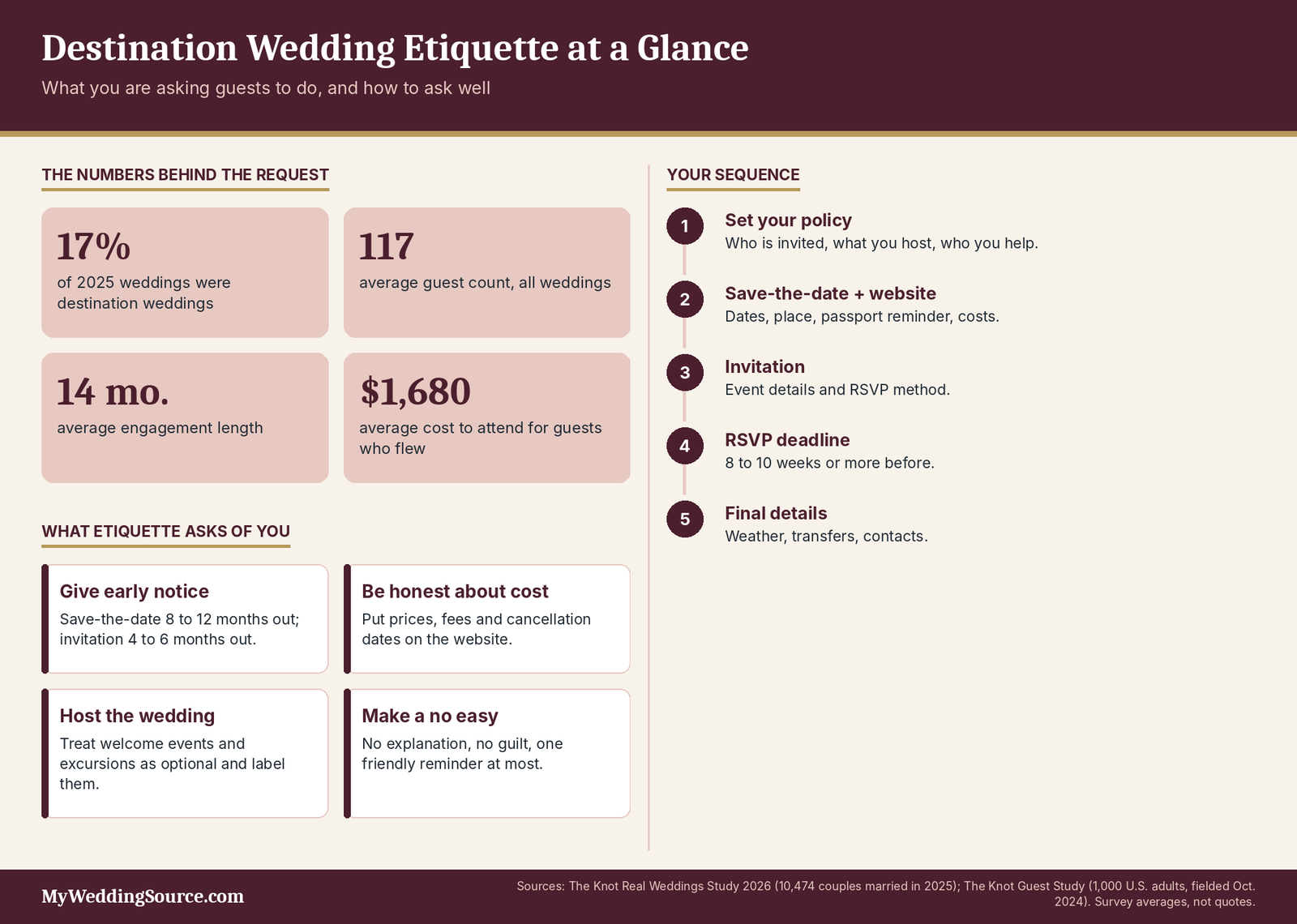
Destination wedding etiquette comes down to one idea: you are asking people to spend money and vacation time to celebrate with you, so give them early notice, honest costs, clear wording and an easy, guilt-free way to say no.
You have found the place: a resort cove, a farmhouse outside Florence, a lodge with a mountain view. Now comes the question that no venue tour covers, which is what you owe the people you are about to ask to board a plane for you. The rules for a hometown wedding assume that most guests sleep in their own beds, and that assumption quietly breaks the moment the ceremony is a flight away.
This guide is the etiquette companion to our cost guides and sits alongside the rest of our wedding planning library. It covers what couples owe guests, what guests owe couples, when each piece of communication should go out, how to word the awkward parts, which events are worth hosting, how to handle room blocks and gifts, and what to do when someone cannot come. For the numbers behind a guest’s trip, see our breakdown of destination wedding guest costs and the build-your-own-number worksheet in destination wedding guest cost: price drivers, quote traps and smarter budgeting. For the logistics side, the destination wedding checklist lays out what to do and when. Here the focus is manners, wording and judgment.
A note on what “rules” means. Etiquette is a set of conventions that experts largely agree on, not a law, and where authorities disagree (save-the-date timing is the big one) we show the disagreement and say which way we lean and why. Where we use an example script or an invented budget, we label it as illustrative. Where we cite a survey, we name the sample so you can judge how far it applies to your guests.
What Etiquette Asks of Couples and Guests at a Destination Wedding
What do you owe guests when you choose a faraway place?
What is the core principle behind destination wedding etiquette?
The core principle is that an invitation is an offer, not a summons. Karen Bussen, quoted in an Islands magazine Q&A on destination wedding etiquette, puts the host’s financial duty simply: couples are technically responsible only for the ceremony and the reception, and anything beyond that, such as a welcome party, is a courtesy rather than an obligation. Guests, in turn, pay their own way to get there. That default has a consequence you should say out loud to yourself before you pick a location, because a couple who chooses a place that costs each household a couple of thousand dollars has made a real request, even if it was made with love.
The practical translation is generosity in the areas that cost you little and cost guests a lot: early notice, plain information, flexible ways to participate and no pressure. You can be a gracious host without picking up the tab for flights. You cannot be a gracious host if guests learn about resort fees, dress codes or a mandatory group dinner after they have already paid for nonrefundable tickets.
How common are destination weddings, and why does it matter for manners?
Destination weddings are a normal, mainstream choice, which helps with the guilt. The Knot’s 2026 Real Weddings Study, which surveyed 10,474 U.S. couples married during 2025, found that 17% of weddings were destination weddings, and the prior year’s study put the share at 18% of couples who married in 2024. The same 2026 study reported an average guest count of 117 across all weddings and an average engagement of 14 months, which is useful context: most couples have a year or more to give notice, so a nine-to-twelve-month save-the-date is realistic for the typical engagement.
The Knot’s Guest Study adds the other side of the ledger. It found that destination weddings are about 17% of events and that 83% of those guests must travel or stay overnight. A destination wedding costs the couple more on average than a hometown one (The Knot’s 2025 study, covering couples married in 2024, reported about $39,000 for destination weddings against $32,000 for hometown weddings), and it asks guests to carry costs the couple never sees. Etiquette is the way you acknowledge that imbalance without making a speech about it.
What do guests owe you in return?
What is a guest’s duty to respond and show up?
A guest’s first duty is to answer, and to answer on time. Destination weddings often run on hard dates: a resort wants a final headcount, a hotel block has a cutoff, a private villa needs a deposit. A guest who sits on an invitation for six weeks, hoping a work project resolves, may cost the couple a room-block penalty or a deposit on a table they will not fill. If you are a guest and you honestly do not know, say so in one sentence, give the date you will decide, and keep that date.
The second duty is to be a good traveler once you arrive. That means reading the schedule on the wedding website, showing up on time to the events you agreed to attend, being flexible when weather or a delayed shuttle changes the plan, and not treating the couple as a concierge. Couples at destination weddings are juggling local vendors, paperwork and family at once, so a guest who sorts out their own transfers and dinner reservations is giving a quiet gift.
Does a guest who declines owe a reason, a gift or an apology?
A guest owes a prompt, warm decline and nothing more. You do not need to explain your finances, your employer’s vacation policy or your child’s school calendar, and a couple who presses for details has stepped outside good manners. A short note works: thank them, say you will be thinking of them that day, and wish them well. Many guests also send a card or a small gift, which is a kindness rather than a debt.
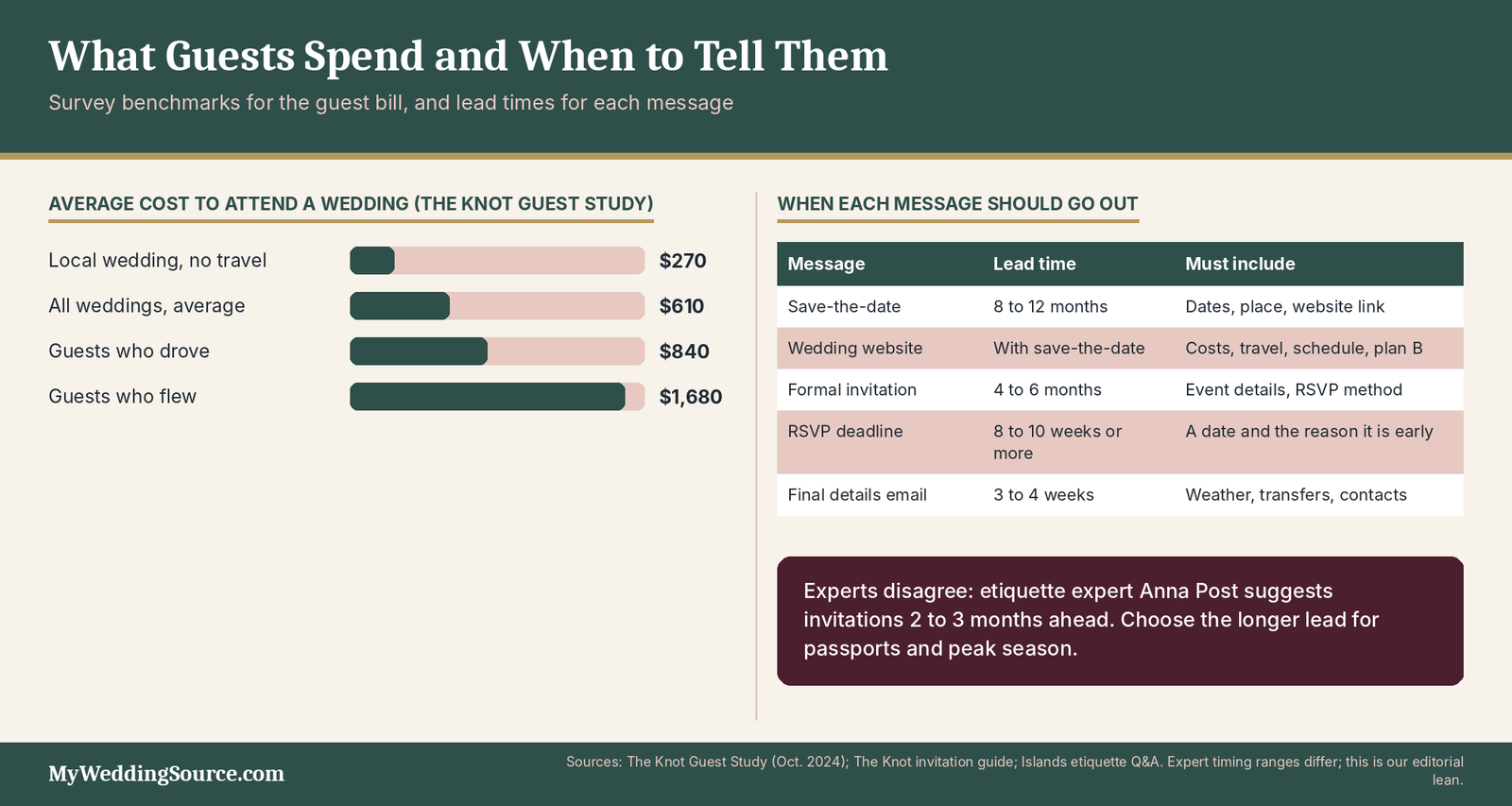
Gift expectations are the murkiest part, and experts frame them differently. etiquette expert Anna Post, also quoted in that Islands Q&A, notes that gifts at destination weddings tend to be smaller because of travel costs, and that a couple can tell guests their presence is their present. The Knot’s Guest Study found an average wedding gift of $150 across all weddings, with only 6% of guests giving none. Those figures describe weddings generally, not destination ones, so treat them as a ceiling for people who traveled rather than a floor for everyone.
Who typically pays for what?
What does a responsibility matrix look like in practice?
The table below sets out the common convention for each cost, with the etiquette note that goes with it. It describes how most couples and guests in the U.S. handle things, not a legal requirement, and families and cultures differ, so you should adjust it to your situation. The most useful column is the last one, because it shows where couples create goodwill (clear communication and optional extras) without spending much.
| Item | Couple usually | Guest usually | Etiquette note |
|---|---|---|---|
| Ceremony and reception | Pays | Attends | Hosts cover food, drink and venue for the main event. |
| Flights and ground travel | Rarely | Pays | Optional help for wedding party or family is a judgment call. |
| Lodging | Rarely | Pays | Share room-block details and cancellation terms early. |
| Rehearsal dinner | Pays or families pay | Attends if invited | Say clearly who is invited, to avoid hurt feelings. |
| Welcome event | Often hosts | Attends | Optional courtesy; host one event beyond the rehearsal dinner at most. |
| Meals outside events | No | Pays | Label which meals are hosted so guests can plan. |
| Excursions and extras | No | Pays if they join | Mark them optional and share prices when you can. |
| Attire | No | Pays | State the dress code and the setting, such as sand or cobblestones. |
| Gift | N/A | Optional | Do not require a gift; keep registry details off the invitation. |
When should a couple make an exception to the convention?
Exceptions are usually reserved for the people who have the least choice about attending. If your maid of honor or best man is a student, a parent who is on a fixed income or a sibling flying in with a family, offering to cover a night of lodging or a portion of the airfare is a thoughtful exception. The risk lies in unevenness. Holly Lefevre, another expert quoted in the same Islands Q&A, says that paying for one struggling guest would be welcome but could draw criticism, particularly from guests who declined because of budget, and suggests a standard policy with exceptions for the wedding party, close friends and family.
The simplest way to stay fair is to decide on your rule before you tell anyone about it. “We are covering lodging for the wedding party” is a rule. “We are helping a few people” invites questions.
Building the Guest List: Who to Invite, How Many Will Come and How to Say No
How big should a destination guest list be?
Should you invite more people than you expect to attend?
Destination weddings usually see a lower share of invitees attend than hometown weddings, but no reliable national attendance rate exists. The Knot’s studies report average guest counts and costs, not the percentage of invitees who accept a faraway invitation, and planners’ rules of thumb vary widely by distance, season and cost. Treat any single “expect X% to decline” number you see online as a guess, including ours: we are deliberately not offering one.
What you can do is plan in tiers. List the people whose absence would genuinely change the day for you (the people you could not imagine the day without), then the people you would love to have, then the people you are inviting out of obligation or hope. Send the first group an early heads-up, or have a short personal conversation, before the save-the-date goes out.
How do you tell someone they are not invited?
Do it before the invitations land and, if possible, in a voice call or in person rather than a text. Lead with the relationship, state the decision without apology, and say what you hope for in place of an invitation. An example script, illustrative and meant to be rewritten in your voice: “We wanted you to hear this from us. We are keeping the wedding very small, just immediate family and the wedding party, because it is a trip for everyone. You matter so much to us, and we would love to celebrate with you when we get back.”
Notice what the script avoids: no excuses about the budget, no suggestions that the friend could not have attended anyway and no request for secrecy. Lefevre advises tact, such as using private groups for sensitive details and avoiding public posts that announce travel plans, which is both a courtesy to the people who were not invited and a basic security habit.
Which guests need special thought?
How should you handle partners and plus-ones?
Partners who are in committed relationships should be invited by name, whether or not you know them well, because telling a guest to travel to a foreign country alone for your wedding is a bigger ask than at a local event. Beyond that, a clear and evenly applied policy matters more than a generous one. Our guide to plus-one wedding etiquette covers the policy options in depth, but the destination-specific wrinkle is that a plus-one adds a full second travel bill, so guests who must bring a partner to be comfortable should hear early whether that is possible.
Address envelopes and website notes precisely. If an invitation names only the guest, the invitation is for that guest, and a guest should not add people without asking. If you do offer a plus-one, say so on the invitation and capture the name in the RSVP so that you can place cards, book rooms and process any passport details your venue needs.
How do you handle children and adults-only events?
Children are the hardest category at a destination wedding, because they combine travel cost, childcare logistics and strong feelings. If your wedding is adults-only, Lefevre recommends addressing invitations only to the invited guests rather than adding wording like “no children,” and Anna Post suggests listing the invited people on the inner envelope and, if needed, calling families with a respectful explanation that focuses on what the couple can offer. Our guide to child-free wedding etiquette covers the wording and pushback in more detail.
At a destination, the question changes shape: parents are not deciding whether to hire a local sitter, but whether they can travel at all. If you can, tell parents on the website what childcare is available at the property, and consider an invitation to a family-friendly welcome gathering or a kids’ activity on arrival day. If you are including children, say what the plans are for them at the ceremony and dinner, so that parents can book flights and pack accordingly.
Timing: When Save-the-Dates, Invitations and RSVP Deadlines Should Go Out
When should each piece of communication go out?
When should destination wedding save-the-dates be sent?
Sources disagree on this one, and the disagreement is worth understanding. The Knot’s general save-the-date guidance says to send them six to eight months ahead and to lean toward the eight-month end for a far-flung locale, calling anything beyond a year “too early” and anything under four months too late to bother with one. The Knot’s destination invitation guide, quoting a stationer, recommends an 8-to-12-month window so guests can plan airfare. The Islands Q&A quotes Lefevre advising 9 to 12 months, sent as soon as details are confirmed, with a link to a wedding website.
Our editorial lean is 9 to 12 months for international trips and peak-season dates, and at least 8 months for domestic ones, which fits the 14-month average engagement from The Knot’s 2026 study. The reason is practical: a guest who needs a passport, unpaid leave or a flight at a good price benefits from every extra month, and the cost of sending early is small. If your engagement is shorter than eight months, send the save-the-date the moment you have a venue and dates, and skip the apology.
When should formal invitations be mailed?
Here too, experts spread across a range. The Knot’s destination invitation guide quotes a stationery expert recommending a four-to-six-month lead time, toward the earlier end for remote locations or peak seasons. Anna Post, in the Islands Q&A, says destination invitations should go out two to three months ahead, earlier than the usual six to eight weeks for a local wedding.
We lean toward four to six months for the invitation itself, for a reason specific to destination weddings: passport processing, time-off requests and nonrefundable fares do not wait for a mid-summer mailing. A guest who gets an invitation three months out may already be locked into other travel, and a guest who must renew a passport has very little slack.
What RSVP deadline should you set?
Set the deadline earlier than you would for a local wedding, and tie it to your first hard contract date. A stationer quoted by The Knot recommends an RSVP deadline at least 8 to 10 weeks before the wedding, and another suggests at least three months for destination weddings, especially if you are booking a property buyout. Those figures reflect that resorts, hotels and private properties often want a headcount before a local caterer would.
Work backward from your own contracts. If your hotel block releases unreserved rooms 60 days out, an RSVP deadline 70 days out gives you time to follow up with stragglers. If your resort needs final guest numbers 30 days out, you still need a gap between the deadline and that date to chase the people who forgot. Add a line to the invitation explaining why the date is early, such as “our resort needs a final count by this date,” because guests respond more readily to a reason than to a rule.
| Milestone | Typical lead time | Basis | What it should include |
|---|---|---|---|
| Personal heads-up to key guests | 12+ months | Editorial judgment | Location, rough dates, a request not to book yet |
| Save-the-date | 8 to 12 months | The Knot; Islands Q&A | Dates, destination, website link, passport reminder |
| Wedding website live | With the save-the-date | Editorial judgment | Travel, lodging, costs, schedule, dress code |
| Formal invitation | 4 to 6 months (some say 2 to 3) | The Knot; Anna Post via Islands | Event details, RSVP method and deadline |
| RSVP deadline | 8 to 10 weeks or more before | The Knot | A clear date and the reason it is early |
| Final details email | 3 to 4 weeks before | Editorial judgment | Weather, transfers, schedule, contacts |
What do the dates mean for a guest’s own deadlines?
How far ahead should guests start on passports?
Your timeline should assume that some guests need to renew or apply for a passport. The U.S. Department of State currently lists routine processing at 4 to 6 weeks and expedited processing at 2 to 3 weeks for an additional $60, not including mailing time of up to two weeks each way, and it recommends applying between October and December when demand is lower. Adult passport renewal by mail costs $130 for the book, and some countries require a passport to be valid for at least six months beyond your trip, so a passport with four months left may be too short.
Include a plain-language line in the save-the-date or website: “International guests will need a passport valid for at least six months after the trip; check yours now.” That sentence takes five seconds to write and can save a guest from a $60 expedite fee and a week of anxiety.
What about time off, health and weather windows?
Time off is a guest’s second deadline. The Bureau of Labor Statistics reported that 80% of private industry workers had access to paid vacation in March 2026, which means about one in five did not, and even those with paid leave often need weeks of notice for a five-day trip.
Health preparation also takes time. The Minnesota Department of Health advises contacting a primary care provider or travel clinic preferably 4 to 6 weeks before you travel, so there is time for vaccines and medications, and the CDC’s travelers’ health pages are the standard place to check destination-specific recommendations. Seasonal risk is the last piece of the calendar. The National Hurricane Center lists the Atlantic hurricane season as June 1 to November 30, with a climatological peak around September 10, and the Eastern Pacific season as May 15 to November 30. If your destination or dates fall inside those windows, the website should address plan B and refund policies directly, a topic we return to in the section on protecting the trip.
Wording That Works: Save-the-Dates, Websites and Awkward Sentences
What belongs on the card, and what belongs online?
What should the save-the-date say?
A save-the-date for a destination wedding has three jobs: give the dates, name the place and point to a website. It does not need a hotel list, a dress code essay or a cost breakdown. A sample, illustrative and meant to be adapted: “Save the date. Maya and Jordan are getting married on Saturday, October 16, in Cabo San Lucas, Mexico. A weekend celebration on the beach. Invitation to follow. Travel details at our wedding website.” The line “invitation to follow” matters because it tells guests that the formal request is coming, and the website line tells them where to look for details.
Two additions earn their space. The first is a quiet passport reminder if the trip is international. The second is a sentence that signals it is fine to need time: “We know this is a trip, and we will share costs and options early so you can decide with confidence.” That sentence sets the tone for the whole weekend, and it is easier to write now than to repair a tone later.
What goes on the wedding website for a destination wedding?
The website is where the destination-specific information lives, and Anna Post’s advice, reported in the Islands Q&A, supports that division: keep the invitation simple, put travel details online, state the ceremony location so guests know what shoes to pack, and leave registry details off the invitation. The Knot’s invitation guide recommends including a weekend schedule with venues, a dress code for each event, hotel or block details, whether transportation is provided and the best travel routes.
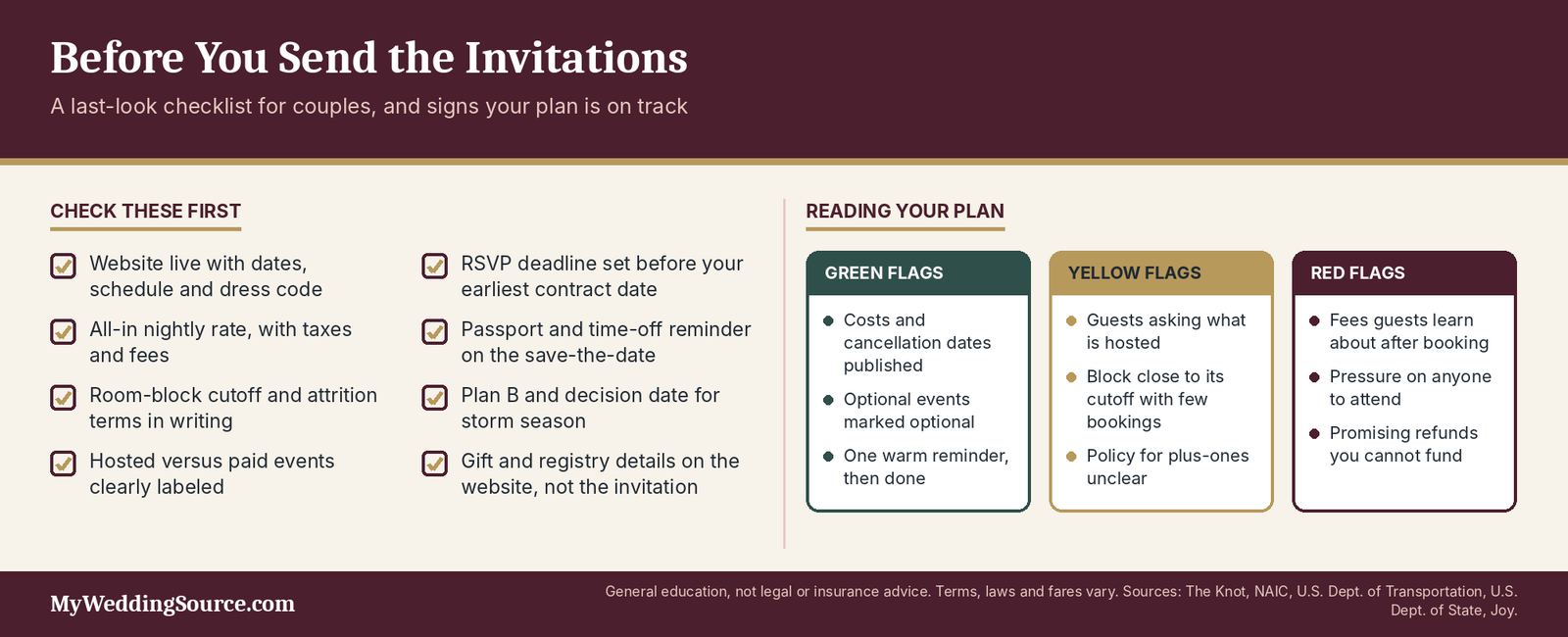
Add the items guests actually need to make a go or no-go decision: an honest cost note (a range for lodging per night, with taxes and resort fees flagged), the last free-cancellation date on the hotel block, which events are hosted and which are paid, the typical weather for your dates, and what happens if a hurricane, strike or closure changes plans. A section called “Good to know” or “Frequently asked” works well.
How do you word the cost conversation honestly?
Honest wording acknowledges the price without apologizing for it or dictating how guests should feel. A line like “A weekend here costs real money, so please do what is right for you, and know that we will be thrilled to celebrate with you either way” does three things at once: it names the cost, hands over the decision and removes guilt in both directions. Avoid lines that quietly lean on guests, such as “we hope everyone can make it work,” which can read as pressure.
Be specific where specifics help. A line like “Rooms in our block run about $289 a night before taxes and fees” (an invented example) is more useful than “affordable rates,” and a statement of what the rate includes (breakfast, resort fee, parking) saves each guest a round of email.
How do you handle the tricky lines?
How do you word optional events and satellite cards?
Karen Bussen, in the same Islands Q&A, suggests a separate card with RSVP boxes for satellite events, which gives guests a place to say which events they will attend without crowding the main invitation. That approach also solves a quiet problem: the person who wants to come for the ceremony and the dinner but skip the sunrise hike can say so without a conversation.
Labeling matters as much as inviting. A card that says “Optional: Sunday catamaran sail, $85 per person, payable to the operator” tells guests exactly what they are agreeing to. A card that says “Join us Sunday for a sail” leaves them to assume it is a hosted event and discover the bill later. If an event is a hosted treat, say that too: “Our treat” is two words that save an awkward moment at the dock.
How do you say “we understand if you cannot come” without making it weird?
The most useful version is short, specific and placed where guests will read it. On the website’s FAQ, a line such as “We know a destination wedding is a big ask. If you cannot make it, we completely understand, and a quick reply helps us plan” gives permission and a reason to respond. On the RSVP, offer “Joyfully accepts” and “Regretfully declines” with space for a note rather than a request for explanations.
Resist two temptations. One is to say “no gifts, please” in a way that sounds like a rule, since the gift question is better answered by tone (Post’s suggestion that guests’ presence is their present) than by a command. The other is to follow up with every non-responder individually in a tone that feels like pursuit. A single warm reminder two weeks before the deadline, with the date repeated, is plenty. After that, a decline is a decline, and a no-reply by the deadline can be treated as a regret with a friendly confirmation message.
Hosting Guests: Welcome Events, Out-of-Town Bags and Group Activities
What should you host, and what can you skip?
Do you have to host a welcome party?
You do not have to, and many couples skip it. Anna Post says pre- and post-wedding events are not required but are appreciated, that guests who travel far should generally be invited, and that hosting only one gathering beyond the rehearsal dinner lets guests relax. Bussen likewise calls extra events optional. The reasoning is straightforward: a destination wedding is already a multi-day commitment, and a packed hosted itinerary can leave guests feeling obligated to attend everything on top of the cost of getting there.
A welcome event works best when it is low-key and solves a real problem. A casual evening on arrival day gives early arrivals a place to be, helps introduce families and friends and lets nervous travelers see familiar faces before the wedding. If you cannot afford to host, a casual “meet at the hotel bar at 7 p.m., pay your own way” note on the website is also a perfectly graceful option, as long as you label it as such.
| Hosting level | Typical events | Signals to guests | Watch for |
|---|---|---|---|
| Minimal | Ceremony and reception only | Simple, flexible weekend | Provide a “where to eat” guide so guests are not stranded |
| Moderate | Plus a welcome gathering | Warm without overload | Keep it to one extra hosted event beyond the rehearsal dinner |
| Generous | Welcome, farewell brunch, shuttles, welcome bags | Hospitality-forward | Budget for per-person costs that scale with guest count |
Who should be invited to which event?
The test for each event is whether a reasonable guest would feel hurt by exclusion. The rehearsal dinner traditionally includes the wedding party, immediate family and anyone participating in the ceremony. If many guests have traveled for the weekend, consider a separate welcome event open to everyone who traveled, so that out-of-town guests who were not at the rehearsal dinner are not left to find their own dinner on a night when the couple is busy.
Be especially careful with partial invitations that happen in public view. A group of eighty guests at a hotel can easily watch twenty people go to dinner without them. If you are inviting only some people to an event, say who it is for on the website (“Rehearsal dinner: wedding party and immediate family”) and consider a quiet alternative, such as a no-host group table at a nearby restaurant, for anyone left out.
What about welcome bags, transportation and small touches?
What goes in an out-of-town welcome bag?
The aim is useful, not impressive. Bussen suggests a small welcome gift left in the room or at the front desk, such as sunscreen and water, local snacks or a candle with a note, along with a wedding itinerary. Items should be usable during the stay or easy to pack, since luggage space and baggage fees are real constraints for guests who flew. A printed one-page schedule with your phone-free contact (a day-of coordinator’s number rather than your own) and directions to the venue is more useful than a trinket.
Costs scale quickly with guest count, so do the arithmetic before you commit. As an illustration, not a quote: 40 room deliveries at $15 each is $600, plus the property’s delivery fee if it charges one, while 40 deliveries at $35 is $1,400. Ask the hotel whether it accepts and delivers bags, what it charges and how far ahead it needs them.
Should you provide transportation?
Transportation is one of the most useful ways to be generous without hosting extra events. Shuttles between the hotel and venue reduce stress, keep guests from driving in an unfamiliar place after drinks and cut the number of rental cars, all of which also helps the guests’ budgets. If you can only provide transportation for the wedding day, do that, and publish a plan for the other days so that no one is surprised by a $60 taxi fare.
Be clear about what is included. “Shuttles will run between the hotel and the venue from 3 p.m. to midnight on Saturday” is better than “transportation provided.” If airport transfers are not covered, give a ballpark price and a link to the property’s recommended provider.
Money Etiquette: Cost Talk, Room Blocks, Gifts and Helping Guests
How should couples handle guests’ costs?
Do you have to pay for guests’ travel?
No. The convention described by Bussen is that hosts cover the ceremony and reception, and guests cover their travel, so a couple who pays only for the wedding is behaving correctly. Paying for everyone’s flights is a generous choice some couples make for very small weddings, and it is not an expectation at the usual 100-plus-guest scale. The Knot’s Guest Study found an average cost of $1,680 for guests who flew to a wedding, and a couple with 100 traveling guests would be looking at six figures for flights alone, before lodging. Even the plain fare data points the same way: the Bureau of Transportation Statistics reported a $428 average domestic fare for the first quarter of 2026, about $522 for round trips, before bag fees.
The more useful question is what you can do within your budget. Options include choosing a destination with lower airfare, picking an off-peak date, negotiating a group rate on lodging, hosting one or two meals, arranging a shuttle or covering the cost of a night for the wedding party. Each of these reduces the guest’s bill without turning the wedding into a travel subsidy.
What do you owe your wedding party?
There is no fixed standard, which is why this question causes more friction than almost any other. Wedding party members face the highest costs because they typically attend more events, buy attire and travel earlier. A DatingNews.com survey of 1,024 Americans in July 2024, reported by FOX 13, found that guests in the wedding party reported spending an average of $1,131, compared with $901 for guests at out-of-town weddings and $360 for local weddings.
The kindest practice is to tell prospective attendants the full picture before they say yes: dates, destination, likely costs for travel and lodging, and what you plan to cover. If you are covering the wedding party’s lodging, say that. If you are not, offer the exit gracefully: “We know this is a big ask. If it does not work, we completely understand, and we would still love to have you at the wedding.”
How do you set up a room block honestly?
A room block is a set of rooms a hotel holds at a negotiated rate for your guests, and it carries a risk that couples sometimes underexplain. Joy’s wedding glossary describes an attrition clause as a contract provision requiring you to book a minimum share of the reserved rooms, with most contracts setting that minimum between 75% and 90% and 80% the most common, and a penalty usually based on the hotel’s lost revenue for the unfilled rooms. Negotiating points include a lower threshold, a review date a few weeks before the cutoff, resale credit and a smaller initial block.
The etiquette is in how you describe this to guests. It is fair to say that booking within the block helps you, because it does, but it is not fair to pressure a guest to pay more than they would elsewhere or to book at a hotel that does not fit their budget. If a guest finds a cheaper option, thank them. The FTC’s rule requiring total prices for short-term lodging (as summarized by Frommer’s), which took effect in 2025, means advertised rates should include mandatory fees, though taxes are excluded from the up-front price, so ask the hotel for an all-in nightly figure before you publish a rate. Our destination wedding guest costs page explains how those fees show up on a folio.
What gift and registry etiquette applies?
What gift is reasonable from a guest who traveled?
There is no required amount, and at a destination wedding the guest’s travel is itself a significant expenditure. The Knot’s Guest Study, fielded in October 2024 among 1,000 U.S. adults aged 18 to 54, found an average wedding gift of $150, with $160 from close friends, family and wedding party members, $140 from casual friends and $120 from a plus-one, and only 6% of guests giving no gift. These are averages across all weddings, not destination weddings specifically, so a traveling guest giving less than the average is not behind.
Anna Post’s guidance is that gifts tend to be smaller at destination weddings and that couples can tell guests their presence is their present. If you are a couple who means that, say it lightly and then believe it. If you are a guest, consider what feels right and let the trip count as part of your contribution.
Where should gifts be sent, and what about registries?
Gifts should go to the couple’s home or a shipping address, not to the destination. Bussen’s advice is to direct gifts to the couple’s home, because guests should not have to carry a blender home from Jamaica, and the same logic applies to guests who carry a wrapped box through an airport. A registry link on the wedding website, with a clear shipping address, is the practical solution. Anna Post advises leaving registry details off the invitation, which keeps the focus on the invitation itself.
Offer alternatives for guests who prefer them. Cash or honeymoon funds are common choices for couples who already have a household, and some couples use funds to offset their own travel. A short, specific thank-you note, sent within a few weeks of the wedding or when the gift arrives, is the piece of etiquette couples tend to remember longest.
| Source | Sample | What it reports | Year |
|---|---|---|---|
| The Knot Guest Study | 1,000 U.S. adults, 18 to 54 | $270 local; $610 average; $840 drove; $1,680 flew | Fielded Oct. 2024 |
| DatingNews.com survey (via FOX 13) | 1,024 Americans | $360 local; $901 out-of-town; $1,131 wedding party | July 2024 |
| BTS average domestic fare | About 40% of tickets sold | $428 average; $522 round-trip average (before bag fees) | Q1 2026 |
Sensitive Situations: When a Guest Declines, Cannot Afford It or Needs More
How do you respond when a guest says no?
What if a guest declines because of cost?
Respond with warmth and without negotiation. The DatingNews.com survey found that 29% of respondents had skipped a wedding in the past year because of cost, so you are asking a question many people are already answering that way. A reply like “Thank you for telling us. We will miss you, and we love that you were honest” ends the exchange without leaving a debt. Do not offer to cover the cost unless you were already planning to do so for everyone in a similar position, and do not tell the guest what they could cut.
If you want to offer help, offer a structure rather than a favor: for example, a partial-weekend option (“come for the ceremony and dinner, and skip the extra nights”) or a flexible RSVP that allows a shorter stay.
What if close family or the wedding party cannot come?
This is the hardest version, and it deserves a phone call. Ask what is getting in the way before you assume it is money: a health concern, a work conflict, a fear of flying or a caregiving obligation. Sometimes there is a creative solution, such as shifting the dates by a day, offering a hybrid role (a reading or toast recorded in advance), arranging a video link for the ceremony or hosting a celebration at home. Sometimes there is not, and the best you can do is say that you understand.
Take the decision seriously before you send invitations. If a parent or a sibling cannot travel internationally, consider whether the wedding you picked is the wedding you want without them. Some couples choose a legal ceremony close to home with immediate family and a celebration at the destination, which is a valid approach.
How do you support guests with additional needs?
What about guests with health, mobility or access needs?
Accessibility varies widely between properties and countries, and guests with disabilities or health conditions need information early. Put the basics on the website: whether the venue and hotel have step-free routes, elevators, accessible bathrooms and shuttle options, how far the ceremony location is from parking or a drop-off and what the terrain is like. If you do not know, ask the property directly and in writing. When a guest asks about access, treat the question as logistics, not a complaint.
Medical needs deserve similar respect. Guests who are pregnant, immunocompromised or managing a chronic condition may need to check destination health guidance and their insurance, and the CDC and State Department pages are the places to start. Minnesota’s Department of Health suggests asking a provider about medications and first-aid supplies and getting a letter that describes medical conditions and prescriptions’ generic names.
What about LGBTQ+ couples and guests, and legal recognition?
If you or your guests are LGBTQ+, the destination itself is part of the etiquette question. The U.S. Department of State’s guidance for LGBTQI+ travelers notes that same-sex relations are illegal in more than 60 countries, that many countries do not recognize same-sex marriage, and that some resorts or neighborhoods may be accommodating while the wider community is not. A couple who picks a location without checking has asked guests to accept a risk without telling them.
Check the State Department’s country page and the Local Laws & Customs section before you commit, and discuss the destination with friends and family who would be affected. If your destination is welcoming, say so on the website so guests can plan with confidence. Legal recognition matters too: marriage laws are set by each country, so confirm whether your ceremony will be a legal marriage, whether you will need a separate legal ceremony at home and what paperwork the destination requires. The Knot notes that couples are often required to arrive a few days early to complete paperwork, so check requirements with the venue and the official authorities rather than relying on a general guide.
Protecting the Trip: Insurance, Refunds and Plan B Etiquette
What can guests and couples insure?
What does guest travel insurance cover?
The National Association of Insurance Commissioners (NAIC) describes the main coverage types as trip cancellation, interruption or delay (repaying prepaid costs for covered reasons such as illness, severe weather or a natural disaster), travel medical, medical evacuation, accidental death and dismemberment and baggage coverage. Common exclusions include pre-existing health conditions, pandemics, civil unrest and risky activities, and if you wait until a storm has been named, a policy likely will not cover claims related to it. Policies typically cost about 5% to 10% of the trip price.
Cancel for Any Reason (CFAR) coverage is the add-on that lets you cancel without a covered reason, but the NAIC notes that it usually must be bought within a set period after booking, costs more and typically reimburses only part of the trip cost. Our guide to travel insurance coverage for honeymoons explains the same categories in more detail, and the principles apply to guest travel.
What coverage should the couple consider?
Couples face a different set of risks. Travel insurance for your own trip, wedding event insurance, vendor insurance and venue liability coverage are separate products with separate exclusions, and they are easy to confuse. Event cancellation coverage is designed to reimburse certain non-recoverable costs if a covered event forces you to cancel or postpone, while liability coverage addresses accidents at the event. Policies vary on what causes they cover, including weather and vendor failure, so read exclusions and ask a licensed agent or your state’s department of insurance to explain what applies.
Etiquette meets insurance in what you tell guests. Do not promise to reimburse guest costs if the wedding is canceled unless you have decided you can afford to. Instead, tell guests what you will do (for instance, “we will tell you as soon as we know and will share any refund options”) and encourage them to read the cancellation terms before booking nonrefundable fares.
How do you communicate when plans change?
How should you handle hurricane season and weather?
If your dates fall in a storm season, build the decision process into the plan before it is needed. The National Hurricane Center lists the Atlantic season as June 1 to November 30 with a peak around September 10, so a September wedding in the Caribbean has a real chance of weather disruption. Pick a decision date (for example, seven to ten days before the wedding), name who will make the call and tell guests how you will communicate, such as email, text and the website.
Be candid with guests about the risk when you invite them and advise them on refundable fares and insurance. Our guides to Labor Day wedding travel and Thanksgiving weekend weddings cover the extra pressures that holiday weekends add to fares and lodging, and the same logic applies when you pick a date at the edge of a season. A calm, early message is almost always better than a polished one sent late.
What are your rights and responsibilities when airlines change plans?
The U.S. Department of Transportation says passengers are entitled to a refund if an airline cancels a flight or makes a significant change and the passenger declines the alternative. Significant changes include departing or arriving 3 or more hours off schedule on a domestic flight or 6 or more hours off on an international flight, a different airport or additional connections. Credit card refunds are due within 7 business days, and the merchant of record is responsible for airfare refunds. The 24-hour rule applies to tickets bought at least seven days before departure, though not to tickets bought through some agencies.
As a couple, the best thing you can do is share these basics on your website and avoid giving guests the impression you can rebook them. As a guest, buy from the airline when possible, keep records and check the carrier’s fare conditions before paying. If a disruption occurs, a quick message in the group chat or the website’s news section, such as “Flights from Chicago are delayed; here is the shuttle plan for late arrivals,” helps everyone.
| Risk | Who usually bears it | What to check | Etiquette move |
|---|---|---|---|
| Nonrefundable airfare | Guest | Fare rules; DOT refund triggers; insurance options | Share cancellation facts early; do not promise reimbursement |
| Hotel block cutoff | Couple (attrition) and guest | Cutoff date, rate after it, cancellation window | State the date and the last free-cancel day on the website |
| Storm or hurricane | Both | Season dates; insurance purchase timing; plan B | Set a decision date and communication channel in advance |
| Passport delay | Guest | Processing time; six-month validity | Add a passport line to the save-the-date |
| Vendor or venue failure | Couple | Contract terms; event insurance exclusions | Tell guests promptly; share what you know |
FAQ: Destination Wedding Etiquette
Questions from couples
Is it rude to have a destination wedding?
No. Destination weddings were about 17% of weddings in The Knot’s 2026 study of couples married in 2025, so guests increasingly expect that an invitation might involve a trip. What can be rude is the way the request is handled: late notice, hidden costs, pressure to attend or a hosted schedule so full that guests cannot enjoy the place. If you give long notice, publish honest costs, make most events optional and accept declines graciously, you have followed the etiquette that matters.
Can we say “no gifts” on a destination wedding invitation?
You can, but it is usually better not to put gift language on the invitation at all. Anna Post’s suggestion that couples tell guests their presence is their present sets a warm tone without issuing a rule, and registry details belong on the wedding website rather than the invitation. If you would prefer no gifts, say it once on the website in a sentence that sounds like you, and then accept gracefully when some guests give anyway.
How do we handle guests who ask for a different hotel or a plus-one we did not offer?
Answer the logistics question kindly and hold your line on the policy. For hotels, thank the guest and explain that the block helps you with the contract but that they are free to book wherever suits their budget, as long as they know the shuttle schedule and meeting points. For plus-ones, repeat the policy briefly and without apology: “We are keeping the guest list to the people named on the invitation, and we hope you understand.” Consistency is the kindest tool you have, because it keeps the answer the same for every guest who asks.
Questions from guests
Is it rude to decline a destination wedding because of cost?
It is not rude. A prompt, warm decline is the correct response when the trip does not fit your budget, time off or health, and you do not owe the couple an explanation beyond a sentence of thanks. The DatingNews.com survey found 29% of respondents had skipped a wedding in the past year because of cost, which suggests that couples increasingly expect it. Reply by the deadline, send a card or a small gift if you wish, and plan a way to celebrate with the couple when they are home.
Do I still send a gift if I decline?
It is a kindness rather than an obligation, and the amount is up to you. Some guests who decline send a modest gift or a card, especially for close friends and family, while others send best wishes only. Anna Post’s guidance that gifts at destination weddings tend to be smaller applies to guests who attend, and it is reasonable to give less or nothing if you did not travel and cost was the reason you declined. If you do send something, ship it to the couple’s home from the registry on the website rather than to the resort.
Can I attend only the ceremony, or arrive late?
Often yes, and couples are usually glad to have you for part of the weekend rather than none of it. Check the website to see which events are hosted and which are optional, then tell the couple which ones you plan to join so they can count correctly. Be careful with the reception meal, because a caterer or resort may have a firm headcount. A short message such as “I can come for Friday and Saturday but must fly home Sunday morning. Is that all right?” gives them what they need to say yes.
Your Next Steps
This week
If you are the couple
Start by writing a one-page policy that answers five questions: who is invited and why, what you are hosting, what you are not, whether you will help anyone with travel and how you want declines handled. Share it with whoever is helping you decide, such as a partner or a parent, and look for places where your answers differ before a guest does. Then draft the save-the-date and the first version of the website, using the timeline table above to set your send date. Link your destination wedding checklist to this policy so contracts, deposits and guest communication stay in sync.
If you are a guest
Open the invitation or website and build a first-pass total by adding the flight, lodging, meals you will pay for, events and a gift. Our guest cost worksheet walks through this in an evening. Check your passport expiration date today, because the State Department’s current routine window of 4 to 6 weeks plus mailing time is long enough to matter. Then decide on your reply, and send it before the deadline with a warm line either way.
Before you send invitations or pay a deposit
Couple checklist
Confirm that your website is live and answers the basic questions: dates, schedule, dress code, travel, lodging, costs, weather and a plan B. Read your hotel and venue contracts for attrition, cancellation and deposit terms, and ask for the all-in nightly price including mandatory fees. Settle your hosting plan and label each event as hosted or paid. Choose your RSVP deadline against the earliest contract date, and plan one reminder two weeks before it. Decide who will answer guest questions and how you will notify everyone if something changes.
Guest checklist
Before you book anything nonrefundable, check the airline’s fare conditions, the hotel’s last free-cancellation date and the terms of any travel insurance, including whether it excludes named storms and when a cancel-for-any-reason add-on must be purchased. Ask the couple about anything unclear, such as a dress code or whether an event is hosted. Confirm time off with your employer, and book vaccinations or a provider visit four to six weeks before departure if your destination calls for it. Finally, set a calendar reminder to send a thank-you note after the weekend, because it is the simplest part of destination wedding etiquette and the one couples remember.
Sources & methodology
- The Knot Real Weddings Study 2026 data read-out (PDF) — 17% destination share in 2025, 117 average guests, 14-month average engagement, sample of 10,474 couples.
- The Knot: how much does a destination wedding cost? — 2025 study (couples married in 2024): 18% destination share, about $39,000 versus $32,000 hometown, planner usage.
- The Knot: wedding guest cost — Guest Study averages ($270, $610, $840, $1,680), gift averages, sample and fielding dates.
- The Knot: destination wedding invitations guide — save-the-date and invitation timing, RSVP deadlines, what to include, hybrid paper-and-web approach.
- The Knot: when to send save-the-dates — six-to-eight-month general window and its limits.
- Islands: 12 destination wedding etiquette questions answered — expert views from Karen Bussen, Holly Lefevre and Anna Post on who pays, timing, welcome gifts, events, gifts and adults-only wording.
- FOX 13 report on the DatingNews.com survey — local, out-of-town and wedding party guest spending; share who skipped weddings for cost.
- U.S. Department of State: passport processing times — routine and expedited processing, $60 expedite fee, advice on when to apply.
- U.S. Department of State: renew a passport — renewal fee, validity and six-month advice.
- U.S. Department of State: LGBTQI+ travelers — local laws, recognition of same-sex marriage and safety planning.
- NAIC: should you get travel insurance? — coverage types, exclusions, CFAR and typical cost.
- U.S. Department of Transportation: airline refunds — refund triggers, significant-change thresholds, refund timing and the 24-hour rule.
- Joy: what is an attrition clause? — attrition thresholds and negotiating points.
- Frommer’s on the FTC junk fee rules — total-price rule for short-term lodging and exclusions.
- Bureau of Transportation Statistics: Q1 2026 average air fare — $428 average domestic fare, $522 round-trip average, what fares exclude.
- Bureau of Labor Statistics: employee benefits — 80% access to paid vacation, March 2026.
- NOAA National Hurricane Center: climatology — Atlantic and Eastern Pacific hurricane season dates and peaks.
- Minnesota Department of Health: travelers — seeing a provider four to six weeks before travel; medical letters.
Methodology: Verified facts come from government and agency pages (the State Department, DOT, BTS, BLS, NOAA, NAIC), survey findings from The Knot and DatingNews.com, whose samples we name, and etiquette conventions from the named experts quoted in the Islands Q&A and The Knot. Our timing lean (9 to 12 months for save-the-dates, 4 to 6 months for invitations), the hosting tiers, the sample scripts, the welcome-bag arithmetic and the guest-list tiers are editorial judgment or illustrative examples, not quotes or legal advice. We found no reliable national figure for the share of invited guests who attend a destination wedding, so we do not give one, and etiquette sources disagree on invitation timing.
Freshness note: Recheck passport processing times and fees, airline refund rules, FTC fee-rule guidance, hurricane-season dates and The Knot’s annual studies before you publish dates or numbers to guests. Marriage-license and legal-recognition requirements are set by each country and change, so verify them with the destination’s official authorities and the State Department. This article reflects research as of October 2026.