
Knowing how to arrange ASL interpretation for wedding toasts comes down to a few decisions made early and in the right order: ask your Deaf guests what they need, book qualified interpreters in a team, get the toast texts to them ahead of time, and set up the room so the interpreter and the speaker can be watched together.
Quick answer
Talk to the Deaf guests first, then book a qualified, certified interpreter team through an agency or the Registry of Interpreters for the Deaf directory. Plan on two interpreters if the toast block runs long, and give them every toast script, the names, and the run of show before the day. Place the interpreter where guests can see the speaker and the interpreter at once, keep that spot lit, and hand the microphone to the speakers, not the interpreter. A one-month lead is a floor, not a goal: start about eight to twelve weeks out. We are not lawyers, and this guide is not legal advice.
Why toasts need their own plan
Most wedding days involve a lot of talking, but the ceremony is scripted and the dinner is mostly conversation. Toasts sit between the two. They are spoken live, often unrehearsed, full of names, inside jokes, and stories, and they arrive in a block when guests are seated and expected to listen. For a guest who uses American Sign Language, that block can be the part of the day that is either wonderful or silent. This section explains why toasts deserve a separate plan before we get to how to arrange ASL interpretation for wedding toasts in practice.
What makes a toast hard to follow without access
A toast mixes spoken words, humor, and emotion, and it is usually delivered by someone who is nervous. Several features make that difficult for a guest who cannot hear it.
Speakers turn, look down, and cover their mouths
People reading from phone screens or cue cards look down and turn away. They hold a microphone in front of their lips. Even for guests who speechread, that removes most of what they could use. One wedding guide on Deaf guests notes that only about 30 percent of speech is visible even to skilled speechreaders, so a front-row seat alone does not settle the question.
Speakers change quickly and names fly by
A toast block can include a best man, a maid of honor, a parent, a sibling, and a friend who asks to say a few words. Each speaker has a different pace, accent, and style, and each introduces people the guest may not know. Without a plan, nobody tells the Deaf guest who is talking or when the next toast begins.
What an interpreter does, and what an interpreter is not
An interpreter moves meaning between two languages. At a wedding toast, that means turning spoken English into signed ASL for the guest, and, if a Deaf guest wishes to say something, turning ASL into spoken English for the room. The National Institute on Deafness and Other Communication Disorders describes ASL as a complete, natural language with its own grammar, conveyed through the hands and the face, and notes that its grammar differs from English. That is why an interpreter cannot simply sign English word for word, and why preparation matters.
An interpreter is a professional, not a guest
The interpreter works under a professional code and is a neutral communication facilitator, not a participant in the conversation, as a university disability office describes the role. Expect them to arrive, work, and step back. Offer them a seat, water, and a meal in the way you would offer to any vendor, and agree in advance how breaks and meals will work.
An interpreter is not a substitute for captions or the reverse
Interpreting serves people who use sign language. The ADA guidance we read points out that sign language interpreters are effective only for people who use sign language, and that people who lost hearing later in life and do not sign need other methods, such as captions. This guide is about ASL, but a later section explains how live captions can sit beside an interpreter for guests with different needs.
Who this guide is for
This is written for couples, planners, and the relatives who often end up organizing these details, such as a parent of the couple or a Deaf family member who is tired of arranging their own access. It assumes you are in the United States, where ASL is the most common signed language, as one city guide on scheduling interpreters puts it.
If you are the couple
You decide the scope and the budget, and you set the tone. If one of you is Deaf or has Deaf family, you already know much of this, and the sections on contracts, materials, and the run of show may be the most useful.
If you are a planner, coordinator, or helpful relative
You are likely to be the person emailing agencies and speakers. The briefs and templates later in this guide are written so one person can run the whole process and hand it off on the day. For wider context, our guide to the accessible wedding guest experience places interpreting among the other supports guests may need.
Start with the guests, not the service
It is tempting to book an interpreter first and tell the guest afterward. The better order is the reverse. People who are Deaf, deaf, hard of hearing, or late-deafened communicate in different ways. The National Association of the Deaf describes ASL as central to American Deaf culture, but not everyone who has hearing loss uses it. Needs-led planning means that you find out what each guest wants before you decide what to buy, and it is the first rule of how to arrange ASL interpretation for wedding toasts well.
Ask each guest, and ask well
A direct, warm message works better than a form letter. Say what you can offer, ask what would help, and give a date.
What to put in the message
Name the specific moments: the ceremony, the toasts, the first dance introduction, and any announcements. Mention that you are considering ASL interpreters and live captions, and ask which, if either, would help. Give a person to contact and a reply-by date, and promise that late requests will still get an answer. The Equal Entry and city-government guidance we read both suggest collecting event details early and naming a point of contact, and the Portland city guide adds that an access statement on outreach materials, saying what is available and whom to contact, helps events that have no advance contact with attendees.
What not to assume
Do not assume that a Deaf guest wants an interpreter, or that every Deaf guest wants the same one. Do not assume that a guest who uses hearing aids prefers captions. Do not assume that a guest who signs does not also read English comfortably. Ask the individual, and write down the answer.
Learn the guest’s preferences about the interpreter
Once you know a guest wants ASL interpretation, you can ask about practical preferences. These shape both the booking and the day.
Preferred interpreters and agencies
The San Francisco guidance on scheduling interpreters says to honor a person’s preference for a particular interpreter when possible. Another government page recommends asking the person who needs the interpreter about interpreter or agency preferences and staying open to their feedback afterward. Some Deaf guests have worked with local interpreters for years and can recommend someone trustworthy, and some will have strong views about who not to hire.
Sight lines and seating
Ask where the guest would like to sit and what they need to see. A guest who wants to watch the couple, the speaker, and the interpreter at once has different seating needs from a guest who mainly wants to watch the interpreter. Our seating chart guide covers how to hold tables for guests with access needs without making them feel singled out.
Account for different communication styles
Not everyone at the table communicates the same way, and several guests may sit close together with different needs. A short intake grid helps you see the pattern before you decide how many interpreters or captioners you need.
Guests who sign
For guests who use ASL as a primary language, interpreting is often the right fit for toasts. If more than one guest signs and they sit at different tables, the room plan in a later section lets you choose a single interpreter position they can all see.
Guests who read lips, use captions, or use hearing technology
Some guests will prefer live captions, a written copy of the toasts, or a seat near a speaker with a good microphone. These supports work well together. A printed or projected copy of toast texts, for instance, helps guests who sign and guests who do not.
What the rules say, and what they leave to you
Before you book anyone, it helps to know how the federal rules describe interpreting, because they shape what a venue or vendor may say to you and what you may ask of them. This is a plain-language summary of public guidance, not legal advice. Duties differ by situation, and a couple hosting a private party is not described in the pages we read as carrying the same duties as a business or a government. Knowing the basics helps you decide how to arrange ASL interpretation for wedding toasts without promising more than you can deliver.
How the ADA describes effective communication
The Department of Justice’s effective communication guidance says covered businesses and governments must communicate with people who have disabilities as effectively as they communicate with everyone else, which can require auxiliary aids and services.
What counts as a qualified interpreter
The guidance defines a qualified interpreter as someone able to interpret effectively, accurately, and impartially, in both directions, using any specialized vocabulary the situation calls for. The same guidance lists qualified sign language, oral, cued-speech, and tactile interpreters among the aids. For a wedding, the practical reading is that “someone who knows some sign” is not the same as a qualified interpreter.
Interpreters and family members
The guidance says a covered entity cannot require a person to bring their own interpreter, and that relying on an accompanying adult is limited to narrow situations: an emergency, or a case where the person asks for it, the adult agrees, and it is appropriate. As a host, you can apply the same logic by default. Do not ask a Deaf guest’s spouse or child to interpret the toasts, and do not ask the Deaf guest to arrange their own interpreter.
Who may have duties at a wedding
The ADA’s Title III page describes a “public accommodation” as a business that serves the public, including restaurants, hotels, and many other places, and it notes that religious organizations are not covered and that private clubs are excluded only under specific conditions. A wedding touches several of these at once.
The venue and the vendors
A hotel, restaurant, or event venue may be a covered business, and it may have its own written access policy. Ask the venue what it provides for guests who need interpreting or captions, whether it has preferred interpreter agencies, and what the contract says about who is responsible. Do not assume every venue has identical duties, because the rules turn on the type of entity and the facts. Our venue questions guide and vendor contract guide show how to get answers in writing.
The couple as hosts
A couple hosting a private celebration is not clearly in the same position as a business open to the public, and the pages we read do not say that a private couple carries the same duties. You should neither assume you are responsible for everything nor assume you are responsible for nothing. If a venue contract hands you the responsibility to provide interpreters or equipment, read it closely, ask the venue to explain it in writing, and consider asking a lawyer if the language is unclear.
Reasonable notice and the limits of “too late”
The effective communication guidance says an entity may ask for reasonable advance notice based on how long an aid takes to arrange, that the notice cannot be excessive, and that walk-in requests must be honored to the extent possible.
What this suggests for a private wedding
The guidance is about businesses, but the idea transfers. You may ask guests to tell you their needs by a date, and you can explain that interpreters book up. You should still answer a late request kindly and try to meet it, even if the answer is a partial plan, such as a written copy of the toasts plus the best seat in the room.
Why we suggest asking early anyway
Interpreters with strong credentials can be hard to find. One couple interviewed by The Knot advised booking at least a month ahead because qualified, certified interpreters can be difficult to find, and the Registry of Interpreters for the Deaf says on its career page that demand currently exceeds supply. Our own suggestion, which is a judgment and not a rule, is to start eight to twelve weeks before the wedding and treat a month as the minimum.
Decide the scope: which toasts, how many interpreters
Scope is where budget and access meet, and it is the next decision in how to arrange ASL interpretation for wedding toasts. The most common mistake is to hire an interpreter for the ceremony only and forget that the reception is where most of the unscripted speaking happens. The second most common mistake is to hire one interpreter for a block that is too long for one person to cover well. Both are easy to avoid once you treat the toast block as its own unit when you plan how to arrange ASL interpretation for wedding toasts.
Choose which moments to cover
List every moment at which someone will speak to the room. Then ask the Deaf guests which of them matter most.
The toast block
This is the center of the plan. Count the speakers, estimate how long each will go, and add a buffer. A typical reception might include a welcome from a parent, a best man, a maid of honor, and a thank-you from the couple, but you know your own plan. Our wedding speeches guide and reception planning guide can help you estimate timing.
The moments around the toasts
Do not forget the spoken pieces that bracket them: the grand entrance announcement, the blessing before the meal, the cake cutting introduction, the DJ’s announcements, and the “last call” for the dance floor. Some of these are only a sentence, but they carry information guests need. Decide whether the interpreter will cover them or whether the MC will also post them in writing.
Decide how many interpreters
Interpreters commonly work in pairs for anything beyond short assignments. Equal Entry says sign language interpreters often work in pairs and switch roles every ten to twenty minutes, and it cites research suggesting that accuracy and speed decline after twenty to thirty minutes. A San Francisco city guide says events under two hours may need one interpreter and events of two hours or more require two.
A rule of thumb for a toast block
Those sources are written for conferences and city meetings, not weddings, so treat the numbers as a guide. A short toast block of fifteen minutes may be manageable for one interpreter who is also interpreting nothing else that hour. A block of half an hour or more, or a full evening, is a good case for two. If the interpreters also cover the ceremony and cocktail hour, ask them what coverage they think is realistic and listen to their answer.
One interpreter per guest or per group
Some families want a separate interpreter for specific people so that they can talk freely at the table. In The Knot’s wedding example, the couple hired three interpreters: one dedicated to the bride’s parents so they could talk with anyone without relying on her, and another for her sister’s family. That is a different service from interpreting toasts for the room. Decide whether you are booking room coverage, personal coverage, or both, and say so in the booking request.
Understand the credential choices
The word “interpreter” covers a range of training and credentials, and it is worth learning the basics before you talk to an agency.
Certification
The Registry of Interpreters for the Deaf states that holders of the National Interpreter Certification have demonstrated general interpreting knowledge, ethical decision-making, and interpreting skill at a professional standard. RID also notes that there is no federal interpreter certification requirement and that each state sets its own rules. Equal Entry adds that certification is an entry point to practice and not a guarantee of quality, so ask about experience, too.
State licenses and skill levels
Some states license interpreters. The New Mexico commission’s guide says that, if you do not specify a skill level, an agency may send a provisionally licensed interpreter, which may be fine for a simple one-on-one meeting but not for a large, multi-speaker, or complex presentation. A toast block is multi-speaker and unscripted, so ask for the higher level and check your state’s rules.
How to arrange ASL interpretation for wedding toasts, step by step
This is the working core of the guide. The steps below take you from a list of guests to a signed booking. They are in the order that causes the fewest do-overs.
Find and vet interpreters
Start by deciding whether you will go through an agency or hire interpreters directly, since that choice shapes the rest of how to arrange ASL interpretation for wedding toasts. Both work, and the right choice depends on your area and your guests.
Where to look
Portland’s city guide on hiring an interpreter suggests searching online for local agencies while avoiding ads, asking Deaf-led organizations for referrals, and asking friends and colleagues who have used interpreters. Equal Entry suggests asking an agency to assign interpreters suited to the specific assignment, not the first available one. The Registry of Interpreters for the Deaf offers a public directory where you can search for members and verify membership and certification.
What to verify
Ask for the interpreters’ credentials and confirm them through the directory or the state licensing office, if your state has one. Ask whether they have worked weddings or other celebrations with speeches. Ask the Deaf guests whether they know the interpreters, and respect a preference for or against a specific person. Equal Entry warns against choosing on price alone, and our own view is that an interpreter who is wrong for the room costs more than the difference.
Send a complete booking request
Agencies work faster and make fewer mistakes when the request is complete, and a complete request is the center of how to arrange ASL interpretation for wedding toasts. The San Francisco scheduling guide gives a useful model.
The details to include
Include the date, start and end time, address, and room. Say what kind of event it is and whether the interpreter is for one person, a group, or the whole room. Give the number of interpreters you expect to need and why. Name a day-of contact with a phone number that will be answered. The city guide asks for interpreters to arrive at least fifteen minutes early for briefing and setup, and Equal Entry suggests adding setup time to the booking.
The context to include
Tell the agency the purpose of the event so it can match interpreters with relevant skills, as the New Mexico guide recommends. Mention that there will be several speakers, that some will be unrehearsed, that there may be humor or songs, and that there will be a microphone. Say whether the interpreters will be filmed or photographed, and how the footage will be used. The San Francisco guide lists this as something to disclose.
Agree on the terms in writing
Interpreter terms are specific, and they differ between agencies. The only reliable approach is to ask and then confirm.
Minimums and overtime
Equal Entry notes that interpreters may bill for more time than the event itself, and that going a few minutes over can add an hour. In a San Francisco vendor list, most of the listed vendors used a two-hour minimum. If your toast block is thirty minutes long, you may still be paying for a longer booking, so ask how the agency counts time and whether the ceremony and toasts can share one booking window.
Cancellation and substitutions
Ask how late you can cancel and what happens if the wedding date moves. In the San Francisco vendor list, cancellation windows ranged from about twenty-four hours to two business days, and those are one city’s vendors, not a national standard. Ask what happens if an interpreter becomes ill, and who will find a replacement. Our wedding insurance guide explains what typical policies do and do not cover, but read your own policy, because interpreter fees may not be covered.
Let the Deaf guests meet the interpreters
If the guests are willing, it helps to connect them with the interpreters before the day.
A short introduction
A brief email introduction or a few minutes before the ceremony lets the guest and interpreter check that their signing styles match. Not every guest will want this, and some will prefer to avoid anything that feels like a test. Offer it, and accept a no.
A way to give feedback
Make clear that the guest can tell you, privately and quickly, if the interpreting is not working on the day. Name a person who will receive the message and fix the problem. The San Francisco guide encourages giving feedback to the vendor afterward, which helps the next couple too.
The toast materials and turnaround brief
This section is the central tool in this guide, and it is the part of how to arrange ASL interpretation for wedding toasts that couples most often skip. It covers the materials that make interpreting accurate, plus the large print and Braille copies that some guests may need, and it sets a working schedule for each. It is a single brief you can fill in and hand to whoever is coordinating.
Why interpreters need the text before the day
A toast read aloud sounds simple, but a signed version has to carry the same meaning, which is why preparation sits at the heart of how to arrange ASL interpretation for wedding toasts. Names, jokes, quotations, and references to shared history are hard to interpret cold. Multiple sources agree that sharing materials ahead of time is among the most useful things a host can do.
What sources recommend sharing
The New Mexico commission advises sending slides, handouts, and agendas in advance so interpreters can prepare terminology and concepts. A university disability office says to send materials as soon as they are available and to flag unusual vocabulary and acronyms. Equal Entry recommends sharing speaker names, describing the topics, and mentioning any music with lyrics, which calls for a specialized skill set. In The Knot’s wedding example, the couple gave the interpreters copies of the ceremony and speeches in advance, and Offbeat Wed’s guide suggests giving the interpreter a script that includes vows, readings, and unfamiliar names.
What a toast packet should hold
Our suggested packet has six parts: the full text or bullet outline of each toast, the order of speakers with their names and relationship to the couple, a list of names and places that will come up, a note on any song, poem, or quotation, a run of show with times, and a short list of inside jokes or wordplay and what they mean. Wordplay and puns often do not carry across languages, so a short explanation lets the interpreter choose how to render them.
The toast materials schedule
The schedule below counts backward from the wedding date. The lead times for interpreters are our suggestions. The Braille turnaround range comes from one transcription company’s published FAQ and may not match another provider.

Collect the drafts early, and the finals late
Ask each speaker for a draft by a set date, such as six weeks before the wedding, and for a final or a close outline by about one week before. People write toasts late, and that is normal, so ask for something imperfect early. A rough outline is far more useful to an interpreter than nothing, and you can send updated versions as they arrive.
Send the packet in two stages
Send the first packet when you have the order of speakers and a first draft of each. Send an updated version a week before. On the day, bring printed copies in a folder and give the interpreters a copy at the door, because some will not see email while traveling.
Large print, Braille, and electronic copies
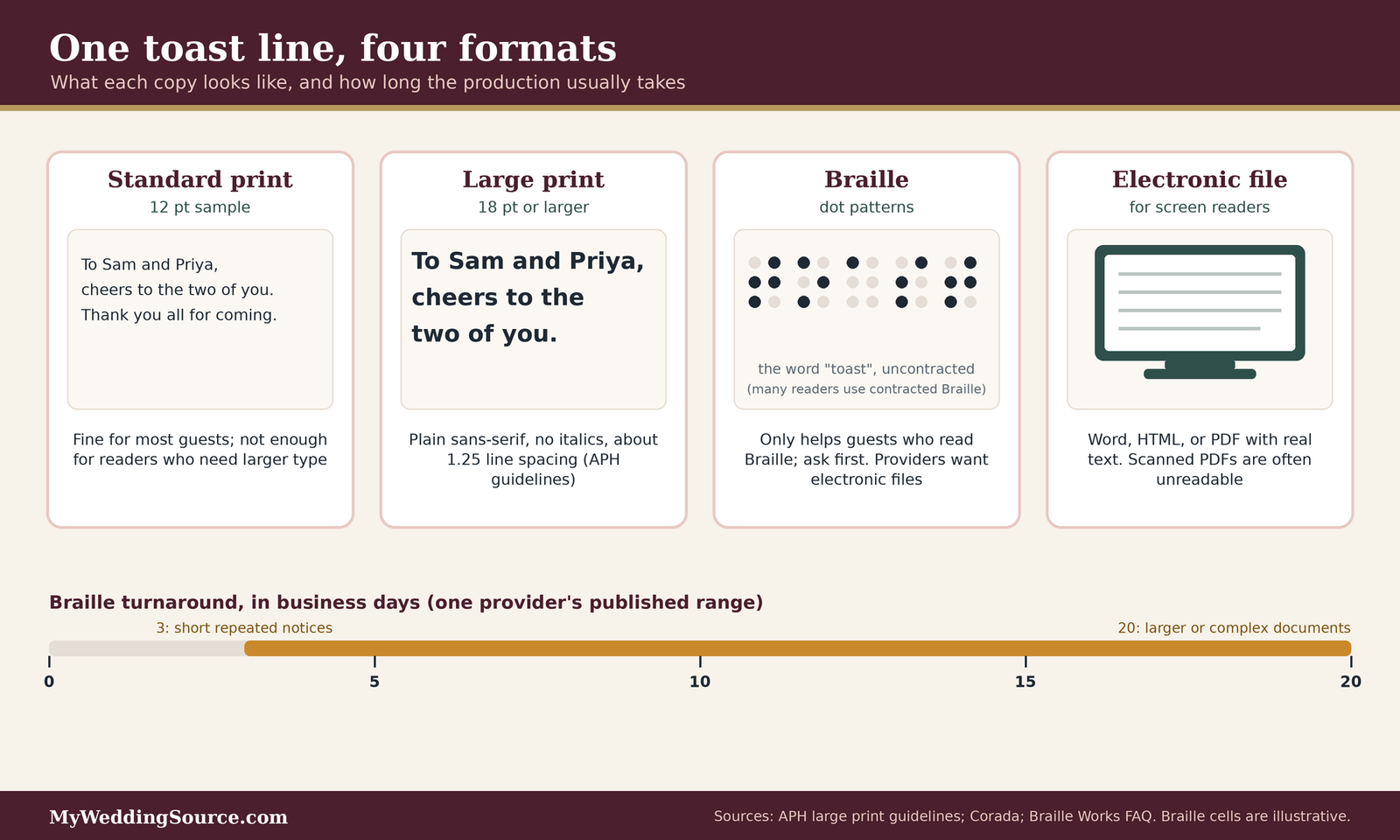
A Deaf guest may or may not also have low vision or be blind, and some guests who are not Deaf may want a written copy of the toasts. The ADA effective communication guidance lists large print, Braille, electronic text for screen readers, and audio recordings among the aids for people who are blind, have vision loss, or are deafblind. It also notes that Braille helps only people who read Braille, so ask the guest what they use.
Large print specifications
The American Printing House for the Blind’s research-based guidelines describe large print as 18 points or larger, with 20-point subheadings and 22-point headings, in a plain typeface such as Verdana, Tahoma, or Helvetica, without italics, and with single-column layout. They give a line spacing of 1.25, block paragraphs with no indent, and lines of about 39 to 43 characters. They also recommend black text on white or an off-white, ivory, or pastel yellow paper, and say to avoid gray. Corada’s meeting guide similarly recommends 18 points or larger, a simple sans-serif font, bold type, and yellow or off-white paper. Because individual needs differ, ask the guest whether they want larger text than that.
Braille production and turnaround
The sources we read suggest that Braille is not a last-minute job. One Braille transcription company says repetitive letters and notices take about three business days, while larger documents can take up to twenty business days depending on complexity, and that charts and tables add complexity. Corada’s guide says Braille turnaround varies widely and recommends asking local organizations that serve blind or low-vision people, independent living centers, vocational rehabilitation agencies, or your state library for blind people for producers. It adds that most providers want electronic source files. Because toasts often change late, many couples will find it more realistic to Braille the program and the run of show, and to give a Braille-reading guest the toast texts by electronic file or a person reading aloud or signing tactilely.
Electronic copies for screen readers
Corada’s guide recommends accessible Word, HTML, or PDF files and warns that scanned or copied PDFs are often inaccessible. Send a plain-text or Word version of each toast to guests who use screen readers, and keep a copy on your phone for the day. Written copies are one more piece of how to arrange ASL interpretation for wedding toasts so that nobody is left out.
Who owns each task
Who handles what
Toasts involve many hands, and tasks fall through the gaps when nobody owns them. The table below is our suggested split. Adjust it to your team.
| Task | Suggested owner | Needed by |
|---|---|---|
| Ask guests about interpreting and formats | Couple or planner | Twelve to ten weeks out |
| Request quotes and book the team | Planner or a trusted relative | Eight weeks out |
| Collect toast drafts | MC or planner | Six weeks out |
| Send first interpreter packet | Access lead | Five weeks out |
| Order large print and Braille of the program | Planner | Five to six weeks out |
| Confirm light, sound, and position with vendors | Access lead | Two weeks out |
| Send final toasts and updated packet | MC | One week out |
| Print folders for the day | Planner | Two days out |
Why a named owner matters
A task with a name next to it gets done. When the interpreter packet is everyone’s job, it tends to be nobody’s, and the first sign of trouble is an interpreter who gets the toasts at the door. Put each owner’s name in the shared brief and ask them to confirm.
A fill-in brief you can hand to a coordinator
The brief below keeps everyone on the same page. Copy it into a shared document and fill in each line.
Brief for interpreters
Event name and date. Venue, address, room, and loading entrance. Parking and check-in instructions. Day-of contact name and phone. Arrival time, which should be at least fifteen minutes before the start according to the guidance we read. Speaker order with names and relationship to the couple. Names and places that will come up. Songs, poems, or quotations, with the text. Where the interpreters will stand or sit, and where they can see the speaker. Break plan and meal plan. Whether the interpreters will be photographed or filmed, and how the footage will be used.
Brief for guests who need alternate formats
Guest name and what format they prefer (large print, Braille, electronic text, audio, or tactile signing). Their preferred type size or Braille type, if they know it. Which documents they want: the program, the run of show, the menu, the toast texts. The date by which you need their answer. The person who will deliver the materials on the day and where they will be.
Room, sight lines, lighting, and microphones
A skilled interpreter in the wrong spot is only half useful. A Deaf guest has to look at the interpreter, not at the speaker, and so the room needs to let them keep both in view. This section covers how to set that up, which is a practical half of how to arrange ASL interpretation for wedding toasts that works on the day.
Place the interpreter where the guest can see both
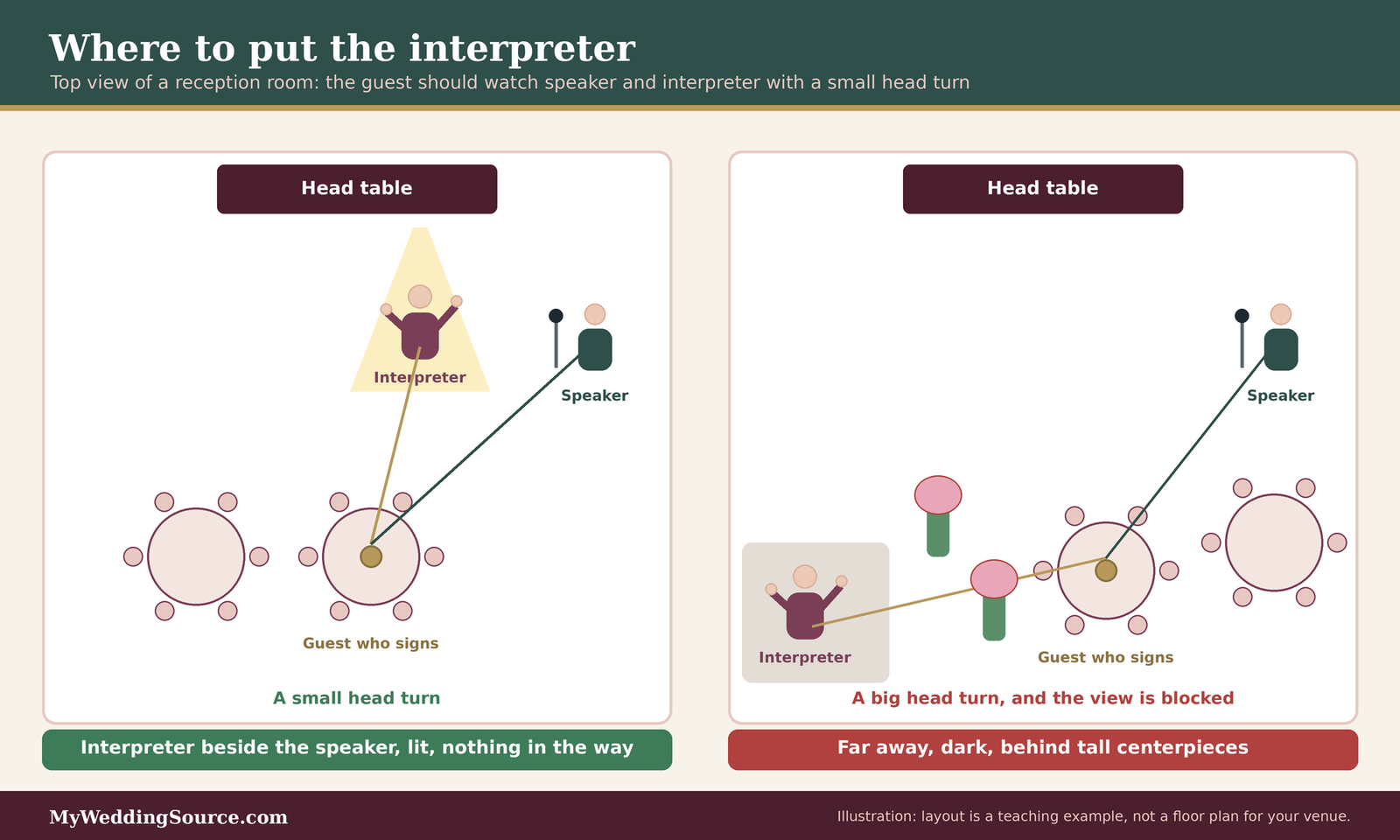
When you plan how to arrange ASL interpretation for wedding toasts, the principle is simple: the guest should be able to watch the interpreter and the speaker with a small turn of the head, not a big one.
Beside the speaker, in the guest’s line of sight
A university disability office advises that the interpreter will work with you to place themselves where the Deaf participant can see both the presenter and the interpreter at once. Offbeat Wed’s guide makes a similar point for weddings: the interpreter does not need to stand between the couple or be visible to every guest, and the goal is a position in a guest’s line of sight. Commenters on that guide warn against putting the interpreter so far away that guests keep looking back and forth.
One spot for the toast block, not one per speaker
A fixed interpreter spot beside the microphone or the head table works better than moving around. If the speakers walk to a mic stand, put the interpreter near it. If the toasts are given from tables, ask the speakers to stand and the interpreter to move once, to a spot where the guests who sign can see both. Walk through this at the venue walkthrough, with the actual tables and the actual stage.
Light the interpreter, even if the room goes dim
Reception rooms are often dimmed for atmosphere. A signer’s hands and face must stay visible.
A steady, front-facing light
The university guide says lighting should be sufficient for everyone to see the interpreter and each other, even if the room is dimmed for a presentation. Ask the lighting or DJ vendor to put a soft, steady light on the interpreter’s spot, and to avoid a spotlight that glares or leaves a dark background that makes hands hard to read. Our wedding lighting guide and audio and lighting checklist are good companions for the conversation with your vendors.
Plain clothing and a clear background
Equal Entry’s guidance for virtual events suggests simple solid colors that contrast with skin tone and avoids patterns and shiny fabrics, and the same idea applies in a room. Tell the interpreters about the venue’s backdrop, such as a floral wall or a patterned curtain, and ask them what they would like to wear. Do not tell them what to wear without asking, because they know what works for visibility.
Microphones and sound
Interpreters can only interpret what they can hear, so sound matters even when the guests they serve cannot hear.
Decide who holds the microphone
In The Knot’s wedding example, the audio staff handed the microphone to the interpreter during the speeches instead of handing it to the bride’s parents, which suggests the team had planned in advance who would be voiced and by whom. The practical rule we suggest is simple: when a hearing speaker gives a toast, the speaker holds the microphone and the interpreter signs from a position where Deaf guests can see. When a Deaf guest speaks in ASL, the interpreter voices for the room and needs a microphone. Settle which case applies before the day, and tell the audio vendor.
Give the interpreter a monitor or a close position
Interpreters need to hear clearly. If the room is loud or the speakers are across the room, ask the audio vendor for a monitor speaker or a position near the main speaker. Ask the interpreters if they want a bottle of water and a stool within reach.
Make the room safe to look across
Little things in a room can block a sight line without anyone noticing.
Centerpieces and tables
Tall centerpieces, floral arches, and lighting trusses can block the view between a guest and the interpreter. Our wedding table settings guide covers centerpiece heights. A low arrangement at the Deaf guests’ tables costs little and fixes a problem that is hard to fix later.
Cameras and photographers
Photographers and videographers moving through the toast block can cross a sight line. Brief them on the interpreter’s position and on where the Deaf guests are sitting, and ask them to stay out of the line between them.
Running the toast block on the day
A well-planned toast block has a few simple routines. None needs much effort, but they need an owner. This is where how to arrange ASL interpretation for wedding toasts meets the real timeline of the reception.
Name one person to run access
Ask yourself how to arrange ASL interpretation for wedding toasts so it does not depend on the couple on the day. Choose someone, not a member of the wedding party, who will handle the interpreters and the Deaf guests during the reception.
What that person does
They greet the interpreters on arrival, show them the position, confirm the order of speakers, and check lighting and sound. They watch the toasts and fix problems fast: a speaker who walks away from the microphone, a light that goes out, a guest who cannot see. They are also the person Deaf guests can tell if something is wrong.
What the master of ceremonies does
The master of ceremonies introduces each speaker by name and relationship, and gives a pause before each speaker begins so the interpreters can set up. The MC reminds speakers to speak one at a time, which matches the university guidance that only one person can be interpreted at a time. The MC also repeats comments or questions from the audience before answering, a habit the same guidance recommends.
Coach the speakers before they speak
Toast-givers are usually the least experienced public speakers in the room. A little coaching helps both the interpreters and the audience.
What to ask speakers to do
Ask them to speak at a steady, unhurried pace, to pause after each story, and to face the room. Ask them to stay near the microphone and not to walk away. Ask them to avoid private references that need a long explanation, or to explain them in a single clear sentence. Ask them to send their text in advance, and to tell the interpreters if they plan to change it.
What to tell speakers about the interpreter
Tell them that the interpreter is there for guests, that they should look at the room, not at the interpreter, and that they should not touch or move the interpreter. Our wedding speeches guide covers coaching in more depth, and we suggest sending the coaching note along with the schedule and a thank-you.
Build in breaks and a handoff
If two interpreters are working, they will handle the rotation. Your job is to leave room.
Switching and rest
Equal Entry says interpreters often switch roles every ten to twenty minutes. Let them choose the moment, and do not ask them to start a new toast at the exact moment they would switch. If the toast block is longer than expected, ask the MC to build a one-minute pause between toasts, which gives the team a clean switch.
Meals and downtime
Interpreters may be working for several hours. Include them in the vendor meal count, and offer them a seat near the Deaf guests’ table, so they are close when the next block begins. Our vendor meals guide covers this, and our vendor timeline guide shows where to place access tasks on your schedule.
Handle the unplanned toast
At almost every wedding, someone stands up who was not on the list.
Set a rule in advance
Decide before the day whether open-mic toasts are welcome. If so, tell the interpreters, and ask the MC to announce each speaker and give a short pause. If not, tell guests in the program and let the MC say so kindly.
Offer a fallback
For an unplanned toast, the interpreters will do what they can without preparation. Ask the MC to remind the speaker to slow down. If the toast contains a text, such as a poem the speaker is reading, ask them to give it to the interpreters before they start. If it is not possible, tell the Deaf guests that the interpreters are working cold, and thank them for their patience.
What it costs and who pays
Costs vary a great deal by region, by day of week, and by the number of hours. If you are working out how to arrange ASL interpretation for wedding toasts on a fixed budget, the best approach is to learn the structure of a quote and to ask for one early.
What interpreter fees can look like
One city’s published vendor list gives a sense of the structure, not a national price. In a San Francisco Mayor’s Office on Disability list of authorized ASL vendors (the page itself is undated), weekday daytime rates for on-site ASL ran from $78 to $120 per hour, most vendors used a two-hour minimum, and weekend or evening rates that the list states or lets us compute ran from about $100 to $180 per interpreter-hour. Travel was charged per mile for each interpreter at the IRS rate, plus parking. Our own arithmetic, an estimate only: two interpreters for a two-hour minimum at those weekend rates would be about $400 to $720, and for a three-hour booking about $600 to $1,080, before travel. Your market, date, and agency will differ, so ask for a written quote.
Understand the parts of a quote
A quote usually has several lines. Reading them separately helps you compare agencies.
Hourly rate, minimums, and premiums
An hourly rate may change by time of day, by weekend or holiday, and by the notice you give. In the San Francisco vendor list, some vendors added a late-booking fee for requests made on short notice. The minimum can matter more than the rate, since a half-hour toast block still bills as the minimum.
Travel, parking, and extras
Mileage, parking, tolls, and public transportation costs can be added. Ask whether travel is billed from the interpreter’s home or from the agency, and whether you will be charged for a separate arrival time. Also ask whether recording or livestreaming the interpreters carries an additional fee.
Decide who pays
This is a question to settle before you sign. Do not leave it for the day.
The couple as the usual payer
Most couples treat interpreting as part of the guest experience budget, like transportation or accessible seating. Our guide to paying for a wedding and budget guide explain how to add a line for it. Offbeat Wed’s guide says to decide who pays before the wedding.
Venue, family, or community contributions
Some venues have preferred agencies or offer interpreter referrals. Some families offer to cover the cost. Do not ask the Deaf guest to pay or arrange the service. Offer a volunteer interpreter only if the guest is comfortable with that choice, as covered in the edge cases below.
Reduce cost without reducing quality
There are honest ways to trim the bill. There are also false economies.
Honest savings
Combine the ceremony and toasts into a single booking window if the timing allows. Book early to avoid late fees. Ask whether the agency has a lower rate for a smaller team or a slightly shorter block. Ask the Deaf guests whether live captions for part of the day would meet their needs, for the toasts that are not their priority.
False economies
Equal Entry says not to choose an interpreter or agency based solely on price. Offbeat Wed’s commenters caution against untrained students for formal events, and recommend, if you use a student, choosing someone in a supervised practicum, not someone who has taken a few ASL classes. A toast that is interpreted badly is worse than one with a clear plan for a written copy.
Questions to ask before you commit
Good questions protect you from vague promises. Ask for the answers in writing and keep them with your contract. These questions will help you decide how to arrange ASL interpretation for wedding toasts with fewer surprises.
Questions to ask an agency or interpreter
- Which interpreters will you assign, what credentials and licenses do they hold, and how can we verify them?
- Have they interpreted weddings, celebrations, or multi-speaker events with unscripted speeches?
- How many interpreters do you recommend for our toast block, and why?
- How do you count billable time, what is the minimum, and what happens if the toasts run long?
- What are your cancellation and substitution terms, and who finds a replacement if someone is ill?
- When do you want the toast packet, and in what format?
- Can the interpreters meet the Deaf guests or the MC before the day?
- Will you need a microphone, a monitor, a stool, a light, or a particular position?
- Are there any fees for travel, parking, or recording and livestreaming?
Questions for the agency or interpreter
These confirm the service you are buying and set up the preparation.
About credentials and fit
Ask which certification or license each interpreter holds and how you can check it. Ask whether they have worked a wedding. If your toast block is long and has many speakers, ask whether they have experience with that kind of assignment, as the New Mexico guide suggests with its question about relevant training and experience.
About terms and logistics
Ask how they count time, how they bill overtime, and when payment is due. Equal Entry notes that interpreters commonly invoice after the event. Ask what the arrival time is, who the day-of contact will be, and whether they have a backup plan.
Questions for the venue, DJ, and audio team
The interpreters will rely on these vendors for light and sound.
About the room
Ask the venue where the head table will be, how the room will be lit during the toasts, and whether the lights can be set to a steady level near the interpreter. Ask whether the venue has a written accessibility policy or preferred agencies, and what the contract says about responsibility. Our venue questions guide can give you more.
About the sound
Ask the DJ or audio vendor how many microphones will be available, who handles them, and whether a monitor speaker can be placed near the interpreters. Our DJ questions guide covers the technical vocabulary.
Questions for the speakers and the MC
These keep the toast block predictable.
About preparation
Ask speakers for a draft by a set date and a final close to the wedding. Ask them to flag names and jokes that need explaining. Ask whether they plan to read or speak from memory.
About delivery
Ask the MC to introduce each speaker, to pause before each toast, and to repeat any audience comments. Ask them to keep the order of speakers fixed and to tell the interpreters about changes.
Edge cases that need their own plan
The steps above fit most weddings. These situations need a different plan, and a few are common enough that you should read them even if none seems to apply. The answer to how to arrange ASL interpretation for wedding toasts changes in each of them.
Guests who are deafblind or have low vision
Some guests have both hearing and vision loss. Their needs are specific, and if you are working out how to arrange ASL interpretation for wedding toasts for a deafblind guest, a standard interpreter plan may not work.
Tactile signing and why placement changes
The National Center on Deaf-Blindness white paper on support service providers describes tactile American Sign Language as a touch-based form of signed language that many people with declining vision use. If a guest uses tactile ASL, the interpreter will need to be next to them, not across the room, and the standard sight-line plan does not apply. The ADA guidance lists tactile interpreters among the qualified interpreters. Ask the guest what works, and ask the agency whether it has interpreters trained in tactile or protactile communication.
Support service providers are not interpreters
The same white paper explains that a support service provider connects a person with combined vision and hearing loss to their surroundings by describing visual details, guiding, and helping with casual conversation, and that the SSP works with one person at a time and does what the guest directs. The paper says SSPs handle casual communication and not formal interpreting, and it notes that there is no national certification for SSPs. So an SSP may help a guest move around and know who is nearby, and an interpreter is still needed for the toasts. The paper also says family members often are not the best fit for the role, because objectivity and privacy can suffer, so do not assume a relative will do. Our guide to wedding guests with service animals may also apply if a guest uses a dog guide.
Deaf interpreters and other specialized teams
Some situations call for a Deaf interpreter, who works alongside a hearing interpreter.
What a Deaf interpreter does
The Registry of Interpreters for the Deaf describes its Certified Deaf Interpreter credential as held by interpreters who are Deaf or hard of hearing, with specialized skills for communicating with tools like gesture and props, and with fluency in ASL. A San Francisco vendor in the vendor list notes that a Certified Deaf Interpreter is used together with a second ASL interpreter. Ask the guest and the agency whether a Deaf interpreter would help, since this is a decision made with the guest.
When to ask about it
When you decide how to arrange ASL interpretation for wedding toasts, raise it if a guest uses a signing style that a hearing interpreter may find difficult to understand, if a guest has limited language exposure, or if the guest simply prefers a Deaf interpreter. We cannot tell you which guests need one. Ask them.
Captions alongside interpreting
Some guests prefer captions, and some prefer both.
Live captions for the toast block
Offbeat Wed’s guide describes CART, or live captioning, in which a provider types the proceedings word for word on a screen, and suggests a small screen in the audience for a few guests or a large screen at the front for a bigger group. Real-time captions can help guests who do not sign, and some guests like to use captions and an interpreter together. Captioning is a separate service with its own booking and costs, so ask a provider for a quote. Our upcoming guide on wedding speech transcripts covers written records of the toasts.
A written copy for everyone
Offbeat Wed also suggests giving a printed program or script to all guests, not just Deaf guests, which can feel more inclusive. A short printed order of toasts, with the speakers’ names, costs little. See our wedding programs guide for layout ideas.
Volunteers, family members, and students
It is common to ask a friend who knows some sign to help. Think carefully before you treat that as how to arrange ASL interpretation for wedding toasts.
Why a volunteer may not be enough
The ADA guidance says a covered business generally cannot rely on an accompanying adult to interpret except where the person asks, the adult agrees, and it is appropriate, and it cautions about companions whose impartiality is in doubt. A family member who is also a guest is not neutral, and a toast about their own family may be hard for them to interpret. A volunteer who is a guest also cannot enjoy the toast. Offbeat Wed commenters suggest looking for volunteers through community colleges, interpreter training programs, or houses of worship that already use interpreters, but caution against untrained students for formal events.
If a guest wants a family member
Sometimes a Deaf guest prefers a trusted relative. That is the guest’s decision, and you can support it. Offer a seat and a meal, and offer the relative the toast packet. Also keep a qualified interpreter on standby if the guest agrees.
Remote and recorded toasts
Toasts may be livestreamed or recorded, and some guests may attend remotely, so check how to arrange ASL interpretation for wedding toasts for that audience too.
Video remote interpreting
The ADA guidance says that video remote interpreting must meet performance standards that include high-quality real-time video and audio and a clear image that shows the signer’s full hands and face, and that it may not be effective for someone who cannot see the screen well. The eCFR text for Title III adds that VRI must not have lag, choppy images, or pauses. A wedding reception with a spotty connection is a poor match for VRI, so on-site interpreters are usually safer. Ask the venue about its internet before you rely on VRI.
Livestreams and recordings
Equal Entry suggests, for virtual events, using separate video windows for the speaker and the interpreter. If your livestream will include a Deaf guest or an interpreter, ask your videographer to frame them. Tell the agency before you record, since the San Francisco guide lists this as something to disclose.
When the couple or a speaker is Deaf
Sometimes the person giving the toast is the one who signs.
Interpreting from ASL into spoken English
The ADA guidance says a qualified interpreter works in both directions. If a Deaf speaker signs a toast, the interpreter voices it for the room. Give the interpreter the toast in advance, in whatever form the speaker prefers. Ask the speaker whether they would like to rehearse with the interpreter, which Equal Entry recommends for presenters, and ask whether they want the interpreter to sign or voice.
Seating the interpreter for a Deaf speaker
When a Deaf speaker is at the microphone, the interpreter’s voice must carry to the room, and the speaker needs to see the interpreter for cues, if they want them. Place the interpreter in front of the speaker and slightly to the side, and give them a microphone.
Other languages and mixed-language rooms
Some weddings have toasts in Spanish, Korean, or another language, and some guests use a signed language other than ASL, which changes how to arrange ASL interpretation for wedding toasts.
Toasts in another spoken language
If a toast will be in another spoken language, tell the agency, and ask whether an interpreter can work from that language into ASL. The San Francisco guide notes that ASL is the most common signed language in the United States, but other signed languages can be requested. This is a specialized request and may need more lead time.
Guests who use another signed language
If a guest uses another sign language, ask the guest and the agency early. Do not assume ASL interpreting will serve them.
Late changes and day-of problems
Even a good plan meets surprises.
If an interpreter does not arrive
Keep the agency’s day-of number and the interpreters’ phone numbers handy. Ask the agency about its backup plan during booking. If nobody can come, offer the guests the written toasts, live captions if you have them, and a seat near the speakers.
If the toast block runs long
Ask the MC to build in a pause, and let the interpreters choose their switch. If you are over the booked time, ask the interpreters whether they can stay, and expect an overtime charge, since Equal Entry notes that going a few minutes over can add an hour.
FAQ: how to arrange ASL interpretation for wedding toasts
Planning and booking
How far ahead should we book an ASL interpreter for the toasts?
One couple interviewed by The Knot advised booking at least a month ahead because certified interpreters can be hard to find. We suggest starting eight to twelve weeks out, since that leaves time to ask guests, compare agencies, and sign a contract. Treat a month as the minimum, not the goal.
Do we need two interpreters for a short toast block?
Not always. A San Francisco guide says events under two hours may need one interpreter and longer events two, while Equal Entry says interpreters often switch every ten to twenty minutes. A fifteen-minute block may suit one interpreter. Longer blocks, or interpreting that continues through the evening, usually call for a pair. Ask the agency.
Can a friend who knows sign language interpret the toasts?
It is not a safe default. The ADA guidance describes a qualified interpreter as one who interprets effectively, accurately, and impartially, and it limits reliance on companions. A friend is also a guest who would miss the toasts. If a Deaf guest asks for a trusted person, honor that, and keep a qualified interpreter available.
Materials and day-of details
What should we send the interpreters before the wedding?
Send the order of speakers with names and relationships, the toast texts or outlines, a list of names and places, any song or poem texts, and the run of show. Several sources we read recommend sharing materials early so interpreters can prepare vocabulary. Send a draft first and an update about a week before.
How early do we need large print or Braille copies?
Ask the guest first, since Braille helps only people who read it. One Braille company says short notices take about three business days and larger documents up to twenty, so order well ahead. Large print should be at least 18 points. Because toasts change late, Braille the program and share toast texts electronically.
Where should the interpreter stand during toasts?
Place them where Deaf guests can see the speaker and the interpreter together, in a spot with steady light, close to the microphone or head table. A university disability office advises working out the position with the interpreter. Offbeat Wed’s guide warns against putting them so far away that guests must keep looking back and forth.
Cost and responsibility
How much does an ASL interpreter cost for a wedding?
It varies by region, day, and hours. In an undated San Francisco list of vendors, weekend or evening on-site rates that we could read or compute ran from about $100 to $180 per interpreter-hour, with two-hour minimums and mileage extra. Ask your local agencies for written quotes, since your market will differ.
Is the couple legally required to provide an interpreter?
We cannot answer that, and this guide is not legal advice. The ADA pages we read describe duties for businesses and governments, and they do not say a couple hosting a private party carries the same duties. Venue contracts may assign responsibility, so read yours, ask the venue to explain it in writing, and consult a lawyer if unclear.
Your next steps
Here is how to arrange ASL interpretation for wedding toasts over the next few weeks, in the order that causes the fewest do-overs.
Start the conversation
Ask your guests this week
Write a short, warm message to each guest who may want interpreting. Name the ceremony and toasts, ask what would help, and give a reply-by date. Our RSVP wording guide shows where to place an access question on a response card.
Check the venue and your contracts
Ask the venue about its access policy, lighting, and any clause that assigns responsibility for interpreters. Use our vendor contract guide to read the language, and add access tasks to your vendor timeline.
Build the plan
Book the team and set the materials schedule
Contact two or three agencies, send the complete request, and confirm terms in writing. Then copy the materials brief into a shared document and set the draft and final dates for each speaker. For the bigger picture, see our wedding planning checklist and the overview of the accessible wedding guest experience.
Brief the MC and the speakers
Give the master of ceremonies the order of speakers, the pause rule, and the instruction to repeat audience comments. Send speakers the short coaching note, and thank them for their drafts. Our wedding etiquette guide can help with the tone of those requests.
Sources & methodology
How we built this guide
What we relied on
This guide on how to arrange ASL interpretation for wedding toasts combines U.S. Department of Justice guidance on effective communication, the federal Title III regulation text, the Registry of Interpreters for the Deaf, the National Institute on Deafness and Other Communication Disorders, a national center on deaf-blindness, large print and alternate-format guidance, interpreter-booking guidance from several government offices and a university, and two wedding-specific accounts. We checked the sources on November 12, 2026. Vendor rates, Braille turnaround times, and agency policies come from the pages named below, are specific to those providers, and may have changed.
What we did not do
We did not interview interpreters, hire an agency, or test any vendor. The dollar ranges are drawn from one undated city vendor list, and the totals are our own arithmetic, so treat them as estimates. The booking lead times in this guide are our own suggestions. We do not give legal advice, and we cannot tell you which duties apply to your venue or to you. For a legal question, ask a lawyer. Please also ask your Deaf guests first, because they know their own needs.
Source list
Government and regulatory sources
- U.S. Department of Justice, ADA effective communication guidance: https://www.ada.gov/resources/effective-communication/
- U.S. Department of Justice, ADA Title III overview: https://www.ada.gov/topics/title-iii/
- Electronic Code of Federal Regulations, 28 CFR 36.303, auxiliary aids and services: https://www.ecfr.gov/current/title-28/chapter-I/part-36/subpart-C/section-36.303
- National Institute on Deafness and Other Communication Disorders, American Sign Language: https://www.nidcd.nih.gov/health/american-sign-language
- New Mexico Commission for Deaf and Hard of Hearing Persons, Hiring Qualified Interpreters: https://www.cdhh.state.nm.us/wp-content/uploads/2022/11/Hiring-Qualified-Interpreters.pdf
- City and County of San Francisco, Scheduling sign language interpreters: https://sf.gov/step-by-step/scheduling-sign-language-interpreters
- City and County of San Francisco, ASL vendor information (undated): https://sf.gov/sites/default/files/2022-08/ASL%20Vendor%20Information04.30.2021%20revised_0.pdf
- City of Portland, Hiring an interpreter: https://www.portland.gov/civic/disability-33
Professional, university, and nonprofit sources
- Registry of Interpreters for the Deaf, Frequently asked questions: https://rid.org/faqs/
- Registry of Interpreters for the Deaf, About interpreting: https://rid.org/about-rid/about-interpreting/
- National Association of the Deaf, American Sign Language: https://www.nad.org/resources/american-sign-language/
- National Center on Deaf-Blindness, Deafblind people and support service providers: https://www.nationaldb.org/media/doc/ssp-white-paper-2021.pdf
- University of Minnesota Disability Resource Center, Interpreting guidelines for staff, faculty, and instructors: https://disability.umn.edu/interpreting/interpreting-guidelines-staff-faculty-and-instructors
- Equal Entry, How to hire sign language interpreters: https://equalentry.com/how-to-hire-sign-language-interpreters/
Alternate formats and wedding-specific sources
- American Printing House for the Blind, Research-based large print guidelines: https://www.aph.org/app/uploads/2022/04/Research-Based-Large-Print-Guidelines.pdf
- Corada, Guide to planning accessible meetings, access to printed or visual materials: https://corada.com/documents/guide-to-planning-accessible-meetings/access-to-printed-or-visual-materials
- Braille Works, Frequently asked questions (a vendor; turnaround times are its own): https://brailleworks.com/faq/
- The Knot, How this couple’s wedding accommodated Deaf guests: https://www.theknot.com/content/accommodating-deaf-wedding-guests
- Offbeat Wed, How to make Deaf wedding guests feel right at home: https://offbeatwed.com/deaf-wedding-guests/