

Honeymoon planning goes best when you treat it as three separate decisions, what the trip is for, when it fits around the wedding, and what it is allowed to cost, and only then pick a place, because the place is easy to fall in love with and hard to undo once the deposits are paid.
Quick answer
For honeymoon planning, decide the purpose first (rest, adventure, food and culture, or a mix), then the timing (straight after the wedding, a short mini-moon, or a trip months later), then a total budget that includes travel documents, insurance, and a cushion. The Knot reports an average honeymoon cost of about $5,300 for couples married in 2024 and an average trip of about seven days, so use those as a rough reference, not a target. Book refundable pieces first, make sure every ticket matches the name on your ID, check passport and entry rules for your exact destination, and leave at least a day or two of unscheduled rest at both ends of the trip.
Choose the trip before choosing the aesthetic in honeymoon planning
Photos of overwater bungalows and cobblestone streets are persuasive, and they tell you almost nothing about whether the trip will suit the two of you. This section is about the decisions that sit underneath the destination. If you settle them first, honeymoon planning gets faster and the later choices (flights, season, hotel) mostly make themselves.
Name what the trip is for
Couples often say they want a “relaxing” or “adventurous” honeymoon and then book something that is neither, because the words mean different things to each person. A few minutes of honest comparison now prevents a week of quiet compromise later, and it is the real starting point of honeymoon planning.
Run a two-column priority exercise
Each of you writes down, privately, the three things you most want the trip to give you. Examples might be sleep, being outdoors, good food, seeing a place neither of you has been, time with no phone, or a story to tell. Then compare. Where the lists overlap, you have the core purpose of your honeymoon planning. Where they conflict, you have a negotiation, and it is much cheaper to negotiate on paper than at a check-in desk. Write the shared priorities in a single sentence, such as “five slow days on a beach and two days of something active,” and keep that sentence visible while you compare options.
Estimate your rest-to-activity ratio
Most itineraries fail by being too full. A useful habit is to decide in advance how many days you want to be “on” (a tour, a hike, a train connection) and how many you want to be “off” (no alarm, no plan). This is our own planning heuristic, not a rule from any source: many couples who have just finished a wedding find that an itinerary with at least as many off days as on days is easier to enjoy. If one of you wants a packed schedule and the other wants a pool chair, split the days instead of averaging them, and put the off days first, because that is when you will be most tired.
Decide how the trip fits around the wedding
In honeymoon planning, timing is a real decision, not a default. The Knot’s honeymoon reporting suggests that many couples leave almost at once, but plenty do not, and neither pattern is wrong.
Leaving straight after the reception
The Knot reports that about 41% of couples in its 2024 data left for their honeymoon within two days of the reception. That fits couples who have already arranged time off and want the trip to feel like a continuation of the celebration. The trade-off is that you are traveling at your most tired, with wedding paperwork unfinished, gifts to move, and, for some people, a name change that has not happened yet (more on that in the documents section below). If you leave quickly, pick a destination with simple logistics and a short transfer from the airport.
A mini-moon now and a larger trip later
The Knot reports that a little over two in five couples took a shorter “mini-moon” in 2024, with 24% doing it instead of a traditional honeymoon and 17% doing it in addition to one. A mini-moon can be a long weekend at a nearby hotel, a cabin, or a short flight. It works well when time off or money is tight, or when your wedding was expensive and you would rather save for a bigger trip. It also works when the first week after a wedding is simply too crowded with family and logistics.
Delaying on purpose
A later honeymoon is a legitimate choice in honeymoon planning, particularly if you want a season that does not match your wedding date, need time to renew passports, or want to spread the cost. The risk is that “later” quietly becomes “never.” If you delay, put a month and a rough budget on the calendar and move money toward it on a schedule, the same way you would for any other planned expense. Our wedding planning timeline can help you see where a delayed trip fits among other post-wedding tasks.
Decide how long you want to be away
In honeymoon planning, trip length drives cost and recovery time more than any other single variable, and the average is a poor guide to what you personally need.
What the average trip looks like
The Knot reports an average honeymoon length of about seven days, and about 28% of couples in its data traveled for one to two weeks. Those numbers describe couples who took a honeymoon, so they leave out the 31% or so who did not plan one in 2024 (The Knot reports that 69% planned a honeymoon). Use the seven-day figure to sanity-check your honeymoon planning, not to set it.
Count travel days separately from vacation days
A “seven-day” trip with two long travel days is really five days at your destination. This matters most for far-away trips, where the first day or two may go to adjusting to the time difference. When you compare options in honeymoon planning, count nights on the ground at your destination, not total days away, and compare cost per night on the ground. We show a worked version of that arithmetic in the budget section.
Split the work so planning does not fall on one person
Honeymoon planning is a small project, and small projects have a way of landing on whoever is most organized. That is a quiet source of resentment, and it is avoidable.
Divide by decision, not by chore
Instead of splitting tasks one at a time, split whole decisions. One person owns documents and insurance research, the other owns lodging and activities, and both agree on the budget and on any nonrefundable booking. Owning a decision means gathering options and bringing a recommendation, not deciding alone. It also means the person who owns documents is the one who notices when a passport is about to expire, which is a task that is easy to miss.
Keep one shared planning document
A single shared note or spreadsheet is enough: purpose, dates, budget lines, quotes, cancellation deadlines, and confirmation numbers. When honeymoon planning lives in two inboxes and a text thread, details get lost and deadlines pass quietly. A shared document also makes it easy to hand the itinerary to a trusted person before you leave, and to check your own decisions against the purpose sentence you wrote at the start.
Match climate, season, travel time, and documents in honeymoon planning
Once you know what the trip is for, destination fit becomes a set of checks you can run against real information. None of these checks require a travel agent, although a good one can speed them up.
Weather and season
Weather is the factor couples most often underestimate when they start honeymoon planning, and it is also the factor with the best official data. You do not need to be a meteorologist. You need to know whether your dates fall inside a risk window.
Check the official hurricane windows
The National Hurricane Center says the Atlantic hurricane season runs from June 1 to November 30, with a peak around September 10 and most activity between mid-August and mid-October. For the eastern Pacific, it lists May 15 to November 30, with most storms between late June and early October. It also notes that storms can form outside those dates. If your destination is in the Caribbean, the Gulf of Mexico, the Atlantic coast, or Mexico’s Pacific coast, those windows are the first thing to check. That does not mean you cannot travel then. It means you should price the risk: look at refund rules, consider insurance (discussed below), and pick lodging with a clear policy for storm cancellations.
Shoulder seasons and what they trade away
The weeks between a destination’s peak and off-peak seasons, often called shoulder seasons, are popular with couples who want lower prices and smaller crowds. The trade is usually less predictable weather and, in some places, fewer open restaurants or tours. We could not verify specific price or weather figures for individual destinations, so treat that as a general pattern, not a claim about any one place. Before you commit, look at the destination’s official tourism or meteorological pages for the month you want, and ask your lodging directly what is closed or reduced during that period.
Travel time and time zones
Honeymoon planning differs from ordinary vacation planning because you may be starting from exhaustion, so door-to-door travel burden counts for more than it would on an ordinary vacation.
Do the door-to-door arithmetic
Add every leg: leaving home, getting to the airport, the airport buffer, each flight and connection, immigration and baggage, and the transfer to your lodging. Then do the same coming back. Here is an illustrative example with assumed numbers, not real schedules. A couple lives forty-five minutes from their airport, allows two hours at the airport, takes a flight of five hours, spends one hour on arrival procedures, and rides forty-five minutes to the hotel. That is roughly nine and a half hours, and it is before any connection. A second couple takes a connecting itinerary with a three-hour layover, and the same trip stretches past fourteen hours. Neither number is a reason to avoid a place. It is a reason to know what the first day will really be.
Time zones and jet lag
Jet lag is a mismatch between your body clock and local time. Mayo Clinic describes symptoms such as sleep trouble, daytime fatigue, poor focus, and stomach upset, usually appearing within a day or two of crossing at least two time zones. It estimates about a day to recover for each zone crossed, and says eastward travel is typically harder than westward. That is a rough rule, and people vary, but it gives you a way to compare destinations. The figure later in this guide shows how many zones a few popular honeymoon regions are from the U.S. East Coast.
A decision matrix for destination fit
The matrix below is our own editorial tool for honeymoon planning. It compares five common honeymoon styles on the factors that tend to decide whether a trip works: time-zone distance, documents, weather windows, and where the money pressure points tend to be. It is built from official sources where they exist and labeled as our judgment where they do not. It does not rank places, and it does not predict prices, which change constantly.
| Trip style | Time zones from U.S. East Coast (standard time) | Documents to check | Weather window to check | Where costs and risks tend to build |
|---|---|---|---|---|
| Hawaii or another U.S. beach destination | About 5 hours behind (Hawaii) | Acceptable photo ID at the airport (a passport works); no passport needed for U.S. domestic flights | Tropical storm season and local ocean conditions | Long flights, high lodging rates in popular seasons, rental cars |
| Caribbean or Mexico beach resort | Often 0 to 1 hour | Passport; confirm any tourist card or entry form on the State Department country page | Atlantic season June 1 to November 30; eastern Pacific from May 15 | Hurricane-season refunds, resort fees and taxes added late, transfers |
| Western Europe city and countryside | About 6 hours ahead | Passport; U.S. citizens usually need an Electronic Travel Authorisation for the United Kingdom; check each country | Summer heat and crowds, winter closures | Rail passes and inter-city transfers, hotel taxes, jet lag on arrival |
| Southeast Asia island or multi-stop trip | About 12 to 13 hours ahead | Passport with enough validity and blank pages; Indonesia, for example, asks for six months of validity and two blank pages | Monsoon and wet seasons vary by island and month | Long flights, domestic connections, visas or entry fees, heavy jet lag |
| U.S. road trip or national parks | Often 0 to 3 hours | Acceptable photo ID; park or lodging reservations | Snow closures, heat, wildfire smoke, road conditions | Gas and lodging in gateway towns, long driving days, limited cell service |
How to use the matrix
For your own honeymoon planning, pick the two rows that appeal to you most, then ask which factor in each row you can live with. If the answer is “jet lag, but not a hurricane risk,” that points you one way. If it is “documents, but not a long drive,” that points you another. The matrix is meant to remove options, not to produce a winner.
When no row fits
If your plan is a cruise, a safari, a ski trip, or a mix of the above, build your own row. Use the same five columns and fill them from official sources: the State Department country page for documents, the National Hurricane Center or the destination’s meteorological service for weather, and your own door-to-door arithmetic for time.

What couples reported, and what it does not tell you
The Knot’s honeymoon figures are useful context for honeymoon planning, and they are easy to over-read. The figure above plots the numbers the Knot published for 2022 through 2024.
What the numbers show
The Knot reports average honeymoon costs of $5,100 for couples married in 2022, $5,700 for 2023, and $5,300 for 2024. It also reports that 53% of couples honeymooned outside the United States in 2022, 62% in 2023, and 59% in 2024, with 41% staying in the United States in 2024. Hawaii, Florida, and California were the most popular U.S. states, and the Caribbean and Mexico were the top regions for couples who traveled abroad, with Europe third. A little under half of couples (48%) planned a tropical getaway, according to the same reporting.
What the numbers do not show
The $5,300 average comes from an internal study of nearly 17,000 couples married in 2024, while most of the other figures come from The Knot’s 2024 Honeymoon Study of 662 U.S. couples recruited through a third-party sample provider. The page does not say whether the average includes airfare, and it does not give separate costs for domestic and international trips. An average also hides a wide spread: a long weekend and a three-week trip both feed into it. Use it to check that your plan is not wildly out of line, then build your own number from real quotes.
Set the budget and the money boundary for honeymoon planning
Money is where honeymoon planning most often turns into friction, partly because the number is easy to underestimate and partly because several pots of money (savings, gifts, family help, points) tend to blur together. This section gives you a way to build the number yourself and to keep the sources of money clear. It is general education, not financial advice, and your own situation may call for a conversation with a professional.
Start from reported figures, and label them
Before you build your own number, it helps to know what you are comparing against and what kind of number it is.
Reported averages are not quotes
An average from a survey is a description of what other couples reported. A quote is a price a specific seller will charge you on specific dates. Your own budget is a plan. These are three different things, and mixing them is how couples end up surprised. The Knot’s $5,300 figure for couples married in 2024 is a reported average. It sits beside the $33,000 average wedding cost that the same page cites, which is a reminder that honeymoon spending is a smaller line than the wedding, but not a trivial one. Our wedding budget calculator can help you decide where a honeymoon line fits within the whole plan.
Planned versus paid
Surveys sometimes ask what couples planned to spend and sometimes what they paid. The Knot’s page does not make that distinction for the average, so we do not either. When you track your own honeymoon planning numbers, record three columns: what you planned, what you were quoted, and what you actually paid. The gap between the first and third teaches you more than any average will.
Priority shares are not spending shares
The Knot also reports how couples prioritized parts of the trip: accommodations 36%, food and drink 31%, activities 30%, and travel 33%. Those shares add up to more than 100% because couples ranked categories differently, so they describe what matters to couples, not how a dollar is split. Do not use them to divide your own budget. Use them as a prompt to ask which categories you would protect if prices rose.
Build your own number from line items
A honeymoon planning budget that is one number is hard to defend. A budget with line items is easy to adjust.
The seven-line worksheet
Our honeymoon planning worksheet has seven lines, and nearly every honeymoon, from a cabin to a multi-country tour, fits into them. First, transportation to and from the destination. Second, lodging, with taxes and mandatory fees included. Third, local transportation such as transfers, rentals, and rail. Fourth, food and drink. Fifth, activities and tours. Sixth, paperwork and protection: passport fees, entry authorizations, and insurance. Seventh, a reserve for things that go wrong or tempt you.
Fill in each line with a quote or a clearly labeled estimate. Where you are guessing, write “est.” beside the number so you can find it later. A line that says “est.” in month nine should say “quoted” by month four.
Size the reserve on purpose
A reserve is not a sign of pessimism. It is the difference between a delayed flight being an annoyance and a financial problem. As an editorial rule of thumb, not a figure from any source, many planners hold something like ten percent of the total aside. If your total is $6,000, that is $600. Decide in advance what the reserve is for: a rebooked flight, a night in an airport hotel, a medical co-pay, or an excursion you decide you cannot skip. If you reach the end of the trip with the reserve intact, you can spend it on a nice dinner on the last night.
Reading the cost numbers
The $5,300 average reported by The Knot is a survey figure for couples married in 2024. It is not a quote, it does not tell you what is included, and it does not separate domestic from international trips. Everything in the worked example below is our own hypothetical arithmetic with invented round prices, shown only to demonstrate a method. Real prices vary by date, season, and seller, so replace every number with a current quote before you decide anything.
Normalize quotes before comparing them
Two quotes rarely cover the same things. A resort package may include meals and exclude flights. A boutique hotel may be cheap per night and expensive once you add food and transfers. The fix is to convert every option into the same units before you compare.
The normalization method
For each option, list the same seven lines from the worksheet. Add taxes and any mandatory fees that are not in the headline price. Add the items that the other option includes. Then divide by the number of nights you actually spend at the destination. The result is a cost per night on the ground, which you can compare across very different trips. Ask each seller what is excluded, and ask for the total price before you pay.
A worked example with hypothetical numbers
Suppose Option A is an all-inclusive resort package with a listed price of $3,300 for two people for six nights, with flights not included. Suppose taxes added at checkout come to $410, airport transfers to $140, and flights for two to $1,150. Add a $300 excursion that is not part of the package. That brings Option A to $5,300, or about $883 per night on the ground.
Suppose Option B is a boutique hotel at $240 per night for six nights, which is $1,440 for the room. Add 14% in taxes and fees, about $202. Add the same $1,150 in flights, $180 for ground transport, and $150 per day for meals, which is $900 across six days, plus the same $300 excursion. That brings Option B to about $4,172, or about $695 per night.
The sticker prices were $3,300 and $1,440, a gap of $1,860. After normalizing, the gap is about $1,128. That is still a real difference, and it may favor Option B, but it is smaller than it looked, and it is sensitive to the meal estimate. If your meals cost more than $150 a day, the gap narrows further. The point of the method is not to decide for you. It is to make sure you are comparing the same things.
What quotes often leave out
When you request a quote, ask directly about taxes, resort or facility fees, mandatory gratuities, transfers, baggage fees, airport or departure fees, parking, and cancellation or change fees. Ask whether the price is per person or per couple, and whether it holds for your dates. Put the answers in writing. If a seller will not tell you the total price before you pay, that is useful information about the seller.
Keep the sources of money clear
Honeymoon planning often involves more than one source of money, and the rules differ for each. Separating them avoids awkward conversations later.
Savings, gifts, and family help
The Knot reports that 74% of couples paid for their honeymoon from their own savings. The same page reports that 23% of couples who set up a wedding registry created a honeymoon fund. Those numbers suggest that most couples use some combination of their own money and, for a minority, contributions from guests. If family has offered to help, agree early on whether the money is a gift or something tied to a condition, and whether it arrives before you need to pay deposits.
Honeymoon funds and registry platforms
If you use a honeymoon fund, read the platform’s terms before you share the link. Ask whether it charges fees, who pays them, how long payouts take, and what happens to the money if you change your plans. We did not review the fee schedules of any specific platform, and they change, so check the current terms yourself. It is also worth thinking about how you want to word the request, since some guests prefer to give an object and others prefer to give toward an experience.
Points, miles, and cards
Points and miles can lower the cash cost of honeymoon planning by covering flights or lodging, and they come with their own rules. Check that the name on the award ticket matches your ID, ask what happens to points if you cancel, and ask how long it takes to get them back. Our wedding planning checklist is a good place to track these tasks alongside the rest of your to-do list.
Track spending before and during the trip
A budget only helps if you look at it. The simplest habit is a short check-in at two moments: before you pay each large item, and once a day on the trip.
Check each commitment against the worksheet
Before you pay a deposit, find its line on the worksheet and note the remaining balance in that line. If a new item does not fit, you have three honest options: move money from another line, pick a cheaper version, or drop it. Making that choice at the moment of payment is how honeymoon planning stays calm. Discovering the overrun in month eleven is how it turns tense.
Keep a light daily tally on the trip
Spending on the trip itself is the easiest line to lose track of. A shared note with a rough daily total is enough, and it does not need to be strict. The purpose is not to police each other. It is to know on day four whether the reserve is intact, so that a splurge on day five is a decision and not a surprise.
Build the booking sequence around travel risk in honeymoon planning
Most honeymoon planning problems come from doing the right things in the wrong order. Booking a nonrefundable hotel before checking your passport, or buying a ticket in a name that will change, are small errors with expensive consequences. This section turns the order of operations into a sequence you can follow.
Lock the dependencies in order
Each booking depends on something earlier. When you see the dependencies, the sequence becomes obvious.
Dates before everything
Three dates anchor the trip: the wedding date, the days of leave you actually have approved, and the date your passports expire. Confirm leave in writing before you search for flights. Check passport expiration against the entry rules of your destination, since some countries ask for months of remaining validity. If a date is still uncertain, for example because a wedding venue contract is not yet final, hold off on anything you cannot cancel.
Refundable before nonrefundable
A refundable booking gives you information at low cost. A nonrefundable booking is a bet. In practice, that means holding a flight or lodging with a free-cancellation rate while you finish the rest of the plan, then converting to a firmer booking once your dates and documents are settled. One consumer protection to know about: the Department of Transportation says airlines must let you cancel for a full refund within 24 hours of booking, or hold a reservation at the quoted fare for 24 hours, if you book directly with the airline at least seven days before departure. The rule does not apply to tickets bought through travel agents or online travel agencies, though they may have similar policies.
Use cancellation dates as planning gates
Every lodging booking has a date after which a cancellation costs money. Write those dates into a calendar the day you book, with a reminder a week earlier. Treat each date as a gate: before it passes, you should know whether you are going. If something is uncertain on the gate date, such as a pending passport, extend the booking if you can, or accept the cost knowingly instead of letting the date pass.
The deadline timeline
The honeymoon planning timeline below is our own editorial sequence. The months are suggestions that assume a twelve-month runway; compress them if you are starting later. The one external number in it is passport timing, which comes from the State Department.
| When (before departure) | Task | Why it sits here | What can change it |
|---|---|---|---|
| 12 to 9 months | Agree on purpose, timing, and a total budget; check passport expiry dates | Everything else depends on these | A venue contract, leave approval, or a delayed trip |
| 9 to 6 months | Choose destination and season; normalize quotes; hold refundable flights and lodging | Cheap to change, expensive to guess | Hurricane windows, school or work calendars |
| 6 to 4 months | Book flights in the name on your ID; book lodging; consider travel insurance | Cancel-for-any-reason coverage usually has a purchase window, so ask insurers when it starts | Name changes, award-ticket availability |
| 4 to 2 months | Add entry authorizations if required; book tours that need reservations | Some authorizations and tours take time to confirm | Destination rule changes |
| 8 weeks | Apply for or renew passports if still needed | The State Department lists standard service at 4 to 6 weeks and expedited at 2 to 3, and mailing may add time | Demand, fees, and mail speed |
| 2 weeks | Confirm every booking; share the itinerary; check official travel advisories | Rules and conditions change | Weather, health notices, advisories |
| Wedding week | Pack a document folder; keep originals with you, not in checked baggage | One place for passports, confirmations, and insurance | Last-minute changes |
| After you return | Start name-change paperwork; update frequent flyer and security programs | Documents depend on your marriage certificate | Processing times at each agency |
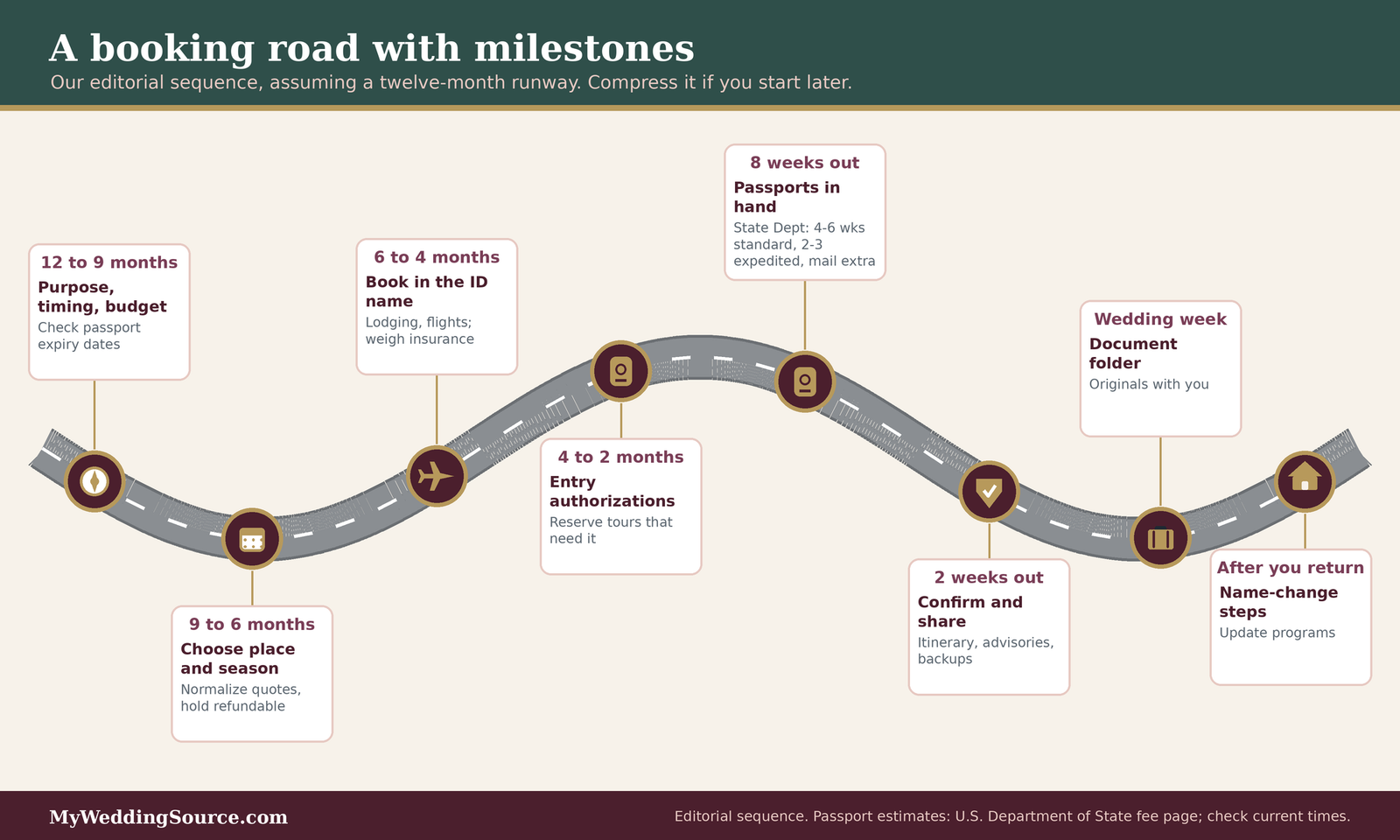
Reading the timeline
This honeymoon planning sequence is deliberately front-loaded with decisions and back-loaded with paperwork. The reason is that decisions are free to change early and expensive to change late, while paperwork is the opposite: starting early costs little, and starting late costs a lot. The figure above shows the same sequence as a road with milestones.
If you are starting late
If your wedding is three or four months away, honeymoon planning needs compression, not skipping. Do the budget and purpose decisions in a single evening. Check passports first, since they are the one item with a long lead time. Then choose a destination where the documents are simple, such as a domestic trip or a country that does not require advance authorization, and book refundable options.
Choose how to book
In honeymoon planning, how you book changes your protections as much as where you book. Each channel has strengths, and none is right for everyone.
Direct, agent, or package
Booking direct gives you a clear contract with the seller and, for airlines, the refund rules the Department of Transportation describes. A travel agent can handle complicated itineraries and be an advocate if something goes wrong, though you should ask how the agent is paid and what happens if a supplier cancels. Packages bundle several pieces and can be convenient, but you should ask what happens to the whole package if one part changes. We did not review any agent or package seller, so ask for the terms in writing from whoever you choose.
Pay with a card that gives you recourse
Paying by credit card can give you a path to dispute a charge. The Federal Trade Commission says you can dispute billing errors, including things you did not accept or that were not delivered as agreed, but your written dispute must reach the card issuer within 60 days after the first bill showing the error was sent. The issuer must acknowledge within 30 days and resolve within 90. Rules and protections vary, and this is general information, not legal advice, so read your card agreement. The practical lesson is to keep every confirmation and to look at each statement promptly.
Keep a record trail
Create a honeymoon planning folder, physical or digital, with every confirmation, cancellation policy, receipt, and message. Take screenshots of the cancellation terms on the day you book, because pages change. Our wedding planning guide covers how to organize paperwork across the whole project.
Communicate the plan early
Honeymoon planning involves fewer people than wedding planning, but the people involved still need information, and some of it is time sensitive.
Tell the people who need to know
Your employer needs dates and a handoff plan, so tell them early in honeymoon planning. Someone you trust should have your itinerary, lodging addresses, and flight numbers. If you are leaving right after the wedding, tell the venue, the vendors who need to coordinate with you after the event, and the person who will collect gifts, cards, and rented items. These are practical conversations to have before the wedding week, when your attention is stretched.
Update people when things change
If a flight is cancelled, a hotel changes your room, or you decide to extend the trip, update your trusted contact and your lodging. It takes a minute, and it means that someone knows where you are if plans move. Keep a list of phone numbers and email addresses on paper in case your phone is lost or dead.
Mistakes that are easy to avoid
Most of the trouble couples run into during honeymoon planning is not exotic. It is a short list of familiar slips, and each has a simple fix.
Choosing the photo before the logistics
A single beautiful image can anchor the whole plan. The fix is to run the destination through the matrix and the door-to-door arithmetic before you fall in love with it, so the decision rests on more than one picture. If it still works, you have lost nothing.
Paying nonrefundable before dependencies are settled
Booking at a discount before your leave, passport, or venue contract is final looks like savings and acts like a bet. Ask for both the refundable and nonrefundable prices, and compare the difference with what a lost booking would cost you.
Forgetting that the name on the ticket matters
Honeymoon planning tends to collide with name changes. Book in the name on the ID you will carry, and confirm that any award or loyalty account details match.
Skipping the rest
A packed itinerary is the most common regret we would predict, though we have no survey to cite for it. Build the off days first and put the activities around them.
Verify documents, names, and entry rules in honeymoon planning
Documents are the part of honeymoon planning with the least room for improvisation. A beach does not care whether you are flexible, but an airline gate agent or an immigration officer may. This section covers passports, names, and domestic ID, and ends with a short note about legal recognition if you are marrying abroad as well.
Passports and entry rules for honeymoon planning
In honeymoon planning, entry rules are the part you cannot negotiate: they belong to the country you are visiting, and they change. The State Department’s country pages are a good starting point, and the destination’s own government pages are the final word.
Passport validity and blank pages
Some countries ask for a passport that remains valid for months beyond your arrival, and some ask for a minimum number of blank pages. The State Department’s page for Indonesia, for example, says a passport must have at least two blank pages and be valid for at least six months beyond arrival, and that travelers with insufficient passports will be denied entry. Its page for the United Kingdom says a passport must be valid for the length of the stay and have at least one blank page. Two countries, two different rules. The lesson is not to memorize these numbers, which may change, but to read the page for your specific destination and for any country where you will connect.
Passport timing
The State Department’s fees page lists standard service at four to six weeks and expedited service at two to three weeks, with expedited service adding $60. Its processing-time page also notes that mailing time is separate, and can add time at each end. Because those estimates move with demand, check the current posted times before you rely on them. If you need a passport urgently, the department says appointments at a passport agency or center are available for urgent international travel within 14 calendar days (or 28 days if you need a foreign visa), that appointments are required, and that it cannot guarantee one will be available. In other words, do not plan a honeymoon around the urgent-travel option. Plan to check passport dates the week you set the budget.
Entry authorizations and visas
Some destinations require an electronic authorization or a visa on arrival even for short tourist stays. The United Kingdom’s government says U.S. citizens usually need an Electronic Travel Authorisation, which costs £20 and allows stays of up to six months, and it warns travelers to avoid sites that imitate government services. Indonesia offers a visa on arrival at some airports for a fee that the State Department lists at 500,000 rupiah, about $35, valid for up to 30 days. Both examples show the same pattern: the requirement is specific to the country, the fee is small, and the official source is the one to use. Look for the government site by typing its address yourself, not by following an advertisement.
Names after marriage and honeymoon planning
If either of you plans to change your name, the honeymoon is where the timing gets tricky, because the plane ticket and the legal name need to agree.
Match the ticket to the ID you will show
The Transportation Security Administration’s PreCheck guidance says the name on your airline reservation must exactly match the name on your enrollment, and that enrollment name must match your ID. For ordinary screening, airline guidance says the name in the reservation must match the government photo ID you will use. Delta’s travel-agency FAQ, for example, says the secure flight name must match a non-expired government-issued photo ID, and that minor differences such as a middle initial or a hyphen should not cause a problem. That is one airline’s policy, so ask yours. The practical rule is simple: book in the name on the passport or ID you will actually carry on the day.
Why many couples travel on their existing names
A marriage certificate does not automatically change your passport. To change the name on a passport, the State Department says that if your current name differs from the name on your most recent passport, you include a certified copy of your legal name change document, such as a marriage certificate, with a mail-in renewal application, and that the document is returned in a separate mailing. That process takes time, and the certified certificate usually does not exist until after the wedding. For many couples, the straightforward approach is to travel on the passport they already have, book the tickets in that name, and change names after returning. This is a common approach, not a rule, and it is worth confirming with your airline and any hotel or tour operator.
Plan the after-trip paperwork
After you return, the name change moves through several agencies, and each one has its own timeline. The State Department’s adult passport fee page lists $130 for a renewal book. The Social Security Administration says that after your name is legally changed you can update it online, by phone, or in an office, and that you receive a replacement card by mail in 5 to 10 business days after the request is completed. TSA says a PreCheck membership cannot be used until a name change on the membership is complete, and that name changes can take up to three months. Keep your certified marriage certificate somewhere safe, and consider ordering extra certified copies if you expect to need several.
Domestic trips and ID
A honeymoon in the United States has fewer documents, but honeymoon planning still has to check them.
REAL ID and acceptable identification
The TSA says REAL ID enforcement began May 7, 2025. For domestic flights, it lists a REAL ID-compliant driver’s license, certain enhanced licenses, a valid passport, military ID, and federally recognized tribal photo ID as acceptable. It says travelers who cannot verify their identity will not be allowed through the checkpoint. Check your license now, not at the airport. If it does not show the compliance marking, a valid passport is an acceptable alternative.
Rental cars, lodging, and the name on the reservation
Many lodging and rental-car companies ask for a photo ID and a payment card in the name of the person checking in. If one of you is traveling on a name that does not match the card, ask the company how it handles that. A brief call before you leave is easier than a long conversation at a counter.
If you are also marrying abroad
Some couples marry at the destination and honeymoon there. That is a separate project with its own legal requirements, and this guide does not cover it.
Treat the legal marriage as its own checklist
In honeymoon planning that includes a legal ceremony, the rules about who can marry, what documents are needed, how long they take, and how the marriage is recorded come from the destination’s government, not from the resort or the planner. Check official government sources for the country, and ask the people who will sign your paperwork what they need and when. We do not give legal advice here, and the rules are different in every place. Our guide to planning a wedding covers the wider planning picture.
Carry the documents you will need afterward
Whether you marry at home or abroad, you will probably want certified copies of the marriage certificate for the name-change steps described above. Ask how and when you will receive them, and whether the destination provides them in a form that U.S. agencies accept. If you are unsure, ask the agency directly before you leave.
Protect the trip with insurance and contingency plans
Honeymoon planning includes a quiet question that most couples would rather skip: what happens if the trip does not go as planned? You can answer it in an afternoon, and the answer will probably be reassuring. This section separates the kinds of coverage, because they do different jobs, and then covers weather, delays, and health. It is general information, not insurance or legal advice, and policies differ.
What travel insurance does and does not do
The term “travel insurance” covers several products. Knowing which is which avoids paying for coverage you do not need or assuming coverage you do not have.
The main types of coverage
The National Association of Insurance Commissioners describes the common types. Trip cancellation, interruption, and delay coverage reimburses prepaid, nonrefundable costs if you cannot take all or part of a trip, and the NAIC says it is the most popular type. Baggage coverage is secondary protection for lost or damaged luggage. Travel medical coverage is secondary health coverage abroad, and medical evacuation coverage pays to move you to a suitable facility. The NAIC says policies are often bundled with non-insurance services such as cancellation fee waivers and travel assistance, and that only the insurance portion is overseen by state insurance departments.
Exclusions and cancel-for-any-reason
The NAIC lists common exclusions: pre-existing health conditions, pandemics, civil or political unrest at the destination, pregnancy and childbirth, and risky activities. It describes “cancel for any reason” coverage as letting you cancel for reasons not otherwise covered and receive a partial refund, typically 50% to 75% of trip cost, and says it usually requires buying within a set window, insuring the full trip cost, and canceling at least 48 hours before departure. It also says travel insurance usually costs about 5% to 10% of the trip price and that cancel-for-any-reason coverage can add roughly 50% to the cost. Using a hypothetical $5,000 trip, that range would be about $250 to $500 before any cancel-for-any-reason add-on. That is our arithmetic from the NAIC’s range, not a quote. Read the actual policy and its exclusions before you buy.
Check what you already have
The NAIC suggests checking whether your homeowner’s, credit card, or health plan already covers some of the same risks. Ask your card issuer what its trip protections cover and what conditions apply, and ask your health insurer what it covers abroad. You may find gaps that are worth filling and overlaps that are not. Our guide on engagement ring insurance and hidden costs also explains how to check whether your jewelry coverage applies when you travel, which is a question worth asking before a trip with rings in your luggage.
Wedding insurance and travel insurance are different
If you bought event insurance for your wedding, it does not cover the honeymoon. The two cover different events, different dates, and different losses.
Separate policies, separate dates
Event insurance is bought for the wedding. Travel insurance is bought for the trip. If you leave on your honeymoon right after the reception, the coverage dates may be close together, and it is easy to assume one policy covers both. Check the policy period, the covered locations, and what each one defines as a covered event.
Read the timing rules
Many travel policies have rules about when coverage starts, and some benefits depend on buying within a window after your first trip payment, according to the NAIC’s description of cancel-for-any-reason coverage. Ask the insurer, in writing if possible, when each benefit begins and what you must do to keep it.
Health, evacuation, and what your coverage may miss
For many couples, the most important part of the insurance question is not the cancelled hotel but the unexpected hospital visit.
U.S. health coverage abroad
The State Department says coverage abroad depends on your policy, that some plans pay customary and reasonable hospital costs overseas, and that very few cover medical evacuation to the United States. It says Medicare generally does not cover care outside the United States. It also says medical evacuation can cost more than $50,000 depending on location and condition, and that standard travel insurance generally covers trip costs, not medical expenses, while travel medical insurance covers care abroad. The U.S. government will help you find medical services and contact family, but it does not pay medical bills.
Questions for your own insurer
For honeymoon planning, call your health insurer and ask four things: what is covered abroad, whether you must pay up front and claim later, whether there is an emergency number to call, and whether evacuation is covered. Write down the answers and keep the card and number in your document folder. If you take prescription medication, ask your clinician or pharmacist about carrying it and about local rules. We did not verify medication rules for any country, so check the destination’s official guidance.
Vaccines and health notices
Some destinations have health recommendations that may need lead time. Ask a clinician or a travel clinic what applies to your itinerary, and do it well before departure, so that nothing has to be rushed. We did not verify the current requirements for any specific destination, so use official public health guidance for the country you choose.
Weather, delays, and illness
Contingency work in honeymoon planning is mostly a set of small decisions made in advance.
Weather and storm planning
If your dates fall in a hurricane window, ask your lodging how it handles storm cancellations and what it offers if a storm is forecast. Ask whether the rate is refundable and how late you can cancel. Decide in advance what you would do if a storm threatened: change dates, change destinations, or stay. It is much easier to answer that question calmly in month five than in the airport.
Airline cancellations and long delays
The Department of Transportation says that if an airline cancels your flight, you are entitled to a refund if you choose not to travel or accept alternatives, and that you can also get a refund if the airline significantly changes your flight. It defines a significant change as, among other things, a departure or arrival that is three or more hours different on a domestic itinerary, or six or more on an international one, a different airport, or more connections. For tickets bought directly from the airline, a refund must be automatic if you reject the alternatives. Those are refund rules, not compensation for hotel costs or missed prepaid tours, which is where insurance comes in, and you should ask your airline how they apply to your route.
Local backup and a small emergency kit
Pick, before you go, a nearby hospital or clinic, an alternate airport, and one backup lodging option. Save them offline on your phone. Carry a small kit: copies of passports, insurance cards, a card that is not your primary one, and some local currency if your destination uses cash. None of this is exotic. It is just a few minutes of preparation that turns a stressful moment into a manageable one.
Safety information and official advisories
The State Department publishes advisories for countries, and the details are often more specific than the headline.
Read the whole advisory, not just the level
Advisories can differ within a country. The State Department’s Indonesia page, for example, advises increased caution for the country overall because of terrorism and natural disasters, while listing Central Papua and Highland Papua as Level 4, Do Not Travel. A couple honeymooning in Bali is in a very different situation than the advisory’s headline might suggest, and a couple who only reads the headline may worry for the wrong reasons. Read the specific region and the reasons.
Keep copies and keep your contacts
Carry paper copies of your passports and store digital copies somewhere you can reach if your phone is lost. The State Department’s Indonesia page advises carrying a copy of your passport and proof of visa when possible. Give a trusted person your itinerary and keep their number written down.
Plan for recovery time and the first week home in honeymoon planning
Most trip guides end at the airport. Honeymoon planning cannot, because it sits between a very full event and a return to ordinary life. Building rest into the plan is not indulgent. It is part of what makes the trip work.
The days before you leave
The wedding itself takes energy, and so does everything that surrounds it. Honeymoon planning that ignores that tends to put a hard travel day on the worst possible morning.
Do not schedule the earliest flight
If you leave right after the reception, avoid a flight that departs at dawn the next day, unless you have no alternative. A later departure gives you time to sleep, pack calmly, and handle small leftovers such as returning rentals or collecting a gift box. This is our practical advice, not a rule, and it may cost little: when you search, compare the price of a later departure with the early one before assuming the early flight is the bargain.
Consider a night at a nearby hotel
Some couples spend the wedding night at a hotel close to the airport, or at the venue, and fly the next day. That breaks the day into two manageable pieces and puts a buffer between the celebration and the travel. It also gives you a place to store the dress, suit, and gifts before you leave.
Decide what you will not do on the trip
It helps to name a few things you will not do, such as check work email, take calls from family about wedding leftovers, or open a laptop. Decide with your manager, your family, and each other before you leave, and tell the people who might otherwise try to reach you what the arrangement is.
Jet lag, honestly
If your honeymoon crosses time zones, recovery time is part of the cost. The size of that cost depends on the distance, the direction, and your own body.
What the guidance says
Mayo Clinic describes jet lag as a mismatch between your internal clock and local time, driven by light exposure, with cabin conditions and dehydration possibly adding to symptoms. It says symptoms usually appear within a day or two of crossing at least two time zones, tend to be worse or last longer the farther you travel, and that eastward travel is typically harder than westward. It estimates about a day of recovery for each time zone crossed. That is a general estimate, and many travelers adapt faster, but it is a useful way to compare destinations.

Turn the rule of thumb into a buffer for honeymoon planning
The figure above shows how many time zones five example regions are from the U.S. East Coast, using standard time. If you take Mayo’s rule literally, a trip to Hawaii, five zones west, asks more of your body than a trip to Cancun, but less than one to Tokyo, 14 zones east. You do not need to take the rule literally to use it. A reasonable approach is to treat larger time differences as a reason to protect more unscheduled days at the beginning, to avoid putting a prepaid, time-specific tour on your first morning, and to avoid planning a major transfer the day you arrive.
Ask what jet lag means for the budget
If a destination needs two or three slow days to adjust, those days are part of the cost per night on the ground that we described in the budget section. They are not wasted. They are the price of that destination, and you can decide whether it is worth paying. For some couples the answer is yes. For others, a closer destination with the same level of beauty and fewer adjustment days is the better choice.
Coming home
The return trip is where honeymoons often meet real life too quickly.
Build a buffer before work
If possible, plan to arrive home at least one full day before you return to work. That gives you time to sleep in your own bed, unpack, do laundry, and handle anything that piled up. It also protects the benefit of the trip, since a honeymoon that ends with a red-eye and an early meeting can erase the rest it gave you. Our wedding planning checklist can help you list those after-trip tasks.
Start the paperwork, but not on day one
After you return, there is a short list of administrative tasks: certified marriage certificate copies, name-change steps for each agency, updating frequent flyer and security program profiles, and thank-you notes. They are described in the documents section above. Put them on a calendar for the second week, not the first, and do them one at a time.
Reconcile the budget and save the lessons
Within a few weeks of returning, close out your honeymoon planning by comparing your plan, your quotes, and what you paid. Note what was surprising, what you would do again, and what you would change. If you plan to travel again for an anniversary, that record will be the best budgeting tool you have. If you hired photographers or took photos during the trip, our wedding photographer shot list is a useful reminder of which moments couples tend to want captured, which can inform what you photograph yourselves.
Two worked scenarios for honeymoon planning
Scenarios help because decisions in honeymoon planning rarely arrive one at a time. The two below are illustrative composites, not real couples, and every number is invented for the sake of the example. Use them to see how the pieces above interact.
Scenario one: tight budget, short leave
This scenario shows how timing and budget interact when both are constrained.
The situation
Imagine a couple with five days of approved leave around their wedding and a total honeymoon budget they have decided is $3,000. One partner has a passport that expires in four months, and the other has never had one. They would like to see somewhere far away, but they are also exhausted by the wedding and do not want a long travel day.
How the decisions play out
They run the door-to-door arithmetic and see that a far-away trip would use two of their five days in transit. They check the State Department’s passport timing and see that a first-time application is not a quick errand. They choose a mini-moon: a three-night domestic trip within a few hours of home, booked with refundable rates, and they set aside a smaller amount each month toward a bigger trip in the following year, with a month and a budget on the calendar. They still check their IDs against the TSA’s acceptable-ID list, and one of them orders a REAL ID-compliant license. The mini-moon costs less than half their budget, and the rest becomes the start of the later trip. This is a common pattern, and the Knot’s mini-moon numbers suggest they are far from alone.
Scenario two: far destination, name change, and a hurricane window
This scenario shows how documents, names, and weather combine.
The situation
Imagine a couple who want ten days in a warm place and who are marrying in late summer. One of them plans to change their name after the wedding. They are drawn to a Caribbean resort, and their only free window overlaps the Atlantic hurricane season.
How the decisions play out
They note that the National Hurricane Center lists June 1 to November 30 as the Atlantic season, with a peak around September 10, so a September trip sits near the peak. They ask the resort about its storm policy and discover that the discounted rate is nonrefundable. They compare quotes using the normalization method and find that the refundable rate costs more, but that the gap is smaller than the sticker difference. They shift the trip to early December, just outside the official season, and choose the refundable rate anyway. They book flights in the name on the passport they already carry, plan to start the name change after they return, and buy travel insurance within the window the insurer specifies, after reading the exclusions. They do not claim that this is the only sensible plan, and a different couple with more flexibility might have chosen differently. What matters is that every decision had a reason they could write down.
A one-page decision rule for honeymoon planning
By now your honeymoon planning notes probably run long. This section compresses it into a short sequence you can run on a single sheet of paper.
The five-question filter
Answer these in order. If you stall on one, stop and resolve it before moving on.
Questions one to three
First, what is the trip for, in one sentence you both agree on? Second, when does it fit: straight after the wedding, a mini-moon, or later? Third, what is the total budget, including paperwork, insurance, and a reserve? If you cannot answer any of these, do not look at destinations yet.
Questions four and five
Fourth, which destinations remain once you apply the destination-fit matrix and the door-to-door arithmetic? Fifth, for each remaining option, what do the documents, the weather window, and the cancellation terms look like in writing? The option that survives all five is a good candidate for your honeymoon planning. If two survive, choose the one that leaves more room for rest.
When to stop researching
There is a point at which more honeymoon planning research stops improving the decision. It is useful to recognize it.
Signs you have enough information
You have enough information when you can state your purpose, your budget, your dates, your documents status, your cancellation dates, and your insurance decision in a few sentences. At that point, additional reviews and photo galleries are unlikely to change the decision, and they may cost you the refundable rate you were holding.
Signs you should wait
If your leave is not confirmed, your passport is pending, or your venue contract is unsigned, wait. A nonrefundable booking made before a dependency is settled is a bet against yourself. It is nearly always better to hold a refundable option for a few weeks.
Questions to ask before you pay for your honeymoon
The questions below work for nearly any seller in honeymoon planning: an airline, a resort, a travel agent, a tour company, or an insurer. Put them in writing, and keep the answers with your confirmation.
Questions worth asking before you pay
- What is the total price for both of us, including every tax and mandatory fee?
- What exactly is included, and what costs extra?
- What is the cancellation or change policy, and what are the dates and fees?
- What happens if you cancel, or if a storm, strike, or closure changes the plan?
- Is the name on the booking exactly the name on our passports or IDs?
- What documents, authorizations, or visas does this destination require, and who confirms them?
- When does insurance coverage start, and what is excluded?
- Who do we call, and at what number, if something goes wrong while we are away?
Questions about the booking
These questions confirm what you are buying and what could change.
Price and inclusions
Ask for a line-by-line list of what the price covers. Ask whether the price is per person or per couple, whether it holds for your dates, and whether meals, drinks, transfers, and activities are included. If something is described as “free,” ask what it is conditional on.
Changes and cancellations
Ask for the cancellation policy in writing, with the dates when fees begin and end. Ask what happens if you change dates instead of canceling, and what the seller does if it cancels or substantially changes the service. Save a copy of the answers.
Questions about protection
These questions confirm what happens if something goes wrong.
Insurance and payment protections
Ask the insurer when coverage begins, what the policy excludes, what the claim process looks like, and whether cancel-for-any-reason coverage is available and when it must be purchased. Ask your card issuer what protections apply to travel purchases made with the card.
Emergency contacts
Ask for a 24-hour contact at the lodging and the tour operator, and the number for your insurer’s assistance line. Write them down and store them offline.
FAQ: honeymoon planning questions
Timing and budget
How far ahead should we book a honeymoon?
A travel expert quoted by The Knot suggests booking about a year ahead for the best room availability and rates, but a shorter runway can work. For honeymoon planning, the safer habit is to hold refundable flights and lodging early, then firm them up once your dates, leave, and passports are settled. Note every cancellation deadline in a calendar the day you book.
How much does a honeymoon cost?
The Knot reports an average of about $5,300 for couples married in 2024, based on an internal study of nearly 17,000 couples. That is a survey average, not a quote, and it does not separate domestic from international trips. Build your own number from current quotes, include taxes, paperwork, insurance, and a reserve, and compare options by cost per night on the ground.
Should we leave right after the wedding?
It depends on your energy, your leave, and your destination. The Knot reports that about 41% of couples left within two days of the reception, so it is common, but not required. If you leave quickly, choose simple logistics and a later flight. If you are exhausted or short on time, a mini-moon now and a bigger trip later is a reasonable alternative.
Documents and insurance
Do we need passports for a honeymoon?
For international travel, yes, and many countries add their own rules about validity, blank pages, or an electronic authorization. The State Department’s page for Indonesia, for example, asks for six months of validity and two blank pages. For domestic flights, the TSA accepts a REAL ID-compliant license or a passport. Check the official page for your exact destination.
Should we book flights in our new names?
Book in the name on the ID you will actually show. The TSA’s PreCheck guidance says the reservation name must match the enrollment name, and airlines say the reservation must match your government photo ID. Because a passport name change needs a certified marriage certificate, many couples travel on existing names and change them afterward. Confirm with your airline.
Do we need travel insurance for a honeymoon?
It is optional, and whether it helps depends on how much money is prepaid and nonrefundable, your destination, and what your card and health plan already cover. The NAIC says travel insurance usually costs about 5% to 10% of the trip price and lists common exclusions, so read them. Travel medical coverage is separate from trip-cancellation coverage. This is general information, not insurance advice.
Trip choices
Is a mini-moon a good idea?
For many couples it is. The Knot reports that a little over two in five took one in 2024, with 24% doing it instead of a traditional honeymoon and 17% doing it in addition to one. A mini-moon suits tight budgets or leave and makes a larger trip easier to plan. It does not have to replace a later trip unless you want it to.
How long should a honeymoon be?
There is no correct length for honeymoon planning. The Knot reports an average of about seven days, and about 28% of couples traveled one to two weeks. A better test is nights on the ground: subtract travel days and jet-lag adjustment from the total, and ask whether the remaining days give you the rest and the experiences you named at the start.
Your next steps
Settle the decisions
Write the one-sentence purpose, timing, and budget
To start honeymoon planning in earnest, sit down together and write what the trip is for, when it fits, and the total you are willing to spend including paperwork, insurance, and a reserve. If you need to see where the trip fits in your wider spending, start with our wedding budget calculator, and check dates against your wedding planning timeline.
Check passports and IDs this week
Look at every expiration date and at the name on every document. If a passport needs renewing, apply first and shop second. If you are flying domestically, check that your license is REAL ID compliant or plan to carry your passport.
Lock in the logistics
Hold refundable options and record the gates
Hold refundable flights and lodging while you finish the plan. Write every cancellation date in your calendar with a reminder a week before. Keep confirmations in one folder, and keep it with the rest of your planning in our wedding planning guide.
Plan for the evenings and the suitcase
Honeymoon planning ends with the suitcase. Check the dress codes of restaurants and venues you intend to visit and pack accordingly. Our guide to cocktail attire explains what that dress code usually means so you are not guessing at the door. Leave a day of rest at both ends of the trip and treat it as part of the plan.
Sources & methodology
How we built this guide
What we relied on
This guide combines survey reporting from The Knot, passport, health-abroad, and country-entry pages from the U.S. Department of State, refund rules from the U.S. Department of Transportation, identification and name-matching guidance from the Transportation Security Administration, name-change information from the Social Security Administration, hurricane-season dates from the National Hurricane Center, billing-dispute guidance from the Federal Trade Commission, a consumer guide to travel insurance from the National Association of Insurance Commissioners, and jet-lag information from Mayo Clinic. Where a statement comes from a company, such as an airline’s travel-agency FAQ or The Knot’s reporting, we say so. The worked budget example, the destination-fit matrix, the booking timeline, the scenarios, and the rest-ratio and reserve rules of thumb are our own editorial tools, built on invented round numbers where they use numbers at all, and none of them is a quote or a forecast. We read these sources in November 2026.
What we did not do
We did not price any trip, test any booking site, review any travel agent, honeymoon fund, or insurer, or verify weather or cost figures for individual destinations. The State Department’s passport processing-time page was showing an older update date when we read it, so we cite the processing estimates from its fees page and tell you to check the current posted times. We could not read the Centers for Disease Control and Prevention’s travel pages, so we give no vaccine or health-notice specifics. Entry rules, fees, and refund policies change. This guide is general education and is not legal, financial, insurance, or medical advice.
Source list
Government and regulatory sources
- U.S. Department of State, Passport fees: https://travel.state.gov/content/travel/en/passports/how-apply/fees.html
- U.S. Department of State, Get your passport fast: https://travel.state.gov/content/travel/en/passports/get-fast.html
- U.S. Department of State, Passport processing times: https://travel.state.gov/content/travel/en/passports/how-apply/processing-times.html
- U.S. Department of State, Renew your passport by mail: https://travel.state.gov/content/travel/en/passports/have-passport/renew.html
- U.S. Department of State, Indonesia country information: https://travel.state.gov/content/travel/en/international-travel/International-Travel-Country-Information-Pages/Indonesia.html
- U.S. Department of State, United Kingdom country information: https://travel.state.gov/content/travel/en/international-travel/International-Travel-Country-Information-Pages/UnitedKingdom.html
- U.S. Department of State, Your health abroad: https://travel.state.gov/content/travel/en/international-travel/before-you-go/your-health-abroad.html
- U.S. Department of Transportation, Airline refunds: https://www.transportation.gov/individuals/aviation-consumer-protection/refunds
- Transportation Security Administration, REAL ID: https://www.tsa.gov/real-id
- Transportation Security Administration, TSA PreCheck FAQ: https://www.tsa.gov/precheck/faq
- Social Security Administration, Change your name: https://www.ssa.gov/personal-record/change-name
- National Hurricane Center, Climatology: https://www.nhc.noaa.gov/climo/
- Federal Trade Commission, Disputing credit card charges: https://consumer.ftc.gov/articles/disputing-credit-card-charges
- GOV.UK, Electronic Travel Authorisation: https://www.gov.uk/eta
Industry, survey, and consumer-health sources
- The Knot, Average cost of a honeymoon: https://www.theknot.com/content/average-cost-of-honeymoon
- The Knot, Domestic honeymoon cost: https://www.theknot.com/content/domestic-honeymoon-cost
- National Association of Insurance Commissioners, Travel insurance: https://content.naic.org/insurance-topics/travel-insurance
- Mayo Clinic, Jet lag: https://www.mayoclinic.org/diseases-conditions/jet-lag/symptoms-causes/syc-20374027
- Delta Air Lines, Secure Flight passenger data FAQs for travel agencies: https://pro.delta.com/content/agency/us/es/policy-library/government-tsa/secure-flight-passenger-data–sfpd–faqs.html