
A wedding week checklist works when every item has one named owner, one deadline, and one way to prove it is finished, because the point of the final days is not to do more tasks yourselves but to hand the day to people who can run it while you rest.
Quick answer
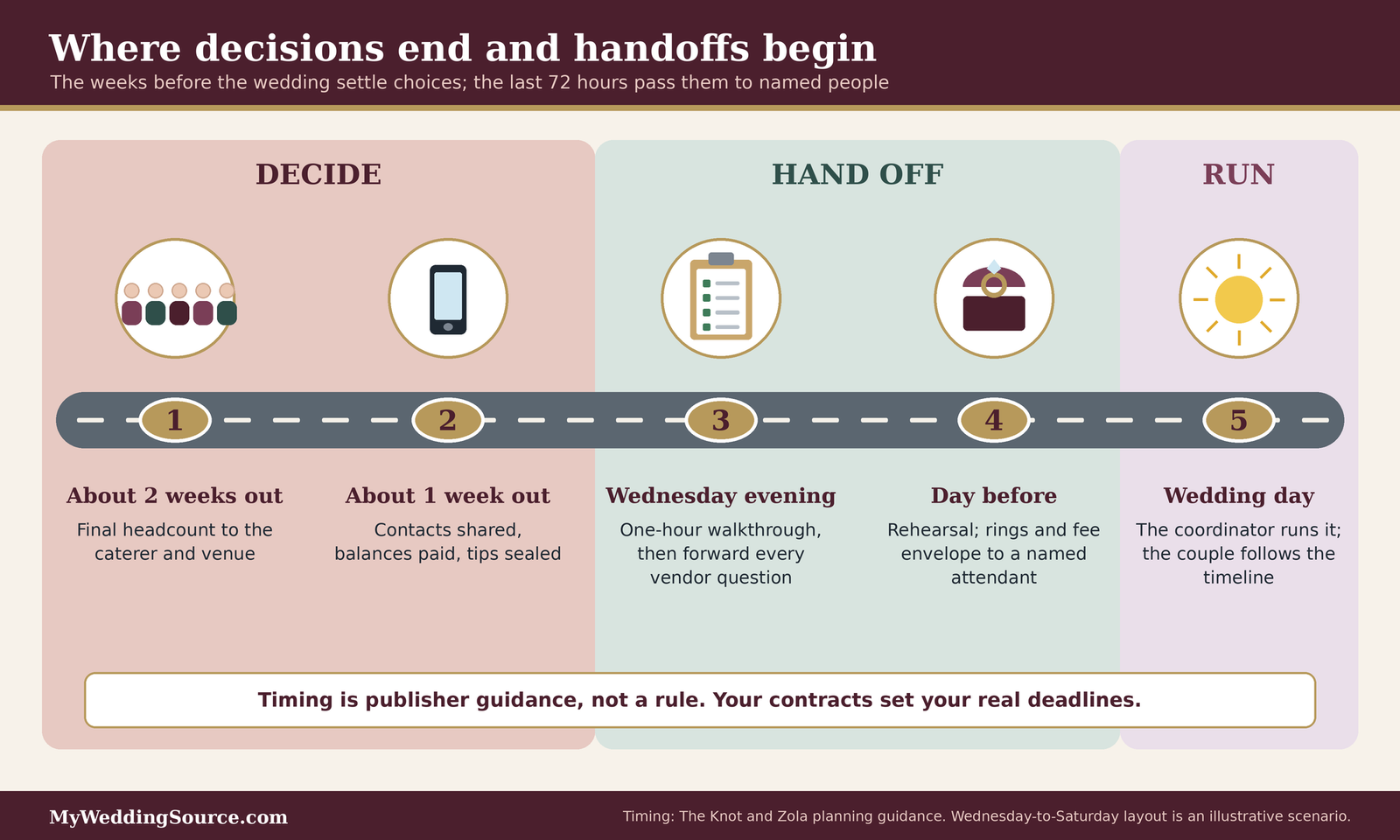
For most weddings, the last 72 hours should contain handoffs, not decisions. Anything that still needs a choice (headcount, seating, timeline, tips, backup plan) should be settled before then, according to the two big planning sites: The Knot suggests giving vendors a final headcount about two weeks out, and Zola suggests sending final balances, tips, and details to the caterer about a week out. What remains in the last three days is passing each item to a named person with a written deadline, a contact number, a proof of completion, and an escalation path. Use the tables and the worked scenario below to build your own wedding week checklist.
Most advice about the final week reads like a long list of errands for the couple. This guide takes a different position on the wedding week checklist. By the time the week arrives, the errands are not the problem. The problem is that every question in the last few days still routes through two people who should be eating, sleeping, and getting dressed. The goal of a good wedding week checklist is to move that flow of questions to someone else. If you are still building the schedule that this checklist rests on, start with our wedding timeline guide and the broader wedding planning checklist, then return here.
A note on what this guide is and is not. It is a method for organizing and delegating, with timing guidance drawn from published planning checklists and from the National Weather Service for the weather portion. The details of your contracts, your venue’s rules, and your state’s marriage license rules decide what is actually required, so confirm those directly. Where a figure is our own arithmetic or an illustrative example, we say so.
Turn the wedding week checklist into tasks that can be completed
A list of intentions is not a wedding week checklist. “Handle flowers,” “sort out transportation,” and “deal with the timeline” are topics, and topics cannot be finished, delegated, or checked. The first job in building a usable wedding week checklist is converting each topic into a task that someone could finish on a given afternoon and that a second person could verify.
Write each wedding week checklist item as a done-when statement
A done-when statement describes the state of the world after the task is finished, in terms another person could observe. It replaces the verb with a result. The format is short: the item, then “done when” and the observable condition.
Replace vague verbs with a concrete deliverable
Verbs like “confirm,” “check,” “review,” and “coordinate” feel productive and prove nothing. Compare these pairs, which are illustrative examples:
- Instead of “confirm the florist,” write “florist has replied in writing with a delivery time, a delivery address, and the on-site contact’s mobile number.”
- Instead of “sort out the rings,” write “rings are in a labeled box with the best man, who has confirmed receipt by text.”
- Instead of “finalize the timeline,” write “timeline version dated this week is saved in the shared folder, printed in three copies, and sent to every vendor, with replies received from each.”
- Instead of “plan for rain,” write “backup ceremony space is named in the venue contract, the setup crew knows the switch time, and the person who decides has the decision rule in writing.”
The test is simple. If the done-when statement cannot be checked without asking the person who wrote it, it is still too vague. This is also why generic downloadable checklists often disappoint: they list nouns, not conditions.
Assign one owner even when several people help
Every task needs exactly one owner, meaning the single person who answers for it being finished. Others may help, but shared ownership tends to mean nobody checks. When you write the owner column, avoid group names such as “the bridesmaids” or “the family.” Use a first name.
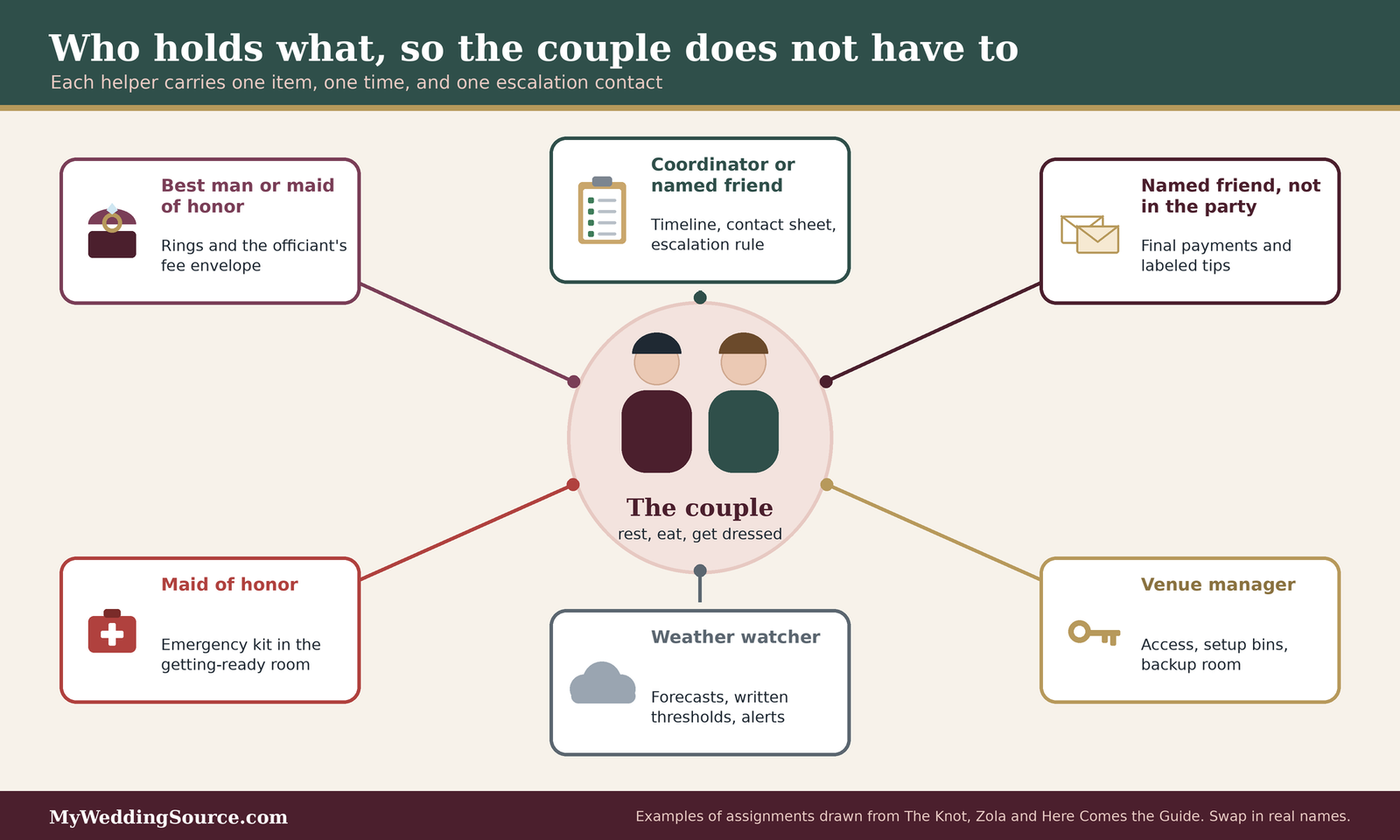
Planning sources describe the same pattern. The Knot’s week-of guidance suggests assigning specific people to ceremony items, money matters, reception questions, and emergency-contact duties on the day, and Here Comes the Guide suggests confirming that the wedding party, ushers, and key family members each know their roles. If you have a coordinator, the coordinator can own many of these, and Zola’s coordinator article notes that a coordinator can hand rings, the marriage license, and vows to an assistant or a member of the wedding party. If you do not have a coordinator, name a friend or relative who is organized, calm, and not in the wedding party, since attendants have their own jobs that day. Our guides to maid of honor duties and best man duties describe what attendants can reasonably carry, and what they should not be asked to.
Group wedding week checklist tasks by dependency, not by aesthetics
Many checklists group items by theme: flowers, music, photos, attire. That is natural to read and poor to run as a wedding week checklist. In the final days, the question that matters is not “what category is this?” but “what stops if this does not happen?” Grouping by dependency puts the items that unlock other items at the top.
Flag blockers that stop later work
A blocker is a task whose failure makes several later tasks impossible. In a typical wedding week, five items tend to block the most:
- The final headcount. It feeds catering, rentals, seating, place cards, the bar order, and vendor meals.
- The timeline. Every vendor’s arrival time and every helper’s job is derived from it.
- The contact sheet. Without a working phone number for each person on the day, no escalation is possible.
- Final payments and tips. Vendors who are not paid on terms, or who do not have their gratuity ready, can create friction at the worst moment.
- Access. Someone has to know how vendors enter the venue, when, and who unlocks the doors.
Mark each blocker visibly on your wedding week checklist, and schedule it first. A late florist delivery is an inconvenience. A missing timeline is a cascade.
Separate must-do items from optional enhancements
Every wedding week checklist attracts enhancements: a welcome basket, a handwritten note for each attendant, a custom playlist for the cocktail hour, a sparkler exit. None is wrong, but each takes attention in a week when attention is scarce. Sort every wedding week checklist item into two columns. Must-do items are those where failure harms the legal, safety, financial, or logistical core of the day: the marriage license, the rings, the officiant’s arrival, the headcount, the payments, the weather plan, and the timeline. Optional items are everything where failure costs only polish.
When time runs short, drop from the optional column without guilt, and delegate the rest. A shorter wedding week checklist is a calmer one, and our guide to managing wedding planning stress covers how to make those cuts without second-guessing them.
Build the wedding week checklist around deadlines and proof
A task with no date is a wish. A task with a date but no proof is a hope. The second job of a wedding week checklist is to attach both: the date by which the thing must be true, and the evidence that it is.
Set the date each wedding week checklist item must be true
The most useful date on a wedding week checklist is not when you will do it but when it must be true. The difference matters because it lets you schedule a buffer between the two.
Work backward from contract or guest deadlines
Start your wedding week checklist from the hard constraints: your venue’s cutoff for the final guest count, your caterer’s cutoff for entree selections, the date your final balances come due, and the last day your marriage license is valid under your local rules. Guidance on the typical headcount timing is consistent across sources. The Knot’s vendor-confirmation article suggests giving vendors a final number about two weeks before the wedding and notes that RSVP deadlines are usually two to four weeks out. Here Comes the Guide advises sending the final count by the venue’s or caterer’s own deadline so you do not pay for the larger original number. Your contract, not either article, sets your actual deadline, so read it.
Then work backward. If the caterer’s cutoff is 14 days out, your RSVP chase should be finished a few days before that, which means your RSVP deadline needs to sit well before it. Our guide to RSVP wording covers how to set a deadline that leaves time to follow up.
Add review dates before hard cutoffs
A review date is a checkpoint set ahead of a hard cutoff, so a problem found at the checkpoint can still be fixed. If the florist needs a final confirmation by a given Monday, schedule the review the previous Thursday. If the license must be signed and returned within a set period after the ceremony, set a reminder for the day after the wedding, not the last day. The number of days of buffer is a judgment call. A reasonable rule of thumb, which is our own and not a published standard, is to place the review at least two working days before any cutoff that involves another person’s reply.
Zola’s planning checklist puts a similar approach on a longer scale: it suggests confirming date, time, and location with every vendor about two months out, which acts as a review before the final-week confirmations.
Store evidence that a wedding week checklist task is finished
Proof is what turns “I think the DJ has the timeline” into “the DJ replied on Tuesday.” It is also what lets you hand the list to a helper without a long conversation.
Save contracts, confirmations, and receipts centrally
Zola suggests saving all vendor contracts somewhere easy to find and setting payment reminders so no due date is missed. In the final week, extend that into a single shared folder containing: each signed contract, the latest confirmation message from each vendor, proof of each payment, the final timeline, the guest list, the seating chart, and the marriage license paperwork.
Two practical points. First, the folder should be available offline on at least two phones, since venues often have poor reception. Second, keep a printed copy of the contract summary for each vendor in a binder or envelope, held by your coordinator or day-of helper. If a vendor arrives with a question about what was agreed, a person with the paper can answer in a minute.
Record the latest approved version of guest-facing information
Confusion in the last week often comes from two versions of the same fact: a ceremony time in an old invitation and a new one in the website, or a shuttle schedule that changed after printing. Name one source of truth for guest information, usually the wedding website, and date every version of the timeline in its file name. When something changes, record what changed, who was told, and when. A short log like this settles disputes quickly and helps whoever answers guest questions on the day.
If something changed after your printed materials went out, our guides to wedding invitations and wedding programs cover how to handle corrections without alarming guests.
| Task | Owner (illustrative) | Must be true by | Done when | Blocked by |
|---|---|---|---|---|
| Final headcount sent to caterer and venue | Couple, then planner or coordinator | Caterer’s cutoff, often about two weeks out | Written acknowledgment of the number, including vendor meals | RSVP replies, vendor meal count |
| Day-of timeline distributed | Coordinator or a named friend | About one week out | Every vendor and helper has replied with receipt | Final headcount, venue access times |
| Vendor contact sheet shared | Coordinator or a named friend | About one week out | Sheet includes mobile numbers for each person on site, plus a backup contact | Timeline |
| Final balances paid | Whoever holds the payment account | Per contract; before the day if possible | Receipts saved in the shared folder | Invoices, added-on charges |
| Tips sealed and labeled | Couple prepares, a named person distributes | The day before | Each envelope names its recipient; the distributor has the list | Final payments settled |
| Rings and officiant fee handed off | Best man, maid of honor, or another attendant | The rehearsal or the morning of | Holder confirms receipt by text | Ring pickup, resizing complete |
| Marriage license in hand | Couple, then officiant or coordinator | Per your jurisdiction’s rules | License is in a folder with a named person; filing steps written down | Local office rules, ID and witness requirements |
| Weather and backup decision rule | Couple and venue manager | A week out, reviewed the day before | Trigger, decision-maker, and switch time are written and shared | Venue’s indoor option, rental crew’s schedule |
| Setup and décor handoff | Coordinator or a named friend | The day before | Items are in labeled, closed bins with a layout note | Delivery times, venue access |
| Emergency kit staged | Maid of honor or coordinator | The day before | Kit is in the getting-ready space | None, except space |
| Attire pickup and storage | Named friend or attendant | Two days out | Garment bag is in the getting-ready space; outfit has been tried on complete | Alterations, steaming |
| Return of rentals after the wedding | A named person | The day after | Rental company has confirmed return | Pickup times, who is staying in town |
The owners in this wedding week checklist table are examples. Replace them with real names, and add the phone number beside each one.
Use the final wedding week checklist as an operational handoff
By now the wedding week checklist is a set of tasks with owners, dates, and proof. The final stage is the handoff itself: the moment execution moves from the couple to the people who will carry it. A handoff is not an announcement. It is a short, deliberate exchange in which the new owner knows what they hold, what done looks like, and who to call when something goes wrong.
Move wedding week checklist execution away from the couple
Couples often say they delegated their wedding week checklist and then describe a day in which they answered questions from the venue manager, the DJ, and an aunt. The tasks were assigned, but the questions still found them. To prevent this, change who the world is told to call.
Give helpers exact responsibilities
A helper who hears “can you keep an eye on things?” does not know what to do. A helper who hears “you hold the rings and the officiant’s envelope, you hand the rings to the officiant at the moment shown on the timeline, and you text me when the fee is delivered” does. Write each responsibility as a short card with five fields:
- What you hold. The physical or informational item.
- When it moves. The time on the timeline, or the trigger.
- Who receives it. The person or vendor.
- How you prove it. A text, a photo of a signed receipt, a checked box.
- Who to call. Your escalation contact if something is off.
Here Comes the Guide’s list of week-of delegations is a good source of candidate cards: someone to gather VIPs for portraits, someone to pack gifts and belongings after the reception, someone to distribute final payments and tips during the event, someone to return rented formalwear the next day, someone to check on speech-givers, and someone to stock the getting-ready rooms. The Knot adds point people for ceremony items, money matters, reception questions, and emergency contact duties. A single page per helper keeps the wedding week checklist concrete, and cards can be sent by text the evening before.
Create escalation rules for exceptions
An escalation rule answers three questions: who hears about the problem first, how long they have to solve it, and who gets called if they cannot. Without it, every problem climbs straight to the couple. A simple three-level rule works for most weddings:
- Level one: the helper solves it. For problems that cost less than a few minutes and no money, the helper fixes it and tells the coordinator later.
- Level two: the coordinator or planner decides. For anything involving a vendor, a schedule shift, or a spend, the coordinator decides.
- Level three: the couple hears about it. Reserve this for decisions only the couple can make, such as moving the ceremony indoors, or safety and legal matters.
The Knot suggests giving vendors your planner’s and venue coordinator’s numbers about a week ahead, plus a backup contact such as a parent or a member of the wedding party. That is the practical form of this rule: vendors know whom to call, and the answer is not the couple. If you are not using a planner, name the person who plays that role in writing, and tell vendors.
| Handoff | Held by (illustrative) | Timing | Proof | Escalation path |
|---|---|---|---|---|
| Timeline and contact sheet | Coordinator or named friend | Sent about a week out; re-sent the day before if anything changed | Replies from each vendor | Coordinator, then backup contact |
| Rings and officiant fee | Best man or maid of honor | Handed over at the rehearsal or the morning of | Text confirming receipt | Coordinator, then the couple only if a ring is missing |
| Marriage license | Coordinator, or officiant if they will collect it | Before the ceremony; filing steps assigned to a named person | License and filing steps in a labeled folder | Officiant, then the issuing office per its rules |
| Payments and tips | Named person who is not in the wedding party | Prepared the week before; delivered at times set on the timeline | Receipts and an envelope checklist | Coordinator |
| Setup bins and signs | Coordinator or venue contact | The day before, or per venue access rules | Photo of the staged items; venue contact acknowledges | Venue manager |
| Vendor meals and breaks | Caterer, with a named friend checking | Included in the final headcount; served per the timeline | Caterer’s confirmation of the count | Coordinator |
| Weather watch | Named friend or the coordinator | From several days out through the end of the event | Written decision rule; messages sent at each trigger | Venue manager, then the couple |
| Emergency kit | Maid of honor | Staged the day before | Kit is in the getting-ready space | The coordinator |
| Cleanup and gift transport | Named friend or family member | After the reception | Items in a vehicle with a named driver | Coordinator |
| Rentals and attire returns | Named friend | The day after | Return confirmation from the shop | The person who rented |
Run a last-pass failure check
A last-pass check on the wedding week checklist is a deliberate attempt to find what is missing before the day does. It takes about an hour and is best done by someone who has not been staring at the plan.
Look for missing owners, times, and addresses
Print the timeline, the contact sheet, and the wedding week checklist. With a pen, mark every line that lacks one of four things: an owner, a time, an address, or a phone number. Then check the less obvious gaps:
- The first and last events of the day. The getting-ready location and the post-reception destination are often missing a name, an address, or a door code.
- Vendor arrival and breakdown times. Are there any gaps where a vendor arrives before the venue is unlocked, or leaves before a cleanup task is done?
- Entrance and parking. Do vendors know where to unload, and is someone assigned to meet them?
- Meals. Here Comes the Guide and The Knot both point out vendor meals. Are the photographer, DJ, and others included in the headcount, and are they scheduled a break?
- The unglamorous items. Is there a ride home for the couple, a plan for the dress or tux after the reception, and a person responsible for the leftover cake or flowers?
Our guide to wedding venue questions lists access and rules questions that often explain these gaps.
Confirm the backup path for weather, travel, or vendor delay
For every vendor and guest-facing event, ask: what happens if this person or item is late by 30 minutes, and what happens if it does not arrive? You are not planning for disaster. You are checking that the answer is not “we’d have to panic.” For vendors, this might mean a named alternate contact at the company. For transport, it might mean a backup driver. For weather, see the full section below.
Questions to ask before the handoff
- Who is the one person vendors should call first, and have they said yes in writing?
- What do I need to have decided before the first handoff, and what can be decided on the day?
- What is the exact time and place each item changes hands?
- Which items are must-do, and which can be dropped if the week gets tight?
- What do we do if the vendor cannot be reached on the day?
- Who holds the marriage license, and who files it afterward?
- What triggers the move to the backup plan, and who has authority to call it?
A worked scenario: one Saturday wedding, three days of handoffs
A scenario makes the wedding week checklist method concrete. The details below are hypothetical and chosen for illustration only. They are not a statistical picture of real weddings, and your numbers will differ.
The assumptions
The wedding we are planning around
Imagine a Saturday wedding with about 110 guests, a ceremony at 4:30 p.m. on a lawn with an indoor backup room, a seated dinner served by an outside caterer, and a reception in the venue’s ballroom. There is a photographer, a DJ, a florist, an officiant, and a hair and makeup artist. A month-of coordinator has been hired. The couple and both sets of parents are local, and about 20 guests are traveling. For this scenario, the 72-hour window runs from Wednesday evening to Saturday afternoon. Earlier items, such as the final headcount, have already been sent about two weeks out, as The Knot suggests, and the vendor confirmations and contact exchange happened about a week out.
The questions we expect to arrive
Every wedding week produces questions. In a hypothetical but realistic mix, the couple would expect around 15 to 20 vendor questions in the final three days if no handoff system exists: arrival details, a changed delivery window, a parking question, and so on. This is our own illustrative assumption, not a published statistic. With a system in place, the target is that nearly all of them go to the coordinator, and only a handful of decisions reach the couple. The value of a handoff is the reduction in interruptions that reach the couple, and the real count cannot be known beforehand.
The handoff calendar
Wednesday evening: close the blockers
The couple spends one hour with the coordinator going through the wedding week checklist, not a day. They confirm that the timeline version dated this week is final, that the contact sheet includes the backup contact, that the tips are sealed and labeled, and that the weather rule is written. They also name who will pick up attire and who will drop the welcome bags at the hotel front desk. Nothing is left as “I’ll figure it out.”
At the end of the hour, the coordinator sends the timeline and the contact sheet to every vendor with a request to reply “received.” The couple’s job after that is to stop answering vendor messages and forward any that arrive to the coordinator.
Thursday: staging and proof
On Thursday, the helpers work through their lines of the wedding week checklist and collect what they hold. The attendant who will keep the rings collects them from the jeweler or the couple. The person picking up attire collects it, checks it against the full outfit, and hangs it in the getting-ready space or a closet. The coordinator checks the reply log and calls any vendor who has not replied. Our guide to wedding dress alterations and the wedding party attire article cover what to confirm when outfits are finished.
Friday: rehearsal and last-pass check
Friday is for the rehearsal, if you have one, and for the last-pass failure check described above. Zola’s checklist places the ceremony rehearsal and the reconfirmation of delivery times and locations on the day before the wedding. The couple hands the rings and officiant’s envelope to the named attendant at the rehearsal, as The Knot suggests. The coordinator reviews the weather outlook with the venue manager and confirms whether the backup room will be set at all. Evening is for dinner and sleep.
Saturday morning: one more reply, then hands off
On the morning of the wedding, the couple’s only operational task is to be where the timeline says they should be. The coordinator runs the day, and a friend is named to keep the wedding party on schedule, a suggestion that Zola makes for the wedding day itself. Vendors who need something call the coordinator. If the coordinator needs a decision, they call the couple once, with a recommendation and a deadline for the answer.
What the scenario shows
The arithmetic of a late headcount change
Money is where handoffs get tested. Consider an illustrative figure: a caterer charging $95 per guest, with a final count of 112 guests sent about two weeks out. Suppose five guests drop out after the cutoff because of illness. If the contract holds the headcount as of the cutoff, you would pay for all 112, which is the full $10,640, including the five absent guests’ $475. The figures are made up to show the math. Your caterer’s charge, and its rules for late changes, are what count, and they differ widely. The point is to ask your contract, ahead of time, what happens after the cutoff, and to decide who has authority to approve changes.
What the final week can cost
The final week contains three kinds of money: balances owed under your contracts, gratuities and thank-you envelopes, and changes after cutoffs. Only the first is certain. Zola’s vendor checklist notes that some contracts already include a tip, so read yours before budgeting. Budget for tips as a separate, labeled line, and keep a small cushion for after-cutoff changes, such as an added plate or a late rental. Read your contract for how late changes are billed. Our guides to how to pay for a wedding and wedding insurance cover payment planning and what coverage typically does and does not address. This is general information, not financial or insurance advice.
What a week without a coordinator looks like
If you have no coordinator, the wedding week checklist still works, but the named person matters more. The person should not be an attendant, who has their own tasks, and should receive the card list, the shared folder, and the contact sheet. Zola’s week-of checklist suggests asking a family member or trusted friend to keep the wedding party on schedule, and Here Comes the Guide suggests giving the coordinator’s tasks to someone you trust if you have no coordinator. Hold a 30-minute walkthrough with that person on Wednesday, just as you would with a hired coordinator.
Plan the weather and delay branches of your wedding week checklist
The most important contingencies in the final days are the ones that depend on things nobody controls: weather, travel, and a vendor who is running late. The approach is the same for each. Decide in advance what counts as a problem, who decides, and what happens next, so that nobody improvises under pressure.
Weather: decide the rule before the forecast
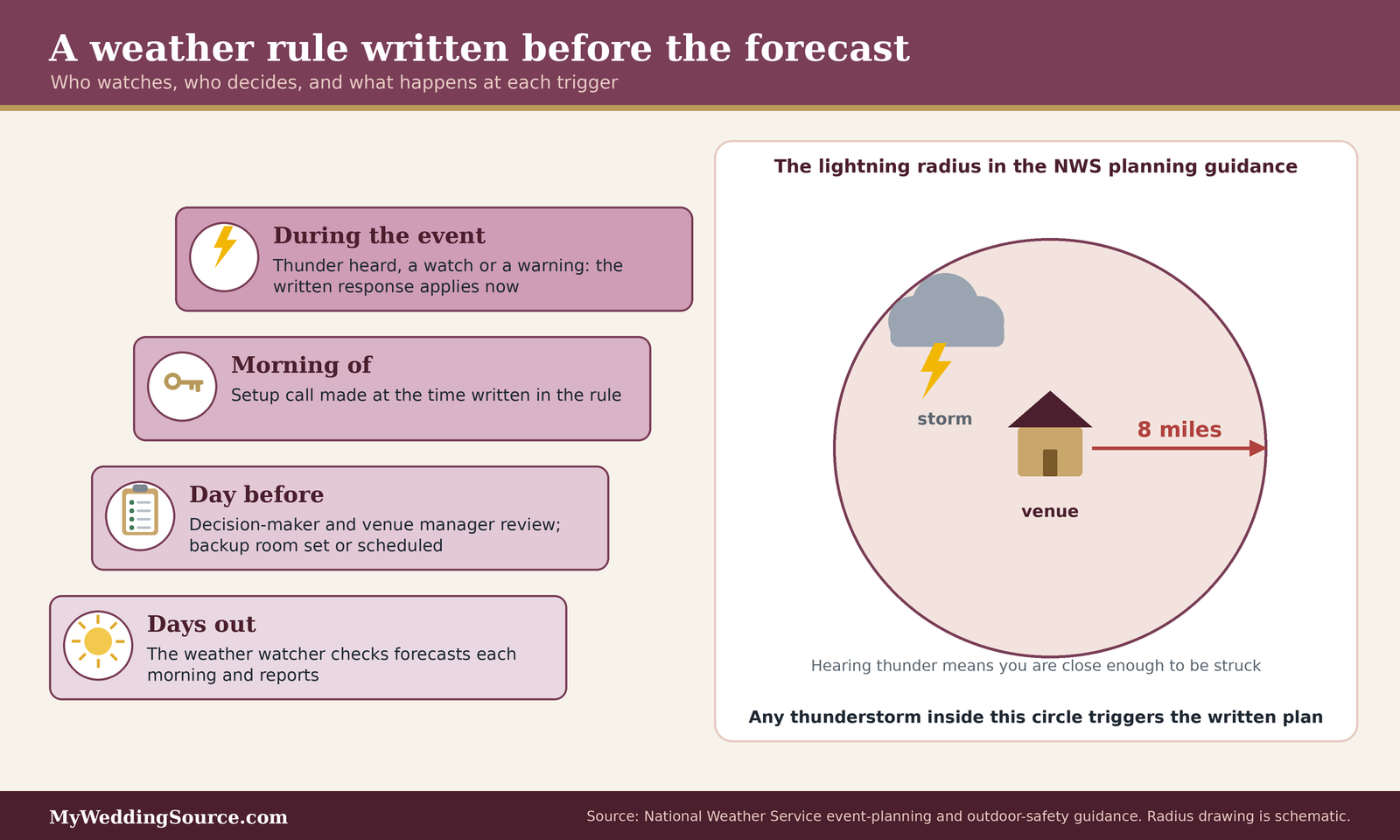
Weather is the one risk where an official source publishes direct guidance for event planners. The National Weather Service’s event-planning page advises assigning one person as a weather watcher, defining ahead of time which conditions would disrupt or endanger the event, and tying each condition to a predefined response. It also says watches typically come hours ahead of severe weather, while warnings may arrive only about 15 minutes to an hour before it, so waiting for a warning leaves little room to move people.
Name a weather watcher and a decision-maker
The weather watcher is a person who tracks forecasts in the days before the event and conditions during it, and who reports to the decision-maker at set times. The decision-maker, usually the coordinator or venue manager, has the authority to trigger the backup plan. The couple should not be the watcher or the decision-maker. Write both names on the contact sheet.
The NWS page lists tools for the watcher, including the NWS mobile forecast and radar, the FEMA app, NOAA Weather Radio, and the NWS social media accounts. A watcher can use whichever the venue already relies on.
Write the thresholds and the responses
A threshold is a condition, such as sustained wind above a certain speed, lightning nearby, extreme heat, or heavy rain, that triggers a step. The NWS advises setting these in advance and, for lightning specifically, building the plan around any thunderstorm within 8 miles of the venue. Its outdoor-safety guidance adds that if you can hear thunder, you are close enough to be struck, and that people should move indoors or into vehicles without waiting. That guidance also advises setting clear thresholds for postponing or canceling, marking shelter locations, knowing the wind limits of tents and other temporary structures, and deciding in advance how to alert attendees.
Turn that into a one-page rule that sits at the top of your wedding week checklist. For a lawn ceremony with an indoor backup, an example looks like this (these specifics are illustrative, and your venue’s rules come first):
- Several days out. The watcher begins checking the forecast and reports to the decision-maker each morning.
- The day before. The decision-maker and venue manager review the forecast, and the backup room is either set or marked to be set at a named time.
- The morning of. The decision-maker makes the setup call at the time written in the rule, using the venue’s tent limits and the forecast.
- During the event. If thunder is heard or a watch or warning is issued, the response in the rule applies immediately.
Include how guests will be told: a sign at the entrance, an announcement from the DJ or officiant, a text to the wedding party. If the ceremony is outdoors, the photographer and officiant should know the plan. Our guide to garden wedding venues and wedding ceremony planning cover indoor and outdoor options.
Delays: vendors, travel, and people
Weather gets the attention on any wedding week checklist, but late arrivals are more common. The method is the same: define the threshold, name the owner, write the response.
Vendor lateness and no-shows
For each vendor, ask what is the latest arrival that still works. For a florist, it may be an hour before guests arrive. For a DJ, perhaps 90 minutes before the reception, to allow setup and a sound check. Write that time beside each vendor on the timeline. If a vendor has not arrived by that time, the coordinator calls them, then calls the backup contact at the company, then escalates to the couple only if a replacement or a spend is needed. Read your contracts for substitution and cancellation terms, since those decide what the vendor owes you if they fail to appear.
Travel delays and guests who are late
Out-of-town guests, and especially family members who are part of the ceremony, can be affected by flights and road closures. Ask travelers to share their arrival plans by the week before, and keep one person responsible for tracking those who are critical to the day. Set a rule for what happens if a key person is delayed, such as holding the ceremony for up to a stated time or adjusting the processional. The hour you are willing to wait is the couple’s call, and it is best made calmly in advance.
For transportation within the day, such as shuttles, car services, and rides for older guests, The Knot suggests confirming transportation pickup and drop-off times one to two weeks out, and Zola suggests reconfirming delivery times the day before. Add a named backup driver. Our wedding etiquette guide covers how to ask family to help without it feeling like a chore.
Protect the couple’s time and attention
Everything in the wedding week checklist exists for one outcome: the people at the center of the day arrive rested, fed, and present. This final section covers the personal tasks that deserve protection and the small things that tend to slip.
What only the couple should do
Most tasks can be delegated. A few cannot, and they should be done early, not at the last moment.
Personal tasks worth protecting
Some tasks are personal by nature: finishing and practicing vows if you are writing them, trying on your complete outfit with shoes and accessories, and finishing any written notes to each other or to family. Here Comes the Guide lists several of these, along with breaking in shoes and cleaning the rings. Scheduling these by Wednesday leaves Thursday and Friday free. If you are working on vows, our guide to wedding vows and the wedding officiant article can help you plan the wording and the timing.
The Knot also suggests keeping minor beauty treatments to the week itself and anything experimental, such as a drastic cut or color, to months earlier. It also suggests taking time off work before the wedding, with the three to four days off that The Knot’s week-of guide mentions. Treat these as suggestions, not rules, since work and budgets vary.
Rest, food, and a quiet moment
The Knot suggests scheduling 10 to 15 minutes of private time during cocktail hour, asking the caterer to plate food for you, and arranging for someone to help with the bustle and veil. It also suggests telling bartenders your drink preferences ahead of time so you are not fetching your own. These small items protect two things people routinely lose on the day: eating and a quiet minute. Put them on the timeline like any other event, with an owner.
After the last handoff
The final handoff is not the end of the wedding week checklist. A few tasks fall after the wedding, and they belong to a named person too.
The day after
Name someone to return rentals and formalwear, collect gifts and belongings left at the venue, confirm that vendor equipment has been picked up, and take the dress or suit to storage or cleaning. The Here Comes the Guide list includes a person to return tuxedos the next day. Add a reminder for the license filing step, which depends on your jurisdiction’s rules. Zola’s marriage license guide notes that the signed license generally goes back to the issuing office, which validates it and then issues the marriage certificate, and that validity periods and waiting periods vary by state. Check your local office’s current rules, and see our marriage license guide. This is general information, not legal advice.
Thank-yous and honeymoon logistics
If you are leaving for a trip, gather the documents and bookings by the week before, as Zola’s checklist suggests packing for the honeymoon about a week out. Our honeymoon planning guide covers what to confirm. Thank-you notes and vendor reviews can wait, but write the names of the people who helped on your contact sheet while you remember them.
FAQ: wedding week checklist questions
Planning the week
How early should I start a wedding week checklist?
Start the planning about a month out, then run the wedding week checklist itself in the final week. Sources such as Zola place the license, vendor details, and task assignments at about a month before and balances, tips, and the caterer’s final details about a week before. By week of, you should be handing off, not deciding.
What should I stop doing in the last 72 hours?
Stop making decisions that other people are waiting on, such as headcounts, seating changes, and timeline edits. Stop answering vendor questions yourself, and forward them to your coordinator or named helper. Stop adding optional touches. Keep the tasks only you can do, such as vows, trying on your outfit, resting, and eating.
Do I need a coordinator for this to work?
No, but you need someone playing that role. A coordinator, planner, or trusted friend who is not an attendant can hold the timeline, the contact sheet, and the escalation rule. Without a named person, every question reaches the couple. Give that person the shared folder and a walkthrough on Wednesday.
What if my vendors do not reply to the timeline?
Treat silence as an open item, not as agreement. Ask the coordinator to call each vendor who has not replied within two working days, and record the reply in the confirmation log. If a vendor cannot be reached, ask the venue manager or the vendor’s own backup contact before the day before the wedding.
Money, paperwork, and weather
Who should carry the tips and final payments?
Choose a named person who is not in the wedding party. The Knot suggests preparing tips in labeled envelopes ahead of time, and Here Comes the Guide suggests asking a trusted person to hand out final payments and tips during the event. Give that person a list of recipients, amounts, and the times set on the timeline.
Who holds the rings and the marriage license?
Name specific people and have them confirm receipt by text. The Knot suggests giving the rings to the best man or maid of honor, and Zola’s coordinator article notes that rings and the license can be handed to an assistant or a member of the wedding party. Write down who files the license afterward, following your local office’s rules.
How do I decide whether to move the ceremony indoors?
Decide the rule in advance, not on the day. The National Weather Service advises setting thresholds, naming a weather watcher, and linking each threshold to a response. Write who decides, by what time, and what the setup crew will do. Your venue’s tent and wind limits come first. Ask them for the numbers.
What changes if I am having a destination wedding?
The wedding week checklist method is the same, but the buffers grow. Here Comes the Guide suggests carrying rings, attire, and valuables in your carry-on, gathering legal documents, and applying for the license on arrival if the destination requires it. Add extra days to every deadline, and ask your coordinator to confirm local vendors’ arrival and access.
Your next steps
Build the list
Convert every topic into a done-when statement
Open your current to-do list and rewrite it as a wedding week checklist, giving each item an owner, a must-be-true date, and a done-when test. Use the operational table above as the template, and drop items that are optional if time is short. Our wedding planning checklist can help you find what is missing, and our wedding timeline guide shows the schedule it should fit into.
Write the contact sheet and the escalation rule
List every person who will be on site with a mobile number, an arrival time, and a backup contact. Then write the three-level escalation rule on one page and send it to the coordinator and each vendor.
Hand it off
Hold the Wednesday hour
Schedule one hour with your coordinator or named helper, review the cards, and send the timeline and contact sheet to every vendor with a request to reply. After that hour, forward every question and stop being the first point of contact.
Plan the photos and the reception handoff
Share the shot list and the reception timing with your photographer and coordinator, using our wedding photographer shot list and wedding reception guide. Confirm vendor meals and who feeds the couple, and let the wedding week checklist run.
Sources & methodology
How we built this guide
What we relied on
This guide combines week-of and vendor-confirmation checklists published by The Knot, Zola, and Here Comes the Guide, and event-safety guidance from the National Weather Service. Timing recommendations, such as when to send a final headcount, are attributed to the publisher that made them, and they are suggestions from planning publishers, not rules. The scenario, the interruption estimates, and the per-plate arithmetic are our own illustrative examples, not survey data, and real vendor terms differ.
What we did not do
We did not survey couples, audit vendor contracts, or verify state marriage license rules for this article, so we do not state any specific license deadline. We did not give legal, financial, or insurance advice. Your contracts, your venue, your local county or city office, and your own judgment decide what applies to you.
Source list
Government sources
- National Weather Service, Event Ready (guidance for event planners on weather monitoring and hazardous-weather plans): https://www.weather.gov/bou/eventready
- National Weather Service, Outdoor safety (lightning, shelter, and outdoor-event guidance): https://weather.gov/crp/outdoor_safety
Planning publishers
- The Knot, Last-minute wedding details to confirm with your vendors: https://www.theknot.com/content/last-minute-questions-to-ask-wedding-vendors
- The Knot, Week-of wedding planning to-dos: https://www.theknot.com/content/week-of-wedding-planning-to-dos
- Zola, Week of the wedding checklist: https://www.zola.com/expert-advice/week-of-the-wedding-checklist
- Zola, A wedding coordinator checklist: https://www.zola.com/expert-advice/a-wedding-coordinator-checklist
- Zola, Wedding vendor checklist: https://www.zola.com/expert-advice/wedding-vendor-checklist
- Zola, A guide to marriage licenses: https://www.zola.com/expert-advice/a-guide-to-marriage-licenses
- Here Comes the Guide, Week-of wedding checklist: https://www.herecomestheguide.com/wedding-ideas/week-of-wedding-checklist