

A honeymoon name mismatch on airline tickets usually starts with a simple scheduling fact: flights are often booked months before the wedding, while the documents that carry your new name cannot be issued until after it, so the useful question is which name to book and how much time each fix needs.
Quick answer
Book each traveler under the name on the government photo ID that person will actually carry on the trip, which for an international honeymoon means the passport as it reads on the day you fly. Do not book in a married name that no document shows yet. If a name does change before departure, ask the airline for a name correction on the same reservation instead of cancelling, and give yourself a buffer, because the passport, the airline, and any trusted-traveler program each run on their own clock. This guide is general information, not legal advice, and every airline can word its rules differently.
Why a honeymoon name mismatch on airline tickets happens
Couples rarely cause a honeymoon name mismatch on airline tickets through carelessness. The calendar sets the trap. Planning guides tell you to lock in flights early, and a marriage certificate does not exist until the ceremony is over and the paperwork is filed. Someone has to guess which name to type into a booking form months ahead, and every available guess has a downside. This section lays out why the problem is structural, and what an airline actually compares.
The calendar trap: names change after bookings are made
The sequence matters more than any single rule, so it helps to see the full order of events before choosing a name.
Why flights are booked before the wedding
Fares, award seats, and resort packages move, and honeymoon travel tends to follow the wedding date closely. Many couples therefore commit to flights half a year ahead. Our honeymoon booking checklist covers the order of commitments across flights, lodging, insurance, and weather, and our honeymoon planning guide covers the broader decisions. For this article the point is narrow: the booking happens while every ID you own still shows the name you had before marriage.
Why documents cannot be updated first
A name change on a passport needs proof of the marriage. The State Department’s page for changing a passport name lists an original or certified marriage certificate as part of the application for a recently issued passport, and it lists the certificate for the other application types too, unless you can show an ID already issued in your new name. That certificate comes from the wedding itself. You can read how licenses and certificates differ in our guide to a marriage license versus a marriage certificate. The practical result is that nothing you hold before the wedding can legitimately carry the new name.
What “mismatch” actually means to an airline
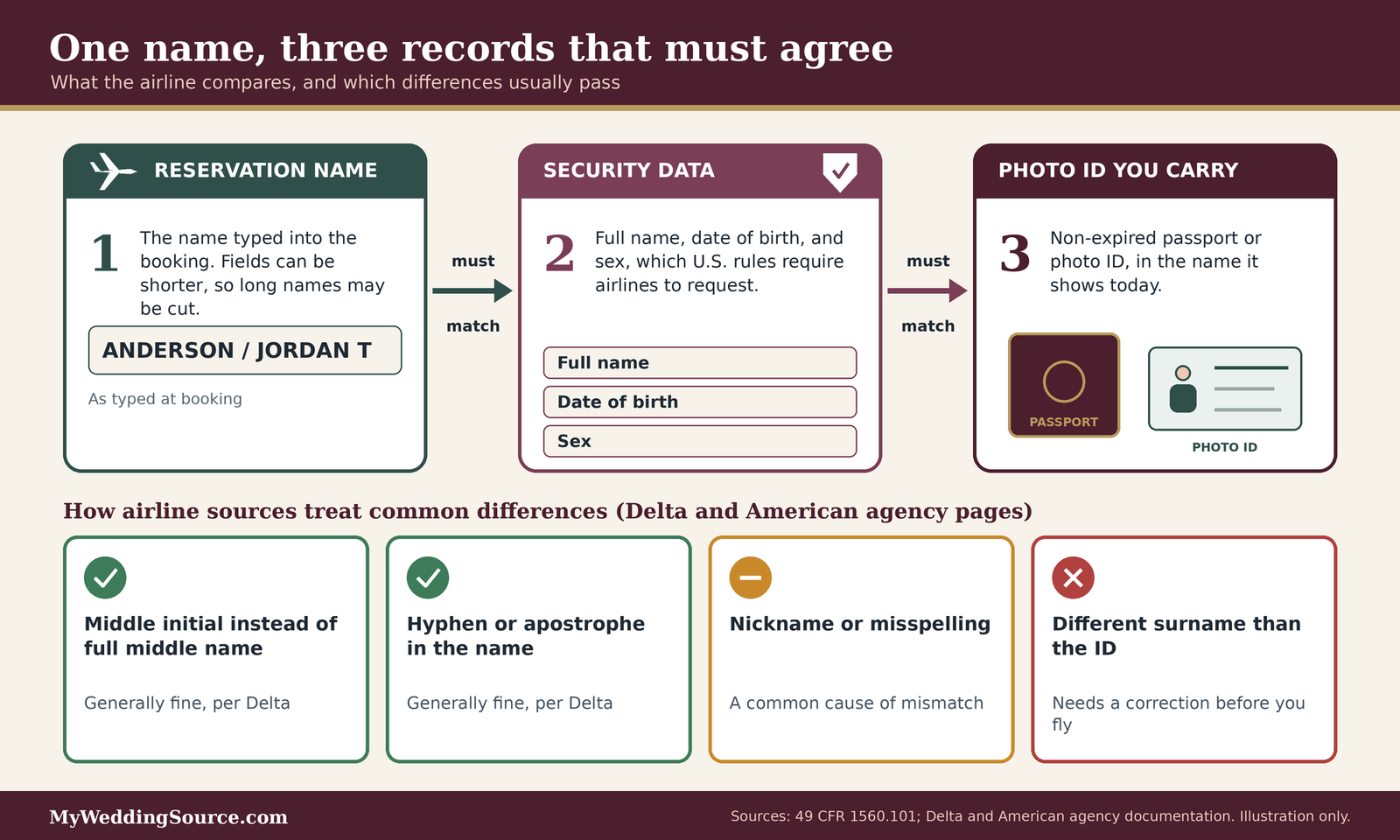
People say “the name on my ticket doesn’t match my ID” as if it were one thing. It is at least three records that have to line up, and knowing which pair is being compared helps you fix the right one.
Three records, one name
An airline reservation holds a name field. Airlines also hold a separate set of government screening data for each passenger, which Delta’s agency documentation calls the security name. Finally, there is the photo ID the traveler presents. Delta’s published explanation for travel agencies says the reservation name must match the security name, and the security name must match the non-expired government photo ID the passenger will travel with. It also notes that reservation fields can be shorter than the security fields, so long names may be truncated in the reservation. This is Delta’s description for its own system, so treat it as a clear example of how large carriers think, not as a rule that every airline word-for-word shares.
Which differences are usually harmless
Not every difference counts as a honeymoon name mismatch on airline tickets. In the same Delta document, small differences such as a middle initial in place of a full middle name, or no middle name, generally do not cause trouble, and hyphens and apostrophes are generally fine. Prefixes and suffixes in the reservation name are not used in matching. A consumer travel site that covers airline middle-name rules reaches a similar practical conclusion, saying a middle name or initial that appears on the ID but not the ticket typically will not cause problems at check-in or screening when first and last names match. That site is an advertiser-supported publication, so we use it only as a secondary, plain-language confirmation. A different surname is another matter entirely, and the rest of this guide concentrates on that case.
What the rules say: Secure Flight, ID, and your reservation
You do not need to read federal regulations to book a honeymoon, but a few lines explain why airlines care about names at all, and why they cannot simply wave through a honeymoon name mismatch on airline tickets. We read the relevant sections of the federal regulations on the Cornell Legal Information Institute site, plus airline and State Department pages, and we describe them in plain terms below. We are not lawyers, and the regulations can change.
What the federal rule asks airlines to collect
The Transportation Security Administration runs a screening program called Secure Flight. The airline is the one that gathers your data, and the rule says what it has to ask for.
Full name, date of birth, and sex
Under 49 CFR 1560.101, airlines on covered flights must request each passenger’s full name, date of birth, and sex, and must also ask for a Redress Number if the passenger has one. An airline may not submit Secure Flight data for a passenger who does not give a full name, date of birth, and sex. For reservations made more than 72 hours before departure, the airline collects the information at booking or no later than 72 hours before departure. For reservations made within 72 hours, it collects the information at booking. Note what that text does and does not say. The section we read asks for the data, and it does not spell out in those words that the name must match an ID. The matching expectation comes from how airlines and TSA describe the program in their own materials, such as the airline documentation quoted elsewhere in this guide.
No boarding pass until screening returns a result
Under 49 CFR 1560.105, an airline cannot issue a boarding pass until TSA reports the matching result for the passenger data the airline most recently submitted. If the airline sends corrected data, earlier results are void and the airline must wait for a new result. If the result is missing or the passenger is inhibited at check-in, the airline must ask for an identity document, and if the person does not present the requested document, the airline must withhold the boarding pass unless TSA authorizes otherwise. This is why a name problem tends to surface at the worst possible moment, in a check-in line, and why correcting the data early is much calmer than correcting it at the counter.
What airline sources say about matching
Federal text sets the framework, and airlines translate it into practice. We looked for primary airline wording and found it mostly on pages written for travel agents.
Delta’s security-name explanation
Delta’s agency page describes what happens when names do not line up. The system sends a notice into the agency’s queue, and the agency is expected to verify the name against the ID and correct the reservation or the security name. Ticketing is not interrupted. If the names still differ before departure, online or app check-in may send the passenger to the airport. A kiosk may flag the mismatch and may let the passenger scan an approved ID, and otherwise the passenger needs an agent. The page says security data can be sent to TSA any time before boarding, and that the data is generally required at booking, before ticketing. For the couple, the lesson is encouraging. A honeymoon name mismatch on airline tickets is usually a fixable data problem with a defined path, not an automatic denial.
Limits of what we could verify
Several things we could not confirm, and you should not assume them either. We could not retrieve TSA’s own identification page, so we do not quote it for acceptable ID types. We could not confirm from a primary source that every U.S. airline treats a name difference at the gate the same way. The Delta material is aimed at agencies, and your own booking channel may have a different process. And one consumer-journalism article we read described older, stricter airline attitudes toward name changes, which tells you the practice has shifted over time. When the stakes are your honeymoon, use these sources to know what to ask, and then get the answer from your own airline in writing.
Domestic versus international honeymoons
The ID that matters, and so the shape of any honeymoon name mismatch on airline tickets, depends on where you are flying. Two couples on the same wedding date can face different rules.
Domestic flights
For flights within the United States, you will present a photo ID at the checkpoint, and the name on it should line up with the booking. TSA’s REAL ID page, in the version we retrieved, said adults need a REAL ID-compliant license, an enhanced license, or another accepted ID such as a valid passport to fly domestically, with enforcement beginning May 7, 2025. That page appeared older than the present date, so confirm current requirements directly. A TSA press release headline we saw in search results says travelers without a REAL ID can pay a $45 fee option beginning February 1, 2026, but we could not open that release, so treat it as a lead to verify, not a fact to plan around. If your driver’s license still shows your pre-marriage name, a domestic honeymoon booked in that name is consistent. Updating a license is a state process, and states differ, so check your state agency.
International flights
For an international trip, the passport is the document that governs entry, so the passport name is the safe anchor for the reservation. The State Department’s travel industry page also notes that many countries require a passport to stay valid for at least six months after arrival, that a passport needs at least two blank pages, and that adult passports are typically valid ten years. It does not address whether a ticket name must match the passport, which is why our recommendation is practical reasoning, not a quotation: match the name your passport shows. Check validity for the return date before you pay, because a passport that is fine today can fall short by the time you come home.
Which name to book under
This is the decision that prevents a honeymoon name mismatch on airline tickets in the first place. The answer is nearly always the same, with a short list of exceptions.
The default rule: the ID you will carry
Everything else in this guide is an exception or a repair for this one rule, so it is worth stating plainly and testing against your own dates.
If you travel soon after the wedding
If you fly within days or a few weeks of the ceremony, you will almost certainly still hold only pre-marriage documents. Book each person under the name on the passport (international) or photo ID (domestic) that person will present. A travel brochure may call you “Mr. and Mrs.” with a new surname, and a resort may greet you that way, but the airline’s check only concerns the legal record you can show. Our guide to changing a passport name after marriage walks through that update and the order of the other changes in our name change overview, and you can do both after you return.
If you travel months later
If the honeymoon is months away, the same rule still holds, but you now have a real choice. You can keep the old name on the reservation and travel on the old passport. Or you can update the passport first and then either book in the new name or correct a booking already made. Which is better depends on whether you will have the new passport in hand with enough buffer. The buffer planner later in this guide turns that into dates.
Six scenarios and what to do in each
A table is the fastest way to test your own honeymoon name mismatch on airline tickets against the common cases. We built the rows from the airline and State Department pages above, and we mark the recommendation as our reasoning where a source does not state it.
How to read the table
Find the row closest to your situation, then follow the action and read the flip point. The flip point tells you what would change the advice. If several rows apply, for example because one partner changes a name and the other does not, work each traveler separately, since the airline treats each passenger record on its own.
| Your situation | Name to book | What to do next | Flip point |
|---|---|---|---|
| Flying within weeks of the wedding, passport still in the pre-marriage name | Name on the passport you hold | Travel on it, then update the passport after the trip | Flips only if you hold a new passport before you fly |
| Honeymoon several months out, passport expires after your return date plus the country’s validity rule | Name on the passport you hold today | Decide whether to update before the trip, using the buffer planner | Flips if the new passport will arrive with several weeks to spare |
| Passport already updated, ticket booked in the older name | Name on the new passport | Request a name correction on the same reservation, early | Flips to rebooking if the airline cannot correct the change |
| Adding the new surname to the old one, or a hyphenated surname | Match the passport exactly | Ask whether the airline treats this as a minor correction | Flips if the passport itself is not hyphenated |
| Domestic trip, license in the older name | Name on the license or passport you will show | Keep the booking and the ID aligned, update the license later | Flips if you change the license and the booking stays old |
| Passport application is pending and may not arrive before you fly | Name on the passport you hold now | Do not wait on the new one, and keep the old passport with you | Flips only if the new passport is in your hands with buffer to spare |
When to wait instead of booking
If you cannot yet tell whether the new passport will be ready before you fly, you may decide to hold off on booking until you know. That is a reasonable choice for award seats that can be held and for fares you can cancel under the 24-hour rule discussed later, and an unreasonable one if fares are rising and your dates are fixed. It is your call, and the costs in each direction are in the money section below.
Booking before the legal change, step by step
You can book months ahead and still avoid a honeymoon name mismatch on airline tickets. The method is to book under the name you can prove today and treat the later change as an optional repair.
Before you click purchase
To head off a honeymoon name mismatch on airline tickets, check three things in this order: the passport expiration date against your return date, the spelling of every name on the passport page, and the date of birth. Type each name exactly as the ID shows it, including middle names when the booking form asks. Our honeymoon budget guide is the place to decide how much flexibility you are willing to pay for before you commit.
After you receive the confirmation
Open the confirmation email on the day you book, not the day before you fly. Read each name against the ID. Add the frequent flyer numbers, the date of birth, the sex field the airline requests, and any Known Traveler Number if you hold one. If the booking was made through a third party, find out who can correct it, because a travel agency or online travel site can be the party that must make the change. Save a screenshot of the confirmation with the names visible. ## The name-difference ladder: from harmless to unfixable
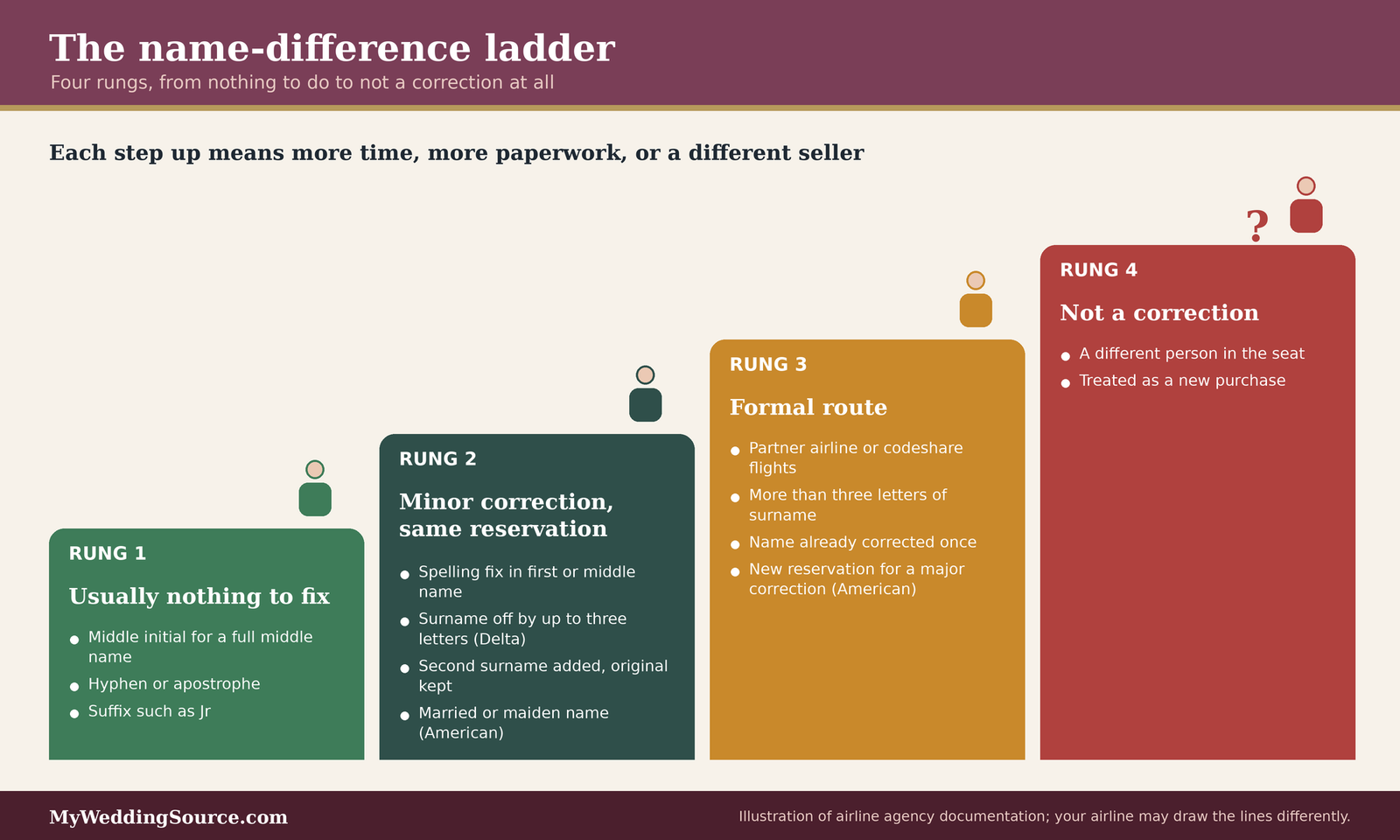
Airlines do not treat every honeymoon name mismatch on airline tickets alike, and neither should you. A useful way to think about it is a ladder with four rungs. The first rung needs nothing. The second can usually be fixed on the same reservation. The third needs a more formal route. The fourth cannot be fixed at all, because the ticket belongs to a specific person.
Rung one: differences that usually need nothing
Before you spend time on a correction, find out whether your honeymoon name mismatch on airline tickets is a problem at all. Many couples worry about differences the airline’s own documentation calls routine.
Middle names and initials
Delta’s agency documentation says an initial in place of a middle name, or no middle name, generally will not cause problems. American’s agency guidance goes a step further and describes adding a middle name to the passenger’s Secure Flight data as something that does not require the ticket to be reissued. That distinction is useful. Often a honeymoon name mismatch on airline tickets does not mean editing the ticket at all, only adding screening data to the reservation. If your middle name is your former surname, which many people use after marriage, this is the rung you are on.
Hyphens, apostrophes, suffixes, and nicknames
The same Delta page says hyphens and apostrophes are generally fine and that suffixes such as “Jr” are not used for matching. It also lists nicknames and misspellings as common causes of mismatch, with the example of a nickname in the reservation and a full legal name in the security record. The way to avoid this kind of honeymoon name mismatch on airline tickets is to type the legal name from the ID and leave the nickname for the hotel front desk.
Rung two: minor corrections on the same reservation
When the surname itself is involved, a honeymoon name mismatch on airline tickets often still falls within what airlines call a minor correction. The details are specific and differ by carrier, so read them as examples.
What Delta lists as a minor correction
Delta’s name correction policy for agencies lists these as corrections that can be made without contacting Delta: fixing a first or middle name, correcting a last name by up to three letters, adding a second name to the last name while keeping the original (the page’s example is changing SMITH to SMITH-ANDERSON), and fixing inverted first and last names under certain conditions. The conditions are that every flight is operated by Delta, including Delta Connection, that the traveler is the same person, that the Secure Flight data stays the same as the original reservation, that only one name-correction reissue is allowed per passenger ticket, and that the exchange is even, with no change to flights or dates. The page does not address a legal name change after marriage directly. Reading its rules, adding a married name to the existing surname would plausibly count as minor, while replacing a surname with a completely different one would plausibly exceed the three-letter limit, but that is an inference and not a statement from Delta. Confirm with the airline.
What American lists as allowed
American’s agency guidance says an agency can correct a passenger’s name to match the government ID the passenger will travel with, and the list of covered situations includes misspellings, married names, maiden names, divorced names, legal names, secondary last names, and inverted names. It divides corrections into minor ones, made in the same reservation on American or American Eagle flights on certain ticket types, and major ones, required for itineraries with other airlines’ flights on an American fare, codeshare segments, or certain fare inventory. A major correction is made in a new reservation that must match the original flights, dates, and routing, with the original kept until the new ticket is issued. Corrections cannot be made within 24 hours of departure, the original date of birth and gender must not change, and tickets are reissued at the original fare with no fees, according to that page. It is written for travel agents, so a customer calling the airline may be offered a different path, although its list of covered situations does name married and maiden names.
Rung three and four: formal fixes and what cannot be fixed
At some point a honeymoon name mismatch on airline tickets stops being routine, or turns out to be something other than a correction at all.
When the surname is replaced
Delta’s page lists several situations that need a call to Delta or its sales support: itineraries with partner airlines, more than three letters of the last name changing, a name already corrected once, and travel to or from India. A honeymoon built around a partner airline, a codeshare, or an award booked on a partner is more likely to land here. Our reading is that a wholesale surname swap on such an itinerary is the most likely to need a formal route, and that you should ask which airline “owns” the ticket before assuming a quick fix is available. If a reissue is refused, the fallback is to cancel and rebook, with the money consequences covered in the next section.
When the ticket is for a different person
American’s guidance says changing a ticket from one person to another is not allowed. A name correction is not a name transfer, and an airline will treat a request to put a different traveler on the ticket as a new purchase. This matters for honeymoons in one specific way. If a plan changes and a friend or relative will take a seat you booked, you are rebooking, not correcting. The correction path exists for the same person whose name was entered incorrectly or has legally changed.
The buffer planner: working backward from your departure date
A honeymoon name mismatch on airline tickets depends on the time each fix needs, so the planner counts backward from the day you fly. Every step below is either a published figure with its source, or our own estimate, labeled as such. Nothing here replaces the current instructions on the official pages.

How to use the planner
The planner works with three dates: the day you fly, the date of the wedding, and the date you can hold a certified copy of the marriage certificate. Everything else counts back from the first of those.
Start with the departure date
Write down the first flight’s departure date, then the return date. Count backward in weeks. The State Department’s expedite page, in the version we retrieved, describes expedited passport service as intended for travel within six weeks of applying, with processing of about two to three weeks, not counting mailing. That is the one published number that frames a passport decision, and it comes from a page whose figures can change, so check it on the day you plan.
Separate the published numbers from our estimates
In the table below, the column “Basis” tells you which figures come from a source and which come from our own arithmetic. We keep them separate on purpose, because an estimate is a planning aid, not a promise. If a published number and our estimate disagree with what an agency tells you, trust the agency.
The buffer table
| Step | Published figure or limit | Basis | Planning buffer |
|---|---|---|---|
| Book flights at least seven days out to use the 24-hour rule | Airlines must offer a 24-hour cancel-for-refund or a 24-hour hold, but not necessarily both, for tickets bought at least seven days before departure | DOT consumer page | Book earlier than seven days, and confirm the airline’s option |
| Check passport expiry | Many countries require validity of at least six months after arrival, plus two blank pages | State Department travel industry page | Check on booking day, again at ninety days out |
| Send security data to the airline | At booking, or no later than 72 hours before departure for reservations made more than 72 hours out | 49 CFR 1560.101 | Add it the day you book |
| Request a name correction | American’s agency guidance bars corrections within 24 hours of departure | American agency page | Request at least one to two weeks before departure (our estimate) |
| Update a passport, expedited | About two to three weeks of processing, plus mailing, for travel within six weeks | State Department expedite page | Apply at least six weeks before you fly (our estimate from the page) |
| Update TSA PreCheck membership | Name changes can take up to three months | TSA PreCheck FAQ | Start about three months out, or fly without it |
| Update the Social Security record | The agency suggests waiting until the state updates the marriage record, which it says usually takes about thirty days | Social Security blog | Do it after the trip; the airline does not ask for it |
Documents first, then the airline
The order is deliberately different from what many couples try. The documents set the legal name, and the airline follows the documents, so the correction request belongs after the document is in your hand. Asking the airline to change the name before the passport exists can create the honeymoon name mismatch on airline tickets you were trying to avoid, a reservation in a name that no document shows.
Programs last
PreCheck, frequent flyer profiles, and airline accounts store a name of their own. TSA’s PreCheck FAQ says the name on the reservation must exactly match the name on the PreCheck application, and that if a name changes after enrollment, benefits cannot be used until the membership is updated. If you update the reservation to a new name while the membership remains in the old one, you can lose the PreCheck indicator, and it may take as long as three months to update. For a short honeymoon trip, keeping the reservation, the membership, and the ID in the same name is often simpler than racing to change all three.
A worked example, with our arithmetic
Examples make the buffers concrete. The dates below are invented, and the arithmetic is ours, so call it an estimate and adjust it for your own timeline.
The wedding is eight days before the flight
Suppose the ceremony is on June 6 and the flight leaves June 14, which is eight days later. A certified marriage certificate would have to be issued, the passport application sent in, and a passport returned, all within eight days, against an expedite window of about two to three weeks plus mailing. On those numbers the new passport will not exist. The sensible plan is to book and travel under the passport you hold, then apply for the name change after you return. Nothing about the airline needs fixing, because there is no mismatch to repair.
The honeymoon is ten weeks after the wedding
Now suppose the ceremony is June 6 and the flight leaves August 15, which is ten weeks later. Counting back six weeks from departure puts our planning deadline for an expedited passport application at July 4. That leaves four weeks, which is enough to order a certified certificate and submit the application on a normal schedule, though we could not verify how long a certified copy takes in your jurisdiction, so ask the office that issues it. In this case you could book now in the old name, wait for the new passport, then request a name correction at least a week or two before you fly. The risk to manage is the gap. If the passport is late, you still hold the old one, and the reservation still matches it, so the fallback is free. ## Money: fees, the 24-hour rule, and refunds
Fixing a honeymoon name mismatch on airline tickets costs money in some situations and nothing in others, and the difference is often decided before you click purchase. The Department of Transportation publishes consumer rules that apply here, and the airline agency pages above add the carrier-level detail.
What this actually costs
Federal rules do not require airlines to make name fixes for free. The Department of Transportation’s buying-a-ticket page says fixing a name or changing a date may cost a fee, and that cancelling for a refund inside the 24-hour window and rebooking can sometimes be cheaper. The agency pages we read describe minor corrections as even exchanges with no added fare, but those pages are written for travel agents, and your airline may charge differently. Get the price of the fix in writing before you rely on it.
The Department of Transportation rules that apply
Three federal consumer protections matter for a honeymoon booking, and each has a boundary that is easy to overlook.
The 24-hour rule and its limits
For tickets bought at least seven days before departure, DOT says airlines must either let you cancel within 24 hours for a full refund or hold the reservation at the quoted price for 24 hours without payment. Airlines do not have to offer both. DOT also says this rule does not cover tickets booked through travel agencies or online travel agencies, which may have their own policies. That boundary matters because many honeymoon packages and award bookings go through third parties. If you booked through one, ask for its cancellation terms before assuming the 24-hour window applies to you.
Name corrections are not guaranteed to be free
DOT’s page states plainly that airlines are not required to make changes for free, so fixing a misspelled name or changing a travel date may cost money, and that within the 24-hour window a refund and rebooking may sometimes be cheaper than paying a change fee. In practice the cheapest moment to catch a honeymoon name mismatch on airline tickets is the first day, which is another reason to read the confirmation against your ID right away. After that window, your costs depend on the airline’s policy and the ticket type.
Price protection after purchase
Under 14 CFR 399.88, sellers of air transportation to, from, or within the United States may not raise the price after you have bought it, with an exception for increases in a government tax or fee that you were warned about and agreed to in writing. This helps with one honeymoon-specific worry. If you decide to cancel and rebook to fix a name, the original price protection ends with the original ticket, and the new ticket is priced at today’s fare.
When rebooking beats correcting
Most of the time a correction is cheaper than starting over, and sometimes it is not. The deciding factors are the fare difference and the time left.
Cases where cancel-and-rebook can win
When a honeymoon name mismatch on airline tickets turns up, rebooking can win when you are inside the 24-hour window and the fare has not moved, when the airline will not correct the change because the itinerary includes partner flights, or when a surname swap exceeds the airline’s minor-correction limits. In those cases a free refund in the window and a fresh booking in the correct name can be simpler than a negotiated exception. The cost to watch is the fare, since the new ticket is priced at today’s fare, and any fare increase between the two bookings is yours.
Cases where correction wins
Correction wins when the fare has gone up since you booked, when you hold award or low-fare seats that may not return, and when the change is the type the airline lists as minor. In those situations the even exchange keeps your original fare and seats, according to the agency pages we read. If you are unsure, ask the airline two questions: “What does the correction cost on this exact ticket?” and “What does cancelling cost, and what is today’s fare?” Then compare in writing.
If the airline cancels or changes your flight
A honeymoon name mismatch on airline tickets is not the only thing that can change a booking, and DOT’s refund rules cover the other case.
Your right to a refund
DOT says that if an airline cancels your flight for any reason and you choose not to travel or accept credits or vouchers, you are entitled to a refund of the ticket price. Refunds for credit card payments are due within seven business days, and for other methods within twenty days. If a ticket agent was the merchant of record on your purchase, the agent is responsible for issuing the refund. For couples who bought through an agency, that last sentence is the one to remember.
Credits and vouchers
Airlines may offer credits or vouchers instead of a refund, and DOT says these must be valid for at least five years and any restrictions must be disclosed. Credits are often issued in the name of the original traveler, which brings the name question back. If your name changes before you use a credit, ask whether the credit can be used under the new name and what proof is needed. We did not find a source that answers this for every airline, so it is a question to ask and not a rule to assume. Our guide to honeymoon travel insurance explains what insurance does and does not do when a trip changes.
Edge cases that complicate a honeymoon name mismatch on airline tickets
The simple version of a honeymoon name mismatch on airline tickets has one traveler, one airline, and one surname swap. Real honeymoons are messier. These are the situations most likely to break the default rule.
Hyphenated, double, and long surnames
Names that do not fit a simple first-and-last format cause more honeymoon name mismatch on airline tickets than a clean surname change does.
Hyphens and two-part surnames
Delta’s agency documentation says to enter hyphenated names in the reservation without the hyphen and notes that hyphens are generally not a problem. That detail matters if you are combining surnames. The airline’s own system may expect “SMITHANDERSON” in the field while your passport shows “SMITH-ANDERSON,” and that is acceptable under the page we read. A two-part surname with a space has similar issues, and the safest approach is to ask the airline how to enter it and to record the answer.
Names that exceed the field
The same Delta page says the security fields allow up to 35 characters each for first, middle, and last names, and that the reservation field may be shorter. If the reservation field is too short, it advises entering the full surname and as many characters of the first name as fit. A long combined surname is the situation where truncation shows up. Check the confirmation to see how the system cut the name, and ask whether that is acceptable.
Award tickets, third-party bookings, and partner flights
How you booked decides who can fix a honeymoon name mismatch on airline tickets, and sometimes whether it can be fixed.
Online travel sites and agencies
DOT says the 24-hour rule does not cover tickets booked through agencies or online travel agencies, and that a ticket agent that was the merchant of record is responsible for refunds. In our reading, the same logic applies to corrections, so the party that issued the ticket is usually the party that has to request the change. Before you book through a third party, ask who handles name corrections and what they charge, since an agency fee may sit on top of the airline’s.
Partner airlines and codeshares
Both airline agency pages we read treat partner and codeshare itineraries differently from single-airline itineraries. Delta says partner-operated flights require contacting Delta, with each partner carrier having its own policy. American’s guidance says itineraries with codeshare segments or other airlines’ flights on an American fare require a major correction in a new reservation. If your honeymoon includes a long-haul partner flight, ask early whether the correction path changes. Our guide to using points for a honeymoon covers award bookings in more detail.
Programs and profiles that store a name
A boarding pass can look right while a program behind it is wrong, and that kind of honeymoon name mismatch on airline tickets can cost you a benefit instead of a boarding pass.
TSA PreCheck and similar memberships
TSA’s PreCheck FAQ says an application name must match the ID and citizenship or immigration documents presented at enrollment, and that the reservation name, date of birth, and Known Traveler Number must match the enrollment details. Any mismatch means no PreCheck indicator on the boarding pass. If you change the name on one record but not the other, you will usually still fly, but without the faster line. The page we read did not say anything specific about marriage. It gave a TSA Help Center phone number for name updates, and we recommend you check the current number on the TSA site.
Frequent flyer and booking profiles
A consumer article we read recommends checking that the frequent flyer profile is accurate, updating each airline’s record if you fly on several carriers, and making sure the full legal name, including the middle name, is consistent in profile and reservation. American’s guidance says the profile name should also be saved correctly. A stale profile can silently refill the old name into the next booking, which is a common way a mismatch returns after you fixed it once.
Hotels, cruises, rentals, and insurance
Airlines are only one vendor. The others have their own name rules, and we did not find authoritative sources for them.
Why we do not give rules for these
We did not find a source for hotel, cruise, or rental car name rules that we could verify, so we do not state any. Our practical suggestion is to ask each vendor the same plain question at booking: whose name must be on the reservation, and whose ID will you check at arrival? Rental companies in particular have their own driver requirements, and our guide to honeymoon rental car insurance covers that separately.
A consistent name across vendors
Using one name across every vendor is easier than tracking a mix of old and new names, and it keeps a honeymoon name mismatch on airline tickets from spreading to hotels and rentals. For a trip soon after the wedding, using the pre-marriage name everywhere keeps the records aligned. If you plan to change names partway, write down each vendor and which name it holds. A short list that you can read in a minute at the airport is worth more than a perfect memory.
Questions to ask, and records to keep
A good question about a honeymoon name mismatch on airline tickets changes an airline’s answer from “it should be fine” to a specific rule you can cite. This section gives you the questions and the paperwork to carry.
Questions to ask the airline or agency
- Which name is on the reservation, and is it exactly as my passport or photo ID shows it?
- Has my security data, meaning full name, date of birth, and sex, been added to this reservation?
- If my legal name changes before we fly, is that a minor correction or a major one on this ticket?
- What does the correction cost, and does the fare stay the same?
- Is there a cut-off, such as a number of hours before departure, after which a name correction is not possible?
- Does any part of this itinerary run on a partner airline that has its own rule?
- If I booked through an agency or travel site, who handles the correction, and is there a separate fee?
- Can you note this conversation on the reservation and send me the answer in writing?
Questions for each kind of seller
Different sellers answer different questions. Ask the right one of the right party.
On the day you book
Ask the airline or agency to read back the names and the security data. If you are booking by phone, ask for the agent’s name and a reference number. Our guide to wedding vendor contracts is aimed at wedding vendors, and the habit it recommends, getting commitments in writing, applies here as well.
Before the day you fly
Read the confirmation against the ID again a week out, since a honeymoon name mismatch on airline tickets is easiest to fix early. Check the check-in rules, since Delta’s page says online or app check-in may send a mismatched passenger to the airport. Plan extra time at the airport if you know a mismatch exists. American’s agency guidance bars corrections within 24 hours of departure, so do not leave the correction for the last day.
An evidence packet you can carry
If a honeymoon name mismatch on airline tickets surfaces at the airport, the person across the counter can only act on what you can show. A short packet saves time.
What to put in it
Carry the passport or photo ID you booked under, the confirmation showing the names, and, if a name change is in progress, a copy of the marriage certificate and the application receipt. The State Department’s name-change page lists the marriage certificate as the supporting document for passports, and a certificate is also the document the Social Security Administration calls the best proof of a name change. A paper copy and a phone copy are both reasonable.
What it cannot do
A marriage certificate does not make an airline accept a honeymoon name mismatch on airline tickets at the counter. It supports a correction request made in advance. At the airport the agent is checking data against the ID, and the safest outcome is the one where the data already matches. This is why the planner treats the airline correction as a step that happens before departure, not at the counter. ## FAQ: honeymoon name mismatch on airline tickets
Booking questions
Should I book my honeymoon flights in my married name before the wedding?
Usually no. Book in the name on the passport or photo ID you will carry, because airline sources we read say the reservation name should match the security name and the ID. A married name that no document shows yet creates the mismatch you are trying to avoid. Update documents after the wedding and ask the airline about corrections.
Can I use the 24-hour rule if I booked through a travel site?
Probably not. The Department of Transportation says the 24-hour rule does not cover tickets booked through travel agencies or online travel agencies, which may have their own policies. It also applies only to tickets bought at least seven days before departure, and airlines may offer either a cancel option or a hold. Check the seller’s terms.
Documents and timing questions
Will my new passport arrive before the honeymoon?
It depends on how close the trip is. The State Department page we read describes expedited service as intended for travel within six weeks, with about two to three weeks of processing plus mailing. For a trip within a couple of weeks of the wedding, plan to travel on the passport you already hold.
Do I need a new passport after marriage at all?
Not necessarily right away. A passport stays valid in the name it shows, and the State Department offers different forms depending on when the passport was issued, including a no-fee form for passports issued within the past year. Plan to update it after the trip unless a country or airline tells you otherwise.
Airline fix questions
Is a name correction the same as a name change on a ticket?
No. A correction fixes the name of the same traveler to match the ID, and American’s agency guidance lists married and maiden names among covered cases. Putting a different person on the ticket is not allowed. Airlines differ on limits, such as Delta’s three-letter surname rule, so ask your carrier which category your change falls into.
What happens if the name still does not match at the airport?
Delta’s agency documentation says online or app check-in may send the passenger to the airport, where a kiosk may flag the mismatch or an agent must fix it. Federal rules say the airline cannot issue a boarding pass until screening returns a result, so allow extra time and bring supporting documents.
Program and cost questions
Will a name change affect my TSA PreCheck on the honeymoon?
It can. TSA’s PreCheck FAQ says the reservation name must exactly match the name on your PreCheck application, and a mismatch means no PreCheck indicator on the boarding pass. Name changes after enrollment can take up to three months to process, so for a short trip, keeping the old name everywhere is often simpler.
Does fixing a name on a ticket cost money?
It can. The Department of Transportation says airlines are not required to make changes for free, and that fixing a name may cost a fee. Agency guidance from Delta and American describes minor corrections as even exchanges without added fare, but those pages are written for travel agents. Ask your airline for the exact price in writing.
Your next steps
Before you book
Read your own documents
Check your passport expiration date against your return date, then read every name as it appears on the ID you will carry. Write down the exact spelling, including the middle name. If you plan to travel soon after the wedding, plan on the name you hold today. Our wedding week checklist can help you place these checks inside the final days before the ceremony.
Decide who books and where
Choose the airline or agency with the fix in mind. Ask who handles name corrections, what they cost, and whether the 24-hour rule applies. If your honeymoon is a short trip near home, our guide to a mini-moon versus a honeymoon may help you decide how much flexibility you need.
After you book
Add your security data and keep proof
Add your date of birth, the sex field, frequent flyer numbers, and any Known Traveler Number the airline requests, then save a screenshot of the confirmation. Put the evidence packet in a folder you can reach from your phone.
Plan the legal changes in order
After the wedding, follow the order in our name change guide and our after-the-wedding checklist. Request any airline correction only after the document that supports it is in your hand, and well ahead of departure.
Sources & methodology
How we built this guide
What we relied on
This guide combines federal regulation text, Department of Transportation consumer pages, Transportation Security Administration and State Department pages, Social Security Administration pages, and airline policy pages written for travel agents. We read each source on November 12, 2026. Airline pages quoted here describe Delta and American practice for travel agencies, and a consumer calling the airline may be given a different process. The worked examples and buffer estimates are our own arithmetic from published figures, and we label them as estimates in the text.
What we did not do
We did not test any airline’s booking system, we could not open several TSA and State Department pages, and we did not verify rules for United, Southwest, Alaska, JetBlue, or international carriers. We do not give legal advice. Rules, fees, and processing times change, so confirm each one with the airline and the agency before you rely on it.
Source list
Federal regulations and agencies
- Electronic Code of Federal Regulations, 49 CFR 1560.101, Secure Flight passenger data request: https://www.law.cornell.edu/cfr/text/49/1560.101
- 49 CFR 1560.105, Secure Flight watch list matching and boarding passes: https://www.law.cornell.edu/cfr/text/49/1560.105
- 14 CFR 399.88, prohibition on post-purchase price increase of air transportation: https://www.ecfr.gov/current/title-14/chapter-II/subchapter-F/part-399/subpart-G/section-399.88
- U.S. Department of Transportation, Buying a Ticket: https://www.transportation.gov/individuals/aviation-consumer-protection/buying-ticket
- U.S. Department of Transportation, Refunds: https://www.transportation.gov/individuals/aviation-consumer-protection/refunds
- TSA, PreCheck frequently asked questions: https://www.tsa.gov/precheck/faq
- TSA, name on reservation and application FAQ: https://www.tsa.gov/travel/frequently-asked-questions/does-name-my-airline-reservation-have-match-name-my-application
- TSA, REAL ID: https://www.tsa.gov/real-id
State Department and Social Security
- U.S. Department of State, Change or Correct a Passport: https://travel.state.gov/namechange
- U.S. Department of State, Get a passport fast: https://travel.state.gov/content/travel/en/passports/get-fast.html
- U.S. Department of State, Information for the Travel Industry: https://travel.state.gov/en/international-travel/planning/guidance/travel-industry.html
- Social Security Administration, Change name with Social Security: https://www.ssa.gov/life-events/change-name
- Social Security Administration blog, Start with Social Security after marriage: https://www.ssa.gov/blog/en/posts/2026-10-22.html
Airline and consumer sources
- Delta Professional, Secure Flight Passenger Data FAQs (agency documentation): https://pro.delta.com/content/agency/us/en/policy-library/government-tsa/secure-flight-passenger-data–sfpd–faqs.html
- Delta Professional, Name Correction Policy (agency documentation): https://pro.delta.com/content/agency/gb/en/policy-library/self-service-exceptions/name-correction-policy.html
- American Airlines SalesLink, Name Correction Guidelines (agency documentation): https://saleslink.aa.com/en-US/resources/html/name-correction-guidelines.html
- Upgraded Points, middle names on airline tickets (advertiser-supported consumer site): https://upgradedpoints.com/travel/airlines/middle-name-airline-ticket/
- Elliott Advocacy, name change and correction reporting (older consumer article): https://www.elliott.org/?p=26172