
Winter Wedding Venue Decor and Lighting Ideas That Work After Sunset
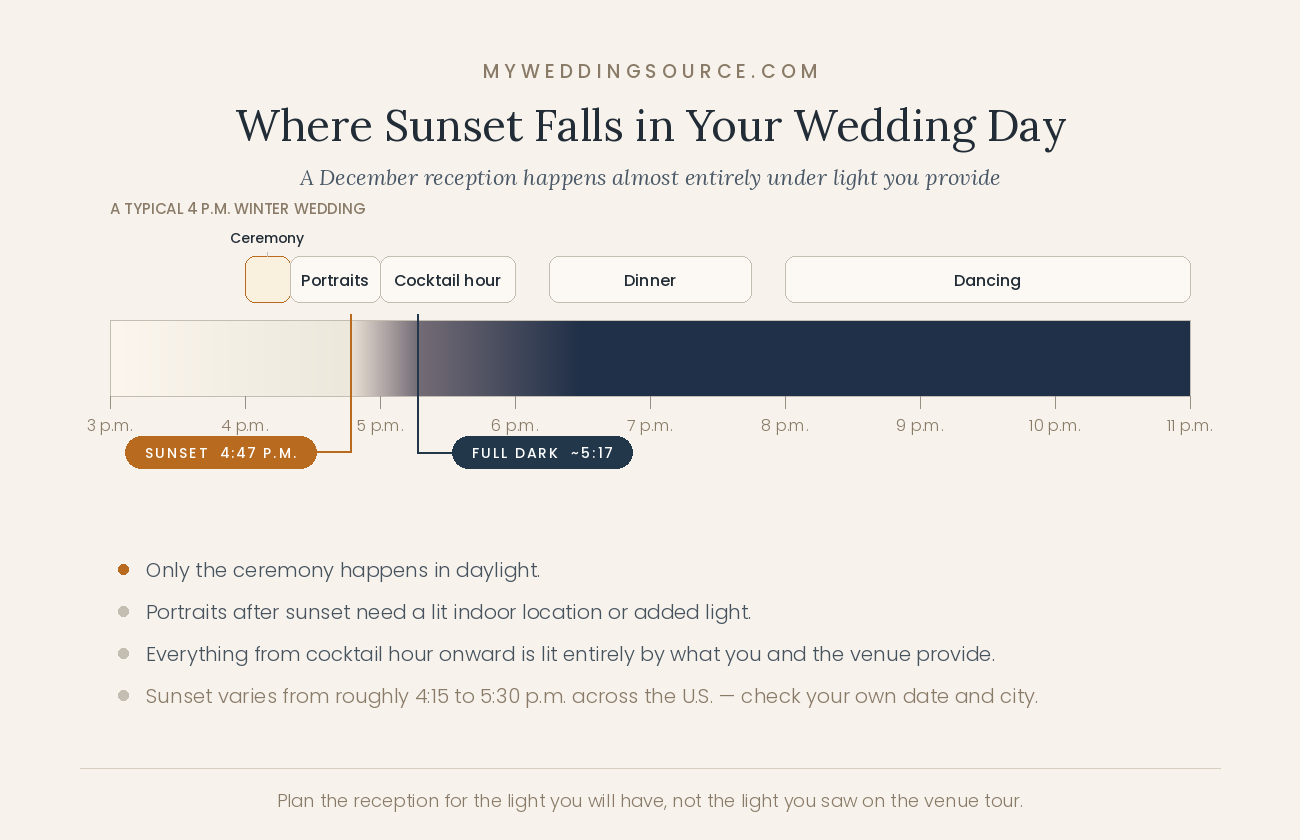
Most couples plan decor for a room they have only seen in daylight. They tour the venue at two in the afternoon in September, photograph the tall windows, and choose linens and centerpieces based on how the space looked with sun coming through the glass. Then the wedding happens in January, the sun sets at 4:47 p.m., and by the time guests sit down for dinner, those windows are black rectangles and the room is whatever the lighting makes it.
This is the practical reality behind most winter wedding decor ideas: after sunset, lighting is not a finishing touch on the design. It is the design. Centerpieces you cannot see, linens whose color has shifted under fluorescent downlights, and a beautiful ceiling nobody looks up at because there is nothing to look at are all lighting outcomes rather than decor failures. In a winter reception, the room you get is the room you light.
The difficulty is that lighting decisions run on a different track than decor decisions. Your florist, your rental company, and your planner each control part of the visual result, while the elements that determine whether the room feels warm — circuits, dimmers, rigging points, fixture placement, color temperature — usually belong to your venue and a lighting vendor you may not have hired yet. Those decisions also have hard deadlines, because a lighting design requires a site visit, a power plan, and an install window written into your venue contract.
Handled poorly, the costs are specific rather than catastrophic. A room lit only by existing overheads photographs flat and feels institutional. Candles ordered without checking the venue’s flame policy get removed by a fire marshal or a venue manager an hour before guests arrive. A tent lighting plan that exceeds available power trips a breaker in the middle of dinner. A gorgeous installation gets struck at midnight at an overtime rate nobody quoted.
This guide compares the full lighting toolkit — candlelight, string and bistro lights, uplighting, pin spotting, lamps, projected patterns, and practical fixtures — alongside the materials that make a winter room feel warm. Then it walks through sixteen concepts for ballrooms, barns, restaurants, tents, modern spaces, and historic venues, each with what it needs in power, labor, and budget. It closes with fire rules, photography, accessibility, realistic costs, and a question list you can take to your venue walkthrough.
Why a Winter Reception Is a Lighting Problem First
The sunset math changes the whole event
Across most of the United States, sunset in December and January falls somewhere between about 4:15 and 5:30 p.m. depending on latitude and time zone position. A 4:00 p.m. ceremony ends in twilight. A 5:00 p.m. ceremony happens after dark. Practically, this means that nearly everything guests see at a winter wedding — the room, the tables, each other, and you — they see under artificial light.
That is not a problem. Winter evenings are genuinely flattering, and candlelight in a dark room is difficult to beat. It becomes a problem only when the design was planned as though daylight would be doing some of the work.
What darkness does to decor you already bought
Three effects show up repeatedly. First, color shifts. Warm venue lighting pushes cool colors toward grey and brown, so a dusty blue linen chosen in daylight can read as taupe by 7:00 p.m. Second, detail disappears. Low centerpieces, delicate place settings, and textured linens all lose definition when the only light comes from a ceiling twenty feet above. Third, the room’s edges vanish. An unlit perimeter makes even a beautiful space feel like a box, which is why a room can feel smaller and less finished at night than it did on your tour.
Each of these has a lighting solution that costs less than replacing the decor. That is the central trade this guide keeps returning to.
Three layers, and most weddings only plan one
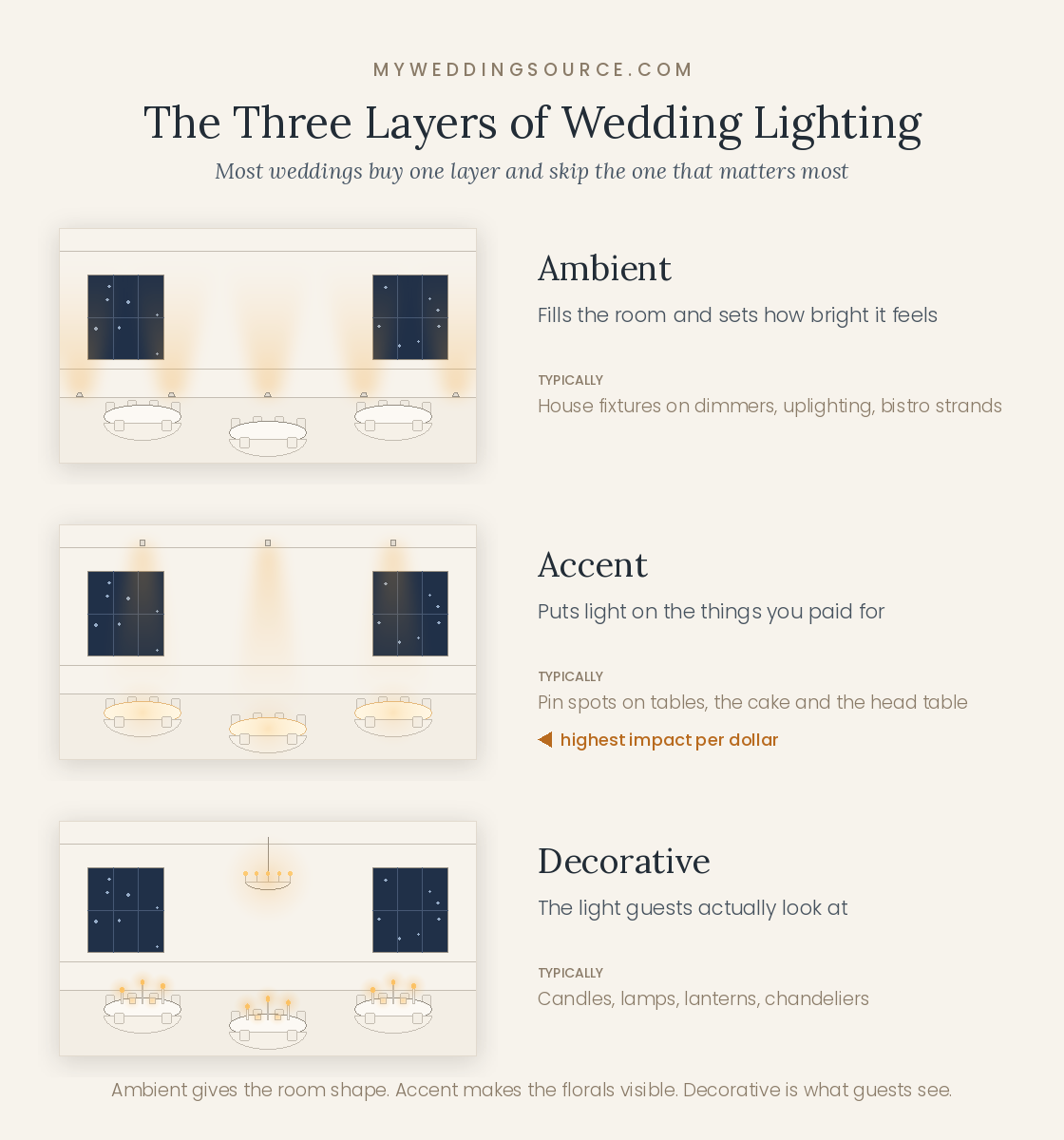
Professional lighting design thinks in layers. It is a useful frame even on a small budget.
- Ambient light fills the room and determines how bright it feels. Usually the venue’s own fixtures, plus uplighting or string lights.
- Accent light puts light on specific things: centerpieces, the cake, the head table, an installation, a fireplace. Pin spots do this.
- Decorative light is the light you actually look at: candles, lamps, bistro strings, lanterns, a chandelier. These are objects as much as sources.
Most weddings buy the third layer, sometimes the first, and skip the second. Accent light is the layer with the highest impact per dollar, because it makes the things you already spent money on visible.
Start with a question, not a product
Before pricing anything, ask what you want the room to do. A room can feel intimate and low, bright and celebratory, dramatic and high-contrast, or soft and even. Those are different lighting plans, and knowing which one you want prevents buying pieces that fight each other. A common and avoidable outcome is a room with warm candles on the tables and cool white overheads at full brightness, which cancels the candles entirely.
The Lighting Toolkit, Compared
Candlelight
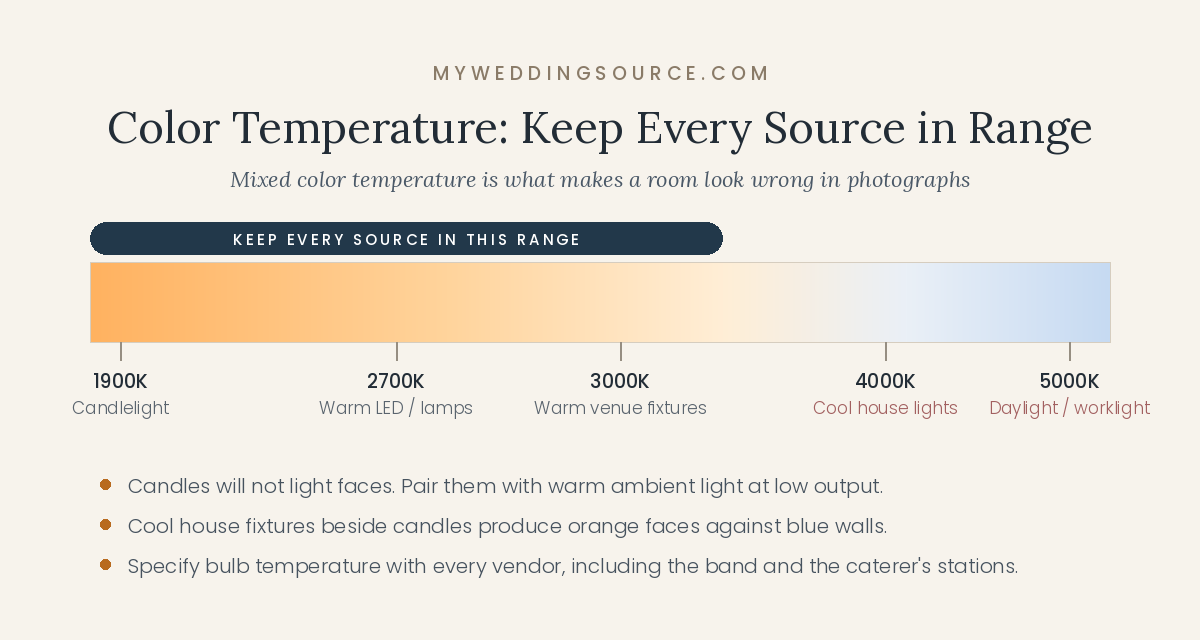
Candlelight is very warm, very low, and unmatched at making a room feel intimate. It also sits at table height, which is exactly where guests are looking. In color terms it is around 1800 to 2000 kelvin, considerably warmer than any household bulb, which is why a candlelit table looks golden while the room around it looks neutral.
Two limits are worth planning for. Candles produce atmosphere, not illumination: they will not light faces enough for photographs on their own, and they do nothing for the perimeter of a room. And quantity matters more than couples expect. A meaningful candlelight effect usually requires far more candles than people first imagine — often 5 to 15 pieces per table across mixed heights, not three votives.
Mix heights: tapers in holders for verticality, votives scattered for glow, and pillars in hurricanes or cylinders for stability. Confirm what your venue permits before ordering, since flame rules vary widely and are covered further below.
String lights and bistro lights
Bistro or café lights — the strands with spaced round bulbs — are the most reliable way to make a large or high space feel warm and enclosed. They create a visual ceiling, which is precisely what a barn, tent, warehouse, or high-ceilinged room needs after dark.
The practical requirements are rigging and power. Strands need attachment points and, in tents or open spaces, sometimes poles or a truss. They also need to be dimmable to be flattering; at full brightness, bistro bulbs read as bright dots rather than as ambient glow. Ask specifically whether the install includes a dimmer, because a plan without one is noticeably less effective and the fix is cheap up front.
Uplighting
Uplights are small fixtures placed on the floor against walls, columns, or drapery, throwing light upward. They are the least expensive way to change how an entire room feels, and they are also the easiest way to make a room look like a school dance.
The distinction is saturation and color. Warm white or amber uplighting looks like architecture and flatters skin. Deeply saturated colors — magenta, purple, blue — become the dominant color of the room, spill onto faces and white attire, and appear in every photograph. If you want color, ask for the lowest saturation that still reads, and keep it away from areas where people are photographed closely.
Pin spotting
Pin spots are narrow beams aimed from above at specific targets, usually centerpieces, the cake, and the head table. They are the highest-leverage lighting purchase at most weddings, because a table with a pin spot looks styled while an identical table without one disappears after dark.
They require rigging points and a way to aim from height, which is why they are typically a professional lighting vendor’s work rather than a rental item you place yourself. If your floral budget is significant, pin spotting is what makes it visible, and it usually costs a small fraction of what the flowers cost.
Table lamps and portable fixtures
Small battery-powered lamps on dining tables and cocktail tables have become common for good reason: they put a soft, human-scale light source at eye level, they are not affected by flame restrictions, and they are unusually flattering. They give a restaurant-like intimacy that candles alone do not, because they provide a bit more actual illumination.
The trade-offs are rental cost per unit and battery life. Confirm the runtime covers your full reception plus setup, and ask who is responsible for charging and swapping.
Projected patterns and monograms
A gobo projector casts a pattern or monogram onto a wall, floor, or ceiling. Patterns such as foliage, snowflake-free abstract textures, or architectural shapes can add depth to a plain wall cheaply. A projected monogram is a stronger stylistic statement and dates more quickly than most other choices.
Practical notes: projections need a clear throw path that people will not walk through, a surface that is light enough to show the pattern, and a dark enough room to register. On a bright wall in a well-lit room, the effect largely disappears.
The venue’s own fixtures, dimmers, and color temperature
Before adding anything, find out what the room already has and how much control you have over it. Three questions matter: are the house lights dimmable, at what zones, and who operates them during the reception. A venue with zoned dimmers gives you an enormous amount of design for free — bright during dinner service, low during dancing.
Color temperature is the other half. Warm fixtures in the 2400K to 3000K range flatter skin and pair well with candlelight. Cooler fixtures at 4000K and above make a room feel like a conference space and clash visibly with candles in photographs. If the venue’s fixtures are cool white and cannot be changed, plan to overpower them with your own warm sources rather than mixing the two at equal strength.
Lighting elements at a glance
| Element | What it does | Typical cost band | Needs |
|---|---|---|---|
| Candles | Atmosphere at table height | Low to moderate, rises with quantity | Venue flame approval; someone to light them |
| Bistro / string lights | Creates a visual ceiling, warms large spaces | Moderate to high, driven by rigging | Attachment points, power, dimmer |
| Uplighting | Changes the whole room’s tone cheaply | Low per fixture | Floor space, outlets or batteries |
| Pin spots | Makes florals and cake visible after dark | Moderate per table | Rigging height, professional aiming |
| Table lamps | Warm, flame-free light at eye level | Moderate per unit | Battery runtime, charging plan |
| Gobo projection | Adds pattern and depth to blank surfaces | Low to moderate per unit | Clear throw path, dark enough room |
| Rented chandeliers / lanterns | Decorative focal point overhead | High, including rigging labor | Structural rigging approval, install window |
| House fixtures on dimmers | Controls the baseline feel of the room | Usually included | Someone assigned to operate them |
Materials That Carry Warmth
Creative Winter Wedding Decor Ideas
Lighting determines whether the room reads warm; materials determine what the light lands on. In winter, texture does more work than color.
Greenery
Greenery is the most cost-efficient volume you can buy. Garlands down the center of long tables, at the base of a bar, or along a mantel add depth without the per-stem cost of focal flowers. Winter varieties hold up well: cedar, pine, juniper, olive, magnolia with its brown reverse, and eucalyptus. Preserved and dried elements last longer and travel better, and they are also more flammable, which matters near candles.
Branches
Bare branches create scale for very little money and are one of the few decor elements that read specifically as winter without reading as a holiday. Birch, manzanita, curly willow, and dogwood work in tall vessels, as an overhead installation, or flanking a ceremony aisle. The costs are labor and mechanics rather than material: large branch arrangements need weight, secure vessels, and someone to build them safely.
Textiles: velvet, wool, linen, and drapery
Fabric is the fastest way to make a hard room feel soft. Velvet napkins and runners absorb light and read rich under candlelight. Wool and bouclé throws on lounge furniture look intentional and are genuinely useful in a cold venue. Ceiling and wall drapery transforms a plain space entirely, and it is also one of the more expensive decor categories once labor and fire-rating requirements are included.
Reflective surfaces
Mirror, mercury glass, polished metal, and glass vessels multiply every light source you have. In a candlelit room, a mirrored table runner or a cluster of mercury glass votives roughly doubles the apparent number of flames. Reflective materials are the cheapest way to make a modest lighting budget look larger, and they cost nothing in power or rigging.
Use them with some restraint on tables, since a fully mirrored surface can throw light upward into guests’ eyes and complicates photography.
Warm neutral materials
Wood, unglazed ceramic, raw silk ribbon, paper, and stone all absorb light rather than bouncing it, which balances a room with many reflective elements. A table with mercury glass, mirror, and metallic chargers can look cold; the same table with a wooden charger or a linen runner reads warm. Balance is the point rather than any single material.
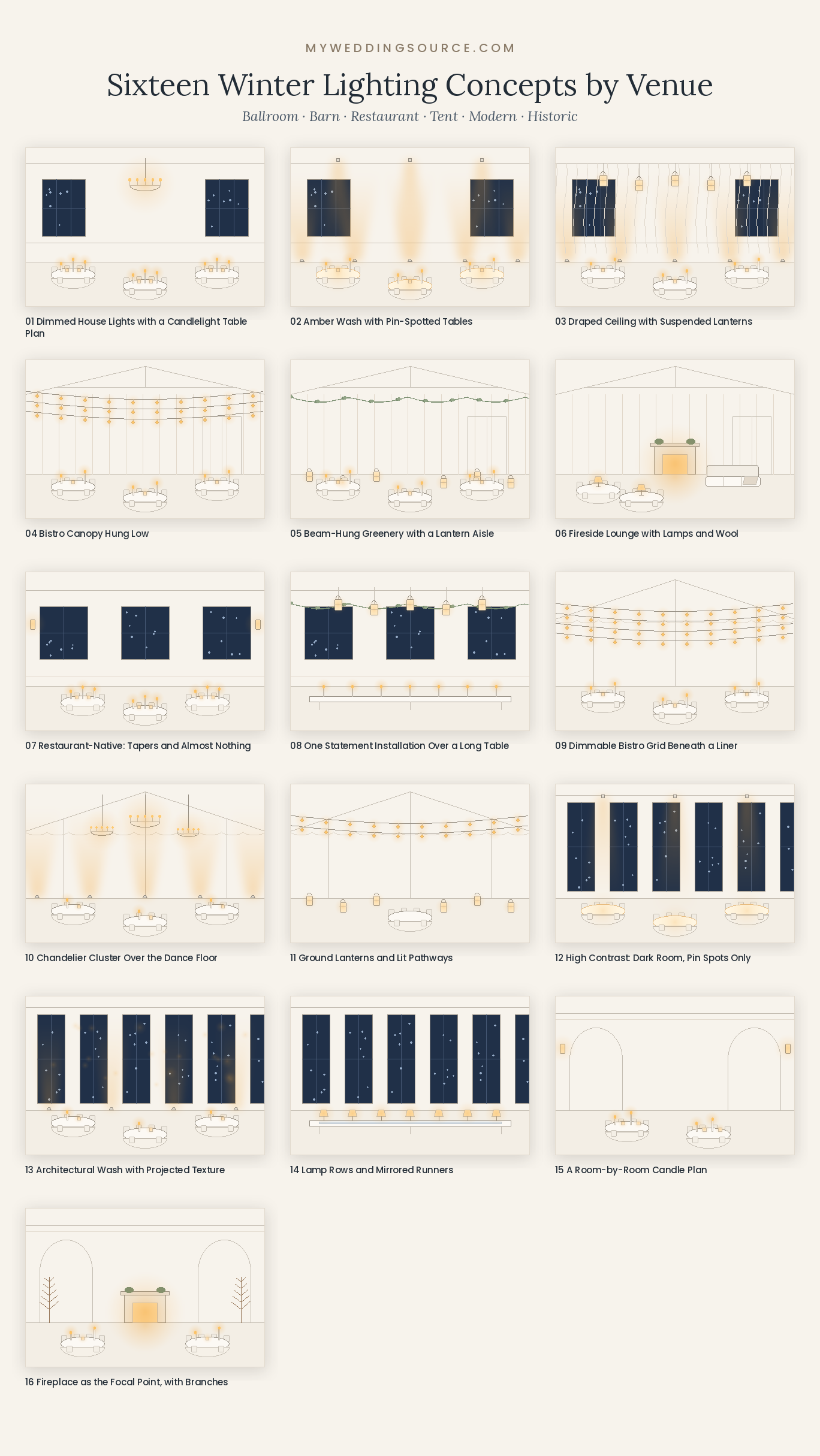
Sixteen Winter Wedding Decor and Lighting Concepts by Venue Type
Each concept below names what it is, what it requires in power and labor, roughly where it sits on cost, and the conditions under which it works less well. Costs are illustrative bands rather than quotes, since regional rates and rigging complexity vary considerably.
Hotel and country club ballrooms
Ballrooms give you scale, reliable power, and a staff that has done this before. They also give you patterned carpet, a lot of ceiling, and overhead fixtures that are often the enemy of atmosphere.
1. Dimmed house lights with a candlelight table plan
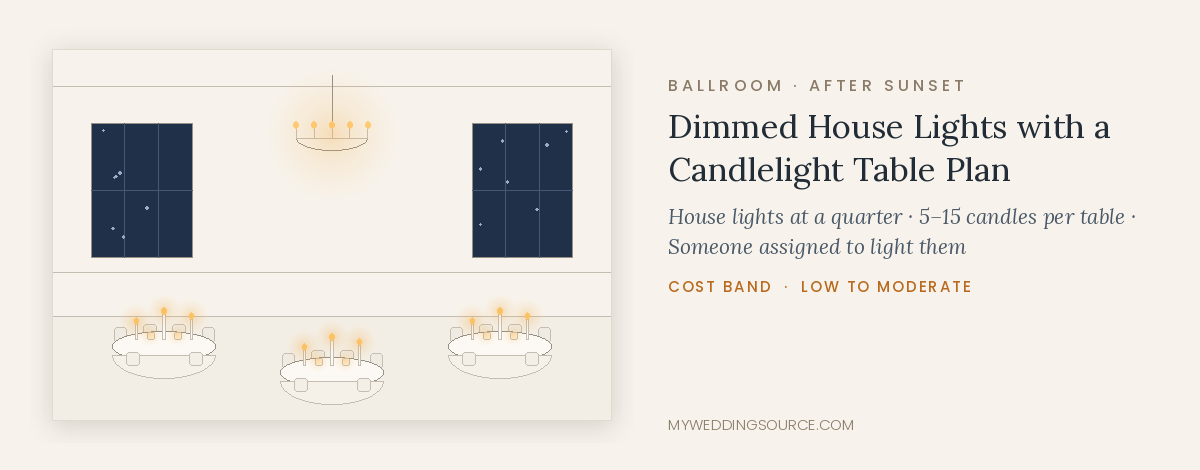
The concept: take the house lighting down to roughly a quarter and let clustered candlelight carry the room. Mixed heights on every table: three to five tapers in holders, a scattering of votives, and one or two pillars in cylinders. Chandeliers stay on at low output as a warm anchor overhead.
Needs: confirmed dimming zones, a named person to operate them, and someone assigned to light candles roughly 30 minutes before guests enter. Budget 10 to 20 minutes of labor per 10 tables.
Cost band: low to moderate, driven almost entirely by candle and vessel quantity.
Works less well when: the venue prohibits open flame or the house lights are not dimmable. Confirm both before this becomes your plan, because it does not survive either restriction.
2. Amber wash with pin-spotted tables
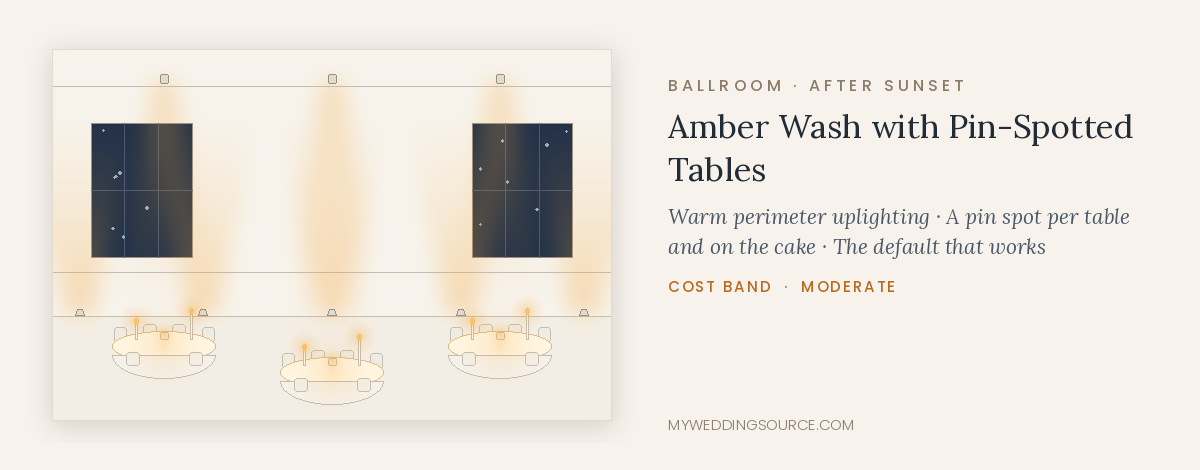
The concept: warm amber uplighting around the perimeter to define the walls, plus a pin spot on each dining table and on the cake. The uplighting gives the room shape; the pin spots make the flowers exist after dark. This is the closest thing to a default that professional lighting designers use, and it suits nearly any ballroom.
Needs: outlets or battery uplights, rigging height for pin spots, and a lighting vendor for aiming. Install typically takes two to four hours.
Cost band: moderate. Uplights are inexpensive per fixture; pin spotting is priced per table.
Works less well when: the ceiling has no rigging access, which some hotel ballrooms restrict. Ask early whether pin spots can be hung and from what.
3. Draped ceiling with suspended greenery and lanterns
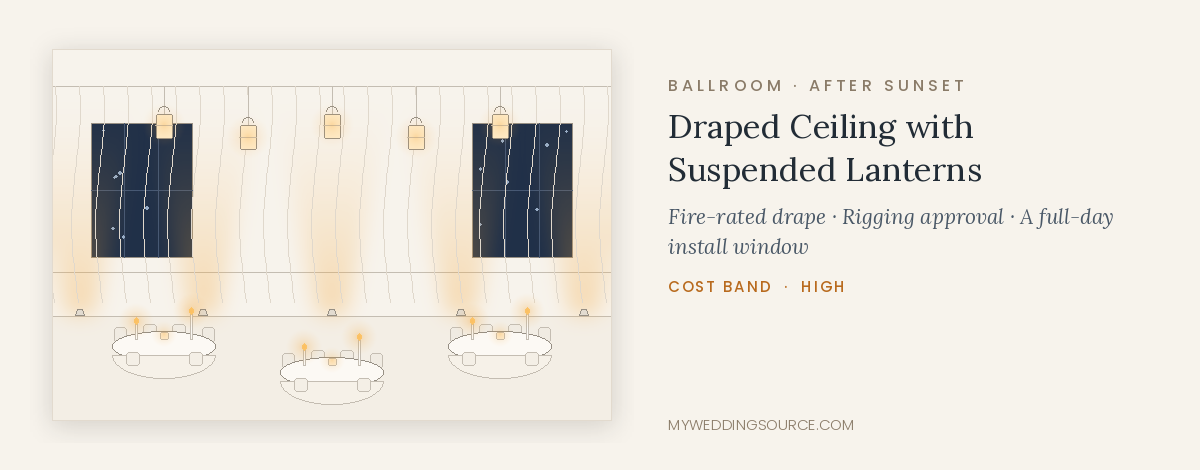
The concept: fabric drape softens a tall, plain ceiling and hides house fixtures you do not want in photographs. Suspended greenery or a run of lanterns above the dance floor lowers the visual ceiling and gives the space a center.
Needs: structural rigging approval, a long install window, fire-rated fabric, and significant labor. This is a full-day install at many venues.
Cost band: high. Drapery plus rigging is one of the larger decor line items available.
Works less well when: the venue has a short setup window or another event the same day. Ask what time your vendors can access the room before you design anything that hangs.
Barns and rustic venues
Barns have warmth built in — wood everywhere, visible structure, plenty of attachment points — and almost no ambient light after dark. They are the venue type where lighting matters most and where it is usually easiest to install.
4. Bistro canopy hung low
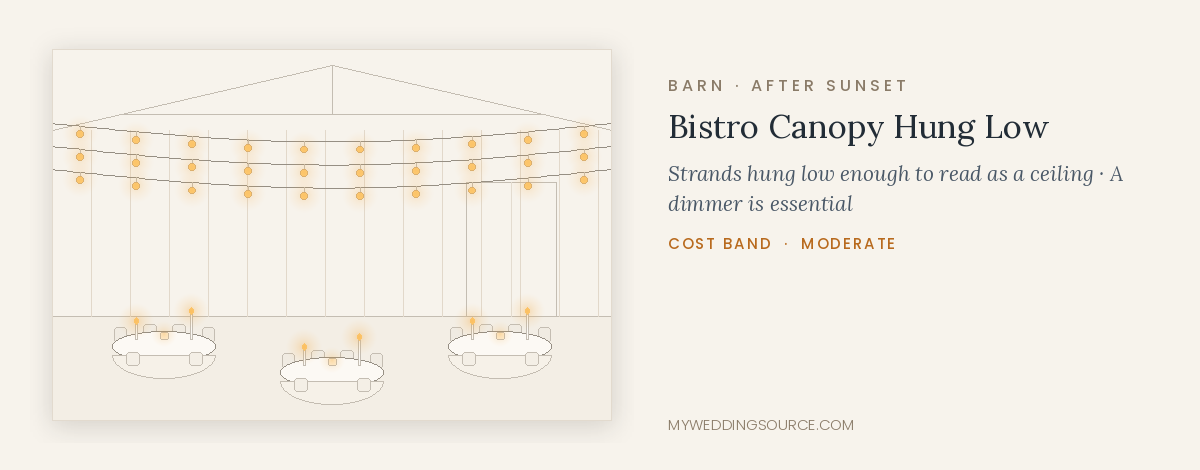
The concept: parallel runs of bistro lights strung across the space at a height that feels like a ceiling rather than a distant sky. Hung too high, the effect is decorative; hung lower, it makes a cavernous barn feel like a room.
Needs: attachment points on beams, adequate circuits, and a dimmer. Confirm bulb type; warm-white LED at low output looks far better than bright filament at full power.
Cost band: moderate, mostly labor. Many barn venues already own strands, which is worth asking about first.
Works less well when: the strands are not dimmable, which leaves you with rows of bright points and no ambience.
5. Beam-hung greenery with lantern aisle
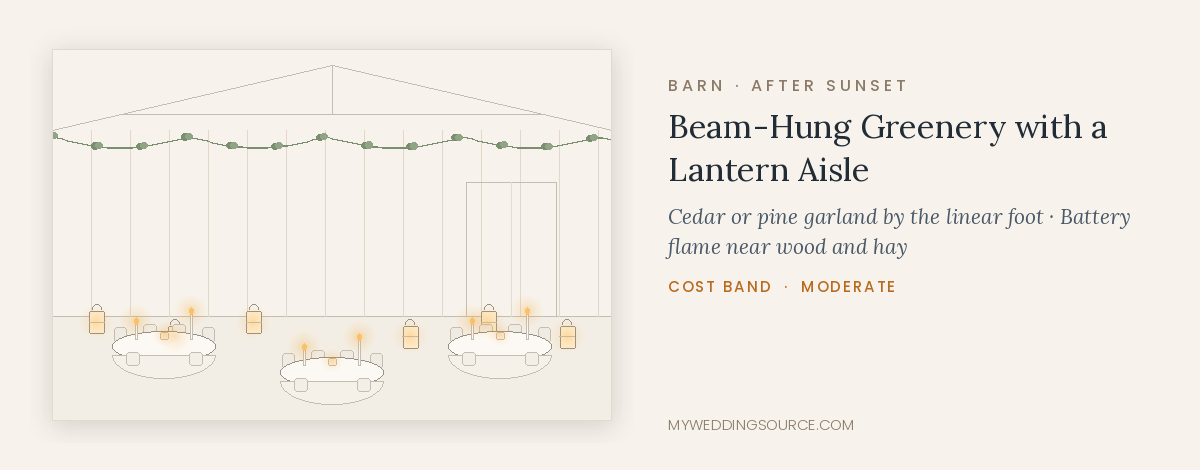
The concept: cedar or pine garland run along the main beams, with lanterns lining the aisle or the path between spaces. The greenery reads as winter, the lanterns give guests something to walk toward, and both work in the dark.
Needs: ladder or lift access, install labor, and battery candles inside lanterns if flame is restricted outdoors or near hay and wood.
Cost band: moderate. Greenery garland is priced by the linear foot, and a long beam adds up faster than expected.
Works less well when: the garland is dried or preserved and sits close to open flame. Fresh greenery is safer near heat, and preserved material should be kept away from it entirely.
6. Fireside lounge with lamps and wool
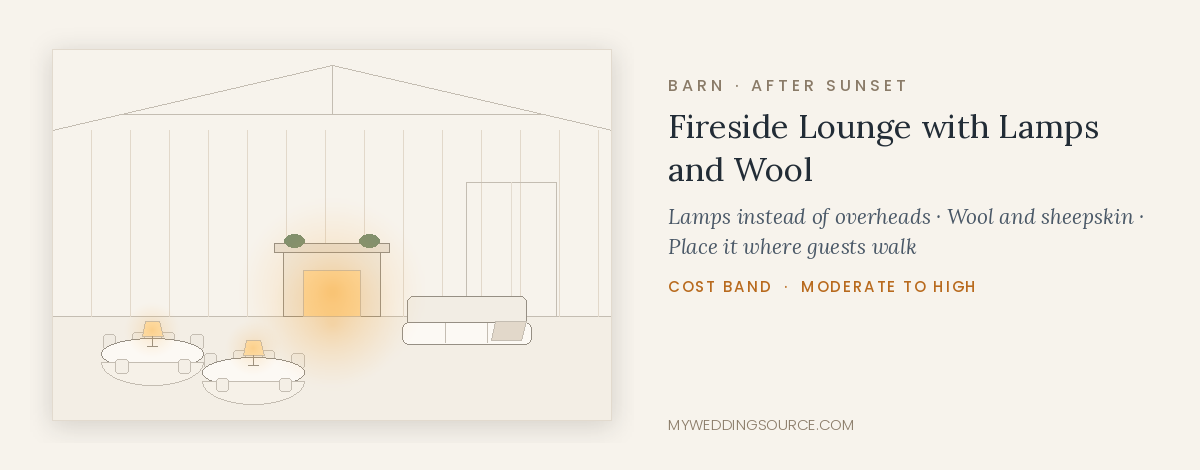
The concept: a seated lounge area outside the main dining plan, lit with table lamps and floor lamps rather than overhead light, layered with wool throws, sheepskin, and low tables. In a cold venue this is also a comfort feature, since it gives guests a warm place to sit that is not their dinner chair.
Needs: furniture rental, floor outlets or battery lamps, and floor space that does not interfere with service paths.
Cost band: moderate to high, driven by furniture rental and delivery.
Works less well when: it is placed far from the action. A lounge nobody walks past goes unused.
Restaurants and private dining rooms
Restaurants come with a designed interior and, usually, lighting that already works. The correct instinct here is subtraction.
7. Restaurant-native: lamps, tapers, and almost nothing else
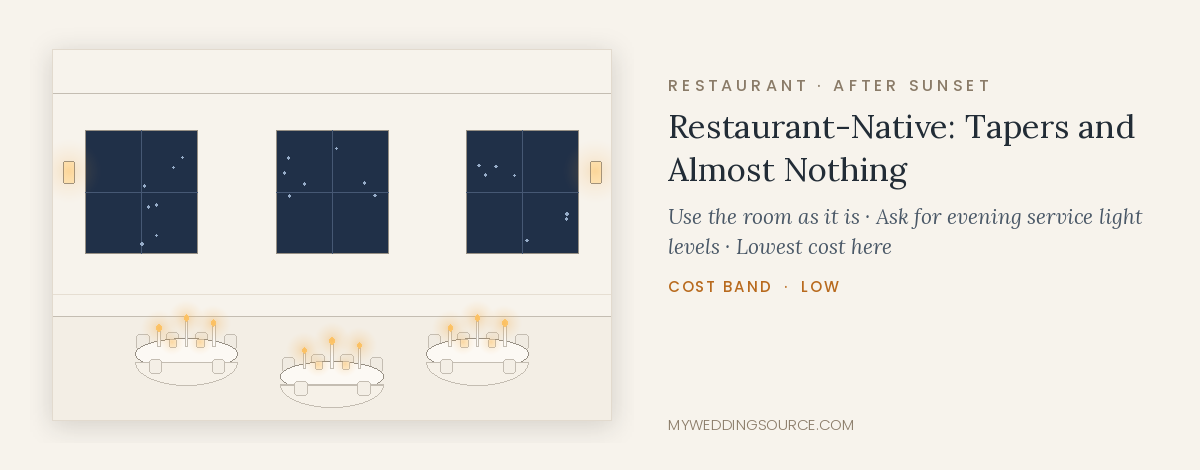
The concept: use the room as it is. Add tapers in simple holders, a low garland or bud vases along the table, and ask the restaurant to run its lighting at the level it uses for evening service. The result reads as an intimate dinner rather than an event.
Needs: almost nothing. Confirm candle policy and whether the restaurant will adjust its lighting for you.
Cost band: low. This is the least expensive concept in this guide and one of the most effective, because the venue has already solved the lighting problem.
Works less well when: you want the space to look transformed. It will look like the restaurant, well dressed.
8. One statement installation over a single long table
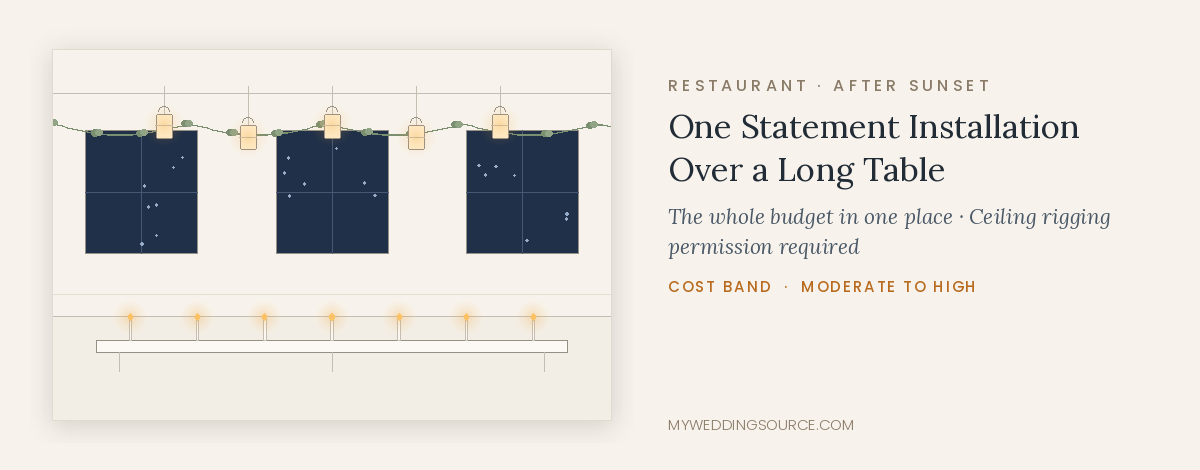
The concept: concentrate the entire decor budget on one overhead element above one long table — a suspended greenery run, a line of pendant lanterns, or a branch installation — and keep everything else quiet.
Needs: ceiling rigging permission, which many restaurants will not grant. Freestanding alternatives exist and cost more.
Cost band: moderate to high, concentrated in one place.
Works less well when: the guest count requires several round tables. This concept depends on a single focal table.
Tents and temporary structures
A tent is a blank space where you control everything and pay for everything, including the power. Winter tents also carry heating, which competes directly with lighting for available electricity.
9. Dimmable bistro grid with a fabric liner
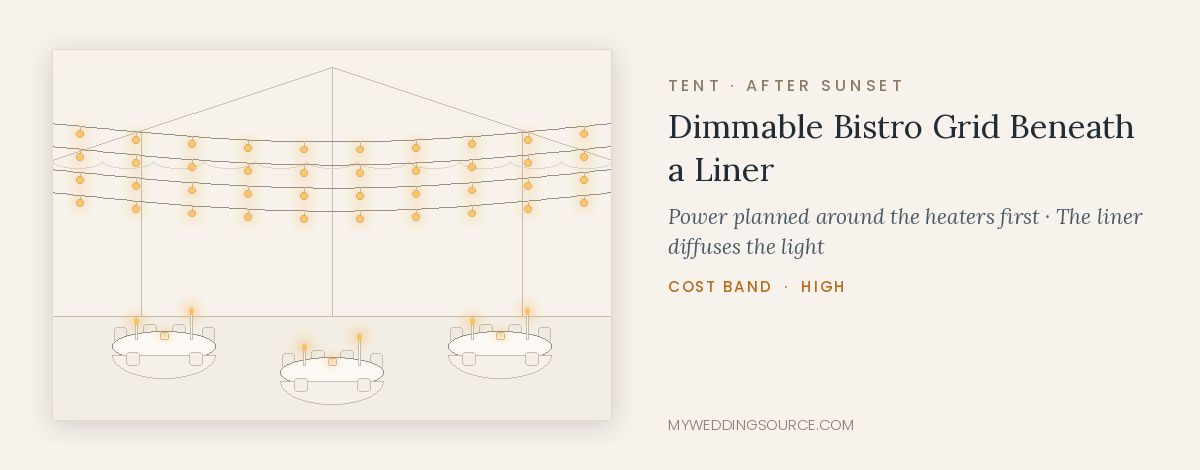
The concept: a grid of bistro strands beneath a fabric tent liner. The liner hides the structure and diffuses light; the strands provide warm ambient glow across the whole footprint.
Needs: a power plan that accounts for heaters first, a generator in most cases, and a dimmer. Install is a multi-day process for the tent company.
Cost band: high once liner, lighting, and power are combined.
Works less well when: the power budget was calculated without the heaters. In a winter tent, heating is the largest electrical load by a wide margin, and lighting has to be planned around it.
10. Chandelier cluster over the dance floor
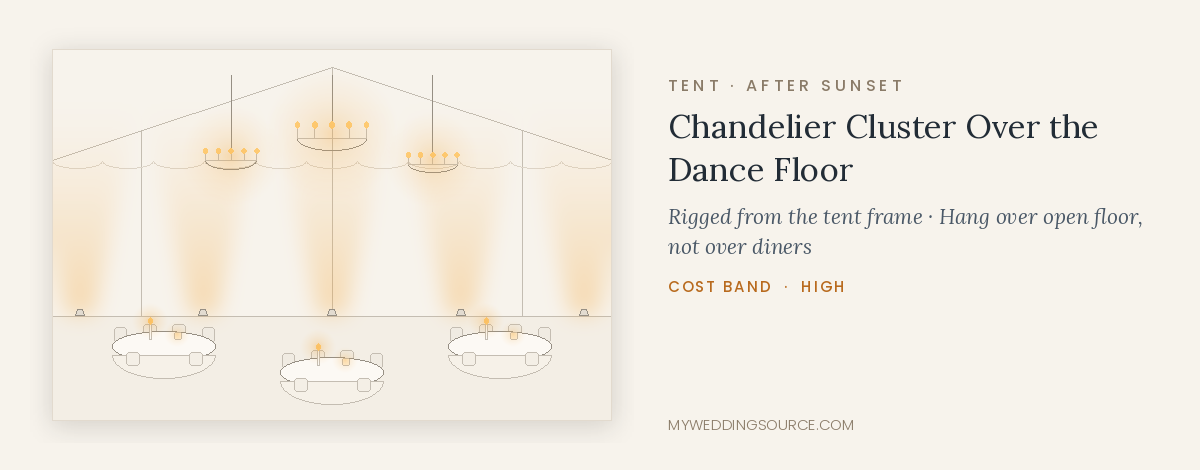
The concept: three to five rented chandeliers hung at varied heights above the dance floor, with a warm perimeter wash and minimal light elsewhere. It creates one clear focal point in a large volume.
Needs: structural rigging from the tent frame, approved by the tent company, plus electrical runs to each fixture.
Cost band: high. Chandelier rental plus rigging labor is a significant line.
Works less well when: guests are seated directly beneath. Keep the cluster over open floor rather than over dining tables.
11. Ground-level lanterns and lit pathways
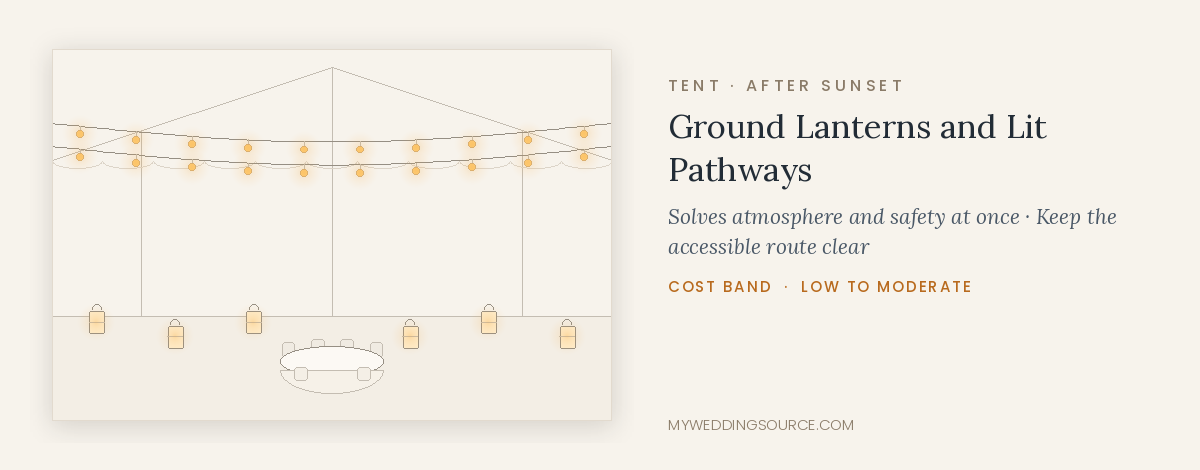
The concept: lanterns along the walk from parking to the tent, at the tent entrance, and around the perimeter. It solves an atmosphere problem and a safety problem at the same time, which is unusual.
Needs: weather-appropriate fixtures, battery or low-voltage power, and stable placement on ground that may be frozen, wet, or uneven.
Cost band: low to moderate.
Works less well when: lanterns become obstacles. Keep them clear of the walking path itself, particularly on any accessible route.
Modern, industrial, and gallery spaces
These rooms have strong architecture, hard surfaces, and often very little warmth. They reward high-contrast lighting and punish attempts to make them cozy with soft furnishings alone.
12. High contrast: dark room, pin spots only
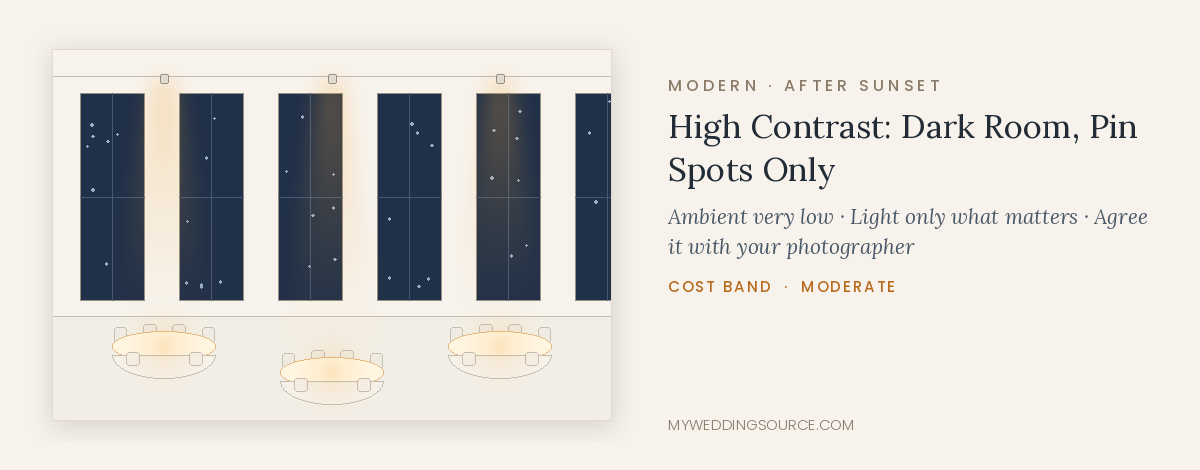
The concept: take the ambient light very low and light only what matters — tables, the bar, the cake, the band. The room disappears into darkness and the lit elements become the design. It is dramatic, contemporary, and photographs beautifully with a photographer who is prepared for it.
Needs: full dimming control, precise pin spotting, and enough light for safe movement. Confirm the plan with your photographer in advance.
Cost band: moderate. You are spending on accent light rather than on volume.
Works less well when: guests need to read menus or navigate steps. Pair it with path lighting and larger type on printed pieces.
13. Architectural wash with projected texture
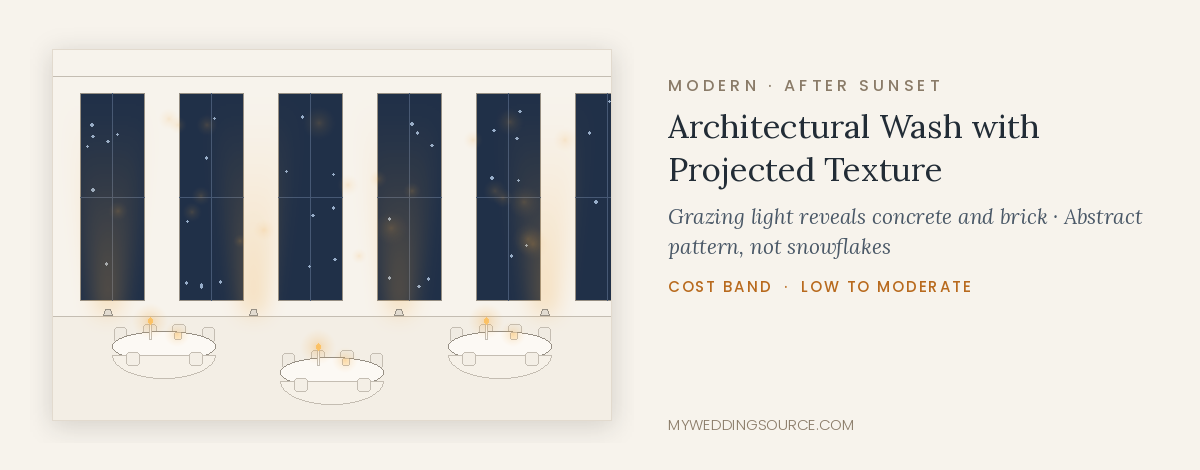
The concept: warm white uplighting grazing a concrete or brick wall to reveal its texture, with an abstract pattern projected onto a large blank surface. It uses the building as decor instead of covering it.
Needs: fixture placement close to the wall for grazing effect, and a clear projection path.
Cost band: low to moderate.
Works less well when: the pattern is literal and seasonal. Abstract foliage and texture age better than snowflakes or monograms.
14. Lamp rows and mirrored runners on long tables
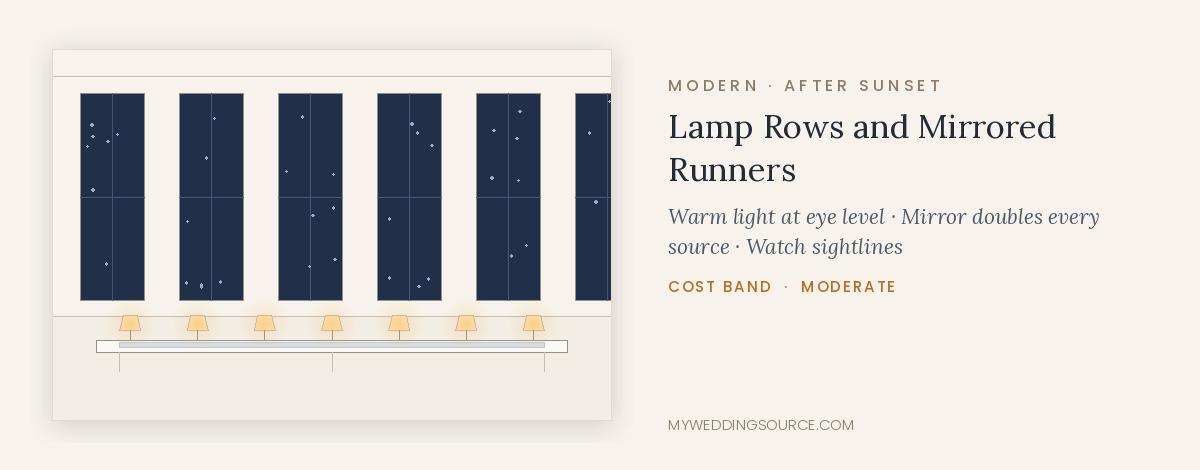
The concept: long banquet tables with a row of small lamps or shaded candles down the center, set on mirrored or polished runners that double every light source. Low, warm, and effective in a room with no natural warmth.
Needs: lamp rental and battery management, plus attention to sightlines so lamps do not block conversation across the table.
Cost band: moderate.
Works less well when: the mirror surface reflects overhead light into guests’ eyes. Works best in a dim room.
Historic houses and multi-room venues
15. A room-by-room candle plan
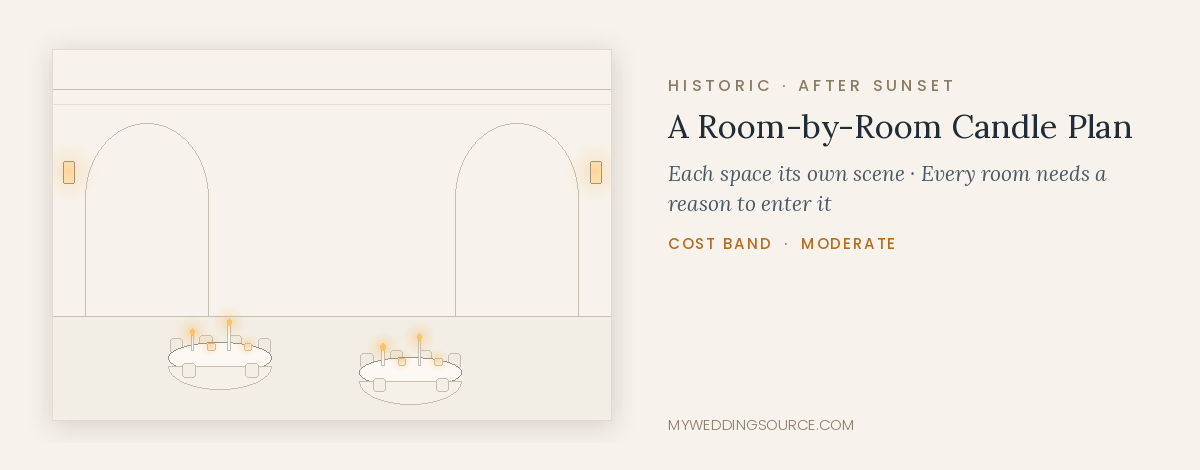
The concept: instead of one large decorated room, treat each space as its own scene: candles and greenery on the mantel in one room, a lit bar in another, lamps and lounge seating in a third. Guests move through a sequence rather than sitting in a single box.
Needs: more fixtures spread thinner, a lighting check in every room at reception hour, and a plan for hallways and stairs.
Cost band: moderate. Costs rise with the number of rooms rather than with guest count.
Works less well when: circulation is not considered. Every room needs a reason for guests to enter it — a bar, food, seating, or music.
16. Fireplace as the focal point, with branches
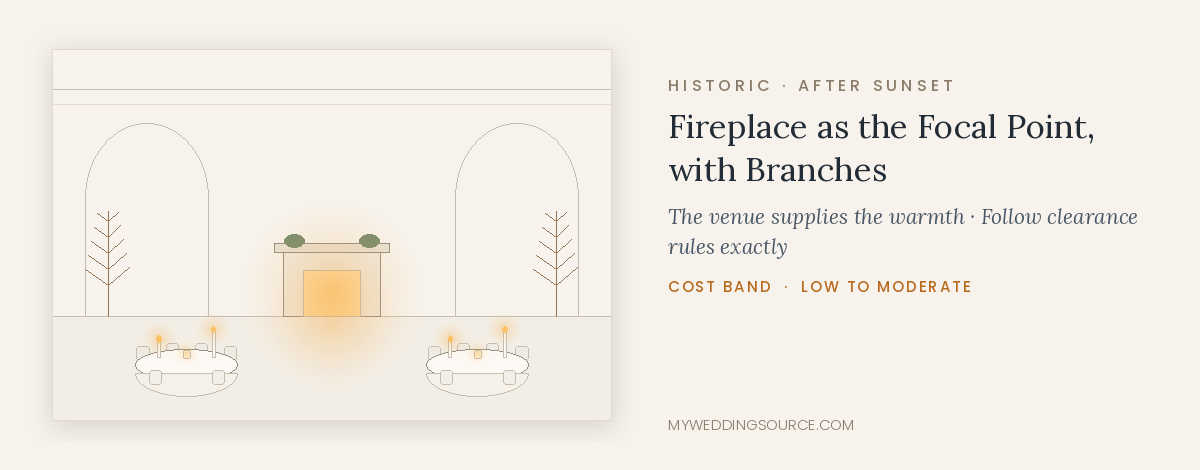
The concept: build the room around an existing fireplace: greenery and candles on the mantel, tall branch arrangements flanking it, seating angled toward it. The venue supplies the warmth and you supply the frame.
Needs: confirmation that the fireplace will be lit and who tends it, plus clearance requirements for anything placed nearby.
Cost band: low to moderate.
Works less well when: decor is placed too close to the firebox. Greenery, dried material, ribbon, and paper near an active fire is a real hazard, not a styling question, so follow the venue’s clearance rules exactly.
Power, Rigging, and Installation
These are the constraints that decide whether a design is buildable. They are also the questions couples ask last, which is why plans get cut on the wedding morning.
Circuits and available power
A standard 20-amp circuit in the United States supplies roughly 1,900 usable watts once you allow headroom. That sounds like a lot until you add catering equipment, a band’s amplification, and — in a tent — heaters, which draw more than everything else combined. LED lighting is very efficient and rarely the problem on its own, but everything shares the same supply.
Ask your venue three specific things: how many circuits serve your event space, where the outlets are, and what else is drawing from them. In a tent or at a venue without a kitchen, ask who is supplying the generator, what it is rated for, and who is sizing it. The person sizing the generator needs a list from every vendor, not an estimate, because a tripped breaker mid-dinner is a lighting failure, a music failure, and a catering failure at once.
Rigging: what can hang, and from what
Anything overhead — chandeliers, drape, suspended greenery, pin spots, bistro strands — needs an approved attachment point and a weight rating. Venues differ enormously here. Some allow rigging from beams, some require a lift and a certified installer, some prohibit anything attached to the ceiling at all. Historic venues and restaurants are the most restrictive.
Get the answer in writing during your venue walkthrough, before you commission a design that depends on it. Freestanding alternatives exist for most overhead ideas, and they cost more and take more floor space.
Install and strike windows
The two questions that most often reshape a decor plan are what time vendors can access the room and what time everything must be out. A venue with an event earlier in the day may give you three hours; a full drape and lighting install may need eight. Ask for the load-in time in writing and give that number to every vendor before they quote, because rush labor and additional staff are how a modest design becomes expensive.
Strike matters just as much. If everything must be removed the same night, someone is working at 1:00 a.m., and that labor is billed. Ask whether next-morning pickup is possible, which is often cheaper.
Who does what
Decor and lighting usually involve three or four parties: the venue, a florist, a rental company, and a lighting vendor. Write down which one owns each element — including who lights the candles, who dims the house lights during dinner, who turns the dance floor lighting on, and who removes everything. Gaps here are the reason candles are still unlit when guests walk in.
Fire Safety and Venue Rules
Flame policy is the rule most likely to change your plan late, and the one most couples assume rather than confirm.
What venues commonly require
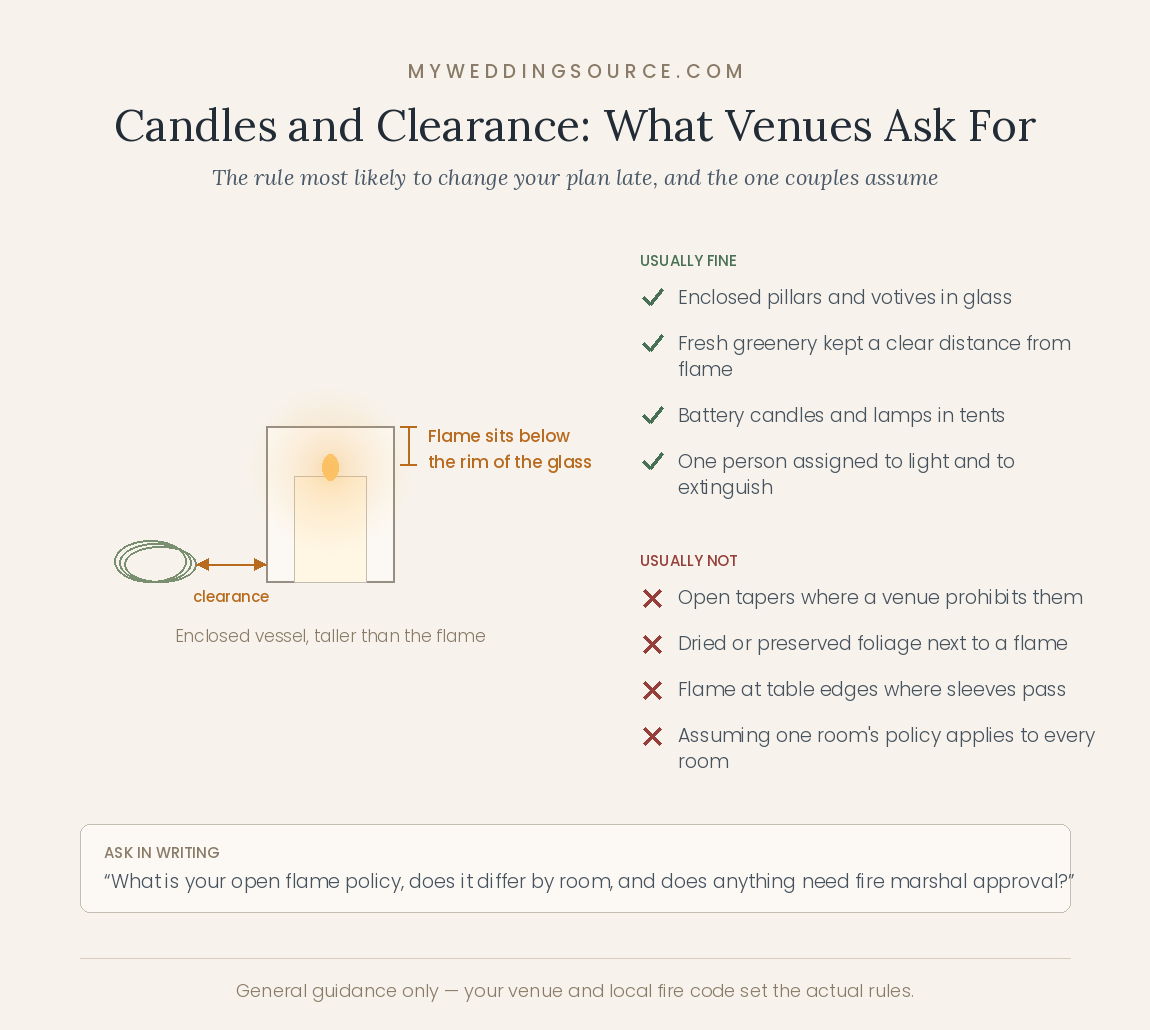
Policies vary by venue, by local fire code, and sometimes by the specific room. Common requirements include: flames fully enclosed in glass with the flame below the rim, no open tapers, minimum clearance from fabric and greenery, no flame at all in tented structures, and no candles in areas guests pass closely. Some venues permit candles only if a staff member lights and monitors them.
Ask the question precisely: “What is your open flame policy, does it differ by room, and does anything need approval from the fire marshal?” Then ask for it in writing, because a verbal yes from one coordinator is not a policy.
Practical fire safety around winter decor
Winter decor concentrates the two things fire safety cares about: heat sources and dry material. Dried flowers, preserved foliage, paper, ribbon, and evergreen that has been indoors for days are all more flammable than they look. The U.S. Consumer Product Safety Commission’s holiday safety guidance covers candle and decoration hazards in seasonal settings and is a useful reference when you are deciding how close is too close.
Working practices that reduce risk without changing the look: keep flame at least a hand’s width from any greenery or fabric, use enclosed vessels taller than the flame, avoid dried and preserved material anywhere near candles, keep flame away from table edges where sleeves pass, and assign someone to extinguish everything at the end of the night rather than assuming staff will.
When flame is not allowed
Battery candles have improved considerably, and good ones with a warm flicker read convincingly at a distance. They will not fool anyone at close range, and they lack the color quality of real flame, but in a room with warm ambient lighting the difference is smaller than you expect. Table lamps are the stronger alternative: they are flame-free, warmer in effect, and give more usable light than any candle.
How the Room Will Photograph
Your photographs are where the lighting plan is judged permanently, so it is worth understanding what a camera does with the room you build.
Light your faces, not only your walls
Uplighting makes a room look designed and does almost nothing for the people in it. Faces need light from somewhere — candles and lamps at table level, warm ambient overhead at low output, or a photographer’s own lighting. A room that is beautiful and very dark produces photographs that are noisier and less detailed than couples expect.
Mixed color temperature is the common problem
Candles at roughly 1900K, warm LED at 2700K, and cool house fixtures at 4000K in the same frame force a camera to choose. The result is often orange faces against blue walls, or the reverse. Keeping every source in a similar warm range is the single most useful thing you can do for your photographs, and it usually costs nothing beyond specifying bulb temperature.
Colored light lands on skin
Saturated uplighting reflects onto faces, white attire, and food. Magenta and deep blue are the most visible offenders. Correction has limits when the color is on skin and clothing simultaneously. Keep strong color away from the dinner area and the dance floor edges where portraits happen, or keep the saturation low throughout.
Tell your photographer the plan
Share the lighting design before the wedding. A photographer who knows the room will be very dark plans different equipment than one who assumes normal ambient light. If you are considering the high-contrast concept, that conversation is essential rather than optional. The same applies to video, which handles mixed and low light less gracefully than stills.
Accessibility and Guest Comfort in Low Light
A dim room is atmospheric for most guests and genuinely difficult for some. These adjustments preserve the mood while keeping the evening usable for everyone.
- Light every transition. Steps, level changes, thresholds, and the route to restrooms and coat check need enough light to be seen. This is where low light stops being a style choice.
- Keep the path from parking lit, which in winter also means visible ice and uneven ground.
- Print for the room you will have. Menus and place cards in small, low-contrast type are unreadable by candlelight. Larger type and real contrast solve it.
- Avoid strobing and rapid flashing effects, or ask your DJ to limit them and announce them, since flashing light can affect guests with photosensitive conditions.
- Give guests with low vision a lit seat where practical, and make sure the bar and food stations are among the brighter areas.
- Consider hearing as well as sight. In a dark room, people rely more on lip reading than they do in daylight, which is another argument for lamps and candles at table level.
What Things Cost and Where to Spend
These bands are illustrative and vary by region, venue difficulty, and vendor. Use them to compare priorities, not to set a budget.
| Item | Illustrative cost | Notes |
|---|---|---|
| Uplight, per fixture installed | $35–$75 | A ballroom often uses 12–20 |
| Pin spot, per table | $40–$80 | Usually the best value in the plan |
| Bistro lighting install | $600–$3,000+ | Driven by area, height, and rigging |
| Gobo or monogram projection | $250–$700 | Custom gobo adds a one-time fee |
| Rented chandelier, each | $150–$700 plus rigging | Rigging labor is often the larger half |
| Ceiling or wall drape | $800–$5,000+ | Fire-rated fabric, long install |
| Battery table lamp, each | $12–$35 | Confirm runtime and charging |
| Candle vessels, each | $1–$8 rental | Quantity is what drives this line |
| Greenery garland, per linear foot | $18–$50 installed | Long beams and tables add up quickly |
| Lighting vendor minimum | $500–$1,500 | Ask before assuming small jobs are quoted |
The spending order that produces the most visible result
- Dimming control over whatever the venue already has. Frequently free and the largest single improvement.
- Candles or lamps at table height, in real quantity.
- Pin spots on tables and the cake, which make the floral budget visible.
- Warm perimeter uplighting to give the room shape.
- An overhead element — bistro lights, chandeliers, or a suspended installation — if the budget reaches it.
- Drape last, because it is the most expensive way to change a room.
Common Mistakes
Designing decor for a room you have only seen in daylight
The most common and most consequential. Visit at the actual reception hour with the lighting set as it will be, and photograph the room with your phone.
Buying atmosphere without buying visibility
Candles and uplighting create mood but do not light faces or florals. Without an accent layer, the decor you paid for is invisible after dark.
Assuming candles are allowed
Flame policies differ by venue and by room, and tents frequently prohibit flame entirely. Confirm in writing before ordering vessels for twenty tables.
Leaving the house lights up
The most beautiful candlelight plan in the world does nothing at full house brightness. Assign someone to control the dimmers and agree the levels in advance for dinner, toasts, and dancing.
Mixing color temperatures
Warm candles under cool overheads look wrong in person and worse in photographs. Specify warm bulbs throughout, or turn the cool sources off.
Planning power without the heaters
In a winter tent, heat is the dominant electrical load. Build the lighting plan around the heating plan, not alongside it.
Ignoring the strike
Same-night teardown at 1:00 a.m. costs money and someone’s night. Ask about next-morning pickup when you book.
Over-decorating a room that already has character
Restaurants, historic houses, and strong modern spaces usually need editing rather than addition. The most common regret in these venues is spending on decor that competes with the room.
Questions for Your Venue and Lighting Vendor
Lighting and power
- ☐ Are the house lights dimmable, in which zones, and who operates them during the reception?
- ☐ What color temperature are the existing fixtures, and can bulbs be changed?
- ☐ How many circuits serve the space, where are the outlets, and what else draws from them?
- ☐ Is a generator needed, who supplies it, and who is sizing it from vendor loads?
- ☐ Do you have a preferred or required lighting vendor?
Rigging and installation
- ☐ What can be hung, from where, and at what weight?
- ☐ Is a lift required, and can one be brought in?
- ☐ What time can vendors load in, and what time must everything be out?
- ☐ Is next-morning pickup permitted?
- ☐ Is there another event that day that affects our access?
Fire and safety
- ☐ What is the open flame policy, and does it differ by room or outdoors?
- ☐ Must flames be enclosed, and at what height relative to the vessel rim?
- ☐ What clearance is required between flame and fabric, greenery, or dried material?
- ☐ Does anything require fire marshal approval, and by when?
- ☐ Must fabric be certified fire-rated, and who provides documentation?
Responsibility
- ☐ Who lights the candles, and at what time?
- ☐ Who sets lighting levels for dinner, toasts, and dancing?
- ☐ Who extinguishes flames and powers down at the end of the night?
- ☐ Who removes each element, and when?
- ☐ Has our photographer been given the lighting plan?
Frequently Asked Questions
How many candles do we actually need per table?
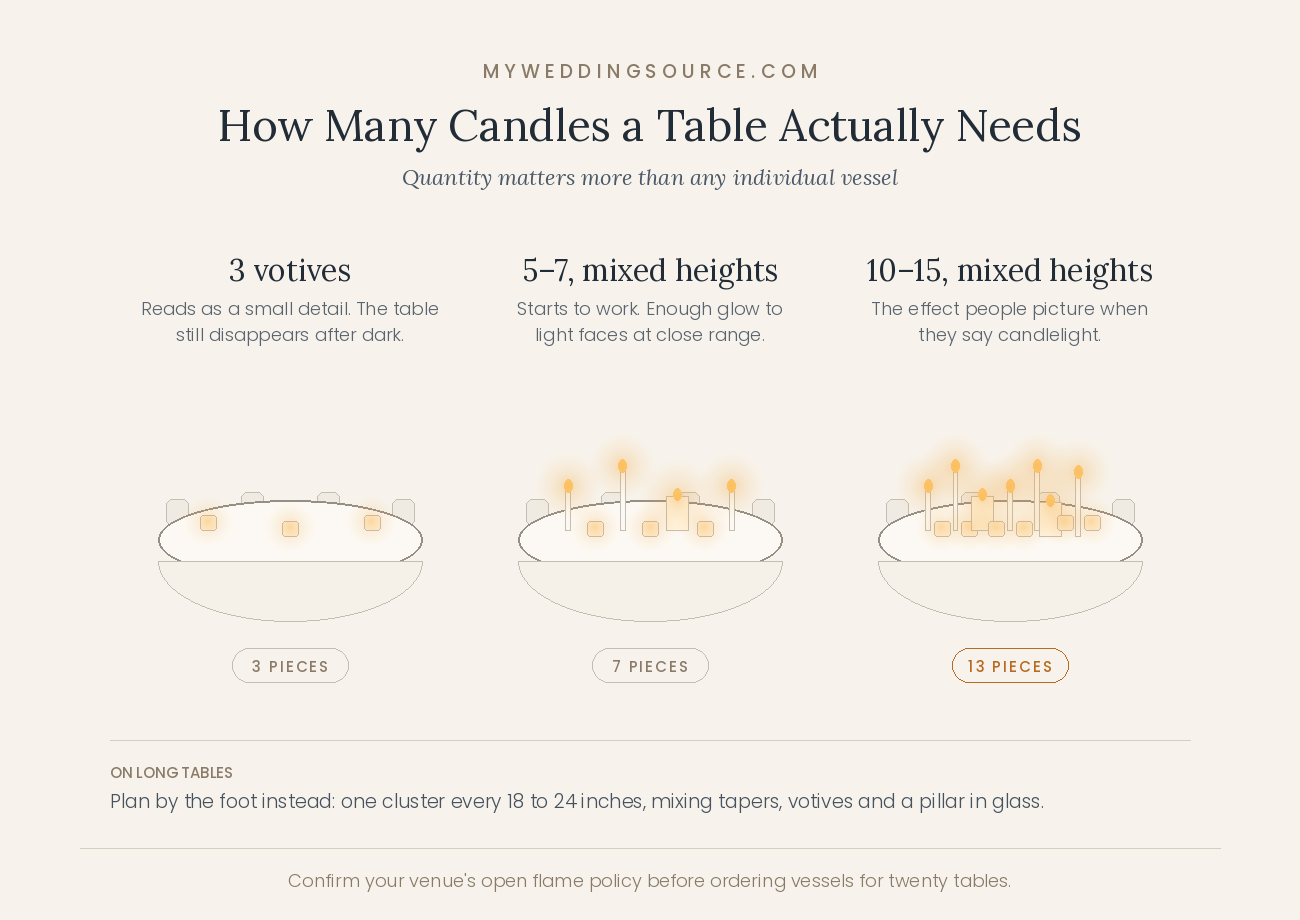
More than most couples first estimate. For a visible candlelight effect on a round table of eight to ten guests, something in the range of 5 to 15 pieces across mixed heights is typical: a few tapers for verticality, several votives scattered for glow, and one or two pillars in glass. On long banquet tables, plan by the linear foot rather than per table, roughly one cluster every 18 to 24 inches. Quantity matters more than any individual vessel, and cheap votives in good glass read better than a few expensive candlesticks alone.
Is uplighting worth it, or does it look dated?
It is worth it in warm white or amber, and it looks dated in saturated color. The dated association comes almost entirely from purple and blue washes at full intensity, which read as a school dance and land on every guest’s face in photographs. Amber uplighting grazing a wall looks architectural and flattering, and it is one of the least expensive ways to give a large room shape after dark. If you want color, ask your vendor for the lowest saturation that still registers.
What is the single best lighting purchase on a small budget?
Dimming control first, if your venue has it and it costs nothing. After that, pin spots on the dining tables. A pin spot costs a fraction of what the centerpiece on that table costs, and without one the centerpiece is close to invisible after dark. Third would be candles or small lamps in real quantity at table height. Perimeter uplighting and overhead installations matter, but they change the room rather than the thing guests are actually looking at.
Our venue does not allow open flame. What are the alternatives?
Battery table lamps are the strongest option, because they provide warm light at eye level and give slightly more usable illumination than candles do. Good battery candles with a warm flicker work well at a distance, particularly in lanterns or frosted vessels where the light is diffused. Combine either with warm ambient lighting and reflective surfaces such as mercury glass or a mirrored runner, which multiply whatever light sources you do have. Ask the venue whether enclosed flames are permitted even when tapers are not, since many policies allow one and not the other.
How do we keep a dark reception from looking dark in photographs?
Give the camera something to work with: warm light at table height, ambient light kept in a similar color temperature, and no strong colored washes near where people are photographed. Then tell your photographer the plan well in advance so they can bring appropriate equipment. If you want a genuinely dark, high-contrast room, that is a legitimate design choice, but it needs to be a shared decision with your photographer rather than a surprise on the night.
Can we hang anything from the ceiling?
It depends entirely on the venue, and the answer ranges from anything within a weight rating to nothing at all. Historic buildings, restaurants, and some hotels prohibit ceiling attachments outright. Ask during the walkthrough, get the answer in writing, and ask what the alternatives are, since freestanding structures can achieve similar effects at higher cost and with a larger floor footprint. Design nothing that hangs until this question is answered.
What does a lighting vendor actually do that we cannot do ourselves?
Aiming, rigging, power distribution, and control. Uplights can be placed by anyone; pin spotting requires hanging fixtures at height and aiming each one at a specific target, which is skilled work. A vendor also brings dimming control, appropriate cable runs, and the ability to make the room look the same after the first two hours. If your plan is candles and a few battery uplights, you may not need one. If it includes anything overhead or anything aimed, you probably do.
How do we make a plain hotel ballroom feel warm?
In this order: dim the house lights, add warm perimeter uplighting to define the walls, pin spot the tables, and put real quantity of candlelight or lamps at table height. Then use materials that absorb light rather than bounce it — velvet, linen, wood, greenery — to soften the room’s hard surfaces. Ceiling drape and chandeliers transform a ballroom most completely and cost the most; they are worth pricing but are rarely the first move.
Do we need to worry about heaters and lighting competing for power?
In a tent or at a venue without adequate electrical service, yes, and it is one of the most common winter planning failures. Heating draws far more power than lighting, and both are usually running at the same time. Ask whoever is sizing the generator to collect the load requirements from every vendor — caterer, band or DJ, lighting, heating — rather than estimating. Getting a larger generator is far cheaper than discovering the limit during dinner.
When should we finalize the lighting and decor plan?
Work backward from your venue’s site visit and your vendors’ lead times. A practical sequence is to confirm venue rules and power at booking, complete a lighting walkthrough at reception hour four to six months out, finalize the design and quantities eight to ten weeks out, and confirm install and strike times with every vendor four weeks out. The one thing to settle early is anything that hangs, since it depends on permissions that can take weeks to obtain.
Light the Room You Will Actually Have
The best winter decor plan is not the one with the most elements. It is the one built for a dark room, with light at the height where guests are looking, and with the rules, power, and install time confirmed before anything is ordered. A modest design that is well lit consistently looks better than an ambitious one that disappears at 6:00 p.m.
The decision sequence that keeps this manageable: confirm what the venue allows and controls, choose how you want the room to feel, buy the ambient layer, then the accent layer that makes your florals visible, then the decorative layer guests look at directly. Keep every source in a similar warm range, keep saturated color away from faces, and make sure transitions, steps, and paths are lit even when the room is not.
If your budget is tight, the order that produces the most visible result is dimmers, candles or lamps in quantity, and pin spots. That combination costs a fraction of drape or chandeliers and does more for how the evening looks and photographs.
Your next step
Book one site visit at the same hour your reception will run, with the house lighting set the way it will be on the day. Bring the question list above, photograph the room with your phone at each dimmer level, and ask the venue to write down the flame policy, the rigging rules, and your load-in and strike times. That single visit will tell you which of these concepts is actually available to you, and it will do it before you have spent anything.
