

Winter wedding venue heating is a safety system as much as a comfort feature: it covers where the heat comes from, how fresh air and exhaust leave the room, what powers it, who is allowed to touch it, and what happens when it stops, so it deserves real questions before you sign.
Quick answer
For winter wedding venue heating, ask five things in writing: what heats each room you will use, whether anything burns fuel and where its exhaust goes, whether the room has working carbon monoxide alarms, what runs on a generator and where that generator sits, and what happens if heat or power fails. Government guidance is consistent on the basics: keep generators outdoors and at least 20 feet from doors, windows, and vents, keep portable electric heaters at least three feet from anything that can burn, and never use a gas oven or a charcoal grill to warm a room. Tents, barns, and temporary structures usually have extra local rules, so involve the venue, the rental company, and the local fire authority.
Most couples picture a winter wedding as candlelight and a cold, clear night, then discover that the real planning work is practical: a room that is the right temperature for a person in a satin dress and a person in a wool suit, and for a grandparent who sits still for an hour. This guide treats winter wedding venue heating as a set of questions you can ask, a map you can sketch, and a few hard limits you should not negotiate. It is written for couples and planners who are not engineers, and it deliberately stops short of any instruction for installing, wiring, or adjusting equipment, because that work belongs to licensed professionals.
We are not electricians, HVAC technicians, fire officials, or physicians. Nothing here replaces the venue’s own safety rules, the manufacturer’s instructions, your local code, or advice from a qualified professional. What we can do is gather what public safety agencies say, translate it into wedding terms, and show you what to ask so that the answers come from people who are accountable for them. Our sources are listed at the end, along with the date we checked them.
What winter wedding venue heating really has to do
Heating a wedding sounds like one job, but it is at least five: raising the air temperature, keeping people from losing heat while they stand at doors and in photo lines, moving fresh air through a crowded room, supplying power to whatever makes the heat, and doing all of it without creating a fire or exhaust hazard. A venue can be strong on three of these and weak on two, and the weak ones are usually the ones nobody asked about.
Heat is a system, not a single heater
When a venue says “we have heat,” its winter wedding venue heating can mean a central furnace and ductwork serving every room, a few portable heaters plugged into wall outlets, a wood stove in one corner, overhead radiant tubes in a barn, or a rented tent heater with ducting. Each of these has different strengths, different failure modes, and a different person responsible for it.
The heat source
For winter wedding venue heating, the source is the equipment that makes the heat. Our heater-types section below explains the common categories, but the first question is simply what it is, who owns it, and when it was last inspected. Public safety agencies repeatedly recommend that heating systems and fuel-burning appliances be serviced by a qualified technician every year, so asking for the date of the last service is reasonable, not rude.
The distribution
Winter wedding venue heating also has to deliver heat that is made in one place to the people who need it. Ductwork, fans, doorways, and open floor plans all change how warm a particular chair feels. A venue with a strong furnace and a long cold hallway can still leave the ceremony row chilly, and guests seated near an exterior door or a big window may feel the cold more than guests in the middle of the room.
The exhaust and fresh air
In any winter wedding venue heating plan, anything that burns fuel creates exhaust, and exhaust needs a way out of the building. Anything that holds a crowd also needs some fresh air. These two facts are the heart of the ventilation conversation, and we give them their own section.
Who owns each part of the plan
Responsibility is often unclear until something goes wrong, so it helps to write the owners down. In most rentals the venue controls the building, its permanent heating, and its electrical service. A rental company controls any tent, flooring, or temporary heaters it supplies. A caterer controls cooking equipment. You and your planner control the layout, schedule, decor, and guest instructions.
What the venue usually controls
Ask the venue about the permanent heating and electrical service behind its winter wedding venue heating, the alarms, the exits, and any rules about heaters and open flame. If the building is old, ask whether there are rooms the heating does not reach and whether any are off limits. For general venue questions beyond heating, our venue questions guide is a good companion.
What rental companies and vendors control
Tent companies, heater rental companies, generator suppliers, caterers, and lighting vendors each bring equipment that draws power or burns fuel. Ask each one to put their equipment, placement, and operator in writing, and make sure the venue has seen the same list. Our vendor contract guide and rental planning checklist show how to keep those documents consistent.
What you control
On winter wedding venue heating, you control the schedule, the guest instructions about what to wear and when to arrive, the seating, and the decor. Those choices change how much heat the room needs and how safely it can be delivered, and they are covered later in this guide.
What this guide covers and what it leaves out
This guide is about the room, the heat, the air, the power, and the people. It does not cover snow removal, road conditions, or the broader contingency plan, which we cover in our winter wedding weather plan. It also does not size a generator for the whole event, which is the job of our wedding generator rental guide. Here we focus on what those guides leave open about winter wedding venue heating: how the heating, the ventilation, and the generator interact in a small, crowded winter room.
No installation or wiring instructions
We do not describe how to install, wire, connect, or repair heating or electrical equipment, and neither should a wedding blog. If a question can only be answered by opening a panel, running a gas line, or choosing a cord, it belongs to a licensed professional or the equipment supplier.
No universal limits
Occupancy limits, clearances for tents, and heater rules differ by city, county, and state, and they change when codes are updated. When we cite a figure from a local document, we label it as one jurisdiction’s rule and not a national standard. Your local authority decides what applies to your venue.
Know your building before you choose a heater
The right winter wedding venue heating plan depends first on what kind of space you are in. A modern banquet room, a drafty barn, and a rented tent need different questions, and the same heater can be fine in one and unacceptable in another.
A finished room with permanent heating
Hotels, banquet halls, restaurants, and many event venues have permanent heating, ventilation, and air-conditioning equipment that serves the room. This is the simplest case for winter wedding venue heating, though not a risk-free one.
Ask what zone the room is on
Large buildings often heat in zones, and a room that is empty most of the week may be set to a low temperature until someone raises it. For winter wedding venue heating, ask whether your ceremony and reception rooms are on separate zones, who controls the thermostat, and how far ahead the room must be warmed. A venue that has hosted winter events can answer this quickly.
Ask about doors and drafts
Winter wedding venue heating loses ground every time an exterior door opens. If guests, caterers, and photographers all use the same door, the room near that door will be colder than the rest. Ask whether there is a vestibule or second set of doors, and whether the staff can use a different entrance for deliveries.
Barns, halls, porches, and converted spaces
Many popular wedding venues were not built for winter events. Barns, lodges, boathouses, greenhouses, and converted warehouses may have high ceilings, large doors, and limited insulation, and their heating may be a collection of portable or fuel-burning units added over time.
High ceilings and open volume
In a barn, winter wedding venue heating has to cope with a tall room that holds a lot of air, and warm air rises. Ask how the venue heats the occupied level, whether it uses fans or radiant heaters, and what the room feels like on a cold evening with a full guest list. Our barn wedding venues guide covers the broader barn tradeoffs, and heating is one of the biggest.
Fuel-burning heaters in older spaces
Some older spaces use unvented or poorly maintained fuel-burning heaters. The U.S. Environmental Protection Agency lists unvented kerosene and gas space heaters among common indoor carbon monoxide sources, along with leaking or back-drafting furnaces, chimneys, and water heaters. If a venue’s winter wedding venue heating uses fuel-burning equipment, ask who inspects it and how exhaust leaves the room.
Tents and temporary structures
A tent adds a new set of rules because the structure itself can burn, the walls are thin, and the heat usually comes from rented equipment. Many cities and fire districts regulate tents above a certain size, and they may regulate heaters inside them separately.
Permits and approvals
As one example of how a local rule can read, the 2015 Seattle Fire Code chapter on temporary structures requires a permit and fire code official approval for tents over 400 square feet and requires heating equipment to be approved by that official. Your city may differ, and codes have been updated since that edition, so treat it as an illustration and ask your tent company and local fire authority what applies to you.
Who is responsible
For tent-based winter wedding venue heating, ask who pulls permits, who schedules inspections, and who is on site when the heaters run. A tent company that handles winter events regularly will know the local process. A company that does not know is a signal to ask the venue or the fire authority directly. We cover permits more broadly in our wedding permits guide, though this guide does not give legal advice.
Heater types and what each one asks of the venue
Heaters used for winter wedding venue heating differ mainly in what they burn, where the exhaust goes, and how much power they need. For winter wedding venue heating, those three facts decide most of the safety questions, so it helps to know the families by name even if you never touch one.
Electric heaters
Electric winter wedding venue heating turns power into heat at the point of use and do not burn fuel in the room, which is why they produce no combustion exhaust. They are common in finished rooms and in tents with strong power. Their limits are electrical and fire-related, not exhaust-related.
Portable electric space heaters
Federal fire and product-safety agencies give consistent advice for these. The U.S. Fire Administration says to place a space heater on a solid, flat surface, keep it at least three feet from anything that can catch fire, check the cord and plug for damage, and plug it directly into a wall outlet instead of an extension cord or power strip. The Consumer Product Safety Commission adds that a heater should never run unattended in a confined space. The CDC suggests models with automatic shut-off and non-glowing elements. Those are household instructions, and a venue may have stricter rules, but they are a good baseline to hold any heater to.
The circuit is the limit
An Army public-health article explains the electrical arithmetic plainly: a 15-amp household circuit can carry about 1,500 watts, and a 1,500-watt heater draws roughly 12.5 amps, so one such heater can nearly use up a circuit on its own. For winter wedding venue heating this means that the number of heaters a room can safely support depends on its electrical service, not on how many heaters the rental company can deliver. Questions about circuits and extension cords belong to the venue’s electrician, and the article itself notes that manufacturer instructions govern cord use.
Ducted and fuel-fired tent heaters
Large tents often get their winter wedding venue heating from a rented unit placed outside, with warm air carried in through temporary ducting. United Rentals, an equipment rental company, describes indirect-fired propane and diesel heaters as the common choice for large tents, installed by professionals, with the burner outside the tent so that combustion exhaust is not released into the guest space. We attribute this to the company because it is a seller’s description, but it matches the regulators’ emphasis on keeping exhaust out of occupied spaces.
Why indirect-fired matters
The safety logic is simple: the flame and the exhaust stay outside, and only warmed air comes in. Technical Safety BC, a Canadian regulator, says tent heaters should use a forced-air system that draws air through ducting from an external combustion chamber that vents exhaust to open air. It is a Canadian bulletin, but the principle is the same one U.S. fire authorities apply.
Direct-fired and open-flame units
United Rentals says it generally does not recommend direct-fired heaters for enclosed tents because of fire risk. As one U.S. local example, the Vancouver, Washington Fire Marshal’s guidance for tents and canopies lists salamander-type heaters, patio-type propane heaters, and infrared propane heaters as prohibited inside tents, and says portable outdoor gas-fired heaters may not be used inside tents at all. That is one city’s rule and not national law, but it shows how restrictive local authorities can be about the heaters that look most convenient.
Heaters that are not meant for guest spaces
Some winter wedding venue heating methods appear in decor photos or in a helpful relative’s suggestion and should not be part of a guest-space plan without explicit approval.
Gas ovens, grills, and camp stoves
The CDC states that you should never heat a space with a gas oven, never burn charcoal indoors, and never use portable gas camp stoves or flameless chemical heaters indoors. The reason is carbon monoxide, which we explain in the next section. If a caterer’s kitchen is warm, that is a byproduct of cooking in a ventilated kitchen, and it is not winter wedding venue heating for the dining room.
Open flames as warmth
Fire pits, fireplaces, and wood stoves feel warm and photograph well, but they add exhaust, sparks, and a crowd-control issue. If a venue has a working fireplace or stove, ask who tends it, how it vents, and what the clearance is from chairs and decor. The same applies to a fire pit on a patio near an exit. We would also treat candles as decor, not heat; the CDC recommends flashlights or battery lanterns over candles during outages because candles can start fires.
Ventilation and carbon monoxide: the hazard you cannot see
Carbon monoxide, usually shortened to CO, is the reason fuel-burning winter wedding venue heating and generators get so much attention from safety agencies. It has no smell and no color, and it can build up in a room before anyone realizes it.
What carbon monoxide is and where it comes from
OSHA explains that CO forms when fuels containing carbon burn incompletely, including natural gas, propane, kerosene, oil, gasoline, and wood. The CDC lists furnaces, generators, charcoal grills, vehicles, stoves, lanterns, fireplaces, and gas ranges as common sources. For winter wedding venue heating at a wedding, the realistic sources are a poorly vented heater, a fuel-burning heater placed inside a tent, a generator too close to the building, a vehicle idling near an intake, and kitchen equipment.
Why generators get special attention
The Consumer Product Safety Commission says portable generators are linked to more than 100 of the roughly 200 or more yearly U.S. deaths from consumer-product CO poisoning that are not caused by fire, and that one portable generator can produce as much CO as hundreds of cars. CPSC and CDC both say a generator should be used outdoors only, at least 20 feet from windows, doors, and vents, and the EPA warns that CO can linger for hours after a generator shuts off.
Vehicles and delivery trucks
The EPA lists vehicle exhaust from attached garages, nearby roads, or parking areas as an indoor CO source. At a winter event, delivery trucks, shuttle buses, and vendors warming up their vehicles near a door or air intake can add exhaust. Ask the venue where vendors may idle and whether any air intakes sit near the loading area.
Who is at higher risk, and why weddings are a special case
The CDC says everyone can be harmed by CO and that infants, older adults, and people with chronic heart disease, anemia, or breathing problems are more likely to become seriously ill. It also says that people who are sleeping or intoxicated can die before they notice symptoms. A wedding reception has older relatives, children, and guests who are drinking, which is why we treat winter wedding venue heating and ventilation as a planning topic and not a footnote.
Symptoms that look like something else
CO symptoms such as headache, dizziness, weakness, nausea, and confusion often resemble the flu, according to the CDC. At a long evening event, a headache and light-headedness are easy to blame on champagne, crowding, or tight shoes. If several people in the same area feel unwell at the same time, treat that as a reason to move people to fresh air and call for help, not as a coincidence.
What to do if something seems wrong
CPSC and CDC guidance is to get outside to fresh air right away and call 911. OSHA adds that rescuers can themselves be exposed to dangerous CO levels, so the right response is to move people out and call trained responders, not to send guests back inside to look for others. Name one person on your team, and one at the venue, who will make that call without waiting for a debate.
Alarms, maintenance, and fresh air
CO alarms are an inexpensive part of winter wedding venue heating compared with the risk, and agencies recommend them, but they are not a substitute for correct equipment and ventilation.
Carbon monoxide alarms
CPSC and the CDC recommend battery-operated or battery-backup CO alarms, and CPSC prefers interconnected alarms so that when one sounds, all sound. The CDC says to check batteries when clocks change and to replace alarms according to the manufacturer’s instructions, about every five years. Those are household recommendations, and commercial venues follow their own codes, so ask what the venue has, where it is, and when it was last tested. In a temporary or tent space, ask whether a portable alarm is provided; do not assume.
Maintenance and fresh air
The EPA says that maintaining and properly adjusting combustion equipment is the most important step, and that extra ventilation is a temporary measure for situations where high CO levels are expected for short periods. In other words, you do not fix a badly vented heater by cracking a window; you fix it by having a qualified person service it, move it, or remove it.
The comfort tradeoff
There is a real tension in winter wedding venue heating: you want to keep warm air in, and you also want fresh air and exhaust to leave. The CDC’s and EPA’s advice resolves it by putting combustion exhaust outdoors through proper venting and keeping fuel-burning equipment out of guest spaces, not by sealing the room tight. CPSC and the National Weather Service both say to keep outdoor furnace and appliance vents clear of snow, which is a good thing to ask the venue’s staff about before a storm.
Generators and winter wedding venue heating
Generators enter the picture in three ways: as backup for a venue that loses power, as the main power for a tent or remote site, or as power for specific vendors such as lighting or sound. Each use changes the winter wedding venue heating plan because heat, especially electric heat, is among the hungriest loads.
What a generator should and should not power
In winter wedding venue heating, a generator is only useful if you know what it runs. If it is meant to protect heat during an outage, you need to know whether it powers the furnace, the fans, the lights, the kitchen, or all of them, and how the connection is made.
Connection is a professional job
How a generator connects to a building is an electrical matter. CDC winter guidance says to plug appliances into a generator using individual heavy-duty, outdoor-rated extension cords, and says never to use a wet generator. For a venue’s permanent backup system, the connection is made by licensed electricians, and for a tent, it is made by the vendor who supplies the generator. Ask who is responsible, and ask to see the plan, not to be reassured verbally.
Heat versus everything else
When power is limited, something in your winter wedding venue heating plan has to give. If a generator cannot run the heaters, the lights, the sound system, and the caterer’s warmers at once, someone must decide which gets priority. We suggest deciding that before the day, in writing, with heat and exit lighting at the top. Our wedding generator rental guide walks through a load worksheet that you can use with vendors.
Placement, exhaust, fuel, and noise
Most of what agencies say about generators that support winter wedding venue heating is about where they sit. The rules are short and consistent.
Distance and direction
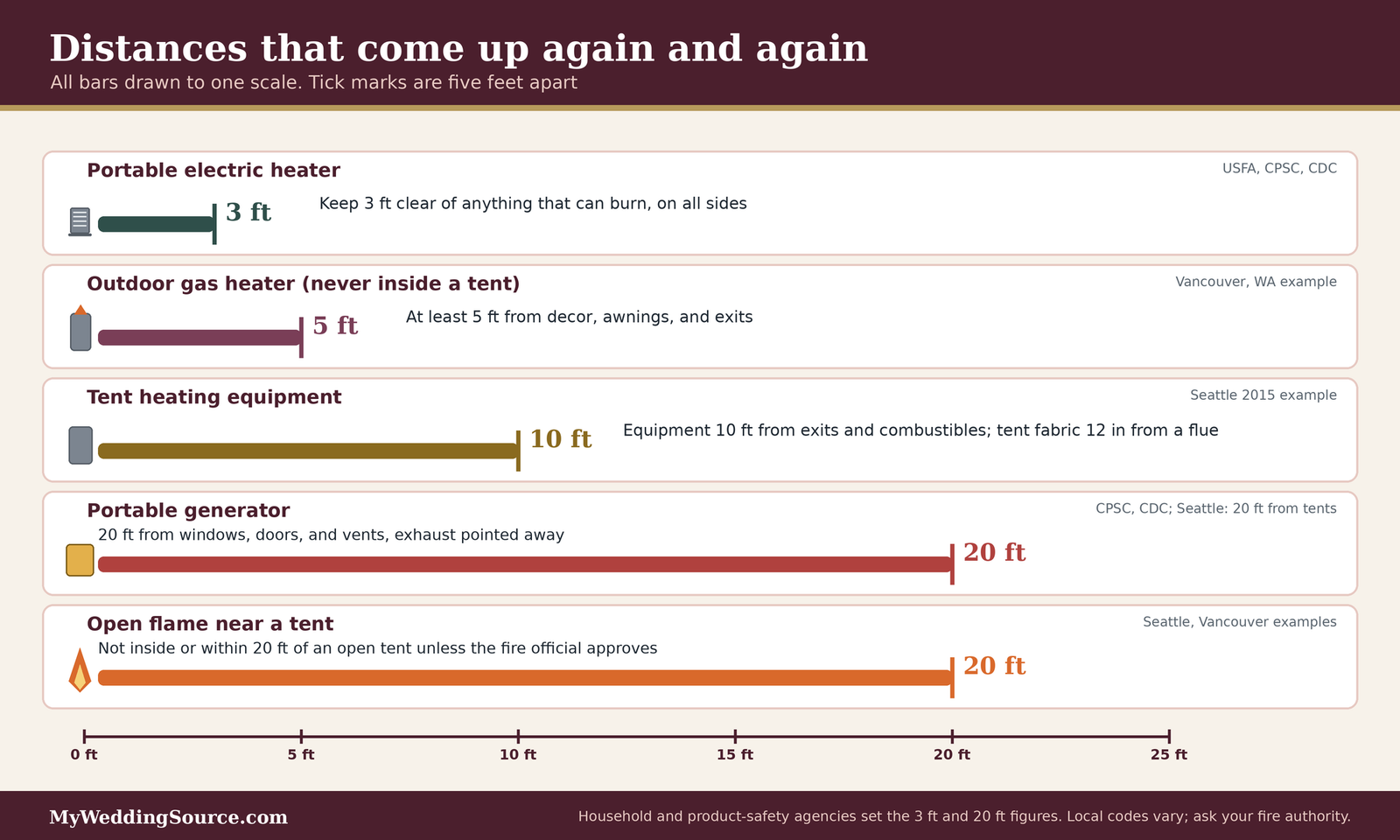
CPSC and the CDC say 20 feet from windows, doors, and vents, with exhaust pointed away from the building, and never in a garage, shed, or enclosed space, even with doors or windows open. Local fire codes can add their own distance from tents; the 2015 Seattle example puts generators at least 20 feet from a tent and says they must be isolated from the public. Both numbers appear in our figure below, which shows how much space that actually is.
Fuel and shutoff features
CPSC suggests choosing generators with a CO shut-off feature and notes that models certified to certain standards (PGMA G300-2018 and UL 2201) could substantially reduce CO deaths, according to its own report. The CDC says never to store gasoline indoors, and the Seattle code excerpt sets separate distances for refueling and fuel storage. Ask the supplier which model they deliver, who refuels it, and when.
Noise and the quiet zones
A generator and a heater fan are both continuous noise sources, and a ceremony, a toast, and a first dance each need a quiet room. We do not have a sourced noise figure for a typical wedding generator, so ask the supplier for a manufacturer noise rating at a stated distance, and ask where the unit will sit relative to the ceremony space. The map later in this guide shows how to put the loudest equipment farthest from the quietest moment.
Worked arithmetic: how much heat a tent might need
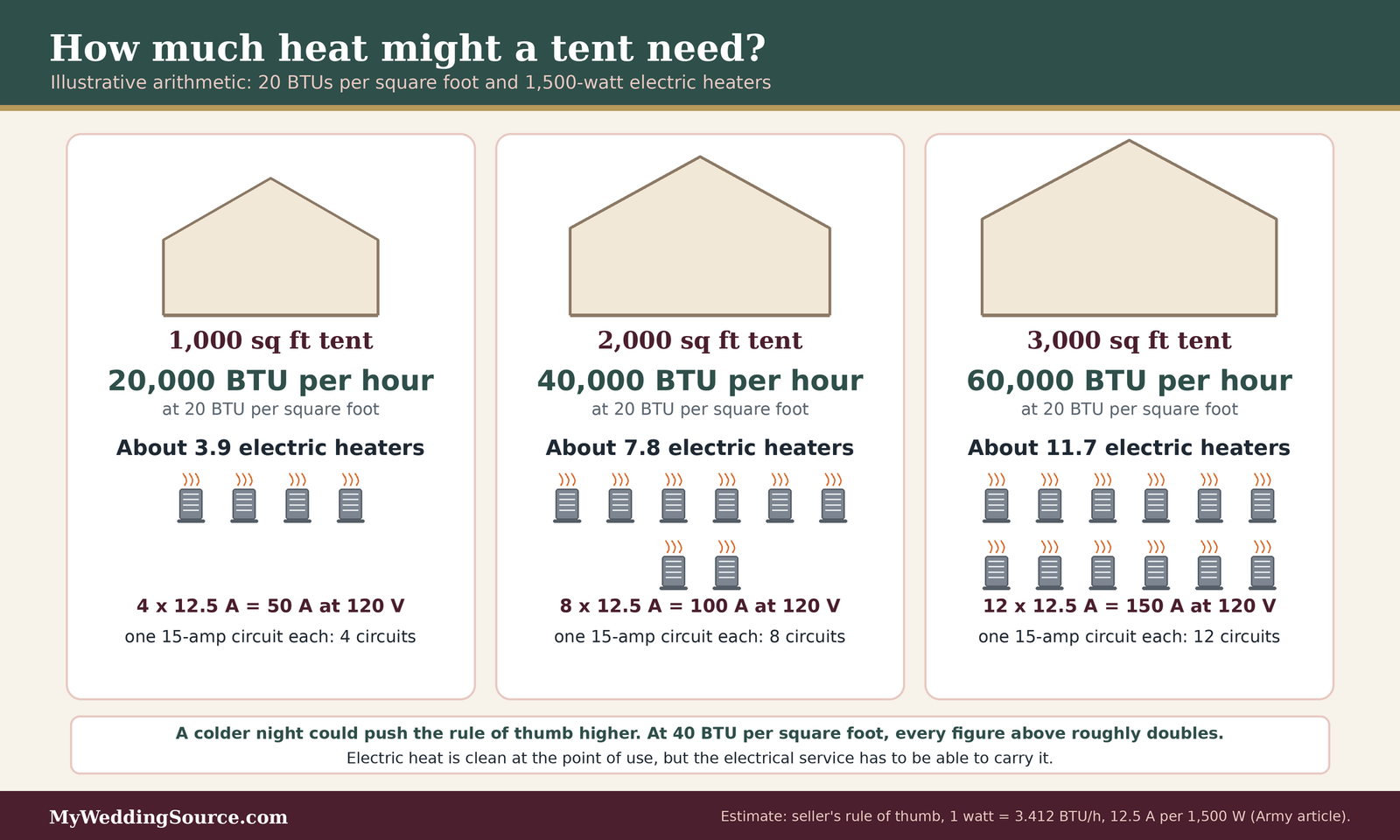
Heat load is a place where an estimate helps, as long as you label it as one. United Rentals gives a rule of about 20 BTUs per square foot as a starting point for a tent, adjusted by 10 to 20 BTUs for outside temperature, and says other factors such as altitude, tent material, guest count, and activity level also affect the load. A BTU is a unit of heat, and one watt of electric heating delivers about 3.4 BTUs per hour. These are our own conversions and a seller’s rule of thumb, not an engineering calculation.
An illustrative tent
Take a hypothetical tent of 2,000 square feet. At 20 BTUs per square foot the rule gives 40,000 BTUs per hour, and if the adjustment is applied upward for a very cold night, the figure could be much higher. A 1,500-watt electric heater delivers about 5,100 BTUs per hour, so replacing 40,000 BTUs with portable electric heaters would take roughly eight of them, and each draws about 12.5 amps. Our figure below shows how the heater count and the amperage climb with tent size.
What the arithmetic tells you
The point is not the exact number. It is that electric winter wedding venue heating for a tent is a large electrical project, which is why United Rentals says heaters large enough for a tent usually need a large generator and recommends asking the vendor about sizing and placement. It is also why ducted fuel-fired tent heaters exist. If a vendor proposes a dozen portable electric heaters on household circuits, ask how many circuits and what service that implies, and ask for the answer from a licensed electrician.
A small-room guest-flow map with sound zones
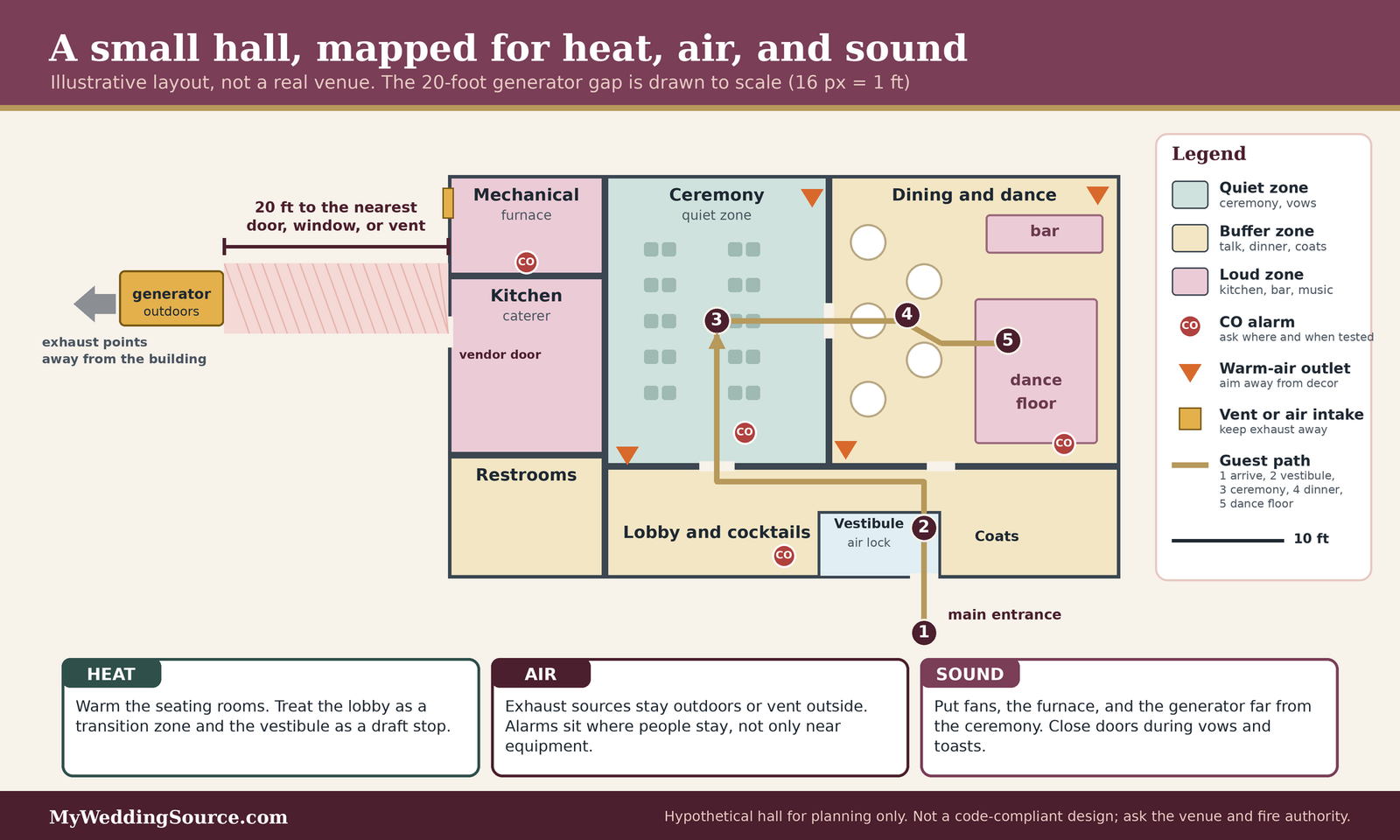
Most advice on winter wedding venue heating treats the room as one block of air. Real weddings move: guests arrive in coats, wait in a doorway, sit for a ceremony, mingle, eat, speak, and dance. A small venue, a house, a lodge, or a hall with a few connected rooms forces all of that through narrow spaces, and heat, exhaust, and noise all travel with the crowd. The map below is a planning aid we built for this guide. It is an illustrative layout, not a real venue and not a code-compliant design, and the only distance we draw to scale is the generator’s 20 feet.
How to read the map
The map shows a hypothetical sixty-by-thirty-six-foot hall with an entry vestibule, a coat area, a ceremony room, a reception room, a bar nook, a kitchen, restrooms, and a mechanical room. A numbered path follows the guest from the car to the dance floor. Colors mark three kinds of zones for winter wedding venue heating: heat, air, and sound.
The guest path
Follow the arrows from the parking area to the vestibule, then to the coat area, the ceremony room, the cocktail space, the dining room, and the dance floor. At each step ask three questions: is it warm enough for someone who just arrived, is there a crowd bottleneck, and does fresh air reach the people who will stay longest? Bottlenecks near exterior doors are where the cold air comes in and where people stand still in thin clothing.
The heat zones
Draw your own venue in three tones. A warm zone is where people sit for a long time, such as the ceremony room and the dining tables. A transition zone is where people pass through, such as the vestibule and hallways. A utility zone is where equipment lives, such as the mechanical room, the generator pad, and the kitchen. Safety attention goes to the utility zone, and comfort attention goes to the warm zone.
The air and exhaust markers
Mark every place that could add exhaust or smoke: a fuel-burning heater, a fireplace, a kitchen range, a generator, a vehicle loading area. Then mark every window, door, and vent nearby. The goal is to keep a clear gap between every exhaust source and every intake. On the map the generator sits outside, beyond the 20-foot line, with its exhaust pointed away from the building.
Sound zones and why heating belongs in the conversation
Sound zones are a planning idea for winter wedding venue heating, not a measurement. Think of three: a quiet zone where people need to hear a voice, a buffer zone where conversation is normal, and a loud zone where equipment and music live. We do not have decibel figures from a source for typical wedding heaters, so the zones are about relative position, not numbers.
Quiet zone: ceremony, toasts, and vows
These are the moments with the least tolerance for hum. Furnace blowers, heater fans, and generators can compete with a microphone or a quiet voice, and guests with hearing loss will notice first. Put the quiet zone as far as practical from the mechanical room, from any heater fan, and from the generator. If you are using a wireless microphone setup, see our wireless ceremony audio guide and our audio and lighting checklist for the questions to ask your audio vendor.
Buffer zone: cocktails and dining
Conversation tolerates more background noise than a ceremony does, which makes this zone a good place for ducted warm air outlets and fan-driven heaters, provided the outlets do not blow directly at seated guests or at candles and decor. A fan that blows on a table can cool food quickly and dry out a bouquet, so ask the caterer and florist where they want it directed.
Loud zone: kitchen, bar, mechanical, and music
The kitchen and bar already make noise and heat, and the DJ or band will fill the dance floor with sound that masks heater hum. Put equipment noise where it will be masked, and keep the doors between loud and quiet zones closed during the ceremony and toasts. Our DJ questions guide covers sound checks, and a sound check is the right moment to listen for heater and fan noise.
Using the map with your venue
A sketch of your winter wedding venue heating is most useful when it goes to the people who can answer questions about it. Print the map, draw your venue’s rooms on it, and bring it to the walkthrough.
Mark the heat sources and alarms
Ask the venue to point to each heat source, each exhaust path, each CO and smoke alarm, and each exit on your sketch. If they cannot, ask for a floor plan with those items marked. A venue that hosts events usually has one for its fire authority.
Keep exits clear
Heaters, drape, rental furniture, and extra tables tend to drift toward the walls and doors. Exits need to stay usable, and local code may set aisle widths and exit counts for your headcount. For the seating and aisle side of the plan, our reception floor plan guide and, for rooms that connect, our guide on planning a reception in a venue with multiple small rooms go deeper.
Clearances, decor, and fire safety around heat
Winter wedding venue heating and decor meet on the same walls. Draped fabric, greenery, paper, candles, and rental linens are all things a heater can ignite if they get too close, so this part of winter wedding venue heating is where the couple has the most control.
The three-foot rule and what counts
The most repeated number in heater guidance is three feet. The U.S. Fire Administration, CPSC, the CDC, and Ready.gov all say to keep space heaters at least three feet from anything that can catch fire, and CPSC says this applies to all sides. The Vancouver, Washington tent guidance applies the same three feet to people as well as combustible material, including the tent or sidewall fabric.
What combustible means at a wedding
Think beyond curtains when you plan winter wedding venue heating. Chair covers, table linens, silk and fresh greenery, paper programs and menus, wedding signs, lightweight arch fabric, tent walls, and wraps left on chair backs can all be within reach of a heater. A heater that is three feet from a wall can still be one foot from a draped chair cover if furniture is moved after the walkthrough.
Who moves things, and when
Assign one person, a planner or a venue staff member, to check clearances after setup and again after dinner when guests rearrange chairs. A heater that was placed correctly at four o’clock may be crowded by a coat rack and a gift table by nine o’clock. Our wedding decor guide covers decor choices; the rule of thumb here is to leave the heater’s surroundings plain.
Flame, candles, and heat-adjacent decor
Candles, lanterns, and other live flames are a common part of winter wedding styling, and they interact with heating in a few ways.
Candles near moving air
Moving air from a fan or ducted outlet can blow a flame toward decor, and drafts at doors can do the same. The CDC recommends battery-powered lanterns or flashlights in place of candles during outages. For a wedding, battery candles near heaters and greenery are a simple way to keep the look and drop the flame, and venues often have their own rules about open flame, so ask before you buy.
Open flame near tents
Tent codes are strict on open flame. Both the 2015 Seattle chapter and the Vancouver, Washington guidance prohibit open flame inside or within 20 feet of an open tent unless the fire official approves. Those are two local examples, but they explain why a tent company may refuse candles on tables or a fire pit by the entrance.
Exits, aisles, and temporary structures
A crowded room full of heaters is a room where people must be able to leave quickly. The details are local, but they are worth asking about.
Examples of what a local code can require
The 2015 Seattle chapter, as one example, sets a minimum number and width of exits that depends on occupant load, requires exit signs for 50 or more occupants, requires lighting at floor level along egress paths while the tent is occupied, and requires public aisles at least 44 inches wide. We cite it to show the type of requirement, not to tell you what applies to your venue.
Flame-resistance paperwork for tents
The same chapter requires certificates showing that tent fabric, sidewalls, floor coverings, and decorations meet a flame-resistance test standard before a permit is issued. A tent company should be able to supply its certificate, and decor that you bring in may also need to meet the local requirement. Ask before you order large fabric installations or a floor covering for a tent. If you plan hanging decor, ask the venue and the tent company what the structure may carry and how close anything may hang to a heater.
Cold bodies: comfort, vulnerable guests, and warning signs
Winter wedding venue heating is ultimately about people. A room can be technically warm and still be cold for guests who have just come in from a freezing parking lot or who sit by a drafty window. The CDC notes that older adults lose body heat more easily and that infants should not sleep in a cold room, and those groups are present at many weddings.
Arrival, doorways, and outdoor moments
Most of what winter wedding venue heating has to fight happens in transitions: waiting outside for a door to open, walking between buildings, standing for photos, and leaving at the end of the night.
Shorten the cold exposure
Ask the venue to open the doors on time, to provide a warm place for early arrivals, and to keep the path between parking and entrance clear. If photos are outdoors, schedule them in short sessions with warm-up breaks. The National Weather Service notes that wind speeds up heat loss, so a short outdoor portrait on a windy day is colder than the thermometer suggests. See our winter wedding weather plan for how to set weather triggers and for the daylight arithmetic.
Attire guidance
A short note on the invitation or wedding website can help guests dress for the venue’s actual conditions. Tell them if the ceremony is in an unheated or partly heated space, and suggest layers they can remove. NIOSH’s cold-stress guidance emphasizes several loose layers and protecting ears, hands, and feet. Wedding attire is not always practical for that, so a coat check and a basket of wraps for the bridal party can fill the gap.
Older adults, infants, and guests with health conditions
For winter wedding venue heating, the people most affected by cold and by CO overlap. The CDC lists older adults, infants, and people with heart disease or breathing problems among those at higher risk from CO, and it notes that older adults lose body heat more easily.
Seating by temperature
Put older or less mobile guests away from exterior doors, windows, and the vestibule, and away from fan outlets that blow cold or hot air on them. Do not put them next to a portable heater either, since clearance and cord hazards matter most in a crowded spot. Our guides for guests with walking aids and the accessible guest experience cover mobility needs in more detail.
Warning signs worth knowing
The CDC lists hypothermia warning signs in adults, including shivering, exhaustion, confusion, fumbling hands, memory loss, slurred speech, and drowsiness, and says a body temperature below 95 degrees Fahrenheit is a medical emergency. It lists frostbite signs as white or grayish-yellow skin, skin that feels unusually firm or waxy, and numbness. Some of these resemble the effects of alcohol and fatigue, so a designated person who stays sober and watches for them is worth appointing. This is general information and not medical advice.
A warm room for anyone who needs one
A wedding with winter wedding venue heating that runs several hours in a large or partly heated space benefits from at least one reliably warm, quiet place that guests can use without drawing attention.
Choose the room before you need it
Identify a small, well-heated room, such as a lounge, an office, or a bridal suite, that is away from the loud zone and not served by a fuel-burning heater unless it is properly vented and alarmed. Tell the venue manager and your coordinator where it is. Our lounge furniture rental guide can help if you need comfortable seating there.
Keep blankets and layers handy
Stock the warm room, and the coat area, with blankets or wraps. The NIOSH cold-stress page recommends warm break locations and extra socks, gloves, hats, and blankets for people exposed to cold. At a wedding this is a modest purchase that avoids a lot of discomfort. Our wedding emergency kit guide can help you fold it into a day-of bag.
If heat or power fails during the event
Most winter wedding venue heating plans work on a normal night. The plan that matters is the one for the night when a furnace locks out, a breaker trips, a generator runs out of fuel, or a storm takes the power. You cannot prevent every failure, but you can decide ahead of time what you will do.
Triggers and decisions
In a winter wedding venue heating plan, a trigger is something observable that starts a defined response. The point is to avoid a long group debate while guests get cold.
Pick observable triggers
Good triggers are things anyone can check: the venue reports a heating or power failure, a room feels clearly colder than the plan assumed, a CO alarm sounds, the generator stops, or the weather service issues a warning for your area. The National Weather Service safety pages are the place to check official alerts for winter hazards. Our winter wedding weather plan shows how to turn alerts into triggers.
Name one decision maker
Choose a single person, typically the planner or day-of coordinator, who may call the response, with a named backup at the venue. Write down what they may decide without asking you, such as moving guests to the warm room, pausing the program, ending the event early, or calling emergency services.
What to do in each failure
The right response to a winter wedding venue heating failure depends on what failed. These are planning principles, not instructions for repairing equipment.
If a CO alarm sounds
CPSC says that if an alarm sounds, get outside right away and call 911. Do not try to find the source or silence the alarm first. Move guests to fresh air at a safe distance from the building and have the venue contact responders. Do not let anyone re-enter until emergency personnel say so, and ask anyone with symptoms to be seen by medical staff.
If heat fails but the building is otherwise safe
The CDC’s winter guidance for power outages suggests closing off unused rooms, putting towels or rags in gaps under doors, and closing drapes to hold heat. At a wedding that translates to consolidating guests into one smaller room, keeping doors closed, and moving the most vulnerable guests to the warmest part of the building. Do not bring in a fuel-burning heater, a grill, or a camp stove to make up the difference. The CDC says never to run those indoors.
If a generator stops
Do not move it closer to the building to shorten a cord, and leave refueling and restarting to the generator vendor. Ask the vendor beforehand who is on call, how fast they can respond, and whether a second unit is available. For tent events, ask whether a spare heater or an alternate warm space is included.
Communication and ending early
A plan that works but is invisible to guests still produces confusion.
Tell guests what is happening
Have a short script ready for the host or DJ: what has happened, what guests should do, and where the warm room is. Calm, specific instructions prevent rumors. Keep the tone practical and brief.
Decide what “shorten the event” means
Agree in advance on what gets cut first and what must happen no matter what. A shorter program, an earlier cake cut, or a shorter dance block can keep the day meaningful while protecting people. If roads are a concern, our guides on guest transportation planning and the wedding venue rain plan discuss how to help guests leave safely and how to think about backup space.
Contracts, permits, insurance, and cost
Winter wedding venue heating and power are easy to leave out of a contract because they feel like part of the building. Put them in.
What to put in writing
A contract can name responsibilities that would otherwise be assumed. We are not lawyers and cannot read your contract, so these are topics to raise with the venue and, if you wish, with a legal professional.
Heat and power commitments
Ask the venue to describe, in writing, the heating for each space you will use, the temperature range it can maintain in the conditions you expect, the backup power arrangements, and who pays if a rental heater or generator is needed. Our contract change orders guide explains how to document a change, and the vendor due diligence checklist helps you check that each vendor is licensed and insured.
Operator and liability language
Ask who operates each heater and generator, who is liable for damage or injury caused by supplied equipment, and whether the vendor carries insurance. Ask the venue and tent company to name any inspections or permits they have obtained. These are questions, not a guarantee of any answer.
Permits and inspections
Local authorities decide what permits winter wedding venue heating needs, such as a temporary heater, a generator, or a tent requires, and the answer varies widely.
Who to ask
Start with the venue and the tent or equipment company, and confirm with the local fire marshal or building department if you are unsure. As one example, the Vancouver, Washington Fire Marshal guidance says the fire code official approves heating equipment and open-flame exceptions and that temporary power for heaters must be approved by the building official. Your city may assign these differently. Our wedding permits guide explains the general landscape.
Timing
Permits and inspections take time. Ask early, and keep a copy of any approval at the event. The Seattle chapter, for instance, calls for inspections during the permit period for longer-term tents, and a fire official may require someone to be on site. Those details differ by place, so ask what your venue’s process is.
Cost and insurance
What this might cost, and how to estimate it
We did not find a reliable, sourced national price for winter wedding venue heating, and quotes vary with region, season, tent size, fuel, and delivery distance, so we do not publish one. Ask each vendor to price these items separately: heater rental, ducting and installation, fuel and refueling, generator rental and operator, extra lighting, a second warm room, a coat check attendant, and any permit or inspection fees. To estimate your own total, use simple arithmetic: for example, if a heater company quotes a hypothetical rate of X dollars per heater per night and you need eight heaters, the rental alone is 8 times X. Add the other lines, then compare the total with what a cold, shortened event would cost you. This is not financial advice.
Where money tends to hide
Costs people forget in winter wedding venue heating are fuel delivery, a technician to be on call, the venue’s winter fee, the second generator, and overtime if setup starts early so the room can warm in time. Our venue cost guide and vendor overtime guide help you find them.
What insurance may and may not cover
Event insurance varies and often has exclusions. Read the policy for weather, equipment failure, and utility outage language, and ask the insurer or broker, not a blog, what is covered. Our wedding insurance guide explains the basics, and this guide does not give insurance or legal advice.
Edge cases that change the plan
The standard advice on winter wedding venue heating fits a standard venue. These situations are common enough to deserve their own thinking, and each one pushes a different question to the top.
Old, rented, or unusual buildings
Some of the most charming winter venues are the ones with the least predictable heating.
Historic buildings and churches
Older buildings may have heating that cycles on a schedule, radiators in some rooms, or forced air that is noisy. Ask whether the system can be set to warm the space well before guests arrive and whether turning it up affects noise during the ceremony. Ask also whether the building has restrictions on temporary heaters, flame, or electrical load, because historic structures often have special rules.
Rented houses and lodges
A house or lodge rented for a weekend may have winter wedding venue heating that includes a wood stove, a fireplace, a gas range, and a garage. These are exactly the CO and fire sources that the CDC and EPA describe. Ask the owner when the chimneys and appliances were last inspected, check that working CO alarms are present, and do not use the gas range or a grill for warmth. If the owner cannot answer, consider a smaller guest list in the building or a different venue.
Outdoor and semi-outdoor spaces
Partially enclosed spaces are where winter wedding venue heating rules tend to be least obvious.
Covered patios and porches
Technical Safety BC notes that “outdoor” has a narrow meaning for heater certification, and that screened walls count as walls. In plain terms, a patio with several enclosed sides may be treated as an indoor space for heater purposes. Ask the venue or fire authority how they classify the space before you bring in a patio heater.
Outdoor heaters near entrances
Vancouver’s tent guidance requires outdoor gas-fired heaters to stay at least five feet from combustible decorations and from exits. Even where heaters are allowed outside, a crowd at the door is a bad place for hot equipment. Keep the heater away from the traffic path and ropes, and ask who watches it.
Very small and very large events
Scale changes the risk profile of winter wedding venue heating.
Micro weddings and home weddings
A small wedding in a home often relies on a household furnace, a few space heaters, and a fireplace, all of which fall under the household safety guidance we have quoted. The advice is the same: alarms working, clearances respected, no gas oven or grill for heat, and no overloaded outlets. Our micro wedding planning guide covers other aspects of small events.
Large tents and multi-room events
Large tents and multi-room venues multiply the number of heat sources, exits, and people who can be in the wrong place. Ask for a written site plan, a named safety contact for the event, and a walkthrough with the fire authority if one is required. Our outdoor wedding infrastructure checklist and wedding venue capacity guide provide more on planning around headcount.
Questions to ask before you sign
Good questions about winter wedding venue heating are specific. Bring this list to the walkthrough, write down who answered, and keep the answers with your contract.
Questions worth asking about winter wedding venue heating
- What heats each room we will use, and who controls the thermostat or equipment?
- When was the heating system last serviced, and by whom?
- Does anything burn fuel in or near our spaces, and where does its exhaust go?
- Where are the carbon monoxide and smoke alarms, and when were they last tested?
- What heaters will the venue or rental company bring, and who operates them?
- How many circuits or what electrical service supports them?
- Is a generator planned, what does it power, where will it sit, and who fuels it?
- What happens if heat or power fails, and who decides?
- Which permits or inspections apply, and who is obtaining them?
- Where is the warm backup room, and how do guests get there?
About the building
These questions help you understand the space before you judge its winter wedding venue heating equipment.
Heating and airflow
Ask how long the room takes to warm, whether it holds heat near doors, and where the cold spots are. Ask to visit on a cold day if possible, since a summer walkthrough tells you little about winter comfort.
Alarms and exits
Ask to see the alarms and the exits, not just hear about them. Check that exit routes are clear and that anything you plan to add, such as lounge furniture or a photo booth, will not block them.
About equipment and vendors
These questions help you align vendors with the venue’s winter wedding venue heating plan.
Heaters and power
Ask each vendor to list the equipment they bring, its fuel or power requirement, its placement, and who is on site. Ask what their safety rules are and whether they are listed or certified for their use. Ask to see documentation.
Generators and noise
Ask for the model, the fuel, the placement relative to doors and vents, the noise rating at a stated distance, and the refueling plan. Our generator rental guide provides a worksheet and a longer list of questions.
About the plan and the paperwork
These questions help you get commitments, not impressions.
Backup and communication
Ask the venue to describe how it handles an outage, who calls it, and how guests are told. Ask to see the backup space, since a plan that looks good on paper may not match a locked or unheated room.
Written answers
Ask for answers by email or in an addendum, and keep them with your contract. If someone declines to answer a safety question, that is information too, and it may be a reason to reconsider.
FAQ: winter wedding venue heating questions
Heaters and fire safety
Are portable heaters allowed at a wedding?
It depends on the venue and the local fire authority. Government guidance says to keep electric heaters at least three feet from anything that can burn, plug them directly into a wall outlet, and never leave them unattended in a confined space. Ask the venue and rental company what is allowed, and get the answer in writing.
Can we use propane patio heaters inside a tent?
Often not. One local fire marshal’s guidance prohibits patio-type propane heaters inside tents and bars outdoor gas-fired heaters from tents entirely. A rental company also says it generally does not recommend direct-fired heaters in enclosed tents. Rules vary by place, so ask the tent company and your local fire authority before planning one.
Carbon monoxide and ventilation
Do we need carbon monoxide alarms at a winter wedding?
Ask for them wherever anything burns fuel or a generator runs nearby. CPSC and CDC recommend battery-operated or battery-backup alarms in homes, and venues follow their own codes. Ask what the venue has, where it is, and when it was last tested, and ask whether a portable alarm is provided in a tent.
Is it safe to crack a window if a heater smells strange?
Do not rely on a window. The EPA says correct maintenance of combustion equipment is the most important step and that added ventilation is only a temporary measure. If an alarm sounds or guests feel dizzy or ill, move people outside and call 911 instead of trying to ventilate the room.
Generators and power
How far should a generator be from the building?
CPSC and the CDC say at least 20 feet from windows, doors, and vents, with the exhaust pointed away, and never in a garage or enclosed space, even with doors open. Local codes may add distances from tents. Ask the vendor where the unit will sit and who is responsible for fueling.
Can a generator run all the heaters in a tent?
Possibly, but only if it is sized for the load. Electric heaters large enough for a tent usually require a large generator, according to one rental company, and a single 1,500-watt heater draws about 12.5 amps. Ask the vendor for a written load calculation, and ask a licensed electrician to review it.
Planning and guests
What should we do if the heat goes out mid-reception?
Follow your plan: gather guests in the warmest room, close doors, and shorten the program if needed. Do not use a gas oven, grill, or camp stove for warmth. If a carbon monoxide alarm sounds, go outside and call 911. Name one decision maker beforehand so the response is quick and calm.
How warm should the room be for guests?
We could not find an official comfort target for wedding rooms, so we do not give one. Ask the venue what temperature range it can hold in your expected conditions, and consider older adults, children, and people in thin formal wear. Plan a warm backup room so anyone who is cold has somewhere to go.
Turning the answers into a plan
Answers about winter wedding venue heating only help if they end up somewhere you will look again. This short section shows where to keep them.
Make the plan concrete
Turn the questions into dates and owners so that nothing is left to the week of the wedding.
Put a date on each question
Assign each question a person and a due date, and put them in your planning checklist. Our wedding planning checklist and wedding vendor timeline guide can hold them.
Keep a running safety file
Keep one folder with the venue’s answers, the vendor equipment lists, permit copies, and the map you drew. Share it with your planner and your venue contact.
Know your limits
A planning file for winter wedding venue heating is not a safety inspection. It records what people told you, so you can check it against what you see on the day.
Trust what you can see
If the room feels wrong, an alarm is missing, or a heater is crowded by decor, say so to the venue contact. Guests will not argue with a calm request to move a chair.
Leave the technical work to professionals
No one in the wedding party should adjust gas, wire, or generator equipment. Call the venue or the vendor, and call 911 for any emergency.
Your next steps
Before you book the venue
Ask the five core questions
Ask what heats each room, whether anything burns fuel and where the exhaust goes, whether alarms are present, what a generator runs and where it sits, and what happens in a failure. Write down the answers and who gave them. For wider venue comparisons, use our venue questions guide.
Visit in cold weather if you can
A winter visit shows drafts, cold spots, and the noise of the equipment when it runs. Bring the map from this guide and mark what you see.
After you book
Put the answers in writing
Ask the venue and each vendor to confirm heat, power, placement, operators, and failure plans in an addendum, and keep the documents with the contract. If something changes, use a change order.
Build the day-of plan
Name the decision maker, the warm room, the alarm locations, and the script for guests. Share it with your planner, the venue, and your vendors a week before the wedding, and review the weather outlook with our winter wedding weather plan.
Sources & methodology
How we built this guide
What we relied on
This guide combines public-agency guidance on carbon monoxide, generators, portable heaters, and cold-weather safety (CDC, CPSC, EPA, OSHA, U.S. Fire Administration, Ready.gov, and the National Weather Service), two local fire-code documents used only as examples of what a local authority can require, a Canadian regulator’s bulletin on gas heaters in tents, and a rental company’s and an Army public-health article’s descriptions of tent heater types and heater circuit loads. Where a statement comes from a seller, we say so, because sellers describe their own products. The heat-load and amperage figures in the figures are our own arithmetic from a rental company’s rule of thumb and standard unit conversions, and they are estimates. The layout in the guest-flow map is a hypothetical illustration and not a real venue or a code-compliant design. We checked the sources listed here in November 2026, and pages change, so confirm current versions before you rely on them.
What we did not do
We did not inspect any venue, test any equipment, or read your contract. We did not give electrical, gas, fire-code, legal, insurance, or medical advice, and nothing here is a substitute for your venue, your local fire authority, a licensed professional, or a clinician. Local codes differ and change, and the Seattle and Vancouver documents we cite are examples of one city’s rules, not national standards.
Source list
Government and regulatory sources
- Centers for Disease Control and Prevention, About carbon monoxide poisoning: https://www.cdc.gov/carbon-monoxide/about/index.html
- Centers for Disease Control and Prevention, Safety guidelines during and after a winter storm: https://www.cdc.gov/winter-weather/safety/stay-safe-during-after-a-winter-storm-safety.html
- Centers for Disease Control and Prevention, NIOSH, Cold stress: https://www.cdc.gov/niosh/cold-stress/about/index.html
- U.S. Consumer Product Safety Commission, Carbon Monoxide Information Center: https://www.cpsc.gov/Safety-Education/Safety-Education-Centers/Carbon-Monoxide-Information-Center
- U.S. Consumer Product Safety Commission, Winter weather safety tips on carbon monoxide and fires (January 3, 2025 release, as reproduced by PR Newswire): https://prnewswire.com/news-releases/as-winter-weather-impacts-millions-cpsc-issues-safety-tips-to-help-families-prevent-carbon-monoxide-poisoning-and-fires-302342148.html
- U.S. Environmental Protection Agency, Carbon monoxide’s impact on indoor air quality: https://www.epa.gov/indoor-air-quality-iaq/carbon-monoxides-impact-indoor-air-quality
- Occupational Safety and Health Administration, Carbon monoxide fact sheet: https://www.osha.gov/OshDoc/data_General_Facts/carbonmonoxide-factsheet.pdf
- U.S. Fire Administration, Portable heater fire safety flyer: https://www.usfa.fema.gov/downloads/pdf/publications/portable_heater_fire_safety_flyer.pdf
- Ready.gov, Winter ready heating fire safety handout: https://www.ready.gov/sites/default/files/2023-12/ready-gov_winterready_heating-fire-safety-handout_0.pdf
- National Weather Service, Weather safety for all hazards: https://www.weather.gov/safety
- National Weather Service, Winter safety one-pager: https://www.weather.gov/media/twc/WinterSafety-OnePager-2-27-19.pdf
Local code examples and a Canadian regulator
- City of Vancouver, Washington, Fire Marshal’s Office, Heating and cooking inside tents and canopies (2020): https://www.cityofvancouver.us/wp-content/uploads/2023/08/fmo_heating-cooking_inside_tents_and_canopies.pdf
- City of Seattle, 2015 Seattle Fire Code, Chapter 31, Temporary structures: https://www.seattle.gov/documents/Departments/SDCI/Codes/SeattleFireCode/2015SFCChapter31.pdf
- Technical Safety BC, Information bulletin on gas-fired heaters used indoors: https://www.technicalsafetybc.ca/alerts/gas-fired-heaters-used-indoors
Industry and public-health explainers
- United Rentals, How to choose event tent heater rentals (a rental company’s description of its own equipment): https://www.unitedrentals.com/project-uptime/equipment/event-tent-heaters-how-choose-heater-rentals-events
- U.S. Army, Electrical space heaters: https://www.army.mil/article/69664/electrical_space_heaters
- Minnesota State Fire Marshal, Portable heater tips: https://dps.mn.gov/divisions/sfm/fire-safety/fire-safety-tips/portable-heater-tips