
Wedding dress stain removal on the day itself is mostly a matter of doing very little, doing it gently, and writing down what happened, because the person who will eventually clean the gown can do far more with an honest record than with a dress someone has already experimented on.
Quick answer
For most spills, the safest wedding dress stain removal plan has three moves and a stop sign. Blot with a clean white cloth, never rub. Absorb liquids and oils with plain cornstarch or baby powder, then brush it off. Stop there and keep the rest for a professional, especially on silk, lace, beads, or anything dry-clean-only. Write down what was spilled, where, and when, because trade and conservation sources say the cleaner needs that information even if the mark is no longer visible. Bridal blogs also suggest vinegar, rubbing alcohol, or peroxide; those are higher-risk, and a conservator we cite advises against pre-mixed stain removers. We cannot guarantee any result on any fabric.
Wedding dress stain removal is a handoff problem
Most advice about wedding dress stain removal reads like a chemistry lesson: this product for wine, that one for lipstick. The trouble with most wedding dress stain removal advice is that the person standing in a hallway at a reception does not know the fiber, the dye, the finish on the beads, or what the cleaner will do next. What that person can control is how much the stain is disturbed, and how much is known about it afterward.
This guide treats the whole thing as a handoff between three groups of people: the one who is wearing the dress, the helper and photographer who see what happens during the day, and the professional who takes over afterward. Each handoff has a job, and getting those jobs right matters more to wedding dress stain removal than any single trick.
Why the dress has two lives
A wedding gown spends a day being worn, hugged, seated, danced in, and photographed. Then it becomes an object that needs to be cleaned, boxed, or kept. Decisions made in the first life shape what is possible in the second, and wedding dress stain removal sits in both.
The day: keep the damage small
During the wedding, the goal is a gown that looks right in photographs and does not get worse. A small mark on a train that no one will see at the reception does not need to be solved at the reception. One bridal-industry article we read, by a textile conservator, says most wear, such as stains, rips, and tears, can be fixed by a textile professional afterward, so brides need not worry about the dress’s condition during the wedding itself.
The weeks after: give the cleaner a fair start
After the wedding, the goal changes. The Drycleaning & Laundry Institute (DLI), a trade association, recommends professional cleaning as soon as possible and says that stains left in during storage can permanently discolor the gown, weaken fibers, attract insects, and cause yellowing. That is the reason a calm wedding dress stain removal plan during the day feeds directly into a prompt, well-briefed cleaning afterward.
Who needs which piece of information
Information gets lost at wedding handoffs the same way it does anywhere else: everyone assumes someone else wrote it down, and wedding dress stain removal is no exception. It helps to say plainly who needs what.
The helper needs a script
The bridesmaid, mother, or hired attendant who is closest to the dress needs a short script: blot, powder, find the photographer’s cue, stop. A helper who has the wedding dress stain removal script will not start improvising with whatever is in the bathroom cabinet. We cover the physical kit in our wedding emergency kit guide; this article is about what to do with it and what to hand over later.
The cleaner needs a history
For wedding dress stain removal, the cleaner needs to know what was spilled, where on the gown, roughly when, and what was applied to it. DLI’s consumer guidance says to tell your cleaner what was spilled even if you can no longer see the stain, and to give as much detail as early as you can. A trade writer in a cleaning-industry trade publication makes the related point that a cleaner should give a realistic assessment of the likely result before going ahead, which is only possible when the history is honest.
What the sources agree on, and where they split
Reading across bridal publications, extension-service stain guides, a conservator, and a trade association, the same few ideas keep showing up, and then the advice diverges. Knowing where the line falls helps you choose how much to do.
Where they agree
Every source we read says to blot instead of rubbing. Most say to test any product on a hidden spot, to avoid heat, and to wait for a professional when you are unsure. Several, including the DLI and a conservator quoted by The Bridal Council, add that water can set certain stains or change the texture of delicate fabrics such as chiffon and organza. Nearly all agree that the gown should go to a professional soon after the wedding rather than being stored as it is.
Where they split
The split is about home solutions. WeddingWire’s expert-sourced article and Zola’s tips suggest things like white vinegar or lemon juice with a drop of dish soap for wine and coffee, rubbing alcohol for makeup, and hydrogen peroxide for blood. The conservator in The Bridal Council piece, and DLI, lean the other way: powder and blot, then leave the rest. DLI specifically advises against household cleaners, stain sticks, and quick-fix products, because they can make professional removal harder. In this guide we describe both positions and attribute each, then give a ladder that starts with the lowest-risk step and tells you where to stop.
Know your dress before anything spills
For wedding dress stain removal, the best time to learn what your gown is made of is before the wedding, not while holding a wet napkin. A short conversation with the salon and a careful look at the label settle most of the questions that matter on the day.
Fabric and trim decide the risk
Fiber content changes how a spill behaves. A WeddingWire article quotes a bridal salon perspective that natural fibers like silk absorb spills more than artificial fibers do, which can make stains harder to remove. Zola’s advice is to ask the seller about the fabric, the embellishments, any care instructions, and any treatments to avoid.
Smooth silk, satin, chiffon, and organza
Smooth, fine fabrics show water rings and texture changes more readily. The conservator quoted by The Bridal Council says that delicate fabrics like silk chiffon and organza can change texture when wet, and warns against applying water or seltzer to a spill. Cornell University’s cooperative extension stain bulletin also advises against chlorine bleach on silk, wool, and spandex, and Texas A&M AgriLife’s guide repeats the point for silk, wool, spandex, and non-colorfast garments.
Lace, beads, sequins, and glued trims
Embellishment is where wedding dress stain removal gets risky, because the trim can be damaged by the treatment even when the stain is not. DLI notes that specialized trim may need to be removed and reattached for proper cleaning, and the Federal Trade Commission’s care-labeling guidance gives beads damaged by dry cleaning as an example of a case where a manufacturer needs testing to support care instructions. In practice, that means you should not scrub anything with beads or glued appliqué, and you should ask the cleaner about it before the wedding if you can.
The care label tells you less than you hope
Every gown sold in the United States by a manufacturer or importer is generally expected to carry care information. But the label is a starting point, not a plan for a spill.
How to read the label
The FTC’s Care Labeling Rule requires a permanent label for most textile apparel with either a washing or a dry-cleaning instruction, and requires a warning when a consumer could reasonably use a part of the care procedure that would harm the item. A label that says “Dryclean Only” means the item cannot be washed, according to the FTC’s business guidance. A label that says “Professionally dryclean” must name the modification, such as “No steam,” to comply with the rule. If a garment cannot be cleaned safely by either method, the label has to say so.
What the label does not cover
The label describes regular care and says little about wedding dress stain removal. It is not a guide to treating a glass of red wine in a hallway, and the FTC says a warning is not required for alternative procedures that are not on the label. The FTC also notes that dry cleaners are not required to follow the care label; using a method that is not listed carries risk, and a customer who asks for it may be asked to sign a consent form. Keep that in mind when you talk with a cleaner later.
Where wedding dress stain removal problems actually land
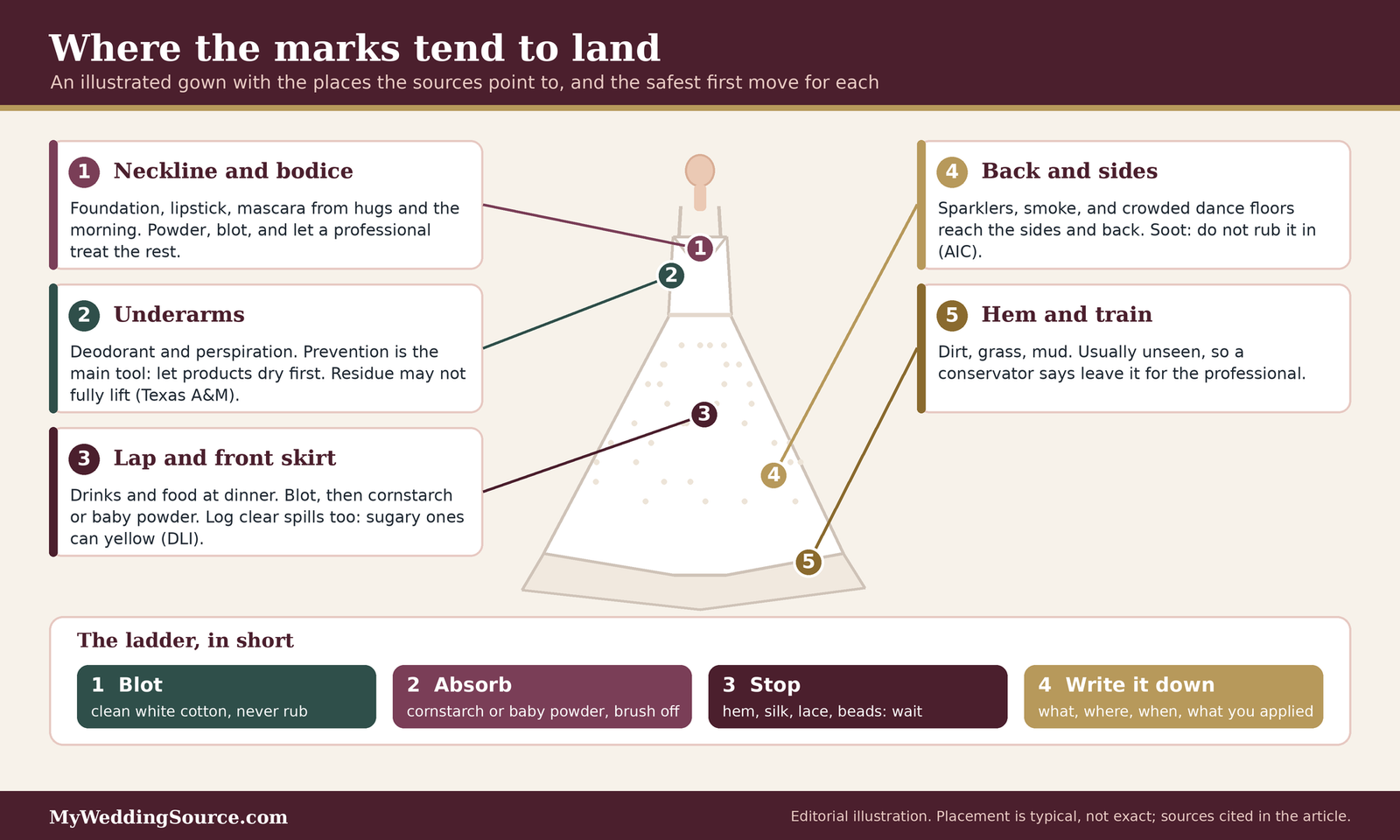
Stains on gowns are not randomly distributed. The conservator in The Bridal Council article observes that grass stains are usually at the hem and rarely visible. The ones that cause trouble tend to cluster in a handful of places, shown below.
The hem and train
The hem and train touch floors, grass, sidewalks, and shoes. Dirt, mud, and grass are the typical story here. Because these marks are low on the dress and often hidden by a bustle, bridal publications suggest waiting for a professional after the wedding instead of working on them in the moment. WeddingWire’s article makes this suggestion for the train and other less visible areas. Our wedding dress train lengths and hem length for flats versus heels guides explain how the hem decides how much floor the dress meets.
The bodice, underarms, and neckline
The upper half collects different things: foundation and makeup at the neckline, deodorant and perspiration near the underarms, and food or drink that lands in the lap or on the front of the bodice. Perspiration is the quiet one. DLI says food and drink spills, body oils, perspiration, and makeup can damage fabric right away, and that even a gown that looks clean is not. A Texas A&M extension guide adds that aluminum or zinc residue from deodorant may not fully come out, which can keep the original color from being restored.
The outfit change clock: when each stain risk shows up
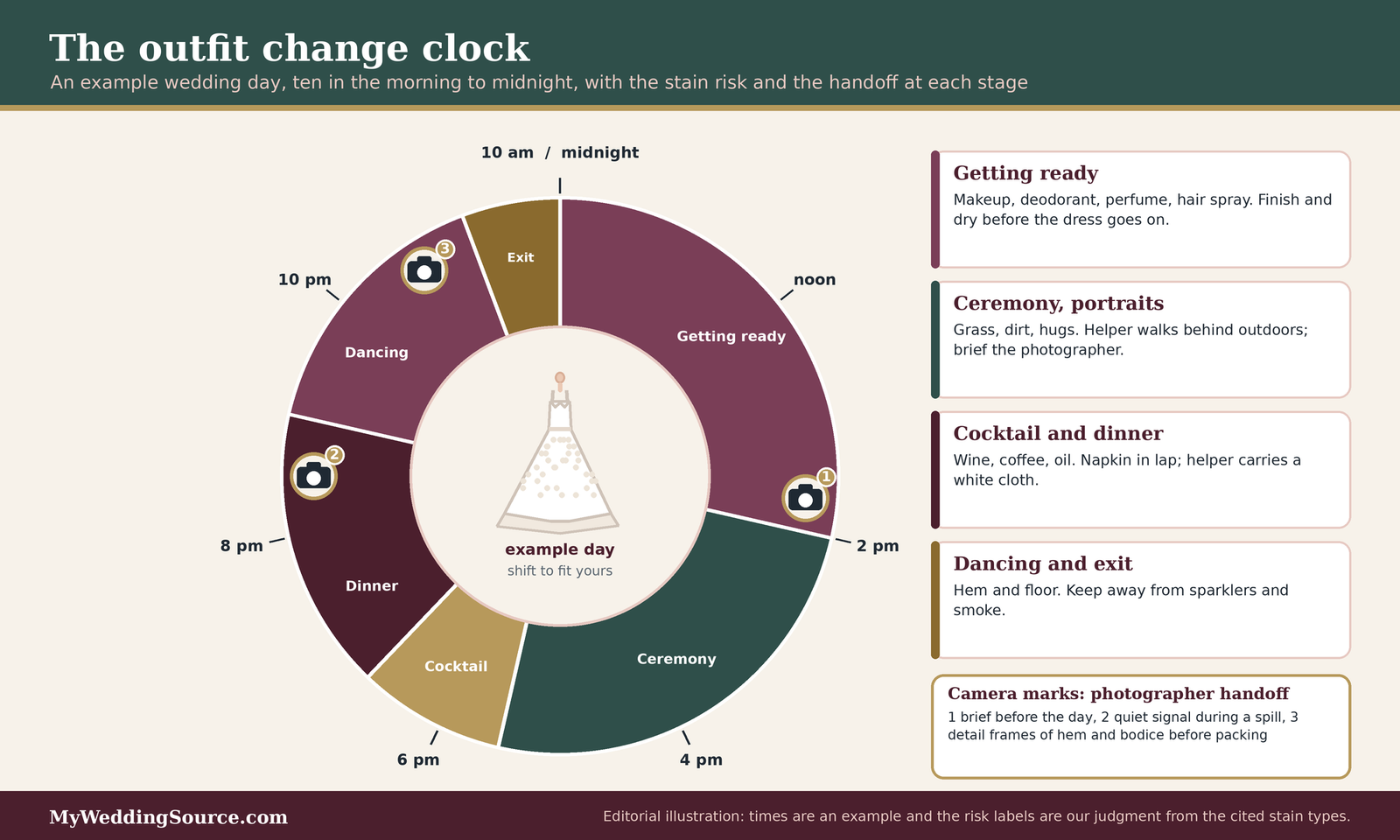
A wedding day has a rhythm, and stains follow it. Makeup and deodorant matter in the morning, grass and handshakes in the afternoon, food and wine in the evening, and the floor late at night. The clock below is an example day, not a schedule you must follow, and the risk labels are our own editorial judgment from the stain types sources describe. Use it to decide when to be extra careful and when to have your helper nearby.
Morning: getting into the dress
The dress is cleanest at the start of the day, so this is when prevention is cheapest. Most of what goes wrong here is about products that were applied before the dress went on.
Before the dress goes on
Finish makeup, hair spray, deodorant, and perfume first, and let them dry. Zola and WeddingWire list lipstick, mascara, foundation, and deodorant among the common stains. Our suggestion, not a sourced rule, is to put a soft scarf or a large T-shirt over your face and hair as you step in and out, so cosmetics never touch the neckline. Our bridal hair and makeup planning guide covers sequencing, and our wedding hair and makeup schedule guide covers who is where when.
Who touches the dress
Limit the number of hands. Anyone who handles the gown should have washed hands, because skin oils can cause stains on textiles, as the American Institute for Conservation’s textile care guide notes. Keep pens, markers, and food away from the room where the dress is hanging, and decide ahead of time who is allowed to steam it, if anyone, since heat is one of the things DLI says to keep away from spills.
Ceremony and portraits
This is the most photographed stretch of the day, and the most walking, so wedding dress stain removal questions start here. The hem meets whatever the venue has underfoot.
Ground, grass, and hugging
Dirt, grass, and mud land on the hem, and hugging lands makeup on the bodice. Our first look photos guide is worth a read if you are deciding how much of the portrait time happens before the ceremony, since that also decides how long the hem is outdoors. If the ceremony is outdoors, ask the venue about wet grass and what is planned for rain; our wedding photography rain backup guide covers the photo side of that conversation.
The receiving line and the first drink
Hugs, kisses, and the first glass of champagne all happen close to the bodice. Ask your helper to carry a clean white cloth and to step in if a drink is poured near you. This is also a good moment in the wedding dress stain removal timeline to remember what DLI says about clear drinks: sugary spills can dry invisibly and later turn yellow or brown, so a drink that left no visible mark still counts as a stain event for the log we describe later.
Cocktail hour and dinner
Food and drink arrive. The risk is not that something will spill, it is that when it does, someone will rush.
Seating and the lap
Sit with a napkin in your lap, and keep red wine, coffee, and sauces on the side of the table away from the dress. Our restroom in a fitted wedding dress guide has practical notes on sitting that apply here too. Ask the caterer where the dress will be at the head table, because a sweetheart table in a tight spot makes spills more likely.
If something does spill
Follow the ladder in the next section. If the spill is large or obvious, step away from the room, let the helper do the blotting, and tell the photographer discreetly so no one tries to retouch or crop around something they do not know about.
Dancing and the exit
By late evening, the hem has been on the floor for hours and the gown has been through dancing, sitting, and a lot of hugs.
The hem again
Bustles lift the train, but the lowest part of the hem still touches the floor. Floor dirt, spilled drinks, and shoe marks all add up here. Our wedding dress alterations guide explains how bustles are made, and our dance floor size guide explains why a crowded floor means more traffic around your hem.
Sparklers, smoke, and fog
Zola’s tips list smoke bomb residue among the stains brides run into, and its suggestion is a vinegar and soap mixture. We would be more cautious: smoke and soot are a particular worry for textiles. The AIC textile guide says soot can be driven deeper into fibers by handling, and recommends consulting a conservator before touching soot-damaged textiles. If you plan an exit with sparklers or smoke, keep the dress away from them and tell the cleaner afterward.
The change moment
If you change into a second look, that is a natural handoff point, and it is also the first time since the morning that someone can look at the whole dress.
Do a ten-second inspection
When the gown comes off, have your helper hold it up under good light and look at the hem, the bodice, and the underarms. Note anything new on the stain log, even if it is only “champagne at the table, nothing visible.” Our bridal outfit changes guide covers the timing of the swap.
Put the gown somewhere safe
Hang the gown on a padded hanger if possible, because the conservator in The Bridal Council article recommends padded hangers to spread weight evenly for short-term storage. Keep it in a clean room away from food and drink, and do not seal it in plastic. David’s Bridal advises against storing it in plastic and says to keep it in a cool, dry place away from sunlight.
Wedding dress stain removal in the moment: a conservative ladder
The rungs below go from lowest risk to highest, and they are the core of any sensible wedding dress stain removal plan. Most spills should end at the second or third rung. The ladder is our synthesis of the sources we cite, and we flag where those sources disagree.
Rung one: stop and blot
In wedding dress stain removal, the first move is the one nearly every source agrees on, and it is usually the only one a spill needs right away.
Blot, never rub
WeddingWire’s article quotes its experts as saying to blot with a clean white napkin and never rub, or the stain sets further. Cornell’s extension bulletin says rubbing or brushing can spread a stain or damage fibers, and recommends keeping an absorbent pad under the stain. The Texas A&M guide suggests blotting from the back or inside of the garment when you can, so the stain is not pushed deeper. On a lined bridal gown that may be easy; on a gown with a built-in corset it may not be, so use judgment.
Use the right cloth
A clean white cotton cloth or napkin is the standard recommendation. Zola cautions against paper towels and toilet paper, which can leave fibers on the dress, especially on embellished areas. The conservator in The Bridal Council piece says baby wipes contain oil and should not be used. Keep one plain white cloth in the helper’s bag, and tell people that is what it is for.
Rung two: absorb with powder
For liquids and oily spots, a dry powder is the gentlest next step and the one named by the most cautious sources.
Powder for liquids and oils
The Bridal Council’s conservator advises blotting a wine or coffee spill, then covering it with baby powder, cornstarch, or both. Once the powder has absorbed moisture, brush it off and reapply fresh powder. For lipstick, lift it gently with a dull knife and cover with powder. A Today.com article that quotes a bridal-retail executive and the executive director of Wedding Gown Specialists gives a similar sequence: blot, cover with powder, let it absorb, brush lightly with a soft brush, and do not apply other stain removers, since those can push the stain deeper.
Choose the powder carefully
Zola suggests chalk that closely matches the dress as a camouflage for a stain that will not come out, and WeddingWire suggests baking soda, cornstarch, or baby powder. Our suggestion: test the powder on a hidden spot of a similar color so it does not leave a visible film on dark or colored fabric, and brush it off thoroughly before photographs.
Rung three: decide whether to treat or wait
This is the rung where sources diverge, and where it pays to slow down.
The treat option and its risks
WeddingWire’s experts describe mixing a drop or two of mild dish soap with white vinegar or lemon juice in a cup of water for red wine, coffee, grass, or mud, dabbing it on a white napkin, and pressing the napkin on the stain. They say to test on an unexposed seam first. Their article also says these solutions cannot be guaranteed for every gown. The risks are the ones the conservator names: water on silk chiffon or organza can change texture, and unlabeled pre-mixed removers can contain bleach that permanently damages fibers.
The wait option and when it is right
In wedding dress stain removal, waiting is the choice when the stain is on the hem or train, when the fabric is silk, lace, or beaded, when the stain is large, or when you do not know what the product is. The conservator says to save the rest of the stain for a professional. DLI says household cleaners, stain sticks, and quick-fix products can make professional removal harder. If you wait, you lose nothing except the chance of a quick cosmetic improvement, and you keep the option of professional treatment fully open.
What to leave alone
A short list, with reasons, saves arguments in the moment, and it keeps wedding dress stain removal from turning into experiments.
Water, heat, and ink
Do not put water on ink, Zola warns, because water can spread it. Large ink stains should be left alone and covered. DLI says to keep heat away from the spot, which means no hot water, hair dryer, or iron. WeddingWire’s article describes drying with a hair dryer after treatment; DLI’s guidance would argue against that, and we think this is a case where the cautious choice is to skip the dryer and let the spot air dry.
Bleach, stain sticks, and mixing products
Do not use chlorine bleach on silk, wool, or spandex, per Cornell and Texas A&M. The conservator also warns that stain sticks and unlabeled pre-mixed stain removers often contain bleach. And never mix cleaning products. The National Capital Poison Center says mixing household cleaners can result in poisonous fumes and serious breathing problems, and specifically warns that ammonia should never be mixed with chlorine bleach, because it can release a highly irritating gas called chloramine. WeddingWire’s experts suggest ammonia for blood; in a hotel bathroom with bleach products nearby, that is one more reason to keep it simple.
Questions to ask the salon before the wedding
- What is the fiber content of the shell, lining, and trim, and does the label say dry clean only?
- Which treatments should be avoided on this particular dress?
- Are the beads, lace, and appliqué sewn on or glued, and has the manufacturer said they withstand cleaning?
- If a spill happens, do you recommend powder only, or is there a product you trust on this fabric?
- Can you recommend a cleaner who handles gowns with this kind of trim, and would you tell them about the dress in advance?
Wedding dress stain removal, stain by stain
Different stains deserve different restraint, and wedding dress stain removal looks different for each. The table below is not a recipe book. It lists, for each common stain, the gentlest first move that sources agree on, what some sources suggest beyond that, and what to tell the cleaner. Where a column says “higher risk,” the method comes from bridal or extension sources and carries the fabric risks described above. We have not tested any of these on a gown, and we cannot promise any of them will work on yours.
| Stain | Lowest-risk first move | Higher-risk options some sources describe | Tell the cleaner |
|---|---|---|---|
| Red wine, coffee, tea | Blot, cover with cornstarch or baby powder, brush off, repeat (conservator) | Dish soap with white vinegar or lemon juice, dabbed on (WeddingWire experts, Zola) | What it was, how long ago, whether anything was applied |
| Clear or sugary drinks, champagne | Blot if wet; note it on the log even if nothing shows | Cold-water dilution, mentioned by DLI for sugary spills, if the fabric tolerates water | That it happened, even if invisible (DLI) |
| Lipstick, foundation, mascara | Scrape excess with a dull knife or spoon, then powder | Rubbing alcohol or a dish soap solution (WeddingWire, Zola) | Product type, where on the gown |
| Oily food, salad dressing, butter | Cover with cornstarch or baby powder, let it sit, brush off | Small dab of dish soap solution or a labeled wipe (Zola, Bridal Council) | What oil, when, whether powder was used |
| Dirt, mud, grass | Leave for the professional; hem marks are rarely visible (conservator) | Vinegar or lemon with a drop of dish soap (WeddingWire, Zola) | Where the hem touched, indoors or outdoors |
| Deodorant, perspiration | Prevention: let products dry, protect underarms | Dryer sheet or pantyhose dabbing (Zola); extension guides warn residue may remain | That the area was worn all day |
| Ink | Do not add water; cover and leave alone (Zola, WeddingWire) | Tiny stains only: detergent solution or rubbing alcohol (WeddingWire) | Pen type if known |
| Blood | Blot gently; keep it simple | Hydrogen peroxide with water, or dish soap with ammonia (Zola, WeddingWire experts) | That it is protein-based and when it happened |
| Smoke, soot, fog residue | Do not handle; avoid rubbing in | Vinegar and soap mixture (Zola) | What source; AIC says consult a conservator for soot |
Liquids that leave no mark
The category that surprises people in wedding dress stain removal is the one that does not look like a stain at all. Champagne, clear sodas, tears, and perspiration can dry without a visible mark.
Why they matter later
DLI’s stain guidance says sugary, food, and oil spills can dry invisibly and later turn yellow or brown as they oxidize. David’s Bridal, speaking as a retailer, says that perspiration, clear beverages, and tears contain salts and sugars that can oxidize into brown or yellow marks, and that sugar-based stains can also attract insects. The cleaning-industry article we cite makes a similar point about drink stains containing sugar: they can dry without a visible mark, and the residue is not fully removed by dry cleaning, and can darken during tumble drying. Taken together, these sources are why we ask you to log invisible events.
What to do in the moment
There is little to do beyond noting it, and wedding dress stain removal for clear spills is mostly record keeping. If a clear drink was spilled and the fabric is water-tolerant, DLI says diluting a sugary spill with a little cold water can help most; but since we do not know your fabric, we would still ask a salon before trying it on silk or organza, where the conservator warns about water. The safe default is to blot, log it, and mention it when you drop the gown off.
Color and oil stains
Wine, coffee, makeup, and grease are the stains most people picture when they think of wedding dress stain removal. They are also where improvisation is most tempting.
Wet color: wine and coffee
The cautious route is blot, powder, brush, repeat. The route in WeddingWire and Zola uses acid (vinegar or lemon) and a little dish soap. Our reading is that the first route is a safer default for a dress you do not fully understand, and the second may be reasonable for a robust synthetic with no trim in the area, after a hidden-spot test. Neither source promises a result, and WeddingWire’s experts explicitly warn that panicking and trying many mixtures can pull color, make water rings, or tear fabric.
Oily color: lipstick, makeup, grease
Texas A&M’s guide and the extension sources classify these as oily stains, which respond to detergent-type products and not to water alone. On a wedding gown that is the point at which a professional should take over. The conservator’s emergency kit includes Shout-brand wipes for small oily stains, and also says to avoid unlabeled stain sticks. Our suggestion is that if you carry a wipe, read the label, test it on a hidden seam, and skip it on lace, beads, and silk.
Dirt, grass, and everything the hem picks up
The hem is the part of the dress that works hardest and shows least, so hem marks come up often in wedding dress stain removal.
Why hem marks usually wait
The Bridal Council’s conservator says to leave grass stains for a professional because they are usually at the hem and rarely visible. WeddingWire says stains on the train or less visible areas can wait. Texas A&M treats grass as a plant and protein stain that needs detergent, rinsing, and sometimes soaking, which is laundry-room advice and not a routine to copy on a layered gown.
Keep the hem from becoming the whole problem
Practical prevention is mostly about travel: lift the skirt on stairs and grass, have a helper walk behind you outdoors, and use the bustle during the reception. Our wedding dress alterations article covers how bustles are planned, and our dress fit and alterations guide covers fitting.
Edge cases within the stain list
A few stains do not fit neatly into a column of the wedding dress stain removal table. They deserve more caution, not less.
Ink, blood, and mildew
For ink, both Zola and WeddingWire say not to add water to a large stain; it spreads. Blood is described by WeddingWire’s experts with two different home solutions, which tells you that even specialists disagree on the details. Mildew is different: the National Park Service says microbial stains are permanent and recommends consulting a textile conservator before any treatment beyond vacuuming, and the Today.com article notes that mold and mildew are the hardest stains to remove, often after a gown gets wet and is stored before it dries. If a gown has gotten wet, dry it properly and tell the cleaner.
Self-tanner, glitter, and confetti
We did not find a reliable source describing how self-tanner, body glitter, or confetti dyes behave on bridal fabrics, so we do not give advice on them beyond this: write down what was used and tell the cleaner. If self-tanner is part of your plan, our wedding spray tan guide covers timing and sequencing on the beauty side.
The photographer handoff for wedding dress stain removal
This is where a wedding dress stain removal plan becomes more than a list of tips. A photographer sees more of the dress than anyone, for longer than anyone, and is already working to a timeline. Giving them a small role costs nothing and does two jobs: it protects the photographs and it creates a record.
Why the photographer belongs in the plan
Photographers move around the room, shoot close details, and see the dress in good light. They are also often the only person who will remember what the gown looked like at 3 p.m. versus 10 p.m.
Photos help you reconstruct the timeline
Time-stamped images show where you were and what the hem and bodice looked like at several points in the day. That is our own inference, not a claim from a source, but it follows from how digital photos are recorded. If a cleaner asks when a mark appeared, or if a stain surprises you weeks later, the sequence of images can narrow it down. Our wedding photographer shot list guide explains how to ask for detail frames.
Photos also decide what gets fixed
If a small mark is visible in a frame, the photographer may be able to tidy it in editing, and you may prefer that to chasing the spot at the reception. Our wedding photo retouching requests guide explains how to ask for that and what to expect. This is a trade-off: retouching hides the mark in the picture, not on the dress, so it does not replace the log.
How to hand off
A good handoff for wedding dress stain removal is short. Three moments carry most of the weight: before the wedding, during it, and just after.
Before the wedding: one line in the brief
Add one line to the photographer’s brief: “If the dress gets marked, my helper will tell you which side; please avoid that angle until we fix it, and take a detail frame of the spot.” Our photography deliverables guide is useful for deciding what else belongs in a brief.
During the wedding: a quiet signal
Pick a signal that does not draw attention, such as the helper touching the photographer’s elbow and pointing with a glance. Most photographers appreciate being told early, since it lets them choose angles. The helper should not describe the stain at length in front of guests.
After: a few detail frames
Before the dress is packed, ask for a few frames of the hem, the bodice, and the underarm area under steady light, if the photographer is willing. That is a favor, not a contractual deliverable, unless your contract says so. A second set of eyes on the dress while it is still on the hanger is worth more than a clever filter later.
The stain log for wedding dress stain removal
The log is the actual handoff to the cleaner, and it is the most useful piece of wedding dress stain removal paperwork you can keep. It does not need to be fancy. A phone note or an index card in the helper’s bag is enough.
What to record
For each event, write the time, the location on the gown, the substance, what was done, and who saw it. Describing location on the dress is easiest if you use a simple map: front, back, left, right as the wearer sees it, and distance from the hem. Here is a sample entry: “8:40 p.m., front skirt, left, about 12 inches up from the hem. Red wine. Blotted, cornstarch applied, brushed off. Photographer aware. Nothing visible after.”
Who keeps it
Give the log to one person, and tell them to forward it to you the next morning. Then it goes to the cleaner with the dress. If the log also records invisible events (“champagne on the bodice, nothing visible”), the cleaner has information that DLI says is valuable and that nothing else will give them.
Questions to ask your photographer about the dress
- If I tell you a spot on the dress is marked, which angles will you avoid, and can you take a close frame for my records?
- Do you retouch small marks on clothing, and is that included or extra?
- Can you share a few unedited detail frames of the hem and bodice the same week, so I have them before the dress is cleaned?
- Where will you be during the first dance and the cake, when the hem is on the floor and the bodice is near drinks?
The first forty-eight hours after the wedding
The wedding ends, and the dress is suddenly a loose end. Many wedding dress stain removal problems are not made at the reception; they are made in the closet, over the following months.
Getting the dress home safely
Someone has to carry the gown out of the venue, and that person needs instructions.
Choose a carrier and brief them
Pick one person, ideally not the couple, to take the dress home or to a hotel room. Give them the stain log and tell them what to do: hang it on a padded hanger, keep it away from heat and sunlight, and do not seal it in plastic. David’s Bridal advises hanging the dress in a cool, dry place away from sunlight and not storing it in plastic. Our wedding party gift delivery and wedding party coordination checklist guides have ideas for assigning end-of-night errands.
Do not put it away dirty
The AIC textile guide notes that dry-cleaning bags trap moisture and block airflow, and recommends cotton dust covers for seasonal clothing. DLI says not to store garments without cleaning them first, because leftover food and spills can attract insects and cause damage. A gown in a closet for six months, uncleaned, is a different problem from a gown that goes to a professional in a week. Our wedding keepsake storage guide covers the rest of what you are saving, and our bouquet preservation guide covers flowers.
How long can the dress wait
Everyone wants a deadline for wedding dress stain removal. The honest answer is that sources give different numbers and none can promise an outcome.
The timing claims, and who makes them
David’s Bridal says it advises acting within 24 to 48 hours of the wedding and says stains become ten times harder to remove after six months; that is a retailer’s claim, and we could not verify the figure. DLI says as soon as possible. The executive director of Wedding Gown Specialists, quoted in Today.com, says there is no true deadline but earlier cleaning makes removal more likely and some fabrics can degrade over the years. A retail executive in the same article recommends preserving right after the wedding to avoid sweat damage. The cleaning-industry article says old stains are much harder to soften and few come out completely.

How to read the numbers
Our reading of wedding dress stain removal timing: the sources agree on the direction (sooner is better) and disagree on the cliff. Treat the 24-to-48-hour figure as a retailer’s target for getting the gown into the pipeline, not as a point at which cleaning stops working. If your honeymoon starts the next morning, a trusted person can deliver the dress within the first week or two. If life gets in the way, do not give up; a late cleaning is still better than none, with a more cautious outlook from the cleaner.
If you are leaving for a honeymoon
Many couples leave town within a day or two. That is when gowns get stuck in the trunk of a car.
Hand the dress to a person with a task
Give the carrier a clear job: call the cleaner on Monday, drop off the gown by Friday, text you a photo of the receipt. Tell them the dress should not go into a hot car trunk. The Conserve O Gram from the National Park Service gives 24 degrees Celsius (75 degrees Fahrenheit) as the upper limit for storing textiles, in a bulletin about mold and mildew, which is a reasonable marker for what a dress should not be left in. Our honeymoon planning guide helps with the rest of that week.
Shipping to a cleaner
Some gown specialists accept shipped gowns, which may be the best option if the nearest specialist is far away. Ask the specialist how they want it packed, whether they provide a box, and what insurance covers; the Today.com piece notes that shipping insurance may cost extra, and that one preservation kit listed in the article includes $1,000 of insurance. Our wedding dress shipping for destination weddings guide covers the outbound side of shipping, including carrier questions, and the same cautions apply on the way back.
Choosing and briefing a professional for wedding dress stain removal
The word “cleaner” covers a wide range of businesses. Choosing the right kind, and briefing them well, is the biggest single factor you control.
Who does what
There are at least three kinds of professionals a gown might go to, and the differences matter.
Dry cleaner, gown specialist, or conservator
A general dry cleaner may handle bridal gowns as part of ordinary work. A gown-cleaning specialist focuses on bridal wear. A textile conservator works on museum-style objects, and the AIC textile guide recommends one when a textile is treasured or historic and may need cleaning. The executive director of Wedding Gown Specialists says in Today.com that she does not recommend DIY cleaning, since specialists hand-wash with gentle chemicals. Where a gown falls on that range depends on its value, its fabrics, and what you plan to do with it. Our suggestion is to ask whichever professional you choose how many bridal gowns they clean in a year and with what method; the answer tells you a lot.
Where to look
AIC says to use its “Find a Professional” tool and select the Textiles specialty to find a conservator. For bridal specialists, your salon is a reasonable first source, and WeddingWire’s article notes that bridal salon consultants can advise on fiber content and spill response.
Briefing the cleaner
The briefing is the second handoff in wedding dress stain removal, and it is the one most people skip.
What to bring
Bring the stain log, the care label or its photo, any photographer detail frames, and the dress’s original paperwork if you have it. DLI suggests telling the cleaner about delicate trim, and, for heirloom pieces, giving extra time for inspection and mentioning age-related issues. Show the cleaner where each mark is and point out any area you treated, and say with what. WeddingWire’s expert says to tell the cleaner about every stain and every treatment, even invisible ones, because the cleaner may take a different approach to stain treatment.
What to ask
The David’s Bridal page, though it has no checklist, notes that professionals document existing damage and test solutions on hidden areas, and suggests asking about cleaning methods, preservation materials, insurance, guarantees, and timeline. We have turned that into the question block below.
Questions to ask a cleaner or gown specialist
- How many bridal gowns do you clean each year, and what is your method for gowns with beads, lace, or silk?
- Will you inspect and document the gown, including existing marks, in writing before you start?
- What will you test first, and what do you do if a test shows color or finish changing?
- Does my care label change your approach, and if you depart from it, will you ask me to sign a consent form?
- What is the written estimate, the timeline, and the policy if a stain does not come out?
- How is the gown packed and insured for return, and who is responsible if there is damage?
Estimates, guarantees, and what is really promised
Money matters in wedding dress stain removal, and so does wording. A promise to “remove all stains” is a promise no one can honestly make.
Cost ranges, with attribution
What cleaning and preservation can cost
We could not find a neutral published average for gown cleaning alone, so we do not quote one. Here are the figures we found, each with its source. David’s Bridal, a retailer, cites typical preservation costs of $200 to $600 and says most services take 6 to 12 weeks. A Today.com article puts preservation services at $170 to $1,000, quotes the executive director of Wedding Gown Specialists as saying the average is $250, and notes that some companies charge at least $800; it gives 4 to 6 weeks including delivery. Shipping insurance may cost extra. These are not quotes for your gown. Get a written estimate that separates cleaning, stain treatment, repairs, and preservation, and keep it with your wedding budget; our wedding budget guide can help you place it.
Guarantees and responsibility
Read what a cleaner promises and what it excludes. The cleaning-industry article describes a division of responsibility in which the owner is responsible for residual marks and fabric damage that stem from staining during use and delay in cleaning, the cleaner shares responsibility if they did not give a realistic assessment beforehand, and the garment maker is responsible for ensuring trims can withstand the recommended cleaning method. That is one trade writer’s view, not law, and we are not offering legal advice; if there is a dispute, a consumer protection office or an attorney can advise you. The FTC’s consumer site (consumer.ftc.gov) publishes general consumer guidance and links to its fraud-reporting page, though it does not handle disputes with individual cleaners.
Cleaning only, or cleaning and preservation
Cleaning, as distinct from wedding dress stain removal on the day, removes what is on the gown now. Preservation adds archival packaging, usually a box, and is about the years ahead. The Today.com piece says to get the gown cleaned first, then take it to a preservationist. DLI’s preservation advice includes acid-free, unbuffered tissue and not storing in basements (dampness) or attics (heat); the conservator adds that you should not vacuum seal gowns. You can choose cleaning only if you plan to wear or remake the gown soon.
Edge cases in wedding dress stain removal
Not every dress and every wedding follows the usual path, and wedding dress stain removal needs adjusting too. These are the situations where a general plan needs adjusting.
Rented, borrowed, and heirloom dresses
The stain is the same; the responsibilities are not.
Rented or sample dresses
If you rent a dress, the rental contract usually sets out who treats stains and what you owe if they do not come out. Do not treat the gown yourself unless the contract says you may. Tell the rental business what happened and ask for their instructions in writing. Our renting wedding dresses and wedding rental damage waivers guides explain how to read those terms.
Heirloom and vintage dresses
An older gown may have weakened fibers or earlier stains. DLI says to allow extra time for inspection and to mention age-related problems such as yellowing, old stains, or weakened construction. AIC’s guide says to consult a conservator when a textile is treasured or historic and may need cleaning, and warns that washing a fragile historic textile can cause fiber damage, dye loss, or dye migration. For a family dress, the “wait” option is nearly always the right one at the reception.
Color, trim, and detachable pieces
Not every gown is plain ivory satin.
Blush, colored, and printed gowns
Dye is the risk in wedding dress stain removal on colored fabric. The Texas A&M guide says to check colorfastness by testing a pretreatment on an inconspicuous area, and the Cornell bulletin says that if color transfers to the cloth or the fabric changes color, you should consult a professional cleaner. With a colored gown, a hidden-spot test is the minimum, and powder may need a color match.
Sleeves, overskirts, veils, and trims
Detachable pieces can be cleaned separately, which sometimes helps. Our detachable wedding dress sleeves guide covers how they attach, and our wedding veil comb security guide covers the veil side. Mention each piece to the cleaner. DLI notes that headpieces, veils, shoes, foam pads, and bra cups should be stored separately from the gown to avoid damage or color transfer.
Outdoor, beach, and destination weddings
Venue conditions change the wedding dress stain removal list.
Sand, salt, water, and mud
Wet hems, sand, and mud come with outdoor weddings. The Today.com article notes that mold and mildew often follow a gown getting wet and being stored before it dries, and the NPS bulletin says microbial stains are permanent. Dry the hem thoroughly in a ventilated space, hang it up, and tell the cleaner. Our beach wedding dresses and beach wedding guides cover the setting itself.
Traveling home after a destination wedding
A gown that has to fly home needs a plan for the journey and a cleaner at the other end. Our wedding dress shipping for destination weddings article is the place to start, and a note to the cleaner about travel, humidity, and how long the dress sat packed belongs in the log.
When someone else made the mess
A server spills wine, a guest hugs you with a lipstick smudge, or a vendor’s equipment marks the hem.
Document it and tell the right people
Take photos, write it in the log, and let the venue manager or vendor know on the day, calmly. Keep a note of who you told and when. Our wedding vendor due diligence checklist and wedding insurance guides explain how to read contracts and policies on that point.
What we cannot tell you
Whether anyone owes you anything depends on your contracts, your insurance, and your state’s law. We are not lawyers and this is not legal advice. Read what you signed, keep your records, and ask the vendor or a professional you trust before assuming either way.
Frequently asked questions
Wedding dress stain removal at the reception
Should I try wedding dress stain removal at the reception?
Usually only the gentlest steps: blot with a clean white cloth, cover liquids or oils with cornstarch or baby powder, and brush it off. Several sources, including a textile conservator, say to save the rest for a professional afterward. Hem and train marks can wait. We cannot guarantee any fabric result.
Can I use vinegar, rubbing alcohol, or hydrogen peroxide?
Some bridal sources suggest them, and extension guides use similar products on ordinary clothing. Others, including the Drycleaning and Laundry Institute, advise against household products on a gown because they can complicate professional removal. If you try one, test a hidden seam first, avoid silk and trims, and never mix products.
What is the safest thing to put on a spill?
A plain white cotton cloth, to blot, and plain cornstarch or baby powder, to absorb. A conservator quoted by The Bridal Council recommends that sequence for wine and coffee, then brushing off the powder. Avoid paper towels, baby wipes, and unlabeled stain sticks, which may contain bleach.
Telling people about wedding dress stain removal
Do I need to tell the cleaner about stains I cannot see?
Yes. The Drycleaning and Laundry Institute says to tell your cleaner what was spilled, even if you cannot see the stain, and to share details early. Sugary and oily spills can dry invisibly and later darken or yellow. A written log with times, places, and what you applied helps the cleaner choose a safe method.
What should I tell the photographer?
Give a short heads-up: where the mark is, so they can pick angles, and whether you want a close frame for your records. Ask whether small marks can be retouched, and whether that costs extra. Retouching changes the picture, not the dress, so the stain log is still worth keeping.
After the wedding
How soon should I get the dress cleaned?
For wedding dress stain removal by a professional, sources say sooner is better. David’s Bridal advises acting within 24 to 48 hours; the Drycleaning and Laundry Institute says as soon as possible; a gown-specialist executive says there is no true deadline. Treat those as guidance on direction, not a cliff, and book a professional within a week or two if you can.
Does a cleaner guarantee the stains will come out?
No honest cleaner can promise that. Old, oxidized, or dye-based stains, delicate fabrics, and trims can all limit results, according to trade and conservation sources. Ask for a written estimate, inspection notes, and what happens if a mark remains. This is not legal advice; read your contract before you sign.
What if my gown is rented or an heirloom?
For a rental, follow the contract and ask the rental business before treating anything. For an heirloom, wait and consult a textile conservator; the American Institute for Conservation says to do so for treasured or historic textiles. In both cases, tell the owner or cleaner everything that happened and everything you applied.
Your next steps
Before the wedding
Ask the salon three things
For wedding dress stain removal, ask about fiber, trim, and treatments to avoid. Take a photo of the care label. Share the answers with your helper, and read our wedding dress fit and alterations guide if a fitting is still ahead.
Brief the helper and the photographer
Give your helper the wedding dress stain removal script (blot, powder, stop, log) and your photographer a single line about marks on the dress. Pack the kit from our wedding emergency kit guide, minus anything you cannot name a use for.
After the wedding
Choose the carrier and the cleaner
Name the person who will carry the gown, find a cleaner while you still have time, and put the log and label photo in the garment bag. Our wedding week checklist and after-wedding checklist can hold these tasks.
Brief and book
Bring the log, the photos, and the label to the cleaner, and ask the questions in this wedding dress stain removal guide. Get the estimate in writing and keep it with your records. If anything about the dress changes your plans, our wedding planning checklist is a good place to keep the thread together.
Sources & methodology
How we built this guide
What we relied on
This guide combines the Federal Trade Commission’s Care Labeling Rule materials, a trade association’s consumer guidance on stains and wedding gowns, extension-service stain guides from Cornell and Texas A&M, a National Park Service conservation bulletin, the American Institute for Conservation’s textile care guide, a poison-control center’s cleaning-safety page, and bridal-industry articles that quote salon owners, a textile conservator, retail executives, and gown-cleaning specialists. Where a statement comes from a retailer or a bridal publication, we say so, because those sources reflect the seller’s products and habits. The advice ladder, the clock, the risk labels, and the stain log are our own editorial synthesis, not a tested procedure. Sources were read in November 2026; we did not verify that any page has been updated since.
What we did not do
We did not test any product on a wedding gown, and we did not speak with a cleaner. Fabrics, dyes, and trims vary, and no source can promise a result. This is not legal, financial, or professional conservation advice. Check the care label, ask the salon, and have a qualified professional treat anything you are unsure about.
Source list
Government, conservation, and safety sources
- Federal Trade Commission, Clothes Captioning: Complying with the Care Labeling Rule: https://www.ftc.gov/business-guidance/resources/clothes-captioning-complying-care-labeling-rule
- Federal Trade Commission, Care Labeling of Textile Wearing Apparel (rule overview): https://www.ftc.gov/node/33787
- Federal Trade Commission, consumer information: https://www.consumer.ftc.gov/
- National Park Service, Conserve O Gram 16/1, Causes, Detection, and Prevention of Mold and Mildew on Textiles: https://www.nps.gov/subjects/museums/upload/16-01_508.pdf
- American Institute for Conservation, How Do I Care for Textiles: https://higherlogicdownload.s3.amazonaws.com/CONSERVATIONUS/f79adbf7-4737-43c9-82a1-92e0d2cc3c1c/UploadedImages/Documents/Resources/How_Do_I_Care_for_Textiles.pdf
- National Capital Poison Center, Top tips for a safe spring cleaning: https://www.poison.org/articles/spring-cleaning
Extension and trade sources
- Cornell University, Removing Stains at Home: https://ecommons.cornell.edu/bitstream/handle/1813/3710/Removing%20Stains%20at%20Home.pdf?sequence=2
- Texas A&M AgriLife Extension, Quick Stain Removal Guide: https://agrilifeextension.tamu.edu/wp-content/uploads/2025/04/Quick-Stain-Removal-Guide.pdf
- Drycleaning & Laundry Institute, Wedding Gowns: https://dlionline.org/Wedding-Gowns/
- Drycleaning & Laundry Institute, Stains: https://dlionline.org/stains/
- Laundry & Cleaning News, Old stains bring problems (bridal dresses): https://www.laundryandcleaningnews.com/analysis/bridal-dresses/
Bridal, retailer, and media sources
- WeddingWire, The 5 Most Common Wedding Dress Stains and How to Fix Them: https://www.weddingwire.com/wedding-ideas/wedding-dress-stains-and-how-to-fix-them
- Zola, 5 wedding dress stain removal tips: https://www.zola.com/expert-advice/5-wedding-dress-stain-removal-tips
- David’s Bridal, How to clean and preserve your wedding dress: https://www.davidsbridal.com/content/wedding-looks/how-to-clean-and-preserve-your-wedding-dress
- The Bridal Council, 10 tips for brides from textile conservator Jonathan Scheer: https://thebridalcouncil.com/archive-thebridalcouncil/2022/12/14/10-tips-for-brides-from-expert-textile-conservator-jonathan-scheer-of-jscheer-and-co
- Today, Wedding dress preservation tips from experts: https://www.today.com/shop/wedding-dress-preservation-tips-t283436