
Wedding dress train lengths decide how your gown looks from behind in the aisle, but they also decide how easily you can turn, sit, climb a step, visit the restroom, and dance, so the useful question is not “how long can I go?” but “how long can I live with, at this venue, for this many hours?”
Quick answer
Bridal retailers describe a ladder that runs from a sweep train, which barely touches the floor, through court, chapel, and cathedral to a monarch train that can reach ten feet or more behind the waist. Shorter wedding dress train lengths are easiest on grass, sand, stairs, and dance floors. Longer ones suit wide, clean, formal aisles, but they usually need a bustle (a set of hidden fasteners that lifts the train) or a detachable train for the reception, plus a helper who has practiced. Measure from the same point every time, because sources disagree on the numbers.
Most advice about trains is written as a style guide: it names the lengths, shows a photo of each, and tells you which looks formal. That is useful, but it leaves out the part of the day when the train stops being a picture and becomes a thing you are dragging behind you through doorways, around chairs, and into a restroom stall. This guide keeps the names and the ranges for wedding dress train lengths, then spends most of its space on motion and place.
We built it around a walk-through that most train articles skip: what a given train does in a restroom stall and in each seated position you will actually be in on the wedding day, from a ceremony chair to the head table. We also include a venue decoder, a timeline of when the train is down, gathered, or off, questions to put to your tailor and your venue, and the edge cases that tend to surprise people. Wherever a number on wedding dress train lengths comes from a retailer or a standards body, we say so. Wherever it comes from our own arithmetic or reasoning, we label it as an estimate.
One boundary before we start. We are not tailors, and we have not handled your gown. Structural changes, such as adding a train, shortening one, or sewing bustle points, belong with a professional bridal seamstress. Nothing here is legal, medical, or financial advice, and nothing here guarantees how a fabric will behave or clean up.
How wedding dress train lengths are named and measured
The names for wedding dress train lengths are a convention, not a standard. A designer, a boutique, and a magazine can each draw the lines in slightly different places, and a gown’s stated train length may not match the measurements any article gives for the same label. Learn the ladder first, then learn why it wobbles.
The ladder from sweep to monarch
Retailers and wedding publishers agree on the order of the names for wedding dress train lengths and roughly on the character of each, even where the inches differ. Reading two or three of them side by side is the quickest way to see how much room for interpretation there is.
The common names and their ranges
Kleinfeld, the New York bridal retailer, describes a sweep train as the shortest option, usually found on lightweight slip-style gowns, and says it cannot be bustled and does not need to be. It puts a court train at about one to two and a half feet behind the bride, a chapel train at about three to four and a half feet, a cathedral train at about six to seven and a half feet, and a monarch (also called royal) train at ten feet or more from the waistline.
The Knot’s guide uses slightly different figures: a sweep (or brush) train under a foot, a court train around a foot, a chapel train about three to four feet, a semi-cathedral about four to five feet, a cathedral about six to eight feet, and a monarch about ten to twelve feet or more, all measured from the waist. True Society, a bridal retail chain, gives a court train as roughly one to two feet, a chapel at about five feet, a cathedral at six to ten feet, and a royal train as anything over ten.
Two other terms show up constantly. A Watteau train attaches at the shoulders or upper back instead of the waist and falls like a cape, and it can be any length. A detachable train is a separate piece that attaches for the ceremony and comes off afterward, so it can be any of the lengths above.
What each name feels like to wear
The names of wedding dress train lengths tell you something about how a train behaves, not just how it looks. A sweep skims the floor and mostly follows you. A court train trails slightly and is visible in photos without demanding attention. A chapel train is the first length that you feel behind you when you turn, and Devotion Dresses, a bridal retailer, says it usually calls for a bustle at the reception. A cathedral train needs attention to every turn, and the same retailer says it always needs a bustle for the reception. A monarch train needs a clear plan, a large room, and attendants to move it, according to the same source.
Our own reading of those descriptions is this. Up to court length, you mostly forget the train. From chapel length, you begin managing it. From cathedral length, other people are managing it with you.
Why the numbers do not agree
If you have noticed that the figures above overlap and conflict, that is not a mistake in this guide. The sources really do disagree, and the disagreement is worth understanding before you compare a number on a tag with a number in an article.
The same label, different inches
Devotion Dresses publishes figures that are noticeably smaller than the others: about six inches for a sweep, about nine inches for a court train, twelve to eighteen inches for a chapel train, about twenty-two inches for a cathedral train, and about thirty-five inches for a royal train. Those sit far below the Kleinfeld, Knot, and True Society ranges, where a cathedral train runs to six feet or more. We cannot tell from the page what point those inches are measured from or whether they describe a specific product line. The practical lesson about wedding dress train lengths is that a label such as “chapel” can mean very different amounts of fabric depending on who is selling it.
For that reason, we treat every range in this guide as a starting vocabulary and not as a specification. When you shop, the number that matters is the one measured on the gown you will actually own, in inches, from a stated point.
Watteau, semi-cathedral, and other in-between names
Some names for wedding dress train lengths exist only in some catalogs. The Knot lists a semi-cathedral length and Kleinfeld does not. A Watteau train has no fixed length. Treat these as signals to ask a follow-up question and not as a category you can compare across brands. If a boutique uses a word you have not seen, ask for the length in inches and ask where it is measured.
Measure from the same point every time
Because the ranges for wedding dress train lengths move, the most protective habit is to ask for one specific measurement and to repeat it at every stage: the sales floor, the order form, the fitting, and the final pressing.
Waist, hem, or back of the skirt
The Knot says its figures are measured from the waist. Devotion Dresses notes that train lengths are sometimes quoted from the waist and sometimes from the hem, and advises comparing figures that use the same measuring point. A train measured from the hem will always be a shorter number than the same train measured from the waist, because the skirt itself accounts for the first few feet.
Ask which point your boutique uses when it quotes wedding dress train lengths. Then ask for the length from the back hem to the end of the train as well, because that is the stretch of fabric that actually lies on the floor behind you.
Get inches on your own gown
Ask the boutique to measure the sample gown, or to confirm the specification of the one being ordered, and write the number down. When the gown arrives, measure it again with a tape from the same point. If you are adding a train or having one adjusted, ask your seamstress to state the finished length in your alterations paperwork.
Take the tape to the venue as well. A length that looks sensible on a spec sheet can feel very different when you lay a tape along the real aisle and mark the end of the train with a piece of tape. Our guide to wedding dress fit and alterations covers how fittings are usually sequenced, and it pairs well with this section.

Mobility: what each train length does when you move
A train is a lever of fabric attached to your back. The longer it is, the more it pulls, catches, drags, and gets stepped on, and the more other people have to handle it so that you do not. Mobility is also where the trade-off between drama and ease is clearest, and it is the part of wedding dress train lengths that photographs never show.
Walking, turning, and stairs
The aisle is where a train is meant to shine, which makes it the easiest place to underestimate. Walking forward in a straight line is the simplest thing a train does. The trouble starts at the turn, at the step, and at the threshold.
The aisle and the turn at the front
When you arrive at the front of the ceremony space and turn to face your partner, the train is behind you and has to follow a turn that you made without looking at it. Devotion Dresses says a bridesmaid can arrange a cathedral train at the altar, and that a royal train needs a clear plan for the aisle and the photos. That is a good practical signal: if a train needs a person to arrange it every time you stop, the person needs a place to stand, a moment in the program, and a rehearsal.
Our guide to the wedding processional order lays out who enters when. Ask your coordinator where the helper will stand at the front and whether there is room for them to step out of the photos afterward. A rehearsal is the cheapest chance to test this, even if you walk it in a skirt and not the gown.
Stairs and thresholds
Steps are where a train does the most damage to itself and to you. A longer train can catch on a step edge, loop under a heel, or fall into the gap between stairs. Devotion Dresses says sand, grass, and stairs favor a sweep or court train, and that longer trains need clean floors and room to move. If your ceremony includes a staircase, a raised platform, or a stage, ask for a rehearsal on those steps and decide in advance whether someone will lift the train or whether you will gather it yourself for that stretch.
A small reasoning note of our own: when a staircase is steep, the person helping is often the limiting factor, not the length. Two helpers on a single narrow staircase can get in each other’s way. Ask the venue how wide the steps are and plan for one helper unless the stairs are generous.
Sitting, hugging, and dancing
After the aisle, most of a wedding day is spent in motion that has nothing to do with walking forward. These are the moments when the longer wedding dress train lengths cost the most.
Sitting down
Sitting in a gown with a train means managing two things at once: the skirt in front and the fabric behind. If the train is down, it lies on the floor behind the chair, and you have to lift it or sit on it, and either one is awkward in a crowded room. The Knot’s guide to getting around in a gown notes that long trains can make dancing difficult and that a bustle lifts the train off the ground so you can move freely. The same logic applies to sitting: a bustled train is out of the way of the chair, while a down train is not.
Our companion guide on how to sit and use the restroom in a fitted wedding dress covers fitted silhouettes in detail. This guide focuses on what the train adds.
Hugging and dancing
The Knot’s guide also points out that holding fabric over your arm makes hugging and greeting guests harder, and that a proper bustle keeps your arms free. Zola, a wedding planning site, says a bustle can come undone when someone steps on the skirt during dancing, and suggests asking your seamstress to add extra loops or buttons if you plan to dance a lot. Pomp & Port, a bridal retailer, says much the same: bustles can come undone when someone steps on the skirt, so ask your seamstress to reinforce the loops or buttons.
In plain terms, the question about wedding dress train lengths is not only whether you can dance in the train but whether the train will stay up while guests move around you on a crowded dance floor. Plan the fasteners for the dance floor you will actually have.
What a bustle does and does not solve
A bustle is an alteration, not an accessory. It is sewn into your gown by a seamstress and is meant to lift the train off the floor so you can move. Kleinfeld says that unless the train is detachable, you should consider having it bustled for the reception. It is the most common answer to the mobility problem that longer wedding dress train lengths create, and it has limits.
Bustle styles in plain language
Zola describes the main styles this way. An American (or over) bustle lifts the train and hooks it over the back of the dress, usually with one to three points. A French (or under) bustle tucks the train beneath the gown with ribbons, in a single-point or multi-point version. A hem (ballroom, or flip-under) bustle flips the train up and fastens it around the hem so the dress stays floor length. An Austrian bustle pulls a cord and gathers the fabric into a ruched look, and a wrist loop lets you carry the train at your side, though not every dress can take one.
LWD Bridal, a bridal retailer, says the American bustle is the most common and can have anywhere from one to eight points, while the French bustle hides its fasteners, which suits unembellished or very clean-lined skirts, and the ballroom bustle is the least common and most complex, folding the skirt into the bodice so it looks as if there never was a train. Pomp & Port says the American style is secure and classic and works well with voluminous ballgowns.
The Knot’s explainer rates the difficulty. American and bow bustles are the easiest, ballroom is intermediate, and French, royal, and Victorian bustles are the most complex. That matters because the person bustling you on the day is probably not a professional.
Points, reinforcement, and who learns it
The right style depends on your gown. Pomp & Port says the right choice depends mainly on the dress’s construction, including fabric and train weight, and that a good tailor will assess your fabric and train weight rather than defaulting to a standard pin-up. LWD Bridal adds that a gown’s volume and material can sometimes allow only one type.
Zola suggests naming a trusted person, such as your maid of honor or a responsible bridesmaid, as the bustle expert, and having them attend a fitting. The Knot says the same and adds that taking notes or recording a video of the seamstress helps on the day. Our guide to maid of honor duties covers the practical, behind-the-scenes role that a bustle expert would add to.
One more limit worth knowing: a bustle fixes the train, not the rest of the skirt. If the gown is also slim or fitted, the restroom and seating problems remain. The walk-through later in this guide deals with both.
Venue considerations for wedding dress train lengths
A venue is a set of surfaces, widths, doors, and people, and each of them changes which wedding dress train lengths are comfortable. Style guides tend to say “formal rooms suit long trains and casual rooms suit short ones.” That is a good opening rule for wedding dress train lengths, but you can be more specific.
Indoor and formal rooms
Indoor spaces are kinder to wedding dress train lengths than outdoor ones, but they are not all alike. A church aisle with a runner, a ballroom with a polished floor, and a historic house with narrow doorways make different demands.
Church and ceremony aisles
The Knot says cathedral trains fit black-tie events, grand churches, estates, and ballrooms, and Devotion Dresses says a cathedral train is designed for long aisles and formal ceremonies. True Society says indoor and formal spaces such as churches, ballrooms, and estates can accommodate cathedral, chapel, and royal trains. The Knot adds one condition: for a cathedral train, confirm that the ceremony aisle is wide enough.
How wide is wide enough? No bridal source gives a number, and the right answer depends on the gown. As a yardstick, the U.S. Access Board’s guide to accessible routes says an accessible route needs a continuous clear width of at least 36 inches. That figure is a design standard for accessible routes, not a bridal rule, and your aisle may be wider or narrower. We use it only as a reference point: if a ceremony aisle between rows of chairs is close to three feet wide, a train spread behind a person and a helper walking beside her will be tight. Ask your coordinator to measure the aisle and to tell you what is on it, such as an aisle runner, chair-back decor, or flowers on the floor.
Ballrooms and historic venues
Large flat floors are the best case for a long train, but the floor finish matters. Devotion Dresses says long trains need clean floors and room to move, and our reading is that hard, smooth surfaces let a train glide while carpet and runners can grab it at the edges. Ask the venue what the floor is, whether the carpet has a pile, and whether any part of your route crosses a transition strip.
Historic homes and older halls often have narrow doors, thresholds, and steps between rooms. Our guide to banquet halls and hotel ballrooms covers how the two room types differ for guests and vendors. For a train, the question is whether your route from the bridal suite to the ceremony and then to the reception has any narrow points, and whether a helper can fit through them beside you.
Outdoor surfaces
Outdoors, the ground becomes part of the dress, and it limits wedding dress train lengths more than any style rule. Grass, gravel, and sand all hold, soil, and slow a train in different ways.
Grass and gravel
True Society says outdoor sites with grass, gravel, or uneven ground are easier with court or shorter chapel trains. Azazie, a bridal retailer whose advice may favor its own products, says cathedral-length trains generally do not suit grass, that morning dew can soak hems, and that rain makes the ground worse for hours. It suggests that a floor-length gown can be altered to sit an inch or two higher, so it stays clear while standing but does not drag as you walk.
Kleinfeld recommends asking the venue coordinator to confirm a clear aisle and smooth pathways for a fuller skirt, suggests a detachable overskirt that comes off after the ceremony and photos, and says that for grassy or uneven ground, shorter lengths such as tea length or midi are practical. It also warns against heavy fabrics that catch and drag through grass.
Azazie notes that venues can help with aisle runners, plywood underlayment, or artificial turf in high-traffic areas, and recommends visiting the site in advance and practicing the walk in your shoes. Those are sensible steps to ask for. Our guides to outdoor wedding venues and garden wedding venues cover the ground-prep questions in more detail.
Sand and beach
The Knot says a sweep train barely touches the floor and is practical for lots of movement or beach settings, and Devotion Dresses says beach, garden, city, and destination weddings suit a sweep train. True Society says beach weddings suit shorter or lightweight detachable trains, which add movement without extra weight. Kleinfeld says lightweight fabrics and relaxed silhouettes suit beach weddings.
Our own reasoning, which none of these sources states directly, is that sand makes a train heavier as it collects and that wind makes light fabric travel in directions you do not choose. Neither Kleinfeld nor the other pages we read address wind specifically, so treat it as a question for your tailor and venue and not as a settled fact. Our guide to beach wedding dresses covers fabric and hem choices for sand.
The routes you will actually walk
A venue is not only the aisle, and wedding dress train lengths are tested on every path between rooms. It is every path between rooms, and trains are tested by the least generous point on the route.
Accessible-route standards as a yardstick
The Access Board’s guide says accessible routes need floor and ground surfaces that are firm, stable, and slip resistant, that the running slope of a walking surface can’t exceed one to twenty, and that changes in level up to half an inch must be beveled, with a vertical edge allowed only up to a quarter inch. These are standards for accessible design, and many older or temporary venues do not meet them. We mention them because they describe what a smooth route looks like, and your train will notice every departure from it: a lip at a threshold, a soft patch, a slope.
If a venue says it is accessible, ask what that means for your specific route. If you or a guest uses a mobility aid, ask the venue about the exact route and surfaces, because our outdoor venue guide notes that a cloth runner can catch a wheel. The questions later in this guide apply to you too.
Walk the route in advance
Whatever the venue, walk the route with a measuring tape and a camera. Start at the door of the room where you will dress and end at your seat at the reception. Note every door, threshold, step, slope, and surface, and photograph each. Measure the narrowest door. Then compare that list with the wedding dress train lengths you are considering. It is a thirty-minute exercise, and it replaces a lot of guessing about wedding dress train lengths. Our list of questions to ask a wedding venue is a good companion for the walk.
A venue decoder you can use
The table below condenses what the sources we read say, plus our own reasoning where labeled. It is a starting point for a conversation with your tailor, not a rule.
How the table was built
Each row pairs a place with the lengths that retailers link to it, and the last column flags the thing most likely to go wrong. Where no retailer addressed a setting, the row is our own reading and says so.
| Venue or surface | Starting lengths to discuss | What the sources say | Watch for |
|---|---|---|---|
| Large church or grand formal ceremony | Chapel through cathedral | Cathedral trains fit long aisles and formal events (Knot, Devotion) | Aisle width, steps at the altar |
| Ballroom or hotel reception | Chapel or cathedral, bustled | Clean floors and room to move (Devotion) | Carpet edges, narrow service doors |
| Historic home or estate | Court to chapel | Estates can suit longer trains (Knot) | Narrow doors, thresholds, stairs |
| Garden or lawn | Court or short chapel | Easier with shorter trains (True Society) | Dew, soft ground, heavy fabric |
| Gravel or uneven ground | Sweep to court | Shorter trains are easier (True Society, Devotion) | Snagging at the hem |
| Beach or sand | Sweep, or lightweight detachable | Sweep suits beach (Knot, Devotion) | Sand weight, wind (our note) |
| Barn, rustic, or loft | Court, or a detachable overskirt | Detachable overskirts can come off after photos (Kleinfeld, outdoor advice) | Wood floors, hay, dust (our note) |
| Courthouse or city hall | Sweep to court | Sweep suits city weddings (Devotion) | Security lines, elevators, stairs (our note) |
What the table leaves out
The table cannot see your particular room, your fabric, or the weather on the day. It also cannot tell you how heavy your train is, and weight matters as much as length. Use it to decide what to ask, not what to buy.
Reading the decoder
A table of wedding dress train lengths by venue is only as good as the questions behind it. Use it to start a conversation, not end one.
When two rows apply
Many weddings cross rows: a lawn ceremony and a ballroom reception, a church ceremony followed by a barn. In that case, choose the length for the stretch where you will be on your feet most and the ground is least friendly, and solve the other stretch with a bustle or a detachable piece. Our guide to wedding transportation helps with the logistics of getting between the two.
When no row applies
If your venue does not fit any row, such as a rooftop, a boat, or a museum, return to the three yardsticks: the narrowest point on your route, the roughest surface you will cross, and the longest time you will spend on your feet. Choose a length that you can manage at all three without help, then add length only where help is available.
The fitted-gown restroom and seated-position walk-through
This is the section most guides to wedding dress train lengths leave out. A train is easy to admire and hard to sit on, and the wedding day includes several moments that depend on where the fabric goes when you are not standing. The walk-through below treats the restroom stall and the most common seated positions as places to test your chosen length.
Our companion guide on sitting and using the restroom in a fitted wedding dress deals with the front of the skirt, the fit through the hips, and the undergarments. This section deals with the back: the train.
Before you go: plan the restroom visit
Restroom visits go badly when they are improvised, whatever your wedding dress train lengths. Two decisions, made in advance, remove most of the risk.
Choose one helper and brief them
Pick one person who has seen the gown and, ideally, attended a fitting. Zola’s advice about a designated bustler applies here as well: the person who learns the bustle is a natural choice for the restroom too. Show them how the train attaches or bustles, where the fasteners are, and what to hold. Pre-agree that they will go in with you and what you will say if you need them to leave the stall.
A second pair of hands is useful, but a third is usually a crowd. In a small stall, extra people make the train harder to manage, not easier. This is our own observation and not a sourced rule, so treat it as a planning heuristic.
Choose the moment
The Knot says to plan when and where the bustle will happen between the ceremony and the reception, such as before cocktail hour or after photos, and to confirm that the bustler will be there. Use the same logic for the first restroom visit: a short window just before photos and another just before you enter the reception. Our wedding day timeline can help you place them. Do not wait until you are desperate, because hurry is the main cause of fabric touching floors and fasteners being missed.
The stall as a measuring tape
A restroom stall is a small, fixed space, so it is a useful way to picture how much train you can fit into a room you cannot enlarge.
What the standards say about stall size
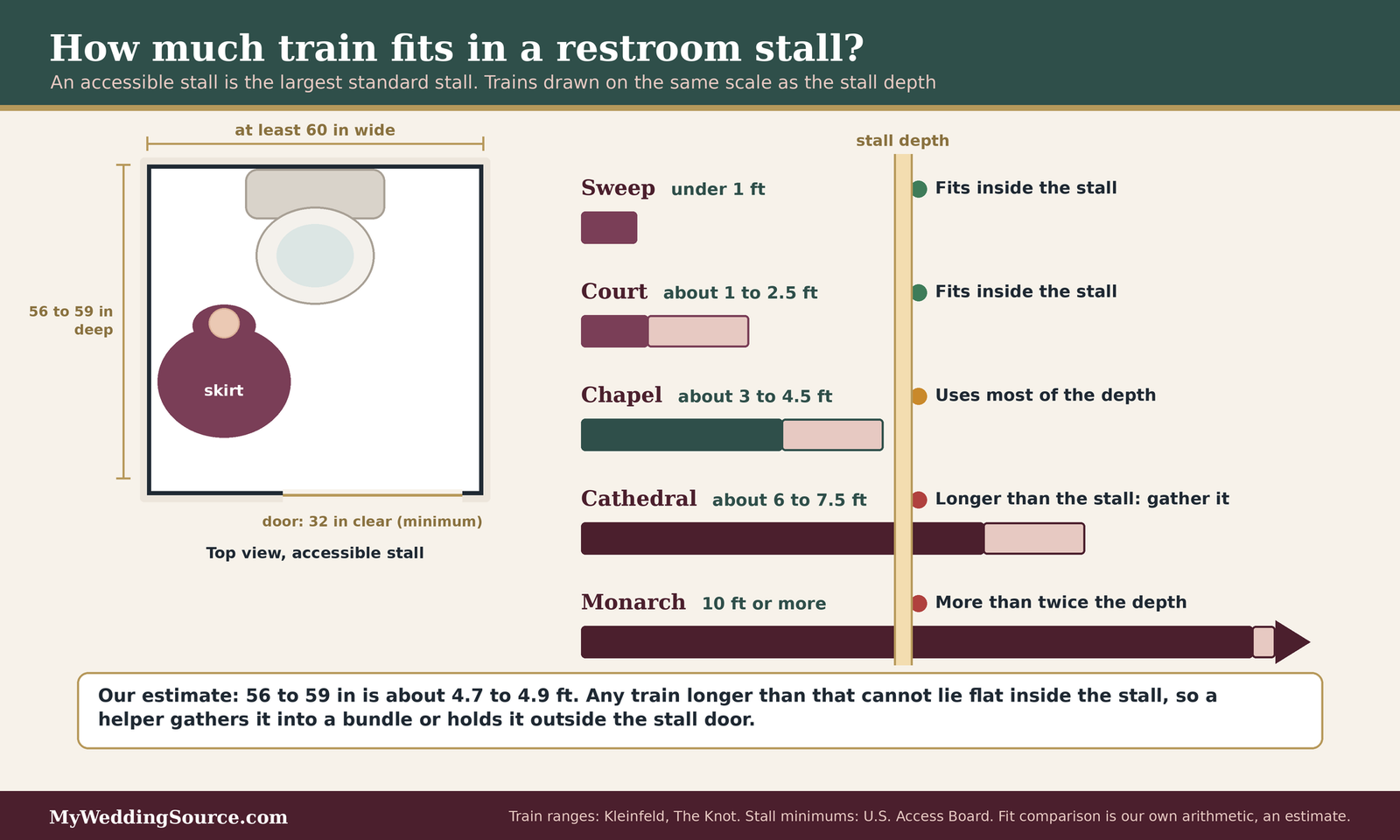
The Access Board’s guide to toilet rooms says a wheelchair-accessible toilet compartment is at least 60 inches wide, and at least 56 inches deep with a wall-mounted water closet or 59 inches deep with a floor-mounted one, and its door must have at least 32 inches of clear width. That is the larger accessible stall. Ordinary stalls in older or smaller buildings may be narrower than these figures, and the guide does not say how many venues have the larger one.
Our arithmetic, which is an estimate: 56 to 59 inches is about 4.7 to 4.9 feet of depth. A sweep or court train, which the retailers we read describe as roughly one foot or less to about two and a half feet, fits entirely inside a stall that deep. A chapel train of about three to four and a half feet uses most of the depth. A cathedral train of six to seven and a half feet is longer than the stall is deep, and a monarch train of ten feet or more is more than twice as long. So with the longer wedding dress train lengths, the train has to leave the stall or be gathered into someone’s arms.
Why the accessible stall is worth asking for
The larger compartment exists for people who use wheelchairs and other mobility aids, and they have first claim on it. If a venue has more than one, asking to use it for a few minutes is reasonable, and doing it quickly and not at a busy moment is courteous. If it is the only one, and a guest needs it, let the guest go first.
The restroom sequence, step by step
The steps below assume a long train that is down, a helper, and a stall of ordinary size. For a short train, you can skip the first and third steps.
Step one: gather before you enter
Before you reach the door, your helper lifts the train and holds it in a bundle, folded loosely so that nothing hangs to the floor. If your gown has a bustle, bustle it first. A bustle takes less time than a bundle and holds better. Kleinfeld says a bustle is an alteration that lifts the train off the floor so the bride can move freely, and that is exactly what you need here.
If the gown has a wrist loop, do not rely on it. The Knot says those loops are meant for hanging the dress, not for carrying the train, and that carrying the train through a loop is only a short-term fix.
Step two: enter, turn, and hand off
Check the door before you go in. The Access Board’s minimum clear width for an accessible stall door is thirty-two inches, and our reasoning is that a full skirt with a petticoat or crinoline can be wider than that when it is spread, so it may need to be gathered to pass. Enter first, and let the helper follow with the bundle. Turn in the stall so that you can reach the lock, and hand the helper the bundle to hold above the floor. In a small stall, the helper may have to stand outside the door and pass the train through the gap, which is slow and awkward. Decide in advance which you will do.
Our guide to the wedding emergency kit suggests items such as safety pins, a small sewing kit, and wipes that are worth keeping close for this moment.
Step three: sit, then reset
Once you are seated, keep the bundle up and off the floor. Your helper holds it, or you drape it over your arms. After you stand, check the hem and the fasteners before you leave the stall. If the train has been bustled, confirm that each point is still fastened. If it has not, let the helper lay it down behind you in a straight line. Wash your hands before touching the dress again, and have the helper do the same.
The sequence takes longer than people expect, and it takes longer as wedding dress train lengths go up. Our estimate is that you should plan on at least ten minutes for a long train with a helper. That figure is our own estimate and not a measured one, so test it at a rehearsal and adjust.
Seated positions, one by one
The restroom is only one place where wedding dress train lengths meet a seat. A wedding day contains several others, and each one handles the train differently.
The ceremony seat
Some ceremonies include a seated moment: a reading, a musical performance, a unity ritual, or a ceremony in which the couple sits in chairs. If you will sit, decide what the train does. For short trains, it simply falls behind the chair. For longer trains, a helper arranges it before you sit and again before you stand. Ask the person who will arrange it to rehearse with you. Our wedding ceremony guide can help you review which parts of your program involve sitting.
The car
Getting into and out of a vehicle is a surprising challenge for a train. Our own reasoning is that a long train is easiest to handle when it is bundled and brought in after you, and that a helper should check that no fabric is caught in the door before it closes. Devotion Dresses says you cannot bustle yourself on the wedding day, and the same goes for managing a train at a car door. Ask your transportation company how much room the vehicle has, and check it with the gown. Our guide to wedding transportation covers what to ask.
The reception table
At the reception, the choice is between a bustled train and a down train. A bustled train is already off the floor and out of the way of the chair. A down train needs to be arranged behind the chair, which a helper can do. If you are seated at a head table or a sweetheart table, check how much room there is behind your chair and how close the next table is. Guests’ chairs, servers, and cables can all catch a train.
The floor, for photos and dancing
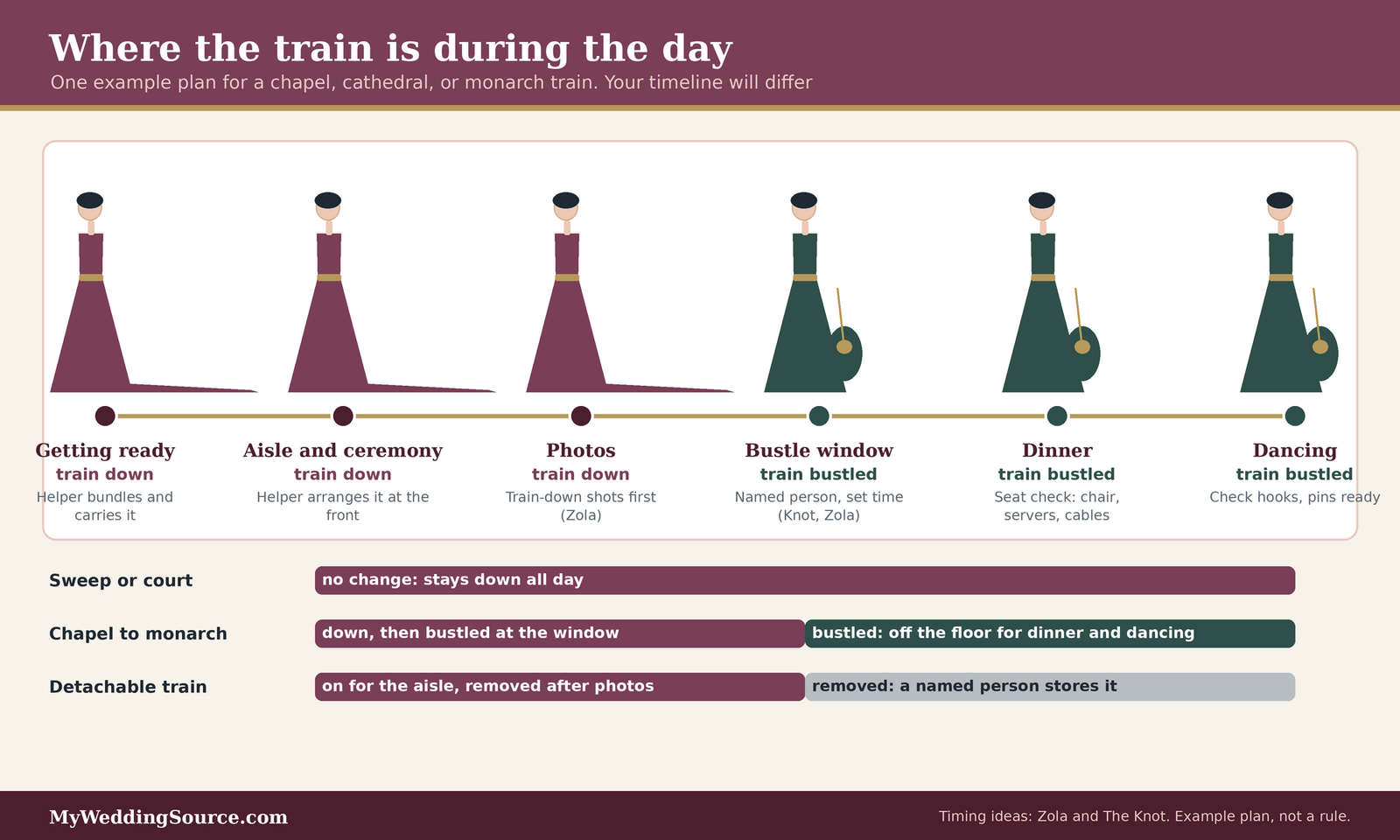
Photographers sometimes ask for sitting or kneeling poses, and a train is often arranged to spread for a portrait. Our guide to a wedding photographer’s shot list can help you plan the train shots you want. Plan them before the bustle goes up and before the dance floor, because arranging a long train for a photograph and then bustling it takes time. Zola suggests taking family and couple photos with the train down first, then bustling for the reception.
A day-of timeline: when the train is down, gathered, or off
Wedding dress train lengths matter most at the moments when the train changes state. It starts down, spends part of the day gathered, and may end the night off the gown entirely. Planning those changes in advance is what turns long wedding dress train lengths from a risk into a feature.
Down for the aisle and the photographs
The train is at its best when it is down: long, spread, and photographed, which is why wedding dress train lengths are usually chosen for this moment. That is also when it is most exposed to the floor, to feet, and to wind.
Getting dressed and getting to the ceremony
Bring the gown to the venue with the train bundled or protected, and plan who will carry and arrange it. The Knot says to plan when and where you will bustle between the ceremony and the reception and to confirm that your bustler will be there, which implies that the train is down until then. Before you walk, have your helper arrange the train behind you and check the route one last time for anything on the floor.
If you are changing location between getting ready and the ceremony, plan the car and the doorway at both ends. A rehearsal walk with the helper, even in everyday clothes, is the cheapest way to check the choreography.
Photographs with the train down
Zola suggests taking family and couple photos with the train down first. That makes sense for a practical reason: a spread train is a photograph, and a bustled one is a different silhouette. Ask your photographer which shots depend on the train, and put them early in the schedule, before the floor, the grass, and the day have taken their toll.
Some couples hold a first look before the ceremony. If you do, the train is down for longer, and you might want an additional helper available to move it between locations.
Gathered for the reception
At some point, even among the longer wedding dress train lengths, the train goes up. When that happens, how it goes up matters more than when.
The bustle window
Zola says most brides bustle between the ceremony and reception or after the first dance. The Knot suggests before cocktail hour or after photos. Either way, schedule the bustle as an item on the timeline, with a time, a place, and a named person. Do not leave it to chance. Our guide to the wedding planning timeline can help you place the item among the other changes of the day.
If you are bustling after the first dance, think about how you will feel on the dance floor with a long train underfoot. If you are bustling before, the train is out of the way for the entrance and the toasts. Neither is wrong. Choose the one that matches your priorities and your photographer’s schedule.
The detachable alternative
A detachable train changes the timeline entirely. Devotion Dresses describes it as attached for the ceremony and removed for the reception, so you get the length for the aisle without restricting movement afterward. Kleinfeld and True Society make the same point. A detachable train means the gown underneath is built to be worn without it, so ask how the back of the gown looks once it is off, and whether the point of attachment is visible.
Our reasoning is that removal is a second timeline item, with its own helper, its own location, and its own storage. Someone has to carry the train away and keep it clean. Name that person.
Plan B when the bustle does not hold
Even a good bustle sometimes fails. Pomp & Port says bustles can come undone when someone steps on the skirt during dancing, and Zola says bustles can occasionally break, so it suggests keeping a needle, clear fishing line, and large safety pins on hand.
What to carry
A small kit in the care of your helper is enough: safety pins, a needle and thread in a color that matches, and a few spare loops or buttons if your seamstress offers them. Our wedding emergency kit guide covers the broader list. Ask your seamstress which repairs are safe to do quickly and which should wait for a professional.
When to stop fixing and take the train off
If a bustle fails repeatedly, and the gown has a detachable piece, remove it. If it does not, a helper can use the wrist loop, if the gown has one, as a short-term measure. The Knot says that loop is meant for hanging the dress and is only a short-term fix for carrying a train. Treat that as a signal to ask your seamstress, before the wedding, what the backup is if the main plan fails.
Choosing among wedding dress train lengths: a short decision path
By now you have vocabulary, venue notes, and a walk-through. This section turns what you know about wedding dress train lengths into a choice. It is a conversation starter for your bridal stylist, not a verdict.
Four questions to answer first
Four questions settle most decisions about wedding dress train lengths. Write your answers down before you go to a fitting, so that a persuasive sales conversation does not decide for you.
Where will you spend the most time on your feet?
Pick the surface, not the venue, when you compare wedding dress train lengths. A lawn ceremony followed by an indoor reception is mostly a ballroom day, but the ceremony is on grass, and that is where the train is most exposed. Choose a length that works for the least friendly surface, then use a bustle or a detachable piece to adapt to the others.
How much will you move, sit, and dance?
If you plan to dance, greet guests, and move between rooms, a shorter train or a detachable one will be less work. If you expect a formal, seated reception with a small number of choreographed moments, a longer, bustled train is more manageable. Devotion Dresses says shorter trains are easiest for dancing and sitting, while longer trains need bustling or a detachable option.
Changing the length
Wedding dress train lengths do not have to be a fixed decision. There are three ways to change it, and each has different costs and limits.
Adding a train
The Knot says to ask your stylist before buying, because some designers can add a train during production, though heavily embellished gowns may cost more. A seamstress can also add a removable train or detachable overskirt during alterations. Because adding fabric is a structural change, it needs a professional.
Shortening or reworking a train
Cutting a train down to a shorter length is a larger job than it sounds when the lace, beading, or lining continues to the edge. Our reasoning is that the more decoration the train has, the more a change to it will show, so ask your seamstress to describe what would be involved before you commit. Our guide to wedding dress alterations explains how alteration work is usually organized.
A quick matching guide
The table below summarizes the ranges, with the movement trade-off for each. It uses the ranges retailers published and adds our reading of what to expect.
| Train length | Typical range (retailers) | Usually bustled? | Movement trade-off |
|---|---|---|---|
| Sweep or brush | Under about one foot | No (Kleinfeld, Devotion) | Easiest to sit, climb, and dance in |
| Court | About one to two and a half feet | Rarely (Devotion) | Visible in photos, still easy to move in |
| Chapel | About three to four and a half feet | Usually (Devotion) | You begin to manage it when you turn |
| Semi-cathedral | About four to five feet (Knot) | Usually (our reading) | More formal, lighter than cathedral |
| Cathedral | About six to eight feet | Yes (Devotion) | Helpers, wide aisle, clean floor |
| Monarch or royal | Ten feet or more | Yes, with attendants (Devotion) | Needs a large space and a plan |
| Detachable or Watteau | Any | Removed or bustled | Gives length for the aisle, ease afterward |
Reading the guide
Treat this table of wedding dress train lengths as a map of the conversation, not a ranking. A court train can be beautiful and a monarch train can be a burden, and the reverse is also true in the right setting. The only fixed point is that every extra foot of train is another thing to manage.
When your gown does not fit the table
If your gown has a detachable piece, a Watteau, or a mix of two lengths, ask your stylist to describe each piece separately. Then run the venue walk and the restroom walk-through for each piece, because the movement trade-off belongs to the piece you are wearing at that moment.
Cost, contracts, and care for a train
Wedding dress train lengths are fabric, labor, and logistics, and each of those has a price and a paper trail. The money questions are usually smaller than the dress, but they are easy to forget until the final fitting.
What a bustle may cost
Zola, a wedding planning site, says a bustle commonly costs roughly $75 to $250 depending on the gown, that ball gowns and long trains tend to cost more, and that bustles above $400 happen. That is one source’s range, not a quote. Seamstress pricing varies by region, fabric, and the number of points, so ask for a written estimate. The Knot notes that a second, shorter outfit for the reception avoids bustling but adds its own cost, and that adding a train to a heavily embellished gown may cost more.
What to put in writing
Before you pay for any alteration tied to wedding dress train lengths, ask for the scope in writing. You are not asking for anything unusual. You are asking for a plain description of what you are buying.
The alteration scope
Ask for the bustle style, the number of points, the finished train length measured from a stated point, and what happens if a point fails in the first weeks. Ask whether the price includes a lesson for your helper, pressing before the wedding, and any follow-up adjustment. Ask when the work will be done relative to your final fitting. Our guide to wedding dress fit and alterations covers fitting timing.
The paperwork
Keep every receipt, estimate, and measurement together with your other wedding paperwork. This guide is not legal advice, and contracts differ, but a written scope is the simplest protection you have if something is not done as described. If you rent a gown, ask in writing whether the rental policy permits a bustle or any other alteration before you assume it does. Our guide to renting wedding dresses covers rental questions.
Care labels and what cleaning can and cannot do
A long train lies on the floor, so it collects whatever is on the floor. The question after the wedding is how to clean it, and the honest answer depends on the fabric, the beading, and the care label.
What the Care Labeling Rule says
The Federal Trade Commission’s guidance on the Care Labeling Rule says manufacturers and importers must attach care instructions to covered clothing, that the instructions must not damage the product if followed, and that every instruction needs a reasonable basis, meaning trustworthy evidence. The FTC also says, as an example, that dyes that may bleed or beads that may be damaged during dry cleaning are cases where testing may be needed. For a gown with a train, that means the label tells you what the manufacturer has support for, and a specialist cleaner is the right person to ask about anything it does not cover.
What we cannot promise
No label or article can guarantee that a hem stained by grass, dew, or sand will come clean. Fabric, dye, and the nature of the soil all matter, and results vary. If the gown has beading or lace on the train, tell the cleaner before they begin. For the day itself, the practical protection is the one we have already covered: choose a length that suits the surface, bustle it when you can, and keep helpers’ hands clean.
Edge cases that change the answer
Most of the advice on wedding dress train lengths above assumes a standard-height, fully mobile bride in a rented-or-purchased gown at a typical venue. Real weddings are more varied, and some of the variations matter a lot for trains.
Mobility aids and different bodies
Wedding dress train lengths can interact with a mobility aid in ways a standing bride will never meet. If you use a wheelchair, cane, walker, or other aid, treat the sections above as a starting point and plan more carefully.
Wheelchairs, canes, and walkers
Our reasoning, not a sourced rule, is that a train behind a seated person falls differently from one behind a standing person, and that fabric can catch on wheels, footrests, or the end of a cane. Ask a tailor who has experience with seated or aided wearers to test the gown in the actual chair or with the actual aid, and to advise on length, fasteners, and whether a detachable train would be easier. Check the route and the surfaces with the venue, using the accessible-route yardsticks earlier in this guide. Our outdoor venue guide notes that a cloth runner can catch a wheel.
Height, heels, and hems
Wedding dress train lengths are measured from the gown, but the train lands relative to your shoes. Pomp & Port suggests finalizing your reception shoe heel height early, before the final fittings, so the hem and bustle work with your footwear. If you plan to switch between flats and heels, our guide to wedding dress hem length for flats versus heels is the place to start. For petite brides, our guide to petite wedding dresses discusses how proportions change the look of a long skirt.
Rentals, fabrics, and the second outfit
A few situations change what you are allowed to do, or what you need to do.
Rental and sample gowns
A rented gown may or may not be altered, and bustling is a form of alteration. Ask in writing whether a bustle is allowed, who does it, and how it is removed at return. If the policy does not allow it, a detachable piece or a shorter train from the start may be the simpler route.
The second outfit
The Knot says a shorter reception dress eliminates the need to bustle but adds to the budget. If you are weighing it, our guide to bridal outfit changes covers the logistics. A change also means a second restroom and seating plan, but with a shorter hem it is usually a simpler one.
Photos, veils, and the little things
Trains are photographed, which makes wedding dress train lengths a communication problem as much as a clothing one.
Telling the photographer
Tell your photographer which length you chose and when it changes state, and ask where they want to spread it. Our guide to wedding photography explains how to share a brief.
Veils and other long things
A long veil and a long train share the floor, and they can tangle. If you plan both, include the veil in your fitting and your rehearsal walk, and decide which one the helper handles first. Our guide to the meaning of the wedding veil covers the tradition if you are weighing whether to wear one.
Questions to ask your tailor, your venue, and your helpers
Good questions turn a vague plan for wedding dress train lengths into a documented one. Ask for the answers in writing when you can, and keep them with your fitting notes.
Questions worth asking before you commit to a length
- What is the exact train length in inches, and from which point is it measured?
- Which bustle style do you recommend for this fabric and train weight, and how many points?
- Can my helper attend a fitting and practice, and can we record a short video?
- What is the narrowest point on my route, and how wide is the ceremony aisle?
- What is the ground surface at each stage, and can the venue add a runner or an underlayment?
- Where is the larger restroom stall, and can we use it briefly before photos?
- What is the plan if a bustle point fails during the reception?
Questions for the tailor
These questions confirm what you are buying and how your wedding dress train lengths will behave afterward.
Length, style, and points
Ask for the finished length in inches, where it is measured (wedding dress train lengths are quoted from different points), and the bustle style with the number of points. Ask why that style suits the fabric, and ask to see an example of the seamstress’s own bustle work, because Pomp & Port suggests asking a bridal tailor to show examples. Ask whether the gown could also take a wrist loop and whether you should use it.
Lessons, reinforcement, and timing
Ask whether the price includes teaching your helper and whether the seamstress will reinforce the loops or buttons if you plan to dance a lot. Ask when the bustle will be finished relative to your last fitting, so that you can practice with the final result.
Questions for the venue and helpers
These questions confirm the route and the people.
Route, surface, and restroom
Ask for the aisle width, the surface at every stage, the location and size of the restrooms, and whether the venue has experience with long trains. Ask for a walk-through of the route in advance. Our guide to venue questions lists more.
Roles, timing, and backup
Ask your helper whether they are comfortable with the role, whether they can attend the fitting, and whether they will be available at each timeline point. Pick a backup in case the first helper is busy.
FAQ: wedding dress train lengths questions
Choosing a length
What is the most common train length?
Kleinfeld calls the chapel train one of the most common lengths, at about three to four and a half feet, because it adds noticeable drama without a lot of extra fabric. Popularity varies by region and season, so choose by venue, movement, and how much help you will have, not by what is common.
Does a longer train always look more formal?
Generally, yes. Retailers link cathedral and monarch trains to black-tie events, grand churches, and large ballrooms, while sweep and court trains suit casual or outdoor settings. The Knot says there are no strict rules, though. A short train on a formal gown can look polished, and a long one can look out of place in a small room.
Moving and sitting
Can I sit down with a long train?
Yes, but plan for it. A train that is down lies behind the chair and needs a helper to arrange it before you sit and again before you stand. A bustled train is already off the floor and out of the way. Practice sitting in the full gown and shoes at your final fitting, with your helper present.
Will I be able to dance in a cathedral train?
Not comfortably if it is down. The Knot says long cathedral trains can make it hard to move on the dance floor, and a bustle lifts the train so you can move freely. If you plan to dance a lot, ask your seamstress to add extra loops or buttons and consider a detachable train.
Venues and surfaces
Can I wear a long train on grass or sand?
It is harder. True Society says outdoor sites with grass or gravel are easier with court or shorter chapel trains, and Azazie says cathedral trains generally do not suit grass. Beach settings favor a sweep or a lightweight detachable train. A tea-length or midi hem is practical on grassy or uneven ground, according to Kleinfeld.
How wide should a ceremony aisle be for a long train?
No bridal source gives a figure. For reference, the U.S. Access Board says accessible routes need at least 36 inches of clear width, which is a design standard and not a bridal rule. Ask your coordinator to measure the aisle and to list anything that narrows it, such as chairs, runners, or flowers.
Bustles and cost
Who should learn to bustle my dress?
Choose one trusted person, such as your maid of honor or a responsible bridesmaid, and have them attend your final fitting. Zola and The Knot suggest taking notes or recording a video of the seamstress so they can follow along on the day. You cannot bustle the gown yourself once you are dressed.
How much does a bustle cost?
Zola says roughly $75 to $250 depending on the gown, with ball gowns and long trains costing more and bustles above $400 possible. That is one source’s range and not a quote. Ask your seamstress for a written estimate that states the style, number of points, and whether a lesson for your helper is included.
Your next steps
Decide on a length
Write down your surface and your movement
Note the least friendly surface you will cross, since it limits wedding dress train lengths more than anything else, how much you plan to move, and how many helpers you have. Our guides to wedding dresses and wedding dress styles can help you see how silhouettes and trains go together.
Measure the route
Walk the route with a tape and a camera, from the dressing room to your reception seat, and keep the numbers with your fitting notes. Our outdoor wedding venues guide helps with ground questions.
Lock in the plan
Get the scope in writing
Ask your seamstress for the length in inches, the bustle style and points, the price, and a lesson for your helper. Our guide to wedding dress fit and alterations covers the sequence of fittings.
Rehearse the walk-through
Put the restroom and seated-position walk-through for your chosen wedding dress train lengths into your rehearsal, even if you do it in a skirt. For the helper’s side of it, see our guide to sitting and using the restroom in a fitted wedding dress, and for the shoes, see hem length for flats versus heels.
Sources & methodology
How we built this guide
What we relied on
This guide combines published train-length and bustle advice from bridal retailers and wedding publishers, the Federal Trade Commission’s guidance on the Care Labeling Rule, and the U.S. Access Board’s guides to accessible routes and toilet rooms, which we use as yardsticks for aisle width, surfaces, and stall size. Where a statement comes from a retailer, we say so, because retailer advice reflects the seller’s products and habits. The stall-depth comparisons are our own arithmetic from retailer train ranges and the Access Board’s stated minimums, and they are estimates. We checked these pages on November 12, 2026, and did not verify whether they have changed since.
What we did not do
We did not test gowns, measure trains, or consult a tailor for this article, and we are not tailors. The ranges for train lengths conflict between sources, and we have said so instead of choosing one. Our notes on wind, sand weight, vehicles, mobility aids, and the time a restroom visit takes are our own reasoning, labeled as such, and not sourced rules. Nothing here is legal, medical, or financial advice, and nothing guarantees how a fabric will behave or clean up. Ask a bridal seamstress about structural changes and a specialist cleaner about care.
Source list
Government and regulatory sources
- Federal Trade Commission, Clothes Captioning: Complying with the Care Labeling Rule: https://www.ftc.gov/business-guidance/resources/clothes-captioning-complying-care-labeling-rule
- U.S. Access Board, Guide to the ADA Accessibility Standards, Chapter 4: Accessible Routes: https://www.access-board.gov/ada/guides/chapter-4-accessible-routes/
- U.S. Access Board, Guide to the ADA Accessibility Standards, Chapter 6: Toilet Rooms: https://www.access-board.gov/ada/guides/chapter-6-toilet-rooms/
Bridal retailers and wedding publishers
- Kleinfeld Bridal, Train lengths: https://kleinfeldbridal.com/pages/train-lengths
- Kleinfeld Bridal, Wedding dress styles best for outdoor weddings: https://www.kleinfeldbridal.com/blog/wedding-dress-styles-best-for-outdoor-weddings/
- Devotion Dresses, Guide to wedding dress train lengths: https://devotiondresses.com/blogs/news/guide-to-wedding-dress-train-lengths
- The Knot, Wedding dress trains: https://www.theknot.com/content/wedding-dress-trains
- The Knot, Getting around in your wedding dress: https://www.theknot.com/content/getting-around-in-your-wedding-dress
- The Knot, What is a bustle: https://www.theknot.com/content/what-is-a-bustle
- The Knot, Wedding gown: find the best length for you: https://www.theknot.com/content/wedding-gown-find-the-best-length-for-you
- Zola, How to bustle a wedding dress: https://www.zola.com/expert-advice/how-to-bustle-a-wedding-dress
- Azazie, Shoes and hemlines: a guide to outdoor wedding dresses on grass: https://www.azazie.com/blog/shoes-and-hemlines-a-guide-to-outdoor-wedding-dresses-on-grass/
- Pomp & Port, Bustle types 101: https://www.pompandport.com/blogs/behind-the-seams/bustle-types-101-pick-the-right-bustle-and-practice-it
- LWD Bridal, Wedding dress bustles 101: https://www.lwdbridal.com/blog/bustles
- True Society, A bride’s guide to wedding dress trains: https://truesociety.com/?p=18220