

The professional bridal makeup vs DIY decision is a trade of cash for time, practice, and risk, and you can settle it by pricing both routes line by line, finding the gap between them, and testing whether your own skills are good enough to be worth that gap.
Quick answer
Published ranges put a professional bridal makeup application for the bride at roughly $200 to $500, according to Zola, with most couples spending about $300 to $400, and a trial at $150 to $300 on top. Zola also reports tips of 16% to 20% of the service total. A do-it-yourself route has no application fee, but it is not free: you pay for products you do not already own, several practice runs, a backup plan, and about ten hours of your own time by our estimate. In the example scenarios in this guide, a typical professional booking costs about $679 with tip, so DIY saves a few hundred dollars if you spend modestly on products and can reach a result you trust. If the gap is small, or you cannot pass the practice tests in this guide by the time you must decide, hiring is the safer choice. A hybrid, such as a lesson or a professional finish, often costs less than a full booking.
What you are actually deciding
Most people who search for professional bridal makeup vs DIY are really asking three separate questions at once: can I afford a professional, can I do this well enough myself, and what happens if it goes wrong. Those questions have different answers for different people, and mixing them together is how couples end up either overspending on a service they did not need or saving a few hundred dollars and being unhappy in the photographs. This section separates the questions so the rest of the guide can answer each one with numbers or a test.
The goal here is not to talk you into either route. Wedding publishers, working artists, and companies that sell beauty services all publish advice on this topic, and they do not agree. A beauty service company will tend to favor booking a professional, and a cosmetics brand will tend to favor doing it yourself with its products. We say whose view each claim comes from and keep the arithmetic in the open so you can change the inputs.
Three versions of “DIY”
“DIY” covers a wider range than the phrase suggests. Zola points out that you can mix professional and do-it-yourself services, for example professional hair with makeup you apply yourself, depending on your skills and comfort. Before pricing anything, decide which version you are actually considering, because the cost and the risk change a lot between them.
Fully DIY
In the fully DIY route you buy or gather the products, learn the technique from tutorials or a counter consultation, practice, and apply everything yourself on the wedding morning, including any touch-ups later in the day. Trinny London, a cosmetics brand, lists real advantages in its blog: you control the look, you control the morning’s schedule, nobody extra has to be at the venue, an artist cannot cancel on you, and you keep the products afterward. The same brand also stresses that you should allow more time than you think you need. The cost is mostly time and practice, and the main risk is that nobody is there to fix a problem on the spot. That is the version most people picture when they search for professional bridal makeup vs DIY.
DIY with a lesson or a professional finish
A middle path is to learn from a professional once, or to have one check your work. Makeup lessons exist at beauty retailers: Sephora’s services FAQ lists a Beauty Lesson at $75, though menus vary by store. The beauty site Beaut.ie suggests a different hybrid: do your own makeup, then book an artist for the morning to finish it by blending eyeshadow, sharpening liner, and evening out the overall look, after discussing the arrangement in advance. Either option raises the cost modestly and lowers the risk a lot. Many couples who start out asking about professional bridal makeup vs DIY end up here.
Pro for you, DIY for everyone else
Many couples reverse the question and ask whether the bride should hire a professional while the bridal party does their own makeup. Zola lists bridesmaids’ makeup at $60 to $125 per person, so the attendants’ share can rival the bride’s own fee when the party is large. Our guide to wedding party costs covers who normally pays for what, and the scheduling guide for a large bridal party covers the logistics. This article focuses mainly on the bride’s own makeup, with a short attendants table in the cost section. In a large party, professional bridal makeup vs DIY is really two separate decisions.
What the published prices cover
A price comparison is only fair if both sides count the same things. A professional quote usually bundles several items, and a do-it-yourself budget usually forgets several. Listing both sets before you do any arithmetic is the most useful single habit in this guide.
What a professional quote usually includes
The service itself, meaning the application on the wedding morning, is the base. Beyond that, the line items that move a total are the trial, travel, an early start, extra people, lashes, and the tip. Thumbtack’s price page, last updated October 28, 2026, describes how individual artists add charges for locations far from home, very early start times, and events that need a hotel stay, and some artists charge for lashes per person. Some include the trial in the total and others bill it separately, so a low headline price can hide fees that arrive later. Our broader guide to wedding hair and makeup cost walks through each line item. Reading quotes closely is the first practical step in any professional bridal makeup vs DIY comparison.
What a DIY budget usually leaves out
People who price the DIY route often count only the foundation they plan to buy. A fair DIY budget also includes the rest of the kit, any item that must be replaced before the wedding because it expires or dries out, the practice runs, a backup plan if you cannot finish the application, touch-up supplies, and your time. The next sections price each of those, using published figures where they exist and clearly labeled assumptions where they do not. A fair professional bridal makeup vs DIY comparison counts these items on the DIY side too.
What professionals charge, from published sources
Before you can find a break-even point you need an honest number for the professional side. The sources disagree because they measure different things: one is an editorial guide, one is a marketplace of individual artists, and several are older surveys. We report each with its date and what it covers, rather than averaging them into a single figure that no one has actually quoted.
Ranges from wedding publishers and marketplaces
Three kinds of published sources give the professional side of the comparison: a wedding publisher’s cost guide, a marketplace that lists individual artists, and older averages that are still widely repeated. They are not interchangeable, so each is described on its own terms.
Zola’s cost guide
Zola’s guide, last updated March 6, 2026, puts the bride’s makeup at about $200 to $500, with most couples spending around $300 to $400. It lists traditional application at $200 to $400 and airbrush at $300 to $500. It lists a trial at $150 to $300, usually booked two to three months before the wedding, and travel at $50 to $200 or $25 to $75 per hour of travel, noting that an artist within about 30 minutes may not charge. Zola’s tipping figure comes from its 2026 Wedding Spend Survey of more than 700 recently married couples: 16% to 20% of the total service cost, with a flat tip of about $150 being the average for a beauty stylist. If airbrush is on your list, our comparison of airbrush vs traditional bridal makeup covers that add-on separately. Zola’s ranges are the main price anchor for the professional bridal makeup vs DIY scenarios later in this guide.
Thumbtack’s marketplace figures
Thumbtack’s wedding makeup page, last updated October 28, 2026, reports a national average range of $200 to $457, with a low of $120 and a high of $902. Individual artists on the page show how pricing works at the small end: one lists on-site touch-ups at $50 per hour, another lists a trial at $60 to $70, and a third lists lashes for additional party members at $15 to $20 per person. Treat those as examples of how single artists price, not as market averages. The page notes that travel fees are usually billed to the client and that some artists include the trial in their total while others charge extra. These figures give a second, more recent reference point for professional bridal makeup vs DIY pricing.
Older averages and why they differ
You will see lower figures repeated around the web. A 2022 article from GoBankingRates put average wedding makeup at about $115, and a 2022 article on The List cited a The Knot survey at about $115 or more. A 2024 update of a The Knot article cited an average 2023 wedding makeup cost of $140. These are older, they average across many weddings including simple ones, and the more recent Zola and Thumbtack ranges are higher. We use the recent ranges for scenarios and mention the older figures only as a sign that prices vary a great deal by market, artist, and what the quote includes. The wide spread in these older numbers is why a single average is a poor guide to professional bridal makeup vs DIY.
The line items that move the total
The base fee is only one piece of what a professional route costs. The items below explain why two quotes with similar headline prices can end up hundreds of dollars apart.
The trial
A trial is a practice session with the artist, typically two to three months before the wedding according to Zola, that lets you test the look, how long it lasts, and possible skin reactions. Zola’s range is $150 to $300 for the bride, and Zola suggests booking a trial for yourself only, rather than the whole party, to save money. A trial is also useful even if you do your own makeup, which we come back to in the hybrid section. A trial also shows up on both sides of a professional bridal makeup vs DIY budget, which is why it matters.
Travel and early starts
Zola lists travel at $50 to $200, or $25 to $75 per hour of travel. Thumbtack’s example artist adds charges for locations more than a 1.5-hour drive away, start times before 7:30 a.m., and events that require a hotel stay. A GoBankingRates article suggests that going to the stylist’s studio or salon, rather than having them travel to you, avoids a travel fee that stylists often build into their prices. Our guide to vendor travel and lodging fees explains how those charges are typically written into a contract. Both fees can tip the professional bridal makeup vs DIY balance when the venue is far from home.
The tip
Zola’s survey figure of 16% to 20% of the total service cost is a useful planning number, but tipping practices vary and the right amount is your decision. Because the tip is a percentage, it makes a larger difference when the total is larger, so it belongs in every professional-route calculation rather than being added at the last minute.
Attendants and extra people
Zola lists bridesmaids’ makeup at $60 to $125 per person, noting that attendant looks are typically simpler than bridal looks. Thumbtack’s example artist charges a flat $150 for an assistant for parties of six or more. The table below uses Zola’s per-person range to show how quickly the attendant share grows. The figures are our arithmetic from those published ranges, not quotes.
| Attendants having makeup done | Low at $60 each | High at $125 each |
|---|---|---|
| 2 | $120 | $250 |
| 4 | $240 | $500 |
| 6 | $360 | $750 |
What to budget
For the bride’s own makeup, the published ranges we found were $200 to $500 for the application (Zola, 2026), $150 to $300 for a trial (Zola), $50 to $200 for travel (Zola), and 16% to 20% for a tip (Zola’s 2026 survey). A retail makeup service is a lower-priced alternative: Sephora’s services FAQ lists an Ultimate Glam application at $90 and a Full Face at $60, though that page does not mention a bridal service and menus vary by store. For a do-it-yourself route, our scenarios assume $100 to $400 of new spending, which are our own assumptions and not market data, so replace them with the prices you actually see. Ask any artist for the total in writing.
What a do-it-yourself route really costs
A do-it-yourself budget has two sides, cash and time, and both are easy to underestimate. We have no published price for a “typical” DIY kit, because what you need depends on what you already own, so this section builds the budget from categories rather than from a single average. The worksheet table gives you blanks to fill in with real prices from the shelf or the website.
The cash side
Cash spending falls into four groups. The first group is the one most people think of, and the other three are the ones that surprise them.
Base and complexion products
Several sources agree that the base is where to put money. Trinny London’s blog advises investing most in the foundation or tinted serum, because it covers the largest area, and checking the shade along the jawline in natural light and in photos. Beaut.ie advises visiting a makeup counter to find a foundation that matches your skin tone and your preferred finish. The List warns of the opposite problem: if you only own the shades you already have, a poor match can leave a “mask” look. Plan for a new or at least a newly matched base, concealer, and powder, since The Knot’s article adds that powder adds coverage and longevity. The base is the largest single decision on the DIY side of professional bridal makeup vs DIY.
Eyes, lips, cheeks, and brushes
Beaut.ie recommends buying the colors you need for your look plus the right brushes to apply them, and says good foundation and brushes are worth the investment. Who What Wear’s interview with the makeup artist Hannah Martin suggests using shades that suit your skin tone rather than matching your flowers or dresses, and adds that you should avoid trying a new lipstick on the day. Count the products that are central to your look, and count any you must replace to avoid practicing with items you would not use at the wedding.
Items that expire or must be replaced
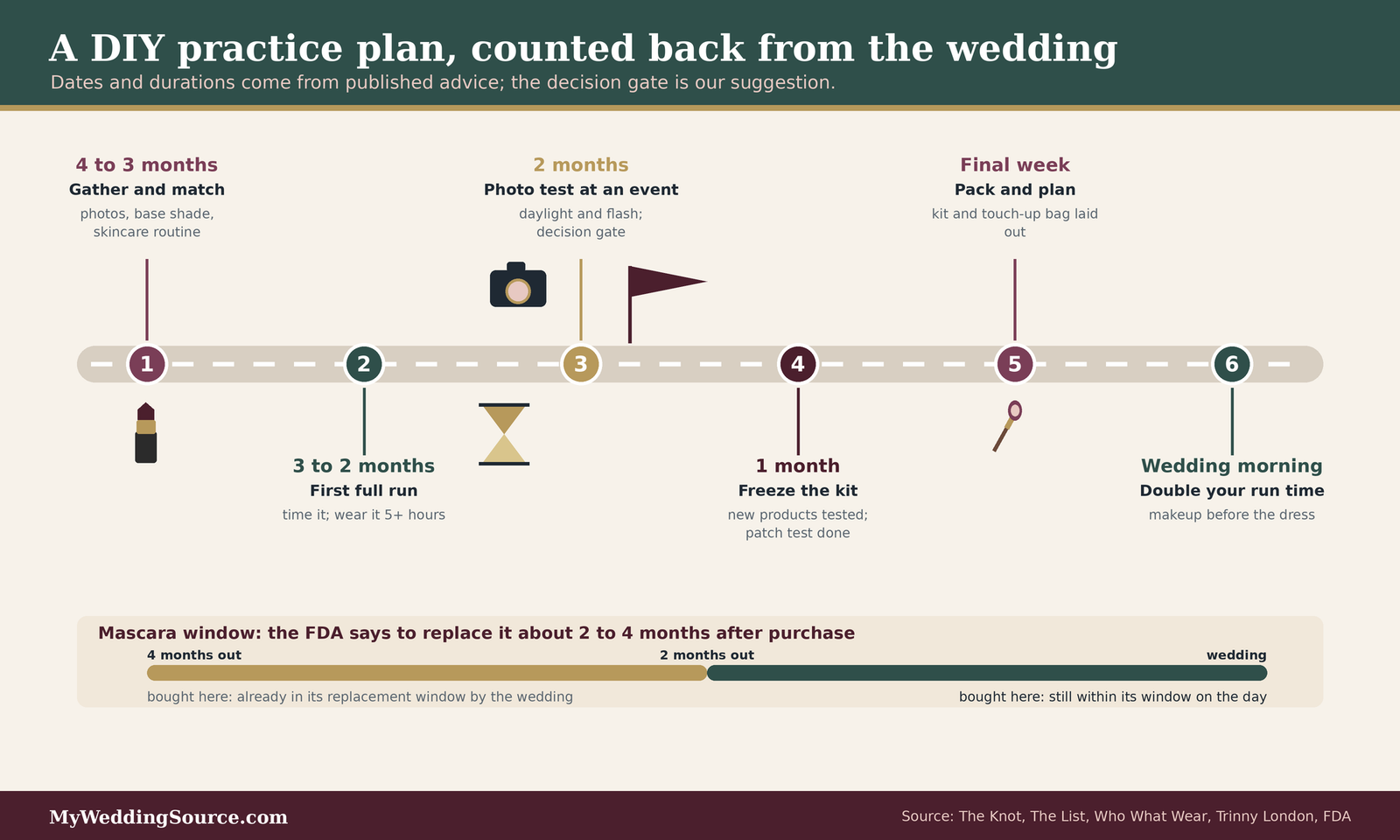
The FDA’s eye cosmetic safety page says to replace mascara about two to four months after purchase and to throw it away once it dries out, never adding saliva or water to revive it. That has a direct planning effect: if you start practicing four months out, buy the mascara you will wear on the day inside that window, or budget for a second tube. The FDA’s consumer page adds that the law does not require an expiration date on cosmetics, that you can write the opening date on a container to track its age, and that you should throw away products whose color or smell has changed.
An optional lesson or consultation
A counter consultation or a lesson is the one line item that buys information. Sephora’s services FAQ lists a Beauty Lesson at $75 and an Ultimate Glam at $90, with a Full Face at $60 and a Feature Focus at $30, and notes that menus vary by store. The page also lists a fee of one-third of the service price for a cancellation within 24 hours or a no-show. Who What Wear’s expert recommends a consultation with an artist at a beauty counter to confirm you are on track, so the lesson is a reasonable DIY expense rather than an extra.
| Line item | What the sources say | Your price |
|---|---|---|
| Foundation or tinted base | Spend most here; check shade at the jawline in daylight and in photos | |
| Concealer and powder | Powder adds coverage and longevity | |
| Cheeks, eyes, and lips | Buy the colors for your look; no new lipstick on the day | |
| Brushes and sponges | Good brushes help the finish | |
| Mascara and other eye products | Replace mascara about 2 to 4 months after purchase (FDA) | |
| Setting spray and primer | Setting spray after a light T-zone powder helps longevity (Who What Wear) | |
| Lashes, if you want them | One artist lists $15 to $20 per person for lashes (Thumbtack) | |
| Touch-up kit | Base, concealer, blush, lip color, a mattifying product, blotting paper (Trinny London) | |
| Optional lesson or consultation | Sephora lists a Beauty Lesson at $75; menus vary | |
| Backup fund | Your own decision; see the break-even section | |
| Total new spending |
The time side
Time is the DIY cost that never appears on a receipt. The sources do not give a single number, so the hours below are built from their advice, and we flag them as estimates.
Practice runs
Celebrity makeup artist Beck Wainner, quoted by The List, recommends several trial runs starting a few months before the wedding. Hannah Martin, in Who What Wear, calls rehearsing the most important step and suggests practicing the final look several times, even briefly at night. The Knot’s article recommends allowing about 90 minutes for the makeup session. Three full runs at 90 minutes each come to 4.5 hours of active practice, which is the figure we use in the estimate. Practice is the biggest hidden cost in professional bridal makeup vs DIY, even though it never appears on a receipt.
Wear tests and photographs
The Knot says to wear the test look for more than five hours to see how it holds up. The List suggests testing at a smaller event, such as bridal photos, an engagement party, or the rehearsal, to see what photographs well and what lasts. Trinny London advises photographing the trials. A wear test is passive time, since you can do other things while wearing it, but reviewing the photographs and noting adjustments takes active time, and we count about an hour for that. Skipping this step is the most common way professional bridal makeup vs DIY goes wrong in practice.
The wedding morning
The List suggests timing your trial runs and then doubling that duration for the wedding day, and Trinny London says to allow more time than you think you need to cover delays, emotions, and touch-ups. If a practice run takes 90 minutes, a three-hour block on the wedding morning is a reasonable plan. In our estimate that adds up to roughly ten and a half hours of your own time: about two hours choosing and matching products, 4.5 hours of practice, one hour reviewing, and three hours on the day. Your own number may be lower or higher. The morning block is where professional bridal makeup vs DIY stops being theoretical.
The break-even math
Break-even is simply the point where DIY stops being cheaper. Because DIY costs cash and time while a professional costs only cash, there are two break-even questions: how much cash would you save, and what hourly value on your own time makes that saving worthwhile? Both are easy to compute once you have the totals.
The formula
The calculation has three parts: the total for the professional route, the total for the DIY route, and the gap. Write all three down in dollars before comparing anything else.
Total for the professional route
Add the application, the trial if you want one, travel, any early-start or assistant fee, and the tip, and apply the tip percentage to the service total. For the bride only, the structure is: application plus trial plus travel, then multiplied by one plus your tip percentage. Zola’s ranges give the inputs for the scenarios below. This is the number that most professional bridal makeup vs DIY comparisons start from.
Total for the DIY route
Add every line in the worksheet above: new products, replacements, lesson, touch-up kit, and a backup fund. Leave time out of the cash total for now, so the gap in dollars stays clear. Then count your hours separately. It is the other half of the professional bridal makeup vs DIY equation.
The gap and the hourly break-even
The gap is the professional total minus the DIY total. Divide the gap by your estimated hours to get the break-even value of your time. If you would not do ten hours of makeup practice for the hourly figure you see, the savings are not worth it to you. If you would, they are. These two numbers are the whole professional bridal makeup vs DIY calculation in miniature.
Worked scenarios
The scenarios use Zola’s published ranges for the professional side and our own assumed DIY spending, because no source gives a DIY average. Treat every figure as an estimate and replace the DIY inputs with your own. The hours use the 10.5-hour estimate from the previous section.
Three professional totals for the bride
The “lean” professional route is Zola’s low application price of $200, no trial, no travel, and a 16% tip, for a total of $232. The “typical” route is $350 for the application (the middle of the $300 to $400 range most couples spend), a $225 trial (the midpoint of $150 to $300), no travel fee, and an 18% tip, for about $679. The “high” route is $500 for the application, a $300 trial, $200 for travel, and a 20% tip, for $1,200. These come from Zola’s ranges and our arithmetic, not from any quote. We use these three totals as the professional side of the professional bridal makeup vs DIY comparison.
Three DIY totals
We assume three DIY levels for illustration. In the “lean” case you already own most of what you need and spend about $100 on new products. In the “moderate” case you buy a matched base, brushes, a second mascara, and a touch-up kit for about $250. In the “generous” case you also take a $75 lesson, add lashes, and set aside a backup fund, for about $400. These are assumptions to show how the formula works, not market data.
What the gap looks like
The table shows the gap in dollars and the break-even hourly value of your time across the nine combinations. A negative gap means DIY costs more in cash than that professional route.
| Professional route | DIY spending | Cash gap | Hourly break-even at 10.5 hours |
|---|---|---|---|
| Lean, $232 | $100 | $132 | about $13 per hour |
| Lean, $232 | $250 | negative $18 | DIY costs more in cash |
| Lean, $232 | $400 | negative $168 | DIY costs more in cash |
| Typical, about $679 | $100 | about $579 | about $55 per hour |
| Typical, about $679 | $250 | about $429 | about $41 per hour |
| Typical, about $679 | $400 | about $279 | about $27 per hour |
| High, $1,200 | $100 | $1,100 | about $105 per hour |
| High, $1,200 | $250 | $950 | about $90 per hour |
| High, $1,200 | $400 | $800 | about $76 per hour |

Putting a price on time and risk
The hourly figure is not a verdict, just a way to make the trade visible. If the break-even value is high, DIY is a good use of your hours. If it is low, the savings are small for the work involved.
How to read the hourly number
Ask whether ten and a half hours of practice and application is something you would do for the hourly figure in the table. For some people, practicing makeup is enjoyable, and the hours cost nothing. For others, the same hours come out of a busy planning period. Neither answer is wrong. Our wedding planning stress guide covers how to protect your time when the schedule gets crowded. Reading the table well is the heart of the professional bridal makeup vs DIY decision.
Why a backup fund belongs in the math
The one cost that is not in the DIY total is the cost of failure. Glamsquad’s blog warns that with DIY there is no artist available to fix a problem on the spot, and that results can show flaws such as uneven liner or poorly blended eyeshadow in photos. A simple hedge is to set aside the price of a lower-cost fallback, such as a retail makeup service, so a bad practice run or a sick morning does not force an expensive last-minute booking. Sephora’s FAQ lists a $90 Ultimate Glam, which is a useful anchor for that fund, though that page does not mention a bridal service and availability varies. Risk is the part of professional bridal makeup vs DIY that a price list cannot show.
Skill requirements: an honest self-assessment
Cost is only half of the question. The other half is whether you can reach a result you are happy with, on your own face, under wedding-day conditions. No test can guarantee that, but a structured set of practice runs gives you evidence rather than a feeling. The sources agree on what to look for.
The skills the sources say matter most
Four skills come up again and again in the advice we read. They are listed here in the order that tends to matter most for how a face looks in photographs.
Shade matching and blending to the neck
The List quotes makeup artist Cassandra Garcia advising that you blend bronzer well and match your face to your neck and shoulders, and that if you plan to get a spray tan, you test it beforehand and choose a foundation that matches the tanned color. Trinny London says to extend makeup to the neck, décolletage, and shoulders if they will be visible, to avoid a visible jawline. Our wedding spray tan guide covers timing for that. Shade matching is the skill that most often separates a good result from a poor one in professional bridal makeup vs DIY.
A base that lasts
Who What Wear’s interviewee says dry skin can drink up foundation and look patchy, and that an unset, very luminous foundation may slide off during the day. She suggests a light dusting of powder on the T-zone and a finish of setting spray. The Knot’s article advises light, buildable layers rather than one heavy coat. If your skin runs oily, our guide to wedding makeup for oily skin covers that case, and the one for mature skin covers another.
Eyes and liner
Beaut.ie advises getting liner and blending right in advance, because a botched liquid eyeliner can cause last-minute stress, and notes that wedding photos show fine detail. Glamsquad’s blog lists uneven liner and poorly blended eyeshadow as the typical DIY flaws. The FDA’s eye cosmetic safety page adds a safety rule that matters on a hectic day: do not apply makeup in a moving car or bus, because a sudden bump can push an applicator into your eye and scratch the cornea. Eyes are where professional bridal makeup vs DIY is hardest to judge from the price alone.
Cheeks, highlighter, and lips
Who What Wear’s interviewee lists common mistakes: too little bronzer and blush can look washed out, too much highlighter looks heavy, and a lipstick darker than your natural lip can look aging. Trinny London adds that flash photography washes out color, so a little more product than usual may be needed, and that you should stay close to your signature look so the makeup does not date. Makeup artist Jo Levy, quoted by The List, says the aim is to make the bride look like herself, only more defined and finished.
Scoring yourself
You do not need a professional’s eye to evaluate your own results. You need a repeatable test, honest photographs, and a rule set in advance.
The three-run test
Run the full look three times, on separate days, timing each one. For each run, record the time taken, whether the shade matched at the jaw in daylight, whether any area was patchy, and how the look held after five hours (The Knot’s suggested wear time). A result that improves by the third run is a good sign. A result that does not improve is also useful information, and costs you less than discovering it on the day. A repeatable test makes professional bridal makeup vs DIY a question you can answer with evidence.
The outside view
Photograph each run in daylight and with flash, and ask someone whose honesty you trust to look at the photographs before you tell them what you think. Trinny London and The List both suggest photographing trials and testing at a smaller event. A friend, a counter consultant, or a trial with a professional can provide the outside view. Our wedding hair trial guide shows how to run a trial so it produces useful evidence. An outside view keeps the professional bridal makeup vs DIY decision honest.
When to stop and hire
Decide your stopping rule before the first run. For example: “If I cannot match my neck, keep my base from patching after five hours, and finish both eyes evenly by the third run, I will book a professional by a set date.” Our wedding vendor timeline guide helps you place that date, and the wedding beauty timeline shows how it fits with skincare and other appointments. A rule written in advance protects you from sunk-cost thinking when professional bridal makeup vs DIY gets close.
| Skill | Pass looks like | Where the advice comes from |
|---|---|---|
| Shade match | Face, jaw, and neck read as one color in daylight and in a photo | The List; Trinny London |
| Base longevity | No patches or sliding after more than five hours | The Knot; Who What Wear |
| Liner and eyes | Both sides even, edges blended, no smudging by the end | Beaut.ie; Glamsquad |
| Cheeks, lips, and highlight | Balanced in flash and daylight; no color tried for the first time on the day | Who What Wear; Trinny London |
| Speed | The run fits inside the block you can protect on the wedding morning | The Knot; The List |
| Touch-ups | You can refresh base, lips, and shine from a small kit in a few minutes | Trinny London |

A DIY practice timeline
A practice plan turns “I will figure it out” into dates. The timeline below draws on the sources’ timing advice, shifted to fit the shape of the break-even question: you need enough runs to know whether DIY works, and early enough to switch to a professional if it does not.
Four months to one month out
The early months are for deciding, not perfecting. The goal is to reach a clear yes or no on DIY while professionals still have openings and before you have spent much on products.
Four to three months out: gather and match
The List cites a skincare timeline in which you start a consistent routine three months out, with daily washing and moisturizing. Use this window to collect photographs of looks you like and of yourself when you felt your best, which Hannah Martin recommends in Who What Wear, and to match a base at a counter. Buy only what you need to start practicing. Our bridal skincare timeline covers the skin side in more detail. This is the earliest useful moment in any professional bridal makeup vs DIY plan.
Three to two months out: first full run
Do the first full run, time it, and wear it for more than five hours, per The Knot. Wainner’s question from The List is a good test: did the application last all day or not? If you are also considering a professional, this is the window Zola gives for a trial, so you could book one here to compare notes. Record the time taken, because the wedding morning should have roughly double that, according to The List.
Two months out: a photographed test at an event
Wear the look to a smaller event, such as an engagement party, a dress fitting, or a rehearsal, and photograph it in daylight and with flash. Trinny London suggests trialing the makeup alongside your dress or fitting so you can match shades to its tone. This is also the best moment for the stopping rule: if the results are not improving, book a professional or a hybrid now, not later.
The final month, the final week, and the morning
The last month is for locking things in. Changing products or techniques this late creates risk, and the advice from the sources is consistently to keep things familiar.
One month out: freeze the kit
The Knot’s article advises testing any new product at least a month ahead, since new formulas can cause reactions, especially on sensitive skin, and finishing new facials about a month before. The Cleveland Clinic describes patch testing a new skin care product on the inner elbow daily for seven to ten days before using it on the face. Taken together, that means your final product list should be settled about six to eight weeks out so the patch test fits before the one-month mark. This is general consumer information and not medical advice.
The final week: pack and plan
Trinny London suggests laying out all products and tools the night before to avoid rushing. Build the touch-up kit now: Trinny London’s list includes a base, concealer, blush, lip color, a mattifying product, blotting paper, and damp cloths for mishaps. Our wedding emergency kit guide covers the rest of the day-of supplies, and the wedding week checklist helps with the schedule.
The morning itself
Schedule the makeup before the dress, since Trinny London advises finishing makeup completely before putting on the dress and washing hands before anyone helps you dress. Moisturize at least 20 minutes before applying, per the same brand’s guidance, and work in a quiet space with good light. If you do your makeup at home, avoid doing it in a vehicle, per the FDA. Build in a buffer, because The List and Trinny London both warn that rushed makeup is more likely to go wrong. The wedding morning is the real test of any professional bridal makeup vs DIY choice.
Hybrid routes that cost less than a full booking
Most of the published advice on this topic is not “pro or DIY” but a mix. If the break-even table showed a small gap with a professional, or if the practice runs gave you mixed results, one of these routes may fit better than either extreme.
Ways to mix the two
Each hybrid below keeps part of the cost down while limiting the risk of the part you are least sure about. The prices are from single sources and will differ where you live.
A lesson, then DIY
Pay for one structured session, then do the rest yourself. Sephora’s services FAQ lists a Beauty Lesson at $75, and Who What Wear’s expert recommends a counter consultation to confirm you are on track. This is the lowest-cost hybrid, and it gives you a professional’s eye on your shade match and technique before you commit to the full DIY plan. For many people weighing professional bridal makeup vs DIY, this is the first hybrid worth pricing.
DIY, then a professional finish
Beaut.ie suggests doing your own makeup and then having an artist finish it by blending eyeshadow, sharpening liner, and evening out the overall look. Discuss the arrangement with the artist beforehand and consider a trial. The cost depends on the artist’s minimum, so ask whether they will do a shorter booking and what the early-start and travel rules are. This hybrid is the middle path in professional bridal makeup vs DIY that costs the least in risk.
Hourly touch-ups instead of a full day
Thumbtack lists one artist at $50 per hour for on-site touch-ups after the initial application, and says some artists negotiate this rate or offer a flat rate for a full day. GoBankingRates suggests the opposite for budget-minded couples: carry your own makeup and refresh throughout the day instead of paying an artist by the hour. Whether you want help with touch-ups, and how often, is a decision to make with your schedule in front of you. Touch-up coverage is a smaller question inside the larger professional bridal makeup vs DIY decision.
Lower-cost professionals
GoBankingRates lists retail beauty counters, an assistant of a top stylist, a cosmetology student, and freelance marketplaces as lower-cost sources. Each has trade-offs: availability, experience level, and whether bridal work is offered. Sephora’s FAQ page does not mention a bridal service, so confirm that a retail counter will do a full wedding look, and confirm cancellation terms, since that page lists a fee of one-third of the service price for late cancellations or no-shows. These options widen the professional bridal makeup vs DIY choice beyond two extremes.
Choosing among them
The decision rule below turns the break-even table into a choice. It is not a formula, just a way to organize your own judgment.
If the cash gap is small
If a lean professional total is close to your DIY total, as in the first rows of the break-even table, the saving does not justify the risk and hours. A lean professional booking, or a retail counter service for the bride, is probably a better fit. Our wedding budget guide can help you decide where else the money might go. When the gap is small, professional bridal makeup vs DIY tends to resolve in favor of hiring.
If the cash gap is large and your practice improves
If a typical or high professional total is far above your DIY total and your third run was better than your first, DIY with a lesson or a professional finish may be a sensible balance. The hourly break-even figure tells you how much the work has to be worth to you. This is the case where professional bridal makeup vs DIY favors a DIY or hybrid plan.
If your schedule is tight
If the wedding morning is already crowded, or if you will be hosting or traveling, the extra time cost of DIY is higher. Our guide to scheduling hair and makeup for a large bridal party explains why timing, not skill, is often the real constraint. Time pressure is the quiet factor in professional bridal makeup vs DIY.
Safety, hygiene, and licensing
Cost and skill are the main questions, but safety belongs in the comparison because it applies to both routes. In the DIY route you are responsible for what goes on your face. In the professional route you are choosing a person to handle your skin. The sources below are general consumer guidance and not medical advice.
If you do it yourself
The FDA’s consumer pages give a short list of habits that matter more when you are using many products, practicing several times, and handling them all in the same few weeks.
Patch test and read the label
The Cleveland Clinic recommends testing a new product on a small area of clean, dry skin, such as the inner elbow, daily for seven to ten days before using it on your face. It notes that an allergic reaction can show up days after exposure and can appear away from where you applied the product. The FDA says to read the entire label, including ingredients, warnings, and directions, and says “hypoallergenic” does not guarantee you will not have a reaction because the agency does not define the term. If you have a history of reactions, ask a clinician before you start. Our guide to sensitive skin bridal beauty covers that case. Safety applies to both sides of professional bridal makeup vs DIY, but it matters most when you are the one choosing every product.
Eye products and hygiene
The FDA advises washing your hands before applying eye cosmetics, keeping applicators and containers clean, not sharing eye cosmetics even with close friends, and not using an eye product during an eye infection. It says that if you try a tester at a store, you should use a single-use applicator such as a clean cotton swab. The FDA’s consumer page also says not to add saliva or water to mascara.
Storage and heat
The FDA says to keep containers clean and tightly closed, protect them from temperature extremes, and store cosmetics below 85 degrees Fahrenheit, since heat such as in a hot car can break down the preservative. For a summer wedding or an outdoor day, that matters for the touch-up kit. Our summer wedding heat plan covers keeping supplies cool.
If something goes wrong
The FDA says that if you develop a rash, redness, a burn, or another unexpected reaction, you should stop using the product and contact your healthcare provider, and that you can report product problems to the agency. If a rash lasts longer than three weeks, gets worse, or affects your eyes or mouth, the Cleveland Clinic advises seeing a clinician.
If you hire a professional
Hiring shifts some of the responsibility to the artist, but you still need to ask the right questions, because rules and practices vary.
Licensing varies by state
A makeup-school website we consulted reports that 32 states and the District of Columbia require a cosmetology or esthetics license for paid makeup work, 13 states do not license makeup-only work, three have a makeup-specific permit or registration, and two depend on the setting. That source sells makeup courses, so treat its framing with care, and note that it also says the rules change and that you should contact the state board. Ask any artist what license, registration, or insurance applies where you are, and confirm with your state board if the answer is unclear. Our wedding vendor due diligence checklist lists what to verify. Licensing is a small but real part of the professional bridal makeup vs DIY comparison.
Sanitation and ingredients
Ask how the artist cleans brushes and tools between clients, whether products are applied with disposable tools, and whether you can see the ingredient list. Our guide to wedding makeup artist sanitation covers these questions in detail. If you have allergies or a history of reactions, tell the artist before the trial and ask a clinician for advice.
The contract
Put the date, start time, number of people, services, trial, travel, tip policy, cancellation terms, and what happens if the artist cannot attend into writing. Our wedding vendor contract and vendor replacement policy guides explain what to look for. Remember that the FDA says cosmetics are regulated but not approved before they reach the market, and that companies are responsible for their products’ safety, so an artist’s claim that a product is “safe” is not a substitute for your own patch test. A written agreement belongs in any professional bridal makeup vs DIY plan that includes a booking, even a partial one.
Questions to ask
- What is the total in writing, including the trial, travel, early start, assistant, lashes, and your tip policy?
- Is the trial included in the price, and can I book a trial only, without the wedding day?
- Can you do a shorter booking, such as a professional finish on makeup I have applied?
- What license or registration do you hold, and does it cover the work you will do for me?
- How do you clean brushes and tools between clients, and which items are single-use?
- Can I see the ingredient list for every product that will touch my face?
- What is your cancellation and replacement policy if you cannot attend?
- Do you charge by the hour for touch-ups on the day, and what is the rate?
Edge cases that change the math
The break-even table assumes a straightforward wedding and a straightforward face. Several common situations move the numbers, and a few change the question altogether.
Situations that shift the decision
Each case below changes either the cost of the professional route, the cost of the DIY route, or the risk that DIY will not work.
Skin that reacts easily
If you have a history of reactions, the cost of experimenting is higher, because each new product needs a patch test and a delay before use. In that case a professional who will work with products you already tolerate, or a DIY route using only products you already use, may be safer. Ask a clinician about your own skin; we cannot give medical advice. Sensitive skin can change the answer to professional bridal makeup vs DIY more than cost does.
A spray tan or a very different shade
The List’s advice is to test a spray tan beforehand and choose a foundation that matches the tanned color. If your skin tone will change before the wedding, a shade matched in January may not fit in June, so schedule the match after any tan or major skin treatment.
A large bridal party
Attendants’ makeup can grow to a significant share of the total. Zola lists $60 to $125 per attendant, so a party of six could add $360 to $750 by our arithmetic. Asking attendants to do their own makeup, with a shared inspiration photo and a time limit, is common, but it is also a courtesy decision. See wedding party costs for who typically pays. A large party can change the professional bridal makeup vs DIY math for the whole group.
A long day or hot weather
Ten or more hours in heat is harder on any makeup, whoever applies it. Who What Wear’s expert suggests setting the makeup with powder and setting spray, and the FDA says heat can break down the preservatives in cosmetics, so keep the touch-up kit out of a hot car.
Backup plans for each route
A backup plan is part of the cost of either route, and it is easier to plan than to improvise.
If you cannot do your own makeup that morning
Sprained wrists, a stye, a cold, or a sudden breakout can all derail a DIY plan. Keep the name of a lower-cost fallback, such as a retail counter, an assistant, or a student, and check availability a few weeks out, since GoBankingRates advises booking students early. Sephora’s FAQ lists a fee of one-third of the service price for a late cancellation, so a booked-then-cancelled fallback has a cost too.
If a professional cancels
A professional route has its own risk, which is that the artist is unavailable. Trinny London lists the risk of an artist cancelling as a reason some people go DIY. Ask for the replacement policy in writing, and keep your practice results and shade notes so a replacement can match the look quickly. If a professional can do the work and you do the touch-ups, our wedding emergency kit guide helps you assemble a kit. Cancellation risk is the one place where professional bridal makeup vs DIY is more even than people expect.
If the weather or schedule changes
Delayed ceremonies, outdoor photos, and long receptions all stretch how long the makeup has to hold. Our guide to vendor overtime rates covers how extra hours are typically billed, which matters if you want an artist on hand for touch-ups.
FAQ: professional bridal makeup vs DIY
Cost and savings
Is doing your own wedding makeup actually cheaper?
Usually, but not always. Zola’s 2026 ranges put a bride’s professional makeup at $200 to $500 plus trial and tip, while DIY has no application fee. Your products, replacements, lessons, and practice time reduce the savings. If a lean professional route is close to your DIY spending, the gap may be too small to matter.
How much does professional bridal makeup cost?
Published figures vary. Zola, updated in March 2026, lists $200 to $500 for the bride, with most couples spending about $300 to $400. Thumbtack, updated in October 2026, lists a national average range of $200 to $457. Trials, travel, and tips are extra, so ask for a written total.
Is a makeup trial worth it if I plan to do my own makeup?
It can be. The Knot recommends a trial run even if you later hire a professional, and Zola says a trial lets you test the look, how long it lasts, and possible reactions. A lesson or consultation costs less than a full bridal trial, so compare both before booking.
Skill and practice
How many practice runs do I need before my wedding?
No source sets one number. Makeup artist Beck Wainner, quoted by The List, recommends several runs starting a few months out, and Hannah Martin recommends rehearsing the final look several times. We suggest three timed runs, with a wear test of more than five hours and a photographed outing, then a stopping rule.
How long should I allow on the wedding morning?
Allow more than a practice run takes. The Knot suggests about 90 minutes for the makeup session, and The List recommends timing your trials and doubling that duration for the wedding day. Trinny London also advises allowing more time than you think you need. In our estimate that means about three hours for makeup.
Safety and backup
Is it safe to try new products close to the wedding?
It is risky. The Knot advises testing new products at least a month ahead, since new formulas can cause reactions, and the Cleveland Clinic describes patch testing for seven to ten days. Settle your product list about six to eight weeks out, and ask a clinician if you have a history of reactions.
Can I mix professional and DIY makeup?
Yes. Zola says you can mix professional and DIY services depending on your skills and comfort, and Beaut.ie suggests doing your own makeup and having an artist finish it. Other options include a lesson, hourly touch-ups, or a professional for you and DIY for attendants. Ask what shorter bookings the artist offers.
What if my DIY makeup goes wrong on the day?
Plan for it. Glamsquad warns that nobody is available to fix problems on the spot in the DIY route. Keep a fallback in mind, such as a retail counter service, an assistant, or a student, and check availability early. Also keep touch-up supplies and photographs of your practice looks so anyone helping can reproduce them.
Your next steps
Price both routes
You can finish the cost side of this decision in one sitting, with a calculator and the worksheet in this guide.
Fill in the professional route
Get written totals from two or three artists, including the trial, travel, early start, assistant, lashes, and tip policy, and calculate the total with the tip. Our guide to wedding hair and makeup cost helps you compare quotes line by line, and the wedding planning checklist shows where this step fits. Start the professional bridal makeup vs DIY comparison with the professional quotes.
Fill in the DIY route
Use the worksheet to list the products you need, the replacements, an optional lesson, and a backup fund. Count your hours, and calculate the hourly break-even from the formula. Compare the result with the bridal makeup and wedding makeup guides if you are still choosing a look.
Test your skills before you commit
The practice runs are what turn an opinion into evidence, and they are also the cheapest way to find out you need help.
Set a stopping rule and a date
Write down what a pass looks like, using the skill table, and choose a date by which you will book a professional if the runs do not pass. Our wedding vendor timeline can help you choose the date. A date turns professional bridal makeup vs DIY from a debate into a plan.
Run, photograph, and decide
Do three timed runs, a wear test, and a photographed outing, and then ask for an outside opinion. If you pass, freeze the kit a month out and plan the morning. If you do not, choose a hybrid or a professional and write the arrangement into the contract. By this point professional bridal makeup vs DIY should be a question with numbers and photographs behind it.
Sources & methodology
How we built this guide
What we relied on
This guide combines FDA consumer guidance on cosmetics and eye cosmetic safety, a clinical explanation of patch testing, price information from two wedding and services marketplaces, advice from wedding publishers and working makeup artists, and a school’s summary of state licensing rules. We checked all sources on November 12, 2026. Where a statement comes from an artist, a publisher, a retailer, or a company that sells beauty products or services, we say so, because those parties have their own perspectives and in some cases products to sell. Several articles are older than 2026, and we note dates where the page gave one. The professional totals, the DIY scenarios, the hours, and the break-even figures are our own arithmetic, built from published ranges and clearly labeled assumptions, and they are estimates and not quotes.
What we did not do
We did not test makeup, price a DIY kit from a store, survey artists, or find a controlled comparison of professional and DIY results. We did not verify licensing rules in any state, and the licensing summary comes from a school that sells courses. We do not give medical, legal, or financial advice, and we cannot say whether any product is safe for your skin; talk to a licensed professional and, for skin concerns, a clinician, and read any contract carefully.
Source list
Government and clinical sources
- U.S. Food and Drug Administration, Cosmetics: https://www.fda.gov/cosmetics
- U.S. Food and Drug Administration, Using Cosmetics Safely: https://www.fda.gov/cosmetics/resources-consumers-cosmetics/using-cosmetics-safely
- U.S. Food and Drug Administration, Eye Cosmetic Safety: https://www.fda.gov/cosmetics/cosmetic-products/eye-cosmetic-safety
- Cleveland Clinic, Allergic reaction to skin care: https://health.clevelandclinic.org/allergic-reaction-to-skin-care
Prices, publishers, retailers, and artists
- Zola, Wedding hair and makeup cost: https://www.zola.com/expert-advice/a-guide-to-wedding-hair-and-makeup-costs
- Thumbtack, Wedding makeup prices: https://www.thumbtack.com/p/wedding-makeup-prices
- Sephora, Services FAQ: https://www.sephora.com/happening/services-faq
- The Knot, At-home beauty mistakes: https://www.theknot.com/content/at-home-beauty-mistakes
- The List, What to know before doing your own wedding makeup: https://www.thelist.com/1131305/what-to-know-before-doing-your-own-wedding-makeup
- Who What Wear UK, How to do your own bridal makeup: https://www.whowhatwear.com/uk/wedding-makeup
- Beaut.ie, Pro tips for if you are considering doing your own wedding makeup: https://www.beaut.ie/beauty/tips-youre-considering-makeup-wedding-420098
- GoBankingRates, Ways to cut back on wedding beauty and hair costs: https://www.gobankingrates.com/saving-money/relationships/8-ways-to-cut-back-on-wedding-beauty-hair-costs/
- Glamsquad, Makeup application at home: https://glamsquad.com/blog/makeup-application-at-home-is-it-worth-it-for-events
- Trinny London, How to do your own wedding makeup: https://www.trinnylondon.com/ca/blog/how-to-do-your-own-wedding-makeup
- Online Makeup Academy, Do you need a license to be a makeup artist: https://onlinemakeupacademy.com/do-you-need-a-license-to-be-a-makeup-artist