

Bridal hair and makeup planning is a small project with its own order of operations: choose a look direction, hire the right people early, test the plan on a calm day, put the details in writing, and back-time the wedding morning so nobody is rushing when the photographer arrives.
Quick answer
For bridal hair and makeup planning, start by deciding five things in order: the look you want, whether artists come to you or you go to them, how many people need services, a spending ceiling, and a backup plan. Then book early (sources suggest six to twelve months ahead for busy seasons), hold a trial roughly one to three months out, score what you see with the sheet in this guide, and get services, headcount, travel, deposit, and cancellation terms in writing. On the day, build the schedule backward from the first photo, not forward from when you wake up. This guide is general information, not medical or legal advice.
Why bridal hair and makeup planning deserves its own plan
Most couples plan the venue, the food, and the photographer in separate, deliberate steps. Hair and makeup tends to get a single line on a checklist, even though it sits at the center of the wedding morning and shows up in every photograph. A little structure early on turns bridal hair and makeup planning from a source of last-minute worry into a set of small, answerable decisions.
What bridal hair and makeup planning actually includes
It covers more than booking an appointment. It means deciding what you want to look like, finding people who can deliver that look on your skin and hair, testing it, agreeing on a written scope, fitting everyone into a schedule, and having a plan for touch-ups and for the unexpected.
The visible parts
The visible parts are the services themselves: the bride’s hair and makeup, plus any services for bridesmaids, parents, flower girls, and others you choose to include. Each of these has its own time requirement, price, and preferences, and each one adds a person to the morning schedule.
The invisible parts
The invisible parts of bridal hair and makeup planning are the ones that cause trouble when they are skipped: the contract, the skin and allergy precautions, the travel arrangements, the lighting at your getting-ready space, the handoff to whoever does touch-ups, and the plan if your artist cannot come. None of these are glamorous, and all of them are easier to settle months ahead than on the wedding morning.
What tends to go wrong when it is left to chance
Nothing here is a statistic, and we are not claiming any of it happens often. These are the patterns that wedding professionals describe repeatedly in published planning advice, and that are cheap to prevent.
The look was never tested
A hairstyle that looks right in a saved photo may not suit your hair texture, length, or the weight of your veil. Makeup that looks calm in a bathroom mirror may read differently under ceremony lighting or a camera flash. Planning a trial, and judging it deliberately, is the single most useful step in bridal hair and makeup planning, which is why this guide includes a scoring sheet.
The schedule was built forward instead of backward
If hair and makeup starts when it is convenient and ends when it ends, the first photo gets pushed. Zola’s guidance is to work backward from the ceremony by adding up every person’s service time, and the same logic applies to photos that happen earlier. We cover how to do this in the timing section.
The paperwork was a text thread
A friendly conversation about a date and a price is not the same as a document that says who is coming, for how many people, starting when, for what total, and what happens if either side cancels. Joy’s guide lists the items to put in writing, and we turn them into a checklist later in this article.
How to use this bridal hair and makeup planning guide
This is a pillar guide, so it gives the whole sequence and links out when a single topic deserves its own deep dive. You do not need to read it straight through. Use the headings to find the stage you are in.
If you have not booked anyone yet
For early-stage bridal hair and makeup planning, read the five-choices section, the calendar, and the artist selection section, and use the questions list when you call or email artists. Then collect your reference photos using the kit.
If you have already booked
You are partway through bridal hair and makeup planning, so skip ahead to the trial, the scoring sheet, and the contract checklist. You can still use the checklist to confirm that the details you discussed are written down, and the timing section to check that the morning adds up.
If your wedding is soon
For a short runway, compress the calendar rather than skipping steps. Contact several artists at once, ask directly about availability, and expect fewer options. Joy’s guide says to reach out immediately if your wedding is six months away or less, and to expect fewer choices.
Five decisions to make before you contact an artist
The most useful form of bridal hair and makeup planning is a short decision framework. Five choices, made in order, shape everything else: what you ask for, who you can hire, what it costs, and what could go wrong. Each choice narrows the next one, so the order matters.
Decision one: the look direction
You do not need a finished look before you start, but you do need a direction. A direction is a short description of the finish, the level of change from your everyday appearance, and the formality of the wedding.
Describe the finish in plain words
At the start of bridal hair and makeup planning, try writing three adjectives for makeup and three for hair, such as soft, luminous, structured, loose, polished, or low-key. Those words give an artist more to work with than a single photo, because they explain why you like it. If your adjectives and your photos disagree, that is useful information to bring to the trial.
Decide how far from your everyday look you want to go
Some people want to look like themselves on a very good day. Others want a clear change. Neither is better, but the answer affects which artists suit you. An artist whose portfolio is all dramatic evening looks may not be the right fit if you want something that reads as natural, and the reverse is also true.
Let the dress and venue set the outer limits
Loverly advises choosing the dress first, because it shapes the hair and makeup style. Neckline, back detail, sleeves, and veil placement all affect what hairstyle is practical. The venue and the time of day affect lighting and weather. Our wedding makeup guide and wedding hairstyles guide cover look categories in detail, so this guide stays focused on bridal hair and makeup planning as a process.
Decision two: the service model
The next step in bridal hair and makeup planning is to decide where the services will happen and who will provide them. There are four common models, and each has different trade-offs for cost, schedule, and control.
Salon appointments
You and anyone else being styled travel to a salon or studio. This can simplify the artist’s setup, but it adds travel on the wedding morning, and a veil, dress, or fragile style has to survive the trip. Think through how you will get from the chair to the photos.
Mobile or on-location services
The artist comes to your getting-ready space. Zola’s cost guide lists travel fees as a common charge, from a flat fee to an hourly travel rate, and notes that artists within a short drive may not charge one. The trade-off is that your space has to work as a workspace, with good light, a mirror, seating, and outlets. Our guide to setting up the wedding morning beauty room covers that in detail.
A hybrid
Some people go to a salon for the hair and have makeup done on site, or the reverse. Hybrids can work well when you find a strong hair stylist and a strong makeup artist who are not part of the same business. The planning cost is that you now have two contracts, two deposits, and two schedules to fit together. The Knot notes that same-day trials are ideal but separate days are fine when you use different businesses.
Doing some or all of it yourself
Some people do their own makeup, or ask a friend. That is a legitimate choice, with its own planning needs: a practice schedule, a product list, a time estimate, and a plan if it is not working on the morning. Our guide to professional bridal makeup versus DIY is the place to weigh that choice,.
Decision three: who gets services
In bridal hair and makeup planning, headcount is the variable that most changes the cost, the number of artists you need, and the length of the morning. Decide it early, even if the number changes later.
Start with the bride, then add by priority
For your bridal hair and makeup planning notes, write a short list in priority order: you, then anyone for whom the service is part of the plan, then anyone for whom it is optional. A clear priority list makes conversations easier when an artist says there is only time for a certain number of people.
Think about the people who are not in the wedding party
Parents, grandparents, flower girls, and close friends are common additions. Zola’s guidance lists separate time and price ranges for mothers of the couple and for junior attendants, which shows that these services are standard enough to be priced individually. Whether you offer them, or pay for them, or just let people book the artist directly, is a family and budget decision, not a rule.
Decide who pays
Clarify early whether bridesmaids pay for their own services. It is a common expectation that people may need to know in advance, and our guide to wedding party costs gives general advice about keeping those costs fair. Whatever you decide, tell people before they have to commit to a time.
Decision four: a spending ceiling
You do not need an exact budget for bridal hair and makeup planning, but a ceiling prevents a series of small decisions from adding up to something you did not intend.
Know what the typical numbers look like
The Knot’s Real Weddings Study, covering couples who married in 2025, reports an average of $300 for the bride’s professional hair and makeup combined, with hair and makeup at $150 each, excluding trials and gratuity. Zola’s guide lists higher ranges for many services. The two sources do not measure the same thing, so use them to see the spread, not to pick a single number. Our detailed guide to wedding hair and makeup cost breaks these down by line.
Include the lines people forget
Trials, travel, extra artists, touch-up coverage, and gratuity are the lines that often surprise couples. The Knot lists trials, gratuity, travel fees, elaborate services, and the number of artists as cost factors. Build them into the ceiling at the start, and use the worked estimate in the costs section as a template.
Decision five: the backup plan
The last step of bridal hair and makeup planning is what you will do if something does not go to plan. It is the one most people skip, and it is the cheapest to settle early.
If your artist cannot come
Joy’s guide suggests asking every artist about their policy if they are sick or have an emergency on your wedding day. Some artists work with a network or a substitute, and some do not. Knowing which kind you have hired helps you decide whether you need a plan of your own, such as a second contact or a salon that could take you.
If the look is not working on the morning
Decide in advance what you will do if the style falls flat, which can happen even after a good trial. A simple fallback, such as a low and loose version of the same style or a pared-down makeup finish, can be agreed with the artist during the trial. We cover this in the trial section.
A back-timed calendar for bridal hair and makeup planning
A calendar is the part of bridal hair and makeup planning that keeps everything else from piling up. The dates below are not rules. They are ranges taken from published planning guides, which disagree with each other in small ways, and we show the disagreement instead of hiding it. Treat the calendar as a starting draft and adjust it for your season, your city, and your artists.
Roughly twelve to six months out: define, shortlist, book
This is when the first stage of bridal hair and makeup planning happens, and when the decisions that cannot easily be changed later get made. The window is long on purpose, because availability is the main constraint for many couples.
What the sources say about booking lead time
The Knot advises booking six to twelve months ahead during busy seasons. Joy’s guide says to book nine to twelve months out, and describes May through October as peak season. A vendor guide from Glamsquad, which sells these services and should be read with that in mind, says nine to twelve months for peak-season Saturdays and six to eight months for off-peak or weekday weddings. These are not identical, but they point the same way: ask early if your date is on a popular weekend.
What to finish in this window
Finish the early bridal hair and makeup planning tasks. Settle the five decisions from the previous section, gather the first version of your reference photos, build a shortlist of artists whose portfolios fit, and contact them with your date, location, and headcount. Ask the questions in the questions block in the artist selection section. Book once you have a written quote and a contract you understand.
What to do if you are starting bridal hair and makeup planning late
If your date is closer than six months, contact artists at once instead of one at a time, and be clear about your date and flexibility. Ask artists whether they have colleagues with a similar style, since an artist who is fully booked may know someone who is not. Expect to adjust your first-choice look to fit who is available.
Roughly five to two months out: test and refine
The middle of bridal hair and makeup planning is where you check the plan against reality. Your hair color, length, and skin are close to their final state, and there is still time to fix what you find.
When to hold the trial
The published ranges vary. The Knot suggests roughly one to three months before the wedding, and Loverly suggests about three months. Joy suggests four to six weeks. Glamsquad suggests four to eight weeks. A sensible reading is that the trial should be close enough that your hair and skin are in their near-final state, and early enough to repeat a session if the first does not work. If you are using extensions, The Knot also notes that tape-in or bonded extensions can last four to eight weeks, which is worth factoring into the date.
What to do before the trial
Start any skin-product testing at least two weeks beforehand, because Healthline’s medically reviewed patch-test guide describes testing a product over about seven to ten days. Settle your reference photos, bring a photo of the dress, and decide who will join you. The Knot advises one to three trusted people at most.
What to do right after the trial
Wear the look for the rest of the day, photograph it in different lights, and score it using the sheet in this guide while the details are fresh. If you want changes, ask for them while you are still with the artist or send written notes the same day.
The final two months: confirm, schedule, hand off
The last stage of bridal hair and makeup planning is mostly confirmation. The creative decisions are done, and the job now is to make sure everyone shares the same facts.
Confirm the written details
Reread your contract against the plan. Check the headcount, the start time, the address, the parking and access arrangements, the balance due date, and the contact numbers for the morning. Resolve any change by email so there is a record.
Send the schedule and the photo plan
Share the final schedule with your artists, your photographer, and your day-of coordinator if you have one. Our guides to the wedding day timeline and the wedding vendor timeline show how the morning fits into the rest of the day.
Plan the handoff for touch-ups
Decide who has the touch-up kit, who knows how to use it, and who will take care of your veil, hair accessories, and lip color during the day. Our wedding emergency kit guide is a good starting point for what to pack.

How this calendar fits your larger plan
Bridal hair and makeup planning is one thread in a larger wedding timeline. It helps to see where it intersects with other tasks, so you do not book a beauty appointment on a date that clashes with something else.
Dress fittings and skin treatments
Fittings, facials, and other appointments can affect the look. The Knot advises scheduling facials, dermaplaning, or laser treatments about a week before the trial, not the day before, and getting a spray tan before the trial if you plan one. Our guides to the bridal skincare timeline and the wedding beauty timeline cover that wider calendar, so this guide focuses on the hair and makeup thread within it.
Other vendors who depend on your schedule
Your photographer needs to know when you are ready, and your venue may limit when vendors can arrive. Check access times with the venue before you finalize the schedule, and look at our wedding planning checklist to see how this fits with the other tasks.
Choosing an artist or a team
The most consequential step in bridal hair and makeup planning is choosing who will do the work. A good artist can adapt to your skin, hair, and schedule. A poor fit can cost you the look you wanted, even if the price was fair.
Where to find candidates
For bridal hair and makeup planning, there is no single best source. Combine several, and treat all of them as leads to verify, not as answers.
Recommendations from people who watched the work
Joy’s guide lists photographers, venue coordinators, local wedding groups, and social media searches as sources. Photographers and venue staff see many weddings, so they know which artists show up on time and how the work looks hours later. Ask them which artists they have seen handle heat, tears, and tight timelines, and why.
Portfolios and social feeds
For bridal hair and makeup planning, search by your wedding location and read the feeds with a purpose, not just for inspiration. Look for artists whose range includes people with your skin tone, hair texture, and level of finish. A feed that is mostly one style is a good sign if that style is what you want, and a warning if it is not.
Salons you already use
If you already have a trusted stylist, ask whether they do wedding work and whether they can travel. A stylist who knows your hair can be an advantage. The BLS notes that most hairstylists work in salons and that evenings and weekends are typically busy, so ask early about Saturday availability.
How to read a portfolio
A portfolio is a marketing document. It shows the artist’s best work, so the job is to read it for consistency, range, and evidence that the work holds up.
Look for real wedding days, not only styled shoots
In bridal hair and makeup planning, Joy’s guide notes that styled shoots are controlled, while wedding photos show how work holds up under heat, humidity, tears, and long hours. Ask to see several full weddings, not only a highlight reel. If the artist is newer, ask for photos from other kinds of events, or from a paid practice session.
Look for your skin tone and hair type
Joy’s list of questions includes asking whether the artist has experience with your skin tone and hair type. This is a practical question, not a delicate one. A good artist will answer directly and show examples, and a good artist will also tell you if another professional would suit you better.
Compare photos with different lighting
Look for the same artist’s work in daylight, indoors, and with flash. Makeup and hair can look quite different between those conditions, and the portfolio may show only one. Ask the artist what lighting their examples were shot in.
Interviewing an artist
A short conversation, by phone, video, or email, tells you more than a website. The goal is to check fit, availability, and how clearly the artist communicates.
What to cover in the conversation
Describe your date, location, headcount, and look direction, then ask about availability, process, and terms. The questions block below includes the topics most guides recommend. Take notes, and follow the conversation with an email summarizing what you understood.
How to read the answers
Clear, specific answers are a good sign. Vague answers about the number of people, the start time, or the cancellation terms are worth following up on. A thoughtful artist will also ask you questions, such as about your skin concerns, allergies, and timeline.
When to ask for a paid consultation or trial first
If you are unsure between two artists, a paid trial with each can be worth the cost of a second trial fee. The Knot’s range for a combined trial is $225 to $350, which is a real expense, so use it when the decision is close. If you are confident, book the one you trust and use the trial to refine.
Licensing, credentials, and safety
Rules about who needs a license vary, and we are not giving legal advice. What you can do is verify what applies in your state and ask about hygiene.
What the sources say about licensing
The Bureau of Labor Statistics states that all states require barbers, hairstylists, and cosmetologists to be licensed, typically through a state-approved program and a state exam. The BLS does not profile makeup artists as a separate occupation, and we did not find a single national rule for makeup application. Check your state board, and ask the artist what license or credential they hold.
How to verify
State boards often provide a lookup tool. For example, the California Board of Barbering and Cosmetology directs consumers to a license verification tool at search.dca.ca.gov and to complaint and safety resources. Your state’s board is the right place to check, and a professional should be willing to share a license number if one applies.
Hygiene and product questions
Bridal hair and makeup planning should include hygiene. The FDA advises against sharing makeup and recommends clean hands, clean tools, and care with eye products. Ask how the artist cleans brushes and tools between clients, whether they use disposable applicators for eye products and lip products, and how they handle clients with sensitivities. Our guide on makeup artist sanitation goes deeper.
Questions to ask every artist before you book
- Do you have experience with my skin tone, hair type, and the look I described, and can you show me full wedding examples?
- Are you available on my date, and for how many people in what time window?
- What is your policy if you are sick or cannot come on the wedding day, and do you have a backup artist?
- Do you travel to my location, and what are the travel fees or minimums?
- What does the trial cost, is it credited to the wedding day, and how long does it last?
- What is the deposit, when is the balance due, and what is the cancellation and rescheduling policy?
- What license or credentials do you hold, and how do you clean tools and handle eye and lip products?
- Can I see the ingredient lists for the products you plan to use, and what is your process if I have a reaction?
- Do you offer touch-up services or a touch-up kit for the day?
The reference-photo kit
Photos are the shared language of bridal hair and makeup planning. Without them, artists guess what “natural” or “polished” means to you. With the right set, a trial can start from the second step instead of the first. The kit below is a short, structured collection, not a Pinterest board of every look you like.
What goes into the kit
The kit has eight parts, and it is the most portable tool in bridal hair and makeup planning. Together they tell the artist what you want, what you do not want, and what they are working with.
Looks you like, with the reason
Collect three hair photos and three makeup photos that appeal to you. The Knot advises bringing inspiration photos of looks you like and photos of past makeup you have loved. Loverly suggests bringing elements from several options so the stylist can combine them. For each one, write a single sentence about what you like in it, such as the soft edge on the eyes or the way the hair sits off the face.
Looks you do not want
The Knot also advises bringing photos of looks you want to avoid. Two or three are enough. A dislike photo is often more informative than another favorite, because it marks a boundary the artist might otherwise cross without knowing.
Your own face and hair, as they are
Take a photo of your bare face in natural daylight, facing the window, and a second at a three-quarter angle. Take photos of your hair air-dried, from the front, side, and back. Artists work with the face and hair you have, and a clear starting point shows texture, density, cowlicks, and any area of concern better than a description does.
The dress, the veil, and the accessories
Loverly and The Knot both advise bringing a photo of the dress. Include a clear shot of the neckline and the back, a photo of the veil or headpiece and where it will sit, and any hair accessories. If you have not chosen them yet, say so, and plan to bring them to a later session.
The venue and the light
Add one or two photos of the ceremony space and your getting-ready room, ideally taken at the time of day you will be there. Our wedding lighting guide explains why this matters, and our wedding photography guide describes how lighting affects photos.
A past photo where you felt good
Include one recent photo of yourself, at any event, in which you liked your hair or makeup. It shows the artist what “feels like me” looks like on your face.
A short list of constraints
Write a few lines about anything that limits the plan: allergies or sensitivities, glasses, contact lenses, sensitive scalp, a hair treatment you are not willing to change, or a religious or cultural requirement. A list is easier to share than to remember in the chair.
A note about timing
Note when you need to be ready for the first photos, and how long you can sit. This sets the limit on what the artist can plan.
| Kit item | How many | What it shows the artist |
|---|---|---|
| Hair you like | 3 | Direction, volume, placement, level of polish |
| Makeup you like | 3 | Finish, color range, intensity |
| Looks to avoid | 2 to 3 | Boundaries and past disappointments |
| Bare face in daylight | 2 | Skin tone, texture, areas you want to address |
| Hair air-dried | 3 angles | Texture, density, length, natural part |
| Dress, neckline, back | 2 to 3 | Constraints on hair placement and makeup balance |
| Veil, headpiece, accessories | 1 to 2 | Where they sit and how much weight they add |
| Venue and getting-ready light | 1 to 2 | Lighting conditions for the work |
| A past photo you liked | 1 | What “feels like me” looks like |
| Constraints list | 1 page | Allergies, glasses, schedule limits |
How to caption and organize the photos
A pile of photos without context invites guessing. A short caption turns each one into a clear request.
Use a one-line format
For each photo, write what you like, and what you would change. For example: “Like the loose waves at the back, would want it higher at the crown.” The artist can then reproduce the part you like and adjust the rest, instead of copying the whole thing.
Keep the set small and ranked
A set of twenty photos is harder to interpret than a set of eight. Rank your favorites from first to last, so the artist knows which one matters most if they cannot all be done together.
Put it in one shareable place
Use a single shared album or a one-page document, and send the same link to every artist you interview. That makes the quotes easier to compare, since each artist is responding to the same brief.
Sharing the kit with the artist
Good bridal hair and makeup planning means sending the kit when you start the conversation, not the night before the trial. It lets the artist tell you early whether the look fits their strengths.
Before the trial
Send the kit at least a week before the trial, along with your constraints list. Ask the artist whether anything in it would be a challenge, and whether they need more information.
At the trial
Bring the kit on your phone and as a printout. Printouts are useful because phone screens vary in brightness and color, so a photo may look different to the artist than it does to you.
Afterward
Add notes to the kit as the plan changes. If the trial changes your mind about something, record it, and send the updated kit to the artist before the wedding.
Running a trial that tells you something
The trial is where bridal hair and makeup planning meets reality. A well-run trial confirms the plan or exposes problems early. A poorly run one gives you a nice afternoon and little information. Our detailed guide to the wedding hair trial covers hair in depth, and our bridal makeup guide covers makeup, so this section is about running the process as a whole.
Preparing for the trial
In bridal hair and makeup planning, preparation determines how useful the trial is. Most of it is simple.
Arrive the way the artist asks
The Knot advises arriving with clean, dry hair, free of oils, heat styling, and products, and says wet hair will not be washed or blown out unless you have paid for that separately. Loverly suggests washing hair the night before and keeping heat light, and for makeup, keeping your usual skincare routine but not applying products beforehand. Confirm these details with your artist, because individual preferences differ.
Wear something that mimics the dress
The Knot and Loverly both recommend a top with a neckline similar to your dress, and clothing that is easy to take off. This is mostly about judging the style against the dress, and about not messing up your hair when you change.
Plan the time
The Knot suggests allowing one to three hours per trial and not scheduling anything right after. It also notes that a standard trial covers about one look, so ask for extra time if you want to test more than one.
During the trial
The goal during the appointment is to give the artist clear information and to notice what you see, in real time.
Say what you see
The Knot’s advice is to speak up during the trial, ask for tweaks, and say what feels wrong. Raising a concern at the trial is much easier than raising it on the wedding morning. A phrase like “that is close, but I would like the edge softer” is enough.
Keep the audience small
Limit outside opinions to a few people. The Knot says to keep it to one to three, and notes that a video call can show how a look moves. More opinions create more disagreement without more information.
Time each part
Loverly advises timing each part of the appointment, which helps you plan the wedding-day schedule. Note how long the hair took and how long the makeup took, and ask the artist whether the wedding-day version would take about the same, longer, or shorter.
After the trial: the wear test
The most important information in bridal hair and makeup planning appears hours after you leave the chair. This is the part many people skip.
Wear the look for the rest of the day
The Knot recommends wearing the look for a few hours, and Joy’s guide suggests wearing it for the rest of the day. Notice whether the hair keeps its shape, whether the makeup stays in place, and whether anything is uncomfortable.
Photograph it in different lights
Loverly and Joy both suggest taking photos in different lighting, including outside. Joy notes that phone photos are closer to wedding photos than a mirror is. Take photos in daylight, indoors, and with flash if you can, from the front and the side.
Note what faded and what held
Write down what faded first, such as lip color, or where hair lost volume. Loverly suggests noting wear and then asking for adjustments or planning touch-ups. This is useful for the artist, and it tells you what to put in the touch-up kit.
A scoring sheet for bridal hair and makeup planning decisions
Memory is unreliable after a long appointment, and it is easy to be swayed by a friendly conversation or a flattering mirror. A scoring sheet, completed on the same day, makes bridal hair and makeup planning decisions less emotional and easier to compare across artists. The sheet below is our own design, not an industry standard, and the weights and thresholds are editorial suggestions that you should adjust to your priorities.
How the sheet works
The sheet has two parts. Part A scores the trial itself. Part B scores the artist as a business partner. Each criterion gets a score from one to five and a weight from one to three.
The scoring scale
For bridal hair and makeup planning, score each criterion from one (poor) to five (excellent). Score what you observed, not what you were told, and write a one-line note beside every score so you can remember the reason later.
The weights
Weights reflect how much each criterion matters to you. A three means it is essential, a two means important, and a one means nice to have. If you have a sensitive scalp, comfort might be a three. If you are wearing an elaborate veil, how well the style supports it might be a three.
The math
Multiply each score by its weight, add the results, and divide by the maximum possible total, which is five times the sum of the weights. The result is a percentage. This is a simple tool, not a measurement, but it forces you to look at each factor separately.
Part A: scoring the trial
Keep this half of the sheet in your bridal hair and makeup planning folder.
When to fill it in
Complete it within a few hours of the appointment, and again after the wear test. The second pass often changes the hold and comfort scores, which is why it is worth doing twice.
The ten rows
| Criterion | What to check | Suggested weight | Score (1 to 5) |
|---|---|---|---|
| Match to your photos | Does it resemble the looks you chose and the reasons you gave? | 3 | |
| Fit with the dress | Does it suit the neckline, back, and overall style? | 3 | |
| Camera test | Does it look right in daylight, indoors, and with flash on your phone? | 3 | |
| Hold over hours | Do hair and makeup keep their shape and finish after a few hours? | 3 | |
| Comfort | Any pulling, itching, heaviness, or irritation during or after? | 2 | |
| Veil and accessories | Do they sit securely and look right with the style? | 2 | |
| Listening | Did the artist ask questions and respond to your feedback? | 2 | |
| Timing | Did the service take about as long as the plan assumes? | 2 | |
| Feels like you | When you look in the mirror, do you recognize yourself and feel good? | 3 | |
| Clean practice | Clean tools, clean hands, disposable applicators for eyes and lips? | 2 |
Part B: scoring the artist as a partner
The second half of the bridal hair and makeup planning sheet looks past the trial.
When to fill it in
Complete it after the interview and again after the trial, since some of these scores change when you see how the artist works.
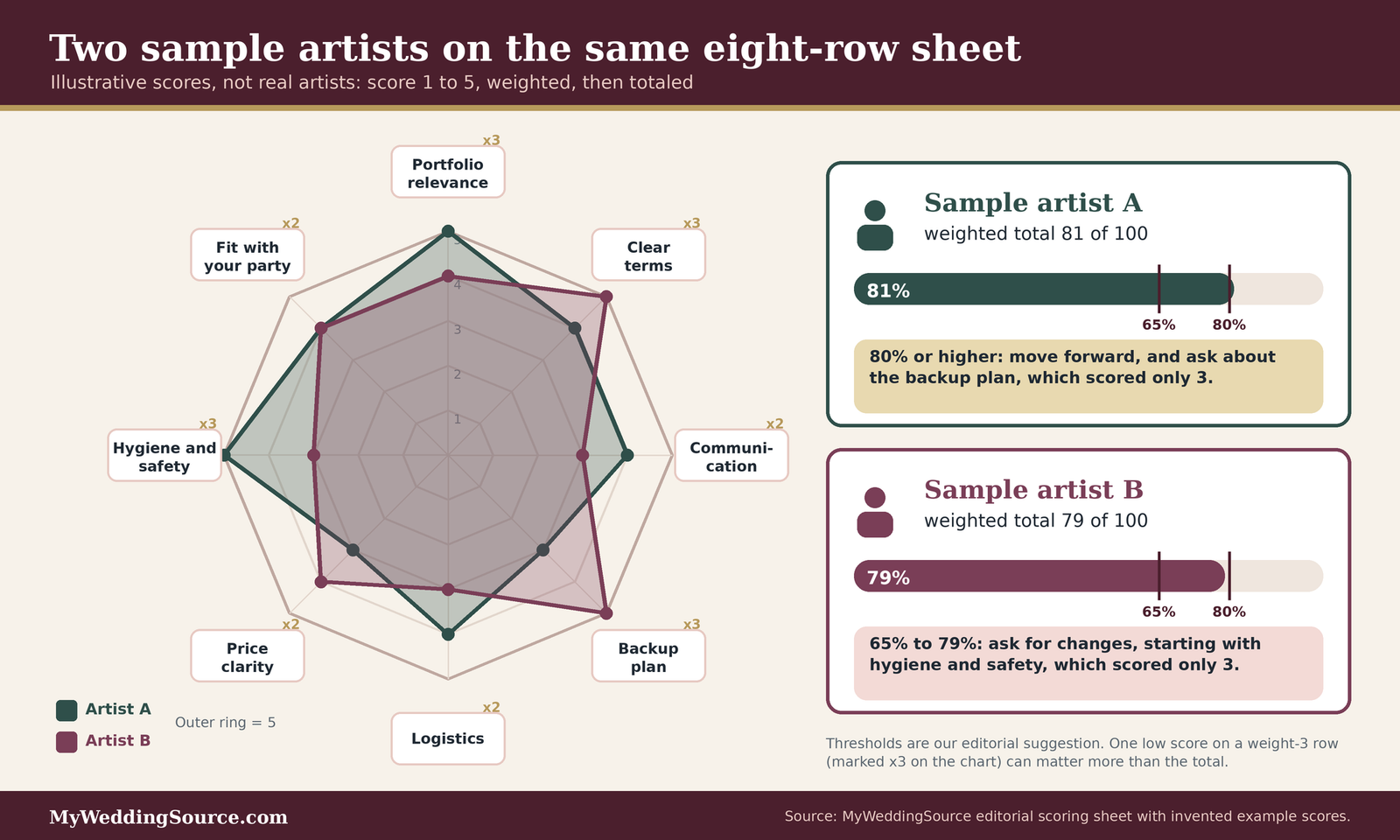
The eight rows
| Criterion | What to check | Suggested weight | Score (1 to 5) |
|---|---|---|---|
| Portfolio relevance | Full wedding examples with your skin tone, hair type, and style | 3 | |
| Clear terms | Services, headcount, start time, travel, deposit, and cancellation written down | 3 | |
| Communication | Prompt, specific, and calm answers | 2 | |
| Backup plan | A clear answer if they are sick or cannot attend | 3 | |
| Logistics | Travel, setup needs, and arrival time handled realistically | 2 | |
| Price clarity | Itemized quote with no surprises | 2 | |
| Hygiene and safety | Tool cleaning, ingredient transparency, and reaction process | 3 | |
| Fit with your party | Can handle your headcount, ages, and preferences | 2 |
Reading the results
In bridal hair and makeup planning, a score is a conversation starter, not a verdict. The point of the sheet is to show you where an artist is strong and where you need to ask more.
A worked example
Suppose Part A has ten rows with weights adding up to 25. The maximum is five times 25, or 125. If your weighted total is 100, the score is 80 percent. If Part B has eight rows with weights adding up to 20, the maximum is 100, and a weighted total of 72 is 72 percent. These numbers are an illustration of the arithmetic, not data from real artists.
A decision rule
As a rough editorial guide, 80 percent or higher suggests moving forward with confidence. Between 65 and 79 percent suggests asking for specific changes and possibly a short second session. Below 65 percent suggests looking at another artist or a different direction. These thresholds are our suggestion, so adjust them if one low score matters more to you than the total.
Watch for single failures
A single low score on a high-weight item can matter more than the total. If the camera test or the comfort score is a one, it deserves attention even if everything else is excellent. Consider discussing the issue with the artist before deciding.
Contracts, costs, and payments
A written agreement is the unglamorous center of bridal hair and makeup planning. It protects you and the artist, and it replaces assumptions with a document you can both read. This section is general information, not legal or financial advice. If a contract is complicated or you are unsure about a clause, consider asking a qualified professional to review it. Our broader guide to wedding vendor contracts covers the general principles.
What the contract should say
For bridal hair and makeup planning, Joy’s guide lists the items to get in writing: services included, number of people covered, travel fees, deposit amount, cancellation policy, and wedding-day start time. We have expanded that into a checklist you can use when you read any quote or agreement.
The scope of services
Every service should be listed by person. For the bride, that might be hair, makeup, lashes, and a touch-up visit. For others, it might be hair only or makeup only. If the contract says “bridal party” without a number, ask for the number to be written in, because headcount drives both price and schedule.
The schedule
The contract should state the arrival time, the start time, and the time the artist will finish. It should also say what happens if the schedule changes, and who is responsible for access to the space. If the artist needs a specific setup, such as a well-lit area near an outlet, the contract or an attached note should say so.
Travel, parking, and extras
Travel fees, parking costs, and any lodging or meals for a destination wedding should be written down. Zola’s guide lists travel fees as a flat fee or hourly rate and notes that destination weddings may add lodging and meals for the team. Ask whether any fee is waived within a certain distance, and get that in writing.
Money terms
The contract should show the total, the deposit, the due date for the balance, accepted payment methods, and whether gratuity is included or separate. The Knot advises checking the contract first, since some teams include a service fee.
Changes and cancellations
Look for the terms for rescheduling, cancelling, and changing headcount, and for what happens to the deposit in each case. Also look for what happens if the artist cannot attend, which is the clause many people overlook. Ask whether a replacement of similar experience is promised, and whether you would receive a refund.
Photos and social media use
Some artists ask for permission to photograph your look and share it. This is a normal request in many creative businesses, but it is optional. Decide what you are comfortable with, and make sure the contract says what you agreed.
What bridal hair and makeup planning costs, and how to estimate it
Published figures vary widely, because they come from different samples and measure different things. We use them to show a range, and we give you a template to build your own estimate from written quotes.
What the sources report
The Knot, using its Real Weddings Study of couples married in 2025, reports an average of $300 for the bride’s professional hair and makeup combined, split evenly between hair and makeup, excluding trials and gratuity. It reports that a combined trial typically adds $225 to $350. Zola’s guide, updated in March 2026, lists wider ranges: $150 to $600 for the bride’s hair, $200 to $500 for makeup, $75 to $150 per bridesmaid for hair, and $60 to $125 per bridesmaid for makeup, with separate ranges for mothers and junior attendants. Zola also lists makeup trials at $150 to $300 and hair trials at $100 to $250, and extra-hour charges of $75 to $150. Joy’s guide lists $300 to $600 for each additional stylist for the day and $200 to $400 for a touch-up artist at the reception.
Why the numbers differ
In bridal hair and makeup planning, a national average, a published range, and a quote from a specific artist in your city are three different things. Region, the artist’s experience, the services chosen, and the date can all move the price. The Knot lists stylist experience, hours, travel, elaborate services, trials, gratuity, the number of artists, and location as the main cost factors. Use published figures as context and your written quotes as the real numbers. For a line-by-line view, see our guide to wedding hair and makeup cost.
A worked estimate, with our arithmetic
Here is how the pieces add up for a bride, four bridesmaids, and two mothers, all receiving hair and makeup, using the ranges Zola publishes. This is our own estimate, not a quote. Bride: $150 to $600 for hair and $200 to $500 for makeup. Four bridesmaids: $300 to $600 for hair ($75 to $150 each) and $240 to $500 for makeup ($60 to $125 each). Two mothers: $200 to $400 for hair ($100 to $200 each) and $200 to $350 for makeup ($100 to $175 each). Services alone total about $1,290 to $2,950. Add a combined trial for the bride ($250 to $550 using Zola’s makeup and hair trial ranges) and a travel fee ($50 to $200), and the subtotal is about $1,590 to $3,700. A gratuity of 16 to 20 percent on services (Zola’s survey range) adds roughly $206 to $590, bringing the full estimate to about $1,800 to $4,300. The range is wide because the published ranges are wide. A written quote narrows it.
Template for your own estimate
For bridal hair and makeup planning, make a table with one row per person and one column per service, then add a row for each of the fixed charges: trial, travel, extra artists, touch-up coverage, and gratuity. Fill it with numbers from written quotes, not from published averages. Compare two or three artists using the same table, so you are comparing the same scope.
Where to save, and where not to
If bridal hair and makeup planning pushes past your ceiling, narrow the scope before you narrow the quality. You might offer services to fewer people, shorten the touch-up coverage, or pick a simpler style that takes less time. Joy’s guide notes that group discounts of 10 to 15 percent are available in some cases, but treat that as a question to ask, not a promise.
Deposits, payments, and gratuity
Money handling is one area of bridal hair and makeup planning where small details matter. We cover the general practice and the consumer protections the federal government describes, without giving legal advice.
Deposits
Glamsquad’s guide, a vendor source, says most artists require a deposit of 25 to 50 percent of the total to hold the date, with the balance due on or shortly before the wedding. Treat that as a vendor generalization and ask your artist for their actual terms. Ask also whether the deposit is refundable, transferable to a different date, or credited toward the trial.
Paying by card and keeping records
The Federal Trade Commission explains that if you want to dispute a charge on your card, you should tell your card company within 60 days of the date of the first statement showing the charge, call first, and follow up in writing. The Consumer Financial Protection Bureau says to start by contacting the seller, and notes that a billing error can include being charged for something you never received. Whether any specific charge qualifies is a question for your card issuer, and we are not giving legal advice. Keep your contract, receipts, and emails in one folder.
Gratuity
The Knot suggests budgeting 15 to 25 percent of the final beauty total. Zola’s survey reports 16 to 20 percent, and says 71 percent of couples tip. Joy’s guide says 15 to 20 percent. Check whether a service fee is already included. Our wedding vendor tipping guide covers etiquette across vendors.
Wedding-day timing and team size
Timing is where all the earlier decisions in bridal hair and makeup planning come together. A schedule that looks fine on paper can fall apart if the team size does not match the headcount, or if the buffer is too small. This section covers the logic of back-timing, and our dedicated guide to the wedding hair and makeup schedule gives much more detail.
How to back-time the morning
In bridal hair and makeup planning, back-timing means starting from a fixed point and working backward. The fixed point is usually the first photo, not the ceremony.
Find the fixed point
For bridal hair and makeup planning, ask your photographer when they want you fully ready. If you are doing a first look or getting-ready photos, the fixed point is earlier than the ceremony. Our guide to first look photos explains how this changes the morning.
Add up service times
Zola’s guide gives typical ranges: brides, 60 to 90 minutes for makeup and 60 to 90 minutes for hair; wedding party members, about 30 to 45 minutes for each service; mothers, 30 to 45 minutes for each; and groomsmen, 5 to 15 minutes for hair. A simple style can take around 20 minutes, and more intricate updos or braids take longer. Add the numbers for your list, using your trial timing where you have it.
Add a buffer
Zola’s sample schedules leave about 90 minutes for spillover and travel in one case and about 45 minutes in another. A buffer is a planning choice, not a rule. The larger the party and the more travel involved, the more buffer you will want. If a trial showed that the work took longer than the artist estimated, use the longer number.
Choosing the number of artists
In bridal hair and makeup planning, the number of artists changes how long the morning takes. The relationship is not perfectly linear, since people need to finish in a particular order and some services depend on each other, but the effect is large.
What the source says about team size
In bridal hair and makeup planning, Zola notes that adding a second stylist roughly halves the prep time. The illustration below uses that logic, with our own assumptions, to show how the length of the morning changes with team size for a bride, four bridesmaids, and two mothers.

How to read the illustration
We assumed one makeup artist and one hair stylist as the baseline. Using round values inside Zola’s ranges, makeup for the bride is 75 minutes, 40 minutes for each of the four bridesmaids, and 35 minutes for each of the two mothers, which is 305 minutes in total. For hair we used 75 minutes for the bride and 35 minutes each for the six others, which is 285 minutes. If hair and makeup run in parallel with one artist for each, the morning is bounded by the longer lane, about five hours. With two artists in each lane, a split like the one drawn lands near 155 minutes in the longest lane, so the morning shrinks by about two and a half hours. If the first photo is at 1:00 p.m. and you keep a 90-minute buffer, the work starts around 6:25 a.m. with one artist per service and around 8:55 a.m. with two. These are our estimates for illustration, not predictions. Real timing depends on the style, the people, and the artists.
When a bigger team is worth it
A second artist adds cost, and Joy’s guide lists $300 to $600 per additional stylist for the day. Whether that is worth it depends on how much earlier you would otherwise need to start, and how you feel about a long morning. If a longer morning means an early start, tired people, or less buffer before photos, a second artist may be the easier choice. If the schedule fits comfortably, it may not be needed.
Touch-ups, handoffs, and the rest of the day
The look needs to hold from the first photo through the end of the reception. That requires either a plan for touch-ups or an accepted level of change.
Who does touch-ups
As part of bridal hair and makeup planning, decide this early. Some artists stay for a period after the ceremony, some offer a touch-up kit, and some leave once the morning is done. Joy’s guide gives $200 to $400 for a touch-up artist at the reception. Decide ahead of time who will help you, and confirm what is included in the contract.
What goes in the kit
The kit should contain items the artist recommends for your specific look, such as lip color, blotting papers, a small comb or pins, and any adhesive for lashes. Ask the artist to list what to include, and keep products in a cool place, since the FDA advises protecting cosmetics from extreme heat. Our wedding emergency kit guide has a general checklist.
Who holds the kit
Choose a person who will be near you, understands the plan, and is not also responsible for something else at a busy moment. Give that person a short note with what to do and when, and make sure they have the artist’s contact information.
Skin, hair, and product safety
Appearance is only part of bridal hair and makeup planning. Products touch the skin, scalp, and eyes, and a few simple precautions make a reaction less likely and easier to handle. Nothing here is medical advice. If you have a known condition, a history of reactions, or any concern, talk to a clinician or dermatologist before the trial.
Allergies and sensitivities
The FDA says cosmetics can trigger allergic reactions, most often itchy red rashes, and lists five groups of common allergens: natural rubber latex, fragrances, preservatives, dyes, and metals.
Tell the artist early
Safety is part of bridal hair and makeup planning, so give the artist a list of known sensitivities before the trial, including fragrance, adhesives, latex, and hair dye reactions. Ask them to check ingredient lists with you. The FDA notes that retail cosmetics must carry an ingredient declaration, but that fragrance ingredients can be grouped under a general term, and that “hypoallergenic” and “for sensitive skin” have no federal definition. A label claim is not a guarantee.
Patch testing before the trial
Healthline’s medically reviewed guide describes testing a product on a small area, such as the inner forearm, and behind the ear at the jawline for facial products, twice a day for about seven to ten days. It also notes that a self test helps predict irritation but does not identify the specific allergen, and that a dermatologist can run an in-office test. Because of that timeline, start well before the trial if you are concerned. The FDA’s allergen page also gives an example of following label instructions, such as testing hair dye on a small area first.
Keep skin routines stable
Avoid trying new products in the weeks before the wedding. This is practical caution, not a medical claim. Our bridal skincare timeline covers this in detail.
Eyes, lashes, and hygiene
The eye area deserves specific care. The FDA publishes guidance that applies to the artist’s kit and to yours.
What the FDA says about eye products
The FDA says not to share or swap eye cosmetics, to use single-use applicators when sampling, to keep products free of dust and heat, and never to add saliva or water to mascara. It notes that manufacturers usually recommend discarding mascara two to four months after purchase. It also says not to use a lip liner as an eyeliner, and to check the ingredients of false lash adhesives, since irritation near the eyes can be troublesome.
Questions to ask about lashes and adhesives
If you plan to wear false lashes or lash extensions, ask what adhesive is used and ask to see the ingredients. The Knot notes that artists may not provide lashes, so bring your own if you want specific ones. The FDA warns that permanent lash and brow tints have caused serious eye injuries, so do not use them as a last-minute addition.
Clean tools and clean hands
The FDA advises washing hands before applying products. A professional should be able to describe how brushes and tools are cleaned between clients, and how eye and lip products are handled. If the answer is unclear, treat it as a flag.
If a reaction happens
A small plan reduces stress if a reaction occurs during the trial or on the wedding day.
Stop and wash off
A reaction interrupts everything, so act first. The FDA says to stop using a product if you notice a rash, redness, burn, or other unexpected reaction, and to contact a healthcare provider. For symptoms such as hives, swelling, or wheezing, the FDA says to call 911 and seek medical help for signs of anaphylaxis. Tell the artist right away so they can stop using that product.
Keep the details
Note the products and ingredients used. This helps a clinician and helps you avoid the same ingredients later. Keep the container or take a photo of the label.
Report it
The FDA invites consumers to report adverse reactions to cosmetics through its MedWatch online form, by mail or fax, or by phone at the Food and Cosmetics Information Center. It says to stop using the product and contact a healthcare provider first.
Edge cases and hard situations
Most of bridal hair and makeup planning follows the same path. A few situations need extra thought, either because they change the plan or because the stakes of a mistake are higher. None of what follows is medical, legal, or religious advice. It is a set of questions to raise with the right professionals and with your artist.
Sensitive skin, scalp, and health considerations
If you have a known allergy, a skin condition, or a history of reactions, the plan needs a few extra steps, and the first one is a conversation with a clinician, not with an artist.
Known allergies and skin conditions
This part starts with a clinician. Talk to your dermatologist or primary care clinician before the trial, and ask what ingredients to avoid. Give that list to the artist in writing. The FDA says that if you suspect an allergy, a healthcare provider can advise on testing options, which include patch, prick, intradermal, and blood tests. Do not rely on a product label alone, because terms like “hypoallergenic” have no federal definition.
Hair color and chemical treatments
If you plan to color, lighten, or straighten your hair before the wedding, coordinate with your stylist so the trial happens after the treatment, not before. The Knot notes that hair color and skin should be close to final at the time of the trial. Test any new product as the label directs, and allow time for any treatment to settle before the trial.
Eyes, lenses, and glasses
If you wear contact lenses or glasses, tell the artist so they can plan the eye makeup and any frames. The FDA advises against applying eye cosmetics if you have an eye infection or inflamed skin around the eye, and says to discard products that were in use when an infection occurred. If you have any eye condition, ask your eye doctor before the trial.
Weather, venue, and outdoor plans
Conditions on the day can test a style more than any trial. A little planning for heat, humidity, wind, or a cramped space goes a long way.
Heat and humidity
In summer bridal hair and makeup planning, hot weather affects comfort and safety as well as appearance. The CDC lists signs of heat-related illness, including muscle cramping, unusually heavy sweating, shortness of breath, dizziness, headache, weakness, and nausea, and advises carrying water and scheduling activity for the coolest part of the day when it is very hot. For makeup and hair, ask the artist how they would adjust the plan for heat, and plan shade and water during photos. Our summer wedding heat plan covers this in more depth.
Wind, rain, and cold
Wind and rain affect hair, veils, and outdoor photos. Ask the artist how they would secure a style for a windy outdoor ceremony, and what you would do if the plan moves indoors. In cold weather, ask how a wrap or coat will interact with the hair. Our winter wedding weather plan and rain plan guide are good companions.
A tight or unusual getting-ready space
If the space is small, dim, or shared, tell the artist in advance and send photos. They may bring lighting, ask for a different room, or suggest a different order of services. Our guide to the wedding morning beauty room explains what to check.
Identity, culture, and accessibility
A good plan fits the person, not the other way around. If your preferences, traditions, or needs are not part of the standard conversation, say so early and plainly.
Cultural and religious elements
If your ceremony includes a head covering, a particular hairstyle, henna, a specific piece of jewelry, or a tradition that affects what can be applied to the face or hair, share that at the first conversation. Ask whether the artist has experience with it, and if not, whether they are willing to learn from you or from a family member. Where a tradition has strict requirements, the final decision belongs to you and your family, not to the vendor.
Gender expression and grooming for everyone
Bridal hair and makeup planning is not only for brides. Grooms, partners, and attendants of any gender may want services or none at all. Ask artists about their experience and comfort with the look you want, and use the same scoring sheet. Zola’s guide lists a short time range for grooms and groomsmen, and that is a reasonable starting point for the schedule.
Sensory, mobility, and comfort needs
If sitting for a long time, loud dryers, strong scents, or physical contact are difficult for you or someone in your party, tell the artist before booking. Ask about unscented options, breaks, seating, and the order of services. A reasonable professional will adjust, and an unwillingness to do so is useful information.
When plans change
Even careful bridal hair and makeup planning can be disrupted. The point is to have a response ready.
If the artist cannot come
This is the scenario that bridal hair and makeup planning should have prepared you for. Contact them to confirm the cancellation in writing, then check the contract for a replacement or refund provision. Reach out to the other artists on your shortlist, and tell them your date and the look you want. Ask your photographer and venue for recommendations as well. If you used a salon or agency, ask whether they have another team member available.
If the trial does not go well
Bridal hair and makeup planning gives you options. You can ask for specific changes at the same session, schedule a second session if the artist offers one, or move to a different artist. The Knot advises trusting how you feel, and suggests that if the trial does not feel right, you might consider a different artist or direction. Use the scoring sheet to explain what was missing, and to decide.
If the dress, color, or date changes
If your dress changes after the trial, send updated photos and ask whether another session is needed. If you change your hair color or length, tell the artist as soon as you decide. If the date changes, ask the artist about availability and what the contract says about rescheduling. Our guide to wedding insurance is a place to start when thinking about the financial side of changes.
Frequently asked questions
Booking and trials
How far in advance should I book hair and makeup?
Sources differ. The Knot says six to twelve months for busy seasons, and Joy’s guide says nine to twelve months, with May through October as peak. A vendor guide from Glamsquad suggests six to eight months off-peak. Ask local artists how far ahead they fill, and book once you have a date and a written quote.
When should I schedule the trial?
Published ranges run from about four weeks to three months before the wedding. The Knot suggests one to three months, Joy four to six weeks, and Glamsquad four to eight weeks. Pick a date when your hair color and skin are near their final state and there is still time to repeat the session if needed.
Do I need a separate trial for hair and makeup?
Not always. The Knot says same-day trials are ideal, and that separate days work when you use different businesses. Loverly notes that you may skip a hair trial if you do not need a style change. Ask each artist whether they offer a combined session and whether the fee is credited toward your wedding-day total.
Cost and contracts
What should I budget for hair and makeup?
It depends on region, artists, and headcount. The Knot reports an average of $300 for the bride’s hair and makeup combined for couples married in 2025, excluding trials and tips. Zola lists wider ranges by service. Collect written quotes and use our worked estimate to add trials, travel, extra people, and gratuity.
How much should I tip?
Sources vary. The Knot suggests 15 to 25 percent of the final beauty total, Zola’s survey reports 16 to 20 percent, and Joy’s guide says 15 to 20 percent. Check your contract first, since some teams add a service fee. Ask your artist how they prefer to receive a tip, and whether one is already included.
How many artists do I need?
It depends on headcount and how early you can start. Zola notes that adding a second stylist roughly halves prep time. Add up each person’s service time, compare it with your photo deadline, and ask your artists what team size they recommend. A second artist adds cost, so weigh it against the extra time.
Safety
How do I check that an artist is properly licensed?
The BLS says all states require hairstylists and cosmetologists to be licensed, and we found no single national rule for makeup application. Look up your state board, ask the artist what license or credential applies, and use any license lookup tool the board provides. We are not giving legal advice, so confirm requirements with the board.
What should I do if I react to a product?
Stop using it, wash it off, and contact a healthcare provider, as the FDA advises. For hives, swelling, or wheezing, call 911. Note the product and ingredients, and tell the artist at once. You can also report the reaction to the FDA through its MedWatch form or its consumer phone line.
Your next steps
Start the plan
Write your five decisions on one page
Put the look direction, service model, headcount, spending ceiling, and backup plan for your bridal hair and makeup planning on a single page. Share it with whoever helps you decide, so the artists you contact hear the same brief from everyone.
Build the reference kit
Collect the photos in the kit table, caption each in one line, and put them in one shared album. Send that album to every artist when you first write, so quotes are comparable.
Choose and confirm
Interview two or three artists
For your bridal hair and makeup planning shortlist, use the questions block, take notes, and complete the Part B scoring sheet after each conversation. Then book the artist who scores well and answers clearly, and ask for a written contract.
Put the details in writing
Check the contract against the checklist in the contracts section, and save your documents in a single folder. For the wider plan, use our wedding planning checklist and wedding budget guide.
Test and finalize
Hold the trial and score it
To keep bridal hair and makeup planning on track, run the trial as described, wear the look for a few hours, photograph it in different lights, and complete the Part A sheet while it is fresh. Ask for specific changes in writing.
Build the morning schedule
Back-time from the first photo, add each person’s service time, include a buffer, and share the schedule with your artists, photographer, and venue. Our wedding day timeline shows how the morning fits into the rest of the day.
Related reading: Bridal hair extensions.
Sources & methodology
How we built this guide
What we relied on
Our bridal hair and makeup planning guide combines U.S. government consumer guidance on cosmetics and on disputing card charges, U.S. labor data on hairstylists, a state licensing board’s consumer page, a medically reviewed patch-test guide, and published planning advice from wedding media and vendors. Where a statement comes from a vendor or a wedding publication, we say so, because their figures reflect their own samples and business interests. The worked cost estimate, the time illustration, the scoring sheet, its weights, and its thresholds are our own, and they are estimates and editorial suggestions, not measurements.
What we did not do
We did not test products, interview artists, or review real contracts, and we are not giving medical, legal, or financial advice. Prices, availability, and licensing rules vary by place and change over time. Confirm any rule with your state board, any health question with a clinician, and any contract term with the artist or a qualified professional. We found no single national rule for makeup application licensing, and we did not research every state.
When we checked
We read the sources below on November 12, 2026. We did not verify whether any page has changed since, so check dates and figures again before you rely on them.
Source list
Government and public-interest sources
- U.S. Food and Drug Administration, Cosmetics: https://www.fda.gov/cosmetics
- U.S. Food and Drug Administration, Eye cosmetic safety: https://www.fda.gov/cosmetics/cosmetic-products/eye-cosmetic-safety
- U.S. Food and Drug Administration, Allergens in cosmetics: https://www.fda.gov/cosmetics/cosmetic-ingredients/allergens-cosmetics
- U.S. Food and Drug Administration, Using cosmetics safely: https://www.fda.gov/cosmetics/resources-consumers-cosmetics/using-cosmetics-safely
- U.S. Food and Drug Administration, How to report a cosmetic product related complaint: https://www.fda.gov/cosmetics/cosmetics-compliance-enforcement/how-report-cosmetic-product-related-complaint
- U.S. Bureau of Labor Statistics, Occupational Outlook Handbook, Barbers, hairstylists, and cosmetologists: https://www.bls.gov/ooh/personal-care-and-service/barbers-hairstylists-and-cosmetologists.htm
- California Board of Barbering and Cosmetology, Consumers: https://www.barbercosmo.ca.gov/consumers/
- Consumer Financial Protection Bureau, What is a chargeback: https://www.consumerfinance.gov/ask-cfpb/what-is-a-chargeback-en-1969/
- Federal Trade Commission, Sample letter for disputing credit and debit card charges: https://consumer.ftc.gov/sample-letter-disputing-credit-debit-card-charges
- Centers for Disease Control and Prevention, About heat and health: https://www.cdc.gov/heat-health/about/index.html
Health, wedding media, and vendor sources
- Healthline, How to do a skin patch test: https://www.healthline.com/health/self-skin-patch-test
- The Knot, Average cost of wedding hair and makeup: https://theknot.com/content/average-cost-wedding-hair-makeup
- The Knot, Things to know ahead of your wedding makeup and hair trial: https://www.theknot.com/content/makeup-trial-mistakes
- Zola, A guide to wedding hair and makeup costs: https://www.zola.com/expert-advice/a-guide-to-wedding-hair-and-makeup-costs
- Zola, How long does wedding hair and makeup usually take: https://www.zola.com/expert-advice/how-long-does-wedding-hair-and-makeup-usually-take
- Joy, Wedding hair and makeup complete guide for brides: https://withjoy.com/blog/wedding-hair-and-makeup-complete-guide-for-brides-2026/
- Loverly, How to prep for wedding hair and makeup trials: https://loverly.com/planning/beauty/prep-wedding-hair-makeup-trials
- Glamsquad, How far in advance should you book wedding hair and makeup services (vendor source): https://glamsquad.com/blog/how-far-in-advance-should-you-book-wedding-hair-and-makeup-services
Headpieces and earrings have to work with the hairstyle you choose. Our guide to wedding day accessories covers hair compatibility and movement tests.