
A beach wedding gives you open sky and a view nobody has to build, and in exchange it hands you wind, heat, tides, sand, ocean noise, and public-land rules that no ballroom ever asks you to manage, so the couples who enjoy it most are the ones who plan for the unglamorous parts first.
Quick answer
A beach wedding works when you treat it as an outdoor event on public, moving, exposed ground. Before you choose flowers or a dress, settle five things: the permit and its rules, the tide and wind on your date and time, shade and water for guests, a way to be heard over the surf, and a written plan B with a named decision-maker and a deadline. Everything else is styling. This guide gives you a risk register, plan-B triggers, a contingency table, and a site-visit routine to build those five.
What makes a beach wedding different from other outdoor weddings
Most outdoor-wedding advice assumes a yard, a garden, or a field. A beach wedding shares the weather problems of those places and adds a few of its own. Understanding those differences first keeps you, as you plan a beach wedding, from borrowing a plan that was written for solid, private, flat ground. If you are still comparing venue types, our guide to garden wedding venues shows what a more sheltered outdoor site looks like by contrast.
The ground, the water, and the owner are all different
A lawn does not move, a lawn does not flood at a predictable hour, and a lawn usually belongs to a venue that carries insurance and has a contact person. A public beach often has none of those. The surface shifts under chairs and shoes, the water level changes through the day, and the land is commonly managed by a city, county, or park agency with its own rules. Each of those three differences creates its own set of tasks.
The surface shifts
Sand is soft, uneven, and slow to walk on, especially in dress shoes or with a cane, walker, or stroller. Chairs sink, tent stakes loosen, and anything heavy sinks unevenly. Zola’s East Coast planning advice suggests burying furniture bases in the sand and using heavy chairs to help them stay put, which is a practical reminder that setup on sand is a small construction job rather than a simple placement.
The water level changes
The ocean is not a backdrop that stays where you left it. Zola advises keeping your setup well away from the waterline and finding out how far the tide reaches, and it notes that a narrow shoreline can become dangerous at high tide. For a beach wedding, a tide prediction for your exact date and hour is as basic as a guest list.
The land has an owner with rules
Most beaches are public property, so a permit is usually involved. Zola says rules vary by state and city and that some places require proof of insurance. Later sections show three real examples of how different those rules can be, which is the best argument for reading your own location’s rules instead of trusting a general checklist.
What this guide covers and what it leaves to other guides
This article is about risk, logistics, and contingency for the ceremony and any reception you hold on or near the sand. It does not try to be a full planning manual. For the overall plan, use our wedding planning guide and wedding planning checklist; for budget, use the wedding budget calculator. Here we stay with the questions only a beach raises.
What is included
You will find the hazards worth planning around, objective triggers for moving indoors, rules from three real permit offices, attire and guest-comfort decisions, a redundancy plan for vendors, a site-visit routine, and a worked scenario that shows how the pieces fit together. Where we suggest a threshold, we say it is our editorial judgment and name the official source that informed it.
What is not included
We do not give legal, medical, or insurance advice. Permit rules, liability, and health decisions depend on your location, your contract, and your circumstances. Use this guide to know what to ask, then confirm the answers with the permit office, your vendors, an insurance professional, and a clinician where health is involved.
Identify the failure modes before designing the pretty version of your beach wedding
The most useful first step is unglamorous. List what could go wrong, rate each item honestly, and decide who owns it. Then design the beautiful version around the plan that survives those risks. Couples who start with the mood board often discover a month before the date that the arch cannot stand in the wind or the permit forbids their setup.
List environmental, access, health, and infrastructure risks in the beach wedding decision
A beach wedding has four families of risk. Environmental risks come from weather and water. Access risks come from the route, the surface, and parking. Health risks come from heat, sun, and water hazards. Infrastructure risks come from the lack of power, shelter, restrooms, and phone service that a built venue provides. Naming them separately keeps you from treating “weather” as one vague worry.
Separate likely inconvenience from high-impact failure
Not every problem deserves a contingency plan. Windblown hair is likely and low impact: you handle it with pins and a smile. A lightning storm during the ceremony is less likely and very high impact: you handle it with a rule and a shelter. A useful sorting method is to give each risk two honest ratings, how likely and how serious, and to spend your planning effort on anything serious regardless of how unlikely it feels. NOAA reports that lightning has killed about 33 Americans a year since 2006 and tells beachgoers to go indoors at the first thunder, which is why storms belong in the high-impact column even when the forecast looks calm.
Identify which risks are controlled by the venue versus the couple
Some risks belong to someone else. A city or park agency controls closures, lighting rules, and how much space you may use. A beachfront resort controls its indoor backup space and its power. You control the schedule, the guest instructions, the attire, and the vendor contracts. Write the owner next to each risk. A risk with no owner is the one that surprises you on the day, and a risk owned by the permit office is one you can only work around by asking early.
Use the risk register as your working document
How to read the register
Table 1 is a starting register for a beach wedding. Treat it as a draft to edit for your own beach, season, and guest list. The likelihood and impact ratings are our editorial judgment for a typical U.S. beach ceremony, not statistics, and your location may change them: a Gulf Coast beach in August and a New England beach in October do not carry the same weather risks.
| Risk | Likelihood | Impact | Trigger | Prevention | Owner | Plan B |
|---|---|---|---|---|---|---|
| Lightning or thunder | Varies by region and season | Severe | Thunder heard, or alert issued | Hourly forecast check; named shelter; pause rule | Coordinator or planner | Move to the substantial indoor building; wait out the pause |
| Strong wind | Common | Moderate | Sustained wind that makes decor and sound unreliable | Weighted decor, short veil option, windscreen for microphones | Couple, florist, DJ | Shorten ceremony; shift to the lee side or indoors |
| High tide or rough surf over the ceremony area | Predictable from tide tables | High | Predicted water reaching the setup zone | Pick the site by tide height at your hour; set up well above the line | Couple, with the permit office | Move the aisle landward; change the hour |
| Heat or intense sun | Common in warm months | Moderate to high | Heat alerts, or guests with cramps, dizziness, or heavy sweating | Shade, water, fans, shorter ceremony, cooler hour | Couple and coordinator | Seat guests in shade; move indoors; shorten |
| Rip currents or dangerous surf | Possible any day | Severe | Red flags, posted warnings, or lifeguard advice | Keep guests out of the water; brief the wedding party | Couple and coordinator | Keep photos on dry sand; skip water poses |
| Permit problem | Avoidable | High | Missing paperwork or a rule you did not read | Apply early; read every restriction | Couple | Backup location with its own permit |
| Sound lost to surf and wind | Common | Moderate | Guests in the back cannot hear | Microphones with wind protection; a sound check on site | DJ or officiant | Move guests closer; shorten the aisle |
| Cold after dark | Common after sunset | Low to moderate | Falling temperature and wind | Wraps, blankets, an indoor reception | Couple | Indoor reception or heaters where allowed |
How to adapt it to your own beach
Delete rows that do not apply and add rows that do. A beach with a boardwalk has a different access risk than one reached by a dune path, and a beach wedding in a hurricane-prone region needs a row for named storms with a much earlier decision date. Review the register with your coordinator and your venue contact, and keep it open on your phone through the final week.
Set objective triggers for plan B in the beach wedding decision
A backup plan only helps if someone actually activates it. The most common failure is hesitation: everyone waits to see if the sky clears, and the decision gets made by the weather rather than by the couple. Objective triggers remove that hesitation by agreeing in advance on what counts as a reason to move.
Use weather, capacity, temperature, or access thresholds
Pick a short list of thresholds you can check on a phone. The National Weather Service Beaufort scale is a good anchor for wind: it describes a 13 to 18 mph moderate breeze as lifting dust and loose paper, a 25 to 31 mph strong breeze as making umbrellas hard to hold, and a 32 to 38 mph near gale as making it a struggle to walk into the wind. Our suggestion, which is editorial judgment rather than an official standard, is to plan a decision point near the fresh-breeze range of 19 to 24 mph if your ceremony depends on tall decor, a veil, or amplified sound, and to treat the strong-breeze range as a likely move indoors. For lightning, adopt the NOAA rule exactly: go indoors at the first thunder and wait 30 minutes after the last thunder. For heat, use your local heat alert and the warning signs from the CDC.
Name who makes the decision and by what deadline
Write one name next to the decision, and write the time. A common pattern is to choose a planner, coordinator, or trusted friend who is not in the wedding party, give that person authority to call plan B, and set two checkpoints: a go or no-go three to four hours before guests arrive, and a continuous watch from then on for lightning. The couple should not be the ones deciding at the last minute while in hair and makeup. Table 2 later in this guide turns this into a contingency activation table.
Wind, sand, and sound at a beach wedding
Wind, sand, and sound are linked at any beach wedding. Wind moves decor, carries away vows, and blows sand into food. Sand changes how chairs, aisles, and shoes behave. Sound disappears into the open air and the surf. Handling the three together saves money on a beach wedding, because a single fix, such as a weighted arch with a wind-protected microphone, often solves more than one problem.
Plan for wind in decor, veils, and the ceremony itself
Wind is the most common practical problem at a beach wedding, and it is also the one you can reduce most with small decisions. The goal is not to defeat the wind but to choose materials and a layout that tolerate it. The Beaufort scale from the National Weather Service gives a shared vocabulary so that you and your vendors mean the same thing by “breezy.”
Read the wind scale before you choose decor
The NWS Beaufort table describes a gentle breeze of 8 to 12 mph as keeping leaves and a light flag moving, a moderate breeze of 13 to 18 mph as lifting dust and loose paper, a fresh breeze of 19 to 24 mph as rocking small trees, and a strong breeze of 25 to 31 mph as making umbrellas hard to hold. The land-based descriptions are not about weddings, but they translate easily: if loose paper flies, so will programs, petals, and lightweight aisle runners. Ask your florist and rental company what they have set up in a given wind speed, and ask for it in writing.

Choose materials that tolerate gusts
Zola advises securing chairs and decor with weights or straps, keeping arrangements small and tightly bound, and skipping lightweight items such as ribbons, balloons, and aisle runners. It also suggests sturdy, beach-friendly materials instead of glass, and it says any canopy needs secure poles. Inside Weddings adds that a short veil can blow into the face while a longer veil flows well, and that an updo keeps hair out of the way. Take those as sensible starting points and confirm them with your own florist, rental company, and stylist.
Make the sand work for your beach wedding
Sand is not only a surface; it is a material that gets into everything. A little planning about walking surfaces, chairs, and cleanup makes guests more comfortable and protects your equipment. This section stays practical and does not assume a particular beach, since sand varies from firm and damp near the water to loose and dry higher up.
Think about the aisle and the walking surface
Inside Weddings mentions a hidden wooden walkway to make the aisle easier to walk on, and Zola notes that soft sand is easier to walk on than a rocky or cliffside beach. Firm, damp sand tends to be easier to walk on than loose dry sand, but damp sand is closer to the water, so the choice connects back to the tide. If any guest uses a mobility device, ask the permit office or venue whether a rollout mat or a path to the beach is allowed, and plan the route so that nobody has to cross loose sand alone.
Handle the shoes, the feet, and the cleanup
Zola suggests a foot-washing station or flip-flops so guests can clean up or change before the reception, and notes that you should plan for any footwear or outfit change. A small basket of flip-flops, a bucket for rinsing, and towels cost little and help a group move from sand to a dining area without carrying the beach with them. Put someone in charge of it so that it does not become another job for the couple.
Make sure guests can hear you at your beach wedding
Ocean noise and wind can drown out vows, which is why the Inside Weddings guide recommends planning for microphones at the ceremony. A quiet, intimate exchange of vows is one of the best parts of a ceremony, and it is the part most likely to be lost on the sand. Treat sound as equipment, not luck.
Use microphones and wind protection
Plan on microphones for the officiant and for the couple, with windscreens on each, and ask your DJ or sound vendor how they power the system on a beach with no outlets. The City of Virginia Beach notes that amplified sound is allowed under its ceremony permit but that the city may set reasonable noise limits, while Key West’s wedding page does not mention amplified sound and bans generators, so confirm both the rules and the power source before you rent equipment. Our wedding officiant guide can help you ask your officiant how they handle projection outdoors.
Shorten the distance and the script
Sound travels poorly in open air, which is why every beach wedding needs a listening plan, so sit guests closer together in a wider, shallower arc instead of a long narrow aisle. If you cannot amplify, shorten the ceremony and give guests a printed or shared copy of the readings. Couples who want their words heard in full can also write a short private exchange, as described in our wedding vows guide, and keep the public ceremony brief.
Heat, sun, and water safety at a beach wedding
Heat and water are the health risks most specific to a beach wedding, and they deserve more attention than most checklists give them. Heat affects everyone at the ceremony, especially older relatives, small children, and anyone who is pregnant or has a chronic condition. Water hazards matter because a beach invites people toward the surf, including guests in formal clothes and photographers in the moment. Neither topic requires alarm, only a plan.
Plan for heat and sun at a beach wedding
Heat is a quiet risk because guests tend not to mention discomfort until it becomes a problem. You cannot control the temperature, but you can control the hour, the shade, the water, and the pace. This is general safety information; if you or a guest has a medical condition, ask a clinician about what to expect and what to avoid.
Know the warning signs
The CDC lists muscle cramps, unusually heavy sweating, shortness of breath, dizziness, headaches, weakness, and nausea as signs that a body is overheating, and it recommends knowing when to seek medical care. It also identifies pregnant people, children and infants, people with asthma or heart disease, adults 65 and older, and people working or exercising outdoors in heat as groups that may need extra precautions. Give a few people, such as the coordinator and a family member, a quiet briefing on those signs so that someone is watching for them.
Build shade, water, and rest into the schedule
The CDC advises taking shade breaks and scheduling outdoor activity for the coolest hours, carrying water and drinking throughout the day, and limiting sugary drinks, caffeine, and alcohol. At a wedding, that means shaded seating wherever your permit permits it, water at the entrance and again before the ceremony, and a schedule that keeps the ceremony short. If you serve alcohol at an indoor reception afterward, put water on every table. Where a venue forbids tents, ask about natural shade, such as buildings or tree lines, and about umbrellas or parasols for guests.
Protect guests from UV and glare at a beach wedding
The sun on a beach is reflected by sand and water, and sunburn can take up to 24 hours to fully appear, according to NOAA, so guests may not realize how much sun they received until the next day. A visible sun-protection plan is a courtesy, and it also lowers the chance of a guest leaving early with a burn.
Use the CDC’s basic sun-protection checklist
When the UV Index is 3 or higher, the CDC recommends staying in the shade, covering arms and legs, wearing a wide-brimmed hat, choosing wraparound sunglasses that block UVA and UVB rays, and using broad-spectrum sunscreen with an SPF of 15 or higher. It adds that in the continental United States UV rays are strongest from 10 a.m. to 4 p.m. daylight saving time. Put a basket of sunscreen and a few hats near the entrance, and mention it on the wedding website.
Account for the photographer and the wedding party
The couple, the wedding party, and the photographer are in the sun longer than any guest. Plan breaks in shade between portraits, and share water with the photography team. Our wedding photography guide and wedding photographer shot list can help you group the sun-heavy portraits into a short window so that no one stands in full sun for the whole session.
Keep people safe around the water at a beach wedding
NOAA’s beach hazards page names rip currents, shorebreak, lightning, sand holes, heat, harmful algal blooms, water-quality problems, marine debris, sharks, and jellyfish. You do not need to plan for every one of them. You do need to know which apply at your beach and to give guests a plain instruction that keeps them out of trouble.
Understand rip currents and shorebreak
The National Weather Service describes a rip current as a narrow, fast flow of water carrying water from near the shore out past the breaking waves, and it says they can form on almost any beach with breaking waves. It also says that they can form on calm, sunny days, so good beach weather does not guarantee safe swimming. NOAA says shorebreak, where waves break directly on the sand, can injure limbs and the neck even when small. The practical conclusion for a wedding is simple: most guests are not dressed to swim, and nobody should enter the water without a lifeguard’s advice.
Check the beach for lifeguards, flags, and advisories
The NWS says to swim only at beaches with lifeguards, to check the local beach forecast before you leave, to ask the lifeguard about conditions, and never to turn your back on the ocean. NOAA also says to check for beach closures and advisories, since runoff can carry contamination that makes swimmers sick. Before you choose a date, look at whether your beach is guarded in that season and hours, and ask the lifeguards or the permit office how they handle weddings.
Tide, light, and timing at a beach wedding
The best time for a beach wedding is a combination of tide, light, temperature, and guest comfort. Couples usually start with the sunset photograph and work backward, but the sunset hour is rarely the easiest hour to manage. This section lays out the trade-offs so you can choose with your eyes open.
Read the tide for your beach wedding date and hour
Tide is the only part of the schedule you can predict precisely, and it is the part many couples forget to check. The National Oceanic and Atmospheric Administration publishes official high and low tide predictions for U.S. locations through its Tides and Currents site, where you can search by location. Use the prediction for your exact date, and treat it as a planning tool, not a promise, because wind and storms can push water higher than predicted.
Check the tide at ceremony, photo, and reception hours
Look up the predicted heights and times for the whole day, and mark the hour of setup, ceremony, portraits, and cleanup. If the water is high when the ceremony is scheduled, the usable dry area shrinks, and a narrow beach can become hazardous, as Zola warns. If the water is low, you may have a wide, firm strip of sand that is easy to walk on but far from the dunes, so guests may need a longer walk. Choose the hour that gives you the most usable space at the moment guests are seated.
Walk the beach at more than one tide
Zola advises visiting the beach at different times of day to see conditions. For a site visit, go once at a tide similar to your wedding hour and, if you can, once at the opposite extreme, so you see how much the beach changes. Take photos from the same spot each time, and measure the distance from the planned ceremony spot to the waterline with a long tape or a phone app. That single comparison tells you more than any chart can.
Choose the hour for your beach wedding by light, heat, and guest energy
Different hours solve different problems. A morning ceremony helps in hot weather, according to Inside Weddings, which also advises holding the ceremony during the day because the ocean is hard to see at night, especially in photographs. Zola notes that many couples choose sunset for golden-hour light and views. Inside Weddings adds that sunset is risky because the light fades quickly.
Compare morning, late afternoon, and sunset
Morning tends to be cooler, and Inside Weddings recommends it for hot weather; wind patterns vary by coast, so check your own hourly forecast. Late afternoon avoids the midday peak of UV but may be hot and gusty. Sunset gives the most flattering light for a short window, but guests are tired, the temperature falls, and the schedule has no slack. Figure 2 shows the CDC’s peak UV window next to those three options so you can see which slots sit inside it.

Build a schedule with slack at both ends
If you choose sunset, start the ceremony early enough that vows are finished before the light falls, and plan portraits to start before the ceremony or immediately after, as your photographer advises. Add a buffer of at least fifteen minutes after the planned start, because late guests, sound checks, and wind adjustments consume it. If you choose morning, plan for a longer gap before the reception so that guests can cool down and change.
Plan for darkness, cold, and turtle rules at a beach wedding
After sunset, sand cools and the beach becomes harder to navigate. Zola notes that sand gets cold after dark and suggests asking guests to bring layers. In some places, rules also limit light, so a plan that assumes lanterns and string lights may not be allowed.
Respect lighting rules where wildlife nests
The City of Key West says that from March through October no lights of any kind, including tiki torches, string lights, and lamps, are allowed on the beach after sunset, because artificial lighting can disorient hatchlings heading to the water. Many coastal areas have similar wildlife-protection rules, so ask your permit office before you plan an evening ceremony or any decor that glows.
Warm guests without breaking the rules
Provide blankets or wraps, and ask guests to bring a light jacket. Plan the reception indoors or in a heated, approved space, and move guests there soon after the ceremony. Verify with the permit office whether heaters or fire features are allowed, because the Key West page, for example, bans open flames.
Permits and rules for a beach wedding
A beach wedding on public land almost always comes with rules, and the rules differ from one beach to the next. Zola says most beaches are public property and that you will usually need a permit, and it cites typical permit costs of about $100 to $150. Inside Weddings adds that reception tents, food service, and alcohol may need separate permits, and that a longer engagement gives you more time to secure them. Rather than generalize, this section compares three real permit offices to show how much the details vary.
Compare three real beach wedding permit rules
The three examples below come from the City of Key West, the City of Virginia Beach, and the Los Angeles County beaches department. They are not a sample of the country, and the pages may change, so use them to learn which questions to ask and read the current rules for your own beach.
What each office says
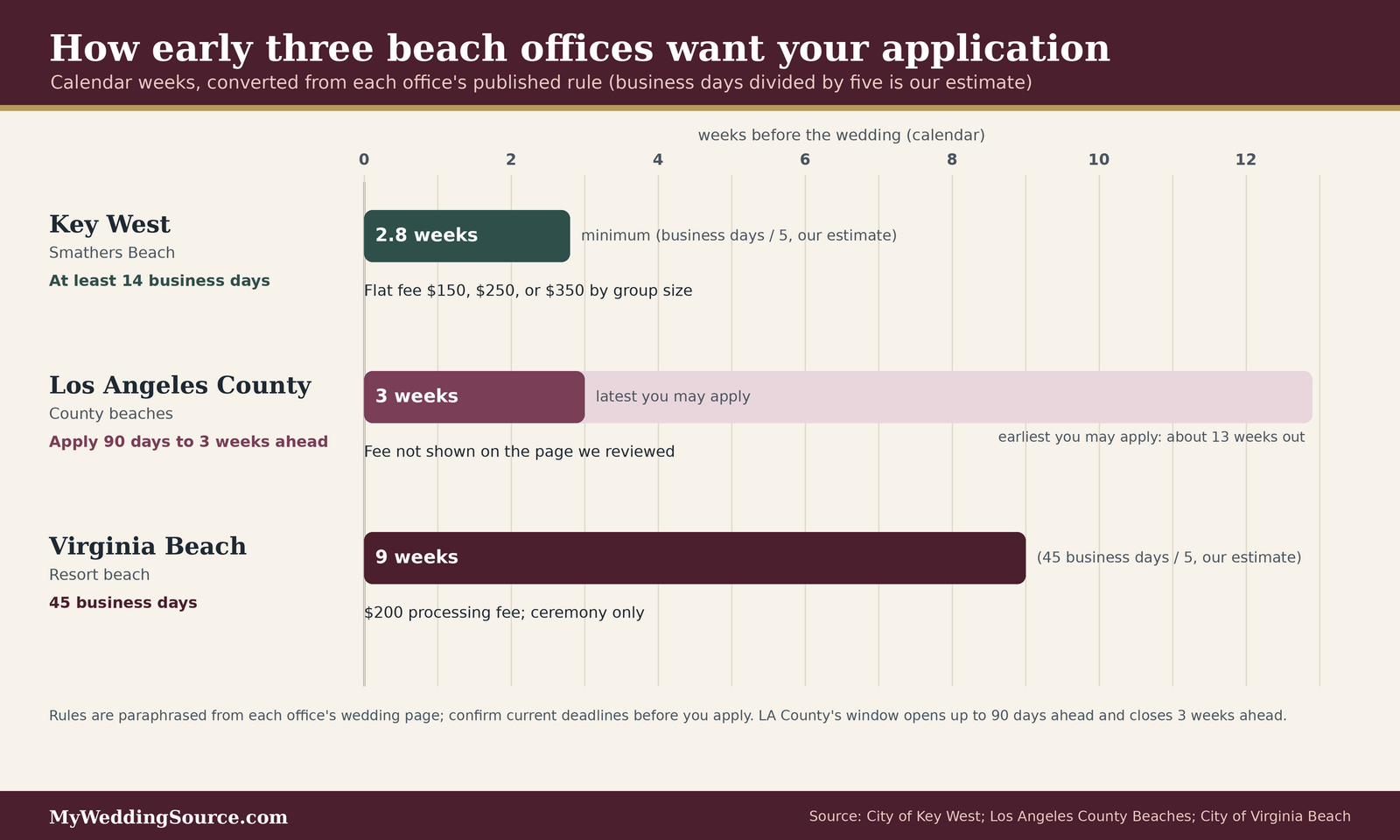
Key West requires a city permit for a wedding on Smathers Beach, with applications due at least 14 business days ahead, flat fees of $150 for 1 to 25 people, $250 for 26 to 50, and $350 for 51 to 100, and a separate special event application for 101 or more. The city bans alcohol on the beach, bans generators and motor vehicles, and bans open flames, glass, rice, birdseed, confetti, balloons, and lights after sunset from March through October. Virginia Beach says small ceremonies with no roped-off area, no equipment, and 199 or fewer attendees do not need a permit, while ceremonies that block off part of the beach, use equipment, or reach 200 attendees do. Its permit gives up to three hours of exclusive use, carries a $200 processing fee, and is due 45 business days ahead. Los Angeles County says weddings and other group events at county beaches need a Special Event Use Permit, and applications are accepted no earlier than 90 days and no later than 3 weeks before the event.
| Rule | Key West (Smathers Beach) | Virginia Beach | Los Angeles County beaches |
|---|---|---|---|
| Permit needed | Yes, for a wedding on the beach | Only for roped areas, equipment, or 200 or more guests | Yes, for weddings and similar group events |
| Fee shown | $150, $250, or $350 by group size | $200 processing fee | Not shown on the page we reviewed |
| Application timing | At least 14 business days ahead | 45 business days ahead | 90 days to 3 weeks ahead |
| Alcohol and reception | No alcohol on the beach | No reception, food, or alcohol on public property | Not shown on the page we reviewed |
| Sound and power | Generators banned; sound not mentioned | Amplified sound allowed; reasonable limits possible | Not shown on the page we reviewed |
| Lighting | No lights after sunset, March through October | Not shown on the page we reviewed | Not shown on the page we reviewed |
What the comparison teaches
Three things stand out. First, the lead time ranges from a few weeks to about two months, which is why you should apply as soon as your date and place are firm. Second, the rules about alcohol, power, and lighting change the design of the day, not only the paperwork. Third, a small ceremony can sometimes avoid a permit, as in Virginia Beach, but only if it uses no equipment, no roped area, and stays under the attendance limit, so the plan with chairs and an arch may need a permit when the plan with a simple gathering does not.
Read the restrictions that change your beach wedding design
For a beach wedding, a permit is more than a fee. It is a list of conditions, and some of them decide whether your vision is possible. Read the conditions before you pay any vendor deposit, because a florist or rental company will not know the rules for your beach unless you tell them.
Check decor, equipment, and cleanup
Key West requires removing arches, chairs, fences, and decorations after the event and does not say whether they are allowed, so a couple must ask. Virginia Beach says its permit covers tents, chairs, and arches. Both cities restrict some items, so confirm each decor piece against the written rules. Ask who is responsible for cleanup, whether you must hire a cleanup crew, and what happens if sand, petals, or debris remain.
Check the cancellation and weather terms
Key West says approval is at the City Manager’s discretion and that dates can be blocked by major events or tropical weather watches or warnings, and it publishes a refund schedule: full refund if you cancel 91 or more days ahead, half at 31 to 90 days, and none at 30 days or less. Ask any permit office what happens if weather forces you to move, whether the fee is refundable or transferable, and whether you can pick a rain date. Because hurricane season runs roughly June through November, according to Zola, ask early about storm policies on the Atlantic and Gulf coasts.
What this actually costs
The permit itself is often the smallest line. The three offices above show fees from $150 to $350 for a flat-rate permit and a $200 processing fee, and Zola cites a typical range of $100 to $150. The larger costs come from what the rules force you to add: sound equipment, windscreens, shade, weights for decor, an indoor backup space, and transport. Ask for permit fees, equipment costs, and the backup venue’s cost in the same budget so that the true figure is visible, and use our wedding budget calculator to add them. For context on typical totals, see our guide to average wedding cost.
Think about insurance and liability for a beach wedding
Many permit offices ask for proof of insurance, and some vendors will ask for it as well. The rules and the products vary, and what is appropriate for your wedding depends on your contract, your location, and your risk tolerance, so this guide does not give insurance advice.
Ask what the permit requires
Zola says some places require proof of insurance. Ask the permit office whether a policy is required, what limits it states, and whether it must list the city or county as an additional insured. A short question to the office now avoids a surprise at the application stage.
Learn what wedding insurance does and does not cover
Our wedding insurance guide explains how event policies generally work, what they commonly exclude, and what to ask an insurance professional. Weather, named storms, and vendor failure are the three areas to ask about for a beach wedding, and an agent can tell you how a policy in your state treats each.
Attire and guest comfort at a beach wedding
Attire for a beach wedding is a question of comfort first and appearance second, because a guest who is hot, cold, or standing on soft sand will not enjoy the ceremony however well dressed. The couple’s clothing needs the same testing as the guests’, and the invitation should tell everyone what to expect.
Dress the couple and the wedding party for a beach wedding in sand, wind, and heat
The couple and the wedding party are on their feet, on sand, in sun, for longer than anyone else. Clothing and shoes should be tested under those conditions before the day, and alterations should account for the footwear you will actually wear.
The couple’s outfits
Inside Weddings suggests a lighter fabric, such as a sheath dress, for comfort on sand and notes that grooms may skip the jacket. Our full guide to beach wedding dresses covers fabrics, hems, trains, and shoes in detail, and our wedding dress alterations guide explains how to schedule fittings. If a suit or tuxedo is part of your plan, groomsmen suits vs. tuxedos can help you compare options.
The wedding party’s outfits
Coordinate the wedding party’s clothing so that it works in heat and wind, and tell them early what shoes to wear on sand. Our wedding party attire guide covers coordinating a group, and a short written instruction about shoes, layers, and sun protection prevents day-of surprises.
Tell guests what to wear and bring to a beach wedding
Guests rely on your invitation and website for cues about a beach wedding. A clear paragraph prevents the common beach mistakes: heels that sink, dark suits in direct sun, and no layer for the evening.
Write a short guest guide
Include the dress code, the surface (soft sand, a boardwalk, or a paved path), the shade you will provide, the expected temperature range, and what to bring, such as a hat, sunscreen, and a light jacket for the evening. Zola’s advice to ask guests to bring layers because sand gets cold after dark fits naturally here. Keep it warm and brief, in the same tone as your other wedding communications. Our wedding etiquette guide can help with wording that is clear and not bossy.
Plan for guests with different needs
Older relatives, small children, and guests with limited mobility have different needs on sand. At a beach wedding, offer a seat in shade near the ceremony, a drop-off point close to the path, and an easier route if one exists. Ask these guests, privately and kindly, whether they need anything, and tell the permit office if you need an accessible route, because that may affect the layout.
Build redundancy into the guest and vendor plan for your beach wedding
For a beach wedding, redundancy means having a second way to do each essential thing: a second place to gather, a second source of power, a second way to reach people, and a second person who knows the plan. It costs a little more in time and money, and it is the difference between a delay and a ruined day.
Provide backup space, power, transport, communication, or equipment in the beach wedding decision
Backup plans fail when they are not tested. A beautiful indoor option that holds half your guests, or sits far from the beach with no transport, is not a plan. Test each backup against the same questions you ask of the primary plan.
Test the backup for the same capacity and accessibility
Count seats and measure the space for your guest count, including the officiant, musicians, and any guests who use mobility devices. Ask whether the indoor space has step-free access, restrooms, and power for sound. Confirm that it is yours for the time you need, with a written contract, not a verbal promise. A backup that holds 80 when your list has 110 is a trigger to reduce the guest list or add a second room.
Put transition time into the schedule
If you must move guests from the beach to an indoor space, estimate the time honestly. Our illustrative arithmetic: if the walk is ten minutes and you have 60 guests, some of whom move slowly, allow 25 to 30 minutes for the whole group, plus time for chairs, sound, and flowers to be reset. That is an editorial estimate, so time the actual route with a few guests. Add the number to your schedule, and decide in advance how the ceremony shortens if time is tight.
Communicate the contingency without creating panic in the beach wedding decision
Guests do not need a long weather forecast. They need to know where to be, when, and what to bring. A short, calm message sent at the right time prevents confusion and keeps the mood of the day intact.
Tell guests only what changes their behavior
Send one message: where the ceremony will be, the start time, and any change in parking, transport, or footwear. Use the channel guests already know, such as a wedding website banner, a text group, or an announcement from greeters. Avoid long explanations, and avoid language that makes guests worry. “The ceremony will be indoors at the resort ballroom at 4:30” is enough.
Give vendors the operational version with exact instructions
Vendors need more detail: the new location, load-in route, time, power access, and who they call. Write a one-page sheet for each vendor team and send it with the contract, with the decision deadline and contact numbers. Our wedding catering, wedding decor, and wedding reception guides cover vendor questions you can adapt for a beach setting.
Use a contingency activation table for your beach wedding
How to use the table
Table 2 converts the plan into actions with deadlines. Treat the times as suggestions to adjust for your venue, travel time, and vendor needs.
| Condition | Decision point | Who decides | Guest message | Vendor action |
|---|---|---|---|---|
| Thunder heard, or lightning alert issued | Immediately | Coordinator | Move to the named shelter | Stop equipment; secure sound gear; wait 30 minutes after the last thunder |
| Wind approaching the strong-breeze range | Three to four hours before guests arrive, then recheck | Coordinator, with the couple | Ceremony location or time may change | Weigh down decor; switch to the short-veil and wind-protected sound plan |
| Predicted tide reaches the ceremony area | When the tide table is checked, then on the day | Couple, with the permit office | New seating spot or time | Move rentals landward; adjust load-in time |
| Heat alert or guests showing warning signs | Two hours before start, then continuous | Coordinator | Shade and water stations; shorter ceremony | Add water, fans, and shaded seating; shorten the program |
| Permit problem or closure | As soon as it is known | Couple | New location or date | Redirect deliveries; confirm the backup contract |
| Sound failure | Before guests are seated, at sound check | DJ or officiant | Seating closer together | Switch to backup mic and battery power |
What to rehearse before the day
Read the table aloud with your coordinator, officiant, and one vendor, and ask each person to say what they would do in the first five minutes. Gaps show up quickly when you say them out loud. Rehearse the lightning row most carefully, because it is the one with no time to deliberate on the day of your beach wedding.
Verify the plan on site before your beach wedding
A beach wedding plan on paper is not a plan until someone has walked it. A site visit, ideally two, turns assumptions into facts and reveals the small issues that cause the biggest delays: a locked gate, a steep dune path, a restroom that closes early.
Walk the route as a guest would experience it in the beach wedding decision
Start at the parking area and walk the route to the ceremony spot at the pace of your slowest guest. Notice what a guest notices: the surface, the distance, the signage, the shade, and the restrooms. Take photos and notes.
Check lighting, surfaces, distances, restrooms, and shelter
Measure the distance from parking to the ceremony site and from the ceremony site to the reception or the shelter you would use in a storm. Note the surface under each stretch, whether any steps or slopes are present, whether restrooms are open at your hour, and where the nearest substantial building is. NOAA says substantial buildings and hard-topped vehicles offer the best protection from lightning, while sheds, rain shelters, and open vehicles do not, so identify a real shelter, not an open pavilion.
Test the plan at the relevant time of day
Visit at the same hour as your ceremony, ideally on the same type of day, such as a weekend in the same month. Notice where the sun sits, which way the wind blows, how loud the surf is, how crowded the beach is, and how the tide looks. A walk at noon tells you very little about a ceremony at six. If you cannot visit at the right hour, ask the permit office, a local planner, or your photographer what to expect.
Close gaps with written responsibilities in the beach wedding decision
After the site visit, write down who does what. A plan that lives in the couple’s heads will fail when they are busy. Written responsibilities let helpers act without asking.
Assign each contingency task
Make a one-page list with a name next to every task: calling plan B, informing guests, moving chairs, resetting sound, leading guests to shelter, and watching the sky. Give the list to your coordinator, officiant, and two or three trusted friends. Our plan wedding timeline guide can help you place these tasks on a calendar, and our guide to wedding planning stress explains why handing off tasks protects the couple.
Store emergency contacts and vendor escalation paths
Save a contact sheet on every helper’s phone and print one copy: the permit office, the lifeguard station or park office, the nearest urgent care, the backup venue, each vendor’s day-of contact, and the person who can approve changes. Beaches often have weak cell service, so note where the signal is reliable and plan a backup, such as a printed sheet or a runner.
A worked scenario: one beach wedding, three decisions
The following is an illustration we constructed to show how the pieces connect; it is not a real couple’s wedding, and the numbers are assumptions for the example.
The setup
Imagine a couple planning a ceremony for 60 guests on a public beach in June, with a reception at a beachfront restaurant a ten-minute walk away. They want an arch, chairs, and a small sound system.
The first decision: the permit
The couple reads the beach wedding permit rules and finds that equipment and a roped area require a permit, applications are due about two months ahead, and alcohol is not allowed on the beach. They apply immediately, budget for the fee, and decide the toast will happen at the restaurant. If the same couple chose a simpler gathering with no equipment, as some cities allow, they would need to verify that the city’s rules still apply, and the sound system would need to be battery-powered.
The second decision: the hour
They compare a 5:30 p.m. ceremony with a 10:30 a.m. one. The late afternoon looks beautiful, but the CDC’s peak UV window of 10 a.m. to 4 p.m. daylight saving time covers the morning option, and guests would wait in the sun, while the 5:30 slot sits after it. They check the tide table and find the water is lower at 5:30. They choose late afternoon, with shade, water, and a start time early enough to finish before the light falls.
The contingency
The couple names their coordinator as decision-maker, with a go or no-go at 1:30 p.m. and a lightning rule of “first thunder, everyone to the restaurant.”
How the day unfolds
At 1:30 the forecast shows a possible thunderstorm. The coordinator calls plan B: the ceremony moves into the restaurant’s dining room, which seats 60 and has step-free access. Guests receive one text. The vendors receive the one-page sheet. The transition is a ten-minute walk, and the schedule has 30 minutes of slack. The beach photographs happen after the storm if the sky clears, and no one is in the water.
What the scenario shows
Nothing in this beach wedding plan required luck. The permit was read before deposits, the hour was chosen against measurable facts, and the decision had a name and a deadline. The result is a day that works whether or not the sky cooperates, which is the point of the whole exercise.
Questions to ask before you book a beach wedding
Use these questions with the permit office, venue, and vendors you consider for your beach wedding. Written answers are better than spoken ones, and a vendor who has worked on beaches will answer easily.
Questions for the permit office and venue
Ask these first because the answers can change everything else.
About the rules
Ask what the permit covers, what it does not, how far ahead to apply, whether the fee is refundable, and what happens in a weather closure. Ask about equipment, sound, lighting, alcohol, and guest limits in writing.
About the site
Ask whether the beach is guarded at your hour, where restrooms and parking are, how accessibility is handled, and whether the area is closed for nesting season or events on your date.
Questions for vendors
Beach wedding experience matters, and a vendor who has not worked on sand may underestimate the effort.
About beach experience
Ask how they secure equipment in wind, how they power equipment, how they handle sand, and what they do if the plan changes at the last minute.
About contracts
Ask for the weather and change policy, the substitution rules, the cancellation terms, and the time they need to move to plan B.
Questions worth asking before you book
- What does the permit cover, and what is its deadline, fee, and refund policy?
- Are amplified sound, generators, tents, alcohol, and lights allowed?
- What does the tide table predict for our date and hour, and how far does the water reach?
- Is the beach guarded at our hour, and who do we call in an emergency?
- Where is the nearest substantial building we can use as a lightning shelter?
- What is our written plan B, who decides, and by what time?
- How does the backup space compare in capacity, access, and power?
FAQ: beach wedding questions
Planning and permits
Do I need a permit for a beach wedding?
Usually yes, because most beaches are public property, though rules vary by city, county, and park. Virginia Beach, for example, exempts small ceremonies with no roped area or equipment, while Key West and Los Angeles County require permits for weddings. Check your beach’s own rules and apply early.
How far ahead should I apply for a beach wedding permit?
It depends on the office. Key West asks for at least 14 business days, Los Angeles County accepts applications from 90 days to 3 weeks ahead, and Virginia Beach asks for 45 business days. Apply as soon as your date and location are firm, and confirm the current deadline.
What time of day is best for a beach wedding?
It depends on your priorities. Inside Weddings suggests a morning ceremony in hot weather and notes that sunset light fades quickly, while Zola says many couples choose sunset. Compare the tide, the UV window, and guest comfort, then keep a buffer in the schedule.
Can I serve alcohol at a beach wedding?
Often not on the beach itself. Key West bans alcohol on the beach, and Virginia Beach says receptions, food, and alcohol are not permitted on public property under its ceremony permit. Many couples hold the toast at a nearby venue, so ask the permit office before you plan a bar.
Weather, safety, and sound
What wind speed is too windy for a beach wedding?
There is no official limit for weddings. The National Weather Service Beaufort scale says a 25 to 31 mph strong breeze makes umbrellas hard to hold. Many couples plan a decision point lower, around 19 to 24 mph, if they use tall decor, a veil, or sound equipment.
What should we do if there is thunder?
Follow NOAA’s guidance: go indoors at the first thunder, use a substantial building or hard-topped vehicle, and wait 30 minutes after the last thunder before returning to the beach. Name the shelter in advance, and give your coordinator the authority to pause the ceremony.
How do we keep guests safe from heat and sun?
Provide shade, water, and a short ceremony, and brief a few people on warning signs. The CDC lists cramps, heavy sweating, dizziness, headaches, weakness, and nausea as signs of overheating, and it advises sunscreen with SPF 15 or higher, hats, and shade. Ask a clinician about individual health concerns.
Will guests be able to hear us over the surf?
Not reliably without help. Ocean noise and wind can drown out vows, so plan microphones with wind protection, seat guests close together, and run a sound check on site. Check the permit, because some places limit noise or ban generators, and use battery power if needed.
Your next steps
Lock the basics
Confirm the date, the beach, and the permit
Read the permit rules for your exact beach, note the deadline, and apply. Keep a copy of every approval and every restriction. If you are still deciding between a larger and a smaller plan, our small wedding planning and micro wedding planning guides can help you decide how much equipment and permit complexity you want.
Check the tide and the forecast pattern
Look up the tide prediction for your date, choose your hour, and note when you will recheck the forecast. Our honeymoon planning guide is a useful next read if the beach is also part of a destination trip.
Build the safety net
Write plan B
Name the decision-maker, the triggers, the shelter, the backup space, and the message to guests for your beach wedding. Share the one-page plan with your coordinator, officiant, and vendors.
Visit the site at the right hour
Walk the route, test the sound, measure the distance to the water, and confirm the shelter. Then update your plan with what you learned.
Sources & methodology
How we built this guide
What we relied on
This guide draws on federal weather and ocean agencies for wind, rip-current, lightning, tide, and sun and heat guidance, on three public permit offices for the examples of beach wedding rules, and on two wedding-planning publishers for practical advice. Where a statement comes from a city, county, or publisher, we say so, because rules and advice differ from place to place. The thresholds for plan B, the risk ratings, and the transition-time estimates are our own editorial judgment and arithmetic, and they are labeled as such.
What we did not do
We did not visit these beaches, test equipment, or interview vendors, and we did not review the full permit documents behind each city or county page. We do not give legal, medical, or insurance advice. Permit rules and weather risks change, so confirm everything with your permit office, your vendors, and, where health is involved, a clinician.
Source list
Government and public agencies
- NOAA National Ocean Service, Beach dangers: https://oceanservice.noaa.gov/hazards/beach-dangers/
- National Weather Service, Rip current science: https://www.weather.gov/safety/ripcurrent-science
- National Weather Service, Rip current safety: https://www.weather.gov/safety/ripcurrent
- National Weather Service, Lightning safety: https://www.weather.gov/safety/lightning-safety
- National Weather Service (Miami), Beaufort Wind Scale: https://www.weather.gov/mfl/beaufort
- NOAA Tides and Currents: https://tidesandcurrents.noaa.gov/
- Centers for Disease Control and Prevention, Heat and health: https://www.cdc.gov/heat-health/about/index.html
- Centers for Disease Control and Prevention, Skin cancer prevention: https://www.cdc.gov/skin-cancer/prevention/index.html
City and county permit offices
- City of Key West, Beach weddings: https://www.cityofkeywest-fl.gov/838/Beach-Weddings
- City of Virginia Beach, Beach weddings: https://cvb.virginiabeach.gov/resort-management/special-events-film/beach-weddings
- Los Angeles County Beaches and Harbors, Beach wedding permits: https://beaches.lacounty.gov/la-county-beach-wedding-permits/
Wedding-planning publishers
- Zola, Things to consider when planning an East Coast beach wedding: https://zola.com/expert-advice/things-to-consider-when-planning-an-east-coast-beach-wedding
- Inside Weddings, Your guide to planning a beach wedding: https://www.insideweddings.com/news/planning-design/your-guide-to-planning-a-beach-wedding/43604/