

An open back removes the straps, bands, and seams that most bridal underpinnings depend on, so the work is to match your back style, your fabric, and your need for support to a layer that stays put and stays hidden for a whole wedding day, and this guide shows how to choose bridal undergarments for a backless dress with a decision card, a fitting plan, and a list of questions for your tailor.
Quick answer
If you are working out how to choose bridal undergarments for a backless dress, work in this order. First, find out how low the opening drops and whether the dress already has built-in cups or a lining. Second, decide how much support you need from the front of the body alone. Third, pick the layer that does that job without crossing the open back: cups sewn in by a tailor, an adhesive bra or silicone petals, or a low-back bra, bodysuit, or bustier when the opening ends high enough. Fourth, match your bottom layer to where the back opening ends and to the fabric. Buy everything before your first fitting, bring it to every fitting, and wear-test it for several hours. Sellers of adhesive products often set their own limits on wear time and skin preparation, so read those instructions and see a clinician about any rash that lingers.
Why an open back changes the undergarment question
Most advice about what to wear under a wedding dress assumes a back that can hide a band, a strap, or a hook. A backless dress takes all three away. That single design choice ripples through the rest of the outfit: how the bust is supported, how the waist is smoothed, how the bottom layer is cut, even how you feel about sweating through a long afternoon. Understanding what changes makes every later decision easier, and it is the first step in learning how to choose bridal undergarments for a backless dress.
What the open back takes away
Think of an ordinary bra as a small suspension system. The band wraps the ribs, the straps lift from the shoulders, and the cups hold the shape between them. In a backless gown, the band and often the straps have no place to run.
The band has nowhere to sit
The first surprise when you start to choose bridal undergarments for a backless dress is how little of an ordinary bra survives. A standard bra band crosses the back at roughly the level where many backless gowns are already open. Even a bra with very thin straps will show in a scoop or a deep V, and a clasp at the back is a visible detail in photographs taken from behind. That is why the sources we read for this guide keep steering readers toward alternatives that skip the back entirely.
The straps compete with the neckline
Many backless dresses are also halter, plunging, or strappy in the front. A conventional strap can cut across the front design just as the band would cut across the back. Convertible straps help in some cases, but a fully open back usually pushes the decision toward strapless or stick-on solutions.
Seams and lines become more visible
Bare skin shows the edge of anything that sits on it. A waistband that is hidden in a closed-back gown can peek out of a low opening, and the same goes for a bodysuit’s edge or the top of a slip. Planning the entire stack of layers, not just the bra, is the practical way to handle this.
Why the dress’s construction comes first
Before you buy anything, look at what the dress already does. Many bridal gowns have lining, interior boning, or a built-in bodice that supplies part of the support, and the way a backless gown is built often decides which undergarment options are even available.
Check whether the gown has cups or a built-in bra
Some gowns arrive with a built-in bra or supportive bodice, and a bridal retailer quoted by The Knot notes that a built-in bra can be enough for some wearers, while others with a larger bust may want more support. If your gown has cups, ask how much lift they give and whether they can be adjusted or replaced. If it does not, a tailor can often add cups inside the lining, which we cover below.
Look at the lining and the shell separately
A lining sits against the skin and the shell fabric is what the camera sees. Sheer or lace shell fabrics over a lining behave differently from a single layer of satin. The practical point is that the thing you put on your skin may or may not show through, so ask whether the bodice is fully lined, partly lined, or an illusion panel.
Measure how far the opening drops
“Backless” covers a wide range. A shallow scoop that ends between the shoulder blades is a different problem from an opening that falls to the waist or below. We built the decision card later in this guide around back depth because the bottom edge of the opening controls which options remain.
What this guide covers and what it does not
This guide explains how to choose bridal undergarments for a backless dress: the choices, the questions to ask, and the order to do things in. It is general information, not medical or tailoring advice, and it cannot test your skin, measure your body, or promise any product will hold up on your day.
Where we got the details
We read retailer and editorial guides, a federal consumer-protection rule for labels and shipping, and health-information pages on rashes from contact with adhesives. Where we repeat a retailer’s advice, we say so, because retailers sell the products they recommend. Our own reasoning is labeled as such.
Where a professional takes over
No article on how to choose bridal undergarments for a backless dress can replace a fitting. Structural changes to a gown, such as sewing in cups, adding boning, or altering a bodice, belong with a bridal tailor or alterations specialist. A skin reaction that does not clear belongs with a clinician. If you are unsure which side of that line a question sits on, ask. Our guides to wedding dress alterations and to wedding dress fit and alterations explain how fittings work.
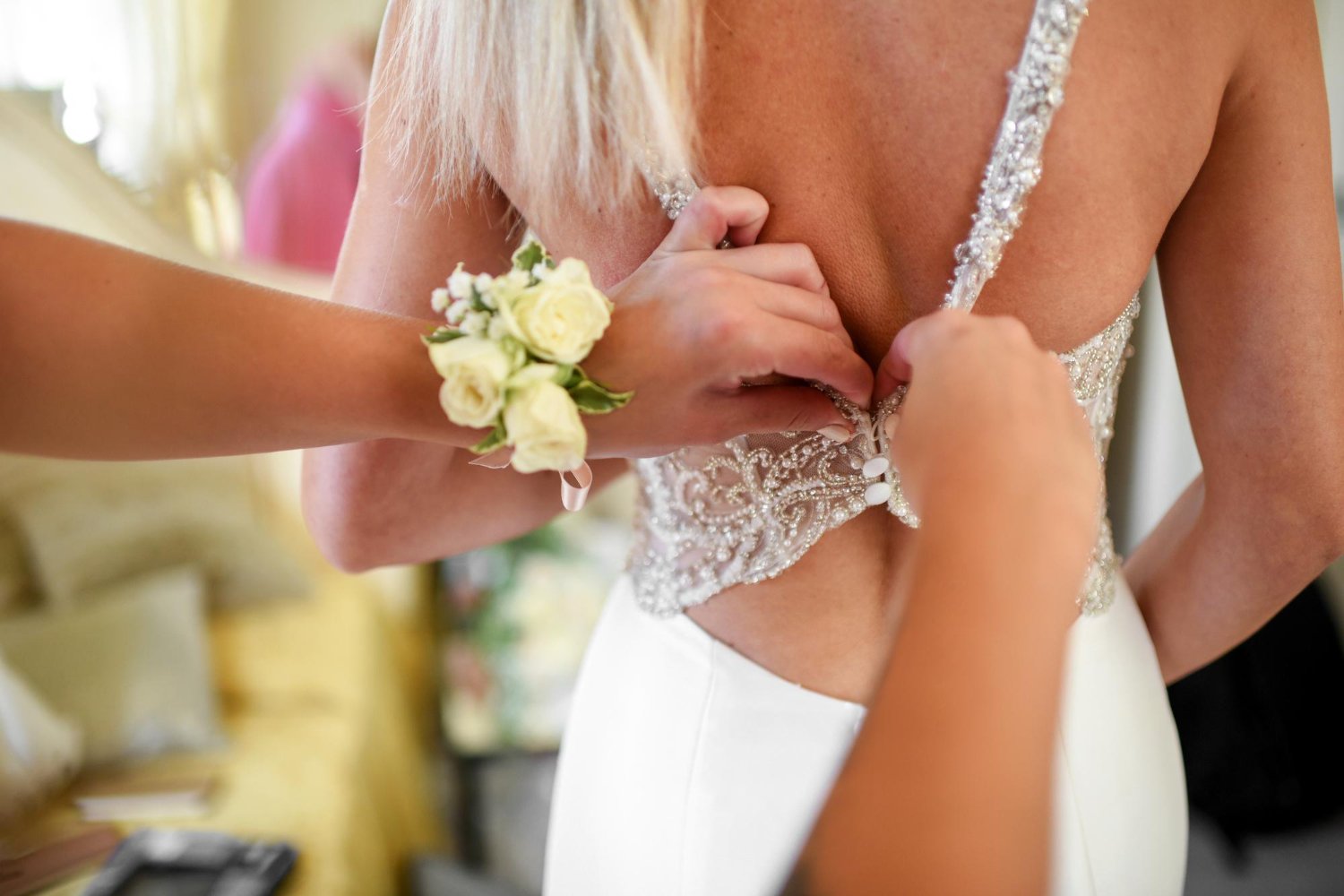
How to choose bridal undergarments for a backless dress, step by step
The approach below turns a long list of products into three decisions, which is the simplest way to see how to choose bridal undergarments for a backless dress without buying a drawer full of options. You can complete the first two before you buy anything, which keeps you from collecting items that cannot work with your dress.
Step one: name your back style
Back styles blend into one another, but five groups cover most gowns. Knowing which group you are in is the quickest way to narrow your options when you are deciding how to choose bridal undergarments for a backless dress.
Scoop and low-scoop backs
A scoop back dips in a curve, ending anywhere from between the shoulder blades to the bottom of the rib cage. When the curve ends high, a low-back bra or a long-line piece may still tuck out of sight. When it ends lower, a conventional back band becomes visible and the choice moves toward adhesive or sewn-in options.
Deep-V and plunging backs
A V-shaped opening narrows toward a point at the center of the back and can fall to the waist. The straight sides of the V leave little room for any band. Adhesive cups, nipple covers, or cups built into the dress are the common answers, and a bodysuit works only if its back is cut at least as low as the V.
Keyhole, cutout, and illusion backs
A keyhole or cutout shows a shape of skin while the rest of the back is covered, and an illusion back uses mesh or lace that is meant to look close to bare. The covered areas can sometimes hide a thin band, but the edges of a cutout and the transparency of an illusion panel are unforgiving. Test any visible band against the actual panel, in daylight.
Open to the waist or below
When the back is open to the waist or past it, the bottom layers matter as much as the bra. A waistband can show above the opening, so a low-rise cut may be the right choice for the back, even if you prefer higher briefs in the front. We cover this trade-off in the underwear section.
Strappy and lace-up backs
Straps, laces, or crossed ribbons cover only parts of the back. The gaps are small but still reveal anything beneath them, so these styles often behave like a deep opening for undergarment purposes, even though they look more covered at first glance.
Step two: decide how much support you need
Support is personal, and it is the part of how to choose bridal undergarments for a backless dress that no product page can answer for you. It depends on your bust, your comfort, and how long the day is, and no one else can decide it for you. A useful way to think about it is as three levels.
Light support or coverage only
Some people answering how to choose bridal undergarments for a backless dress find that coverage is all they need. If you want mainly coverage and a clean line, the simplest answers are silicone petals, nipple covers, or cups sewn into the bodice. These give no lift, so they suit people who are comfortable without a bra in everyday clothing.
Moderate lift and shape
If you want some lift without a full bra, an adhesive bra with side wings, a plunge-shaped sticky cup, or built-in cups with some structure can all help. A writer for a UK fashion outlet cautioned that sticky designs vary widely and that the ones with side wings can look odd and move out of position, so wear-test them before you commit to one.
Significant support
If you need the kind of support a structured bra gives, an open back narrows your choices, and each one carries trade-offs. A low-back bra, a bodysuit with a plunging back, or a longline bustier can work if the opening ends high enough. Otherwise, the best route may be to ask a tailor to build support into the gown, since a few retailers recommend sewing a bra into the dress as a solution.
Step three: choose the layer that does the job
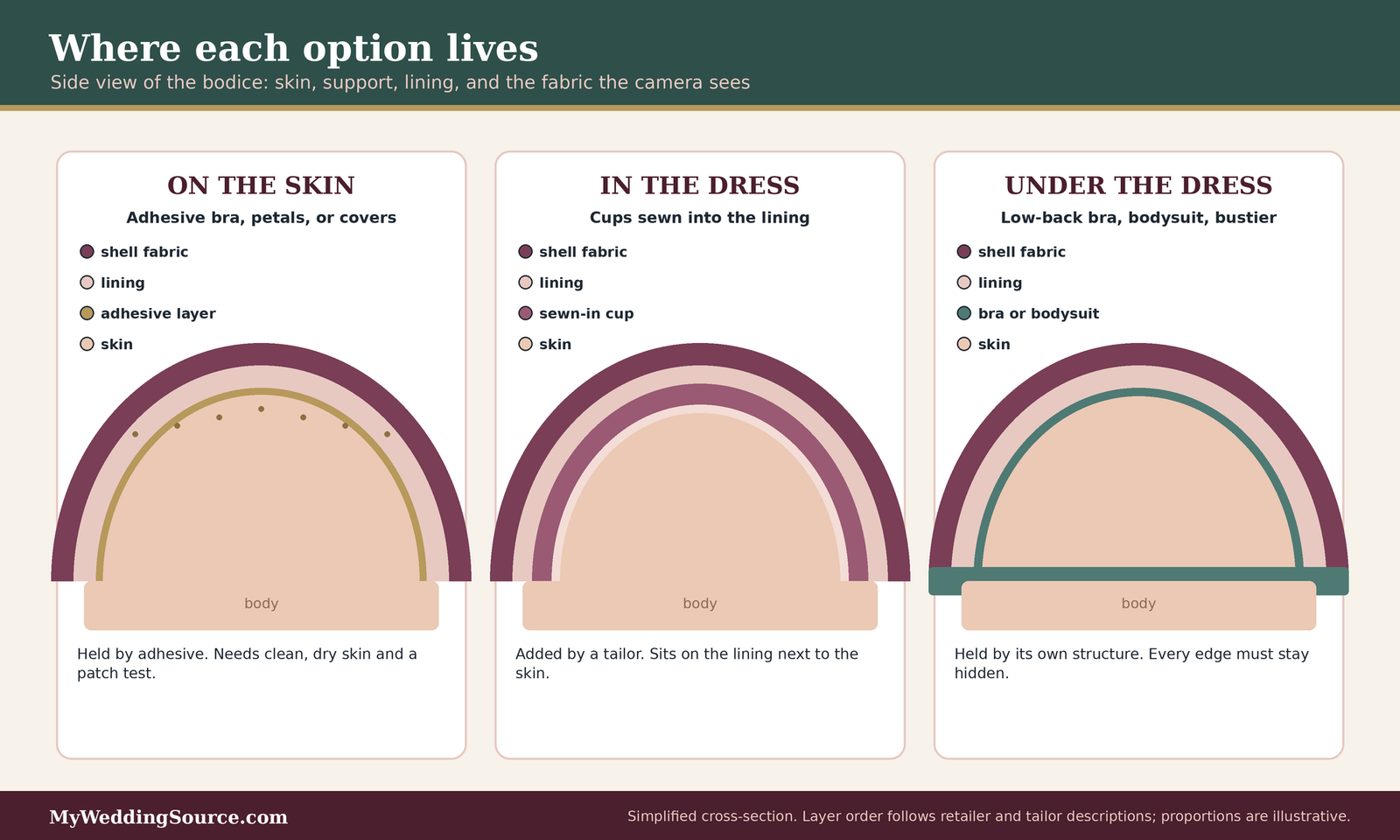
With your back style and support level in mind, you can choose where the support lives: in the dress, on the skin, or under the dress.
In the dress
Cups sewn into the lining, a built-in bra, or a tailor-added bodice panel keep everything inside the gown and leave your back bare. The advantage is that there is nothing to stick or slip. The drawback is that the work is permanent and has to be fitted by a professional, as covered in the alterations section.
On the skin
Adhesive bras, silicone petals, and nipple covers sit directly on the skin. They leave the back completely open and are the most common recommendation for deep openings, but they depend on your skin, the weather, and how you prepare the area, so they need the most testing.
Under the dress
Low-back bras, bodysuits, and bustiers sit under the gown and are held by their own structure. They suit shallow openings best, and they require that every strap and edge stay hidden. They also make the bottom layer part of the same decision, because a bodysuit is both a top and a bottom.
Your main options for a backless gown, compared
Four families of products cover almost every backless wedding dress, so how to choose bridal undergarments for a backless dress mostly means picking one family and a backup. Each one trades convenience, support, and risk differently, and none is right for everyone. The notes below paraphrase what retailers and style publications say, and we point out where they disagree.
Adhesive bras and silicone petals
These are the products most often recommended for open backs. An adhesive bra is a pair of cups, sometimes joined at the center or with side wings, that sticks to the skin. Silicone petals or gel cups are smaller and give coverage and a little shaping.
What the sources say
On how to choose bridal undergarments for a backless dress, adhesive products come up first. An intimates retailer, Soma, recommends adhesive bras that are both backless and strapless for backless dresses and notes that most are washable and reusable. A bridal retailer, Martin Thornburg, calls a strapless adhesive bra a best bet for an open back. A bridal editor quoted by The Knot says adhesive bras give coverage and lift without visible straps, but warns that inexpensive versions may not give enough support or stay in place for a long event. These are consistent on the basic point and cautious on the details.
Where they fall short
A UK style writer who tested options for a backless dress found that stick-on bras are tricky and that she had not found one that lifted and stayed secure for a long time. She was most skeptical of designs with side wings that attach cups at the natural height. Her view is one reviewer’s experience, not a rule, but it matches the warnings elsewhere: the longer the day and the heavier the bust, the more likely an adhesive product is to give way.
How skin and care affect them
The fashion retailer Lulus advises keeping the sticking area clean and dry and avoiding lotion, deodorant, or powder where the adhesive touches, since those can stop it from sticking. Another retailer’s page for its own adhesive products, ASOS, says to start with clean, completely dry skin, to avoid oily soaps and moisturizing products near the area, and to patch-test first. Those are product-specific instructions, so follow the instructions for the item you buy.
Low-back bras, bodysuits, and bustiers
When the opening ends high enough, a garment designed with a low back can give real support without any adhesive.
Low-back and backless convertible bras
A low-back bra has a deep U or plunge cut in the back and usually a short, wide center. The UK style outlet we read says low-backed bras are great if you need more support, and it lists several plunge models with a low back. It also says one such model might not work for everyone, which is a fair reminder that fit varies.
Bodysuits, bodies, and longline bustiers
A low-back bodysuit or a longline bustier supports from the waist up and keeps the torso smooth. The outlet notes that such a piece must be paired with a high-waisted brief or short to keep a clean silhouette. Because it covers the torso, it shows the most at the edges, so check how it looks under the exact fabric of your dress, and whether it lets you use the restroom without removing the dress, a practical issue we cover in our guide on using the restroom in a fitted wedding dress.
Converter straps and add-on devices
Converter straps hook onto an ordinary bra to lower the back. The same outlet warns that they can create a prominent line across the hips and stomach in the front. If you are considering one, try it under the gown with the dress zipped or laced, and look at the whole silhouette, not only the back.
Cups and bodices sewn into the dress
Instead of adding a garment, some brides have a tailor build the support into the gown itself.
What a tailor can add
A bridal tailor interviewed by a wedding publication describes bra cups placed inside the dress, on top of the lining next to the skin, so that they do the work of a bra. The same article says the right cup size is chosen at the first appointment, and that in some cases two cups are used. Martin Thornburg also suggests asking a seamstress to sew a bra into the dress for built-in support. Soma points out that if a gown does not already have support, you can ask your seamstress to add it during alterations.
Why they are popular for deep openings
For many brides learning how to choose bridal undergarments for a backless dress, this is the answer that removes the most risk. With cups in the dress, there is no adhesive on the skin, no band, and nothing to slip. That is attractive for long days and for people with sensitive skin. It also means the support is tied to the dress, which makes the fitting schedule matter more.
What to confirm before saying yes
Sewn-in cups are a structural change. Ask what type of cup the tailor will use, where the stitching will sit relative to the lining and shell, how it will be fitted, how much it adds to the price, and whether it can be removed. Ask the tailor for a written estimate. The questions at the end of the vendor section give a longer list.
Nipple covers and going without
For some gowns, especially those with a built-in bodice or sheer cups, a very small piece of coverage is all that is needed.
Nipple covers and concealers
Lulus suggests nipple concealers for backless, deep-V dresses where a full bra will not work. These are thin and adhesive, so the same skin preparation and testing advice applies, and they give coverage but no shape or lift. Whether they are comfortable for long hours is a personal matter that a test run reveals.
Wearing nothing under the bodice
If the dress is fully lined and structured, some brides wear nothing in the bust area, and Soma notes that going braless is an option when a gown has built-in support. The practical test is to move, sit, raise your arms, and dance in the dress, with someone you trust looking for gaps. If you pass, you have your answer. If not, you have found out before the wedding.
A decision card by back style and fabric
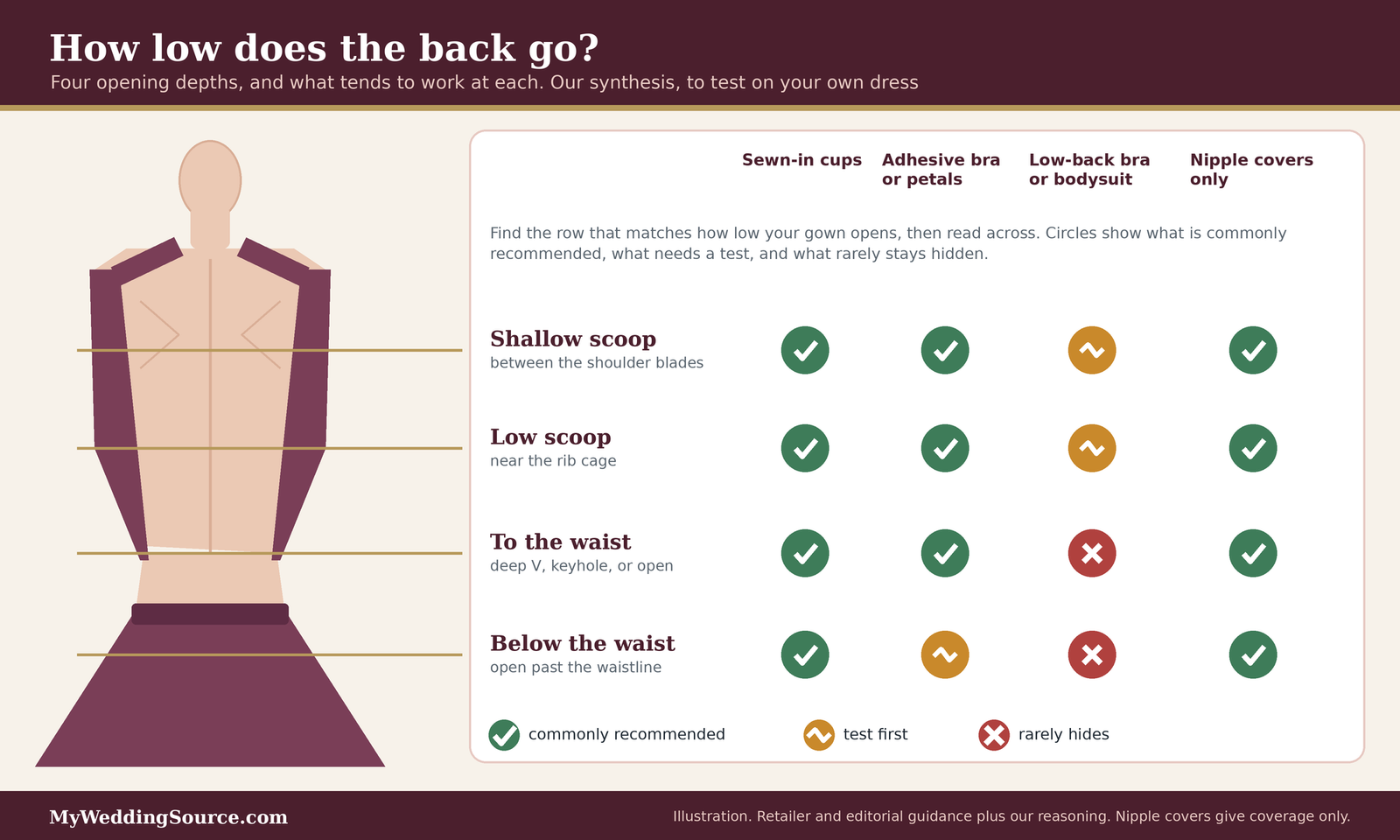
This is the practical heart of the guide, a one-page answer to how to choose bridal undergarments for a backless dress for your particular gown. The card below combines the five back styles from step one with the options from the section above. It is our own synthesis of the sources we read plus general reasoning about visibility, so treat it as a starting point and test it against your actual gown. Where a cell leans on one source, we note it in the next section.
The decision card for how to choose bridal undergarments for a backless dress
Read across your row. “Good fit” means the option is commonly recommended for that back style or follows directly from how the garment is built. “Test first” means it can work but depends on fit, fabric, or skin. “Rarely works” means it tends to show or slip with that opening.
| Back style | Sewn-in cups | Adhesive bra or petals | Low-back bra or bodysuit | Nipple covers only | Bottom layer to check |
|---|---|---|---|---|---|
| Shallow scoop, ends between the shoulder blades | Good fit | Good fit | Test first. Check that the band is hidden when you lift your arms | Good for light coverage | Standard seamless briefs usually stay hidden |
| Low scoop, ends near the rib cage | Good fit | Good fit | Test first. Only if the cut is lower than the opening | Good for light coverage | Smooth briefs, check the back waistband |
| Deep V to the waist | Good fit | Good fit, with strong skin prep | Rarely works unless the cut is as deep as the V | Good for light coverage | Low-rise or high-cut styles that stay below the opening |
| Keyhole or cutout | Good fit | Test first. The cutout edge can show a patch | Test first. Place the edge away from the cutout | Good for light coverage | Check lines at the cutout edge |
| Illusion mesh or lace back | Good fit | Test first. Patches can be visible through mesh | Test first. Lines and seams can show | Test first. Check against the mesh | Seamless, skin-tone matched |
| Open to or below the waist | Good fit | Test first for wear and slip | Rarely works | Good for light coverage | Low-rise cut, check the top edge in the back |
| Straps, laces, or crossed ribbons | Good fit | Test first. Straps can cross the edges | Test first. Band may peek between straps | Good for light coverage | Check what shows between the straps |
How to read the card
This is the shortest route we know to how to choose bridal undergarments for a backless dress. Start with your row and note the “Good fit” options. Then pick one primary and one backup from the list, and test both. The columns are not a ranking. They show which choices are likely to hide, not which one will be the most comfortable on your body.
Where the entries come from
The “Good fit” entries for adhesive bras and sewn-in cups reflect what retailers and editors in our sources recommend for open backs. The “Rarely works” entries for conventional low-back garments and converter straps follow from the garments’ construction and from the UK style outlet’s warnings. The row-by-row notes on illusion and cutout backs are our own reasoning, because we did not find a published guide that treats them separately. Test them.
Adjusting for fabric
The shell fabric changes how much of the layer underneath shows, so how to choose bridal undergarments for a backless dress cannot rest on back style alone. This second card adds the fabric.
| Shell fabric | What tends to show | What to favor | What to check |
|---|---|---|---|
| Satin, crepe, or silky fabrics | Seams, edges, and lines of anything under it | Seamless pieces, slip shorts or seamless nude underwear (The Knot) | Edges of adhesive cups and nipple covers in strong light |
| Chiffon or georgette | Shadows and darker colors through the layers | A close skin-tone match and fully lined cups | Whether the bodice lining is opaque |
| Tulle or illusion mesh | Anything that is not skin tone, plus patches of adhesive | Cups sewn in under a lining, or skin-tone petals | How the panel looks from a distance and in a flash photo |
| Lace | Texture and gaps between lace motifs | Smooth seamless layers that match your skin | Gaps where the lining ends and the lace begins |
| Heavy or structured fabrics, such as a ball gown skirt | Less shows, and creasing is less of a concern (Martin Thornburg) | More freedom to choose by comfort | Whether the bodice, not the skirt, is the limiting layer |
Smooth and clingy fabrics
The Knot’s advice for silky fabrics is to wear slip shorts or seamless, nude underwear to avoid visible lines. Lulus adds that clingy column dresses call for a one-piece bra and smoother to avoid lumps at the band, which does not apply to a bare back but does apply to the front and torso.
Sheer, mesh, and lace
With sheer fabrics, the question is color and edge, not just thickness. Choose a layer that matches your skin as closely as possible, and look at it in daylight and in a camera flash. A photographer may well capture the back during the ceremony, so it is worth testing in photographs.
Heavier fabrics
Heavy fabrics and full skirts give you more freedom below the waist. Martin Thornburg notes that ball gowns allow more freedom in undergarment choice because creasing is less of a concern. The bodice is still where the decisions happen on a backless gown.
Fabric care, labels, and residue
Undergarments and the dress meet at the skin, so they can also meet each other’s care instructions.
Read the care label first
Federal rules require that most garments carry permanent care instructions, and the FTC’s summary notes that a label must give either a washing or a dry-cleaning instruction, or say that the item cannot be safely cleaned. For a wedding gown, that label, or the bridal shop’s own care sheet, is the place to look before you put an adhesive product against the lining.
Ask the shop about adhesive and body products
We did not find a published source on whether adhesive residue, deodorant, or skin products can mark a particular bridal fabric. Because the answer depends on the fabric and the product, ask the shop or your tailor before the first fitting, and ask what they recommend if a mark appears. Our guide to wedding dress stain removal will cover what to do after a mark, and we cannot guarantee that any product will remove any stain.
Keep the structural work with the professional
A gown’s lining, boning, and cups are part of its construction. A do-it-yourself change can complicate later alterations and may conflict with a shop’s policies, so check your contract before you pick up a needle or a glue stick, and see our guide to alterations for the questions to ask.

The bottom half: underwear, shapewear, and waistlines
An open back makes the underwear half of how to choose bridal undergarments for a backless dress harder than most guides admit, because the sources disagree and each rule makes sense for a different dress. The way through is to decide what your particular dress shows, not to follow one slogan.
Low-rise, high-waisted, or somewhere between
Two pieces of advice appear in the sources we read, and they point in opposite directions. An expert quoted in The Knot recommends low-rise underwear so waistbands do not show above a deep back. Several guides, including The Knot’s advice for column and bodycon silhouettes, favor high-waisted briefs or shorts for a smooth front.
Why both can be right
This is where how to choose bridal undergarments for a backless dress stops being a shopping list and becomes a fitting problem. They answer different questions. A low-rise cut protects the back from a visible waistband. A high-waisted cut smooths the front and the hips. If your dress is open to the waist and clingy in the front, you may want a piece that is high in the front and cut low in the back, or you may need to accept a small compromise on one side.
How to test the waistband
Stand with your back to a mirror, or have someone photograph your back in the dress, and look at the top edge of the underwear. Check it standing, bending, and raising your arms. If any edge appears, try a lower cut, a different fabric, or a seamless version, and check again at the next fitting.
What to do if nothing fits both
Tell your tailor. A fitter who sees the problem in person may suggest a change to the gown, such as raising the opening slightly, or may recommend a specific piece. We did not find a source that gives one fix for every gown, so treat this as a conversation to have, not a rule to apply.
Shapewear and an open back
Many shapewear pieces are built with a back, which is the very part you are trying to avoid.
What the sources say about shapewear
The Knot describes seamless shapewear, high-waisted briefs, or full-coverage bodysuits for fitted gowns and puts typical prices at roughly $30 to $150. It advises avoiding anything so tight that it is hard to get on and off, and suggests trying a different size if you struggle. A fashion retailer’s intimates advice warns that a bra and bodysuit should be worn to each fitting so the dress can be adjusted to them.
Why backless gowns limit the choices
Because most bodysuits and shapers have a back, the choices for an open back are narrower. Look for pieces that are cut low in the back or that stop below the opening, and check how the top edge behaves when you move. If the dress already has internal structure, you may not need shapewear in the torso at all.
Comfort, restroom access, and the long day
Anything you cannot get out of quickly can become a problem at the reception. If you plan to wear a one-piece garment, practice using the restroom in the dress before the wedding. We cover this in our guide to using the restroom in a fitted wedding dress.
Seams, lines, and skin tone
The final test of any bottom layer is whether it disappears.
Go seamless where the fabric is smooth
Martin Thornburg suggests a seamless nude thong for fit-and-flare gowns to avoid creases, and The Knot suggests slip shorts or seamless, nude underwear under silky fabrics. Both are retailer or editor guidance, not a rule, and both depend on what your own fabric shows.
Match your skin, not the dress
For sheer or illusion fabrics, a nude layer should match your skin tone, not the color of the gown. If a piece is slightly lighter or darker than your skin, it can show as a visible shape. Soma, which sells bras, even suggests a light blue bra if you want a “something blue” detail, but that only works where nothing shows through.
Photograph a test before the final fitting
A photo can show lines your eye misses, including in the flash and in bright outdoor light. Take a test picture of your back and front at the second fitting, so there is time to change something before the final fitting.

Timing: when to buy, fit, and test
The most common pattern in our sources on how to choose bridal undergarments for a backless dress is also the simplest: choose the undergarments early and fit the dress to them, not the other way around. Choosing late is the way a perfectly good dress ends up fitting differently on the day.
When to buy and when to decide
Two timing ideas show up consistently. Buy before your first fitting, and bring the same pieces to each fitting.
Buy before the first fitting
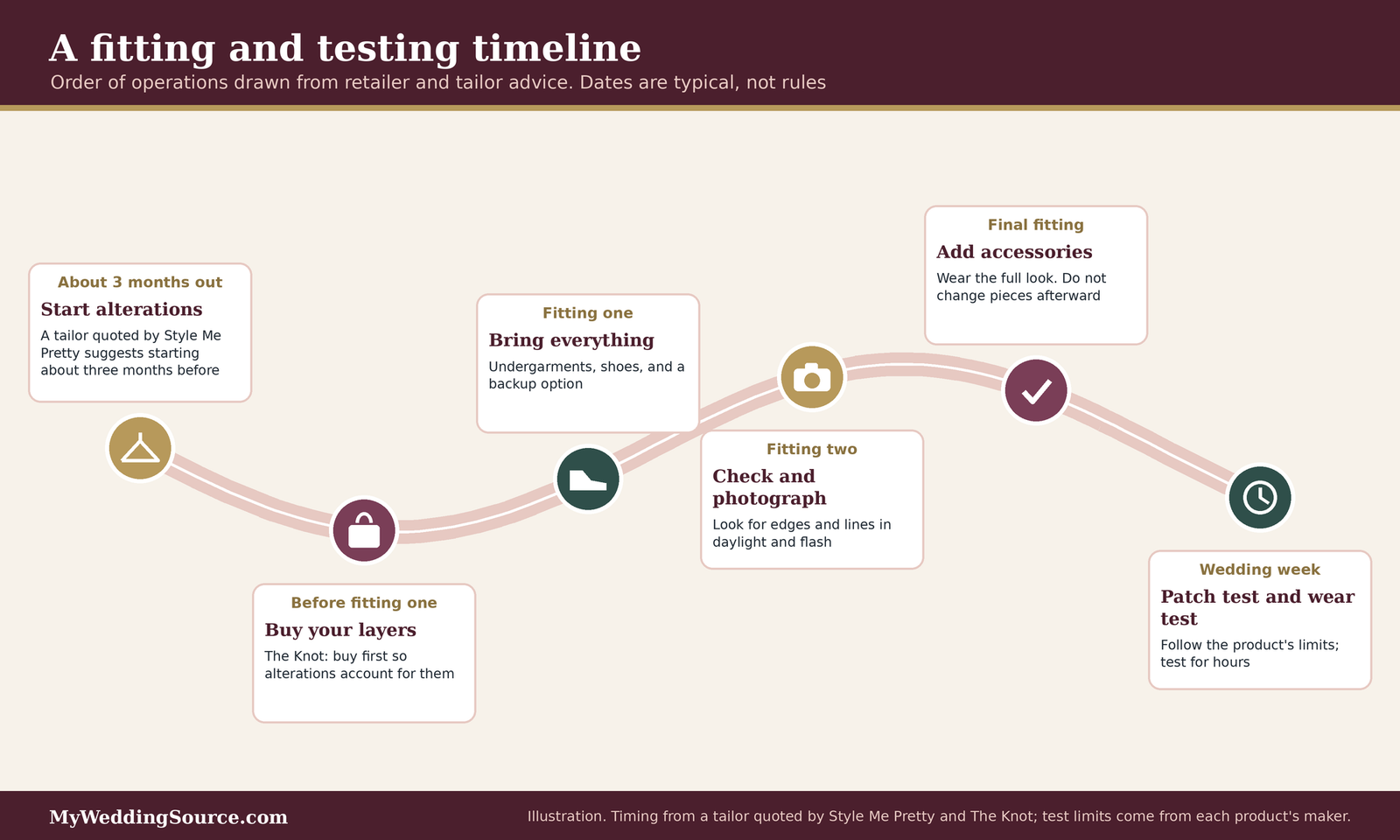
If you remember one rule about how to choose bridal undergarments for a backless dress, make it this one. The Knot’s advice is to buy undergarments before the dress fitting if possible, so alterations account for them. A wedding-style publication quotes a tailor who suggests beginning the alterations process about three months before the wedding, typically with three fittings, and who says to bring the shoes and undergarments you will wear to the first one.
Do not switch after alterations
The Knot warns that changing to a padded or push-up bra after alterations can throw off the fit on the wedding day. The same logic applies to any change in cup type, adhesive product, or shapewear. If you change, book another fitting.
Bring everything to each fitting
Lulus tells brides to wear their underpinnings to every fitting so they can confirm the fit and that nothing shows. For a backless dress, add your backup option and your bottom layer, not only the primary one. A good fitter will want to see both.
How to wear-test
A test that lasts a few minutes proves very little. The goal is to find the failure point before the wedding.
Test for hours, not minutes
A wear test is the real answer to how to choose bridal undergarments for a backless dress. The Knot advises wearing pieces for several hours to confirm comfort. For an adhesive product, that means testing it for as long as you expect to wear it, within the maker’s limits, on a day with similar temperature and activity, if you can.
Move the way you will move
Sit, hug, raise your arms, lean over to hug a short relative, and dance a few songs. Ask a friend to watch the back and the front for slipping, gaps, or edges. Check again after twenty minutes of movement.
Test with the same shoes, hair, and accessories
Shoes change posture and posture changes how a bodice sits. Veils, hair pieces, and necklaces can also tug at a neckline. Our guides to hem length for flats and heels and to veil comb security explain why these small details matter.
Working with your tailor
A good tailor can solve problems that no product can. A bad plan with an excellent tailor still costs time, so go in prepared.
What to bring
Bring every layer you plan to wear, including the backup, plus the shoes and any accessories that touch the bodice. If you plan to use an adhesive product, bring it and use it at the fitting, so the tailor sees how the dress sits on you with the product in place.
What to ask about structural changes
Ask what the tailor can add, such as cups, boning, or a modified lining, and what it costs. Ask for a written estimate and a schedule. Sewing and structural changes belong with a professional, as our wedding dress fit and alterations guide explains.
What to confirm in the contract
Check whether your alterations contract covers added cups or lining, whether there is a fee for extra fittings, and what happens if you change your mind. We cannot interpret a contract for you. Ask the shop to explain any terms you do not understand, and consider having someone you trust read it.
Skin, sweat, and comfort on the wedding day
Adhesive products sit on skin that will be warm, moving, and possibly nervous. A little knowledge goes a long way, and so does a willingness to switch plans.
Adhesive and skin: what to know
This is general information from consumer health pages and retailers, not medical advice. Anyone with a history of skin reactions, eczema, or allergies should talk with a clinician before using a skin adhesive.
Irritation and allergy are different
The Mayo Clinic describes contact dermatitis as an itchy rash caused by skin contact with a substance that either irritates the skin or triggers an allergic reaction. It says the rash usually appears where the skin touched the substance, and that irritant reactions are the most common type. Healthline notes that tape adhesives can contain acrylates, and that irritation can come from a harsh material or from a tight bandage.
Prepare and patch-test
ASOS, in guidance for its own adhesive products, advises starting with clean, dry skin that is free of oils and moisturizers, not applying adhesive over broken or damaged skin, and testing a small piece first. Its test is to apply a small piece for 30 minutes and watch the area for 24 hours. Your product may say something different, so follow its instructions.
Remove gently and know when to stop
ASOS advises peeling its product slowly, at a low angle parallel to the skin, while holding the skin steady, and removing it right away if it is uncomfortable. If a rash shows up, the Mayo Clinic says to make an appointment if it disrupts sleep or daily life, is severe or widespread, has not improved after about three weeks, or if you are concerned. Seek urgent care for signs of infection or trouble breathing.
Heat, sweat, and long days
A wedding day can run twelve hours or more, and adhesives have limits that belong in any plan for how to choose bridal undergarments for a backless dress.
Wear-time limits are real
ASOS says not to wear its adhesive products for more than four hours and cautions that skin can overheat in warm conditions. That limit is for its products, not all brands, but it is a useful reminder that a product designed for an evening out may not be designed for an all-day ceremony and reception. Read the wear-time guidance for yours, and plan for a change if it is short.
Plan for warm weather
Heat and humidity can affect how long any adhesive holds, and they affect how much you sweat under a lined bodice. Lulus says to keep the area free of lotion, deodorant, and powder, which also means thinking through your morning routine. Our summer wedding heat plan has ideas for staying comfortable, and a gown with built-in cups takes adhesive out of the equation.
Spray tan, makeup, and skin products
If you have a spray tan or body makeup planned, ask the artist and the adhesive’s maker whether they can be used together, since we found no source that settles it. Our spray tan guide covers timing for the tan itself, and our sensitive skin guide covers patch testing in general.
A backup kit for the day
Even a well-tested plan can fail, so bring a small kit.
What to pack
Pack a spare pair of whichever adhesive product you chose, a second pair of nipple covers or petals, the second option from your fitting, and a small bag to carry them. Our wedding emergency kit guide lists other supplies worth carrying.
Who holds it
Choose one person to carry the kit, usually someone who stays near you and who has already seen how the pieces go on. A bridesmaid, your mother, or a friend who has been to a fitting can all do this job.
When to switch to plan B
Decide ahead of time what would make you switch, such as a product that has slipped twice, a patch of skin that is red or itchy, or a gap that shows in photos. A plan made in advance is much easier to follow than a decision made at the reception.

What to ask sellers, tailors, and brands
Learning how to choose bridal undergarments for a backless dress involves several parties: the bridal shop, the tailor, and the sellers of the products themselves. Each one knows something the others do not, and a few well-chosen questions will save you time and money.
What bridal undergarments for a backless dress may cost
What to budget
Prices vary widely by brand, size, and region, so treat these figures as signposts, not quotes. The Knot puts shapewear at roughly $30 to $150. A UK style outlet’s roundup listed adhesive lift tape at about 15 pounds, silicone petals at about 12 to 15 pounds, stick-on backless bras at 13 to 25 pounds, low-back plunge bras at about 28 pounds, and a longline low-back bustier at about 65 pounds. Those are British prices from one article, and they may have changed. Sewn-in cups are a tailoring charge, and we did not find a published price, so ask your tailor for a written estimate. As our own rough arithmetic, a primary option, a backup, and a bottom layer can add up to a modest sum or to a meaningful one, depending on what you choose, so total the three before you decide.
A budget for how to choose bridal undergarments for a backless dress is easy to forget in the middle of dress shopping, and it is worth a line in your plan. If you are watching costs, the cheapest path is not always the cheapest outcome, because a product that fails on the day can cost more to replace than a better one would have cost up front.
Count the whole stack
When you price how to choose bridal undergarments for a backless dress, count every piece, not just the bra. Add the primary layer, the backup, the bottom layer, any alteration charge, and any extra fitting fee. Our wedding budget guide shows where small items like these tend to hide.
Leave room for a second try
If a product does not work in testing, you will want to replace it. Set aside a small amount for that, so a failed test is an inconvenience and not a crisis.
Questions to ask when you are choosing
Questions worth asking before you commit
- Does this gown have cups, a built-in bra, or a lining, and how much support do they give?
- Can the cups be adjusted or replaced, and what would that cost?
- What do you recommend for this exact back style, and have you fitted it before?
- Can I use my adhesive product at fitting, and does it affect the fabric?
- What does the care label or care sheet say about body products?
- What is the wear-time limit and skin-prep advice for this product?
- What are the return and exchange terms for intimate items, and who pays for shipping?
- Can I get the alteration estimate and schedule in writing?
Ask the shop first
The bridal shop sees the gown’s construction every day, so start there. Ask what the gown already includes before you spend anything on undergarments.
Then ask the seller or the tailor
A tailor can answer structural questions, and a product’s seller can answer questions about wear time and skin preparation. Write down each answer with the date, so you can compare them later.
Reading policies, labels, and shipping
The paper trail matters. These are the documents and rules worth reading.
Shipping and delay rules for online orders
The FTC’s mail, internet, and telephone order rule requires sellers to have a reasonable basis for any shipping time they state, and says that if no time is stated, a seller must be able to ship within thirty days of receiving a properly completed order. If a seller cannot meet its date, it must give you the choice to accept the delay or cancel for a refund. Our estimate is that you should order early enough for a delay not to touch your fitting dates, since returns and exchanges eat time.
Return policies for intimate items
We did not find a single rule that covers returns of intimate items, and policies differ by seller. Ask before you buy whether opened adhesive products or worn garments can be returned. If a seller cannot say, assume the sale is final and test small quantities first.
Fiber content and care labels
The FTC’s guidance on textile labels says that fiber content labels list each fiber with its percentage by weight, along with the country of origin and the company’s name or registered number. That information tells you whether a garment is nylon, spandex, or something else, which matters if you have a known sensitivity. The care label tells you how the garment can be cleaned.
Reading retailer and editorial advice
Most of the advice you will find online comes from sellers and publishers who have a reason to recommend something.
Retailers sell what they recommend
Most online advice on how to choose bridal undergarments for a backless dress comes from sellers. Soma, Martin Thornburg, Lulus, and ASOS are retailers, and their advice reflects their products and customers. That does not make it wrong, and several of the points we cite are practical and cautious. It does mean that a recommendation is not a test. Where we cite a retailer, we name it.
Test claims, not slogans
A product described as all-day or invisible is a marketing claim. The reviews we read vary, and the UK writer’s experience with stick-on bras is one example of how real-world results can differ from product descriptions. Your own wear test is the strongest evidence you can collect.
Use a professional when stakes are high
If you have a medical condition, a reaction history, or a very structured gown, ask a clinician or a bridal tailor instead of relying on a general guide. That is not a limitation of this article so much as the reason for the questions above.
Edge cases that change the answer
The decision card for how to choose bridal undergarments for a backless dress assumes an average situation. A few circumstances shift it, and it helps to think about them early.
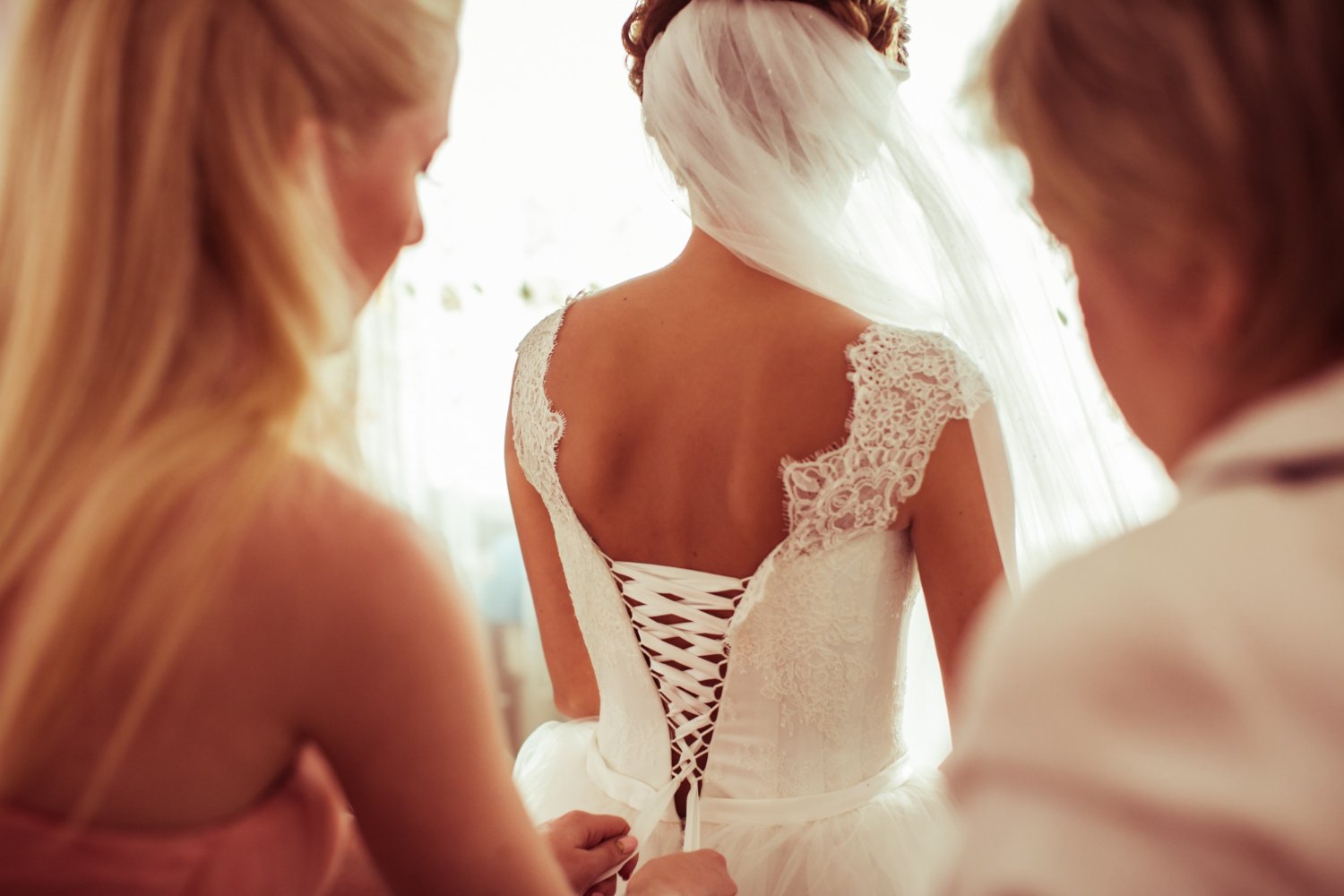
Fuller busts and higher support needs
Support is the main constraint, and adhesive products have limits.
Why adhesive alone may not be enough
For fuller busts, how to choose bridal undergarments for a backless dress often means leaning on the dress itself. A bridal editor quoted in The Knot says that cheap adhesive options may not give enough support or stay put over a long event, and the UK style writer says that her search for a stick-on bra that lifted and stayed secure was unsuccessful. Neither says that no product works for fuller busts, and a few listed products come in fuller-bust versions. They do point to a pattern: the more support you need, the more you should lean on the dress.
Ask about structure in the gown
For higher support, ask your tailor whether cups with more structure, a built-in corset, or an internal bodice can be added. Soma also points out that you may have your seamstress add support during alterations. A tailor can tell you what the specific gown can accommodate.
Plan for the mid-day check
Longer days mean more time for movement and slipping. Plan a moment to check, and decide who will help. Fuller-bust brides in particular may want a second fitting after any change.
Smaller busts and light coverage
Light coverage is easier in some ways, and it opens up more options.
Fewer products, fewer problems
If your dress is lined and you are comfortable without lift, nipple covers or silicone petals may be enough, and some gowns need nothing at all. The fewer layers, the fewer edges to hide, so check the gown’s own construction first.
Consider the dress’s cups
If the dress has built-in cups that are larger than you need, ask the tailor about adjusting them. A cup that does not match your shape can create gaps at the neckline, which a tailor can address in fittings.
Test movement
Even with light coverage, raise your arms, bend, and dance. Gaps often appear only in motion.
Outfit changes, long days, and photos
Many weddings include more than one outfit or a long gap between events.
A second dress or a second look
If you plan a reception dress, you do not need to repeat the same plan. A different gown may call for different undergarments, and our guide to bridal outfit changes covers how to plan for them. Bring the second set to fittings, too.
Photos from behind
The photographs are part of how to choose bridal undergarments for a backless dress, because the camera sees what a mirror misses. A backless dress puts the back in the frame. A photographer may shoot from behind the couple during the ceremony, so decide early whether you want any details of your back to be part of the story, and share the dress’s design with your photographer. Our wedding photographer shot list shows how to share priorities.
Long gaps between events
If there is a long gap between the ceremony and reception, plan a time to check the product, reapply if it has slipped, or switch to a spare. Use the wear-time limits for your product, not a guess.
Sensitive skin, scars, and medical considerations
Some situations belong with a professional.
Sensitive skin and known allergies
If you know that adhesives, latex, or fragrances bother you, talk with a clinician and consider a design that keeps products off the skin, such as sewn-in cups. Healthline lists alternatives to adhesive bandages, such as hypoallergenic tape, but a clinician can tell you what suits you.
Scars, healing skin, and medical devices
If you have a surgical scar, healing skin, or a medical device on or near the area, ask your clinician what is safe before you use any adhesive. ASOS advises against applying its product over broken or damaged skin. We cannot advise on individual medical cases.
Chronic pain, mobility, and accessibility
If dressing is physically hard, simplify the layers. Fewer fasteners and fewer pieces can mean less help is needed on the day, and a piece you can put on and take off yourself may matter more than one that looks perfect.
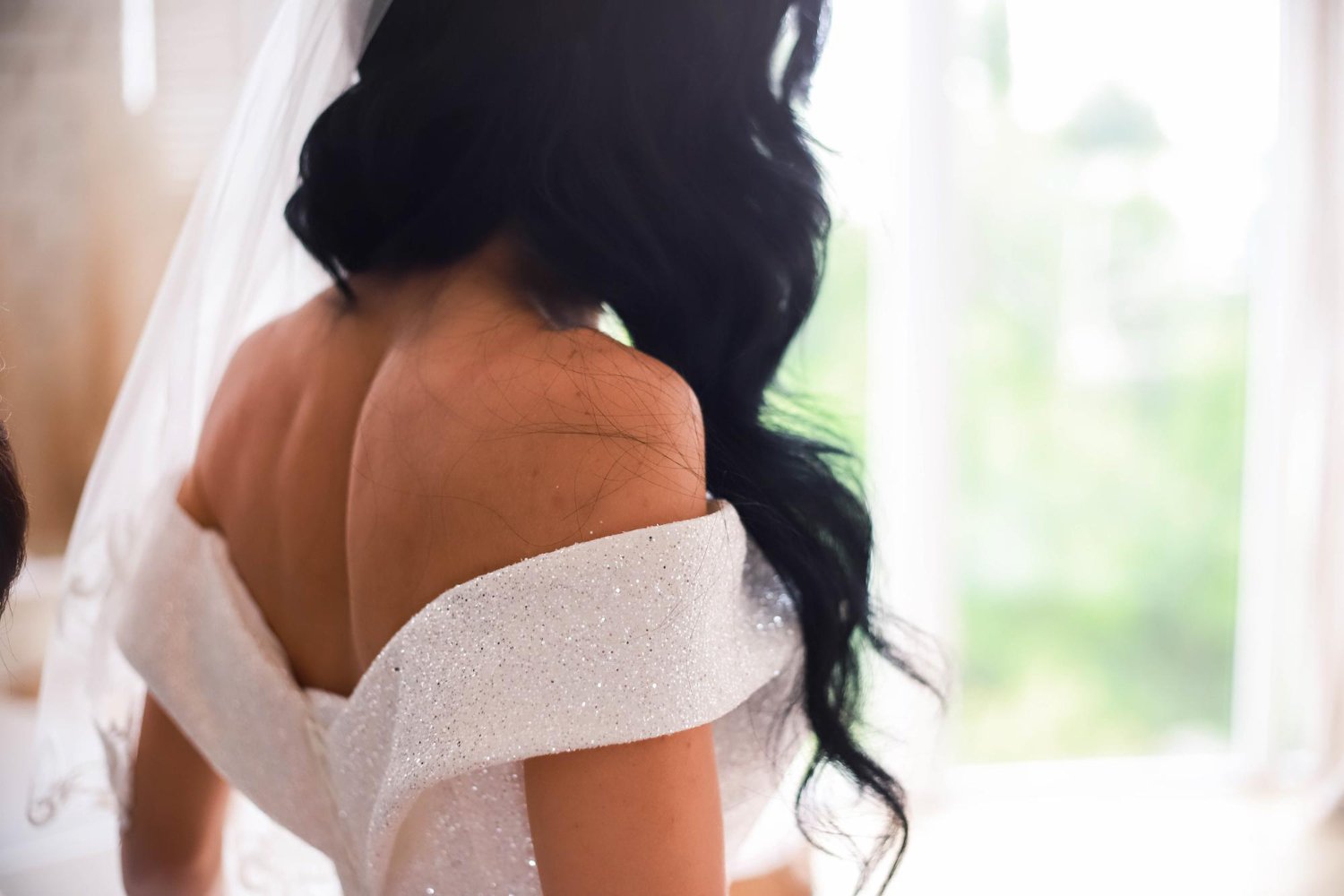
FAQ: backless wedding dress undergarments
Choosing the right option
How do I choose bridal undergarments for a backless dress?
There is no single answer. Retailers and editors most often recommend an adhesive strapless bra, silicone petals, or cups sewn into the gown for deep openings, and a low-back bra for shallow ones. The right choice depends on your back style, your support needs, and how it performs in a wear test.
Can I wear a regular strapless bra with a backless dress?
Usually not, because the band sits across the back where the opening is. A strapless bra may work only if the opening ends above the band. Test it under the actual gown, with your arms raised, in good light, and compare it with an adhesive or sewn-in option.
Do I need shapewear under a backless gown?
Not always. Shapewear can smooth lines under clingy fabrics, but most pieces have a back that may show. If you want it, look for styles cut low in the back and test the top edge. Some gowns have internal structure that makes it unnecessary, so ask your tailor.
Can a tailor sew cups into my wedding dress?
Often yes. Tailors and bridal sources describe cups placed inside the dress next to the lining, and some suggest sewing in a bra. It is a structural change, so ask about the cup type, price, and timeline, and get an estimate in writing before agreeing.
Comfort, skin, and the big day
How long can I wear an adhesive bra?
It depends on the product. ASOS says not to wear its adhesive products for more than four hours, and other makers set different limits. Read the instructions for your item, test it for the length of time you plan to wear it, and carry a backup.
Can adhesive bras irritate my skin?
They can. The Mayo Clinic explains that contact with a substance can cause an itchy rash through irritation or an allergic reaction. Patch-test first, follow the maker’s skin-prep advice, remove the product gently, and see a clinician if a rash is severe or does not clear.
Will deodorant or lotion affect an adhesive bra?
It may. Lulus advises keeping the area clean and dry and avoiding lotion, deodorant, or powder where the adhesive touches, since these can stop it from sticking. Check your product’s instructions, and plan your morning routine around them, not the other way around.
When should I buy undergarments for my wedding dress?
Before your first fitting, if you can. The Knot advises buying them ahead so alterations account for them, and a tailor quoted by a wedding publication says to bring the shoes and undergarments you will wear to the first fitting. Avoid changing pieces after alterations without another fitting.
Your next steps
Get ready to decide
Write down your back style and support needs
To choose bridal undergarments for a backless dress with confidence, note how low the opening drops, whether the dress has cups or a lining, and how much support you want. These three notes drive the decision card, and they give your tailor something concrete to react to. Our wedding dress styles guide can help you name the silhouette.
Choose a primary and a backup
When you choose bridal undergarments for a backless dress, pick one option from the “Good fit” column for your row, and one alternative. Having a backup removes the pressure from the first choice and gives you something to test against.
Test and confirm
Book fittings with your layers in hand
Bring every layer, the shoes, and the accessories to each fitting. If you have not chosen yet, ask the shop what they can show you in person. Our alterations guide explains the usual sequence.
Wear-test for hours and photograph the result
Test at home for the number of hours you expect to wear it, with the same shoes and a similar level of movement. Take photos of your front and back and look for edges, gaps, and lines.
Prepare for the day
Build the backup kit
Pack spare adhesive items, a second option, and anything else from your plan, and name one person to carry it. See the wedding emergency kit guide for more ideas.
Write the plan down
A short note with your product names, wear-time limits, and what to do if something fails is enough. It helps whoever is helping you on the day, and it helps you remember what you decided.
Sources & methodology
How we built this guide
What we relied on
This guide draws on retailer and editorial advice about wedding undergarments, a tailor’s account of how fittings and sewn-in cups work, consumer-health pages on contact dermatitis and adhesive reactions, and Federal Trade Commission guidance on care labels, fiber content labels, and mail and internet orders. Where a statement comes from a retailer, we say so, because retailers sell the products they recommend. The decision cards and the fitting timeline are our own synthesis and reasoning, not tested results. We checked the sources listed below on November 12, 2026, and pages and prices may have changed since.
What we did not do
We did not test products, fit garments, or examine anyone’s skin. We did not find published sources for several questions, including how adhesives interact with specific bridal fabrics, whether adhesive products can be used on spray-tanned skin, or what sewn-in cups cost, and we say so where those questions come up. Nothing here is medical, legal, or tailoring advice. Ask a clinician about skin reactions and a bridal tailor about structural changes.
Source list
Government and clinical sources
- Federal Trade Commission, Care Labeling Rule summary: https://www.ftc.gov/node/119456
- Federal Trade Commission, Threading Your Way Through the Labeling Requirements Under the Textile and Wool Acts: https://www.ftc.gov/business-guidance/resources/threading-your-way-through-labeling-requirements-under-textile-wool-acts
- Federal Trade Commission, Business Guide to the Mail, Internet, or Telephone Order Merchandise Rule: https://ftc.gov/business-guidance/resources/business-guide-ftcs-mail-internet-or-telephone-order-merchandise-rule
- Mayo Clinic, Contact dermatitis, symptoms and causes: https://www.mayoclinic.org/diseases-conditions/contact-dermatitis/symptoms-causes/syc-20352742
- Healthline, Allergic to Band-Aids: https://www.healthline.com/health/allergic-to-bandaids
Retailer, editorial, and tailoring sources
- The Knot, What to wear under your wedding dress: https://www.theknot.com/content/wondering-what-to-wear-under-your-wedding-dress-read-these-tips
- Who What Wear UK, Best bra for a backless dress: https://www.whowhatwear.com/best-bra-for-backless-dress
- Soma, The best bra style for your wedding dress: https://www.soma.com/store/blog/whats-inside/the-best-bra-style-for-your-wedding-dress
- Martin Thornburg, A complete guide to the best undergarments for your wedding dress: https://martinthornburg.com/blog/a-complete-guide-to-the-best-undergarments-for-your-wedding-dress
- Lulus, What to wear under every type of wedding dress, according to a bra expert: https://www.lulus.com/blog/fashion/what-to-wear-under-every-type-of-wedding-dress-according-to-a-bra-expert/amp/
- ASOS, Adhesive product guidelines: https://www.asos.com/us/customer-care/product-stock/what-are-your-adhesive-product-guidelines/
- Style Me Pretty, Key alterations terms all brides should know: https://stylemepretty.com/2018/01/29/wedding-dress-alterations-101