

Wedding dress shipping for destination weddings is a question of who holds the dress at each handoff, what proof exists if something goes wrong, and how many days of slack you have left, and a calm plan built on those three things beats any single packing trick.
Quick answer
If you can, carry the dress on the plane yourself: both the TSA and bridal sources describe that as the way to know where the dress is. If it has to travel without you, ship it three to four weeks early (a bridal designer’s guidance) to a named person at the destination, packed by the shop or in a sturdy box with acid-free tissue, with declared value or insurance that matches what you paid, photos taken before the box is sealed, and a return label planned in advance. Standard carrier liability is small, so ask for the exact limit in writing. This is general planning information, not legal or insurance advice.
Why wedding dress shipping for destination weddings is a risk-allocation problem
Most advice about wedding dress shipping for destination weddings starts with tissue paper and box sizes. Those details matter, and we cover them, but the bigger decision comes first. A dress that travels without you passes through several sets of hands, and each handoff is a place where responsibility can quietly shift from one party to another. Thinking about it as risk allocation, rather than a packing chore, makes the rest of the plan easier to organize.
What you are really deciding
You are choosing between three broad routes: carrying the gown yourself, shipping it ahead, or giving it to someone else to carry. Each route in wedding dress shipping for destination weddings moves the risk to a different place. Carrying it keeps the dress in your sight but adds airport and cabin logistics. Shipping it ahead removes the dress from your travel day but puts it in a carrier’s network and a venue’s mailroom. Handing it to a travel companion keeps the dress personal but depends on one person’s schedule and care.
The three variables that matter
Almost every good decision about wedding dress shipping for destination weddings comes down to three variables. The first is time: how many days sit between the planned delivery and the wedding, because slack is what turns a delay into an inconvenience instead of a crisis. The second is proof: whether you can show what the dress was worth, what condition it was in, and how it was packed. The third is custody: whether a named, reachable person will actually receive the box. If one of the three is weak, strengthen it before you worry about the other two.
Why the dress is a hard item to ship
In wedding dress shipping for destination weddings, the dress is bulky, easily wrinkled, often beaded or layered, and expensive relative to its weight. Parcels are generally priced by actual or dimensional weight, so a large padded box can cost more than the dress alone would suggest, as one resale marketplace’s shipping guide points out. A gown is also hard to replace on a short timeline, and standard carrier liability is far below what most gowns cost. That mix of fragile, bulky, and valuable is why this kind of shipping deserves its own plan rather than a casual parcel label.
Where things actually go wrong
No source we found publishes a loss rate for wedding gowns, so we will not claim one. A bridal designer’s shipping guide says lost or damaged shipments are rare, and we take that as a designer’s observation, not a measured statistic. What the sources do describe are the failure types that planning can address: a package that arrives late, a package that arrives and sits unattended, damage that nobody can prove, and a claim that is denied for a paperwork reason.
Delay and dead ends
In wedding dress shipping for destination weddings, delays come from processing time, customs holds, weather, and remote delivery routes. A guide from a wedding-dress resource tells brides to confirm that the chosen shipper actually serves the destination on the dates needed, which matters most for islands and remote venues. A delay becomes a problem only when the schedule has no buffer, which is why the timeline in this guide leaves a deliberate cushion.
Damage without proof
In wedding dress shipping for destination weddings, damage claims tend to fail on evidence, not on the damage itself. The U.S. Postal Service’s own claims rules, which we read in full, say that damage from shock or transportation without any sign of damage to the outer container is not payable, and that the addressee must keep the box, packaging, and contents for inspection. Whatever carrier you use, the lesson is the same: the packaging and the photographs are part of the insurance.
The package nobody is expecting
In wedding dress shipping for destination weddings, a box delivered to a front desk that was never told about it can sit in a back room, get moved, or be refused. One planning guide advises against sending a gown to a hotel or venue without notifying someone and arranging a trustworthy person to collect it promptly. That is a custody problem, not a carrier problem, and it is entirely fixable with one email.
Ship, carry, or send with someone: comparing the three routes
Before choosing a carrier, choose a route. The right route for wedding dress shipping for destination weddings depends on your distance, your airline, your budget, and how much time you have. The comparison below uses only what the sources we reviewed support, and where a source says nothing, the cell says so.
The side-by-side comparison
The table puts the three routes for wedding dress shipping for destination weddings against the questions that change decisions. Treat it as a starting point for your own wedding dress shipping for destination weddings plan rather than a ranking, because a short flight with a generous airline looks very different from a multi-leg trip to a small island.
| Route | What it protects | What it leaves exposed | What to confirm |
|---|---|---|---|
| Carry it on yourself | Custody: you know where the dress is | Cabin space, security re-packing, wrinkles | Airline policy on garment bags or a seat; arrive early |
| Ship it ahead | Your travel day, plus a possible steaming window | Carrier handling, delays, an unattended box, claim paperwork | Delivery date, named receiver, declared value, proof of packing |
| A companion carries it | Custody, shared travel | One person’s schedule and care | Who packs, who hangs it, who pays if it is damaged |
When carrying it yourself is the usual answer
Bridal sources and the TSA lean the same way. The TSA’s page for wedding dresses says you can take a gown through the checkpoint, suggests a garment-style bag or other protective packaging, and says to contact your airline about its rules for bringing the dress onboard. A wedding-insurance company’s travel guide goes further and recommends carrying it on so you know it boarded, instead of checking it, and says a FRAGILE sticker is no guarantee of safe arrival. If your trip is a single flight on a carrier that allows it, this is usually the simplest answer to wedding dress shipping for destination weddings: you do not ship at all.
When shipping ahead makes sense
Wedding dress shipping for destination weddings makes sense when you are traveling light, when the flight is long or has several connections, when the airline will not give the dress reliable cabin space, or when you want the gown steamed and hanging before you land. It also makes sense when a designer or boutique will ship directly and has done it before. The price of that convenience is that your dress now depends on a carrier network, so everything in the packing, insurance, and receiving sections below becomes more important.
When a travel companion carries it
A mother, sister, or friend can carry the gown if their flight timing is better than yours or if you will travel separately. This works best with a clear agreement about who packs the dress, who hangs it on arrival, and what happens if it is damaged. The honest weakness is that a companion’s bag can be delayed or checked by mistake, so give the same airline instructions you would follow yourself.
How to choose with a short decision path
A simple sequence can settle the route in a few minutes. Ask whether the airline allows a garment bag in the cabin or lets you buy a seat for the dress. Ask whether you have at least three to four weeks before the wedding. Ask whether a named person will be at the destination to receive and hang the dress. The answers point toward carrying, shipping, or a hybrid.
The airline question comes first
Call the airline and ask how it handles a wedding gown. One travel guide says you may be able to store it in a closet or overhead bin, and that on flights that are not full a seat for the dress can sometimes be arranged at no cost, while buying it its own seat is possible if the budget allows. Policies differ by carrier and by aircraft, so treat these as questions to ask, not promises to expect. Get the answer in writing if the airline will provide it.
The calendar question comes second
If you are inside three weeks of the wedding, shipping gets riskier because delays have nowhere to go. In that case, carrying the dress or sending it with a companion becomes more attractive than a parcel. If you have more time, shipping becomes a reasonable option, particularly for far-away or remote locations where you want an early arrival so there is room to steam and fix small problems.
The people question comes third
If nobody at the destination can receive the box, wedding dress shipping for destination weddings loses most of its appeal. A venue coordinator, planner, or relative who will sign for the package, open it promptly or store it sealed, and message you with photos is worth more than a premium delivery service. If that person does not exist yet, find one before booking any shipment.

The timeline: from eight weeks out to the day after the wedding
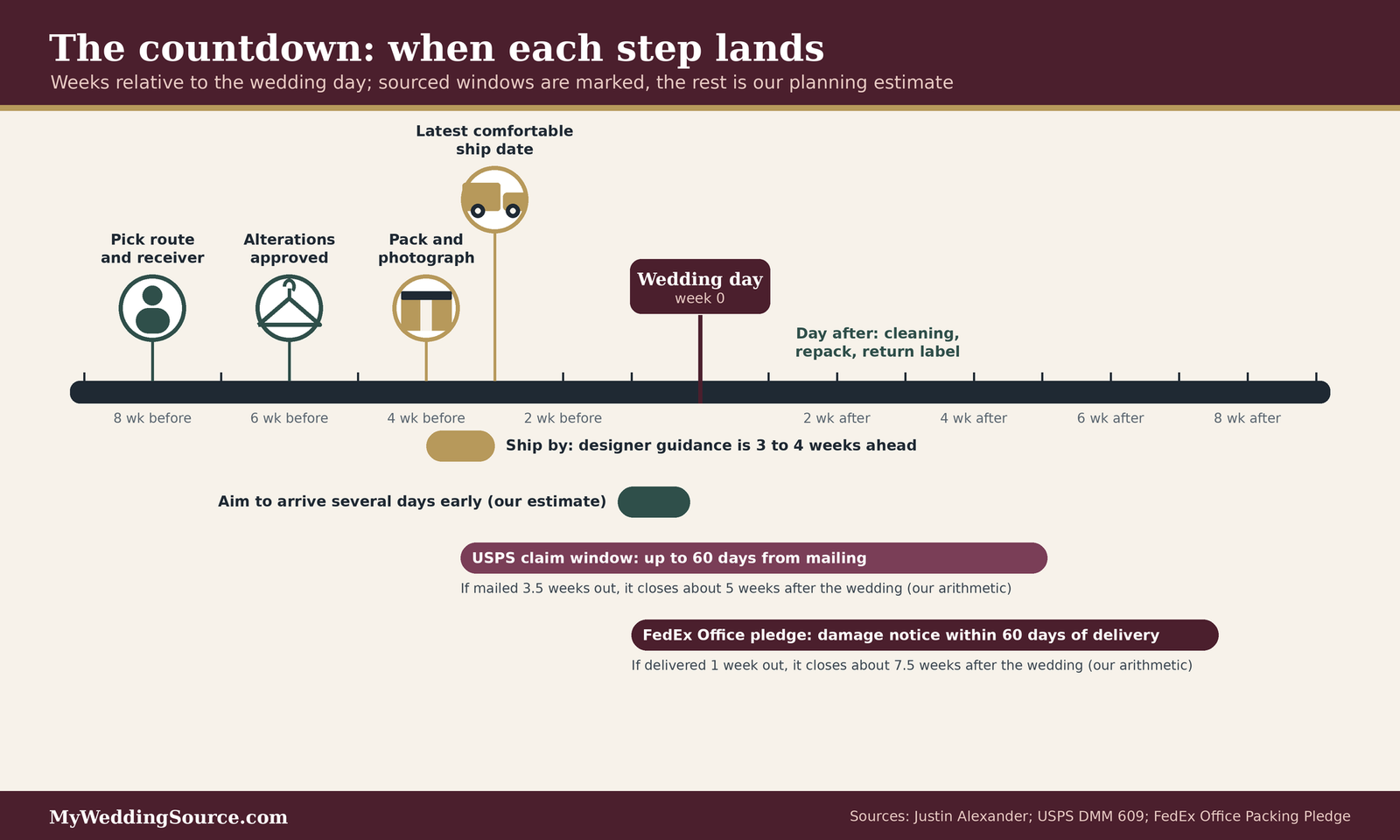
A plan for wedding dress shipping for destination weddings is mostly a calendar. The one firm number we found from a bridal designer is to ship at least three to four weeks before the wedding, to leave room for processing time and delays. Everything else in this timeline for wedding dress shipping for destination weddings is our own planning estimate built around that anchor, and you should stretch it if your destination is remote or your carrier quotes a long transit time.
Eight to five weeks out: decide and prepare
This is the quiet stretch when most of the useful work happens. Nothing is in a box yet, and you can still change routes without cost or stress.
Settle the route and the receiver
Pick carrying, shipping, or a companion for your wedding dress shipping for destination weddings plan, and write the choice down. If you are shipping, contact the venue or planner and ask about their package-receiving policy, because one designer’s guide notes that some venues require advance notice or particular delivery instructions. Ask whom the package should be addressed to, what name belongs on the label, and who can sign. This is also the moment to read our destination wedding checklist so the dress plan sits alongside the larger travel plan.
Finish alterations early
Alterations should be done and approved before the dress goes anywhere, because fixing a fit problem from another country is far harder than fixing it at home. Our guide to wedding dress alterations explains the usual sequence of fittings, and the wedding dress fit and alterations guide covers how to judge a final fitting. Ask your seamstress whether they will pack the dress or advise on packing, since they know how it was built.
Gather proof of value
Collect the receipt or invoice, your payment record, and any alteration invoices into one folder. The USPS claims rules say the mailer or addressee must show the value of the item when it was mailed, with examples such as a sales receipt, a paid invoice, or a credit card statement. Even if you ship with another carrier, that same paperwork is what any claims team will ask for, so assembling it now saves a scramble later.
Four to three weeks out: pack, photograph, and send
This is the shipping window the designer’s guidance points to for wedding dress shipping for destination weddings. Treat it as the latest comfortable date, not the target date.
Pack with time to spare
Do not pack the night before a courier pickup. Pack the dress, check the box against the packing steps below, photograph every layer, and sleep on it. If the shop packs for you, ask them to photograph it too. A packing job done calmly is more likely to be a good one, and a gap of a day or two before pickup gives you room to fix a mistake you notice later.
Choose the service and declare value
Decide between an express and a ground service by weighing time against cost, as the designer’s guide describes, and ask the carrier or the retail location what the standard liability limit is for the service you chose. Declare the value or buy coverage when you create the shipment, since UPS says declared value is added at that point, and keep every receipt. We explain the options in the insurance section.
Share tracking with the receiver
Send the tracking number, the expected delivery date, and a photo of the packed box to your named receiver. Ask them to confirm receipt the day it arrives and to message you a photo of the sealed box. Tracking is only useful if someone is watching it, and the designer’s guide recommends tracking the package online after shipping to stay ahead of delays or problems.
Two weeks out to arrival: watch and adjust
By now the dress is on its way or in your hands. The goal for these days is to catch problems while there is still time to act on them.
Check progress every day or two
Look at the tracking at regular intervals instead of obsessing. If the dress is not moving for several days, call the carrier and the receiver at once. A guide from a bridal resource suggests confirming that the carrier serves your destination on the dates you need, so ask directly about the last scheduled delivery attempt.
Have the backup plan ready
A designer’s guide suggests a simple backup, such as a white dress or one borrowed from a friend or relative, in case the gown is lost or damaged, and notes that such shipments are rare. We think it is worth thinking about the backup without buying one: know where the nearest bridal or formal shop is, and know whether your planner or hotel can help if you need a fast alternative. Our wedding emergency kit guide covers the small repairs that do not require a replacement.
Plan the arrival buffer
If the dress arrives with at least a couple of days to spare, wrinkles have time to relax and steaming can be arranged calmly. One travel guide says wrinkles may fall out in one to two days and that you should steam if they do not. That is a reason to aim for arrival several days before the ceremony, not the day before.
The day after: close the loop
The timeline does not end at the ceremony. The return trip has its own deadlines, and several claims windows start counting from the day of delivery or mailing.
Know your claim deadlines now
Write the deadlines on your calendar before you leave. USPS says damaged or missing-content claims should be filed immediately and no later than 60 days from mailing. FedEx Office’s Packing Pledge page says damage notices must reach FedEx within 60 calendar days after delivery. These are different rules for different services, which is why you should read the terms that apply to your own shipment and not assume a single number.
Card disputes run on their own clock
If you paid for shipping or a dress by credit card, the Federal Trade Commission’s consumer guidance says a billing-error dispute letter must reach the card issuer within 60 days after the first bill showing the error was sent. The FTC also notes that for damaged or defective goods you generally must try to resolve the problem with the seller first and that purchase-price and distance conditions apply. We are not giving legal advice, and a card dispute is a backstop rather than a plan.
How to pack for wedding dress shipping for destination weddings
If you are shipping, packing is the part of wedding dress shipping for destination weddings that you control most directly. The sources we read on wedding dress shipping for destination weddings agree on the broad outline, and they differ on details, so we flag the differences instead of picking one voice. If the boutique or designer offers to pack the dress, one planning guide says to let them, since they know how to limit wrinkles and dirt.
The materials and the order of layers
A good pack has a few ingredients and a sensible order. Acid-free tissue goes closest to the fabric, a moisture barrier goes around that, and a rigid outer container carries the load.
Acid-free, uncolored tissue
Several sources recommend uncolored, acid-free tissue paper against the dress, especially around embellishments. A resale marketplace’s guide warns that ordinary tissue paper contains acid that can damage a dress. A designer’s guide adds that you can stuff the sleeves and bodice with tissue so the garment keeps its shape. This is the layer where it is worth spending a few extra dollars, and a bridal salon may sell it or give you some.
A moisture barrier for transit
Both a designer’s guide and a resale marketplace’s guide suggest a plastic bag for water protection during transit, and the marketplace notes that plastic is fine for travel but not suited to long-term storage. A planning guide recommends a clean, high-quality garment bag with a clean liner before the box. Choose clean, unscented materials, and do not leave the dress sealed in plastic for weeks once it arrives.
A rigid outer box
The box should fit the dress snugly without crushing it, and the sources say to measure the dress instead of guessing. A designer’s guide says most dresses fit in an 18 by 16 by 9 inch box or a 30 by 20 by 8 inch one, and the resale marketplace’s guide gives a similar example. A planning guide suggests a box rated at 200 pounds per square inch burst strength or equivalent, with gaps filled with wadded paper or packing peanuts. Treat those sizes as examples and measure your own folded gown.
How to fold and protect the dress
Folding is where most of the risk to a structured or beaded gown lives. The aim is to avoid hard creases and to keep embellishments from pressing against each other.
Fold around a soft form
One planning guide suggests folding the dress around a curved form, such as a cylinder of rolled tissue or a clean T-shirt, to avoid a sharp crease. The resale guide advises tissue between each layer, which matters most over beading and keeps tulle from snagging. Fold as few times as you can, and ask your seamstress whether any section should never be folded.
Protect the embellishments
Beads, lace, and sequins snag on each other and on stitching. Ask the designer what protection the embellishments need, and pad any area that could be pressed hard against another part of the dress. If a gown has a structured bodice, boning, or a hoop, a shop may recommend a different approach, such as a larger box or a garment bag, so ask before you improvise.
Photograph every stage
Take clear photos of the dress before you pack it, of each layer, and of the sealed box on all sides. A reader comment on the planning guide suggests photographing the dress inside and outside its packaging before sealing, and we agree because the USPS rules show how much a claim depends on evidence. Save the photos in a folder with your receipt and tracking number, and send copies to a family member.
Labels, seals, and the outer box
The outside of the box is a communication tool. It tells handlers what they are holding and tells the receiver whom it belongs to.
Mark it clearly
Both the planning guide and the resale guide suggest marking the box as a wedding gown. Add the receiver’s name and phone number on the outside. Do not write the dress value or jewelry-style hints on the outside. Keep the markings plain: a name, a phone number, and a short label.
A duplicate label inside
Both the designer’s guide and a planning guide suggest putting a note with your contact information inside the box in case the outer label is damaged or the carrier needs to reach you. Include the receiver’s name and phone number there too. If the outer label is damaged or lost, the inside copy is the fallback, and it costs nothing.
Seal and relabel carefully
The resale guide advises sealing with thick adhesive tape and going over the seams several times, putting the label on a flat face and not over a seam, and removing any old labels first. If you reuse a box, cover or remove old markings so the scanning system reads only the new label. Keep the packing receipts together with your photos.
Insurance and carrier liability for wedding dress shipping for destination weddings
This is the part of wedding dress shipping for destination weddings where people most often assume more protection than exists. We are not insurers and this is not insurance advice. What follows is what the carriers and one insurer say on their own pages, plus the questions to ask before you pay.
What this actually costs
We found no current, sourced price for shipping a wedding dress, so we will not quote one. Carrier prices depend on weight, box size, speed, and destination, and a resale marketplace’s guide notes that parcels are priced by actual or dimensional weight, whichever is higher. Use this as an estimate frame, filling in real quotes: outbound shipping + declared value or insurance fee + return shipping + steaming or cleaning + any customs or import charges + a replacement-or-rental reserve if you want one. Get written quotes for each line, and add the lines together before you decide between carrying and shipping. The sum, not the postage alone, is the true price of the plan.
What carriers say they include
Each carrier publishes a baseline for wedding dress shipping for destination weddings. The baselines are modest, and you need to read them against the price of your gown.
UPS and FedEx: a small default
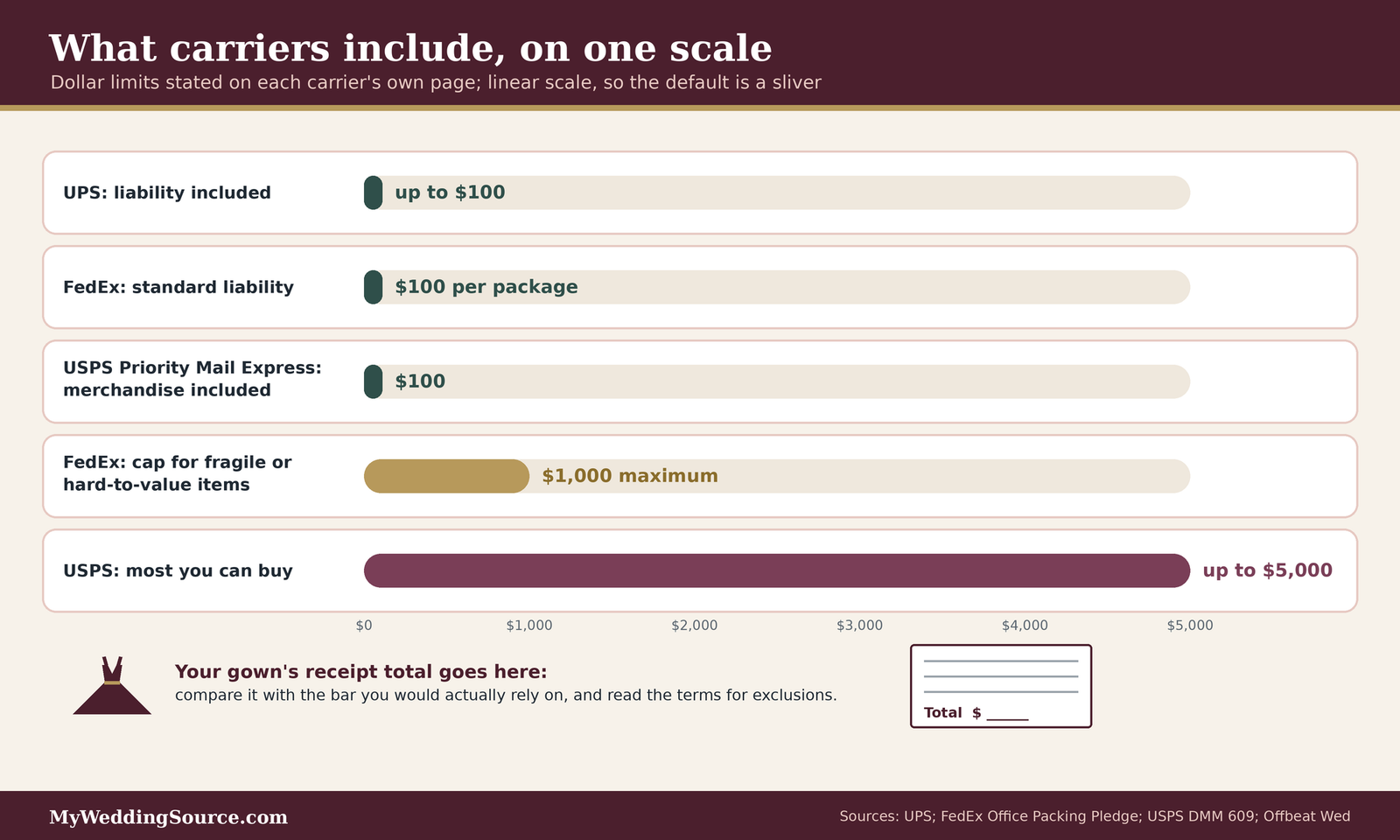
UPS says on its package protection page that carrier liability is included on eligible shipments, with liability up to $100, and that for shipments worth more you can declare the value when you create the shipment. FedEx Office’s Packing Pledge page states that standard FedEx liability for each package is limited to $100 unless a higher value is declared and the added charge is paid. If your gown cost much more than that, the default does not protect it.
The fragile-item cap to ask about
FedEx’s page also says that fragile items, items of extraordinary value, and items whose market value is hard to determine are capped at $1,000, and that a higher value cannot be declared for them. We do not know whether a carrier would classify a particular gown that way, because the page does not mention wedding dresses. That uncertainty is the reason to ask the carrier or retail location, in writing, how it treats a boxed wedding gown and what the maximum declared value is.
USPS insured mail and Priority Mail Express
The USPS Domestic Mail Manual says indemnity applies to insured mail, COD, Registered Mail with postal insurance, and Priority Mail Express. For Priority Mail Express, merchandise coverage is $100 and more can be purchased, up to $5,000. A planning guide for brides also notes that the U.S. Mail maximum is currently $5,000. Used items are depreciated based on life expectancy, and payment never exceeds the item’s actual value when mailed, so the receipt and the age of the dress matter.
What coverage usually refuses to pay for
In wedding dress shipping for destination weddings, coverage is not a promise that anything that goes wrong will be refunded. Each service has exclusions, and the conditions are where claims are won or lost.
Packaging and fragility exclusions
The USPS rules say items not packaged well enough to reach their destination undamaged are not payable, that abrasion, scarring, or scraping is not payable for articles not properly wrapped, and that fragile articles that could not be safely carried in the mail are not payable regardless of packaging. The FedEx pledge, by contrast, covers only packages packed by FedEx Office in new FedEx packaging, and excludes packages packed by the shipper. If you pack the dress yourself, the pledge does not apply to you.
Paperwork and evidence conditions
The USPS rules require evidence that the service was purchased, such as the mailing receipt, and say that if only the outer packaging with the label is submitted, indemnity is limited to $100 for insured and Priority Mail Express items. They also say the addressee must keep the mailing container, all packaging, and any damaged contents, and that failing to do so results in denial of the claim. Tell your receiver this before the box arrives.
Value, depreciation, and sentiment
Under the USPS rules, claims based on sentimental value or consequential loss are excluded, and used articles are depreciated. A wedding dress that you wore once is not covered for the emotional importance of the day, and a claims team may start from the purchase price and the condition. For a rental or a consignment gown, the owner’s terms may say who bears the loss, so check the contract before you ship anything you do not own.
Other places coverage can come from
Carrier coverage is only one layer. A few other layers may exist, and each has conditions you should read yourself.
Third-party shipping insurance
The UPS page mentions InsureShield and Parcel Pro as additional options and describes UPS Package Shield, which is available on eligible shipments processed on UPS.com, as a protection offering that is not insurance. A designer’s guide says insurance can come from the carrier or a third-party provider. Ask each provider whether a worn or altered wedding gown qualifies, how a claim is valued, and how long it takes.
Wedding or event insurance
A wedding insurance company’s travel guide says its wedding cancellation policy can help pay for a dress that is lost, ripped, stained, or damaged in transit, or for a replacement. That is a company statement about its own product and not an independent finding, and policies differ by provider, state, and plan. Our wedding insurance guide explains what these policies usually do and do not include, and our honeymoon travel insurance guide covers the trip side. Read the actual policy wording.
Homeowners, renters, and cards
Some homeowners or renters policies and some credit cards offer limited coverage for belongings in transit, and some do not. We could not verify specific terms and will not guess. Call the insurer or card issuer, ask whether a shipped wedding dress is covered, ask what proof they need, and write down who you spoke to and what they said.
Choosing the destination address and the person who receives it
The address on the label is a decision about custody, and it is the weakest link in much wedding dress shipping for destination weddings. A great packing job in a box that is signed for by the wrong person, or nobody, is a weak plan. This section is about making the last handoff boring.
Venue, hotel, planner, or a person
There are four typical places to send a dress. Each has trade-offs, and the best choice depends on staffing and trust more than on convenience.
The venue or its coordinator
A venue coordinator already knows the property and may have received wedding deliveries before. A designer’s guide says to ask the venue for shipping recommendations because they may have experience delivering wedding items there, and a planning guide says that if the venue suggests a shipper, that may be the safest choice. The risk is that the venue may have limited storage or staff on the days you need. Ask them for a written receiving policy.
The hotel front desk
A hotel can be convenient because you will be there, but a package for a guest who has not arrived can be held in a general storage room. Ask whether the hotel accepts packages for guests before check-in, how long it holds them, and whether it will place the box in a secure room and notify you when it arrives. Put your reservation name and dates on the label.
A planner or a trusted person
A planner, relative, or friend who lives locally or arrives early is often the safest receiver. The planning guide’s advice is to arrange a trustworthy person to pick up the package as soon as it arrives, and to have them unpack and hang the dress promptly or store the sealed box if they are unfamiliar with handling gowns. Make sure they know what they are receiving and what to do if the box looks damaged.
What to tell the receiver
The receiver does not need to know about dresses. They need a short list of instructions and a way to reach you.
The inspection routine
Ask them to photograph the box on all sides before opening it, to open it carefully, to photograph the contents, and to hang the dress on a padded hanger in a clean, dry room. If the box is crushed or wet, ask them to stop, photograph it, and call you before anything else. The USPS rules say the container and packing must be kept, so they should not discard anything.
The storage rule
If the receiver is unsure how to hang the gown, they should leave it sealed and store it flat or upright in a cool, dry place until you arrive. A planning guide describes exactly this option. Heat, damp, and direct sunlight are the usual enemies, so ask them to avoid a car trunk, a bathroom, or a sunny windowsill.
The contact plan
Give the receiver your mobile number, your travel dates, and the name of a backup contact. Agree on a time by which they will confirm receipt. If the box has not arrived by then, they should call the carrier and message you. A clear contact plan turns a vague worry into a defined step.
Customs and duties in wedding dress shipping for destination weddings
If the wedding is outside the United States, the dress crosses a border at least once and often twice. Customs is the least glamorous part of wedding dress shipping for destination weddings, and it is where an otherwise well-planned shipment can stall. We are not customs brokers and this is not legal advice, so use this section to prepare questions.
Going out: the destination country’s rules
The first border is the destination’s. Its rules decide whether the box clears quickly or sits in a warehouse waiting for paperwork.
Import rules and documents
A designer’s guide says to check the destination country’s import rules because some restrict certain items, and to be ready to provide extra documentation or pay customs fees. Duties and fees depend on the dress’s value and the destination, so the guide advises including them in your budget. Ask the carrier what paperwork it needs on the label or invoice for a personal item that will be taken home again, and ask your planner or venue what they have seen.
Describing the contents honestly
Declare the contents truthfully and consistently across the invoice, the label, and any forms. A clear description such as a used wedding gown for personal use at a ceremony, with an accurate value, is better than a vague or understated one. Do not guess at the correct customs wording for wedding dress shipping for destination weddings; ask the carrier’s international desk or a licensed customs broker what they require for your destination.
Who pays charges at the other end
For wedding dress shipping for destination weddings, ask whether duties and taxes are billed to the sender or to the receiver, and whether the carrier will hold the package until they are paid. A receiver who is unexpectedly asked for payment at the door may refuse the box. Settle this in advance and put the answer in writing, along with who has the authority to pay on your behalf.
Coming back: the return trip home
The second border is home. This is where the dress is a returning personal item and not a new purchase, and that difference can matter.
What the federal rule says about items taken abroad
A federal regulation, 19 CFR 148.31, says returning U.S. residents can bring back personal and household items they took abroad without paying duty, and notes that items of foreign origin should be registered so the exemption applies. It also says that if an item becomes more valuable or better in condition abroad, the cost of that work is generally dutiable, while routine cleaning or repair that only addresses normal wear does not count as an improvement. The regulation concerns items taken abroad by returning residents, and we could not verify how it applies to a gown that was shipped ahead without you.
Why alterations and repairs abroad deserve a question
If a tailor at the destination alters or repairs the dress, that work could count as an improvement under the rule above, and the cost may be dutiable. Ask a customs professional before authorizing anything beyond routine steaming or cleaning, and keep invoices. Under the same regulation, an item transformed into a different article abroad is dutiable at full value, so do not turn the gown into something else without checking.
Keep documentation for the way home
Keep the original receipt, photographs of the dress, the outbound shipping record, and any registration for foreign-origin items together in one folder. Those records show that the dress left with you and came back with you. If you are not sure whether your trip needs a customs registration or declaration, ask the carrier or a broker before you leave, not at the airport on the way home.
Arrival day: unpack, inspect, steam, document
In wedding dress shipping for destination weddings, the first hour with the dress at the destination matters more than most people expect. A calm routine for wedding dress shipping for destination weddings catches damage while a claim is still simple and gives wrinkles time to relax.
The first inspection
Do the inspection yourself, or with someone you trust, as soon as the box is in your hands. Do it even if the box looks perfect.
Photograph before you open
Photograph the box from all sides, including the label and any dents, tears, or stains. Then open it carefully and photograph the contents before you lift the dress out. The USPS rules say the addressee must keep the container, all packaging, and any damaged contents, so set the packaging aside, not in the trash. Do this even if you intend to carry the dress home yourself and never file a claim.
Remove all packaging and hang the dress
A travel guide advises removing all packaging right away, hanging the dress, and inspecting it well before the wedding day. Use a padded or wide hanger that supports the bodice, hang the gown in a clean, dry room, and let it breathe. Remember that plastic is fine for transit and not for storage, so do not leave the dress in a bag.
Check the fit and the small parts
Look at the seams, hooks, zipper, hem, lace, and beadwork. Try on the dress with the shoes and undergarments you plan to wear, if you can, so that you find fit issues early. Check that the veil, belt, and any detachable pieces made the trip. Our wedding dress train lengths guide explains how a bustle and train should behave, which helps you spot a problem.
Steaming and wrinkle care
Wrinkles are the most common arrival problem in wedding dress shipping for destination weddings, and they are usually fixable. The hard part is knowing which fix is safe for your fabric.
Let gravity work first
A travel guide says wrinkles may fall out within a day or two, and if they do not you can steam the dress. Start by hanging the dress and waiting. Avoid pressing or ironing a wedding gown, and avoid using a hot tool on lace, beading, or synthetic fabric without advice from the designer.
Arrange steaming in advance
A planning guide advises arranging steaming in advance with the dress shop or designer, and a travel guide suggests asking the hotel or resort whether it offers onsite steaming or can recommend a nearby dry cleaner. Our research did not find a sourced standard for which fabrics can be steamed safely, so ask the designer. Ask who is allowed to touch the dress and what it costs, and book the slot early because wedding weekends are busy.
If you steam it yourself
The planning guide suggests cleaning the steamer head first and testing on a light-colored fabric. A travel guide also mentions hanging the dress in the bathroom during a hot shower. Both are sourced as options, not guarantees, and we do not guarantee results. If the fabric is delicate or you are unsure, stop and call a professional, since structural or fabric damage is much harder to fix than a wrinkle.
When damage is found
Finding damage is stressful. A calm sequence helps you protect both the dress and your claim.
Stop, document, and call
Stop handling the dress. Photograph the damage, the box, the packing, and the label. Contact the carrier, the receiver, and your insurer or card issuer, in that order or in whatever order your documents specify. Write down names and times for every call.
Repair paths
For minor problems such as a loose bead or a small snag, a local seamstress or the designer’s team may be able to help quickly. For structural damage, use a professional tailor and do not attempt a structural repair yourself. Our wedding emergency kit guide covers small fixes you can carry, and a planner or hotel concierge may know a local seamstress.
Decide on the plan B
If the dress cannot be repaired in time, decide early on the backup. A designer’s guide suggests a simple white dress or a borrowed one. Consider renting or buying off the rack in the destination if the location allows. Our guide to renting wedding dresses explains how rental timelines work, which may help if you need a fast alternative.
The small parts: veil, comb, shoes, and accessories
In wedding dress shipping for destination weddings the gown gets the attention, but a lost comb or crushed veil can cause as much stress. Small items travel differently from the gown, and they are better kept with you.
What to keep in your carry-on
A simple rule is to keep anything small, irreplaceable, or hard to find at the destination with you at all times.
Veil, comb, and hair pieces
Veils can be fragile, and a comb, tiara, or hairpins are easy to lose. Keep these in your personal bag or carry-on, in a small box or pouch, so they cannot be crushed or lost in a parcel. Our wedding veil comb security guide explains how a comb should be anchored to your hairstyle, and our wedding tiaras guide covers hair accessories.
Jewelry, shoes, and undergarments
Jewelry and the right undergarments should usually travel with you, not in a shipped box, because they are valuable, personal, or critical to fit. Shoes are worth bringing so you can check the hem. If you are altering the hem for a specific heel height, our hem length guide explains why a shoe change affects the length.
Documents and keepsakes
Keep your marriage license paperwork, passports, and any heirloom pieces on your person. Our destination wedding legal requirements guide explains the paperwork side. Anything you cannot replace should not be in a box handled by strangers.
A veil and comb practice checklist for the destination
Because your stylist at the destination may not know your hairstyle plan, a small practice routine on arrival can prevent a surprise. These are our suggestions, built on the general comb guidance in our veil guide, not on a tested standard.
Test the attachment
On arrival, try the veil with the comb and the planned hairstyle if the stylist or a friend is available. Check that the veil sits where you want, that the comb is anchored by pins crossed over its teeth, and that it holds when you turn your head and walk. Any problem you find early can be fixed with a different comb, extra pins, or a shorter veil.
Check the weather and the setting
If the ceremony is outdoors, check the forecast and ask the venue about wind and shelter. If you are marrying on a beach, our beach wedding dresses guide covers dress choices for that setting. Talk with the stylist about whether a shorter or lighter veil makes sense and whether to plan for removing it after the ceremony.
Pack a repair pouch
Keep a small pouch with extra pins, a spare comb or clips, thread that matches the veil, and a few safety pins. The pouch should travel with you, not in the shipped box. Hand it to your maid of honor or planner on the wedding day so repairs do not rely on one person.
Edge cases that change the plan
Some situations break the default advice on wedding dress shipping for destination weddings. If one of these describes you, read it before you book anything.
Remote locations and tight timelines
Islands, mountain venues, and small towns have fewer delivery options and fewer second chances.
Islands and remote venues
A planning guide tells brides to confirm that the shipping company serves the destination on the dates needed, especially for international or remote island locations. Ask the carrier for the last realistic delivery date, not the average one, and add buffer. If there is any doubt, carrying the dress becomes the better route, because a missed delivery on an island may not be fixable in time.
Less than three weeks to go
The designer’s three-to-four-week guideline exists to absorb delays. If you are inside it, wedding dress shipping for destination weddings is a bigger gamble. Consider carrying the dress, asking a companion who flies earlier, or choosing the fastest service and the earliest delivery, as a planning guide suggests the fastest method may also get more careful handling. Say plainly to your carrier what the deadline is and ask what they can actually promise.
A venue that cannot receive packages
Some venues, private homes, and rental properties have no staff to sign for a parcel. In that case ship to a planner, a local relative, or a hotel that accepts guest packages, and confirm in writing. Do not leave the box on a porch or at an unattended gate.
Dresses that are not simply yours
Not every gown is a straightforward purchase that you can ship however you like.
Rented or borrowed gowns
If the dress belongs to a rental company, a friend, or a family member, the owner’s terms decide who pays for loss or damage and how it may be shipped. Ask the owner whether they permit shipping or require a particular method, and who holds the risk. Our guide to renting wedding dresses explains the contract points to read.
Designer or boutique shipping directly
Some designers and shops will ship a gown to the destination for you. If so, ask who packs it, which carrier and service they use, what declared value they set, who owns the claim, and what proof of packing they can provide. A shop that has shipped to your region before is a real advantage, as the planning guide notes about experienced shippers.
Heirloom and fragile fabrics
For a vintage or heirloom gown, or one with delicate lace, the better route is usually to carry it, because fragile and hard-to-value items are the ones carriers and insurers treat most cautiously. FedEx’s page, for example, caps fragile and hard-to-value items at $1,000. Ask a textile conservator or the designer how the garment should be folded or supported, and consider whether it should travel at all.
When plans change
Weddings shift, and so do travel plans. Know what happens to the dress when they do.
Postponement or cancellation
If the wedding is postponed, the dress may be in transit or sitting at the venue. Ask the carrier whether you can redirect or hold the package, and ask the receiver to keep it sealed. Your insurance wording will say whether a dress is covered in that situation.
A flight change or delay
If you are carrying the dress and your flight is delayed or rebooked, keep the dress with you and tell the airline staff that you are carrying a wedding gown. Do not agree to check it at the gate without asking about the risks, since one travel guide warns that a FRAGILE sticker does not guarantee safe arrival.
A second ceremony or outfit change
If you plan a second look, such as a reception dress, apply the same planning to the second outfit. Smaller and simpler pieces are easier to carry. Decide which gown is the one that must arrive, and give that one the most protection.
The return trip
Most guides to wedding dress shipping for destination weddings stop at the ceremony, and then people are left standing in a hotel room with a dress, a packing problem, and a flight in the morning. Planning the return before you leave is far easier than improvising.
Cleaning and care after the wedding
A worn gown carries spills, sweat, and dirt you may not see yet. A planning guide suggests having it cleaned by a specialist the day after, or asking the shop or designer how to treat stains.
Ask before you treat stains
Do not scrub or use household cleaners on a wedding dress. Ask the designer how to treat any stain, and tell the cleaner what the stain is. We cannot guarantee the result of any cleaning method, and a professional with experience in bridal fabrics is the safest route.
If you leave for a honeymoon
If you travel straight on, a planning guide suggests asking a trusted person to arrange cleaning and hang the dress once clean. Agree on who has the dress, who pays for cleaning, and where it goes next. Our wedding keepsake storage guide covers longer-term storage.
Getting it home
The return leg of wedding dress shipping for destination weddings deserves the same planning as the outbound one.
Repack the same way
A planning guide advises repacking the dress the same way it was packed for the trip. Keep your tissue, bag, and box if they survived, or buy new acid-free tissue. Photograph the dress again before sealing it so you have a before-and-after record.
Plan the shipping before the wedding
The same guide says to plan the return shipment before the wedding. Book or at least research the carrier, the label, and the person who will drop it off. Insurance and declared value apply to the return too, so do not assume the outbound coverage carries over.
Or carry it home
If your flight home allows it, carrying the dress is the same low-risk answer it was on the way out. Ask the airline about garment bag space again, since the return flight may have a different aircraft or policy.
Questions to ask before you ship
The core question list
Most shipping problems trace back to a question nobody asked. The list below gathers the ones that matter most, grouped by who can answer.
Who to ask first
Start with the airline and the venue, because their answers decide whether you ship at all. Then ask the carrier and your insurer, whose answers decide how much protection you actually have.
How to record the answers
Write the date, the name of the person, and the answer beside each question. A short note in your phone is enough, and an email confirmation is better.
Questions to ask before you ship
- To the carrier: What is the standard liability for my service, what is the maximum I can declare for a wedding gown, and how do you classify fragile items?
- To the carrier: What are the claim deadlines, what proof do you require, and who files, the sender or the recipient?
- To the venue or hotel: Do you accept packages for guests, for how long, where is the box stored, and who signs?
- To the boutique or designer: Will you pack and photograph the dress, and what do you advise for steaming at the destination?
- To the insurer or card issuer: Is a shipped wedding dress covered, under what conditions, and what documents do you need?
- To an international carrier or broker: What paperwork, duties, and taxes apply for a personal gown going out and coming back, and who pays?
- To the airline: Can I carry the gown in a garment bag, store it in a closet, or buy it a seat?
Source questions worth checking yourself
The sources we read give general guidance, and terms change. A few checks will keep your plan current.
Read the live terms
Carrier terms, declared-value limits, and claim windows for wedding dress shipping for destination weddings can change. Read the current terms for your service on the carrier’s own site on the day you ship, and save a copy. We did not find a date on every page we read, so treat the figures in this guide as a starting point.
Ask for answers in writing
When a representative tells you something on the phone, ask for an email or a chat transcript that confirms it. Write down the date, the name, and the reference number. If a dispute arises, a written answer carries more weight than a memory.
The control sheet: one page to keep
This is the deliverable that ties wedding dress shipping for destination weddings together. Copy it into a note or print it, fill in the blanks, and share it with your receiver.
How to use the sheet
The sheet is organized by who is responsible for each handoff. If a line has no name beside it, the handoff is not yet planned.
Fill in the blanks first
Start with the gaps: who receives, what the declared value is, which carrier and service, the promised delivery date, and the return plan. A blank is the most useful signal on the page.
Share it
Send the sheet to your receiver, planner, and one family member, so that someone other than you has the whole plan if you are in the air or unreachable.
The sheet itself
Before the box is sealed
Every line below should have a name, a date, or a document attached before you close the box.
| Item | What to record | Done |
|---|---|---|
| Route | Carry, ship, or companion; backup route | ☐ |
| Receiver | Name, phone, address, backup contact | ☐ |
| Venue or hotel policy | Package rules in writing | ☐ |
| Packing | Acid-free tissue, moisture barrier, snug rigid box, labels inside and out | ☐ |
| Photos | Dress, each layer, sealed box on all sides | ☐ |
| Proof of value | Receipt, payment record, alteration invoices | ☐ |
| Carrier and service | Name, service, tracking number, promised date | ☐ |
| Declared value or insurance | Amount, provider, terms saved | ☐ |
| Customs | Paperwork, duties payer, return plan | ☐ |
| Arrival plan | Inspect, hang, steam, photos, who does what | ☐ |
| Claim deadlines | Dates from carrier, insurer, and card issuer | ☐ |
| Small parts | Veil, comb, jewelry, shoes, repair pouch in carry-on | ☐ |
| Return plan | Cleaning, repacking, label, carrier or carry-on | ☐ |
After the dress arrives
Return to the sheet on arrival day and add three things: the date the box was opened, where the photos are saved, and whether any damage was found. If something is wrong, the sheet tells you whom to call and which deadlines are running.
Frequently asked questions
Planning and timing
How early should I ship my wedding dress to a destination wedding?
One bridal designer advises shipping at least three to four weeks before the wedding to allow for processing and delays. If your destination is remote or international, add more cushion and ask the carrier for the last realistic delivery date. Treat that guideline as a minimum, not a target.
Should I ship the dress or carry it on the plane?
If your flight and airline allow it, many bridal sources and the TSA’s wedding dress page point toward carrying it in a garment-style bag, so you always know where it is. Shipping makes sense for complex trips or when the airline cannot accommodate the gown. Call the airline before deciding.
Packing and arrival
What is the safest way to pack a wedding dress for shipping?
Sources agree on acid-free uncolored tissue against the fabric, a moisture barrier for transit, and a snug, sturdy box. Fold around a soft form, label the box inside and out, and photograph every stage. If the boutique offers to pack the gown, one guide says to let them.
Who should receive the dress at the destination?
Choose a named, reachable person such as a planner, local relative, or venue coordinator who will sign, unpack or store it sealed, and message you with photos. A planning guide warns against sending a gown to a hotel or venue without notifying someone first.
Insurance and claims
Is my wedding dress insured when I ship it?
Not necessarily, and not for its full value. UPS and FedEx both describe standard liability up to $100, with higher coverage available by declaring value. Check each provider’s current terms, ask how a worn gown is valued, and keep your receipt and photos as evidence.
What proof do I need for a shipping claim?
USPS rules call for proof the service was purchased and proof of the item’s value, such as a receipt or statement, and require the addressee to keep the box, packaging, and contents. Photos before sealing and after opening strengthen any claim. Other carriers have their own conditions, so read them.
Do I need to pay customs on a wedding dress shipped abroad?
It depends on the destination and the carrier’s rules, and we could not give a universal answer. A designer’s guide says duties and fees depend on value and country. A federal rule describes duty-free return for personal items taken abroad, but applying it to a shipped gown needs a professional’s confirmation.
What if the dress arrives damaged?
Stop handling it, photograph the damage and packaging, keep every piece of the box, and contact the carrier and receiver promptly. Claim windows can be short, such as the 60 days USPS states. For structural repairs use a professional tailor, and ask the designer before steaming or cleaning.
Your next steps
This week
Two choices and one phone call start any plan for wedding dress shipping for destination weddings, and none needs money.
Choose a route
Decide between carrying, shipping, or a companion, and name a backup. Write it at the top of the control sheet.
Call the airline and the venue
Ask the airline about garment bag space or a seat, and ask the venue about package receiving. Our destination wedding etiquette guide and wedding week checklist help place these calls in the wider schedule.
Before the dress leaves your hands
A short checklist protects both the dress and any later claim.
Gather the paperwork
Collect your receipt, payment record, and alteration invoices, and save the carrier terms you are relying on. Compare your coverage to the price you paid, using our wedding vendor travel and lodging fees guide to see where else travel costs hide.
Pack, photograph, and share tracking
Pack with time to spare, photograph every layer, and send the tracking number and a photo of the sealed box to your receiver. Add claim deadlines to your calendar before you leave.
Sources & methodology
How we built this guide
What we relied on
This guide to wedding dress shipping for destination weddings combines carrier and postal terms, a federal customs regulation, a federal consumer-protection page, the TSA’s guidance on wedding dresses, and published advice from bridal designers, a bridal resale marketplace, a wedding publication, and a wedding insurer. Where a claim comes from a company’s own page, it is labeled that way and treated as practical guidance, not independent evidence. The timeline and the cost frame are our own planning estimates. We checked these pages on November 12, 2026, and carrier terms and fees can change.
What we did not do
We did not ship a gown, test packing methods, or quote current carrier prices. We did not verify any wedding-dress loss rate, because we found none. Nothing about wedding dress shipping for destination weddings here is legal, customs, insurance, or financial advice, and we cannot guarantee any cleaning, steaming, or repair result. Read your own policies and carrier terms, and use a professional tailor for structural changes.
Source list
Government and regulatory sources
- Transportation Security Administration, What can I bring: wedding dress: https://tsa.gov/travel/security-screening/whatcanibring/items/wedding-dress
- U.S. Postal Service, Domestic Mail Manual 609, Filing Indemnity Claims for Insured Mail, COD, Registered Mail, and Priority Mail Express: https://pe.USPS.com/text/dmm300/609.htm
- Cornell Legal Information Institute, 19 CFR 148.31, Effects taken abroad: https://www.law.cornell.edu/cfr/text/19/148.31
- Federal Trade Commission, Disputing Credit Card Charges: https://consumer.ftc.gov/articles/disputing-credit-card-charges
Carrier sources
- UPS, Package protection and declared value: https://www.ups.com/us/en/support/shipping-support/shipping-services/package-protection
- FedEx, The FedEx Office Packing Pledge: https://www.fedex.com/en-us/shipping/packing/pledge.html
Bridal, retailer, and insurer sources
- Justin Alexander, How to ship your dress to your destination wedding (bridal designer blog): https://justinalexander.com/blog/how-to-ship-your-dress-to-your-destination-wedding-2025-02-12/
- Offbeat Wed, How to ship a wedding dress by mail (wedding publication): https://offbeatwed.com/how-to-ship-a-wedding-dress/
- Still White, Guide: How to ship a wedding dress (bridal resale marketplace): https://www.stillwhite.com/blog/how-to-ship-a-wedding-dress
- Markel, Traveling with a wedding dress (wedding insurer; promotional for its own product): https://www.markel.com/insights-and-resources/insights/traveling-with-a-wedding-dress