

Wedding dress hem length for flats vs heels is one of the few alterations that depends on a shoe you may not have bought yet, so it pays to decide how you will walk, stand, and dance before the tailor pins the first inch.
Quick answer
A hem is set for one pair of shoes. Wear a pair with a different sole height and the skirt rises or drops by roughly the difference, which is why bridal salons say to bring your actual wedding shoes, or shoes of the same heel height, to every fitting. One wedding marketplace’s guidance puts the hem within about 3 cm (a little over an inch) of the floor for tall heels, around 5 cm (about two inches) for flats, and 6 cm (about two and a half inches) or more for statement shoes or dancing. If you plan to change shoes, tell your tailor at the first fitting and use the decision sheet below to choose which pair the hem is built around.
Why wedding dress hem length for flats vs heels is a planning decision
Most alterations respond to your body. A hem responds to your body and to your feet. That second part is what makes wedding dress hem length for flats vs heels different from a bust adjustment or a bodice taking-in: the number your tailor is chasing changes every time the shoe changes. This section explains what a hem is doing, why the same hem looks different from one pair of shoes to the next, and how to turn that into simple arithmetic you can check yourself.
What a hem does, and why gowns arrive long
A finished gown is rarely ready to wear on the day it is delivered. Designers know that brides come in different heights and wear different shoes, so they leave room. Understanding that room is the first step to making a good call on wedding dress hem length for flats vs heels.
Gowns are built long on purpose
Honey Fawn, an Australian bridal retailer, explains that gowns are made intentionally long so they can be fitted to different heights and shoe choices, and it names flats, block heels, and tall stilettos as examples. The Shane Co. guide, a jewelry retailer’s wedding library, makes a similar point in plainer words: most hem work involves shortening, because designers build extra length into their dresses. In practice that means the starting point is usually a skirt that is too long for everyone, and the tailor’s job is to decide how much length to remove. Keep that in mind whenever you compare quotes on wedding dress hem length for flats vs heels.
The hem is measured to the floor, not to the shoe
When people talk about hem length they often picture the skirt ending at the shoe. The tailor is working with something different: the distance between the bottom edge of the fabric and the floor, with you standing on the shoes you will wear. The shoe matters only because it changes how high your body stands above the floor. A skirt that hangs from your waist does not know what is on your feet. It knows only how far your waist is from the ground. It is a small point, and it is exactly where wedding dress hem length for flats vs heels goes wrong most often.
The arithmetic of a shoe change
Because the skirt hangs from your body, the effect of a shoe change can be estimated with subtraction. This is our own arithmetic, offered as a rough guide and not as a tailor’s measurement, because real skirts also move with fabric weight, petticoats, and how you stand.
A height difference becomes a hem difference
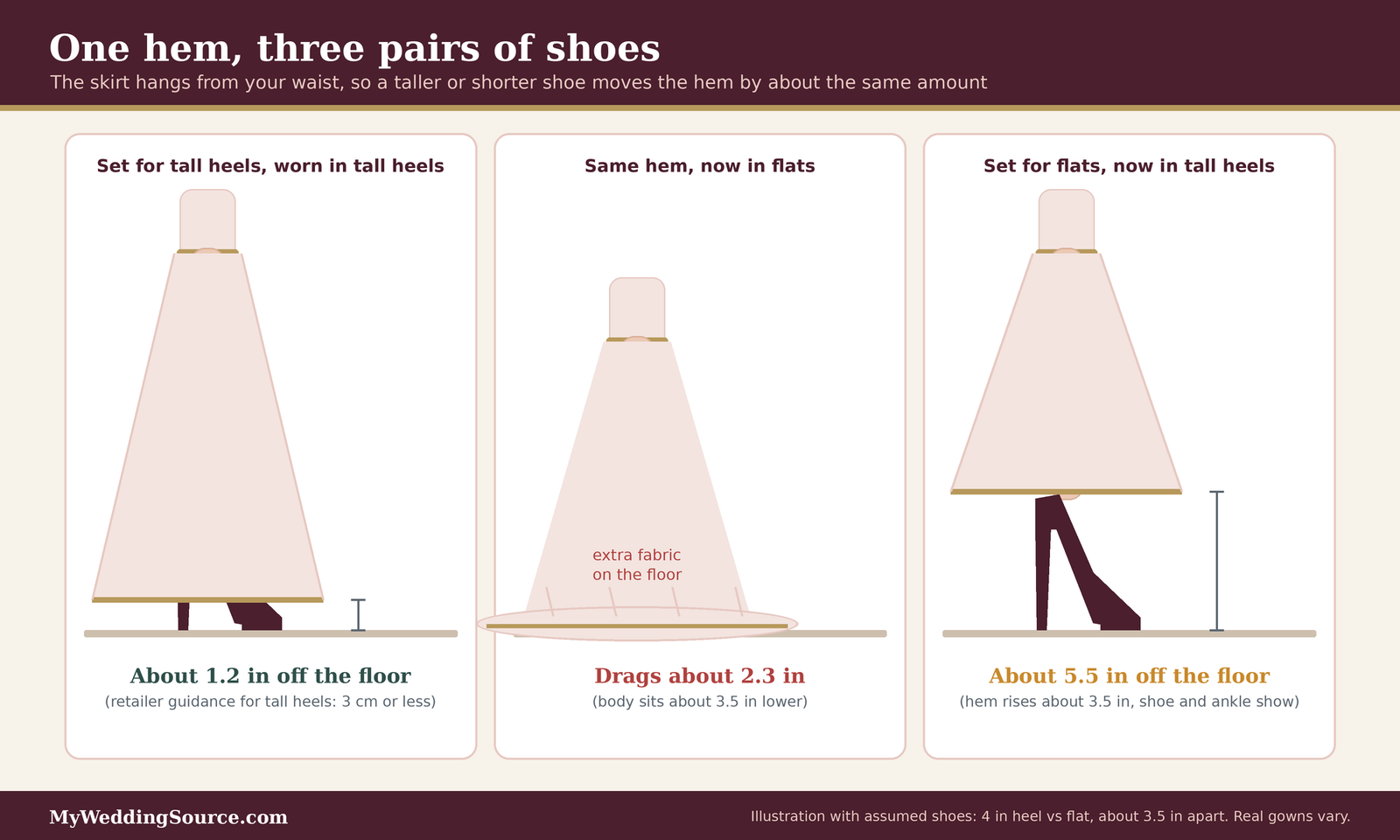
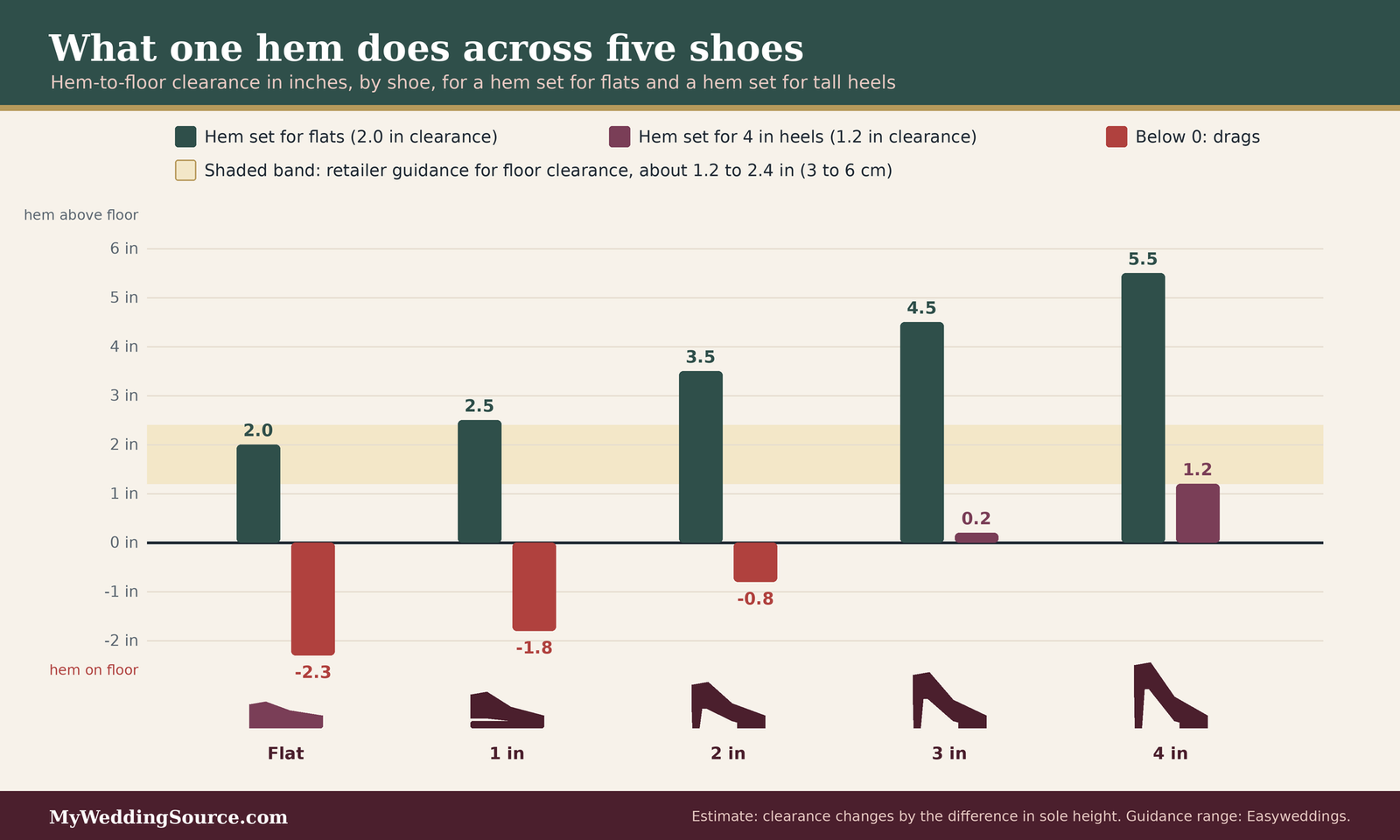
Suppose a tailor sets the hem while you stand in heels that lift your heel about four inches, and later you change into flats that lift you about half an inch. You now stand roughly three and a half inches lower. The waist is lower by about that amount, so the skirt’s bottom edge moves toward the floor by about the same amount. If the hem cleared the floor by an inch in heels, it would now be expected to drag by more than two inches in flats. Run the example the other way and the same thing happens in reverse: a hem set for flats with two inches of clearance would rise to something closer to five and a half inches off the floor in tall heels, high enough to expose most of the shoe and some ankle. Think of it as the first test of any plan for wedding dress hem length for flats vs heels.
The figure below draws this out. It uses a four-inch heel and a flat as an assumption, so treat the exact inches as an illustration of the direction and size of the change, not a prediction for your gown.
Why small changes still show
You might expect a half-inch difference to disappear. Honey Fawn cautions that even a small change in heel height can alter the finished length, and Kleinfeld Bridal notes that clean-lined or fitted skirts show small length differences more clearly than full, layered ones. A ballgown with many layers can hide a half inch of drag. A crepe sheath with a plain hem cannot. If your dress has a simple silhouette, the margin for a late shoe swap is smaller. Nothing here changes the basic rule: wedding dress hem length for flats vs heels follows the shoe you will actually wear.
Reading hem clearance: where the edge should land
Once you know that the hem is a distance from the floor, the next question is which distance. There is no single correct number, and a good tailor will adjust to your height, your dress, and your day. What is useful is knowing the ranges that wedding publishers describe, so you can compare what you are told with something outside the fitting room.
Floor clearance ranges that wedding publishers describe
The most specific numbers we found come from Easyweddings, an Australian and U.K. wedding directory. Its guidance is written in centimeters and is one publisher’s rule of thumb, not a standard that every salon follows, so use it as a conversation starter. We have converted to inches and rounded.
Tall heels: close to the floor
For towering heels, Easyweddings suggests a hem about 3 cm or less from the floor, which is about an inch or a little more. The logic is simple: in tall heels you stand high, the skirt rides up, and a hem that already sits close to the floor still reads as floor length. A hem set higher than that would show a lot of shoe and leg. This is also why a hem set for tall heels is the least forgiving when you change into anything lower. People who ask about wedding dress hem length for flats vs heels often skip this step, and it is cheap to do.
Flats: a little more room
For flats, the same publisher suggests leaving more than 3 cm, around 5 cm or two inches, so the skirt does not catch under your toes as you walk. A flat sole sits close to the floor, and a hem right at the floor would drag and could trip you. If you are choosing between a sandal and a ballet flat, tell the tailor, because sole thickness changes the number. For wedding dress hem length for flats vs heels, this is the detail worth writing down.
Statement shoes and dancing: higher still
Easyweddings suggests 6 cm or more, about two and a half inches, if you want to show off a decorative shoe, and also around 6 cm if you plan to dance and want the hem out of the way. That is a deliberate trade: a higher hem leaves the foot visible and gives it room to move, and the gown reads closer to a tea or ballerina length than a traditional floor length. A calm answer on wedding dress hem length for flats vs heels starts with this fact.
How a dressmaker takes the measurement
Understanding the measurement helps you ask better questions, because a hem number depends on how and when it was taken.
Hollow to hem
Easyweddings describes a measurement called hollow to hem, taken from the hollow at the base of the throat, near the center of the collarbone, down to the floor. It cannot be taken by yourself: you stand straight and relaxed, ideally barefoot, with someone helping. The same article says dressmakers typically remove about 3 to 6 cm, which is roughly an inch to two and a half inches, so that the dress does not drag or catch on the shoes. A salon that works from a barefoot measurement still has to add the shoe back in, which is why your shoe height must be known before the final cut. This is where wedding dress hem length for flats vs heels stops being abstract.
Why the shoe still needs to be in the room
A barefoot measurement is a starting figure. The tailor must still decide where the edge falls while you are standing in your shoes, because shoes change how you stand as well as how tall you are, and that can change how the skirt falls. A tailor who pins the hem while you stand in your real shoes sees that. A tailor who guesses from a number on paper does not. Bridal sources agree on the practical rule: Kleinfeld Bridal, The Knot, and Wedding Spot all tell brides to bring the shoes they will wear, and Kleinfeld adds that bringing shoes with the same heel height avoids rescheduling or re-hemming. Ask about it directly, because wedding dress hem length for flats vs heels depends on it.
The second figure compares what one hem looks like across different shoes, using our own arithmetic and the Easyweddings range as a reference band.
Questions to ask at your first fitting
- Which shoe height do you want me to bring, and is the pair I own close enough, or should I buy the real pair first?
- How much clearance from the floor do you plan to leave in my shoes, and why that number for this dress?
- If I change shoes later in the evening, what happens to the hem, and what do you recommend?
- Will you pin the hem while I stand in the exact shoes and the exact undergarments I plan to wear?
- Is this hem a single layer, or does it have horsehair, lace, beading, or several layers that change the price and the time?
The hem decision sheet
Most guides tell you to bring your shoes and stop there. That advice is right, and it leaves out the harder question: what do you do when two pairs of shoes are involved? The sheet below is a worksheet you can copy into a notes app or print. It has three parts. Part A gathers facts about your shoes, Part B records measurements at each fitting, and Part C turns those into a plan you can say out loud to your tailor. It is a planning aid, not tailoring instructions. Structural changes to a gown belong with a professional.
Part A: your shoe facts
Fill this in before the first fitting. If you do not own the shoes yet, use the closest pair you have and mark the entry as a stand-in.
Heel height and platform
Write the heel height in inches and, if the shoe has a platform at the front, the platform height too. A shoe sold as a four-inch heel with a one-inch platform may lift the heel by less than the headline number over a flat, because the front is raised as well. Retailers describe heel height differently, so measure from the floor to the top of the heel where it meets the shoe, and note the model name so a tailor can look it up. Your own measurements matter more than any chart on wedding dress hem length for flats vs heels, including ours.
Sole, shape, and closure
Note whether the sole is thin leather or thick rubber, whether the shoe is open or closed, and how it fastens. Sole thickness changes the number by a fraction of an inch, and fastening affects whether the foot slides forward in the shoe, which changes how the hem lands. These small notes matter most for a dress with a plain hem. It is the kind of detail that makes a decision on wedding dress hem length for flats vs heels easier to defend later.
Which moments each pair will cover
List the parts of the day each pair will be worn: arrival and photographs, the ceremony, the reception line, the first dance, and the dance floor. This list is the most useful thing on the sheet, because it tells you which pair is on your feet when the hem is most visible. A hem is seen most in the ceremony walk and the photographs, and it is felt most on the dance floor. None of this is complicated, but wedding dress hem length for flats vs heels rewards doing it in order.
Part B: measurements to record at every fitting
You are not expected to take professional measurements, but a few simple observations make fittings faster and leave you with a record if a question comes up later. Ask the tailor to say the numbers aloud and write them down.
Hem to floor in each pair of shoes
At each fitting, stand on the real shoes and have the tailor note the distance from the hem to the floor at the front, the side, and the back. Then, if you have a second pair, repeat in those. The gap between the two sets of numbers is how much the shoe change moves the hem. If the gap is larger than the range you can live with, you have found the problem early enough to fix it. If you remember one thing about wedding dress hem length for flats vs heels from this section, make it this.
Walk, stairs, sit, and turn
Walk across the room, take a few steps up and down if the shop has stairs, sit, stand again, and turn. The Knot advises practicing sitting, walking, and dancing during fittings. Note anywhere the hem catches your toe, rides over the shoe, or lifts at the back. Hem trouble tends to show up in motion before it shows up when you stand still. Many questions about wedding dress hem length for flats vs heels come back to this point.
Part C: the decision rule
Use the table to pick a plan. The rules are our own synthesis of the sources and the arithmetic above, so treat them as a way to organize the discussion with your tailor.
Read the table one row at a time
Find the row that sounds most like your day and read across. The middle column is a starting plan, not a verdict, and the right-hand column is the list of things to confirm out loud. If two rows fit, use the one that describes the shoes you will wear when the most people see the hem. Seen this way, wedding dress hem length for flats vs heels becomes a list of small, checkable facts.
Know where the rule bends
The table assumes the dress can be hemmed to a range of lengths. Lace, beading, and horsehair, covered in the next section, can narrow that range, and a dress that is already short has fewer options. When a row says to confirm something with your tailor, treat that as the real instruction. It is also why wedding dress hem length for flats vs heels cannot be settled from a product photo.
| Your situation | Suggested starting plan | What to confirm with the tailor |
|---|---|---|
| One pair of shoes all day | Hem to that pair | Exact heel height and sole, hem measured in those shoes |
| Heels for the ceremony, flats for the dance floor | Choose the pair you will wear longest or in most photos; ask how far the other pair moves the hem | How much drag or lift the second pair causes, and whether a bustle or hem lift handles it |
| Flats all day, outdoor or beach venue | Hem a little higher than a heel-set hem would be | Clearance on grass or sand, and the lowest the edge can safely sit |
| Tall heels all day | Hem close to the floor in those heels | A backup plan if the heels are swapped late |
| Shoes not chosen yet | Pick a target heel height now | Which fitting is the last day the shoe can change |
| Dress with lace, beading, horsehair, or many layers | Decide the shoe before the work starts | How the trim will be handled and what each option costs |
Choosing a plan when you will change shoes
Many people want heels for the ceremony and comfort later. Nothing in the sources says that is a mistake, and Honey Fawn tells brides who plan to switch to flats or sneakers later in the evening to tell their seamstress so she can recommend an approach. The aim is to make the change a choice you made on purpose instead of a surprise on the day.
Four ways to handle one dress and two pairs of shoes
These options are ways to frame the conversation with your tailor, not rules. Which one works depends on the dress, the venue, and how much a hem change costs where you live.
Hem for the pair you will wear longest
If you expect to be in heels for the ceremony, photographs, and cocktail hour and in flats only for the last stretch of dancing, hem for the heels and plan how to handle the dance floor. If flats will carry most of the day, hem for flats and accept that heels will show more shoe. Choosing by the hours on your feet keeps the hem looking right when most people, and most photographs, see it. This is a good moment to revisit your notes on wedding dress hem length for flats vs heels.
Hem for heels and choose a lower second shoe
If you want the dress to look correct in heels, you might choose a second pair that is closer in height instead of a true flat. A low block heel or a wedge lifts you by less than a stiletto but more than a ballet flat, so the hem shifts by less. That is our own reasoning rather than a rule from a source, and you should test it with the actual shoes at a fitting. Tailors vary, so treat this as a prompt for the fitting and not a script for wedding dress hem length for flats vs heels.
Hem for flats and let heels show the shoe
A hem set for flats leaves clearance that, in tall heels, becomes a visibly raised hem. Some people like this because it shows a decorative shoe. Easyweddings notes that statement shoes can justify a higher hem. If you do not want the shoe to show, this plan is the wrong one. Keeping this in view makes wedding dress hem length for flats vs heels a shared plan instead of a guess.
Keep the pairs close in height
The simplest plan is also the least dramatic: pick two pairs whose sole heights differ by only a little. Then the hem moves by a fraction of an inch, a bustle or a small adjustment can absorb it, and the tailor can set one number with confidence. The same logic runs through every decision about wedding dress hem length for flats vs heels.
What to tell your tailor, and when
The decision is only useful if the person with the pins knows about it.
Say it at the first fitting
Honey Fawn advises telling the seamstress about a planned change in shoes. Do it at the first fitting, before the hem is cut, because Honey Fawn also points out that a traditional hem is usually done once you have chosen your wedding shoes. Once the fabric is cut, extra length is hard to restore. Whatever you decide about wedding dress hem length for flats vs heels, check it with the real shoes.
Ask the tailor to mark the plan
Ask the tailor to write the plan in the notes for your file: which pair the hem is set for, the clearance in that pair, and the expected clearance in the other. If the plan needs a second adjustment later, such as a hem lift for the dance floor, that note tells the next fitting what you agreed on. Saying so early keeps wedding dress hem length for flats vs heels from becoming a last-minute surprise.
The third figure shows the planning path from a single question, will you change shoes, to the four plans above.

When flats make sense: comfort, body, and venue
Choosing flats is not a lesser choice. Several sources describe good reasons to prefer them, and the reasons should shape the hem from the start.
Foot comfort over a long day
You will probably be on your feet for much of the day. The American Orthopaedic Foot & Ankle Society’s FootCareMD site, which is written for patients, offers general guidance on heels. It is not advice about your feet and cannot replace a clinician’s.
Higher heels mean higher pressure
FootCareMD says that the higher the heel, the higher the pressure on the ball of the foot, and that lower heels reduce pressure on the ball of the foot and toes and make balance easier. It also suggests a wider toe box and a wider heel base, which are more stable than a pointed toe and a narrow heel. If you are weighing flats against heels for comfort, the guidance leans toward lower and wider. This is one of the quieter factors in wedding dress hem length for flats vs heels, and it is easy to overlook.
Switching shoes is not free either
FootCareMD also warns that after frequent heel use, shortened calf muscles can be painfully stretched when you move to flatter shoes or go barefoot. If you wear heels rarely, that matters little. If you wear them often and plan to swap to flats at the reception, it is another reason to try both pairs for a while before the wedding. People with existing foot conditions such as bunions should ask a podiatrist or orthopedist, not a bridal guide. If you already have a foot condition, that is a medical question to settle before you settle wedding dress hem length for flats vs heels.
Venue and route
The place can decide the hem as much as the shoe.
Grass, sand, and dirt
Easyweddings suggests a higher hem for outdoor venues such as gardens and parks to avoid dirt, grass, and leaves, and True Society suggests a slightly shorter hem for beach venues and a slightly raised hem for gardens. If your venue has a lawn, ask the venue what the ground will be like and whether heels will sink. Our guides to garden wedding venues, outdoor wedding venues, and beach wedding dresses cover the other practical issues. A stair-heavy route is one more reason to think about wedding dress hem length for flats vs heels in terms of your actual venue.
Stairs and the dance floor
Easyweddings says a higher hem lowers the risk of falling when the route has many stairs, and suggests a higher hem of around 6 cm for dancing. Take your actual route, including steps at the venue, into account when you decide between heels and flats, and walk it in your shoes if the venue allows a visit. For more on the dance floor, see our wedding first dance guide. If a tailor’s advice on wedding dress hem length for flats vs heels differs from the ranges above, ask why, because gown construction can justify the difference.
How hem construction changes your options
Two gowns can have the same skirt silhouette and need very different work to change the hem. What the edge is made of decides how much choice you really have, so ask about construction before you decide between heels and flats.
Layers, horsehair, lace, and beading
The sources agree that decoration at the hem makes hemming slower. They do not give a single formula, so the details below are descriptions from the retailers, not guarantees for your dress.
Lace and beadwork at the edge
Honey Fawn lists lace appliqués, beading and sequins, and delicate edging as details that complicate hemming, and says that decorative details may need to be removed and reapplied. CloudBridal, a software company serving bridal shops, says lace and beadwork may need removal and hand reapplication, so it recommends inspecting the gown and quoting the expected hours instead of a flat price. Brides in a WeddingWire forum thread, who are anecdotal sources and not professionals, describe similar approaches and warn that lace can tear when removed, so ask your tailor how many times she has altered a similar edge. The practical effect on wedding dress hem length for flats vs heels is easy to test at a fitting.
Several layers and horsehair braid
Honey Fawn names horsehair braid and crinoline as hem elements that can each need individual alteration, and The Knot notes that the many layers of a ballgown make hemming more time consuming. CloudBridal’s benchmark prices, discussed below, put a multi-layer or horsehair hem above a single-layer hem. If your gown is layered, a late change in shoe height means redoing the work on every layer, so settle the shoe early. Few details matter as much to wedding dress hem length for flats vs heels as this one.
Designer hem or traditional hem
There are two moments when length can be set, and they come with different costs and different deadlines.
A custom hem during production
Honey Fawn says many designers can shorten a gown while it is being made, though not every designer or gown qualifies. In that case you must know your exact heel height before ordering, because the designer uses it to set the finished length. The retailer adds that this can be more cost-effective than a traditional hem for layered, lace, or intricate gowns. A production hem is a strong reason to decide flats or heels early, and an equally strong reason to be sure before you commit. That is the reason wedding dress hem length for flats vs heels is worth settling before any cutting begins.
A traditional hem during alterations
The other route is the familiar one: a seamstress hems the gown after it arrives, usually once you have chosen your wedding shoes, using your shoes at the fitting. That keeps your options open longer. The cost is that the work is done on a finished gown with whatever construction it has, which is why the earlier questions about lace and layers matter. Put plainly, wedding dress hem length for flats vs heels is a question about which day you are planning for.
Bustles, trains, and the back of the hem
If your dress has a train, the hem has two jobs: it must look right in front when you walk, and it must look right in back when the train is lifted for the reception. Wedding dress hem length for flats vs heels touches both, so it helps to see how the bustle fits into the plan. For more on trains, see our guide to wedding dress train lengths.
Why the bustle depends on the shoe
A bustle lifts the train to a set height. The Knot says the seamstress sews the hooks, ties, or buttons during alterations and that the bustle is done on the wedding day between the ceremony and reception.
The bustle’s height is set with shoes on
If the hooks are set while you wear tall heels and you later switch to flats, the bustled hem will sit lower than planned and may touch the floor. If they are set in flats and you switch into heels, the hem will sit higher. The bustle is where a late shoe change shows up first, because it is the part of the skirt people see from behind when you dance. Ask the tailor to set the bustle points in the pair you will wear at the reception. A bustle set in the wrong shoes is a common reason wedding dress hem length for flats vs heels needs a second look at the last fitting.
Types of bustle and the hem you see
The Knot lists the American or over-bustle, the traditional, the ballroom, the French or under-bustle, the royal, and the bow. It describes the French style as folding the train under itself, which leaves a two-layer hem, and the ballroom style as holding the train out of sight so the dress looks floor length. Each leaves a different edge at the back, so ask which one the tailor suggests for your gown and what the back hem will look like in your reception shoes. Expect a good tailor to raise it herself when discussing wedding dress hem length for flats vs heels.
Practice before the day
A bustle is a skill more than a measurement, so practice it.
Bring the person who will bustle
The Knot recommends having a bridesmaid or family member, a designated bustler, attend the final fitting to practice with the seamstress, taking notes or filming. Do that in the shoes you will wear at the reception, so the person sees where the hem should end. Rehearsing in the reception shoes is the simplest way to test your plan for wedding dress hem length for flats vs heels.
Check the plan at the last fitting
At the final fitting, wear both pairs if you can. Confirm the front hem in each, the back hem bustled and unbustled in each, and that the bustler can do the work in a reasonable time. Our guide to fit and alterations lists the other things to confirm at that visit. A bustle that matches your reception shoes also keeps wedding dress hem length for flats vs heels from becoming a second alteration bill.
Timeline, fittings, and cost
Sources do not agree on one schedule, so treat the dates below as a range and ask your tailor for the real calendar.
When to start
A good hem plan needs the shoes settled before the cutting begins, so work backward from the final fitting.
What the sources suggest
The Knot suggests scheduling the first alterations consultation about two to three months before the wedding and says alterations usually take six to eight weeks. True Society describes three fittings, about three months out, about one month out, and a final review. CloudBridal describes a first fitting eight to ten weeks out, a progress fitting three to six weeks out, and a final fitting in the last one to two weeks. Wedding Spot says to expect three to four fittings. The takeaway is not a date but an order: shoes first, hem second, bustle third. Little of this is unique to one gown, which is why wedding dress hem length for flats vs heels is worth learning once.
What a late start can cost
CloudBridal lists a rush fee for work under six weeks before the event, between $120 and $205 depending on its market tier. That is one company’s benchmark and your tailor may charge differently or not at all, but it is a useful reason to ask about turnaround early, before the shoe question forces a last-minute change. Ask about turnaround at the first fitting, because a late change to wedding dress hem length for flats vs heels is the kind of change that can trigger it.
What hemming costs: reference points
Prices vary by city, tailor, and dress, and none of these figures is a quote. CloudBridal, a software company that publishes pricing benchmarks for bridal shops, lists a single-layer hem at $140 in a value market, $175 in a U.S. mid-market, and $235 in a luxury or metro market, and a multi-layer or horsehair hem at $240, $300, and $405. It describes these as working starting points, not mandatory prices, and gives lace and beadwork labor at $40, $50, or $70 per hour. The Knot gives a typical alterations range of $150 to $800, with intricate lace or beading reaching $1,000 or more. Wedding Spot says to expect $400 or more, and True Society cites roughly $400 to $900 for alterations overall. Use the figures to sanity-check a quote, and ask for the hem line item separately.
What the cost tells you about the decision
Cost matters because it affects how many times you can afford to change your mind.
A shoe change can mean paying twice
If the hem has been cut for one pair and you change to a pair with a different height, the fix may mean new work on a hem that has already been finished. Honey Fawn notes that hemming is often more labor intensive and expensive than people expect. Our own advice, not a source’s, is to decide the shoe before the work starts and ask whether the quote includes one adjustment. For wedding dress hem length for flats vs heels, the cheapest hem is usually the one you only pay for once.
Budget the hem as its own line
Several sources suggest budgeting for alterations as a separate item from the dress. For the wider picture, our wedding budget guide shows where alterations sit among other costs, and the wedding dress alterations guide covers the other items. The budget line for wedding dress hem length for flats vs heels is small next to the gown, but it is easy to forget.
Edge cases
Not every dress and day fits a tidy rule. These situations come up often enough to plan for.
The hem is already too short
A hem that ends up too short is the hardest case, because fabric is easier to remove than to add. Kleinfeld Bridal explains the common causes: the dress may have been ordered to a standard length that ignores your height or heel choice, or a previous alteration may have removed more length than intended.
What a tailor can check
Kleinfeld says a tailor can check the seam allowances, decide whether the hem can be let down, and propose a new hem treatment. Letting a hem down only works if the construction leaves extra fabric, and intricate lace, beading, or horsehair trim can make it harder. Ask for an honest answer on what is possible before agreeing to any work. Treat it as one input to wedding dress hem length for flats vs heels, never the only one.
When length cannot be added
If lengthening is not possible, Kleinfeld suggests refining the rest of the gown so the proportions still look intentional, or treating a shorter look on purpose, with polished shoes, a clean hem finish, and elevated accessories. In that case, choosing the shoe to suit the new hem is a reasonable plan.
Shoes that change the plan entirely
Some shoe choices break the usual assumptions.
Sneakers and very flat shoes
Honey Fawn names sneakers as a late-evening change and says to tell the seamstress. Sneakers often have thicker soles than ballet flats, so measure the pair you will wear and do not assume that any flat is the same. This is our own caution, not a figure from a source.
Platforms, wedges, and thick soles
A platform lifts the whole foot, so the total height is what matters, not the quoted heel. A wedge may feel stable and still change the hem by a good fraction of an inch. If you are unsure, wear the shoe to the fitting and let the tailor see it.
A shorter dress, a second outfit, or a different style
A shorter hem changes the question. Easyweddings notes that tea, ballerina, knee, and mini lengths exist for people who want to break with tradition, but it also says the gown must not be so short that guests see too much when you sit or bend. The Knot notes that a mini or midi reception dress needs no bustling, though a second outfit adds to the overall cost. If you are weighing a change of outfit, see our guide to renting wedding dresses and simple wedding dresses, and our upcoming guide to bridal outfit changes.
Petite frames
Easyweddings suggests that short brides keep the skirt as close to the floor as possible without touching it, to look taller, which makes the shoe decision more consequential. Our guide to petite wedding dresses has more.
Dancing and movement
Easyweddings suggests a hem of around 6 cm, about two and a half inches, for dancing, and The Knot notes that a bustle lets the dress carry its own train. If the skirt catches under your foot when you dance, test the dress with and without the bustle while walking and turning, and ask your tailor how the hem will look from the side.
Questions for your salon, tailor, and contract
A hem plan lives or dies on whether everyone involved has the same facts. The salon that sold the dress, the tailor who alters it, and the shop that sold the shoes may be three different businesses, so use the questions below to line them up.
What to ask the salon and the tailor
These questions work whether you bought from a boutique, a department store, or online.
Questions about the plan
Ask who will do the hem and whether the salon’s own tailor or an outside one will do it. Ask whether the hem is a single layer or includes lace, beading, horsehair, or several layers, and how that changes the price and the time. Ask how many fittings the quote includes, and whether a second hem adjustment is covered if the shoe changes. Kleinfeld Bridal says each fitting lasts about an hour, so ask how many of those hours are in the price.
Questions about limits
Ask how much length can still be removed or added. Ask what happens if the hem is cut and the shoe plan changes. Ask whether the work could damage the lace or beading, and what the shop does if it does. Brides in a WeddingWire forum thread say lace can tear during removal, which is anecdotal, but it is the kind of question a careful tailor will answer directly.
Putting the plan in writing
A written plan is protection for you and for the tailor. This is general consumer advice, not legal advice, and a lawyer or a consumer protection office is the right place for a contract dispute.
What belongs in the note
Ask for a note or an alterations contract that lists the planned shoe heel height, the planned hem-to-floor clearance, the number of fittings, the price of the hem, the pickup date, and what happens if you change shoes. Photograph the notes after each fitting, so you have a record of what was agreed. Our guide to wedding vendor contracts lists the clauses to look for in any vendor agreement.
Care labels and what the work leaves behind
Hem work that removes and reapplies trim can change how a gown is cleaned later. The Federal Trade Commission’s Care Labeling Rule requires makers and importers of most clothing to attach care instructions and to have reasonable evidence behind them, so read the label before and after the work and ask the tailor whether the alteration changes the care instructions. The FTC page we read is dated 2014, so check the current rule before relying on its details. We do not give cleaning advice or guarantees, and the label and a professional cleaner are the right place to start.
The last fitting and the wedding day
The final fitting is the only dress rehearsal you will get for the hem. Use it.
Rehearse in both pairs
If you plan to change shoes, do the final fitting twice, once in each pair, and check what you recorded on the decision sheet.
Walk the route you will take
Walk, climb stairs if the shop has them, sit, stand, turn, and take a few dance steps, as The Knot suggests. Do it in the shoes, with the undergarments, and with the shapewear you will wear on the day. Kleinfeld Bridal and True Society both recommend bringing those items. Our guide to sitting and using the restroom in a fitted wedding dress goes through that part of the day.
Check the change itself
If you will change shoes at a certain moment, practice that moment. Know where the second pair will be, who will hold it, and how long the change takes. If the change happens at the same time as the bustle, rehearse them together.
On the day
Keep the plan simple and put one person in charge of it.
Hand off the details
Give the designated bustler and one other helper a copy of the sheet, with the shoe plan, the hem numbers, and the tailor’s phone number if the shop allows calls. Ask the venue where you can change shoes in private and sit down while you do it. Our wedding week checklist and wedding emergency kit guides cover what else to have on hand.
Photographs and the hem
If both pairs will appear in photographs, tell the photographer which comes first. A hem set for heels can look short in flats and the reverse, and photographers can frame around it if they know. Our wedding photographer shot list has a place for these notes.
Shoes and measurements
Should I buy my wedding shoes before the hem is done?
Yes if you can. Honey Fawn says a traditional hem is usually done once you have chosen your shoes, and several salons say to bring the exact pair to fittings. If you cannot, pick a target heel height early and wear something similar, as True Society suggests, then confirm before the cut.
Can I hem for flats and still wear heels?
You can, but the hem will rise by roughly the difference in sole height, as our own arithmetic suggests, and more of the shoe will show. Easyweddings notes statement shoes can justify a higher hem. If you want the dress to look floor length in heels, hem for the heels instead.
What heel height should I plan for if I have not chosen shoes yet?
Choose the height you can comfortably stand in for hours, then use it as your working number. True Society advises figuring out your ideal heel height early and wearing something like your final choice. FootCareMD says lower and wider heels reduce pressure and improve balance. Revisit the number at the second fitting.
Costs and timing
How much does a wedding dress hem cost?
It depends on the layers, trim, and city. CloudBridal’s benchmarks list a single-layer hem from $140 to $235 and a multi-layer or horsehair hem from $240 to $405, described as starting points. Lace and beadwork may be billed by the hour. Get the hem quoted as its own line.
When should the hem be finished?
Sources vary. The Knot suggests starting two to three months out, True Society describes fittings at about three months, one month, and a final review, and CloudBridal lists a rush fee under six weeks. Ask your tailor for a calendar, and settle the shoe before the hem is cut.
Special situations
Does lace or horsehair change the hem plan?
It can. Honey Fawn says lace appliqués, beading, horsehair braid, and crinoline complicate hemming, and decorative details may need removing and reapplying, which raises time and cost. Ask the tailor how the edge will be handled and decide the shoe before work starts, because later changes may repeat that work.
What if I plan to change into flats or sneakers at the reception?
Tell your tailor at the first fitting, as Honey Fawn advises. Then choose which pair the hem is built around, check how far the second pair moves it, and ask whether a bustle or small adjustment can absorb the difference. Practice the change at the final fitting.
How do I choose a hem for stairs, grass, or dancing?
Easyweddings suggests a higher hem for gardens, parks, many stairs, and dancing, about 6 cm for dancing, and True Society suggests a slightly raised hem for gardens and a slightly shorter one for beaches. Visit the venue’s route if you can and tell the tailor what the ground will be.
Your next steps
Decide the shoes
Pick a target heel height
Choose the pair, or the height, you will wear for most of the day, and write it on Part A of the decision sheet. If you plan a second pair, choose one close in height. Revisit the choice before the first fitting.
Settle the shoe before the cut
Ask the tailor which fitting is the last day the shoe can change without extra work, and put that date on your calendar. Treat it as the deadline for your shoe decision.
Prepare the fittings
Bring the sheet and the shoes
Bring both pairs, the undergarments you will wear, and the filled-in sheet to the first fitting. Ask for hem-to-floor numbers in each pair and write them down. For the wider plan, see our wedding dress alterations and wedding planning checklist guides, and our guide to wedding dresses.
Rehearse the bustle and the shoe change
Bring your designated bustler to the final fitting, and practice both the bustle and the shoe change together. If you are also choosing sleeves, our guide to detachable wedding dress sleeves covers fittings for that detail.
Sources & methodology
How we built this guide
What we relied on
This guide combines retailer and publisher advice on hems and fittings, patient guidance on heels from an orthopedic society, and a federal rule on care labels. We read each source on November 12, 2026, and did not verify whether pages have changed since. Where a statement comes from a retailer or publisher, we say so, because bridal sellers have their own products and habits. The height arithmetic and the decision sheet are our own estimates and synthesis, not tailoring instructions or a standard. Forum posts are cited only as anecdotes.
What we did not do
We did not test hems, measure bodies, or consult a tailor for this article, and we do not give medical, legal, or cleaning advice. Prices are benchmarks from the sources, not quotes. Ask your tailor, your salon, and, for foot concerns, a clinician.
Source list
Government and clinical sources
- Federal Trade Commission, Clothes Captioning: Complying with the Care Labeling Rule (May 2014): https://www.ftc.gov/business-guidance/resources/clothes-captioning-complying-care-labeling-rule
- American Orthopaedic Foot & Ankle Society, FootCareMD, How do I avoid injuries and pain while wearing heels: https://www.footcaremd.org/resources/how-to-help/how-to-wear-high-heels-and-avoid-injury
Bridal retailers, publishers, and industry sources
- Kleinfeld Bridal, Alterations essentials: https://kleinfeldbridal.com/blogs/advice/alterations-essentials
- Kleinfeld Bridal, Wedding dress hem too short: https://kleinfeldbridal.com/blogs/kleinfeld-bridal-guide/wedding-dress-hem-too-short
- Honey Fawn, Hemming your wedding dress: what every bride should know: https://honeyfawn.com.au/pages/hemming-your-wedding-dress-what-every-bride-should-know
- The Knot, Wedding gown alterations 101: https://www.theknot.com/content/wedding-gown-alterations-101
- The Knot, What is a bustle: https://www.theknot.com/content/what-is-a-bustle
- The Knot, Getting around in your wedding dress: https://www.theknot.com/content/getting-around-in-your-wedding-dress
- Easyweddings, How long should a wedding dress be: https://www.easyweddings.co.uk/articles/how-long-should-a-wedding-dress-be
- True Society, Everything you need to know about wedding dress alterations: https://truesociety.com/?p=17051
- Shane Co., Everything you need to know about wedding dress alterations: https://shaneco.com/theloupe/articles-and-news/wedding/wedding-dress-alterations
- Wedding Spot, Wedding dress alteration tips: https://wedding-spot.com/blog/wedding-dress-alteration-tips
- CloudBridal, Wedding dress alterations pricing guide: https://cloudbridal.com/articles/wedding-dress-alterations-cost-guide
Community discussion (anecdotal)
- WeddingWire forum, Hemming a lace designed dress with scalloping: https://www.weddingwire.com/wedding-forums/hemming-a-lace-designed-dress-with-scalloping/872462560209d41e.html