
Wedding veil comb security comes down to three things you can plan in advance: what the comb is anchored to, how much the veil pulls and catches wind, and whether you tested the whole setup with the actual veil before the day.
Quick answer
A veil stays put when the comb grips something firm, not loose hair. Stylists commonly build that base first with teasing, tiny elastics, a pin curl, or a hidden X of bobby pins, then slide the comb in behind it and cross pins over the teeth. Match the setup to your hairstyle, keep a veil short and light if you expect steady wind, and bring the real veil to your hair trial so you can test it by turning, nodding, walking, hugging, and standing in front of a fan. Wind, weight, and movement all pull on the comb, so the plan needs all three in mind.
Wedding veil comb security starts with what the comb grips
A veil comb looks like a small piece of hardware, and it is easy to assume the comb does the holding. In practice a comb is a set of teeth that needs something to push against. The hair, and whatever your stylist builds into the hair, does most of the work. That is why two brides can wear the same veil on the same day and have very different experiences, and why wedding veil comb security is partly a hair question and partly a veil question.
This guide treats wedding veil comb security as a short chain: the veil, the comb, the anchor, and the hairstyle. It then adds the one variable you cannot control, which is wind. Each link can be checked ahead of time, and most of the fixes are inexpensive when you find them at a trial instead of on the lawn at the ceremony.
The forces that act on a veil comb
Four forces act on the comb during a wedding day. Naming them helps you decide which ones matter for your venue and your veil, and it keeps the planning conversation with your stylist specific instead of vague.
Weight and length pull the comb downward
A longer veil has more fabric hanging from a single point. Retailer guides describe lengths ranging from about 9 inches for a birdcage up to 120 inches or more for a royal length, with fingertip around 42 inches, chapel around 90 inches, and cathedral around 114 inches in one guide (the numbers vary by brand). More fabric means more mass hanging from the comb, and it also means more fabric that can catch a gust. Neither source gives a weight in grams, so we do not either. What you can do is hold your actual veil by the comb at the trial and notice how it pulls. That one test tells you more about wedding veil comb security than any product description.
Wind lifts and twists the fabric
Wind does two things to a veil. It lifts the lower edge, and it twists the fabric around the comb. A light gust may only move the hem. A steady breeze can pull sideways and back on the comb, and it does so repeatedly, which loosens a marginal hold over time. One retailer guide notes that shorter, lighter veils are more practical and less likely to be blown around outdoors. That is a reasonable starting point, and later sections show how to scale your wedding veil comb security plan to the wind you expect.
Your own movement works the comb loose
Turning your head, hugging relatives, getting in and out of a car, sitting down, and dancing all move the comb a little. None of these is dramatic on its own, but they repeat across a long day. A hold that feels solid when you are standing still in a mirror can slide during a long hug line. Wedding veil comb security, then, includes the movement you will actually do, not only the wind.
Hair slips, especially clean or silky hair
Freshly washed or very smooth hair offers less friction for the comb teeth. This is a general styling principle that stylists work around by adding texture, such as teasing, elastics, or pin curls. We could not find a measured study of how much texture changes hold, so treat the idea as common practice, not as a measurement, and ask your stylist how they prepare your hair type.
What the comb actually grips
If you remember one idea about wedding veil comb security, make it this one: the comb grips an anchor, and the anchor is what you are really securing. Seeing it that way changes the questions you ask.
The comb grips hair and pins, not the scalp
A comb is not designed to bite into skin, and it should not be pushed in that way. The teeth slide through a section of hair and meet resistance from hair that has been given structure. That structure can be a small teased section, a few small elastics, a pinned curl, or a pair of bobby pins crossed under the hair. The comb then sits behind or inside that structure. When people say a veil “kept slipping out,” the usual cause is that there was nothing for the teeth to hold against.
Why comb size matters less than anchor quality
It is tempting to buy a bigger comb for a heavier veil. A larger comb spreads contact over more hair, which can help, but it also needs a bigger base and can be harder to hide. Stylists quoted in the sources below pick comb size to match the hairstyle: small and delicate for intricate updos, medium for half-up styles, and light for loose waves. If a veil is heavy, the anchor and the extra pins are usually the first thing to improve, and the comb size follows from the style.
How veil combs and attachments differ
Before you plan around a specific hairstyle, it helps to know what kind of attachment your veil has. Veils arrive with a sewn-on comb, with a loose pinned design, or with a comb you add yourself. Each calls for a slightly different approach to wedding veil comb security.
Metal, plastic, and sewn-on combs
The material and the way the comb is attached to the fabric both change how the veil behaves. Look at both before you commit to a wedding veil comb security plan.
Metal combs and plastic combs
Two stylist sources we reviewed agree on one practical point: metal combs hold better than plastic ones with bobby pins, and plastic combs are harder to secure and may need extra pins or small alligator clips. If you have a choice, ask to see both in person and test how a bobby pin slides over the teeth. If your veil came with a plastic comb you love, ask your stylist or a seamstress whether a metal comb can be sewn on in its place.
Combs sewn on in the right spot
One bridal accessories designer recommends a comb sewn onto the veil at the right place, because it makes the veil easier to place and helps keep it in position. A comb in a default position may ignore your height, your hairstyle, and where you want the blusher to fall. Moving or replacing a comb involves sewing into the veil edge, so treat it as a small alteration and have someone with sewing skill do it. Our guide to wedding dress alterations covers how to find and brief a seamstress, and the same questions apply to veils.
Drop veils, loose pinned veils, and add-on pieces
Not every veil has a comb. Knowing which type you have saves time at the trial and helps your stylist choose the right method.
Drop veils and combless designs
A drop veil lies flat against the head and typically has a comb sewn in or none at all. The designer we reviewed notes that some drop veils have no comb and are pinned into the hair with hairpins, and that a combless veil can fall out if you wear your hair down, even when pinned. If you love a combless veil and plan to wear your hair down, discuss it with your stylist early. A comb added in the right place may be the simplest fix.
Add-on pieces and pin choice
When a veil needs pins, the same designer advises choosing pins without plastic tips so they do not catch or damage the netting. The same logic applies to anything you add to a veil, such as a small clip or a snap. Bring any extra hardware to the trial, because a pin that works in a plain updo can snag lace or beaded trim. If the veil has delicate trim, say so before the stylist starts, so they place pins in the plain tulle and avoid the trim.
Hairstyles and where the veil comb goes
Placement is where wedding veil comb security and hairstyle meet. The sources we reviewed give general positions for common styles, and a stylist adjusts them for your hair, your veil, and your dress. Think of the positions below as a starting vocabulary for the conversation, not as fixed rules.

Updos and buns
For wedding veil comb security, updos give the comb the most to work with, because the hair is already gathered and often already textured. That is one reason a stylist source notes that heavy headpieces generally stay put better in upstyles and half-up styles.
Above the bun
Placing the veil above the bun is the classic arrangement. One veil-styling article associates it with traditional looks, notes that it adds height and volume, and says the veil is easier to remove after the ceremony without disturbing the hairstyle. The trade-off it names is that this look can feel too formal for relaxed or outdoor weddings and a full veil can hide an intricate bun. For wedding veil comb security, a comb above the bun can sit in structured hair, and cross pins are easy to hide.
Below the bun
Placing the veil below the bun keeps the hairstyle visible and suits a more minimal look. The same article cautions that a longer or heavier veil may shift during the day, especially while dancing, and that a small comb may be needed because a large straight comb is hard to work in below a bun. If you want this look with a long veil, ask your stylist how they would reinforce the area, and test it with movement.
Half-up styles
Half-up styles sit between structure and movement, which makes wedding veil comb security a matter of the base. The top section can hold an anchor, while the lower hair stays loose.
Where the sections meet
A stylist article suggests a medium comb at the point where the top section meets the lower section. That spot lets the comb sit behind a firm base, and the lower hair can cover the pins. It also keeps the blusher falling where you expect it to, which matters for the first look at the aisle.
What to ask about hold
Because the lower hair is loose, it may pull on the comb as it moves. Ask your stylist whether they would add texture or a pin curl under the comb position, and ask what they do when the hair is very fine or very smooth. Their answer tells you how they think about wedding veil comb security for your hair type.
Loose waves and hair worn down
Hair worn down looks relaxed and is the hardest style for wedding veil comb security, because the hair is free and there is less structure to grip.
Comb choice for loose styles
The stylist source we reviewed recommends a lightweight side comb for loose waves, so it does not pull or feel heavy, and suggests placing it above the ear or at the back where the hair naturally falls. A light comb suits a light veil. It is a poor match for a long, heavy veil in strong wind.
Pairing a loose style with a veil
A veil styling article suggests placing the veil on the upper back of the head for a modern look with hair down, and a shorter veil for a vintage wave. If you have your heart set on loose hair and a long veil, consider the anchor base carefully, and plan to take the long veil off before the reception, as one retailer guide also suggests for dancing.
Low styles, braids, and short hair
Some styles are neither classic updos nor loose waves, and wedding veil comb security works a little differently for them. The sources are thinner here, so lean on your stylist’s experience with your hair.
Low buns and angled placements
For a modern or bohemian look, one stylist source suggests the base of a low bun or an angled position. A low placement changes the blusher height, because the designer we reviewed notes that a comb tucked further back in a low half-up style sits the blusher higher, while a comb higher at the crown lets it fall lower. Decide how you want the blusher to fall before the stylist sets the comb.
Short hair and tiny elastics
For short hair, one stylist source describes making tiny ponytails with small clear elastic bands where the comb will sit, hiding the bands under a section of hair, nestling the comb teeth into them, and reinforcing with bobby pins. Short hair does not rule out a veil. It changes the method, and a stylist who has done it before is worth asking for. Our guide to wedding hairstyles shows how common styles look in photos.
Wedding veil comb security in the wind
Wind is the part of wedding veil comb security that people tend to guess at. A simple, sourced way to talk about it is the Beaufort scale, which the National Weather Service publishes with plain descriptions of what each wind speed does on land. It gives you vocabulary you can share with a stylist, a planner, and a photographer.

Reading wind with the National Weather Service scale
The Beaufort descriptions were written for general observation, not for veils, so the link to wedding veil comb security is our own interpretation. Still, the land cues are useful because you can see them at your venue, and a forecast gives the speed.
What the scale says from breeze to gale
According to the National Weather Service version, a light breeze at 4 to 7 miles per hour is felt on the face and rustles leaves. A gentle breeze at 8 to 12 mph keeps leaves and small twigs in constant motion. A moderate breeze at 13 to 18 mph raises dust and loose paper and moves small branches. A fresh breeze at 19 to 24 mph sways small leafy trees. A strong breeze at 25 to 31 mph moves large branches and makes umbrellas hard to use. A near gale at 32 to 38 mph moves whole trees and makes walking against the wind difficult, and a gale at 39 to 46 mph breaks twigs off trees.
Using the cues at your venue
If you visit your venue on a similar day, watch for these cues. When loose paper lifts and small branches move, the wind is in the moderate range. If umbrellas would be hard to use, a long veil will likely be difficult too. This is a rule of thumb from us, not from the Weather Service, so treat it as a conversation starter and decide with your stylist and planner.
Why the push grows faster than the wind
A simple piece of physics explains why a moderate day and a windy day feel so different for a veil. The pressure of moving air grows with the square of its speed, so doubling the speed roughly quadruples the pressure, in the idealized case of air hitting a flat surface.
The square rule in plain numbers
At sea-level air density, the idealized dynamic pressure of wind is roughly 12 pascals at 10 mph, 49 pascals at 20 mph, 110 pascals at 30 mph, and 196 pascals at 40 mph. These are our own estimates from the standard formula, not measurements of a veil. A veil is not a flat plate, and the real force depends on its shape, its area, and how it hangs. But the pattern holds: a 20 mph wind pushes about four times as hard as a 10 mph wind, and a 30 mph wind about nine times as hard.
What the square rule means for a veil plan
This is why a veil that behaves on a calm afternoon can fail on a breezy one, even if the wind seems only a little stronger, and why wedding veil comb security needs a wind plan. It is also why planning for the likely wind matters, and why shorter, lighter veils are more forgiving. If your forecast is anywhere near the upper bands, your plan should change from “pin it well” to “pin it well, shorten or lighten the veil, and have a fallback.”
Gusts, shelter, and the shape of the venue
A forecast gives you an average and a gust figure. A venue adds its own wind pattern.
Average wind versus gusts
Regional National Weather Service offices publish thresholds for when winds are strong enough to call for an advisory. One regional page we reviewed lists sustained winds of 31 to 39 mph for at least an hour, or gusts of 46 to 57 mph, as the range where wind advisory criteria are likely, and notes that page was last updated in 2015. Criteria differ by office, so check your local one. For a veil, a single gust can matter more than the average, because it is a sudden pull on the comb.
Open lawns, beaches, rooftops, and shelter
Our own reasoning, not a sourced rule: open ground, beaches, and rooftops tend to give wind more room to build, while courtyards, tree lines, and buildings can break it up or funnel it through gaps. Ask your venue coordinator where the wind usually comes from, whether the aisle runs along it or across it, and whether there is a sheltered spot for portraits. Our guides to outdoor wedding venues and the outdoor wedding infrastructure checklist cover other venue questions, and the beach wedding guide covers shoreline conditions.
Matching veil length and fabric to the day
For wedding veil comb security, length and fabric decide how much there is for the wind to catch and for gravity to pull. They also decide how much the comb has to hold.
Length in inches and in plain language
Retailers describe lengths in inches, and the numbers vary by brand. Use them to compare, then check your actual veil.
The common lengths
One retailer’s chart lists fingertip at about 36 to 46 inches, chapel at 90 to 110, cathedral at 108 to 120, and royal at 120 to 160 inches or more, measured from the comb to the end of the fabric. Another guide lists elbow at 25 inches, waist at 30, fingertip at 42, waltz at 60, floor at 72, chapel at 90, and cathedral at 114. A third says chapel extends about two and a half to three and a half feet past the hem, and cathedral about six and a half to seven and a half feet. Our guide to wedding dress train lengths explains how the veil and the train interact.
Which lengths are friendlier in wind
One bridal guide says shorter, lighter veils are more practical and less likely to be blown around, which makes them better for outdoor ceremonies. Another notes that elbow-length veils are less likely to snag and are less restrictive, and that shoulder-length veils suit casual, outdoor, or heavily detailed dresses. A longer veil can still work outdoors with a stronger anchor, a wind plan, and a willingness to take it off for photos or dancing.
Fabric, trim, and weight
Tulle is common, and lace, embroidery, beading, and pearl trim add weight and texture. The sources do not give weights, so treat any weight claim from a seller with care.
Light tulle versus trimmed edges
A plain tulle veil catches wind across its surface, while a heavily trimmed one has more weight along the edge. One styling source says a heavy church-length veil, or a cathedral veil with embellishment, may stay put on its own weight, which is a useful reminder that heavier edges can calm movement even as they pull on the comb. The right balance depends on the veil. Handle yours at the trial and watch how it moves.
Magnets, weights, and what to ask a seamstress
The same stylist notes that magnets sewn into a veil’s edge can weigh it down outdoors in wind. Adding anything to the edge changes how the veil hangs and pulls on the comb, so ask a seamstress who knows veil fabric to do it, and test the result with the comb and anchor you plan to use. We could not find a source on how much weight is appropriate, so ask the seamstress to start light. ## Anchoring methods step by step
Most of the work in wedding veil comb security happens before the comb goes in. This section walks through the sequence stylists describe, in plain language, so you can follow along at your trial and ask good questions. It is not a substitute for a stylist, who can see your hair and adjust.
Build the base before the comb
In wedding veil comb security, a base gives the teeth something to hold against. The sources we reviewed describe several ways to build one, and which one fits depends on your hair length and texture.
Teasing, elastics, and the pin curl
One stylist source describes three methods. In the first, a stylist lifts a layer of hair at the comb spot, gently teases the underside with a fine-tooth comb, lowers the section, and pins the comb in with bobby pins across its teeth. In the second, used for short hair, tiny clear elastics create small ponytails to nestle the teeth into. In the third, a small section is twisted into a curl, pinned with two bobby pins crossed in an X, set with a little hairspray, and the comb is tucked behind the pins.
The hidden X at the crown
A second source describes a simple base at the crown. A stylist clips the top section out of the way and uses bobby pins to form an X underneath, or uses small ponytails or a small horizontal braid if the hair’s texture calls for it. The clipped section is released to cover the prep work, the comb slides in behind the base, and bobby pins matching the hair color go on both sides, tucked under the hair so they cross over the comb’s teeth. If you only remember one picture, make it this one: a hidden structure, a comb behind it, and pins crossing the teeth.
Insert and pin the comb
Once the base is ready, how the comb goes in matters as much as where, and it is a small habit with a large effect on wedding veil comb security.
Direction of insertion
A stylist source offers a detail worth knowing. Insert the comb with its teeth pointing opposite to the direction you want it to face, so to face downward you start by pushing it in upward. Once it is partly in, rotate it to the final direction, which anchors the teeth into the hair. Hold the hair section with your fingers while you do this, and be gentle if the section was teased so you do not flatten the volume you just made.
Cross pins and light hairspray
Two sources describe adding bobby pins over the teeth, matched to your hair color. One describes weaving a pin through the comb and into the hair, then crossing a second pin over it in an X. A light mist of hairspray adds a little more grip. Another bridal retailer advises not relying on a single pin for a heavy veil, and says the attachment should feel comfortable and not pull on your hair. A good rule is that the pins reinforce the comb and base, and they should never be the only thing holding the veil.
Comfort limits: security without pulling
It is possible to overdo wedding veil comb security. A hold that feels strong but tugs on the scalp can cause discomfort through a long day, and the American Academy of Dermatology notes that hairstyles which repeatedly pull on the scalp can cause a type of hair loss called traction alopecia.
What to watch for on the day
The Academy lists pain from a hairstyle, a stinging scalp, scalp crusts, or skin lifting in tent-like sections as signs a style is too tight. A single wedding day is not the same as wearing tight styles repeatedly, and we are not suggesting your veil will cause hair loss. The practical point is simpler: if the anchor hurts at the trial, say so and ask for it to be loosened or moved, since discomfort tends to get worse over a long day.
When to talk with a professional
If you have a sensitive scalp, a hair-loss condition, or past problems with tight styles, tell your stylist before the trial, and consider asking a board-certified dermatologist for advice. This guide is not medical advice. Stylists can adjust placement, use fewer or gentler pins, and choose lighter combs, and you can decide with them how much hold you want in exchange for comfort.
The Veil Hold Planner
Here is the practical tool this guide is built around, a planner for wedding veil comb security. It combines your hairstyle, your veil, and the wind you expect into one plan you can take to your stylist. It is our editorial framework, assembled from the sourced techniques above, not an industry standard, and it does not replace your stylist’s judgment.
Where the money goes
Most of a wedding veil comb security plan costs little, but a few items can add up: extra stylist time for a longer trial or a veil check on the day, a seamstress to move or replace a comb or add edge weights, a second veil or a shorter veil for the outdoor ceremony, and any spare pins or clips. We could not find a reliable published price range for any of these, so we do not give one. Ask your stylist and seamstress for written quotes, and see our guides to wedding hair and makeup cost and the wedding hair trial for how those line items are usually handled.
Step one: choose your hairstyle row
Start by naming your hairstyle in one of four groups, based on the sources: updo or bun, half-up, loose waves or hair down, and low or short styles. Then note your veil group: short and light, such as shoulder or elbow length, mid-length, such as fingertip or waltz, or long, such as chapel or cathedral.
Why the hairstyle comes first
The hairstyle determines how much structure is available for an anchor, so it sets your starting point for wedding veil comb security. An updo has the most, a half-up has some, loose hair has the least, and low or short styles depend on a method such as elastics or a pin curl.
Why the veil comes second
The veil determines how much load the anchor must carry and how much fabric the wind can reach. A short, light veil can use a lighter approach with the same hairstyle. A long veil needs a stronger base or a plan to remove it before the party.
Step two: choose your wind band
Next, pick the wind band you expect. These bands are our simplification of the National Weather Service Beaufort cues, so they line up with something you can observe or look up in a forecast.
Calm to light breeze
Up to about 7 mph, where the Weather Service says wind is felt on the face and leaves rustle. Plan for your normal anchor and the movement tests.
Gentle to moderate breeze
About 8 to 18 mph, where leaves and small twigs move constantly and loose paper begins to lift. Plan for an extra reinforcement, a veil that is not the heaviest or longest, and a wind check before the processional.
Fresh breeze and above
About 19 mph and above, where small trees sway and, from about 25 mph, umbrellas are hard to use. Plan for a short veil, a stronger anchor with extra pins, a way to remove the veil quickly, and a flexible photo plan.
Step three: read your row and your band together
The table below combines hairstyle, veil, and wind into a plan. Treat it as a starting point for a conversation, not as a rule or a promise.
| Hairstyle | Veil | Calm to light breeze | Gentle to moderate breeze | Fresh breeze and above |
|---|---|---|---|---|
| Updo or bun | Short and light | Small comb, base, cross pins | Same, plus a test with a fan | Usually workable with a firm base |
| Updo or bun | Mid-length | Medium base, cross pins | Add a second set of cross pins | Consider a shorter veil or a quick-removal plan |
| Updo or bun | Long | Strong base, pins both sides | Strong base, extra pins, plan to remove after photos | Strongly consider a shorter veil or a late placement |
| Half-up | Short and light | Medium comb at the section meeting point | Add texture or a pin curl under the comb | Add a second anchor point |
| Half-up | Mid-length | Medium comb, base, cross pins | Add a second anchor and test with movement | Consider shortening the time the veil is worn |
| Half-up | Long | Strong base at the meeting point | Ask the stylist about extra anchors | Plan for a quick-removal approach |
| Loose waves | Short and light | Light side comb, small base | Add a pin curl under the comb | Consider a different style or a wind-ready plan |
| Loose waves | Mid-length | Light comb, careful base | Test hard for slipping | Consider a different hairstyle |
| Loose waves | Long | Ask the stylist if it is realistic | Consider a different hairstyle or shorter veil | Not a good match without major changes |
| Low or short styles | Any | Use elastics or a pin curl as the base | Test for slipping | Plan a shorter veil and a backup |
How to read the table
Each cell is a direction for wedding veil comb security, not a promise. The goal is to show how the plan changes as the hairstyle gets looser, the veil gets longer, or the wind gets stronger. If your cell says “consider a shorter veil,” that is a cue to talk about options, not a verdict.
What to do when the table says “not a good match”
That cell does not mean you cannot have your look. It means the combination needs changes: a different hairstyle for the ceremony, a shorter veil, a veil worn only for photos, or a sheltered spot. Many couples choose a version of each: the long veil for portraits in a calm spot and a lighter piece or nothing for the open-air walk.
Trial and fitting schedule
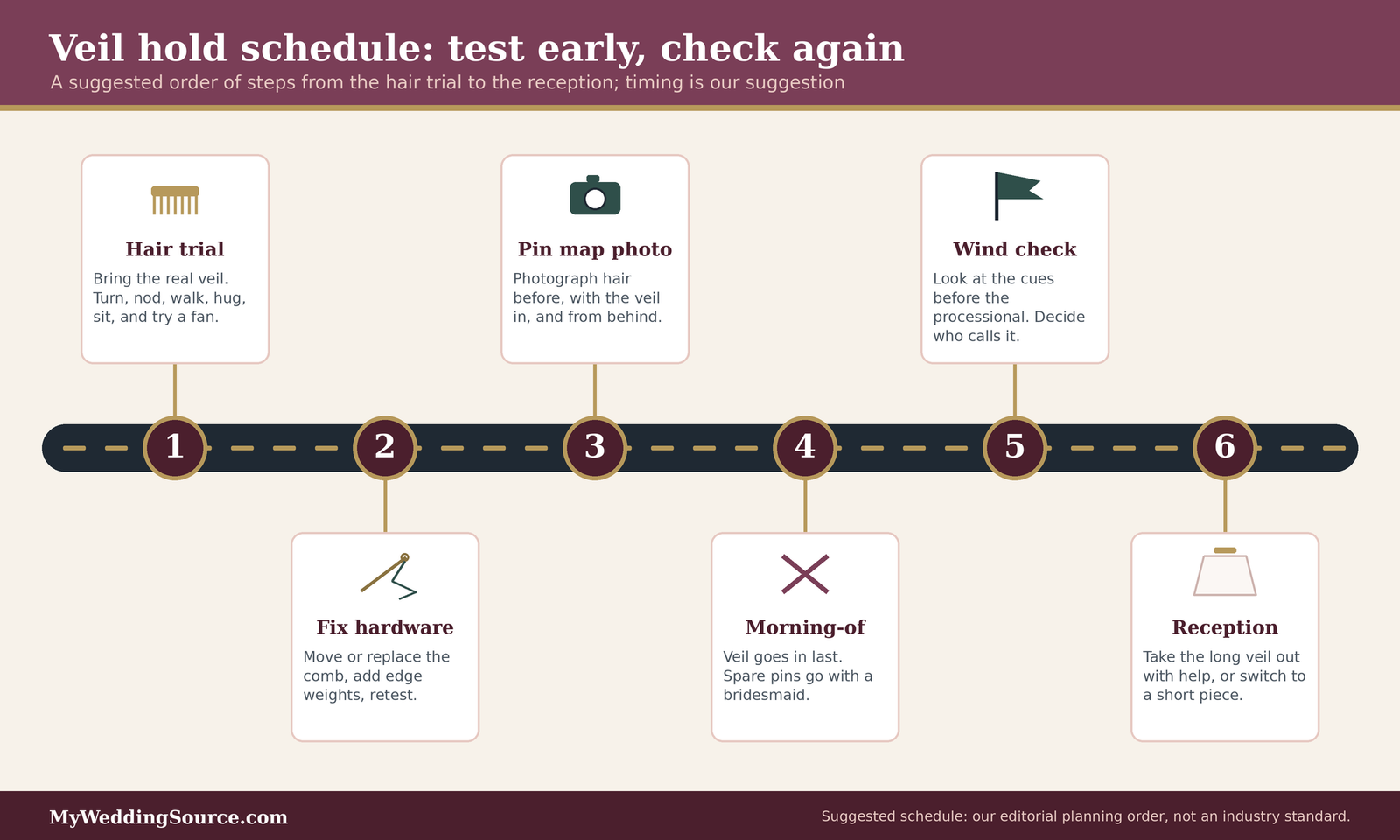
The schedule below follows the logic of wedding veil comb security: test early, adjust, then repeat the test close to the day. The timing is our suggestion, and your own calendar may differ.
At the hair trial
The trial is the best moment to test wedding veil comb security, because you learn how your veil actually behaves in your hair. Our guide to the wedding hair trial covers how to prepare, and the tips below add the veil.
Bring the real veil and the dress photo
Bring the actual veil, not a substitute, because comb size, weight, and trim differ. Bring a photo of your dress and your planned length, so your stylist can see how the veil and hair relate to the neckline and back. If the veil is not ready, ask the stylist to use a similar-weight piece for the trial and plan a second check.
Run the movement tests
Once the veil is in, do what you will do on the day. Turn your head side to side, nod, walk across the room quickly, hug someone, sit in a car seat, and bend to pick something up. Put the stylist’s pins and comb to use. If anything slides, tell them exactly when, so they can fix that spot. Stand in front of a household fan on a high setting as a rough wind test. This is not calibrated to any wind speed, but it shows whether the veil lifts sharply or twists.
Between the trial and the wedding
After the trial, take notes on wedding veil comb security while they are fresh. Small adjustments are easier to make with weeks to spare.
Photograph the pin map
Ask your stylist to photograph the hair before the veil goes in, with the veil in, and from the back. Sources recommend noting how a comb was secured before removing it so the style is not disturbed, and a photo makes that easy for you, your stylist, and bridesmaids on the day.
Fix hardware early
If the comb needs to be moved, replaced, or reinforced, or if you want to add edge weights, have a seamstress do it right away, then repeat a short test. If you ordered the veil online, check delivery timing. The Federal Trade Commission’s rule for mail, internet, and telephone orders says that a seller who advertises a shipping time needs a reasonable basis for it, and if no time is stated, must reasonably expect to ship within 30 days. Order early enough that a delay does not collide with the trial. Our sibling guide on wedding dress shipping for destination weddings covers longer shipping chains.
On the wedding day
On the day, wedding veil comb security shifts from testing to watching and adjusting. A short routine reduces surprises.
Morning: place the veil last
Ask your stylist to place the veil as the last step, after the hair is set, and to leave a spare set of matching pins with a bridesmaid or your planner. The wedding emergency kit is a good place to keep them. If you are changing outfits during the day, see our guide to bridal outfit changes for how to schedule it.
Before the ceremony: check the wind
Step outside before the processional and look at the same cues you noted at the venue. If the wind is stronger than forecast, you have options: switch to a shorter piece, add an extra set of pins, delay the veil until after the walk, or have a bridesmaid hold the end. Decide who gives the call, so it is not made in a rush.
After the ceremony: removal and the reception
A retailer guide suggests removing a long veil for the reception or dancing, and a stylist article advises asking for help when you do. Ask your stylist or a bridesmaid who saw the pin map to remove it, because pulling the comb out can disturb the style. If you will keep a short piece for the party, make sure it has its own secure anchor.
Questions to ask your stylist, seamstress, and venue
Good questions turn this guide into a working wedding veil comb security plan. We group them by who can answer, because each person controls a different link in the chain.
Questions to ask
- How would you anchor this veil in my hairstyle, and what are the other options?
- What happens to the hold if it is windy, and do you add extra pins for that?
- Can we test the veil with movement and a fan at the trial?
- Where will the comb sit, and where will the blusher fall?
- Can the comb be moved, replaced, or reinforced, and who does that?
- What is your plan if the wind picks up before the ceremony?
Questions for your stylist
Your stylist builds the anchor, so start here. Their answers show how they think about wedding veil comb security for your hair.
About the method and the plan
Ask which method they would use for wedding veil comb security with your hair length and texture, why they chose it, and what the backup is. Ask whether they have worked with a veil of this length and trim, and whether they can attend a short check on the day or have an assistant do it. Ask how many pins they use and how they hide them.
About comfort and removal
Ask how the hold will feel at hour six, how to tell if it is too tight, and how to remove the veil without disturbing the style. Ask whether they will mark the pin positions in a photo, and whether they stay for the ceremony or leave after the hair is done. Our guide to bridal hair and makeup planning and the hair and makeup schedule help you place these requests on the timeline.
Questions for the veil seller or seamstress
The seller or seamstress controls the comb, the trim, and the weight at the edge.
About the comb and the fabric
For wedding veil comb security, ask what material the comb is made of, where it is sewn, whether it can be moved or replaced, and how that is done without damaging the fabric. Ask about the weight of any trim, and whether the veil can be shortened or lightened if needed. Get answers in writing, particularly for any alteration, return, or exchange.
About timing and policies
Ask when the veil will arrive, what the return policy is if the comb does not work for your hair, and how long an alteration takes. For online orders, keep the order confirmation and any stated ship date. The Federal Trade Commission rule says that when a seller cannot ship on time, it must offer a choice between a delay and a refund, and that refunds follow set timelines. We are not giving legal advice, so check the rule or ask the seller.
Questions for the venue, planner, and photographer
Wedding veil comb security in the wind is a venue question as much as a hair question.
About wind and shelter
Ask the venue coordinator which direction the wind usually comes from, whether there are sheltered spots, and what the indoor backup is. Ask whether tents or structures change the airflow near the aisle. Our wedding photography rain backup guide shows how a weather plan interacts with photo timing, and the same logic applies to wind.
About photos and timing
Ask your photographer when veil photos are best taken, whether a calm spot is available, and whether a few portraits can be done before the ceremony with the veil, then the veil removed. Our wedding photographer shot list can help you list the veil shots you care about most.
Edge cases and special situations
Not every wedding fits a standard approach to wedding veil comb security. Here are situations that call for extra thought.
Beaches, rooftops, and lakefronts
Open water and open sky mean more wind and fewer places to hide. A veil can still work, and wedding veil comb security is still achievable with the right plan.
Plan for constant breeze
If a steady breeze is likely, our earlier bands suggest choosing a shorter, lighter veil with a stronger anchor and a quick-removal plan. The Knot says shorter, lighter veils are less likely to be blown around, so a shoulder or elbow length is a sensible starting point. Check the forecast for gusts too.
Plan for sand and slippery ground
Another guide advises thinking about whether fabric might catch on grass, sand, or uneven paths. A long veil can drag or snag on these surfaces, which pulls on the comb. Consider a bridesmaid to manage the length, or a shorter piece for the walk. Our beach wedding dresses guide covers fabric and hem choices that pair well.
Different hair types and hair accessories
Hair type affects wedding veil comb security, because it changes how well teasing, elastics, and pins work. A stylist who knows your hair is a real advantage.
Very fine, very smooth, or very thick hair
We found no published study of how hair type changes veil hold, so we do not make claims. Stylists use texture to add grip, and the methods above are their usual tools. Ask your stylist how they adapt for your hair, and ask to see a past example if they have one.
Extensions, tiaras, and headbands
If you plan to wear a tiara, headband, or hair extensions with the veil, tell your stylist early, because each adds weight or changes the base. A stylist source says heavy headpieces need a solid foundation. Our wedding tiaras guide explains how headpieces and veils can be paired, and your stylist can decide the order of placement.
Dancing, hugging, and photos
Even on a calm day, movement is part of wedding veil comb security.
The hug line and the dance floor
A long hug line is a repeated test of your anchor. If you plan to dance, consider removing the long veil beforehand, as a retailer guide suggests, and hand it to a bridesmaid or your planner. Our guide to the wedding first dance can help with timing.
Keeping the veil for photos
If you want portraits with the veil in motion, plan a calm location and time, and have someone ready to adjust it. A veil toss or wind-blown photo is a fun idea, but in our reasoning the pulling could loosen the comb, so ask your photographer and stylist to plan it before any other photos that need the veil to stay still.
FAQ: wedding veil comb security questions
Placement and hold
Where should the comb go for good wedding veil comb security?
It depends on your hairstyle. Stylists commonly place it above or beside an updo, where the top and lower sections of a half-up meet, or above the ear or at the back for loose waves. The comb should sit behind a firm base, with pins crossed over the teeth. Ask your stylist to confirm placement at your trial.
Are metal combs better than plastic ones?
Stylist sources say metal combs hold better with bobby pins, while plastic combs are harder to secure and may need extra pins or small alligator clips. If your veil has a plastic comb, ask whether a seamstress can replace it with metal. Test whichever you choose at the trial, using the movement checks before the wedding.
Can I wear a veil with loose hair?
Yes, but it is the hardest style, because loose hair gives the comb less to grip. Stylists suggest a lightweight side comb above the ear or at the back, and a shorter, lighter veil. A combless veil can fall out when the hair is down. Talk with your stylist early about the base.
Wind and weather
How much wind is too much for a veil?
There is no sourced threshold for veils. The National Weather Service describes a strong breeze at 25 to 31 mph as making umbrellas hard to use, which suggests a long veil would struggle as well. Plan around the forecast, venue shelter, and your veil length, and decide with your stylist whether to shorten or remove it.
Do heavier veils improve wedding veil comb security?
Sometimes. One stylist notes a heavy church-length veil, or an embellished cathedral veil, may stay down on its own weight, and magnets sewn into the edge can weigh a veil down outdoors. But more weight also pulls on the comb, so the anchor must be stronger. Test the actual veil rather than assuming.
What if the wind picks up right before the ceremony?
Have a plan: switch to a shorter piece, add an extra set of matching pins, delay placing the veil until after the walk, or have a bridesmaid hold the end. Decide ahead who makes the call and where the spare pins are. A wind check before the processional gives you time to adjust.
Day-of and after
How do I take the veil out without ruining my hair?
Note how it was secured before removal, and ask your stylist or a bridesmaid who saw the pin map to help. Sources advise finding the pins first, then easing out the comb in the direction it was set, rather than pulling. A photo of the pin positions from the trial makes this easier.
Can I keep the veil on for dancing?
You can, but a retailer guide suggests removing a long veil for the reception or dancing, since movement and fabric length work against the anchor, in our reading. If you want to keep a veil on, choose a short, light piece with its own secure anchor, and test it with the dance moves.
Your next steps
Prepare for the trial
List your decisions
Write down the inputs to wedding veil comb security: your hairstyle, veil length, venue exposure, and the wind you expect. Use the Veil Hold Planner above to find your row and band, then take it to your stylist so the conversation starts from a shared plan. Our wedding hairstyles and wedding veil meaning guides can help you decide the look first.
Book the trial with the veil in hand
Schedule the trial after the veil arrives, and ask for time to run the movement tests. If you are still choosing a veil, our guide to wedding veil traditions around the world can spark ideas, and the wedding dress hem length and dress fit and alterations guides help you see how length and fit work together.
Lock in the plan
Write it down and share it
Make a one-page wedding veil comb security note with the pin map photo, the veil length, the spare pins, and the wind fallback, and share it with your stylist, planner, and a bridesmaid. Include who decides about wind and where the spare kit is.
Add it to the day-of timeline
Place the veil step, the wind check, and the removal step on your wedding-day schedule so wedding veil comb security does not depend on memory. Our wedding hair and makeup schedule guide and bridal outfit changes guide can help you slot them in without a rush.
Sources & methodology
How we built this guide
What we relied on
This guide combines stylist and bridal-accessory advice on securing veil combs, retailer and editorial guides on veil lengths, the National Weather Service wind descriptions, the American Academy of Dermatology on hairstyles that pull on the scalp, and the Federal Trade Commission rule on mail, internet, and telephone orders. Where a statement comes from a stylist, retailer, or editorial site, we say so, because those sources describe their own practice and products. The wind-pressure figures and the Veil Hold Planner are our own arithmetic and editorial framework, and they are estimates, not measurements or industry standards. We fetched and read each page listed below on November 12, 2026, and we make no claim that they have not changed since.
What we did not do
We did not test veils, combs, or hair, and we did not find published measurements of veil weight, hold strength, or the effect of hair type, so we do not give any. We do not give legal, medical, or financial advice. A stylist can assess your hair, a seamstress can alter a veil, a board-certified dermatologist can advise on scalp or hair-loss concerns, and the Federal Trade Commission or a lawyer can advise on a purchase dispute.
Source list
Government and professional sources
- National Weather Service, Beaufort Wind Scale (Miami office): https://www.weather.gov/mfl/beaufort
- National Weather Service, Non-Thunderstorm Wind Hazards (Newport/Morehead City office): https://www.weather.gov/mhx/NonThunderstormWindHazards
- American Academy of Dermatology Association, Hair loss: hairstyles that pull: https://www.aad.org/public/diseases/hair-loss/causes/hairstyles
- Federal Trade Commission, Business guide to the Mail, Internet, or Telephone Order Merchandise Rule: https://ftc.gov/business-guidance/resources/business-guide-ftcs-mail-internet-or-telephone-order-merchandise-rule
Stylist, retailer, and editorial sources
- Tania Maras, 3 ways to secure a metal hair comb: https://www.taniamaras.com/3-ways-to-secure-a-metal-hair-comb/
- Tania Maras, This trick will make sure your veil stays in place: https://www.taniamaras.com/?p=136274
- Tania Maras, Wedding veils above or below the bun: https://www.taniamaras.com/?p=9385
- Tania Maras, What every bride should know about drop veils: https://www.taniamaras.com/?p=153572
- Style Me Pretty, How to rock a veil and gorgeous hair: https://stylemepretty.com/2016/02/21/wedding-day-veil-hairstyles
- Maggie Sottero, Wedding veil lengths: https://www.maggiesottero.com/blog/understanding-veil-lengths/
- The Knot, Common wedding veil styles and lengths: https://www.theknot.com/content/beautiful-wedding-veil-styles
- Kleinfeld, Guide to wedding veil lengths: https://kleinfeldagain.com/blogs/dress-guide/the-ultimate-guide-to-wedding-veil-lengths-from-delicate-fingertip-to-dramatic-cathedral