

Detachable wedding dress sleeves let one gown do two jobs, but the sleeves are only as good as the points where they anchor, the bodice that supports them, and the practice you put in before the day, so it pays to decide how they attach and how they must fit before you pay for anything.
Quick answer
Detachable wedding dress sleeves usually hold on with snaps, buttons and loops, hook-and-eye closures, or an elastic band, according to bridal retailers and designers. Ask which method your sleeves use, where it anchors on the gown, and who will sew those anchors. Plan on at least two fittings with the sleeves in your hands, finish alterations about a month before the wedding, and run a short movement test (hug, reach, sit, stairs, dance) before you sign off. Check the return policy first, because sleeves are sometimes final sale.
What detachable wedding dress sleeves are, and what they are not
Detachable wedding dress sleeves are separate sleeve pieces that fasten to a gown and come off again without cutting a thread. That sounds simple, but the phrase covers a wide range of products, from a pair of sheer tubes that stay up with elastic to a pair of beaded lace sleeves that button into hidden loops at the shoulder. Because the term is loose, two sellers can use the same words and mean very different things, and it is worth pinning the meaning down before you compare prices or fittings.
This guide treats detachable wedding dress sleeves as a fit-and-hardware problem. It does not rank sleeve styles by beauty, and it does not tell you whether sleeves suit your face or your faith. It explains how the pieces attach, what a tailor needs from you, what to test, and what to ask.
Defining the pieces
The vocabulary matters because each word implies a different amount of engineering. A sleeve that is shaped like a long fingerless glove is a different object from a sleeve that attaches at the shoulder seam.
Sleeve, strap, cap, and cover-up
A true sleeve covers some or all of the arm and attaches at the shoulder or the armhole. A strap is a narrow band over the shoulder that may or may not have fabric down the arm. A cap sleeve covers only the top of the arm. A bolero, capelet, or jacket is a separate garment that sits over the dress and does not need to be fastened to it at all. One bridal brand describes sleeves that attach with an elastic band around the arm, while another lists a bolero or bridal jacket as an alternative way to add coverage. Ask the seller which of these you are actually buying.
Included, add-on, or custom
Sleeves reach a bride in three common ways. Some gowns are designed with removable sleeves and sold with them; one David’s Bridal listing, for example, includes “removable sleeves” in the feature list for a strapless lace gown. Some designers sell matching sleeves separately. And some sleeves are made to order or built by a seamstress for a gown that has none. Essense Designs notes that sleeves can sometimes be custom-made if you love a gown that lacks a matching set. Each route changes who is responsible if the detachable wedding dress sleeves do not fit, and we return to that in the section on cost and paper.
Why people choose detachable wedding dress sleeves
The reasons are practical more often than aesthetic, and knowing yours helps you decide how much fit work is worth doing.
Two looks from one gown
Vows Bridal markets detachable sleeves to brides who want “two looks in one,” switching between a sleeved and a sleeveless version of the same gown. Justin Alexander describes wearing sleeves for the ceremony and photos and then removing them in the bridal suite for a sleeveless reception. Both are brand descriptions, so treat them as marketing, but the idea is sound: the same dress can handle a church aisle and a dance floor.
Coverage, weather, and comfort
Essense Designs says sleeves can add warmth for cool outdoor weddings and extra coverage for modest or religious ceremonies. Justin Alexander points to spring and fall weddings, where temperatures can swing. If your concern is cold or heat, our guides to the winter wedding weather plan and the summer wedding heat plan cover the surrounding logistics, and sleeves are one tool among several.
How detachable wedding dress sleeves attach: a decoder
Everything about fit and comfort follows from the attachment method. Retailers name a handful of options, and the same sleeve can often be adapted to more than one. The decoder below describes each method in plain terms, notes what the sources say about it, and flags what to check. The strength and visibility judgments in this section are our own reasoning from how the hardware works, not test results, so use them to ask better questions rather than as ratings.

The hardware family
Most detachable wedding dress sleeves use one of four small mechanical fasteners, often hidden in a seam or under a bit of lace. They differ in how forgiving they are of movement, how easy they are to fasten alone, and how much they show.
Snaps
Snaps are two interlocking metal or plastic discs, one sewn to the gown and one to the sleeve. A retailer page from Calla Blanche says snaps create a seamless look, and The Knot lists tiny snaps among common fasteners. Snaps are quick to close and open, which suits a mid-day sleeve change. The thing to ask about is spacing: a few snaps across a wide gap can leave the edge between them free to lift, so ask how many there are and how far apart they sit.
Buttons and loops
Calla Blanche describes buttons sewn inside the shoulder or neckline with matching buttonholes on the sleeve, and a variation with fabric or thread loops sewn inside the dress and buttons or hooks on the sleeve. This is the family most associated with traditional couture finishing. Buttons hold firmly, but they take longer to fasten and are hard to do on yourself, because the buttons sit at the back of the shoulder or inside the neckline where you cannot see them. If you choose buttons, plan on a helper and practice the sequence.
Hooks and eyes
A hook on one piece catches a fabric or thread loop on the other. Calla Blanche describes small metal hooks on the dress that catch loops on the detachable wedding dress sleeves, and Azazie lists lingerie hooks as a fastener. Hooks are flat and low-profile and can be placed precisely, but a hook that is under tension can slip free if the loop is too large, so a tailor will often add a second anchor nearby.
Concealed zippers
Justin Alexander lists concealed zippers alongside snaps, clasps, and elastic loops. A zipper runs the full length of the seam and distributes the pull, which could help with a heavier sleeve, though that is our inference and not something the brand states. Ask whether the zipper is sewn into the gown or into the sleeve, because a zipper that must be sewn into the bodice is a structural alteration and belongs with a professional.
The soft family
Not every sleeve is pinned in place by metal. Several common products rely on elastic, ribbon, or friction instead, and they come with their own checks.
Elastic bands and loops
Vows Bridal and Essense Designs both list an elastic band around the arm as one way a sleeve stays up, and The Knot describes a slip-on sleeve with no armhole, secured with elastic at the top, as the simpler route for a strapless gown. Azazie lists clear elastic loops among its fasteners. Elastic is quick and forgiving, but it has to be snug enough to hold without being tight enough to press into your skin or leave a mark in photos. Silver Bobbin advises cutting elastic to fit snugly, neither too tight nor uncomfortable. Test it over a full hour, not a five-minute try-on, because arms swell slightly with heat and activity.
Ribbon ties and bows
Azazie also lists ribbon ties hidden under bows. A bow can be a design feature as well as a fastener, which means it shows, and it can be retied for a different effect. It is the least secure of the options for a heavy sleeve, because a tie holds by friction. It suits lightweight tulle or chiffon.
Fashion tape and temporary fixes
Emmaline Bride mentions fashion tape or discreet snaps for keeping sleeves in place, and describes some cap sleeves or straps as lightly sewn. Tape is a last-minute backup, not a plan. Skin oils, sweat, and sunscreen can affect adhesion, so if you plan to rely on tape for any part of the day, test it on the same fabric at the same temperature and carry spare strips in your emergency kit. Our wedding emergency kit guide lists what else to pack.
Where the weight goes
Fasteners are only the visible part. The sleeve’s weight has to travel somewhere, and where it goes decides whether the bodice stays smooth.
The anchor and the load path
Azazie says detachable sleeves depend on hidden loops or snaps and a stable anchor to stay secure, and that attachment points must be engineered. In plain terms, the sleeve pulls down and outward, so each fastener needs fabric beneath it that is strong enough to resist that pull. On a boned or structured bodice, the anchor can be stitched into a seam allowance or a stay. On soft chiffon, an anchor may need a small patch of stabilizing fabric underneath so the fastener does not pucker the bodice.
Bodice support first
Azazie also says the bodice needs support first, and that heavy sleeves on a delicate bodice will pull. That means the order of operations matters: fit the dress to your body, then add the detachable wedding dress sleeves, not the other way around. If you are still losing or gaining weight, or if the bodice is not yet at its final fit, hold the sleeve attachment until the fit is settled. Our guide to wedding dress fit and alterations explains how the bodice stages usually run.
Which gowns accept detachable wedding dress sleeves
Not every neckline can take every sleeve. The neckline decides what is possible, a point The Knot makes plainly: not every dress suits every sleeve. The practical question is where the sleeve can attach and whether there is a stable place to attach it.
By neckline
The notes below draw on The Knot’s guidance for how a seamstress approaches each neckline, plus our own reasoning about anchor points.
Strapless and sweetheart
The Knot says many sleeve types work on a strapless gown. A slip-on sleeve with no armhole, secured with elastic at the top, is simpler, while full set-in sleeves require building up the neckline first. For detachable wedding dress sleeves, that means a strapless gown is flexible but may need anchor points added. The David’s Bridal listing for its detachable-sleeve gown, for instance, describes a strapless lace dress with a boned bodice and a sweetheart neckline, which gives the sleeve something firm to anchor to, though the page does not say how the sleeves attach.
Spaghetti straps and thin straps
The Knot notes that when a gown already has spaghetti straps, sleeves can be stitched onto them because the armhole already exists. For detachable versions, the same logic suggests snapping or hooking to the strap base and the bodice edge. A thin strap is not much of an anchor on its own, so ask how the sleeve’s weight is shared between the strap and the bodice.
Halter and high-neck designs
The Knot calls halter necklines harder, because of the neckline itself. It says illusion or detachable sleeves are more feasible and that an elastic slip-on is typical. Some halter designs have no shoulder seam to anchor to at all, so a tailor may need to add a stay or choose a different style of sleeve. A stylist quoted by The Knot suggested adding straps from the princess seam for a cold-shoulder look.
By silhouette and fabric
Beyond the neckline, the shape and fabric of the skirt and bodice influence which sleeves look right and which ones fight the gown.
Silhouettes
Kleinfeld Again says A-line and fit-and-flare gowns accommodate sleeve variations well and that ball gowns offer dramatic transformation. Treat that as a resale retailer’s view. The principle that matters for fit is balance: the page advises keeping the silhouette balanced whether the detachable wedding dress sleeves are on or off, so check the gown in the mirror both ways and make sure neither look feels unfinished.
Fabric and weight
Azazie warns that heavy sleeves on a delicate bodice will pull, so match sleeve weight to gown weight. Emmaline Bride recommends lightweight fabric to avoid bulk or overheating and suggests simpler sleeves on heavily detailed bodices. Silver Bobbin cautions that stretchy knit fabrics flop rather than puff, which matters if you want a structured puff or bishop shape. Color needs matching too: the same page notes that ivory satin may clash with stark white tulle, so view the sleeve and the gown together in daylight and under indoor lighting.
By body and proportion
Fit is personal, and retailer advice on proportion is opinion, not law. Use the ideas below as prompts for a conversation with your tailor.
Proportion suggestions from retailers
Kleinfeld Again suggests cap sleeves that come off to reveal slim straps for petite brides, saying this can elongate the torso, and three-quarter-length sleeves for fuller-figured brides. These are one retailer’s suggestions and are not rules. Our guides to petite wedding dresses and plus-size wedding dresses go into proportion and tailoring in more depth.
Arm measurements matter more than dress size
Silver Bobbin describes measuring around the upper arm and giving puff sleeves extra fullness, and it describes pinning off-the-shoulder sleeves on the wearer before trimming. The upshot is that sleeves fit an arm, not a dress size. Arm circumference, the length from shoulder to wrist, and how much your arms move all matter. If sleeves come in standard sizes, ask whether the sleeve can be taken in or let out, and how.
The fitting plan for detachable wedding dress sleeves
Detachable wedding dress sleeves that arrive in a box and look right on a hanger can still fail on a moving body. A fitting plan turns that risk into a short list of checks at predictable moments. The plan below blends what Azazie, The Knot, and Silver Bobbin say about fittings with our own suggestions for what to bring and what to record.
Before you commit
The cheapest time to find a problem is before you buy. A few questions and a few minutes with the sleeve on the gown can save a return you may not be allowed to make.
Try the sleeves on the actual gown
The Knot says many bridal salons sell pre-made sleeves and can clip them on so you can preview the look, and it warns that many sleeves cannot be returned, so check with your seamstress before buying. Justin Alexander makes a similar point from the design side: sleeves should not look like an add-on but like part of the dress. A preview with clips is not the same as a fitted preview, but it answers the first question, which is whether the sleeve belongs on this gown at all.
Ask the seamstress before you pay the seller
If you plan to use a tailor, show the detachable wedding dress sleeves and the gown to the tailor before purchase when you can. A tailor can tell you in a few minutes whether the anchors can be added cleanly, whether the bodice can carry the weight, and whether the sleeve length is workable. If you cannot do that, ask the seller for the return terms in writing and keep the tags on.
The fitting sequence
Azazie describes detachable sleeves as needing two fittings over a window of four to six weeks, with a sequence of design and attachment test, placement, and comfort check. Silver Bobbin says professional work usually involves a fitting and then a return visit to collect the dress. The sequence below is built around those ideas and adds a few of our own checkpoints.
First fitting: design and anchor test
Bring the detachable wedding dress sleeves, the shoes you will wear, the undergarments you will wear, and a friend if the tailor allows it. Azazie advises bringing the sleeves to every fitting. At this first visit the tailor decides the method, marks the anchor points, and checks whether the bodice needs reinforcement. Ask the tailor to explain the plan in plain terms: where each fastener goes, what will be sewn into the gown, and what, if anything, cannot be undone.
Second fitting: placement and length
Azazie places basting of the sleeve and the setting of its length at the second fitting, about four to six weeks out. This is when you do the movement test described in the next section. Ask the tailor to leave the basting in place until you have worn the sleeves through a full movement test, because basting is easier to change than finished stitching.
Final check: the full dress rehearsal
Before you leave the last appointment, put the detachable wedding dress sleeves on and take them off at least twice, with the person who will help you on the day watching. Azazie recommends practicing the on-and-off routine. Photograph the gown with and without the sleeves in daylight, because Emmaline Bride suggests taking photos with and without sleeves in different lighting to see how the combination reads.
What to bring and what to record
A fitting goes better with a small kit and a record that outlasts the appointment. The suggestions below are ours.
The fitting kit
Bring the detachable wedding dress sleeves in the bag or box they came in, the shoes you will wear, the underlayers you will wear, a phone for photos, and any jewelry that sits near the sleeves. The Knot notes that sheer lace sleeves can catch on rings, so wear the rings you plan to wear on the day, at least once, to see whether they snag. Azazie suggests storing sleeves in a labeled sleeve bag, which doubles as a way to keep the pair together between visits.
The fitting record
Write down the method used, the number and position of fasteners, who sewed them, the date, and the sleeve length you settled on. Photograph the inside of the shoulder seam if the tailor allows it. This record makes it possible for another tailor or a helper to follow the plan if the original tailor is not available on the day, and it is a useful reference if a fastener fails.
The sleeve fit test: a movement checklist you can run at a fitting
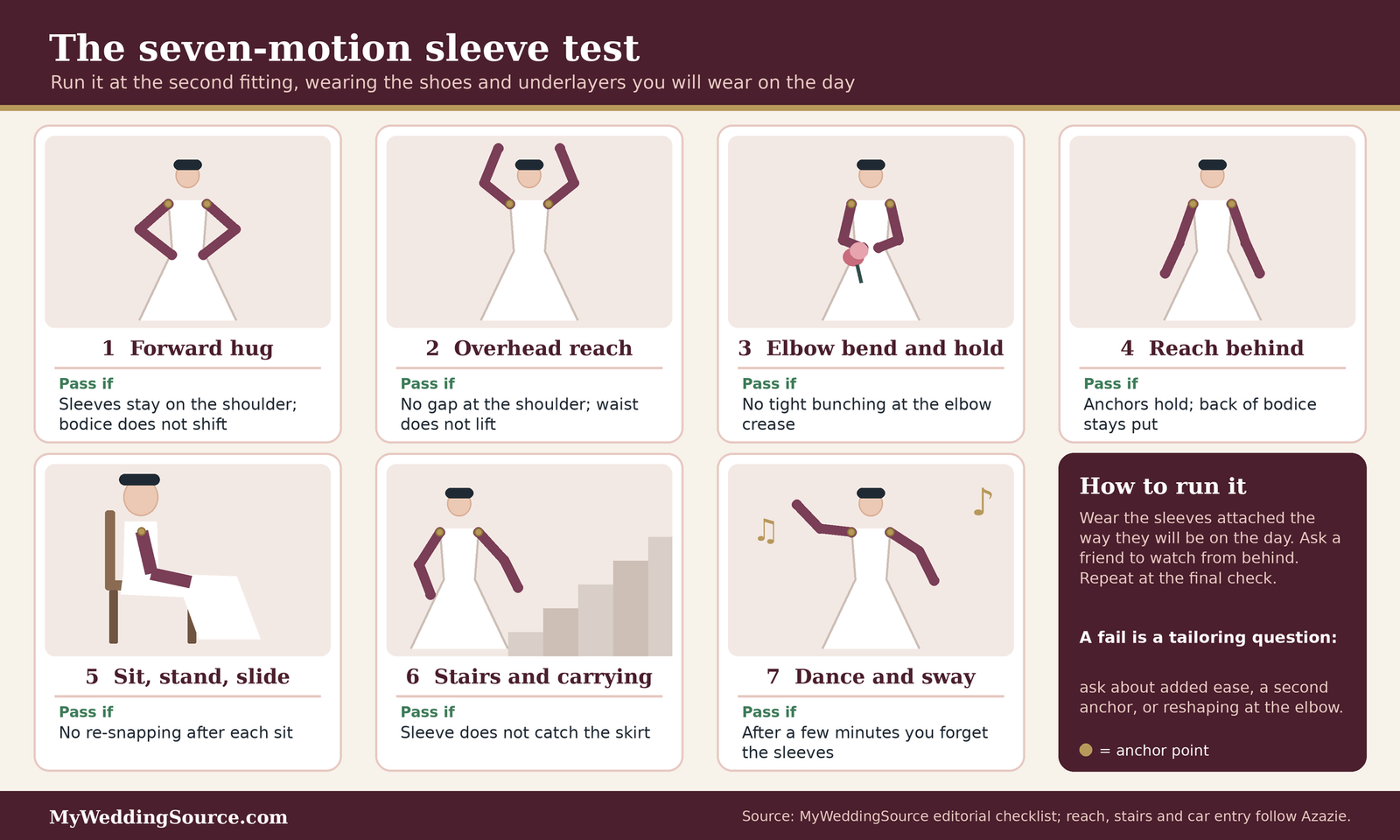
Most fit problems with detachable wedding dress sleeves appear only when the arms move. A sleeve that sits perfectly while you stand still may twist when you hug, ride up when you reach, or pull the bodice off your body when you raise your arms. The test below is our own checklist, built from the situations that sources such as Azazie flag, including reach, stairs, and car entry, and from the moments a wedding day actually contains.
Run it at the second fitting, with the detachable wedding dress sleeves attached the way they will be on the day, and run it again at the final check. Wear the shoes and underlayers you will wear. Take your time. If you can, have a friend watch from behind, because many problems are visible only from the back.
The seven motions
Each motion mirrors a real moment. The pass criteria are ours, and they are about comfort and appearance, not safety certifications.
Forward hug and shoulder roll
Wrap your arms around a friend and hold for a few seconds, as you will with parents and grandparents. Pass: the detachable wedding dress sleeves stay on the shoulder without sliding forward, the bodice does not shift, and you can breathe normally. Fail: the sleeve rotates toward the front, the anchor points show, or the bodice pulls away from your back.
Overhead reach
Raise both arms as if adjusting a veil, hugging a tall guest, or cheering on the dance floor. Pass: the sleeve rises with the arm without dragging the bodice upward, and no gap opens at the shoulder. Fail: the dress lifts at the waist, the neckline gapes, or the fasteners strain. Azazie suggests a micro-gusset or additional ease if sleeves tug or lock during mobility checks, so ask the tailor what the options are.
Elbow bend and hold
Bend your elbows to ninety degrees as if holding a bouquet at the waist or raising a glass for a toast. Pass: the fabric folds without bunching tightly at the inside of the elbow, and the sleeve does not creep up the forearm. Fail: the sleeve pinches the crook of the elbow or the cuff rides up. Elbow shaping is one of the specific adjustments Azazie suggests asking for.
Reach behind
Reach back as if pulling a seat belt across, adjusting the dress as you sit, or hugging someone who is next to you. Pass: the sleeve stays in place and the back of the bodice is not pulled forward. Fail: the sleeve feels like it is anchored to a seam that is working against your reach.
Sit, stand, and slide
Sit on a chair and a car seat, then stand up, and repeat. Azazie suggests checking car entry as part of the mobility test. Pass: the detachable wedding dress sleeves do not catch on the seat, the arms rest naturally, and you can stand without readjusting. Fail: you need to re-snap or re-hook after each sit. Our guide to sitting and using the restroom in a fitted wedding dress walks through the seated part of the day.
Stairs and carrying
Climb a flight of stairs while holding the front of the skirt with one hand and a bouquet-sized object in the other. Azazie lists stairs among the movement checks. Pass: the sleeve stays put when the arm swings and lifts. Fail: the sleeve catches the skirt, or the fasteners pull when you grip the fabric.
Dance and sway
Play a song and move as you would at the reception: sway, turn, lift your arms, and hold a partner. Pass: after a few minutes nothing has shifted and you do not feel the detachable wedding dress sleeves. Fail: you are thinking about the sleeves instead of the music. If the failure is in the sleeve change plan and not in the fit, that is a sign the sleeves are better as a ceremony-only layer.
Reading the results
A fail does not mean the detachable wedding dress sleeves are wrong. It means the fix is a tailoring decision, not a shopping decision, and that is the point of running the test before the final payment.
Fixes a tailor may propose
Azazie mentions adding ease or a micro-gusset when sleeves tug or lock, and it suggests elbow shaping and a sleeve length set at the second fitting. Other fixes depend on the method. A tailor might add a second fastener to share the load, replace snaps with a hook-and-loop combination, adjust the elastic, reshape the armhole edge, or reinforce the bodice under the anchor. Ask what each fix does to the dress without the detachable wedding dress sleeves, because a fix should not leave the sleeveless look unfinished.
When to choose a different sleeve
If the sleeve fails in several motions, or if the fix would require a structural change to the bodice, consider a different sleeve or a lighter fabric. Silver Bobbin describes inset long sleeves as a lot of work best left to a professional tailor, and says sewing sleeves into a finished gown is tricky even for a professional. If a gown is not designed for sleeves, the more your plan depends on structural work, the more worthwhile it is to see a tailor early.
A timeline for detachable wedding dress sleeves
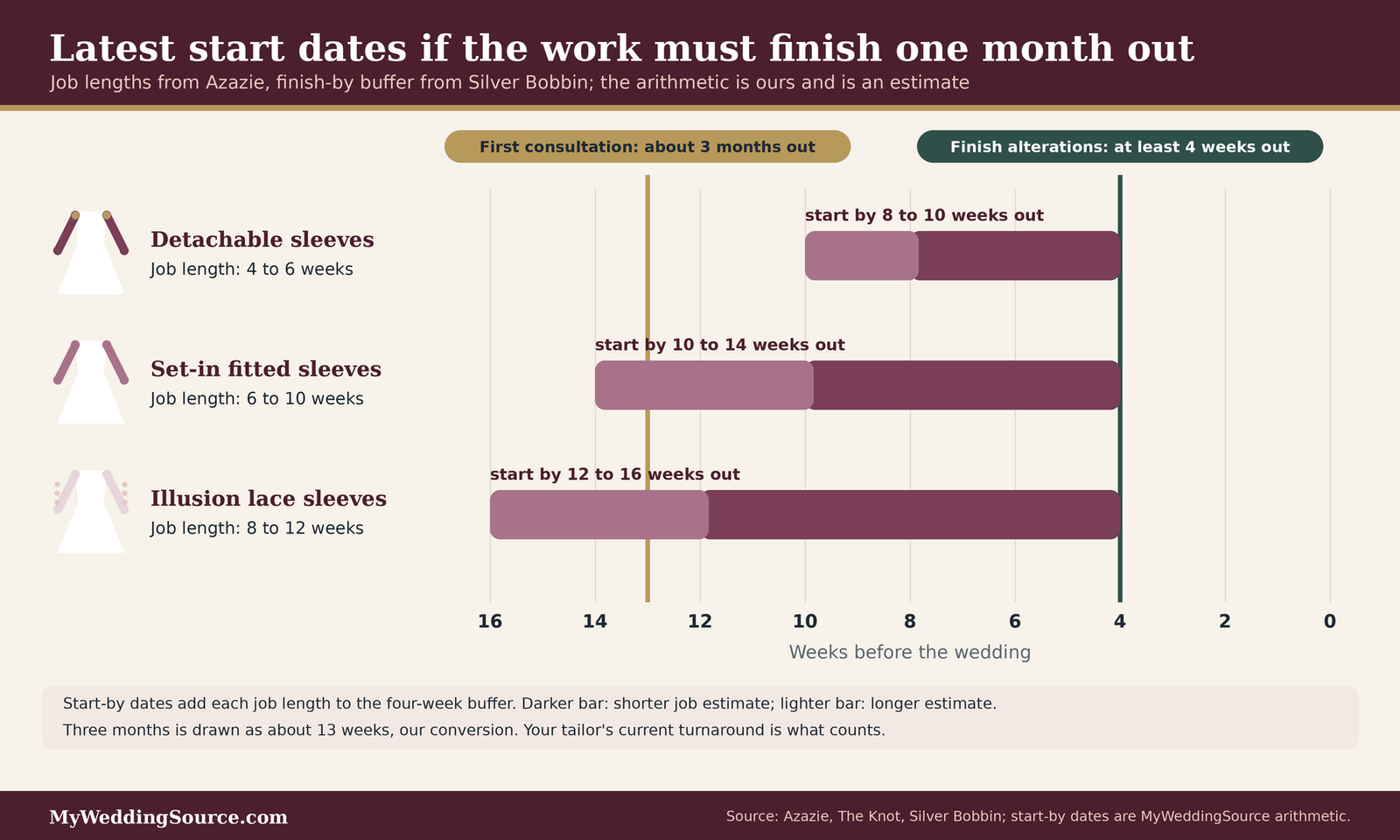
Time is the most common reason that a sleeve plan fails. Alterations queues fill up near wedding season, sleeves may need to ship, and the second fitting depends on the first. The numbers below come from retailers and a sewing business, and they describe typical windows, not guarantees. Ask your own tailor for their current turnaround.
Working backward from the date
The sources give three anchor points, and together they sketch a timeline you can adapt.
Three months, six weeks, one month
The Knot suggests scheduling the first consultation about three months before the wedding so there is room for multiple fittings. Azazie describes detachable sleeves as a four to six week job, compared with six to ten weeks for set-in fitted sleeves and eight to twelve weeks for illusion lace, and it calls detachable puffs a good rush option. Silver Bobbin recommends finishing alterations at least a month before the wedding to allow for a tailor’s backlog. If you set the final sleeve decision about three months out, book the second fitting about six weeks out, and aim to have everything finished about a month out, you leave a buffer in each stage.
Shipping and lead times
Silver Bobbin notes that online detachable sleeves involve shipping time, while putting them on takes about thirty seconds. Custom or made-to-order sleeves can take longer, and Calla Blanche mentions customization such as sleeve length and embroidery without giving lead times, so ask for one in writing. If sleeves are coming from outside the country or from a small maker, add extra buffer. Our guide to wedding dress shipping for destination weddings covers how to move a gown and its parts safely.
If time is short
A tight timeline changes the plan but does not make it impossible. The trade-off is fewer fittings and less room for adjustment.
Rush options
Azazie calls detachable puffs a good rush option because they go on and off in seconds, and Emmaline Bride says no-sew sleeves can be added on the day of the wedding. A clip-on or elastic sleeve that has been tested at home can be a sound backup, provided you test it with the gown. A tailor may also offer a rush fee, which is a commercial term to ask about and not something any source quantifies.
What to skip when you are short on time
If time is tight, skip anything that needs new construction inside the bodice. Choose a lightweight sleeve with a soft attachment, do the movement test at home with a helper, and keep a backup fastener kit. If you have a tailor on your team, ask which adjustments can be done within a week and which cannot.
Cost, returns, and paperwork for detachable wedding dress sleeves
Money is where detachable wedding dress sleeves surprise people, because the cost has three separate parts: the sleeves, the attachment work, and the risk that you cannot return them. The published figures are scattered, come from sellers and a sewing business, and sometimes disagree. Treat every number below as one source’s claim, not a market price, and get written quotes for your own gown.
What the sources say about cost
- Sleeves themselves: Emmaline Bride puts sheer overlays and fingerless gloves under about $50 and retailer sleeves at roughly $50 to $100. Silver Bobbin says detachable sleeves on Etsy range from about $25 to $1,000.
- Tailor work: Silver Bobbin lists sewing sleeves into a dress at about $200 to $400, shortening or tapering existing sleeves under $100, adding straps at about $20 to $80, and says David’s Bridal in-shop sleeve alterations run $150 to $500. The same page also lists general professional alterations at $100 to $500, so its ranges overlap and are not exact.
- Brand claim: Justin Alexander says detachable sleeves are more budget-friendly than paying a seamstress to design, measure, and sew sleeves into a gown. That is a seller’s comparison.
- Not priced in the sources we read: the labor to add anchors to a gown for sleeves that were bought separately. Ask your tailor for a written quote.
How to budget without a market price
Because the sources do not give a single price, the useful skill is breaking the cost into pieces you can ask about.
A line-item sketch
List four lines: the detachable wedding dress sleeves, the attachment work, any bodice reinforcement, and a small contingency for a second round of adjustments. Fill in only the numbers you have been quoted. Our arithmetic is simple and it is an estimate: if you pick an inexpensive retailer sleeve in the range Emmaline Bride describes and add a tailor visit in the range Silver Bobbin lists for strap work, the total stays far below the upper end of a sewn-in sleeve, but we cannot give your tailor’s price, and prices vary by region and by the complexity of your gown. Our wedding budget calculator can hold the figures once you have them.
Resale and rental effects
Silver Bobbin warns that alterations may lower resale value, especially for designer gowns. If you plan to sell the gown, ask whether the attachment work can be done in a way that leaves no permanent change, such as sewing fasteners into removable stays. If you are renting, read the rental terms before anyone touches the dress; our renting wedding dresses guide covers the terms worth reading before a rental.
Returns and final sale
Returns are the most overlooked line in a sleeve purchase. A sleeve that has been clipped, basted, or sewn is hard to return even when the policy allows it.
Read the policy before you pay
The Knot says many sleeves cannot be returned. The David’s Bridal listing we reviewed for a gown with detachable sleeves marks the item as final sale. A listing is not a contract, and policies change, so ask for the current terms in writing before you pay, and ask what counts as unworn.
Put the plan in a contract
If a tailor will sew anchors, ask for a written estimate that names the work, the number of fittings, the due date, and what happens if the sleeves do not work. Our wedding vendor contract guide lists the clauses worth asking for in any vendor agreement. This guide is not legal or financial advice; if a dispute arises, a consumer protection office or an attorney can advise you.
Labels and what they cover
Federal labeling rules affect what you can expect on a sleeve’s tag, and they matter more than people expect once the sleeve is a separate item.
Care labels on separate pieces
The FTC’s Care Labeling Rule applies to manufacturers and importers of textile clothing. The FTC says a multi-piece outfit sold as a unit needs only one label if all the pieces share the same care instructions, but pieces that need different care, or that are sold separately, each need their own. It also says a detachable component such as a slip-out liner needs its own label if its care differs from the main garment’s. That is the model for detachable sleeves in principle, but the FTC page does not address wedding sleeves by name, so ask the seller what the label on each piece says. The FTC also says gloves are exempt from the care label requirement, so do not assume a glove-style sleeve carries one.
Fiber content labels
The FTC’s guidance on textile labeling says items that are not always sold together must be labeled individually, and that trim and decorative elements are generally excluded from the fiber disclosure. In practice, if the detachable wedding dress sleeves are sold separately from the gown, ask for the fiber content of the sleeves so you can judge heat, drape, and care.
Wearing detachable wedding dress sleeves on the day
The plan matters most at the moments when you cannot stop and adjust. A sleeve that holds through a fitting can still be a distraction if the change takes ten minutes and three helpers. The notes below are our suggestions, built on what the retailers describe, and they are meant to be adapted to your schedule.
The sleeves-on stretch
For many couples the detachable wedding dress sleeves cover the ceremony, family photos, and the first part of the day. Justin Alexander describes this pattern.
Putting them on
Practice the sequence in the order you will use. If your fasteners are at the back of the shoulder, plan for a helper to close them. Azazie suggests a sleeve buddy, a person who knows how to do the on-and-off routine. Silver Bobbin says putting online-purchased detachable sleeves on takes about thirty seconds, which is a reasonable target for a practiced routine, though your own gown may take longer. Write the order of steps on a card and give a copy to the helper.
Hair, makeup, and jewelry
Lace and tulle can catch on rings, earrings, and hair accessories. The Knot warns that sheer lace sleeves can catch on rings and suggests turning rings inward when putting the gown on. Sleeves also pass close to the face and neck, so check them against your makeup, because foundation may transfer to light fabric. Our wedding hair and makeup schedule explains the usual order of the morning, and that order matters here: the detachable wedding dress sleeves usually go on last.
The change
The moment the detachable wedding dress sleeves come off is the moment people remember to plan too late. It needs a place, a person, and a bag.
Where and when
Justin Alexander suggests removing sleeves in the bridal suite between the ceremony and the reception. Build the change into the timeline, with a private room, a mirror, a chair, and a few minutes. Our wedding vendor timeline guide shows where such buffers fit around photography and dinner.
Where the sleeves go
Azazie advises storing sleeves in a labeled sleeve bag. Hand the bag to the helper, not to a guest, and name a place it will stay for the rest of the night. Detachable wedding dress sleeves left on a chair in a venue’s bridal room can be lost, stepped on, or confused with another bag. If you plan to put them back on for a late photo or a send-off, say so before the change.
Photos and the sleeve decision
Photographers need to know which look comes when, because a sleeve change affects the shot list.
Order the photos around the change
Emmaline Bride suggests taking photos with and without sleeves in different lighting. If you want portraits in both looks, tell your photographer in advance. A first look is often a good time to capture the sleeved look at full light; our first look photo guide covers the schedule, and our photographer shot list shows how to ask for a gown detail shot of the fasteners and the sleeve edge.
Edit expectations
If a fastener shows in an image, a retoucher may or may not remove it, and our article on wedding photo retouching requests covers retouching requests. Better still, check the shoulder in photos from your fitting. A visible snap line is easier to fix before the day than in an edit.
Caring for and storing detachable wedding dress sleeves
Care is the part of this topic where sellers say the least. Several of the pages we read did not mention cleaning or storage at all, and one major retailer listing gave a care instruction only for the dress as a whole. The honest answer is that you need the label, and if there is no label, a written answer from the seller.
Read the label first
The label on each piece is the authority, and a blog post is not.
What the label should tell you
Under the FTC’s rule, a care instruction must have a reasonable basis, and a label must stay legible for the garment’s useful life. If a sleeve has its own label, follow it. If it does not, ask the seller. The David’s Bridal listing we reviewed lists dry cleaning for the dress as a whole and has no separate sleeve note, which is exactly the gap to ask about. We cannot promise that any method will remove a stain or preserve a fabric, and neither should a seller.
What blogs suggest, with a caution
Emmaline Bride suggests hand-washing delicate sleeve fabrics in cold water, air drying, and storing them flat or in a garment bag. That is one blogger’s advice and conflicts with a “dry clean only” label if the label says so. Beads, adhesive trims, and lace can react differently from the gown, so if in doubt, consult a professional cleaner and tell them the detachable wedding dress sleeves are separate.
Handling and storage
Most damage to detachable wedding dress sleeves happens in the gaps: in the car, in the venue, in a bag.
Between fitting and wedding
Keep the detachable wedding dress sleeves flat in the bag, away from direct sun and moisture, and out of sight of children and pets. Azazie’s labeled sleeve bag is a simple model. Keep small spare fasteners in a labeled envelope inside the same bag.
Spills and snags on the day
Carry a small repair kit with a needle, matching thread, spare snaps or hooks, and a few safety pins, along with a stain pen your cleaner approves. Our wedding emergency kit guide has a fuller list, and our article on wedding dress stain removal explains what to try and what to leave to a professional.
Edge cases that change the answer
Most advice assumes a new gown, a local tailor, and a standard body. Real plans are messier. The cases below are the ones that most often change the decision.
Gown source and condition
Where the gown came from changes what you are allowed and able to do.
Pre-owned and sample gowns
Kleinfeld Again says sample and gently worn gowns from premier designers often include their original detachable components, usually at a lower price than boutique originals. It is a resale retailer, so check each listing: confirm in writing that the detachable wedding dress sleeves are included, that they match the gown, and that the anchor hardware is intact. Compare with the listing details, because the page does not say whether listed prices include the sleeves.
Rental gowns
Rental terms may restrict permanent changes, so a sleeve that requires sewing may not be allowed. Ask before you book, and ask whether clip-on or elastic sleeves are acceptable. If the shop offers sleeves of its own, ask how they attach and what it charges if the fastener is damaged.
Ceremony, travel, and weather
The setting can change which sleeve works, how it is carried, and when it is worn.
Religious and modest ceremonies
Essense Designs says sleeves can add coverage for modest or religious ceremonies. If your officiant or venue has a dress code, ask for it early and bring the sleeves to the conversation, since coverage rules sometimes specify shoulders or length. If the sleeves come off after the ceremony, confirm that this is acceptable at the venue. Our guide to the wedding ceremony explains how to coordinate with an officiant.
Destination and beach settings
Detachable wedding dress sleeves have to travel with you, which means pressing, packing, and and a check of your airline’s carry-on rules. Pack them in the labeled bag in your carry-on, not the checked bag, and take your fasteners kit. For a beach look, lightweight tulle may suit the conditions, and our guide to beach wedding dresses covers wind and sand. Our guide to wedding dress shipping for destination weddings covers sending a gown ahead.
When detachable is not the answer
Detachable wedding dress sleeves are one of several ways to add coverage, and sometimes another route is better.
No-sew and borrowed alternatives
Emmaline Bride lists capes, boleros, shrugs, and fingerless gloves among its no-sew options and calls fingerless gloves its top pick for no-sew bridal sleeves. Essense Designs lists a full bodysuit worn under the gown and a bolero or bridal jacket as alternatives. Borrowing a bolero is an option the blogger raises too. These routes avoid structural work and can be tested at home, though they may not match the gown as precisely.
Sewn-in sleeves and a different gown
Azazie calls sewn-in sleeves the cleanest designed-in look, and says set-in fitted sleeves take six to ten weeks. If you want sleeves for the whole day, a gown designed with sleeves may be easier than adding them to one that was not. If you are adding sleeves to a gown that has none, accept that you are changing its design and talk to a tailor early. If you have a gown you love, a seamstress may be able to build sleeves from excess hem fabric or a closely matching fabric, as The Knot notes.
Questions to ask about detachable wedding dress sleeves
Vague answers are the main risk with sleeves, because the details that decide success are small: a fastener type, a count, a due date. Ask for the answers in writing, and keep them with your fitting record.
Questions to ask before you pay
- How do these sleeves attach, and how many fasteners are there on each side?
- Is the attachment hardware already on the gown, or will it be added, and by whom?
- Can the attachment be removed later without a visible change to the gown?
- Are the sleeves included in the gown price, and are they final sale?
- What are the fiber content and care instructions for the sleeves, and is there a separate label?
- How many fittings will be needed, and when is the last date you can finish the work?
- What happens if the sleeves do not pass our movement test?
- Who can help me put the sleeves on, and can you show my helper the routine?
Questions for the seller
These questions confirm what you are buying and what you can undo.
Product and policy
Ask whether the detachable wedding dress sleeves are included, whether they are sized or custom, and what the return rules are. The Knot says many sleeves cannot be returned, and one major retailer listing we reviewed marks a gown with detachable sleeves as final sale, so get the current policy in writing. Ask what the seller will do if the sleeves arrive in the wrong color or fiber.
Care and labeling
Ask for the label information on the detachable wedding dress sleeves, not only the dress. The FTC says pieces that need different care or that are sold separately need their own labels. If the answer is that the sleeves are dry clean only, ask what the seller bases that on, and whether the sleeves can be cleaned separately from the gown.
Questions for the tailor
These questions turn a general plan into a specific one.
Method and structure
Ask what the tailor will sew into the gown, where the anchors will sit, how the bodice carries the weight, and whether anything will change the sleeveless look. Ask whether the anchors can be removed later. Silver Bobbin warns that alterations may reduce resale value, so if resale matters to you, say so at the first fitting.
Schedule and backup
Ask how many fittings are included, when the last one is, and what the tailor’s turnaround is right now. Silver Bobbin recommends finishing alterations at least a month before the wedding. Ask what the backup plan is if a fastener fails, and whether the tailor will show your helper how to repair one.
Questions for your helper and your photographer
The people around you decide how smooth the change is on the day.
The helper’s role
Ask your helper to attend the final fitting, practice the on-and-off routine twice, carry the repair kit, and hold the sleeve bag. Azazie recommends a sleeve buddy. Give the helper a written copy of the steps and the tailor’s phone number.
The photographer’s role
Tell your photographer when the detachable wedding dress sleeves come off and whether you want portraits in both looks. Ask for a detail photo of the shoulder and sleeve edge. If you want the sleeves back on for a late shot, say so before the change.
FAQ: detachable wedding dress sleeves questions
Attachment and fit
How do detachable wedding dress sleeves stay on?
Retailers describe snaps, buttons with loops, hook-and-eye closures, concealed zippers, and elastic bands, sometimes with ribbon ties. Which one fits depends on the gown and sleeve weight. Ask which method yours uses, where it anchors, and who will sew the anchor points, since heavier sleeves need a stable base.
Can sleeves be added to any wedding dress?
Not every neckline accepts every sleeve, according to The Knot. Strapless and spaghetti-strap gowns are generally easier, while halter necklines are harder and often need an elastic slip-on or illusion sleeve. A tailor can tell you in one visit whether your gown has a stable place to anchor.
Will detachable sleeves limit my movement?
They can if the attachment points or the sleeve fabric are wrong. That is why a movement test matters: hug, reach overhead, bend your elbows, sit, climb stairs, and dance while wearing them. If something pulls, a tailor can add ease or reshape the sleeve, as Azazie suggests.
Timing and cost
How long does it take to add detachable sleeves?
Azazie describes detachable sleeves as a four to six week job with two fittings, faster than set-in sleeves. The Knot suggests starting about three months out, and Silver Bobbin suggests finishing alterations at least a month before the wedding. Ask your own tailor for current turnaround.
How much do detachable wedding dress sleeves cost?
Published figures vary widely. Emmaline Bride places retailer sleeves at roughly $50 to $100, and Silver Bobbin says Etsy listings range from about $25 to $1,000, plus tailor fees. These are one page’s claims, not market prices, so get written quotes for the sleeves and the attachment work.
Care and day-of
Can I return detachable sleeves if they do not fit?
Possibly not. The Knot says many sleeves cannot be returned, and one retailer listing we reviewed marks a gown with detachable sleeves as final sale. Read the policy before you pay, keep tags on until the tailor confirms the plan, and get any promises in writing.
How do I clean detachable sleeves?
Follow the label on the sleeves. The FTC says separately sold pieces need their own care labels, and a dress label may not cover them. One blog suggests cold hand-washing for delicate fabrics, but that can conflict with a dry clean label, so ask a professional cleaner if unsure.
How do I change out of the sleeves during the reception?
Plan a private room, a helper who has practiced the routine, and a labeled bag for the sleeves. Justin Alexander describes removing them in the bridal suite after the ceremony and photos. Tell your photographer when the change will happen so portraits in both looks can be planned.
Your next steps
Decide the sleeve plan
Start with the decisions that everything else depends on.
Name the job the sleeves must do
Write one sentence: warmth, coverage, a second look, or comfort on a long day. That sentence tells you how much fit work is worth doing and whether a no-sew option is enough. If the job is only a second look in photos, a lightweight clip-on piece may be all you need.
Choose the attachment method with your tailor
Bring the gown and the detachable wedding dress sleeves to a tailor before you finalize. Ask which of the methods in this guide fits your neckline and fabric, and get the plan in writing. Our wedding dress alterations guide explains how to find and brief a tailor, and our wedding dress fit and alterations guide explains the fitting stages.
Run the test and set the day
Then protect the plan with a rehearsal and a schedule.
Do the movement test twice
Run the seven motions at the second fitting and again at the final check, and write down what changed. If something fails, ask for a fix, not a shrug. Our guide to wedding dress train lengths explains the other big mobility decision for the gown.
Build the change into the day
Add the sleeve change to your schedule, name the helper, and pack the repair kit. Our wedding week checklist shows where such tasks fit in the final days, and our wedding veil comb security guide covers another small item that benefits from a test.
Sources & methodology
How we built this guide
What we relied on
This guide combines published guidance from bridal retailers, designers, and a sewing business about how detachable sleeves attach, fit, and are altered, plus two Federal Trade Commission resources on care labeling and textile labeling. Where a statement comes from a seller, we say so, because seller advice reflects the seller’s products. The movement test, the decoder judgments, and the budgeting sketch are our own reasoning and are not test results. We checked these pages on November 12, 2026; products, prices, and policies change, so verify current terms before you buy.
What we did not do
We did not test sleeves, measure bodies, or interview tailors, and we did not confirm any price. Several sources are promotional, and some did not discuss care, fit, or durability at all. This guide is not legal, medical, or financial advice, and we make no promise that any cleaning method will work. Use a professional tailor for structural changes and ask each seller for current terms in writing.
Source list
Government and regulatory sources
- Federal Trade Commission, Clothes Captioning: Complying with the Care Labeling Rule: https://www.ftc.gov/business-guidance/resources/clothes-captioning-complying-care-labeling-rule
- Federal Trade Commission, Threading Your Way Through the Labeling Requirements Under the Textile and Wool Acts: https://www.ftc.gov/business-guidance/resources/threading-your-way-through-labeling-requirements-under-textile-wool-acts
- Federal Trade Commission, Consumer Advice: https://www.consumer.ftc.gov/
Bridal retailers, designers, and editorial sources
- Azazie, Can I Add Sleeves to My Wedding Dress?: https://www.azazie.com/blog/can-i-add-sleeves-to-my-wedding-dress/
- The Knot, Add sleeves to a wedding dress: https://www.theknot.com/content/add-sleeves-to-wedding-dress
- Justin Alexander, The Versatility of Detachable Sleeves for Your Wedding Dress: https://justinalexander.com/blog/the-versatility-of-detachable-sleeves-for-your-wedding-dress-2025-07-03/
- Kleinfeld Again, The Transformative Magic of Detachable Lace Sleeves: https://kleinfeldagain.com/blogs/dress-guide/the-transformative-magic-of-detachable-lace-sleeves
- Calla Blanche, Detachable Sleeves for a Wedding Dress: https://www.callablanche.com/blog/article/detachable-sleeves-for-a-wedding-dress
- Essense Designs, Wedding dresses with detachable sleeves: https://www.essensedesigns.com/blog/?p=18045
- Vows Bridal, What are detachable sleeves?: https://vowsbridal.com/?p=319315
- David’s Bridal, Detachable Sleeves Lace Sheath Wedding Dress (product page): https://www.davidsbridal.com/product/detachable-sleeves-lace-sheath-wedding-dress-wg4020
Alterations and blog sources
- Silver Bobbin, How to add sleeves to a wedding dress: https://silverbobbin.com/how-to-add-sleeves-to-a-wedding-dress/
- Emmaline Bride, Detachable wedding dress sleeves: https://emmalinebride.com/?p=228384