

A wedding spray tan is a color treatment you have to plan like a dress fitting: test it once, book it a few days ahead, protect the fabric it will touch, and decide in advance how it will look in your photos, not just in the mirror.
Quick answer
Book a trial a few weeks out with the same artist, solution, and prep you will use for the real thing, then schedule the final wedding spray tan roughly two to three days before the wedding, which is the window two published guides recommend. Photograph the trial in daylight, flash, and indoor light, and check it the next morning, because the color keeps developing for a day or more. Prevent patchiness with careful skin prep, protect the dress with a full rinse and a dry, set tan, and remember that a wedding spray tan gives no sun protection.
What a wedding spray tan has to survive
Most beauty services are judged the moment you leave the chair. A wedding spray tan is judged days later, in a gown, under a photographer’s flash, after hugging a hundred people. That is a different test, and it is why the useful questions are about conditions and timing rather than about shade names. This guide covers the decisions in order: the result you want, the trial, undertone, dress transfer, patchiness, the back-timed schedule, health and safety, cost, and a contingency plan. For the wider picture of beauty planning, start with our bridal makeup guide, and come back here when the tan itself is the open question.
Define the result before you book a wedding spray tan
A vague wish for “a glow” produces a vague appointment. Naming the result in plain terms gives the artist something to aim at and gives you something to judge the trial against.
Depth, finish, and coverage
Write down three things. First, depth: how many shades deeper than your current skin do you want to be in photos? Second, finish: matte and natural, or a slightly luminous look? Third, coverage: only arms, shoulders, and chest where the dress shows skin, or the whole body? A dress with a high neckline and long sleeves is a different brief from a strapless gown or a backless one. Telling the artist where the skin will show lets them put effort where the camera will look and be conservative elsewhere.
A practical test is to take your dress neckline and mark on a photo of yourself exactly which skin will be visible. Bring that photo to the trial. An artist who knows the visible area can also tell you honestly whether a smaller, cheaper treatment would do the job.
Weather, dress, and photography conditions
List the conditions the wedding spray tan must survive on the day. An outdoor July ceremony brings heat, sweat, and humidity. A December ceremony brings dry air, which can make skin flaky, and coats that rub the shoulders. A beach ceremony adds salt air and sand. A flash-heavy reception makes uneven color easier to see than it would be in a candlelit dining room. Our guides to summer wedding heat planning and winter wedding weather planning cover those conditions in more depth, and the wedding photography guide explains how lighting changes through the day.
What the chemistry means for your calendar
You do not need a chemistry lesson to plan a tan, but two facts shape every schedule in this guide: how the color forms, and how long it lasts.
How the color develops
According to the Food and Drug Administration, the main ingredient in sunless tanners is dihydroxyacetone, usually shortened to DHA, which darkens skin by reacting with amino acids in the skin’s surface layer. The Cleveland Clinic says color appears within two to four hours and can keep developing for 24 to 72 hours, and the Canadian Dermatology Association describes darkening that begins at about two to four hours and continues for one to three days. For planning, that means the tan you see when you walk out of the appointment is not the tan you will have two days later. It will be deeper, and the tan you check at the trial should be judged the next morning, not in the parking lot.
Many professional solutions also contain a guide color, a temporary tint that lets the artist see where the product went. The FDA describes bronzers more broadly as temporary, makeup-like color that washes off. That is the part that can rub onto fabric before your first rinse, and it is the reason rinse timing matters later in this guide.
How long it lasts
Sources do not agree on a single number, and that disagreement is useful to know. The Canadian Dermatology Association says a wedding spray tan fades gradually over about three to seven days as skin naturally exfoliates. The Cleveland Clinic says about five to ten days, and a L’Oréal Paris beauty guide says roughly seven to ten days before fading begins. The honest planning range is therefore about three to ten days, and your own skin, your shower habits, and the artist’s solution will decide where you land. If your honeymoon photos matter to you, plan on the shorter end.

Avoid choosing from filtered inspiration alone
Saved photos are the usual starting point, and they are a poor measuring stick on their own.
Why tan photos mislead
A photo of a tan has been shaped by lighting, editing, camera settings, and often a different skin tone and undertone than yours. A shade that looks soft and golden on someone else can look orange or gray on you. Treat inspiration photos as a conversation starter about mood, and let the trial on your own skin decide the shade.
Bring real references to the trial
The most useful references are photos of you. Bring a photo of how your skin looks in photos after a week of summer sun, if you tan naturally, or a photo of how you look in your usual makeup and jewelry. Ask the artist to match to that, not to a stranger. A reference of your own tells the artist what you consider natural on you.
Schedule a realistic trial for your wedding spray tan
A trial is the single step that separates a planned result from a hopeful one. It costs an extra appointment, and it is the only chance to find a problem while there is still time to fix it.
When to book the trial
Published advice is consistent on the principle and varies on the exact number of days.
Two to four weeks out
A bridal sunless-tanning vendor, writing as a business and not as a neutral authority, recommends a test session two to four weeks before the wedding using the same artist, solution, and prep you will use on the day. That window gives you time to see the full result, including how it fades, and still leaves room to change shade or artist. If your schedule is tight, a trial at least a week out still lets you see the color fully develop and check for skin reactions. A trial scheduled only a few days out leaves no room to act on what you learn.
Same artist, same solution, same prep
A trial only predicts the wedding if the variables match. That means the same artist or at least the same company, the same solution and strength, the same exfoliation routine beforehand, the same time between appointment and first shower, and the same clothing afterward. If anything changes, you are testing something new on the day. Ask the artist to note the solution and strength on your booking so it can be repeated exactly.
What to test on trial day
The trial has two jobs. One is to check the color. The other is to rehearse the process around it.
Test the look for several hours, and the morning after
Because color develops over hours and days, one look at the end of the appointment is not enough. Look at your skin that evening, again the next morning, and again two days later. Wear something close to the dress neckline, with similar jewelry, so you see the tan against what it will sit beside. Note the first shower: how long you waited, what the water looked like, and whether any color transferred to your sheets or clothes.
That last observation is the transfer test. The trial is the cheapest place to find out whether your skin and the artist’s solution leave a visible mark on light fabric, so wear a plain white or ivory cotton top as a stand-in when you rinse and dress afterward, and note whether it picks up color.
Photograph it in daylight, flash, and indoor light
Take the same pose in three conditions: outdoor shade, a phone flash in a dim room, and warm indoor lighting. Skin color shifts between them, and flash can make streaks and uneven edges easier to spot. If the budget allows, one mini photo session with your photographer is the most reliable check, and a magazine guide from THE WED mentions a trial photo shoot as an option. Even a few phone photos taken by a friend will show whether the tone is flattering and whether the edges at the neckline look natural.
Reading the trial with a matrix
The matrix below turns your trial into a pass or fail check. It is an editorial tool, not a standard, and the correction column describes common adjustments that an artist can confirm.
| Result you want | Condition to test | Photography check | Wear-time check | Correction to discuss |
|---|---|---|---|---|
| Natural depth, not orange | Outdoor shade and a window | Compare to a photo of you in usual makeup | Look again the next morning | A lighter strength or a different solution base |
| Even coverage on arms and chest | Pose in your neckline | Flash photo of shoulders and collarbones | Look at elbows, knees, and ankles after day two | Better exfoliation, a lighter first coat on dry areas |
| No transfer to the dress | Rinse, dry, dress in white cotton | Check the inside of the top | Hug a friend in the top after the first rinse | Longer wait before dressing, a longer rinse, translucent powder |
| Face matches the body | Daylight, no makeup | Close-up of jawline and neck | Check the face on day three | A separate face blend, a lighter face solution |
| Color lasts to the event | Normal showers and moisturizer | Photo on day one and day five | Mark when patches or fading appear | Different moisturizer, gentler cleanser, a later final date |
What to change
Change one variable at a time. If the color was too deep, ask for a lighter strength and keep everything else the same. If it faded unevenly, look at your exfoliation and moisturizer before blaming the artist. If you change three things at once, you will not know which one helped.
When to book a second trial
A second trial is worth the money when the first revealed an undertone problem, a skin reaction, or visible transfer onto the test fabric. It is not worth it for a minor tweak the artist can make on the day. Decide before the trial what would count as a pass, so you are not talking yourself into or out of a second appointment while looking at your arm in a mirror.
Undertone and shade: choosing a wedding spray tan color that suits your skin
Depth is how dark the tan is. Undertone is the cast underneath, and it is what separates a wedding spray tan that looks like you from one that looks applied. Neither is a fixed property you can read from a chart, so this section is about how to look, what to ask, and what published vendor advice says.
Depth and undertone are separate decisions
Artists adjust both, and clients usually only talk about depth.
How to look at your own undertone
Beauty professionals commonly describe undertones as cool, neutral, or warm, and a Makeup.com article title points readers to makeup artists for undertone guidance. We have not found a published standard test, so treat any home test as a rough guide. A reasonable approach is to look at your skin in daylight without makeup, compare how silver and gold jewelry look against it, and note whether you burn or tan easily. Then let the trial confirm it. A vendor guide we reviewed says undertone is confirmed during the trial run, which is the right place to settle it.
Solution strength and base color
The same vendor describes a medium solution of about nine percent DHA as the most popular choice and a deeper twelve percent option as suited to medium or dark skin, and advises fair to medium complexions to start lighter. That is one company’s description of its own product line, and strengths are not standardized across companies, so ask your artist what strength and base color they plan to use and why. The same vendor also describes clear, bronzer-free solutions as a way to avoid transfer, with the caveat that they require a more skilled artist because the artist cannot see where the product has gone. Those trade-offs are worth discussing if dress transfer is your top worry.
Match the tan to makeup, dress, and flowers
The tan is one layer of a look that includes makeup, fabric, and jewelry, and the layers should be judged together.
Tell your makeup artist
THE WED’s guide suggests asking your makeup artist to match your wedding spray tan to your makeup, which is sensible because foundation and bronzer decisions follow from your final skin color. Send your makeup artist a photo of your trial tan in daylight a few weeks ahead, and ask whether they want a lighter or deeper result so they are not matching to a color you will not actually have. Our guide to bridal makeup covers the makeup side in more detail.
White, ivory, and champagne against a tan
This section is editorial opinion, not sourced fact. Bright white fabric tends to make any tan look deeper by contrast. Ivory and champagne tones sit closer to skin and can look softer. If you are between two shades, pick the one that looks good next to a swatch of your actual dress fabric. Ask your bridal salon whether they can give you a small swatch, or hold your tan arm next to the dress at a fitting, which is something to plan for when you book your wedding dress alterations.
Matching face, body, and the details people see
Photos zoom in on faces, hands, and collarbones, so those are the places where mismatches show.
The face fades faster
The L’Oréal Paris guide notes that facial tans tend to fade faster than body tans. That means a face that matched your body on day two may look lighter than your arms by day five, and that is a reason to keep the final appointment close to the wedding. It is also a reason to ask whether your artist uses a separate, lighter solution on the face, and whether you should plan to use a gradual tanning lotion on the face yourself afterward, a product the same guide mentions as a way to extend color.
Hands, feet, and visible edges
Hands, feet, and the edges of the wedding spray tan near the hairline, neckline, and straps attract attention. Ask the artist how they blend the hands, whether they lighten elbows and knees where skin is drier, and how they handle strap and neckline edges. Remove rings and bracelets for the appointment, as L’Oréal advises, to avoid tan lines. If you wear a band or a ring you will not take off, look at the area during the trial and ask how it will look afterward. Our wedding jewelry guide covers what to wear with a dress and how to plan the pieces.
Transfer risk: keeping a wedding spray tan off the dress
The fear that a tan will mark a gown is the most common worry around this service, and it is reasonable. A dress is expensive, hard to clean, and worn once in public. The risk is manageable when you understand when it is highest.
Why transfer happens
Transfer comes from three sources, and they peak at different times.
Guide color before the first rinse
The temporary color on the skin’s surface, the part the FDA describes as washing off, is the main transfer risk. It is highest before the first shower. A bridal sunless vendor says that once the wedding spray tan has developed and you have showered, the risk of transfer is minimal. We read that as a vendor view, not a guarantee, and it is the reason we recommend testing with white cotton. The L’Oréal Paris guide adds that a wedding spray tan that is not fully set can leave blotchy marks on clothing and skin, so the drying and setting time matters.
Oils, sweat, and friction
Body oils, heavy lotions, deodorants, and sweat can move any residue on skin onto fabric. THE WED’s guide specifically advises avoiding oil-based moisturizers on the morning of the wedding where the dress fits tightly, so the product does not rub onto the fabric. Friction points are predictable: the neckline, underarms, the waist where a fitted bodice sits, and the back where a zipper or buttons run. Those are the places to protect and to inspect.
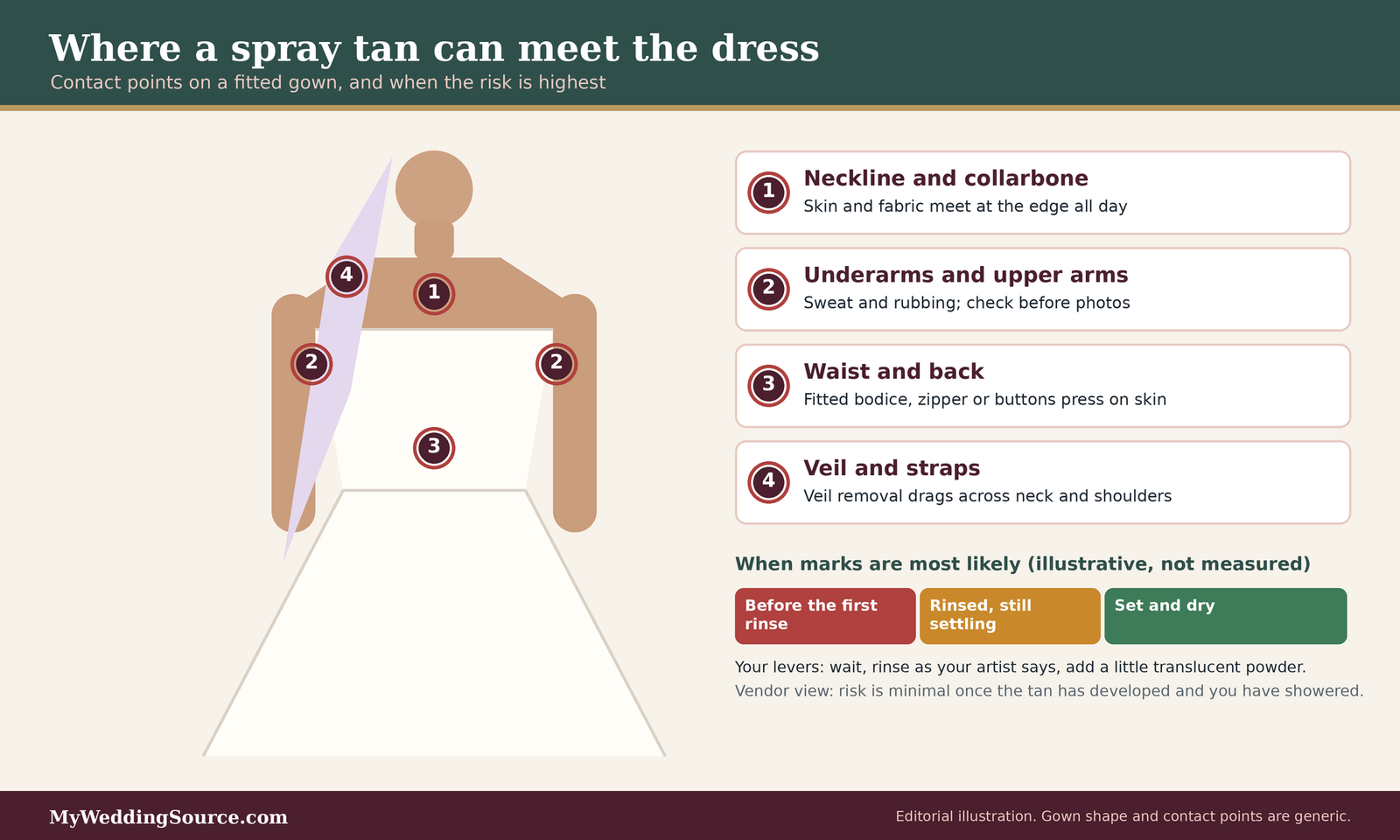
Reduce the risk in practice
You have three levers: wait, rinse, and block.
Rinse, powder, and wait
A vendor guide suggests several steps for extra caution: have help getting into the gown, dust translucent powder on areas like the neckline and underarms, and let moisturizer absorb for twenty to thirty minutes before dressing. A first rinse of lukewarm water, with no soap, is advised in THE WED’s guide for the first shower after the appointment, and Makeup.com says to wait six to eight hours before that first shower. Follow your artist’s specific timing, and write the plan on your timeline so that it survives a busy week. The back-timed schedule later in this guide shows where these steps fit.
Think about fabric, color, and lining
This part is editorial reasoning and not sourced. Smooth fabrics such as satin can show a mark clearly, while lace and tulle can catch residue in the pattern. Light colors show marks more than darker ones. A lined bodice protects the dress from skin contact, and a good seamstress can tell you which parts of your gown touch skin. If you are choosing a dress and planning a tan, mention both to your salon. For gowns worn outdoors or on a beach, our beach wedding dress guide covers fabric choices that handle heat and moisture.
If a mark appears anyway
Even a careful plan can leave a faint mark, and it helps to decide in advance how you will respond.
Do not scrub
Resist the urge to rub a mark with whatever is at hand. Rubbing can spread residue or damage delicate fabric. A good first step is to blot gently, stop, and call the salon or cleaner who knows the fabric. That person is better placed than any article to say what is safe.
Name the person to call
Before the wedding, put one name and number in your emergency kit for dress care, such as the salon, your seamstress, or a cleaner who has handled formalwear. If you have a person helping you dress, give them the number and ask them to handle it so you do not. Our wedding emergency kit guide lists other supplies worth having on hand.
Patchiness: why a wedding spray tan goes uneven and how to prevent it
Uneven color is the other big fear, and most of the published guidance addresses it. The causes are mostly about skin condition and what is on your skin when the solution lands.
What causes patches
Three causes show up repeatedly across the guides we reviewed.
Dry skin and leftover products
The L’Oréal Paris guide says dry skin can cause pigment to settle into dry patches and look blotchy, and that you should arrive with clean, bare skin, without makeup, lotion, perfume, or deodorant. Makeup.com says similar products can block the solution and cause uneven patches. Dead or flaky skin can also create patches and streaks, which is why exfoliation is the standard recommendation. WebMD makes a related point for at-home products, saying exfoliating first can smooth skin and help a tan last longer.
Hot showers, pores, and shaving
Makeup.com advises showering at least four hours before the appointment, because warm water enlarges pores and the solution can settle in them and create dark spots. It also advises shaving at the end of a pre-tan shower, once hair has softened, and notes that shaving after the wedding spray tan can strip color. L’Oréal agrees that you should shave before, and adds that shaving too soon before the wedding spray tan can make it fade faster. Those sources differ on how long before, which is a reason to ask your artist for a specific window and to follow it.
A prep calendar for the week before
The sources overlap enough to build one sensible sequence. Treat it as a starting point and replace any step your artist contradicts.
Seven to two days before
A bridal vendor advises stopping retinol, alpha hydroxy acid, and exfoliating products a week out, and finishing waxing or body treatments 48 hours before the wedding spray tan. Makeup.com recommends starting exfoliation about three days before, with the last session about 24 hours before the appointment. L’Oréal advises getting manicures and pedicures before the tan rather than after, because soaking and polish remover can make the wedding spray tan patchy. Check any skincare product you use with your own clinician if you are unsure, since we cannot advise on medicated skin treatments.
The day before and the day of
Exfoliate gently, shave, and moisturize earlier in the day, but not right before the appointment, since L’Oréal warns that moisturizer applied just before may dilute the wedding spray tan. Shower early, at least four hours before, and arrive with bare skin. Bring a dark, loose outfit for afterward, because the guides we reviewed recommend dark, loose clothing afterward, and THE WED also suggests skipping tight bras and leggings that could rub or leave lines.
Aftercare that keeps the fade even
The first day sets the result, and later days decide how the wedding spray tan fades.
The first shower
Published first-shower timing ranges from six to eight hours (Makeup.com), at least eight hours of staying dry and avoiding sweat and skin contact (THE WED), to at least 24 hours (L’Oréal). The spread comes from different products and different artists, so there is no single correct number. Ask your artist for the exact timing for the solution they use, and put it in writing on your timeline. A vendor guide also suggests sleeping in the tan on dark sheets and rinsing the next morning with plain water.
Moisturize, and skip the scrub
Several guides recommend moisturizing daily with a lightweight, oil-free lotion and using a gentle body wash and cooler showers. THE WED advises avoiding exfoliation until after the wedding. Makeup.com says consistent moisturizing helps the wedding spray tan fade evenly. If you notice a patch before the wedding, call the artist and ask whether a touch-up is possible, which is much easier than trying to fix it yourself with an unfamiliar product.
Build the timeline backward from the photo deadline
The photo deadline is the moment your photographer starts, which is often the first look or the getting-ready shots, and the wedding spray tan has to be finished and dressed-over by then. Working backward from that moment turns scattered advice into a schedule.
Choose the day for your wedding spray tan
There is no universal answer, but the published guidance clusters tightly.
Two to three days before
A bridal vendor recommends the wedding spray tan two days before the wedding, in the late afternoon or evening, so the color can develop fully and you can shower before the wedding day. It describes a day-before appointment as riskier. THE WED recommends about two to three days before so the color can settle, and says the wedding spray tan should be the last beauty treatment on your list. Two independent sources point to the same window, which is why we use it as the default in this guide. If your wedding falls on a weekend, that usually means a Wednesday or Thursday evening appointment for a Saturday wedding, depending on how you read two to three days.
Why the wedding morning is a poor choice
Color keeps developing for a day or more, according to the Cleveland Clinic and the Canadian Dermatology Association, and the first rinse is when transfer risk is highest. A wedding-morning tan would put both of those on your dress-up day. We have not seen a published source that recommends it for a wedding, and it removes the one step that makes dress transfer manageable: a full rinse before you dress.
Calculate service time by person
Group appointments are where timelines break. A single bride can fit an appointment around her day. Five people cannot.
Appointment, setup, drying, and travel
We could not find a published standard for appointment length, so ask your artist and use their number. For the example below, we assume 30 minutes per person, including a few minutes between clients for setup, and a 30-minute drive each way for a mobile artist. Both numbers are our assumptions for illustration. Add time for the client to dry before dressing, which the L’Oréal guide says should happen fully before any clothing goes on, and for the artist to touch up a spot.
Buffers before you get dressed
Add a buffer on every step that depends on another person. For a five-person group in the example, we back-timed an evening appointment two days before the wedding. Five clients at 30 minutes is 150 minutes of spraying. Add half an hour for the artist to set up, and one hour of buffer for late arrivals and touch-ups, and you have a four-hour block on site, plus the drive. That is editorial arithmetic, and it is the reason to book the group early in the evening, not late.
| When | Step | Assumed duration | What it protects |
|---|---|---|---|
| Four weeks out | Trial tan, photos, shade and solution noted | 30 minutes plus photo time | Time to change artist or shade |
| Three days before | Exfoliate last time, shave, stop all active skincare | 20 minutes | Even color, per Makeup.com and THE WED |
| Two days before, 4:00 p.m. | Artist arrives (after a 30-minute drive) and sets up | 30 minutes | Late arrival buffer |
| Two days before, 4:30 p.m. | Five 30-minute sessions, bride first | 150 minutes | Bride gets a full evening to develop |
| Two days before, 7:00 p.m. | Buffer and touch-ups | 60 minutes | Missed spots and late guests |
| Two days before, overnight | Wear dark, loose clothes, keep skin dry | About 8 hours or as advised | First-shower timing from your artist |
| Day before, morning | First rinse as instructed, then oil-free moisturizer | 20 minutes | Color is set before the wedding day |
| Wedding morning | Moisturizer absorbs 20 to 30 minutes before dressing | 30 minutes | Dress transfer risk |
| Wedding morning | Dress, jewelry, and veil, with a helper | 45 minutes | A calm photo deadline |

What the table is for
The numbers in the table are placeholders. The point is the order: trial first, tan two days out, rinse before the wedding day, and absorption time before dressing. Replace each duration with your artist’s number and your own travel time, and add the result to your master timeline from our wedding planning timeline and wedding vendor timeline.
A scenario where the plan bends
Suppose your artist is only free the morning of the day before the wedding. That is a trade-off, not a failure. Ask whether that artist can use a solution with less guide color, ask for a longer rinse instruction, plan for translucent powder on the neckline, and add the transfer test to the trial. A vendor described the day-before slot as riskier, so go in with the extra precautions rather than pretending the risk is gone.
Coordinate accessories and clothing with the beauty plan
The tan does not exist apart from what you wear on top of it. Test combinations before the wedding.
Veil, neckline, earrings, and getting-ready clothing
Try the veil, earrings, necklace, and any wrap or jacket at a dress fitting, after the trial tan. A veil comb, a pin, or a zipper can rub skin. Choose a getting-ready outfit that opens at the front, so you do not pull anything over a freshly tanned face or shoulders. Our wedding tiara and headpiece guide covers headpieces and veils in more depth.
Avoid last-minute product and color changes
The week of the wedding is not the time to try a new body lotion, perfume, deodorant, or tan extender. Each can change how the wedding spray tan fades or can irritate skin, and the Cleveland Clinic notes that spray tan products may contain fragrances that irritate sensitive skin or cause allergic reactions. Keep what worked at the trial, and tell your artist about any change you make. If you want to deepen the color, ask the artist, not a drugstore shelf.
Safety, booths, and what regulators say about a wedding spray tan
This is general information, not medical advice. Ask a clinician about your own skin, medications, and health conditions.
What the FDA says about spray application
The details matter here because they change what you should ask the artist.
External use and misting
According to the FDA, DHA is approved as a color additive for external application, and cosmetic use is limited to that, under 21 CFR 73.2150. The FDA says that DHA used as an all-over spray or mist is not approved, that no safety data has been submitted for use on the eyes, lips, mucous membranes, or for misting, and that exposure to the eyes, lips, mucous membranes, or internal exposure from inhaling or swallowing may be hard to avoid in spray booths. The American Cancer Society says that tanners are not thought to be harmful when used properly, and also says not to breathe the spray in or apply it to the eyes, nose, and lips. Reading these together, the careful position is that sunless tanning is a lower-risk way to be tan than UV exposure, and that the spray application is where questions remain.
Questions to ask your artist
The FDA advises consumers to ask whether their eyes, lips, and mucous membranes are protected, and whether they are protected from inhaling or ingesting the product, and to request protective measures if the answer is no. In practice, ask what is provided, such as eye protection, nose filters, or lip balm, and ask about ventilation in the room. The FDA also notes that oversight of professional salon practices generally falls to local and state health authorities, and that professional-only products are not covered by retail ingredient labeling rules, so ask for the product name and ingredient list, and look at the label yourself. The Knot’s cost guide notes that spray tanners do not need a license or formal training, which is another reason to ask about experience.
Sensitive skin, pregnancy, and reactions
A reaction a week before the wedding is worse than one at the trial, which is one more reason for the trial.
Allergies and sensitive skin
The Canadian Dermatology Association says fragrances and preservatives in self-tanners may cause allergic contact dermatitis, and the FDA says consumers have reported rashes and, mainly from spray booths, coughing, dizziness, and fainting. The cause is unclear. If you have eczema, a history of contact allergies, or asthma, ask a clinician before the trial, and tell the artist about it. Ask for a fragrance-free option if one is available. Consumers and health professionals can report reactions through the FDA’s cosmetic complaint page.
Pregnancy
The Cleveland Clinic suggests that pregnant people may want to avoid spray tans and consider self-tanning lotions instead. We cannot tell you what is right for your pregnancy, and the right person to ask is your own clinician. If you are planning a wedding while pregnant, add the question to your next appointment, and let your artist know.
Sunscreen, honeymoon, and skin checks
A tan from a bottle looks like a tan from the sun, and it does not behave like one.
A spray tan is not sun protection
The Cleveland Clinic says plainly that a wedding spray tan is not a base tan and does not prevent sunburn. The American Cancer Society notes that most sunless tanning products do not contain sunscreen, and the FDA says only tanners with sunscreen and SPF labeling may protect against sun, and that those without it must carry a warning. The Canadian Dermatology Association recommends broad-spectrum sunscreen with an SPF of at least 30, applied generously and reapplied after swimming or sweating. It also cites an FDA report suggesting DHA concentrations of five percent or more may increase free-radical damage from sunlight for 24 hours after application, which is a reason to use shade and sunscreen right after a wedding spray tan, especially for outdoor weddings and beach honeymoons. Our honeymoon planning guide can help you plan the days after.
Skip the tanning bed
The Skin Cancer Foundation and MD Anderson Cancer Center both warn against indoor tanning, and MD Anderson says there is no such thing as a safe tanning bed. If a deeper color is the goal, sunless products are the lower-risk route, according to MD Anderson. The American Cancer Society also advises seeing a doctor about any new or changing spots on your skin, which is a good habit to keep before and after the wedding.
Stop experimenting close to the wedding
The final weeks are for repeating what you know, not testing what you do not.
Use professional advice for reactions and procedures
If you are planning facials, peels, lasers, waxing, or a new prescription skincare product, ask the person providing those services how far ahead of the wedding they should happen and how they interact with a tan. A vendor guide advises ending waxing or body treatments 48 hours before, but your clinician or esthetician knows your skin better than any general guide does. If you develop a reaction, see a clinician, and tell your artist.
Patch-test where it makes sense
WebMD’s guidance on self-tanning lotions suggests trying the product on a small patch and waiting 24 hours before committing. Salon solutions are different, but you can ask whether the artist offers a patch test or whether your trial counts as one. If you have a known sensitivity, a small test on the inner arm days before the trial is a low-effort check, and a clinician can tell you if it is enough for your situation.
What a wedding spray tan costs, and how to compare quotes
Cost is one of the least standardized parts of this service. There is no single price, and the quotes you receive may include different things.
What this actually costs
The Knot’s cost guide, updated in November 2024 and based on quotes from two spray tan professionals and not on a survey, puts machine-applied booth tans at about $25 to $60 and hand-applied airbrush tans at about $60 to $95, with mobile service costing more for convenience, in some places double or triple. Treat those as reference points, not as a market average, and compare real quotes from artists near you, including the trial.
What published prices show
A published guide can tell you what drives price, even when it cannot tell you your price.
Booth, airbrush, and custom color
The Knot’s guide separates a booth tan, which is machine-applied and uniform, from an airbrush tan, which is hand-applied and tailored and takes more technician time. It says custom shades, such as lighter on the face and darker on the body, cost more, and that add-ons such as scents, shimmer drops, and drying powder raise the bill, though none are necessary. For a wedding, the custom blending that airbrush work allows is often the reason to pay more, and that is a judgment for you and your trial.
Mobile service, location, and amenities
The same guide says mobile service can double or triple the price depending on location, that prices are higher in big metro areas than in suburbs, and gives a salon example of spray tans starting at $55 in Scottsdale, Arizona and $110 in Los Angeles. Amenities such as disposable underwear, hair ties, and drying rooms may be extra or built in. These are one publication’s examples, and your local market may be quite different. Our wedding budget calculator can help you place beauty costs in context, and the wedding party cost guide covers what to expect when you offer to cover a group.
Normalize quotes before you compare
Two quotes that look different may not be quoting the same thing. The fix is to convert every quote to the same scope.
A worked example with invented numbers
These numbers are invented to show the method. Suppose Artist A quotes $75 per person for the final tan for five people, no travel fee, trial extra at $75. Artist B quotes $55 per person but charges a $100 mobile fee and has no trial. Artist C quotes $90 per person including the trial for the bride and a lighter face solution, with a $50 travel fee. Normalize to five final tans plus one bride trial. Artist A: five times $75 is $375, plus $75 for the trial, for $450. Artist B: five times $55 is $275, plus $100, plus a trial that you would need to book elsewhere or skip, for $375 before any trial. Artist C: five times $90 is $450, trial included, plus $50, for $500. The lowest headline price does not include a trial, which is the step this guide treats as essential.
Do not forget the trial, travel, and gratuity
Add the trial to every quote, because a trial is not optional if you want a predictable result. Add travel fees, group minimums, early-morning or evening surcharges, and cancellation or reschedule rules, and ask whether a reschedule fee applies if the weather or your timeline changes. We did not find a published, reliable tipping norm for spray tan artists, so ask the business what they expect, and include any amount you plan to give in your budget.
Contingency kit and wedding-day plan for your tan
By the wedding day, the tan is done. The remaining work is protecting it and knowing what you will do if something goes wrong.
Touch-up and contingency supplies
Small items solve most small problems.
Assign who carries them
Name one person to carry the kit, usually a maid of honor, a bridesmaid, or a planner, and tell the photographer and your hair and makeup artist who it is. Put the dress-care contact, your artist’s number, and a copy of your timeline in the kit. Our wedding emergency kit guide covers general supplies, and our guides to bridesmaid dresses and wedding party attire are useful if your attendants will be tanned as well.
What to pack
Pack translucent powder, which a vendor guide mentions for the neckline and underarms, along with soft cotton pads, a small mirror, and the specific makeup your makeup artist uses for touch-ups. Ask your artist what they recommend for a small uneven spot, and whether to bring the product they used. Do not bring a new, untested product to fix a problem, because an unfamiliar product is more likely to cause one than solve one.
Humidity, tears, wind, heat, and veil removal
Weather and emotion test a tan in ways a salon does not.
Heat, sweat, and humidity
Sweat and humidity are the main threats to a wedding spray tan on a hot day. Plan shade for photos, a fan or cooling item for the getting-ready room, and a way to blot rather than rub. THE WED’s guide suggests avoiding sweat and skin-to-skin contact for at least eight hours after the wedding spray tan, which matters for the first night more than for the wedding itself.
Tears, wind, hugging, and veil removal
Tears and hugging move makeup and product, so blot gently and plan photos with that in mind. Wind can lift a veil across skin, and removing a veil can drag across the neck and shoulders, so ask a helper to lift the veil off, not pull it. Hugging is unavoidable, so wear what you tested at the trial, and tell close family that you may need to avoid heavy contact right after dressing, if that is a concern. Our wedding week checklist can hold all of this in one place.
Questions to ask before you book
Good questions protect you from vague promises and tell you whether an artist has thought about weddings. Ask for the answers in writing and keep them with your booking confirmation.
Questions worth asking your wedding spray tan artist
- What solution and strength will you use, and does it contain a guide color?
- How do you protect my eyes, lips, nose, and mouth, and what ventilation does the room have?
- Can you give me the product name and ingredient list, including any fragrance?
- When should I take my first shower, and what soap and water temperature do you advise?
- How do you blend the face, hands, and feet, and can you use a lighter solution on the face?
- Do you offer a trial, and is it credited toward the final appointment?
- What are your rules for travel, group size, late arrival, and rescheduling?
About the artist and the product
These questions confirm what is going on your skin and who is doing the work.
Experience, training, and weddings
Ask how many bridal tans the artist has done and whether they can show photos of clients with a similar skin tone to yours. The Knot’s cost guide notes that spray tanners do not need a license or formal training, so the answer is a way to judge experience, not a credential check. Ask how they handle a group, and who they send if they are ill on the day.
Solution, ingredients, and safety measures
Ask for the solution name, strength, and fragrance status, and note the details for your clinician if you have a sensitivity. The FDA says professional-only products are not covered by retail ingredient labeling rules, so the artist may need to look up the information, and a good artist will have it. Ask what protective gear is provided, and decline the service if the answers do not satisfy you.
About the plan and the policy
These questions decide what happens if the plan changes.
Timing, trial, and touch-ups
Ask whether the trial can be at the same time of day as the final appointment, whether a touch-up is available if you see a problem, and how soon you must tell them. Ask what happens if you are sick or the weather shuts down travel, and whether the artist has a backup person. Put the answers into the plan that you share with your planner or wedding party.
Deposits, cancellation, and group terms
Ask for the deposit amount, the refund rules, the minimum group size for mobile service, and the fee for each late person. Confirm in writing who pays for attendants, and whether you will cover the cost or each person will, a decision our wedding party cost guide can help you frame.
FAQ: wedding spray tan questions
Timing and trial
How far ahead of the wedding should I get a spray tan?
Two published guides point to about two to three days before the wedding, so the color can develop and you can rinse before dressing. A bridal vendor calls a day-before appointment riskier. Ask your artist what their solution needs, and use your trial to confirm that the timing works for you.
Do I really need a trial?
A trial is the best way to check shade, undertone, skin reactions, and how the color looks in different lighting. A bridal vendor recommends one two to four weeks before the wedding. If the budget is tight, a trial with the same artist and solution is more valuable than a more expensive final appointment without one.
Can I get a spray tan on the morning of the wedding?
We would avoid it. Color keeps developing for a day or more, according to the Cleveland Clinic, and transfer risk is highest before the first rinse. Two guides we reviewed recommend a window a few days earlier. If the morning is your only option, discuss clear solutions and translucent powder with your artist.
Dress, color, and patchiness
Will a spray tan stain my wedding dress?
It can leave a mark if the product has not been rinsed or has not set, or if oils and sweat move residue onto fabric. A bridal vendor says the risk is minimal after the tan has developed and you have showered. Test with a white cotton top at the trial, and ask your salon about fabric.
How do I stop a spray tan from looking orange?
Orange results usually come from a shade or solution that does not suit your undertone or from too much depth. Ask for a lighter strength, compare the trial in daylight, and avoid inspiration photos as your only guide. A bridal vendor advises fair to medium complexions to start lighter and confirms undertone at the trial.
What causes a patchy spray tan?
Published guides point to dry or flaky skin, leftover lotion, deodorant, or makeup, hot showers before the appointment, and shaving at the wrong time. Exfoliating about 24 hours before, arriving with clean bare skin, and moisturizing daily afterward are the most common recommendations. Ask your artist to fix a patch before the wedding.
Safety and cost
Is a spray tan safe?
Sunless tanning involves no UV exposure, but the FDA says DHA is approved for external application and that use as a spray or mist is not approved. It advises asking how your eyes, lips, and mucous membranes are protected. This is general information, not medical advice, and a clinician can answer questions about your own health.
How much does a wedding spray tan cost?
The Knot’s guide, updated in 2024 and based on two professionals’ quotes, gives about $25 to $60 for a booth tan and $60 to $95 for an airbrush tan, with mobile service costing more. Local prices vary, so compare real quotes after adding the trial, travel, and any group fees.
Your next steps
Decide and test
Write the brief and book the trial
Write down the depth, finish, and coverage you want, mark the skin your dress will show, and book a trial two to four weeks out with the artist you plan to use. Bring your dress neckline photo and a reference of your usual makeup. Our bridal makeup guide can help you coordinate the two.
Run the transfer and photo tests
At the trial, rinse as instructed, dress in white cotton, and take photos in daylight, flash, and indoor light. Look again the next morning and two days later. If the result is not what you want, change one thing and repeat.
Lock in the schedule
Back-time the final week
Choose a tan day two to three days before the wedding, add the artist’s travel and group time, and place the first rinse and the absorption time on your master timeline. Our wedding planning checklist and wedding planning guide can hold the rest of your plan.
Share the plan with your team
Give your photographer, your makeup artist, and the person carrying your emergency kit the same one-page plan, including the dress-care contact. Add a line for your photographer so they know when your wedding spray tan will be at its best, and review the wedding photographer shot list so the details you care about are on it. If the plan starts to feel like too much, our wedding planning stress guide has ways to cut it down.
Sources & methodology
How we built this guide
What we relied on
This guide combines U.S. regulatory information on sunless tanners, clinical and cancer-center guidance on tanning and sun protection, a published cost guide from The Knot, and advice from beauty publishers and a bridal sunless-tanning vendor. Where a statement comes from a vendor, we say so, because a vendor describes its own products and habits. Timing, shower, and prep advice varies between sources, and we show the range instead of choosing one number. The back-timed schedule, the quote-normalization example, and the clothing and fabric notes are our own editorial reasoning and arithmetic, and the numbers in them are invented for illustration.
What we did not do
We did not test tanning solutions, try artists, or measure how tans transfer to fabric, and we did not give medical or legal advice. Skin, health conditions, and products differ from person to person. Ask your artist for specifics, ask a clinician about reactions, pregnancy, or medical conditions, and ask your dress salon about fabric care.
Source list
Government, clinical, and professional sources
- U.S. Food and Drug Administration, Sunless Tanners & Bronzers: https://www.fda.gov/cosmetics/products/sunless-tanners-bronzers
- Electronic Code of Federal Regulations, 21 CFR 73.2150, Dihydroxyacetone: https://www.ecfr.gov/current/title-21/chapter-I/subchapter-A/part-73/subpart-C/section-73.2150
- American Cancer Society, Is It Safe to Get a Fake (Sunless) Tan?: https://www.cancer.org/cancer/risk-prevention/sun-and-uv/tanning-pills-and-products.html
- Canadian Dermatology Association, Position Statement: The Use of Sunless Tanners (April 2024): https://dermatology.ca/wp-content/uploads/2026/02/Position-Statement_The-Use-of-Sunless-Tanners.pdf
- Cleveland Clinic, Are Spray Tans Safe?: https://health.clevelandclinic.org/are-spray-tans-safe
- UT MD Anderson Cancer Center, 6 myths about tanning safety: https://mdanderson.org/publications/focused-on-health/FOH-sunless-tanning.h13-1589835.html
- The Skin Cancer Foundation, Tanning & Your Skin: https://www.skincancer.org/risk-factors/tanning/
Cost, beauty, and vendor sources
- The Knot, Booth vs. Airbrush Tan Cost Differences and Factors: https://www.theknot.com/content/spray-tan-cost
- L’Oréal Paris, How To Prep Your Skin for a Spray Tan: https://lorealparisusa.com/beauty-magazine/skin-care/sun-care-and-self-tanning/spray-tan-tips
- Makeup.com, What to Do Before and After Getting a Spray Tan: https://www.makeup.com/skin-care/skin-care-tips/what-you-need-to-know-about-spray-tans
- THE WED, The Ultimate Pre-Wedding Spray Tan Guide: https://thewed.com/magazine/the-ultimate-pre-wedding-spray-tan-guide
- WebMD, Fake the Perfect Tan With Sunless Tanning Lotion: https://www.webmd.com/beauty/features/fake-perfect-tan-sunless-tanning-lotion
- Pro Sunless Advice, Bridal Spray Tan guide (bridal sunless-tanning vendor): https://www.sjoliespraytan.com/bridal-spray-tan/