

Planning teeth whitening before wedding photos comes down to timing and a dentist’s opinion, not to chasing the whitest shade, because the same treatment that brightens your smile can also leave teeth sensitive for days or weeks.
Quick answer
Book a dental exam first, ideally four to six months before the wedding, so a dentist can tell you what is staining your teeth and whether whitening will change it. Choose a method with that dentist, finish the active whitening at least three to four weeks before the wedding (our planning buffer, not a clinical rule), and never schedule a new treatment for the day or night before. Whitening only changes natural tooth structure, so crowns, veneers, and fillings need a plan of their own. This guide is general information, not dental advice.
Why teeth whitening before wedding photos is a timing problem, not a shade problem
Most advice about teeth whitening before wedding photos jumps straight to products. Strips, trays, in-office lights, toothpastes, and kits all promise a brighter smile, and it is easy to buy one in a hurry. The harder question is when to do it, because three separate clocks are running at once, and they do not line up by default. This section explains those clocks so the rest of the guide makes sense.
What a photo actually asks of your teeth
For teeth whitening before wedding photos, remember that a wedding day produces hundreds of images in which your smile is visible at different distances, in different light, and often at the end of a long day of eating, drinking, and talking. Nobody can promise how any one set of teeth will read on camera, and we did not find a source that does. What we can say is that people in a hurry tend to fix the wrong problem. The goal of teeth whitening before wedding photos, for most couples, is a smile that looks like their own, cleaner and a little brighter, with no pain or gum irritation on the day.
Natural-looking beats maximum white
A dentist quoted by Cleveland Clinic advises against expecting dramatic changes when teeth start out very dark, and says results are gradual. That is a useful frame for teeth whitening before wedding photos: aim for a modest, even lift and decide your target shade with a professional rather than from an ad. If you also plan to change other things in your look, our wedding makeup guide covers how the rest of your face will read in the same pictures.
Even color matters as much as brightness in teeth whitening before wedding photos
A tooth that is whiter than its neighbor draws the eye. That happens when one tooth is a crown or a filling, because only natural teeth change color. The American Dental Association notes that crowns, implants, and other tooth-colored restorations do not whiten, which can leave visible differences. For photos, even color across the front teeth is often a better target than the highest brightness.
The three clocks you are working against
Think of teeth whitening before wedding photos as three timelines laid on top of each other. When you see them side by side, most of the common mistakes become obvious.
The treatment clock
Different methods of teeth whitening before wedding photos take very different amounts of time. The ADA reports in-office power bleaching sessions of up to 30 minutes, dentist-supplied tray systems used daily for 2 to 10 hours over 6 to 28 days in one systematic review, and tetracycline stains that may need roughly three to four months of nightly treatment on average. Dentists quoted by WeddingWire describe a stubborn-case system that can run up to ten weeks. Your method decides how early you must start.
The sensitivity clock
Sensitivity is the most common side effect of bleaching, and for teeth whitening before wedding photos it has its own schedule. The ADA says it can affect up to two-thirds of users early in treatment, and with strips or trays it may start within two to three days and usually resolves by day four. A manufacturer source says it can last a couple of days and sometimes up to two weeks or longer. Because the range is wide, we treat sensitivity as a buffer to protect, not a detail to hope about.
The wedding clock
The wedding date does not move, and neither do the vendors around it, so teeth whitening before wedding photos has to bend around them. Your photographer, your makeup artist, and your venue schedule are fixed, so the only flexible clock is the start of your whitening. That is why the countdown later in this guide works backward from the ceremony. If you have not yet built a wider beauty schedule, our wedding beauty timeline shows where a dental visit sits among haircuts, facials, and skin prep.
What whitening can and cannot do
Before you compare methods for teeth whitening before wedding photos, it helps to know what whitening is and what it is not. The answer shapes every other choice in this guide.
How bleaching changes a tooth
The ADA explains that carbamide peroxide releases hydrogen peroxide, which can reach the pulp of the tooth within about 15 minutes of exposure. An ADA news item drawing on Cleveland Clinic reporting describes the agents as breaking down darker-colored compounds called chromogens at a molecular level. The chemistry is why a professional should look at your teeth first: bleaching is a real change to a living tooth, not a cleaning.
What it does not touch
Whitening does not change crowns, veneers, dentures, or most tooth-colored fillings. It also has limited effect on some stains from inside the tooth. The ADA notes that removing intrinsic stains within dentin is considered nearly impossible with external whitening methods. If your concern is a gray front tooth or an old dark filling, whitening is probably not the right tool, and a dentist can explain what is.
Start with the dentist consultation
Every source we reviewed that discusses teeth whitening before wedding photos recommends talking to a dentist first. Cleveland Clinic and the ADA both say a dentist can find out why your teeth are discolored, deal with underlying problems, and suggest suitable products. A consultation about teeth whitening before wedding photos also protects your schedule, because it shows early whether you are a quick case or a slow one.
What a pre-bleaching exam covers
The ADA describes a pre-bleaching exam, with radiographs and other tests as needed, that helps identify the causes of discoloration. It also describes a history that covers allergies, including allergies to bleaching ingredients, and past or recent tooth sensitivity. That is the minimum you should expect from a visit about teeth whitening before wedding photos.
The health check that comes first
Cleveland Clinic advises that gum disease and cavities should be treated before whitening starts. Whitening is cosmetic, and the order matters: treat the problems first, then brighten. Ask whether a cleaning alone might change your shade, because Delta Dental notes that a thorough cleaning and exam may be enough to brighten teeth for some people and helps identify who is a good candidate.
The history questions you should expect
Expect questions about past sensitivity, gum recession, previous dental work, and any reaction to whitening products. Answer completely, even if the answer makes the plan slower. The ADA lists risk factors for sensitivity, including peroxide concentration, contact time, light intensity and duration, and adhesive restorations, and your dentist can only adjust for risks they know about.
Reading your stain type
Not all discoloration is the same, and the type determines both the method and the timeline. A dentist will usually sort your stains into a few groups, and understanding the groups lets you ask better questions.
Surface stains from food, drink, and tobacco
The ADA calls these extrinsic stains and lists tobacco, metal salts, and pigmented foods and drinks such as dark fruits, red wine, coffee, tea, and cola as common causes. They are often reduced by brushing with whitening toothpaste or by professional cleaning. If most of your discoloration is on the surface, a cleaning may deliver more than you expect, and you may not need aggressive bleaching at all.
Stains inside the tooth
Intrinsic stains sit within enamel or dentin. The ADA lists causes that include genetic disorders, fluorosis, childhood tetracycline use, tooth decay, amalgam restorations, and prolonged use of chlorhexidine rinse. It also notes that with age, enamel thins and becomes more translucent, so yellower dentin shows through. Delta Dental says gray stains from tetracycline or fluorosis are unlikely to change noticeably, and that brownish teeth respond less well than yellow ones.

Crowns, veneers, bonding, and the mismatch problem
The most common surprise in teeth whitening before wedding photos is not a failed treatment. It is a successful one that leaves a crown or filling looking darker than the teeth around it. This is predictable, so plan for it early.
Why restorations do not change color
The ADA states that only natural teeth whiten, and that restorations should be identified and documented during the exam. Harvard Health’s archived guidance, published in 2010, says most products bleach only natural enamel, so tooth-colored fillings, crowns, veneers, and partial dentures may give uneven results. Delta Dental adds that bonding or tooth-colored fillings on front teeth will not change and may no longer match the new shade.
What to ask your dentist to do about it
Ask whether any visible restoration needs to be replaced after whitening so it can be matched to the final shade. That sequence matters, because Delta Dental’s guidance suggests considering options such as porcelain veneers or bonding on other teeth when materials will not match. Replacement work takes appointments, so raise it at your first visit. We could not verify typical lead times, so ask your own office how long it takes.
Who is told to be cautious
Several sources on teeth whitening before wedding photos list groups for whom whitening may not be recommended or may need adjustment. The lists differ in detail, and they are not a complete screening, so treat them as prompts for a conversation with your dentist.
Gum disease, worn enamel, and sensitive teeth
Harvard Health’s 2010 guidance says whitening products are not recommended for people with sensitive teeth, a peroxide allergy, gum disease, or worn tooth enamel. Delta Dental says a dentist may discourage whitening for people with sensitive teeth, gum disease, or worn enamel. Those are the exact conditions to describe at the first visit.
Pregnancy, breastfeeding, and age
Harvard Health’s 2010 guidance lists pregnant or breastfeeding women and children under 16 among those for whom whitening is not recommended, and the ADA notes that the American Academy of Pediatric Dentistry discourages full-arch cosmetic bleaching during primary and mixed dentition. We did not find a current, authoritative source on pregnancy that settles the question, so if this applies to you, ask your dentist or prenatal clinician before using any whitening product.
The whitening options, compared
There are more ways to brighten teeth than most people realize, and they differ in speed, supervision, cost, and risk. The ADA groups them into in-office bleaching, dentist-supplied at-home kits, over-the-counter products, and a few specialized methods. Here is how each fits into teeth whitening before wedding photos, starting with the ones a dentist directs.
Dentist-directed options
These are the choices where a dentist plans, applies, or supplies the treatment. The ADA encourages anyone considering professional whitening to consult a licensed dentist, and notes that dentist-directed care supports proper tray fit, barrier protection, and assessment of discomfort.
In-office bleaching
The ADA describes professionally applied bleaching, sometimes with a light to speed the process, and notes that power bleaching uses concentrated hydrogen peroxide solutions for up to 30 minutes. A dentist quoted by WeddingWire describes a roughly one-hour procedure in which the teeth are isolated from the gums, gel is applied, and a special light activates it. Cleveland Clinic says professional treatments can produce faster, more dramatic results, sometimes in a single 30-minute session. Because results are fast, so is sensitivity, and that matters for scheduling teeth whitening before wedding photos.
Custom trays used at home
The ADA describes custom-fitted trays with gel worn at night or during the day, with carbamide peroxide typically ranging from 10% to 38%. A dentist quoted by WeddingWire says custom trays are used with gel for at least five consecutive days. Harvard Health’s older guidance describes an hour or two daily or overnight for one to two weeks. Home use gives you control over pace, which is valuable when you want to stop if teeth become sensitive.
Over-the-counter options
Over-the-counter products are sold in stores and online, and they use lower peroxide concentrations. They are easy to start and easy to misuse, which is why a dentist’s input still matters.
Strips, gels, and trays from a store
Cleveland Clinic says gel-filled trays can be fastest, sometimes showing results within a few days, while strips and gels typically lighten teeth within about two weeks. The ADA reports that over-the-counter products usually take longer than professional ones, and in one study an over-the-counter technique needed 16 days to match a seven-day tray system and a one-day in-office procedure. Delta Dental says over-the-counter products carry a higher risk of gum irritation and of harm to existing dental work, a claim we treat as that organization’s view.
Whitening toothpastes and rinses
Whitening toothpastes mainly use abrasives to remove surface stains, and a few contain low peroxide levels, according to the ADA. It adds that a 2020 systematic review found limited evidence that they work as well as paint-on gels and less well than whitening strips. Cleveland Clinic says toothpastes and rinses work more slowly and produce subtler results. They are a reasonable maintenance tool, but a weak plan on their own for teeth whitening before wedding photos on a fixed deadline.
What to skip
Social media is full of home remedies, and a wedding deadline makes them tempting. The sources are clear about the ones to avoid.
Kitchen and medicine-cabinet remedies
Cleveland Clinic says cooking oils, apple cider vinegar, and activated charcoal are not supported by evidence and may damage teeth over time, and that medicinal hydrogen peroxide from the cabinet is not formulated for dental use and carries considerable risk. The ADA reports that strawberry and baking soda showed no measurable whitening in one study, that a charcoal and salt mix was abrasive and ineffective and eroded enamel, and that oil pulling has no documented whitening effect and has been linked to adverse events.
Products without a clear dental backstop
Be careful with kiosks, mall stands, and online kits that skip the exam. The ADA’s policy statement says only licensed dentists, or their supervised dental allied personnel, should make impressions for appliances used with whitening products. That is a professional policy position, not a law we are citing, but it is a useful test: if nobody examines your mouth first, you are carrying the dentist’s risk yourself.
What the research says about which is best
It is natural to want a single winner for teeth whitening before wedding photos. The research does not offer one, and that is itself useful for planning.
What the large reviews found
A Cochrane review published in December 2018 covered 71 trials with 3,780 adults and found that bleaching agents whitened teeth compared with placebo, with no reliable evidence that any particular product, concentration, application method, or duration was better. Sensitivity and oral irritation were the most common side effects, more frequent at higher concentrations but mild and transient. The certainty of evidence was low to very low. A 2024 systematic review of 30 articles in Bioengineering reached a similar conclusion, adding that sensitivity appeared higher with in-office and combined bleaching and that at-home carbamide peroxide trays showed lower recurrence.
What that means for your plan
Because no method is proven best, choose by fit and schedule, not by claims. If you need a quick change and your dentist agrees, in-office treatment fits a short window but front-loads sensitivity. If you have time, a gradual at-home approach gives you control and room to stop. Either way, the review authors found low certainty, so treat any specific promise about speed with caution.

The stain-and-sensitivity timeline: how long discomfort can last
Brightness is the part of teeth whitening before wedding photos that you can see in the pictures. Sensitivity is the part you feel, and it is what most often ruins a schedule. This is the section to read if your wedding is closer than you would like, because it explains how to protect the final weeks.
What published sources say about sensitivity timing
The sources on teeth whitening before wedding photos give different numbers because they describe different products, different people, and different measures. Rather than pick one, we line them up and plan around the longest.
The short window: the first day or two
A dentist quoted by WeddingWire says sudden, sharp pains, which she calls zingers, typically last only seconds but can appear unexpectedly within the 24 hours after treatment. She calls whitening the day or night before a wedding one of the biggest mistakes a bride can make, because sensitivity can flare within 24 hours. That is the origin of the simplest rule for teeth whitening before wedding photos: no new treatment on the last day or two.
The typical window: about four days
The ADA reports that with strips or trays, sensitivity may begin within two to three days and usually resolves by day four, and that temporary sensitivity is associated with all forms of bleaching. It also says sensitivity can affect up to two-thirds of users early in treatment. For a multi-day course, that means discomfort can arrive in the middle of the course and fade soon after it ends, though individual experience varies.
The long tail: up to two weeks or more
Colgate, a manufacturer that sells whitening and sensitivity products and therefore has a commercial interest, says sensitivity typically lasts a couple of days but can last up to two weeks or longer, and that people with existing sensitivity or certain health conditions can have it longer. We use this as the conservative end of the range. It is the reason our planning buffer is measured in weeks, not days.
Why some people react more than others
Sensitivity is not random, and several factors are known. Knowing yours helps you choose a gentler plan and tells your dentist what to watch.
Product and exposure factors
The ADA lists peroxide concentration, contact time, light intensity and duration, and adhesive restorations as risk factors. It also reports a systematic review finding that lower hydrogen peroxide concentrations caused less sensitivity and produced a greater objective color change. Colgate notes that leaving a product on too long increases sensitivity. In plain terms, more is not always better, and following directions matters.
Tooth and gum factors
Colgate explains that bleaching agents can remove minerals from teeth, which can expose the layer beneath the enamel and irritate tiny channels connected to the nerve, and that thinner or weaker enamel before whitening raises the risk. Harvard Health’s 2010 guidance says whitening can be uncomfortable for people with sensitive teeth or gum recession. If you already wince at cold water, tell your dentist before choosing a method.
What to do if your teeth become sensitive
Plan for the possibility, and decide in advance what you will do. Deciding in the moment, with the wedding close, tends to lead to over-treatment.
Pause, switch, and call the dentist
Cleveland Clinic advises taking a break from bleaching or switching to a milder product, and asking your dentist for guidance. Harvard Health’s older guidance says to stop a product immediately if it causes irritation or mouth sores and see a dentist. Both fit the same rule: stop first, then ask. Do not push through pain to stay on schedule, and do not add a second product to compensate.
Comfort measures and what is unproven
The ADA says pretreatment with anti-inflammatory medication and a gel containing 5% potassium nitrate with 2% sodium fluoride have been tried, but that the evidence is not yet confirmed and more research is needed. Colgate suggests brushing before whitening rather than after, using a soft brush and fluoride toothpaste if you must brush afterward, and limiting very hot, very cold, acidic, or sugary items. We are not recommending any medication. Ask your dentist what, if anything, fits your health history.
Staying clean while you whiten
Many people planning teeth whitening before wedding photos ask what to eat and drink during treatment. The sources we reviewed are cautious on this point, and we want to be too.
What the sources say about stain-causing habits
The ADA lists tobacco, red wine, coffee, tea, cola, and dark fruits as common causes of surface staining, but its whitening page gives no post-whitening diet protocol. A dentist quoted by WeddingWire recommends brushing at least twice daily and flossing daily to help prevent stains and tartar, and regular checkups and cleanings about every six months. Those habits are grounded in the sources, even if a strict diet is not.
A sensible, low-drama approach
Because we found no source supporting a specific list of forbidden foods, we do not offer one. A practical approach is to ask your dentist for a short, personal list, and to avoid starting a new smoking or heavy coffee habit during the course. If you are a tobacco user, the ADA’s list of stain causes is a good reason to raise it at the first visit.
The countdown for teeth whitening before wedding photos
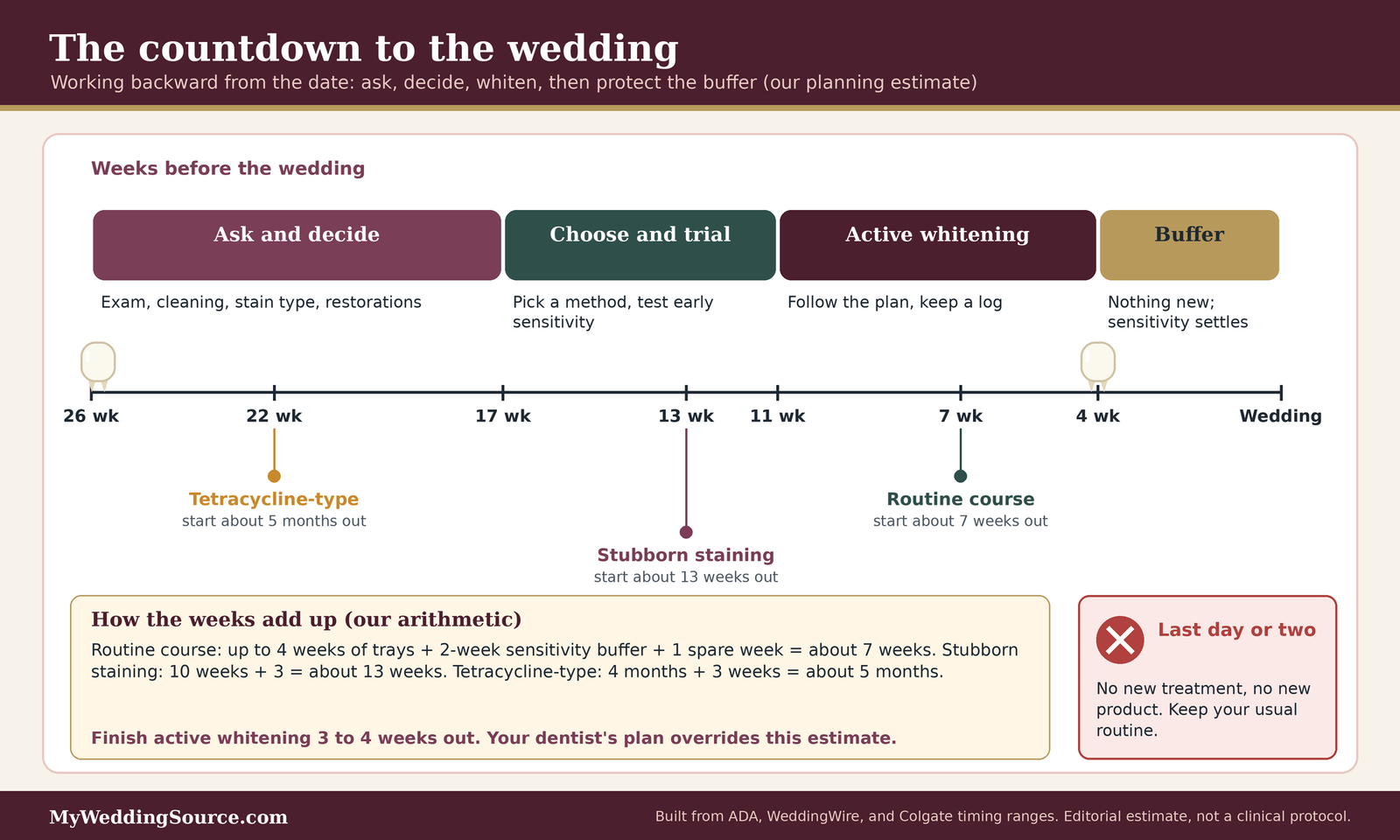
This is the timeline many people ask for when planning teeth whitening before wedding photos: a dentist visit, a treatment window, a sensitivity buffer, and a quiet final stretch. It is our own planning estimate, built by working backward from published treatment and sensitivity ranges, and it is not a clinical protocol. Your dentist’s plan overrides it.
How we built the timeline
The arithmetic is simple and you can check it. We took the longest treatment time that applies to you, added the longest sensitivity window you are willing to plan for, and added a spare week for rescheduling.
The inputs
For an ordinary course, we use the ADA’s 6 to 28 days for dentist-supplied trays as the treatment window. For stubborn cases, we use a dentist’s ten-week figure from WeddingWire, and for tetracycline staining we use the ADA’s three-to-four-month figure. For sensitivity, we use Colgate’s two-week upper range. Those are the numbers behind our estimate, and they come from different kinds of sources.
The result
For an ordinary course, 28 days of treatment plus 14 days of sensitivity buffer plus 7 spare days is about 7 weeks, so we suggest finishing active whitening three to four weeks before the wedding and starting seven or more weeks before it. For a stubborn case, 10 weeks plus the same 3 weeks is about 13 weeks. For tetracycline staining, 4 months plus 3 weeks suggests starting about five months out. These are estimates, and a dentist may shorten or lengthen them.
Five to six months out: ask and decide
At this stage of teeth whitening before wedding photos you are collecting information, not whitening yet. The earlier you learn which group you belong to, the more options you have.
Book the exam and cleaning
Schedule a dental exam and cleaning, and tell the office your wedding date and that you are considering whitening. Ask for treatment of any cavities or gum problems first. If your next regular cleaning is months away, a dentist quoted by WeddingWire advises booking a consultation early so the dentist can assess your shade and recommend a plan that fits your budget.
Decide about restorations and stubborn stains
If you have visible crowns, veneers, or fillings, ask now whether they should be replaced after whitening. If your dentist suspects intrinsic staining from tetracycline or fluorosis, ask about realistic expectations and the longest treatment path. This is also the moment to compare costs, using the worksheet in the budget section below.
Four to three months out: choose the method and run a trial
The middle of the timeline for teeth whitening before wedding photos is where you test your plan while changes are still easy. A short trial tells you far more than any article can.
Start with a gentle test
If your dentist recommends at-home whitening, begin with the first few days and watch how your teeth respond. Early signs matter, because the ADA says sensitivity with strips or trays may begin within two to three days. If you tolerate it, continue as directed. If you do not, you still have months to switch methods without panic.
Settle the photographer conversation
Tell your photographer if you are working on your smile, and ask how they handle edits to teeth. Our guides to wedding photo retouching requests and wedding photography deliverables explain how to ask in writing what is included, so you are not surprised by cost or policy later.
Two months to four weeks out: the active whitening window
This is the stretch where most standard courses of teeth whitening before wedding photos happen, and the one most affected by schedule pressure. Protect it from other commitments.
Complete the planned course
Follow the directions for your chosen product or your dentist’s schedule, and keep a short log of when you started, when you finished, and any sensitivity. The log is useful if you need to call the office, and it shows you whether you are on track. Cleveland Clinic cautions against overdoing it, since frequency and duration vary with the concentration of the bleaching agent.
Finish on time
Aim to complete the active course three to four weeks before the wedding. If you are behind schedule at that point, talk to your dentist about stopping early, not stacking sessions. A slightly less white smile that is comfortable on the day is a better outcome than a brighter one with raw gums. Our wedding facial timing guide applies the same principle to skin: finish treatments early and leave a recovery buffer.
The final three weeks: protect the buffer
The last weeks of teeth whitening before wedding photos are for maintenance and stability. New experiments belong in the past.
What to do
Brush and floss as usual, keep your cleaning appointment if it falls in this window, and ask your dentist whether anything should wait until after the wedding. A dentist quoted by WeddingWire recommends a checkup and cleaning about every six months to keep stains from setting in. If a cleaning is due near the wedding, ask whether it could cause temporary tenderness and schedule it with room to recover.
What not to do
Do not start a new product, switch brands, or add a second treatment in this window. Do not whiten the day or night before the wedding, a point the WeddingWire dentist makes plainly. If you notice sensitivity returning, stop whitening and call the office. Our wedding week checklist is a good place to note the last dates you must protect.
| Situation | Treatment window | Sensitivity buffer | Suggested start before the wedding |
|---|---|---|---|
| Routine surface stains, dentist trays | About 1 to 4 weeks | About 2 weeks | Seven or more weeks |
| Stubborn staining, longer system | Up to about 10 weeks | About 2 weeks | Thirteen or more weeks |
| Tetracycline-type staining | About 3 to 4 months | About 2 weeks | About five months |
| One in-office session | One visit, often 30 to 60 minutes | About 2 weeks | At least four weeks |
| Store-bought strips | About 1 to 2 weeks | About 2 weeks | At least five weeks |
| Cleaning only | One visit | Ask the office about tenderness | At least two weeks |
Questions for your dentist, photographer, and product sellers
Good questions turn a vague plan for teeth whitening before wedding photos into a written one. The more specific the question, the less room there is for a surprise on the wedding week.
Questions to ask before you start whitening
- What is causing my discoloration, and is whitening likely to help?
- Do I have any cavities, gum problems, or old restorations that change the plan?
- Which method fits my timeline, and what is the latest date I should finish?
- How likely is sensitivity for me, and what should I do if it starts?
- What will it cost in total, including follow-up visits and touch-ups?
- What happens to my crowns, veneers, or fillings, and who pays if they no longer match?
Questions for your dentist
Bring the list above, and add questions that reflect your own history. Write down the answers or ask for a printed plan.
About your teeth and your timeline
Ask for your shade goal, the expected number of visits, and the date by which you should stop. Ask what happens if the wedding date moves. A dentist quoted by WeddingWire notes that some teeth are hard to whiten and may need a more involved system, so ask early whether you are one of them. Put the answers into your schedule alongside the vendors in our wedding vendor timeline.
About comfort and aftercare
Ask what sensitivity you should expect, what products the office recommends, and when to call. Ask whether a desensitizing step is available and what evidence supports it. The ADA says options like potassium nitrate gel remain unconfirmed, so a good dentist will be honest about uncertainty. Ask for a phone number to use during the final weeks.
Questions for your photographer and makeup artist
Your photo team can tell you things about teeth whitening before wedding photos that a dentist cannot, such as how your smile reads in their typical lighting. Keep the conversation practical.
Retouching and editing
Ask whether teeth brightening is part of standard editing, whether it costs extra, and how much they will change. Many couples prefer minimal changes, and some photographers have a policy. Ask in writing and compare against the deliverables in your contract. Our candid wedding photography guide can help you think about which moments matter most.
Lipstick, lighting, and the smile itself
Ask your makeup artist how lip color interacts with teeth, since color choices can change how teeth look. We did not find a published source on this, so treat it as a question for your artist, not a rule. Ask your photographer how lighting at your venue is likely to look, and see our wedding lighting guide for the vendor side of that conversation.
Questions for sellers of whitening products and services
Anyone selling products for teeth whitening before wedding photos should be able to answer plain questions. If they cannot, that is information.
Who is responsible and who regulates
The FDA states that companies and individuals who market cosmetics have a legal responsibility to ensure the safety of their products, and that cosmetics are regulated but not approved by the agency. The FDA Law Blog describes the status of peroxide tooth whiteners as a long-running gray area: it reports that FDA denied a 2009 ADA petition in 2014, saying it lacked enough data to classify them as a group. In practice, you cannot assume a store-bought kit was reviewed by a regulator for your situation.
Reading an advertisement
Check whether a product has the ADA Seal of Acceptance, a voluntary program for over-the-counter products. The ADA says dentist-supplied professional products are not eligible, so the absence of a Seal on a professional product means nothing. Be skeptical of promises of dramatic results in days. Our editorial rule: if a seller will not state the active ingredient and its concentration, do not use the product. You can report problems to FDA through its cosmetic complaint page.
Edge cases and special situations
Most of this guide on teeth whitening before wedding photos assumes a healthy mouth and a few months of lead time. Real couples have shorter timelines, more complicated histories, and different needs.
Health and history that change the plan
These situations call for a dentist’s input before anything else. We describe what sources say, not what you should do.
Pregnancy, breastfeeding, or allergies
Harvard Health’s archived guidance lists pregnancy, breastfeeding, and peroxide allergy among reasons whitening is not recommended. That page is from 2010, so ask your dentist and prenatal clinician what current practice is. The ADA says a pre-bleaching history should cover allergies, including allergies to bleaching ingredients, so say so at the first visit.
Gum disease, recession, or worn enamel
Harvard Health and Delta Dental both mention gum disease and worn enamel as reasons for caution, and Cleveland Clinic advises treating gum disease and cavities before whitening. If you have recession or visible roots, ask whether a gentler or slower approach is better for you. A longer, milder plan can be a better fit than a fast one.
Stain and restoration puzzles
These are the cases where whitening alone will not give an even smile. They are also the ones to raise at the earliest visit.
Tetracycline, fluorosis, and gray or brown teeth
The ADA says brown stains from fluorosis or tetracycline may respond better than white stains and that tetracycline stains may need three to four months of nightly treatment on average. Delta Dental says gray stains from tetracycline or fluorosis are unlikely to change noticeably. Cleveland Clinic says brown or gray discoloration may signal problems bleaching will not fix. The sources disagree in emphasis, so ask your dentist what your specific stains are likely to do.
One tooth that does not match
A single dark tooth can have its own cause. The ADA lists pulpal hemorrhage or necrosis among causes of intrinsic stains, describes intracoronal bleaching for non-vital discolored teeth, and notes that external cervical resorption is rarely associated with it. This is a question for a dentist, not for a store-bought kit. If one front tooth is a different color from the rest, ask about it directly, and do not try to fix it with products meant for surface stains.
Tight timelines and travel
Not every wedding leaves months. Sometimes the date is close, or the trip is long, and the answer is to change the goal, not to speed up.
Less than a month to go
If you are inside a month, a professional cleaning is often the safest brightening step, since the ADA says professional cleaning can reduce extrinsic stains and Delta Dental says a cleaning and exam may brighten teeth. Ask your dentist whether anything else fits the time left. Skip any new bleaching in the final two weeks, in line with the buffer logic above.
Destination weddings and early arrival
If you are traveling, finish whitening before you leave, because you will not have your dentist nearby if sensitivity flares. Pack your usual toothpaste and any product the dentist recommended. Our wedding emergency kit guide is a good place to add dental items, and our wedding planning stress guide addresses the pressure of last-minute fixes.
Different people in the same photos
Teeth whitening before wedding photos is not only a bride’s concern. Partners, parents, and the wedding party appear in the same pictures, and a few practical points help.
Grooms and groomsmen
Everything above applies to every partner, regardless of gender. If you are also scheduling shaving, trimming, and skin care, our beard grooming guide covers the grooming side, and the dental timeline can sit next to it. Do not coordinate whitening as a group event without individual dental advice.
Family and the wedding party
It is tempting to organize whitening for the whole party. We suggest not doing this: people have different histories, and the sources say a dentist should decide whether whitening is appropriate for each person. A group conversation about dental visits is fine. A shared product is not.
Budget, coverage, and comparing quotes
Cost is the other reason couples under-plan teeth whitening before wedding photos. Prices vary by region and provider, and we did not find a current, authoritative national price source, so we treat any dollar figure here as a dated reference, not a quote.
What this can cost
The only price ranges we found were in Harvard Health’s archived 2010 article, which listed roughly $500 to $1,200 for in-office bleaching, $300 to $600 for dentist-prescribed home trays, and about $20 to $150 for over-the-counter products. Those figures are more than a decade old and should not be treated as current. Delta Dental says in-office whitening generally is not covered under its plans, so check your own plan and ask for a written quote.
What the published numbers can and cannot tell you
A price can be a useful guide to scale but a poor guide to what you will pay. Be careful with any figure that does not have a date.
Why old numbers are still useful
The 2010 ranges show relative order: over-the-counter options cost far less than trays, which cost less than in-office treatment. That ordering is probably stable. The dollar amounts are not, so use them only to understand relative cost and ask your dentist for today’s prices.
Why you still need a written quote
A written quote should list the method, number of visits, products, follow-up, and what happens if you need to stop. Ask whether touch-ups are included. Delta Dental notes that over-the-counter treatments often take longer, which can increase the risk of gum irritation and damage to existing dental work, so a lower sticker price is not always the lower total cost.
A simple quote-comparison worksheet
Use this table to compare two or three options for teeth whitening before wedding photos on the same terms. The point is to compare total cost and schedule, not just a headline price.
How to fill it out
For each option, write the method, the total price including exams and follow-ups, the number of visits, the earliest finish date, and the plan if sensitivity appears. Add a line for restoration work, since a crown or veneer replacement can change the budget. This is a template, not a price list.
How to read the result
Put the finish date next to your sensitivity buffer. An option that finishes ten days before the wedding does not meet a three-week buffer, even if it is the cheapest. A slightly higher cost that fits the timeline is often a better use of money than a bargain that leaves no room for recovery. For the wider budget picture, see our wedding budget guide.
| Question | Option A | Option B | Option C |
|---|---|---|---|
| Method and who supervises it | |||
| Total price, including exam and follow-up | |||
| Number of visits or days of use | |||
| Earliest finish date | |||
| Plan if teeth become sensitive | |||
| Restoration work needed afterward | |||
| Insurance or plan coverage |
The wedding day and what comes after
Once the course of teeth whitening before wedding photos is done, the job changes from whitening to protecting what you have. A few small habits matter more than any product.
Photo-day habits
The wedding day is long, and after teeth whitening before wedding photos, your smile is on display for most of it. A calm routine beats a last-minute fix.
Morning of the wedding
Brush and floss as you normally do, and keep your usual products. This is not the time to try a new whitening toothpaste or a new mouth rinse. If your teeth feel tender, choose room-temperature drinks and lukewarm food for the morning. Add a travel toothbrush and floss to your bag so you can freshen up between portraits and the reception.
During the reception
Red wine, coffee, and dark sauces are the same stain sources the ADA lists, but a few hours will not undo a good course of treatment. Drink water, brush or rinse when you can, and do not stress about it. If you plan a spray tan or other cosmetic services, our spray tan guide shows how to sequence them.
After the wedding
The effect of teeth whitening before wedding photos does not last forever, and the sources give a wide range. Plan for maintenance, not repetition.
How long results may last
Harvard Health’s 2010 guidance says in-office results generally last one to three years, and Delta Dental says results from dentist-supervised whitening can last one to five years depending on eating, drinking, and smoking habits. Those ranges are wide, and your results may differ. Ask your dentist what to expect for your own teeth.
Keeping a routine
Regular cleanings, brushing, and flossing support a brighter appearance, according to Cleveland Clinic and the WeddingWire dentists. Whitening products are not a substitute for good oral hygiene. If you want a touch-up later, discuss the schedule with your dentist instead of repeating a course on your own, and keep your wedding photos as a reference for the shade you liked.
FAQ: teeth whitening before wedding photos
Timing questions
How far ahead should I start teeth whitening before wedding photos?
It depends on the method and your stains. Our estimate is to finish active whitening three to four weeks before the wedding, which means starting seven or more weeks ahead for a routine course and longer for stubborn staining. Book a dental exam four to six months out so the plan is realistic.
Is it safe to whiten my teeth the week of the wedding?
We would not. A dentist quoted by WeddingWire says sensitivity can flare within 24 hours of treatment and calls whitening the day or night before a wedding a big mistake. The ADA reports sensitivity can start within two to three days. Ask your dentist whether anything at all fits the final week.
What if my wedding is only a few weeks away?
Focus on a professional cleaning and good daily care, since the ADA notes cleaning can reduce surface stains. Ask your dentist whether any short, gentle option fits, and skip new bleaching in the last two weeks. A comfortable, natural smile usually photographs better than a rushed change.
Method and safety questions
Which whitening method is best for wedding photos?
No single method has proven best. A Cochrane review of 71 trials found no reliable evidence that any product, concentration, or duration was superior, with low certainty overall. Choose with your dentist based on your stains, history, and schedule, and favor a method that lets you stop if sensitivity starts.
Will whitening change my crowns, veneers, or fillings?
No. The ADA says only natural teeth whiten, so crowns, implants, and tooth-colored restorations keep their color and can look mismatched afterward. Ask your dentist at the first visit whether any visible restoration should be replaced to match your final shade, and allow time for that work.
How long does tooth sensitivity last after whitening?
Sources vary. The ADA says sensitivity with strips or trays may start in two to three days and usually resolves by day four, while a manufacturer source says it can last up to two weeks or longer. Plan a two-week buffer, and call your dentist if pain persists or gums are sore.
Cost and product questions
Are store-bought kits as good as a dentist’s treatment?
They can lighten teeth, but the ADA says over-the-counter products usually take longer, and Delta Dental reports a higher risk of gum irritation. The ADA Seal of Acceptance marks some over-the-counter products as meeting its safety and effectiveness requirements. A dental exam first is still the safest way to choose.
Does insurance cover teeth whitening?
Often not. Delta Dental says in-office whitening generally is not covered under its plans, and other plans vary. Ask your insurer and your dentist’s office for a written estimate before you book, and compare the total cost, including exams and any restoration work, across your options.
Your next steps
Get the information you need
Book the dental exam
Call for an exam and cleaning four to six months before the wedding if you can to start teeth whitening before wedding photos on a calm schedule, and tell the office your date. Ask about stain type, restorations, and any health issues that change the plan. Add the visit to your wedding planning checklist.
Ask the people who will photograph you
Tell your photographer and makeup artist that you are working on your smile and ask what they offer. Our wedding photographer shot list guide and wedding photography guide can help you decide which portraits matter most.
Build the schedule
Work backward from the date
Use the countdown and the planning table for teeth whitening before wedding photos to set a finish date at least three to four weeks before the wedding, then add the start date for your method. Place both on your month-by-month wedding timeline beside your other appointments.
Protect your skin and comfort too
Whitening is one piece of a calm beauty plan. If you react easily, see our sensitive-skin bridal beauty guide, and for the rest of the schedule, see our bridal skincare timeline.
Sources & methodology
How we built this guide
What we relied on
This guide to teeth whitening before wedding photos draws on the American Dental Association’s whitening topic page, Cleveland Clinic and ADA News summaries of dentist advice, a Cochrane review and a 2024 systematic review of bleaching, dental-insurer and magazine guidance, and U.S. regulatory information from the FDA and a legal analysis of its position. Where a claim comes from a manufacturer or a dental insurer, we say so. Our timeline is our own arithmetic from the ranges cited, and it is an estimate. Sources were checked on November 12, 2026, and the ADA page we used showed an update date in November 2026. Harvard Health’s article is dated 2010 and is used only where marked.
What we did not do
We did not test any product, interview a dentist, or review your health. Nothing here is dental, medical, or legal advice, and we make no promise about how your teeth will look. Dental claims should be confirmed with a licensed dentist.
Source list
Government and regulatory sources
- U.S. Food and Drug Administration, Cosmetics: https://www.fda.gov/cosmetics
- FDA Law Blog, Grandma, What White Teeth You Have! But it’s Still Such a Gray Area (March 2021): https://www.thefdalawblog.com/2021/03/grandma-what-white-teeth-you-have-but-its-still-such-a-gray-area/
Dental associations and clinical sources
- American Dental Association, Tooth whitening (oral health topics): https://www.ada.org/resources/ada-library/oral-health-topics/whitening
- ADA News, Experts weigh in on teeth whitening: https://adanews.ada.org/huddles/experts-weigh-in-on-teeth-whitening/
- Cleveland Clinic, Is teeth whitening safe: https://health.clevelandclinic.org/is-teeth-whitening-safe
- Cochrane, Home-based chemically induced whitening (bleaching) of teeth in adults (2018): https://www.cochrane.org/CD006202/ORAL_home-based-chemically-induced-whitening-bleaching-teeth-adults
- Butera et al., Evaluation of the Effectiveness of Different Types of Professional Tooth Whitening: A Systematic Review (Bioengineering, 2024): https://pubmed.ncbi.nlm.nih.gov/39767997/
- Harvard Health Publishing, Time for tooth whitening? (2010, archived): https://www.harvardhealth.org/healthbeat/time-for-tooth-whitening
Insurer, manufacturer, and media sources
- Delta Dental, Teeth whitening risks: https://www1.deltadentalins.com/wellness/conditions-and-treatments/articles/teeth-whitening-risks.html
- Colgate, What causes teeth to be sensitive after whitening (manufacturer): https://www.colgate.com/en-us/oral-health/conditions/tooth-sensitivity/tooth-bleaching-at-home-five-ways-to-stop-sensitivity-0814
- WeddingWire, Teeth whitening before your wedding: https://www.weddingwire.com/wedding-ideas/teeth-whitening-before-wedding