

A honeymoon booking checklist works best when it is built around risk instead of tasks: who can change each reservation, who pays when something breaks, and when each window closes, so the trip you plan in a calm month still holds up in a busy one.
Quick answer
Sort every honeymoon reservation into six layers: names and documents, flights, lodging, money and protection, access and health, and weather and timing. For each item, write down three facts: whether it can be changed, who pays if it fails, and the date the window closes. Book the most flexible pieces first, commit to the least flexible pieces last, and confirm names against the documents you will actually carry. This honeymoon booking checklist gives you a worksheet, a booking order, and the questions to ask. Rules and vendor terms change, so verify them for your own itinerary.
Why a honeymoon booking checklist is really a risk map
Most advice on a honeymoon booking checklist is a list of tasks: book flights, book a hotel, buy insurance, pack. That list is accurate, and it is not enough. Two couples can complete exactly the same tasks and have very different outcomes, because one booked a fare that could be changed and the other did not, or one put the right name on a ticket and the other put a name that no longer matched a passport. The tasks are the same. The exposure is different.
This guide treats the planning as a map of exposure. It assumes you have already chosen a general direction, perhaps with our honeymoon planning guide or our look at honeymoon destinations, and it picks up at the moment when real money and real names go into real reservation systems. It does not repeat the broader planning conversation. It focuses on what can go wrong in the booking itself and how to see it coming.
What makes a honeymoon different from other trips
A honeymoon is not a standard vacation, and the differences are exactly where booking problems hide. Understanding them is the first step in any honeymoon booking checklist that actually works.
Your legal name may be in motion
Many couples travel within days or weeks of a ceremony. Some are changing a surname. Others are not, but one of them has a passport that expires soon, or a booking made under a nickname. A honeymoon is the one trip where the name on a ticket and the name on a travel document can disagree for entirely ordinary reasons, and where the timing of a marriage certificate and a passport update are both outside your control. We cover the legal sequence in our guide to a passport name change after marriage. Here, the point is that names deserve their own layer in the model.
The date cannot move
A wedding date is fixed by guests, vendors, and a venue. A honeymoon that begins the next morning inherits that rigidity. When a flight is cancelled on an ordinary vacation, you might shift a day. After a wedding, you may have a hotel prepaid, a leave-from-work date, and a return date that matters. A good honeymoon booking checklist therefore weights date flexibility more heavily than a typical trip does, and it asks what the plan is if the first leg fails.
Tired people make fast decisions
By the time the trip starts, you will have been through months of decisions. Fatigue narrows patience for troubleshooting at an airport counter. It is a practical reason to do the boring verification work in advance, and to write the answers somewhere both of you can reach them without searching.
What this honeymoon booking checklist does and does not cover
Boundaries matter, because a pillar guide can sprawl. Knowing what is outside the scope keeps the honeymoon booking checklist usable.
What is covered
You will find a model for sorting risk, an order for booking, a close look at six layers, edge cases that trip couples up, a worksheet, a verification timeline for the last weeks, and questions to ask each kind of vendor. Where a rule comes from a government source, we say so and give the date we checked. Where a figure is our own arithmetic, we label it as an estimate.
What is not covered
This is not legal, financial, medical, or insurance advice. We do not recommend a particular insurer, airline, or resort, and we do not quote current prices. Pricing, fare rules, and policies change often, and a policy document you hold governs your coverage. For deeper work on cost, see our honeymoon budget guide. For policy detail, see our guide to honeymoon travel insurance. If a short getaway fits your situation better than a long trip, our comparison of a mini-moon versus a honeymoon can help you decide before you book.
The six-layer model behind this honeymoon booking checklist
The core tool in this guide is a way of sorting every reservation into a layer, and then asking the same three questions about each item. It is simple on purpose. A model you can hold in your head is a model you will use at midnight when a fare alert arrives.
The six layers
Each layer is a category of things that can fail for a different reason, and in a different way. Separating them stops one kind of risk from hiding behind another.
Layer one: names and documents
This layer covers the identity of each traveler: the name on every reservation, the passport and ID you will carry, and the entry rules of every country on the route. Failure here is binary. Either the documents match and the traveler boards, or they do not.
Layer two: flights
This layer covers every seat, including connections, baggage, and seat selection. Failure here is usually timing: a cancellation, a delay, a missed connection, or a fare that cannot be changed. Airlines are regulated in the United States, which gives you certain rights, and those rights have limits that are worth knowing before you buy.
Layer three: lodging
This layer covers rooms, resorts, rentals, and the fees around them. Failure here is usually about what you thought you bought versus what you received: a room category, an inclusion, a fee that was not obvious, or a property that is not ready for your needs.
Layer four: money and protection
This layer covers how you pay, what is refundable, and what insurance does or does not do. It is the layer that decides who bears the loss when any other layer fails. It is also the layer most people treat last, when it should be considered first.
Layer five: access and health
This layer covers accessibility, medical needs, vaccines, medications, and anyone in the party for whom the standard route is harder. Failure here is rarely dramatic. It is more often a quiet mismatch, such as a room that cannot be used, an assistance request that was never made, or a prescription that cannot be refilled.
Layer six: weather and timing
This layer covers the season, storms, heat, rainy periods, daylight, and the calendar at the destination, including holidays and local events that change prices and availability. It is the layer you control least and can plan for most.

The three questions to ask of every item
Once a reservation is in a layer of your honeymoon booking checklist, you ask it the same three things. Writing the answers down turns a vague worry into a specific line you can act on.
Can it be changed?
Ask whether the reservation can be changed, cancelled, or transferred, and under what terms. The answer is rarely just yes or no. A hotel might allow a free change until a certain date and charge a fee after it. A fare might allow a credit but not a refund. Record the exact terms and the date they change, not the general impression.
Who pays if it fails?
Ask who is financially responsible if the item fails for each plausible reason: your change of plans, the vendor’s change, a storm, an illness, or a mistake in the booking. The answer may be you, the vendor, your card issuer, an insurer, or nobody. If you cannot answer it, that is the answer: the exposure is unmanaged.
When does the window close?
Ask for the last date or time at which the best option is still available. Free cancellation windows, insurance purchase windows, passport processing time, and check-in cutoffs all close on schedule, and almost all of them close earlier than people expect. A date written in your calendar beats a date remembered.
A worksheet you can copy
The following table is the working form of the honeymoon booking checklist model. Copy it into a shared note and fill one row for every reservation. It takes about an hour for a typical trip, and it is the most useful hour in the process.
| Item | Layer | Booked under (exact name) | Can it be changed? | Who pays if it fails? | Window closes | Confirmation saved |
|---|---|---|---|---|---|---|
| Outbound flight | Flights | As on passport | Terms and fee | You, airline, or card issuer | Date and time | Yes or no |
| Return flight | Flights | As on passport | Terms and fee | You, airline, or card issuer | Date and time | Yes or no |
| First hotel or resort | Lodging | As on ID | Terms and fee | You or property | Free-change date | Yes or no |
| Transfers and rental car | Lodging and flights | Driver’s license name | Terms and fee | You or provider | Pickup cutoff | Yes or no |
| Tours and dinners | Lodging | Lead traveler | Terms and fee | You or operator | Deadline | Yes or no |
| Insurance policy | Money and protection | Both travelers | Free-look period | You or insurer | Purchase deadline | Policy document |
| Passport and visa | Names and documents | Document name | Not applicable | You | Processing time | Copies stored |
| Medical and access requests | Access and health | Each traveler | Not applicable | Airline or property | Request lead time | Reference number |
How to read a filled worksheet
When the sheet is full, look for rows where the answer to “who pays if it fails” is “you” and the answer to “can it be changed” is “no.” Those are your high-exposure items. You do not have to eliminate them. You have to know they exist, and decide on purpose whether to accept them, convert them into something more flexible, or protect them with a payment method or a policy.
Why the dates column matters most
A table full of terms is helpful. A table with dates is useful. Sort the sheet by the “window closes” column and you have a schedule of deadlines, which is a better calendar than any generic timeline. Put the first three dates in both partners’ phones.
Layer one: names and documents
On any honeymoon booking checklist, names are the layer where the smallest mistake has the largest consequence, because a ticket cannot be fixed by good intentions at the gate. It is also the layer most affected by the wedding itself. This section is about what has to match, what flexibility exists, and what to do when a mismatch is possible.
What has to match what
The rule is easy to say and easy to get wrong in practice: the name in the reservation needs to correspond to the name on the identification you will present. The details depend on whether you are flying within the United States or across a border.
The airline name and the security name
For the flight line of a honeymoon booking checklist within and into the United States, airlines pass each passenger’s full name, date of birth, and gender to the Transportation Security Administration through a program called Secure Flight. Delta’s agency guidance describes the required fields as full name, date of birth, and gender, with Known Traveler and Redress numbers optional. It states that the security name must match the name on the traveler’s non-expired government-issued photo ID, and that the reservation name must correspond to that security name. Treat that as one airline’s description of a government program, and check your own airline’s instructions for details.
Small differences are different from big ones
The same Delta guidance says minor differences, such as a middle initial in place of a full middle name, no middle name, or a hyphen or apostrophe that was dropped, should not cause problems for the passenger. It also notes that the reservation name field is shorter than the security name field, which is why long names get truncated. A swapped surname, a nickname in place of a legal first name, or a former surname on a ticket is another category. That is the kind of mismatch to resolve before check-in, not at it.
What happens if a mismatch is detected
According to the same airline guidance, a detected mismatch prompts the agency or airline to verify and correct the name, and if it is still unresolved before departure, online or app check-in may route the traveler to an airport agent. This is not a rare edge case during the weeks after a wedding. It is the predictable result of changing one record and not another, so it is worth preventing. Our sibling guide on honeymoon name mismatches on airline tickets goes deeper on the ticket side.
Passports, ID, and the timing of a name change
The most common name decision for a honeymoon is whether to book under the name on the passport you hold today, or the name you expect to use after the wedding. The answer is almost always the document you will actually travel with.
Book under the document you will carry
If you will travel on a passport issued in your current name, book under that name, even if you plan to change it later. A name change requires a certificate and a process, and a new passport takes time, so a name on a ticket should follow the document that is physically in your bag. Our name change after marriage guide lays out the sequence of agencies, and our explanation of a marriage license versus a marriage certificate clarifies which paper proves what. This is general information, and the agencies’ own instructions control.
Check the expiry and the blank pages
The U.S. Department of State’s travel industry page says many countries require at least six months of validity remaining to enter, with more time possible where a visa is required, and it describes a good practice as having a passport valid for six months after returning home. It also says a passport should have at least two blank pages, because some countries may deny entry without them. Because requirements vary by country, confirm them for every country on your route, including those you only pass through.
Domestic travel and REAL ID
For flights within the United States, the Transportation Security Administration says that since May 7, 2025, every traveler aged 18 or older needs acceptable identification at the checkpoint, such as a REAL ID-compliant license marked with a star, a valid passport, or another accepted form. It also says interim paper driver’s licenses are not acceptable. If your honeymoon includes a domestic leg, confirm that the ID you will present is on the accepted list, especially if you have recently moved or renewed.
Entry rules and official advisories
Documents are not just paper, and a honeymoon booking checklist should treat them that way. They are also the rules of the country you enter, which can change, and which the U.S. government publishes for travelers.
Where to check country requirements
The State Department’s Travel.State.Gov site publishes country-specific information and advisories for U.S. travelers, and its travel industry page describes this as destination-specific information to help travelers make informed decisions. Check the page for each country on your route before booking, and again close to departure. We could not verify every page’s current wording while preparing this honeymoon booking checklist, so treat the site as the place to confirm, not as something we have summarized for you.
Health notices and vaccines
The Centers for Disease Control and Prevention operates a Travelers’ Health site with destination pages and travel health notices, and it says it is important to be current on routine vaccines before travel. Whether a specific vaccine or precaution applies to you is a question for a clinician or travel medicine clinic. We include it in the model because it belongs on the dates list: appointments take time to get, and some precautions require lead time your clinician will explain.
Keep proofs where both of you can reach them
Store a photo of each passport’s information page, each reservation, and each policy document in a shared folder that works offline. Keep this as a convenience, not as a substitute for the original document, which you must carry. If one phone is lost, the other traveler can still reach everything.
Questions to ask about names and documents
The questions below are worth asking before you finish booking, because they convert assumptions into written answers.
Questions to ask about names and documents
- What exact name will appear on my travel document on the day I fly, and is every reservation in that name?
- How long does my passport remain valid after the date I return, and does every country on the route accept that?
- Does each country require a visa, an electronic authorization, or proof of onward travel for a U.S. passport holder?
- If my name changes soon after the wedding, which reservations are affected, and how does the airline handle a correction?
- Is my ID acceptable for any domestic leg, and does it match the name on the reservation?
- Who holds copies of our documents if one of us loses a bag?
A short note on timing a name change
Because this topic carries the most anxiety, it is worth being direct about what a calm approach looks like.
A plain sequence for most couples
Book under the current passport name. Marry. Travel on the current passport. Start the name change after you return, unless you have a documented reason to do it sooner and the processing time fits your timeline. This is not advice for any particular situation, only the pattern that avoids a mismatch that nobody has to solve at a counter.
When the sequence does not fit
Some couples want a new passport before the trip, or the trip departs very soon after a ceremony, or the passport expires within the validity window. In those cases the timing becomes a calendar problem, and the answer is to check the agency’s current processing information, build in extra time, and keep the old document available. If any date is tight, treat the item as high-exposure on the honeymoon booking checklist worksheet.
Layer two: flights and what a honeymoon booking checklist should ask of an airline
Flights are the most regulated line on a honeymoon booking checklist and also the part with the most misunderstanding, because couples tend to assume rights that do not exist and miss rights that do. The Department of Transportation publishes plain-language guidance on refunds, and what follows paraphrases the page as it read when we checked on November 12, 2026. Rules and wording can change, and DOT’s own page was not fully consistent about one timeline, which we note below.
Refund rights worth knowing before you buy
A refund right is only useful if you know it exists before you choose a fare, which is why it belongs early in a honeymoon booking checklist. These are the points that matter most for a trip built around a fixed date.
When the airline cancels or changes the flight
According to the DOT refund page, a passenger is entitled to a refund when the airline cancels a flight for any reason and the passenger chooses not to travel or accept a credit or voucher. It also describes a refund right when the airline makes a significant change and the passenger declines the alternative. DOT’s examples of significant change include a departure or arrival that shifts by at least three hours on a domestic itinerary or six hours on an international one, a different origin or destination airport, or additional connections. For a honeymoon with a hotel prepaid at the other end, those thresholds are worth keeping in mind, because a flight that shifts by a few hours does not trigger them.
Refund timing and what counts as automatic
The same page says that for tickets bought directly from the airline, the refund is automatic when you decline a changed flight, a rebooking, or a voucher, and that the airline should issue it within seven business days for a credit card purchase. For other payment methods, the page gives twenty days, but it describes them as calendar days in one place and business days in another. We cannot resolve that discrepancy, so check the current DOT language and your airline’s policy for the payment method you use.
Vouchers, credits, and the right to ask for cash
DOT’s page says airlines may offer a credit or voucher in place of a refund, but they must tell you that a cash refund is available, and any credit must be valid for at least five years with material restrictions disclosed. Practically, that means you can decline a voucher and ask for money back where the refund right applies. If your trip is date-bound, a credit with a long life may still be less useful than the refund, so decide before you accept it.
The twenty-four-hour window and its limit
Many couples hear that there is a “twenty-four-hour rule” and assume it applies to every ticket. It does not, and the exception matters if you book through a third party.
What the rule says
DOT states that for tickets bought at least seven days before departure, an airline must either let you cancel for a full refund without penalty within twenty-four hours, or let you hold the reservation at the quoted fare for twenty-four hours without payment. The airline may choose one of these and does not have to offer both. It is a short window, but it is useful, because it lets you book a fare, check the names against your passports, and fix an error before it costs anything.
Where it does not apply
According to the same page, the rule does not apply to tickets bought through travel agents or online travel agencies, and you should contact the agent directly for a refund. This is a significant point for the booking layer: buying through an intermediary can add convenience and bundled options, but it can also change who you ask for help and which policies govern. Neither choice is wrong. Know which one you made.
A good use of the first day
Treat the first day after booking as a verification step in your honeymoon booking checklist, not a celebration. Open the confirmation, compare the spelling of each name with the passport, check dates and airports, check that the return is the date you meant, and check baggage terms. If you find a mistake, fix it while the rules are most favorable.
Fares, bags, seats, and connections
A fare is a bundle of terms, and the cheapest bundle often leaves out the exact things a honeymoon tends to need.
Changeable versus unchangeable fares
Compare what a fare allows rather than what it costs on its face. Ask whether a change is allowed, whether it carries a fee, whether a refund or only a credit is possible, and what happens if the price has dropped by the time you change. A fare that is a little higher and allows a change can be cheaper overall if there is a real chance the date moves. For trips tied to a wedding date, the risk tends to sit at the back end: the departure date is firm, but return dates can move with work or weather.
Checked bags, carry-ons, and wedding clothes
Honeymoon luggage often includes items that do not fit a minimal plan: formal clothes, gifts, fragile items, or a dress you do not want to crush. Check the bag rules for each leg, since multi-airline itineraries can have different rules per segment. DOT’s refund page notes that a checked bag fee is refundable when the bag is lost or significantly delayed, and it defines significantly delayed bags as those not delivered within twelve hours on a domestic flight, fifteen hours on an international flight of twelve hours or less, or thirty hours on a longer international flight. It says airlines usually declare a bag lost after five to fourteen days. File a mishandled baggage report before leaving the airport.
Connections and the cost of a tight layover
On an international honeymoon, a connection is where flight risk concentrates. A tight layover turns a small delay into a missed flight, and a missed flight on a separate ticket may not be protected by the first airline. Ask whether all segments are on one ticket, what the minimum connection time is, and what happens if you miss the next flight. Choosing a longer layover is a way of buying protection with time instead of money.
Seats, assistance, and special requests
Honeymooners often want to sit together, and some travelers need more than that. Both belong on the worksheet, even if you do not need them.
Seat selection and sitting together
Check whether seat selection is free, paid, or assigned at check-in, and whether the airline guarantees seats together on your fare. A seat fee on your honeymoon booking checklist may be refundable if the service is unavailable through no fault of yours, according to the DOT refund page, but a seat you declined to pay for is not a refund right. If sitting together matters, pay for the seats or choose a fare that includes them, rather than relying on a gate agent.
Requesting assistance early
If either traveler needs assistance, make the request when booking and confirm it again before departure. The details of accessible travel are covered in the access and health layer below, and in our guide to honeymoons with mobility needs. The point for this layer is that an assistance request is a data item in the reservation, not a conversation at the airport.
Special occasion notes
Airlines sometimes note a honeymoon in a reservation. Treat any upgrade or acknowledgment as a pleasant possibility, not a plan, and do not plan the trip around one. A kind note on a booking is not a guarantee.
Questions to ask about flights
Questions to ask about flights
- Is every traveler’s name on the ticket exactly as on the passport, and can I verify it before the cancellation window closes?
- What does this fare allow if I need to change the date, and what does it cost?
- If the airline changes the schedule, what thresholds count as a significant change for refund purposes?
- Are all legs on one ticket, and what protects me if I miss a connection?
- What are the baggage allowances and fees for each leg, and do they differ by carrier?
- If I booked through an agency, who handles a refund request, and what is their cancellation policy?
Why these questions
Flight terms are written for the airline’s convenience, so plain questions about changes, refunds, and connections are the fastest way to see what a fare really contains.
What to do with the answers
Record the answers in the flights rows of the worksheet. If an answer depends on how the ticket was bought, note which seller you must contact, because that is the person who can help.
Layer three: lodging, rooms, and the fees around them
On a honeymoon booking checklist, lodging risk is mostly the risk of difference between what you imagined and what you were sold. A honeymoon invites romantic language in marketing, and the room you booked may have a name that sounds like a promise and a contract that makes none. Read the contract, not the description.
Cancellation terms and deposit schedules
The most important fact a honeymoon booking checklist can capture about a hotel or resort is when your money becomes unrecoverable. It is usually earlier than the trip, and often earlier than you think.
The three clocks on a hotel booking
Most lodging bookings run on three clocks: the free-change deadline, the date the first deposit is due, and the date full payment is due. They are often different dates. Put all three on the honeymoon booking checklist worksheet. A property may allow a free change until a certain date, then charge a night, then charge the full stay. The terms differ by property, so ask for them in writing and keep the confirmation.
Nonrefundable rates versus flexible ones
A nonrefundable rate is cheaper because the property is taking less risk and you are taking more. That is a legitimate trade, and sometimes the right one. The risk to measure is not whether you expect to cancel, but how bad the outcome is if something outside your control forces you to. If the answer is that you would lose the cost of a month’s rent, a flexible rate can be worth a premium. If the answer is that you would lose a modest amount, a nonrefundable rate may be reasonable.
Booking direct or through a platform
Booking direct tends to give you one party to deal with, while booking through a platform adds a second party whose policies may differ from the property’s. Neither is inherently better. Whichever you choose, record who you would contact for a change and whose policy applies. Our guide to wedding vendor contracts explains the habit of reading terms before signing, which applies just as well to travel.
Total price, resort fees, and what is included
Price transparency in lodging changed recently in the United States, and it helps to know what protections now exist and where they stop.
What the FTC fees rule says
The Federal Trade Commission’s Rule on Unfair or Deceptive Fees, which took effect on May 12, 2025, covers short-term lodging such as hotels, motels, vacation rentals, and platform home shares, as well as live-event tickets. According to the FTC’s frequently asked questions, a business must display the total price upfront, including mandatory fees it knows about, and the total must be more prominent than other pricing information. The FAQ gives a daily resort fee as an example of a mandatory fee that belongs in the total.
What the rule does not remove
The same FAQ says some charges may be disclosed later, including taxes and other government charges, shipping, and optional add-ons the customer chooses, as long as they are clearly disclosed before payment. So the rule helps you compare headline prices, but it does not mean every cost is in the number. It also does not tell you whether a given resort’s inclusions match your expectations. We could not verify how each property you consider applies the rule, so confirm the final amount before paying.
Reading inclusions like a contract
Ask what is included in the stated price, in writing, in specific terms: meals, drinks, activities, transfers, gratuities, taxes, and facility fees. Descriptions such as “all inclusive” and “romance package” are not standardized. Ask what falls outside them, and what happens if a facility is closed or under renovation during your stay. Our guide to all-inclusive wedding venues has a similar approach to inclusions for a different purchase.
Room categories, renovations, and special requests
On a honeymoon booking checklist, a room category is a label the property controls. Honeymooners often pay for a particular view, bed, or feature, and the contract may promise less than the brochure.
What a room category actually guarantees
When you complete the honeymoon booking checklist for lodging, ask whether the category you booked guarantees a specific room feature or only a type, and whether the property assigns rooms at check-in. If a view, floor, or bed type matters, ask whether it is guaranteed or requested. A request is not a promise. If it is guaranteed, ask what remedy applies if it is not delivered. Room category language deserves its own careful reading, so ask for the guarantee in writing.
Construction, closures, and seasonal changes
Properties renovate, close facilities for maintenance, and change restaurant schedules by season. Ask whether any significant work or closure is planned for your dates, and what the property will do if one happens. A calm email asking this at booking and again a few weeks before arrival creates a record, and often surfaces issues while you still have options.
Arrival day and late check-in
Honeymoon travel often arrives late after a long day. Confirm the check-in time and whether the property holds the room if you arrive late, since some properties release rooms or charge a no-show fee. Tell the property your flight number and expected arrival so a delay does not become a cancelled reservation.
Questions to ask about lodging
Questions to ask about lodging
- What are the free-change deadline, the deposit date, and the final payment date?
- What is the total price including every mandatory fee, and which taxes or charges are added afterward?
- Is the room type, view, or bed guaranteed, or only requested?
- What is included, and what costs extra, in plain terms?
- Is any construction, closure, or reduced service planned for my dates?
- What happens if we arrive late or the property cannot honor the booking?
Why these questions
Lodging descriptions are marketing, and lodging contracts are policy. These questions move you from the first to the second.
What to do with the answers
Save the written replies with the confirmation. Add the free-change, deposit, and final payment dates to your calendar, since those are the dates that decide how much you can recover.
Layer four: money, refunds, and protection
This is the layer of the honeymoon booking checklist that decides who absorbs a loss when something else goes wrong. It is also where couples are most likely to rely on assumptions: that a card protects them, that insurance covers anything, or that a deposit can be recovered. Each assumption is partly true, which is why it is dangerous.
How you pay changes what you can recover
On a honeymoon booking checklist, the payment method is a layer of protection or its absence. The right choice depends on the transaction, and most couples use more than one.
Credit cards and the dispute process
The Consumer Financial Protection Bureau explains that if you have a problem with a charge, you should call the card company and then send a written billing error notice within sixty calendar days of when the charge first appeared on your statement, and that the call alone does not protect your rights. It says the issuer must acknowledge a dispute in writing within thirty days of receiving the notice, and that disputes about defective goods or services may follow a different process. The Federal Trade Commission’s consumer advice adds that credit card protections are generally stronger than debit card protections, and recommends sending a letter by certified mail. These are general descriptions. Your card agreement controls, and this is not legal advice.
Why the sixty days matters for travel
Travel is the category where the sixty-day clock causes the most trouble, because you pay months before you use the service. A charge that appears on a statement in January for a trip in June has an obvious problem only in June. Ask your card issuer how it handles disputes for services paid long before they are delivered, and keep the answer. We cannot tell you how any particular issuer treats this, and we did not verify issuer-specific policies.
Cash, wire, and transfer payments
Methods that are hard to reverse, such as wires and some peer-to-peer transfers, carry less recourse if a booking turns out to be wrong. If a vendor asks for one of these for a large deposit, treat it as a reason to slow down and verify the vendor independently. The FTC’s consumer guidance on travel scams, which we could not retrieve for this guide, is a good place to read the current red flags, so we only note that a payment demand that requires you to give up a protected method deserves extra checking.
What insurance does and does not do
Insurance deserves its own guide, and we have one in our honeymoon travel insurance guide. Here the aim is only to place it correctly in the honeymoon booking checklist model, as one of several ways to move a risk.
What the insurance regulators say
The National Association of Insurance Commissioners describes several coverage types: trip cancellation, interruption, or delay, which reimburses prepaid, nonrefundable costs; baggage coverage; travel medical coverage; medical evacuation; and a cancel for any reason option, which it says typically returns 50 to 75 percent of the trip price. It states that eligibility for that option usually requires buying within a set time frame, insuring the full trip cost, and cancelling at least 48 hours before departure. It also says policies often cost 5 to 10 percent of the trip price, and that cancel for any reason can add close to 50 percent to the cost.
Exclusions are the real policy
The NAIC page tells consumers to check what a policy excludes, not only what it includes, and lists common exclusions: pre-existing conditions, pandemics, civil or political unrest, pregnancy and childbirth, and risky activities. It also notes that products bundled with insurance, such as cancellation fee waivers and travel assistance services, may not be insurance, and that only the insurance portions are overseen by state insurance departments. A honeymoon is a good moment to read these carefully, because couples travel in situations the standard exclusions touch, including some that are personal.
Where wedding insurance and trip insurance differ
A policy bought for the wedding does not automatically cover the honeymoon, and a trip policy does not cover the wedding. If you bought one, read its terms to see whether it extends to any travel. Our overview of wedding insurance explains what that product is meant to cover. Do not assume the two overlap.
The exposure ledger
A ledger turns the abstract idea of exposure in a honeymoon booking checklist into numbers you can compare. It is the most useful single tool in this layer.
How to build one
List each prepaid or committed item and its cost, then mark whether it is refundable, partly refundable, or not, and the date that changes. Add the nonrefundable amounts. That total is the amount you stand to lose if the trip is cancelled today. It is an estimate, because terms change, but it makes the choice about protection concrete.
A hypothetical example, clearly labeled
Imagine a couple with $2,400 in flights, $3,600 in lodging, and $600 in tours. Suppose the flights are changeable for a fee, the lodging is nonrefundable after a date, and the tours are refundable until a week out. In this invented case, the unprotected exposure after the lodging deadline would be about $6,000, and the choice is whether a policy or a more flexible rate is a sensible way to manage that figure. This is our own illustrative arithmetic, not a statistic, and your numbers will differ.
What to do with the total
Compare the exposure on your honeymoon booking checklist to what you could absorb without hardship. If you could absorb it, you may choose to self-insure. If you could not, look at flexible terms, a card with relevant protections, or a policy. Whichever you choose, write the reason down. A decision recorded in advance is easier to defend later than a decision remembered afterward.
Questions to ask about money and protection
Questions to ask about money and protection
- Which card or method am I using for each large payment, and what recourse does it provide?
- What is the exact dispute deadline, and how do I send a written notice?
- Which items are refundable, partly refundable, or not, and until what date?
- What does the policy exclude, and does it cover the reason I am most worried about?
- When must the policy be bought to keep options such as cancel for any reason, and what must be insured?
- Is anything I am calling insurance actually a waiver or an assistance service?
Why these questions
Money questions look dull and prevent the most expensive surprises. They are for your card issuer, your insurer or agent, and each vendor holding a deposit.
What to do with the answers
Copy the answers into the exposure ledger. A deadline you do not know is a deadline you will miss, so record every date, including the card dispute window.
What this actually costs
Protection has a price, and so does going without it. The NAIC page reports that policies often run about 5 to 10 percent of the trip price and that a cancel-for-any-reason option can add close to half again. Flexible fares and flexible hotel rates usually carry a premium too. The useful comparison is not protection versus no protection, but the cost of protection against the nonrefundable amount you would lose. Use your exposure ledger to see which items are worth protecting.
Layer five: access and health
Access is the layer of a honeymoon booking checklist where good intentions most often meet a shortfall in detail. A property can describe itself as accessible and still not suit a given traveler, and an airline can offer assistance that must be requested in advance to work smoothly. This section applies to anyone in the party, including travelers who are not disabled but who have a medical need, a recent injury, a pregnancy, or older relatives joining part of the trip.
Accessible air travel in the United States
The Department of Transportation publishes the rights of passengers with disabilities on flights to, from, and within the United States, and several of them shape how to plan a honeymoon booking checklist for access.
What the Air Carrier Access Act page says
According to the DOT page on passengers with disabilities, airlines cannot generally require advance notice that a passenger with a disability is traveling, though up to forty-eight hours of notice may be required for certain accommodations that need preparation, such as respirator hookups or carrying an electric wheelchair on a small aircraft. It says airlines cannot require a passenger to sit in a particular seat or keep a passenger out of one because of disability, except to comply with safety rules, and that assistive devices do not count against carry-on limits. It also says airlines must accept battery-powered wheelchairs and provide prompt assistance with boarding, deplaning, and connections. Even where notice is not required, giving it is a sensible way to make assistance happen.
The newer wheelchair rule and its uncertain status
In December 2024, DOT published a final rule about safe accommodations for air travelers who use wheelchairs. The Federal Register text says mishandling a checked wheelchair or scooter is a violation that an airline can rebut with defenses, that airlines must give written notice of rights after mishandling, including the right to a loaner and to choose a repair vendor, and that assistance must be safe, dignified, and prompt. A later DOT notice said the department would not take enforcement action on the new or revised requirements before August 1, 2025, citing a review and a pending court challenge, and it mentioned compliance dates that run as late as June 17, 2026. We did not find a later notice. We therefore cannot tell you which parts are being enforced today, and you should check DOT’s current wording before relying on any specific protection.
Where airport screening support fits
The Transportation Security Administration says travelers can call TSA Cares to request help at security, and recommends contacting it at least seventy-two hours before departure. It also says a passenger support specialist does not provide expedited screening and that TSA does not provide airport wheelchair service, which you should arrange through your airline. Keeping the two requests separate on the worksheet prevents a common gap where each party assumes the other is handling it.
Lodging and destination accessibility
The word accessible does not describe a single standard everywhere you might travel, and a honeymoon often goes abroad. Verification means asking specific questions and getting specific answers.
Ask for measurements and photographs
Instead of asking whether a room is accessible, ask for the width of the door, the height of the bed, the type of shower, the presence of a threshold, the turning space, and the route from the room to the dining area and the pool. Ask for photographs of the actual room type. A property that answers carefully has probably thought about it. A property that answers with a general reassurance has not told you much. Our guide to accessible wedding venues uses the same approach for a venue, and the habits transfer directly.
Transfers, tours, and the distance between things
On a honeymoon booking checklist, accessibility breaks down in the gaps: the vehicle between airport and hotel, the boat to an island, the path to a beach, the stairs to a restaurant. Ask each provider whether the vehicle can carry the equipment you use, and whether staff will assist. For tours, ask about terrain and pace before paying. If a key part of the plan is not accessible, you want to know while the booking can still change.
Destination infrastructure varies
Some destinations have robust accessibility standards, and some do not. Do not rely on assumptions from one country when planning another. Look for recent, specific reports from travelers with similar needs, from disability travel organizations, and from the property itself, and treat any one source with appropriate caution. For a deeper checklist, see our guide to honeymoons with mobility needs.
Medical needs, medications, and vaccines
Some of the most important items on a honeymoon booking checklist are invisible: the supplies you carry and the preparation you do before you go.
Medications and documentation
Carry medications in their original containers, in carry-on baggage, and in enough quantity to cover delays. Ask your prescriber about a letter that describes your medications, and check the destination country’s rules about carrying them, since rules on certain medicines can differ from country to country. Embassy and consulate websites are the right place to check. This is a planning reminder and not medical advice, and your clinician is the right person to ask about your own needs.
Vaccines and health notices
The CDC’s Travelers’ Health site posts destination-specific notices and says it is important to be current on routine vaccines before travel. A travel medicine clinic or your own clinician can tell you what applies to you and when to start. Because some preparations take time, put the appointment on your dates list as soon as the destination is chosen.
Pregnancy, recent surgery, and other situations
If either of you is pregnant, recovering from a procedure, or managing a condition that changes with altitude, heat, or time zones, discuss the trip with a clinician before you commit money. Insurance exclusions often touch these situations, as the NAIC page notes, so the order matters: ask the clinician, read the policy’s exclusions, and only then decide how to book. We do not offer medical guidance, only a prompt about sequence.
Questions to ask about access and health
Questions to ask about access and health
- Has assistance been requested on every flight leg and recorded in the reservation, and do I have a reference number?
- Can the equipment we use be carried on every vehicle, boat, and aircraft on the route?
- What are the exact measurements and features of the room, bathroom, and routes between areas?
- What medications must travel with us, and are they allowed in each country on the route?
- Which clinician appointments or vaccines should be scheduled, and by when?
- Does the policy exclude any condition or situation that applies to us?
Why these questions
Access questions work best when they are specific and early. They are for airlines, properties, transfer providers, and your own clinician, and they should be asked before money is committed.
What to do with the answers
Keep reference numbers for every assistance request and screenshots or emails for every promise about a room or route. These are what you will show staff if a promise has been forgotten.
Layer six: weather, seasons, and timing
Weather is the line of a honeymoon booking checklist you cannot negotiate with, and the only one where the correct response is sometimes to change the plan rather than manage it. It is also where couples are most likely to underestimate, because a brochure shows the best week of the year and a booking might fall in the worst.
Reading a storm season honestly
For beach destinations in the Atlantic, Caribbean, and Gulf of Mexico, the question is not whether storms are possible but how much you are exposing and how it is protected.
What the National Hurricane Center says about the season
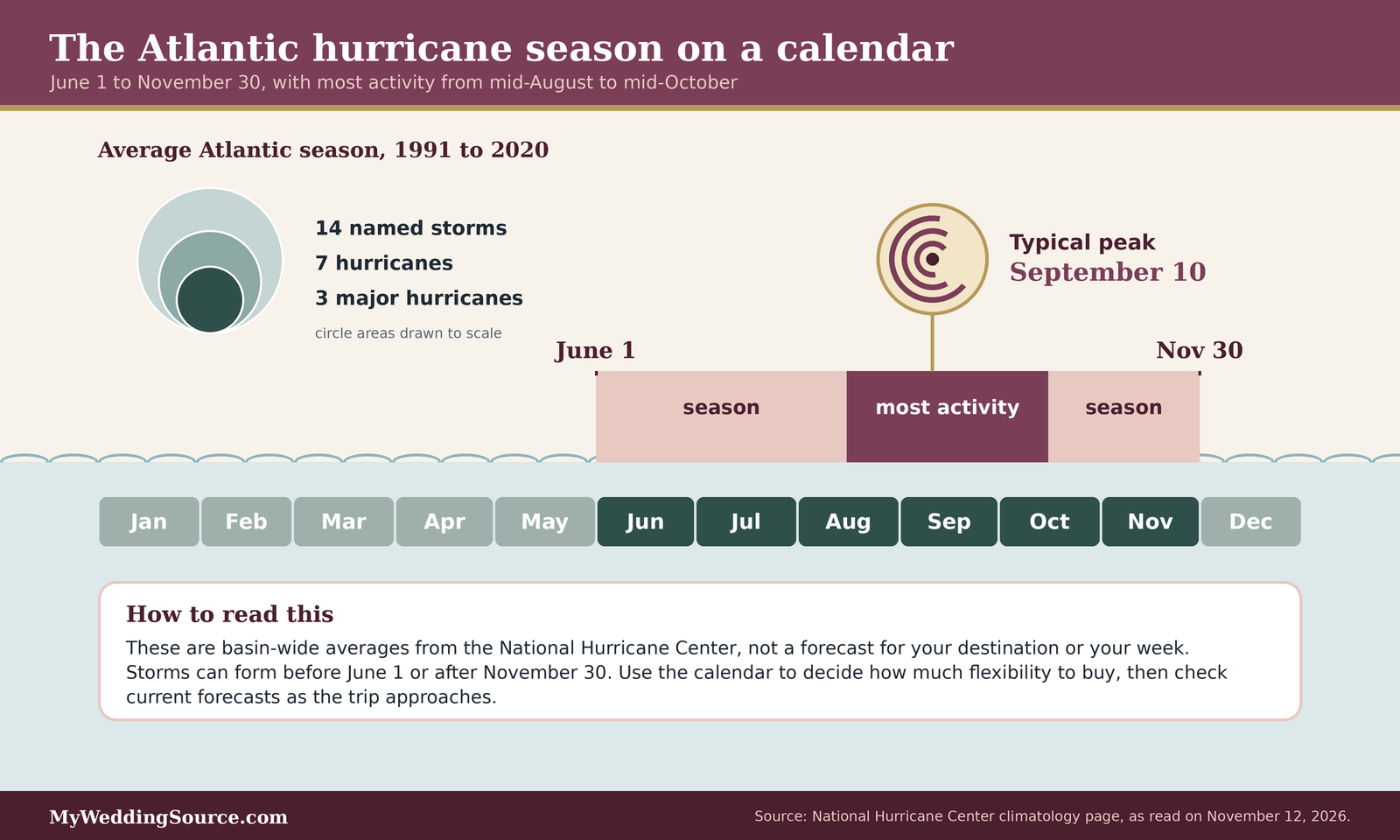
According to the National Hurricane Center’s climatology page, the Atlantic hurricane season runs from June 1 to November 30. It gives an average from 1991 to 2020 of fourteen named storms, seven hurricanes, and three major hurricanes. It places the peak of the season on September 10, with most activity falling between mid-August and mid-October, and it notes that activity sometimes occurs before June 1 or after November 30. These are averages for the basin, not forecasts for a destination or a week.
Why an average does not tell you your risk
A basin average says little about whether a particular island or coastline is affected during a particular week. A storm can miss an area entirely, or a weak system can still bring days of rain and travel disruption. Treat the season as a reason to ask specific questions and to build in flexibility, not as a verdict on a destination. The other direction is also true: an off-peak date is not a guarantee. Our related guide on travel during hurricane season goes further on booking flexibility.
Sources that update as the trip approaches
The National Hurricane Center is the source for current Atlantic storm information, and NOAA’s preparedness page tells travelers to use more than one way of receiving alerts and to know when to leave. Check them close to departure and during the trip. Pre-trip planning cannot replace current information.
Other weather and timing risks
Hurricanes are the most dramatic weather item on a honeymoon booking checklist, not the only one. Several others change the experience of a trip in less dramatic ways.
Heat, rain, and shoulder seasons
Many popular destinations have rainy seasons, heat peaks, or cold seasons that affect what you can do. A shoulder season can offer lower prices and fewer crowds, and it can also mean closed facilities or reduced service. Ask the property what is open on your dates and what the typical weather is, and compare their answer with an independent weather source before paying.
Holidays, festivals, and local calendars
Local holidays and festivals change prices, crowds, and availability, and sometimes close businesses. They can also be a highlight. Check the local calendar for your dates so the surprise is a good one. Prices that look unusually high or unusually low for a week often have a reason.
Daylight and travel time
Short days change how much you can fit in, and long flights change how you feel on arrival. Build the first day lightly. A plan that is realistic after a wedding and a long journey beats one that is ambitious on paper. We touch on this in our planning guide, and the other half of the problem is jet lag, which gets its own treatment in a related article.
Turning weather into a booking decision
Weather risk is only useful in a honeymoon booking checklist if it changes what you do. The following approach converts an uncomfortable unknown into a few specific choices.
Choose flexibility in proportion to the season
If your dates fall in a high-risk window for your destination, favor changeable fares and flexible lodging, check the terms for storm-related changes, and read the insurance policy’s treatment of named storms, including whether coverage applies if a storm is already named when you buy. The NAIC page does not address named storms specifically, so read the policy language itself, and ask the insurer or a licensed agent if anything is unclear.
Pick a backup before you need one
Decide in advance what you would do if the first week were lost: a second destination, a shorter stay, a delayed start, or a staycation that preserves your leave. Writing this down in calm conditions is much easier than inventing it with a storm on the news. The backup does not need to be booked, only known.
Know the decision date
Set a date, such as a week before departure, when you will look at the forecast and decide whether to proceed. Having a date prevents both premature panic and late denial. It also lets you use the flexibility you paid for while it still exists.
Questions to ask about weather and timing
Questions to ask about weather and timing
- What is the property’s policy if a named storm threatens, and when does it decide?
- Does the airline waive change fees for storm-affected flights, and under what conditions?
- Does the insurance policy cover named storms, and does that depend on when it was bought?
- What is open, closed, or limited at the destination on our dates?
- What local holidays or events fall during our stay?
- What is our backup plan, and by which date will we decide?
Why these questions
Weather questions turn a worry into a policy you can read. They are for the property, the airline, the insurer, and the destination’s own sources.
What to do with the answers
Write down your decision date and your backup plan next to the answers. Having both on paper means the choice is made calmly, before the forecast makes it urgent.
The order of booking: from most flexible to least
The sequence in which you commit matters as much as what you commit to, and a honeymoon booking checklist should state it. A common mistake is to book the most exciting or scarce item first, such as a resort, and then build everything else around it. A better approach is to confirm the facts that could stop the whole trip, then commit in a sequence that keeps options open as long as possible.
The commitment ladder
Think of the honeymoon booking checklist as a staircase. Each step is a commitment that is harder to undo than the one before it. The goal is to climb only as fast as your confirmed information allows.

The bottom steps: facts and flexibility
Start with documents and dates: confirm passports, entry rules, leave from work, and the wedding timeline. Then agree on a budget range and an exposure limit, meaning the nonrefundable amount you are willing to hold at any moment. These steps cost nothing and make every later choice faster. Our honeymoon budget guide helps with the money side, and the wedding planning timeline shows where this fits among other tasks.
The middle steps: refundable holds
Next, book the pieces that can be cancelled, such as a refundable fare or a flexible hotel rate, or use a hold that expires. These secure availability and give you real prices, while leaving the decision open. This is where the DOT twenty-four-hour option can help, if your airline offers it. These bookings are not free of risk, but they are inexpensive risk.
The top steps: nonrefundable commitments
Only after the facts are confirmed and the exposure limit is clear should you commit to nonrefundable items, such as discounted rates, prepaid tours, and cheaper fares. Buy protection at the time you commit, because the NAIC summary says some policy options, such as cancel for any reason, require buying within a set time frame. This is the step where the honeymoon booking checklist worksheet matters most.
Dates that anchor the sequence
A booking order in a honeymoon booking checklist is only real when it has dates. The following are the points in a typical timeline that tend to decide whether the sequence works.
Far ahead: when the trip is first imagined
When a destination is chosen, check entry rules, health notices, and the season. If the passport needs renewing, begin that early, since processing takes time and the agency publishes current estimates. Early checks cost little and can change the destination before any money is spent.
Mid-range: when the wedding is a few months away
When the wedding is a few months away, book the main flights and lodging if the fare and rates are attractive and the terms fit your exposure limit. This is also the time to request assistance, if needed, and to buy a policy if you want options that depend on early purchase. Our guide to destination wedding planning covers a related situation where travel and ceremony are linked.
Close in: the final weeks
In the last weeks, verify instead of buying. Confirm names, check schedules, read emails from vendors, and set the weather decision date. The next section turns this into a timeline you can follow.
Edge cases that break a honeymoon booking checklist
A general honeymoon booking checklist handles the common path. The following situations are where couples most often find that the common path does not apply. None is rare, and each deserves a deliberate choice rather than a default.
When the name might change or the trip is split
Honeymoons that do not follow a single, tidy route are the most likely to expose a gap between a reservation and a document.
One traveler changing a name and the other not
Couples frequently change only one name, and the two travelers hold documents in different states of transition. Treat each traveler separately on the worksheet. The reservation for each traveler should follow that traveler’s own document, and a shared booking under one name for both is a place errors hide. If a reservation lists both travelers, confirm each spelling individually.
Separate tickets for different legs
If you book a flight to a gateway city and a separate flight onward, the airlines may not treat a missed connection as their responsibility. Allow a generous gap, and check bag rules, since you may need to collect and recheck bags. A separate-ticket itinerary can save money and can also move the risk to you, so record that on the honeymoon booking checklist worksheet.
Multiple countries and passing through
A route that crosses several borders multiplies the entry rules and the passport validity checks. Include transit countries, even for short layovers, since entry or transit authorization requirements may apply. Check each one on the official government site, and write the result with a date.
When the trip is not what was planned
Plans change for reasons that range from disappointing to serious, and a honeymoon booking checklist should allow for that. A model that handles only the happy path is incomplete.
Postponing the honeymoon
Some couples decide to delay the trip, whether for work, money, health, or because the wedding itself took more than expected. A delayed honeymoon is a legitimate choice. It changes the booking logic in a useful way: with no fixed date, you can buy flexible terms and wait for fares and rates that suit you. If you already booked something, check the change terms before the free window closes. Our discussion of mini-moons covers a middle path of a short trip now and a longer one later.
The wedding itself changes
If the wedding date moves, a prebooked honeymoon moves with it, and the terms you accepted may not allow it cheaply. Before you finalize honeymoon bookings, consider whether the wedding date is truly fixed. Our guide to wedding cancellation and postponement covers the wedding side, and the honeymoon should be one of the items that you check against it.
Illness or an emergency before departure
If one of you becomes ill or a family emergency arises, your options depend on what you booked and what you bought. This is where the exposure ledger earns its place: you already know which items can be changed, who pays for the rest, and which policy conditions apply. Contact each vendor and the insurer promptly, keep records, and ask for decisions in writing. We cannot advise on any specific claim.
When the honeymoon is funded or bundled differently
How the trip is paid for and packaged changes who you contact when something goes wrong.
Honeymoon funds and registry contributions
Some couples ask guests to contribute to a honeymoon fund. If you do, keep the booking records clean, because the funds may be linked to a specific trip, and a changed plan means a conversation. Our wedding registry guide and the guidance on wedding gifts discuss how couples handle that. This is not tax or legal advice, and fund platforms have their own terms.
Packages and travel agents
A package that bundles flights, lodging, and extras can simplify booking and can complicate changes, since one part may not be changeable on its own. A travel advisor can add real value in a complicated itinerary, and the same worksheet applies: ask the advisor for the terms of each component, who holds the money, and who to contact if a supplier fails. Disclose to yourself that an advisor or platform may earn commissions, and ask how any fee is charged. We do not recommend a specific advisor in this honeymoon booking checklist.
Gifted or discounted components
Gifts of points, certificates, or upgrades can be wonderful. They often have their own rules about changes, expiry, and blackout dates, and they may be nonrefundable. Treat a gifted item as a separate row on the worksheet and read its terms. Another guide in this series examines using points in detail.
The last weeks: a verification timeline
By the final weeks, the honeymoon booking checklist changes from building the trip to confirming it. This is a different activity, and it benefits from its own schedule. The timeline below uses ordinary intervals that you can adjust, and it assumes you have kept the honeymoon booking checklist worksheet.
A schedule you can adapt
These intervals are our own suggestion, not a regulatory requirement, and the right schedule depends on your itinerary.
| When | What to confirm | Why it matters |
|---|---|---|
| Several weeks out | Passports valid, names match every reservation, assistance requests recorded | Fixes are cheapest and most possible now |
| About three weeks out | Vendor emails read, schedule changes checked, vaccine or medication needs settled | Changes by vendors often arrive in this window |
| About two weeks out | Policy documents saved offline, card dispute deadlines noted, the weather decision date set | Protects against an unreachable email later |
| About one week out | Forecast reviewed, transfers and late arrival confirmed, backup plan checked | The last point at which flexibility may still be used |
| Two days out | Check-in opens, seats and names verified, passports and IDs in the bag, copies stored | Last chance for a calm correction |
| Day of travel | Time to airport, bag rules, documents in hand, phone charged, hotel informed of arrival | Small details that cause the most stress |
Why a schedule helps
A schedule gives each of you an explicit job and prevents the trap of assuming the other person checked. Assign each row to one person. Both of you will feel calmer on the day if you know the checking is already done.
What to do when you find a problem
If your honeymoon booking checklist turns up a mismatch or a change, address it right away, in writing where possible, and keep records. Call the airline or property, ask what can be done, and ask them to note the file. If a payment is involved, note the dispute deadline on your calendar. Acting early changes the available options.
Documents to carry and copies to keep
The right set of documents is smaller than most people carry, and more valuable than most people assume.
What to carry on your person
Carry passports, the ID required for any domestic leg, a payment card with a good dispute path, and a paper or offline copy of the first night’s reservation. Keep a second card in a different place from the first. If your phone fails, the paper copy of your first address can still get you through immigration and a taxi.
What to store offline and share
Store reservation confirmations, policy documents with the claim phone number, passport photo pages, and the worksheet in a place both phones can open offline. Share the access with a trusted person at home, so someone can find a number if you cannot.
What to leave at home
Leave documents you do not need, such as extra cards, a marriage certificate you do not need to carry, and unused membership cards. If you do need the certificate for a particular reason, carry a copy and keep the original safe. This reduces the harm of loss or theft.
A worked example of the honeymoon booking checklist
Examples make a honeymoon booking checklist real. The following one is invented for illustration. It does not describe a real couple, and the numbers are not data.
The scenario
Imagine a couple marrying in the fall, planning a two-week trip abroad that begins two days after the ceremony. One partner plans to change a surname, and the other will keep theirs.
The facts as they stand
One passport expires about seven months after the planned return, and the other is well within range. The flights cost a combined amount that the couple can afford to lose only partly, the first resort is nonrefundable after a certain date, and one partner has a health condition that changes with long flights. The destination has a rainy season that overlaps the second week.
What the honeymoon booking checklist model surfaces
Run through the six layers, the couple finds several items. The passport that expires seven months after return is above a six-month rule but close, so they note the entry requirement for the destination and check it. The name change goes after the trip, so reservations match current passports. The flights are changeable for a fee, so they accept that. The resort is the high-exposure item, so they consider a flexible rate or a policy. The health condition goes to a clinician before booking, and assistance is requested. The rainy season prompts a backup plan for the second week.
What they decide
A model is only useful if it changes decisions. This is what changes in the example.
The order they follow
They confirm entry rules, then check with the clinician, then book refundable flights, then choose a flexible resort rate for the first night and a nonrefundable one only for the second week once the forecast outlook is clearer. They buy a policy after reading the exclusions and confirming that the condition is addressed, and they set a decision date a week before departure.
What stays uncertain
Even after all this, uncertainty remains. The weather could still be poor, a vendor could still change terms, and a rule could still shift. The model does not remove uncertainty. It makes the remaining uncertainty visible and chosen.
Using the honeymoon booking checklist model with vendors and advisors
The best vendors welcome the precise questions a honeymoon booking checklist produces. The following approach helps you ask them in a way that gets useful answers, and helps you recognize when answers are not forthcoming.
How to ask so you get a real answer
How you ask shapes what you hear. Specific, written questions produce specific, written answers.
Ask in writing and keep the reply
Email is better than a phone call for terms, since it creates a record. If you do call, send a short email afterward summarizing what was said and asking for correction. Save the thread with the reservation. This simple habit resolves many later disagreements.
Ask for numbers and dates, not reassurance
Replace general questions with specific ones. Instead of asking whether the room is flexible, ask for the last date you can cancel without charge and the amount charged after it. Replace “is it accessible” with measurements. A vendor who answers with numbers is easier to trust than one who answers with adjectives.
Ask what happens when it goes wrong
Ask what the vendor does when it cannot deliver: if a flight is cancelled, if a room is unavailable, if a facility is closed. The answer shows how the vendor behaves under stress, which is what you are really buying.
Recognizing warning signs
Most travel vendors are honest, and a few are not. Some warning signs are worth knowing.
Pressure and secrecy
Pressure to pay immediately, a refusal to put terms in writing, or reluctance to give a physical address and a way to be contacted are reasons to slow down. A genuine offer survives a day of checking. This is general consumer wisdom, and the FTC maintains current guidance on travel scams, which you should read before sending a large deposit.
Payment methods that remove recourse
A vendor who insists on a payment method that you cannot reverse, when other methods are normal for that type of business, deserves extra checking. Use independent contact details, not those in an unsolicited message, to confirm that you are talking to the real business.
Claims you cannot verify
Be careful with claims such as guaranteed upgrades, guaranteed weather, or guaranteed availability, since no vendor controls those. Treat a promise that cannot be kept as a reason for caution, not for confidence.
A master list of questions
The questions below pull together the most important items from the earlier layers. Use them as a starting script.
Master questions for any honeymoon vendor
- What is the exact name on this reservation, and how do I correct it if it is wrong?
- What can be changed, by when, and at what cost?
- What is refundable, and what is not, and how is a refund paid?
- Who do I contact if something goes wrong, and how quickly do you respond?
- What is included in the price, and what costs extra?
- What is your policy for weather, closures, and schedule changes?
- What do you need from us in advance, and by what date?
Putting the honeymoon booking checklist into practice
A honeymoon booking checklist is valuable only if it becomes a habit. This final section ties the pieces together and offers a way to keep the work proportionate to your trip.
Scaling the model to your trip
Not every trip needs every step of a honeymoon booking checklist. A short domestic trip and a multi-country journey are different problems, and the same worksheet can handle both.
A short domestic getaway
For a short domestic trip, the honeymoon booking checklist worksheet may have only a handful of rows. The key layers are the flight or drive, the lodging terms, and the weather. Names matter for flights, and the ID rule matters at the airport. You may still want protection, but the exposure is smaller.
A long international journey
For a long international trip, every layer carries weight. The worksheet grows, the dates multiply, and the value of a written schedule rises. Spend more time on entry rules, health preparation, and flexible terms. If the trip is complex, a travel advisor may be worth the cost, and the same questions apply to them.
A trip with older relatives or a recent injury
If someone’s mobility or health shapes the trip, the access layer leads. Build the plan around the traveler with the most constraints, and add flexibility everywhere else. A trip that works well for the person with the most needs usually works for everyone.
Keeping the plan alive
The honeymoon booking checklist worksheet is not a one-time document. Terms change, schedules shift, and your own needs evolve. A few habits keep it useful.
Review at fixed points
Review the worksheet at the points on the verification timeline, and whenever a vendor sends a change. Update the dates and terms. A stale worksheet is worse than none, because it creates false confidence.
Share the load
Divide the rows between the two of you, and review each other’s. A second reader catches spelling errors and missed dates more often than the person who wrote them. This is also a modest way of practicing the shared decision-making that a marriage involves.
Keep a short record for next time
After the trip, note what worked and what you would change. You will likely travel together many more times, and a record of what you learned is the most reusable part of the process. It is also the honest answer to the question of what a honeymoon booking checklist is for: not to remove every risk, but to make sure the risks you take are the ones you chose.
FAQ: honeymoon booking questions
Names and documents
Should I book the honeymoon under my current name or my married name?
Book under the name on the passport you will carry on the trip, since the airline name needs to correspond to that document. If your passport is still in your current name, use it, and start the name change afterward. Check the airline’s own instructions, and see our passport name change guide for sequence.
How early should I check my passport before booking?
Before you book anything. The State Department’s travel industry page says many countries require at least six months of validity remaining and at least two blank pages. A passport that looks fine today may fall short on the return date, and renewal takes time, so check expiry first and confirm each country’s rule.
Flights and lodging
Can I cancel a flight for free after booking?
Sometimes. DOT says that for tickets bought at least seven days before departure, an airline must allow a full refund within twenty-four hours or hold the fare for that time, and need not offer both. DOT also says the rule does not apply to tickets bought through travel agents or online agencies, so confirm who sold yours.
When am I owed a refund if the airline changes my flight?
DOT says you are entitled to a refund if the airline cancels or makes a significant change and you decline the alternative. Its examples include a schedule shift of at least three hours domestically or six hours internationally. Credits may be offered, but you can ask for money back where the right applies. Check current DOT wording.
Do hotel resort fees have to be shown in the price?
The FTC’s fees rule, effective May 12, 2025, says short-term lodging must show a total price that includes mandatory fees the business knows about, and gives a daily resort fee as an example. Taxes and optional add-ons can be disclosed later. Confirm the final amount before paying, since we could not check each property.
Protection and money
Does travel insurance cover everything if I cancel?
No. The NAIC says common exclusions include pre-existing conditions, pandemics, civil unrest, pregnancy, and risky activities, and that cancel for any reason typically returns 50 to 75 percent and has timing rules. Read the exclusions in the actual policy, and see our honeymoon travel insurance guide for more detail.
How long do I have to dispute a charge on my card?
The CFPB says to send a written billing error notice within sixty calendar days of when the charge first appeared on your statement, and that a phone call alone does not protect your rights. Travel is paid early, so ask your issuer how it handles services delivered later. This is general information, not legal advice.
Access and weather
How do I arrange wheelchair assistance on a honeymoon flight?
Request it when you book and again before departure, and keep a reference number. DOT says airlines cannot generally require advance notice, though some accommodations may need up to forty-eight hours. TSA Cares recommends seventy-two hours for security help and says airlines provide airport wheelchairs. Check current DOT rules on mobility devices.
Is hurricane season a reason not to book a beach honeymoon?
Not by itself. The National Hurricane Center lists the Atlantic season as June 1 to November 30, with a September 10 peak and most activity from mid-August to mid-October. These are basin averages, not forecasts for your week. Favor flexible terms, read policy language on named storms, and set a decision date.
Your next steps
Build the map
Fill in the honeymoon booking checklist worksheet
Copy the booking worksheet into a shared note and add a row for every reservation, including ones you have not made. Fill the dates column first, then sort by it. In an hour you will have a schedule of deadlines that is more useful than any generic timeline.
Check documents before money
Look at each passport’s expiry date and blank pages, confirm that your ID works for any domestic leg, and decide which name each reservation will use. Our passport name change guide can help with the sequence.
Commit in order
Book flexible items first
Start the honeymoon booking checklist with refundable or changeable items, use the airline’s twenty-four-hour option if it offers one, and verify names on the first day. Then commit to nonrefundable items only when you have set an exposure limit and decided on protection.
Set your decision dates
Put three dates from your honeymoon booking checklist in both phones: the earliest free-cancellation deadline, the date to review weather, and the date to confirm assistance. Use the verification timeline for the last weeks, and our wedding week checklist to fit the trip into the busiest days.
Sources & methodology
How we built this guide
What we relied on
This guide to the honeymoon booking checklist draws on U.S. government pages from the Department of Transportation, the Transportation Security Administration, the Federal Trade Commission, the Consumer Financial Protection Bureau, the State Department, the National Hurricane Center, and the CDC, along with a consumer guide from the National Association of Insurance Commissioners and an airline’s agency documentation on Secure Flight. Pages were checked on November 12, 2026. Where a page appeared dated or inconsistent, we say so in the text. The exposure example is our own illustrative arithmetic, not data.
What we did not do
We did not verify any rule beyond what the pages said when we read them, and we did not confirm current enforcement of the 2024 wheelchair rule. We did not quote prices, review insurers, airlines, or properties, or give legal, financial, medical, or insurance advice. Several pages we tried to retrieve, including the TSA Secure Flight page, the FTC travel scams page, and the State Department’s travel advisories page, could not be read, so we did not rely on them. Verify rules and vendor terms for your own itinerary.
Source list
Government and regulatory sources
- U.S. Department of State, Travel.State.Gov international travel hub: https://travel.state.gov/content/travel/en/international-travel.html
- U.S. Department of State, travel industry guidance (passport validity and blank pages): https://travel.state.gov/en/international-travel/planning/guidance/travel-industry.html
- U.S. Department of Transportation, Refunds: https://www.transportation.gov/individuals/aviation-consumer-protection/refunds
- U.S. Department of Transportation, Passengers with disabilities: https://www.transportation.gov/airconsumer/passengers-disabilities
- Federal Register, DOT final rule on safe accommodations for air travelers using wheelchairs (December 17, 2024): https://www.govinfo.gov/content/pkg/FR-2024-12-17/html/2024-29731.htm
- U.S. Department of Transportation, Notice of enforcement discretion on the wheelchair final rule (June 2025): https://www.transportation.gov/sites/dot.gov/files/2025-06/Notice%20Enforcement%20Discretion%20%E2%80%93%20Final%20Rule%20on%20Ensuring%20Safe%20Accommodations%20for%20Air%20Travelers%20With%20Disabilities%20Using%20Wheelchairs.pdf
- Transportation Security Administration, REAL ID: https://www.tsa.gov/real-id
- Transportation Security Administration, Passenger support and TSA Cares: https://www.tsa.gov/travel/passenger-support
- Federal Trade Commission, Rule on Unfair or Deceptive Fees frequently asked questions: https://search.ftc.gov/business-guidance/resources/rule-unfair-or-deceptive-fees-frequently-asked-questions
- Federal Trade Commission, Consumer advice on disputing charges: https://consumer.ftc.gov/node/298638
- Consumer Financial Protection Bureau, How do I dispute a charge on my credit card bill: https://www.consumerfinance.gov/ask-cfpb/how-do-i-dispute-a-charge-on-my-credit-card-bill-en-61/
Weather, health, and insurance sources
- National Hurricane Center, Tropical cyclone climatology: https://www.nhc.noaa.gov/climo/
- NOAA, Hurricane preparedness: https://www.noaa.gov/hurricane-prep
- Centers for Disease Control and Prevention, Travelers’ Health: https://wwwnc.cdc.gov/travel
- National Association of Insurance Commissioners, Travel insurance: https://content.naic.org/cipr-topics/travel-insurance
Industry source
- Delta Air Lines (agency policy library), Secure Flight Passenger Data Program FAQs: https://pro.delta.com/content/agency/us/en/policy-library/government-tsa/secure-flight-passenger-data–sfpd–faqs.html
Why these questions
These questions are deliberately general, so you can use them with a vendor that does not fit any single layer, such as a planner, a tour operator, or a private host.
What to do with the answers
Adapt the wording to the vendor, keep the replies with the reservation, and notice how a vendor answers as well as what it answers. A clear reply is a good sign for the rest of the trip.
Why these questions
Names are checked by systems that do not negotiate, so these questions are about removing ambiguity before check-in. Ask them of the airline, the hotel, and yourselves.
What to do with the answers
Write each answer next to the matching worksheet row, with the date you asked. If an answer is uncertain, treat the row as high-exposure and put the verification date on the calendar.