

Engagement ring insurance is a decision about one small, valuable object and one narrow question: if the ring is lost, stolen, or damaged, who pays, how much, and on what terms, which is why the wording of the policy matters far more than the size of the coverage amount on the first page.
Quick answer
A standard homeowners or renters policy may cover a ring, but jewelry is usually subject to a special dollar limit, and that limit sits inside your overall contents coverage instead of on top of it. The usual way to close the gap is a scheduled endorsement (also called a rider or floater) or a separate jewelry policy that insures the ring for its appraised value. Compare any engagement ring insurance offer by perils covered, payout method, deductible, who chooses the replacement, territory, and what the insurer requires as proof, not by the headline amount. This guide is general education, not insurance, legal, or financial advice, and your policy language controls.
Start with the risk engagement ring insurance is meant to transfer
Before comparing a single quote, it helps to be precise about what you are trying to protect against. An engagement ring is unusual among household belongings: it is small enough to slip off a wet finger, valuable enough that replacing it would be a major expense, and worn so often that it is exposed to a long list of everyday accidents. Engagement ring insurance exists to move some of that financial exposure from you to an insurer, in exchange for a premium. The useful questions are which losses you want to transfer, how much of the replacement cost you could absorb yourself, and which parts of the exposure belong to other products entirely.
What can actually happen to a ring
Most claims on any jewelry policy fall into a few buckets. Thinking about them separately makes it easier to read a policy, because each one is treated differently in the fine print.
Loss, theft, damage, and the quiet disappearance
With engagement ring insurance, theft is the event people imagine, but it is often not the likeliest one. A ring can be lost down a drain, left on a hotel sink, dropped in a parking lot, or simply not be on your hand when you look down. A stone can loosen and fall out of a worn setting. A band can bend, crack, or be crushed in a gym or a car door. A ring can also vanish with no clear explanation, and you may never be able to say when it happened. Each of these is a different kind of event, and a policy may treat them very differently: some policies list the perils they cover, and others cover everything except what they exclude. The National Association of Insurance Commissioners (NAIC) notes in its homeowners overview that policies can be written to cover all perils except those explicitly excluded, or only named perils, and that difference is the first thing to check for a ring.
When we use the word “disappearance” in this guide, we mean a loss where you cannot point to a theft, a fire, or an accident. We did not find a regulator page that defines how insurers treat that situation, so treat it as a question to ask in writing: if the ring is gone and I cannot say how, is that covered, and what proof will you want?
Why the exposure behind engagement ring insurance is lopsided
A ring is likely to be one of the most valuable things you own per cubic inch, which is why household policies treat jewelry as a special category. The California Department of Insurance explains in its homeowners and renters guide that coverage is limited on certain types of property considered especially susceptible to loss, including jewelry, antiques, furs, collectibles, fine art, firearms, silverware, and money. The Insurance Information Institute (Triple-I) says something similar: jewelry, furs, art, collectibles, and silverware usually carry dollar limits for theft. The practical effect is a lopsided exposure. A whole-house contents policy might be generous for a sofa and a television and still be thin for a ring that cost as much as a used car.
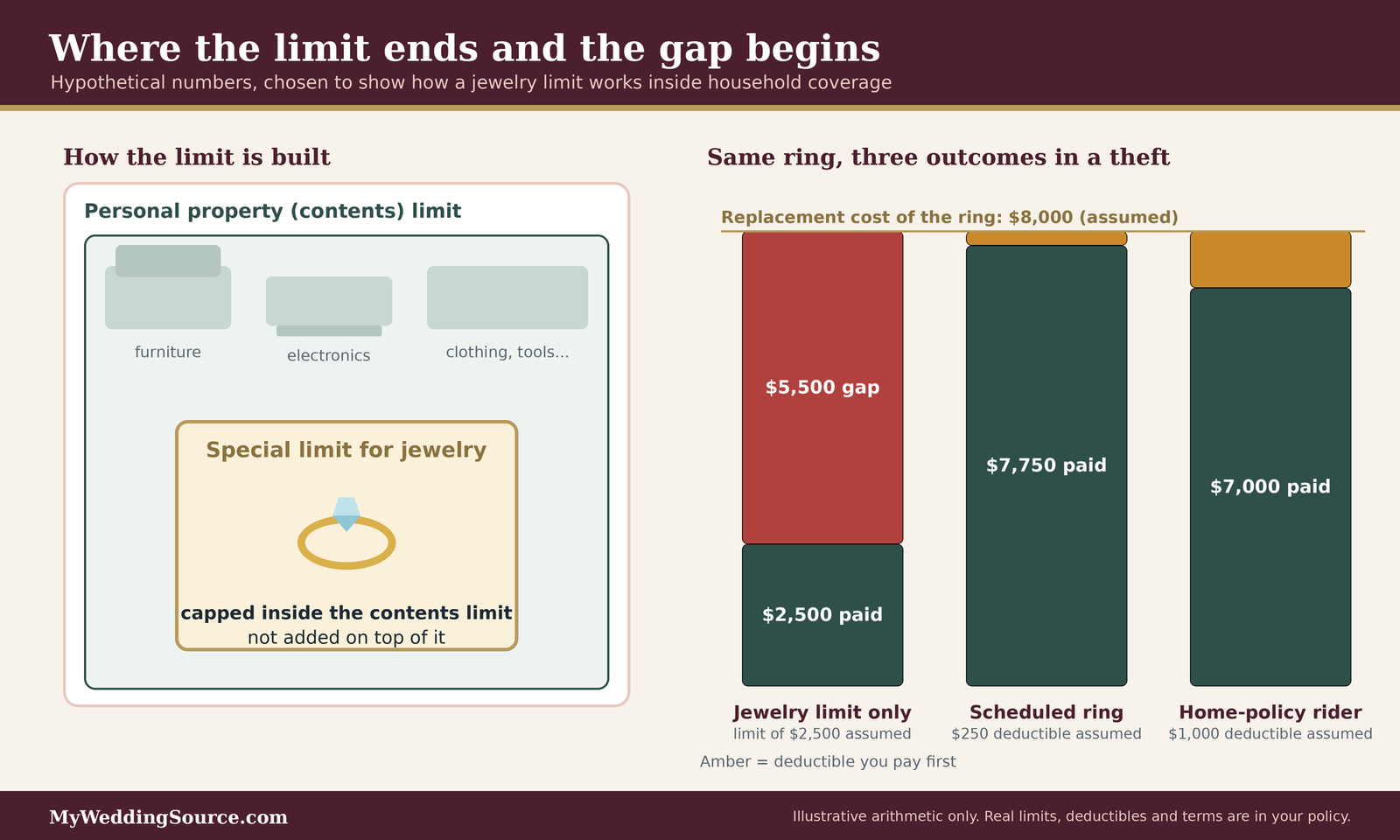
To make the lopsidedness concrete, imagine a ring that a jeweler would replace for $8,000 and a policy that caps jewelry theft at $2,500. Both numbers are hypothetical, chosen only so the arithmetic is easy to follow. The uncovered portion in a theft would be $5,500, before any deductible. If you could comfortably absorb that gap, going without extra coverage is a reasonable choice. If you could not, the gap is the risk you are shopping to transfer.
Risks that belong to other policies
A common source of confusion is that “insurance” for the engagement and the wedding sounds like one product. It is not. Several different exposures exist around the same celebration, and each has its own policy type, if it has one at all.
Wedding event insurance is a different product
Event insurance for a wedding is built around the event: a venue that closes, a vendor that fails, or a liability claim from a guest. It is a different contract with different exclusions, and it is not designed to replace a lost engagement ring. If you are weighing both, our guide to wedding insurance explains what event policies are meant to cover and what they usually leave out. Read it for the event, and read this guide for the ring. When you talk to an agent, ask directly whether the ring is covered under any event policy, and get the answer in writing, because assumptions here are expensive.
Travel, honeymoon, and liability exposures
A trip creates its own set of risks: delayed bags, medical bills, canceled flights, and stolen belongings. Travel policies commonly place low caps on jewelry, and we could not find a neutral regulator source that states those caps, so we are not quoting numbers. What we can say is that the right question is always the same: is a ring I am wearing covered, is a ring in checked luggage covered, and is the cap enough? Our guide to honeymoon travel insurance covers the trip-specific questions. Liability coverage (what you owe someone else if you cause harm) is a separate matter and has nothing to do with protecting the ring itself.
Deciding whether you need engagement ring insurance at all
Not every ring needs engagement ring insurance of its own. The decision is personal, financial, and reversible, and it is fine to decide differently at different times.
The self-insure test
Ask yourself a simple question: if the ring disappeared tomorrow, could you replace it from savings without hardship, and would you? If yes, the premium you would pay might exceed the value of the risk you are transferring, and some people skip coverage on that basis. If no, the argument for coverage gets stronger. We cannot tell you which side of that line you are on, and we do not publish premium rates because we could not verify any from a regulator or an insurer’s filed rates. What we can offer is a way to compare any engagement ring insurance quote you receive, which we cover in the second half of this guide.
A related point is sentimental value. Insurance pays money. It cannot return a ring that belonged to a grandparent or was designed together. Some owners accept that and insure the replacement cost; others decide the sentimental piece is the reason to be careful instead of the reason to buy coverage. Neither choice is wrong for engagement ring insurance as a whole.
When it is a close call
A close call is more common than you might think. A lab-grown or moissanite center stone can have a lower replacement cost than a natural diamond of similar appearance, which can shrink the gap between your homeowners limit and the ring’s value. Our guides to lab-grown diamond engagement rings and moissanite engagement rings cover how those stones are priced and described. If your homeowners limit already covers most of the replacement cost, a rider may add little. If you rent and your belongings coverage is modest, a standalone policy may matter more. Run the numbers for your own engagement ring insurance decision instead of copying someone else’s decision.
If you are budgeting for the whole engagement and wedding period, an engagement ring insurance premium is one more recurring cost, and it belongs in your plan next to the other costs people forget. Our wedding budget hidden costs article covers that wider list, and the wedding budget calculator can hold the line item.
Where homeowners and renters policies leave gaps in engagement ring insurance
For many couples, the first step is to look at the policy they already have. A homeowners or renters policy can be a good starting point, but it was written for an entire household of belongings, not for one ring. Understanding how it handles jewelry tells you whether you need anything more.
How special limits work
The word “limit” appears everywhere in an insurance policy, and it is easy to confuse the different kinds. The one that matters most for a ring is the special limit for jewelry.
The jewelry limit sits inside the contents limit
The California Department of Insurance guide makes a point that surprises many readers: special limits are not added on top of the personal property limit. They are part of it and cap what the policy will pay for those items. So if your contents coverage is $50,000 and your jewelry limit is $2,500 (again, illustrative figures), you do not have $52,500 in total. You have $50,000, of which at most $2,500 can go to jewelry for the covered losses. The same guide says contents limits are generally set around half the dwelling limit as a guideline, and Triple-I describes personal property coverage as generally set at 50 to 70 percent of the structure coverage amount. For a renter, the contents amount is chosen by the policyholder, subject to the insurer’s minimum.
Because the jewelry limit is inside the contents limit, increasing your contents coverage does not by itself raise the jewelry cap. To insure a ring to its full value, the usual route, according to both Triple-I and the California Department of Insurance, is an endorsement (also called a rider or floater) that schedules the item. Triple-I says to insure the item for its officially appraised value.
Why the dollar amount lives in your policy, not here
Neither of those sources states a universal dollar figure for the jewelry limit, and we could not find a regulator source that does. Limits differ by insurer, state, and policy form. That is why we use hypothetical figures in this guide and ask you to find the number in your own policy. Look for a section titled something like “special limits of liability” or “limited coverage” in your declarations or policy form, and ask your agent to point to the sentence that applies to jewelry. If the agent says “you are covered for everything,” ask for the specific limit in writing.
One more detail worth checking is whether the limit is stated per item, per loss, or in total for all jewelry. A limit that applies to all jewelry combined is easily consumed if you own several valuable pieces, because a loss that takes a ring and a watch together may be paid under a single cap.
Named perils, all-risk, and what each might leave out
The next layer of engagement ring insurance is what events are covered at all. Two policies with the same limit can behave very differently if one lists perils and the other excludes only specific ones.
Reading the perils section
The NAIC says policies can cover all perils except those explicitly excluded, or only named perils, and lists typical covered perils such as fire, lightning, windstorm, hail, theft, and vandalism. The California Department of Insurance guide lists perils generally not covered, including flood, earthquake, mold, and wear and tear, and advises reading the exclusions in your policy. For a ring, a few exclusions matter more than the rest: anything about loss that is not tied to a specific event, damage from wear or gradual deterioration, damage from repair or resizing work, and loss while the ring is in the care of someone else.
A practical way to read the section is to take a short list of ring events and look for each one in the policy: it slips off and is lost, it is stolen from a locked car, it is stolen in a burglary, a stone falls out, the band is crushed, the ring is damaged during resizing, and the ring is lost on a trip. For each, find the sentence that grants coverage and the sentence that excludes it. If you cannot find either, ask. Our claim-scenario table later in this guide puts these events side by side.
Wear, gradual damage, and loose stones
The California guide lists wear and tear among the things policies generally do not cover. This matters because a loose stone is often the result of a gradual process: a prong thins over time, and one day the diamond is gone. An insurer reviewing that loss may ask whether it was sudden or gradual, and a policy that excludes wear may not pay for the missing stone. Some jewelry-specific policies advertise broader damage coverage, and when a company says so, treat it as that company’s claim and ask for the exact wording. We did not review any specific insurer’s policy form for this guide, so we are not saying which products cover loose stones and which do not.
The preventive answer is the cheapest one. Have a jeweler check prongs and settings on a regular schedule, and keep a record of each check; it is useful both for the ring and for any claim. Our guide to engagement ring settings explains how different settings hold a stone, which affects how often a check is worth doing.
Endorsements, floaters, and standalone engagement ring insurance
There are, broadly, three ways to insure a ring beyond the default coverage in a household policy. Each has trade-offs that are easy to miss in a sales conversation.
Adding an endorsement to a household policy
For engagement ring insurance through your existing insurer, an endorsement is a written agreement that adds or removes coverage, according to the California Department of Insurance guide, and it is also called a rider or floater. It schedules a specific item, which usually means the item is listed with a description and a value. The advantage is convenience: one insurer, one bill, and a ring tied to the policy you already have. The trade-offs are questions to ask, not conclusions. Does the endorsement carry the same deductible as the base policy? Does a claim on it count toward your loss history for the household policy? Could it affect renewal? We could not verify the answers from a regulator source because they vary by company, so ask each one and record the replies.
Choosing a separate engagement ring insurance policy
Triple-I describes a floater as a separate policy that can be added to a renters policy, and some insurers sell jewelry-only policies that are independent of any home policy. Companies that sell them tend to describe broad coverage and a simpler claim process, but those are the sellers’ own claims, and we have not independently tested them. If you consider one, check that the company is licensed in your state, using the NAIC’s Consumer Insurance Search or your state insurance department, and look up its complaint record. The NAIC notes that a company may have subsidiaries with different names, so match the name on the policy to the name in the search.
A separate engagement ring insurance policy is not automatically better. It is one more contract, one more bill, and one more renewal to track, and the right answer depends on your household policy, your deductible, and your tolerance for paperwork.
| Layer | What it usually does | Typical gap to check | Proof you will likely need | Question to ask |
|---|---|---|---|---|
| Homeowners or renters policy, no endorsement | Covers belongings against listed events, with a special dollar limit for jewelry | Jewelry limit may be far below replacement cost; the limit sits inside contents coverage | Receipts, photos, inventory | What is the exact jewelry limit and which events does it apply to? |
| Endorsement or floater on the same policy | Schedules the ring, often for its appraised value | Deductible, claims history, renewal effects, who chooses replacement | Appraisal, photos, description | Does a claim affect my home policy and its renewal? |
| Separate jewelry policy | Insures the ring on its own contract | Exclusions, territory, appraisal rules, premium changes at renewal | Appraisal, receipts, photos | Is the company licensed here, and how are replacements handled? |
| Event, travel, or wedding policy | Covers the event or trip, not usually the ring itself | Sublimits for jewelry, exclusions for loss without a clear cause | Receipts, police or carrier reports | Does it list jewelry, and for how much? |
| No insurance, self-insure | You pay for any loss | Savings gap if the ring is lost | Not applicable | Could I replace the ring from savings without hardship? |
The matrix above is a reading aid, not a ranking. It shows where to look, not what a given insurer will do.
Compare policy wording instead of headline coverage amounts for engagement ring insurance
Once you have two or three engagement ring insurance offers on the table, the headline numbers (coverage amount and annual premium) are the easiest to compare and the least informative. The real differences hide in definitions, exclusions, deductibles, and settlement terms. This section is a method for turning several different offers into something you can compare fairly.
Build an apples-to-apples coverage matrix
The goal is to lay each offer out in the same columns so that a difference stands out. Use a spreadsheet or a sheet of paper; the format does not matter, but the discipline does.
Match definitions and exclusions
Start with definitions. A policy may define “jewelry,” “loss,” “theft,” “damage,” or “mysterious disappearance” in ways that change what is covered. Put each offer’s definition next to the others. Then list exclusions one by one: wear and tear, gradual damage, loss from repair work, loss while in someone else’s custody, loss in particular countries, and loss from specific activities. An offer that looks cheaper may simply exclude more. The comparison is fair only when you know which exclusions each offer includes.
Ask each engagement ring insurance provider for the actual policy form, not a marketing summary. A policy form is the document that governs a claim. If a salesperson describes a benefit, ask them to show you the sentence that grants it. If they cannot, treat it as a verbal promise, which is not a contract term.
Flag endorsements required by lenders or venues
Some situations require proof of specific coverage: a mortgage lender may require evidence of a homeowners policy, and Triple-I notes that lenders may require proof of a policy before final mortgage approval. A venue may ask for event liability insurance in its contract. Neither of those requirements concerns your ring. Still, it is worth keeping the documents separate, so that a certificate you send to a venue is not confused with the policy that covers the ring. Our guide to wedding vendor contract red flags explains how venue and vendor contracts handle insurance requirements, and the same discipline applies: read the clause, then read the policy it points to.
Quote normalization: turning offers into one comparable number
Prices differ because offers differ. A method for normalizing them lets you compare cost fairly.
A worked example with hypothetical numbers
Suppose a ring is appraised at $8,000 for replacement. Three hypothetical offers arrive. Offer A is a standalone policy with a $96 annual premium and a $0 deductible. Offer B is a standalone policy with a $64 annual premium and a $250 deductible. Offer C is a rider on a home policy with an $80 annual premium and a deductible equal to the home policy’s $1,000. These are invented to demonstrate the method, and they are not market prices.
Step one: divide the premium by the insured value and multiply by 100 to get the cost per $100 of coverage. A is $1.20, B is $0.80, and C is $1.00. Step two: multiply each annual premium by the number of years you expect to hold the policy, say five, which gives $480, $320, and $400. Step three: test a small claim. Suppose a repair costs $1,500. Under A you pay nothing beyond the premium. Under B you pay $250. Under C you pay $1,000 and the insurer pays $500. Step four: add the five-year premium to the out-of-pocket cost of that claim: A is $480, B is $570, and C is $1,400. Step five: test a total loss of $8,000. With A you pay $0, with B $250, and with C $1,000, again before premiums.
The point of the exercise is not that A wins. It is that the cheapest premium (B) is not the cheapest outcome in a claim, and that a rider’s deductible can make small claims barely worth filing. Your numbers will differ, so replace the inputs with real quotes and see where the ranking moves.
What this actually costs
The real cost of engagement ring insurance is the premium plus the deductible you would pay in a claim, plus the cost of appraisals and re-appraisals, plus any effect a claim has on your household policy. The first number is on the quote; the others are not. All figures in this guide’s examples are hypothetical arithmetic for comparison, not market prices.
What the normalization leaves out
A fair comparison of engagement ring insurance also needs the items a spreadsheet cannot price: how the insurer treats claims, whether the premium can change at renewal, and how easy it is to reach a person. Triple-I notes that premiums can rise even without a claim of your own, because of more frequent claims and higher claims costs across the market. Ask what limits there are on premium changes at renewal, and whether the insurer can decline to renew. Check the NAIC’s Consumer Insurance Search and your state insurance department for complaint information, and treat reviews on retail sites as anecdotes.
Payout terms in engagement ring insurance: actual cash value, replacement cost, and who chooses
The word “covered” does not tell you what you will receive. The settlement method does.
Actual cash value versus replacement cost
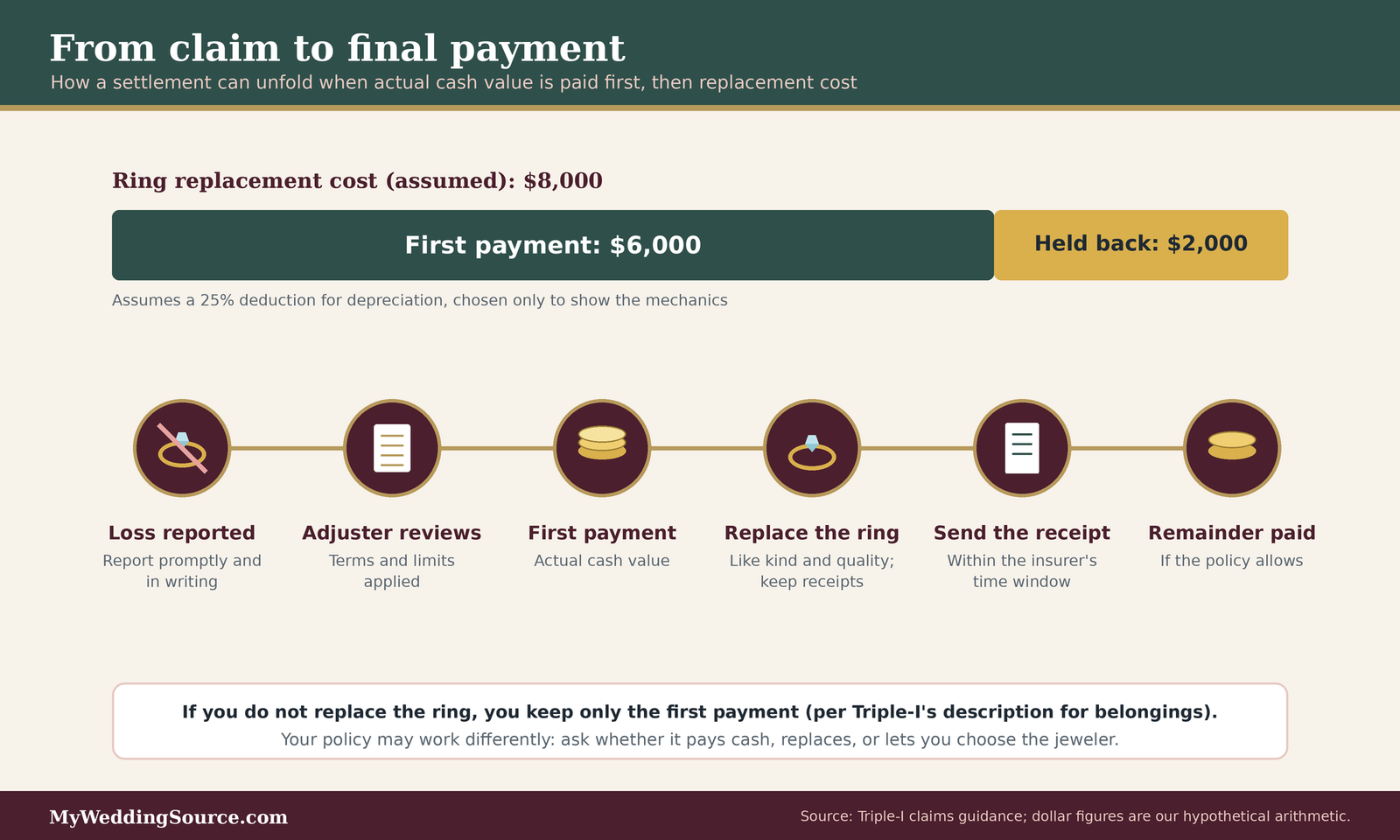
The California Department of Insurance guide defines the two: actual cash value is the repair or replacement cost minus a fair deduction for depreciation, and replacement cost is the amount needed to replace property with new property of like kind and quality locally. The NAIC similarly says policies can be written on replacement cost or actual cash value. Triple-I adds how these work together for belongings: they are first paid at actual cash value, even under a replacement value policy, and to receive the remaining replacement amount you generally must buy replacements of similar size and quality and submit receipts. You typically have several months from the first payment to replace items, and Triple-I advises confirming the timeframe with your agent. If you do not replace an item, you keep only the first payment for it.
Here is the arithmetic, using hypothetical numbers. Say the ring would cost $8,000 to replace, and the insurer applies a 25 percent deduction for depreciation in this example. The first payment would be $6,000. If you then buy a comparable ring for $8,000 and submit the receipt, the remaining $2,000 would be paid, subject to the policy. If you decide not to replace the ring, you would keep $6,000. We chose 25 percent only to illustrate the mechanism; the percentage depends on the insurer and the policy.
Choices at claim time
Settlement terms in engagement ring insurance are not just a question of how much. They include whether the insurer may pay in cash, replace the ring with a ring from its own supplier, or pay a jeweler directly, and whether you may choose the jeweler. We could not verify from a regulator source how common each approach is, so the only reliable answer is the policy language. Ask four questions: Can I choose the jeweler? Will the replacement match the original in quality and design? Is a cash settlement available, and at what amount? What happens if the ring is a custom or antique design that cannot be duplicated?
Custom pieces deserve extra thought. A ring designed around a particular stone or setting does not have a “comparable” in a catalog, and a replacement that is “like kind and quality” may look very different. If the design matters to you, ask how the insurer would handle it and how an appraisal should describe it. Our guides to engagement ring shapes and engagement ring settings explain the features an appraisal should capture.
Deductibles and premium trade-offs in engagement ring insurance
A deductible is the amount you pay before the insurer pays a claim. The NAIC notes that a lower deductible generally means a higher premium. The California guide adds that a larger deductible can significantly lower your premium if you can afford the added risk.
Choosing a deductible you can live with
For engagement ring insurance, the sensible deductible is the one that matches a loss you could absorb. A $0 deductible makes small claims worthwhile but usually costs more every year. A higher deductible lowers the premium but turns small claims into non-claims. For a ring, the likely claims are either small (a repair or a re-set stone) or total (loss or theft). If your main worry is a total loss, a higher deductible may be a reasonable trade. If you worry about repairs, a low deductible matters more. Run both scenarios in the normalization method above before you decide.
Check whether the deductible applies per claim or per year, and whether a rider shares the deductible of the base policy. Those details change the arithmetic.
Claims history and renewal for engagement ring insurance
Insurers contribute claims data to a shared database. Triple-I explains that most homeowners and auto insurers contribute to the C.L.U.E. database, which covers claims going back five years and is generally used when insurers underwrite policies; you can get one free report per year by law. Triple-I does not say how a claim changes a premium, and we are not claiming it does or does not. What the page does support is that claims can appear in a report that insurers use when deciding whether to offer coverage and on what terms. So when you compare a rider to a standalone policy, ask each insurer where a claim is reported, and whether a ring claim would appear in a report tied to your home.
The same Triple-I renewal guidance recommends reviewing your coverage each year, and notes that switching carriers does not always save money, because price is only part of the value. Put a yearly reminder on your calendar to compare your engagement ring insurance to your ring’s current replacement cost.
Appraisals, grading reports, and the paper behind engagement ring insurance
Almost every insurer that schedules a ring asks for documentation, and the most common request is an appraisal. Two documents are often mixed up here, and the difference changes what you can prove.
Grading reports and appraisals do different jobs for engagement ring insurance
A grading report and an appraisal are not interchangeable, even though both describe a stone. Treat the following as the commonly understood distinction in the trade; we could not fetch a laboratory or appraisal-association page to confirm every detail, so ask your appraiser to explain what their own document states.
What each document is for
A grading report from a gemological laboratory describes the characteristics of a stone, such as its weight, shape, and quality grades. In general it describes the stone and is not where a dollar value is stated. An appraisal, by contrast, is where a value is stated, and it usually describes the whole ring, including the metal, the setting, and the stone, along with a replacement value for insurance purposes. If an insurer asks for an appraisal “for insurance replacement,” it is asking for a document that estimates what it would cost to replace the ring with one of like kind and quality. A grading report on its own may not satisfy that request, and an appraisal that copies grades without a lab report may raise questions of its own. Keep both together.
Be careful with the word “value.” A retail replacement value for insurance and the price a buyer would pay for a used ring are different numbers, and an appraisal should say which one it states. Ask the appraiser to name the type of value in the document.
Honest descriptions and what federal guidance expects
The Federal Trade Commission’s Jewelry Guides are federal guidance on how jewelry is described, and they are not an insurance rule. They say that misrepresenting an item’s price or value falls under the general deception rule, that if a grade is claimed the grading system used should be disclosed, and that treatments that significantly affect a gemstone’s value must be disclosed. They also address lab-created stones: lab-grown diamonds may be called “cultured” with a clear disclosure that they are not mined, and other lab-created gemstones need an equally conspicuous disclosure. The Guides decline to add new rules on grading and appraisals.
For an insurance appraisal, the useful takeaway is that the description should be specific and accurate: what the stone is, whether it is natural or lab-grown, whether it has been treated, and what the metal and mounting are. Mislabeling a stone on an appraisal does not just risk a dispute with your insurer; it is the kind of misdescription the Guides are meant to discourage. If your center stone is lab-grown, say so on every document. Our lab-grown diamond engagement rings guide explains the terminology.
Choosing and using an appraiser
The appraisal is only as useful as the person who writes it. There is no single credential we can point to that guarantees quality, and we did not verify any association’s membership rules for this guide, so the approach below is about questions you can ask directly.
Questions for the appraiser
Ask what the appraisal will state (value type, stone details, metal, setting, measurements, photos), how long it will take, what it costs and how the fee is set, and whether the appraiser also sells jewelry. A fee that depends on the value of the ring is a conflict-of-interest question to ask about, because a higher stated value would then raise the appraiser’s pay. We did not find a regulator rule on that point, so it is a judgment call, and the safest course is to ask how the fee is set and to prefer a flat, disclosed fee.
Ask also whether the appraisal you use for engagement ring insurance will include clear photographs and a precise description of any distinctive features, such as engraving. Our ring engraving guide covers how inscriptions are recorded; an inscription can help identify a ring if it is recovered.
Keeping the value current for engagement ring insurance
Replacement costs change, and an appraisal behind engagement ring insurance is a snapshot of one moment. Triple-I recommends reviewing your coverage each year, and the same logic applies to the appraised value. We could not verify a standard interval for re-appraisal, and some insurers set their own rules, so ask yours what age of appraisal it accepts and whether it adjusts the insured value automatically. If your policy pays on an appraised value and that value has fallen behind replacement cost, the gap becomes your problem at claim time. Put the appraisal date on your calendar and decide each year whether it still reflects what a jeweler would charge.
If the ring is resized, re-set, or has a stone replaced, update the appraisal and tell the insurer. The ring you insured and the ring on your hand should match, or your engagement ring insurance may not respond the way you expect.
What changes the replacement quote
An appraiser’s number depends on features of the ring that are easy to overlook. Knowing them helps you read the document and check it for errors.
Stone, setting, and shape
Weight, shape, and quality grades drive the price of a stone, and the setting affects both cost and how the ring is replaced. A ring with many small accent stones has more parts to replace than a solitaire. Our guides to engagement ring shapes and engagement ring settings explain these features, and our engagement rings overview ties them together. For insurance, the point is accuracy: each feature on the appraisal should match the ring on your hand.
Metal, size, and the wedding band
The metal and the ring size also appear on a good appraisal. Our wedding ring metals guide explains how common metals differ, and ring sizing explains why size can change over time. When a wedding band joins the engagement ring, decide whether to schedule it separately or together. Wedding rings and wedding bands cover the band itself. Ask whether a pair or set clause applies: if one ring of a matched pair is lost, will the policy pay to replace only that ring, or to match the set? Policies differ, and the clause is worth reading before you buy.
Test claim scenarios before you buy
Engagement ring insurance reads one way in the abstract and another way on the worst day. The best test of any engagement ring insurance offer is to walk a realistic loss through it, sentence by sentence, before you pay.
Walk five realistic events through the wording
Take each event below and look for the grant of coverage and any exclusion that would apply. The table at the end of this section summarizes how these events tend to sort, but your own policy decides.
The ring slips off and is lost
A ring slips off during a swim, a workout, or hand washing. Nothing was stolen and nothing was destroyed; it is simply gone. This is the scenario where wording is most important. A policy that covers “loss” may pay; a policy that covers only named perils such as theft and fire may not. An insurer may ask for an account of when and where you last saw the ring, and your answers should be consistent with your records. Ask before you buy whether loss without a clear cause is covered, and get the reply in writing.
A stone falls out of a worn setting
A diamond goes missing from a prong setting. The insurer will likely ask whether the loss was sudden or the result of gradual wear. Because the California Department of Insurance lists wear and tear among the things generally not covered, this scenario is uncertain under many household policies. A jewelry-specific policy might handle it differently, and its seller may say so, but you need the exact wording. If you recover the stone, take the ring to a jeweler and keep the report; if you do not, check whether a lost center stone is treated as a loss of the whole ring or only of the stone.
The ring is stolen in a burglary or a car break-in
Theft from a home is a listed peril in the sources we reviewed, and Triple-I says jewelry usually has dollar limits for theft. That limit is where a household policy tends to run out. Theft from a vehicle or a hotel room raises extra questions: Triple-I notes that most renters policies cover belongings outside the home against the same listed disasters, and that some companies limit off-premises coverage to 10 percent of personal property coverage. Read the off-premises language, because the percentage applies to the contents coverage and not to a single item’s value. Ask whether the insurer wants a police report for a theft claim; filing one promptly also helps your own record.
The ring is damaged during resizing or repair
If a jeweler damages a ring in the shop, the first place to look is the jeweler’s own responsibility, and the policy’s exclusion for loss while in someone else’s custody may apply. Before you leave a ring for resizing, ask the jeweler about their care and liability, and take photos before you hand it over. Ask your insurer separately whether a ring in a jeweler’s care is covered.
The ring is lost on a trip
Travel changes the setting: hotel rooms, airport security trays, beaches, and unfamiliar bathrooms. Check the territory language in a policy. Some policies cover worldwide, some limit to certain regions, and some limit coverage for items in checked luggage. Because we did not review a specific policy, we cannot say which is which. Our guide to honeymoon travel insurance covers the trip-level risks, and our destination wedding guide may help if the wedding itself is abroad.
| Event | Likely sorted as | Why it might fall that way | What to check in the policy |
|---|---|---|---|
| Ring stolen in a home burglary | Covered, up to a special limit | Theft is a listed peril; jewelry has a dollar cap | The exact jewelry limit and whether it is per item |
| Ring lost with no clear cause | Uncertain | Depends on whether “loss” or only named perils are covered | Definition of loss; any exclusion for unexplained disappearance |
| Stone falls from a worn prong | Uncertain or excluded | Wear and tear is generally not covered | Wear exclusion; whether a lost stone is a covered loss |
| Ring crushed or bent in an accident | Often covered if damage is covered | Depends on the damage clause and any exclusions | Whether sudden damage is covered and whether repair or replacement is paid |
| Ring damaged during repair | Uncertain | Custody and workmanship exclusions may apply | Exclusion for loss in another’s care; the jeweler’s liability |
| Ring lost abroad | Uncertain | Territory and off-premises limits | Territory clause; off-premises percentage |
Understand when a claim would fall outside coverage
Almost every denial traces back to a few causes. Learning them in advance gives you a short list of things to ask about.
Exclusions and sublimits
Exclusions are events the policy will not pay for; sublimits are caps on particular categories. The California guide advises reading the exclusions in your policy, and it lists flood, earthquake, mold, and wear and tear as generally not covered. A claim may fall outside coverage because the event was excluded, because it exceeded a sublimit, or because required proof was missing. Check each of the three for your ring.
Territory, storage, and conditions
Some policies attach conditions: the ring must be stored in a certain way, or a claim must be filed within a deadline. Triple-I notes that most policies require claims to be filed within one year of a disaster, and recommends checking with your state insurance department about the laws that apply. For a ring, the practical advice is to report a loss promptly, in writing, and not wait to see whether it turns up. Delay can complicate a claim and may violate a policy condition.
The wedding day and the weeks around it
The ceremony and reception are high-motion days: dressing, dancing, photographs, and handing the ring to others. They are a good time to think about habits instead of coverage.
Handling the ring on the day
Decide in advance who holds the ring, where it goes during photos, and where it is stored at the reception. Many couples assign a trusted person to hold valuables, and some venues offer a locked room. Jewelry that is handed around is easy to lose. Our wedding planning checklist is a good place to add a line for rings and valuables, and a short note in your timeline helps everyone remember.
The weeks before and after
The weeks before the wedding add errands: resizing, engraving, cleaning, and adding the wedding band. Each trip to a jeweler is a moment when the ring is in someone else’s care. After the wedding, you may change the setting, add a band, or move. Treat each of these as a prompt to update your insurer and your documents. Our proposal ideas guide covers the moment the ring first arrives; the insurance steps start the same day.
Verify the policy against timing, names, and paperwork
The last stage is the one most people skip: checking that the policy you bought actually matches the ring, the people, and the dates. A strong policy with the wrong name or the wrong start date can fail you.
Check effective dates and the first gap in engagement ring insurance
Coverage under engagement ring insurance starts when the policy says it starts, which is not necessarily when you pay or when you buy the ring. Gaps are common in the first days.
Know when engagement ring insurance begins
Ask the insurer in writing when coverage starts for a newly scheduled ring and what is required before it starts. Some insurers require an appraisal before they insure the ring for its full value, which means there may be a period in which the ring has only default coverage. Ask how that period is handled, and ask whether a recent purchase receipt can stand in for an appraisal for a short time. We did not find a regulator source on interim coverage, so the only reliable answer is the one in your policy documents.
If the ring is shipped from a jeweler, ask the jeweler who is responsible for the ring in transit and whether shipping is insured. A ring that is lost in transit is a dispute between you and the seller before it is a claim.
Buy before the risk becomes real
The best time to arrange coverage is before the ring is in your hands, because the gap between buying and insuring is when the most uncertainty exists. If you plan to propose, think about whose policy the ring belongs under before the proposal and what changes afterward. Questions about ownership of a ring if an engagement ends are legal questions, and we do not give legal advice; ask a licensed attorney in your state if that matters to you. For the insurance side, ask the agent who must be named so the right person can file a claim.
Confirm names and addresses
Engagement ring insurance has to match the real world: who owns the ring, where it is kept, and who will file a claim.
Named insureds
A named insured is the person or persons the policy protects. If the ring is purchased by one partner and worn by the other, the policy may need to list the wearer, the buyer, or both. If you are not sure, ask what happens if the person who bought the ring is not the person who files the claim. After marriage, you may want a joint policy or an updated one. Do not assume that updating a name on a household policy automatically updates a separate jewelry policy; confirm each in writing.
Addresses, lenders, and changes
When you move, tell every insurer. Some policies tie coverage to a location, and a changed address can affect your premium or your coverage. Triple-I notes that lenders may require proof of a policy before final mortgage approval, and a lender is a party to your home policy, not to a ring policy. Keep separate files so a lender’s requests do not get mixed with your ring paperwork.
Keep the evidence file for engagement ring insurance claims
A claim on engagement ring insurance is a documentation exercise. The insurer pays on what you can show, and the time to assemble the file is before anything goes wrong.
What to save for engagement ring insurance and where to keep it
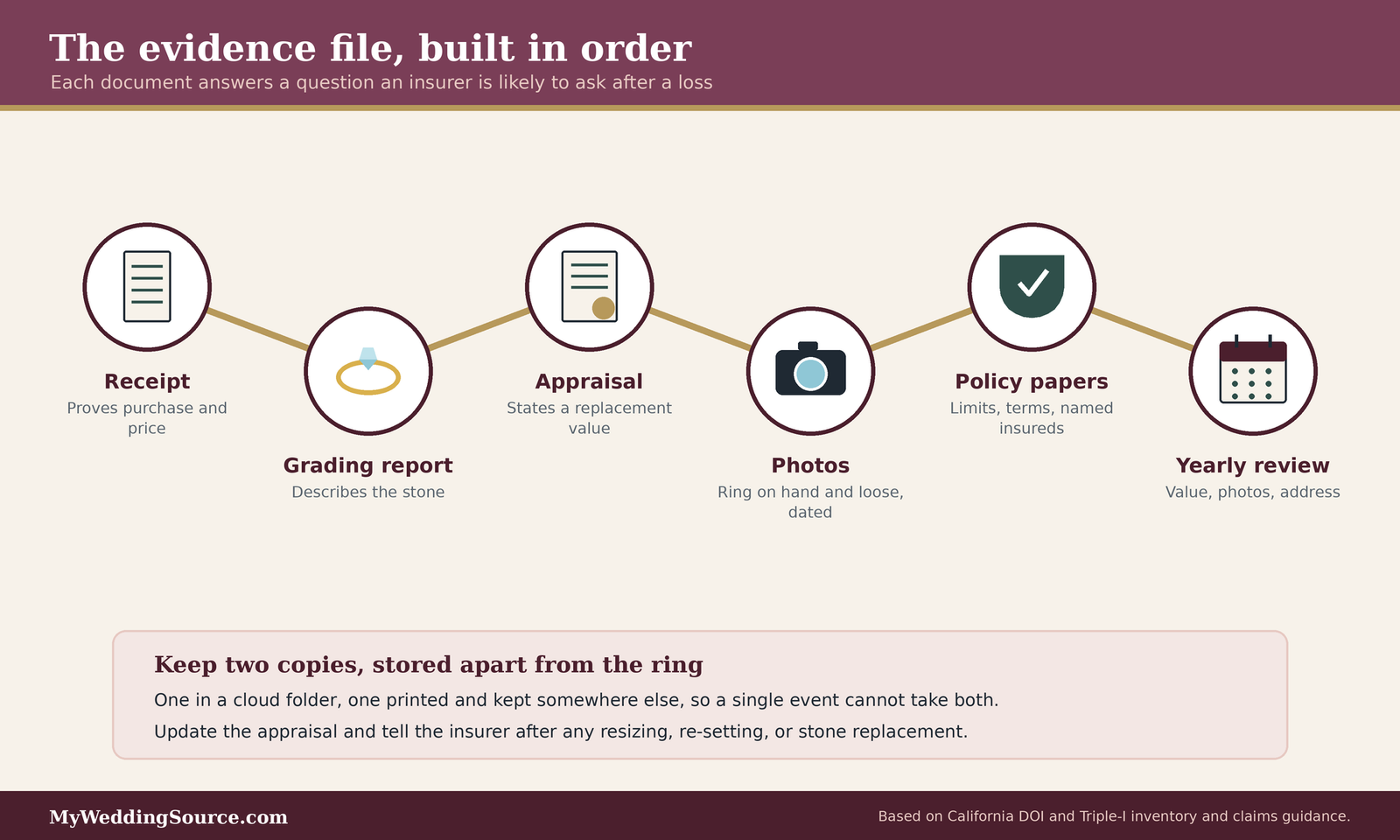
The California Department of Insurance notes that it is very important to take inventory of your belongings before you have a loss, and that emotion after a fire, earthquake, or burglary makes it hard to recall everything. Triple-I calls a home inventory the best way to determine whether your personal property coverage is enough. For a ring, the file should include the purchase receipt, the appraisal, the grading report, clear photographs from several angles (including the inscription, if any), the policy and endorsement documents, and the jeweler’s service records. Keep copies away from the ring: a cloud folder and a printed set in a different location, so a single event does not destroy both ring and records.
Triple-I’s claims guidance lists an inventory of damaged belongings and receipts for replacements among the documents you will need, which matches this approach. Photograph the ring on your hand and loose, in good light, once a year, and record the date.
The incident timeline and what to do if a claim stalls
If something happens, write down the date, time, place, and sequence of events as soon as possible, and record every conversation with the insurer: who, when, and what was said. File a police report for theft. Report the loss to the insurer promptly and in writing. Triple-I notes that the first payment is often an advance and not the final settlement, and that you may reopen a claim for damage you find later, so keep records after payment.
If you disagree with a decision, the NAIC advises trying to resolve it with the insurer first, then contacting your state department of insurance, which can investigate at no cost. Prepare your policy number, relevant documents, a log of communications, a timeline, and the outcome you want. The NAIC says insurers cannot retaliate for filing a complaint. Do not sign a settlement or release before comparing it with your policy, and consider asking the insurer to explain any reduction in writing.
Questions to ask before you buy engagement ring insurance
Bring these questions about engagement ring insurance to every agent or company you speak with, and keep the answers in writing. The pattern of replies, including the vague ones, is part of the comparison.
Questions worth asking before you buy
- What is the exact jewelry limit on my current policy, and is it per item or total?
- Which events are covered for the ring, and is loss with no clear cause included?
- Do you pay actual cash value first or replacement cost, and how long do I have to replace?
- Who chooses the jeweler, and can I receive a cash settlement?
- What is the deductible, and does a ring claim count against my home policy?
- What appraisal do you require, how old can it be, and how is the insured value updated?
- Does coverage apply abroad and in luggage, and is there an off-premises limit?
- What can change at renewal, and can you decline to renew?
Questions about the ring and the paperwork
These questions make sure the policy matches the object it covers.
Description and value
Ask how the ring will be described in the policy, and whether the description will come from the appraisal. Confirm that the stone type (natural or lab-grown), metal, and setting are stated correctly, and that the value type (replacement or other) is spelled out. If the ring has custom features, ask how they will be handled in a claim.
Proof and process
Ask what proof is required to file a claim, how long a claim usually takes, and whether the insurer requires its own forms. Ask for a copy of the claims procedure before you need it. If the insurer cannot describe its process, take that as information.
Questions about the company and the contract
These questions about engagement ring insurance test the party you are trusting with a large and uncertain future payment.
Company, license, and complaint record
Ask whether the company is licensed in your state, and check it yourself using the NAIC’s Consumer Insurance Search or your state insurance department. Ask for the full legal name of the insurer on the policy, because the NAIC notes subsidiaries can have different names. Look at the complaint record and treat marketing claims as claims.
Red flags worth taking seriously
Pressure to skip the appraisal, vague answers about who chooses the replacement jeweler, promises that are not in the policy, and coverage that seems too broad for the price are all reasons to slow down and read the form. None of these proves a problem, but each is a prompt to ask for the sentence in writing. Our wedding vendor contract red flags guide describes the same habit for contracts: if it matters, it should be on paper.
A decision rule to carry into the conversation
The most useful way to end is with a short rule for engagement ring insurance that survives a persuasive sales pitch. It is not a recommendation to buy or to skip coverage, and it is not advice tailored to you.
Four steps in order
The sequence matters because each step uses the answer to the one before.
Find the gap, then price it
Look up your current jewelry limit, subtract it from the ring’s replacement cost, and call the difference your gap. If you could absorb the gap, you may not need more than your existing policy and good habits. If not, price an endorsement and a standalone policy, normalize the quotes as shown above, and compare the wording, not only the premium.
Read the terms, then paper the ring
Read the exclusions and payout terms in the policy form, test the claim scenarios against it, and document the ring thoroughly. Put annual reminders on your calendar to review the value, the policy, and the photographs. Our how to pay for a wedding guide can help you fit a premium into your wider financing plan.
Where this engagement ring insurance guide stops
The limits of this guide matter as much as its content.
What we could not verify
We did not review any insurer’s policy form, we could not verify typical premium rates, deductible amounts, jewelry limits, or re-appraisal intervals from a regulator or published filing, and we could not fetch a gemological laboratory page on how its reports are worded. Where we describe a typical practice, we say so and tell you what to ask. Anything with a dollar amount in this guide is hypothetical arithmetic, not a market price.
Who to ask
Your state insurance department, a licensed agent you trust, and the insurer’s own written policy are the right authorities for your situation. If something in this guide conflicts with your policy, your policy and your state’s rules prevail.
Coverage basics
Does homeowners insurance cover an engagement ring?
It may, but jewelry usually has a special dollar limit for theft, and that limit sits inside your overall contents coverage, according to Triple-I and the California Department of Insurance. Check the exact limit and the covered events in your policy, then compare it with the ring’s replacement cost.
What is the difference between a rider and a separate jewelry policy?
A rider or endorsement adds a scheduled item to a household policy, while a separate policy is its own contract. Both can insure a ring for an appraised value. The differences that matter are the deductible, the effect of a claim on your home policy, the exclusions, and the renewal terms.
Is engagement ring insurance worth it?
It depends on your gap between the ring’s replacement cost and your existing coverage, plus how much of a loss you could absorb. If the gap is small, your current policy and careful habits may be enough. If it is large, price an endorsement and a standalone policy, then compare the wording.
Appraisals and payouts
Do I need an appraisal to insure a ring?
Many insurers ask for one, since it states a replacement value, but requirements differ, so ask yours. A grading report describes the stone and generally does not state a value. Keep both, and ask how old an appraisal can be before the insurer wants a new one.
What is the difference between actual cash value and replacement cost?
Actual cash value deducts depreciation, while replacement cost pays what it takes to replace the item with one of like kind and quality. Triple-I notes that belongings are often paid at actual cash value first, with the remainder paid after you replace items and submit receipts.
Will the insurer let me choose the jeweler?
Policies differ, and we could not verify a common rule, so ask before you buy. Request in writing whether you may choose the jeweler, whether a cash settlement is available, and how a custom or antique design would be replaced if it cannot be duplicated.
Claims and proof
What should I keep to make a claim easier?
Save the receipt, appraisal, grading report, photographs from several angles, policy documents, and jeweler service records. The California Department of Insurance stresses taking inventory before a loss. Store copies in a different place from the ring, such as a cloud folder and a printed set.
What if my claim is denied or stalls?
Ask the insurer to explain the decision in writing, then compare it with your policy. The NAIC advises contacting your state department of insurance if you cannot resolve it, and preparing your policy number, documents, a log of communications, and a timeline. Complaints to a state department are investigated at no cost.
Your next steps
Find your numbers
Pull your current policy
Locate your homeowners or renters policy, find the special limit for jewelry and the deductible, and write down the replacement cost of your ring from a jeweler or appraiser. The difference is the gap you are deciding about. Our engagement ring guide covers the ring itself if you are still choosing.
Request two kinds of quote
Ask for one endorsement quote from your current insurer and one standalone quote, and use the normalization method above to compare them. Record each answer to the questions in the callout.
Paper the ring and plan ahead
Build the evidence file
Gather the receipt, appraisal, grading report, and photographs, and store copies in two places. Add the policy documents once you buy.
Put reviews on the calendar
Set a yearly reminder to review the value, the policy, and your photographs, and add insurance to your wedding budget calculator and wedding planning guide so it does not get forgotten.
Sources & methodology
How we built this guide
What we relied on
This guide combines a federal rule on how jewelry is described, consumer guidance from the National Association of Insurance Commissioners, the California Department of Insurance, and the Insurance Information Institute (Triple-I), and our own arithmetic. We fetched each page listed below and report only what the pages say, in our own words. Where a source did not state a fact, such as a dollar limit for jewelry, we say that it did not. All dollar figures in examples are hypothetical and are our own arithmetic, not market data.
What we did not do
We did not review any insurer’s policy form, test any company’s claims service, verify premium rates, or give insurance, legal, or financial advice. We could not fetch a gemological laboratory or appraisal-association page, so statements about what appraisals and grading reports contain are described as general trade understanding and should be confirmed with your appraiser. Your policy and your state’s rules govern your situation.
Source list
Government and regulatory sources
- Federal Trade Commission, Guides for the Jewelry, Precious Metals, and Pewter Industries, final revisions (Federal Register, August 16, 2018): https://www.govinfo.gov/content/pkg/FR-2018-08-16/html/2018-17454.htm
- California Department of Insurance, Residential Insurance: Homeowners and Renters guide (text version): https://www.insurance.ca.gov/01-consumers/105-type/95-guides/03-res/res-ins-guide.cfm
- California Department of Insurance, Home Inventory Guide: http://www.insurance.ca.gov/01-consumers/105-type/95-guides/03-res/Home-Inventory.cfm
- NAIC, Homeowners insurance: https://content.naic.org/insurance-topics/homeowners-insurance
- NAIC, How to file a complaint: https://content.naic.org/consumer/how-to-file-complaint
- NAIC, Consumers and state insurance departments: https://content.naic.org/consumer
- NAIC, Consumer Insurance Search: https://content.naic.org/cis_consumer_information.htm
Industry education sources
- Insurance Information Institute, What is covered by standard homeowners insurance: https://www.iii.org/article/what-is-covered-by-standard-homeowners-insurance
- Insurance Information Institute, Understanding the insurance claims payment process: https://www.iii.org/article/understanding-the-insurance-claims-payment-process
- Insurance Information Institute, What is a loss history report: https://www.iii.org/article/what-is-a-loss-history-report
- Insurance Information Institute, Your renters insurance guide: https://www.iii.org/article/your-renters-insurance-guide
- Insurance Information Institute, Renewing your homeowners or car insurance policy: https://www.iii.org/article/renewing-your-homeowners-or-car-insurance-policy
- Insurance Information Institute, What should new homebuyers know about homeowners insurance: https://www.iii.org/article/what-should-new-homebuyers-know-about-homeowners-insurance