

If a ring has ever left your finger red, itchy, or scaly, wedding band metal allergies deserve a plan before you buy, because the cause is not always the metal, the fix is not always a different metal, and a label that says “hypoallergenic” does not settle the question.
Quick answer
Nickel is the metal most often blamed for jewelry allergy, and it can sit in the alloy of a white gold band or in the base metal under a plated finish. Platinum, high-karat yellow gold, and titanium are commonly recommended for wedding band metal allergies, but each has a catch worth checking, and many “rings that cause a rash” turn out to be soap and moisture trapped under the band. Before you buy, ask for the exact alloy in writing, confirm what any surface finish covers, and get a written return policy for skin reactions. If you already react to jewelry, a dermatologist can run a patch test. This guide is general information, not medical advice.
What wedding band metal allergies really are
Most people use “metal allergy” to mean any rash under a ring. Clinicians separate that into several different problems, and the difference decides what you should look for in a new band. A careful read of wedding band metal allergies starts with sorting those problems, because buying a more expensive metal solves only one of them.
Allergy, irritation, and trapped moisture are different problems
Three things can produce a red, itchy band of skin where a ring sits. Only one of them is a true allergy to the metal itself, and the other two can happen with a ring made of any material.
Allergic contact dermatitis
This is the immune-system reaction. Mayo Clinic describes nickel allergy as an immune response that usually shows up as an itchy rash where the metal touches the skin, with symptoms typically starting within a couple of days of contact. The reaction can include bumps, severe itching, color changes, dry or thickened skin, and blisters. A person who is truly allergic reacts to the metal each time, which is why swapping to a ring made of a different metal can help.
Irritant reactions and occlusion dermatitis
The American Academy of Allergy, Asthma and Immunology (AAAAI) describes “occlusion dermatitis” under a wedding ring: if the rash is not contact dermatitis, it is usually irritation from soap, moisture, and debris trapped beneath the ring. A Mayo Clinic dermatologist says in a short video that most ring rashes are not an allergy to the metal at all; soap residue, sweat, and dirt under the band are the more common cause, and an allergy is possible but less common. That matters because an irritation problem can follow you to a platinum band if the habits stay the same.
Why the difference changes what you buy
If the problem is an immune reaction to a specific metal, the shopping task is composition: which metals are in the alloy, and which finishes sit on top. If the problem is moisture and soap, the shopping task shifts toward fit, interior shape, and daily care. Plenty of people with wedding band metal allergies have both problems at once. The sections below take the composition problem seriously, and the later parts on edge cases and daily habits cover the rest. For wedding band metal allergies in particular, it helps to know which problem you are solving before you spend money.
How common nickel sensitivity is and why it matters at the jeweler
Nickel is the headline allergen in wedding band metal allergies, so it is worth knowing how widespread it is and how it behaves once it starts.
What the numbers say
A widely used encyclopedia entry on the European nickel restrictions states that roughly 10% of people in Western Europe and North America are nickel-sensitive. A published review of metal allergy reports nickel allergy of up to 17% in women and 3% in men in the general population, with cobalt and chromium allergy around 1% to 3%, and higher rates among people already being seen for dermatitis. Those are population estimates from different studies and different decades, so treat them as a sense of scale, not a personal risk score. The practical point is simple: a meaningful share of wedding shoppers have some degree of nickel sensitivity, and many do not know it until a ring fails.
Why sensitization tends to last
DermNet, a dermatology reference, says nickel allergy can develop at any age, tends to persist for many years and is often lifelong, and that desensitization with injections or pills is not possible. Mayo Clinic lists ear and body piercings as a common route into nickel allergy, which helps explain why women are affected more often in the data. The consequence for a couple facing wedding band metal allergies is that “it never bothered me before” is not proof you are safe. Sensitivity can show up after years of exposure, and a ring is worn continuously for years.
Why a ring is a long exposure
Most nickel-bearing items you touch for seconds: keys, coins, a phone. A wedding band touches the same patch of skin for most of the day, in warm, damp conditions, often for decades. That is the setting in which a small amount of nickel release matters most. It is also why wedding band metal allergies deserve their own planning step instead of a footnote in a general metals guide. If you want the broader comparison first, our wedding ring metals guide covers scratching, bending, and weight, and this guide stays on the skin question of wedding band metal allergies.
Reading the rash: is it wedding band metal allergies or moisture?
Before choosing a new metal for suspected wedding band metal allergies, it helps to work out which of the problems above you actually have. You cannot diagnose yourself, and nothing here replaces a clinician, but a few observations make the conversation with a doctor or a jeweler far more productive.
Timing and location clues
The pattern of the rash carries information about wedding band metal allergies versus irritation. It will not settle the question, but it narrows it.
Where the rash sits
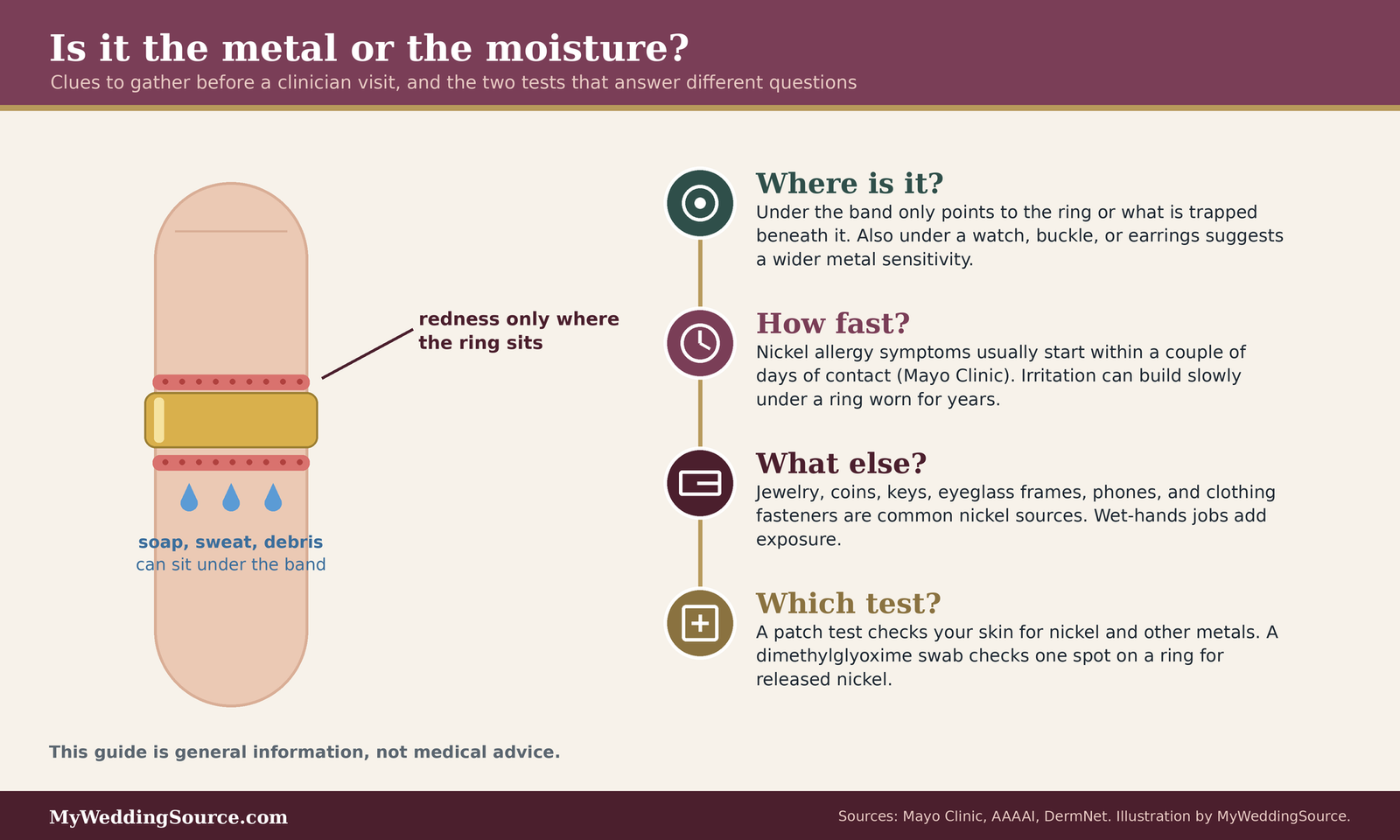
A reaction limited to the band of skin under the ring points to something about the ring, either the metal or what is trapped beneath it. AAAAI notes that this kind of rash appears only where the ring sits. A rash that also appears under a watch, a belt buckle, or earrings suggests a broader metal sensitivity, because those items are common nickel sources. Mayo Clinic lists coins, keys, eyeglass frames, electronics, clothing fasteners, and jewelry as everyday sources.
How fast it appears
Mayo Clinic says nickel-allergy symptoms usually start within a couple of days of contact. AAAAI describes a case where the rash tended to appear after a ring was worn for two to three days or longer. Healthline, a consumer health site, says ring rash often develops after years of wearing the ring. These sources do not contradict each other so much as describe different situations: a new allergy can appear fast with a new ring, while irritation can build slowly under a ring worn for years. So a rash that starts a few days after you try on a new ring is a different clue from one that appears gradually under an old ring.
Where the sources disagree, and why that is fine
Dermatology sources agree on the main ideas and differ in emphasis. The AAAAI page and the Mayo Clinic video lean toward moisture and irritation as the common cause. Healthline lists both contact dermatitis and occlusion dermatitis and suggests coating the inside of a band with clear nail polish as a nickel barrier, while DermNet advises against nail varnish on earring studs because it soon chips off. We return to that disagreement in the barrier section. For now, the useful reading is that nobody should be certain from the outside which problem you have, and a test is better than a guess when wedding band metal allergies are on the table.
A contact-allergy question sheet for the wearer
Part of the deliverable of this guide is a pair of question sheets. This first one is for you. Write the answers down before you see a clinician or a jeweler, so the conversation starts from facts.
Questions about the rash
- Where exactly is the rash: under the band only, on the whole finger, or on other fingers too?
- How long after putting the ring on did it start: hours, a few days, weeks, or years?
- Does it improve when the ring is off for several days and return when it goes back on?
- Is the skin under the ring ever damp when you remove it, and what soap do you use at the sink?
- Does the rash blister, weep, crack, or only itch and redden?
Questions about other exposures
- Have earrings, a watch back, a belt buckle, or a phone case ever left a mark?
- Do you work with wet hands, such as cooking, cleaning, hair, or health care? Mayo Clinic lists these jobs, especially with frequent handwashing, as a risk factor for nickel allergy.
- Do you have a known piercing reaction or a past patch-test result you can bring?
- What is the composition of the ring that caused trouble, if you know it, and was it plated?
What to bring to the clinician
Bring the ring that caused the rash, any paperwork or receipts, photos of the skin when it flared, and your answers above. A photo taken while the rash is active is more useful than a description later. If the rash persists, blisters, or looks infected, see a health professional: Mayo Clinic lists swelling, warmth, pus, or pain as signs that need prompt attention. Nothing in this guide is a diagnosis, and wedding band metal allergies can only be confirmed by testing.
Getting a real answer: patch testing and home kits
Two practical tests exist for wedding band metal allergies, and they answer different questions. One tests you, the other tests the ring.
Patch testing tests you
Both DermNet and AAAAI describe patch testing as the way to confirm contact dermatitis. Mayo Clinic describes a patch in which a nickel-containing material is left on the skin for 48 hours. DermNet notes that standard baseline patch series use nickel sulfate. A dermatologist or allergist can also test other metals, and AAAAI notes that platinum patch-test material exists. A patch test tells you which substances you react to, which is far more useful than guessing from a ring.
The dimethylglyoxime kit tests the ring
Home nickel-testing kits are mentioned by Mayo Clinic and described by DermNet: the kit contains dimethylglyoxime and ammonium hydroxide, you rub a drop on the item with a cotton swab, and a pink stain means the item releases nickel. DermNet recommends trying a coin first so you know what a positive looks like, and says the chemicals will not harm jewelry. A kit is inexpensive compared with a ring, but you should still ask a jeweler before testing a ring you do not own.
What a home test can and cannot tell you
A pink swab is useful information. A clear swab is less conclusive, and this part is our own reasoning, not a quoted finding: DermNet says a clear swab means no free nickel, which describes the spot you tested at that moment, not the whole ring, the solder joint, or a plated layer that may wear through later. A home test also says nothing about metals other than nickel. Use it as one input beside the written alloy specification, not as a replacement for it, when you are working through wedding band metal allergies.
Where nickel and other allergens hide in each metal
With the rash question sorted, the next step for wedding band metal allergies is composition. Each metal family has its own nickel story, and several have a catch that a product page will not mention.
Gold, karat, and white gold
Gold is a very common wedding band material, and also the one where “it depends” is most honest. The word gold on a ring says very little about what else is in it.
Karat arithmetic
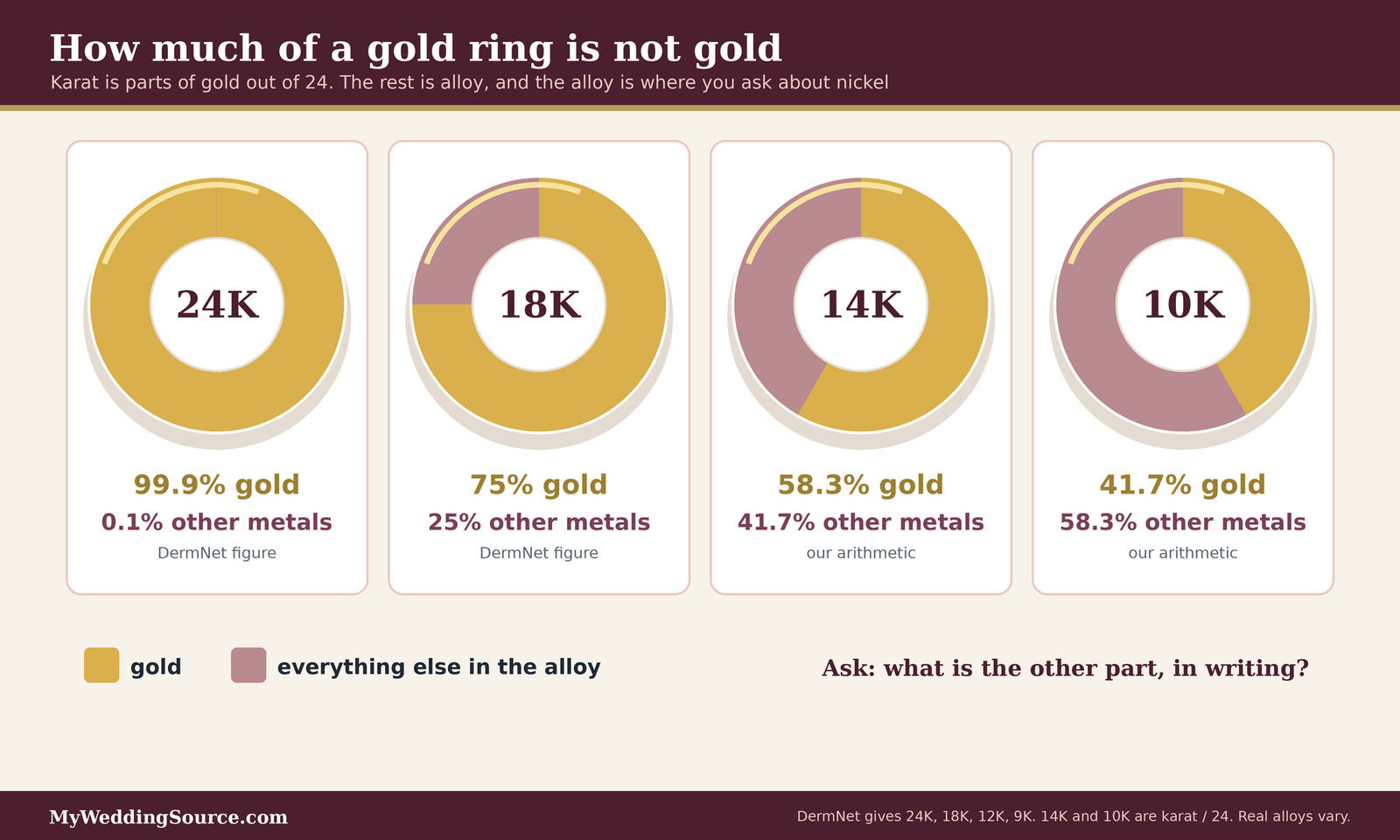
Karat measures how much of an alloy is gold, out of twenty-four parts. DermNet gives 24-karat as about 99.9% gold, 18-karat as 75%, 12-karat as 50%, and 9-karat as 37.5%. By the same arithmetic, 14-karat is about 58.3% and 10-karat about 41.7%; those two figures are our own calculation (karat divided by 24), not quoted from a source. The remainder of the ring is other metals, and for people concerned about wedding band metal allergies, the remainder is the part to ask about. Higher karat means less non-gold metal, but it does not by itself tell you what the non-gold metal is.
White gold is where nickel most often appears
DermNet says white gold is usually alloyed with nickel and that nine-carat gold and white gold contain nickel. It also says solid gold at twelve carat or more should generally be safe, which shows how guidance differs between sources on this topic. Mayo Clinic’s jewelry advice names high-karat yellow gold (18, 22, or 24 karat) and nickel-free white gold. A retailer, With Clarity, states that white gold is usually 75% gold mixed with 25% nickel and zinc, which is a retailer statement about typical alloys and not a rule: palladium-based white gold is also made, and DermNet lists palladium alloys as a more expensive alternative to nickel alloys. Brilliant Earth says white gold can be made nickel-free with palladium or platinum as whitening agents, and advises verifying the alloy because some white gold still contains nickel.
The takeaway for wedding band metal allergies is practical. “White gold” is a color description, not a composition. If you or your partner react to nickel, the question to ask is not whether the ring is white gold but what whitens it.
Yellow and rose gold
Yellow gold is generally alloyed with silver and copper, according to DermNet. That is one reason yellow gold is often suggested over white gold for sensitive skin. Brilliant Earth describes rose gold as slightly less hypoallergenic than yellow because copper gives it its color, and prefers higher karat versions. Another retailer, Newman Bands, notes that gold is not inherently hypoallergenic and names nickel, copper, zinc, and silver as possible alloy allergens, advising shoppers to confirm composition. The PubMed review mentioned earlier calls gold allergy rarely clinically relevant despite its high prevalence, which is a useful reminder that when a gold ring causes a reaction, nickel or another alloy metal is often the first suspect, though the review does not rule out the gold itself in a given person.
Platinum, palladium, and the platinum family
Platinum-group metals are a common answer to wedding band metal allergies, with reasons and exceptions.
Platinum
Several retailers call platinum the most hypoallergenic metal in fine jewelry. Brilliant Earth, for instance, describes platinum at 95% purity or higher as one that does not cause skin reactions in its guide, and Ritani says 950 platinum is 95% platinum, usually with about 5% iridium. Clinical evidence is more measured. AAAAI cites a 2008 study in the journal Dermatitis that tested 446 patients and found positive platinum reactions in only two, one of whom also reacted to other metals. The authors noted platinum jewelry can occasionally cause allergic contact dermatitis. Rare is not never, which is why, for wedding band metal allergies, we describe platinum as a low-risk choice and not a guarantee. Under the FTC’s Jewelry Guides, an item may be marked “Platinum” if it contains at least 950 parts per thousand pure platinum, so the stamp tells you something real about purity. DermNet also lists pure platinum as a nickel-free metal.
Palladium and cross-sensitization
Palladium is a platinum-family metal used in some jewelry alloys and in alternative white gold. A published review of metal allergy says palladium allergy is mainly cross-sensitization to nickel. In plain terms, many people who react to palladium do so because they are also sensitized to nickel, which is a reason to treat palladium as something to test for, not to assume. Retailers including Ritani describe palladium as hypoallergenic, lightweight, and less expensive than platinum. If you have a confirmed nickel allergy, ask your clinician whether palladium is appropriate before choosing a palladium band or palladium white gold.
Rhodium
Rhodium is another platinum-family metal and is commonly used as a thin plated surface on white gold. DermNet suggests platinum or rhodium plating as a non-allergic coating for items like wedding rings, but also says that plating wears off and needs re-plating. Brilliant Earth says rhodium is unlikely to cause reactions and shields the skin from the base metal, and says that because the plating wears away, the base metal should be hypoallergenic too. That last point is the one worth remembering, and the plating section below returns to it.
Titanium, tungsten, cobalt, stainless steel, and other alternatives
Alternative metals attract people dealing with wedding band metal allergies, partly because they are cheaper and partly because marketing leans on the word hypoallergenic. Evidence here is thinner, and retailers disagree.
Titanium
Retailers commonly recommend titanium for sensitive skin. Brilliant Earth presents titanium as nickel-free and highly resistant to corrosion. Newman Bands says its Grade 5 titanium, an alloy with aluminum and vanadium, is free of nickel, cobalt, and copper, and calls it its best overall choice for sensitive skin. Mayo Clinic lists titanium among its suggested substitutes for nickel-containing items such as eyeglass frames. These are retailer and general-health statements, not controlled studies of wedding bands. A reasonable question to ask is which titanium grade is used, since “titanium” on a product page can cover more than one alloy.
Tungsten and its binder
Tungsten carbide rings are made by binding hard tungsten carbide particles with a metal, and the binder is the part that matters for allergies. Newman Bands says it uses a nickel binder, not cobalt, and that the binder is held within the carbide so reactions are rare, while also advising people with a confirmed severe nickel allergy to choose titanium instead. It says cobalt is sometimes used as a binder in lower-quality tungsten and calls cobalt a significant allergen. Another retailer, Ritani, lists tungsten among its hypoallergenic options without discussing the binder. The takeaway for wedding band metal allergies is the question, not an answer: ask which binder is used and ask for it in writing. This is also a good example of how one retailer’s reassurance can be another retailer’s warning.
Cobalt chrome and stainless steel: where sources disagree
Ritani lists cobalt as a hypoallergenic option and notes its use in dental and orthopedic implants. Newman Bands describes cobalt as a significant allergen and advises avoiding it for daily wear. The published review cited above gives cobalt and chromium allergy rates of about 1% to 3%, lower than nickel but not zero. We cannot resolve that disagreement for you, and it is a good reason to ask a clinician if you have had reactions to cobalt or chromium in the past.
Stainless steel is similar. DermNet lists “hypoallergenic” stainless steel as safe and says it does not usually cause dermatitis unless it is nickel-plated, and elsewhere recommends stainless steel for jewelry and piercing needles. Mayo Clinic recommends nickel-free or surgical-grade stainless steel. Newman Bands rates fashion-grade stainless steel as moderate risk, varying by grade, with nickel in lower grades as the concern. The common thread is the grade: “stainless steel” is a family, and the grade and its nickel content are the details that matter.
The metal composition question sheet
This is the second sheet and the working core of this guide to wedding band metal allergies. It translates everything above into questions you can put to a jeweler or an online seller, with the reason for each. Print it or screenshot it, and write the answers next to each line.
The sheet itself
The table groups the questions by what is on the ring. You will not need every row; use the rows that match the ring in front of you.
How to use the sheet
Pick the row for the metal you are considering, ask the question in the second column, and write down the answer with the date and the name of the person who gave it. If a seller cannot or will not answer a question about wedding band metal allergies, that is information. The goal is not to catch anyone out but to make the answer part of the paperwork, so that if a problem appears later you have more than a memory of a conversation.
| Ring or finish | Ask this | Why it matters | What the sources say |
|---|---|---|---|
| Yellow gold | What karat, and which non-gold metals are in the alloy? | The remainder after the gold is where nickel or copper could sit | DermNet: yellow gold is typically alloyed with silver and copper |
| White gold | What whitens the alloy: nickel, palladium, or something else? | “White gold” describes color, not composition | DermNet: white gold usually contains nickel; Brilliant Earth: palladium or platinum can replace it |
| Rose gold | What karat, and how much copper? | Copper gives rose gold its color | Brilliant Earth: slightly less hypoallergenic, higher karat preferred |
| Platinum | Is it stamped 950 or lower, and what is the other 5%? | The stamp tells you purity, not the minor metals | FTC Guides allow “Platinum” at 950 parts per thousand or more; Ritani: usually about 5% iridium |
| Palladium | Is it a palladium alloy or palladium-plated, and which minor metals? | Palladium reactions are often tied to nickel sensitivity | Published review: palladium allergy is mainly cross-sensitization to nickel |
| Titanium | Which grade, and is any coating applied? | Grade 5 contains aluminum and vanadium; a coating is a separate layer | Newman Bands: Grade 5 is free of nickel, cobalt, and copper |
| Tungsten carbide | Which metal binds the carbide: nickel, cobalt, or something else? | The binder is the metal in contact with some skin | Newman Bands: uses nickel binder; says cobalt is used in lower-quality tungsten |
| Cobalt chrome | What is the exact alloy, and how do you handle a cobalt reaction? | Retailers disagree on cobalt for sensitive skin | Ritani: lists it as hypoallergenic; Newman Bands: advises avoiding it |
| Stainless steel | Which grade, and what is its nickel content? | Grades differ and some contain nickel | DermNet, Mayo Clinic, and Newman Bands each frame stainless steel differently |
| Any plated finish | What is the base metal, and how thick is the plating? | Plating wears; the base metal is what remains | DermNet: rhodium plating wears off over months or years |
| Any ring | What is the return policy for a skin reaction, in writing? | A policy is useless unless it is in the paperwork | FTC Guides cover how metals are described, not return policies |
Reading the answers
A good answer to a question about wedding band metal allergies is specific: a named alloy, a named binder, a stated karat, a written statement you can keep. A weak answer is a general reassurance, such as “it’s hypoallergenic” or “most people have no problem.” Neither is false, but neither tells you what is in the ring. If the answer is specific and says the ring contains nickel, you have learned what you needed. If it is vague, ask for the supplier’s specification sheet, or choose a seller who can provide one.
What an unclear answer means
An unclear answer is not proof of a problem, and it is not proof of safety. It means you cannot verify the claim, and for wedding band metal allergies that is the gap that causes trouble. Reasonable responses are to ask a different person at the store, to ask the maker, to buy a sample or a returnable ring and test it, or to choose another ring. What you should not do is let a friendly tone substitute for a written answer.
What marks and labels can and cannot tell you
Stamps and labels are useful, but they answer narrower questions about wedding band metal allergies than shoppers hope.
Karat and platinum stamps
Under the FTC’s Jewelry Guides, a gold alloy can be marked with a karat number placed directly before the word gold, and unqualified “gold” is misleading for anything that is not 24-karat. For platinum, an item at 950 parts per thousand or higher can be marked “Platinum,” and stamps such as 950Pt are given as examples. Items from 500 up to 850 parts per thousand require a clear disclosure of the full composition by metal and percentage. These rules tell you about purity and about how a seller may describe the metal. They do not tell you which minor metals are in the remainder.
What the FTC Guides say about allergens
For wedding band metal allergies, the Guides do not address nickel as an allergen, and they do not define “hypoallergenic” for jewelry. In the platinum section, the term appears only in a provision about scientific evidence for certain claims. The practical reading is that a federal rule governs how metal content is described, but it does not set a skin-safety standard for rings. The Guides are also guidance and not a description of every state’s rules, and we are not giving legal advice here.
“Hypoallergenic” is a marketing word, not a standard
For cosmetics, the Food and Drug Administration says there is no federal standard or definition for “hypoallergenic,” that companies can apply the label however they choose, and that it knows of no scientific studies showing that such products cause fewer reactions. We found no jewelry-specific equivalent, and we are not claiming the FDA page governs jewelry. We cite it because it shows how the word works elsewhere. A retailer, Brilliant Earth, states in its own guide that hypoallergenic does not guarantee a reaction-free experience and that individual sensitivities vary. Treat “hypoallergenic” as a starting point for a question about wedding band metal allergies, never as the answer.
How regulation elsewhere shows what is possible
Some regions regulate nickel release in jewelry. It is useful background for wedding band metal allergies, and it is not a promise about any ring sold in the United States.
The European nickel restrictions
The Nickel Directive, now part of the EU’s REACH rules, sets migration limits: 0.2 micrograms per square centimeter per week for post assemblies inserted into pierced parts of the body, and 0.5 micrograms per square centimeter per week for other products in direct, prolonged skin contact, measured with a standardized one-week artificial-sweat test. The directive dates from 1994 and has been part of REACH since 1 June 2009, according to the encyclopedia entry we relied on.
What the published review says about trends
The metal-allergy review we used reports that nickel allergy among ear-pierced Danish women declined after regulation limited nickel release from consumer products, and that in the United States nickel allergy was still increasing, which the authors attributed to a lack of regulation. That review is older, so the U.S. statement may not describe today’s market, and we did not find a current U.S. nickel-release limit for wedding bands. For you, the useful part is practical: a seller who sells in the European market has likely thought about nickel release, and a seller who can cite a test standard is giving you more than a seller who offers only a reassurance. This is our inference, and it is worth asking.
Coatings, plating, and wear: when a safe surface stops being safe
Plating can be the reason a ring that was fine in the shop becomes a problem months later, which is a classic pattern in wedding band metal allergies. The surface layer is thin, the metal underneath is not the same, and the two interact as the ring wears.
Rhodium plating on white gold
Rhodium plating is routine on white gold, and it deserves a plain explanation.
What the plating does
DermNet says white gold is usually alloyed with nickel and rhodium-plated to look whiter, and that the plating wears off over months or years, exposing the nickel beneath. Brilliant Earth makes the related point that the plating shields the skin from the base metal and that the base metal should be hypoallergenic because the plating wears away. For people avoiding nickel, a rhodium surface on a nickel alloy is a temporary barrier, not a solution. The FTC Guides also require that items marketed as white gold or silver with a rhodium surface layer disclose the rhodium layer, so a seller should be able to tell you.

How wear changes the picture
We did not find a source on where plating wears first, so this part is our reasoning. The inside surface touches your skin most of the day, so any thinning there matters for allergy even if the outside still looks bright. A ring that looked fine for a year can start causing reactions when the plating thins, and the timing can feel mysterious unless you know the layer is there.
Asking about re-plating
For wedding band metal allergies, ask the seller whether re-plating is offered, how often they suggest it, what it costs, and whether the inside surface is included. Ask whether the alloy underneath is nickel-free, because that decides whether a worn patch matters. We did not find a sourced figure for how often rhodium plating must be renewed, and DermNet’s “months or years” is the most specific statement we can quote, so rely on your own ring’s condition and your jeweler’s advice. If a resize is planned, our ring resizing guide is a useful companion.
Gold plated, gold filled, and vermeil
Not every gold-colored ring is gold throughout. The FTC Guides define several layered constructions, and they are worth knowing if you are looking at a budget or fashion ring.
What the FTC Guides define
The Guides describe gold-filled items as having gold of at least one twentieth of the item’s weight, and gold plate or overlay items at least one fortieth, with the plating at least 10-karat. Electroplated gold must reach a stated minimum thickness, about 0.175 microns of fine gold equivalent for “gold electroplate,” and heavy electroplate is held to a higher minimum. Vermeil is a sterling silver base plated with at least 10-karat gold of a stated minimum thickness. The Guides also require disclosure when a thin gold wash covers a base metal, and they list nickel as one possible base metal under gold coatings.
Why thin layers matter for an allergy
A layered ring has two surfaces: the one you see and the one that remains when the layer wears. DermNet notes that nickel is often the base metal under gold or silver plating. For a wedding band you will wear for years, a thin gold layer over an unknown base is a harder bet than a solid alloy with a known composition. This is a judgment, and not a rule: some layered pieces are made over nickel-free bases, which is exactly the question to ask.
Costume and matching pieces
If your ceremony outfit includes jewelry that touches skin for hours, such as earrings, a bracelet, or a hairpiece, the same questions apply. Mayo Clinic suggests checking metal content before piercings and choosing items with documented composition. Our wedding jewelry guide is the place for the wider jewelry plan, and the same composition questions are worth asking about every item that touches skin on the day.
Clear nail polish and other barriers
Barriers are a common home remedy for wedding band metal allergies. Sources are split on how much to trust them.
What the sources suggest
Healthline suggests painting the inside of a band with clear nail polish to block contact with nickel. Mayo Clinic’s prevention advice mentions clear nail polish or a clear barrier on snaps and clasps. DermNet advises against coating earring studs with nail varnish because it soon chips off.
Why a barrier is a stopgap
A coating on the inside of a ring is exposed to the exact conditions that wear plating: friction, soap, and sweat. It will need renewing, and a chipped coating can leave patches that hold moisture against the skin. We would treat it as a short-term measure while you arrange a better ring, not as the plan for a ring you will wear for decades. That is our judgment, and your clinician may have a different view.
What to do instead
The durable fix is a ring whose composition you can verify. If the ring in hand is sentimental, a jeweler can discuss options such as swapping the band while keeping a stone, or wearing the ring on a chain on the day. Treat those as conversations to have, not as promises about outcomes.
Cost, budget, and returns
Managing wedding band metal allergies does not have to mean spending the most, but some choices do cost more, and policies decide who pays when a ring does not work out.
What this actually costs
We did not find a reliable, current price list for allergy-friendly bands, and prices change daily with metal markets, so we do not quote figures. What sources do say: DermNet describes palladium white gold as more expensive than nickel alloys, retailers describe platinum as the premium option and titanium as comparable in biocompatibility for much less money (Newman Bands, a retailer), and re-plating adds a recurring cost on rhodium-plated rings. The cost question is not just the sticker price, but the price of the ring plus any re-plating plus what happens if you have to replace it. Ask for all three in writing.
What changes the price of a safer band
Three levers move the price more than the word “hypoallergenic” does.
The alloy
A nickel-free white gold alloy is usually priced differently from a nickel-based one, and DermNet’s remark that palladium-based alternatives cost more is the sourced version of that. Platinum is described by retailers as costing more than gold. Titanium and similar alternative metals are described by retailers as costing less. These are retailer and reference statements, and your quote will depend on weight, width, and labor. Our gold versus platinum guide goes deeper on that comparison.
The finish and its maintenance
A plated finish is cheaper up front and has a maintenance cost later. A solid alloy that is white through its thickness has no layer to wear, and costs more at the start. If you are comparing two quotes, make sure both include the same finishing and the same maintenance.
Width and weight
A wider band contains more metal and costs more in precious metals. If budget is a constraint, a narrower band in a verified metal may be a better answer than a wider band in a metal you cannot verify. Our wedding band width guide covers that trade-off.
Returns, exchanges, and what to get in writing
The most useful budget protection for wedding band metal allergies is a clear return policy.
Ask for a skin-reaction clause
Most sellers have return windows, and many exclude custom or resized rings. Ask specifically what happens if you have a skin reaction, in what window, and whether the ring must be unworn, unresized, or unengraved. Put the answer in your paperwork. We cannot tell you what any particular seller will agree to, and policies change.
Be careful with custom and engraved rings
Engraving, resizing, and custom work often end the return window because the ring cannot be resold. If you are unsure about a metal, test a returnable sample before committing to custom work, and wear the sample for several days at the size you intend to buy. That advice is ours, and it follows from the observation by AAAAI that rashes can take two to three days or longer to appear. Our guide to wedding ring engraving is worth a look before you book it.
Insurance and appraisal paperwork
If you insure the ring, the policy and appraisal usually record metal and purity. Insurance and coverage terms vary and we do not make guarantees about any policy, but a clear written description of the metal helps. Our engagement ring insurance guide and our guide to engagement ring insurance appraisals cover the insurer side.
Questions for vendors and sources
The sheet above works best for wedding band metal allergies when you know who to ask and what to expect. Different sellers give different quality of answer.
Questions to ask before you buy
- What is the exact alloy, karat or purity, and what are the non-gold or non-platinum metals in it?
- If it is white gold, what whitens it, and is the ring plated?
- If it is plated, what is the base metal, how thick is the layer, and what does re-plating cost?
- If it is tungsten carbide, what metal binds the carbide?
- If it is titanium, which grade?
- Can I have the composition in writing on the receipt or a specification sheet?
- What is the return policy for a skin reaction, and does resizing or engraving end it?
- Who is the maker, and can they confirm the alloy?
Questions for local jewelers
A local jeweler can answer questions on the spot and can often show you the ring in different metals.
About the alloy
Ask what is in the ring, and if the answer is a trade name, ask what that name means in metals. A knowledgeable jeweler will usually be able to tell you the karat and what whitens a white gold, or will call the supplier. If the salesperson is unsure, that is fine; a call to the maker is better than a guess.
About the finish
Ask whether the ring is plated, with what, and whether the inside is plated too. Ask what the finish will look like in a year, and whether there is a charge to refresh it. If you plan to wear the ring daily, ask how the jeweler’s own customers have found the finish holds up, and treat the answer as anecdote, not as data.
About the policy
Ask for the return, exchange, and resizing policies in writing, and what changes if you have the ring engraved. A written policy is a reasonable thing to ask for, and a seller who is confident in their product usually does not mind.
Questions for online and custom sellers
Online sellers give you less chance to handle a ring and more chance to read a specification. Use the written record.
Documentation
Look for a product page that names the alloy, the karat or purity, the finish, and the maker. If the page says only “hypoallergenic,” send a message and ask for specifics. Save the answer and a screenshot of the product page with the date. Retailer pages change, and a screenshot is the only record of what you were told.
Binder, grade, and base metal
For tungsten, ask for the binder. For titanium, ask for the grade. For plated pieces, ask for the base metal. These are the three questions that product pages most often skip, and they are the ones that matter for wedding band metal allergies.
Independent testing
Ask whether the seller has had the alloy tested by an independent lab for nickel release, and by which standard. A seller who has done so can usually tell you immediately. A seller who has not may say so honestly, and that is useful information for wedding band metal allergies. We did not find a U.S. requirement that rings be tested this way, so what a seller offers here is voluntary.
Questions for heirlooms and secondhand rings
Family rings and antique bands carry history and unknowns. Composition is often undocumented.
Unknown alloy
If a ring has no paperwork, the alloy may be unknown. A jeweler may be able to test or assay it, and a home nickel kit gives a limited check on the surface. Ask the jeweler what they can and cannot tell you, and keep in mind that a surface test describes the surface.
Wear and plating on older rings
An older white gold ring may have lost its rhodium layer, and the alloy underneath is what touches your skin. DermNet’s description of plating wearing off over months or years applies here, and a ring that was comfortable for a relative may not be for you.
Solder and repairs
Rings that have been resized or repaired may contain solder, which is a different alloy from the band. We did not find a source on the nickel content of jewelry solder, so we cannot make a claim, but it is a fair question to ask the repairer: what alloy was used, and is it nickel-free? Our ring resizing guide covers the process.
Edge cases that complicate wedding band metal allergies
Real situations around wedding band metal allergies rarely match a single metal. A few cases come up often enough to plan for.
Stacked rings, two-tone bands, and mixed metals
Most wearers have at least two rings next to each other, and the pair is its own question.
The engagement ring is part of the picture
If your engagement ring is white gold and you react to nickel, the engagement ring may be the cause, not the new band. Ask the same composition questions about the engagement ring, and consider having a jeweler confirm its alloy and plating. Our guide to pairing an engagement ring and a wedding band looks at the two rings together.
Two-tone and inlay designs
A band with more than one metal has more than one surface in contact with skin. Ask which metal touches the skin on the inside, and whether any inlay or accent is a different material. A band that is nickel-free on the outside may include a different metal in a liner or inlay, and the question costs nothing.
Mixing metals on purpose
Many couples mix metals deliberately. For allergy purposes the rule is the same: know what each ring is made of, and check each one. Mixed metals do not cause extra wedding band metal allergies on their own according to anything we found, but each metal is a separate exposure.
Work, water, and daily habits
Where and how you wear the ring changes the risk of wedding band metal allergies, sometimes more than the metal does.
Jobs with wet hands
Mayo Clinic lists jobs with frequent nickel exposure, especially with wet hands or frequent handwashing, as a risk factor: metal workers, hairdressers, food handlers, housekeepers, and health care workers. If you work in one of those jobs, ask a clinician whether a different ring or an alternative for work hours makes sense for your wedding band metal allergies. Many people keep a simple work band for the job and the wedding band for other times.
Soap, moisture, and drying
The Mayo Clinic video and Healthline both emphasize rinsing and drying thoroughly under the band. Healthline suggests removing the ring before washing hands, using gentle, non-antibacterial soaps, moisturizing, and having rings professionally cleaned to remove buildup. AAAAI says keeping the area dry is the main measure it mentions. These steps help irritation regardless of the metal, and they belong in any plan for wedding band metal allergies, and they do not hurt if the metal is also part of the problem.
Gloves, silicone, and alternatives
For severe sensitivity, With Clarity, a retailer, suggests silicone rings. Mayo Clinic suggests barriers such as gloves for nickel exposure from tools and similar items. A silicone band does not replace a wedding band for every couple, but it is a practical stand-in during work, exercise, and travel, and it keeps the metal ring off your skin for those hours.
When the rash persists after you change the ring
Sometimes a new ring does not fix suspected wedding band metal allergies. That is useful information and not a failure.
Look at the patch-test result
If a patch test was negative for the metals involved, DermNet suggests considering other causes such as irritant dermatitis, psoriasis or vitiligo appearing at an injury site, or infection. A dermatologist can sort out which applies.
Consider other sources of nickel
A new ring in a safe metal will not help if the real exposure is elsewhere. DermNet lists clothing fasteners, phones, keys, cutlery, and tools as common nickel sources, and the Mayo Clinic piece adds eyeglass frames and electronics. A ring can be the spot where a broader sensitivity shows up first, which is why wedding band metal allergies sometimes persist after a swap.
When to see a clinician
See a health professional if the rash does not improve, blisters, spreads, or shows signs of infection. Healthline says rashes usually clear within about a week once the cause is identified and treated, and allergic cases may take two to four weeks, though that article was last updated in 2018 and individual courses vary. Mayo Clinic says to seek emergency care for trouble breathing. None of this replaces advice from a clinician who knows your history.
A plan from first suspicion to wedding day
Planning for wedding band metal allergies fits into a normal wedding timeline if you start early. The three phases below give a sequence you can adapt.
Before you shop
The cheapest and most useful work on wedding band metal allergies happens before you see a ring.
Find out what you react to
If you have a history of jewelry reactions, ask your primary care provider or a dermatologist about patch testing. Patch results turn “I think I’m allergic to nickel” into a documented answer that you can give to every jeweler. Do this well before the wedding, since appointments can take time.
Write your list
Use the question sheets above. Write down your rash history, the metals you are considering, and the three or four questions that matter most for your situation. Our wedding planning checklist can help place ring shopping on the larger timeline.
Decide what you are willing to change
With wedding band metal allergies in the picture, think about whether you would trade metal, color, or width to get a ring you can verify. Knowing your own priorities in advance makes it easier to say no to a ring that looks perfect and cannot be verified.
While you shop
Try rings with the question sheet for wedding band metal allergies in hand.
Try, ask, and write it down
Ask the composition questions, write the answers, and ask for the specification in writing. Compare answers across sellers. A seller who answers clearly and puts it on paper is giving you something real. Our wedding vendor due diligence checklist covers the broader habit of documenting what a vendor promises.
Try a sample for several days if you can
If the seller allows it, wear a sample or a returnable ring at your intended size for a few days, in normal conditions, before committing to custom work. This is our suggestion, and it follows from the timing AAAAI describes. A short try-on in a shop will not reveal a reaction that takes days to appear.
Check fit at the same time
Allergy is not the only reason a ring feels wrong. Fit matters too, and a band that is too tight traps moisture. Our ring sizing guide and wedding bands guide cover the sizing side.
After you buy
The work does not end at the register.
Wear it in steps
Consider wearing the new ring for increasing periods in the weeks before the wedding, instead of for the first time on the day. If a reaction appears, you have time to act. That is a planning suggestion and not medical advice.
Keep the paperwork
Keep receipts, specification sheets, screenshots, and the written return policy for your wedding band metal allergies together with your insurance and appraisal documents. If a problem appears later, you can show the seller what you were told, and a clinician what the ring is made of.
Have a backup for the day
Decide in advance what you will do if the ring bothers you on the wedding day. Many couples keep a simple backup band, or a silicone ring for the reception. The point is that the day is not the time to find out. Our wedding emergency kit guide is a good place to add a spare, and our bridal skincare timeline covers caring for skin on the hands and elsewhere before the day.
FAQ: wedding band metal allergies
Choosing a metal
What are the best choices for wedding band metal allergies?
No single metal is best for everyone. Platinum, high-karat yellow gold, and titanium are commonly recommended by Mayo Clinic, DermNet, and retailers, but each has caveats, such as alloy composition or grade. Confirm the exact composition in writing, and ask a dermatologist about patch testing if you have reacted before.
Is white gold safe if I am allergic to nickel?
It depends on the alloy. DermNet says white gold usually contains nickel, while Brilliant Earth says white gold can be made with palladium or platinum instead. Rhodium plating can also hide a nickel alloy for a time. Ask what whitens the metal and whether it is plated, and get the answer on paper.
Is platinum completely hypoallergenic?
Rarely a problem, but not guaranteed. AAAAI cites a 2008 study of 446 patients in which only two reacted to platinum, and the authors noted that platinum jewelry can occasionally cause allergic contact dermatitis. Treat platinum as low risk, not risk free, and test a returnable ring if you have a history of reactions.
Labels and testing
Does “hypoallergenic” on a ring mean it is nickel-free?
Not necessarily. The FTC Jewelry Guides do not define the term for jewelry, and the FDA says there is no federal definition for cosmetics. Brilliant Earth itself says hypoallergenic does not guarantee a reaction-free experience. Ask for the alloy, the binder or base metal, and any finish, instead of relying on the word.
Can I test a ring for nickel at home?
Yes, with a dimethylglyoxime kit, which Mayo Clinic and DermNet both describe. A pink swab means the spot you tested releases nickel. A clear swab is less conclusive, because it describes only that spot. A kit does not replace a patch test, which checks your skin and other metals as well.
How do I know whether it is an allergy or just ring rash?
You cannot tell reliably from home. AAAAI and a Mayo Clinic dermatologist say soap, moisture, and debris under a ring are common causes, while a true allergy is possible but less common. Patch testing by a clinician can separate them. Rinse and dry thoroughly under the band while you wait for an answer.
Plating, cost, and policy
How long does rhodium plating last on a white gold ring?
Sources do not give a fixed number. DermNet says the plating wears off over months or years, exposing the alloy beneath. Wear depends on your habits and the ring’s design. Ask the jeweler what re-plating costs and whether it covers the inside, and remember that a nickel alloy underneath matters most once the layer thins.
What should my return policy cover if I react to a ring?
Ask for it in writing before you pay. Cover the return window, whether the ring must be unworn, unresized, and unengraved, and what happens with custom work. Policies vary by seller and change over time, so keep a dated copy. Wearing a returnable sample for several days before custom work is a sensible precaution.
Your next steps
Find out what you are dealing with
Book a patch test if you have reacted before
A clinician can test for nickel and other metals behind wedding band metal allergies, and a documented result is more useful at a jeweler’s counter than a guess. Schedule it well before ring shopping, since appointments take time. Bring the old ring and photos of any past rash.
Fill in the wearer sheet
Write down where the rash sits, how fast it appeared, and what else you wear that has left a mark. Take that page to your appointment and to every jeweler you visit.
Shop with the sheet
Ask the composition questions and keep the answers
Use the composition sheet, ask for specifications in writing, and compare sellers. Our wedding ring metals guide and gold versus platinum guide help you weigh the choices once you know what you can wear.
Lock in policies and a backup
Get the return policy in writing, decide on a backup band for the day, and add ring shopping to your wedding planning checklist. If you are weighing width and fit as well, our wedding band width guide is the next read.
Sources & methodology
How we built this guide
What we relied on
This guide combines a federal rule on how jewelry metals are described and marked, dermatology and allergy references on nickel allergy and wedding ring rash, a published review of metal allergy, the FDA’s page on the word “hypoallergenic” for cosmetics, an encyclopedia summary of the European nickel restrictions, and published guidance from jewelry retailers. Where a statement comes from a retailer, we say so, because retailer guidance reflects the seller’s products and often disagrees with other retailers. The karat figures for 14-karat and 10-karat gold are our own arithmetic (karat divided by 24). We checked each source on November 12, 2026; several pages carry older review dates, which we note in the text.
What we did not do
We did not test rings, run nickel-release tests, or verify any seller’s alloy. We did not find a current U.S. nickel-release limit for wedding bands, a sourced figure for how often rhodium plating must be renewed, or a source on the nickel content of jewelry solder, so we make no claims on those points. We do not give medical, legal, insurance, or financial advice. Allergies vary by person, and prices, policies, and regulations change. See a clinician about skin reactions and read any seller’s policy yourself.
Source list
Government, clinical, and professional sources
- Federal Trade Commission, Guides for the Jewelry, Precious Metals, and Pewter Industries, 16 CFR Part 23, final revisions (Federal Register, August 16, 2018): https://www.govinfo.gov/content/pkg/FR-2018-08-16/html/2018-17454.htm
- U.S. Food and Drug Administration, Hypoallergenic cosmetics: https://www.fda.gov/cosmetics/cosmetics-labeling-claims/hypoallergenic-cosmetics
- Mayo Clinic, Nickel allergy: Symptoms and causes: https://www.mayoclinic.org/diseases-conditions/nickel-allergy/symptoms-causes/syc-20351529
- Mayo Clinic News Network, Mayo Clinic Minute: Wedding ring rash: https://newsnetwork.mayoclinic.org/?p=236679
- American Academy of Allergy, Asthma and Immunology, Ask the Expert: Wedding ring dermatitis: https://www.aaaai.org/ask-the-expert/wedding-ring-dermatitis
- PubMed, Metal allergy: a review on exposures, penetration, genetics, prevalence, and clinical implications: https://pubmed.ncbi.nlm.nih.gov/19831422/
Reference and consumer-health sources
- DermNet, Nickel allergy: https://dermnetnz.org/topics/nickel-allergy
- DermNet, Jewelry allergy: https://www.dermnetnz.org/topics/jewelry-allergy
- Wikipedia, Nickel Directive: https://en.wikipedia.org/wiki/Nickel_Directive
- Healthline, Ring rash: causes and treatment: https://www.healthline.com/health/ring-rash
Jeweler and retailer sources
- Brilliant Earth, Best hypoallergenic jewelry metals for sensitive skin: https://www.brilliantearth.com/guides/best-hypoallergenic-metals-for-jewelry/
- With Clarity, Wedding ring metals and skin allergies: https://www.withclarity.com/blogs/wedding-bands/wedding-ring-metals-and-skin-allergies-how-to-avoid-them
- Newman Bands, Best rings for sensitive skin: https://newmanbands.com/best-rings-for-sensitive-skin/
- Ritani, Hypoallergenic metals for engagement rings and wedding bands: https://www.ritani.com/blogs/education/6-hypoallergenic-metals-for-engagement-rings-wedding-bands