

Wedding rings are a pair of small objects that you will wear nearly every day for decades, so the useful decisions are the ones that are hard to undo later: the metal, the width, the fit, the budget you set for both rings together, and the order in which you buy them.
Quick answer
Decide metal, width, and fit first, in that order, and decide them for both wedding rings at once. Keep the metal and finish consistent across the pair, let widths and designs differ if your hands or jobs differ, and size each ring in its own width. Plan on two to three months from first shopping to rings in hand for ready-made styles, and longer for custom work. Set a combined budget for both rings, compare quotes on the same specifications, and get the return, resizing, and engraving rules in writing before you pay.
This guide is the hub for our wedding ring articles. It covers the decisions every couple faces, then points to the deeper guides on wedding ring metals, wedding band width, and ring engraving. It does not tell you what to like. It shows you which choices interact, where the real trade-offs are, and what to verify before the money is gone.
Start with the pair, not the product
Most shopping pages sell one ring at a time, and most advice about wedding rings repeats that frame. In practice wedding rings behave like a system. The metal you pick changes the price of both wedding rings. The width one of you prefers changes what the other ring looks like beside it. A sizing mistake on one ring delays the delivery of both. Looking at the pair first saves you from comparing forty individual listings with no way to decide between them.
Why wedding rings work better as a decision about two people
You are not choosing a product. You are choosing two rings for two hands, two sets of habits, and often two budgets of attention. One partner may type all day and the other may lift boxes. One may already own an engagement ring that constrains the design. Naming those differences early makes the shopping faster, because it removes options before you ever fall for them.
Write down who wears what, and when
Before you open a single catalog, write two short notes, one for each wearer. Include the job, the hobbies, whether the person already wears rings or watches, and any history of skin reactions to jewelry. A note might read, “Nurse, washes hands forty times a shift, never wears rings, prefers plain styles.” Another might read, “Carpenter, wears gloves, lost a ring once at a job site, wants something he can replace cheaply.” Those two lines will drive more of your final choice than any trend report.
Decide whose ring constrains the other
If one of you has an engagement ring, that ring is the anchor. A wedding band for that hand has to sit beside it, so its width, height, and metal color matter more than they would on a hand with no other ring. Our engagement ring guide explains how setting styles change what can sit flush next to them. If neither of you has an anchor ring, you have the most freedom, and the real constraint becomes the budget and the calendar.
What matching actually means
People often use the word “matching” to mean identical, and then feel forced to compromise. A retailer guide on matching bands from the jeweler 25karats makes a more useful point: matching is a spectrum, and sharing a metal color and finish usually does more to make two rings look related than sharing a design. That is one retailer’s view, and it favors buying a full set from one maker, but it fits what many jewelers describe.
Three levels of matching
Think of three levels. At the first, the rings are identical in metal, width, and finish. At the second, they share the metal and the finish but differ in width, profile, or stones. At the third, they share only an idea, such as a hammered texture on one and a polished edge on the other. The first level is the easiest to order and the least personal. The second is the most common choice when hands and habits differ. The third suits couples who want rings that look chosen, not purchased as a set.
Why mixing hardness can cause uneven wear
The same 25karats guide recommends keeping both rings in the same metal and karat, because two metals of different hardness wear at different rates. That is a reasonable caution, and it comes from a seller, so treat it as a preference and not a rule. The practical point is that a very hard ring worn beside a soft one can mark the softer metal over time. If you plan to wear a stacked or paired set on one hand, ask a jeweler how the two metals will behave together.

How the main decisions depend on each other
Metal, width, and fit look like separate tabs on a product page, but they push on one another. A wider band costs more in precious metal because it contains more of it, and it feels snugger on the finger. A harder metal resists scratches but may not be resizable. A comfort-fit interior changes how a size feels. If you decide each one in isolation, you can end up with a ring that looks right in the display case and feels wrong by dinner.
The order that avoids rework
When you choose wedding rings, decide the metal first, because it sets the price range, the weight, and whether the ring can ever be resized. Decide the width second, because it sets the look and drives the sizing. Decide the interior and the size third, with the actual ring on your actual finger. Then add engraving, finish, and extras. This order matters because each later choice depends on the earlier ones, and the early choices are the expensive ones to reverse.
A note on this guide’s sources and limits
This guide draws on a federal rule about how jewelry is described, clinical and dermatology sources on ring rash, a gemological guide to settings, wedding-industry survey data, and published advice from jewelers. Retailer advice reflects the seller’s products, so we label it as retailer advice. Our own arithmetic is labeled as an estimate. Nothing here is legal, financial, insurance, or medical advice, and prices change, so confirm anything that matters with the seller and a professional.
Separate must-haves from preferences before you shop
Once you know who wears what, the next step is to sort what you want into what the wedding rings must do and what you would like them to look like. Shoppers who skip this step tend to be steered by whatever is in front of them. A short sort, done together and in writing, keeps the conversation with a seller on your terms.
Sort the criteria into three buckets
A simple method works better than a long wish list. It is our own method, not an industry standard, and it takes about fifteen minutes.
Must-haves, strong preferences, and nice-to-haves
Make three columns. In the first, put the things your wedding rings must do, such as being resizable, staying comfortable through a full day, surviving a particular job, or fitting under a glove. In the second, put strong preferences, such as a metal color, a width, or a finish. In the third, put nice-to-haves, such as a tiny stone or a particular edge. A ring that fails a must-have is out, however pretty. A ring that misses a nice-to-have is still a good ring. Most disappointment in this purchase comes from letting column three overrule column one.
Give each criterion a weight
If you want to compare two or three finalists, give each criterion a weight, for example three points for must-haves, two for strong preferences, and one for nice-to-haves. Score each ring from zero to two on each criterion and add up the weighted totals. This is illustrative arithmetic, not science, and the exercise matters more than the number. It forces both of you to say out loud what you care about, and it makes disagreements visible before money changes hands.
Run the sort on a realistic pair
A method is easier to trust when you see it applied. The example below is invented. It is not a real couple and not a recommendation.
A worked example with invented numbers
Imagine one partner who teaches and wants a ring that can be resized if pregnancy or weight changes affect the fit, and another who works with tools and wants a ring that costs little to replace. Their must-haves are different: resizable for the first, replaceable for the second. A shared strong preference is a matte finish in a similar metal color. Under that sort, the first partner’s shortlist might lean toward gold or platinum, and the second’s toward an alternative metal with a clear replacement policy. The pair still looks related because the finish and color are shared. The reasoning is the point, not the particular metals.
What to do when you disagree
Disagreements are normal. When they happen, check whether the disagreement is about a must-have or a nice-to-have. If it is a nice-to-have, let the person who will wear the ring decide. If it is a must-have for one person, treat it as a constraint for both, and look for the option that meets it. If a disagreement is about money, return to the combined ceiling and agree on the split before you look at more rings.
Pick the metal around your hands and your routine
For wedding rings, metal is the decision with the longest tail, because it affects price, weight, color, skin comfort, and whether a jeweler can ever adjust the ring. We cover it in depth in our guide to wedding ring metals. Here is the version you need to shop for a pair: what each family of metals is good at, how it fails, and who should look elsewhere.
Gold and platinum: the metals jewelers can work on
Gold and platinum are the two metals for wedding rings that most jewelers are comfortable resizing, repairing, and refinishing. That flexibility is the main reason they remain the low-regret choices. If your fingers change, if a prong needs re-tipping, or if a scratched surface needs refreshing, a jeweler has options.
What the karat number tells you about gold wedding rings
Pure gold is too soft for a ring worn daily, so rings are made from alloys. The karat number tells you how much of the alloy is gold. Brilliant Earth’s guide to karats lists 10K as about 41.7 percent gold, 14K as about 58.3 percent, and 18K as 75 percent, and it describes 14K as a common balance of durability and gold content for everyday rings, with 18K more prone to scratching than 14K. In the United States, the Federal Trade Commission’s Jewelry Guides say a karat mark must be at least as prominent as the word “gold” when both appear, and that a maker or dealer who stamps a gold quality mark must also stamp its trademark or name. Look for both stamps on the inside of the band.
What platinum costs and how it ages
The FTC guides say an item may be called “platinum” only if it is at least 950 parts per thousand pure platinum, and they set disclosure rules for lower purities. Jewelers Mutual, an insurer, describes platinum as durable and resizable but not scratch-resistant, with a natural patina that polishing can restore. Zola reports that platinum adds roughly $800 to $1,500 per ring compared with gold, though Zola does not state the method behind that range, so treat it as a rough indicator and not a quote. Platinum suits people who like a heavier ring and are comfortable with a softly worn, satin look over time.
Alternative metals: scratch resistance with limits
Titanium, tungsten carbide, cobalt, and ceramic are popular for bands because they resist scratches and cost less than platinum. They are not simply cheaper versions of gold. Each fails differently, and several cannot be resized.
Resizing is the main limit
Jewelers Mutual says tungsten, ceramic, and cobalt cannot be resized and that titanium is difficult or impossible to resize. It adds that tungsten is very scratch-resistant but somewhat brittle and prone to chipping or breaking. Palladium is described as similar in look to platinum but harder to resize, usually by the manufacturer. If there is any chance your finger size will change, perhaps because of pregnancy, weight changes, or a job that swells your hands, the inability to resize is a real cost, because the fix is replacing the ring.
Replacement is the repair
Many sellers of alternative metals offer a replacement program or a discounted exchange. Ask exactly what it covers, how long it lasts, and whether it applies to damage, loss, or only a size change. A replacement policy can make a brittle or non-resizable ring a sensible purchase, but only if the terms are written down and the seller is likely to be around when you need it.
Skin comfort and what is in the alloy
Some people react to certain metals, and many more get a rash from something else entirely. Sorting out which is which can save you from buying a ring you cannot wear.
Most ring rashes are not a metal allergy
A Mayo Clinic dermatologist, speaking in the clinic’s news network, says wedding ring rashes are common and are usually not an allergy to the metal. More often, moisture and debris get trapped under the ring, especially when soap and sweat are not rinsed away. The American Academy of Allergy, Asthma and Immunology makes a similar point in a patient case, noting that soap, moisture, and debris can build up under a ring and irritate skin, and that patch testing can help rule out contact allergy. The practical advice from both is to wash, rinse, and dry under the ring and to see a clinician if the rash persists. We are not clinicians, so use this as background for a conversation with one.
If you do react, get the alloy in writing
If you already know that costume jewelry irritates your skin, ask the seller for the exact alloy composition of the ring, not just the metal name. Alloys vary between makers. If you are unsure, ask a dermatologist about patch testing before you spend money on a ring you may not be able to wear.
Choose width and thickness by proportion, not by gender label
Width is the measurement most couples decide by eye when choosing wedding rings, and it deserves more care than that. We go deep on it in our guide to wedding band width. For a pair, the key ideas are proportion, comfort, and how the two wedding rings look beside each other.
Common ranges and what they imply
Retailers publish typical width ranges, and they are useful as starting points. The 25karats guide says women’s bands typically run about 2 to 4 millimeters and men’s about 4 to 7 millimeters, and it adds that comfort and proportion matter more than convention. It is a description of what stores stock, not a rule about who should wear what.
How a range turns into a look
A narrow band reads delicate and lets a center stone or a nearby ring stand out. A mid-width band reads classic. A wide band reads bold and takes visual attention for itself. The same width looks different on different hands, which is why a paper strip around your finger tells you more than a thumbnail photo does. Our width guide shows how to cut and use those strips.
Why a pair can have two widths
Two wedding rings of different widths can look intentional if they share the metal and finish. The 25karats guide suggests that the narrower band be roughly half to two-thirds the width of the wider one, which is a design preference, not a law. For example, a 6 millimeter band paired with a 3 millimeter band falls within that range by simple arithmetic. If a ring has to sit next to an engagement ring, choose the width of that band first and fit the other ring to it.
Thickness is the number product pages skip
Width is listed everywhere. Thickness, sometimes called depth or gauge, is the distance from the inside surface to the outside, and it controls how much metal stands between your finger and a hard knock. The 25karats guide describes a thickness of about 1.6 to 2.0 millimeters as comfortable and likely to hold its shape for decades. That is a retailer’s view, but it matches a common-sense point: a very thin band is more likely to bend.
Ask for the thickness of your wedding rings in writing
If the listing does not show thickness, ask for it. A narrow band that is also thin may bend under pressure, particularly in softer metals. If you do manual work, a slightly thicker band in a low profile is a safer starting point than a thin, high one.
Weight follows width and thickness
In precious metals, a wider and thicker band contains more metal, so it weighs more and costs more. That is simple geometry, and it is why quotes for the same design can differ so much by width. When comparing prices, compare width, thickness, and weight, not only the sticker price. We return to this under quote normalization in the budget section below.
Get the fit right before the finish
Fit is where good wedding rings go wrong, because size is easy to get roughly right and hard to get exactly right. A ring that spins loose can slip off at a pool. One that is too tight can leave a mark, trap moisture, and be hard to remove. Spend time here, and do it for each ring separately.
Measure the way a jeweler would
Fingers are not a fixed size. They change with temperature, activity, salt in your food, time of day, and weather. Retailers that publish sizing advice agree on the broad habits, even if they disagree on details, so the sensible approach is to follow the shared habits and test the actual ring.
Measure late in the day and more than once
Blue Nile’s sizing guide advises measuring late in the day, when fingers tend to be most swollen, so the ring still fits at night. It also notes that cold weather shrinks fingers and warm weather swells them, and it recommends measuring several times because size changes through the day. Brilliant Earth’s comfort-fit guide adds that you should measure when your hands are comfortably warm and repeat the measurement on different days. Together, those habits give you a range instead of a single number, and the range is more honest.
Check both the knuckle and the base
If your knuckle is wider than the base of your finger, Blue Nile suggests measuring both and choosing a size between them. A good fit passes over the knuckle with gentle resistance and sits securely at the base, according to Brilliant Earth. If a ring only fits when it is loose enough to rotate freely, it is probably too big. If you have to force it over the knuckle, it may be too small, or you may need a different interior.
Wide bands, comfort fit, and the half-size question
Width changes sizing. A wide band covers more of the finger, so it presses on more skin and often feels tighter than a narrow band in the same nominal size. Sellers say this consistently, though they give slightly different numbers.
What retailers say about sizing up
Blue Nile says bands 6 millimeters or wider sit more snugly and suggests ordering a quarter to a half size larger. The 25karats guide says wide bands of 6 millimeters and up usually need about half a size more. Brilliant Earth says a wide ring may need a larger size but gives no exact increment and says the adjustment depends on the ring and your finger shape. Taken together, the honest summary is that many people need a little more room in a wide band, that the amount varies, and that trying both sizes in the real ring is the only reliable test.
What comfort fit changes
Brilliant Earth explains that comfort fit means a gently curved or domed interior that touches the finger less, which can reduce pressure and friction and make a ring easier to slide over the knuckle. Standard fit has a flat interior and more even skin contact. The exterior design does not tell you which one a ring has, so ask. Brilliant Earth names men’s bands, bands about 8 millimeters or wider, and rings worn for long periods as common candidates for comfort fit. It also warns against automatically ordering a smaller size because a comfort-fit ring feels roomier. That warning is worth taking seriously, because a ring that is too loose is a real loss risk.
Size each ring in its own width and interior
In a pair, it is tempting to size both wedding rings from one finger measurement. Resist that. The rings differ in width, interior, and profile, and each wearer has a different finger shape, so each ring needs its own check.
Use a sizer in the right width
Many sellers offer free or low-cost sizers. A sizer in a narrow width will mislead you if you plan to buy a wide band. If you can, try on a physical ring in the width and interior you intend to buy, even if it is in a different metal, and wear it for part of a day. A paper strip can help you choose a width, but Blue Nile warns against using string or paper to find a size because they can stretch or twist.
Plan for fingers that change
Fingers change over the years. Ask whether the ring can be resized and by how much, and check whether stones or engraving limit that. The 25karats guide notes that gold and platinum bands can usually be resized but that eternity bands set with stones all the way around often cannot. If a ring cannot be resized, find out what the seller offers instead, and get it in writing.
Choose where to buy: local jeweler, online seller, or custom maker
Where you buy changes the price, the lead time, and the help you get when something goes wrong. None of the channels is correct for everyone, and most sources describing them are sellers, so the useful question is what each channel is good at and what it asks of you.
What each channel does well
Think of the channels for wedding rings as trade-offs between convenience, price, and support, not as good and bad.
A local jeweler for wedding rings
A local jeweler lets you try on actual wedding rings in several widths, check the interior by touch, and talk to someone who will still be there when a prong needs attention. Zola’s guide says online retailers are often 20 to 30 percent less than traditional stores, with no stated method, so the in-person convenience may cost more. Ask whether the shop will resize and repair rings you did not buy from them, and what they charge, because that determines how much their service is worth later.
An online seller for wedding rings
Online sellers often offer wide selection, published specifications, and free sizers. Blue Nile, for example, says it offers free ring sizers. The trade-off is that you cannot feel the ring before ordering, so the exchange policy matters more. Before you order, read the policy for engraved and resized rings in particular, and confirm who pays for return shipping.
What custom work asks of you
Custom wedding rings suit people who want a specific design, a particular stone, or a precise set of dimensions. They also ask for more time and money.
Time and cost
Zola says custom bands often cost about double a comparable pre-made ring and that custom rings can take four to six months from consultation to delivery. Those are the publisher’s figures, with no method stated, so ask a maker for its own timeline and price. Treat the date you commit to a design as the real deadline, because changes late in the process are the ones that slip the schedule.
How to protect yourself
Ask for a written design with dimensions, metal, and purity, ask for a rendering or wax model if the maker offers one, and ask what happens if the finished ring differs from the design. Get the deposit terms in writing. Because custom work is often final sale, make sure you are satisfied with the proof before the ring is cast.
Think about durability as wear, damage, and upkeep
Durability in wedding rings is not a single property. A ring can resist scratching and still chip, or bend easily and still be easy to repair. We explain the differences in our wedding ring metals guide. Here we focus on what wears out first on a real ring, and what to do about it.
Metal wear: scratches, dents, and breaks
Jewelers Mutual makes a distinction worth remembering: strong can mean durable, which is resistance to chipping and breaking, or hard, which is resistance to scratches. A ring can be strong in one sense and weak in the other.
In wedding rings, soft metals bend and hard metals break
Platinum and gold tend to scratch and dent, and a jeweler can often polish or reshape them. Jewelers Mutual describes tungsten as very scratch-resistant but somewhat brittle and prone to chipping or breaking, and describes platinum as durable but not scratch-resistant. The trade-off is simple. A ring that bends can usually be straightened. A ring that cracks usually has to be replaced. If you drop things or work with tools, think about which failure you would rather have.
Finish is part of durability
A high polish shows every scratch. A satin or brushed finish hides fine marks, and a hammered texture hides more. Finishes can often be refreshed on soft metals, but they wear down and may need renewing. If you want a ring to look the same in ten years with little attention, choose a finish that expects to be scuffed, not one that depends on being flawless.
Stones and settings: where most repairs begin
If either ring has stones, the setting usually needs more attention than the band itself. GIA’s guide to settings describes how each style protects stones differently.
How common settings compare
GIA says a bezel wraps a metal rim around the stone and gives the strongest protection against chips and snagging, which suits active lifestyles. It says channel settings protect stones well because the stones sit between two metal walls. It says prong settings expose most of the stone but shield it less, and that pavé relies on careful workmanship because each small stone has less protection. If a ring will take daily knocks, ask which setting fits that use.
Inspect, do not just clean
GIA notes that prongs wear over time and may need re-tipping, that prong and pavé settings benefit from regular inspection, and that ultrasonic cleaners can dislodge stones that are already loose. The practical habit is to have a jeweler check the ring periodically, and to avoid ultrasonic cleaning until it has been checked. A loose stone found early is a small repair. A lost stone is not.
Daily care and skin health
Most care advice is simple, and most of it is about keeping the ring and the skin under it clean.
Clean under the ring
GIA says most rings can be cleaned at home with warm water, mild soap, and a soft brush, and that intricate settings benefit from professional cleaning too. For skin comfort, the Mayo Clinic advice is to wash, rinse, and dry thoroughly under the ring. Together, those habits protect both the ring and your finger.
Know when to take it off
Many people remove rings for heavy lifting, climbing, and chemical work. Whether you do depends on the metal, the work, and the risk, so decide in advance where the ring will go when it comes off. A small dish at the sink and a pocket in the gym bag prevent most losses. If you are not sure how a ring will behave in your work, ask the jeweler, and consider whether a plain replaceable band for the job site is worth having.
Read the labels: terms, stamps, and claims that need evidence
Wedding rings belong to one of the few kinds of purchases where the product name is regulated. In the United States, the Federal Trade Commission publishes its Jewelry Guides, which explain how marketers should describe metals, plating, and gemstones so that buyers are not misled. The guides are advisory, not a replacement for the law, and we are not giving legal advice. They are still a useful reference for what a seller should be able to tell you.
Stamps and metal names
The easiest verification is the one stamped on the ring. A reputable seller can tell you what each mark means and why a ring carries it.
Karat marks and maker’s marks
According to the FTC guides as summarized in the Federal Register, a karat mark such as 14K must be at least as prominent as the word “gold” when both appear, and a manufacturer or dealer that applies a gold quality mark must also apply its trademark or name. In practice, look inside the band for the karat number and a small maker’s mark. If a seller cannot explain the marks, or the ring has no marks, ask why. Some very small or unusual rings are exceptions, so ask before you assume a problem.
Platinum is a defined term
The FTC guides say an item may be marked “Platinum” if it is at least 950 parts per thousand pure platinum, and that items at 850, 900, or 950 parts per thousand may carry the number before the term, such as 900Pt. Unqualified “platinum” is considered misleading below 950, and lower-purity items need clear disclosure of their composition. When a seller says “platinum,” ask for the purity in writing, because two platinum rings with different purities can differ in price and behavior.
Plating, coatings, and treatments
Surface claims are where wording matters most, because a coating can look the same as solid metal until it wears.
Gold-colored does not mean solid gold
The FTC guides set rules for plated and layered gold. Plating must be durable, and “gold filled” requires at least one twentieth of the item’s metal weight to be gold, while rolled gold plate and overlay require at least one fortieth and must carry a karat designation. Electroplated items have a minimum thickness of fine gold, and a gold coating over a base metal must disclose that the base metal lies beneath. If a price looks far below comparable rings, ask whether any part is plated and what happens when the plating wears.
Stones and treatments in wedding rings
The guides say sellers must disclose a gemstone treatment if it is not permanent, if it requires special care, or if it significantly affects value, and that diamonds count as gemstones for this purpose. For online sales, the disclosure may appear in the product description. If your wedding rings include stones, ask for the stone type, whether it is natural or lab-grown, and whether it has any treatment, and ask that the answers appear on the receipt.
Marketing phrases that need evidence
Some phrases sound reassuring and mean little unless you ask a follow-up question.
Words to follow up on when shopping for wedding rings
Phrases such as “lifetime warranty,” “hypoallergenic,” “scratch-proof,” and “unbreakable” invite questions. Ask what a lifetime warranty covers and excludes. Ask what alloy a hypoallergenic ring is made from, since Brilliant Earth’s karat guide, for instance, says 24K is described as hypoallergenic while 10K carries a higher risk of reactions because it contains more alloy metals, and 14K can still cause sensitivity in some people. Ask how a scratch-resistant ring behaves when struck, since Jewelers Mutual notes that tungsten, though very scratch-resistant, can chip or break.
Claims you can test yourself
Some claims can be checked with a few minutes of effort. Ask for the weight of the ring and compare it with similar rings. Ask to see the stamps. Ask for the return policy before you pay. If a claim cannot be written down, treat it as a hope and not a fact. The goal is not to distrust everyone but to make sure the facts you rely on are on paper.
Compare options by use case instead of popularity
Popularity tells you which wedding rings other people bought, not what will work for your hands. A better way to shortlist is to match the ring to the situation. The table below is our own synthesis of the retailer and insurer sources cited in this guide. It is a conversation starter, not a ranking, and the lead times are the ones the sources give, which vary by seller.
Build a short list around your situation
Start from the scenario that sounds most like yours, and look at what to ask before you commit.
The wedding rings option matrix
| Option | Suits | Trade-offs | Specs to confirm | Typical lead time (sources vary) | Main failure risk |
|---|---|---|---|---|---|
| 14K gold | Everyday wear, couples who may need resizing | Scratches and dents over time; softer than alternative metals | Karat stamp, trademark, width, thickness, interior | Ready-made within days per Zola; made-to-order about two weeks per 25karats | Wear and thinning |
| 18K gold | Richer color, lighter use | Brilliant Earth says it scratches more easily than 14K | Karat stamp, finish, thickness | Ask the seller | Scratching and bending |
| Platinum | Heavier feel, long-term wear, resizing | Higher price; Jewelers Mutual says it is not scratch-resistant | Purity mark, weight, finish | Ask the seller | Patina and scratches |
| Titanium or cobalt | Hands-on work, lower cost | Jewelers Mutual says resizing is difficult or impossible | Exact alloy, interior, replacement terms | Ask the seller | Cannot be resized |
| Tungsten carbide or ceramic | People who want scratch resistance | Jewelers Mutual describes tungsten as brittle and unresizable | Exchange or replacement policy | Ask the seller | Chipping or cracking |
| Diamond-accented band | Anniversary-style look, formal wear | GIA says pavé relies on careful workmanship | Setting type, stone count, resizing limits | Zola says custom work takes 4 to 6 months | Loose or lost stones |
The rows overlap on purpose. Real choices combine them, such as a platinum band with a satin finish or a tungsten band with a comfort-fit interior. Use the matrix to see which questions apply, and then ask them.
Who each option suits
The metals that jewelers can work on suit people who want flexibility, whose fingers may change, or who prefer a ring that can be repaired and refreshed. The metals that resist scratches suit people who prioritize a clean surface, accept the lack of resizing, and have a replacement plan. Diamond-accented bands suit people who accept inspection and maintenance in exchange for the look.
Who should avoid each option
Every option among wedding rings has a person for whom it is the wrong answer. Saying so plainly is more useful than a ranking.
Where each option tends to disappoint
Soft precious metals disappoint people who want a flawless finish for years. Brittle hard metals disappoint people who drop things or work around impacts. Non-resizable metals disappoint anyone whose finger size may change. Stone-set bands disappoint people who do not want to inspect and maintain them. These are patterns drawn from the sources, not predictions about you.
A worked comparison of two couples
Consider two illustrative couples. The first works at desks and wants rings they will wear for decades and may resize. For them, the sources point to 14K gold or platinum in a mid-width band with a satin finish, with resizing confirmed in writing. The second works with tools and expects to damage a ring someday. For them, a lower-cost replaceable band in titanium or cobalt may suit better, as long as the replacement policy is clear and a spare plain band is acceptable. These are invented examples to show the reasoning, not recommendations for anyone.
Expose the trade-offs that product pages minimize
Product pages are written to sell. They show the finish at its best and put the limits in small print. Reading for the limits is a skill.
Maintenance and resale
Resale values for jewelry vary widely, and we found no reliable survey figure for wedding bands, so we do not give one. If resale matters to you, ask a jeweler how they would value the ring before you buy, and keep in mind that an engraved ring may be harder to sell on.
The cost of fixing a wrong choice
A wrong choice costs different amounts depending on the fix. Resizing, where possible, is a service fee. Replacing a non-resizable ring means buying again. Engraving errors may or may not be fixed at the seller’s expense. Zola’s guide says resizing and special orders typically take about four to eight weeks, though it does not describe its basis. Add the lost time to the lost money, and the cheapest ring can become expensive if the wrong one has to be replaced close to the wedding.
Set a budget for both rings together
Wedding rings are one of the few wedding purchases where the numbers published online disagree sharply. Some reports give a single average for the pair, others give a separate figure for each ring, and some do not say how they were collected. The honest approach is to separate three kinds of numbers: what couples reported spending in a survey, what a publisher estimates without describing its method, and what a seller quotes you. Only the third is a price.
What the published numbers say, and how much to trust them
We found two useful public reference points, and they are not the same kind of evidence.
A survey of couples who married in 2025
The Knot’s 2026 Real Weddings Study covers couples who married in 2025. The Knot says it received responses from 10,474 U.S. couples, recruited by email invitation from its membership and that of WeddingWire, so it describes people who use those sites and not every couple in the country. The study reports an average cost of wedding rings of $3,000, an engagement ring average of $4,600 listed separately, and an overall average wedding cost of $34,200. By our own arithmetic, $3,000 is roughly 9 percent of $34,200, an estimate that mixes two survey averages and should be read loosely.
A publisher’s estimate without a stated method
Zola’s guide to wedding ring costs, last updated in February 2026, gives a headline of about $600 for men’s bands and $1,400 for women’s bands, and elsewhere gives ranges of $400 to $1,000 for men’s and $600 to $1,800 for women’s. It also gives a combined figure of about $1,500, which does not match the two headline averages added together. The guide does not name a data source or method for these figures. We therefore treat Zola’s numbers as a rough guide to the shape of the market and not as a measured average. The same guide lists simple metal bands at $150 to $700 per ring, alternative metal bands at $200 to $800, diamond-accented bands at $700 to $2,500, and vintage-inspired designs at $800 to $2,000.
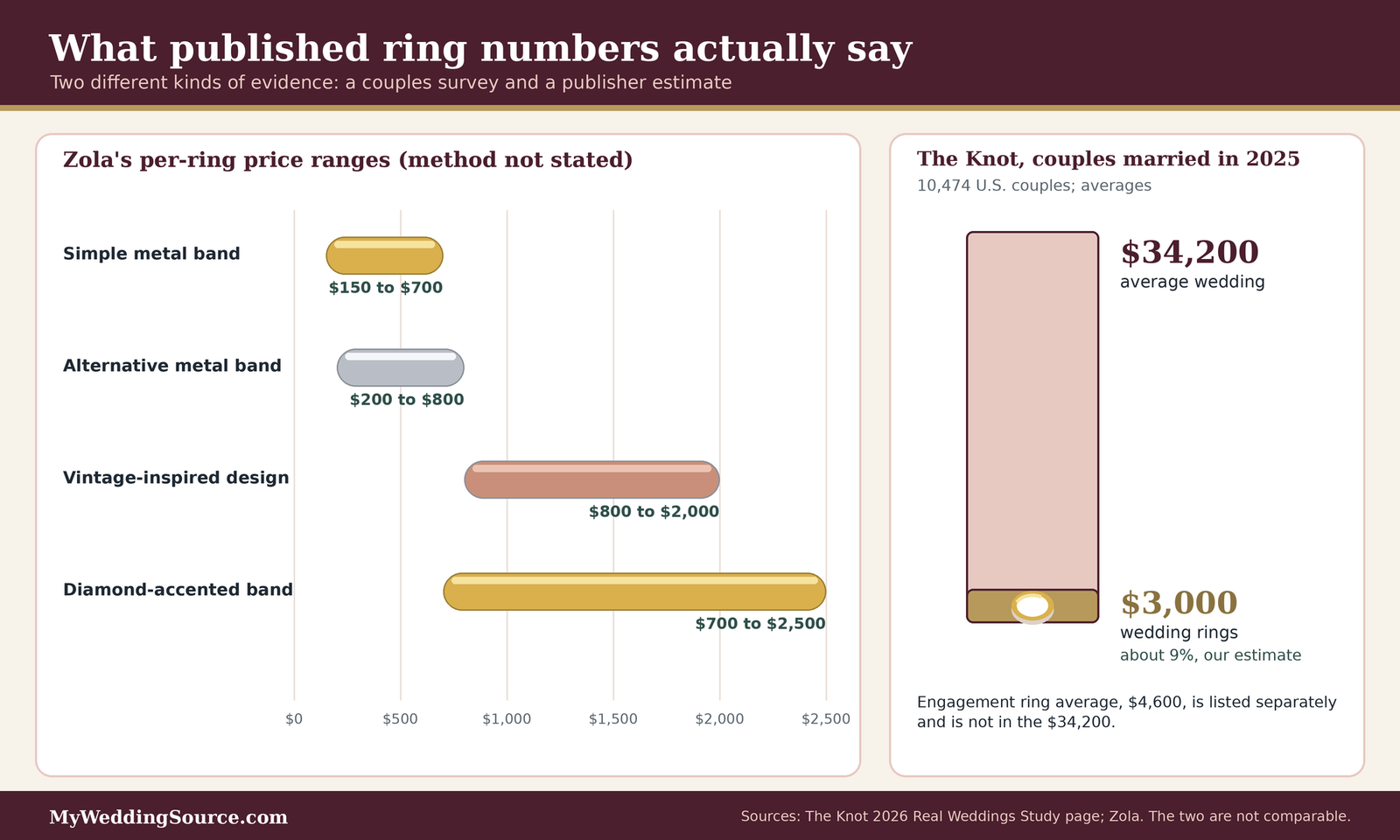
What to budget, and what each number means
Survey average (The Knot, couples married in 2025): about $3,000 for wedding rings, reported as a single figure. Publisher estimate (Zola, method not stated): roughly $400 to $1,800 per ring, depending on style. Your quote: the only number that matters when you buy. A pair of plain bands in a precious metal can sit well below the survey average, and a pair with diamonds or platinum can sit well above it. Set a ceiling for both wedding rings together, then compare quotes on the same specifications. This is general information, not financial advice.
Turn a total into a ceiling you can shop to
A budget for wedding rings is only useful if you can shop to it. That means deciding one combined number, then deciding how to split it.
Work from one combined ceiling for wedding rings
Start with a single ceiling for both rings, plus anything you plan to add, such as engraving, resizing, and insurance. If you do not have a number, our wedding budget calculator can help you see how much room the rest of the plan leaves. Then split the ceiling by what each person values. The split does not have to be even. One partner may care about a wide platinum band, and the other may prefer a plain titanium one, and that is fine as long as the total holds.
A worked example, labeled as illustrative
Suppose a couple has a $30,000 wedding budget and decides to spend about 9 percent on rings, the share implied by the Knot averages above. That is about $2,700, by our arithmetic. They split it into $1,500 for one ring and $900 for the other, which leaves about $300 for engraving, a possible resize, and a buffer. This is an invented example to show the method. The percentage is a reference point from survey averages, not a recommendation, and plenty of couples reasonably spend far less or far more.
Compare quotes by normalizing them
Two quotes for what looks like the same ring can differ because the rings are not the same. Quote normalization is a simple way to make them comparable. It is our own method, not an industry standard.
The normalization checklist
For each quote, write down the same items in a row: metal and purity, width, thickness, weight if given, interior (flat or comfort), finish, stones, engraving, resizing policy, return window, warranty, shipping and insurance during shipping, and tax. If a seller cannot give an item, write “unknown.” After you fill in the rows, the cheaper quote is often cheaper for a reason you can see, such as a thinner band, a lower karat, or no resizing.
Spot differences that hide in the price
A few differences hide well. A band quoted in a lower karat will cost less and may scratch differently. A band that is narrower or thinner contains less metal. A ring that is final sale once engraved has a cost if the size is wrong. The FTC’s Jewelry Guides add that plating must be durable and that a gold coating over a base metal must be disclosed, so if a price looks far below others, ask whether any part of the ring is plated and what happens when the plating wears.
Savings that are real, and savings that are only claimed
Savings advice on wedding rings is easy to find and hard to check. Treat it the way you treat the rest of the market: ask for it in writing.
Where publishers say prices drop
Zola’s guide says online retailers are often 20 to 30 percent less than traditional stores, that lab-grown diamonds cost 40 to 60 percent less than natural diamonds of comparable quality, and that custom bands often cost about double a comparable pre-made ring. It also says holiday periods such as Black Friday, Christmas, and Valentine’s Day offer the deepest discounts, and that buying the engagement ring and both bands from one jeweler at the same time may earn a discount. Zola does not describe how it reached these figures, so treat them as claims to test, not guarantees. If you are comparing quotes now, ask each seller directly whether they price-match or bundle.
What a discount does not change
A lower price does not change the return window, the resizing limits, or the warranty. A sale ring may be final sale. Check the policy before you let a discount drive the decision. Our guide to engagement ring insurance and hidden costs covers insurance costs that are easy to overlook, and the same thinking applies to wedding bands.
Plan the timing backward from the day you need the wedding rings
Timing is where couples get caught. Wedding rings themselves are simple, but the steps around them, sizing, ordering, engraving, shipping, and possibly a resize, take real time, and they cannot all happen at once.
What the sources say about lead times
Sources agree that ready-made rings are quick and custom work is slow. They disagree on the details, and we say so where they do.
Ready-made, made-to-order, and custom wedding rings
Zola’s guide says ready-made rings are often available immediately or within a few days, that custom pieces, resizing, and special orders typically take four to eight weeks, and that custom rings from consultation to delivery can take four to six months. The 25karats guide says made-to-order rings take about two weeks and recommends starting about three months before the wedding to leave room for sizing, crafting, engraving, and a resize. Zola’s guide also says wedding season and holidays can extend production times. Those are different sellers describing different services, so use them as ranges, and ask your seller for its own lead time in writing.
Where the timelines do not agree
Zola’s article gives more than one research window in different sections, including two to three months and three to six months before you need the rings. We read that as a sign that the number depends on the kind of ring and how decisive you are, not as a contradiction to resolve. A reasonable synthesis is to begin research several months out and to treat the date you place the order, not the wedding date, as your deadline.
A backward calendar
Because the wedding rings need to arrive early enough to fit, engrave, and fix, work backward from your wedding date.
A sample timeline, labeled as our synthesis
This sequence combines the lead times above with our own judgment. Treat it as a template, not a promise. About six months out, start research and measure fingers on several days. About four months out, narrow the shortlist and try on widths. For custom work, place the order now, since Zola gives four to six months. About three months out, order ready-made or made-to-order rings, per 25karats. About two months out, receive the rings and check the fit. About one month out, engrave if you have not, resize if needed, and have the stones checked. In the final week, clean the wedding rings, confirm where they will be, and keep them with the person who will hold them.

Add buffers where things go wrong
The steps most likely to slip are shipping, engraving, and resizing, because they depend on someone else. Build a buffer of at least a few weeks for those. Our wedding planning timeline shows where rings fit among the other deadlines, and our wedding planning checklist can hold the dates.
Coordinate rings with the rest of the plan
Wedding rings touch other parts of the wedding, even though they are small. Handling those touchpoints early prevents last-minute stress.
Who holds the wedding rings, and where
Decide who carries each ring on the day and where they are stored the night before. A small box with a pocket or a pouch is enough. Some couples assign the wedding rings to the best person or another trusted attendant, and some keep them close. Pick one person, and tell them where the spare plain band is if you have one.
Photographs of the rings
If ring photos matter to you, add them to your list for the photographer. Our wedding photographer shot list shows how to ask for detail shots. A clean finish and a clear interior photograph well, and engraving is easy to show if you plan for it. For the broader plan, see our wedding planning guide and plan a wedding pages.
Handle the situations that change the plan
The steps above assume a fairly typical case: two new rings, bought together, with time to spare. Many couples are not in that case. This section covers the common exceptions and how the same logic applies.
When one ring has to fit beside an engagement ring
A wedding band worn with an engagement ring is judged as a stack, not alone. The two rings touch, rub, and compete for space on the finger.
Check the stack, not the band
Always try the wedding band with the engagement ring on the same finger. Look at the gap between them, at whether the center stone tilts the band, and at whether the two wedding rings sit flat together. Our engagement ring guide explains how the shape of a setting affects what can sit beside it. If the engagement ring sits high, a curved or notched band, sometimes called a contour band, may sit closer, though we describe it here as a general design idea and not a sourced specification. Ask the jeweler to show you.
Match the metals or choose a deliberate contrast
If the engagement ring is in a given metal, the simplest choice is a band in the same metal, which also avoids the uneven wear the 25karats guide warns about. Some people prefer a deliberate contrast, such as a yellow band beside a white-metal ring. If you choose contrast, choose it on purpose and look at the stack in daylight. Mixed metals are a matter of taste, and our wedding ring metals guide covers the practical side.
When your needs differ from your partner’s
Couples often have different jobs, different hands, and different attitudes toward jewelry. A pair does not require identical answers.
Share the metal and finish, vary the rest
The 25karats guide suggests that if needs differ, couples keep the metal and finish shared and vary the designs. It adds that hands-on work favors textured finishes and lower profiles, that healthcare work favors smooth interiors, and that gym use favors thicker bands. That is a retailer’s advice, but the logic holds up: one shared choice makes the pair look related, and the rest follows the wearer.
Plan a work ring if the real ring is at risk
Some people keep the wedding ring for evenings and weekends and wear an inexpensive plain band at work. That is a personal choice with a practical logic, since the cost of a lost work ring is small. If you take this route, budget for the second ring from the start, and decide whether it matches the first.
When the wedding rings are not new
Not every pair of wedding rings starts from scratch. Some couples use a family ring, a secondhand ring, or an older ring that has to be resized.
Inherited or secondhand wedding rings
An older ring may be worn thin, may have loose stones, and may be in an alloy the seller cannot identify. Before you plan a wedding around it, have a jeweler inspect it. GIA’s advice to inspect prongs and settings regularly applies doubly to an older piece. Ask what repair is needed, what it costs, and how long it takes, and add that time to the calendar.
Resizing and altering an existing ring
Resizing wedding rings is usually possible in gold and platinum, with limits, and the 25karats guide notes that eternity bands often cannot be resized. If the ring is engraved, ask where the text sits before work begins, because a resize can reach it. Our ring engraving guide covers how engraving interacts with resizing.
Verify the final choice before money becomes nonrefundable
The most important protection in this purchase is not research. It is paperwork. Once a ring is engraved, resized, or custom made, many sellers treat it as final sale, and a mistake becomes yours. A short verification pass on your wedding rings before you pay prevents most of the regrets.
Ask for proof and a written scope
Spoken promises about wedding rings do not survive staff changes. Anything that matters should be written on the order, the receipt, or an email you keep.
Turn vague promises into specific terms
Replace phrases such as “it should be fine” with specifics. Ask for the metal and purity, the width and thickness, the interior, the finish, and the stamps to be listed on the order. Ask for the resizing limit and the fee. Ask what “lifetime warranty” covers, since a warranty may exclude damage, loss, or wear. The FTC’s Jewelry Guides set rules for how metals and plating are described, and a seller that cannot say what a ring is made of is a seller to avoid.
Questions to ask before you pay
- What are the exact metal, purity, width, thickness, and interior of each ring, and where is each stamped?
- Is any part plated or coated, and what happens when it wears?
- Can each ring be resized, by how much, and what does it cost?
- What is the return or exchange window, and does engraving or resizing end it?
- If you make a mistake in engraving or sizing, do you fix it at no charge?
- What does the warranty cover, and what counts as damage?
- What is the lead time in writing, and what happens if the rings arrive late?
- Who pays for shipping, and who is responsible for loss in transit?
Keep the records together
Keep the receipt, the order confirmation, the written specifications, photos of the wedding rings, and any appraisal in one folder. If you plan to insure the rings, you will need those records. Our guide to engagement ring insurance and hidden costs explains what to ask an insurer, and we are not giving insurance advice here.
Check return, exchange, and replacement rules
Return policies on wedding rings are where retailer practice varies the most. Some sellers offer generous windows, some exclude engraved items, and some charge fees.
What sellers say about their own policies
Policies belong to the seller, so we do not generalize. As examples, the 25karats guide advertises 60-day returns and free professional cleaning and inspection on its own pieces, and Blue Nile’s sizing guide says Blue Nile offers a 30-day window to exchange for a different size. We report those as claims from those sellers at the time we read their guides, and they may change, so check the current policy of whoever you buy from. The 25karats guide also notes that engraved rings are often non-returnable, so confirm the size before engraving.
Compare the rules, not only the price
Write the return window, the engraving exclusion, the resizing fee, and the replacement terms in your comparison table. A ring with a modest price and a strict policy can cost more in the end than a ring with a higher price and an easy exchange. Table 2 below turns this into a checklist.
Run a pre-purchase verification checklist
This is our own checklist. It assumes you are ordering both wedding rings and want to catch the problems that are hard to fix afterward.
The wedding rings checklist
| Step | What to confirm | Proof to ask for | Fallback if it fails |
|---|---|---|---|
| Sample or proof | Width, interior, and finish match what you tried on | Photos, a try-on ring, or a written spec | Choose the in-stock alternative |
| Metal and purity | Karat or purity mark and maker’s mark | Written spec and stamp photo | Ask for a different alloy |
| Size | Each ring sized in its own width | Written size on the order | Exchange window noted |
| Resizing | Limit, cost, and effect on engraving or stones | Written policy | Plan a replacement option |
| Engraving | Text, font, location, and proof | Written proof approved by you | Remove or re-engrave terms |
| Policy | Return, exchange, and warranty terms | Policy in writing | Choose a seller with clearer terms |
| Timing | Delivery date and buffer | Written lead time | Backup plain band |
| Records | Receipt, specs, photos, and appraisal | One saved folder | Request copies |
How to use it
Go through the table once per ring and once per seller. The point is not to distrust the seller. It is to make sure that both of you remember the same promise later. If a seller declines to put something in writing, treat that as information.
Run a final fit test
When the wedding rings arrive, do not assume they are right. Check them while you can still exchange them.
Test wedding rings against real life
Wear each ring for part of a day, in the situations that matter. Do the dishes. Type. Reach into a pocket. Wash your hands and dry them. Note whether the ring spins, pinches, or traps moisture. Check it again at the end of the day, when fingers tend to be larger, and again on a different day. If either ring is wrong, tell the seller within the exchange window.
Define the fallback before you need it
Decide in advance what you will do if a ring fails: a spare plain band, an in-stock exchange, or a borrowed ring for the ceremony. Our wedding planning checklist can hold that note. A fallback costs little and removes the panic if shipping slips or a resize goes wrong.
Think about what happens after the wedding
Buying wedding rings is not the end of the job. The first year tells you whether the choice was right.
Schedule a check on your wedding rings
Put a reminder in your calendar for a few months after the wedding and again after a year. Look at the fit, the finish, and the settings. GIA advises periodic inspection of prong and pavé settings, and the 25karats guide mentions inspection every six months on its own pieces, which we report as that seller’s practice and not a standard. Small repairs are cheaper than large ones.
Keep the paperwork current
If you changed the size, added engraving, or had a repair, update the records. If you insured the wedding rings, tell the insurer about changes. Keeping the file current takes minutes, and it makes any later claim, repair, or replacement simpler.
Frequently asked questions
Buying and budget
How much should we spend on wedding rings?
There is no correct amount. The Knot’s 2026 study of couples who married in 2025 reports an average of about $3,000 for wedding rings, but that is an average of couples who use its sites. Set a combined ceiling that fits your whole budget, then compare written quotes on the same specifications before you decide.
Do both rings have to be the same metal?
No, but sellers often recommend it. The 25karats guide suggests the same metal and karat because mixed hardness can wear unevenly, and it says sharing metal color and finish makes rings look related. If you mix metals, choose the contrast deliberately and ask a jeweler how the two will wear together.
When should we start shopping for wedding rings?
Zola says to begin research several months ahead and notes that custom work can take four to six months, while 25karats suggests starting about three months out for ready-made or made-to-order rings. Ask your seller for its lead time in writing, and add a buffer for sizing, engraving, and shipping.
Is it cheaper to buy both wedding rings from one jeweler?
It may be. Zola says buying the engagement ring and both bands together from one jeweler may earn a discount, and it says online retailers are often 20 to 30 percent cheaper than stores, though it gives no method. Ask each seller directly about bundles, and compare return and resizing terms as well as price.
Fit, comfort, and durability
Do wide wedding rings need a bigger size?
Often a little. Blue Nile suggests a quarter to a half size larger for bands 6 millimeters or wider, and 25karats suggests about half a size more. Brilliant Earth says the amount depends on the ring and your finger. Try the actual ring in the width and interior you plan to buy.
Which metal is the most durable for wedding rings?
It depends on how you define durable. Jewelers Mutual separates scratch resistance from resistance to breaking. Tungsten resists scratches but can chip, and platinum resists breaking but scratches. Gold and platinum can usually be resized, while several alternative metals cannot. Choose the failure you can live with.
Why does my ring cause a rash?
Often the cause is moisture and debris trapped under the ring, not an allergy to the metal, according to a Mayo Clinic dermatologist. Rinse and dry under the ring after washing. If the rash persists, see a health care provider, who may suggest patch testing to check for a metal allergy.
Can wedding rings be resized after engraving?
Sometimes. A resize can reach engraved text, depending on where it sits and how much metal is moved, and stone-set eternity bands often cannot be resized at all. Ask the jeweler before you order, and read our guide to ring engraving for how text and sizing interact.
Your next steps
Decide the pair
Write the two notes and the ceiling
Write one note for each wearer covering job, habits, and skin history, and agree on one combined budget. Our wedding budget calculator can help you place the rings inside the wider plan.
Pick metal, then width, then fit
Choose the metal using our wedding ring metals guide, the width using our wedding band width guide, and the interior by trying both. Then decide on engraving with our ring engraving guide.
Lock in the details
Normalize quotes and verify in writing
Fill the normalization checklist for each quote, run the verification table, and get return, resizing, engraving, and warranty terms in writing before you pay.
Calendar the buffers
Place the order dates on your calendar with buffers using our wedding planning timeline, and add the ring tasks to your wedding planning checklist.
Sources & methodology
How we built this guide
What we relied on
This guide combines the FTC’s Jewelry Guides, The Knot’s 2026 Real Weddings Study page, Zola’s guide to wedding ring costs, an insurer’s guide to band metals, GIA’s guide to settings, dermatology sources on ring rash, and published advice from jewelers. Where a statement comes from a retailer, we say so, because retailer advice reflects the seller’s products and policies. Cost figures are labeled as survey averages, publisher estimates, or our own arithmetic, and the arithmetic is an estimate. Examples and scenarios are illustrative and invented to show a method.
What we did not do
We did not test rings, measure hands, collect price quotes, or survey couples. We could not confirm Zola’s methodology, and we noticed that its combined and per-ring figures do not fully agree. We did not give legal, financial, insurance, or medical advice. Policies, prices, and lead times change, so confirm them with the seller, and see a clinician for persistent skin problems.
Source list
Government, professional, and survey sources
- Federal Trade Commission, Guides for the Jewelry, Precious Metals, and Pewter Industries, 16 CFR Part 23, final revisions (Federal Register, August 16, 2018): https://www.govinfo.gov/content/pkg/FR-2018-08-16/html/2018-17454.htm
- The Knot, 2026 Real Weddings Study and Average Wedding Cost data: https://www.theknot.com/content/average-wedding-cost
- The Knot, Real Weddings Study overview page: https://www.theknot.com/content/wedding-data-insights/real-weddings-study
- GIA, Guide to engagement ring settings: https://4cs.gia.edu/?p=39609
- Mayo Clinic News Network, Mayo Clinic Minute: Wedding ring rash: https://newsnetwork.mayoclinic.org/?p=236679
- American Academy of Allergy, Asthma and Immunology, Ask the Expert: Wedding ring dermatitis: https://www.aaaai.org/ask-the-expert/wedding-ring-dermatitis
- Jewelers Mutual, Strongest metals for a wedding band: https://www.jewelersmutual.com/the-jewelry-box/strongest-metals-wedding-band
Jeweler and retailer sources
- Zola, How much do wedding rings cost: https://www.zola.com/expert-advice/how-much-do-wedding-rings-cost-average
- Brilliant Earth, Different karats of gold: https://www.brilliantearth.com/engagement-rings/buying-guide/precious-metals/different-karats-of-gold
- Brilliant Earth, Comfort fit ring vs. standard: https://www.brilliantearth.com/guides/comfort-fit-ring-vs-standard/
- Blue Nile, How to find the perfect ring size: https://www.bluenile.com/blog/diamonds-jewelry/perfect-ring-size
- 25karats, Matching bands buying guide: https://www.25karats.com/education/jewelry/matching-bands-buying-guide
- 25karats, Wedding rings buying guide: https://www.25karats.com/education/jewelry/wedding_rings_buying_guide