
Wedding bands come in more shapes than the display case suggests, and the right one depends less on taste than on a few practical questions: how the band sits next to an engagement ring, how much hand work it has to survive, whether you may stack more rings later, and what you can verify before you pay.
Quick answer
With wedding bands, choose the shape first, the sparkle second, and the occasion last. A plain band is the simplest and most repairable. A diamond band adds sparkle but adds settings that need checking and sometimes cannot be resized. A curved or contour band solves a gap problem that a straight band creates beside some engagement rings. A stackable band is a plan for several rings, so size and metal for the whole stack. An anniversary band is defined by the occasion, not the construction. Before any deposit, put the specs, resizing rules, and return terms in writing.
What wedding bands are, and the five labels you will see
The phrase wedding bands covers a wide range of rings, and shops use it loosely. Some labels describe the surface (plain, diamond), some describe the outline (straight, curved, contour), some describe how the ring is worn (stackable), and one describes the moment it is given (anniversary). Sorting the labels first prevents a common confusion when shopping for wedding bands, which is comparing two rings that are different kinds of things.
Style, shape, and occasion are three different questions about wedding bands
A single ring can answer all three at once. A half-set diamond band can be curved, can be worn as part of a stack, and can be given on a fifth anniversary. When a product page uses several labels together, read each as a separate answer.
Style describes what the surface looks like
Plain, textured, milgrain, and diamond-set are surface descriptions. They tell you how the ring looks and how much upkeep it needs. They do not tell you whether the ring will sit flush against an engagement ring, because that depends on shape.
Shape describes how the edge meets the engagement ring
Straight, curved, contour, chevron, and notched are outline descriptions. Retailers use these words inconsistently. One guide from the retailer With Clarity calls curved bands the same family as contour, fitted, or shaped bands, while a guide from the jeweler Alexis Russell treats contoured bands as a custom-fitted variation that dips to nestle against the ring. When a listing says “contour,” ask for a side-view photo or a drawing of the outline.
Occasion describes why the ring exists
An anniversary band is named for the milestone it marks. An eternity band is named for how it is built, with stones around the whole ring. Liori Diamonds, a retailer, makes the same distinction in its own guide: an eternity band can serve as an anniversary band, but an anniversary band can have any number of stones.
Where wedding bands fit in the wider ring decisions
This guide stays on the choice of band style. Several neighboring decisions have their own full guides, and it is worth reading them in the right order rather than repeating them here.
Decisions covered in other guides
Metal choice, including how platinum, gold, and alternative metals behave, is covered in our wedding ring metals guide. Width, comfort fit, and sizing at different widths are covered in our wedding band width guide. Engraving limits and character counts are covered in our ring engraving guide. We link to them where they matter and do not repeat them in this look at wedding bands.
Decisions covered here
The choice among plain, diamond, curved, contour, stackable, and anniversary designs; how to diagnose a gap before buying; how to plan a stack; how to compare quotes that are built differently; and what to confirm in writing before money is nonrefundable.
Plain wedding bands: what they do well and where they stop
A plain band is a smooth or lightly textured ring of metal with no stones. Among wedding bands, it is the lowest-maintenance option, and for many wearers that is the whole argument. It is also the style where the other specifications, such as thickness, fit, and metal, carry the most weight, because nothing else is there to distract from them.
The case for plain wedding bands
The Alexis Russell guide describes plain bands as clean and minimal, a choice that lets an engagement ring stay the focal point. That description matches how most jewelers talk about plain bands, and it holds up on practical grounds too.
Fewer parts mean fewer things to loosen
A diamond-set band depends on small prongs, beads, or channel walls holding each stone. A plain band has none of those. The Gemological Institute of America (GIA), which publishes a consumer guide to ring settings, notes that pavé and halo styles may need occasional checks to keep stones secure and more frequent cleaning. A plain band skips that maintenance schedule entirely.
Resizing is usually simpler
The GIA guide also notes that resizing can disturb the small stones of a pavé band. A plain band has no stones to disturb, so a jeweler has more freedom. Whether a specific metal can be resized, and how far, is a question for the jeweler, and our wedding ring metals guide explains why metals differ on this point.
How finish and profile change a plain band
Two plain bands in the same metal can look and wear very differently because of the finish on the surface and the shape of the cross-section.
Polished, satin, hammered, and brushed finishes
A polished finish is mirror-bright and shows fine scratches quickly. A satin or brushed finish is matte, and a hammered finish has small facets. The Alexis Russell guide says textured bands can help disguise daily wear. That is a reasonable expectation, because a surface that is already patterned does not show new marks as sharply, but the marks are still there. Any finish can be refreshed by a jeweler, and it is worth asking whether that service is included.
Flat, domed, and comfort-fit profiles
The outside can be flat or domed, and the inside can be flat or rounded. Brilliant Earth explains that comfort fit describes the interior only: the inside surface is curved so the ring touches the finger less, which can reduce pressure and friction. The same guide warns not to size down automatically for comfort fit, because the effect depends on the design, width, and finger. Our wedding band width guide covers fit in depth.
Who should choose something other than plain wedding bands
Plain is not automatically the sensible default among wedding bands. Some situations push toward a different design.
When a plain band leaves a gap
If your engagement ring has a low-set stone, a basket, or a halo, a straight plain band may not sit against it. That is a shape problem rather than a style problem, and the section on curved and contour bands explains how to diagnose it.
When plain does not match the plan
If you expect to add anniversary rings later, a very thin plain band may be fine, but a very wide plain band can leave little finger space for additions. Planning the stack now costs nothing, and the stacking section below walks through the arithmetic.
Diamond wedding bands: settings, upkeep, and resizing
Diamond wedding bands add small stones to the surface. How those stones are held matters more than how many there are, because the setting determines how well the band survives daily wear, how easily it can be resized, and how much maintenance to expect.
The settings you will see on diamond bands
The GIA guide to ring settings describes several methods of holding stones. Five of them appear on most diamond wedding bands.
Pavé and micro-pavé
Pavé, common on wedding bands, holds many small stones closely together with tiny beads or prongs, according to GIA. The result looks like a surface of sparkle. The trade-off is upkeep: GIA says pavé may need occasional checks to keep stones secure and more frequent cleaning, and that resizing can disturb the stones.
Channel
In channel-set wedding bands, a row of stones sits between two parallel metal walls. GIA notes that the surrounding metal protects the stones, which suits everyday wear, and that channel settings are less likely to catch than exposed accent stones. The same guide cautions that channel bands are difficult to resize, especially when stones extend far around the band.
Bar, bezel, and flush
Bar settings hold each stone between vertical bars and, per GIA, are more exposed than channel. A bezel wraps a metal rim around the stone and protects its edges well. A flush setting sits level with the band, which GIA describes as highly durable and unlikely to snag, though it admits less light and usually needs a wider, thicker shank. These three are worth asking about if hand work is part of your week.
Shared prong
Shared-prong bands use a single set of prongs between neighboring stones. We did not find an independent consumer-authority description of shared prong, so we do not make claims about its durability here. Ask the seller to show you the underside and explain how each stone is held, and ask for the shop’s inspection and re-tipping policy.
Half-set, full-set, and everything in between
Where the stones stop is a separate decision from how they are held, and it affects resizing more than almost anything else.
Why stones around the full ring limit resizing
A jeweler resizes a band by cutting it, usually at the bottom, and adding or removing metal. Liori Diamonds explains that this requires some plain metal at the cut. A full eternity band has diamonds through that spot, so Liori and Gabriel & Co. both say full eternity bands generally cannot be resized. The jeweler Berlinger Jewelry, in its own policy, says eternity rings cannot be resized without a remake, and that an additional charge may apply.
Why partial settings stay adjustable
A half-set band has plain metal on the underside. Liori says half eternity bands can usually be resized and are described as more comfortable for long wear because the palm side is smooth, while some wearers feel stones on the palm side of a full band during long periods of typing or gripping. That is a retailer’s description, so treat it as one view and test the ring yourself.
Diamond wedding bands and the question of natural versus lab-grown
Both natural and lab-grown stones appear on wedding bands. The label matters for the price and for how the seller must describe the ring.
What the federal rule requires
The Federal Trade Commission’s Jewelry Guides, revised in 2018, define a diamond without requiring that it be natural, so lab-created stones with the same properties are diamonds. The guides say a lab-created stone described with a term like “cultured” needs a clear disclosure that it is not mined, and suggest qualifiers such as “laboratory-grown.” This is general consumer information, not legal advice, and it concerns how sellers describe stones. Ask any seller to write the stone type on the invoice.
What it means for budgeting
Liori Diamonds states in its anniversary guide that a natural seven-stone band with about three carats of emerald-cut diamonds costs roughly twice what its lab-grown equivalent does. That is one retailer’s catalog, not a market average, but it illustrates why stone origin should be written next to every quote you compare.
Curved and contour wedding bands: diagnosing the gap before you buy
Of all the choices among wedding bands, the straight versus curved decision is the one most likely to be wrong when made from a photo. It depends on the geometry of your engagement ring, which you can inspect, and it is the one where a small mistake produces a visible gap or a ring that pushes against another ring all day.
The four outlines and what each is for
Retailers use several words for wedding bands that bend or notch around an engagement ring. They are not standardized, so use the descriptions below as a vocabulary rather than a rulebook.
Straight, or flush
A straight band runs in a continuous line. Alexis Russell describes flush bands as suited to high-set stones or settings with little interference. StoneBridge Jewelry says straight bands suit high-set round solitaires, cathedral settings, and open galleries, and adds that a low basket, hidden halo, or wide prong base can cause a gap or rubbing.
Curved
A curved band bows away from the engagement ring at the center. With Clarity says straight bands can leave a visible gap beside settings that rise above the band, and names low-set center stones, marquise and pear shapes, and intricate halo or vintage-inspired settings as common cases. StoneBridge says a deep curve can leave extra space around a smaller diamond and that curved bands can look unfinished when worn alone.
Chevron and contour
A chevron band forms a V that nestles around a center stone, according to With Clarity, which suits solitaires or rings with a prominent center diamond. Alexis Russell describes contoured bands as dipping to nestle closely and reducing movement between the rings, and says they are custom-fit. Because these words overlap, ask the seller what outline the ring actually has.
Notched
A notched band has a small cut-out for side stones, prongs, or unusual settings, per With Clarity, and sits flush without crowding. A notch is the most specific answer to the most specific problem, and it is almost always made to order.

A side-view gap diagnosis you can do at home
You do not need special tools to find out whether a straight band will fit your engagement ring. You need a flat table, good light, and a phone camera.
Look at the ring from the side, at eye level
Rest the engagement ring on a table so you see it as a profile. Look at three places: the underside of the center stone’s setting, the width of the prong base, and any halo or gallery detail beside the shank. StoneBridge recommends checking basket height, under-gallery clearance, prong base width, halo depth, and pavé beads. If a straight edge laid along the shank would touch the setting anywhere above the shank, a straight band will touch it too.
Lay a strip of card against the shank
Cut a straight strip of stiff card about as wide as the band you are considering and hold it against the shank, edge to edge. If the card rocks on a prong or a halo, a straight band will sit away from the ring or push against it. If it lies flat along the whole shank, a straight band is a reasonable candidate. This is our own method, not a jeweler’s measurement, so confirm with a try-on.
Decide whether the gap is a problem or a design choice
StoneBridge notes that a small gap can be intentional, especially with open, chevron, or mixed-metal stacks. A gap becomes a problem when it traps dirt, when it lets the rings pinch skin, or when the rings rub at one point. Its advice, if a straight band presses into prongs or a halo, is to switch to a curved or open style instead of forcing the fit.
Where curved and contour bands cost more than they seem to
Curved bands often cost more than the same width in a straight band because of the extra shaping, and a contour made to measure may be priced as custom work. We did not find an independent price survey, so treat this as a prompt to ask rather than a number.
Custom shaping may change the return terms
Many sellers treat made-to-measure rings differently from catalog rings. One jeweler we reviewed, Berlinger Jewelry, states in its policy that custom or customized jewelry is not subject to return or exchange, that deposits on custom orders are non-refundable, and that returns on other items must happen within seven days of receipt. Other shops differ. The point is to find out in writing, before the deposit, which category the band falls into.
Plan for the engagement ring to change after you buy wedding bands
If the engagement ring may later be resized, reset, or upgraded, a band shaped exactly around the current setting may no longer fit. With Clarity notes that curved bands are positioned so rings sit close without excessive contact at key points. Ask whether the shop will reshape or remake the band if the engagement ring changes, and at what cost.
Stackable wedding bands: planning the whole stack, not one ring
Stackable wedding bands are not a separate construction. They are bands chosen to sit with other rings on one finger. That changes the questions you ask: the unit that has to fit is the stack, not the individual ring.
Order, widths, and the arithmetic of a stack
Several guides describe a traditional order. GIA says the engagement ring sits above the wedding band, which is closest to the heart, and that an eternity ring, if added, goes above the engagement ring. Blue Nile says an anniversary or eternity ring can go above the engagement ring or in whatever order feels meaningful. Both treat order as a custom that you can change.
Add up the width before you buy
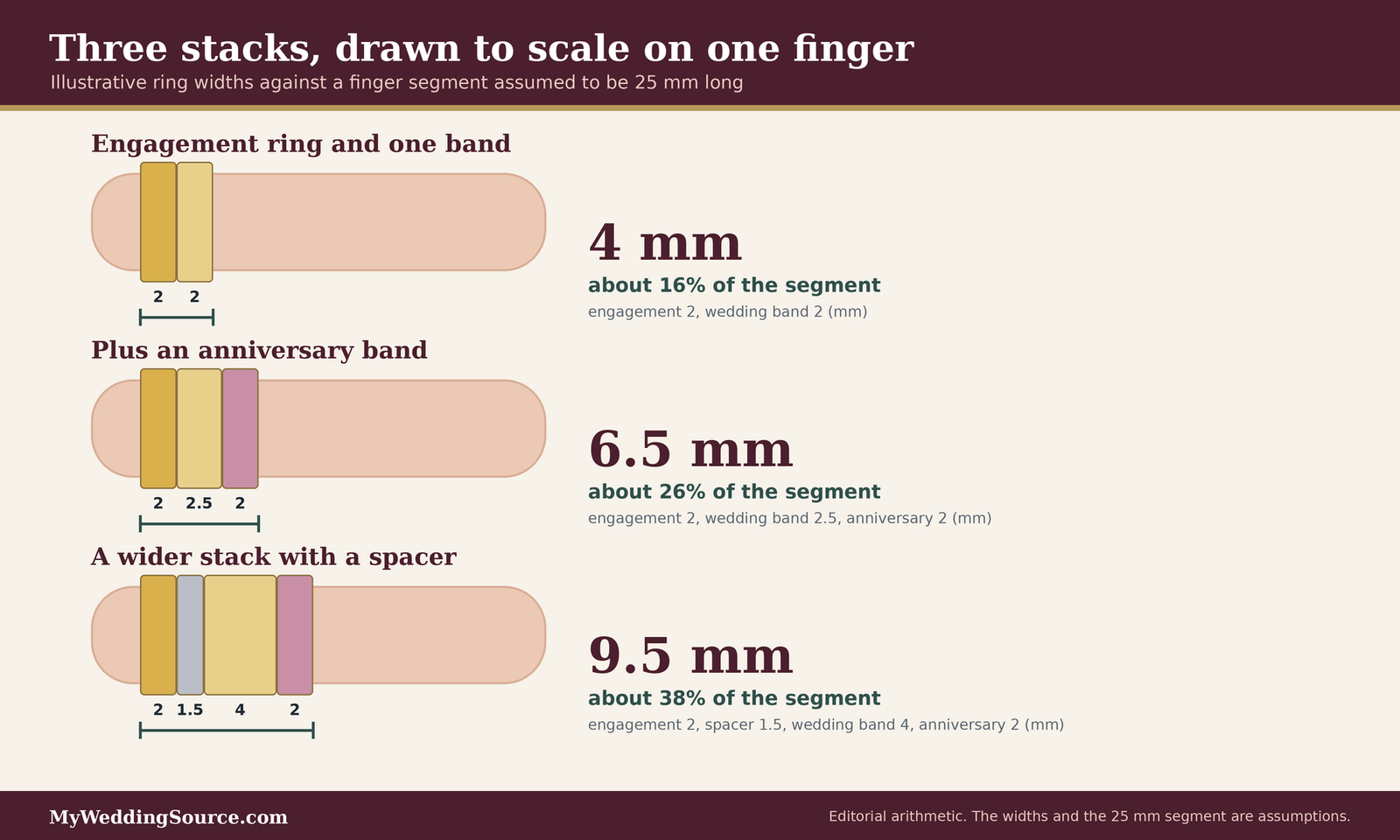
Stack width is simple to compute and rarely done. As an illustration, suppose an engagement ring has a 2 mm shank, a plain wedding band is 2.5 mm, and a later anniversary band is 2 mm. The stack covers 6.5 mm of finger. Using the 25 mm finger segment from our wedding band width guide, that is about 26 percent of the segment. The 25 mm figure is an assumption for illustration, and real fingers vary, so treat the percentages as comparisons rather than facts about your hand.
Put the widest ring at the bottom
GIA advises that when bands differ in width, the thickest goes at the bottom of the stack, which keeps the stack from looking top-heavy. Blue Nile adds that mixing slim and wider rings adds dimension and that thinner rings can fill unwanted gaps. Brilliant Earth notes that narrower bands are easier to stack and that varied widths can still look balanced.
Metals that wear together
Wedding bands that share a finger touch each other all day, and their hardness differences show up over time.
Match karat and hardness when you can
GIA says softer metals such as gold can wear faster when stacked against harder metals such as platinum, and gives the example of a 14 karat gold band under a platinum band being damaged over time. Blue Nile makes the same point and suggests pairing rings of similar karat and hardness. If your engagement ring is platinum and your wedding band is gold, the gold band is the one more likely to show wear. Our wedding ring metals guide explains the hardness differences.
Use a spacer ring if you mix metals
GIA says a ring in a different metal between the engagement ring and wedding band can unify the look and help prevent wear. This is one of the few places where a third ring is a practical tool and not only a design choice.
Sizing a stack
Several stacked wedding bands cover more of the finger than one, and the fit changes.
A stack can feel tighter than a single ring
Blue Nile says a stack can feel tighter than a single ring because several rings cover more of the finger, and that with more than three rings, or a wider stack, some pieces may fit better a quarter or half size larger. GIA says stacking several rings can tighten the fit and suggests resizing as needed or consulting a jeweler. Our wedding band width guide explains why width alone changes how a ring feels.
Test the stack before you commit
Blue Nile suggests testing proportions with a faux stack or rings you already own. StoneBridge says to judge comfort after a few minutes of wear. If you can, try the engagement ring and the candidate band together for at least ten minutes while you move your hand, type, and wash your hands, because a stack that feels fine in a shop for a minute can feel different by dinner.
Anniversary bands and eternity rings: what the names mean
An anniversary band is a ring given to mark a milestone. It is the one category in this guide defined by an occasion, which means there is no technical standard to check. What you can check is the construction, the stone count, and the resizing rules.
Anniversary band, eternity band, half eternity
The terms overlap, and shops use them differently. The definitions below follow the two retailers whose guides we reviewed, Liori Diamonds and Gabriel & Co.
How the labels differ
Liori describes an anniversary band as a diamond ring given for a wedding anniversary or another milestone, with any number of stones, and an eternity band as one with diamonds all the way around. Gabriel & Co. says eternity bands are popular for anniversaries as well as weddings, usually worn on the left ring finger, alone or layered with an engagement ring and a wedding band.
Stone counts and what they imply
Liori says matching the stone count to the anniversary year, for example five stones for a fifth anniversary or seven stones for seven years, is optional. It lists five-stone, seven-stone, half eternity, and full eternity styles, with the resizing rules noted below. Treat the numerology as a tradition you may follow or ignore.

Reading the resizing rules before you propose the purchase
Anniversary bands are often bought as gifts, which makes resizing the main risk compared with the wedding bands worn since the ceremony. The giver may not know the exact size, or the wearer’s size may change between engagement and a milestone year.
Which styles Liori says can be resized
Liori says three- and five-stone bands resize easily, that seven-stone bands can still be resized, that half eternities usually can, and that full eternities cannot. It advises confirming ring size before buying a full eternity. That is a retailer’s description of its own products, so confirm the rule for the specific ring you are buying.
How to learn the size without asking
If the ring is a surprise, the safest path is to borrow a ring the person wears on the same finger and have a jeweler measure its inside diameter, rather than guessing from a different finger or an old size. Brilliant Earth recommends measuring the finger you plan to wear the ring on, later in the day when hands are comfortably warm, repeated on different days, and checking both the knuckle and the base of the finger.
Comparing wedding bands by use case instead of popularity
Popularity tells you which wedding bands sell. It does not tell you what suits an engagement ring with a low halo, a job that involves gripping tools, or a stack you plan to grow over twenty years. The comparison below is built from the trade-offs documented in the sources above, and it deliberately avoids ranking one style as better than another.
An option matrix you can reuse
Use the matrix of wedding bands as a starting list. The entries are drawn from the GIA guide, the retailer guides named earlier, and our own reasoning where noted. They describe tendencies, not guarantees.
The matrix
| Option | Suits | Trade-offs | Specs to get in writing | Main failure risk |
|---|---|---|---|---|
| Plain, straight | High-set engagement rings; hand work; simple resizing | Can leave a gap beside low settings | Width, thickness, profile, interior fit, metal and purity | Rubbing or gap at the engagement ring |
| Plain, curved or contour | Low-set stones, halos, baskets, marquise or pear shapes | Can look unfinished alone; may be made to order | Outline drawing, clearance to the setting, return terms | Mismatch if the engagement ring changes |
| Pavé or micro-pavé | Matching a pavé or halo ring; added sparkle at slim widths | More cleaning; resizing can disturb stones | Stone count, setting type, resizing limits, re-tipping policy | Loose or lost stones |
| Channel, bezel, or flush | Daily wear; active hands | Less light reaches stones; channel is hard to resize | Setting type, wall height, resizing rule | Resizing limits |
| Half-set diamond | Comfort on the palm side; keeping resizing possible | Fewer stones than a full band | Where the stones stop; plain metal on the underside | Stones near the resizing cut |
| Full eternity | A continuous row of diamonds | Generally cannot be resized; stones can touch the palm | Confirmed size; remake policy and cost | Wrong size, no adjustment |
| Anniversary five- or seven-stone | A milestone gift; stacking above an engagement ring | Larger stones can compete with the engagement ring | Total carat weight, stone origin, resizing | Visual competition; size surprise |
| Stackable, multiple slim rings | Building up over time | Stack can feel tight; metals wear against each other | Stack width, metal match, size for the stack | Tight fit; wear on softer metal |
The matrix is our own synthesis and the failure risks are judgments, not statistics. We did not find an independent source that rates how often each option fails, so we do not claim one.
How to use it
Pick the row that matches your engagement ring and daily life, then read across to find what to verify. If two rows seem to fit, the “main failure risk” column is a tie-breaker: choose the one whose failure you could most easily fix.
Who each option suits, and who should look elsewhere
The suitability notes for wedding bands below combine the sources with ordinary caution. Where a claim comes from a seller, we say so.
Who plain bands suit
People who work with their hands, people who want the engagement ring to stay the focus, and people who want the simplest repair history. With Clarity says accent diamonds are generally not advised for handypersons and construction workers because they can loosen with heavy hand use, and steers athletes toward simple single-metal bands and healthcare providers toward sleek low-profile styles. Those are one retailer’s views, so treat them as a starting point for a conversation with your jeweler.
Who diamond bands suit
People whose hands have a moderate daily load, people matching a pavé or halo engagement ring, and people who want sparkle at a slim width. With Clarity says narrow bands in the 2 mm to 6 mm range may not accommodate accent diamonds and that wide bands of 6 mm and up showcase them better. That is a design note, and a narrow pavé band can be made, but it is worth asking how small the stones are and how they are held.
Who should choose a different shape
If your engagement ring has a low basket or a halo, do not choose a straight band without trying it. If your engagement ring may be reset, do not commit to a band shaped around the current head without asking about remake terms. If the wearer’s finger size changes often, do not choose a style that cannot be resized.
Trade-offs that product pages tend to leave out
Product pages for wedding bands show the ring at its best and rarely mention the maintenance and fit costs. The notes below address the issues most likely to matter after the first month.
Maintenance, comfort, and long-term upkeep
StoneBridge recommends scheduling inspections for pavé, shared-prong, and open-end styles about every six to twelve months. GIA advises that prongs be checked periodically and that worn tips can be rebuilt by re-tipping. With Clarity points out that rings sitting closely together will touch, which can cause minor surface wear over time, especially with pavé or exposed side stones. Put an inspection into the calendar the way you would a dental visit.
Comfort over a full day
A ring that is comfortable at ten in the morning may not be at six in the evening, and a stack is less forgiving than a single band. Liori says that fingers swell in heat and shrink in cold and that you should choose a size that works at both times. Our wedding band width guide explains why width changes how tight a ring feels at the same size.
Insurance and replacement
A band with diamonds is worth more than its metal weight, and wedding bands are easy to leave off a policy, and many people forget to add it to a policy. Our guide to engagement ring insurance and hidden costs explains what to check, and the same questions apply to a diamond band. We do not give insurance advice, and you should read your own policy.
The cost of fixing a wrong choice
Every wrong choice among wedding bands has a repair path. Knowing it in advance is the cheapest protection.
What can be fixed and what cannot
Of all wedding bands, a plain one can usually be resized, refinished, and sometimes reshaped. A pavé band may need stones reset after resizing, per GIA. A full eternity band generally cannot be resized, per Liori and Gabriel & Co., and Berlinger Jewelry says an eternity ring needs a remake when the size must change, with an additional charge possible. The practical rule is that the more stones go around the ring, the more the correct size matters on day one.
A worked scenario, labeled as illustrative
Suppose a couple, whom we will call Sam and Jordan, bought an oval engagement ring with a low halo and ordered a straight plain band online. At home, the band pushed against the halo and rotated to one side. The two choices were to return it or to order a contour band. The seller’s policy allowed returns within seven days but not on made-to-order items, and a contour band was made to order. Sam and Jordan could not return the contour band if it also failed, so they asked to try a sample contour in the shop first. The scenario is invented to show the order of questions: confirm the return rule before ordering the shaped band, not after.
What wedding bands cost, and how to compare quotes that are built differently
We do not publish a single typical price for wedding bands, because the sources we reviewed do not provide one that holds across metals, widths, and stone counts. What we can do is show what drives the price and how to compare quotes fairly.
What this actually costs
The price of a band is mostly metal weight and purity, plus stones, plus labor and any custom shaping. The Knot’s engagement ring pages do not give a wedding band figure, and neither does the study page we reviewed, so we do not quote one. Ask each seller for a written quote that lists metal, weight, total stone weight, stone origin, and service terms, so you can compare like with like.
What survey data does and does not tell you about wedding bands
Survey averages are tempting because they sound objective. They are useful for context, but they rarely answer the question you are actually asking.
What The Knot reports
The Knot’s page on engagement ring prices cites a national average of $5,200 from its 2024 Jewelry and Engagement Study, down from $5,500 in 2023, $5,800 in 2022, and $6,000 in 2021. The page does not state a sample size or a methodology and gives no wedding band figure. The Knot’s 2025 Real Weddings Study page says it surveyed US couples who married in 2025, and refers to a full report for methodology. That page did not state a ring cost or a sample size. We use the engagement ring figure as context only, not as a budget for a band.
Why an average is not your budget
An average mixes platinum and 10 karat gold, solitaires and eternity bands, and lab-grown and natural stones. A band quote depends on the exact metal, the exact width, and the exact stones. Our wedding budget calculator helps you decide how much of the wedding budget the rings should receive before you start shopping.
A quote-normalization method
Quotes for wedding bands from different sellers are rarely comparable as written. This method, which is our own, makes them comparable in five steps.
Write every quote on the same worksheet
Create one row per seller of wedding bands and one column each for metal and purity, width, thickness, interior fit, stone count, total stone weight, stone origin, setting type, and resizing terms. If a seller cannot fill a column, that is a finding. Our wedding planning checklist can hold the worksheet alongside your other decisions.
Compare price per total carat only within the same structure
Total carat weight is the main price factor in Liori’s guide, so it is natural to divide price by carats. Do that only within one structure. As an illustration, Liori lists a lab-grown full eternity of about 2 carats at about $2,250 and a lab-grown seven-stone of about 3 carats at about $2,500. By our arithmetic that is roughly $1,125 per carat for the eternity and roughly $830 per carat for the seven-stone, but the two bands have different construction, different stones, and different resizing rules, so the per-carat figures should not be used to call one cheaper. Liori’s own listings show that stone count alone does not set the price, and it says prices change as pieces sell.
Price ranges to use as anchors, not as quotes
The ranges below are one retailer’s published prices. They are not market averages, and they will have moved by the time you read this.
What Liori Diamonds published
Liori’s anniversary guide, with prices it says it checked on October 2, 2026, lists five-stone bands from $1,950 to $2,950, seven-stone bands from $1,980 to $4,750, and full eternity bands from $2,250 to $12,600. It also says the metal changes the look more than the price, with platinum costing about $3,000 on a lab-grown seven-stone where gold costs about $2,500. Treat these as examples of how wide a range can be, not as what you will pay.
Why the range is wide
The same guide ties price mostly to total carat weight and to whether stones are lab-grown or mined, and says shape and metal matter too. A plain band has none of those variables except metal and weight, which is why plain bands are generally easier to price-compare. We did not find a comparable independent range for plain bands, so we do not give one.
Verifying wedding bands before money becomes nonrefundable
When buying wedding bands, the most useful hour in the whole process is the one spent reading terms before paying a deposit. Most regret over wedding bands comes from a policy that was not read, not a style that was wrong.
Ask for proof, samples, and a written scope
A written scope is a short document or invoice line that describes exactly what you are buying. It protects both sides.
Questions to ask before you pay
- What are the exact width, thickness, profile, and interior fit of this band?
- What metal and purity is it, and where is it stamped?
- If it has stones, how many, what total weight, what origin, and how is each held?
- Can it be resized, by how many sizes, and at what cost?
- If it is shaped around my engagement ring, can I try a sample against the ring?
- What happens if my engagement ring changes?
- Is it made to order, and does that change the return and cancellation terms?
- What is the inspection, re-tipping, and repair policy for the stones?
Turn vague promises into contract language
“Lifetime service” and “free resizing” are marketing phrases until they are written with limits. Berlinger Jewelry, for example, states free resizing for life for U.S. customers up to two sizes in either direction, and notes that changes beyond that may require a remake with a fee, and that resizing takes about one to two weeks from receipt. That is one jeweler’s policy. The lesson is to ask for the limit, the cost beyond it, and the turnaround time, in writing, for the exact band you are buying.
Ask for the stone and metal facts on the invoice
The Federal Trade Commission’s Jewelry Guides address how metals and stones may be described. They say an unqualified “platinum” marking requires at least 950 parts per thousand pure platinum and that gold alloys marked “gold” should carry a karat designation such as 14K. This is general information on how sellers must describe products, not advice on your particular purchase. Ask that the invoice record metal, purity, and stone type exactly as the seller will mark them.
Check return, cancellation, alteration, and replacement rules
Every seller of wedding bands sets its own rules. The checklist below turns them into questions with a place to record the answer.
The verification table
| Item | What to ask for | Where to record it | Fallback if it fails |
|---|---|---|---|
| Fit with engagement ring | Try the band against the ring, or a sample in the same outline | Photo and invoice note | Switch to a curved, notched, or open shape |
| Return window | Days from receipt, condition required, restocking fee | Order confirmation | Exchange for store credit if allowed |
| Made-to-order terms | Whether cancellation or return is allowed after production starts | Signed order form | Ask for a sample first |
| Resizing | Sizes up or down, cost, turnaround, stone limits | Invoice | Choose a half-set or plain style |
| Stone facts | Count, total weight, origin, setting | Invoice | Request a written correction |
| Inspection and repair | How often, who pays for re-tipping | Written policy | Plan a yearly check with an independent jeweler |
| Engraving | Whether engraving changes returns or resizing | Order form | Engrave after the fit is confirmed |
Read the cancellation and return clock
Berlinger Jewelry’s policy gives a concrete example of how short the window can be: returns must be made within seven days of receipt in unworn condition with paperwork, exchanges must be started within seven days, made-to-order cancellations are accepted only within twenty-four hours, and custom orders and their deposits are not returnable. Other sellers have different rules, which is the point. Read the clock before you order, and calendar the last day.
Run a final fit test
The last check before the rings become permanent is a test in real conditions.
Test against your actual day
Wear the candidate wedding bands with your engagement ring for an hour or two on an ordinary day, if the seller allows try-ons or a sample. Wash your hands, hold a steering wheel, and type. GIA says wedding rings should sit snugly with minimal rotation and still allow normal blood flow, and that discomfort calls for a jeweler’s adjustment. If a ring leaves a deep mark or cannot be removed easily, ask a clinician or jeweler before buying it. We do not give medical advice.
Test against the wedding itself
Wedding bands that will be exchanged on the day have a deadline. Our guide to planning a wedding timeline shows how to work backward from the date, and we suggest allowing time for one resize or remake before the ceremony. If ring photos are on your list, our wedding photographer shot list shows how to ask for detail shots, and a band with a clean finish generally photographs well.
Define the fallback before your first choice of wedding bands fails
A fallback is a decision you make while calm, so you do not make it under a deadline.
Pick a second-choice pair of wedding bands now
Name one alternative that meets the same fit and use requirements, for example a plain curved band in place of a pavé contour. Ask whether the seller will exchange between the two, and what it costs. That way, a failed fit becomes an exchange instead of a restart.
Know when to use a different jeweler
If a seller of wedding bands cannot or will not put resizing, return, and repair terms in writing, treat that as information about the seller. An independent jeweler can inspect a ring from any source and advise on resizing and setting security before you commit to the ceremony date.
FAQ: wedding bands questions answered
Choosing a style
Do I need curved wedding bands?
Not always. A curved band helps when your engagement ring has a low-set stone, a halo, or a basket that a straight band would touch. Rest the ring on its side, check whether a straight edge touches the setting, and try both shapes against the ring. If a straight band sits flat, you probably do not need a curve.
What is the difference between a contour band and a curved band?
Retailers use the terms inconsistently. With Clarity treats contour as another name for curved, while Alexis Russell describes contoured bands as custom-fit versions that dip around the setting. Ask the seller to show an outline drawing or a side photograph so you know what the ring actually does before you order.
Are diamond wedding bands less durable than plain ones?
It has more parts that can loosen, according to GIA, which says pavé may need occasional checks and more frequent cleaning. Settings like channel, bezel, and flush protect stones better than exposed styles. A plain band has no stones to check, so it generally needs less maintenance, though it may still need refinishing.
Stacking and anniversary bands
Which ring goes on top in a stack?
Tradition, according to GIA, puts the wedding band closest to the heart, the engagement ring above it, and an eternity ring above that. Blue Nile says an anniversary or eternity ring can go in whatever order feels meaningful. Order is a custom, not a rule, so choose what looks balanced and feels comfortable.
Should I size up for a stack of rings?
Possibly. Blue Nile says a stack can feel tighter than a single ring and that some pieces may fit better a quarter or half size larger when a stack is wide or has more than three rings. Try the full stack on, ideally later in the day, and ask the jeweler how resizing affects the settings.
What is the difference between an anniversary band and an eternity band?
An anniversary band is named for the occasion it marks and can have any number of stones, according to Liori Diamonds. An eternity band is named for its construction, with stones around the whole ring. An eternity band can serve as an anniversary band, but an anniversary band is not always an eternity band.
Fit, cost, and fixing mistakes
Can a full eternity band be resized?
Generally not, according to Liori Diamonds and Gabriel & Co., because stones run through the spot a jeweler would cut. A half-set band usually can be. Berlinger Jewelry says an eternity ring needs a remake if the size must change. Confirm the size and the remake policy before you order a full band.
How much should wedding bands cost?
The cost of wedding bands depends on metal, weight, stones, and shaping, so no single figure fits. Retailer ranges are wide: Liori Diamonds lists full eternity bands from $2,250 to $12,600. Ask each seller for a written quote listing metal, stone weight, origin, and service terms, then compare quotes on the same worksheet rather than on headline price.
Your next steps
Narrow the field
Diagnose the engagement ring first
Lay the engagement ring on its side and test whether a straight edge touches the setting. Our engagement ring guide explains how setting styles change what sits beside them. Choose the outline before you choose the surface.
Pick a metal and a width together for your wedding bands
Match the metal to the engagement ring when you can, and read our wedding ring metals guide and wedding band width guide before you finalize. Add up the stack width if more rings are coming.
Lock in the details
Get the terms in writing
Before you pay a deposit on wedding bands, record the metal, purity, stone facts, resizing limits, return window, and made-to-order rules on the invoice. If engraving is planned, check our ring engraving guide for limits that can affect resizing and returns.
Place the rings in the wider plan
Add the rings to your budget in the wedding budget calculator, work backward from the date with the wedding timeline guide, and keep the rest of the decisions in view with our wedding planning guide.
Sources & methodology
How we built this guide
What we relied on
This guide combines a federal rule on how jewelry is described, GIA’s consumer guides to ring settings and stacking, The Knot’s published study pages, and published advice from jewelers and retailers. Where a statement comes from a seller, we say so, because retailer advice reflects the seller’s own products and policies. The stack-width and stone-count figures are our own arithmetic from stated assumptions and are estimates.
What we did not do
We did not test rings, inspect settings, or survey prices. We could not verify any claim about the typical lead time of custom curved bands from an independent source, so we make none. Policies and prices change, so confirm everything with the seller in writing. Nothing here is legal, medical, insurance, or financial advice.
Source list
Government, professional, and survey sources
- Federal Trade Commission, Guides for the Jewelry, Precious Metals, and Pewter Industries, 16 CFR Part 23, final revisions (Federal Register, August 16, 2018): https://www.govinfo.gov/content/pkg/FR-2018-08-16/html/2018-17454.htm
- GIA, Guide to engagement ring settings: https://4cs.gia.edu/?p=39609
- GIA, Guide on how to stack rings: https://4cs.gia.edu/en-us/blog/guide-on-how-to-stack-rings/
- The Knot, Engagement ring price and cost: https://www.theknot.com/content/engagement-ring-price-cost
- The Knot, 2025 Real Weddings Study: https://www.theknot.com/content/wedding-data-insights/real-weddings-study
Jeweler and retailer sources
- Blue Nile, Ring stacking guide: https://www.bluenile.com/ae/blog/diamonds-jewellery/ring-stacking-guide
- Brilliant Earth, Comfort fit ring vs. standard: https://www.brilliantearth.com/guides/comfort-fit-ring-vs-standard/
- Brilliant Earth, Ring width chart: https://www.brilliantearth.com/en-ca/jewelry/buying-guide/ring-size/ring-width-chart/
- With Clarity, Curved wedding bands: https://www.withclarity.com/pages/curved-wedding-bands
- With Clarity, Men’s wedding band width guide: https://www.withclarity.com/blogs/wedding-bands/mens-wedding-bands-width-guide
- Liori Diamonds, Anniversary bands by stone count: https://lioridiamonds.com/blogs/news/anniversary-bands-by-stone-count
- Liori Diamonds, Diamond eternity bands explained: https://lioridiamonds.com/blogs/news/diamond-eternity-bands-explained-full-vs-half-by-metal-cost
- Gabriel & Co., Eternity rings meaning, wear, proposal, resizing: https://www.gabrielny.com/blog/eternity-rings-meaning-wear-proposal-resizing/
- Alexis Russell, How to choose a wedding band: https://www.alexisrussell.com/blogs/journal/how-to-choose-a-wedding-band
- StoneBridge Jewelry, Round wedding ring stack fit: https://stonebridgejewelry.com/blog/round-wedding-ring-stack-fit-straight-curved-or-open
- Berlinger Jewelry, Returns and exchanges: https://berlingerjewelry.com/pages/return-policy