
Wedding charger plates are the large decorative plates that sit under each dinner plate, and because they are optional, rented by the piece, and handled by several different people on the day, they deserve a small plan of their own: what they cost, who cleans them, what your venue allows, and whether your tables can carry them.
Quick answer
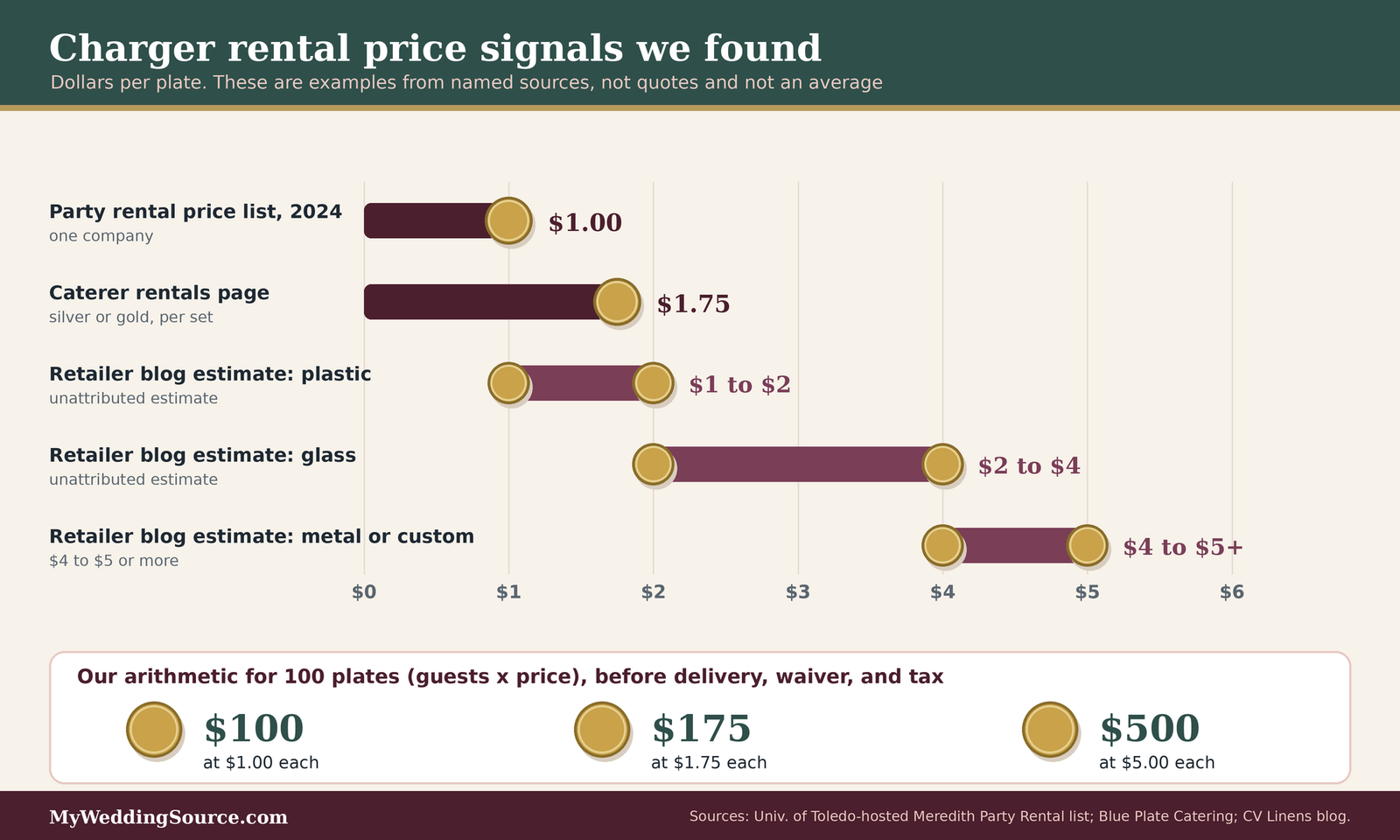
Wedding charger plates are a styling choice, not a requirement. The rental prices we found for the plates themselves were low, from about one dollar to a little under two dollars per plate on two rental price lists and a broader estimate of one to five dollars on a retailer blog, so the surprises usually come from the extras: delivery, damage rules, cleaning expectations, and minimum orders. Before you commit, confirm four things in writing: the per-plate price and spare count, who cleans the plates before they go back, what the venue or caterer lets you bring in, and whether your table surface and layout can hold them. If you are setting up over grass or a temporary floor, use the checklist near the end of this guide.
What wedding charger plates are and how they are used
Wedding charger plates show up in photos of nearly every polished reception table, yet many couples have never seen one used at a real dinner until their own. A short, plain explanation of what they do is the best starting point, because every later decision, from cost to cleaning to venue rules, follows from how the plate behaves on the table.
A charger is a base, not a dish
An etiquette writer describes a charger as an oversized plate set beneath the dinner plate, and notes it is also called an underplate or a service plate. The key idea is in that last name: it serves the plate that goes on top of it. The Knot makes the same point in its formal place-setting guidance, describing the charger as a decorative base that guests do not eat from and that holds the place for the dinner plate.
What it sits on and what sits on it
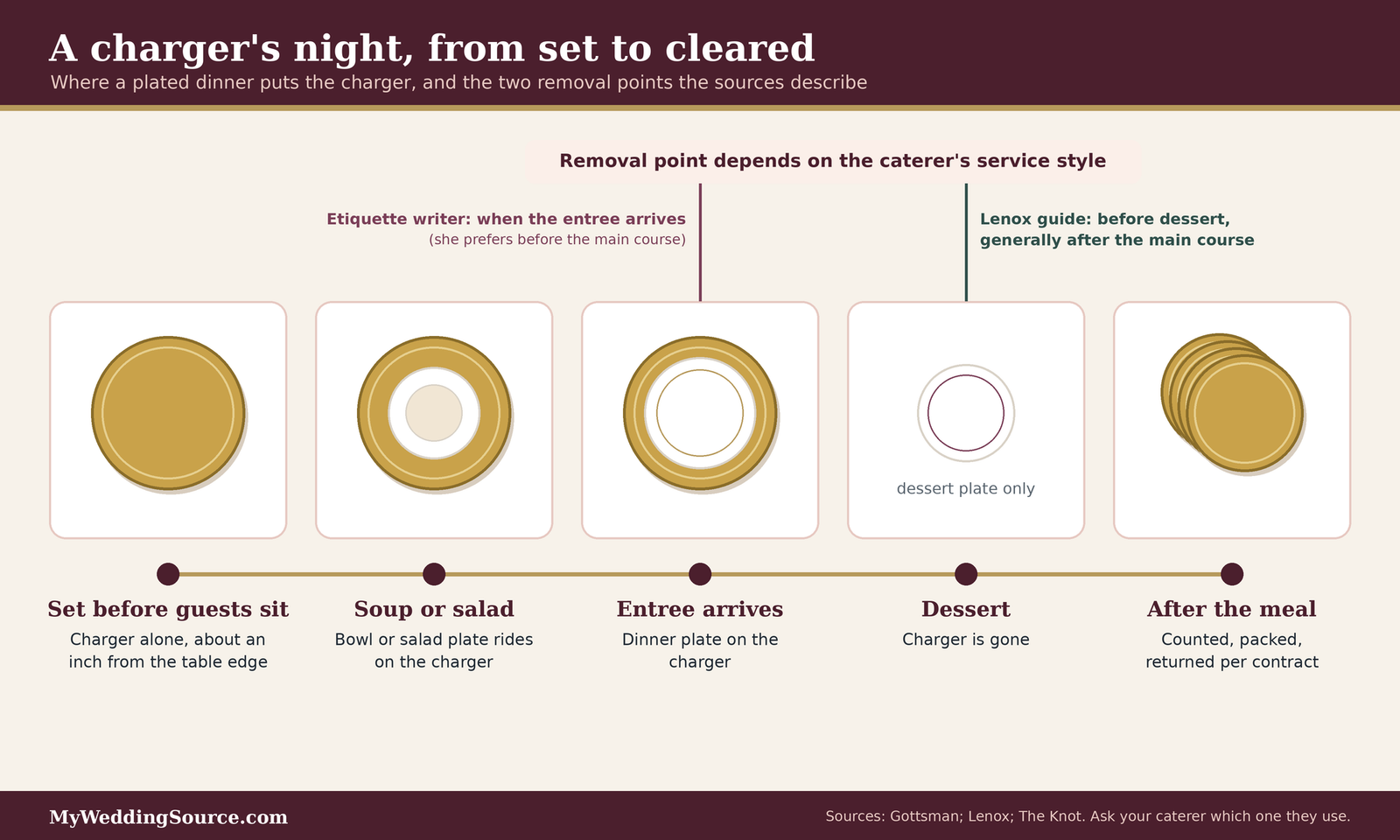
At a plated dinner the charger is usually already on the table when guests sit down, and servers set each course on top of it. Bowls for soup, salad plates, and the dinner plate can all go on the charger in turn. A retailer’s guide to chargers (Lenox, which sells dinnerware, so read it as a seller’s view) adds that the charger should be set before guests arrive, about an inch from the table edge and centered with the chair, and that food should not be served directly on it.
What it is not
A charger is not a serving platter and not a plate for eating. That matters for the logistics later in this guide, because a plate that never touches food is easier to keep clean, but it still gets handled, stacked, and wiped, and it can still chip.
Why couples add them
The reasons given in the sources we read are a mix of practical and visual. The etiquette writer lists three: the charger can protect the tablecloth or table from heat, it can keep rings and other marks from damaging the table surface, and it adds decoration. She also notes that some hosts monogram their chargers.
The visual reason
Wedding charger plates add a frame of color or metal around each place setting, which is why the retailer and caterer pages we read list them in finishes such as gold, silver, and bronze, as well as glass. If your plates are plain white and your linens are neutral, a charger is one of the few places where a single inexpensive item changes how the whole table reads in photographs.
The practical reason, with a caution
Protecting a surface sounds important, but at most receptions the surface is already covered by a rented or venue-provided tablecloth, so the practical benefit is smaller than the visual one. We did not find an independent test showing that chargers protect linens better than a plain setting does, so treat the protective argument as the etiquette writer’s explanation, not as measured evidence.
When wedding charger plates leave the table
Sources agree that the charger is removed during the meal, not at the end of the night, but they disagree on the exact moment, and that is useful to know before you brief your caterer.
Two common moments for removal
The etiquette writer says soup and salad can be eaten with the charger in place and that it is usually removed when the entrée arrives, though she personally prefers taking it away before the main course. The Lenox guide says to take chargers off before dessert, generally after the main course. In other words, there is no single rule, and the caterer’s service style decides.
Why this affects your plan
Whoever clears the wedding charger plates needs somewhere to put them, and a stack of plates needs a bus tub or a cart. That is an extra handling step for servers during a busy moment, so it is a fair question for your caterer. Our guide to wedding catering service planning covers how service styles change the work for staff, and the wedding table settings guide shows how the rest of the place setting is arranged around the plate.
Do you need wedding charger plates at all?
Wedding charger plates are one of the easiest items to cut from a rental order and one of the easiest to add on a whim, so it helps to decide on purpose. There is no etiquette rule that makes them mandatory, and a casual search of wedding forums finds plenty of couples who skipped them and were happy with the result.
Reasons to rent them
If the reasons below fit your wedding, wedding charger plates may earn their place on the order sheet.
Your plates are plain and your table is simple
When the dinner plate is white and the tablecloth is a solid color, a charger adds contrast without adding a centerpiece. This is the situation where the plates are doing the most visual work per dollar, and it is the case catalogs show most often.
You are serving a multi-course plated dinner
Wedding charger plates make the most sense when courses arrive one after another, because the plate holds the place at the table between courses and the table never looks empty. For a single-plate buffet meal, the case is weaker, and we cover that in the edge cases below.
Reasons to skip them
Skipping is a legitimate, budget-friendly choice, and several couples in a public wedding forum thread, which is opinion and not professional guidance, called chargers unnecessary or an avoidable budget hit. One of them reported that their caterer rented chargers for about fifty dollars for 120 guests, which shows both how small the line item can be and how much it can vary by caterer.
Money and handling
Even at a low price per plate, wedding charger plates add a delivery weight, a count to reconcile on return, and a clearing step during dinner. If your budget is tight and your plates already look good, the effort may not be worth it. Our wedding budget guide can help you decide where a small styling expense ranks against bigger ones.
Table space
Wedding charger plates are wider than dinner plates, so they use more of each guest’s share of the table. If your tables are already crowded with centerpieces, menus, glasses, and candles, a charger can push everything toward the middle. The fit section below puts numbers on this.
Ways to get a similar look for less
If you like the idea of a framed place setting but not the rental line item, there are a few alternatives, all of which are options, not recommendations.
Let the plate do the work
A dinner plate with a colored rim or pattern can make a charger redundant. Compare the two choices instead of assuming a charger is the cheaper way to add a frame. One rental cost article we read lists a white plate with a gold rim at one dollar and a plain white plate at fifty to sixty cents, though it does not name where those figures came from.
Use a napkin, runner, or menu as the accent
A folded napkin, a menu card, or a table runner can add a layer of color on the table without needing a plate under each setting. Those items have their own costs and constraints, so see our wedding centerpieces guide and our wedding signage guide before you add more items to a crowded table.
What wedding charger plates cost to rent
The per-plate price of wedding charger plates is the easy part. We looked for published rental prices and found a few, but they are not a market survey, and none of them tells you what your local company will charge. Use them as a sanity check and nothing more.
Published price signals, with dates and limits
The table below collects the prices we found, who published them, and how much weight to put on each. We did not invent a range, and we did not average different sources together, because the sources describe different companies, different years, and sometimes different things.
| Source | What it says | How to read it |
|---|---|---|
| University purchasing price list from a party rental company (marked 2024) | Charger plates, one dollar each, in the china and glass section | One company’s list, two years old, subject to change per its own terms |
| Blue Plate Catering rentals page | Silver or gold charger plates, one dollar seventy-five cents per set | A caterer’s rental price, offered with catering orders; the page shows no date |
| CV Linens blog (published January 2025, updated July 2026) | Estimates of one to five dollars per plate: plastic one to two, glass two to four, metal or custom four to five or more | A seller’s blog estimate, not tied to a rental price list or study |
| A caterer’s rental, reported by a commenter in a wedding forum thread | About fifty dollars for 120 guests | One anecdote; unverified |
How to use the table
Read the first two rows as examples of what two real companies listed, the third as a rough outer range, and the fourth as a reminder that prices differ by supplier. Do not treat any row as what you will pay. Ask your own rental company for a written quote that lists the plate count, the finish, and the date of the quote.
What we could not find
We did not find a government or industry survey of charger rental prices, so there is no verified national average, and we are not offering one. If you see a headline figure elsewhere, check whether it names its source and its year.
What drives the price
The same plate can cost different amounts depending on what surrounds the order. The sources we read point to a handful of consistent factors.
Material and design
The CV Linens blog says plastic is the cheapest, with glass, metal, and specialty designs costing more. A rental cost article we read gives a similar logic for dishes in general, with more complex designs costing more and standard white plates costing less than cream or gold-rimmed ones.
Quantity, minimums, and who supplies the plates
The same rental cost article notes that guest count drives the number of items and that some rental companies set minimum orders, which can make renting unwise for a small gathering. It also notes that venues and caterers handle dinnerware differently: some provide it free or for a service fee, others charge per head. If your caterer or venue already includes dishes, ask whether wedding charger plates are included, because that can change the math entirely.
A worked estimate for your own order
Here is arithmetic you can adapt, labeled plainly as our own estimate and not a quote.
Cost check: illustrative arithmetic, not a quote
Using the two dollar figures from the company price lists above, one dollar and one dollar seventy-five cents per plate, a table of 100 guests would be about 100 dollars and 175 dollars before extras. At the outer end of the blog estimate, five dollars per plate, the same 100 plates would be about 500 dollars. Add the spares your rental company recommends, and add delivery, any damage waiver, and tax if they apply. One rental company’s published waiver, described below, is 4 percent of the whole order, so on a 175 dollar plate order the waiver alone would be about 7 dollars, though the waiver applies to the entire order and not to plates alone. Your real number depends on your quote.
Start with the guest count and add spares
Count the guests who will be seated for the plated meal, then add the vendors who will eat with you if your caterer sets a place for them, and finally add spares. A rental cost article suggests renting at least ten extra pieces of dishware, flatware, and drinkware. Whether ten extra wedding charger plates are right for you is a question for your rental company, but it is a helpful floor to ask about.
Check the arithmetic against your catering contract
Your caterer’s final count and the rental order should match. If your guest count drops after final counts are locked, some rental companies allow additions but not reductions, as one published policy states, so confirm the deadline before you lock the order.
Extras beyond the per-plate price
The per-plate price is rarely the whole bill. Each of the extras below turned up in at least one source, but none of them has a standard amount, so you will need to ask.
Delivery, setup, and pickup
The CV Linens blog and the university-hosted price list both mention delivery and pickup fees without giving amounts. The price list adds that its rates assume ground-floor service and that setup and teardown cost extra if arranged ahead. If your venue is up stairs, down a long path, or across a lawn, say so when you ask for the quote.
Deposits, waivers, and replacement cost
Many rental companies require a refundable damage deposit that is returned after inspection, according to the CV Linens blog. Some sell a damage waiver instead, and some charge replacement cost for anything missing or unusable. We cover those policies in the next section on cleaning and breakage, and our companion guide on wedding rental damage waivers goes deeper.
Sizes, materials, and how wedding charger plates fit on your tables
Wedding charger plates are wider than dinner plates, which is the whole point, and that extra width has a cost in table space. Before you choose a finish, check that the size you like will actually sit comfortably at the tables you have.
Size and the one-inch rule of thumb
The Lenox guide says most wedding charger plates measure about 11 to 14 inches across and recommends 12 inches or more so the charger frames the dishes on top. Because Lenox sells dinnerware, treat that as a seller’s rule of thumb. Rental catalogs list the exact diameter of each style, so ask for that number and not just “standard.”
Check the diameter against your dinner plate
A charger only reads as a frame if it extends visibly past the dinner plate on every side. If your rental dinner plates are on the larger side, a small charger will look like a coaster. Ask for both diameters and compare them, or ask the rental company to show you a place setting.
Place settings are not just the plate
Glasses, flatware, a bread plate, and a napkin all take room. Our wedding table settings guide walks through the usual layout, and the charger’s width is the number that affects all of it. The Knot notes that utensils work from the outside in and leave the table with each course, so your caterer’s menu decides how many utensils sit beside the plate at the start.
Materials and what they mean for handling
Retail and etiquette sources list the same few materials. The etiquette writer names porcelain, painted metallic resin, and wicker. The Lenox guide lists glass, porcelain or ceramic, plastic, and wood or natural fiber, plus metallic finishes in gold, silver, and bronze. The CV Linens blog prices plastic, glass, and metal or custom styles separately.
Plastic and resin
Plastic is the lowest price on the blog’s estimate, and for outdoor or casual events it may be the easiest to handle. The trade-off is appearance, and we did not find a test comparing how finishes wear, so ask the rental company how worn its stock is and ask to see a sample.
Glass, ceramic, and metal
Glass and ceramic plates can chip or crack if stacked carelessly, and a chip can cost you under a replacement-cost policy. Metallic finishes can wear at the rim. If a finish can be scratched, ask whether the rental company charges for wear. The Party Rental Ltd. damage policy described later lists scratched flatware among the minor damage it covers under its waiver, which shows that vendors treat wear differently from breakage.
Fit at the table: our arithmetic
This is where wedding charger plates can quietly cause trouble, because a table that looks big in a floor plan can feel crowded once every guest has a 12-inch plate.
A rental company’s published seating guide says to allow 24 to 30 inches of space per guest for comfortable seating, and notes that tabletop items such as chargers, florals, candles, and decor can increase the footprint and may require wider tables. The same guide lists a 60-inch round as seating 8 to 10, and a 48-inch round as seating 6 to 8.
The geometry, with assumptions spelled out
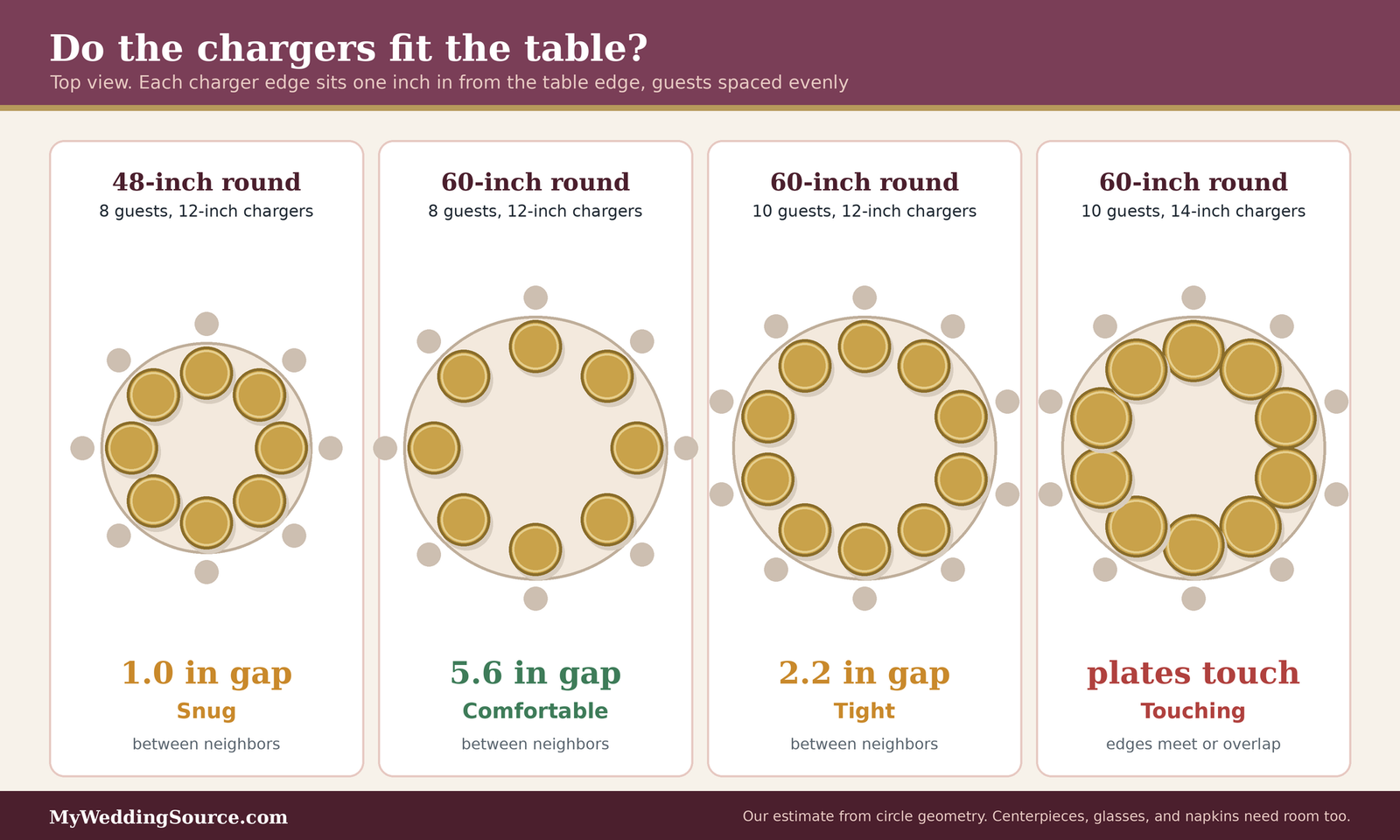
Using the Lenox suggestion of setting the plate about an inch from the table edge, we worked out how much clear space is left between neighboring chargers on a round table. The assumptions are simple: the edge of each charger sits one inch in from the table edge, the guests are spaced evenly, and nothing else is on the table. The gap is measured in a straight line between plate edges. It is our estimate, not a measurement taken at a real table.
On a 60-inch round with 8 guests and 12-inch chargers, the gap between neighboring plates is about 5.6 inches. With 10 guests it shrinks to about 2.2 inches. With 14-inch chargers and 10 guests, neighboring plates would touch or overlap slightly. On a 48-inch round with 8 guests and 12-inch chargers, the gap is about 1 inch.
What to do with those numbers
Treat a gap of about two inches as the point where it is worth asking whether you want wedding charger plates at all, because dinner plates, glasses, and napkins also need room. If your tables are packed to the top of the rental range, consider a smaller charger, fewer guests per table, or no chargers. Our guide on wedding table shapes explains how round and rectangular tables seat different numbers, and our wedding seating chart guide helps you plan the seat count per table before you finalize the rental order.
Counting plates and spares
The rule for any rental is to count plates against what is on your contract, not what you remember ordering.
Build the count in three lines
Start with your final seated count, add vendor meals if the caterer sets places for them, and add spares. Keep those three numbers separate in your notes, so when you receive the delivery you can check each against the packing list.
Why spares matter
One rental cost article suggests ordering at least ten extra pieces of each item. A chip during setup or a late-added guest is the situation spares are for. Ask what the rental company charges for unused spares, since most price by the piece for the rental period.
Cleaning, returns, and breakage for rented wedding charger plates
Cleaning is where couples are most often surprised, because rental policies differ and the plates look clean even when they are not. The sources we read do not describe a single standard, so the right move is to ask what your company expects and write it down.
Who cleans what, and what “returned clean” can mean
Published rental terms show the range. The party rental price list we found says items are delivered “inspected, clean, and ready for use” and lists no separate rinse fee. A linen rental company’s help page asks customers to remove food, flower petals, and other debris before returning tablecloths. The CV Linens blog says cleaning may be included or you may need to clean the plates before returning them.
Ask for the cleaning rule in writing
Ask whether the company expects plates returned rinsed, scraped, or untouched, and whether they will charge a cleaning fee if the plates come back dirty. Ask whether the policy changes for crates, for example whether plates must be returned in the same crates and with the same dividers they arrived in.
Decide who will do it on the night
If the plates need rinsing, someone has to do it after a long evening. Your caterer, your venue’s staff, a family member, or a hired helper may do it. Our companion guide on wedding rental return logistics goes through the handoff, and our wedding vendor timeline shows where cleanup and pickup fit.
Safe handling basics when plates need washing
Wedding charger plates are not meant to touch food, but they do get handled with food-stained hands and stacked after the meal, and some are used under soup bowls that leak. If your rental company expects you to wash them, here are the basics from a government fact sheet, not a full food-safety program.
What a state health department fact sheet says
A South Dakota Department of Health fact sheet on manual dishwashing describes five steps: pre-rinse to remove food, wash in dishwashing detergent in hot water, rinse in clean warm water, sanitize, and air-dry. It says to replace the wash, rinse, and sanitizer water often, to avoid towel-drying, and gives sanitizer strengths such as at least 50 parts per million for chlorine and at least 200 parts per million for quaternary ammonium for one minute, or as the product label directs.
How to apply it, and when not to
This sheet is written for food service operators, and your rental company may have different expectations. For a decorative plate that never held food, a thorough wash and air-dry may be enough, but ask the company first. Do not use a cleaning product on an unusual finish, such as a metallic coating or wood, without checking with the company, because it may damage the plate and leave you with a replacement charge. We are not offering food-safety or health advice, and your local health department has the final say.
Damage waivers and replacement cost
Policies for broken or missing plates fall into a few patterns in the documents we read, and the difference between them is worth more than the price of the plates.
Three policy patterns
The university-hosted party rental price list says full replacement cost applies to any item rendered unusable or missing on return. The linen rental help page says you pay replacement cost for missing or damaged items but not for stains from normal use. Party Rental Ltd. describes a different model: a damage waiver fee of 4 percent of the total order, which it says is taxable, non-refundable, and cannot be waived. Its page says the waiver covers minor damage from normal wear, such as broken glassware or chinaware, stained linen, dented trays, or scratched flatware, and excludes theft or missing equipment, vandalism or deliberate misuse, and damage from leaving items outdoors in bad weather. Excluded items are billed at replacement cost.
Why the weather exclusion matters outdoors
That last exclusion is easy to miss. If your reception is outdoors and plates are left out overnight or in rain before the vendor picks them up, a waiver like the one above may not cover what happens. We cannot say how other companies treat it, so ask. Our wedding insurance guide explains how event insurance differs from a rental waiver, and we do not give insurance or legal advice.
Return day
The return step is where deposits are decided, so it is worth planning like a small event.
Know the deadline and the late charge
The university-hosted price list says items are due back by 5:00 pm on the return date and that late items incur an additional day’s charge. Rental periods are described by the CV Linens blog as ranging from 24 hours to multiple days. Your contract has the real deadline, so put it on the vendor timeline.
Count before you hand them over
If you are returning plates yourself, count them against the packing list before you hand them over, and photograph the crates. If the company picks up from the venue, ask whether the venue staff will sign for the count. Keep the paperwork until the deposit is refunded or the final invoice is paid.
Venue and caterer rules that affect wedding charger plates
Your venue and caterer can change your wedding charger plates plan, sometimes before you have chosen a color. The venue may supply tableware, require approved vendors, restrict what you can bring in, or charge for cleanup. This section covers the rules to look for.
Who is allowed to supply the plates
Venues differ widely on rentals, and the sources we read show both ends.
Venues that include tableware
One museum venue’s rentals FAQ says house china, flatware, and glassware are included, along with house tables, chairs, and tablescapes, while linens and florals are excluded. If your venue includes dishes, ask whether wedding charger plates are included or can be added, and whether you may bring your own.
Venues that set approved-vendor and insurance rules
A wedding-contract guide from Here Comes The Guide explains that venues set their own rules on outside vendors, with some requiring a preferred or exclusive list and others allowing your own choices. It adds that if outside vendors must carry insurance, the contract should say when you must submit proof of coverage. The museum FAQ shows what that can look like in practice: vendors must carry general liability and employer’s liability insurance, each at one million dollars, provided 60 days before the event. We do not know whether a rental company’s insurance requirements apply to a charger-only order, so ask.
Contract clauses to look for
A venue contract is where the rules are written down. The clauses below turned up in the contract guide and the venue FAQs we read.
Access times, cleanup, and damage
The contract guide says to confirm your access start and end times for setup and cleanup and the deadline for vacating, since venues may charge extra if setup and breakdown run over. It also says cleaning fees may be charged separately and that you are generally responsible for damage during your event, including damage caused by guests and vendors. If a rental company must deliver and collect plates, make sure its pickup window fits inside the venue’s access times.
Decor restrictions that touch the table
The contract guide says house rules may limit decor such as open flames, and the museum FAQ prohibits confetti, glitter, and open flames. That matters because the etiquette writer notes a charger can hold a votive candle. If you plan to put a candle, petals, or glitter on or near a charger, check whether the venue allows it. Our wedding lighting guide covers lighting choices for tables, and our wedding venue questions list is a good place to start the conversation.
The caterer’s role
For a plated dinner, the people who handle your wedding charger plates most are the servers. Your caterer decides when they come off and what happens to them.
Brief them early
Ask whether the caterer prefers to clear chargers before the entrée or with the dinner plates, as the two sources we read describe, and whether the staff has a place to stack them. If your caterer provides dishes, they may prefer to supply wedding charger plates too, so compare their price with the rental company’s. Our wedding catering guide and catering service planning guide give context for these conversations.
Allergy and dietary service
Wedding charger plates do not hold food, so they do not change allergy practices on their own, but a crowded table can make careful plate delivery harder. If you have guests with allergies or special diets, raise table layout with your caterer. Our wedding dietary restrictions guide covers how to organize that information.
Grass, tent, and subfloor checklist for tables with wedding charger plates
This is the checklist the plan asked for. It exists because many receptions with rented wedding charger plates are held in tents or on lawns, where the ground under the tables can shift, tilt, or soften. We found no source that tests charger plates on grass, so we are not claiming that chargers slide or fall on uneven ground. What the sources do say is that the subsurface matters for any flooring, and an unsteady table is a risk for any place setting. The checklist applies that general guidance to a charger order, and where an item is our reasoning, we say so.
Why the ground matters
An outdoor table can be level in a floor plan and tilted in real life.
What the vendor sources say
A tent-flooring retailer, GreatMats, advises considering the subsurface first because it must support the flooring, notes that many products need a hard, flat surface while some can go over irregular ground such as grass, and says to budget for a subfloor if your product requires one. A rental company, Curated Events, advises walking the site to note slopes and drainage, clearing debris, smoothing high and low spots, and notes that a framed substructure or adjustable pedestals can level a surface on minor slopes. Both are vendor sources with products to sell, and neither gives slope limits or independent test data.
What that means for plates
A slightly rocking table is a nuisance for glassware and place settings in general, and rented plates that must be returned unbroken make that nuisance more expensive. This is our reasoning, not a tested result. If your reception is on grass or a temporary floor, ask your tent and flooring vendor how level the surface will be under the tables, in writing.
The checklist
Use the table below as a working list. Each item is a question to settle, not a rule. Copy it into your planning notes and fill in the answers.
| Item | What to settle | Who to ask |
|---|---|---|
| Site walk | Note slopes, soft spots, drainage paths, and where the tables will stand (a rental company, Curated Events, advises a walk before placing anything) | Venue, tent vendor |
| Subsurface | Is the ground firm, or does it need a base or subfloor, and is that in the budget? (GreatMats advises considering the subsurface first and budgeting for a subfloor if needed) | Flooring vendor |
| Leveling method | Will the floor be framed, on adjustable pedestals, or laid directly on grass, and who is responsible for leveling it? | Flooring vendor |
| Table check | Who checks that each table is steady before the cloth and plates go on? | Rental company, planner |
| Weight under tables | Are heavy items such as bars and stages given reinforced areas, and are the guest tables away from them? (Curated Events says to reinforce under heavy loads) | Flooring vendor |
| Rain plan | Where do tables go if rain is forecast, and what happens to plates left outside? (Party Rental Ltd. excludes damage from leaving items outdoors in bad weather from its waiver) | Tent vendor, rental company |
| Delivery path | Can the delivery team reach the tables, and will their carts cross the flooring? | Rental company, venue |
| Overnight storage | If plates are set the night before, where are they kept, and who is responsible for them? | Rental company, venue |
| Pickup window | Does the pickup time fit the venue’s access end time and any ground restrictions? | Rental company, venue |
| Written answers | Are the answers above in the contract or an email you can find later? | You |
How to use it
Go through the list with your planner or day-of coordinator, and put the answers beside the rental contract. Items that no one can answer are the ones to raise first. For flooring over grass for dancing, see our companion guide on wedding dance floor rental over grass, which covers a different flooring job with similar ground-preparation questions.
What to do if the answer is “we will see on the day”
That is not a plan. Ask who has the authority to move a table, add shims, or change the layout on the day, and ask what the cost would be. Our outdoor wedding venues guide and outdoor wedding infrastructure checklist cover broader site planning for lawns and tents.
Questions for the tent and flooring vendor
These are short questions you can send in one email.
About the surface
Ask what the surface will be under the tables, how level it will be, whether it is the same under every table, and what the vendor does if a table is not steady. Ask whether guest tables will sit on the flooring or beside it.
About the weather
Ask what happens to the floor and the tables in rain, how long the ground takes to dry, and where plates should be stored if the setup is delayed. Ask whether the vendor has a rain plan and what it costs.
Edge cases: buffets, small weddings, and other situations
Most advice about wedding charger plates assumes a seated, plated dinner at round tables. Plenty of weddings are not that, and the questions change.
Buffets and family-style service
When guests serve themselves or share platters, the logic of a charger shifts.
Buffets
The etiquette writer describes the charger as a base that is removed before or with the main course, and the Knot describes servers adding courses on top of it. At a buffet there are no servers setting courses, so the charger has no job to do between courses, and guests carrying a dinner plate to the buffet will leave the charger behind. A reasonable choice is to skip them, or to ask your caterer how they handle the plates. A wedding forum thread we read mentioned buffet chargers as a question without a clear answer, so there is no consensus to rely on.
Family-style service
With shared platters on the table, a charger can add to crowding, because the platters need room too. If you are considering family-style service, that is a conversation to have with your caterer. Ask them how many platters will be on each table and whether the chargers will still fit, and use the fit arithmetic above as a starting point.
Small guest counts and minimum orders
Small weddings can be harder to price than large ones.
Minimums
One rental cost article notes that some rental companies have minimum order quantities that can make renting unwise for small gatherings, and the CV Linens blog says small gatherings may pay more per plate. If you have 20 guests and a company requires a larger minimum, you may be better off buying a few wedding charger plates or borrowing from someone.
Buying instead of renting
CV Linens, which sells chargers, says buying may be a better investment for reusable items and lists purchase prices of as low as two dollars per plate, which is a claim from a seller and not a verified market price. Buying means you own the plates afterward, and you will need to store, resell, or donate them. If you buy, remember that you will also be responsible for cleaning and for any chips before the wedding.
Disposable, plastic, and mixed settings
Some weddings use disposable or plastic dishes, and wedding charger plates can still be part of that.
Disposable dishes
Blue Plate Catering’s rentals page lists fancy disposables for weddings at two dollars per guest alongside china, flatware, and stemware sets at five to twelve dollars. Those are the caterer’s figures for its own rentals. If you are using disposables, a charger can still make the setting look more formal, but you would be adding a rental on top of a disposable plate. Ask whether it is worth it.
Mixed settings
If you have a mix of formal and casual tables, for example a head table with full china and guest tables with simpler plates, ask whether wedding charger plates should be used throughout or only at certain tables. A consistent look usually reads better in photographs, but uneven settings are fine if you plan them on purpose.
Guests who need extra room or reach
Not every guest uses a table the same way.
Guests with limited reach or mobility
A wide charger moves the dinner plate and the glassware slightly farther from the guest. For guests who use a wheelchair or who have limited reach, a crowded table can be harder to use. See our seating guide for guests who cannot stand for long periods for broader seating considerations, and talk to your caterer about whether an accessible table can be set without chargers.
Children’s tables
If children will be seated, a smaller or no charger can leave more room on the table. This is our suggestion, not a rule, and it is easy to decide at the order stage.
A timeline for deciding on wedding charger plates
Wedding charger plates are a small decision, and a small decision still benefits from a deadline. The sequence below uses the timing advice we found and our own reasoning, and it is meant as a plan to adapt.
Months before the wedding
The rental cost article we read suggests renting at least two months ahead and requesting three to six months ahead during peak months, which it gives as April to June and September to October. That is one writer’s advice, so ask your own company about its calendar.
When to decide whether to use them
Decide whether you want wedding charger plates when you decide on your rental order for tables, chairs, and linens. Our wedding rental planning checklist puts that order in context, and our lounge furniture rentals guide covers another rental category that often shares a delivery.
When to request quotes
Ask for at least two quotes once you know the finish and the approximate guest count. Compare the plate price, spares, delivery, damage rules, and return terms, not just the plate price.
The weeks before
This is where the quote becomes an order and the details lock in.
Final counts and payment
The university-hosted price list says payment in full and final counts are due 10 days before delivery or pickup, that later additions may be allowed if available, and that reductions are not. Other companies will differ, so ask for the exact dates. Put final-count and payment deadlines on your calendar.
Cancellation terms
The same price list says a refund of half the deposit applies if you cancel more than 30 days before delivery, 25 percent if you cancel 10 to 30 days before, and full payment is due if you cancel within 10 days. Terms like these are specific to one company, so read yours, and if your plans could change, ask what flexibility you have.
The week of
By this point the work is checking and confirming. Our wedding week checklist has a broader list.
Confirm the handoffs
Confirm the delivery time, who will receive the delivery, who will count the plates, who will clear them during dinner, and who will pack them afterward. Put each name next to the task.
Brief the people who will touch them
Tell the caterer or venue staff when you want the wedding charger plates cleared, where to stack them, and how to pack them for return. Share the cleaning rule and the return deadline so nobody has to guess.
Questions to ask before you commit to wedding charger plates
Questions are cheap, and the answers are the part you will want in writing.
Questions to ask before you sign
- What is the per-plate price, the diameter, and the finish, and what date is the quote valid through?
- Is there a minimum order, and how many spares do you recommend?
- Are delivery, setup, pickup, and any stair or distance charges included?
- What happens to a chipped, cracked, scratched, or missing plate: replacement cost, a deposit, or a damage waiver, and what does the waiver exclude?
- Do I need to clean or rinse the plates before return, and is there a fee if I do not?
- When are final counts due, and can I reduce the count?
- Does my venue or caterer allow outside rentals, and do you need to provide proof of insurance?
To the rental company
These questions are about the plates and the paperwork.
About the plates
Ask for diameter, finish, material, and the condition of the stock. Ask to see a sample, or a photograph of a table set with the plates, so you can check the look against your dinner plates and linens.
About the policy
Ask for the damage, cleaning, return, cancellation, and late policies in writing, along with the final-count deadline. If the company has a damage waiver, ask for its exclusions in writing, and see our guide to wedding vendor contracts for how to read the fine print.
To the venue and caterer
These questions are about the rules of the place and the people on the day.
About the venue
Ask whether outside rentals are allowed, whether approved vendors are required, whether the rental company needs insurance, what the access times are, and whether open flames or other decor are restricted. Our wedding vendor due diligence checklist can help you check a vendor before you book.
About the caterer
Ask whether the caterer prefers to supply the wedding charger plates, when the staff will clear them, where they will stack them, and who will rinse or pack them. If the caterer provides dishes, ask whether wedding charger plates are part of that price.
FAQ: wedding charger plates
Short answers to the questions couples ask most. They reflect the sources in this guide, and your rental company, venue, and caterer have the final say.
Basics
Do I need wedding charger plates at a wedding?
No. They are decorative and optional. An etiquette writer says a charger protects the table and adds decoration, but a covered table and a nicely rimmed dinner plate can look finished without one. Decide based on your plates, your budget, and how much room your tables have.
When are wedding charger plates taken off the table?
It depends on the service. One etiquette writer says the charger is usually removed when the entrée arrives, though she prefers before the main course, and a retailer guide says before dessert, generally after the main course. Ask your caterer when they plan to clear them.
Can food go directly on a charger?
No. A charger is a decorative base, not a serving dish, and guidance from both a dinnerware retailer and an etiquette writer says not to serve food on it. A dinner plate, bowl, or napkin goes on top. Ask your caterer to confirm how they plan each course.
Cost and rental terms
How much do wedding charger plates cost to rent?
We found one dollar each on a 2024 party rental price list, one dollar seventy-five cents per set at a caterer, and a retailer blog estimating one to five dollars. Those are examples, not an average. Ask your own company for a written quote that includes delivery, spares, and damage terms.
What fees come with renting wedding charger plates besides the price per plate?
Common extras in the sources include delivery and pickup, a refundable damage deposit or a percentage-based damage waiver, replacement cost for missing items, and late charges. None of the sources gave a standard amount, so ask your company to itemize each one before you pay a deposit.
Do I have to clean rented charger plates before returning them?
It depends on the company. One price list says items are delivered clean and lists no rinse fee, a linen company asks you to remove debris before return, and a retailer blog says cleaning may be included or you may need to do it. Ask for the rule in writing.
Venues and table setup
Can my venue stop me from bringing my own wedding charger plates?
Possibly. A venue contract guide says venues set their own rules on outside vendors, and some require a preferred or exclusive list. A museum venue includes house china and flatware, so ask whether wedding charger plates are included, allowed, or restricted, and get the answer in your contract.
Do wedding charger plates work on a tent or grass floor?
We found no source testing wedding charger plates on grass. Vendor guidance does say the subsurface and levelness matter for flooring, and an unsteady table is a risk for any setting. Ask your tent vendor how level the tables will be, and use the checklist in this guide.
Your next steps
Decide whether to rent
Check your plates and your tables
Hold up a sample or a photograph of your dinner plate and linen and ask whether a charger improves the setting. Then use the fit arithmetic above to check your table sizes and seat counts. If either answer is no, skip the rental and put the money elsewhere. Our wedding decor guide and DIY decor guide have other ways to add polish.
Compare two written quotes
Ask two suppliers for quotes with the same plate count, finish, delivery location, and dates, and compare damage, cleaning, and return terms side by side. Your caterer may be one of them.
Lock in the details
Put the rules in writing
Confirm the quote date, plate count, spares, diameter, damage terms, cleaning rule, return deadline, and final-count date in the contract or an email. For the wider plan, use our wedding rental planning checklist and, for who does what on the day, our wedding vendor timeline.
Plan the day-of handoffs
Name the person who receives the delivery, the person who counts, the person who tells the servers when to clear, and the person who packs the plates. If the reception is outdoors, add the person who checks that the tables are steady before the plates go on.
Sources & methodology
How we built this guide
What we relied on
This guide draws on published rental price lists and policies, a state health department fact sheet on manual dishwashing, venue contract and rental guidance, retailer and etiquette articles about charger plates, and vendor guidance on preparing ground and flooring for outdoor events. We fetched each page listed below during November 2026 and report what it said when we read it. Prices, policies, and terms change, so verify them before you rely on them. Where a statement comes from a retailer or rental company, we say so, because sellers describe their own products and habits. The table-fit figures and the cost examples are our own arithmetic, they are estimates, and they rest on the stated assumptions.
What we did not do
We did not collect quotes, test plates, visit venues, or measure tables, and we did not find an independent national price average for charger rentals, so we do not offer one. We do not give legal, insurance, financial, or food-safety advice.
Source list
Government sources
- South Dakota Department of Health, Manual dish washing (fact sheet): https://doh.sd.gov/media/lsjf4mmb/manual-dish-washing.pdf
Venue, contract, and rental-policy sources
- Here Comes The Guide, Wedding venue contracts: https://www.herecomestheguide.com/wedding-ideas/wedding-venue-contracts
- Crystal Bridges Museum of American Art, Event rentals FAQ: https://crystalbridges.org/event-rentals/rentals-faq
- Meredith Party Rental, 2024 price list and policies (hosted by the University of Toledo purchasing office): https://www.utoledo.edu/depts/supplychain/purchasing/pdfs/Meredith%20Party%20Rental%20Price%202024.pdf
- Party Rental Ltd., What happens if I break or misplace something: https://help.partyrentalltd.com/en_US/payment-and-policies/what-happens-if-i-break-or-misplace-something
- Party Rental Ltd., How many people can sit at a table: https://help.partyrentalltd.com/en_US/how-many-people-can-sit-at-a-table
- Premier Table Linens, What happens if something has been lost or damaged on my rental: https://help.premiertablelinens.com/article/what-happens-if-something-has-been-lost-or-damaged-on-my-rental
- Blue Plate Catering, Rentals: https://www.blueplatecatering.com/rentals/
Charger plate, etiquette, and cost sources
- Diane Gottsman, What is a charger plate and how is it used: https://dianegottsman.com/2022/11/14/what-is-a-charger-plate-and-how-is-it-used/
- The Knot, Put together a formal place setting for your wedding reception: https://www.theknot.com/content/put-together-a-formal-place-setting-for-your-wedding-reception
- Lenox, What is a charger plate: https://www.lenox.com/blogs/buying-guide/what-is-a-charger-plate
- CV Linens, How much does it cost to rent charger plates (published January 2025, updated July 2026): https://www.cvlinens.com/blogs/styling-tips/how-much-does-it-cost-to-rent-charger-plates
- Wedding Frontier, Average cost of renting dishes, glasses, and dinnerware for a wedding (published September 2021, modified November 2023): https://weddingfrontier.com/?p=1281
- WeddingWire community forum, Are charger plates necessary (forum opinion, September 2021): https://www.weddingwire.com/wedding-forums/are-charger-plates-necessary/eb100aa9b1e653c7.html
Ground and flooring sources
- Curated Events, How to prepare flooring for outdoor events (rental company blog): https://curatedevents.com/blog/how-to-prepare-flooring-for-savannah-outdoor-events/
- GreatMats, How to choose the proper tent and event flooring (vendor guide): https://www.greatmats.com/event-flooring/how-to-choose-the-proper-tent-and-event-flooring.php