

A wedding dance floor rental over grass is really two rentals in one: the floor your guests see, and the level, dry base underneath it that makes the floor safe to dance on, so the useful questions are about the ground and the delivery path as much as the surface.
Quick answer
For a wedding dance floor rental over grass, plan on three base requirements: ground that is level and firm enough that panels lock cleanly, a moisture barrier and usually a subfloor between the lawn and the panels, and a clear, wide path from the truck to the spot. Vendors quoted in this guide describe the base as an add-on or a separate line, and the published ranges we found disagree with each other, so treat any single number as a starting point. Ask each company for an all-in quote that names the base, delivery, installation, removal, minimums, and damage terms, then compare the quotes line by line with the grid below. Prices and policies change, so confirm everything in writing.
What a wedding dance floor rental over grass actually includes
When people search for a wedding dance floor rental over grass, they usually expect a single price for a floor. What they receive from a rental company is a bundle of separate decisions: a surface, a base, a delivery, a crew, a rental period, and a set of terms. On a patio or in a ballroom, several of those decisions are made for you. On a lawn, every one of them is open, and each can change the total.
This guide is written for couples, planners, and parents who are comparing quotes for a wedding dance floor rental over grass, whether the lawn is a backyard, a field, or a garden. It does not repeat how large a floor should be, because our wedding dance floor size guide covers that. It focuses on what is different when the ground is soft, sloped, wet, or irrigated, and on how to get quotes you can actually compare.
Why grass changes the job
A lawn is not a floor. It is living turf over soil, and both change from one corner of the yard to the next. An event-equipment seller, Tent and Table, puts it plainly in its outdoor setup advice: grass is unpredictable because soil density varies and hidden dips can stress a floor, and grass also holds moisture, especially overnight. Those two facts explain most of what follows in this guide about a wedding dance floor rental over grass.
Soil, dips, and moisture
Soil that feels firm in the morning may be soft after a sprinkler cycle or a night of dew. A shallow dip you would never notice while walking can sit under a panel seam and, as the same company notes, stress a floor or let panels separate. A wedding dance floor rental over grass has to account for the worst spot under the footprint, not the average.
Why a pad or patio is simpler
Hard surfaces still need checking, since concrete and asphalt can slope slightly for drainage. But they rarely sink, hold water under the panels, or hide a sprinkler head. That is why some vendors price a wedding dance floor rental over grass differently from an indoor install, and why a retailer of LED floors, Backyard Movie Theater, tells customers to ask whether outdoor pricing differs from indoor pricing and whether installation and teardown are included.
What is usually in a quote, and what is often missing
A vendor’s website may list a price per square foot, a price per floor size, or a price per panel. The same wedding dance floor rental over grass can therefore look cheap on one site and expensive on another until you add the pieces that each quote leaves out.
Pieces that tend to be listed
Base rental rates are the most visible piece. One Kansas City rental company, EventWorks Rentals, lists several floor finishes at roughly four dollars per square foot on its dance floor page. Another company lists a 21 foot by 36 foot oak-finish floor at a flat rate that covers up to three days. Those are product rates, and both companies describe installation, delivery, or ground preparation as separate matters.
Pieces that tend to be separate
Delivery, installation, subfloor, damage waiver, cleaning deposit, and removal timing are commonly billed apart from the base rate. On the 21 foot by 36 foot floor just mentioned, the company’s page shows installation as its own charge, a damage waiver applied as a percentage of the order, and a note that extra charges may apply for uneven terrain, long-distance delivery, or after-hours work. Treat each of those as a question for any vendor, not only that one.
The base requirements for a wedding dance floor rental over grass
Rental companies phrase the requirements differently, but the same four ideas appear in nearly every source we read: a flat surface, a firm surface, protection from moisture, and enough room to work. We separate them below because each one has a different fix and a different cost.
Level: the floor can only be as flat as what is under it
Interlocking panels lock only when they sit in the same plane. An online flooring retailer, GreatMats, says that uneven ground makes tiles hard to connect, stresses them, and can make the floor dangerous to dance on. Allied Event Solutions, a Maryland-area rental company, says uneven lawns can cause guest injuries and recommends a professional subfloor on sloped ground.
How much slope is too much
Published tolerances come from vendors, not from a standard, and they differ by product. A flooring company, D and G Flooring, reports that floors with leveling legs can handle slopes up to about four inches over ten feet without a visible tilt, and that anything steeper than about one inch over ten feet needs shimming or leveling legs, which add setup time and cost. Converting those numbers is simple arithmetic: one inch over ten feet is a grade of about eight-tenths of one percent, and four inches over ten feet is about three percent. These are one company’s figures. Ask your vendor what grade its floor tolerates without extra work.
Why leveling shows up as labor
Leveling is hands-on work: checking the ground, shimming, and adding base units where the grade drops. Tent and Table recommends rot-resistant composite shims under the framework to correct minor depressions. An event production company, Production Management One, describes checking the ground on a site walk and then leveling each platform to the surface, using scaffold bases where the grade needs them. Because that is skilled labor, a vendor may charge for it, and a budget for a wedding dance floor rental over grass that ignores it can be too low.
Firm: the ground must not sink or swallow the panels
Level and firm are different. A lawn can be perfectly flat and still be soft enough to let a loaded floor settle. D and G Flooring says soft ground, such as a wet lawn or sand, needs a plywood layer under the dance floor frame to keep it from sinking. GreatMats adds that soft ground, mud, or large bumps make installation harder and can leave the floor uneven.
Why mowed turf helps
GreatMats notes that mowed grass gives a firmer, flatter base than long grass. A lawn service, LawnStarter, advises mowing one to two days before an event. The two pieces of advice come from different businesses with different goals, but they agree on timing: cut the lawn shortly before the crew arrives, not a week earlier.
Why recently watered lawns are risky
LawnStarter also suggests cutting back irrigation about a week before an event so the soil is drier and more tolerant of foot traffic. Backyard Movie Theater says grass can work for its LED floors only if the ground is even, dry, and compact, and warns that soft, muddy, or recently irrigated lawns may need extra prep. If your lawn has an automatic sprinkler system, talk to whoever manages it well before the wedding.
Dry: the moisture barrier and drainage
Even a lawn that feels dry holds moisture. GreatMats says a floor should be fully waterproof because grass holds moisture even under a tent. Tent and Table recommends putting down a heavy-duty vinyl tarp as a moisture barrier before the subfloor or panels. Whether your vendor includes that layer is a fair question, since it is cheap compared with the floor but easy to forget when comparing quotes.
What a barrier does and does not do
A barrier keeps ground moisture away from the underside of panels, which protects wood-based products and the locking joints. It does not fix a dip or stop rain from running onto the floor from the side. For multi-day events or areas prone to heavy rain, Tent and Table suggests raised or sleeper-and-joist systems so water drains underneath instead of pooling on the floor.
Panels that let water through
Some floors are designed to drain. D and G Flooring says polypropylene tiles have holes that let rain and spills pass through, so the surface can dry within minutes of a shower. That is a product claim from a flooring company, and it applies to one type of tile. A wood-look vinyl floor on a plywood base behaves differently, which is why you should ask what happens to your specific floor if it rains.
Room to work: space around the floor
A floor needs extra space around it for the crew and equipment. The oak-finish floor page mentioned earlier says extra space is needed around the floor for access. Tent and Table recommends sloped aluminum or heavy-duty vinyl perimeter trim to reduce trip hazards and keep outer panels from moving sideways.
Edging and transitions
Perimeter trim sits at the boundary between the lawn and the floor, which is where guests step on and off. Ask whether edging is included and whether it is ramped. A tall, abrupt edge in the dark, in heels, is a different experience from a sloped edge.
Clearance for the crew
Panels have to be unloaded and carried to the footprint, assembled in order, and checked. If chairs, lounge sets, a band riser, or a cake table are already set out around the floor before the crew arrives, they get in the way. Sequencing matters, and we return to it in the load-in section.

Subfloors, tarps, and platforms: what sits between the grass and the dancers
Most of the extra cost in a wedding dance floor rental over grass sits in this layer. It is also the layer where vendors differ most, so it deserves its own section. Below we describe what several vendors say, and where they stop saying anything.
Plywood, composite bases, and ground protection mats
Three approaches show up repeatedly: a plywood layer, a modular composite or plastic base, and heavy ground protection mats. They do similar jobs by different means.
Plywood subfloors
Tent and Table recommends a plywood subfloor for premium events instead of placing panels directly on the ground, since it spreads weight over a larger area, and says to stagger the seams in a brick-like pattern to avoid a continuous line of weakness. GreatMats says that if the ground stays dry, plywood alone may give a stable subsurface. LawnStarter’s guidance on protecting lawns suggests plywood about three-quarters of an inch thick in gathering areas. Plywood is heavy and has to be laid and removed, and that labor is one reason a base can appear as its own line in a wedding dance floor rental over grass quote.
Modular bases and mats
A Michigan rental company, Knight’s Party Rental, describes a modular sub-flooring base for grass, gravel, sand, and similar surfaces, and says it reduces trip hazards and soft spots and helps keep flooring from warping or shifting. The page does not list panel sizes, prices, or minimums. GreatMats mentions waterproof composite mat systems with strong interlocks as an alternative to plywood on uneven ground.
Raised platforms and scaffold systems
When the ground is steeply sloped, or the floor needs to be raised, vendors move from a thin base to a built platform. That is a different product with a different price, and it is worth knowing where the line is.
When a platform is the right tool
Production Management One describes tent platforms as raised, level platforms for tents on grass or on a grade, built with aluminum-frame decks at heights from four inches upward. The company states that a typical build takes under one day, that pricing is by build based on size, height, ground, access, and schedule, and that platform builds start at a ten thousand dollar minimum. That company serves large events, so this is not a quote for a wedding dance floor rental over grass, but it shows how quickly cost rises once a platform is needed. For a typical lawn that is only slightly sloped, shims or a modular base are the more common route.
Why accessibility is part of platform pricing
The same company says ADA ramps or lifts are optional and sized to the platform height and site. In other words, if the floor is raised, the way onto it is part of the design and the budget, not an afterthought. We cover accessibility in its own section below.
Moisture barrier, ground cover, and what to do about turf
The layer closest to the grass is the one most likely to affect the lawn. The goal is to protect the turf, protect the floor, and keep both from trapping heat and moisture.
Vinyl tarps and geotextile fabric
Tent and Table’s recommended moisture barrier is a heavy-duty vinyl tarp. For permanent installations on grass or soil, D and G Flooring recommends geotextile fabric under the tile to suppress weeds and improve drainage, naming one product. A wedding is temporary, so the tarp is the more relevant idea, but a vendor may use fabric or mats. Ask what goes down first.
Why covering time matters
A sports turf institute document on tarping fields says that with air temperatures above 60 degrees Fahrenheit and bright sun, a tarp can act like a greenhouse, and grass can be damaged within hours; it suggests a covering limit of roughly 24 to 36 hours in warm weather during active growth. That guidance is written for sports fields, not for dance floors, and panels with air gaps are not the same as a tarp. It is still a useful reason to ask your vendor how long the floor will be down and how soon after the event it will be removed. GreatMats advises not leaving a floor down longer than needed, and LawnStarter says coverings should stay on for only a few days at most, with the highest risk when it is hot and the covering sits in full sun.
Reading the site before you request quotes
A quote is only as accurate as the information behind it. Many of the surprises people report with a wedding dance floor rental over grass trace back to something nobody checked until the crew arrived. The checks below are free, take about an hour, and make any wedding dance floor rental over grass quote more accurate.
Walk the footprint with a vendor in mind
Backyard Movie Theater advises hosts to walk the footprint and check for slope, soft spots, and drainage issues before the crew arrives. We would go a step further and do it at the time of day the setup will happen. That walk is the cheapest part of a wedding dance floor rental over grass.
What to look for on the walk
Look for visible dips, bare patches, drainage lines, soft spots that hold footprints, tree roots, sprinkler heads, and anything that would stop a hand truck. Photograph each one with a person or a tape measure in frame for scale. Note which way water would run if it rained.
What to send the vendor
Send a simple site description with your request for a wedding dance floor rental over grass: the approximate footprint, whether the lawn is level, flat but soft, or sloped, how far the floor is from the nearest gate or driveway, and what is between them. One rental company, EventWorks, says its sales staff assess ground conditions, drainage, and surface stability before confirming an installation plan, and a clear description helps any vendor do that accurately.
Buried lines, sprinklers, and stakes
Dance floors sit on top of the ground, but tents, lighting poles, and some edge anchors go into it. That raises a question that has nothing to do with the floor itself.
Why 811 matters for tent stakes
Two sources, a call-before-you-dig site and a tent-industry site, say the person or company installing a tent, fence, or other structure that goes into the ground should contact 811, the national call-before-you-dig number, at least two to three business days before digging, and that stakes count. The utility companies then mark the approximate locations of buried lines with paint or flags, and one source says waiting periods vary by state. A wedding dance floor rental over grass may not need a stake of its own, but a tent over it usually does, so ask your tent company who calls and when. That is not legal advice, and local rules differ.
Private irrigation and who knows where it is
Utility marking may not cover private irrigation lines that a homeowner or venue installed. We did not find a source that settles this, so treat it as a question for the property owner: where are the sprinkler lines and heads, and can the system be turned off for the event? D and G Flooring says driving stakes through interlocking tiles usually voids warranties and recommends placing stakes outside the floor footprint or using weighted ballast bins instead, which can be a way to avoid penetrating the ground near the floor.
Tent, weather, and the footprint beyond the floor
Many outdoor receptions put the dance floor under a tent. Others do not, and their plan for rain changes everything about the floor.
Tent coverage
Tent and Table suggests extending the tent footprint roughly four to six feet beyond the dance floor edge to keep wind-driven rain off the floor. Allied Event Solutions recommends a sturdy tent over the dance area as protection from rain and sun and as a backup plan for unpredictable weather. See our outdoor wedding infrastructure checklist for the wider set of questions about tents, power, and restrooms.
The no-tent floor
If you plan an open-air wedding dance floor rental over grass, ask the vendor what the floor does in rain: whether wet panels are slippery, whether the floor can be used, and whether the vendor will pull it. Rain can quickly turn grass to mud, according to Tent and Table, so the plan for a wet lawn belongs in the contract, not only in your head. Our wedding vendor contract guide shows where weather terms usually sit.
Load-in: how a wedding dance floor rental over grass reaches the lawn
Panels do not appear on the grass by themselves. They arrive on a truck, move across whatever lies between the truck and the footprint, and have to be assembled before guests arrive. Load-in is where a quote that looked fair can turn into extra labor, and it is the part of a wedding dance floor rental over grass that couples most often forget to describe.
The path from truck to footprint
Backyard Movie Theater says the crew needs a workable path from the truck to the setup area, and lists narrow gates, steps, gravel, long backyard distances, and crowded vendor layouts as things that can slow installation. A second page from the same company advises confirming door width, hallway width, ramp availability, and any sharp turns, and says even one step can be a problem with heavy equipment.
Measure the narrowest point
Walk from where the truck would stop to the edge of the footprint and find the narrowest point: a side gate, a gap between a fence and a shed, a garden path. Measure it with a tape and write the number down. Do not guess, and do not describe it as wide enough. Vendors work from measurements.
Name the hazards on the route
Steps, a curb, a driveway apron, a soft verge, a gravel strip, and a slope all slow a hand truck. A rental company will tell you what its carts can handle if you describe the route. Tent and Table recommends rolling carts that stack panels vertically to protect locking mechanisms, which suggests that panels are bulky enough to need carts, not carrying by hand.
Timing windows and who else is on site
Setup time for a wedding dance floor rental over grass is not only the crew’s time. It is time when the lawn is closed to other vendors, and it has to fit between the moment the property opens and the moment guests arrive.
The example that shows the squeeze
Backyard Movie Theater gives a simple example: a venue may open the room at noon but allow vendors in only at two in the afternoon, and if the event starts at four, that leaves a tight window for setup. Load-out rules also vary, since some venues require same-night removal and others allow pickup the next morning. A six-hour rental still needs separate time for setup and teardown.
How long the install itself takes
Published install times for a wedding dance floor rental over grass are scarce. D and G Flooring says a four-person crew can install about a thousand square feet of polypropylene tile in roughly ninety minutes, but gives no time for plywood subfloor systems. Production Management One says a typical platform build takes under one day. Each vendor will have its own numbers, so ask for the crew size and the expected install and breakdown times for your footprint rather than assuming.
Power, lighting, and other things that share the route
A wedding dance floor rental over grass is rarely alone on the lawn. The DJ or band needs power and sound, lighting hangs overhead, and lounge furniture may be set near the floor. All of that arrives through the same gate.
Power for LED and lighted floors
Backyard Movie Theater says an LED floor needs a suitable electrical source within a practical distance and that long cable runs require extra planning and cable protection. Allied Event Solutions advises taping down all electrical cables to prevent trips near the dance zone. If a generator is part of the plan, read our wedding generator rental guide, and for lighting questions see our wedding lighting guide and the audio and lighting checklist.
Lounge sets and the same minimums
If you are also renting lounge furniture, check whether the same company supplies it and whether its delivery and minimum rules apply to both orders together. Our lounge furniture rentals guide walks through how those sets are priced. Whether combining orders helps meet a minimum is the vendor’s rule, not a standard. Centric Events says that during peak seasons companies may require a minimum order value for delivery or charge a fee to fall below it, so ask how your vendor applies its rule, and get the answer in writing.

What a wedding dance floor rental over grass costs, and why quotes disagree
This section collects published figures from vendors and cost guides and shows how to turn them into a rough estimate. Every number below comes from the source named, not from us, and every calculation is our own arithmetic and is labeled an estimate. We found no neutral price survey. Instead we found vendor price lists and two cost guides, one from Paperlust and one from Centric Events, and they do not match.
Cost reality check
Published ranges for the same kind of floor differ by a factor of two or more, because they bundle different things. Paperlust’s 2026 cost guide puts an outdoor subfloor or leveling platform over grass or gravel at an added two hundred to six hundred dollars, while D and G Flooring lists plywood subfloor rental at two dollars and fifty cents to five dollars per square foot per event, which is a much larger number for a large floor. Neither is a quote. Use them to learn which lines exist, then ask real vendors for real numbers, dated and in writing. Nothing here is financial advice.
The pieces of the price
A wedding dance floor rental over grass can be broken into six lines. Each is billed in some quotes and bundled in others.
Base floor rental
This is the visible rate in any wedding dance floor rental over grass quote. EventWorks Rentals lists four dollars to four dollars and twenty-five cents per square foot, depending on finish. Centric Events lists two to four dollars per square foot for wood or parquet, four to six dollars for white or black vinyl, and ten to thirty dollars for LED. D and G Flooring lists four to nine dollars per square foot per event for a modular dance floor. Paperlust gives size-based ranges, such as six hundred fifty to nine hundred dollars for an eighteen-foot square floor. One rental company lists a twenty-one by thirty-six foot oak-finish floor at one thousand three hundred forty-four dollars for up to three days, with installation billed separately at two hundred ninety-four dollars.
Delivery and installation
On delivery, Centric Events gives one hundred to two hundred dollars within thirty miles and three hundred or more out of town, and says pickup is generally not offered for dance floors. Paperlust gives fifty to two hundred fifty dollars for itemized delivery. For installation, Centric says one hundred to three hundred dollars, and Paperlust says fifty to two hundred dollars when it is not bundled. Paperlust adds that remote venues and long setup windows can raise these, and that the gap between an all-in quote and a base-only quote can be two to four hundred dollars.
Subfloor and leveling
Paperlust says two hundred to six hundred dollars over grass or gravel, and that some vendors bundle it automatically. D and G Flooring lists two dollars and fifty cents to five dollars per square foot per event for a plywood subfloor system. Centric Events names a subfloor as a possible extra for outdoor venues but gives no figure. For a wedding dance floor rental over grass, the range of possibilities is wide enough that a vendor that includes the subfloor can look more expensive than one that does not and still cost less.
Damage waiver and deposits
The oak-finish floor page applies a ten percent damage waiver to every rental order and a refundable cleaning deposit to items that carry one. Paperlust says a refundable damage deposit commonly runs one hundred to five hundred dollars. For what a waiver does and does not cover, see our guide on wedding rental damage waivers.
A worked estimate for one floor
To show how much the assumptions matter, we price a floor of eighteen feet by eighteen feet, which is three hundred twenty-four square feet. For the number of dancers it serves, Allied Event Solutions suggests assuming that about forty percent of guests dance at once, with roughly nine square feet per couple, and Paperlust uses forty to fifty percent at four and a half square feet per dancer. As an illustration, at four and a half square feet per dancer, three hundred twenty-four square feet suits about seventy-two dancers, which at forty percent is a guest list of about one hundred eighty. This is our arithmetic, and our size guide covers how to choose a floor for your own guest count.
Lane A: per-square-foot sources
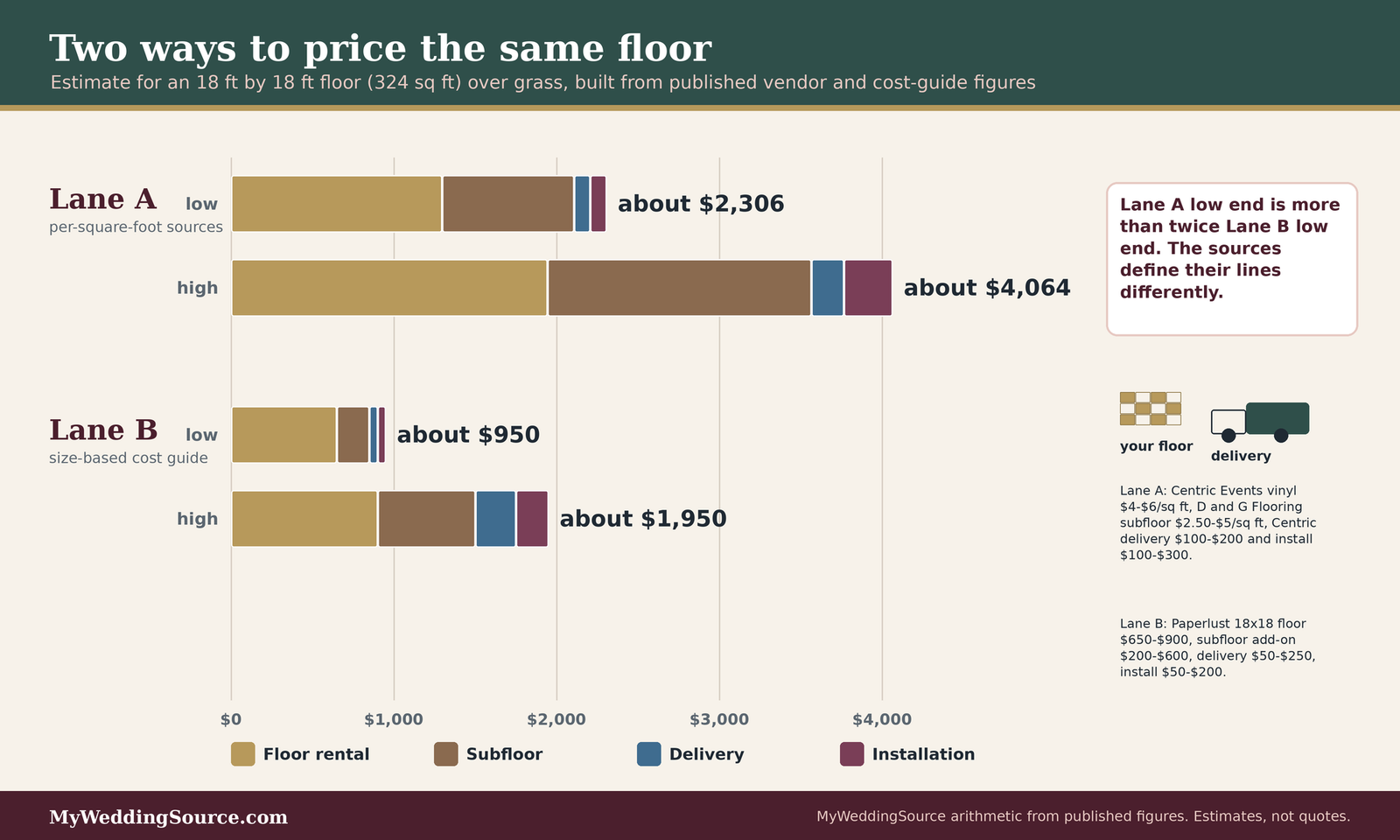
Using Centric’s vinyl rate of four to six dollars, D and G’s plywood subfloor rate of two dollars and fifty cents to five dollars, Centric’s local delivery of one hundred to two hundred dollars, and installation of one hundred to three hundred dollars, our estimate is about one thousand two hundred ninety-six to one thousand nine hundred forty-four dollars for the floor, eight hundred ten to one thousand six hundred twenty dollars for the subfloor, plus delivery and installation. The total comes to roughly two thousand three hundred to four thousand sixty dollars before any waiver, deposit, tax, or surcharge. We assume the subfloor covers the full footprint.
Lane B: size-based sources
Using Paperlust’s range for an eighteen-foot square floor of six hundred fifty to nine hundred dollars, a subfloor add-on of two hundred to six hundred dollars, delivery of fifty to two hundred fifty dollars, and installation of fifty to two hundred dollars, our estimate is roughly nine hundred fifty to one thousand nine hundred fifty dollars. Lane A’s low end is more than double Lane B’s low end. The sources define their lines differently and measure different markets, which is exactly why one number is not a budget.
Minimums, seasons, and surcharges
Minimums are the least visible part of a wedding dance floor rental over grass, and the one most likely to apply when the floor is small or the lawn is remote.
What the sources say about minimums
The sources are thin. Centric Events says companies may require a minimum order value for delivery in peak seasons, or charge a fee to fall below it, without giving an amount. Paperlust mentions possible weekend, evening, early-morning, and May through October peak-season surcharges, and long-distance fees beyond a standard radius, again without amounts. The oak-finish floor page states no minimum, and neither does EventWorks. Production Management One states a ten thousand dollar minimum for platform builds, a different product.
How rental length changes the price
Centric Events says a two-day rental costs about fifty percent more than a one-day rate and a weekend rental about double, while the oak-finish page states that its base rate covers up to three days. If setup for your wedding dance floor rental over grass happens the day before, ask whether that day is billed. Time-sensitive details like these are exactly what an itemized quote should show.
The rental minimums and load-in quote grid
This is the working tool of the guide. When two vendors quote a wedding dance floor rental over grass, their totals are not comparable until each line is answered. Copy the grid, fill in one column per vendor, and note the date of each quote. Where a cell is blank, the quote is incomplete, not cheap.
How to use the grid
The grid for a wedding dance floor rental over grass has five columns: the line, what to ask, why it matters on grass, and one blank column for each vendor. Fill it in by phone or email, and ask each vendor to send the answers in writing so that you have them for the contract.
Fill it in the same way every time
Ask every vendor the same questions in the same order, using the footprint measurements and photos you collected on your walk. If one vendor includes a subfloor and another does not, that difference should be visible in the grid, not buried in a total.
Mark what is missing, not what is assumed
If a vendor says it will confirm something later, write “pending” and a date. Do not write the likely answer. A grid full of assumptions looks complete and is not.
The grid
Sixteen lines to fill in
Each row is one item that can change the price or the plan for a wedding dance floor rental over grass. Skip none of them, even if a vendor says a line is standard.
| Line | What to ask or confirm | Why it matters on grass | Vendor A | Vendor B |
|---|---|---|---|---|
| Floor size and finish | Exact dimensions, panel size, finish, capacity claim | Sets the base rate and the footprint to level | ____ | ____ |
| Base and subfloor | Is a subfloor included, what material, and is a moisture barrier laid first | Often billed apart over grass | ____ | ____ |
| Slope and soft ground | Maximum slope the floor tolerates, and what happens beyond it | Shims, legs, or a platform add cost | ____ | ____ |
| Site visit | Will someone assess the lawn before the date, and is it free | Surprises are cheaper to find early | ____ | ____ |
| Delivery | Fee, radius, truck size, delivery window | Remote lawns can cost more | ____ | ____ |
| Installation and removal | Crew size, install and breakdown time, billed apart or bundled | Setup time competes with other vendors | ____ | ____ |
| Access path | Narrowest gate or path the crew needs, carts used, steps or slopes allowed | Narrow or soft routes slow the crew | ____ | ____ |
| Rental period | Days included, whether setup day is billed, pickup day and time | Rates can rise with longer periods | ____ | ____ |
| Minimums | Any minimum order, delivery minimum, or small-floor fee | Peak season rules differ by vendor | ____ | ____ |
| Lounge or other rentals | Does combining orders change delivery or minimum rules | Shared route and shared truck | ____ | ____ |
| Edging and access | Ramped edging included, ramp or step units for guests | Trip hazards happen at the edge | ____ | ____ |
| Power and lighting | Does the floor need power, how far, cable protection | Cables cross guest paths | ____ | ____ |
| Weather policy | Rain, wind, and heat terms, who decides, and any refund or reschedule | Lawns change fast in rain | ____ | ____ |
| Damage terms | Waiver percentage, deposit, what is excluded, how damage to the lawn is handled | Tends to be a separate line | ____ | ____ |
| Surcharges | Weekend, evening, early-morning, peak-season, uneven terrain, after-hours | Often absent from list prices | ____ | ____ |
| Total and date | All-in total, tax, and the date the quote is valid until | Prices and policies change | ____ | ____ |
Three rows that deserve extra attention
The base and subfloor row, the slope row, and the weather policy row cause the most disagreement between quotes in the sources we read. If a vendor is vague on any of them, ask for a written answer, and ask what happens on the day if conditions are worse than expected.
Comparing two quotes honestly
Once the grid is filled, the comparison is a matter of reading across a row. A vendor that shows a lower base rate but leaves rows blank is not cheaper until those rows are answered.
Normalize to the same footprint and the same days
Convert both wedding dance floor rental over grass quotes to the same floor size, the same rental period, and the same inclusions. If one includes a subfloor and the other does not, add an estimate for the missing subfloor and label it an estimate, then ask the second vendor for a real number.
Look for the lines that appear only once
If only one vendor mentions a moisture barrier, a site visit, or ramped edging, ask the other whether it is included. A line that appears in one quote only is usually either a real difference or a missing line, and both are worth knowing about before you sign. Our wedding vendor contract guide and the vendor due diligence checklist explain what else to confirm.
Protecting the lawn, the venue, and your deposit
Most venues and homeowners care about two things when a wedding dance floor rental over grass goes on their lawn: that no one is hurt, and that the grass survives. Both matter to your deposit, and both are easier to manage if you plan them. Below is what lawn-care sources and vendors say, with the caution that none of them studied wedding dance floors specifically.
Before the date: the lawn schedule
The lawn does not need much for a wedding dance floor rental over grass, but the timing matters. The steps below combine lawn-service advice with the vendor guidance earlier in this guide. Adjust them to your climate and your venue’s rules.
About a week before
LawnStarter suggests cutting back irrigation about a week before an event so soil is drier and more tolerant of foot traffic, without letting the turf reach severe drought stress. If hot, rainy weather is forecast, it suggests a fungicide about a week ahead. That is a lawn-service recommendation that quotes two university extension specialists, and it may not suit your lawn. Ask your venue or a local lawn professional before changing anything.
Two to three days and one to two days before
Two to three business days before any stakes go in, 811 should be called by whoever is installing them. One to two days before the event, mow the lawn, since LawnStarter recommends mowing within that window and never removing more than one-third of the blade height at once. If the lawn was sodded recently, the same source says to wait at least two weeks, or until the sod has rooted, before hosting.
During the event: spreading the load
A wedding dance floor rental over grass concentrates foot traffic in one place, but it also keeps that traffic off the rest of the lawn. Other zones need attention too.
Walkways and wear zones
LawnStarter suggests setting up separate stations for eating, dancing, and socializing to spread out foot traffic, and using plywood, mats, or carpet for walkways. For a wedding, the busiest paths are usually from the parking area to the ceremony, from the ceremony to the reception, and from the reception to the restrooms. See our guides on portable restrooms for outdoor weddings and outdoor wedding venues for the rest of the layout.
Spills and heat
LawnStarter says to rinse alcohol spills with water right away or water the spot after guests leave. On a hot day, keep an eye on how long the floor and any covers sit in direct sun. The sports turf document mentioned earlier says that above sixty degrees Fahrenheit and in bright sun a tarp can act like a greenhouse and damage grass within hours. A dance floor is not a tarp, but a hot, still day is a reason to ask your vendor about removal timing, and our summer wedding heat plan covers keeping guests comfortable.
After the event: removal and recovery
The floor should come up soon after the event, and the lawn deserves a look.
Removal timing
GreatMats advises removing a floor when it is thoroughly dry if possible, and taking it apart and drying it indoors if it is wet. For a wedding dance floor rental over grass quote, the question is when the crew will return and how that time is billed. Our wedding rental return logistics guide covers the return side in more detail.
Lawn recovery
LawnStarter suggests looking for thin spots, standing water, and shallow roots after an event, which signal compaction, and lightly raking to lift matted grass. It describes aerating warm-season lawns in late spring or early summer and cool-season lawns in fall, and overseeding bare spots with a starter fertilizer. Any turf repair is the owner’s call, and who pays should be settled in the contract before the date.
Accessibility and guest safety at the edge of the floor
A dance floor is a place where people move quickly, in formal shoes, sometimes after a drink. With a wedding dance floor rental over grass, the edges deserve particular attention. This section describes guidance from the U.S. Access Board and from vendors, and it is not legal advice.
Surfaces, edges, and changes in level
The U.S. Access Board publishes plain-language guides to the ADA Standards. They describe permanent construction and do not address temporary events, so treat them as a reference point, not a rule for your floor.
What the Access Board guide says
The guide to floor and ground surfaces says surfaces should be stable, firm, and slip resistant, that changes in level up to one-quarter inch need no treatment, that changes up to one-half inch should be beveled with a slope no steeper than one in two, and that changes above one-half inch should be treated as a ramp. It also limits openings so that a half-inch sphere cannot pass. It does not mention mats or temporary surfaces. A lawn with a tall floor edge exceeds those numbers quickly, so ramped edging is worth asking about.
Why edging matters even if no one uses a wheelchair
Tent and Table recommends sloped aluminum or heavy-duty vinyl perimeter trim to reduce trip hazards. Heels, canes, walkers, strollers, and a guest who has had a long day all benefit from a low, gradual edge. Our accessible wedding guest experience guide covers the wider picture.
Ramps and raised floors
If your floor is raised, or the lawn drops away at one side, there may be a step. The ramp is part of the floor.
Ramp numbers from the Access Board
For permanent ramps, the Access Board’s guide gives a maximum running slope of one in twelve, which is about eight percent, a maximum cross slope of one in forty-eight, a minimum clear width of thirty-six inches, a maximum rise of thirty inches per run, and level landings at the top and bottom. It states that required ramps must be permanent, with a narrow exception for ramps serving temporary structures, and it suggests contacting the Board for guidance on specific cases. Whether any of this applies to a private wedding depends on the venue and local rules, so ask the venue and the vendor.
Asking early
Production Management One notes that ADA ramps or lifts for its platforms are drawn into the same layout as the platform and sized to the platform height. For a wedding dance floor rental over grass, the practical lesson is to ask for ramp or step units when you request the quote, since adding them late can change the layout.
Shoes, tripping, and lighting
Surface and shoes interact. Lighting changes what guests can see.
Heels and sinking
GreatMats notes that high heels can damage some surfaces. Heels may also catch in joints or gaps, or sink into soft ground just beyond the floor edge. If the ground around the floor is soft, a walkway of mats or plywood to the floor is worth asking about.
Lighting the edges
Allied Event Solutions suggests warm string lights overhead or uplights around the edge, and taping down cables. Lighting the edge is partly aesthetic and partly practical, since a lit boundary is easier to see. See our wedding lighting guide for more.
Questions to ask the rental company and the venue
For a wedding dance floor rental over grass, two parties have to agree: the company that supplies the floor and the owner of the property where it goes. Their answers sometimes conflict, so ask both.
Questions to ask before you sign
- What exactly goes between the grass and the panels, and is it included in the price?
- What is the maximum slope the floor tolerates without shims, legs, or a platform, and who pays if my lawn exceeds it?
- Will someone visit the site before the date, and is the visit free?
- How wide is the narrowest gate or path your crew needs, and what carts do you use?
- What is the crew size, the install time, and the breakdown time for my footprint?
- How many days does the rate cover, and how is a setup day or a late pickup billed?
- Is there a minimum order or a delivery minimum, and does it change in peak season?
- What does the damage waiver cover, and what happens if the lawn is damaged?
- What is your weather policy for rain, wind, and heat, and who decides?
- Is your quote valid until a stated date, and what is the total with tax?
For the rental company
Ask in writing, and ask for answers in writing. The grid in the previous section lays out the full list.
The three questions that reveal the most
Ask what is included in the base, what the slope tolerance is, and what the weather policy says. A vendor that answers those three clearly has usually thought through a lawn install. A vendor that answers vaguely may still be good, but it is a reason to ask for more detail.
The documents to request
Ask for a written quote with line items, the rental agreement, the damage and cancellation terms, and a certificate of insurance if the venue requires one. Backyard Movie Theater notes that some venues require vendor insurance documents. Our wedding insurance guide explains how event coverage works in general.
For the venue or property owner
The venue may have rules that the rental company does not know about. Ask early.
Surface, irrigation, and permission
Ask whether floors, stakes, and vehicles are allowed on the lawn, whether the sprinkler system can be turned off, and where lines and heads are. Ask whether the venue has a preferred vendor or a required one. Our wedding venue questions guide and wedding permits guide cover these points.
Access, hours, and deposits
Ask when vendors may enter, when they must leave, which gate trucks must use, and whether a deposit covers lawn damage. Production Management One says some jurisdictions require thirty days from permit submittal to the event date, so if any raised structure is involved, ask early. See also our wedding venue cost guide for how venue fees and rules interact with rentals.
Edge cases for a wedding dance floor rental over grass
Some situations break the simple version of the advice for a wedding dance floor rental over grass. These are the ones that come up most often.
Sloped, soft, or wet lawns
These are the lawns where a base matters most, and where vendors may decline or change the plan.
A noticeable slope
If the lawn visibly slopes, ask whether the vendor uses leveling legs, shims, or a platform, and whether it will do so for your wedding dance floor rental over grass. Production Management One describes scaffold bases where grade requires it. Consider moving the floor to the flattest part of the lawn, even if it is farther from the tent.
A lawn that is soft or wet
If the lawn holds water, ask whether the vendor will install on wet ground. D and G Flooring says soft ground needs plywood so frames do not sink, and Tent and Table says rain can turn grass to mud. A drainage-friendly floor, a raised system, or a different location may be the answer, and some days a vendor may reasonably decline. A rain plan agreed in advance is better than a decision at the gate. Our wedding venue capacity guide helps when the alternative location is indoors.
Private yards, gardens, and farms
On private land, a wedding dance floor rental over grass has no venue manager to coordinate with, so you become the coordinator.
Backyards
Measure the narrowest gate, find the sprinkler lines, and confirm where trucks can park without crossing soft ground. Neighbors, street parking, and quiet hours matter too. For rural land, see our barn wedding venues and garden wedding venues guides, and our guest pickup windows for rural wedding venues guide for timing.
Fields and long distances
Remote locations can raise the delivery cost of a wedding dance floor rental over grass. Centric Events says out-of-town delivery is three hundred dollars or more depending on distance, and Paperlust says remote venues can raise delivery and installation fees. If trucks must cross a field, ask whether the vendor will drive on it, and what happens if the ground is wet.
Heat, timing, and unusual footprints
A few special cases are worth thinking through before they happen.
Hot days and long coverage
On a hot day with a wedding dance floor rental over grass in full sun, the turf underneath may be under stress. We did not find a source that gives a safe time limit for dance floors, so use the sports-turf guidance on coverings as a cautious reference point and ask the vendor how soon after the event the floor will come up. For comfort planning, see our summer wedding heat plan.
Multi-day weddings and early setup
If the floor goes down a day or two early, the coverage period lengthens and the billing may change. Ask whether early setup is billed as an extra day and whether the vendor is comfortable with the weather forecast. For a wedding weekend, see how our wedding vendor timeline lays out setup and teardown.
FAQ: wedding dance floor rental over grass questions
Ground and base
Can a dance floor go directly on grass?
Some floors are made for it, and some vendors place floors on grass that is even, dry, and compact. Others require a plywood or modular base first. Rental companies quoted in this guide say the ground must be reasonably level and that suitability must be confirmed before installation, so ask your vendor which applies to your floor and your lawn.
Do I need a subfloor for a wedding dance floor rental over grass?
Often, but not always. Vendors describe a plywood or modular base as protection against soft spots, dips, and moisture, and they say it helps on sloped or uneven lawns. Whether it is required depends on the floor type and the ground. Ask whether it is included, what it is made of, and whether it is billed separately.
How level does the lawn need to be?
There is no single standard. One flooring company says floors with leveling legs can handle roughly four inches of drop over ten feet, and that more than about one inch over ten feet needs shimming or legs. Another says only that the surface must be reasonably level. Ask your vendor for its tolerance in writing.
Cost and quotes
How much does a wedding dance floor rental over grass cost?
Published figures vary widely. Our worked example for an eighteen-foot square floor produced roughly nine hundred fifty to one thousand nine hundred fifty dollars from one source’s size-based ranges, and roughly two thousand three hundred to four thousand sixty dollars from per-square-foot sources. These are our estimates, not quotes. Ask local vendors for itemized, dated quotes.
Why is the subfloor a separate charge?
It is separate labor and material: laying a moisture barrier, placing plywood or modular units, leveling, and removing them. Some vendors bundle it into the floor price and some list it as an add-on. One cost guide puts an add-on at two hundred to six hundred dollars, while another vendor lists a per-square-foot rate. Compare the all-in totals.
Are there minimums I should expect?
It depends on the vendor. One cost guide says companies may require a minimum order value for delivery in peak seasons or charge a fee to fall below it. Other vendor pages state no minimum. Ask whether a minimum applies, whether combining lounge or other rentals counts toward it, and whether peak-season rules differ.
Lawn and safety
Will a dance floor damage the grass?
Sources do not give a firm answer for dance floors. Lawn-care and sports-turf guidance says covering grass for long periods, especially in heat and sun, can harm turf, and that compacted areas may need raking, aeration, or overseeding. Ask the vendor how long the floor stays down and agree on lawn terms with the owner beforehand.
Do I need to call 811 for a dance floor?
A floor that sits on the surface generally is not dug in, but tent stakes and other ground-penetrating items are. Sources say whoever installs a tent or similar structure should call 811 two to three business days before digging, and that stakes count. Ask your tent company who calls. Rules vary by state, and this is not legal advice.
Your next steps
Gather what vendors need
Walk the lawn and write it down
To start a wedding dance floor rental over grass request, walk the footprint at the time of day setup will happen, photograph dips, soft spots, and sprinkler heads, measure the narrowest gate, and note where the truck can stop. Our outdoor wedding infrastructure checklist helps you cover power, restrooms, and tents in the same visit.
Size the floor first
Choose a footprint using your guest count and the guidance in our wedding dance floor size guide, then send that size to every vendor so the quotes match. For the broader rentals list, use our wedding rental planning checklist.
Collect and compare quotes
Ask two or three companies the same questions
Copy the grid, send it by email, and ask each company to answer in writing and to date the quote. If a company will not visit or describe its base, note that. Our wedding budget guide can help you place the final number in your plan.
Read the terms before you pay
Before you sign, confirm slope tolerance, weather policy, damage terms, and the removal day. For help with the contract, see our wedding vendor contract guide and our guide on wedding rental damage waivers.
Plan the day itself
Set the load-in order
Give your planner or point person the arrival window, the gate, and the sequence: floor first, then furniture, then dressing. Our wedding vendor timeline shows how to fit that into the schedule.
Think about the dancing
Once your wedding dance floor rental over grass is settled, think about the moments that will happen on it. Our wedding first dance guide and last dance guide are good next reads.
Sources & methodology
How we built this guide
What we relied on
This guide to wedding dance floor rental over grass combines two plain-language guides from the U.S. Access Board, two sources on calling 811 before staking a tent, a sports-turf institute document on tarping, a lawn-service article quoting university extension specialists, and published pages from rental companies, equipment sellers, flooring retailers, and cost guides. Where a statement comes from a company, we say so, because companies describe their own products and policies. Price figures are the sources’ own and are not quotes. Every calculation, including the worked estimate and the dancer count, is our own arithmetic and is an estimate. We opened The Knot’s Real Weddings Study summary page, which covers couples married in 2025, but it did not include dance floor or rental figures, so we did not use it for prices. All sources were reviewed on November 12, 2026, and prices and policies change, so confirm everything before you book.
What we did not do
We did not test floors, survey lawns, or obtain vendor quotes, and we did not find a neutral national price survey. We did not find a source that sets a safe covering time for dance floors on grass, and the sports-turf figures apply to fields. We do not give legal, safety-engineering, or financial advice, and ADA, permit, and utility rules vary by place and use.
Source list
Government and standards-related sources
- U.S. Access Board, Guide to the ADA Standards, Chapter 3: Floor and Ground Surfaces: https://www.access-board.gov/ada/guides/chapter-3-floor-and-ground-surfaces/
- U.S. Access Board, Guide to the ADA Standards, Chapter 4: Ramps and Curb Ramps: https://www.access-board.gov/ada/guides/chapter-4-ramps-and-curb-ramps/
- 811 Call Before You Dig, Before You Stake: https://811beforeyoudig.com/before-you-stake/
- Tent rental industry resource, 811 Call Before You Stake: https://tent.textiles.org/811-call-before-you-stake/
- STMA, Tarping Fields (sports turf, not dance floors): https://stma.org/wp-content/uploads/2019/09/Tarping-Fields-STMAInstitute-logo.pdf
- The Knot, Real Weddings Study (summary page): https://www.theknot.com/content/real-weddings-study
Rental companies, sellers, and cost guides
- Tent and Table, Dance Floor Setups for Outdoor Events: https://www.tentandtable.net/blog/post/dance-floor-setups-for-outdoor-events-tips-for-stability-and-style
- Allied Event Solutions, Outdoor Dance Floor Planning Tips: https://www.alliedpartyrentals.com/5-easy-outdoor-dance-floor-planning-tips/
- Backyard Movie Theater, Outdoor LED Dance Floor Rental Requirements: https://backyardmovietheater.com/blogs/news/outdoor-led-dance-floor-rental-requirements
- Backyard Movie Theater, Guide to Venue Access for Rentals: https://backyardmovietheater.com/blogs/news/guide-to-venue-access-for-rentals
- GreatMats, Build a DIY Dance Floor on Grass: https://www.greatmats.com/dance-flooring/how-can-i-make-a-dance-floor-on-grass.php
- Production Management One, Tent Flooring: https://productionmanagementone.com/eventproductionchannel/5-things-about-tent-flooring-your-boss-wants-you-to-know
- Knight’s Party Rental, Sub Flooring Rental: https://knightspartyrental.com/full-inventory/flooring-stage-rental/sub-flooring-rental
- D and G Flooring, Outdoor Event Flooring: https://dgfloors.com/outdoor-event-flooring/
- EventWorks Rentals, Dance Floor Rental Kansas City: https://www.eventworksrentals.com/collections/dance-floor-rental-kansas-city
- All Occasion Rentals, 21 x 36 Oak Dance Floor Rental: https://all-occasion-rentals.com/products/21-x-36-oak-dance-floor-rental
- Paperlust, How Much Does a Wedding Dance Floor Cost: https://paperlust.co/blog/how-much-does-a-wedding-dance-floor-cost/
- Centric Events, Dance Floor Rental Cost Guide: https://centric.events/blog/dance-floor-rental-cost-guide-2024/
Lawn care
- LawnStarter, How to Protect Your Lawn During Outdoor Events: https://www.lawnstarter.com/blog/lawn-care-2/how-to-protect-lawn-during-outdoor-events/