
The banquet hall vs hotel ballroom decision is rarely about which room is prettier. It comes down to how each venue charges you, what the price actually includes, how many guests you are really inviting, and which contract terms you can live with, so this guide gives you a way to compare the two on equal footing before you pay a deposit.
Quick answer
A banquet hall is usually a rental plus whatever services you add, while a hotel ballroom is usually a food-and-beverage contract with a minimum spend, a service charge, and a cancellation schedule. Neither is automatically cheaper. In the illustrative model below, the hotel’s minimum makes it cost more for a small party, the hotel’s lower fixed costs make it cost less in a middle range, and a hall can win again for a large party, and one change to a single input moves those crossover points. So the useful move in the banquet hall vs hotel ballroom question is to turn both quotes into an all-in cost for your own guest count, read the minimum, service charge, and cancellation language, and then choose.
Define the decision before declaring a winner for banquet hall vs hotel ballroom
Most couples start the banquet hall vs hotel ballroom comparison with a feeling: the hotel looks polished and easy, the hall looks flexible and affordable. Those feelings are sometimes right, and sometimes they are the opposite of what the paperwork shows. Before comparing prices in the banquet hall vs hotel ballroom decision, it helps to define what each term means in practice, because the words are used loosely and venues rarely fit a clean category.
This guide does not try to choose a ceremony style, a neighborhood, or a season for you, and it does not cover every venue type. Garden sites, barns, and restaurants have their own trade-offs, and our guide to garden wedding venues covers the outdoor case. For the wider planning sequence, start with our wedding planning guide and come back here when you have a rough date range and guest count.
What the two venue models actually are
In the banquet hall vs hotel ballroom debate, the labels sound like building types, but the useful difference is the business model behind the building. That model decides what you pay for, what you are allowed to bring in, and what happens if your plans change.
A banquet hall is usually a rental first
A banquet hall is an event space that exists mainly to host parties. Zola describes banquet halls as venues that often come already decorated and furnished, with tables, chairs, and linens, and says some offer full-service packages that bundle catering and other vendors, while others require their in-house caterer. Pricing for catering at a hall is usually per person, according to Zola. Zola also points out that some halls allow only in-house or preferred vendors, that substituting your own may carry a fee, and that other events may share the building on your wedding day.
That range is the point. One hall may be a room you rent for a flat fee, with any caterer you like. Another may sell a per-person package that looks more like a hotel contract. Crescent Hall, a banquet-style event venue in Utah, says on its FAQ page that renters may hire any outside caterer, that its kitchen is for serving rather than cooking, that alcohol must be served by its preferred licensed and insured bartender, and that a $300 cleaning and staffing fee applies when alcohol is brought in. Sweeten Hall says its basic package includes six hours of event time with tables, chairs, and tablecloths, and that a 30 percent security deposit applied to the rental fee is due at signing. Those are two examples of what a hall can look like, not a description of all halls, but they show why you cannot assume a hall’s price includes food, drinks, or staff.
A hotel ballroom is usually a food-and-beverage contract first
A hotel’s main business is rooms and food service, so a ballroom wedding is often priced around the food and drink you buy. The Westin Dallas Downtown publishes a wedding FAQ that shows one version of this. It says the hotel supplies and prepares all food and beverages, that outside food or drink needs approval from the catering manager and may carry a service fee, that a minimum spend based on guest count and date applies and must be met before tax and service charge, and that the current service charge is 25 percent of total revenue plus applicable taxes. It also lists an initial 20 percent deposit and a cancellation schedule tied to the minimum. We cite that hotel as an example of how one property words its terms. Other hotels use different numbers and different structures, so treat it as a template of the questions to ask, not a market average.
List the criteria that genuinely change the choice in the banquet hall vs hotel ballroom decision
A long pros-and-cons list hides the few factors that actually decide a banquet hall vs hotel ballroom choice. Most criteria turn out to be preferences, and a smaller set is a true constraint. Sorting them first keeps you from rejecting an affordable option over something you could solve, or accepting an unsuitable one because of a nice photo.
Separate deal-breakers from preferences
In a banquet hall vs hotel ballroom decision, a deal-breaker is a condition that, if the venue fails it, makes the venue unworkable no matter how good everything else looks. A preference is something you would like but could trade. The same item can be either for different couples, so write your own list before you tour. A useful way to do it is to finish this sentence for each item: “If this is not true, we will not book.”
Common deal-breakers in the banquet hall vs hotel ballroom comparison include a hard cap on total spend, a guest count the room cannot hold at tables, a required caterer who cannot meet a dietary or cultural food need, an alcohol policy that conflicts with your plans, a lack of an accessible route for a guest who needs one, and a cancellation schedule that you could not afford to trigger. Common preferences include a particular chandelier, a built-in stage, an on-site wedding night room, and a tasting included in the price. If you notice that a preference is driving your decision, check whether it can be recreated in the other venue type with a rental or an add-on, and what that costs.
Weight cost, logistics, experience, and flexibility
After the deal-breakers, four groups of criteria usually matter in the banquet hall vs hotel ballroom decision, and it helps to weight them against each other instead of treating them as equal. Cost is the total you will actually pay, not the headline fee. Logistics means setup time, load-in, parking, how many vendors you must coordinate, and how many hours you get. Experience is how the day feels to guests: the room, the service, the food, the sense of occasion. Flexibility is how much you can change, bring in, or move if plans shift.
If you give each group a weight that adds up to 100, you have a quick tool for ties. A couple with a tight budget and a large family might weight cost at 45, logistics at 15, experience at 20, and flexibility at 20. A couple planning a polished evening for a mid-sized group who want one point of contact might weight cost at 25, logistics at 35, experience at 25, and flexibility at 15. Those weights are illustrations, not recommendations, and the point is only that the two couples can reasonably land on different venues for the same room.
Cost note
The Knot’s 2026 Real Weddings Study, which surveyed 10,474 U.S. couples who married in 2025, reports an average total wedding cost of $34,200, an average of 117 guests, an average cost of $292 per guest, and an average reception venue cost of $12,900. The page does not say whether those figures are planned or paid, and it does not separate banquet halls from hotels, so use them as national context, not a price for either venue type. Enter your own quotes in our wedding budget calculator, and see our average wedding cost guide for what else sits beside the venue in a typical budget.
The matrix below brings the criteria together. It is our own synthesis of the published policies cited in this guide and ordinary planning logic, so it describes tendencies, and a specific venue can differ from its type in any row.
| Criterion | Banquet hall tends to | Hotel ballroom tends to | What flips it |
|---|---|---|---|
| How price is built | Rental fee, with food and drink either bundled or separate | Food-and-beverage minimum plus service charge and tax | A hall that sells a bundled per-person package behaves like a hotel |
| Outside caterer | Sometimes allowed, sometimes required in-house | Usually the hotel’s own kitchen | Written exceptions, buyout fees, or religious or dietary approvals |
| Cost for a small guest count | Often lower, because there is no minimum to fill | Can rise toward the minimum | Whether the room fee is waived at the minimum |
| Cost for a large guest count | Fixed costs spread out, but rentals and labor scale | Per-guest food cost dominates | Per-guest food and bar prices from each quote |
| Included furnishings | Tables, chairs, and linens common but not universal | Tables, chairs, china, and staffing usually part of service | Linen upgrades, dance floor, AV, and power fees |
| Guests staying overnight | Rarely on site | Room block and walk-to-bed convenience | Block terms, attrition, and parking charges |
| Time on site | Defined rental window including setup | Defined event hours, often with a set end time | Overtime rates, early load-in, and curfews |
| Flexibility to personalize | Often higher, with decor approval | Often more standardized, with a catering manager | Preferred-vendor rules in either type |
| Cancellation exposure | Deposit and venue policy | Percentage of minimum that rises as the date nears | Whether a deposit is refundable or credited |
| Sense of occasion | Depends on the hall | Often built into the property | Photos at your actual date and layout |
Compare like with like in the banquet hall vs hotel ballroom decision
In a banquet hall vs hotel ballroom comparison, two quotes can sit side by side on your table and still describe different purchases. One includes five hours and the other includes seven. One names a service charge and the other hides labor in a per-person price. Normalizing means turning both documents into the same unit so that the difference you see is real.
Normalize package contents and time coverage
For a fair banquet hall vs hotel ballroom comparison, build a worksheet with the same rows for each venue and fill in every line from the actual quote, not from the website. The columns are simple: what is included, what is excluded, what is optional, and what the line costs at your guest count. Then convert the total to a cost per guest by dividing by the number of people who will eat and drink.
Here are the rows that tend to matter most. Start with the room: rental fee, how many hours it covers, whether setup and cleanup sit inside those hours, and what overtime costs per hour. Then food: the per-person price, what courses and service style it covers, and whether children and vendors eat at a reduced rate. Then drink: the bar structure, who must serve it, and whether bartenders and glassware are priced separately. Then furnishings: tables, chairs, linens, china, flatware, glassware, a dance floor, and a stage. Then staff: servers, a banquet captain, a coordinator, and security. Then percentages: service charge, administrative fee, gratuity, and tax, and what each is applied to. Finally, the exclusions: valet, parking, coat check, cake cutting, corkage, and any fee for outside vendors.
If one venue quotes five hours and the other eight, compare hourly cost for the part that is time-based and compare per-guest cost for the part that is food, and do not blend them. A five-hour hall rental that ends at 10 p.m. and an eight-hour hotel package that includes a long cocktail hour are not the same product. You may need fewer hours than you think, and you should ask each venue what its standard wedding timeline looks like.
Expose features that sound equivalent but are not
Some phrases appear in both types of contract and mean different things, which makes the banquet hall vs hotel ballroom comparison harder than it looks. “Includes tables and chairs” may cover only basic banquet chairs, with upgraded chairs extra. “Coordinator included” may mean a venue contact who opens the doors, not a person who runs your rehearsal and timeline. “Open bar” may be limited by brand tier, hours, or drink types. “Exclusive use” may mean the building or may mean only one wedding in your room. “Service charge” may or may not include gratuity for the staff. “Setup included” may cover your layout or only the venue’s standard layout.
The Knot makes the shared-space point about all-inclusive venues, noting that hotels, banquet halls, and country clubs may host several weddings in one day, and that you could see staff cleaning up from an earlier event unless you pay for exclusive use. Zola adds that smaller inns may only hold a license for wine and beer. When a feature matters to you, ask for the exact wording in the contract or the event order, and if the answer is verbal, ask them to send it by email so there is a record.
Check the guest list against the room, not the brochure
A published capacity is a marketing number, and a fire-code number is a legal ceiling. Neither tells you how many guests fit at tables with a dance floor, a bar, and a buffet. This matters more than people expect, because in a banquet hall vs hotel ballroom comparison the two venue types often advertise capacity in different ways.
Seated, standing, and code capacity
The Minnesota State Fire Marshal’s guidance on occupant loads in assembly buildings uses about 15 square feet of net floor area per person for tables and chairs and about 7 square feet per person for standing areas and dance floors. Those factors come from one state’s published guidance. The local authority sets the actual occupant load for a room, and the number may be posted, so ask the venue for the posted figure and for how many guests it seats at rounds with your layout. A room that is rated for far more people standing can still seat far fewer at dinner, and a room that seats 150 at tables may not leave space for a dance floor at 150.

To see how the arithmetic works, imagine a room with 3,600 square feet of net floor area. Using the 15 square foot factor for the whole room gives 240 as an upper bound, and using 7 gives about 514 standing. If you then take out 400 square feet for a dance floor and 500 square feet for a bar and buffet or food stations, leaving 2,700 square feet of tables, the same 15 square foot factor gives 180 seats. That is our own estimate from one published factor, and it ignores stages, columns, and aisles. The takeaway is simple: the number you can seat comfortably is the one that matters, and it is usually lower than the number on the brochure.
Count the guests who will need a bed
Hotel ballrooms offer one advantage that a banquet hall rarely does, and in the banquet hall vs hotel ballroom decision it is a bed upstairs. If many of your guests are traveling, the ease of walking from the reception to a room is a real benefit, and Zola lists a reserved room block, wedding suite, and discounted rooms among the hotel and resort perks. If most of your guests live within an hour’s drive, that advantage shrinks, and a block can become a risk instead. We return to blocks and attrition later, but at this stage, estimate how many rooms you would realistically fill, and treat that as one input to the choice.
Show where each option is stronger—and what it costs to get that advantage for banquet hall vs hotel ballroom
In the banquet hall vs hotel ballroom decision, each venue model buys you something and charges for it. A hotel sells convenience and a single contract, and it charges through minimums, percentages, and standardization. A hall sells room and freedom, and it charges through the work and the extra vendors that freedom requires. The sections below put numbers and contract language on that trade.
Model the real trade-offs in the banquet hall vs hotel ballroom decision
The cleanest way to see the banquet hall vs hotel ballroom trade-off is to write one cost model with assumptions on the page. The model below is ours. Every input is an assumption, chosen so the arithmetic is easy to follow, and none of them is a market price, so replace them with the numbers from your quotes.
Include hidden labor, fees, space, or coordination
Start with what the banquet hall vs hotel ballroom price does not show. The Knot’s venue guidance lists damage and overtime fees, extra charges when outside vendors need setup or cleanup, the cost of extending your hours, upgrades that add up quickly, and charges for bringing in outside vendors. Zola adds that valet service or upgraded chairs can carry charges, that some packages leave out florists, DJs, or coordinator fees, and that renting outside tables and linens can add costs when a venue’s own are not suitable.
Those line items hide two kinds of cost. The first is money, such as a fee for a bartender, a dance floor, or a cake cutting. The second is work, such as scheduling deliveries, confirming who sets up what, and making sure someone removes decor and personal items at the end. Crescent Hall’s FAQ says renters must remove their decor, food, flowers, and personal items afterward, and that the renter must tell vendors their available times. That is a normal arrangement for a rental, but it is a task a hotel’s event staff may handle inside a full-service contract. If you are paying a hall less, ask yourself who is doing the extra work, and whether you want it to be you, a planner, or a day-of coordinator you hire.
A hotel has its own hidden costs, and they tend to be percentage-based. The Westin Dallas Downtown FAQ says its service charge applies to total revenue, that other fees such as setup, labor, or bartender fees are separate from the staff gratuity, and that rates can change until event orders are approved. If a hotel’s quote shows a food price and a separate line for service charge and tax, add them yourself before comparing, because a per-person price that looks lower can carry a higher percentage on top.
Identify the point where one option stops being cheaper
Here are the assumptions for our illustrative model, all of them editorial inputs.
- Hotel ballroom: food and drink priced at $140 per guest, a food-and-beverage minimum of $17,500, a 25 percent service charge (the figure the Westin Dallas Downtown FAQ states for its property), and 7 percent tax applied to the food, drink, and service charge. The tax rate and what it applies to vary by location, so ask. In this model the ballroom itself, tables, chairs, linens, and staffing are included in the minimum.
- Banquet hall: a $5,500 rental fee, $3,000 in fixed extras for linens, glassware, a bartender or cleaning fee, and day-of help, and an outside caterer and bar at $120 per guest with a 20 percent caterer service charge and the same 7 percent tax.
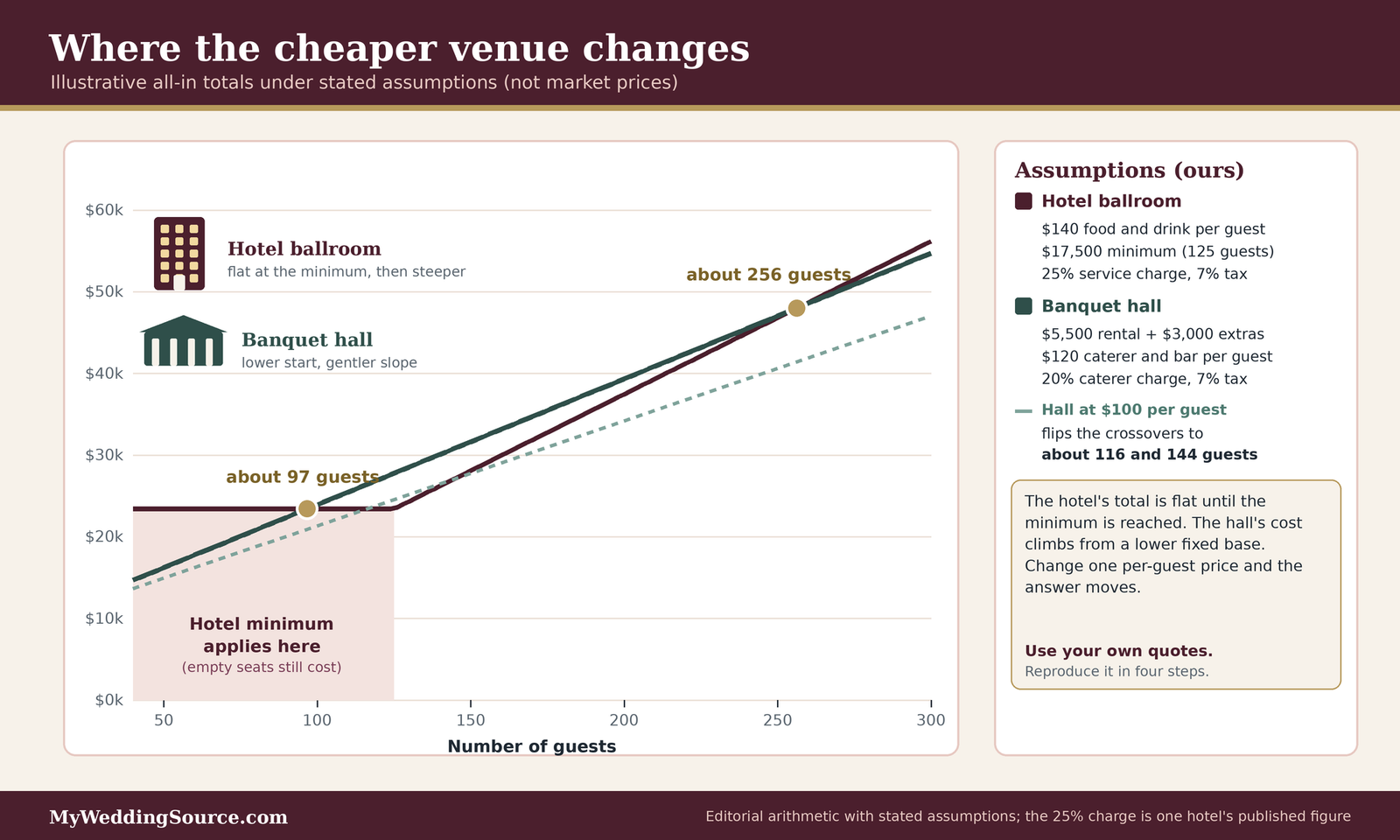
With those inputs, the hotel’s total is the larger of $17,500 and $140 times the guest count, multiplied by 1.25 for the service charge and 1.07 for tax. The hall’s total is $8,500 in fixed costs plus about $154 per guest. The result is an uneven picture, shown in the chart and the table below.
| Guests | Hotel total | Hotel per guest | Hall total | Hall per guest | Lower total |
|---|---|---|---|---|---|
| 60 | $23,406 | $390 | $17,745 | $296 | Hall |
| 100 | $23,406 | $234 | $23,908 | $239 | Hotel, narrowly |
| 150 | $28,088 | $187 | $31,612 | $211 | Hotel |
| 250 | $46,812 | $187 | $47,020 | $188 | Hotel, narrowly |
| 300 | $56,175 | $187 | $54,724 | $182 | Hall |
Three features of this model are worth taking away, because they hold even when your numbers differ. First, a minimum creates a flat zone. Under these inputs, the hotel’s bill does not change between zero and 125 guests, because the minimum is $17,500 and $140 per guest only reaches it at 125 people, so a smaller party pays for food it does not eat. Second, a rental fee and fixed extras create a flat cost for the hall, which is why the hall’s per-guest cost falls as the guest list grows. Third, the crossover points are sensitive to price, so a modest change in either per-guest figure moves them noticeably.
To show that sensitivity, change one input. If the hall’s caterer and bar come in at $100 per guest instead of $120, the hall’s per-guest cost with fees falls to about $128, and the hall is cheaper below roughly 116 guests and again above roughly 144, with the hotel marginally ahead only in the narrow band between them. The model did not become more correct. It showed that the answer turns on two or three numbers you can find out by asking, so the right move in a banquet hall vs hotel ballroom comparison is to get those numbers, not to trust a rule of thumb about which type is cheaper.
You can reproduce the method with your own quotes in four steps. Write each venue’s fixed costs. Write each venue’s per-guest costs including the percentages that apply to them. Write the minimum, if there is one, and note the guest count at which it stops mattering. Then compute the total at your low, expected, and high guest counts. That last step matters, because RSVPs move. Our wedding budget calculator can hold the banquet hall vs hotel ballroom totals once you have them.
Know the money rules that differ: minimums, service charges, and cancellation schedules
Most disputes in venue contracts come from three clauses, and the banquet hall vs hotel ballroom choice often changes which of them you face. Reading them early is cheaper than negotiating them late.
Food-and-beverage minimums and what counts toward them
A food-and-beverage minimum is a commitment to spend at least a set amount on food and drink, and the Westin Dallas Downtown FAQ describes it as based on guest count and date, stated in the contract, and applied before tax and service charge. The FAQ we read does not say what happens if you fall short, so ask whether you pay the difference. Questions to settle include which items count toward the minimum (food and bar, but perhaps not rentals, room fees, or the service charge), whether the minimum changes if your guest count changes, and whether the minimum differs by day of the week or season.
A hall’s equivalent, if it has one, is usually a minimum guest count or a minimum catering spend when you use its in-house caterer. Zola notes that venues may charge a flat fee, a per-guest rate with a minimum headcount, or a rental fee plus a per-guest charge, and that taxes and gratuity are usually extra. Whatever the structure, ask for the number at which the minimum stops mattering. In our model it was 125 guests, and below that, every empty seat still cost the same.
A service charge is not a tip
A service charge is a percentage the venue adds to the bill. Walters Wedding Specialists, a venue that explains its own charge on its blog, says service charges generally run from 19 to 25 percent, that its own is 22 percent, that the charge funds operations, labor, cleaning, and planning support, and that it is not a tip. Treat that as one venue’s explanation, not a rule. The Westin Dallas Downtown FAQ is more specific about the split, saying about 12 percent of food-and-beverage revenue goes to service staff as gratuity and that the hotel keeps the rest to cover event costs.
The distinction matters for a practical reason. The IRS, in Revenue Ruling 2012-18, says an employer’s label does not decide whether a payment is a tip. A payment is a tip only if the customer pays voluntarily, decides the amount freely, the amount is not set by employer policy or negotiation, and the customer generally decides who receives it. The ruling’s own example is an automatic 18 percent charge on large parties, which it treats as a service charge and as wages when distributed to staff. In plain terms, a mandatory percentage on your contract is the venue’s charge, and what staff receive from it is the venue’s decision. That is not tax advice and it does not tell you what to pay. It tells you to ask what share reaches the people who serve your guests, and whether an extra tip is expected or already covered.
Cancellation schedules and deposits
The Westin Dallas Downtown FAQ states cancellation fees as a percentage of total minimum revenue, rising with proximity to the date: 20 percent if you cancel between the agreement date and 270 days out, 50 percent from 269 to 151 days, 75 percent from 150 to 91 days, and 100 percent at 90 days or less. It also lists a 20 percent deposit at signing and final payment ten days before the wedding. That is one hotel’s published schedule, and others differ. Halls often use a simpler structure. Sweeten Hall says a 30 percent security deposit is non-refundable but applied to the rental fee, and Crescent Hall says a $500 deposit is non-refundable and a signed contract is required to hold a date.

To make the exposure concrete, apply the Westin percentages to the $17,500 minimum from our model. That would be $3,500 in the first band, $8,750 in the second, $13,125 in the third, and $17,500 in the last. The calculation assumes the percentage applies to the minimum itself, which you should confirm in your own contract. The comparison with a hall is not as simple as it looks, because a hall’s rental fee is only part of your spending, and your caterer, bar, and rental vendors each have separate cancellation terms. If you are weighing the risk in a banquet hall vs hotel ballroom booking, our wedding insurance guide is the place to start if you are considering cancellation coverage, and the contract’s own cancellation language should come first.
Match the options to different wedding scenarios in the banquet hall vs hotel ballroom decision
Averages hide the fact that the right answer to banquet hall vs hotel ballroom depends on who is coming and what they need. The three couples below are illustrations we made up, using the same model inputs as above, to show how the recommendation moves.
Use at least three distinct couple and venue examples
A smaller local wedding. Dana and Marcus plan a Saturday dinner for 70 guests, nearly all within an hour’s drive, with a firm spending ceiling. Under our model, the hotel costs $23,406, since the minimum applies, and the hall costs about $19,286, a difference of roughly $4,100. A hall with an outside caterer fits them, and what they give up is some convenience. They should still price a second hall that sells a bundled package, because it may come in below a caterer-plus-rentals build.
A destination-style weekend. Priya and Alex invite 140 guests, and about 60 of them are flying in. In the model, the hotel costs about $26,215 and the hall about $30,071, a difference of nearly $3,900, and the hotel also offers a reserved block where guests can walk to bed. A ballroom suits them, with one risk to manage, which is the attrition clause in the room block, covered below. If they expect far fewer travelers than the block requires, the hotel’s advantage shrinks.
A large family wedding with specific food needs. Rosa and Daniel invite 260 guests and need a caterer who can prepare specific family dishes and meet cultural dietary requirements. In the model the two venues are within a few hundred dollars of each other at that size, so price does not decide it. The caterer rule does. A hall that allows an outside caterer, as Crescent Hall says it does, may be the only path. If a hotel will approve an outside caterer in writing, or its kitchen can meet the menu, the hotel is back in play. The Westin Dallas Downtown FAQ describes a process where outside food needs approval from the catering manager, with religious-purpose exceptions available, which shows that the question is worth asking early.
Explain why the recommendation changes across scenarios
The three couples in this banquet hall vs hotel ballroom example differ on three inputs: guest count relative to the minimum, how many guests need rooms, and how much control they need over the menu. Those three inputs account for most of the difference in this guide’s examples. The table below turns them into thresholds that flip the recommendation. It is an editorial synthesis and it gives the situation in which each option tends to win, not a rule.
| Scenario | Usually wins | Threshold that flips it | Why |
|---|---|---|---|
| Guest count well below the hotel’s food-and-beverage minimum | Hall | The hotel lowers or waives the minimum for your date | A minimum makes empty seats cost money |
| Guest count near or above the minimum | Hotel, if per-guest prices are similar | The hall’s per-guest price is meaningfully lower than the hotel’s (in our model, $100 instead of $120 moved the first crossover by about 20 guests) | Fixed costs and percentages decide |
| Many out-of-town guests | Hotel | The block’s attrition terms are strict relative to likely bookings | Walking to bed has real value if the block is realistic |
| Mostly local guests | Hall, or either | The hotel’s price is clearly lower for your count | Rooms add little value |
| Menu needs a specific caterer | Hall | The hotel approves an outside caterer in writing | The caterer rule beats price |
| One point of contact matters most | Hotel | A hall sells a bundled full-service package | Bundled service lowers coordination work |
| Date flexibility is available | Either | A weekday or off-season hotel date lowers the minimum | Minimums often depend on date, as the Westin Dallas Downtown FAQ describes |
Guests, rooms, and risk: where banquet hall vs hotel ballroom contracts diverge
In the banquet hall vs hotel ballroom decision, price and capacity get most of the attention, but the contract terms around rooms, access, alcohol, and time often cause the surprises. This is also where the two models differ most in structure, so it is worth reading each clause before it is your problem.
Read the room block and attrition terms before counting on a hotel
If you choose a hotel, a block of guest rooms often arrives in the same conversation as the ballroom. Blocks can help your guests, and they can also carry a financial commitment, so they deserve their own check.
How an attrition clause works
Joy, the wedding website company, defines an attrition clause as a room block provision that obligates you to fill a minimum percentage of the reserved rooms. If bookings fall short by the cutoff date, you pay a penalty that covers the hotel’s lost revenue on the unsold rooms. Joy says most contracts set the minimum between 75 and 90 percent, with 80 percent the most common, and that some hotels use a sliding scale. Its worked example is 30 rooms at $200 a night with an 80 percent threshold. The minimum is 24 rooms, so if only 20 are booked, you owe for four rooms, or $800 before taxes.
Joy’s advice for couples weighing a banquet hall vs hotel ballroom with a block is practical. Size the block to realistic attendance, start smaller because adding rooms is easier than paying for unused ones, ask to lower the threshold, request a review date two to four weeks before the cutoff so you can release unneeded rooms, ask for a credit when the hotel resells rooms in your block, and share your booking link early. It also points out that attrition is different from cancellation, since attrition covers unbooked rooms in a block you keep, while cancellation penalties apply when you drop the whole block or event. Ask whether any penalty covers only room revenue or also taxes, resort fees, or estimated food and beverage spending.
When a block helps and when it risks money
In a banquet hall vs hotel ballroom decision, a block helps most when many guests are traveling, when the hotel’s rate is close to what guests would find on their own, and when walking from the reception to a room matters to your group. It risks money when your guests are mostly local, when they prefer to stay with family, or when many will book cheaper rooms elsewhere. The attrition arithmetic does not care why the rooms went unbooked.
Before you accept a block, make a rough count of the guests who will realistically need a room, divide by how many will share, and compare that with the number of rooms the hotel wants you to hold. If the likely number is well below the required minimum, either shrink the block or negotiate the threshold. A banquet hall has no equivalent, which is a point in the hall’s favor if your guests are local, and a point in the hotel’s favor only if the block terms are workable. Our wedding planning timeline can hold the cutoff dates, so they do not slip by.
Check access, alcohol, and liability in both venue types
These banquet hall vs hotel ballroom topics sit in the fine print, but they change who can attend, what you can serve, and who pays if something goes wrong.
Accessibility questions to ask both venue types
The U.S. Department of Justice’s guidance for planning accessible meetings lists six basic features to check at any site: parking and passenger drop-off, routes to the building entrance, the entrance itself, routes to the meeting space, the meeting space, and restrooms. It describes accessible routes as at least 36 inches wide with ramps no steeper than 1:12, and it advises booking interpreters, captioners, Braille, and other aids early because they can take weeks to arrange. It also says that if a meeting site cannot be made at least temporarily accessible, another site should be selected, and that temporary fixes do not relieve a facility owner’s continuing obligation to remove barriers.
The guidance is aimed at event organizers in general, not weddings specifically, but the checklist transfers. Hotels may have elevators, accessible rooms, and staff who handle such requests regularly, and halls vary widely, so a hall in an older building may have steps at the entrance. Neither type is accessible by default. If you have a guest who uses a wheelchair, walker, or other mobility aid, or who has hearing or vision needs, ask each venue to describe the route from the drop-off point to the seat, the restroom, and the bar, and visit it with that route in mind. We are not giving legal advice, and the answer for your venue depends on the building and your location.
Alcohol, insurance, and who is liable
Alcohol rules differ more than people expect in a banquet hall vs hotel ballroom comparison. Crescent Hall says alcohol must be served by its preferred licensed and insured bartender, and Zola notes that smaller inns may only hold a license for wine and beer. A hotel may serve its own alcohol, as the Westin Dallas Downtown FAQ says it does for food and beverages generally. Ask each venue who holds the liquor license, whether you can bring your own alcohol and what that costs, whether the bartender fee is separate from the service charge, and what the hours of service are. Our open bar wedding guide covers the bar decision itself.
On liability, The Knot’s guidance on reading a venue contract advises you to confirm that the venue carries its own insurance and to note what it covers and its limits, which is separate from any wedding insurance you buy. It also warns that an indemnification clause determines whether you could be compensated if someone is hurt because of the venue’s negligence, and that some contracts waive the venue’s responsibility for accidents, theft, or losses. Sweeten Hall’s FAQ says its vendors must present a certificate of insurance, which is a common requirement in rental venues. The Knot notes that its article is not legal advice, and neither is ours. Have a lawyer you trust review any contract you are unsure of.
Fit the day’s timeline to each venue’s clock
Time works differently in a banquet hall vs hotel ballroom booking, and it affects both cost and the feel of the day.
Hours, load-in, and quiet hours
A hall’s rental window usually includes setup, decorating, and vendor time, so the hours on the quote are not all party hours. Crescent Hall describes its rental rates as showing the window the venue is available, including setup, decorating, and vendor time, and Sweeten Hall says its basic package includes six hours of event time, with longer events arranged with management. A hotel’s event contract typically specifies hours for the function itself, and the ballroom may be in use before or after you. Ask each venue when your vendors may arrive, when they must leave, what the music curfew is, and what happens in the hour after the event ends.
Then work backward, whichever side of banquet hall vs hotel ballroom you favor. If the ceremony is at 4:30, cocktails run an hour, dinner takes ninety minutes, and you want two hours of dancing, count the hours against the window, including photographs. If the rental ends sooner than the plan requires, buy more time up front, since overtime is often priced at a premium. Our wedding reception guide can help you build the run of the evening.
Vendors, photos, and the second room
In either banquet hall vs hotel ballroom case, check whether the venue offers a second space for the ceremony, cocktails, or getting ready, and whether that costs extra. Check where photographs can be taken, since a hall may have a plain courtyard and a hotel may restrict some areas or hours. If photos matter to you, ask to see images from weddings on the same date range and light, and share the list from our wedding photographer shot list with your photographer so they can scout the space. For table layouts and decor limits, our wedding table settings and wedding decor guides cover the choices, and then the venue’s rules determine what you can actually do.
End with a decision rule readers can actually use for banquet hall vs hotel ballroom
After the research, the banquet hall vs hotel ballroom choice usually becomes simple, and the work is to put it in writing before you sign. This section turns the guide into a rule you can apply to your own quotes.
Create a choose-hall-when and choose-hotel-when matrix for the banquet hall vs hotel ballroom decision
The banquet hall vs hotel ballroom matrix is a summary of earlier sections, restated as conditions. Mark every line that is true for you, and see which column has more checks on the lines that matter most.
State the threshold that changes the answer
Choose the banquet hall when your guest count sits well below a hotel’s food-and-beverage minimum, when a specific caterer or menu is a requirement, when most guests are local, when you want more control over decor, and when you have the time or a coordinator to manage extra vendors. Choose the hotel ballroom when your guest count sits at or above the minimum, when many guests are traveling and a realistic room block would serve them, when you want one contract and one point of contact, and when you value standardized service over customization.
For the price side of banquet hall vs hotel ballroom, here is a rule of thumb that is ours and not a standard. Compute the all-in total at your expected guest count for each finalist, using the normalization steps above. If the totals are within about 10 percent of each other, treat price as a tie and decide on the deal-breakers, the contract terms, and the work you are willing to do. If one is lower by much more than that, ask whether the lower quote leaves out a cost, because a large gap is more often a missing line than a bargain. Then run the total again at a guest count 15 percent lower and 15 percent higher than your estimate, since the hotel’s minimum and the hall’s fixed costs respond differently when the list changes.
Call out cases where neither option is ideal
Some weddings fit neither side of the banquet hall vs hotel ballroom question. A guest list of 30 or 40 may find a hotel’s minimum steep and a hall’s room cavernous, and a restaurant’s private room or a small home-based event may suit better. Our small wedding planning and micro wedding planning guides cover those cases. Couples who want an outdoor ceremony should read our garden wedding venues guide. Couples who find that the venue’s price is driving the whole budget may want our guide to how to pay for a wedding, and anyone feeling the weight of the comparison may find our wedding planning stress guide useful.
You may also find that neither of your two finalists passes your deal-breakers, which is a legitimate result. It is better to learn that now than after a deposit.
Give the next verification step before booking in the banquet hall vs hotel ballroom decision
The last step in a banquet hall vs hotel ballroom decision is to ask for evidence, not reassurance. A verbal answer helps you decide whom to ask next. A written answer is what protects you.
List the evidence to request
Ask each banquet hall and hotel ballroom finalist for the same short list of documents. The questions below work for both types of venue.
Questions to ask
- What is the full itemized quote at my low, expected, and high guest counts, with service charge, administrative fee, gratuity, and tax shown separately?
- Is there a food-and-beverage or guest minimum, what counts toward it, and at what guest count does it stop mattering?
- What hours does the rental or event window cover, including setup, vendor load-in, and cleanup, and what does overtime cost?
- May I bring an outside caterer, baker, or bartender, and what fees or approvals apply? Please send the rule in writing.
- How many guests does the room seat at rounds with a dance floor, and what is the posted occupant load?
- What is the accessible route from drop-off to the seat, restroom, and bar?
- What are the deposit amounts, due dates, and the full cancellation and date-change schedule, and is any deposit credited to the total?
- If I need a room block, what is the attrition percentage, cutoff date, review date, and penalty, and does it include taxes and fees?
- What insurance does the venue carry, what must I carry, and what does the indemnification clause say?
- Will another event share the space or building on my date, and what does exclusive use cost?
To compare banquet hall vs hotel ballroom answers side by side, use a simple worksheet. It is a template, and the figures are blanks you fill in from your own quotes.
| Line | Venue A | Venue B | Notes |
|---|---|---|---|
| Room rental or room fee | Hours covered | ||
| Food per guest | Courses, service style | ||
| Bar per guest | Tier, hours, bartender fee | ||
| Furnishings and rentals | Chairs, linens, china, dance floor | ||
| Staffing and coordination | Captain, coordinator, security | ||
| Service charge or administrative fee | Percentage and what it applies to | ||
| Tax | Percentage and what it applies to | ||
| Minimum spend or guest count | Level at which it stops mattering | ||
| Overtime and extras | Rate per hour, outside vendor fees | ||
| Total at expected guest count | Divide by guests for per-guest cost | ||
| Total at low and high guest counts | Range of 15 percent either way |
Name the contract or quote line that should settle the question
In most banquet hall vs hotel ballroom comparisons, one line settles the question once you find it. For a hotel it is usually the minimum and the cancellation schedule, because those set the floor you pay and the amount you risk. For a hall it is usually the caterer and alcohol clause, because those decide whether the rental price is the real price. If the line is vague, ask for it in writing before you decide.
Ask yourself one final question: if the guest count dropped by 20 percent next month, or the date moved, which venue’s contract would hurt more? The answer tells you which banquet hall vs hotel ballroom risk you are buying. Put it next to the total, and you have the information the choice needs. Keep the quotes, the worksheet, and the venue’s written answers together, and use our wedding planning checklist to track the dates they create.
FAQ: banquet hall vs hotel ballroom questions
Cost and contracts
Is a banquet hall cheaper than a hotel ballroom?
Not always. A hall can cost less when your guest count is below a hotel’s minimum, and a hotel can cost less when the hall’s fixed costs and outside vendors add up. Compare all-in totals at your expected guest count, including service charge and tax, instead of relying on the type of venue.
What is a food-and-beverage minimum?
It is a commitment to spend at least a set amount on food and drink. One hotel’s FAQ says it depends on guest count and date and applies before tax and service charge. Ask what counts toward it, what happens if you fall short, and whether it changes if your guest count changes.
Is a service charge the same as a tip?
No. A service charge is a percentage the venue adds. The IRS treats an employer-set charge as a service charge rather than a tip. Ask what share reaches the staff who serve your guests, and whether an additional tip is expected or already covered in your contract.
Guests and logistics
Can I bring my own caterer to either venue?
It depends on the venue. Some halls allow any caterer, and others require in-house food. Hotels often require their own kitchen, though one says outside items may be approved by the catering manager. Ask for the rule in writing, and ask about fees or approvals before you plan a menu.
Do I need a hotel room block?
Only if many guests are traveling and a realistic number will book. A block can include an attrition clause that charges you when too few rooms are booked. Joy says most contracts set the minimum between 75 and 90 percent. Start small, and ask for a review date before the cutoff.
How do I know how many guests a room really holds?
Ask for the posted occupant load and for the number seated at rounds with your layout. One state fire marshal’s guidance uses about 15 square feet per person at tables and about 7 for standing areas. A dance floor, bar, and buffet reduce seating, so ask for your own floor plan.
Booking and risk
How far ahead should I book either type?
It varies by venue, date, and region, and we found no reliable universal timeline. Popular dates often go first, so ask each venue for its calendar and booking window early, hold a second date if the venue allows, and check deposit and cancellation terms before you commit.
What if my guest count changes after I sign?
Ask before you sign. Zola notes that quotes are usually based on your expected guest count and that the final bill reflects actual attendance, and a minimum may keep the price from falling. Ask for the date by which you must give a final count and what changes if it falls.
Your next steps
Narrow the field
Fix your guest range and deal-breakers
To settle banquet hall vs hotel ballroom, write a low, expected, and high guest count, and list the three conditions that would rule a venue out. Our wedding planning guide can help you place this decision within the larger plan, and our wedding catering guide helps you think about food before you tour.
Request matching quotes
For a clean banquet hall vs hotel ballroom comparison, send both venues the same date range, guest range, and question list from this guide, and ask for itemized quotes. Fill in the worksheet and compare the totals at all three guest counts before you tour a second time.
Lock in the details
Get the key lines in writing
Before paying a deposit, confirm the minimum, service charge, hours, outside vendor rules, cancellation schedule, and any room block terms in the contract itself. Keep your venue, your caterer, and your rental quotes together in our wedding planning checklist.
Add the dates to your timeline
Put the deposit dates, the final headcount date, any room block review date, and the final payment date into your calendar and our wedding planning timeline, so no deadline arrives as a surprise.
Sources & methodology
How we built this guide
What we relied on
This guide combines a federal Revenue Ruling on service charges and tips, the U.S. Department of Justice’s guidance on accessible meetings, a state fire marshal’s published occupant-load factors, The Knot’s 2026 Real Weddings Study page, Zola and The Knot advice on banquet halls, all-inclusive venues, and venue contracts, a wedding website’s explanation of room blocks, and policies that venues published on their own pages. Where a statement comes from a venue, a survey, or a company’s advice, we attribute it, because terms, prices, and rules differ by place and change over time. The cost model, the capacity example, the cancellation arithmetic, the scenarios, the matrices, and the worksheet are our own illustrations and editorial syntheses, and every input in the model is an assumption.
What we did not do
We did not tour any venue, request any quote, or verify any venue’s current terms, and we do not recommend a venue. We cite individual hotels and halls only as examples of how one property words its terms, and other properties differ. Nothing here is legal, tax, insurance, or financial advice. Confirm every rule and price with the venue, your local authorities, and professionals you trust, and have a lawyer review any contract you are unsure of.
Source list
Government and regulatory sources
- Internal Revenue Service, Revenue Ruling 2012-18 (tips versus service charges): https://www.irs.gov/pub/irs-drop/rr-12-18.pdf
- U.S. Department of Justice, ADA Best Practices Tool Kit: planning accessible meetings and events: https://archive.ada.gov/business/accessiblemtg.htm
- Minnesota State Fire Marshal, occupant loads in assembly buildings: https://dps.mn.gov/divisions/sfm/fire-code/fire-code-information-topic/occupant-loads-assembly-buildings
Industry surveys, guides, and venue pages
- The Knot, Average wedding cost (2026 Real Weddings Study data): https://www.theknot.com/content/average-wedding-cost
- The Knot Worldwide, 2026 Real Weddings Study press release: https://www.theknotww.com/press-releases/the-knot-worldwide-unveils-2026-real-weddings-study
- The Knot, All-inclusive wedding venues: https://theknot.com/content/all-inclusive-wedding-venue
- The Knot, How to read a wedding venue contract: https://www.theknot.com/content/how-to-read-wedding-venue-contract
- Zola, Should I get married in a banquet hall: https://www.zola.com/expert-advice/should-i-get-married-in-a-banquet-hall
- Zola, All-inclusive wedding venues: pros and cons: https://www.zola.com/expert-advice/how-to-upgrade-your-wedding-reception-space
- Joy, What is an attrition clause in a hotel block: https://withjoy.com/glossary/what-is-attrition-clause/
- Westin Dallas Downtown, Weddings and events FAQs: https://www.marriott.com/en-us/hotels/daldw-the-westin-dallas-downtown/events/weddings-events/faqs
- Walters Wedding Estates, What is a service charge: https://waltersweddingestates.com/blog/wedding-budget-101-what-is-a-service-charge-why-does-it-exist/
- Crescent Hall, FAQs: https://www.crescenthall.com/faqs
- Sweeten Hall, FAQ: https://www.sweetenhall.com/faq