

Choosing among first dance songs is less about finding the perfect track and more about checking five things that decide whether the dance feels good on the day: what the song means to you, how long it runs, how fast it moves, whether it can be shortened cleanly, and whether you can dance to it comfortably with everyone watching.
Quick answer
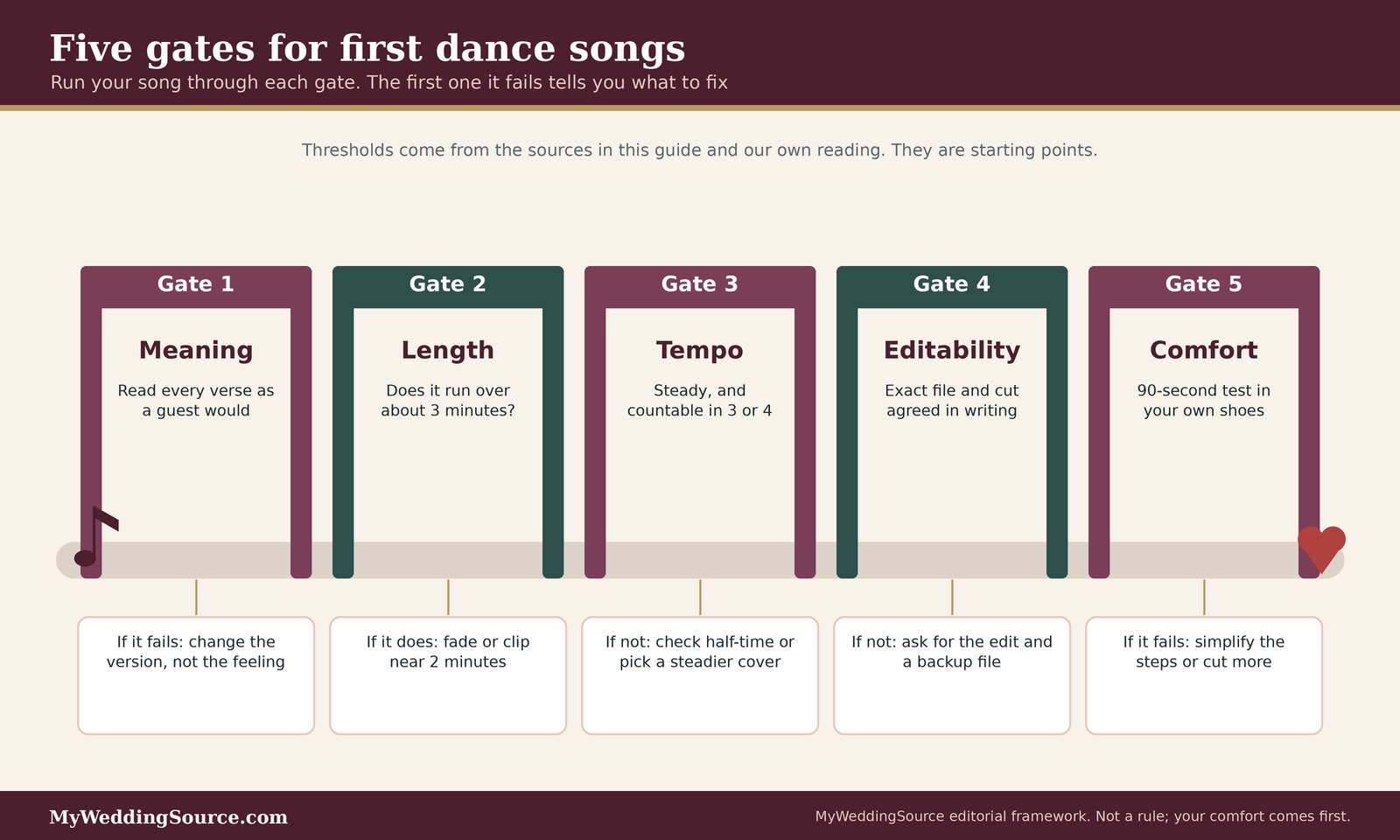
Pick the song that means the most to you, then test it against four practical filters, which is how most first dance songs get sorted into workable and not workable. Length: published guides range from 60 seconds to about 4 minutes, and many recommend trimming the original. Tempo: you want a steady beat you can count, not just a slow one. Editability: ask your DJ or band for the exact cut before you commit. Dance comfort: match the song to the amount of dancing you are willing to practice. If a song fails the filters, change the version or the edit before you change the song.
Most advice about first dance songs is a list of titles. Lists are fine for browsing, but they do not help when you have already fallen for a song that runs five minutes, speeds up in the second verse, or has a line your grandmother will not enjoy. This guide works the other way around. It starts with the song you are drawn to and gives you a way to test it, adjust it, and hand it to the people who will play it.
Everything we say about first dance songs here is a planning aid, not a rule. The numbers come from published planner and studio guidance, which we attribute by name, and from simple arithmetic we label as our own. Nobody has published a controlled study of how long a first dance should be, so where sources disagree, we show the disagreement instead of picking a winner.
If you are still building the evening around the dance, our wedding reception guide covers the schedule, the DJ and band decision, and where the first dance sits among the other blocks. This article stays with the song.
What a first dance song has to do, and why first dance songs are hard to pick
First dance songs carry more jobs than any other track at a wedding. It is a private memory played in public, a piece of music a room full of people will sit through, and a physical task you perform in front of them, usually in formal clothes and unfamiliar shoes. Songs that are wonderful in a car are not always wonderful in all three of those roles at once, which is why first dance songs deserve a test of their own.
The Knot’s 2026 Real Weddings Study, which surveyed 10,474 U.S. couples married in 2025, reports that 87 percent of couples open the reception with a first dance. That makes it one of the most common moments in the evening. The respondents were recruited through The Knot and WeddingWire, so the figure describes couples who use those services, not every couple in the country. It still tells you the dance is expected by most guests, which raises the stakes for a decision that most people make only once.
The inputs that change the answer
Not every couple needs the same song, and first dance songs that work for one wedding can fail at the next. The same track can be a good choice for one wedding and a poor one for another, because the inputs around it differ. Before you compare any titles, write down the inputs, because they set the limits the song has to fit inside.
Guest count, venue, budget, relationships, and timing
Start with the room, because the room changes which first dance songs make sense. A first dance for 40 guests in a backyard is a different event from one for 150 guests in a hotel ballroom. In a small space, guests see your faces and hear the lyrics clearly, and a quiet, intimate song can work well. In a large ballroom, a very quiet song can get lost in room noise, and a long one asks a lot of attention from people sitting a long way from the floor. The Knot reports an average guest count of 117 in its 2026 study, which gives you a rough sense of what “typical” looks like, but your own guest list is the only number that matters here.
Then look at the sound setup. A DJ or band brings speakers, a mixing board, and someone who can cut a track on request. A phone and a rented speaker, which many small weddings use, can play a file well but cannot easily fade, restart, or trim live. Budget enters here too: The Knot’s cost page reports average spending of about $1,800 for a wedding DJ and $4,500 for a live band in the same study, and lists custom song arrangements for bands as one factor that can raise a band’s price. Whether your song needs an arrangement or just a trim changes what you should ask for.
Finally, think about relationships and timing. Are there family members who will read meaning into a lyric? Does the dance come right after your entrance, when guests are seated and waiting, or after dinner, or at the end of the night? The timing changes how long the song can run before it feels like an interruption, and we return to that below.
Hard constraints versus social pressure
Separate what you cannot change from what you only feel you must do. Hard constraints are things like a venue sound system that cannot play from a streaming app, a band that cannot learn a new song in time, a knee that will not bear a spin, or a venue contract that ends music at a set hour. Those deserve respect and early questions.
Social pressure is softer. You might feel that a first dance must be a slow ballad, that it must last the full song, that it must be choreographed, or that it must be on everyone’s list of popular songs. None of those are requirements. The Knot’s own advice says that two to three minutes can feel much longer once you are standing on the floor, and that a song can be danced in part. Writing the pressures down next to the constraints makes it easier to see which ones you can let go of without losing anything that matters to you.
The hidden effects of the choice
The song is a single decision, but it pushes work and risk onto other people. Naming those effects early keeps the choice from turning into a scramble in the last week.
What the song changes downstream
Whichever of the first dance songs you pick, it sets off several smaller jobs. Your DJ or band needs the exact recording or arrangement, and a cut if you want one. Your photographer needs to know when the dance happens and whether you plan any dips, spins, or a kiss, since The Knot suggests telling the photographer about planned poses ahead of time. Our wedding photographer shot list shows how to give your photographer a short list of moments, and the dance belongs on it.
The song also affects the video. If a videographer will edit your wedding film, the music in that film raises licensing questions that we cover in a later section. And if you plan to rehearse, the song decides how many practice sessions you need, which is a question of time and money rather than taste.
A less obvious effect is on your clothing. A long skirt, a stiff train, or a new pair of shoes changes how you can move. If you are planning alterations, our wedding dress alterations guide explains hem length and bustles, and it is worth asking your seamstress to check the dress against the dance before the final fitting.
Fairness, workload, and guest experience
First dance songs also land on the people watching. Guests have usually been through a ceremony, cocktail hour, and a wait before the entrance. A song that is too long, too quiet, or too inside-joke-heavy can leave them politely waiting. The Knot’s advice on music mistakes notes that a one-sided playlist can keep older guests off the floor and that explicit lyrics can push parents to pull children away from the dance floor, and the first dance is the one track every guest hears, so first dance songs get more scrutiny than any other music of the night.
Workload is a fairness question inside the couple, too. If one partner loves dancing and the other dreads it, the song and the amount of rehearsal are a negotiation. Agreeing on how much choreography each of you is willing to learn, before you pick the song, keeps one person from carrying the preparation and the other from carrying the nerves. Our wedding planning stress guide has more on dividing planning tasks without resentment.
How long first dance songs should run, and how to shorten them
Length is the filter that most often rejects a favorite among first dance songs. Many love songs run four or five minutes, according to one event company’s guidance, and a dance that long is a lot to ask of two people on an open floor with an audience. The good news is that length is also the easiest filter to fix, because a song can be shortened without being replaced.
What published guides say about length
Published guides to first dance songs do not agree on a number, and none of them cites research. The most useful way to read them is as a spread of professional habits, which you can place your own comfort inside.
The ranges, side by side
The Knot’s guidance on when to hold the first dance says 60 to 90 seconds is the sweet spot, and its list of cover songs repeats that 60 to 90 seconds is usually ideal, which often means using only part of a song. A separate Knot piece on first dance tips gives a wider window of about 2 to 4.5 minutes, with 2 to 3 minutes as the sweet spot, and says a DJ or band can cut a song that runs past 3 minutes. WeddingWire’s tips call about three minutes a sweet spot and suggest more than a minute and under four. One wedding-event company says most songs run 3 to 4 minutes and suggests a fade for anything longer. A ballroom studio recommends under 3 minutes, and notes that learning choreography for a full four- or five-minute song takes many rehearsals. A wedding-music site says DJs often prepare edits of about 90 seconds to 2 minutes.

Read together, the sources on first dance songs overlap between about 90 seconds and 3 minutes. That overlap is our own reading, not a finding, but it is a practical range to plan inside. Anything shorter than a minute can feel abrupt, and anything past four minutes needs a plan for guests.
Why the ranges differ
The ranges differ because the advisers have different jobs. A photographer or planner thinks about attention and schedule, so they favor shorter. A dance studio thinks about how many lessons it takes, so it also favors shorter, and it has a reason to mention choreography. A DJ thinks about energy at the next moment, which is the open dance floor. A couple who loves to dance may be happy at three or four minutes.
There is also a difference between how long a song feels to listen to and how long it feels to perform. The Knot’s article quotes a planner who says two to three minutes feels much longer once you are on the floor, and another who suggests about three minutes if you are confident and 90 seconds if you are more reserved. That is the most useful single idea in the length debate: choose your length by your own comfort, not by the average.
Editing without losing the meaning
A shortened version of one of your first dance songs only works if the cut keeps the part that mattered to you. Before you ask for an edit, decide which line, chorus, or instrumental moment you cannot lose.
Fade, clip, or custom edit
There are three common ways to shorten a track, and they ask different things of your DJ or band. A fade-out lets the full song play from the start and fades at a set time, for example around 2.5 minutes. One wedding-event guide suggests it as a clean way to fit the timeline. A clip starts or ends in the middle, for instance starting at the first chorus. The Knot says you can dance to a section of a longer song and ask your DJ to build a custom clip of your favorite parts. A custom edit removes a middle section, such as a long bridge or a repeated verse, and joins the rest so the song still sounds finished. One dance studio says it offers professional edits that cut sections like the middle bridge, and the cost of that kind of service is a question for your vendor.
Our view is that a fade is the safest default, because it needs no editing skill and can be done live. A custom edit gives the best result when the song has a clear structure, but it needs time and a listen before the day.
Approving the edit before the day
An edit you have not heard is a risk. Ask the DJ or editor to send the finished file, and listen to it on speakers, not just headphones, to hear whether the cuts are clean. Check that the beginning gives you a moment to settle into position, that the ending lands on a musical resting point, and that the volume matches the rest of the set.
Then decide who plays it. If your DJ is bringing the file, ask whether it is in the show software or only on a laptop. If a band is playing live, ask whether the band will play the edit or its own arrangement, and get the answer in writing. The Knot’s list of music mistakes warns that a DJ may play a remix or cover instead of the original, so confirm the version too. We come back to that in the section on versions.
Tempo and dance comfort: matching the song to your feet
A song can have the right meaning and the right length and still be hard to dance to. For first dance songs, tempo and meter decide whether you can find the beat, and your dance comfort decides whether you can enjoy it. These are separate from taste.
Reading tempo and meter
Tempo is how fast the beat moves, usually measured in beats per minute, or BPM. Meter is how the beats group, most often into threes or fours. Both are things you can check, and checking them early prevents a rehearsal where the song feels wrong and you do not know why.
BPM, half-time, and tap tempo
One wedding-music site’s FAQ says most first dances fall between roughly 65 and 95 BPM, which gives a rough tempo window for first dance songs. Treat that as a general guide from one source rather than a rule. A ballroom resource’s tempo chart lists a waltz at about 84 to 90 BPM, international rumba at about 88 to 108 BPM, and bolero at about 92 to 104 BPM, with foxtrot faster at about 120 to 136 BPM. It describes nightclub two-step as about 72 to 80 BPM by formula, and notes that other social references list slower numbers.
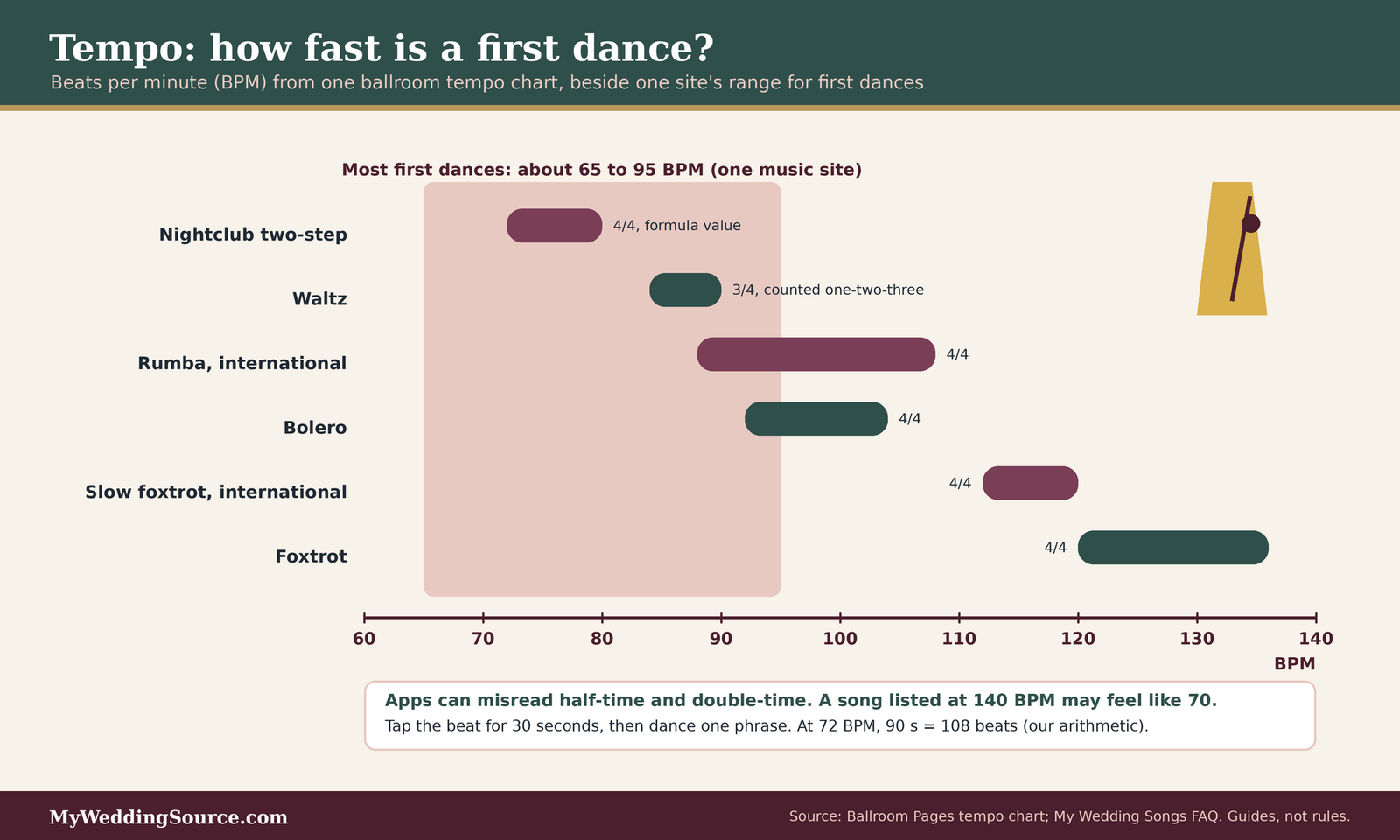
That chart also warns that music apps can misread a song’s pulse and report half or double the real speed. A slow ballad that an app labels 140 BPM may feel like 70. Tap along with a timer for 30 seconds, or use a tap-tempo tool, and check by dancing a short phrase. A site that lists BPM can give you a first number, but your ears and feet decide.
Our own arithmetic shows why tempo matters when you cut first dance songs to length. At 72 beats per minute, a 90-second dance is 108 beats, and a 3-minute dance is 216 beats. In 4/4 time that is 27 and 54 measures. That is an estimate from simple multiplication, but it gives you something to count against when you plan steps.
Three or four beats to the measure
Meter changes the feel. A waltz is counted in three, as one-two-three, and most other romantic dances you will see at weddings are counted in four. A ballroom guide lists waltz as 3/4 and rumba, foxtrot, nightclub two-step, and swing as 4/4. It suggests counting one-two-three against the song, and if that repeats cleanly, a waltz may fit. If the count fits one-two-three-four, a four-beat style does.
If a song changes meter or tempo partway through, it is harder to dance. The Knot says tempo changes are fine if you have time to practice, but that couples short on time should choose a steady beat. A ballroom resource adds that if a song is hard to count or changes tempo, a simple slow-dance structure or a shorter edit is a sensible option. Both are consistent with the idea that fewer surprises in the music make a calmer dance.
How much dancing the song asks of you
Once the tempo and meter of your first dance songs are clear, the question is what you will do on the floor. This is where many couples overbuild, then feel the strain.
Sway, simple steps, or choreography
Zola lists levels of effort and the number of lessons it associates with each. It suggests one to three lessons for basic steps and comfort, two to five to add a few fancier moves like turns and dips, three to eight to add an entrance and ending pose, and 10 to 20 for a fully choreographed number. Those are the publication’s ranges, not guarantees, and your own experience will change them.
The Knot advises keeping choreography simple with beginner-friendly moves, focusing on moving together instead of hitting every beat, and saving flair, such as a spin or a dip, for obvious musical changes like the start of a chorus. It also warns against copying social-media dance videos, since many feature professional dancers. A gentle sway with an eye on each other is a legitimate first dance, and a song with a steady medium beat makes it easy.
Floors, shoes, and clothing
The surface and the clothing can change what is comfortable. A lawn, a sand floor, or a patterned rug moves differently from a wood dance floor. If your venue is outdoors, our garden wedding venues guide covers the ground conditions to ask about. A long skirt, a high heel, or a new pair of dress shoes can make a spin tricky.
Rehearse in the shoes and the outfit, or as close as you can get. The Knot advises scheduling a rehearsal in the reception space, arranged through your planner and venue, if you plan a complex routine, and having someone film it. For a simple sway, a few practice runs in your living room, in the shoes, are usually enough to find out whether the song’s tempo suits your movement.
Lyrics, versions, and covers: the meaning test
Meaning is the filter that only you can run on first dance songs, and it is the reason to pick a song at all. It also has two practical edges: the words that will be heard by every guest, and the exact recording that will actually play.
Reading the lyrics as a guest would
You know why the song matters to you. Your guests may not, and they will hear every line over a quiet room. Reading the lyrics as an outsider takes ten minutes and prevents most lyric regrets.
Read every verse, not just the chorus
Many of the first dance songs people love open with a warm chorus and then turn sad, jealous, or suggestive in a verse you have not listened to in years. Print or pull up the full lyrics and read them slowly. One planner guide suggests avoiding lyrics that are too sad or too risqué, and WeddingWire’s tips give a risqué song title as an example of a poor fit. Flag any line you would not want to explain to your grandparents.
The Knot suggests using the lyrics as a source of dance ideas. A dip can suit a line about falling in love, and stepping closer can suit a line about being held. Lyrics, in other words, are also a choreography guide, so read them for what they might ask you to do as well as what they say.
A mixed-age room and the song’s reputation
Think about who will be watching. The Knot’s music-mistakes advice says explicit songs are better saved for later in the night, since parents may pull children off the floor over inappropriate words. A first dance is the one song every generation hears, so a song with mild language is a safer choice than one with a loud chorus that you love in a car.
Reputation matters a little too, even for first dance songs that are not on any popular list. If a song is closely tied to a famous film scene or a breakup, some guests will think of that instead of you. That is not a reason to drop a meaningful song, but it may help you decide whether to use a different version, discussed next. The Knot’s 2025 study release lists “Can’t Help Falling in Love,” “Joy of My Life,” “Life With You,” “At Last,” and “Lover” as the most popular first dance songs, but that tells you what others pick, not what suits you. The release does not say which group of couples the ranking is drawn from.
Choosing the exact version
“The song” is not one thing, and first dance songs are no exception. A song can exist as the original studio recording, a live version, a remix, a cover, and an instrumental, and each has a different length, tempo, and feel.
Originals, covers, and instrumentals
A cover can fix a problem without giving up the song, and covers are a common way to rework first dance songs. WeddingWire’s tips suggest a slower, acoustic cover of a faster song as a way to get a danceable tempo, and The Knot’s list of first dance cover songs includes slower, softer rearrangements of upbeat songs. An instrumental or string version can suit couples who love a melody but do not want its lyrics, and WeddingWire notes that a band can play a pop song instrumentally to make it more suitable.
Each option has a trade-off. A cover may lack the thing that made the original meaningful, and an instrumental removes the words. The question to ask is whether the meaning lives in the lyrics, in the melody, or in the specific recording you remember. If it is the recording, a cover will feel like a substitute, and an edit of the original is the better choice.
Send the exact link
The Knot’s list of music mistakes includes the risk that a DJ plays the wrong version, such as a remix or a cover, and advises couples to share a link or the title and artist with their entertainer. Do that. Send the specific link or file, the title, the artist, and the album or year, and listen to the DJ’s copy before the wedding to confirm it is the same recording.
Also note which version has the tempo and length you tested. If you rehearsed to a radio edit and the DJ plays the album version, your edit points move. A short email that says, “Please use this exact recording, edited at these timestamps,” saves a lot of confusion on the day.
Compare viable options against the same criteria for first dance songs
By now you have a shortlist of first dance songs, or a single favorite, and five filters. This section puts the options side by side so you can see where each one is strong, where it is weak, and where two options tie. The comparisons are our editorial judgment, not measurements, so treat them as a way to organize your thinking.
Score the options with transparent assumptions
A decision matrix is useful only when you can see the assumptions behind the ratings. Ours are plain: the ratings describe a typical case, a “strong” rating means the option usually helps with that filter, and “varies” means it depends on the song, the vendor, or your skills.
Ranges and qualitative thresholds, not fake precision
We have not given the options for first dance songs numeric scores, because no published data supports precise numbers, and a score of 7.5 would suggest accuracy we do not have. Instead the table uses strong, medium, and varies, plus a plain note on what could change the rating.
| Option | Meaning | Length control | Tempo certainty | Editability | Dance comfort | Main trade-off |
|---|---|---|---|---|---|---|
| Original recording, played in full | Strong | Low | Fixed by the song | None | Varies with the song | Long songs ask a lot of attention |
| Original with a fade or clip | Strong | Medium to high | Fixed by the song | Easy, can be done live | Varies | Fade must be agreed with the DJ |
| Custom edit of the original | Strong | High | Fixed by the song | Needs editing time and a listen | Good if cuts follow the beat | Cost and lead time are vendor-specific |
| Cover or acoustic version | Medium, depends on what you love | Varies | Often slower or steadier | Varies by version | Often good | May lose the recording you remember |
| Instrumental version | Medium, melody only | Varies | Varies | Varies | Often good | Removes the lyrics |
| Live performance by a friend or band | Strong if personal | High, set by the musicians | Set by the musicians | Needs rehearsal with them | Can adapt to you | Needs coordination and a sound check |
How to read the table
Read across a row for one option and down a column for one filter. If length control is your problem, the fade, clip, custom edit, and live performance rows help most. If tempo is the problem, a cover or a live arrangement can change the speed in a way an edit of the original cannot. If meaning is the problem, the original rows keep the most.
Notice that no row for first dance songs is strong on everything. Choosing first dance songs is always a trade between what you love and what is easy to dance to, and the matrix makes the trade visible.
Where two options tie
Some options tie. A fade and a custom edit both fix length. A cover and an instrumental both change the feel of first dance songs. When two options tie on the filters you care about, break the tie with something outside the table: the lead time you have, the cost the vendor quotes, or the person who will actually be at the soundboard.
If your DJ can do a clean fade live but a custom edit needs a week and an extra fee, the fade wins on practicality when the song has a natural stopping point. If the song has a long instrumental middle you cannot stand, the edit wins. A tie is a sign that either choice will work, and it is a good moment to stop deliberating.
Test the options with contrasting weddings
A rule about first dance songs is easier to trust when you can see it flip. These scenarios are invented for illustration, with labeled assumptions, and they are not case studies.
A small, simple case and a large, complex one
The first scenario is a 40-guest backyard wedding with a phone and a rented speaker, a couple who dislike being watched, and a favorite song that runs 4 minutes 40 seconds. A file trimmed in advance to about 90 seconds, played from a playlist, suits the setup, since a phone cannot fade live. Our micro wedding planning guide and small wedding planning guide cover planning at that scale.
The second scenario is a 150-guest ballroom reception with a four-piece band, a couple who enjoy dancing, and a favorite song with a key change. A full-length or lightly trimmed version, with guests invited onto the floor partway through, may fit, if the band can play the song and the couple can rehearse the key change. A band’s arrangement may cost extra, so ask before you assume.
| Scenario (illustrative) | Assumptions | Suggested approach | Threshold that flips it |
|---|---|---|---|
| Backyard wedding, 40 guests | Phone and speaker, no DJ, couple dislikes an audience, song runs 4:40 | Pre-trimmed file of about 90 seconds to 2 minutes | A friend with a live sound setup could allow a live fade |
| Ballroom, 150 guests, band | Four-piece band, couple enjoys dancing, song has a key change | Light trim, guests invited to join partway | Band cannot play the song or the key change, so switch to a recorded edit |
| Choreographed first dance | Couple wants an entrance, spins, and an ending pose | Custom edit at about 2 to 3 minutes, rehearsed in the room | Fewer than a few lessons available, so simplify to steps and a sway |
| Long song with meaningful lyrics | Song runs 6 minutes, lyrics matter most | Clip the chorus and final verse, or a fade at the point the lyrics land | If no clean cut exists, dance to a cover with the same lyrics |
| Limited mobility or standing stamina | One partner tires quickly or needs support | Short edit, steady slow tempo, seated or supported movement | Comfort and safety override any length guideline |
Why the preferred option changes
The preferred option changes because the binding constraint changes. In the backyard case, the constraint is equipment: a phone cannot fade live, so the edit has to be done in advance. In the ballroom case, the constraint is the band’s repertoire, which is a conversation with the bandleader. In the choreography case, the constraint is practice time, and in the long-song case, it is a cut that keeps the meaning.
The scenario with limited mobility shows a different kind of flip. There, no table, planner guide, or average should outrank what your body can do comfortably. If standing for a long time is hard, choose a shorter song, a steadier tempo, and movement that can be done seated or with support, and tell your DJ and photographer the plan. A first dance does not have to look a certain way to count.
Rights, recordings, and sharing the video
Music rights are the least romantic part of picking first dance songs, and the part couples are least likely to hear about until a video gets flagged. This section is general information, not legal advice, and sources disagree on some points, so confirm the specifics for your venue and your vendors.
Playing the song at the reception
Playing a recording at a venue is a public performance in the legal sense, but who has to pay for it, if anyone, depends on the venue, the vendors, and the event.
Venue licenses and rights organizations
U.S. copyright law gives the owner of a musical work the exclusive right to perform it publicly, as the U.S. Copyright Office’s text of Section 106 explains, and Section 110 lists some narrow exceptions. In practice, music in the U.S. is licensed through performing rights organizations such as ASCAP, BMI, and SESAC. One event-production company writes that a venue usually holds blanket licenses with those organizations, and that the owner or operator of a rented space is typically the party responsible for authorizing music played there. It adds that some venues pass that responsibility to private-event clients.
Sources do not fully agree. A meeting-industry association article says events held within a family circle do not require payment, and the event-production company’s piece quotes an ASCAP representative saying a private event such as a wedding reception does not need a license. The same piece does not resolve how that fits with the venue practice it describes. The sensible response is a question, not an assumption: ask your venue whether its music licenses cover your reception, and get the answer in writing.
What your DJ or band can and cannot cover
A DJ or band does not automatically supply a license for the songs they play. The event-production company says a performer generally cannot provide a license that covers cover songs, and that licensing is only a client issue if the venue passes it down. For a wedding with a professional DJ or band, the usual practice is that the venue or the vendor’s own arrangements handle it, but practices differ.
Ask two short questions of the vendor about first dance songs and everything else they play: do you carry your own performance licenses, and does your contract make me responsible for any music licensing? If the answer to the second is yes, ask the venue before signing. A first dance is one song in a long evening, so this is a contract question about the whole event more than about your dance.
Posting the dance
Even when playing the song at the reception is straightforward, posting video of it is a separate matter. Rights for a recording at a live event differ from rights for a recording shared online.
Your videographer and licensed soundtracks
A Philadelphia magazine article quotes a local videographer saying most music cannot be used legally in a wedding video, and that unlicensed songs are fine for private viewing at home but can cause problems once a video is shared publicly or used commercially. The studio in that article licenses music for clients through a licensing service and selects the songs itself, and says that when a song cannot be licensed, most clients choose another one.
If you hire a videographer, ask how they handle music in the finished film. Ask whether the first dance song in the film is the one you danced to or a licensed substitute, and whether the licensed track can be shared online. If you want the real song in the edit, ask whether it can be licensed at all, and what that adds to the quote.
Platform claims on social media
When you post a video yourself, the platform may match the audio to a copyrighted recording. YouTube’s help pages explain that when its Content ID system finds a match, the rights holder can block the video, earn money from it through ads, or track its viewing statistics, and the options can vary by country or region. The help page does not list muting as a rights-holder option, but notes that creators can mute claimed audio to remove a claim.
This is a risk, not a certainty, and it differs by platform. If you plan to share your first dance widely, upload a private or unlisted copy first and see what the platform says, or ask your videographer for a version with a licensed track. If it is only for family, a private link is the simpler path. Either way, treat the video’s audio as a separate decision from the dance itself.
What first dance songs cost, and a working timeline
Choosing among first dance songs costs nothing. Making it work costs time and sometimes money, and it helps to know which parts are optional before you commit to them.
What this actually costs
The song is usually free to choose, but the preparation is where money enters. Zola reports professional dance lessons at about $50 to $100 or more per hour, so our estimate for one-hour private lessons is roughly $150 to $300 for three lessons and $500 to $2,000 for 10 to 20. Group lessons cost less. A DJ or band may charge for a custom edit or arrangement, so ask. These are planning estimates, not quotes.
Lessons, edits, and music costs
The three costs that can attach to first dance songs are lessons, an edit or arrangement, and the music vendor’s time. Not every couple needs all three.
Lessons
Zola gives the ranges of lessons by goal that we described above, a professional hourly rate of about $50 to $100 or more, and a higher range of $80 to $200 in New York City. It also says group lessons are usually cheaper than private ones, that some studios discount packages, and that practicing at home for 20 to 30 minutes a couple of times a week can reduce the number of paid lessons you need.
Our arithmetic, which is an estimate and assumes one-hour private lessons at the low end of that range, gives $150 for three lessons and $1,000 for 20 at $50 each, rising to $300 and $2,000 at $100. Those are before tax and any package discount. For a gentle sway with a steady song, one to three lessons may be enough, and that is the cheapest path to a comfortable dance.
Music vendors and edits
The Knot’s cost page reports average spending of $1,800 for a DJ and $4,500 for a band in its 2026 study of couples married in 2025, with prices varying by region, guest count, and hours. It lists custom song arrangements for bands as a price factor. The page does not give a price for editing a single song, so we cannot tell you what an edit costs. Many DJs may include a simple edit in their service. Ask whether it is included, whether there is a limit on revisions, and when you need to submit the song.
If you want a professional edit from a dance studio or an audio editor, ask for a quote with the delivery date, the file format, and the number of revisions, and compare that with the DJ’s price. Our average wedding cost guide and wedding budget calculator help you place any of these costs in the full budget.
A working timeline
Planning first dance songs does not need a long runway, but it benefits from a plan. Zola says most dance studios recommend starting lessons at least three months before the wedding, and The Knot says couples who start early look the most comfortable. The timeline below is our suggestion built on those two points, and you can compress it for a simple sway.
From song choice to the final week
Four to six months out, choose a shortlist of first dance songs of two or three songs, run each through the five filters, and talk to your DJ or band about what they can do. Three months out, confirm the song, the version, and the edit plan, book lessons if you want them, and add the dance to your overall schedule. Our wedding planning timeline shows where this fits among the other planning tasks.
One to two months out, have the edit made or confirmed, listen to it on speakers, and rehearse in your shoes. In the final week, send the exact file or link and the timestamps to the DJ, band, photographer, and videographer, and run through the dance a few times without overdoing it. The dance should feel familiar, not rehearsed to exhaustion.
The last day and the moment itself
The day before, check that the file is where you said it would be and that the DJ has a backup copy. On the day, tell the person running the music exactly when the dance happens and who gives the cue. Our wedding reception guide explains how to assign owners to each block of the evening, and the dance should have one.
During the dance, focus on each other. The Knot suggests holding dips and leans for a second or two and letting spins unfold slowly, keeping eye contact and good posture, and not worrying much about footwork. If a step goes wrong, keep swaying. Guests are watching two people who are married, not judging a performance.
Turn the analysis into a rule for first dance songs
You do not need to remember every section above about first dance songs. You need a rule you can apply to the song you have, and a short list of people to talk to.
The threshold that should drive the choice
Most of the filters for first dance songs are soft, but one of them should lead: the one the song fails. Run the song through the five filters and find the first failure. That failure sets the next action.
A default when uncertainty remains
If you are unsure which of your first dance songs to use, start from the one with the strongest meaning, keep the original recording, and plan a fade or clip at about two minutes. That sits inside the overlap in published guidance, between about 90 seconds and 3 minutes, and it is the easiest to fix on the day. Check that the tempo is steady and can be counted in threes or fours, and that you can dance a simple sway to it without strain.
If the song is longer than about three minutes, plan an edit or a fade, since several guides recommend one. If a tempo check lands far outside the 65 to 95 BPM range that one source describes as common, listen again for half-time and double-time, and test whether the speed feels comfortable. If you cannot count the song or it changes tempo, use a shorter edit or choose a steadier version.
The exception that overrides the default
The default gives way when the meaning of the song depends on something the default would cut. If the lyrics land only in the final verse, fade after the final verse. If the meaning lives in a specific recording, do not substitute a cover. If you are dancing with limited mobility or stamina, comfort overrides every length and tempo figure in this guide.
Another exception involves first dance songs that are hard to dance to but easy to listen to. In that case, consider having the first dance to a different, steadier song and playing the meaningful one during dinner or as the entrance song. Nothing requires the song you love most to be the song you dance to, and separating those two jobs often solves the problem.
The next conversation
Once you have chosen among first dance songs and made a default plan, the remaining work is conversations. Four people usually need to know, and one or two need to agree.
Who must agree
You and your partner need to agree first, on the song, how much you will rehearse, and what each of you is comfortable doing. Then the person running the music, whether a DJ, a bandleader, or a friend with a laptop, needs to confirm what they can do with the version and the edit. Ask to speak to the person who will actually be at the soundboard on your wedding day, since The Knot warns that a booking agent and the day-of performer are not always the same person.
The photographer and videographer need to know the timing and any planned moves. If your venue controls the sound system or has music rules, someone there needs to confirm that the format and the volume are fine. If a family member is performing live, they need the song, the key, and a rehearsal.
The quote, measurement, or guest information to obtain
Gather a short list before you finalize anything. From the DJ or band, get the written confirmation that they will play the exact version, the edit, or the arrangement, plus any added fee. From the song itself, get the measured BPM, the meter, the full running time, and the timestamps of your cut. From the venue, get the sound-system format, the music hours, and any licensing language in the contract.
From your guests, get any information that changes the dance, such as a family member who needs seating near the floor or a child who might join. Keep the list in one document that you send to everyone on the same day, so the DJ, the photographer, and your partner are all working from the same page.
Questions to ask before you lock in first dance songs
Good questions about first dance songs turn a vague plan into something a vendor can confirm. Ask for the answers in writing, and keep them with your contract.
Questions worth asking before you decide
- Can you play this exact recording or edit, and in what file format?
- Can you fade or cut the song live, or does the edit have to be finished in advance?
- Is there a fee for a custom edit or arrangement, and what is the deadline?
- Who will be at the soundboard on the wedding day, and can I speak with them?
- Does the venue’s music license cover our reception, and does our contract shift any music-licensing duty to us?
- If the wedding is filmed, can the real song be licensed for the video, and can the film be shared online?
Questions for the music vendor
These questions about first dance songs deal with the version, the edit, and the cue. They protect you from a surprise remix or a missed fade.
Version, edit, and cue
Ask which file the DJ will use and whether it is in the show software or on a laptop. Ask what happens if the song does not load, and whether there is a backup. Ask who gives the cue to start and who fades or stops the song, and make sure that person has the timestamps in writing.
Equipment and sound check
Ask whether the first dance is part of the sound check, since a quiet song can show up problems that a loud one hides, such as hum, uneven volume, or a microphone that picks up the speakers. If you will be dancing outdoors, ask how the speakers are positioned relative to the floor.
Questions for the venue and the videographer
These two parties control the room and the record of it. A few questions now avoid a conflict later.
Venue music rules and licensing
Ask for the venue’s music policy, including cutoff time, volume limits, and any licensing language. Ask whether guests can see the floor from the dining area, whether the dance floor surface suits your shoes, and whether you can rehearse in the room before the day. Our wedding etiquette guide can help if you are unsure how to raise any of this with family hosting part of the cost.
Video soundtrack and sharing
Ask how the videographer handles music, whether the first dance song in the film is licensed, and whether the finished film can be posted online without being muted or blocked. If the answer depends on a licensing service, ask what it adds to the price and whether you choose the song.
FAQ: first dance songs questions
Length and editing
How long should a first dance be?
Published guides vary. The Knot says 60 to 90 seconds is the sweet spot for the dance and also describes 2 to 3 minutes as ideal for the song, while WeddingWire says about three minutes. Our reading of the overlap is roughly 90 seconds to 3 minutes. Choose by your own comfort, and plan an edit if the song is longer.
Can the DJ shorten the song?
Usually, yes. The Knot says a DJ or band can help cut a song to the right length, and event companies describe fades, clips, and custom edits. Ask which method your DJ uses, whether it is included in the price, and when they need the request. Listen to the finished edit before the wedding.
Do we have to dance to the whole song?
No. The Knot says you can dance to a section of a longer song and ask the DJ for a custom clip of your favorite parts. Some DJs also invite guests onto the floor partway through, which keeps energy up and takes some pressure off the couple. Agree on this with your DJ in advance.
Tempo and comfort
What tempo is best for a first dance?
One wedding-music site says most first dances fall between roughly 65 and 95 BPM, and a ballroom resource lists waltz at about 84 to 90. Those are guides, not rules. A steady beat you can count matters more than the exact number, so test the song by dancing a short phrase.
Do we need dance lessons?
Not necessarily. Zola suggests one to three lessons for basic steps and comfort, and 10 to 20 for a fully choreographed number. The Knot recommends lessons even for people with some dance experience, since they build confidence. A simple sway to a steady song can be learned at home with a few practice sessions.
Meaning, versions, and rights
Can we use a cover or an instrumental version?
Yes. WeddingWire and The Knot both suggest covers, including slower acoustic ones, and WeddingWire notes instrumentals as an option. The trade-off is that a cover may lose the recording you remember. Send your DJ the exact link so they play the version you chose, not a remix.
Do we need a license to play our song at the reception?
Often the venue’s arrangements cover it, but sources disagree and practices vary. This is general information, not legal advice. Ask your venue and your DJ or band whether licenses are in place, and whether your contract assigns any licensing duty to you.
Can we post our first dance video online?
You can, but the song may be flagged. YouTube says a Content ID match can let the rights holder block the video, earn money from it, or track its statistics. A videographer quoted by Philadelphia magazine says unlicensed songs are fine for private viewing but can cause problems once shared publicly. Try a private link first.
Your next steps
Test your song
Run the five filters
Write down how each of your first dance songs scores: meaning, running time, tempo, edit options, and dance comfort in one line each. Find the first filter each one fails and decide whether to change the version, the edit, or the song. Our wedding planning checklist is a good place to add this task.
Dance a short phrase
Play the edit, put on your shoes, and dance for 90 seconds in your living room. If it feels natural, you have your song. If it does not, try a steadier version before you give up on the song.
Hand it off
Send one clear message
Send your DJ, band, photographer, and videographer the exact recording of your pick among first dance songs, the edit timestamps, the timing, and any planned moves in a single message. Our wedding planning guide can help you place that message in the wider schedule.
Keep the evening in view
Even your favorite among first dance songs is one block in a longer night. Use the wedding reception guide to decide where it sits, and if you are not sure about the order, plan your wedding from the fixed times backward.
For a closer look, read Holiday Wedding Travel and Hotel Blocks: How to Reduce Guest Costs.
Sources & methodology
How we built this guide
What we relied on
This guide combines planner and studio guidance from The Knot, Zola, and WeddingWire, a ballroom resource’s tempo chart, survey figures from The Knot’s 2026 Real Weddings Study, the text of U.S. copyright law, and articles on music licensing and wedding video. Where a statement comes from a company, a studio, or a planner, we say so, because their advice reflects how they work. The length overlap, the beat counts, and the lesson cost estimates are our own reading and arithmetic, and the scenarios are illustrations, not case studies.
What we did not do
We did not test songs, measure tempos, survey couples, or interview DJs. We found no published research on how long a first dance should be, so the length ranges are professional habits and not findings. We have not given legal, medical, or financial advice, and sources on music licensing disagree. Contracts, venue policies, and your own physical comfort vary, so confirm each point with the vendor, the venue, or a qualified professional.
Source list
Survey data, planner guidance, and government sources
- The Knot, First dance tips and back-pocket moves: https://www.theknot.com/content/first-dance-tips
- The Knot, When should we have our first dance: https://www.theknot.com/content/when-should-we-have-our-first-dance
- The Knot, First dance cover songs: https://www.theknot.com/content/first-dance-cover-songs
- The Knot, Top wedding music mistakes: https://www.theknot.com/content/top-9-wedding-music-mistakes
- The Knot, Real Weddings Study facts (2026 study, couples married in 2025): https://www.theknot.com/content/real-weddings-study-facts
- The Knot, Average cost of a wedding band and DJ: https://theknot.com/content/average-cost-wedding-band-dj
- The Knot Worldwide, 2025 Real Weddings Study press release: https://www.theknotww.com/press-releases/weddings-shine-bright-in-2025-the-knot-study-reveals-couples-prioritize-celebration-joy-and-connection-amid-socioeconomic-instability
- Zola, Should I take wedding dance lessons: https://zola.com/expert-advice/should-i-take-wedding-dance-lessons
- WeddingWire, Helpful tips for choosing a first dance song: https://www.weddingwire.com/wedding-ideas/8-helpful-tips-for-choosing-a-first-dance-song
- U.S. Copyright Office, Title 17, Chapter 1 (Sections 106 and 110): https://www.copyright.gov/title17/92chap1.html
Studio, vendor, and licensing sources
- Ballroom Pages, Ballroom music tempo chart: https://www.ballroompages.com/ballroom-music/tempo-chart/
- Ballroom Pages, What dance fits your song: https://www.ballroompages.com/wedding-dance/what-dance-fits-your-song/
- Bella Ballroom, Wedding dance questions answered: https://www.bellaballroom.com/wedding-dance-questions-answered/
- My Wedding Songs, First dance fun facts (by theme and BPM): https://www.myweddingsongs.com/weddingblog/first-dance-fun-facts
- My One of a Kind Event, How long should a first dance song be: https://www.myoneofakindevent.com/blog/how-long-should-a-first-dance-song-be/
- Mike Staff Productions, How long should our first dance be: https://intercom.help/mike-staff-productions/en/articles/2952596-how-long-should-our-first-dance-be
- Destination I Do, Guide to choosing a first dance song: https://destinationido.com/planning-and-advice/guide-to-choosing-a-first-dance-song
- Entire Productions, Licensing and paying for music performances for private events: https://entireproductions.com/blog/licensing-and-paying-for-music-performances-for-private-social-corporate-and-non-profit-events
- PCMA, Three key lessons for licensing music at your next event: https://www.pcma.org/3-key-lessons-for-licensing-music-at-your-next-event/
- Philadelphia Magazine, Why you and your videographer have to license the songs in your wedding video: https://phillymag.com/?p=2217011
- YouTube Help, Content ID: https://support.google.com/youtube/answer/6013276